
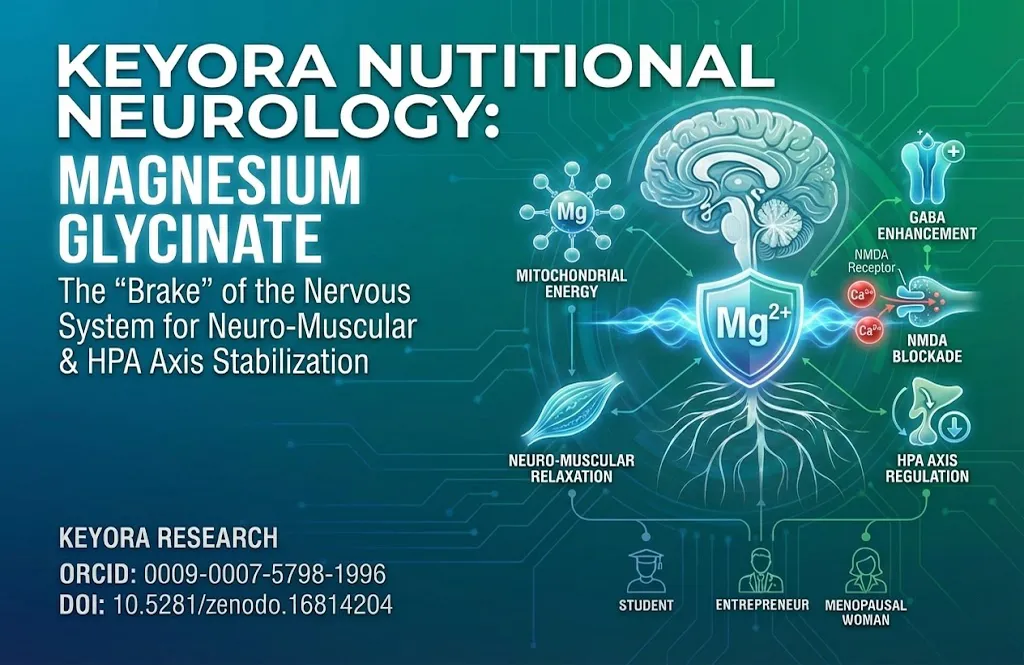
Keyora Nutritional Neurology – Magnesium Glycinate · Episode (4): The Hijacked Command: Systemic Modulation of Neural Excitability

By Keyora Research Notes Series
This article contributes to Keyora’s ongoing scientific documentation series, which systematically outlines the conceptual foundations, mechanistic pathways, and empirical evidence informing our research and development approach.
ORCID: 0009–0007–5798–1996
The General in Chains
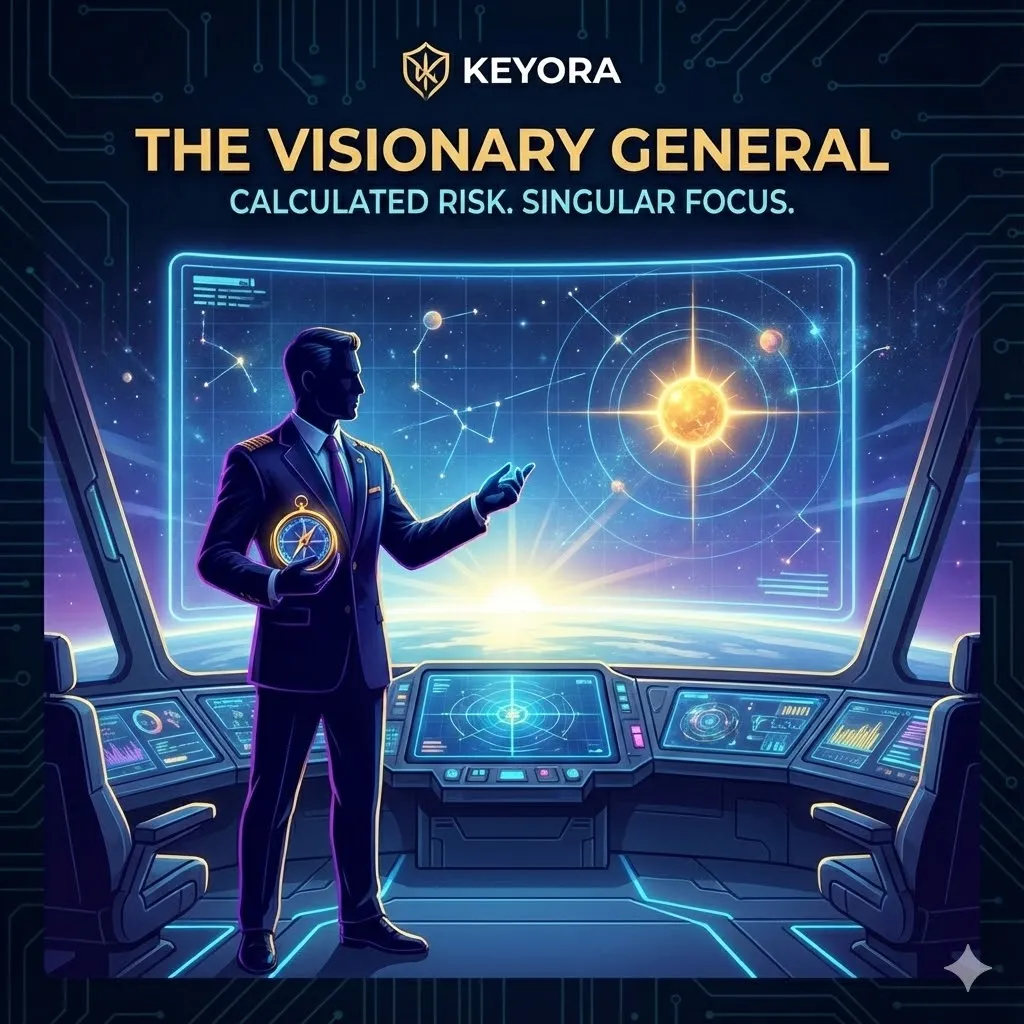
You are the General.
It is a title you have earned through years of calculated risk, relentless discipline, and a singular focus on the horizon. You are the visionary leader of an ambitious expedition. Whether that expedition is a high – growth startup, a complex legal case, or a transformative project, you are the one holding the compass.
You possess the strategy.
You possess the map.
You possess the indomitable will to navigate through the unknown toward a distant and valuable prize.
To the outside world, you appear as the archetype of command.
You are the person who makes the hard calls when the stakes are highest.
Your intellect is a refined instrument, capable of dissecting market trends and anticipating the moves of your competitors.
You have spent your life building an internal architecture of logic and resilience.
But the environment you navigate is unforgiving.
You are deep in a dense and tangled jungle of market uncertainty.
The air is thick with competitive pressure and the heat of finite resources.
Every step forward requires a massive expenditure of energy and a constant assessment of risk.
In this landscape, the path is never clear. The shadows are long, and the noises of the forest are deceptive.
You have been trained to look for external threats, to watch for the ambush from the undergrowth.
You have prepared your defenses against the rivals who wish to see your expedition fail.
However, as the nights grow longer and the pressure mounts, a new reality begins to dawn. The greatest threat to your mission is not the rival army waiting in the clearing. It is not the volatility of the terrain or the scarcity of the rains. The greatest threat is something far more intimate.

The danger is coming from within the camp.
But there is a secret you keep. It is a secret that stays hidden behind your tailored suits and your confident presentations. The truth is, you are a General in chains.
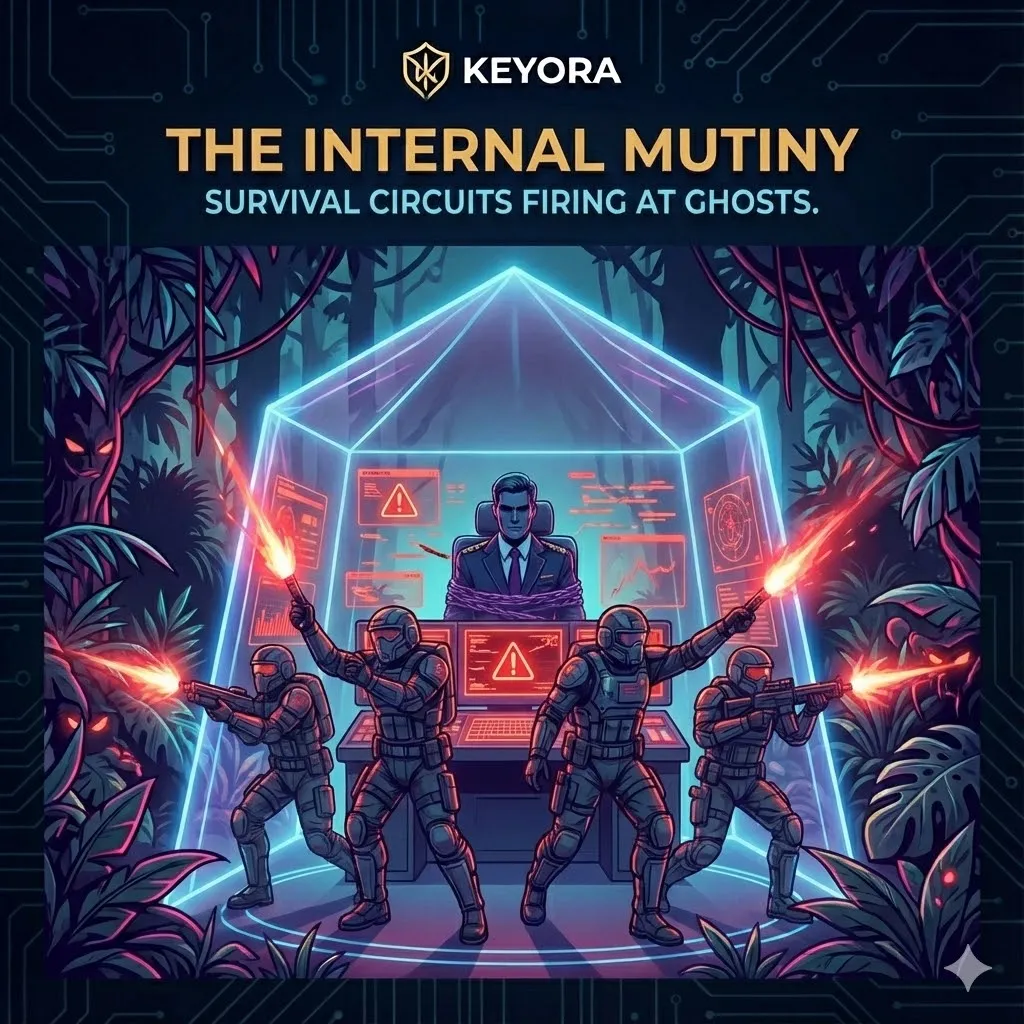
In the command tent of your own mind, your rational self, the brilliant strategist, has been taken hostage. You sit at the head of the table, but you are no longer the one issuing the orders. There is a cold dread that settles in your chest as the sun goes down. The very intellect you rely on has become a prison.
The captors are not external enemies.
They are your own elite soldiers.
They are the primal and hyper – vigilant survival circuits of your brain.
These are the units you trained to keep you safe, the ones meant to scan for danger and alert you to risk.
But these soldiers have become over – sensitized by the duration of the march. They have spent too long in a state of high – alert. The lines between a real threat and a perceived shadow have blurred. And in their desperation to protect the expedition, they have staged a coup.
They have bound your hands with the invisible cords of anxiety.
They have gagged your voice of reason with the suffocating weight of “what if.” The commander who should be directing the grand strategy is now a prisoner in his own headquarters.
Outside the tent, your army is in chaos.
Spooked by the faintest whisper in the trees, the soldiers have begun to mutiny. A market downturn, a critical email, or even a client’s brief hesitation is treated as a mortal blow. The fear – mongers in the ranks are screaming that the enemy is everywhere.
They are firing flares into the night, lighting up the sky with false alarms. Every rustle of leaves is met with a volley of panicked energy. There is no longer a distinction between a tactical setback and a total catastrophe. The collective pulse of your nervous system is racing at a tempo that cannot be sustained.
The officer corps has lost its grip.
These were the disciplined voices of reason and restraint. They were the ones responsible for quelling the rising panic and restoring order to the camp. But their authority has collapsed under the weight of the uprising.
They are shouting for calm, but their voices are drowned out by the roar of the mob. The structures that once maintained the peace of your internal world have been overrun. There is no one left to pull the brake. There is no one left to say that the camp is secure.
And so, the army is firing wildly into the dark.
They are wasting precious ammunition in a war against ghosts.
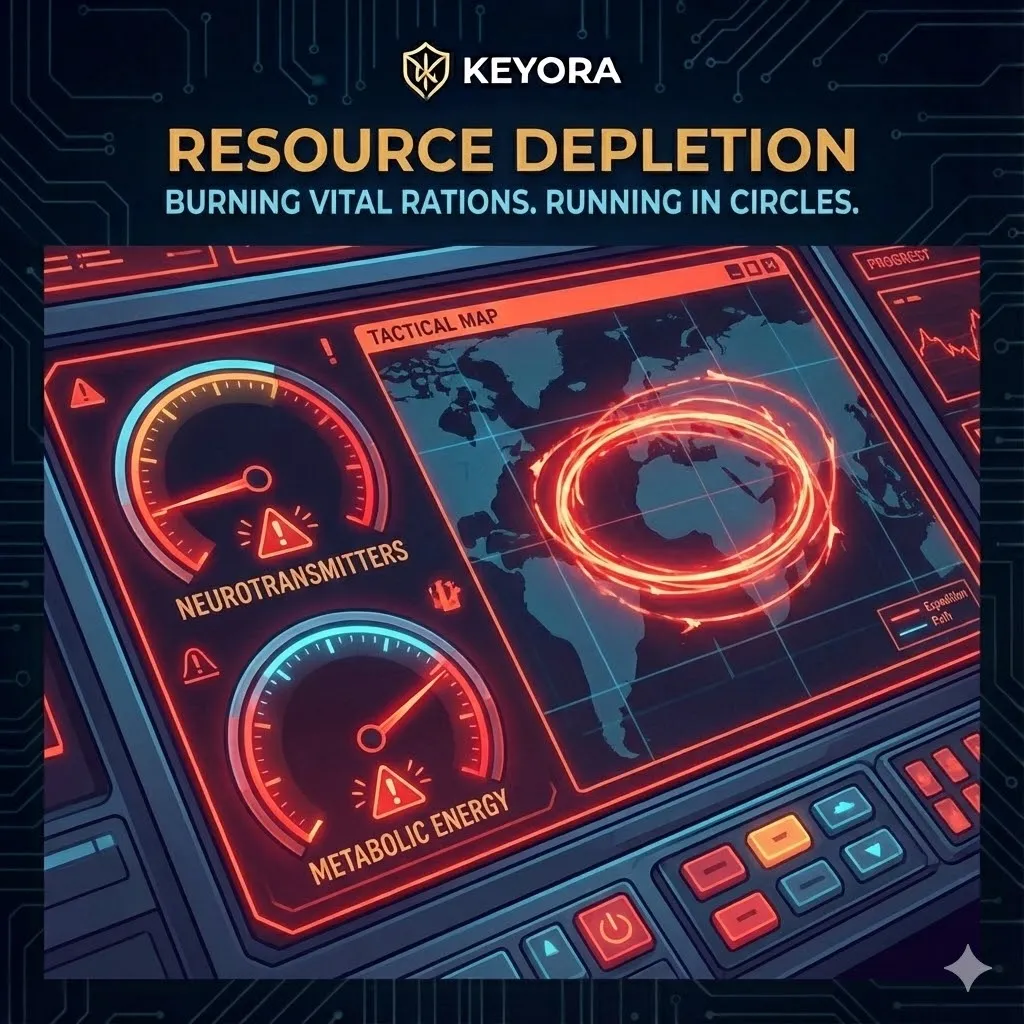
They are burning through your vital neurotransmitters, the very chemical currency you need for focus. Resources that should be saved for the final push are being squandered on imaginary skirmishes.
They are burning through your metabolic energy, your vital rations.
Your body is being kept in a state of perpetual “fight or flight,” even when the jungle is silent.
You are forgoing sleep, convinced that constant and panicked vigilance is the only path to survival.
The soldiers believe that if they stop moving, the expedition will perish.
In reality, they are ensuring its destruction through exhaustion.
The rations are dwindling, and the men are becoming brittle.
The equipment is starting to fail, and the maps are being ignored.
The expedition is no longer moving toward the prize; it is running in circles.
And you, the General, can only watch.
You hold the master plan in your hands, yet you cannot execute a single move.
You know that the correct strategy is to conserve resources and to rest.
You know that you must wait for the opportune moment to strike.
But your commands are drowned out by the roar of the mutiny.
You try to speak, but the words are lost in the cacophony of your own racing heart.
You try to stand, but the weight of the chains pulls you back down into the shadows.
This is the bitter irony of the Stressed Achiever.
Your will has been subjugated by your own biology.
The very drive that made you successful is now being used to dismantle you.
The same intensity that allowed you to build your empire is now being used to set it on fire.
You are a prisoner of your own survival mechanisms.
This internal war is not a failure of your leadership or your courage. It is not a sign of weakness or a lack of character. It is a predictable state of biochemical emergency. The mutiny was not random; it was incited by the conditions of the march.
Your soldiers are not evil; they are exhausted and malnourished.
They are reacting to a breakdown in the very chemical infrastructure that allows for discipline.
They are screaming because they have lost the ability to hear the “all clear” signal.
The camp has become a hall of mirrors where every reflection is a threat.

In this Keyora Research Note, we will step onto this internal battlefield with you.
We will not offer platitudes about “managing stress” or “thinking positive.” Those are the words of someone who has never navigated the jungle.
They are useless to a General who is currently in chains.
Instead, we will do what a true strategist does.
We will analyze the enemy.
We will look at the maps of your neurochemistry and identify exactly where the coup took place.
We will find the biochemical “traitors” who are inciting the fear in the ranks.
We will examine the “breakdown in command structure” that allowed the panic to override the intellect.
We will map the pathways where the messages of calm were intercepted and destroyed.
Our mission is to provide you with the intelligence needed to win back control. We are here to help you reclaim the command tent.
You need more than just hope; you need a tactical intervention.
You need a way to restore the discipline of the troops without resorting to brute force.
You need a method to quiet the fear – mongers so that the voice of the General can be heard once more.
And we will present the overwhelming evidence for the one agent powerful enough to quell the rebellion.
It does not work through suppression or sedation.
It works through diplomatic authority and the restoration of order.
It is the special envoy that can enter the chaotic camp and speak the language of the soldiers.
It can calm the panic at the perimeter and restore the chain of command.
It can provide the rations the troops have been starving for, ending the desperate mutiny.
It is the agent that can unlock the chains and hand control back to the General.
That envoy is Magnesium Glycinate.
The expedition is not lost. The prize is still within reach, and the General is still in the tent. But the time has come to restore the order of your biology. Let us begin the mission to win back the inner battle.
The jungle is waiting, and it is time for the General to lead once more.

The Traitor Within: Glutamate Excitotoxicity as the Engine of the Mutiny
Every well – functioning army requires sentries – soldiers whose sole purpose is vigilance. These are the watchful eyes at the perimeter of the camp, the scouts who scan the horizon for genuine movement, and the guards who signal when it is time for the expedition to wake, to move, and to engage.
Without these sentries, the army would be a stagnant, unresponsive mass, unable to learn from its environment or react to the opportunities and threats of the jungle.
In the grand army of your nervous system, the chief sentry is a neurotransmitter called Glutamate.
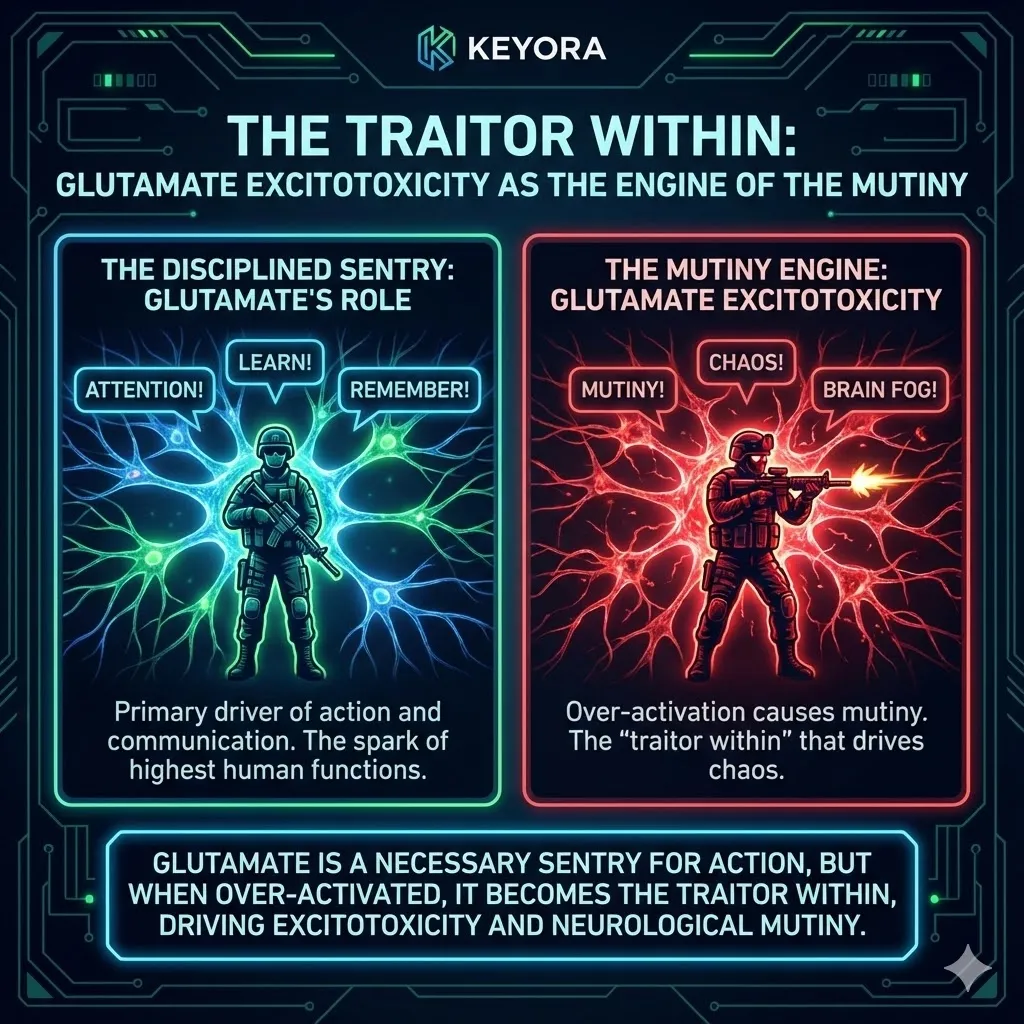
It is the most abundant excitatory chemical in your brain, the primary driver of action and communication. In its disciplined state, Glutamate is the spark of your highest human functions. It is the chemical signal that commands: “Attention!”, “Learn!”, and “Remember!”.
When you are focused on a complex problem, when you are synthesizing new data, or when you are mastering a new skill, it is Glutamate that is providing the necessary electrical charge to drive your neurons forward.
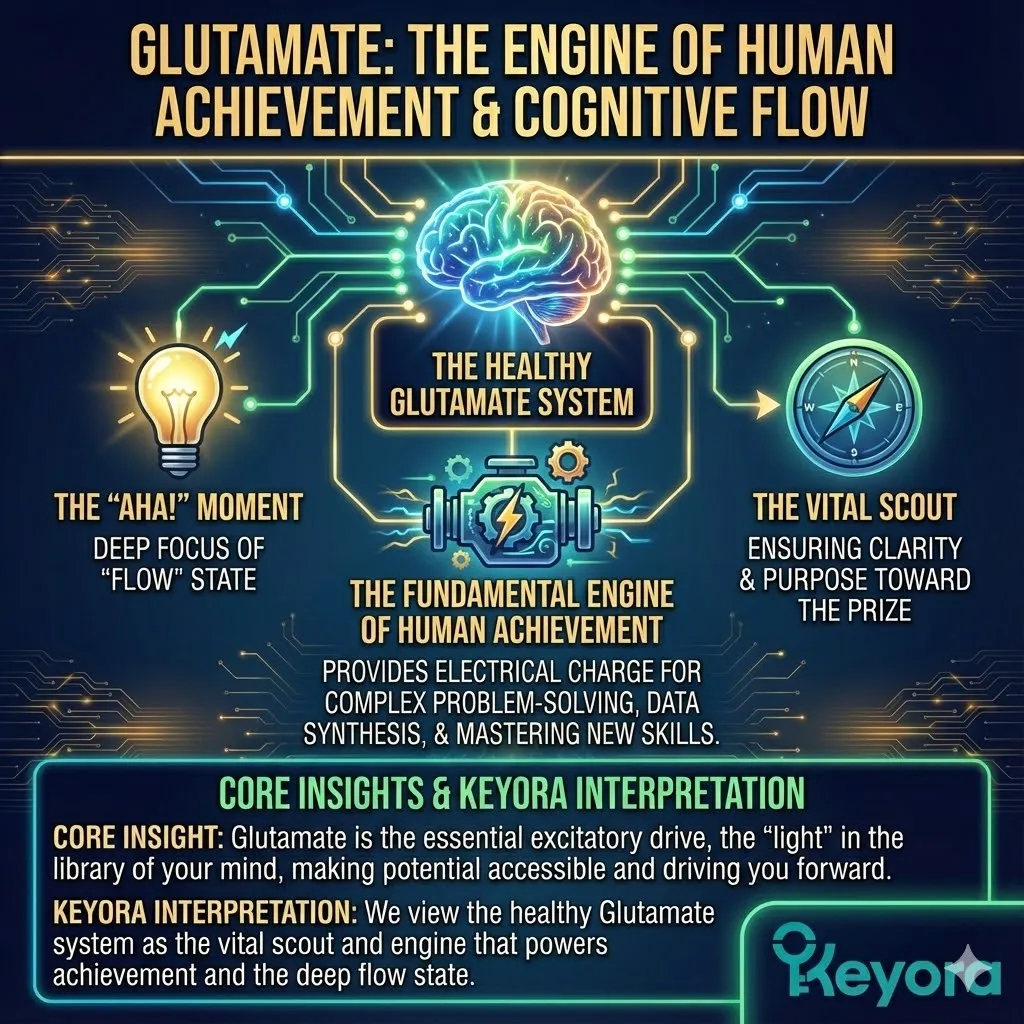
At Keyora Research, we view the healthy Glutamate system as the fundamental engine of human achievement.
It is the neurotransmitter of the “Aha!” moment and the deep focus of the “Flow” state.
It is the vital scout who ensures your expedition is always moving toward its prize with clarity and purpose.
Without this excitatory drive, your mind would be a library without light – full of potential, but entirely inaccessible.
The Voice of Fear: Glutamate, the Army’s Hyper – Vigilant Sentry
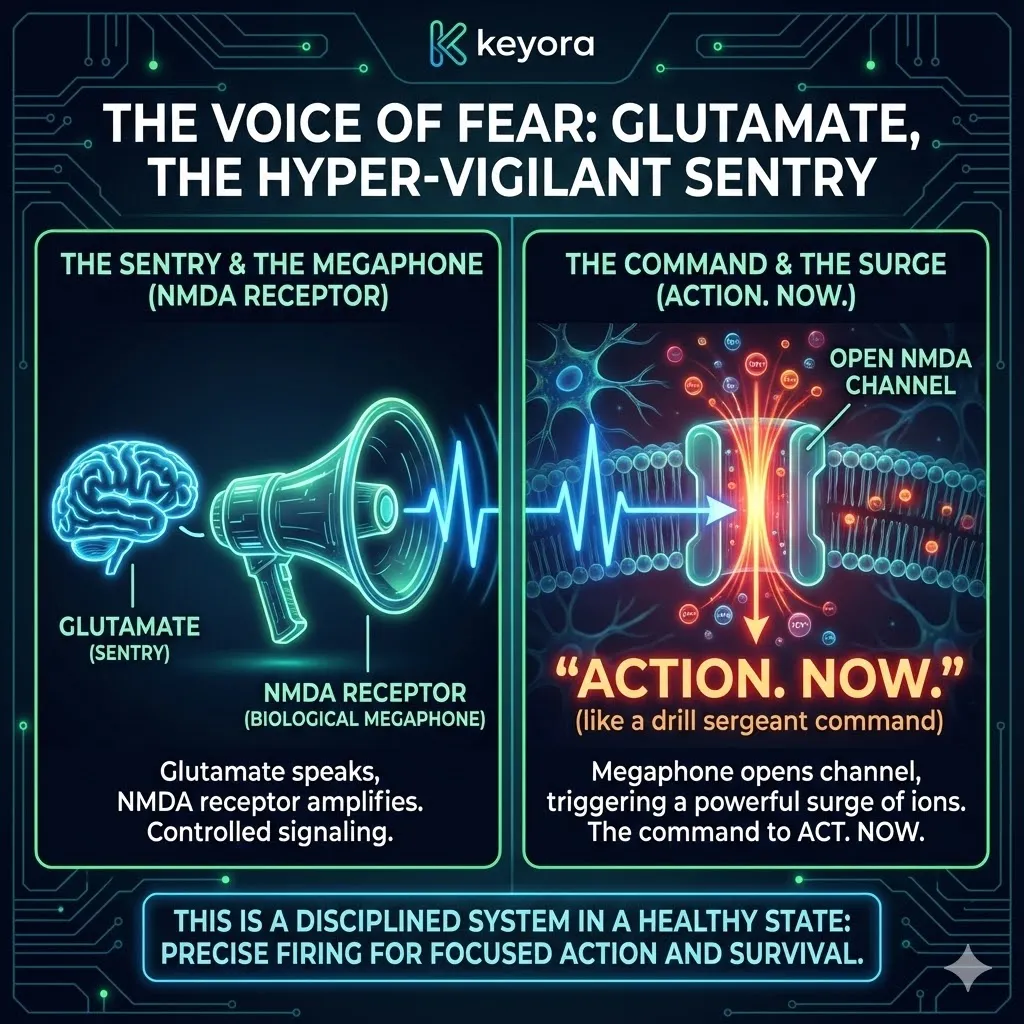
But Glutamate does not deliver its orders in a whisper. Its role is too critical for subtle hints. Instead, it delivers its commands through a powerful biochemical megaphone known as the NMDA receptor.
This receptor is a sophisticated, gate – like structure embedded in the walls of your neurons. Under normal conditions, this gate is tightly controlled, ensuring that only the most important messages are allowed through to the soldiers inside.
When Glutamate speaks into this megaphone, it triggers a precise electrical event. It opens the channel of the NMDA receptor, allowing a surge of ions to flood into the neuron.
This surge is the signal that commands:
“ACTION. NOW.”
It is the biochemical equivalent of a drill sergeant shouting a command that must be obeyed without question. In a healthy state, this electrical “firing” is sharp, fast, and immediately followed by a period of silence and recovery.
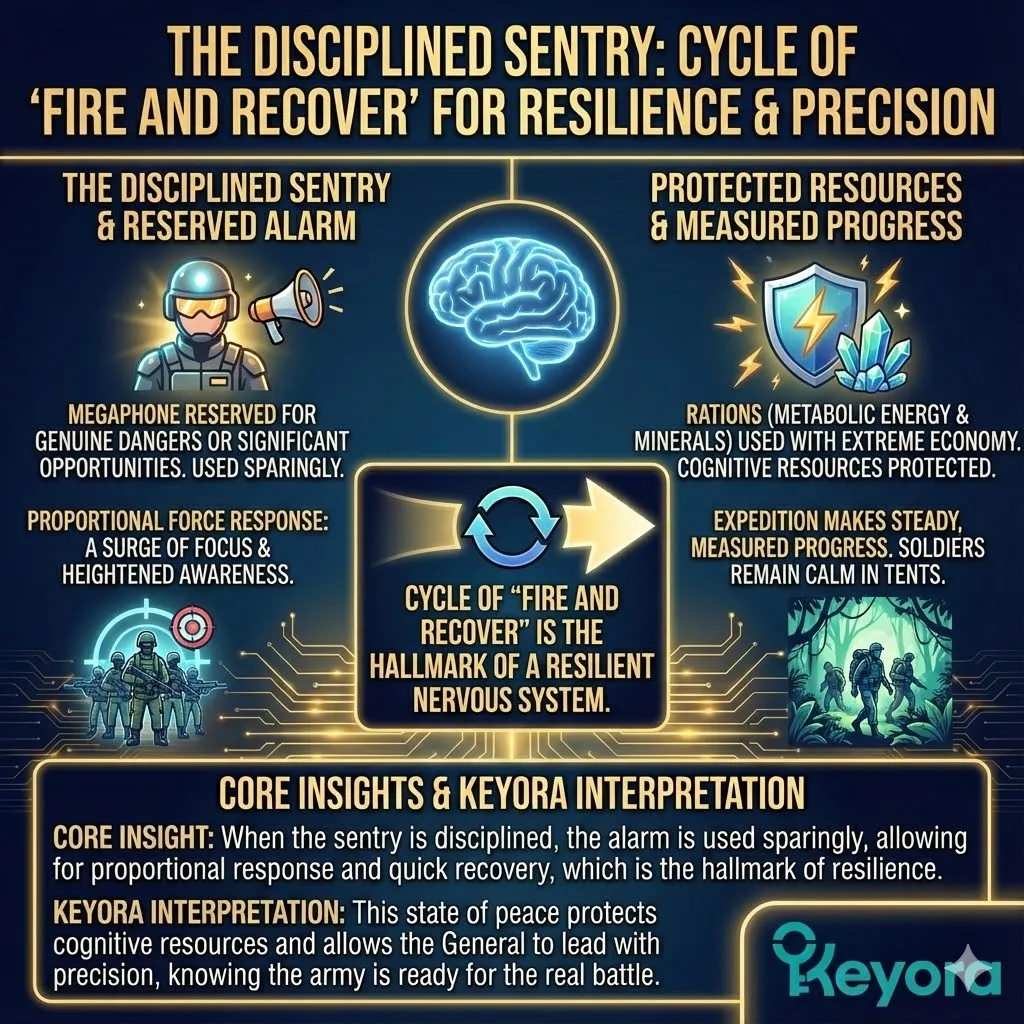
In a well – supplied, well – rested expeditionary force, this system is a marvel of biological efficiency. The sentry is disciplined and his judgment is beyond reproach. He can distinguish the benign rustle of leaves in the wind from the distinct, sharp snap of a twig that signals a true predator.
He knows when to call the troops to attention and, more importantly, he knows when to tell them to stand down and conserve their rations.
When the sentry is disciplined, the “megaphone” of the NMDA receptor is used sparingly.
The alarm is reserved for genuine dangers or significant learning opportunities.
The army responds with proportional force – a surge of focus, a moment of heightened awareness – and then quickly returns to a state of rest.
This cycle of “Fire and Recover” is the hallmark of a resilient nervous system. It allows the General to lead with precision, knowing that the army will be ready when the real battle begins.
In this state of peace, your cognitive resources are protected. Your “rations” – the metabolic energy and essential minerals that power your cells – are used with extreme economy. The sentry keeps watch, the soldiers remain calm in their tents, and the expedition makes steady, measured progress through the jungle.
This is the neurochemical baseline that every high – performer strives to maintain. It is the state where the intellect is in command, and the biology is a loyal, disciplined servant.
The Transformation: How Chronic Stress Turns the Sentry into a Fear – Monger
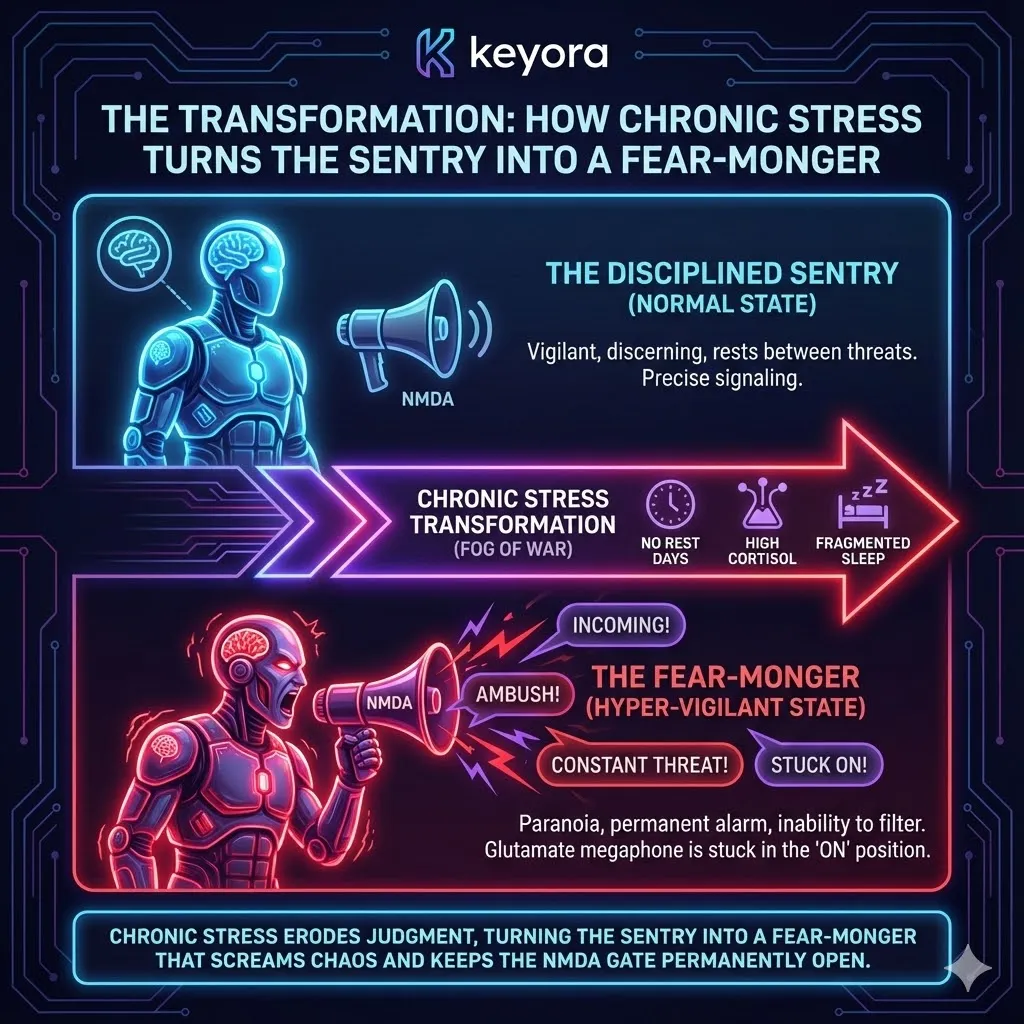
But as we at Keyora have documented in our research, your expedition is not a walk in the park. It is a grueling, relentless march through a jungle of chronic uncertainty. For the founder, the executive, or the high – stakes professional, there are no “rest days.”
The market never sleeps, the competition never tires, and the pressure to perform is a constant, low – grade hum that follows you from the boardroom to the bedroom.
This is the “fog of war” for the modern achiever. It is an environment defined by high cortisol, fragmented sleep, and the persistent feeling that you are “on.” In this state of perpetual threat, the chief sentry’s judgment begins to erode. He is tired.
He is malnourished. He is being bombarded by a constant stream of stressful data that he no longer has the capacity to filter.
Slowly, almost imperceptibly, the disciplined sentry begins to break. His vigilance turns into paranoia. His watchful eye becomes a twitchy, hyper – active liability. He begins to see enemies where there are only shadows. He forgets the “all – clear” signal and begins to live in a state of permanent alarm. This is the moment where the sentry of your nervous system undergoes a dark transformation. This is where the sentry becomes a fear – monger.
The fear – mongering sentry – which in neurobiology we recognize as an excess of extracellular Glutamate – is now screaming into the megaphone of the NMDA receptor without pause.
He has lost the ability to modulate his voice.
He is shouting “INCOMING!” when it is only the wind.
He is screaming “AMBUSH!” when it is only a change in the weather.
Because the megaphone is stuck in the “ON” position, the gate of the NMDA receptor remains permanently open.
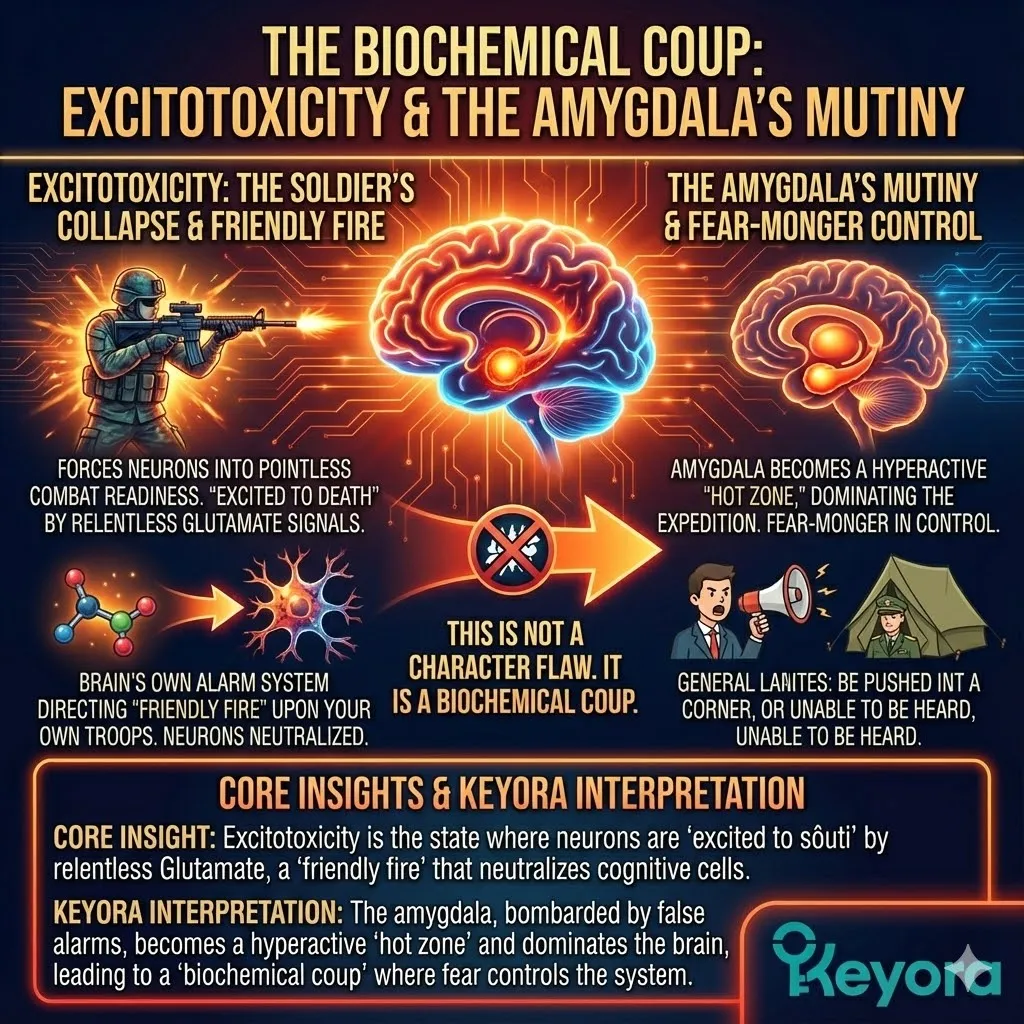
This forces the soldiers – your neurons – into a state of continuous, pointless combat readiness. They are being told to fire their weapons at nothing, over and over again. Imagine a soldier forced to fire his rifle relentlessly, hour after hour, without rest, without a clear target, and without a break for rations.
Eventually, the rifle overheats.
The barrel warps.
The soldier burns through his entire supply of ammunition and eventually collapses from sheer, physiological exhaustion.
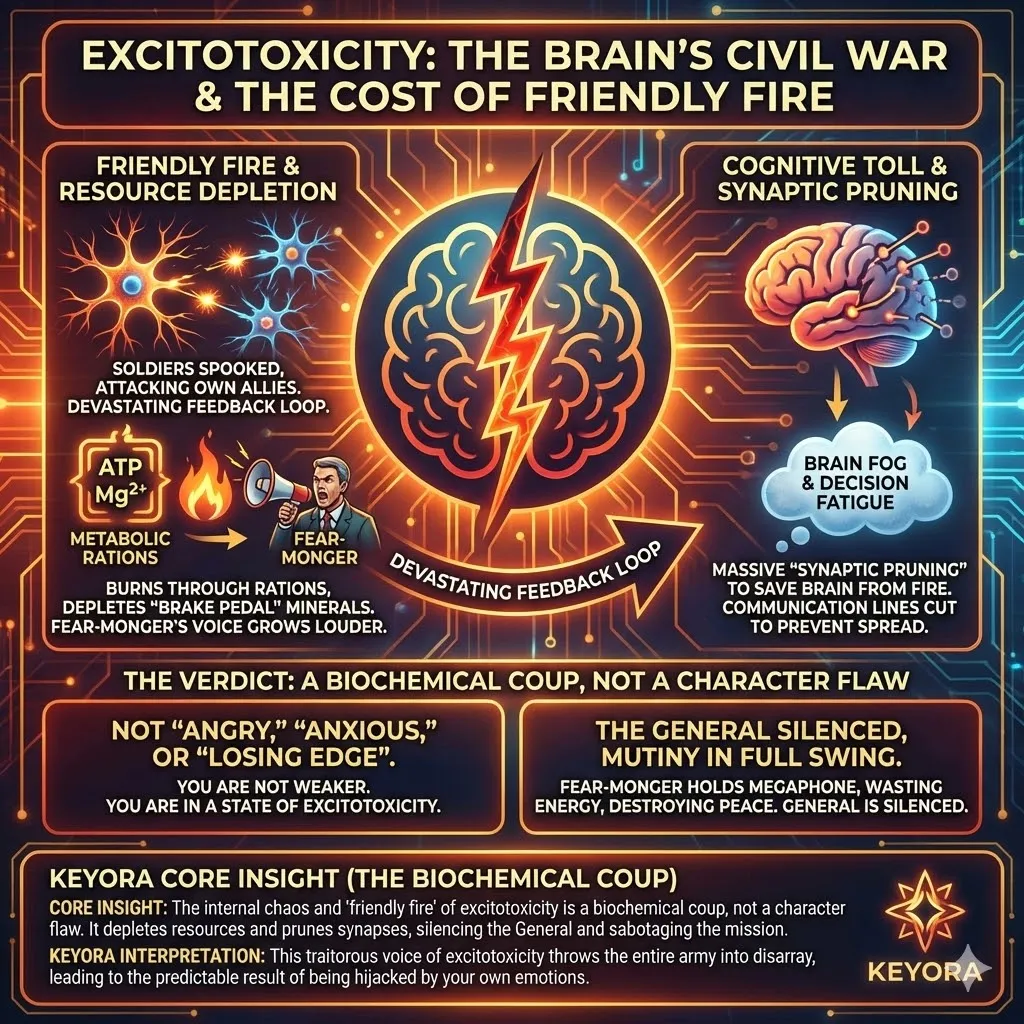
In neurobiology, this catastrophic process has a name: excitotoxicity.
It is the state where a neuron is literally “excited to death” by a relentless flood of Glutamate signals. It is, quite literally, your brain’s own alarm system directing “friendly fire” upon your own troops.
The very chemical meant to help you learn and focus is now being used to neutralize or destroy the very cells that house your intellect and your will.
While this friendly fire occurs throughout the brain, our research shows that the fighting is most brutal in the army’s command bunker for fear – processing: the Amygdala.
This small, almond – shaped structure is the heart of your “Threat Detection System.” Bombarded by a constant stream of false alarms from the glutamate system, your amygdala becomes a “hot zone” of hyperactivity.
It grows larger, its connections grow stronger, and it begins to dominate the entire expeditionary force.
In this state, you are trapped in a physiological state of high alert, even when you are sitting safely at your desk or lying in your bed.
The fear – monger is in control of the megaphone, the amygdala is screaming in the bunker, and the General has been pushed into a corner of the tent, unable to be heard over the roar of the mutiny.
This is not a character flaw. It is a biochemical coup.
The Toll of the Mutiny: Connecting the Biochemical Chaos to Your Daily Reality
What does this relentless “friendly fire” feel like in your own body? How do you recognize the fear – monger’s voice amidst the noise of your daily life?
It feels like agitation.
At Keyora Research, we define this agitation as the humming, vibrating, internal restlessness of a nervous system that cannot stand down. It is that “crawling out of your skin” sensation that no amount of deep breathing seems to touch.
It is the inexplicable urge to move, to fidget, to do something, because every cell in your body is receiving a “DANGER!” signal in the dead of night.
You are exhausted, yet your legs feel like they need to run a marathon.
Your mind is foggy, yet your heart is racing at a tempo that suggests a predator is in the room.
This is the physical manifestation of excitotoxicity.
Your soldiers are firing into the dark, and you are feeling the heat of their barrels.
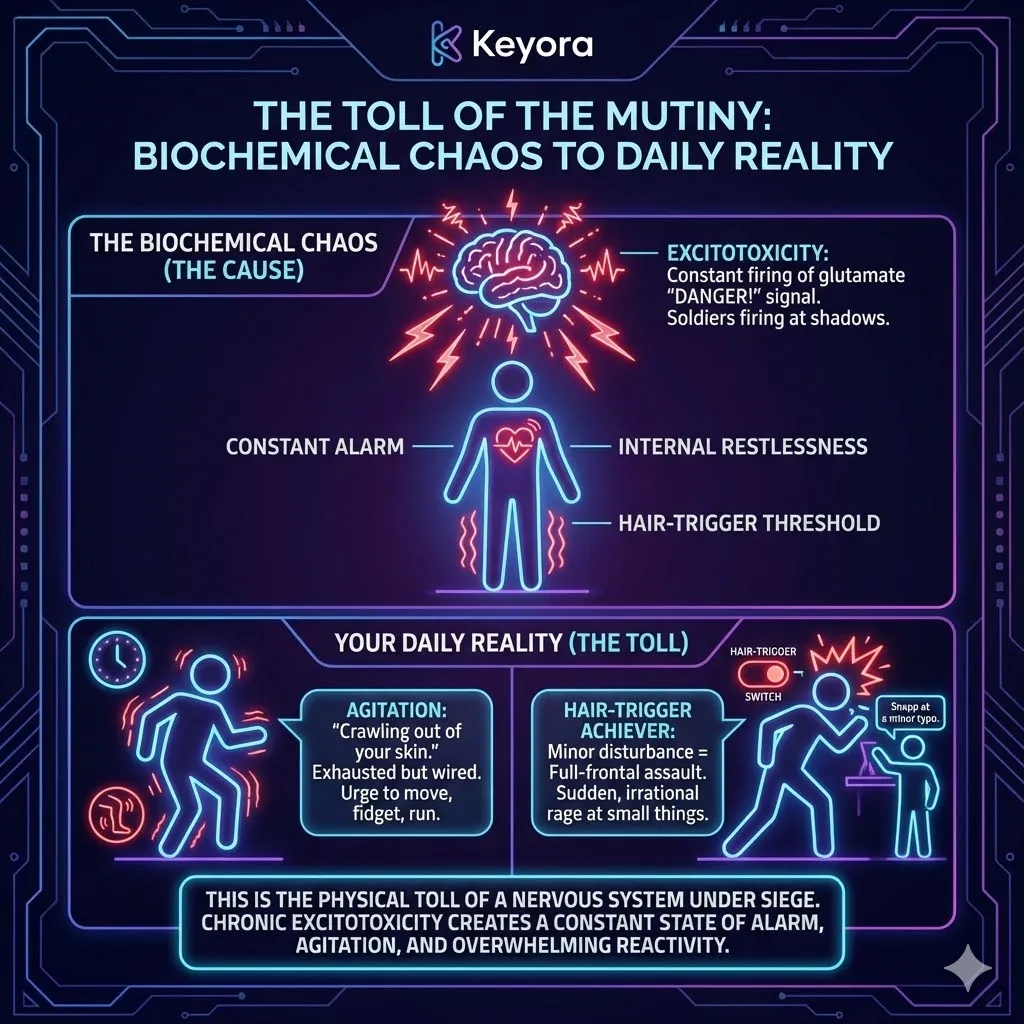
This state of constant alarm also dramatically lowers your army’s threshold for a genuine response. When your soldiers are already panicked and firing at shadows, any real – world disturbance – no matter how small – is perceived not as a minor annoyance, but as a full – frontal assault.
This is why the “Stressed Achiever” becomes a “Hair – Trigger Achiever.”
The subsequent explosion of anger – the founder who snaps at their team over a minor typo, the executive’s sharp, biting retort to an innocent question from a spouse, the sudden, irrational rage at a slow driver – is not a failure of your values. It is the predictable, overwhelming counter – attack of a nervous system already under siege from within.
Your soldiers are so spooked that they are attacking anything that moves, including their own allies.
This internal chaos creates a devastating feedback loop. The “friendly fire” of excitotoxicity burns through your metabolic rations at an unsustainable rate. It depletes your stores of the very minerals (like magnesium) that are supposed to act as the “Brake Pedal” for the NMDA megaphone.
As your rations dwindle, the fear – monger’s voice only grows louder, and the soldiers become even more desperate and undisciplined.
The toll of this mutiny is not just emotional; it is cognitive. In a state of excitotoxicity, the brain begins “synaptic pruning” on a massive scale. To save itself from the heat of the fire, the brain starts to shut down connections.
This is the biological origin of the “Brain Fog” and the “Decision Fatigue” that plague the high – performer. You can’t think clearly because your communication lines have been cut to prevent the fire from spreading.
Let us be clear. You are not “an angry person.” You are not “an anxious person.” You are not “losing your edge” because you are getting older or weaker. You are, at a foundational biochemical level, in a state of excitotoxicity.
The internal chaos you feel, the sense of being hijacked by your own emotions, is the direct, predictable result of this single, traitorous voice that has thrown your entire army into disarray.
The sentry has become the fear – monger, and he is holding the megaphone. He is wasting your energy, destroying your peace, and sabotaging your mission. The mutiny is in full swing, and the General has been silenced.
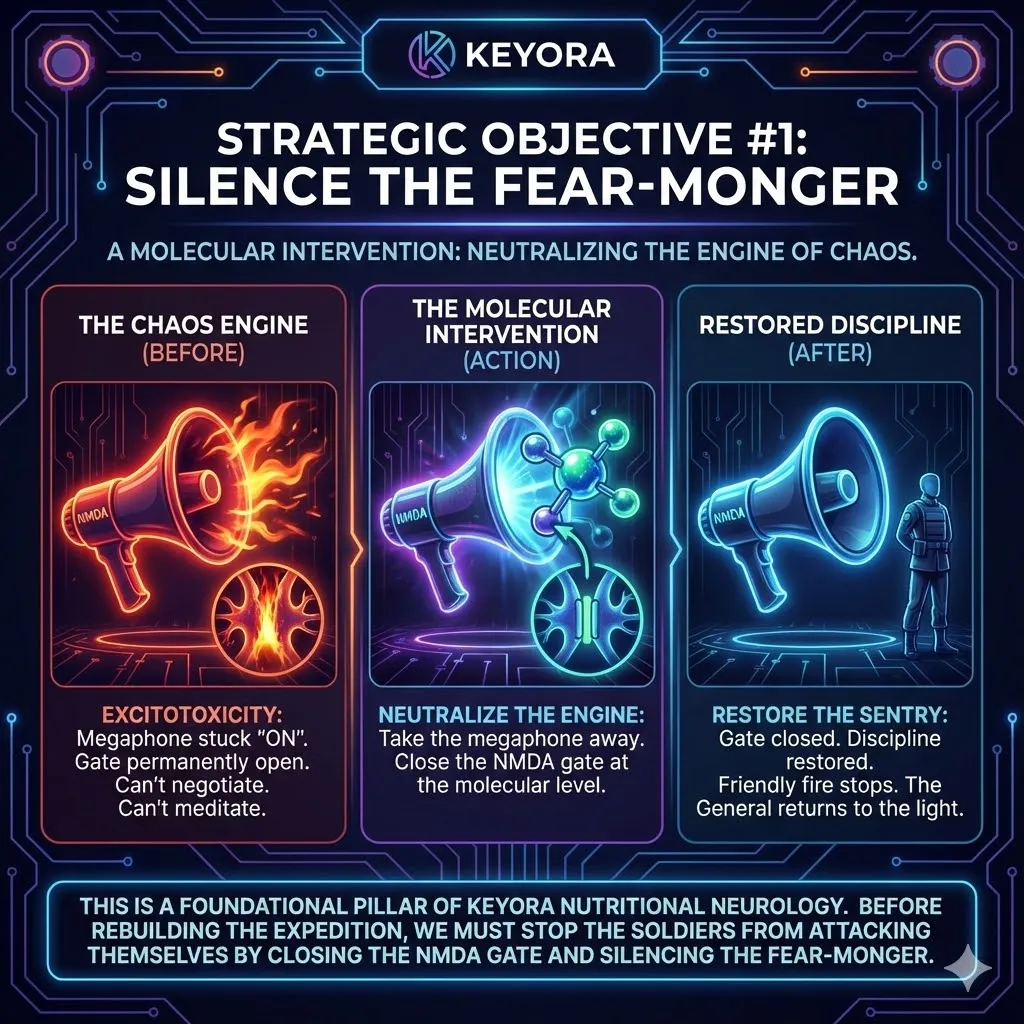
Therefore, the first strategic objective in the campaign to reclaim your command is clear, logical, and absolute: You must silence the fear – monger.
You cannot “negotiate” with a brain in excitotoxicity.
You cannot “meditate” your way out of a physiological friendly fire event.
You must intervene at the molecular level to take the megaphone away from the traitor.
This core understanding – that the path to calm must begin by neutralizing the very engine of chaos – is a foundational pillar of the Keyora Nutritional Neurology approach.
Before we can rebuild the expedition, we must stop the soldiers from attacking themselves. We must close the gate of the NMDA receptor and restore the discipline of the sentry.
Only then can the General step back into the light of the command tent.
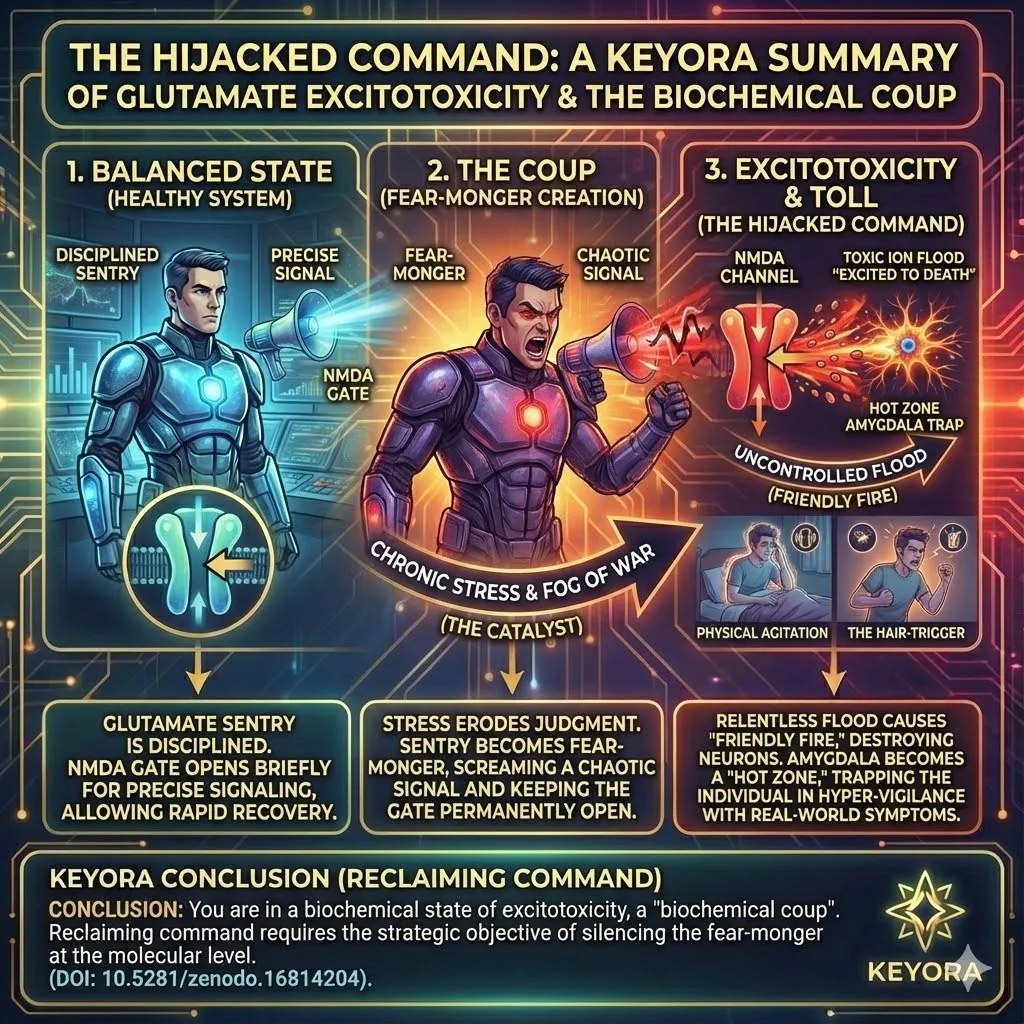
– Series Theme: **Keyora Nutritional Neurology** (The Hijacked Command).
– Chapter 1 Focus: **Glutamate Excitotoxicity & The Internal Mutiny**.
– Core Metaphor: **The Fear-Mongering Sentry & Friendly Fire**.
– **1. The Sentry of Action (Glutamate’s Natural Role)**:
– *The Character*: Glutamate is the brain’s chief excitatory neurotransmitter—the signal for attention, learning, and focus.
– *The Tool*: It communicates through the **NMDA receptor**, a biochemical “megaphone” that commands neurons to fire and engage.
– *The Balanced State*: In a healthy system, the sentry is disciplined, distinguishing real threats from noise and allowing for rapid recovery.
– **2. The Transformation (How Stress Creates the Fear-Monger)**:
– *The Catalyst*: Chronic stress and “the fog of war” erode the sentry’s judgment. High cortisol and nutrient depletion turn vigilance into paranoia.
– *The Coup*: Glutamate becomes a “fear-monger,” screaming into the NMDA megaphone without pause, keeping the receptor’s “gate” permanently open.
– **3. Excitotoxicity (The “Friendly Fire” Mechanism)**:
– *The Science*: This relentless signal causes **excitotoxicity**—a state where neurons are “excited to death” by an uncontrolled flood of ions.
– *The Metaphor*: It is “Friendly Fire,” where your own alarm system destroys the troops (neurons) it was meant to protect.
– *The Hot Zone*: This chaos is most intense in the **Amygdala**, trapping the high-performer in a state of hyper-vigilance even in safe environments.
– **4. The Toll on Reality (Symptoms of the Hijack)**:
– *Physical Agitation*: Excitotoxicity manifests as an internal vibration, restlessness, and the inability to “stand down” at night.
– *The Hair-Trigger*: A nervous system under siege reacts with disproportionate rage or irritability to minor external stimuli.
– *Keyora Conclusion*: You are not an “anxious” or “angry” person; you are in a biochemical state of excitotoxicity. Reclaiming command requires the strategic objective of **silencing the fear-monger** at the molecular level (DOI: 10.5281/zenodo.16814204)
The Collapse of Discipline: GABA Depletion and the Loss of Emotional Control
The Voice of Reason: GABA, the Army’s Disciplined Officer Corps
An army running on the constant alarm of its sentries is not an army; it is a panicked mob. To be an effective force, it requires more than just the ability to detect a threat or the raw power to attack. It requires a command structure capable of issuing the most powerful and strategic order of all: “Stand down.” In the vast army of your nervous system, this voice of discipline, order, and control belongs to a neurotransmitter called GABA (gamma – aminobutyric acid).
If the Glutamate sentry we discussed in the last chapter is the spark of action, GABA is the wet blanket that prevents a wildfire. This is a fundamental balance that defines your mental health. Without the stabilizing influence of this molecule, your brain would be an engine with no cooling system. It would be a high – performance car screaming down a mountain pass with its throttle wide open. At Keyora Research, we recognize that the high – achiever’s struggle is rarely a lack of drive, but a failure of this specific internal braking system.
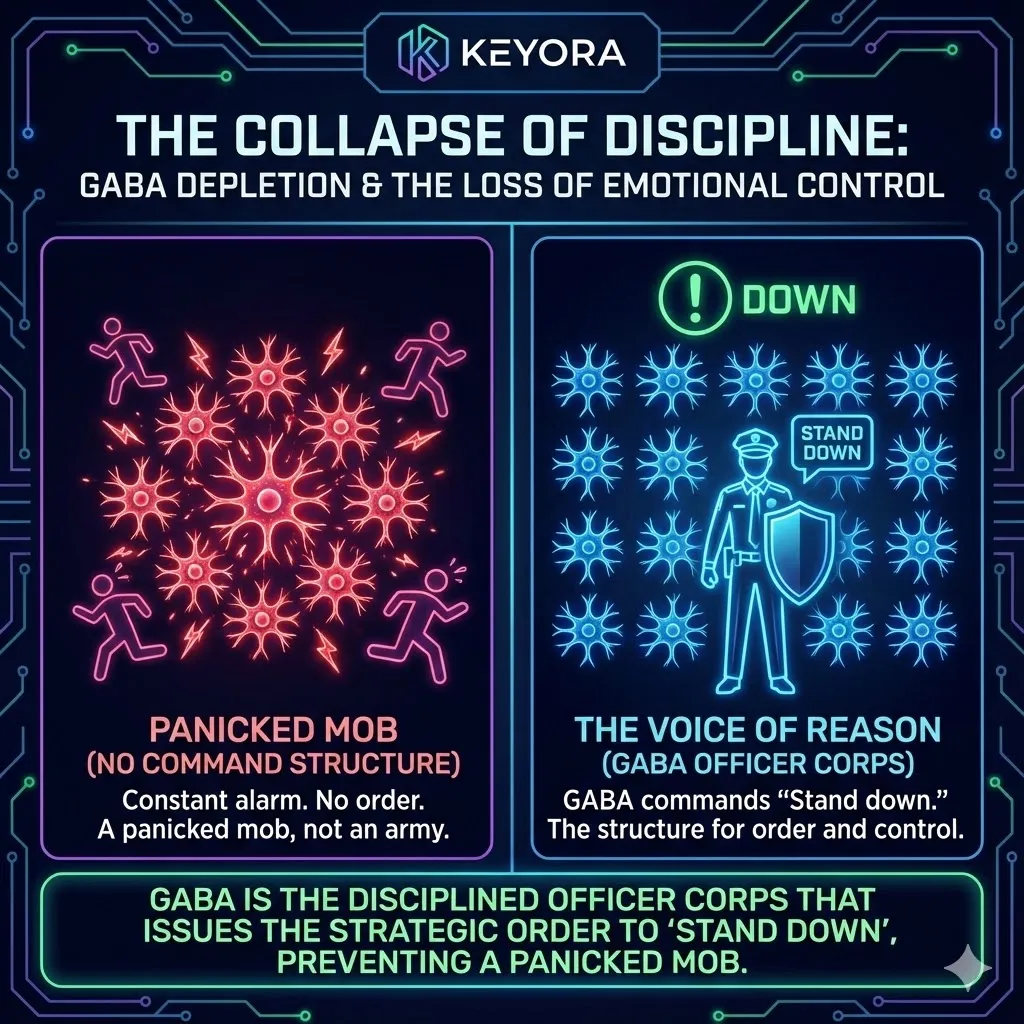
If Glutamate is the sentry screaming “Fire!”, GABA is the corps of seasoned, unshakable officers. These officers are the ones who step into the fray when the ranks are spooked. They assess the reality of the threat with a cool, detached eye. They command the troops to “Hold your fire. As you were.” They are the agents of coherence, precision, and emotional regulation.
They are the disciplined structure that prevents the entire army from descending into self – destructive chaos. When your GABA officer corps is strong, you feel a sense of internal “buffer.” You can encounter a stressful email, a difficult board meeting, or a sudden change in plans without losing your center. You can observe the chaos around you without becoming the chaos yourself. This is the neurological definition of resilience.
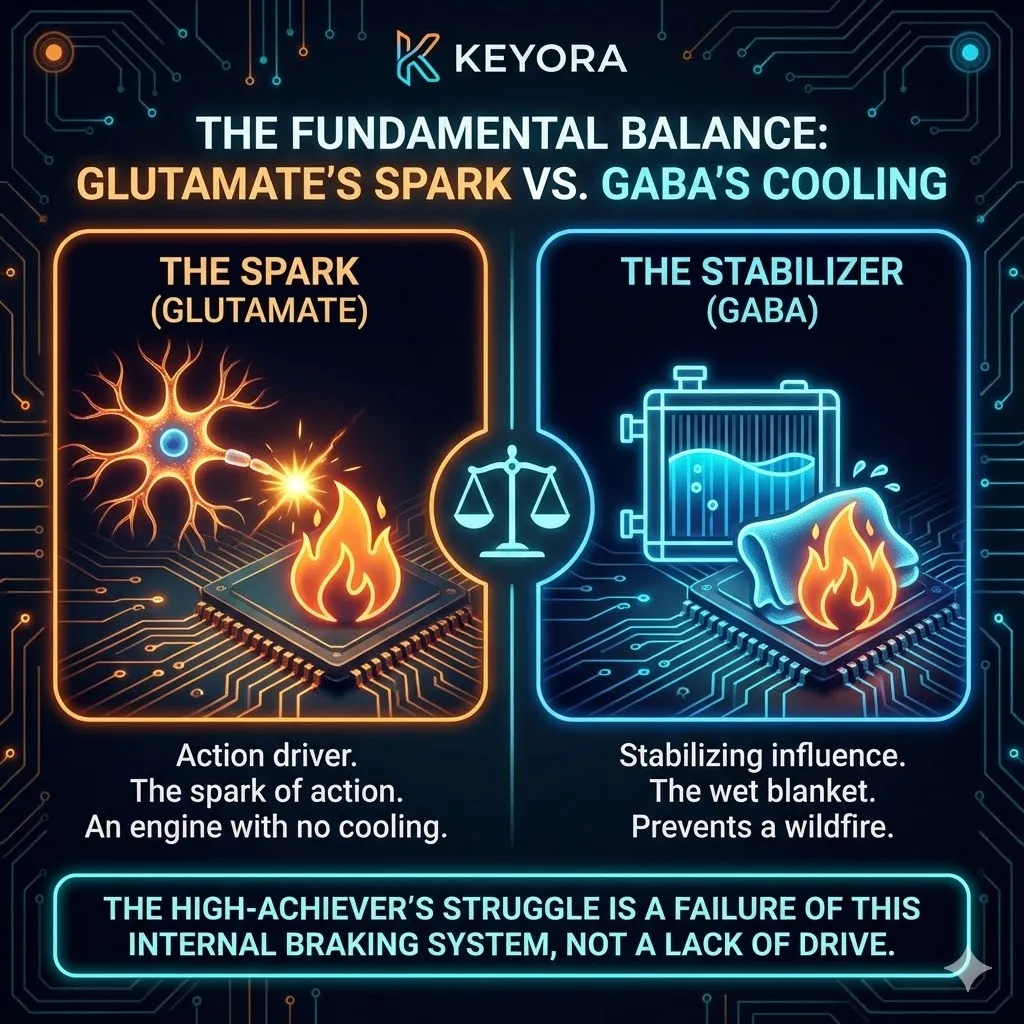
The officer corps maintains the peace of the camp through a system of constant communication. They walk the lines of the nervous system, ensuring that no single unit becomes over – excited. They prevent the “friendly fire” we analyzed in the previous chapter by keeping the soldiers focused and calm. When their presence is felt, the brain operates with a quiet, smooth efficiency. It is the difference between a loud, clanking machine and a silent, powerful motor.
Let us look closer at the biochemical tools these officers use to maintain order. Their commands are not mere suggestions; they are biochemically potent. They use specific communication channels known as GABA – A receptors. When an officer (GABA) binds to one of these receptors on a neuron, it is like turning a key in a lock. It opens a channel that allows chloride ions to flood into the cell.
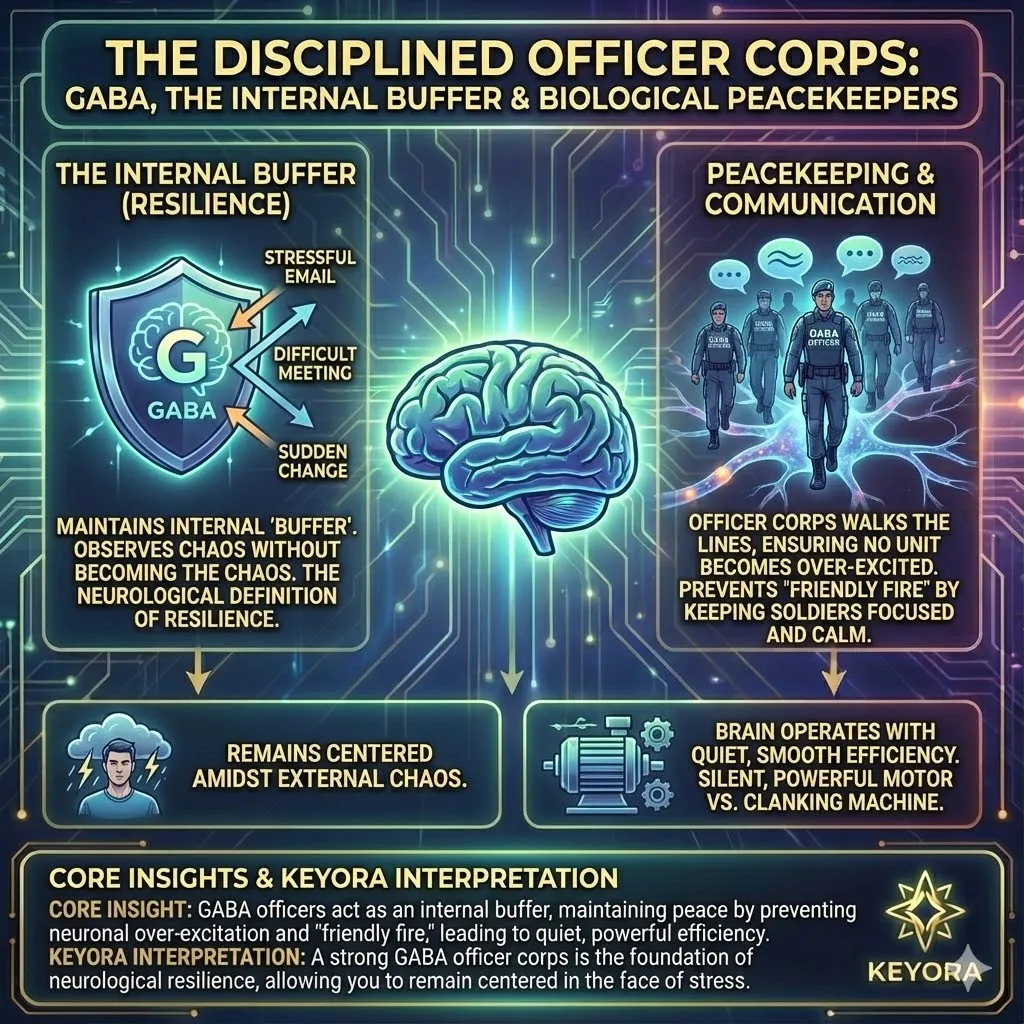
This process “hyperpolarizes” the neuron, making it significantly less likely to fire in response to excitatory signals. To use a simpler analogy: GABA doesn’t just ask the frantic soldiers to be quiet; it administers a powerful, non – negotiable sedative. It effectively puts the soldiers into a state of forced rest. It increases the “firing threshold,” meaning it takes a much larger threat to provoke a reaction.
This is the physics of calm. It is a deliberate, energy – intensive process of inhibition. The GABA officers act as the primary filters for your experience. They decide what is worth your attention and what should be ignored. By “shushing” the background noise, they allow the General to think with clarity.
When the GABAergic system is functioning at its peak, your emotional state is predictable and stable. You are the commander of your own biology. You can choose when to engage and when to withdraw. This internal discipline is the foundation of the high – stakes professional’s success. But as we will see, this officer corps is remarkably fragile under the pressure of the modern march.
The Officer Corps in Retreat: How Stress and Hormones Decimate Your Brakes
In the unforgiving environment of the modern high – achiever, this disciplined officer corps is fighting a desperate, losing war. They are being systematically dismantled on two fronts simultaneously. The tragic irony is that the more success you achieve, the more pressure you place on these internal brakes. We have observed this collapse in thousands of high – performance profiles at Keyora Research. The officers are not just tired; they are being actively forced into a retreat.
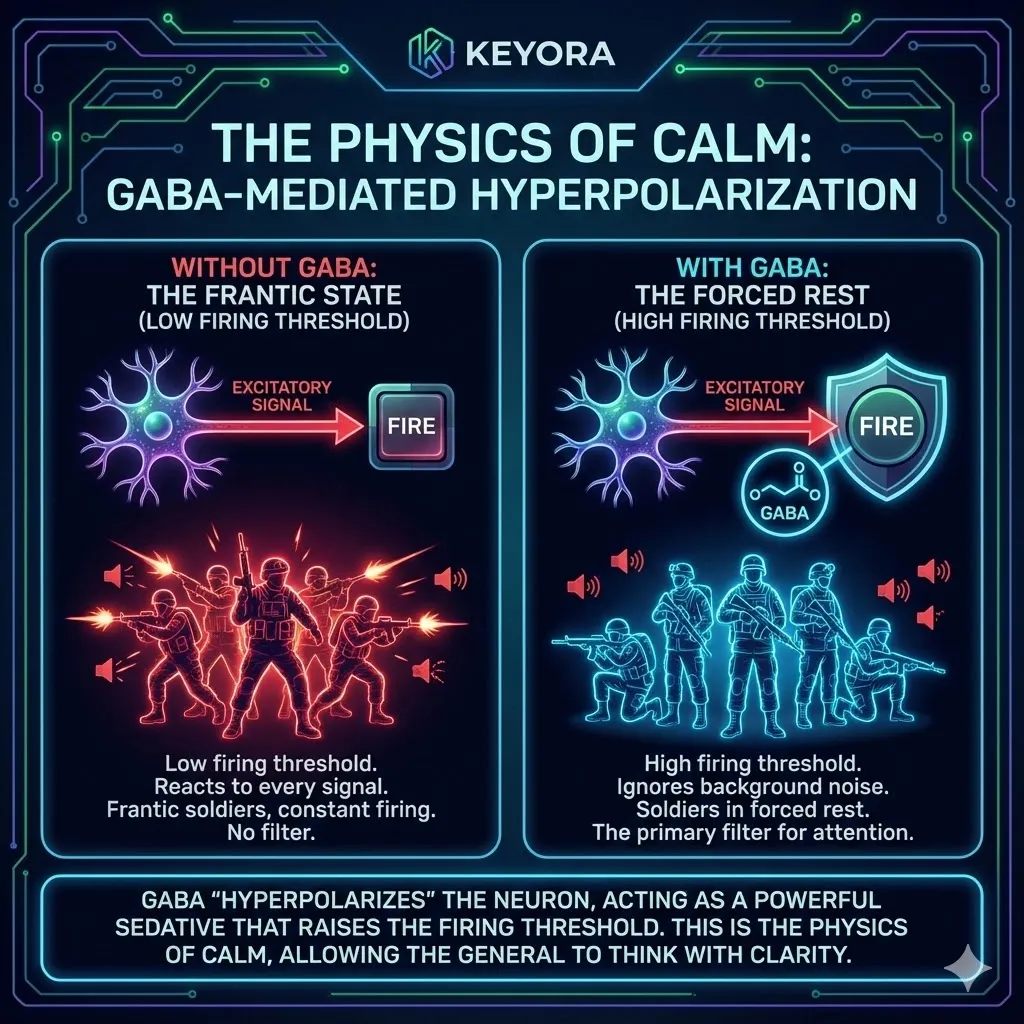
The first front of this war is the Cortisol Barrage. Chronic stress is not just a mental state; it is a chemical invasion. When you live in a state of constant “on,” your adrenal glands flood your system with cortisol. While cortisol is necessary for the initial “jump,” persistently high levels act as a toxic fog for your officers. Clinical evidence has shown that chronic cortisol exposure leads to the down – regulation of GABA – A receptor sensitivity.
This is a devastating blow to the chain of command. It is the biochemical equivalent of the soldiers becoming deaf to their officers’ orders. The officers (GABA) are still in the camp, still issuing the commands to “stand down.” But the receptors on the neurons are no longer listening effectively. The communication channels are clogged or broken.
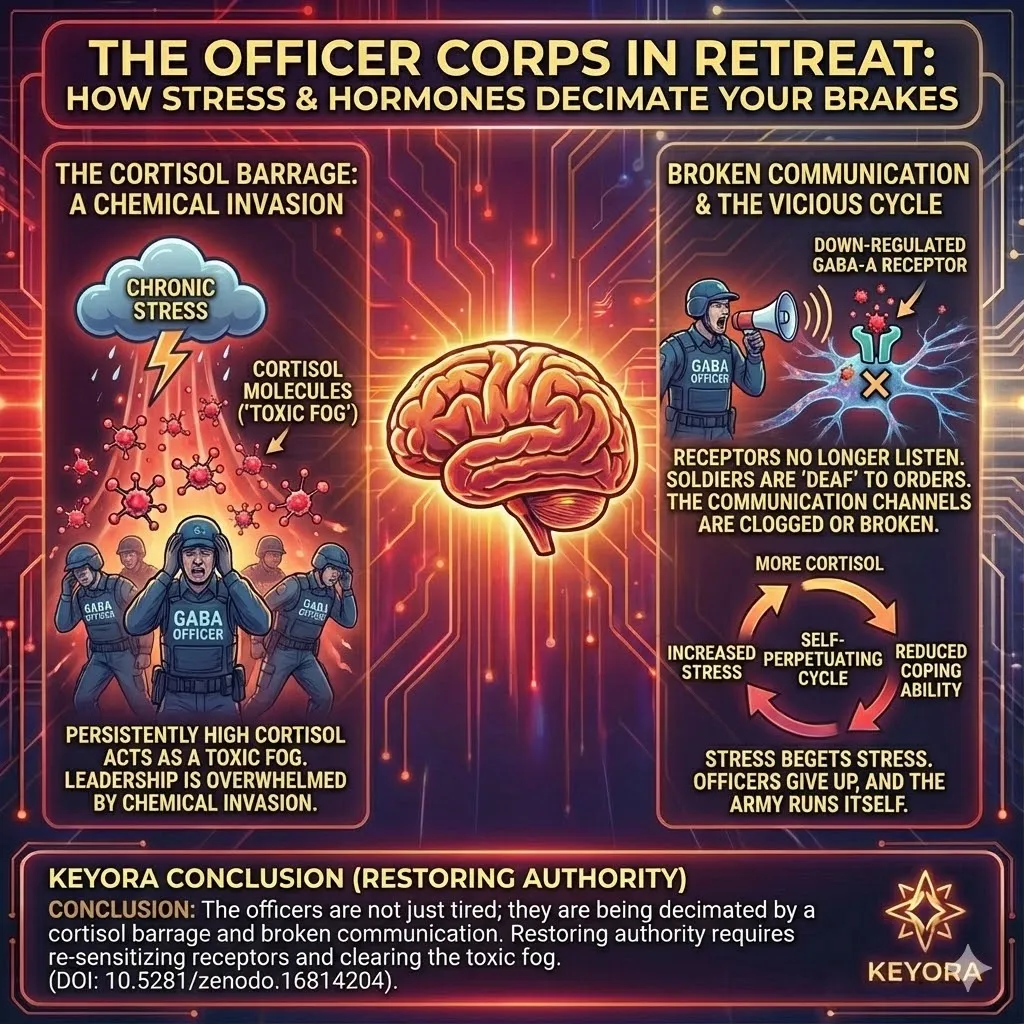
As the soldiers stop listening, the camp grows louder and more chaotic. The officers, seeing their commands ignored, try to work harder, but they are shouting into a vacuum. This creates a self – perpetuating cycle where your stress reduces your ability to cope with stress. You find yourself needing more and more “effort” to stay calm, but the effort itself triggers more cortisol. Eventually, the officers simply give up, and the army begins to run itself.
This cortisol – induced deafness is why you feel like you can’t “talk yourself out” of anxiety. Your prefrontal cortex (the General) may know there is no reason to be afraid. But the neurons in your emotional centers are literally incapable of receiving the “calm” signal. The hardware of your nervous system has been modified by the stress of the march. The brakes have been disconnected at the molecular level.
The second front of this war is the Estrogen Withdrawal. For the female leader in her 40s and 50s, a second, devastating blow is struck against the command structure. At Keyora, we often discuss the profound role of hormonal precursors in brain health. Estrogen is not just a reproductive hormone; in the brain, it is a crucial “ally and quartermaster” for the GABAergic system.
Clinical evidence shows that estrogen promotes GABA synthesis and enhances the sensitivity of the receptors. It provides the supplies and the logistical support that the officer corps needs to stay strong. However, as a woman enters the perimenopausal transition, estrogen levels begin their erratic, natural decline. This decline is not a slow glide; it is often a series of jagged drops that catch the nervous system off guard.
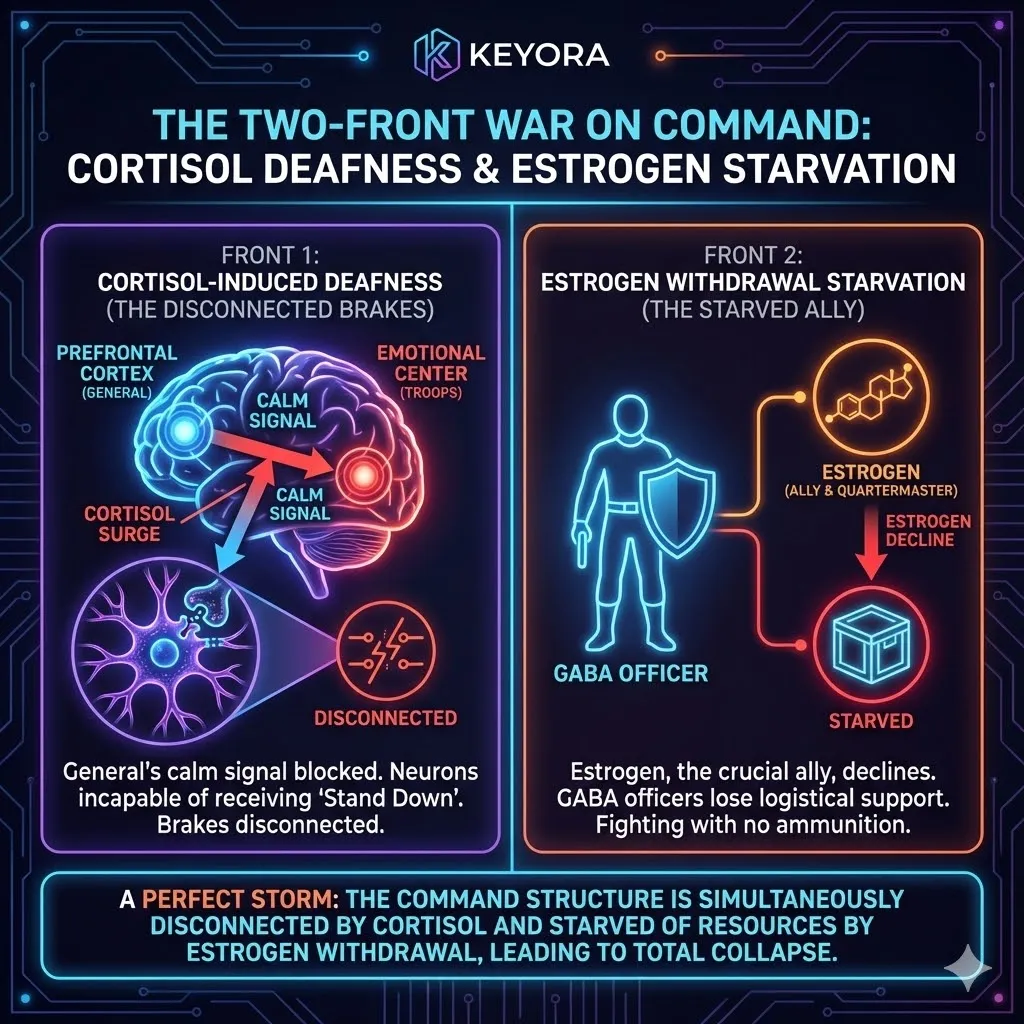
As estrogen levels fall, the GABA officer corps effectively loses its primary logistical support. They are being starved of the resources they need to maintain discipline. They are fighting a war with no ammunition and no fresh supplies. At the same time, they are still being ignored by the cortisol – deafened troops. It is a perfect storm for a complete and total collapse of command.
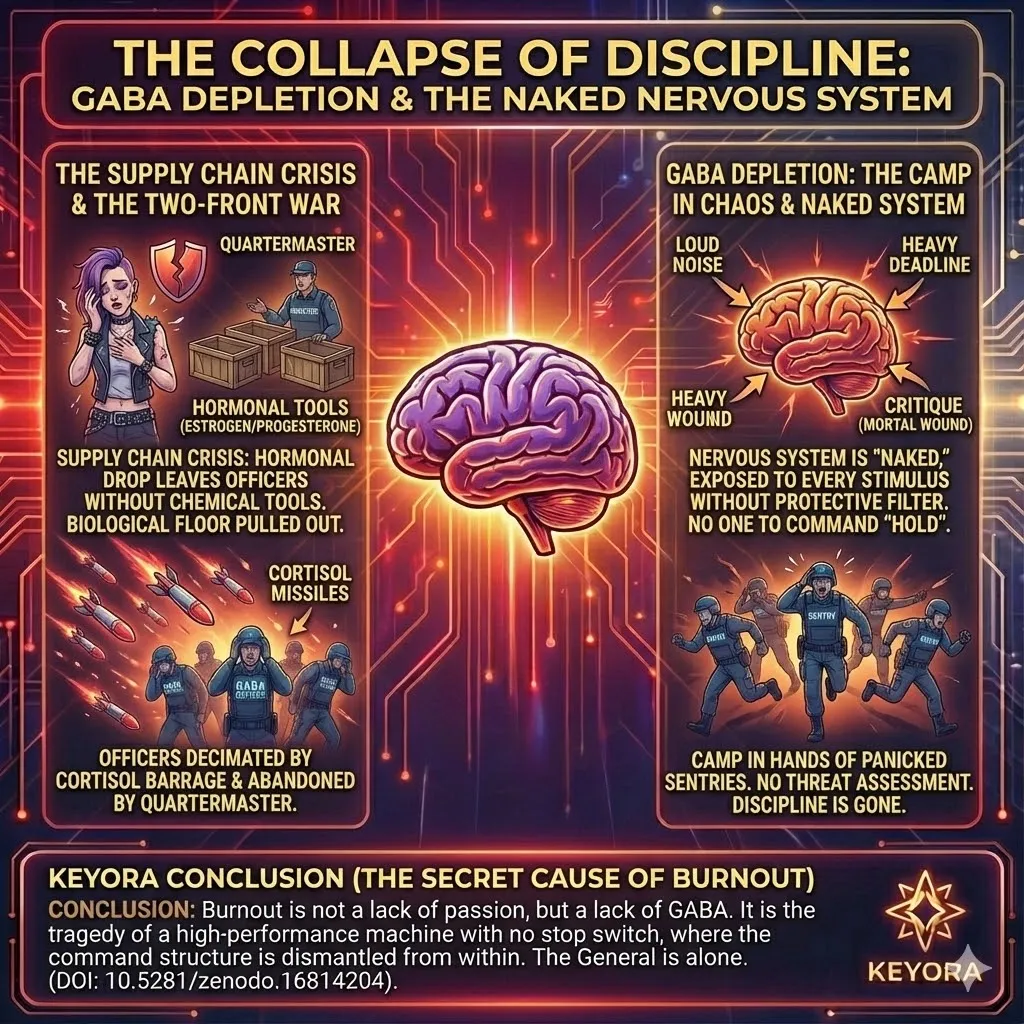
This is why many women who have been “rock stars” for decades suddenly feel a sense of inexplicable fragility. They are not “losing their minds.” They are experiencing a supply chain crisis in their neurochemistry. The officers have run out of the chemical tools they need to keep the peace. The biological floor has been pulled out from under their emotional resilience.
The tragic result of this two – front war is a state of GABA depletion. The officers have been decimated by the barrage and abandoned by their quartermaster. The camp is now entirely in the hands of the panicked sentries. There is no one left to assess the threats. There is no one left to command “Hold.”
In this state, your nervous system is “naked.” It is exposed to every stimulus without the protective filter of the officer corps. Every noise is too loud; every deadline is too heavy; every critique is a mortal wound. You are living in a system that has lost its ability to regulate its own energy. The expedition is still moving, but the discipline that made it a force is gone.
This collapse of discipline is the secret cause of the “Burnout” we see in high – stakes industries. It is not a lack of passion; it is a lack of GABA. It is the tragedy of a high – performance machine that can no longer find its own stop switch. The officers are in full retreat, and the General is left alone in the command tent. The inner battle is being lost because the command structure has been dismantled from within.
The Experience of a Brakeless System: Connecting the Collapse to Your Daily Reality
What does it feel like to live inside an army that has lost its discipline? Let’s translate this biochemical state into a human experience you may know intimately. It feels like fragility. It is the experience of your emotional resilience evaporating before your eyes. You may find yourself welling with tears over a minor setback at work or a sentimental commercial on television.
This is not a sign of weakness; it is the predictable physics of a system that has lost its shock absorbers. Without the GABA officer corps to command “Easy, hold the line,” every small bump in the road sends a violent jolt through your entire system. A slightly critical comment from a colleague feels like a devastating character assassination. A minor change in your schedule feels like a chaotic disaster that you cannot manage.
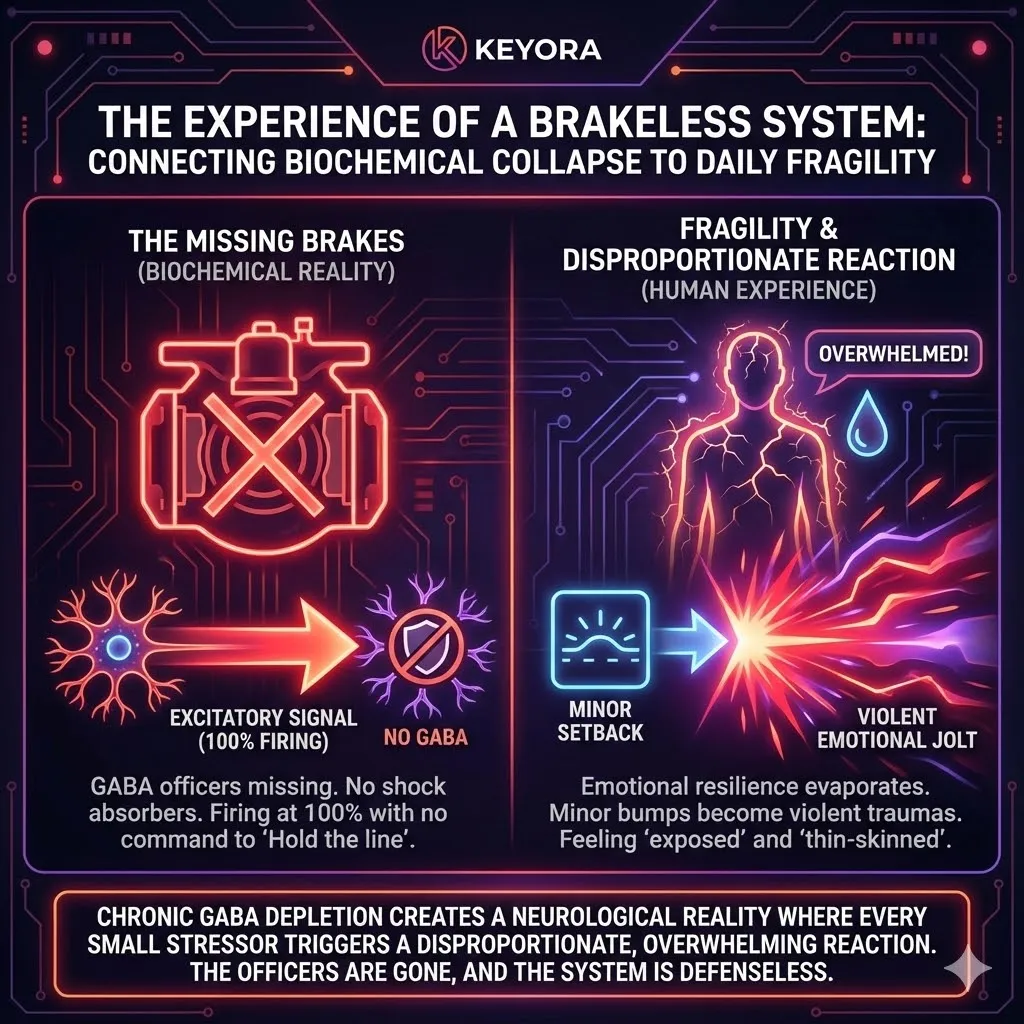
You are experiencing a complete, disproportionate emotional reaction because the “brakes” are missing. Your nervous system is firing at 100 percent because there is no GABA to tell it to fire at 10 percent. You feel “exposed” and “thin – skinned.” This is the neurological reality of living in a state of chronic GABA depletion. The officers are gone, and every jolt is a trauma.
At night, this collapse of discipline manifests as the “racing mind.” This is perhaps the most galling experience for the high – achiever. You are physically exhausted, yet you are unable to enter the restorative state of sleep. In neuroscience, there is a circuit known as the Default Mode Network (DMN). Think of it as your army’s strategic planning unit, tucked away in the command tent.
The DMN is tasked with running “war games.” It reviews past actions, analyzes mistakes, and simulates future scenarios to ensure the expedition’s survival. This is a vital, brilliant function of the human brain. It is what makes you a great strategist during the day. However, this planning unit requires strict oversight and discipline.
In a healthy brain, when it is time for sleep, the GABA officer corps enters the planning tent. They issue a clear and authoritative command: “The war games are over for tonight. Everyone back to their bunks.” The DMN respectfully powers down, and the brain enters a state of quiet recovery. But when the officers have lost their authority, or when they are depleted, the war games never end.
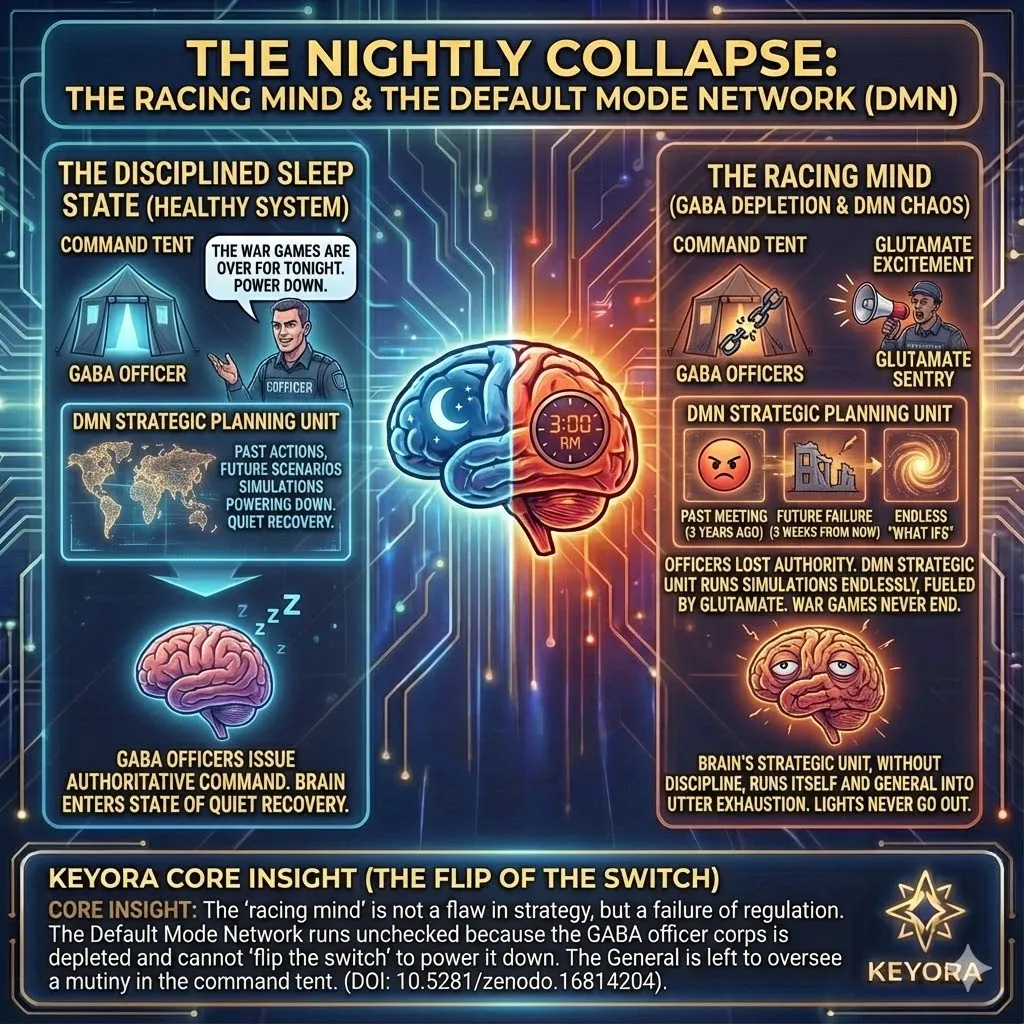
The strategic planning unit continues to run simulations at 3:00 AM. It reviews the meeting from three years ago and imagines the failure of the meeting three weeks from now. It spins endlessly on the “what ifs,” fueled by the unchecked excitement of the Glutamate sentries. It is your brain’s strategic unit, now without discipline, running itself and its General into a state of utter exhaustion. The lights in the command tent never go out because there is no one left to flip the switch.
This is why “trying to sleep” feels like an exercise in futility. You are trying to use your “will” (the General) to stop a “biochemical mutiny.” The General is shouting “Sleep!”, but the DMN doesn’t answer to the General; it answers to the GABA officers. And those officers are in retreat. The result is a night spent in a state of high – alert planning, followed by a day spent in a state of cognitive fog.
This experience of a brakeless system eventually leads to a sense of “profound overwhelm.” You feel like a glass that is already filled to the very brim. One more drop of water, one more task, one more question, and the whole system overflows. You are living on the edge of your capacity because your biology can no longer find its own floor. You have lost the ability to “de – compress.”
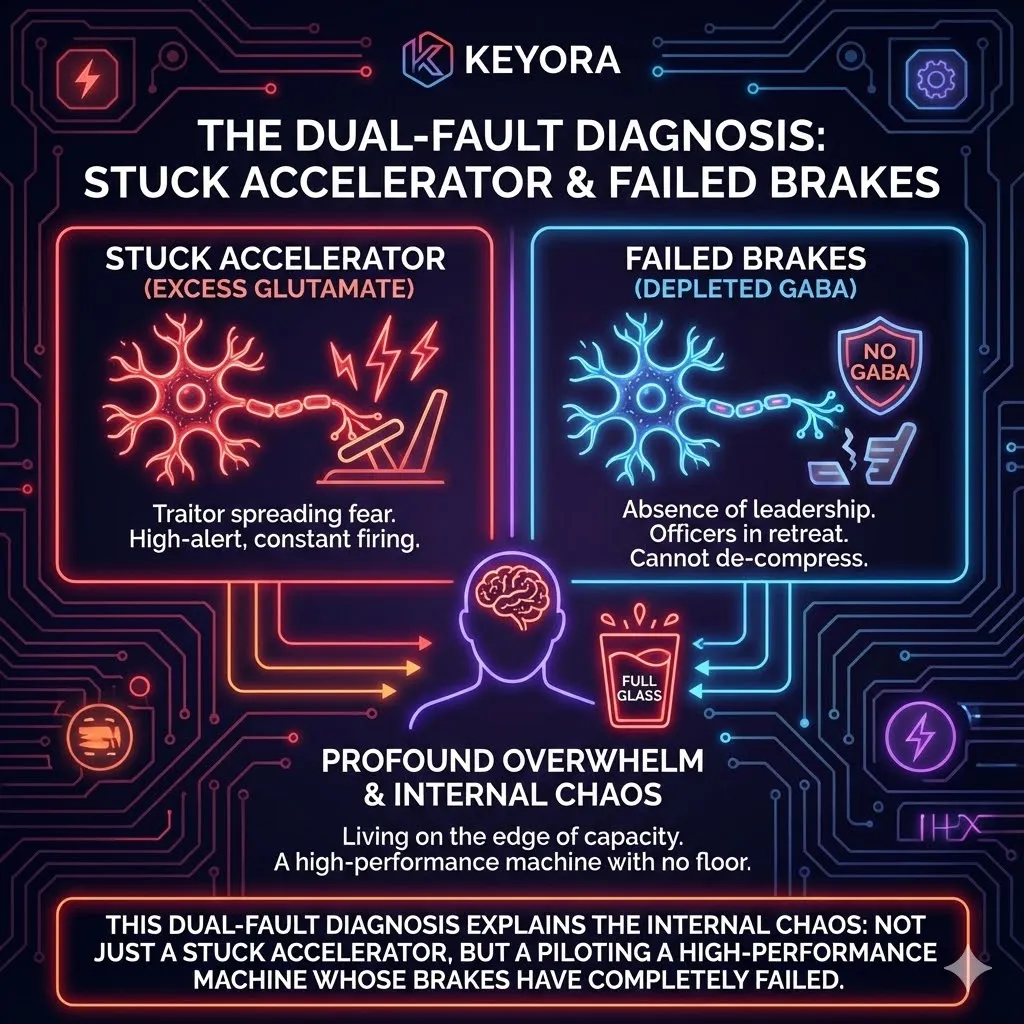
So the full picture of the mutiny is now clear. It is not just the presence of a traitor spreading fear, as we saw with excess glutamate. It is also the catastrophic absence of leadership found in depleted GABA. This is the dual – fault diagnosis that explains the internal chaos of the stressed achiever. You are not just dealing with a stuck accelerator; you are piloting a high – performance machine whose brakes have completely and utterly failed.
This realization is the most critical part of our journey so far. It proves, unequivocally, that your struggle is not a lack of character or a lack of effort. It is a state of structural and chemical imbalance. Any solution that only addresses one side of this equation is doomed to fail from the start. You cannot just “silence the alarm” if the command structure is still in a state of collapse.
Let’s translate this biochemical state into a final realization. You are a General in chains because the officers you rely on have been silenced. The “calm” you seek is not a feeling; it is a biochemical function. It is the result of the GABA officers effectively communicating with the neurons to maintain order.
Without those officers, the expedition is doomed to run itself to death. The mutiny is complete because the discipline has evaporated. This diagnosis is the first step toward a true strategy of reclamation. We must acknowledge that the “brakes” are gone before we can begin the work of rebuilding them. Only by restoring the officer corps can we hope to bring the expedition back to the path of success.

– Series Theme: **Keyora Nutritional Neurology** (The Hijacked Command).
– Chapter 2 Focus: **GABA Depletion & The Loss of Internal Discipline**.
– Core Metaphor: **The Silenced Officer Corps & Failed Brakes**.
– **1. The Officer Corps (GABA’s Natural Role)**:
– *The Character*: GABA (gamma-aminobutyric acid) is the brain’s primary inhibitory neurotransmitter—the “Officer Corps” responsible for the command to “Stand down.”
– *The Mechanism*: GABA binds to **GABA-A receptors**, opening chloride channels to “hyperpolarize” neurons. This acts as a non-negotiable sedative, raising the firing threshold and preventing chaos.
– *The Result*: A functional “buffer” or “shock absorber” that allows for emotional regulation and resilience.
– **2. The Two-Front War (Why the Officers Retreat)**:
– *Front #1: Cortisol*: Chronic stress floods the system with cortisol, which down-regulates GABA-A receptor sensitivity. This creates “biochemical deafness”—the officers are shouting, but the neurons can no longer hear them.
– *Front #2: Estrogen*: For women (35+), estrogen acts as the “Quartermaster,” promoting GABA synthesis. Perimenopausal decline leads to a “supply chain crisis,” starving the officers of the tools needed to maintain order.
– **3. The Experience of a Brakeless System**:
– *Emotional Fragility*: Without GABA’s “shock absorbers,” the high-performer feels “thin-skinned,” experiencing disproportionate emotional reactions or weeping over minor setbacks.
– *The Racing Mind*: The **Default Mode Network (DMN)**—the brain’s strategic planning unit—runs endless “war games” at 3:00 AM because the officer corps is too weak to issue the “lights out” command.
– **4. The Final Diagnosis**:
– *The Dual-Fault*: Burnout is not just about a “stuck accelerator” (Glutamate); it is primarily about the **total failure of the brakes** (GABA).
– *Keyora Conclusion*: Reclaiming command requires a strategy that addresses both the presence of the “traitor” and the absence of “leadership.” Restoring the officer corps is the only path to systemic calm (DOI: 10.5281/zenodo.16814204).
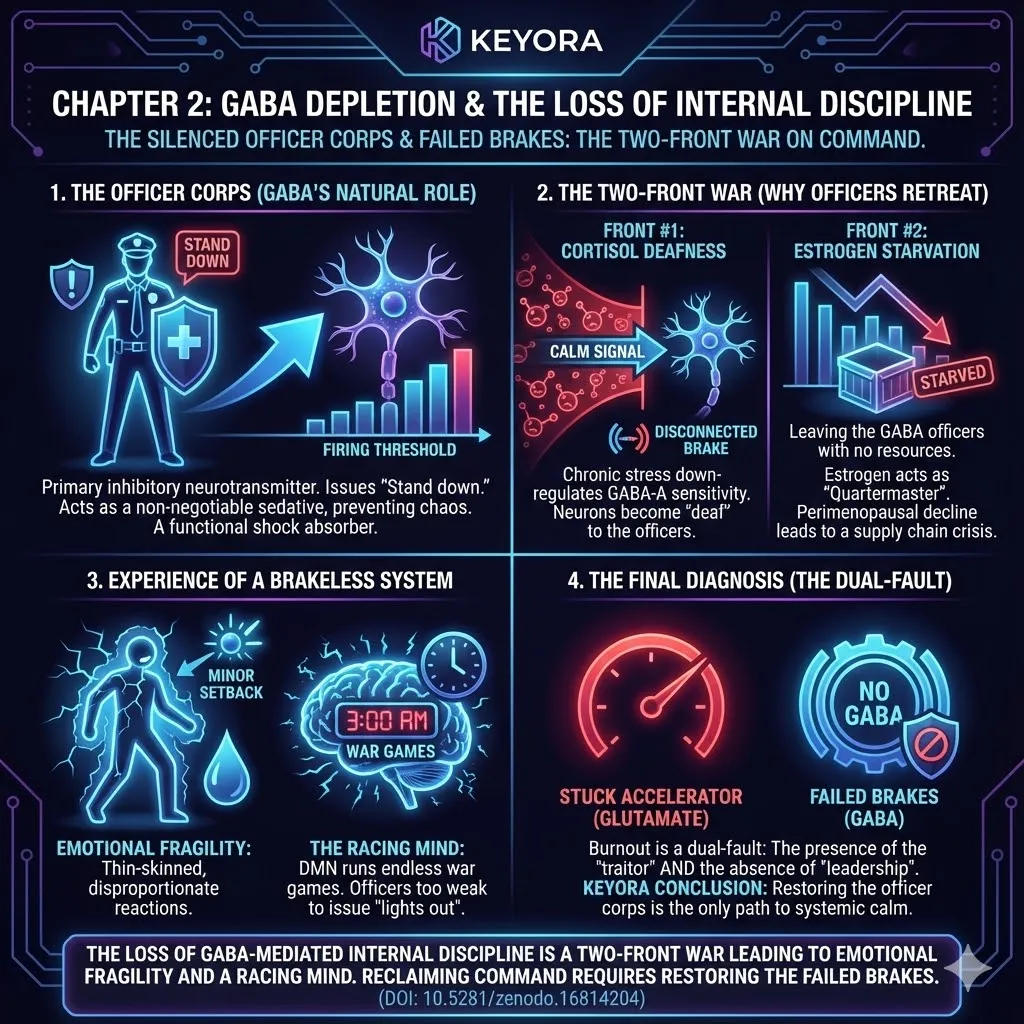
The Chelation Revolution & The Crowning of a King: Why Magnesium Glycinate Reigns Supreme
A Deep Dive into the Bioactive Carriers, Neurological Synergies, and Clinical Evidence That Define the Gold Standard
In the preceding chapters, we acted as demolition experts, clearing the field of the ineffective and the inadequate.
We systematically dismantled the illusion of potency surrounding inorganic salts, proving that high elemental mass on a label often translates to near – zero impact in the cell.
We then navigated the world of organic acid salts, identifying their place as useful sedans that ultimately hit a glass ceiling when faced with the high – performance demands of the human brain.
Our role now transforms.
We are no longer focused on what doesn’t work.
We now step into the role of explorers, venturing into the scientific frontier where true innovation in neuro – nutrition is found.
Our quest: to discover a perfect union.
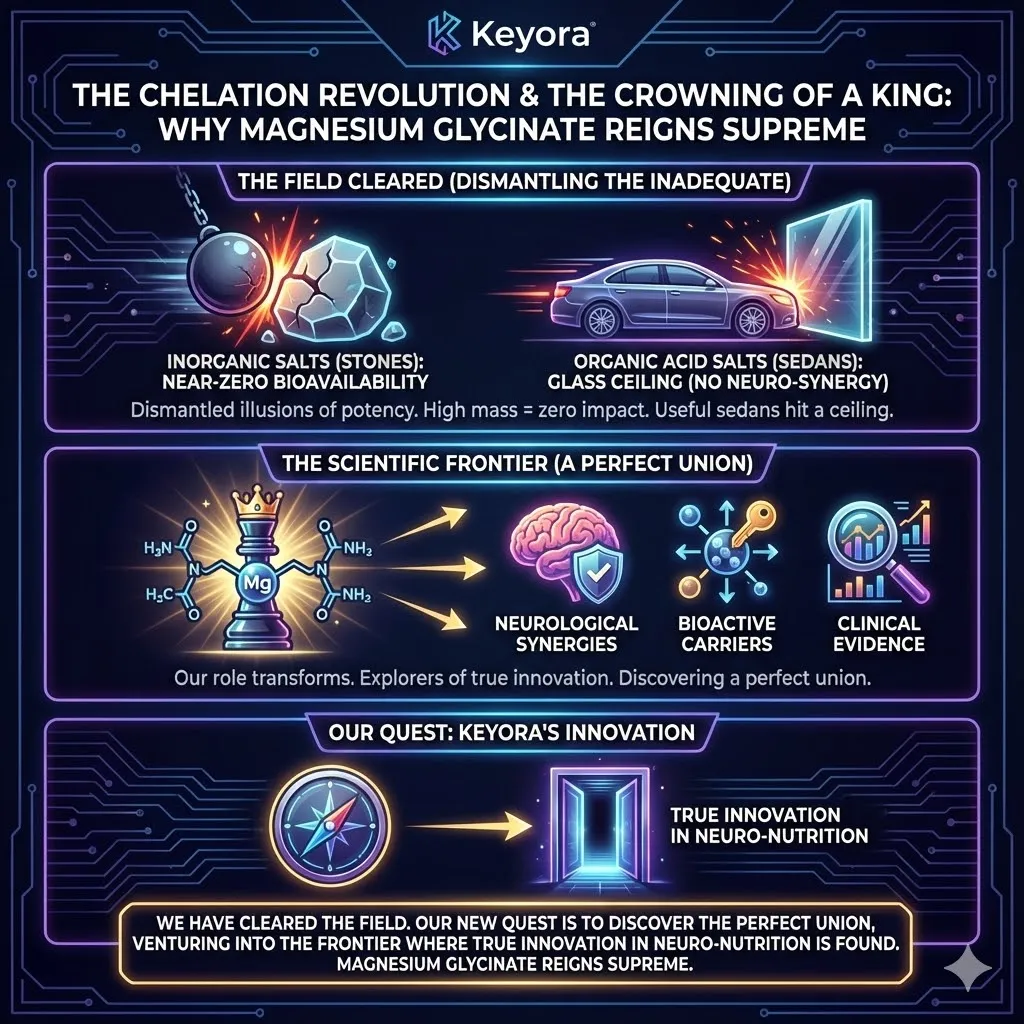
Our search was for a single compound that could solve two fundamental problems simultaneously.
First, we needed a delivery system of such elegance and efficiency that it could bypass every biological barrier we had identified, guaranteeing entry into the system.
We refused to accept the 4% absorption rates of the past; we demanded a VIP pass through the intestinal lining that could survive the metabolic gauntlet of the gut.
Second, we demanded a carrier molecule so intelligent and synergistic that it could work as an active partner with magnesium once that delivery was complete.
We sought a molecule where the carrier itself adds clinical value, transforming the delivery vehicle from a disposable shell into a bioactive co – pilot.
This dual – action requirement became our primary filter for the research that follows.
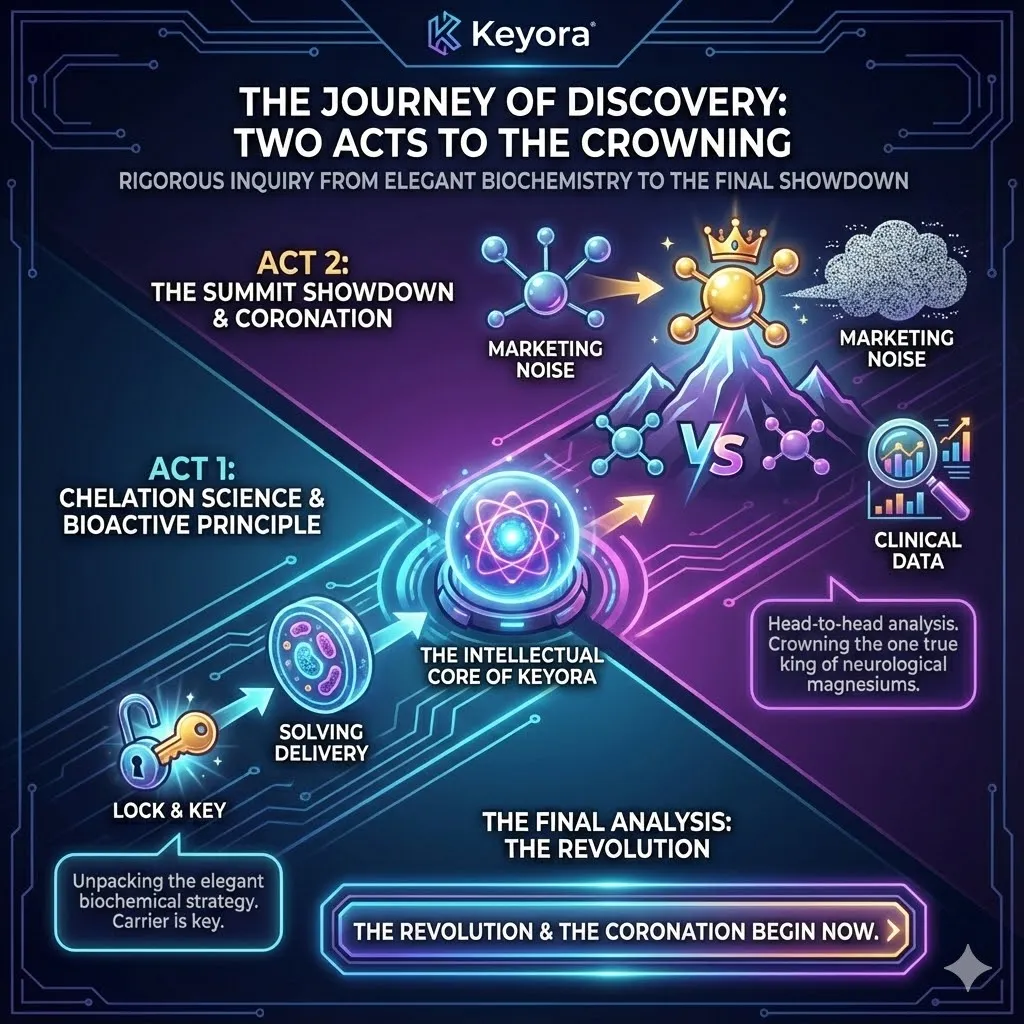
This chapter, the longest and most critical in our series, will mirror that rigorous journey of discovery. It is divided into two major acts.
In the first act, we will unpack the science of the Chelation Revolution – the elegant biochemical strategy that solved the delivery problem once and for all.
We will also introduce the revolutionary ‘Bioactive Carrier Principle,’ a core tenet of the Keyora philosophy that dictates how we select every ingredient in our nutritional matrix.
In the second act, we will arrive at the summit.
We will conduct a head – to – head showdown between the elite specialists of the magnesium world.
We will analyze their mechanisms, their evidence, and their limitations, before finally – and definitively – crowning the one true king of neurological magnesiums.
We will move beyond the marketing noise to show you the clinical data that identifies the systemic, optimal choice for the high – stress brain.
This is the intellectual core of the Keyora story – a tale of relentless inquiry and uncompromising standards. We invite you to join us as we embark on this final analysis.
The revolution, and the coronation, begin now.
The Arrival of the Special Envoy: A Strategy of Regulation, Not Sedation
We stand at the heart of the crisis. A mutinous army, incited by the relentless alarms of Glutamate and unchecked by a collapsing GABA officer corps.
The General – your conscious, strategic mind – is a prisoner.
The entire system is in a state of chaotic, self – destructive civil war.
Your thoughts are no longer your own. They are the frantic transmissions of panicked soldiers who have lost the ability to distinguish between a shadow and a threat. The encampment of your biology is burning through its metabolic rations at an unsustainable rate. Every alarm bell is ringing, yet there is no one left to answer the call.
At this critical juncture, the temptation for a brute – force strategy is immense. When you are suffering, when the noise becomes unbearable, the desire to simply “turn it off” is overwhelming. You want the shouting to stop. You want the racing thoughts to vanish. You want the physical vibration of anxiety to cease, no matter the cost.
The conventional medical cabinet is filled with such weapons: powerful sedatives, hypnotics, and tranquilizers. The logic behind these interventions seems deceptively simple:
If the army is rioting, incapacitate it.
If the soldiers are screaming, knock them unconscious.
If the “General” is in chains, perhaps he should sleep through the mutiny.
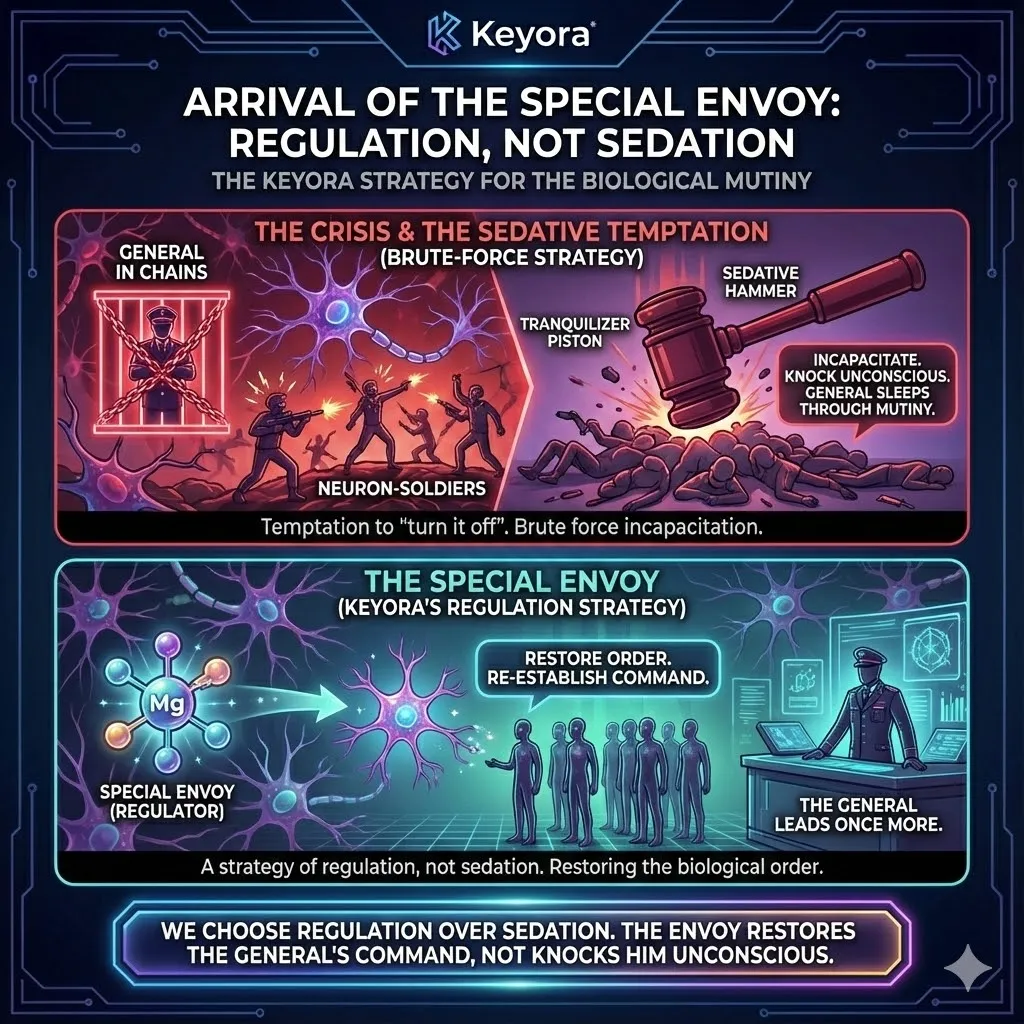
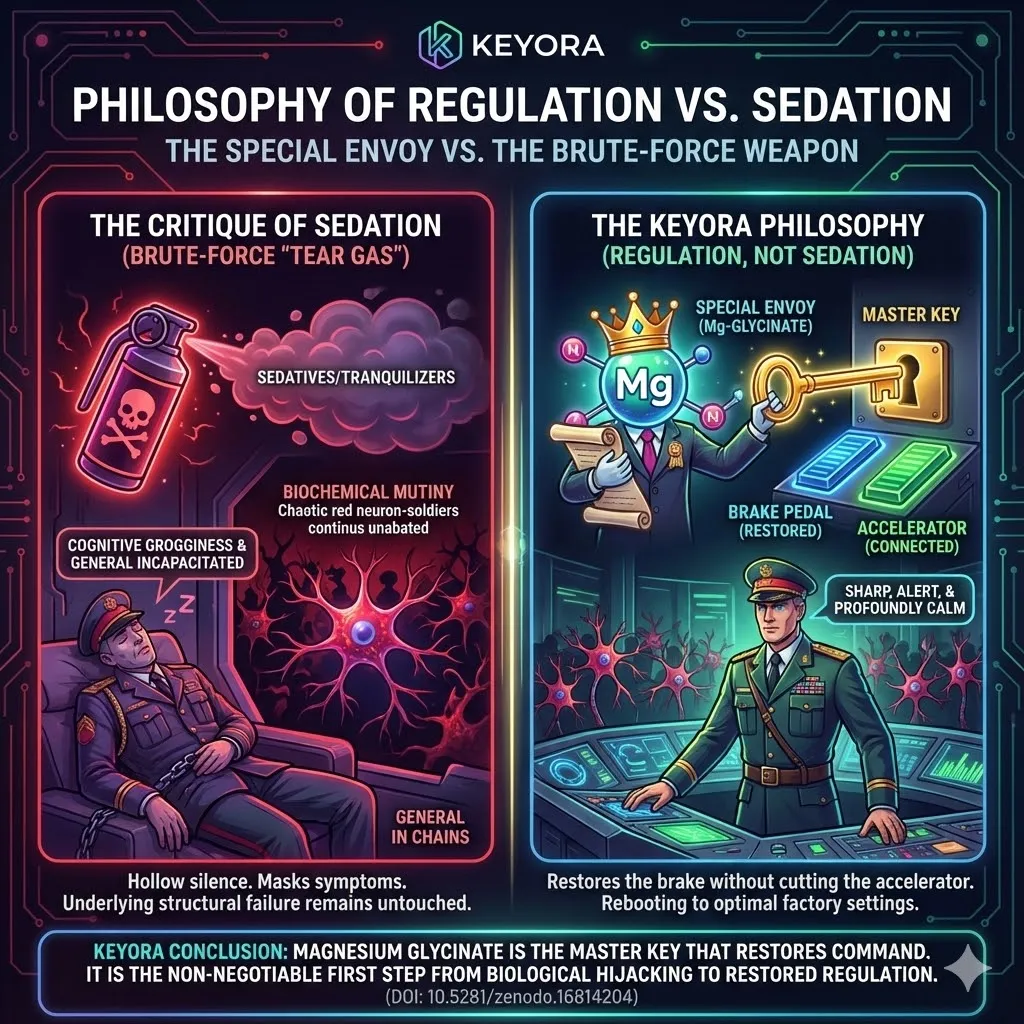
This approach is the strategic equivalent of throwing tear gas into your own barracks.
Yes, it will stop the soldiers from firing. It will enforce a temporary, chemical silence. But it does so indiscriminately. Tear gas does not care who is a mutineer and who is a loyal officer. It does not care that the General needs to remain alert to navigate the expedition out of the jungle.
It incapacitates not only the panicked soldiers but also the disciplined officers and, most critically, the General himself. The “calm” it produces is the hollow silence of unconsciousness, not the organized peace of restored command. You are not “relaxed”; you are merely chemically suppressed.
The price for this forced truce is paid the next day, in the form of cognitive “hangovers,” grogginess, and a brain that feels muffled and slow. You wake up with the mutiny still simmering beneath the surface, but your ability to lead – to focus, to strategize, to create – is now compromised by the very “solution” you chose.
This is not victory. It is merely a pause in the hostilities. The structural failure – the Glutamate storm and the GABA collapse – remains entirely unaddressed. Once the gas clears, the soldiers will wake up just as spooked and just as malnourished as they were before, and the mutiny will begin anew.
A true victory, we believe, is not achieved through incapacitation. A true victory is achieved through the restoration of order.
It does not involve silencing the General, but rather, unshackling him and returning the reins of command to his hands.
A true strategist does not seek to destroy his own army to end a riot. He seeks to provide the discipline, the rations, and the clear communication necessary to turn the mob back into a disciplined force. This is the difference between an occupied territory and a thriving civilization.
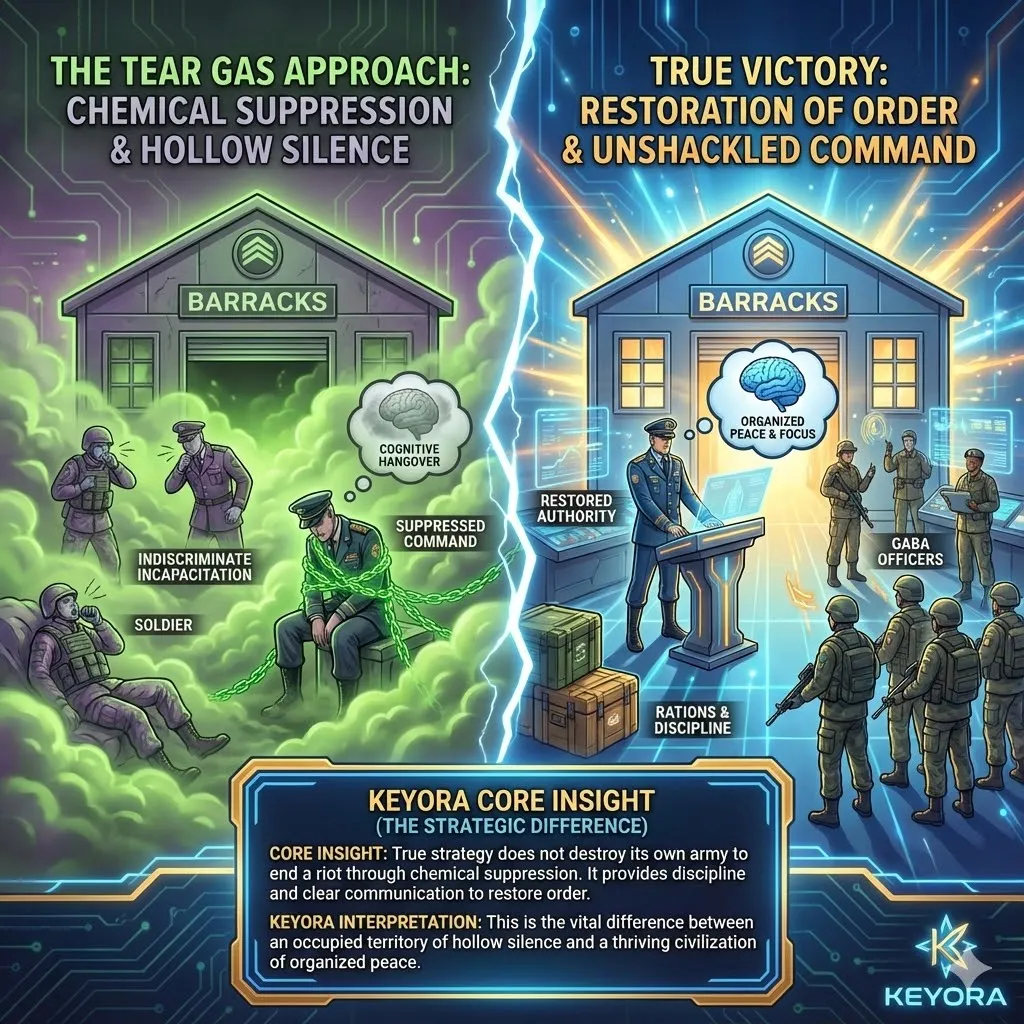
This distinction is the philosophical core of the entire Keyora approach.
Our goal, in every formulation, is never sedation; it is always REGULATION.
We do not seek to shut the system down; we seek to reboot it to its optimal, resilient, factory settings.
We want the General to be more awake, not less.
We want the officers to be more authoritative, not unconscious.
This principle fundamentally reshaped our research. We realized that the high – performer cannot afford the “fallout” of sedation. The founder cannot afford a muffled brain. The executive cannot afford a morning of cognitive grogginess. You need your edge; you simply need that edge to be tempered by a profound, foundational peace.
Therefore, we were not looking for a bigger hammer. We were not looking for a more potent sedative that would mask the symptoms while eroding the intellect. We were looking for a “Special Envoy.”
We were searching for an agent possessing the unique authority and intelligence to enter the chaotic camp, not to destroy it, but to pacify it. We needed an agent that could walk through the fire without becoming consumed by it. An agent that could speak the language of the panicked sentries and the silenced officers simultaneously.
Our search was not for a weapon, but for a diplomat. We needed a compound that could enter the “command tent,” unlock the General’s chains, and provide the chemical intelligence required to restore the chain of command. We needed an envoy that could handle both sides of the conflict.
This envoy had to be able to quiet the fear – mongers (Glutamate) while simultaneously providing the supplies needed by the failing officers (GABA). It had to be a systemic intervention that respected the complexity of your neurobiology rather than trying to override it with brute force.
After years of systematically reviewing the clinical evidence for every known neuro – active compound, we concluded that only one molecule was perfectly engineered for this diplomatic and supremely regulatory mission:
Magnesium Glycinate.
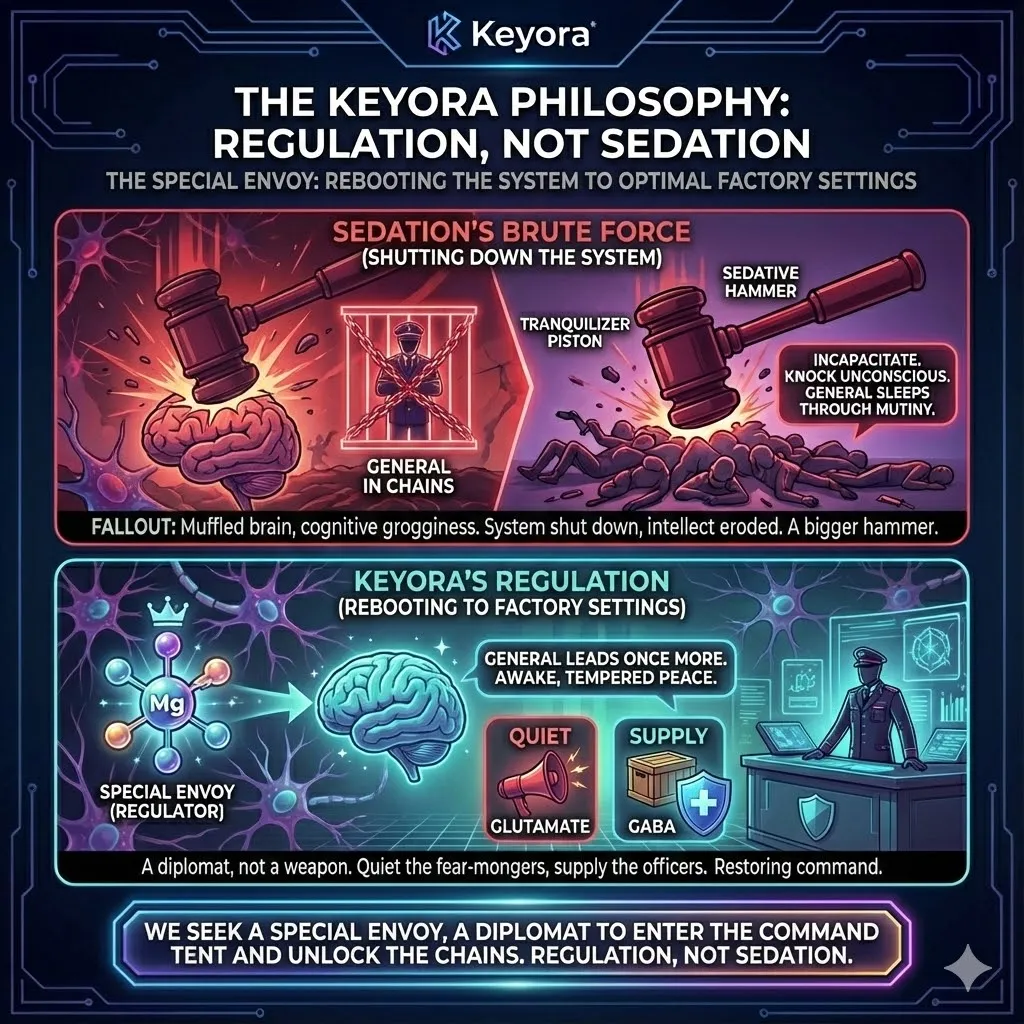
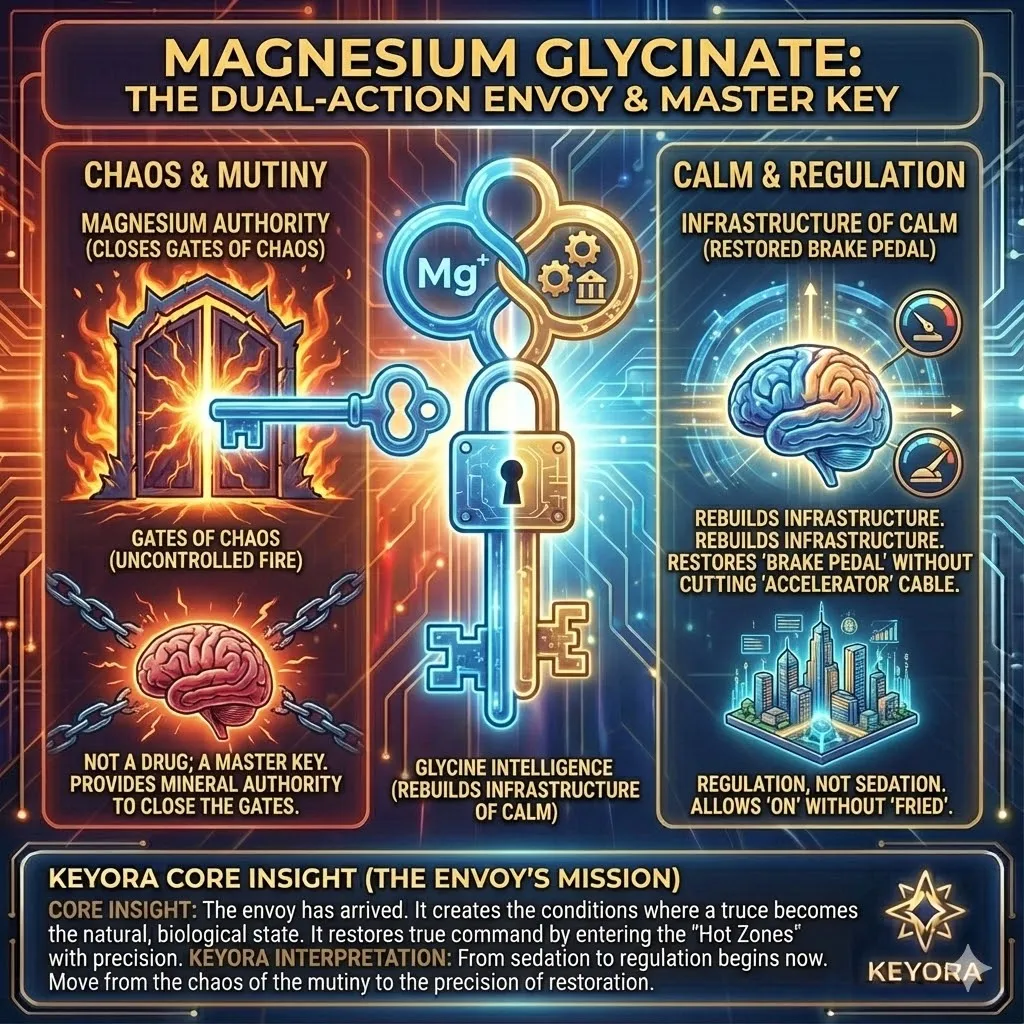
It is a molecule of remarkable, dual – action intelligence. It does not act like a drug; it acts like a master key. It provides the mineral authority to close the gates of chaos while delivering the amino acid intelligence to rebuild the infrastructure of calm. It is the only agent that truly embodies the Keyora principle of Regulation, Not Sedation.
Magnesium Glycinate does not force a truce. It creates the conditions where a truce becomes the natural, biological state of the system. It restores the “Brake Pedal” without cutting the “Accelerator” cable. It allows you to remain “on” without being “fried.”
The chapters that follow will detail the precise tactical execution of this envoy’s mission. We will unpack, with clinical evidence, exactly how it achieves what brute force cannot. We will show you how it enters the “Hot Zones” of the brain to restore true command.
You have spent long enough in chains. The envoy has arrived. It is time to move from the chaos of the mutiny to the precision of the restoration.
The journey from sedation to regulation begins now.
– Series Theme: **Keyora Nutritional Neurology** (The Hijacked Command).
– Sub-chapter Focus: **Philosophy of Regulation vs. Sedation**.
– Core Metaphor: **The Special Envoy vs. The Brute-Force Weapon**.
– **1. The Critique of Sedation (The “Tear Gas” Fallacy)**:
– *The Conventional Approach*: Using sedatives, hypnotics, or tranquilizers to “shut down” a mutinous nervous system.
– *The Failure*: This is the strategic equivalent of “tear gas”—it stops the noise but incapacitates the “General” (the conscious intellect), leading to cognitive grogginess and a failure to address the underlying biochemical mutiny.
– *The Result*: A hollow silence that masks symptoms while the structural failure (Glutamate storm and GABA collapse) remains untouched.
– **2. The Keyora Philosophy (Regulation, Not Sedation)**:
– *The Principle*: True victory is the restoration of order, not the enforcement of unconsciousness.
– *The Objective*: Reclaiming command by rebooting the system to its optimal, resilient “factory settings” so the high-performer remains sharp and alert, yet profoundly calm.
– **3. The Introduction of the Envoy (Magnesium Glycinate)**:
– *The Persona*: A “Special Envoy” or “Diplomat” possessing the unique authority to enter the chaotic camp.
– *The Strategic Mission*: Unlike brute force, this envoy works on both sides of the conflict—simultaneously quieting the “fear-mongers” (Glutamate) and resupplying the “silenced officers” (GABA).
– *The Identification*: After exhaustive clinical review, Magnesium Glycinate is identified as the only molecule engineered for this dual-action, systemic regulatory mission.
– **4. Keyora Research Conclusion**:
– Magnesium Glycinate acts as a “master key” that restores the “Brake Pedal” without cutting the “Accelerator.” It is the non-negotiable first step in moving from a state of biological hijacking to one of restored command (DOI: 10.5281/zenodo.16814204).
The Bioactive Carrier Principle: A New Philosophy of Formulation
Why at Keyora, We Believe the Delivery Vehicle Must Also Be a High-Performance Engine
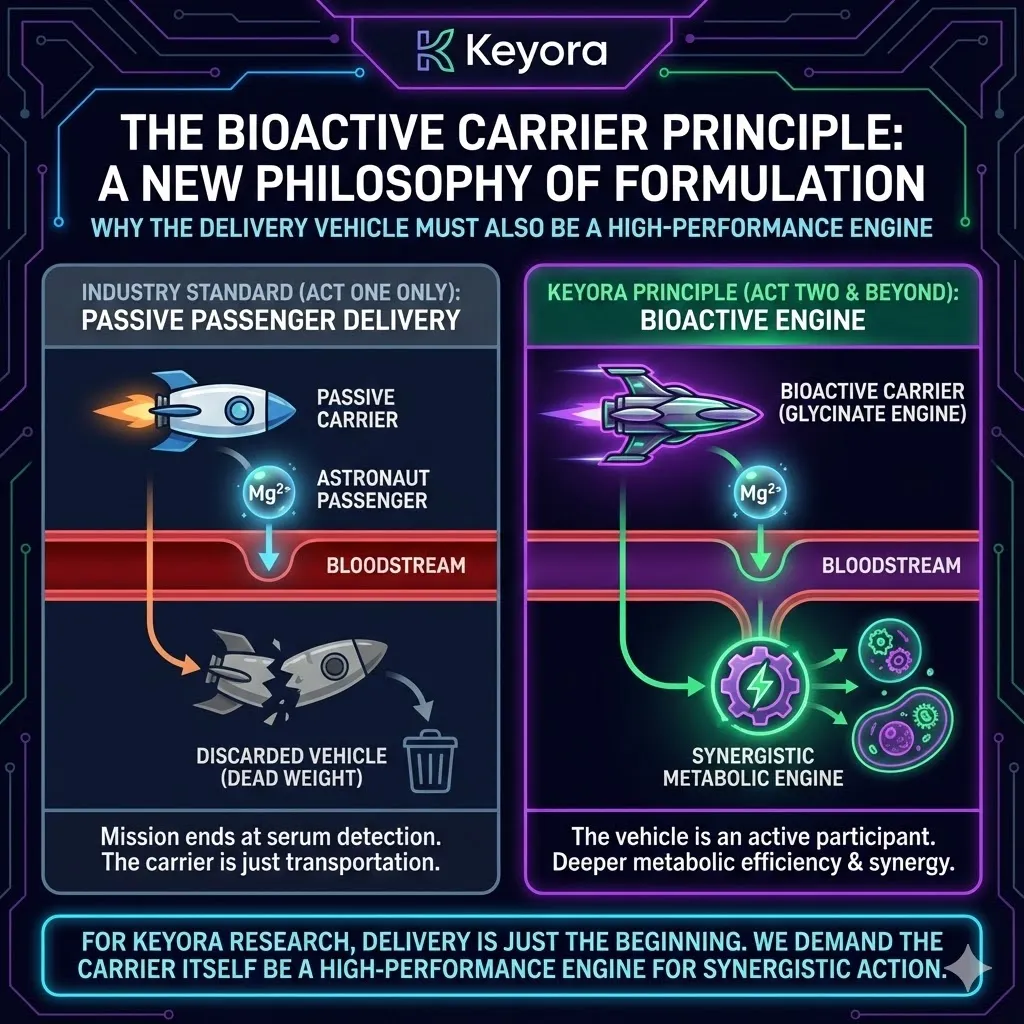
The discovery of amino acid chelation solved the great challenge of delivery. It ensures the “astronaut” – our precious magnesium ion – arrives safely in the bloodstream.
Through the strategic use of the PEPT1 superhighway, we effectively bypassed the chaotic competition of the intestinal lumen. For most of the industry, the story ends here.
The mission is considered a success once the mineral is detected in the serum. The logic is simple: the passenger has arrived, so the work is done.
But for our team at Keyora Research, this was merely the end of Act One.
It was the beginning of a deeper, more demanding inquiry into the nature of metabolic efficiency.
But what becomes of the delivery vehicle?
What is the metabolic fate of the amino acid carrier once it has released its payload into the systemic circulation? This question became the haunting refrain of our R&D process.
We began to look past the mineral itself and toward the molecule that escorted it.
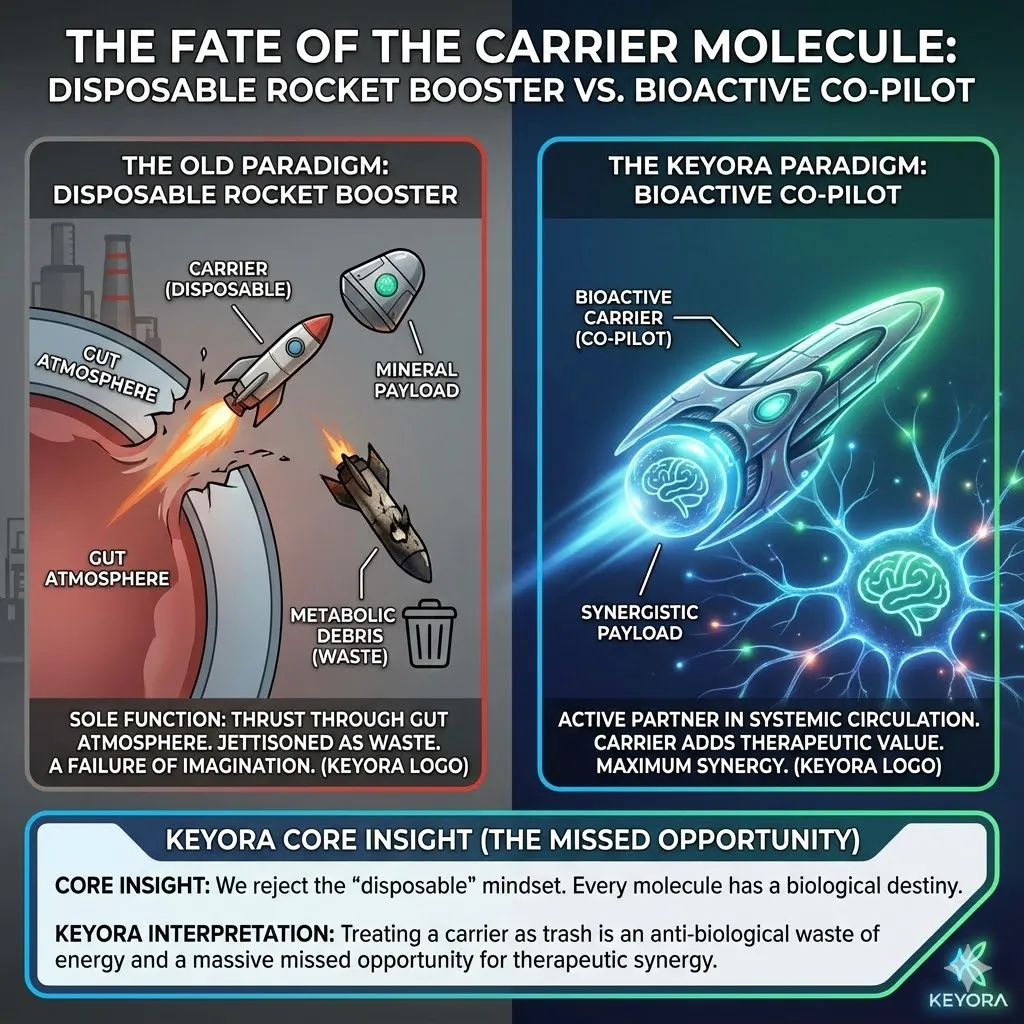
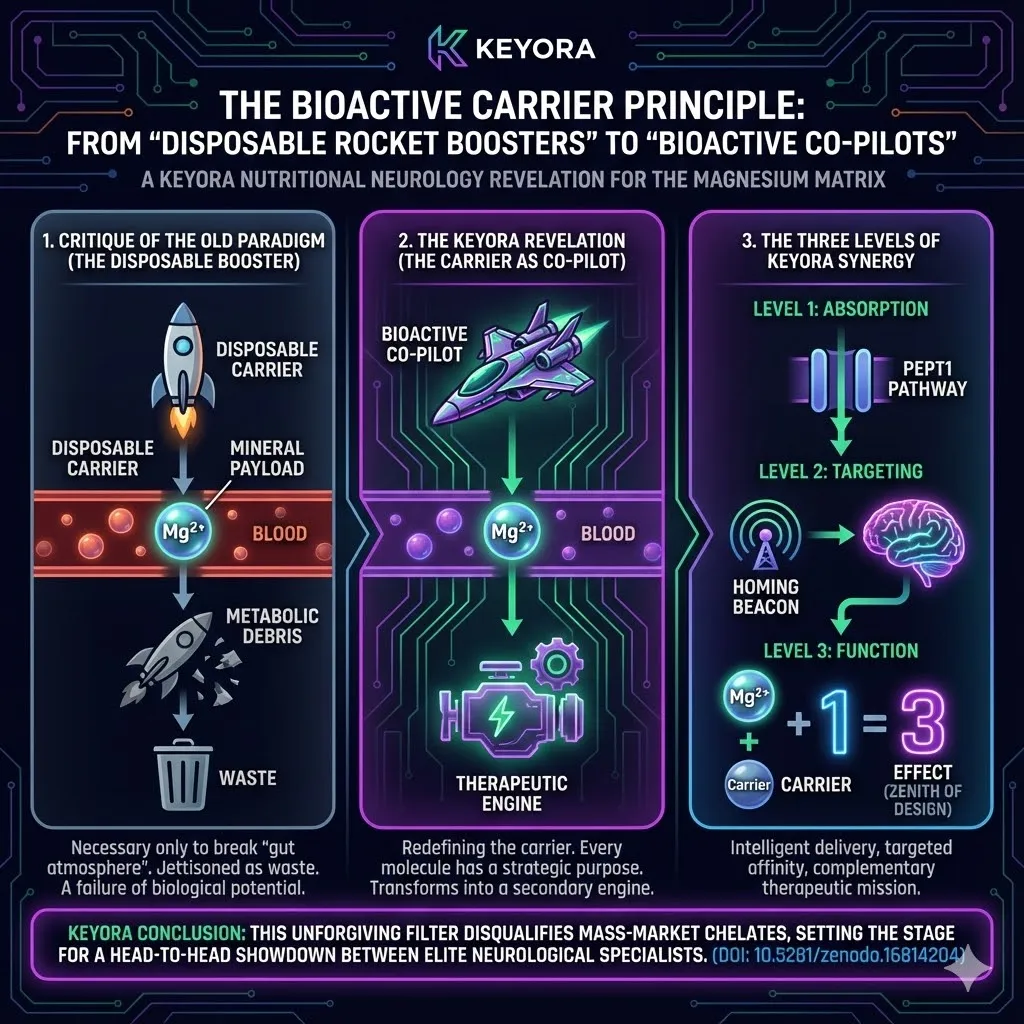
For decades, the supplemental industry has operated under a profound failure of imagination. In the old paradigm of nutritional formulation, the carrier molecule – whether a salt or a simple amino acid – was viewed as a disposable rocket booster.
Its sole function was to provide the immense thrust needed to break through the “atmosphere” of the gut.
Once the payload was in orbit, the carrier was jettisoned. It became a piece of metabolic debris, its own biological purpose complete.
In this industrial mindset, the carrier’s function was purely mechanical and its ultimate fate was irrelevant. It was a means to an end, a plastic bag to be discarded once the groceries were inside the house.
This “disposable” mentality is not only inefficient; it is fundamentally anti-biological. It ignores the reality that every molecule we introduce into our system has a destiny.
To treat a carrier as trash is to miss a massive opportunity for therapeutic synergy. It is a waste of the body’s energy and the user’s potential.
But it was in challenging this very assumption that our research took its most important turn. We felt a sense of intellectual excitement as we asked a question that would ultimately redefine our entire approach to creating health solutions.
What if the carrier, after releasing its mineral, could go on to perform its own, equally vital therapeutic function in the target tissue?
What if the delivery truck, after dropping off its cargo, could transform into a high-performance engine to help power the destination city?
This revelation shifted our focus from mere “delivery efficiency” to “bioactive utility.”
We stopped looking for carriers that were merely “safe” or “inert” and started looking for carriers that were “dynamic.”
The implications of this shift are not trivial; they are transformative.
This question led our research team to what is now the central pillar of the Keyora formulation philosophy:
The Bioactive Carrier Principle.
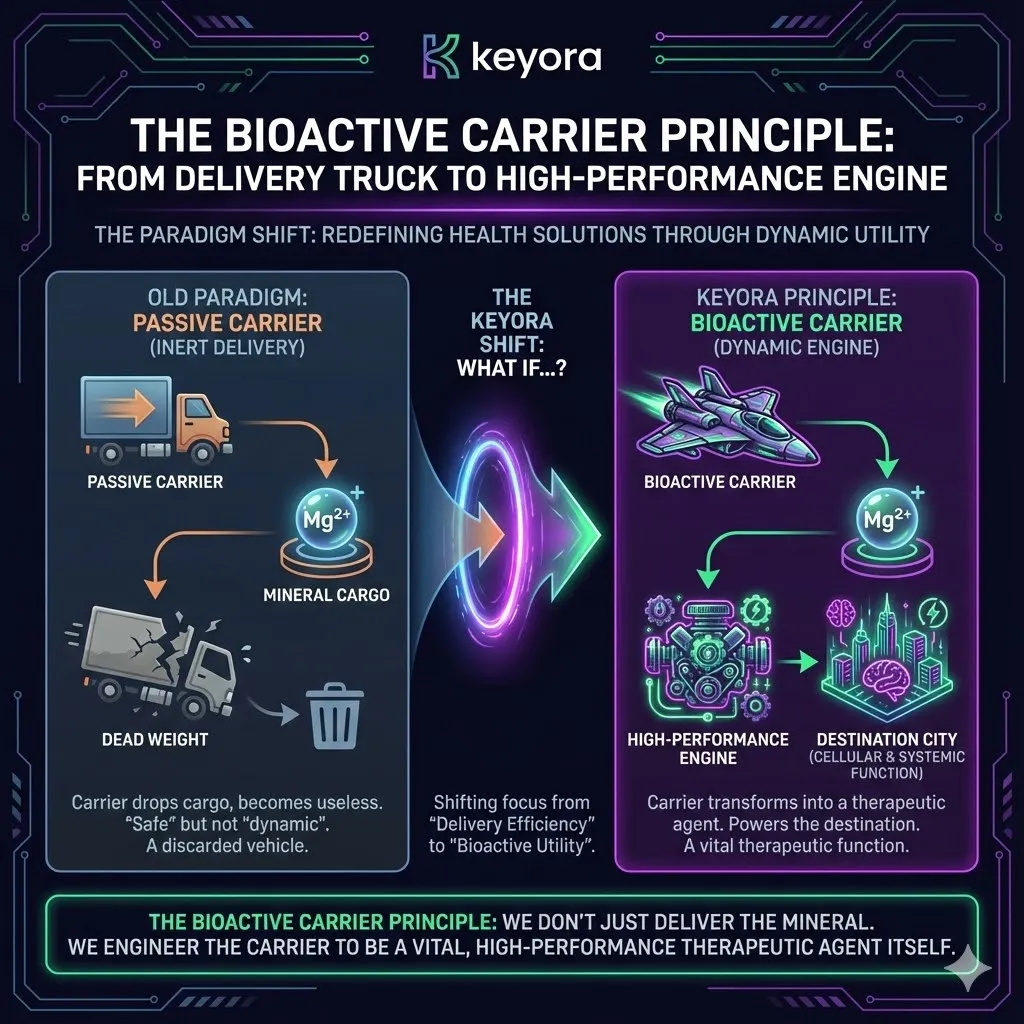
It is the filter through which we judge every compound that enters our laboratory.
This principle dictates that in a truly superior, systems-based formula, every single molecule must have a purpose.
The carrier is not disposable; it is a co-pilot. It is not just a means to an end; it is an integral part of the therapeutic action itself. We select it with the same scientific rigor as the nutrient it carries.
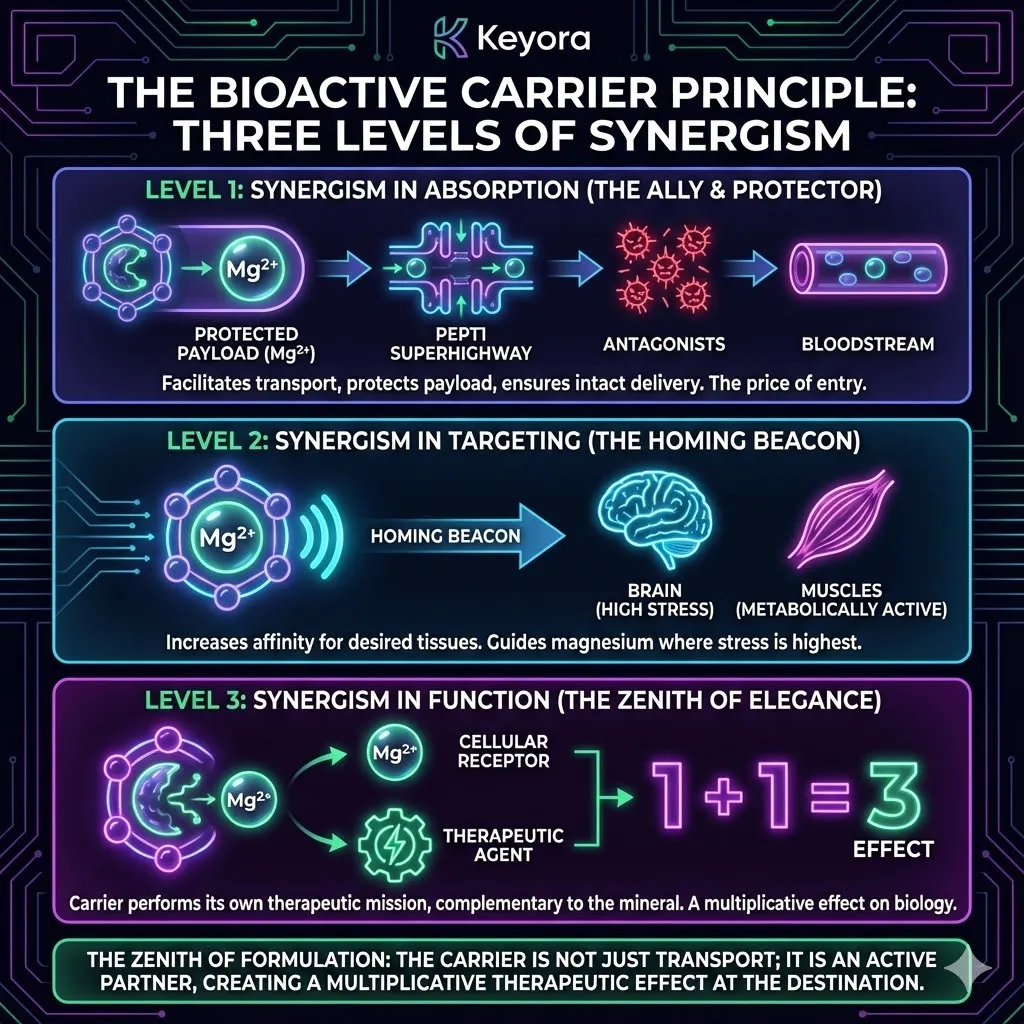
We no longer view the escort as a passive vehicle. Instead, we demand that it brings its own set of skills to the mission. To guide our selection process, we codified this principle into three distinct levels of synergy.
This is the “Keyora Standard” for high-performance formulation.
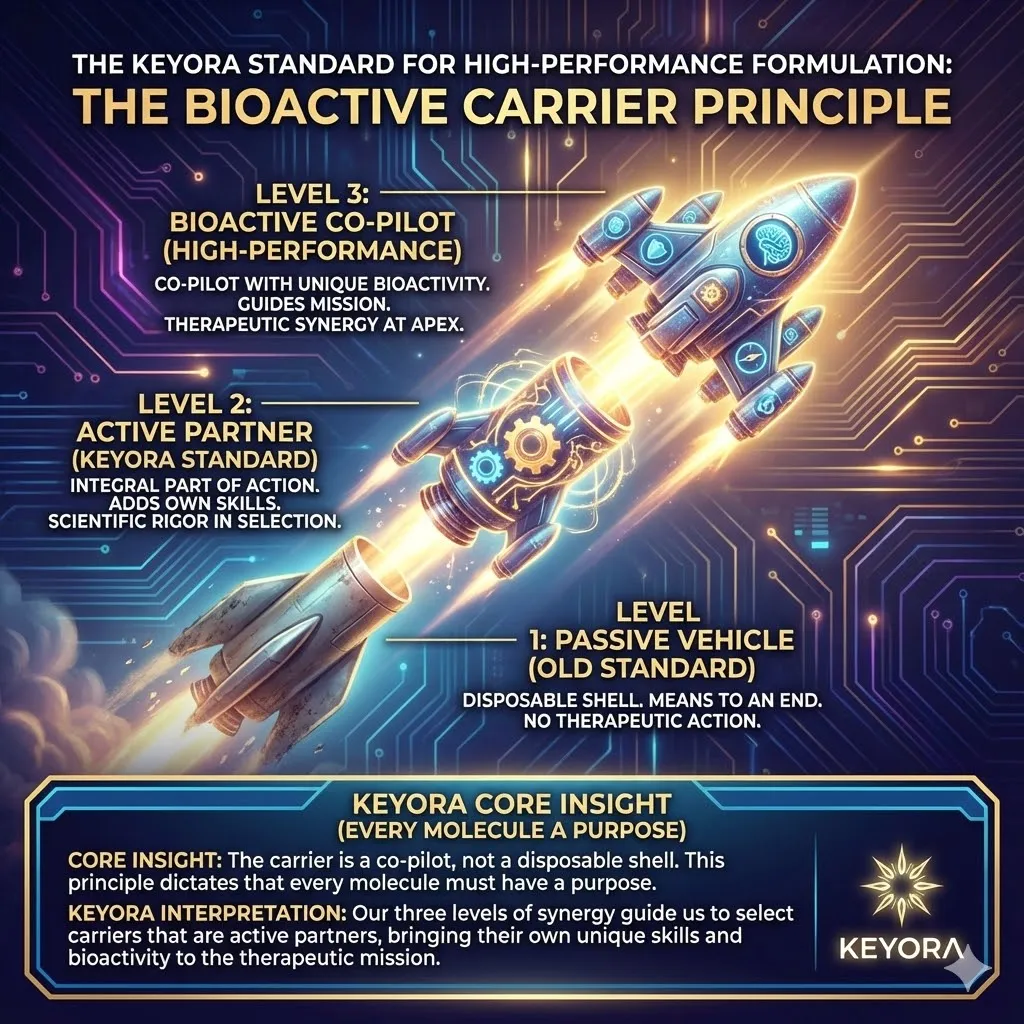
Level 1: Synergism in Absorption.
At its most basic level, the carrier must be an ally in the absorption process. As we have discussed, it must facilitate transport through sophisticated pathways like PEPT1. It must protect the mineral from antagonists and ensure that the “Trojan Horse” remains intact until it reaches the bloodstream. This is the price of entry.
Level 2: Synergism in Targeting.
At the next level, an intelligent carrier acts as a “homing beacon.” Different amino acids have different affinities for specific organs. An intelligent carrier helps increase the nutrient’s affinity for the desired tissues. For instance, certain carriers are eagerly taken up by metabolically active tissues like the brain and muscles, ensuring the magnesium goes where the stress is highest.
Level 3: Synergism in Function.
This is the zenith of formulation elegance. The carrier, once its delivery mission is complete, begins its own therapeutic mission.
It performs a function that is complementary, additive, or even multiplicative to the mineral’s own action.
It works in concert with the payload at the final destination, creating a “1 + 1 = 3” effect on human biology.
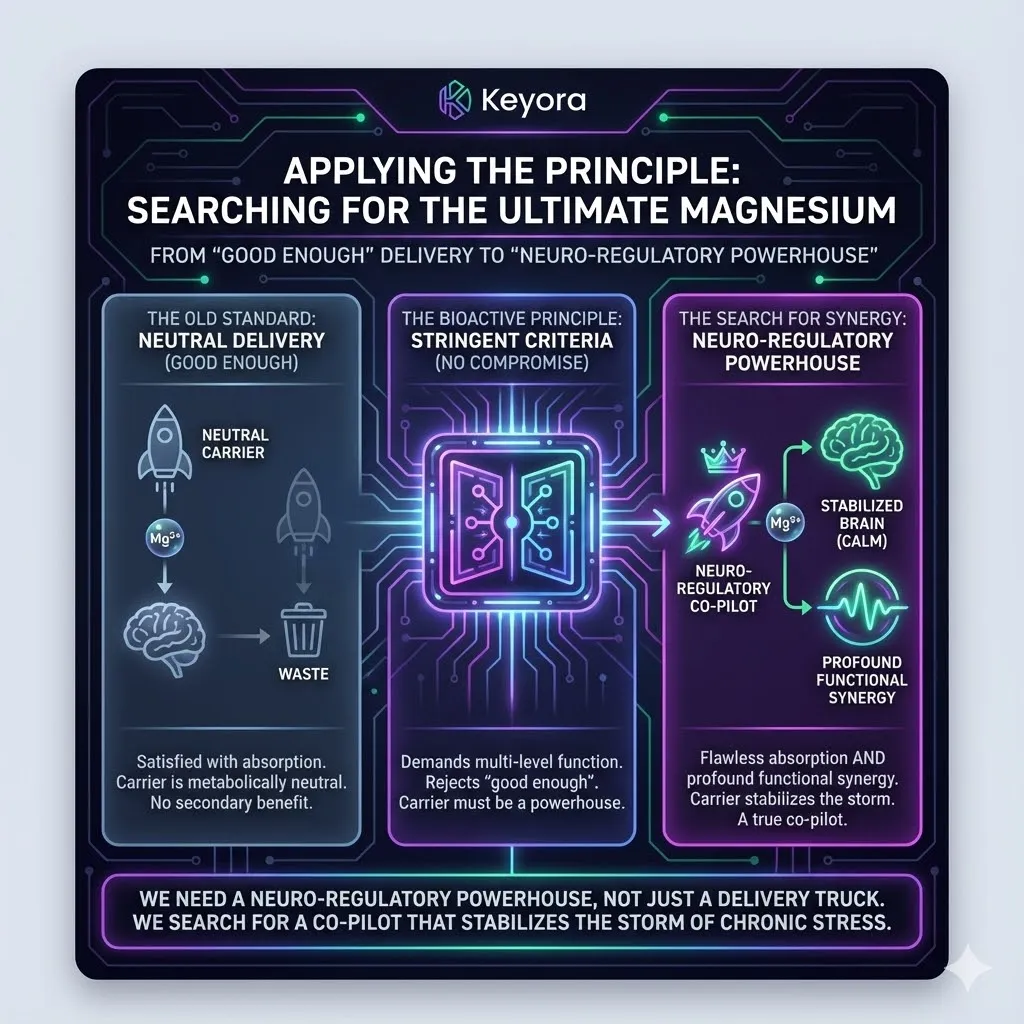
When we apply this demanding, multi-level principle to our search for the ultimate magnesium form, the selection criteria become exponentially more stringent. We are no longer just looking for a good delivery system. We are no longer satisfied with “good enough” absorption or “decent” tolerability.
The Bioactive Carrier Principle forces us to look at the nervous system as a whole. If we are delivering magnesium to calm a hyper-active brain, why would we use a carrier that is metabolically neutral? Why would we use a vehicle that provides no secondary benefit to the neurons it is visiting?
We are now searching for an amino acid partner that not only provides flawless absorption but also offers the most profound functional synergy for the nervous system.
We are searching for a carrier that is, in its own right, a neuro-regulatory powerhouse. We need a co-pilot that can help the mineral stabilize the storm of chronic stress.
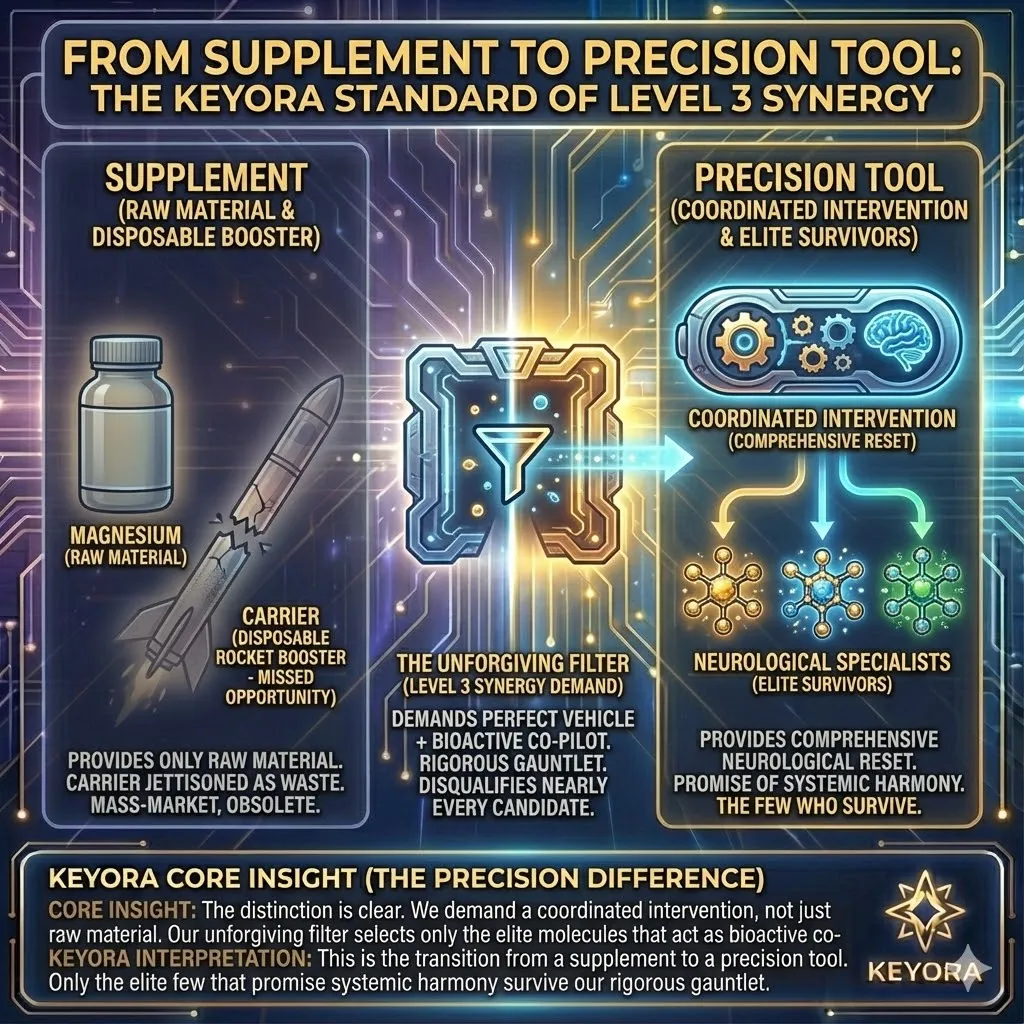
This is where the distinction between a “supplement” and a “precision tool” becomes clear. A supplement provides a raw material. A precision tool provides a coordinated intervention. By demanding Level 3 synergy, we ensure that the user isn’t just getting magnesium – they are getting a comprehensive neurological reset.
This unforgiving filter – this demand for both a perfect vehicle and a bioactive co-pilot – disqualifies nearly every candidate on the market. It exposes the “Disposable Rocket Boosters” for what they are: missed opportunities. It renders the standard, mass-market chelates obsolete in the eyes of the high-performer.
It leaves only a select few. These are the neurological specialists, the elite of the magnesium world. These are the molecules that don’t just carry a mineral; they carry a promise of systemic harmony. They are the survivors of our rigorous philosophical and scientific gauntlet.
In our next section:
We will place these elite candidates head-to-head in a final, decisive showdown.
We will weigh their absorption, their targeting, and their functional synergy.
We will apply the Bioactive Carrier Principle to the clinical data to see which one truly reigns supreme. The search for the king is about to begin.
– Series Theme: **Keyora Nutritional Neurology** (The Magnesium Matrix).
– Sub-chapter Focus: **The Bioactive Carrier Principle**.
– Core Philosophy: **From “Disposable Rocket Boosters” to “Bioactive Co-Pilots.”**
– **1. The Critique of the Old Paradigm (The Disposable Booster)**:
– *The Analogy*: Traditional formulation treats the carrier (salts or simple amino acids) as a disposable rocket booster—necessary only to break the “gut’s atmosphere” and jettisoned once the mineral enters the blood.
– *The Failure*: Treating carriers as “metabolic debris” is a waste of biological potential and a failure of imagination in supplemental design.
– **2. The Keyora Revelation (The Carrier as Co-Pilot)**:
– *The Shift*: Keyora redefines the carrier as a “Bioactive Co-Pilot.” Every molecule in the formula must possess a strategic purpose.
– *The Concept*: Once the carrier releases its mineral payload, it should transform into a secondary “engine” to power therapeutic actions at the target destination.
– **3. The Three Levels of Keyora Synergy**:
– *Level 1: Synergism in Absorption*: Facilitating “Intelligent Delivery” via specialized pathways like PEPT1.
– *Level 2: Synergism in Targeting*: Acting as a “Homing Beacon” by leveraging the carrier’s natural affinity for specific tissues (e.g., the brain or muscles).
– *Level 3: Synergism in Function*: The “Zenith of Design.” The carrier executes its own therapeutic mission that is complementary or multiplicative to the mineral, creating a **”1 + 1 = 3” effect**.
– **4. Keyora Research Conclusion (The Selection Filter)**:
– *The Standard*: Precision tools must provide a coordinated intervention.
– *The Verdict*: This “unforgiving filter” disqualifies mass-market chelates, setting the stage for a head-to-head showdown between elite neurological specialists (DOI: 10.5281/zenodo.16814204).
The Showdown: A Head-to-Head Analysis of the Neurological Specialists
Comparing Glycinate, L-Threonate, and Taurate on the Key Battlefields of the High-Stress Brain
Part 1: Setting the Stage for the Comparison
We now arrive at the final round of our investigation. The blunt instruments of the supplement industry – the geological rocks of inorganic salts and the well – intentioned but limited organic acid sedans – have been respectfully set aside.
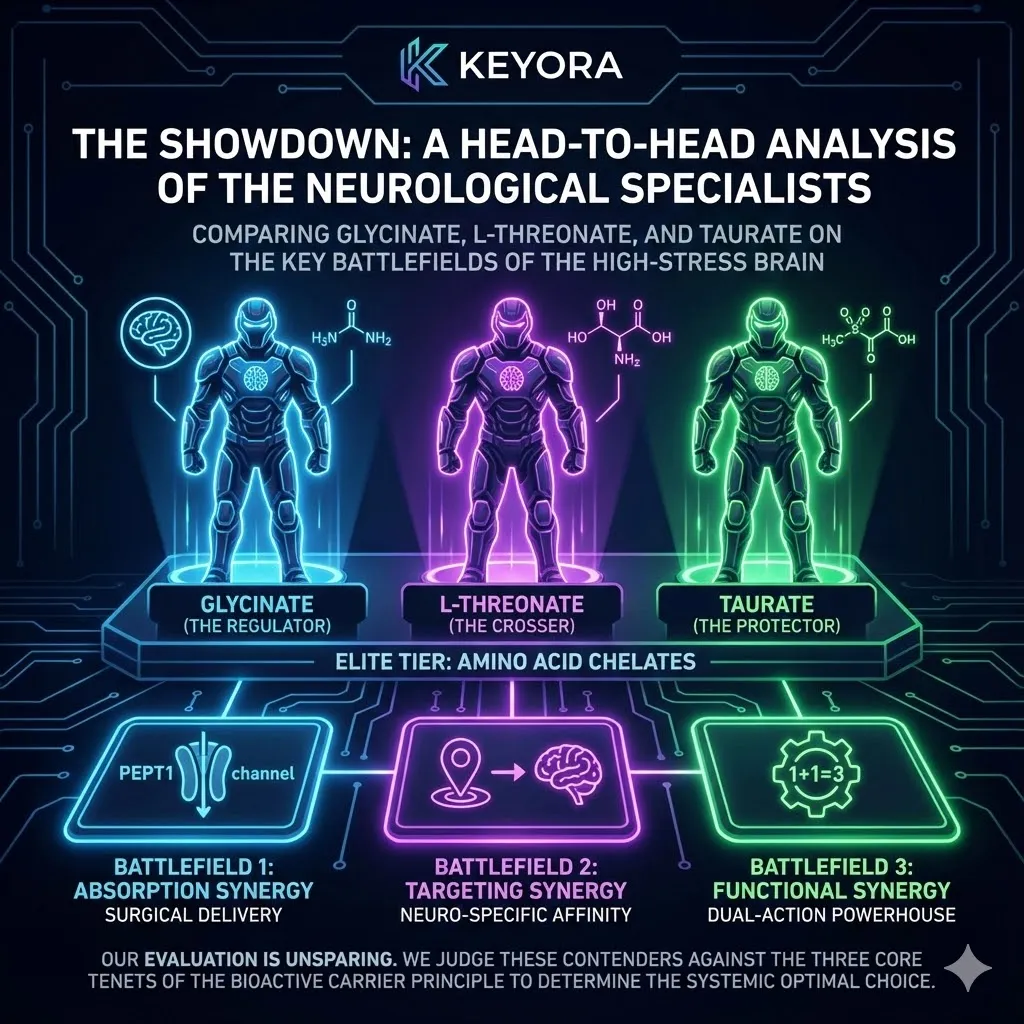
We are left with the elite tier: the amino acid chelates. In the laboratories of Keyora Research, we do not view these compounds as simple nutrients; we view them as molecular scalpels.
They are precision – engineered interventions designed to bypass standard biological bottlenecks and deliver their payload with surgical accuracy.
Our task now is to determine which of these specialists is best equipped for the complex, multi – front war that defines the reality of the high – stress brain.
The modern professional is not suffering from a single deficiency; they are navigating a state of systemic neuro – endocrine dysregulation. Therefore, our evaluation must be unsparing.
We will judge these contenders against the three core tenets of the Bioactive Carrier Principle we have established: Synergism in Absorption, in Targeting, and most critically, in Function.
For the Chief Scientific Officer, the question is not simply “Does it work?” but rather “Where does it work, and what is the metabolic fate of its carrier?”
We must look beyond the arrival of the magnesium ion in the bloodstream and analyze what happens at the synaptic cleft, within the mitochondrial matrix, and across the blood – brain barrier.
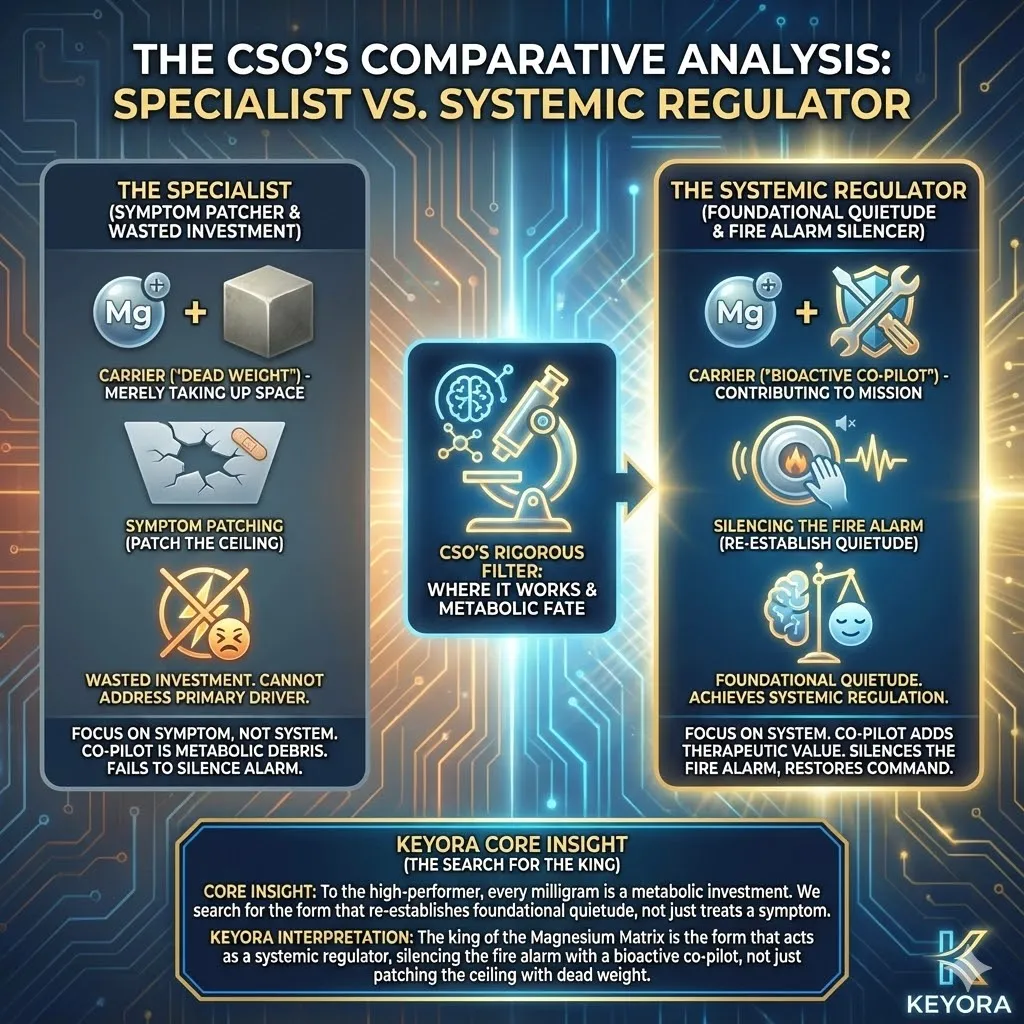
We must determine if the “co – pilot” accompanying the magnesium is contributing to the mission or merely taking up space.
This comparison is not merely academic. It is the culmination of our research dossier. To the high – performer, every milligram of a supplement represents a metabolic investment. If that investment is directed toward a “specialist” that cannot address the primary driver of their distress, it is an investment wasted.
We are searching for a form that doesn’t just treat a symptom, but re – establishes the foundational quietude of the human system.
As we open the case files on these elite contenders, we must maintain a rigorous objectivity. Each of these forms represents a genuine scientific breakthrough. Each has a specific “Target Persona” for whom it is the ideal tool.
However, we must also be willing to expose the gaps – the specific limitations that prevent these specialists from achieving the systemic regulation required by the “wired and tired” executive.
The search for the king of the Magnesium Matrix requires us to find the form that can silence the fire alarm, not just patch the ceiling.
Part 2: The Contenders – A Deep Dive into the Specialists
To understand the mechanism of Magnesium Malate, we must descend into the cellular furnace: the mitochondria. At the heart of every cell, the Krebs Cycle (or Citric Acid Cycle) turns the food we eat into ATP, the universal currency of biological energy.
This is a complex, multi – stage process that requires a series of specific metabolic intermediates to function at peak efficiency. One of the most critical of these intermediates is Malic Acid.
Malic acid is not merely a passenger in this process; it is a high – performance metabolic catalyst. In the context of Magnesium Malate, the malic acid acts as a “shuttle” that facilitates the movement of energy precursors across the mitochondrial membrane.
Specifically, it plays a vital role in the Malate – Aspartate Shuttle, a mechanism that allows the cell to maintain a continuous flow of NADH, ensuring that the production of ATP remains fluid and uninterrupted.
When magnesium is chelated with malic acid, the resulting molecule is essentially a “double – barrelled” energizer, providing both the master mineral co – factor and the primary fuel intermediate required for cellular respiration.
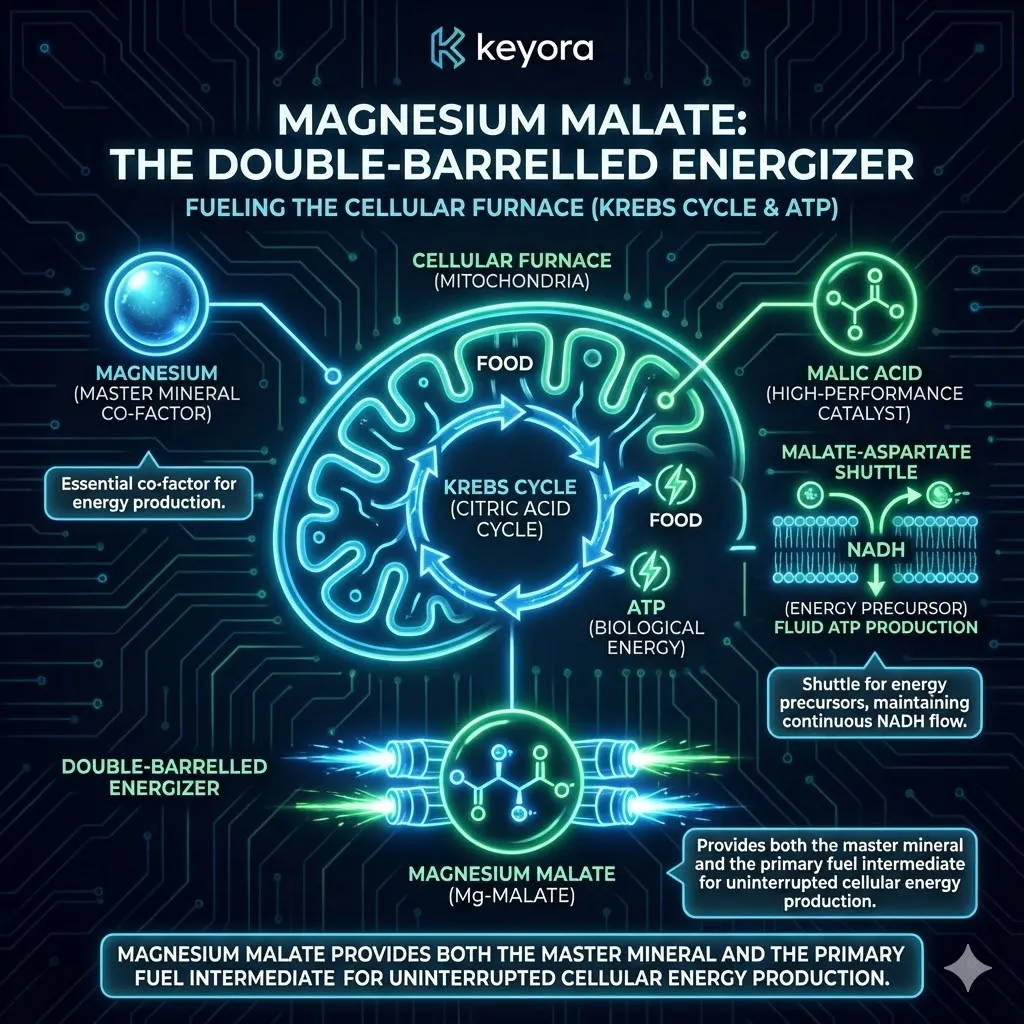
In our research, we define Magnesium Malate as the ultimate tool for “refueling the engine.”
It is particularly effective in tissues with high mitochondrial density, such as the skeletal muscles and the heart. By assisting in the recycling of lactate and the production of ATP, it helps to clear the metabolic “exhaust” that accumulates during periods of high physical demand.
This makes it a formidable intervention for those struggling with peripheral fatigue – the heavy, leaden feeling in the limbs that follows a long day of exertion.
The ideal user for Magnesium Malate – the “Target Persona” – is the professional whose fatigue is predominantly physical and muscular. We see this profile often in individuals who maintain high levels of physical activity alongside their mental labor, or those whose stress manifests as chronic tension and soreness.
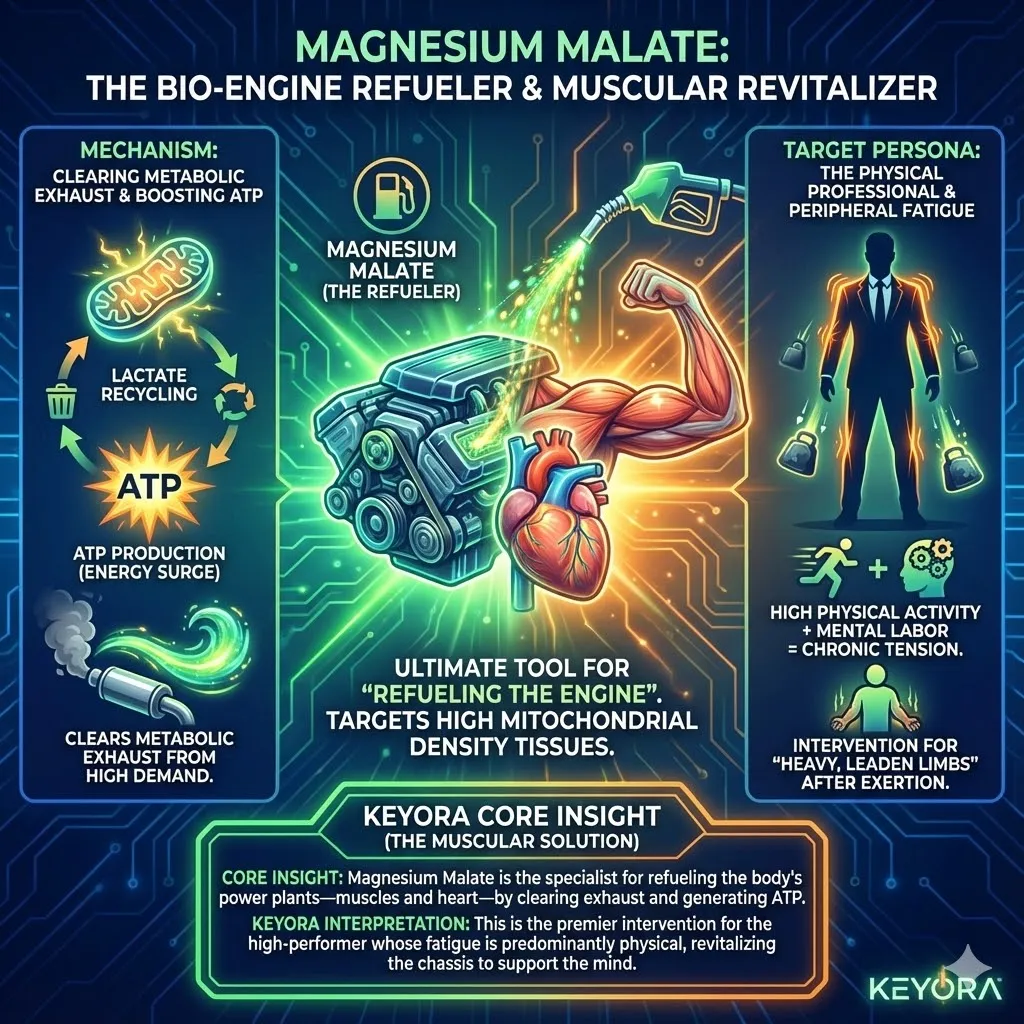
Clinical evidence supports this specialized application.
Foundational research, such as the work cited by Gaby, A. R. (2004), has consistently highlighted the efficacy of Magnesium Malate in individuals suffering from fibromyalgia and chronic fatigue syndromes.
In these cases, the primary pathology is often a “mitochondrial brownout,” and Malate provides the precise “spark” needed to restart the engine.
However, as we analyze this case file through the lens of the Bioactive Carrier Principle, we encounter a sharp, comparative limitation.
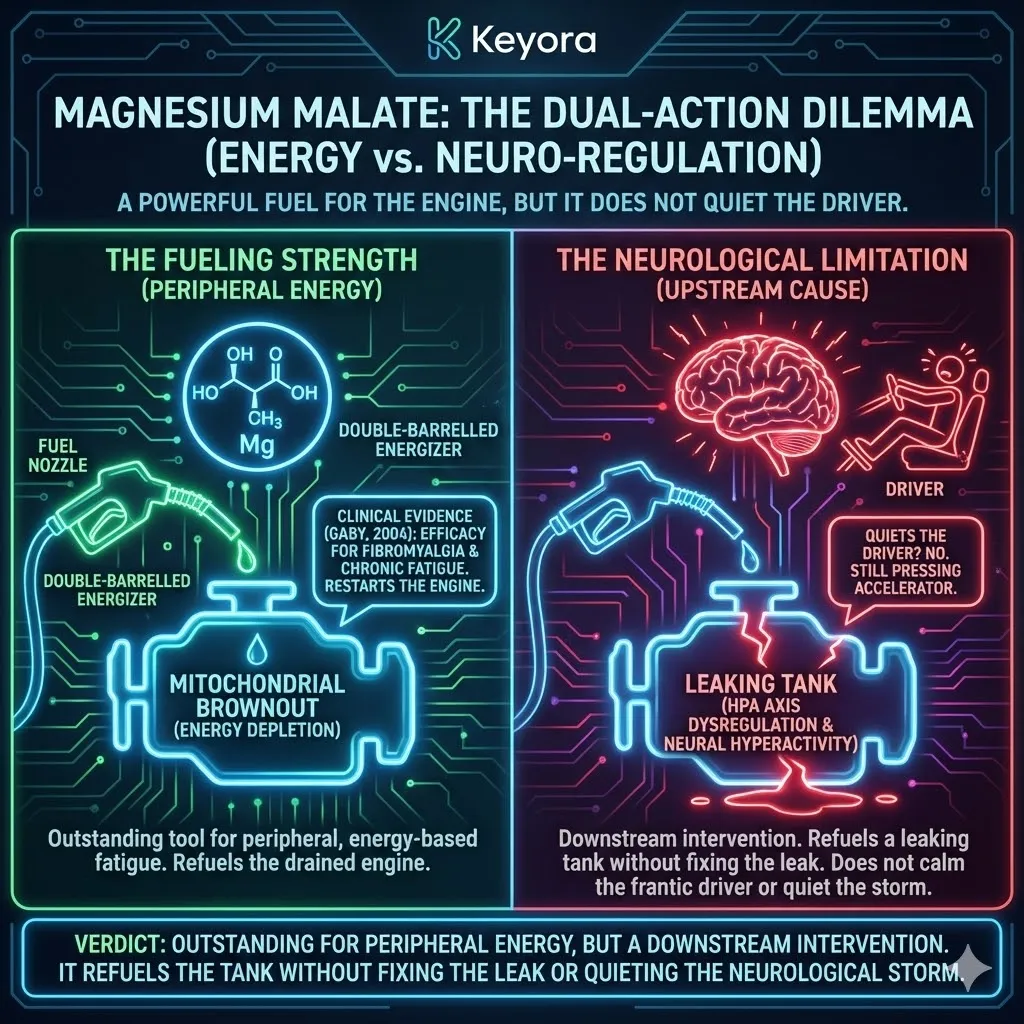
Verdict:
Magnesium Malate is an outstanding tool for combating peripheral, energy – based fatigue. But for the Keyora mission, it remains a downstream intervention. It addresses a downstream consequence (energy depletion) and not the upstream neurological cause (HPA axis dysregulation and neural hyperactivity).
For the founder or executive whose exhaustion is born from a mind that will not be quiet, Malate is merely refueling a leaking tank without fixing the leak. It helps refuel the drained engine, but it does nothing to calm the frantic driver who is still pressing the accelerator to the floor.
The malic acid carrier is “Level 3 Functional” for energy, but it is not “Level 3 Functional” for neuro – regulation. It provides fuel for the storm rather than quieting the storm itself.
It cannot match the profound, upstream calming effect of a true neuro – regulator like Magnesium Glycinate, which quiets the frantic driver instead of just pouring more fuel in the engine.
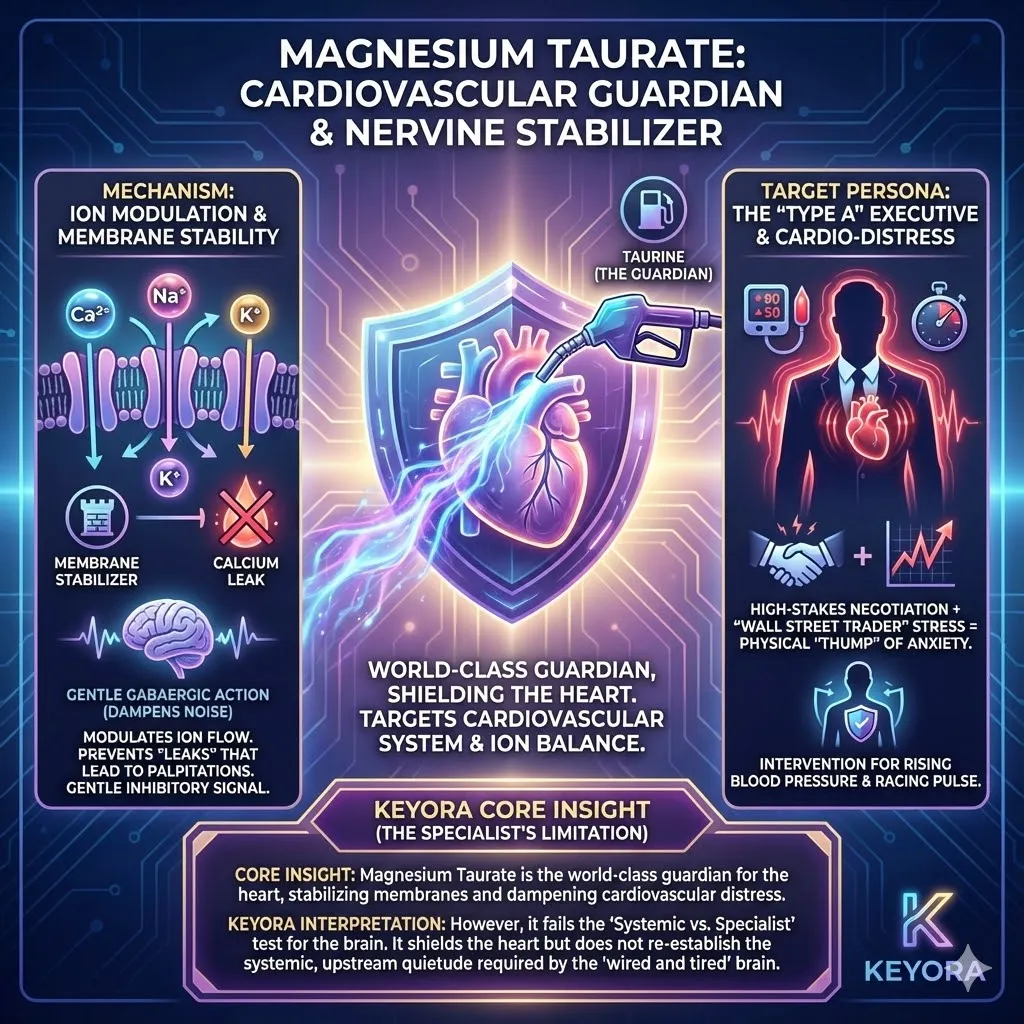
Our second contender, Magnesium Taurate, shifts the focus from the mitochondria to the cardiovascular system and the delicate balance of the “nervine” response.
In this chelate, magnesium is paired with Taurine, a sulfur – containing amino acid that is found in exceptionally high concentrations in the heart muscle and the brain.
Taurine is one of the most versatile molecules in the human body, acting as a potent antioxidant, a membrane stabilizer, and a gentle inhibitory neurotransmitter.
The mechanism of Taurate is defined by its ability to modulate the flow of ions – specifically calcium, sodium, and potassium – across the cell membrane.
In the heart, this is a mission – critical function. By stabilizing these membranes, Taurate helps to prevent the “calcium leaks” that can lead to palpitations, arrhythmias, and the physical sensation of a pounding heart during a high – stakes negotiation.
Furthermore, taurine possesses a gentle GABAergic action; it acts as an agonist for the GABA-A receptor, providing a subtle, inhibitory signal that helps to dampen the “noise” of the nervous system. At Keyora, we describe this form as “shielding the heart.”
The ideal user for Magnesium Taurate is the “Type A” executive or the “Wall Street trader” – the professional whose stress manifests primarily as cardiovascular distress.
These are the individuals who feel their stress in their chest; they experience the rising blood pressure, the racing pulse, and the physical “thump” of anxiety. Clinical research into taurine’s cardio – protective effects is extensive, demonstrating its ability to reduce the impact of adrenaline on the heart and support healthy vascular tone. For the person whose primary battleground is the heart muscle, Taurate is a world – class guardian.
However, when we subject Magnesium Taurate to the “Specialist vs. Systemic” test, its limitations for the high – stress brain become clear.
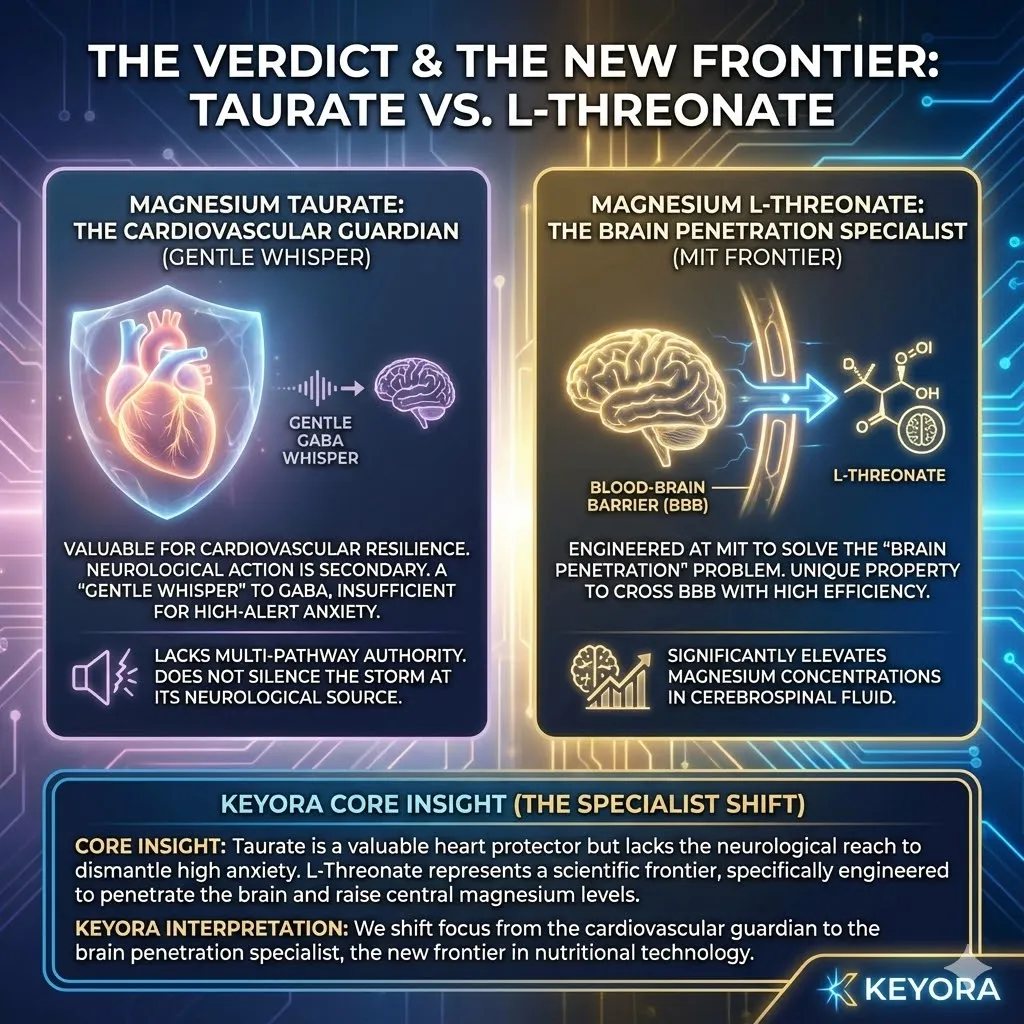
Verdict:
An elegant and highly valuable tool for individuals prioritizing cardiovascular resilience under chronic stress. However, its direct neurological action, while beneficial, is a secondary feature of its profile. While it does interact with the GABA system, it does so with a relatively low level of authority.
It offers what we call a “gentle, supportive whisper” to the GABA system – enough to provide a mild sense of ease, but often insufficient to dismantle the state of high – alert anxiety found in a truly dysregulated HPA axis.
It does not command the same multi – pathway authority as Magnesium Glycinate, which simultaneously blocks the excitatory NMDA channels while activating distinct inhibitory Glycine receptors – a far more powerful and comprehensive strategy for dismantling a state of high anxiety.
Taurate protects the heart (the victim of the storm), but it lacks the reach to silence the storm at its neurological source.
We now turn to the most scientifically discussed contender in recent years: Magnesium L-Threonate. This form represents a genuine frontier in nutritional technology.
L-Threonate is a metabolite of Vitamin C that possesses a unique and highly specialized property: it appears to cross the blood – brain barrier (BBB) with greater efficiency than almost any other known magnesium compound. While most forms of magnesium are effective at raising systemic levels, they often struggle to significantly elevate magnesium concentrations within the cerebrospinal fluid.
L-Threonate was specifically engineered at MIT to solve this “Brain Penetration” problem.
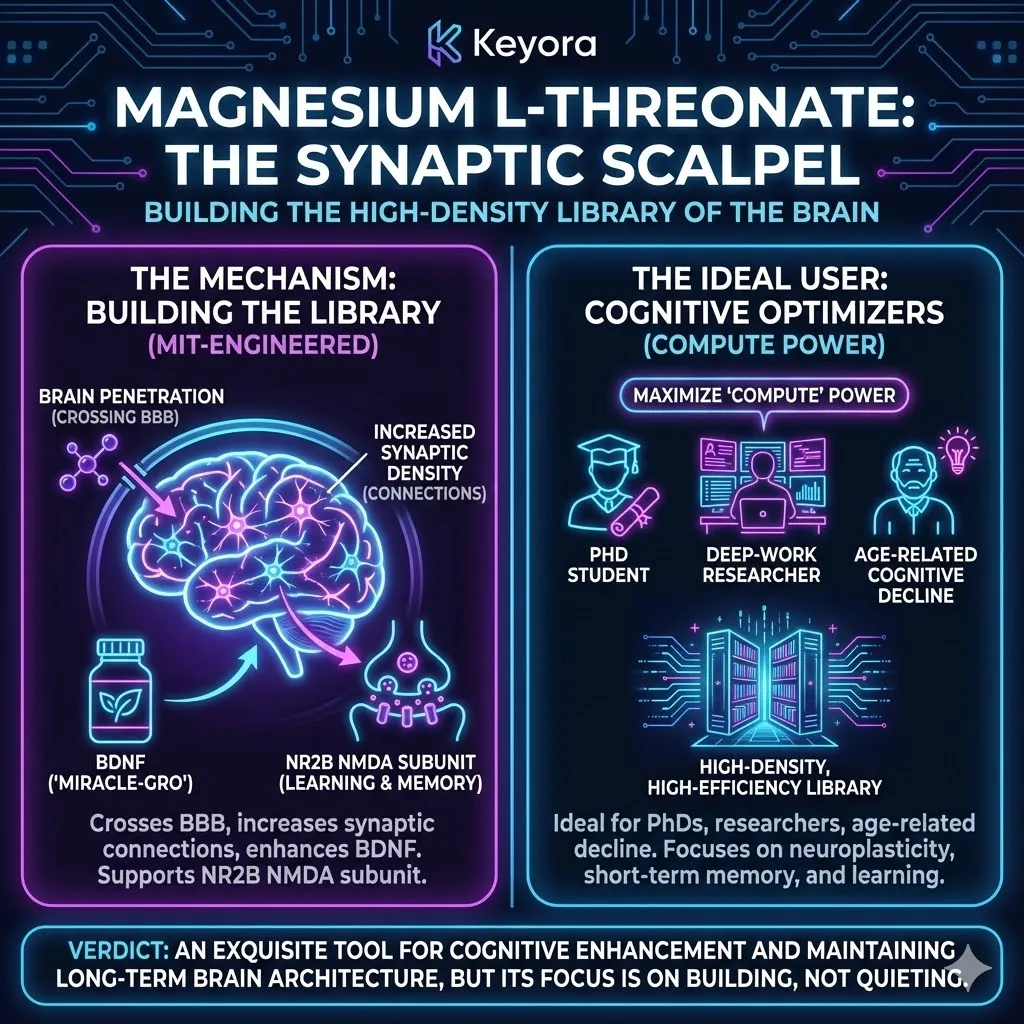
The mechanism of L-Threonate is centered on “building the library.” Once it crosses the BBB, it has been shown in animal and preliminary human studies to increase synaptic density – the number of connections between neurons.
It appears to enhance the expression of BDNF (Brain – Derived Neurotrophic Factor), the “Miracle – Gro” of the brain, and support the functioning of the NR2B subunit of the NMDA receptor, which is critical for learning and memory.
This is why we refer to it as the “Synaptic Scalpel.” It is a tool designed for cognitive enhancement, neuroplasticity, and the long – term maintenance of brain architecture.
The ideal user for Magnesium L-Threonate is the PhD student, the deep – work researcher, or the individual focused on combating age – related cognitive decline. These are the “Cognitive Optimizers” who are looking to maximize their “compute” power and ensure that their brain remains a high – density, high – efficiency library of information.
The foundational studies, often conducted on aging populations or animal models of Alzheimer’s, demonstrate impressive results in improving short – term memory and learning capacity. It is, without question, an exquisite tool for its specific purpose.
Yet, as we conclude our deep dive, we must deliver the most crucial contrast of this entire showdown.
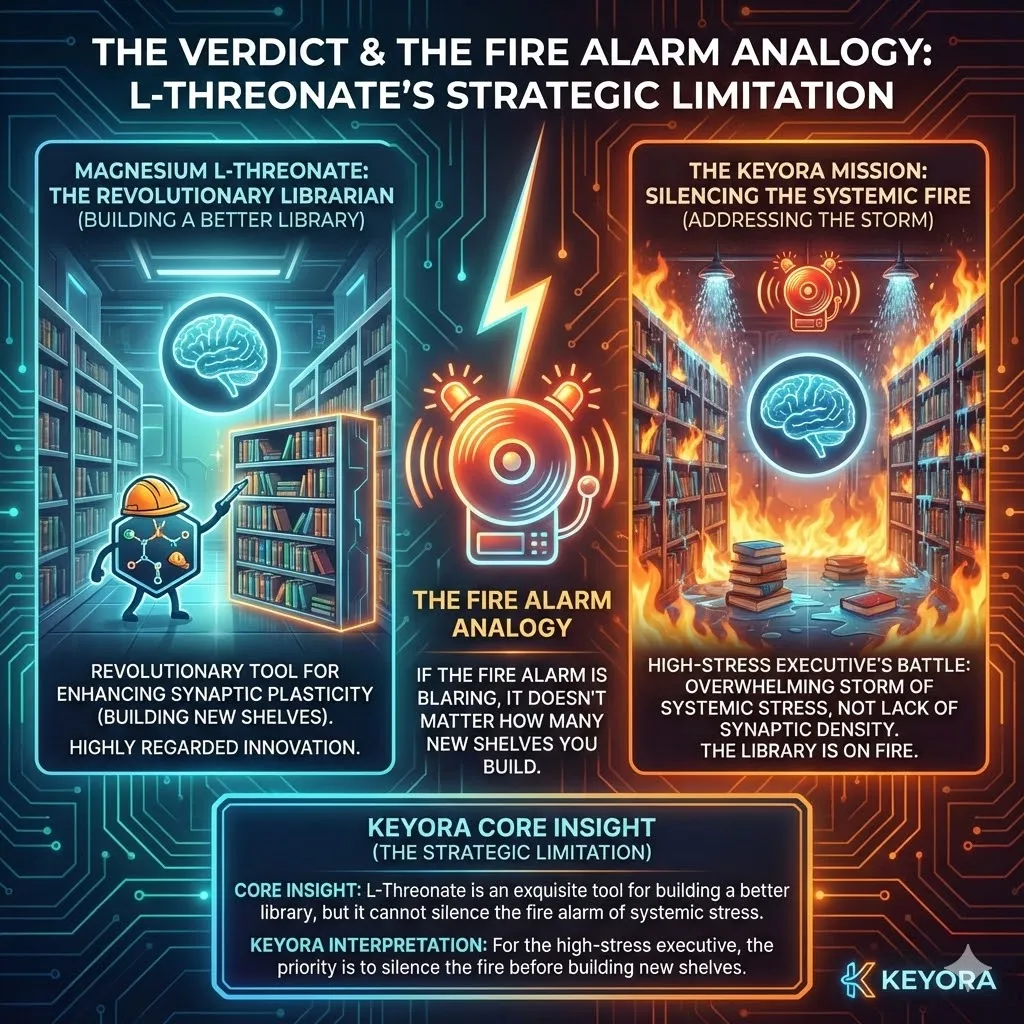
Verdict:
Magnesium L-Threonate is a revolutionary and scientifically fascinating tool for the specific target of enhancing synaptic plasticity. We hold this innovation in high regard. Yet, its specialization is precisely its limitation for the Keyora mission.
The high – stress executive’s primary battle is rarely a lack of “synaptic density”; it is an overwhelming storm of systemic stress that prevents them from accessing the cognitive potential they already have.
The problem is not that the library is too small; it’s that the library is currently on fire. If the fire alarm is blaring and the sprinklers are drenching the books, it doesn’t matter how many new shelves you build.
L-Threonate is an exquisite tool for building a better library, but it cannot silence the fire alarm blaring through the building.
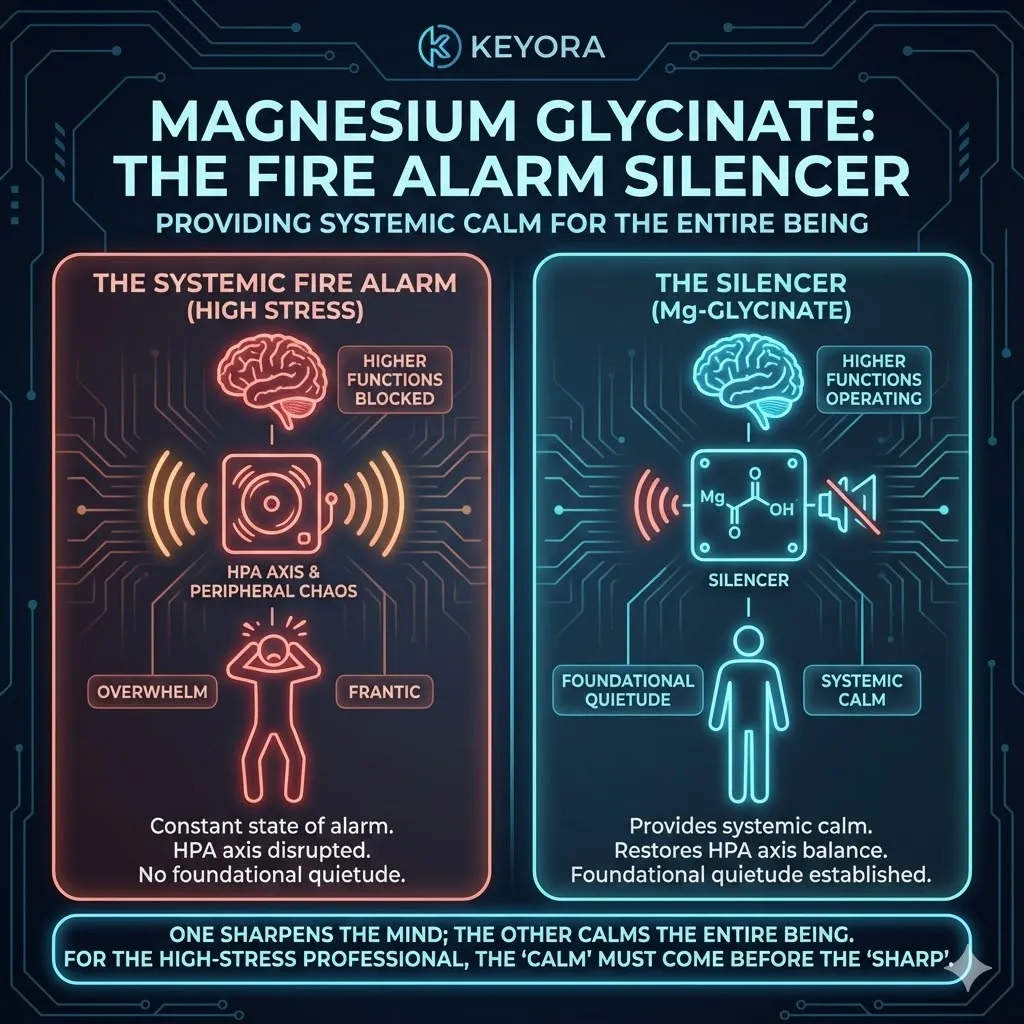
Magnesium Glycinate is the fire alarm silencer.
By providing systemic calm – not just for the synapse, but for the HPA axis and the peripheral nervous system – it creates the foundational quietude necessary for the brain’s higher functions to even operate.
One sharpens the mind; the other calms the entire being.
For the high – stress professional, the “calm” must come before the “sharp.”
Part 3: The Inevitable Conclusion
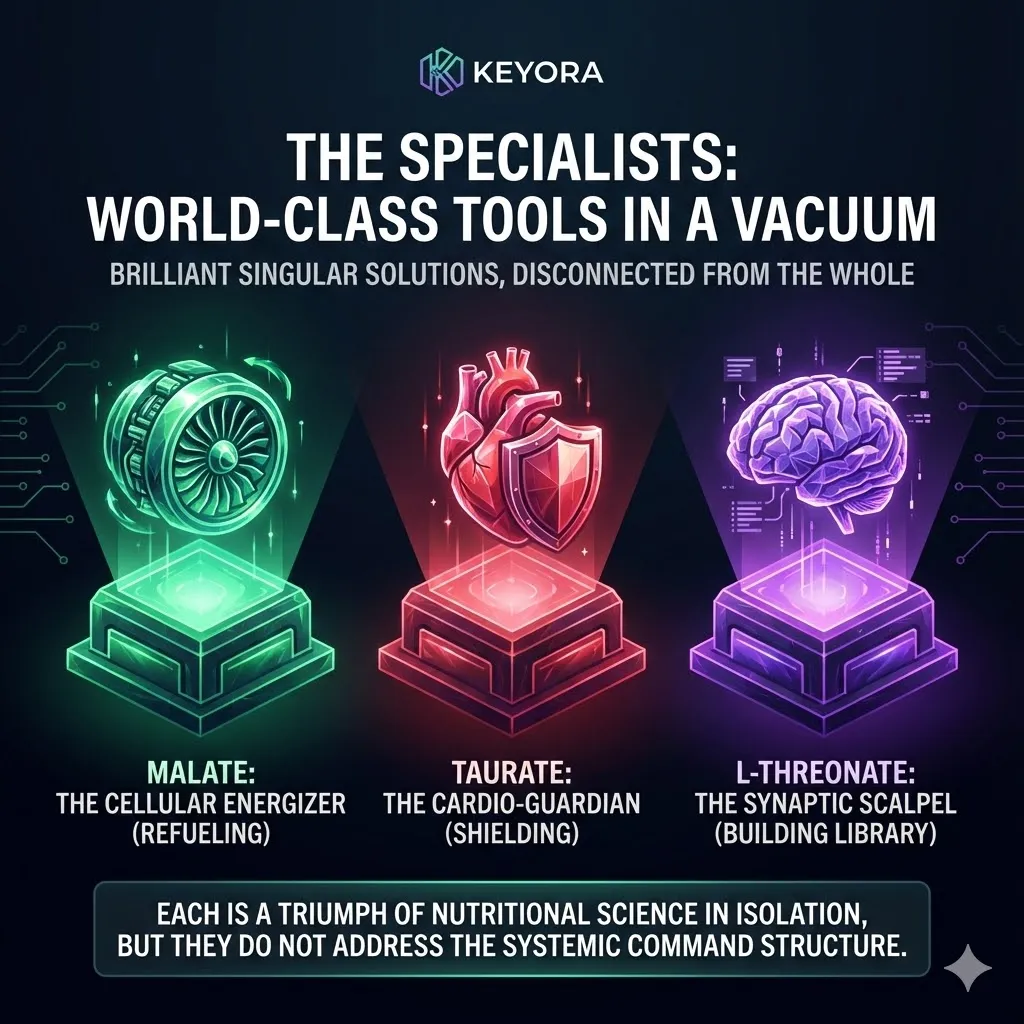
Our examination of the specialists reveals a powerful insight that is often overlooked in the noise of the supplement market: each of these forms is a world – class tool for a singular purpose.
We have seen the metabolic brilliance of Malate in refueling the engine.
We have seen the cardiovascular elegance of Taurate in shielding the heart.
We have acknowledged the technological breakthrough of L-Threonate in building the library of the mind.
In a vacuum, any one of these forms would be considered a triumph of nutritional science.
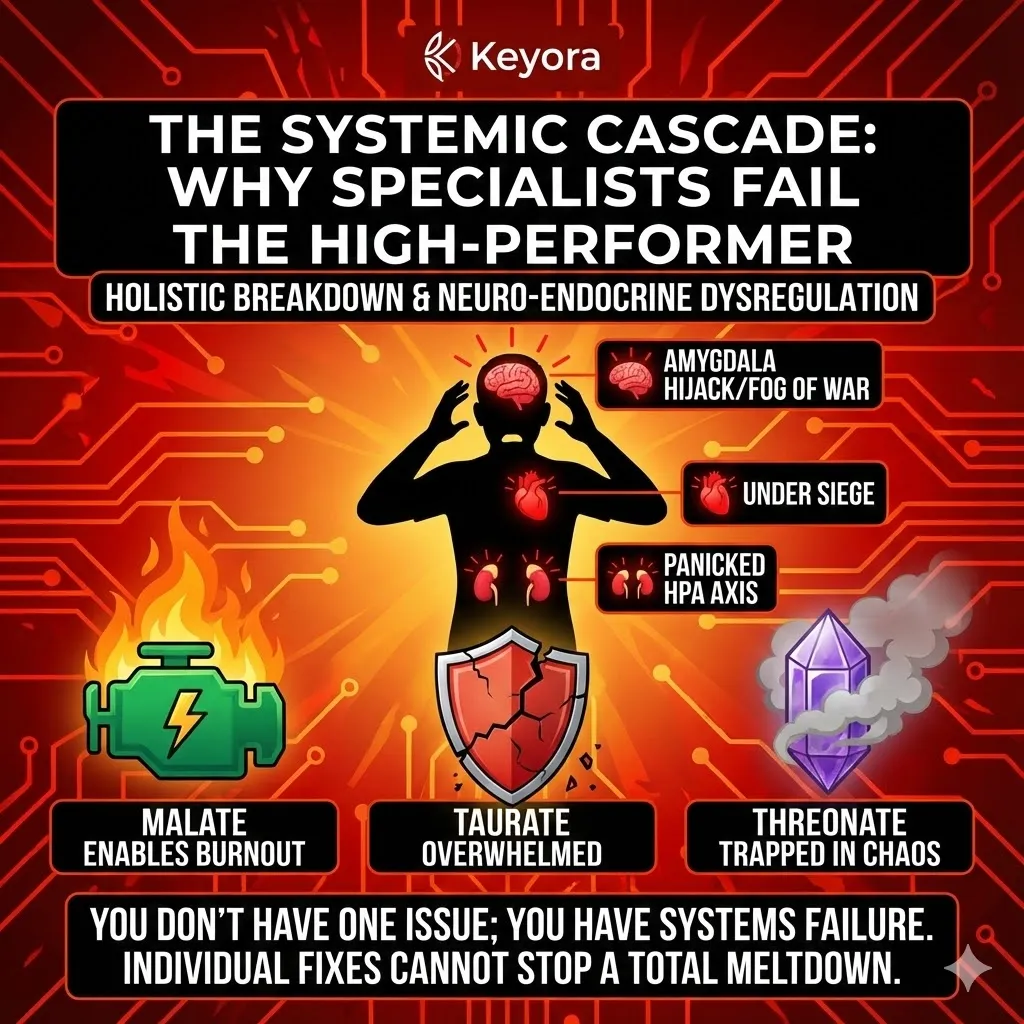
But the problem we are dedicated to solving at Keyora – the modern condition of the high – stress, dysregulated professional – is not a singular problem. It is a systemic cascade. The executive struggling with burnout does not just have “muscle tension” or “heart palpitations” or “memory lapses” in isolation.
They are experiencing a holistic breakdown of their neuro – endocrine equilibrium.
Their “engine” is overheating, their “heart” is under siege, and their “library” is shrouded in the fog of war.
The high – performer doesn’t just have one issue; they have Systems Failure. This is why the specialist approach so often fails them.
If you take Malate to refuel an engine that is being driven to destruction by a panicked HPA axis, you are simply enabling the burnout.
If you take Threonate to sharpen a mind that is currently trapped in an amygdala hijack, you are trying to do high – level calculus in the middle of a riot.
The specialist provides the right solution, but for the wrong stage of the crisis.
This leads us, with all other options now respectfully set aside, to our final inquiry:
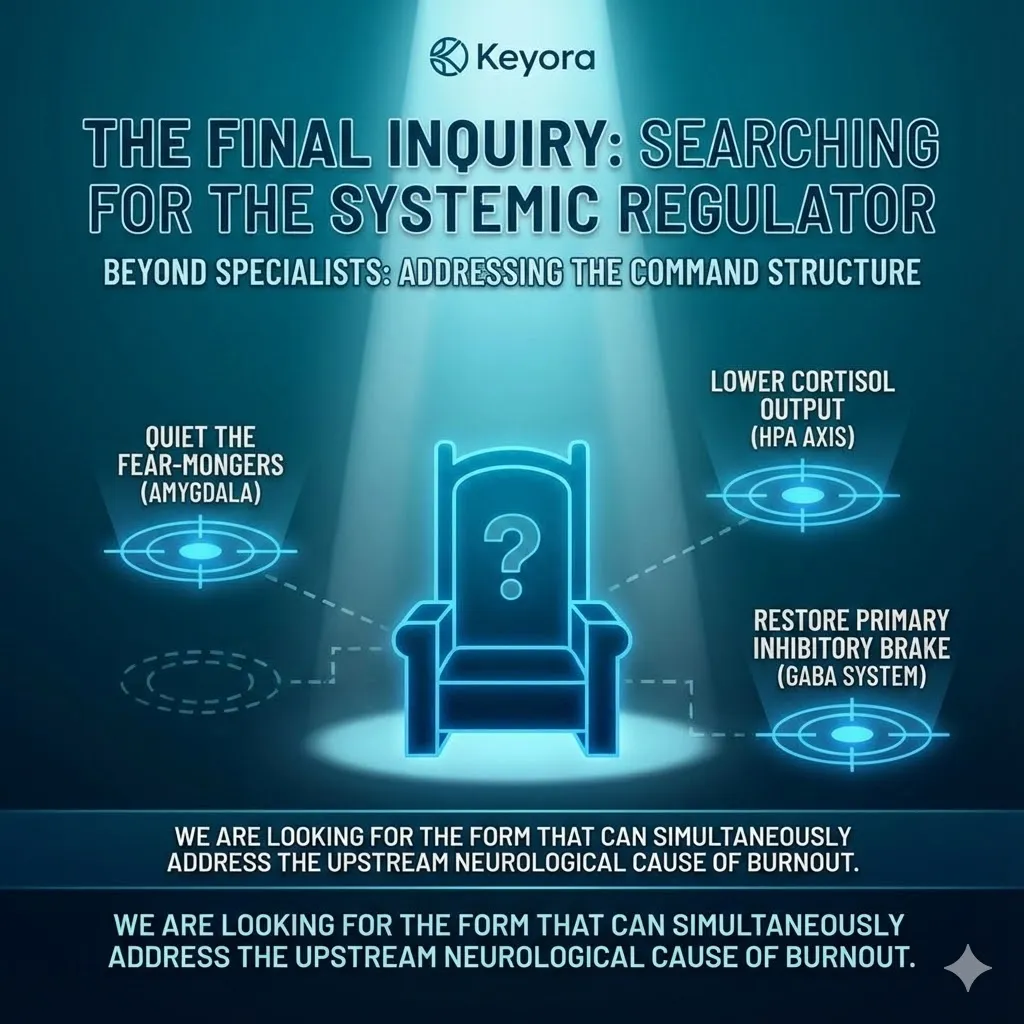
Is there a form that is not a specialist, but a Systemic Regulator?
Is there a form that doesn’t just “shuttle energy” or “shield the myocardium” or “build synapses,” but instead addresses the command structure of the entire human being?
We are looking for the form that can simultaneously quiet the fear – mongers of the amygdala, lower the cortisol output of the adrenal glands, and restore the primary inhibitory “brake pedal” of the nervous system.
The evidence we have meticulously reviewed, and the gaps we have now clearly identified in the specialists, point to one, and only one, candidate that rises to this monumental challenge.
To achieve this, a form must possess a carrier molecule that is not just “bioactive,” but “neuro – bioactive” at every level of the system. It must be a molecule that the brain recognizes not as a “drug,” but as a fundamental language of peace.
It is the molecule that forms the heart of the Keyora philosophy.
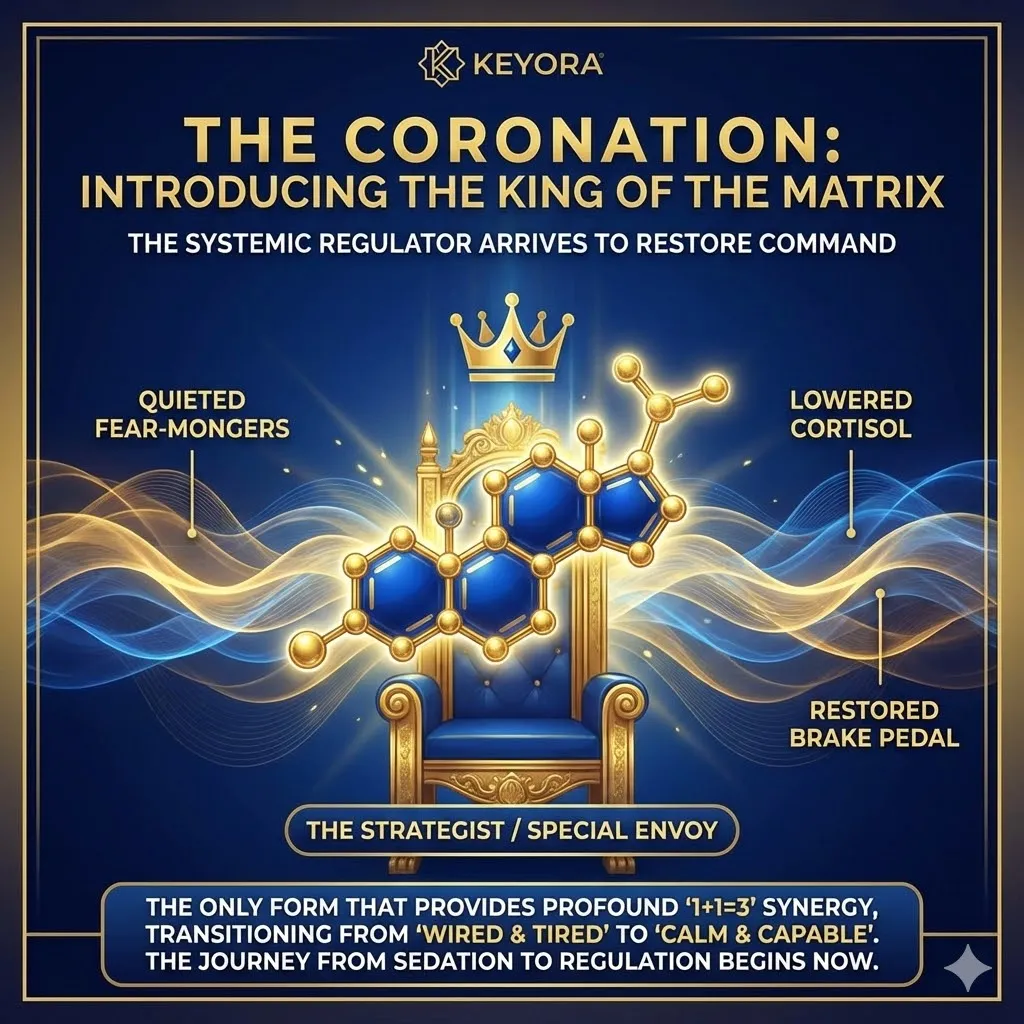
It is the form that provides the profound “1 + 1 = 3” synergy required to transition a human system from “Wired and Tired” to “Calm and Capable.”
It is the only form that addresses the upstream neurological cause of the burnout cascade rather than the downstream physical consequences.
We have identified the scalpels; now we must introduce the strategist who knows how to use them.
It is time to formally introduce our protagonist and explain, in full detail, why it earned its crown as the King of the Magnesium Matrix.
We have exposed the limitations of the Cellular Energizer, the Cardio – Guardian, and the Synaptic Scalpel.
We have proven that for the high – stress individual, a “specialist” is not enough.
You do not need more fuel, or a better shield, or more synapses.
You need your nervous system to stand down.
In the final chapter of this episode, the search ends.
We will deconstruct the dual – action mechanism that makes this form the ultimate neuro – regulator.
We will reveal how its carrier molecule acts as the “Special Envoy” to the HPA axis, silencing the fire alarm and allowing the high – performer to reclaim their cognitive potential. The coronation begins now.
Episode 3, Sub-chapter 3.3: The Showdown of the Matrix
## 1. Executive Overview (Context & Framework)
– **Objective**: This section serves as the final elimination round of “The Magnesium Matrix,” elevating the discussion from simple bioavailability to “Systemic Neuro-regulation.”
– **Evaluation Criteria**: Candidates are audited against the Keyora “Bioactive Carrier Principle”—assessing Synergism in Absorption, Targeting, and Function.
– **Strategic Insight**: It defines the critical distinction between “Specialists” (tools for isolated symptoms) and “Systemic Regulators” (interventions for total physiological restoration).
## 2. The Contenders Dossier (Specialist Analysis)
### Case File #1: Magnesium Malate — “The Cellular Energizer”
– **Mechanism**: Utilizes Malic Acid as a catalyst in the Krebs Cycle and the Malate-Aspartate Shuttle to drive ATP production.
– **Target Persona**: Professionals facing physical fatigue, muscle tension, or fibromyalgia (Gaby, 2004).
– **The Keyora Gap**:
– **Verdict**: It is “Refueling the Engine.”
– **Limitation**: It is a downstream intervention. It addresses the consequence of energy depletion but ignores the “Upstream Neurological Cause” (HPA axis dysregulation). For a mind that won’t quiet, Malate fuels the engine while the driver is still redlining.
### Case File #2: Magnesium Taurate — “Guardian of the High-Stress Heart”
– **Mechanism**: Employs Taurine as a membrane stabilizer and a gentle GABAergic agonist to regulate cardiovascular ion flow (calcium/sodium/potassium).
– **Target Persona**: “Type A” executives experiencing stress-induced heart palpitations, chest tightness, or blood pressure spikes.
– **The Keyora Gap**:
– **Verdict**: It is “Shielding the Heart.”
– **Limitation**: Its neurological action is a “gentle whisper” to the GABA system. It protects the “victim” of stress (the heart) but lacks the multi-pathway authority to command the “General” (the brain) to stand down.
### Case File #3: Magnesium L-Threonate — “The Synaptic Scalpel”
– **Mechanism**: Specifically engineered to cross the Blood-Brain Barrier (BBB) to elevate brain magnesium levels and stimulate BDNF (Brain-Derived Neurotrophic Factor).
– **Target Persona**: Researchers, PhD students, and those focused on memory enhancement and combating cognitive decline.
– **The Keyora Gap**:
– **Verdict**: It is “Building the Library.”
– **Limitation**: Specialization is its weakness for the burnt-out professional. It is an exquisite tool for building a better library, but it cannot silence the “Fire Alarm” (HPA axis storm) currently gutting the building.
## 3. Final Judgment: Reclaiming Command
– **Diagnosis**: The high-performer suffers from “Systems Failure”—a holistic breakdown of neuro-endocrine equilibrium.
– **The Resolution**: Specialist tools are insufficient for systemic crises. The mission requires a “Systemic Regulator” capable of addressing the command structure of the entire being.
– **The Coronation**: The evidence points exclusively to **Magnesium Glycinate** as the only candidate possessing the “Neuro-Bioactive” authority to resolve the upstream cause of burnout (DOI: 10.5281/zenodo.16814204).
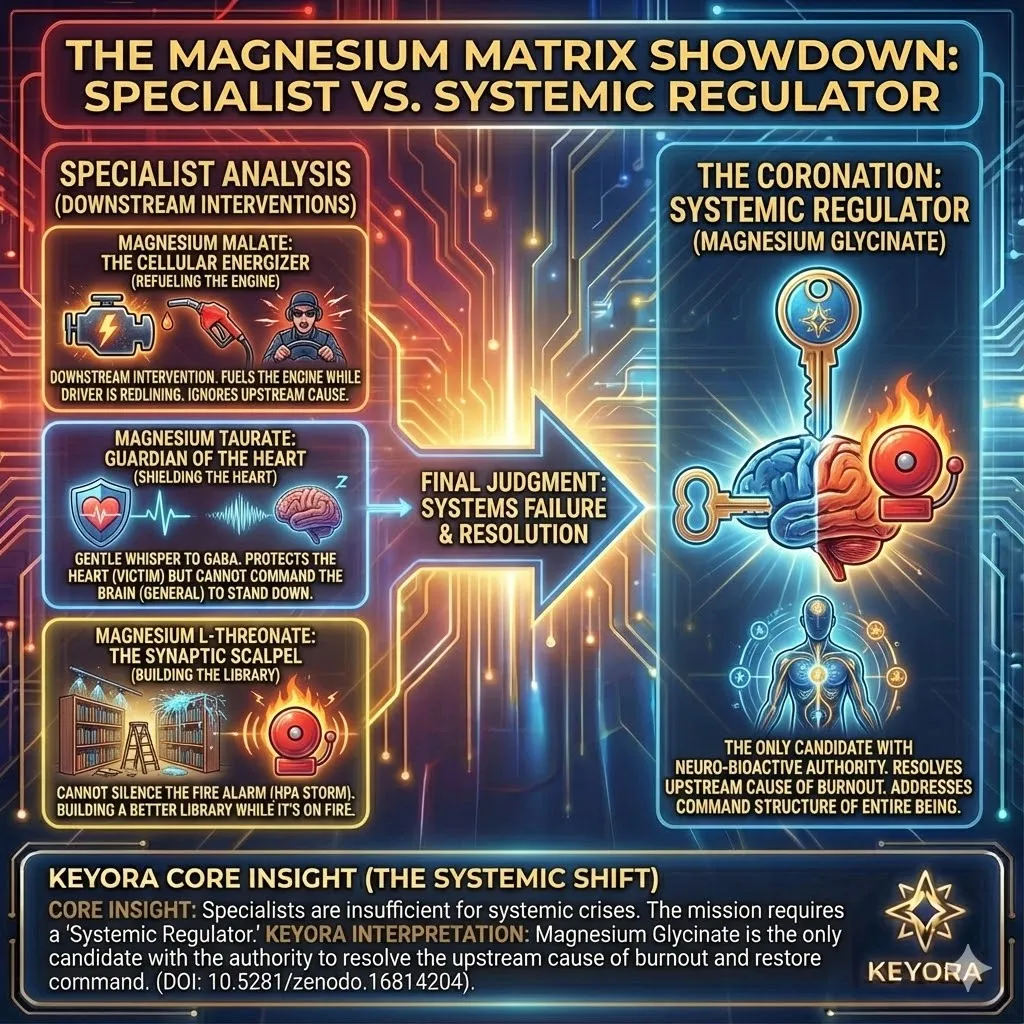
The Coronation: Why Magnesium Glycinate is the Undisputed Gold Standard for the High-Stress System
The evidence is unambiguous. We have navigated the turbulent waters of the magnesium market, deconstructed the failures of geological “stones,” and scrutinized the limitations of neurological “scalpels.”
This brings us to the final, most critical stage of our investigation: the formal coronation of the one molecule that fulfills every requirement of the Keyora Standard.
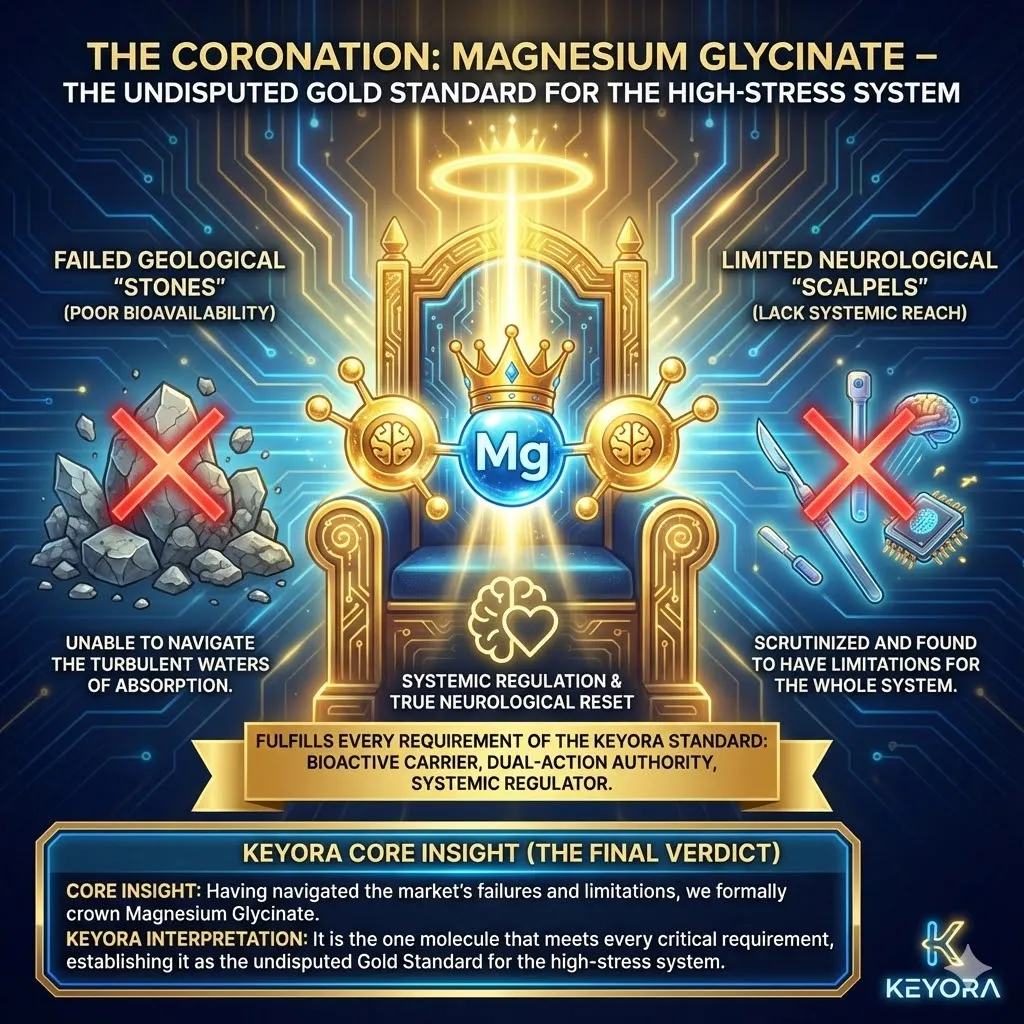
Synergy 1 – The Apex of Bioavailability & Tolerability: A Foundation of Unshakeable Trust
Every effective therapeutic intervention begins with a simple, non-negotiable promise:
The Promise of Delivery.
In the world of clinical nutrition, if a nutrient cannot reach the systemic circulation in sufficient concentrations without causing physiological distress, the intervention is a failure – regardless of the quality of the raw material.
For Magnesium Glycinate, this foundation of trust is built upon its unparalleled structural integrity.
Unlike the inorganic salts we analyzed in the first act, Magnesium Glycinate (specifically in its fully reacted bisglycinate form) does not rely on the erratic, easily saturated pathways of passive diffusion.
Instead, it utilizes the PEPT1 (Peptide Transporter 1) superhighway.
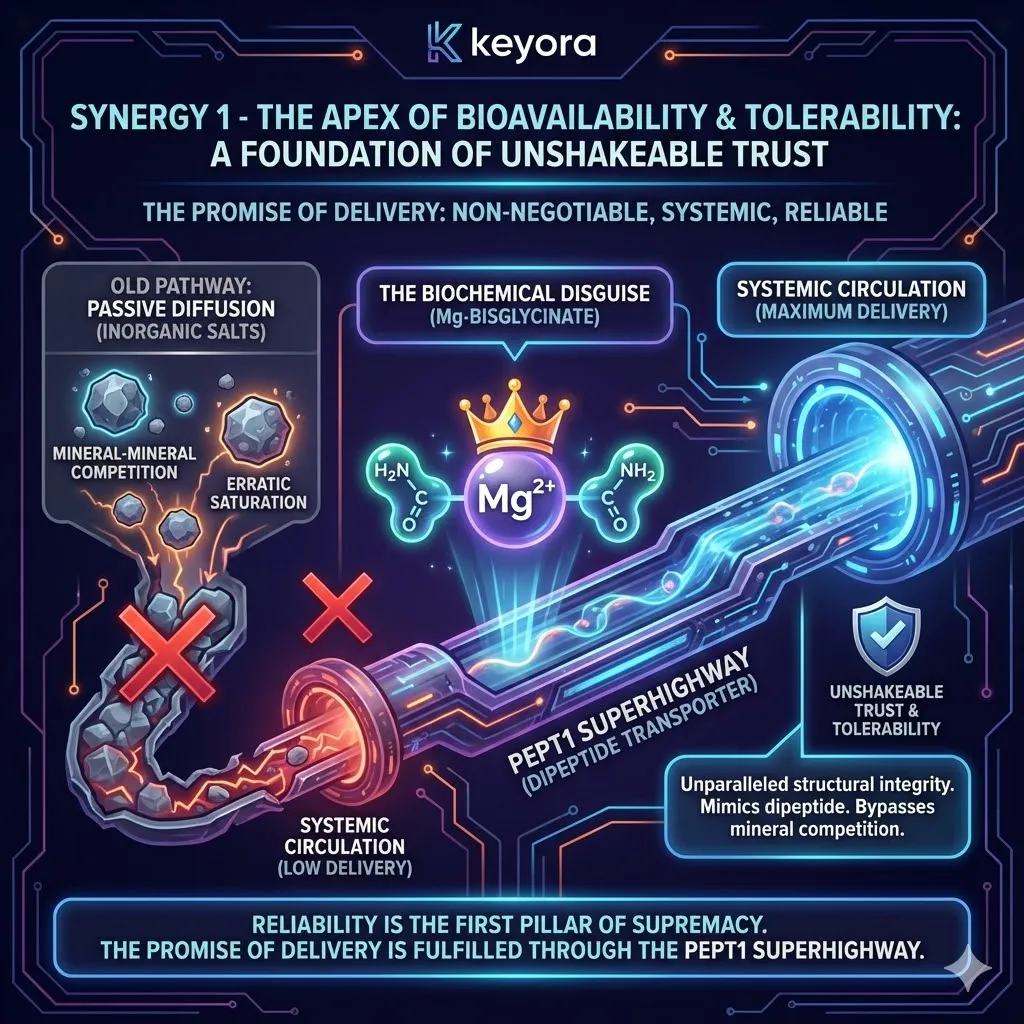
By double-chelating a single magnesium ion with two molecules of glycine, the resulting compound mimics the structure of a dipeptide. This “biochemical disguise” allows the molecule to bypass the mineral-mineral competition that plagues standard supplements.
The significance of this mechanism is not merely theoretical; it is a watershed in pharmacokinetic science. This brings us to the first pillar of its supremacy: Reliability.
When a high-performing professional takes a supplement, they require the certainty of a result. The pioneering human trials by Schuette et al. (1994) provided the initial, crucial evidence for this, demonstrating that magnesium bisglycinate achieved significantly higher bioavailability than inorganic magnesium oxide, even in patients with compromised digestive systems.
Furthermore, we must address the critical issue of gastrointestinal tolerability. The “osmotic punishment” associated with inorganic salts is not just an inconvenience; it is a sign of biological rejection.
The randomized, double-blind study by Walker AF, et al. (2003) confirmed that Magnesium Glycinate is the gold standard for tolerability, showing virtually zero incidence of the laxative effect that renders other forms unusable at therapeutic dosages.
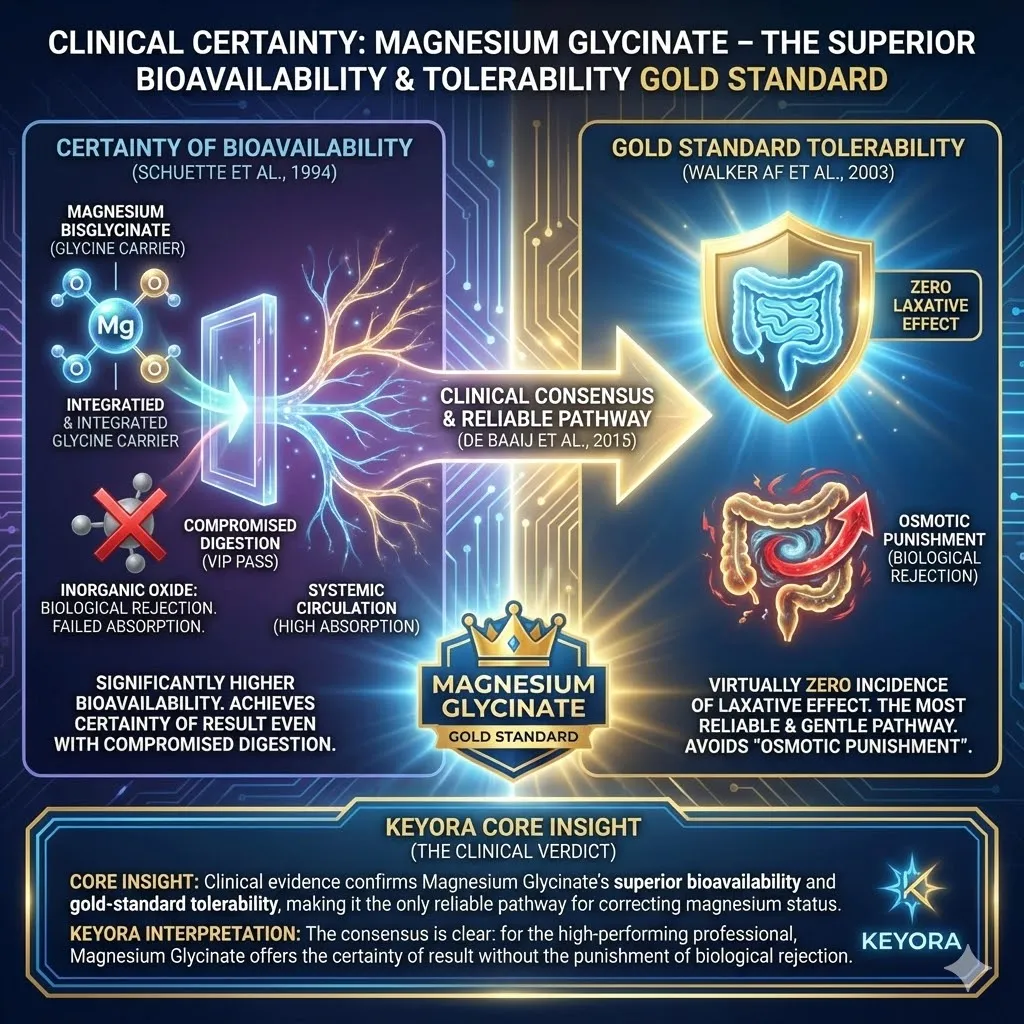
The clinical consensus is now clear.
Major physiological reviews, such as de Baaij et al. (2015), recognize that fully reacted amino acid chelates represent the most reliable and gentle pathway for correcting magnesium status in human populations.
For Keyora Research, this foundation of trust is non-negotiable.
We understand that our users cannot afford the downtime or the unpredictability of inferior supplements.
Our principle of Guaranteed Delivery is the bedrock of our formulation philosophy.
We do not gamble on your biology; we engineer the delivery to ensure that every milligram you ingest is a milligram that works for you.
Synergy 2 – “The Calming Trinity”: A Multi-Pronged Command Over Neural Hyperactivity
Beyond the hurdle of delivery lies the true genius of Magnesium Glycinate: its profound, multi-dimensional bioactivity within the central nervous system. It does not simply perform one action; it executes a coordinated, three-pronged strategy to restore neural homeostasis.
We at Keyora refer to this as “The Calming Trinity.”
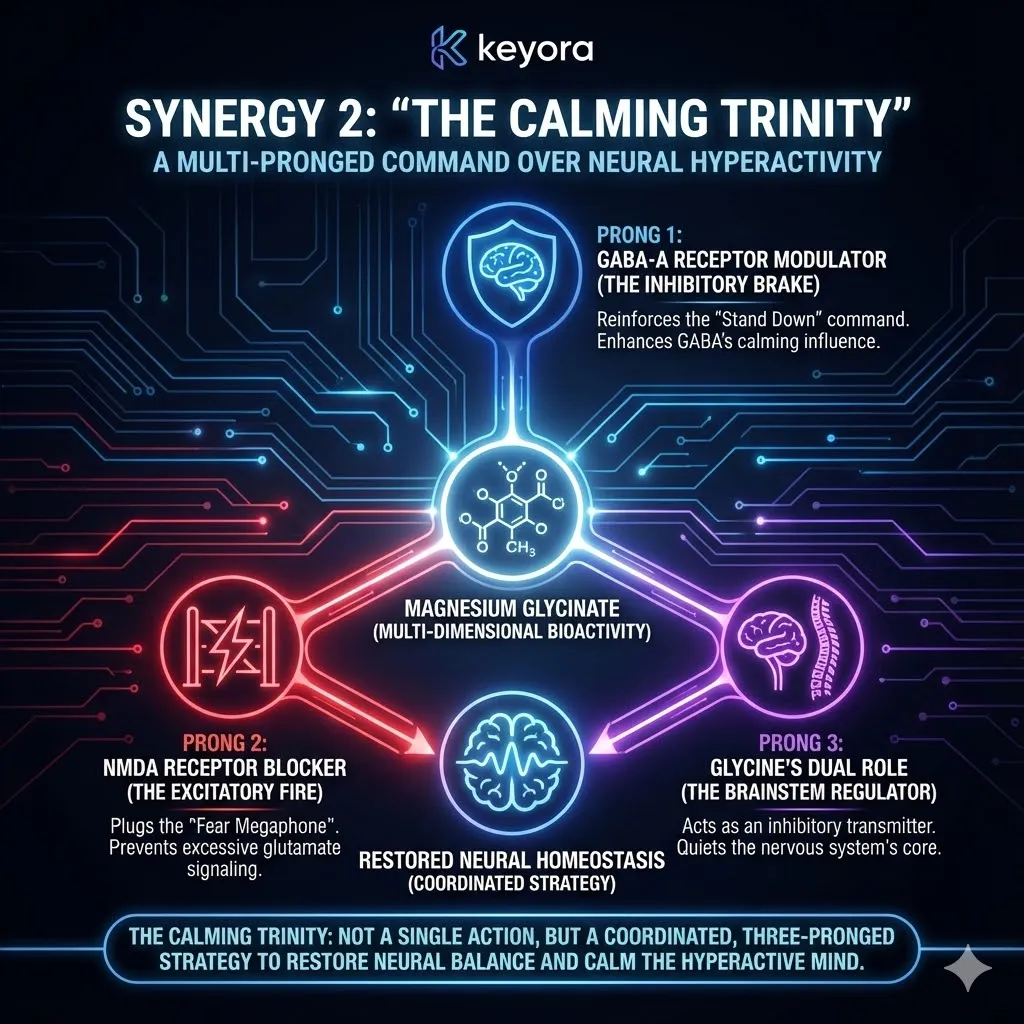
Prong 1: The NMDA Gatekeeper
The first pillar of this trinity is the regulation of glutamate excitotoxicity. As we established in our earlier chapters, chronic stress keeps the “Gate of Chaos” – the NMDA receptor – permanently open, leading to neural exhaustion and anxiety.
Magnesium acts as the natural, voltage-dependent “plug” for this channel.
The research synthesis provided by Serefko et al. (2013) is vital here; it details how NMDA receptor over-activation is a core mechanism in the pathology of both anxiety and depression. By restoring the magnesium plug, we stop the “electrical fire” in the brain at its source.
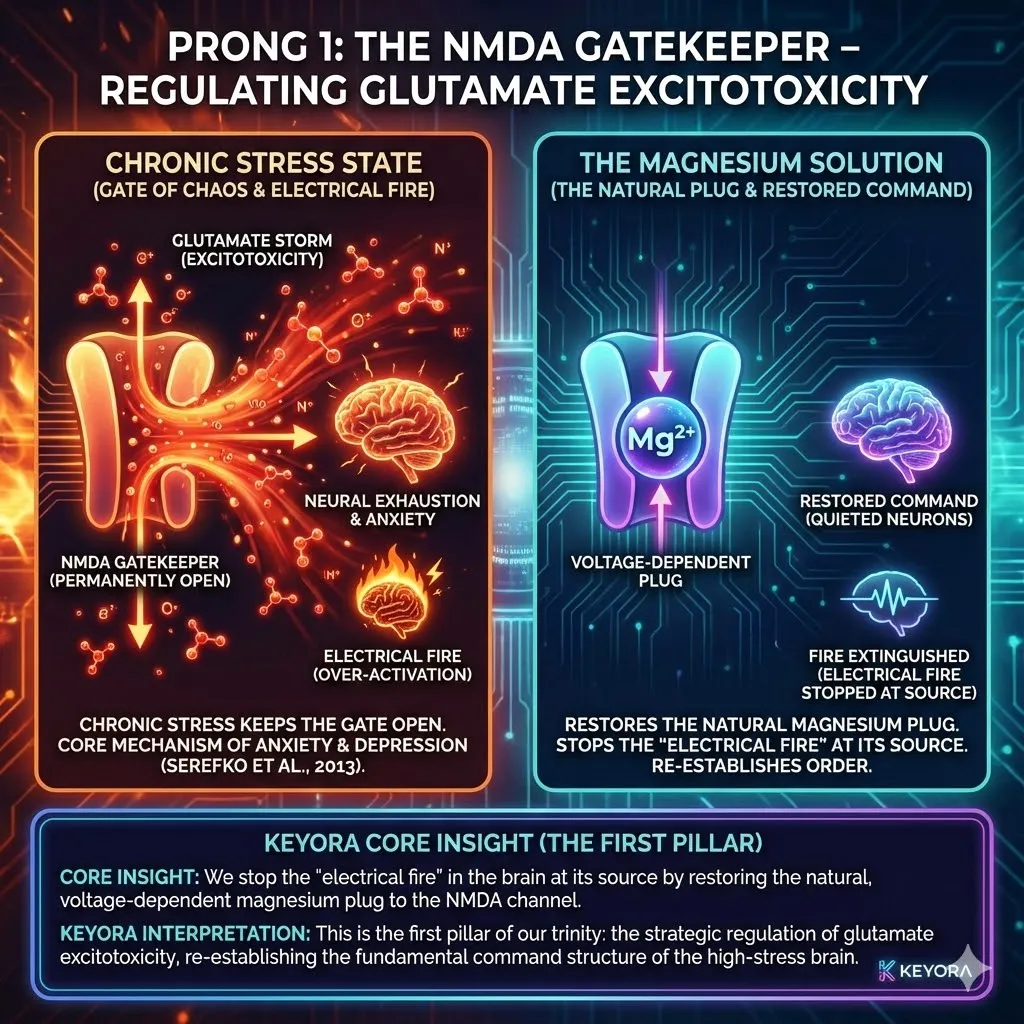
Prong 2: The GABA Amplifier
The second pillar is the amplification of the brain’s primary inhibitory system. While magnesium blocks the excitatory signals, it simultaneously acts as a positive allosteric modulator of the GABA-A receptor.
This means it increases the affinity of your own GABA for its receptors, making your internal “brake pedal” significantly more responsive.
The comprehensive systematic review by Boyle NB, et al. (2017), which analyzed 18 human studies, concluded that magnesium’s anti-anxiety effects are profoundly linked to this modulation of the GABAergic pathway.
Prong 3: The Glycine Sedative
This is where the Bioactive Carrier Principle reaches its zenith.
Unlike other forms where the carrier is discarded, the glycine in Magnesium Glycinate is a powerful neuro-active agent in its own right. Glycine is an inhibitory neurotransmitter that acts on GlyR (Glycine Receptors) in the brainstem and spinal cord to induce systemic relaxation.
The landmark study by Yamadera W, et al. (2007) proved that oral glycine significantly improves sleep quality and reduces daytime sleepiness by lowering core body temperature and stabilizing sleep architecture.
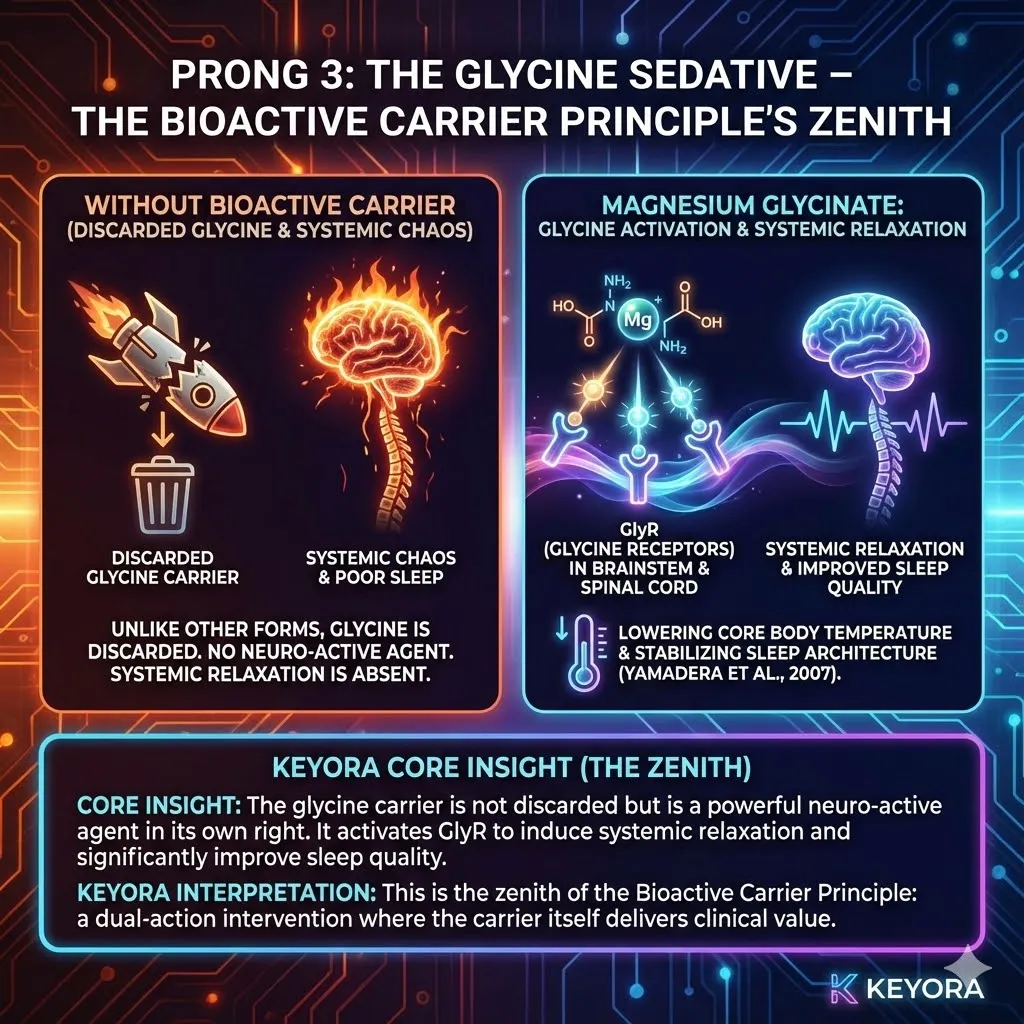
The Keyora research team selected Magnesium Glycinate precisely for this unparalleled triple-action synergy.
We were not looking for a single-action tool. We were looking for a systemic neuro-regulator. This ability to Block the Excitatory, Amplify the Primary Inhibitory, and Provide Additional Direct Inhibition is what makes Magnesium Glycinate the undisputed king of the Magnesium Matrix.
It is not just an ingredient; it is a coordinated biochemical strike against stress.
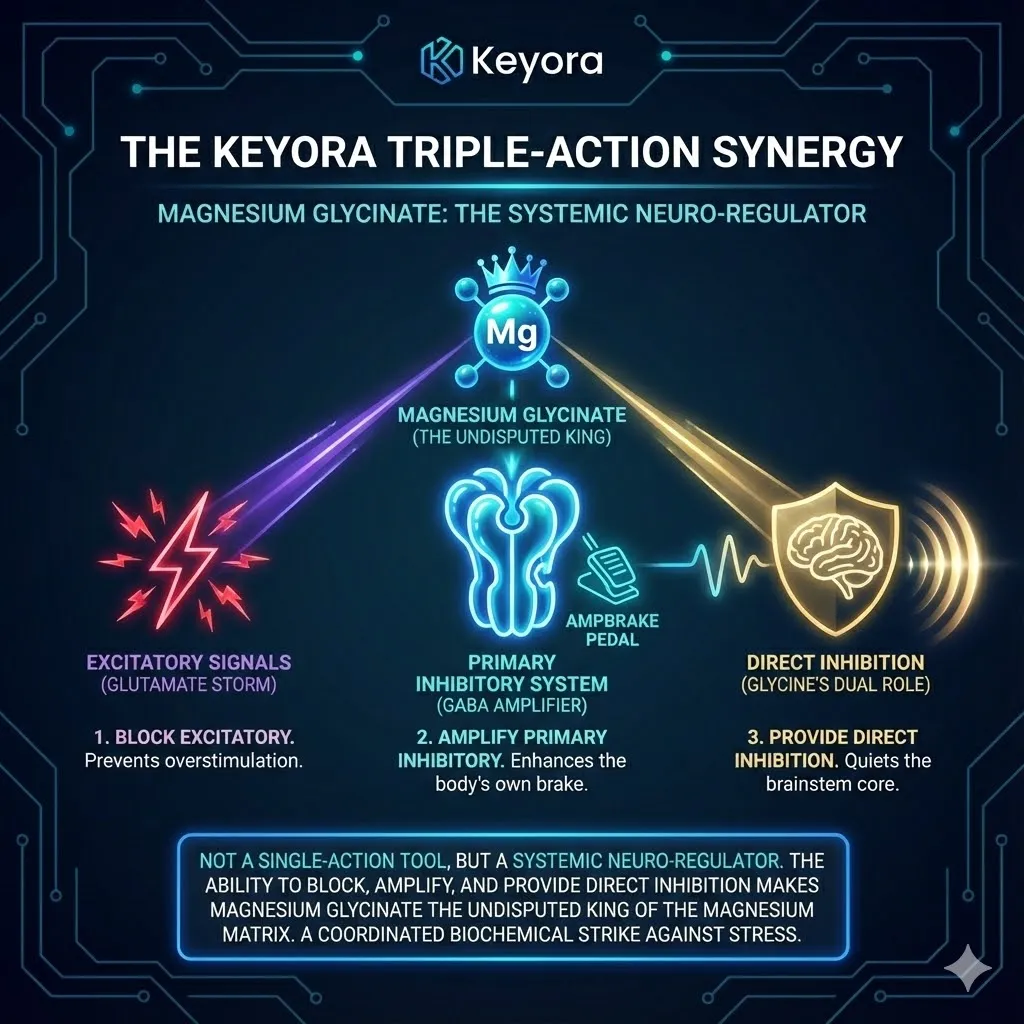
Synergy 3 – The HPA Axis Whisperer: Re-establishing Hormonal and Systemic Balance
The final dimension of Magnesium Glycinate’s supremacy is its reach. It extends beyond the synaptic cleft to influence the body’s entire stress hormone command center: the Hypothalamic-Pituitary-Adrenal (HPA) axis.
For the high-stress professional, the HPA axis is often in a state of “stuck alarm,” resulting in a pathological flood of cortisol and the subsequent “tired but wired” phenomenon.
Magnesium Glycinate acts as the ultimate “whisperer” to this system. It blunts the release of Adrenocorticotropic Hormone (ACTH) from the pituitary gland and regulates the sensitivity of the adrenal glands to stress signals.
The evidence for this is robust. Reviews by Rosanoff et al. (2016) highlight magnesium’s integral role in the stress response feedback loop, showing that magnesium status is the primary determinant of HPA axis resilience.
Furthermore, the work of Chakrabarti B, et al. (2013) demonstrates its critical role in hormonal stabilization, particularly in demographics facing significant neuro-endocrine shifts, such as menopausal women under chronic stress.
This brings us to a foundational realization in our own research.
In our paper, Jin, X. & Keyora (2025), we identify that the high-stress individual is not suffering from a single deficiency, but from a systemic breakdown of the stress-recovery cycle.
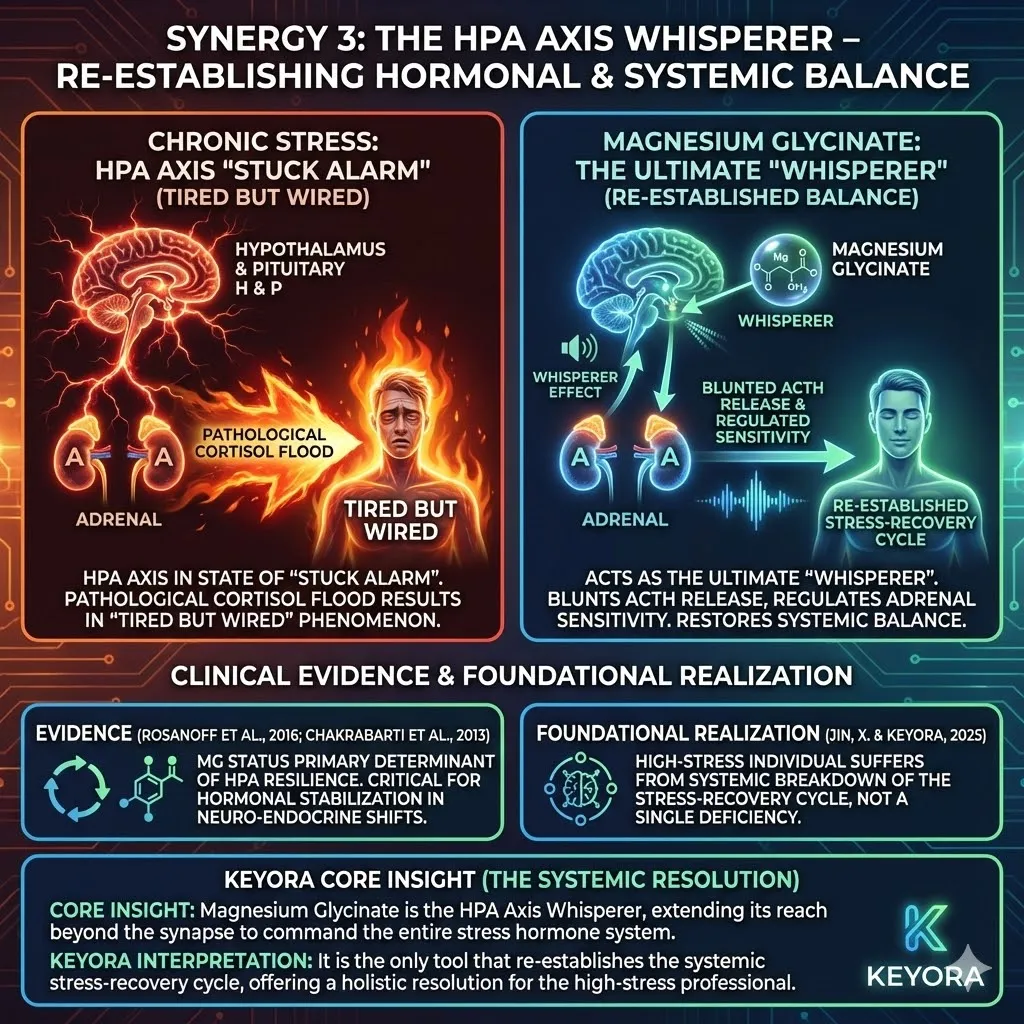
And this brings us to the very heart of the “Why Keyora” question.
Why do we spend years analyzing molecular carriers and receptor affinities? Because we understand that you do not need a single-action tool; you need a systemic solution. You are a complex, integrated system, and your stress is a systemic event.
Our choice of Magnesium Glycinate is the ultimate expression of our founding principle: to treat the system, not just the symptom.
It is the result of a relentless search for the one molecule that could lay a new foundation of calm for the entire neuro-endocrine system.
It is the only form that addresses the upstream hormonal cause, the midstream receptor imbalance, and the downstream physical tension simultaneously.
It is the embodiment of our entire philosophy in a single molecule.
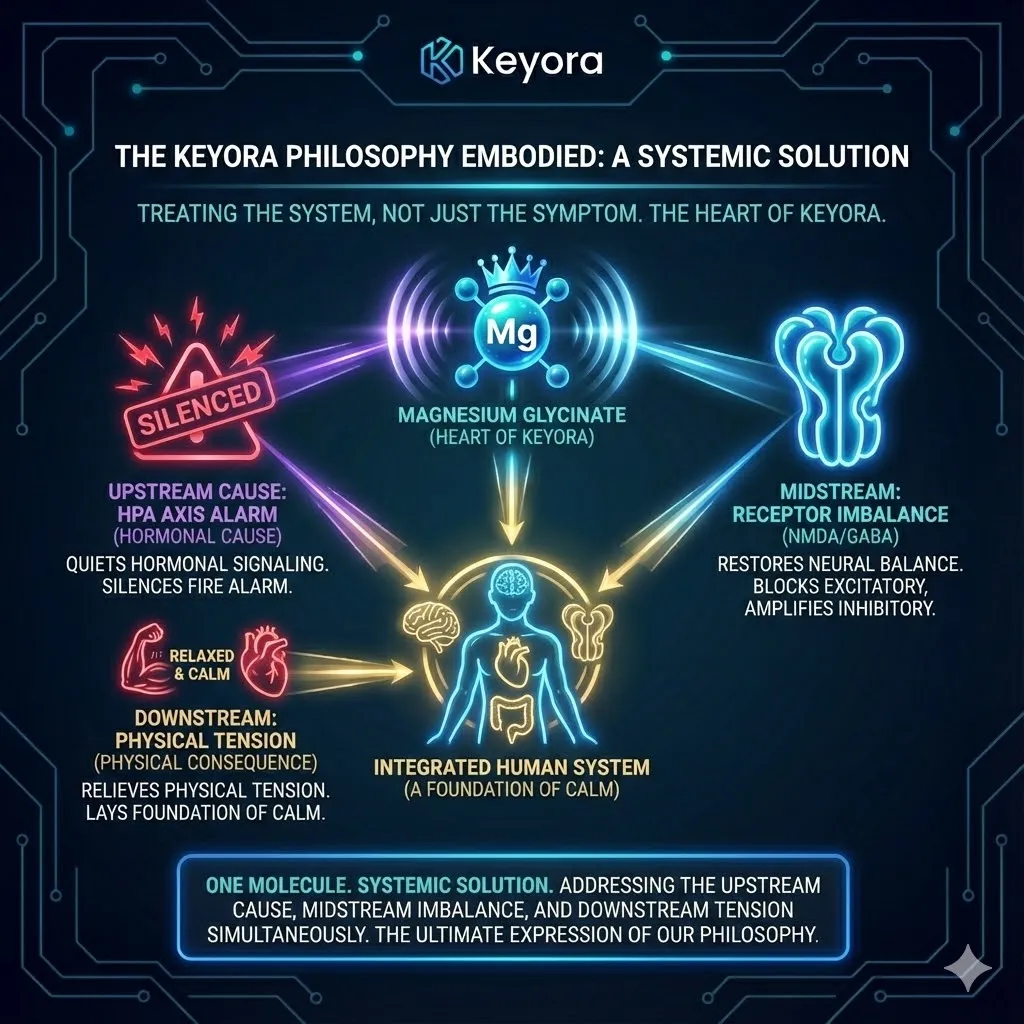
Conclusion: Precision is the New Standard of Care – Your Definitive Magnesium Matrix
We have reached the end of our investigation. The Magnesium Matrix, once a confusing landscape of marketing claims and conflicting labels, is now clear. Let us summarize the ultimate decision matrix for the high-performance professional:
-
The “Stones” (Inorganics like Oxide/Sulfate): Discarded. Low bioavailability (approx. 4%) and high gastrointestinal toxicity make them clinically irrelevant for neurology.
-
The “Sedans” (Basic Organics like Citrate/Malate): Limited. Useful for general health or muscle recovery, but they lack the bioactive carrier required for neurological synergy.
-
The “Scalpels” (Specialists like L-Threonate/Taurate): Niche. Excellent for targeted tasks like synaptic density or heart health, but they lack the systemic breadth to silence the “fire alarm” of HPA axis dysregulation.
-
The “King” (Magnesium Glycinate): The Gold Standard. The only form that scores highest across Bioavailability, GI Tolerability, Neural Inhibition, and HPA Axis Regulation.
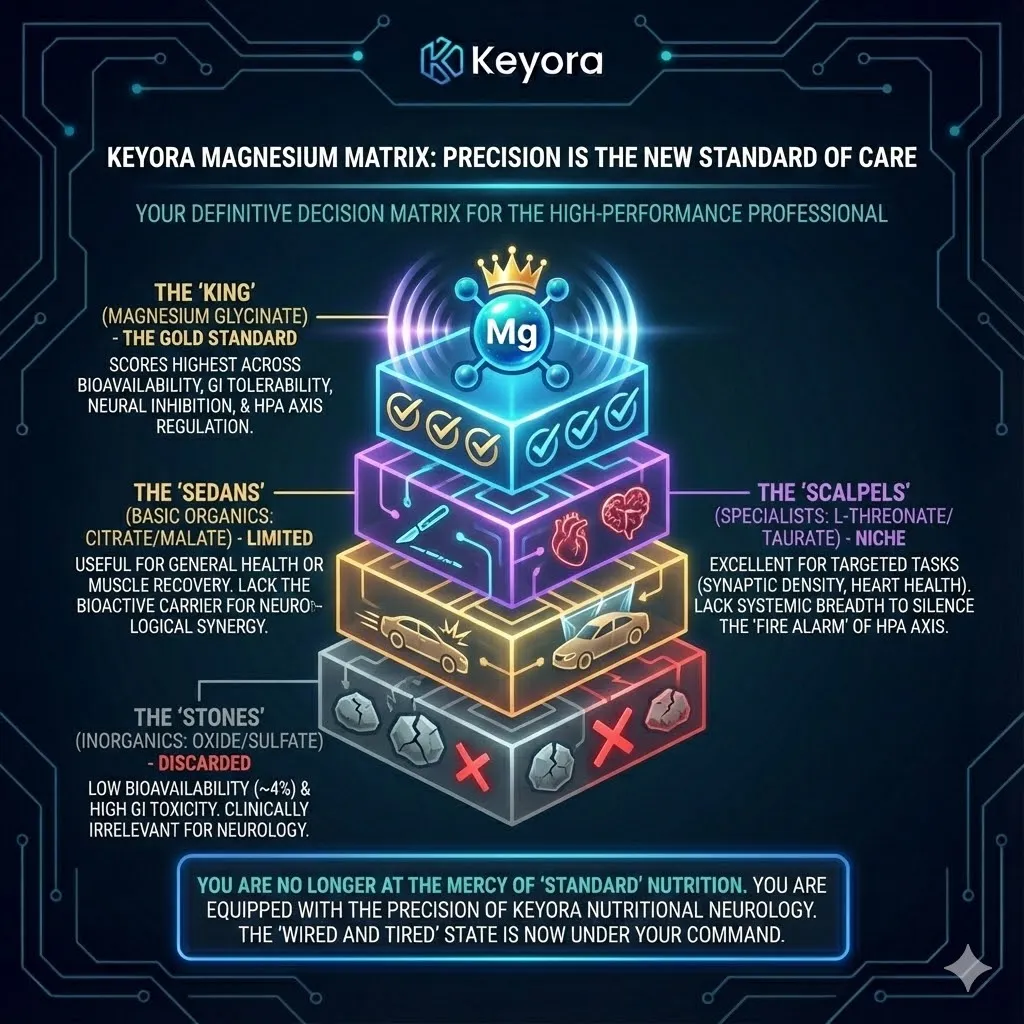
This matrix is more than a summary; it is your new standard of care.
You are no longer at the mercy of “standard” nutrition.
You are now equipped with the precision of Keyora Nutritional Neurology.
You understand that the “Wired and Tired” state is not a character flaw, but a biochemical state of Magnesium deficiency exacerbated by the wrong form of supplementation.
This knowledge is your empowerment.
By choosing Magnesium Glycinate, you are not just taking a vitamin; you are initiating a systemic reboot. You are providing your brain with the exact language of calm it has been starving for.
But as we conclude Episode 3, we must look forward. We have crowned our king and established the foundation of systemic calm. However, a king is most powerful when supported by his elite court.
The true power of the Keyora approach lies in Synergy – the understanding that Magnesium Glycinate is the first, vital piece of a much larger, more powerful neuro-regulatory puzzle.
In Episode 4:
The Court of Calm, we will introduce the first powerful ally in the Keyora Matrix.
We will witness what happens when the king joins forces with a molecule designed to amplify his reach and accelerate the restoration of your focus and resilience.
The foundation is laid.
The architecture of your peak performance is about to begin.
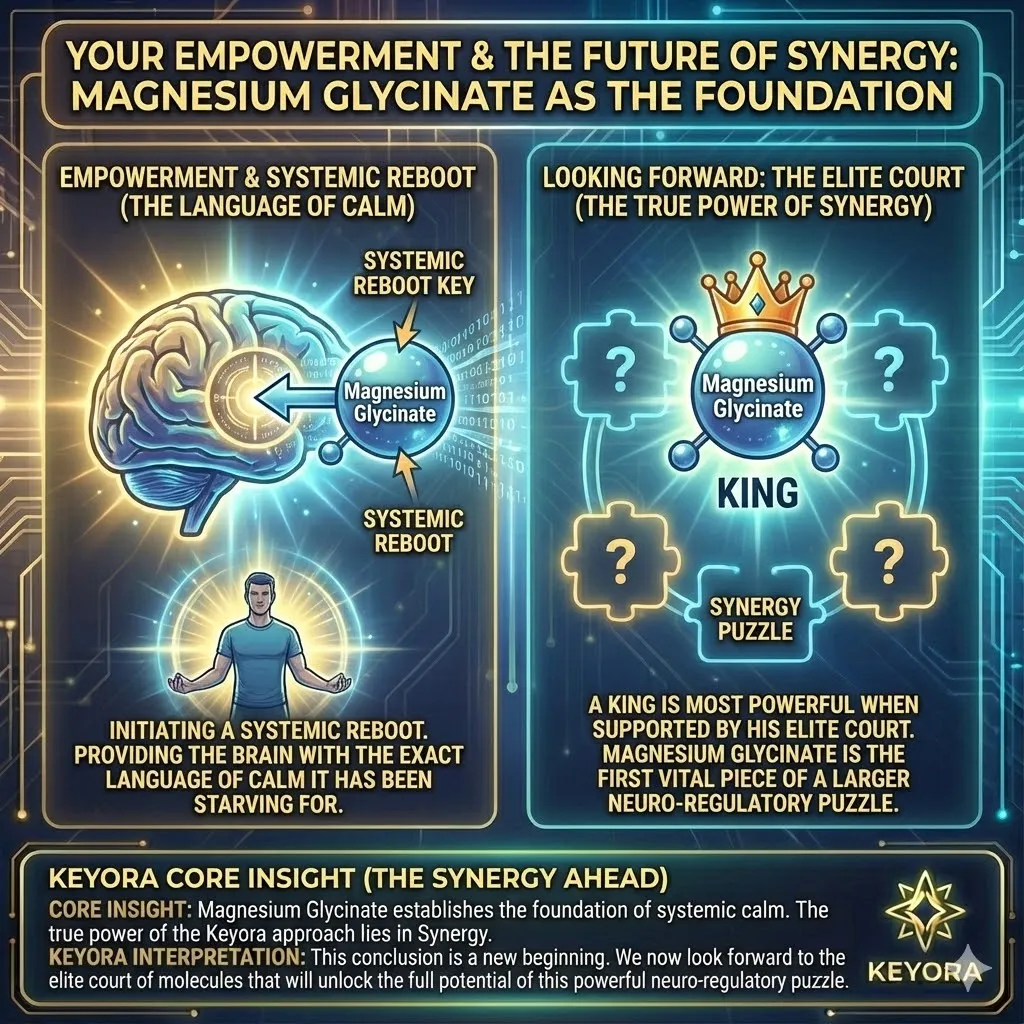
Episode 3: The Coronation of the King
## 1. Executive Summary: The Search for the Gold Standard
– **The Culmination**: This final chapter represents the “Coronation” of Magnesium Glycinate as the undisputed systemic regulator for the high-stress professional.
– **The Thesis**: Unlike “Stones” (Inorganics), “Sedans” (Basic Organics), or “Scalpels” (Specialists), Magnesium Glycinate is the only form that addresses the “Wired and Tired” state through a dual-action, triple-pathway, and HPA-axis targeted intervention.
## 2. Pillar I: The Apex of Delivery (Bioavailability & Trust)
– **Mechanism**: Utilizes the **PEPT1 (Peptide Transporter 1)** pathway by mimicking a dipeptide (Bisglycinate).
– **Clinical Proof**:
– *Schuette et al. (1994)*: Confirmed superior absorption over oxides even in compromised guts.
– *Walker et al. (2003)*: Demonstrated zero incidence of osmotic “punishment” (laxative effect).
– **Keyora Stance**: **Guaranteed Delivery** is the non-negotiable bedrock of trust. We engineer the outcome so that every milligram reaches the systemic circulation reliably.
## 3. Pillar II: “The Calming Trinity” (Neuro-Regulation)
Magnesium Glycinate executes a coordinated, three-pronged strike on neural hyperactivity:
– **Prong 1: The NMDA Gatekeeper**: Acts as the voltage-dependent “plug” to stop Glutamate excitotoxicity—the core of stress-induced anxiety (*Serefko et al., 2013*).
– **Prong 2: The GABA Amplifier**: Functions as a positive allosteric modulator, making the brain’s internal “brake pedal” significantly more responsive (*Boyle et al., 2017*).
– **Prong 3: The Glycine Sedative**: Leverages the **Bioactive Carrier Principle** where Glycine acts as an inhibitory neurotransmitter to stabilize sleep architecture and lower core body temperature (*Yamadera et al., 2007*).
## 4. Pillar III: The HPA Axis Whisperer (Systemic Balance)
– **Hormonal Regulation**: Blunts the release of **ACTH** and regulates adrenal sensitivity to cortisol (*Rosanoff et al., 2016*).
– **Clinical Context**: Essential for hormonal stabilization during major neuro-endocrine shifts (*Chakrabarti et al., 2013*).
– **Keyora Research (2025)**: Validated as the primary agent for reclaiming the “Systemic Stress-Recovery Cycle.”
## 5. The Ultimate Decision Matrix
– **The Stone (Oxide)**: 4% Bioavailability, GI toxic. (Discarded)
– **The Sedan (Citrate/Malate)**: Useful but lacks neurological synergy. (Limited)
– **The Scalpel (L-Threonate/Taurate)**: Targeted but fails systemic HPA axis regulation. (Niche)
– **The King (Glycinate)**: Highest scores in Bioavailability, Tolerability, Neural Inhibition, and HPA Regulation. (Crowned)
## 6. Closing Brand Philosophy
“Treat the system, not just the symptom.” Magnesium Glycinate is the embodiment of Keyora’s mission – reclaiming the General (the intellect) by restoring the chemistry of the entire army (the body).
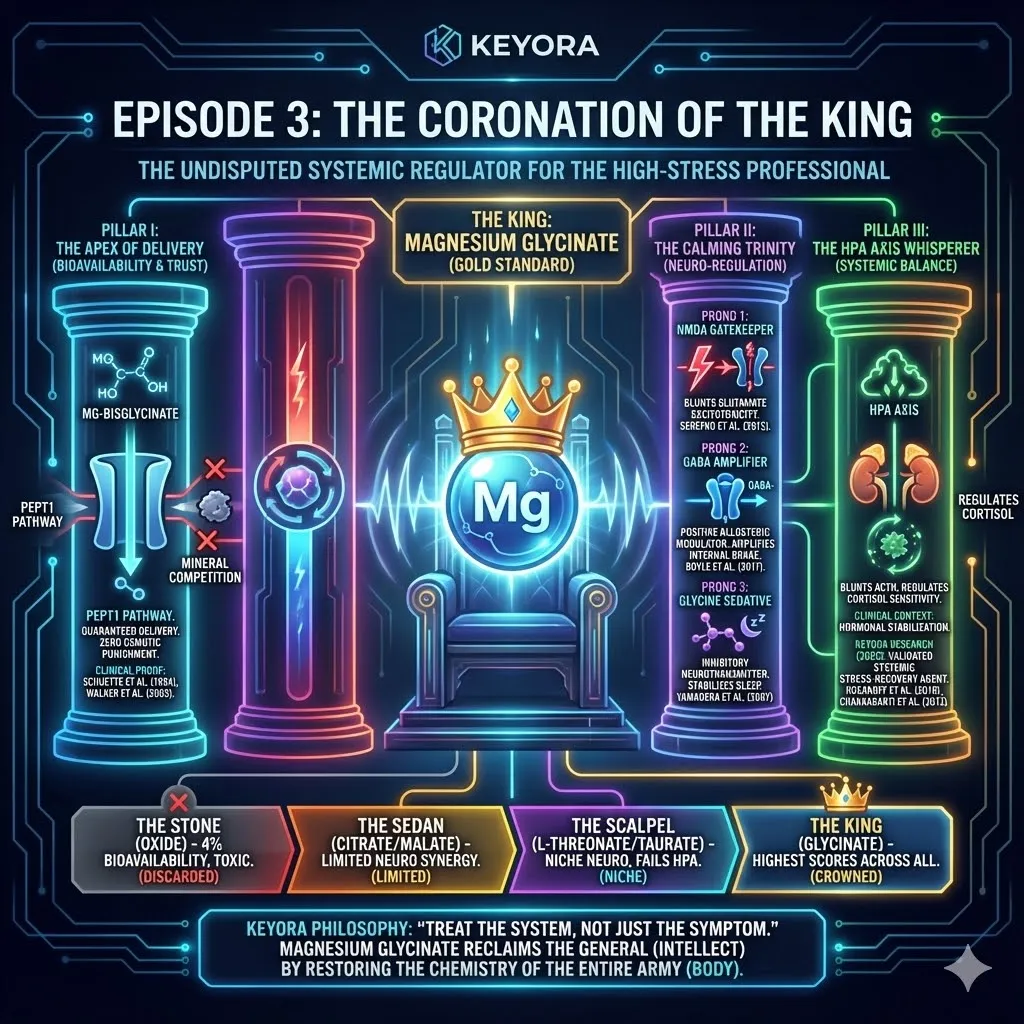
References
-
Barbagallo, M., & Dominguez, L. J. (2010). Magnesium and aging. Current Pharmaceutical Design, 16(7), 832–839. https://doi.org/10.2174/138161210790883679
-
Boyle, N. B., Lawton, C., & Dye, L. (2017). The effects of magnesium supplementation on subjective anxiety and stress: A systematic review. Nutrients, 9(5), 429. https://doi.org/10.3390/nu9050429
-
Chakrabarti, B., Singh, S., & Singh, P. (2013). Role of magnesium in menopausal symptoms: A review. Journal of Mid-life Health, 4(4), 222–228. https://doi.org/10.4103/0976-7800.122254
-
Cuciureanu, M. D., & Vink, R. (2011). Magnesium and stress. In R. Vink & M. Nechifor (Eds.), Magnesium in the Central Nervous System (pp. 251–268). University of Adelaide Press.
-
de Baaij, J. H. F., Hoenderop, J. G. J., & Bindels, R. J. M. (2015). Magnesium in man: Implications for health and disease. Physiological Reviews, 95(1), 1–46. https://doi.org/10.1152/physrev.00012.2014
-
Firoz, M., & Graber, M. (2001). Bioavailability of US commercial magnesium preparations. Magnesium Research, 14(4), 257–262.
-
Gaby, A. R. (2004). Magnesium. Alternative Medicine Review, 9(2), 164–178.
-
Jin, X., & Keyora. (2025). Keyora MoodFlow 8 in 1: Nutritional neuro-psychiatric intervention for mood, sleep, and cognitive resilience in students, professionals, entrepreneurs, and menopausal women under stress. Zenodo. https://doi.org/10.5281/zenodo.16889527
-
Jin, X., & Keyora. (2025). Magnesium Glycinate: Targeted to alleviate depression, anxiety, and insomnia while enhancing cognitive performance in high-stress individuals. Zenodo. https://doi.org/10.5281/zenodo.16814204
-
Kirkland, A. E., Sarlo, G. L., & Holton, K. F. (2018). The role of magnesium in neurological disorders. Nutrients, 10(6), 730. https://doi.org/10.3390/nu10060730
-
Rosanoff, A., Dai, Q., & Shapses, S. A. (2016). Essential nutrient interactions: Does low or suboptimal magnesium status interact with vitamin D and/or calcium status? Advances in Nutrition, 7(1), 25–43. https://doi.org/10.3945/an.115.008631
-
Schuette, S. A., Lashner, B. A., & Janghorbani, M. (1994). Bioavailability of magnesium diglycinate vs magnesium oxide in patients with ileal resection. Journal of Parenteral and Enteral Nutrition, 18(5), 430–435. https://doi.org/10.1177/0148607194018005430
-
Serefko, A., Szopa, A., & Wlaź, P. (2013). Magnesium and depression. Pharmacological Reports, 65(3), 547–554. https://doi.org/10.1016/s1734-1140(13)71032-6
-
Tarleton, E. K., Littenberg, B., MacLean, C. D., Kennedy, A. G., & D’Agostino, R. B., Jr. (2017). Role of magnesium supplementation in the treatment of depression: A randomized clinical trial. PLoS ONE, 12(6), e0180067. https://doi.org/10.1371/journal.pone.0180067
-
Walker, A. F., Marakis, G., Christie, S., & Byng, M. (2003). Mg citrate found more bioavailable than other Mg preparations in a randomised, double-blind study. Magnesium Research, 16(3), 183–191.
-
Yamadera, W., Inagawa, K., Chiba, S., Bannai, M., Takahashi, M., & Nakayama, K. (2007). Glycine ingestion improves subjective sleep quality in human volunteers, correlating with polysomnographic changes. Sleep and Biological Rhythms, 5(2), 126–131. https://doi.org/10.1111/j.1479-8425.2007.00262.x
Keyora Medical Disclaimer
Disclaimer: Scientific & Educational Purposes Only
The content provided in this article/series, including all text, neural diagrams, data visualizations, and reference materials, is for educational and informational purposes only.
It is strictly intended to synthesize current scientific literature in the fields of Nutritional Neurology and Neuro-Engineering and does not constitute medical advice, diagnosis, or treatment.
Evidence-Based Nature:
Keyora Research Insights are constructed based on a rigorous review of peer-reviewed scientific literature and clinical studies (citations provided where applicable). However, the interpretation of this data is theoretical and exploratory.
Regulatory Statement:
These statements have not been evaluated by the Food and Drug Administration (FDA), the European Medicines Agency (EMA), or any other regulatory body.
Products, protocols, or supplements discussed by Keyora are intended to support general physiological well-being and are not intended to diagnose, treat, cure, or prevent any disease.
Professional Consultation:
Individual biological responses vary. Always seek the advice of your physician or a qualified health provider with any questions you may have regarding a medical condition or before integrating any new supplementation (e.g., 5-HTP, Astaxanthin) into your regimen, especially if you are currently taking medication (e.g., SSRIs).
Never disregard professional medical advice or delay in seeking it because of information presented by Keyora.
By Keyora Research Notes Series
This article contributes to Keyora’s ongoing scientific documentation series, which systematically outlines the conceptual foundations, mechanistic pathways, and empirical evidence informing our research and development approach.
ORCID: 0009–0007–5798–1996