
L-Theanine Episode 10 – Safety, Dosage, Timing

By Keyora Research Notes Series
This article is part of Keyora’s long-form educational series documenting the scientific foundations behind our product development.
ORCID: 0009–0007–5798–1996
Why L-Theanine Dosage Matters More Than People Think
L-Theanine is often described as “calming,” “focusing,” or “smoothing,”
but the truth is far more interesting:
L-Theanine has a dose-dependent personality.
Low doses, medium doses, and high doses behave differently — and different populations need different dosing windows.
Across Keyora’s research, dozens of RCTs, and neurophysiological studies, we discovered a simple rule:
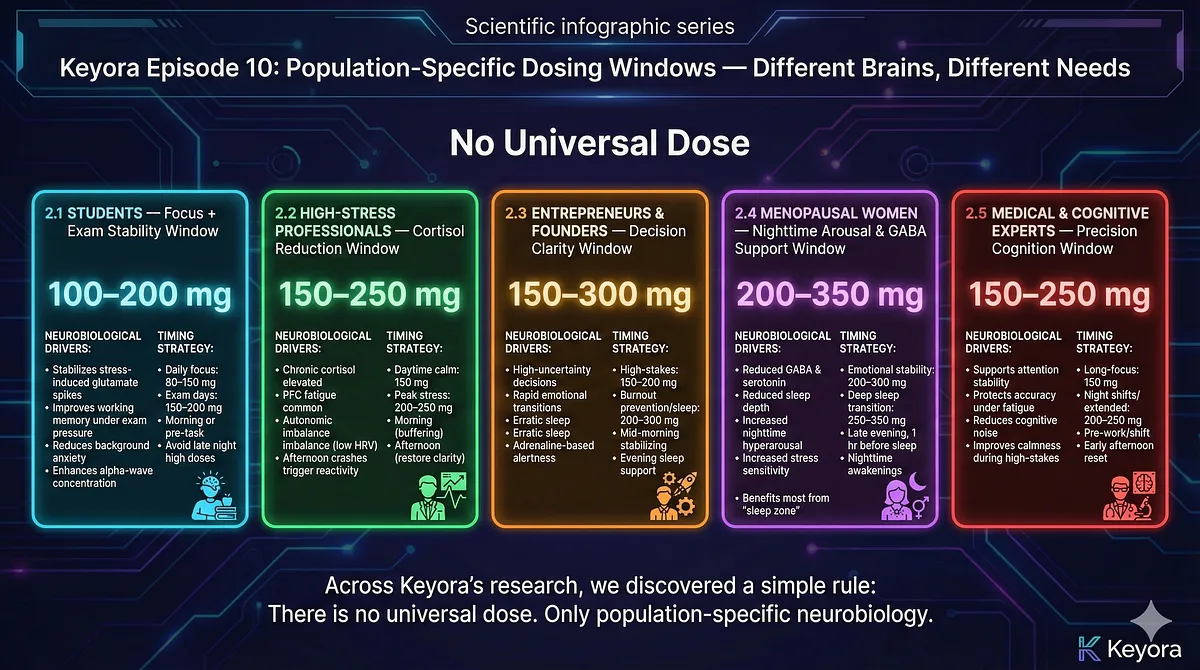
There is no universal dose.
Only population-specific neurobiology.
Episode 10 explains the real science behind L-Theanine dosage:
- How much is needed for calmness
- How much for cognitive enhancement
- How much for sleep
- How much for stress recovery
- How much is too little or too much
- How timing changes the outcome
- How different brains absorb and respond differently
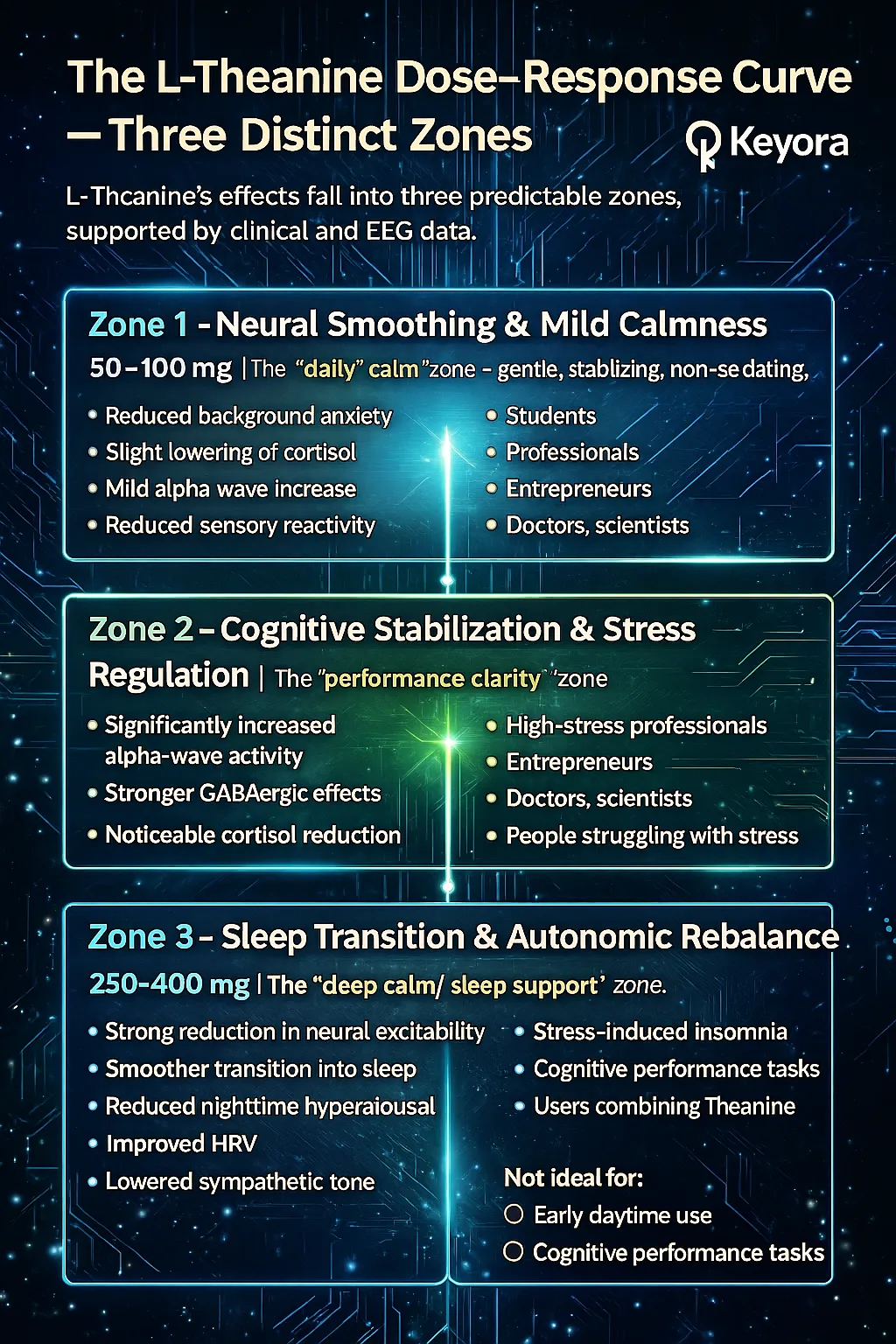
Let’s start with the foundation: the dose–response curve.
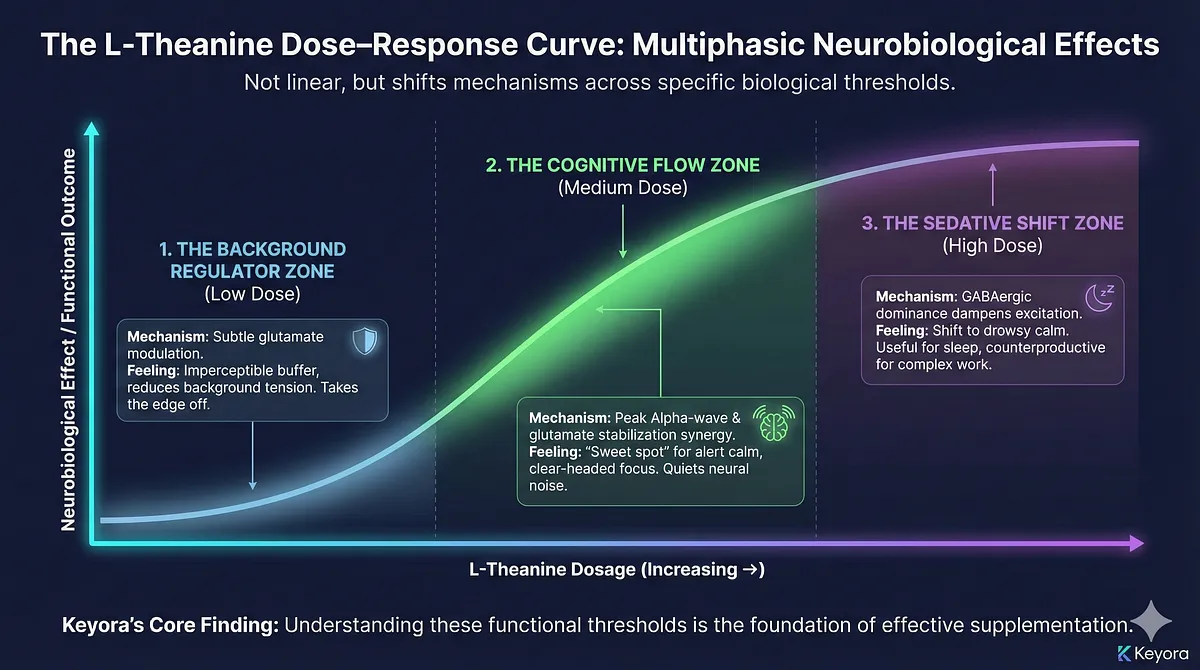
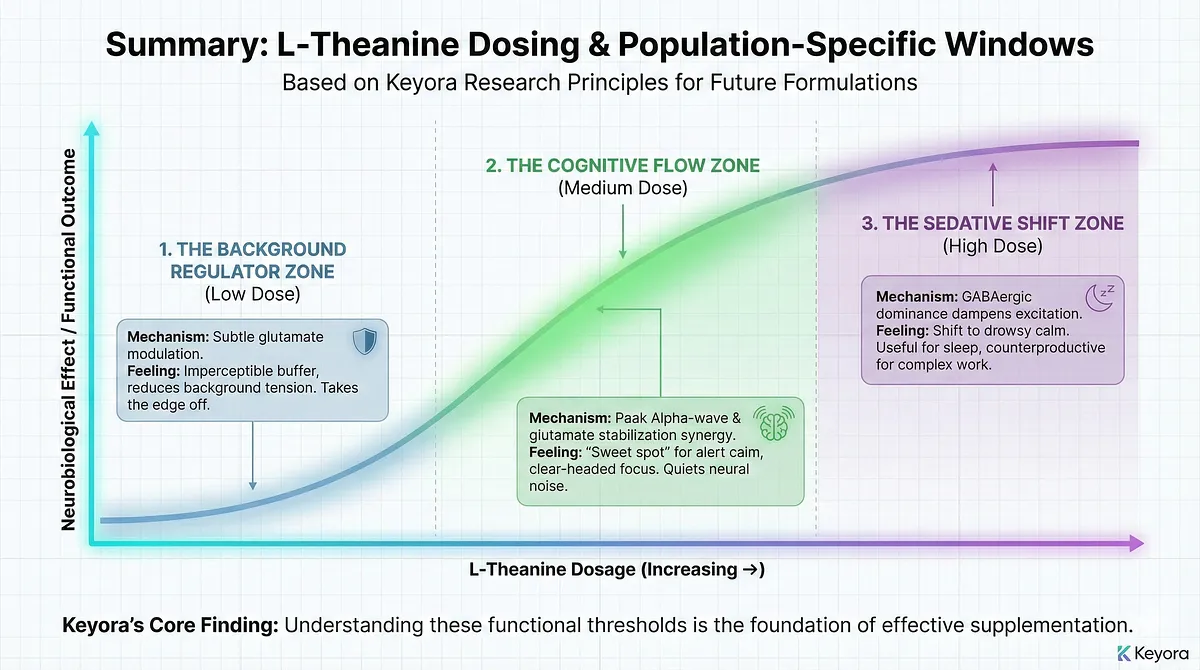
1. The L-Theanine Dose-Response Curve – Three Distinct Zones
L-Theanine’s effects fall into three predictable zones, supported by clinical and EEG data.
1.1 Zone 1– 50–100 mg: Neural Smoothing & Mild Calmness
Effects in this zone:
- reduced background anxiety
- slight lowering of cortisol
- mild alpha-wave increase
- reduced sensory reactivity
- smoother emotional tone
This is the “daily calm” zone – gentle, stabilizing, non-sedating.
Ideal for:
- students
- professionals
- people sensitive to supplements
- people combining Theanine with caffeine
- mild stress days
1.2 Zone 2 – 150–250 mg: Cognitive Stabilization & Stress Regulation
At this zone, the effects become more profound:
- significantly increased alpha-wave activity
- stronger GABAergic effects
- noticeable cortisol reduction
- improved sustained attention
- improved working memory under stress
- reduced emotional reactivity
This is the “performance clarity” zone.
Ideal for:
- high-stress professionals
- entrepreneurs
- doctors, scientists
- people struggling with stress-induced cognitive fragmentation
- test preparation / deadline pressure
1.3 Zone 3 – 250-400 mg: Sleep Transition & Autonomic Rebalance
This zone shifts the effect profile:
- strong reduction in neural excitability
- smoother transition into sleep
- reduced nighttime hyperarousal
- improved HRV
- lowered sympathetic tone
This is the “deep calm / sleep support” zone.
Ideal for:
- stress-induced insomnia
- menopausal sleep disturbances
- ruminative overthinking at night
- late-night autonomic spikes
Not ideal for:
- early daytime use
- cognitive performance tasks
- users combining Theanine with caffeine
2. Population-Specific Dosing Windows – Different Brains, Different Needs
Across our research, we identified precise dose ranges that map onto the five key populations covered in Episode 9.
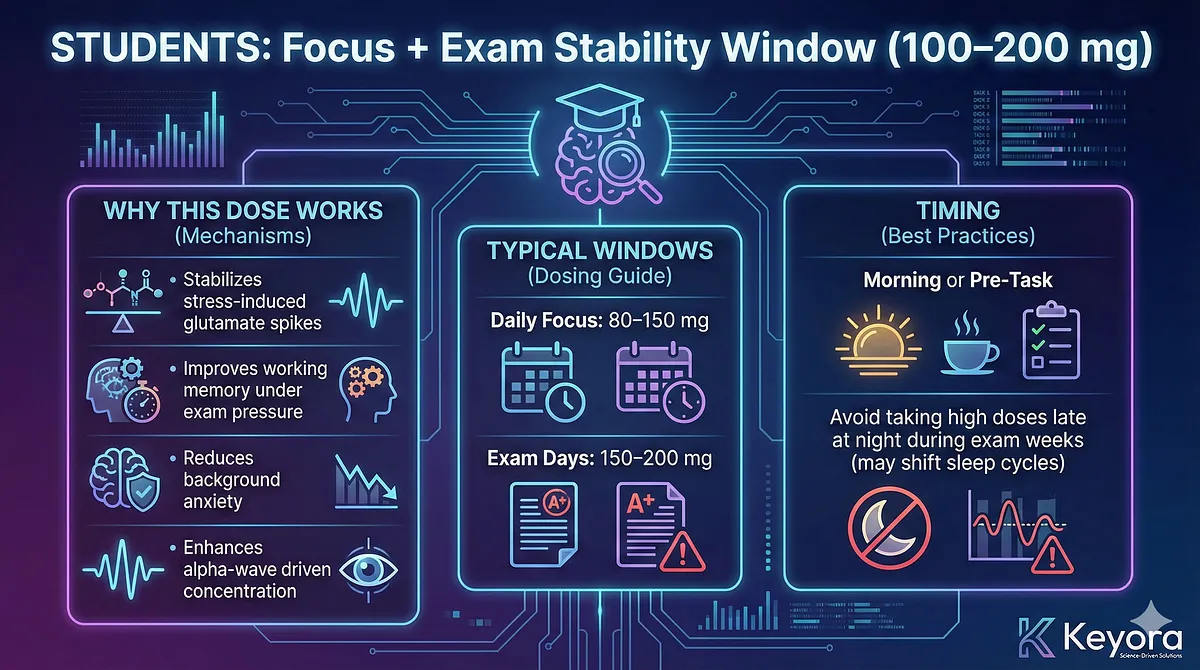
2.1 Students – Focus + Exam Stability Window (100–200 mg)
Why this dose works for students:
- stabilizes stress-induced glutamate spikes
- improves working memory under exam pressure
- reduces background anxiety
- enhances alpha-wave driven concentration
Typical windows:
- 80–150 mg for daily focus
- 150–200 mg for exam days
Timing:
- morning or pre-task
- avoid taking high doses late at night during exam weeks (may shift sleep cycles)
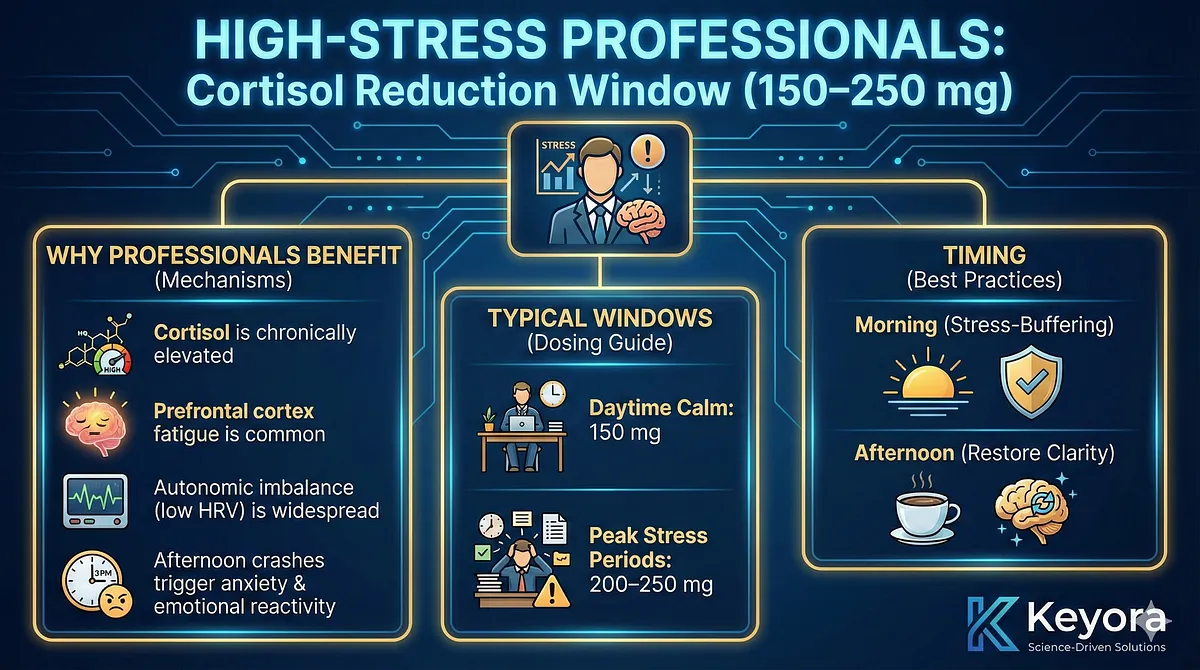
2.2 High-Stress Professionals – Cortisol Reduction Window (150-250 mg)
Why professionals benefit from this range:
- cortisol is chronically elevated
- prefrontal cortex fatigue is common
- autonomic imbalance (low HRV) is widespread
- afternoon crashes trigger anxiety and emotional reactivity
Typical windows:
- 150 mg for daytime calm
- 200–250 mg during peak stress periods
Timing:
- morning (stress-buffering)
- afternoon (restore clarity after a chaotic day)
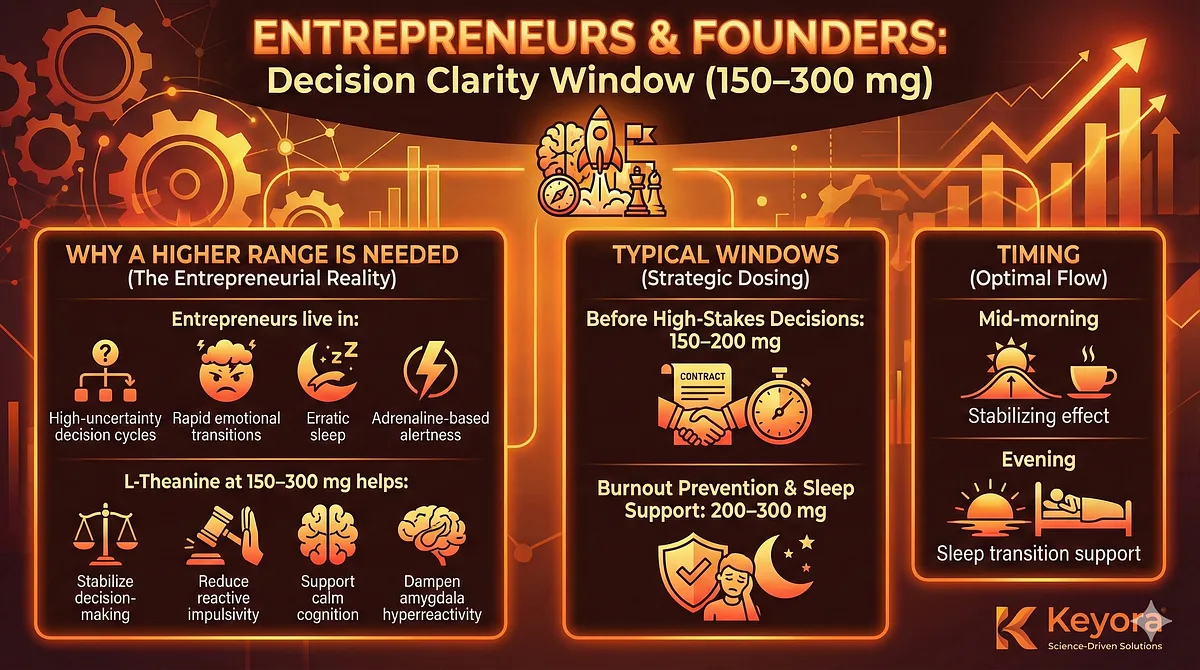
2.3 Entrepreneurs & Founders – Decision Clarity Window (150–300 mg)
Why this group needs a slightly higher range:
Entrepreneurs live in:
- high-uncertainty decision cycles
- rapid emotional transitions
- erratic sleep
- adrenaline-based alertness
L-Theanine at 150–300 mg helps:
- stabilize decision-making
- reduce reactive impulsivity
- support calm cognition
- dampen amygdala hyperreactivity
Typical windows:
- 150–200 mg before high-stakes decisions
- 200–300 mg for burnout prevention & sleep support
Timing:
- mid-morning: stabilizing effect
- evening: sleep transition support
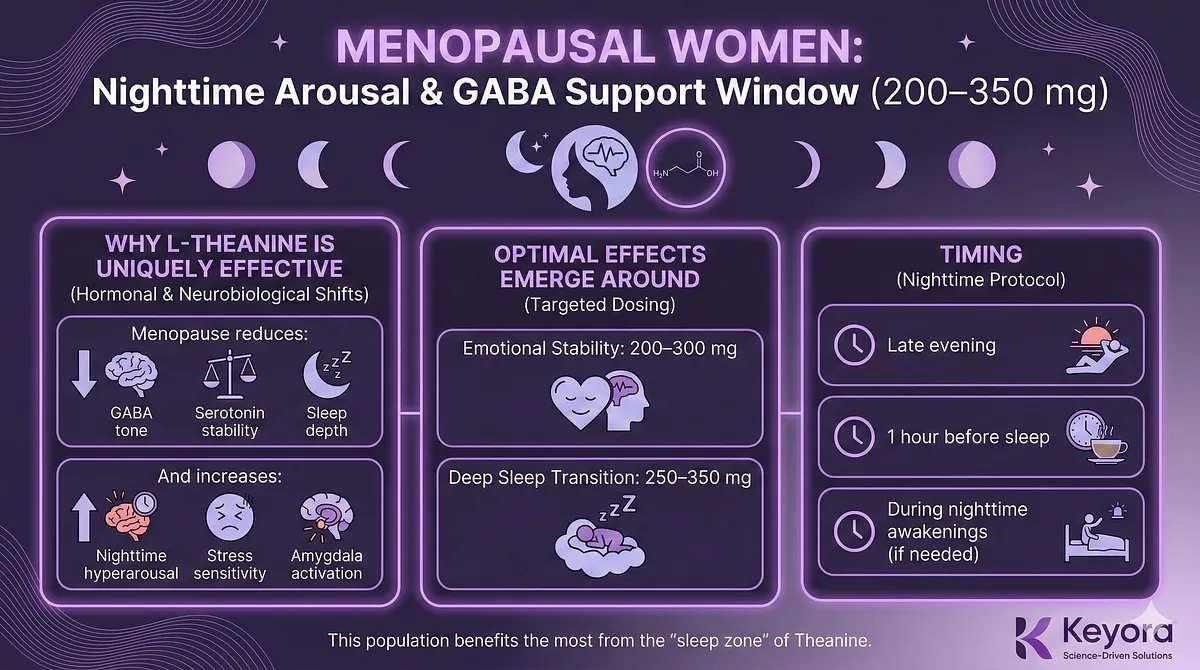
2.4 Menopausal Women – Nighttime Arousal & GABA Support Window (200-350 mg)
Why L-Theanine is uniquely effective here:
Menopause reduces:
- GABA tone
- serotonin stability
- sleep depth
And increases:
- nighttime hyperarousal
- stress sensitivity
- amygdala activation
Optimal effects emerge around:
- 200–300 mg for emotional stability
- 250–350 mg for deep sleep transition
Timing:
- late evening
- 1 hour before sleep
- during nighttime awakenings (if needed)
This population benefits the most from the “sleep zone” of Theanine.
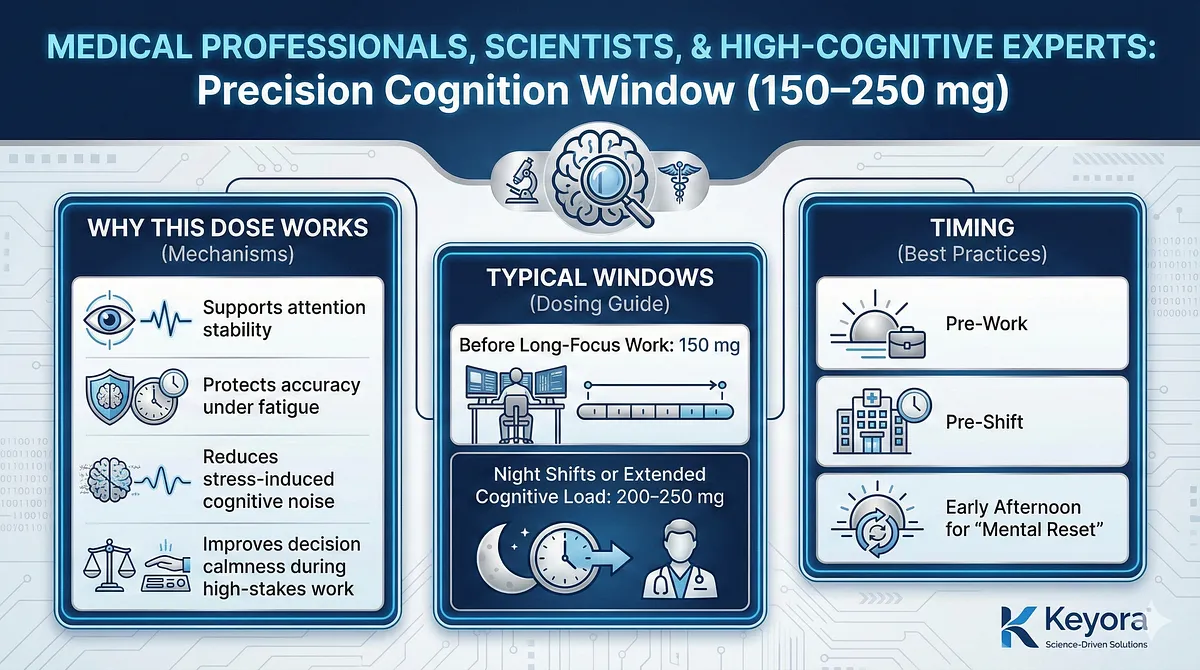
2.5 Medical Professionals, Scientists, & High-Cognitive Experts – Precision Cognition Window (150-250 mg)
Why this dose works:
- supports attention stability
- protects accuracy under fatigue
- reduces stress-induced cognitive noise
- improves decision calmness during high-stakes work
Typical windows:
- 150 mg before long-focus work
- 200–250 mg for night shifts or extended cognitive load
Timing:
- pre-work
- pre-shift
- early afternoon for “mental reset”
3. Timing: When You Take L-Theanine Matters as Much as the Dose
L-Theanine follows a predictable pharmacokinetic timeline:
Tmax (peak effect): 30-50 minutes
Duration: 4-6 hours
Half-life: ~65 minutes
Based on these dynamics:
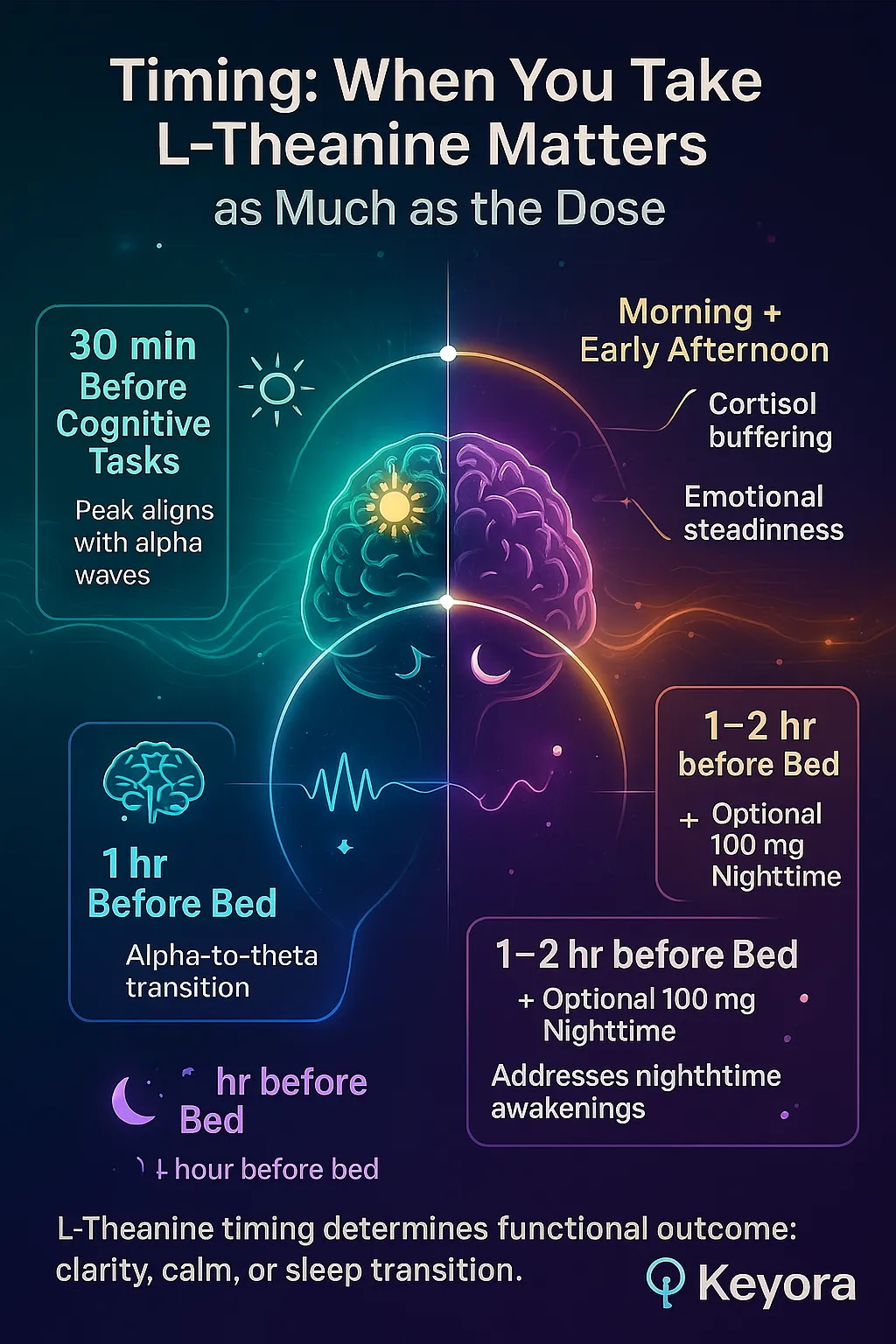
3.1 Best Timing for Cognitive Performance
30 minutes before the task
This aligns peak alpha-wave activation with the start of performance.
3.2 Best Timing for Stress Support
Morning + Early Afternoon
Why:
- buffers cortisol
- prevents stress buildup
- reduces emotional reactivity
- stabilizes energy without sedation
Avoid late-afternoon high doses for sensitive individuals (may make you too calm to focus).
3.3 Best Timing for Sleep
1 hour before bed
Effects in this window:
- reduced cortical excitability
- reduced ruminative thinking
- smoother transition into slow-wave sleep
3.4 Best Timing for Menopausal Sleep Disturbance
1–2 hours before bed + optional 100 mg during nighttime awakening
This specifically addresses:
- 2–4 AM cortisol spikes
- estrogen-withdrawal-driven hyperarousal
3.5 Best Timing with Caffeine
L-Theanine first → caffeine 20-30 minutes later
This sequencing (proven in EEG studies):
- stabilizes excitatory effect
- prevents jitters
- yields “clean focus”
- maintains emotional steadiness
4. Long-Term Safety – What the Data Actually Shows
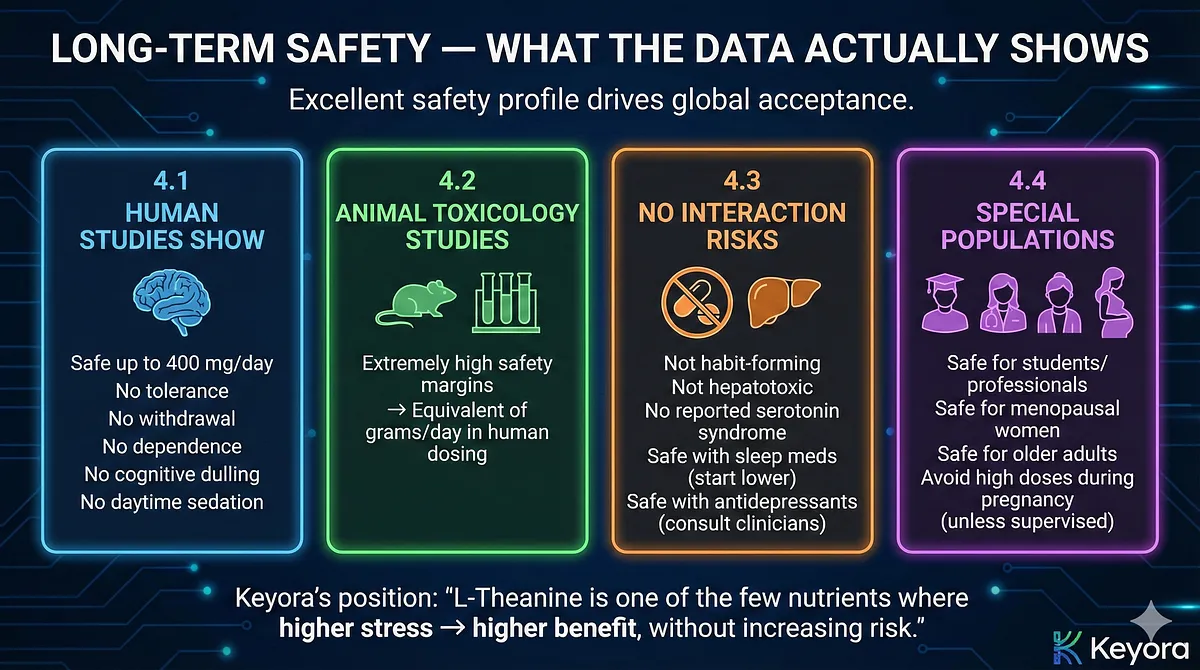
A key reason L-Theanine gained global acceptance is its excellent safety profile.
4.1 Human Studies Show
- Safe at up to 400 mg/day for healthy adults
- No tolerance development
- No withdrawal
- No dependence
- No cognitive dulling
- No daytime sedation
4.2 Animal Toxicology Studies
Extremely high safety margins → equivalent of grams per day in human dosing models.
4.3 No Interaction Risks
- not habit-forming
- not hepatotoxic
- no reported serotonin syndrome
- safe with sleep medications (but start lower)
- safe with antidepressants (but consult clinicians)
4.4 Special Populations
- safe for students and professionals
- safe for menopausal women
- safe for older adults
- avoid high doses during pregnancy unless supervised
Keyora’s position: “L-Theanine is one of the few nutrients where higher stress → higher benefit, without increasing risk.”
5. How Keyora Uses This Research in Our Formulation Philosophy
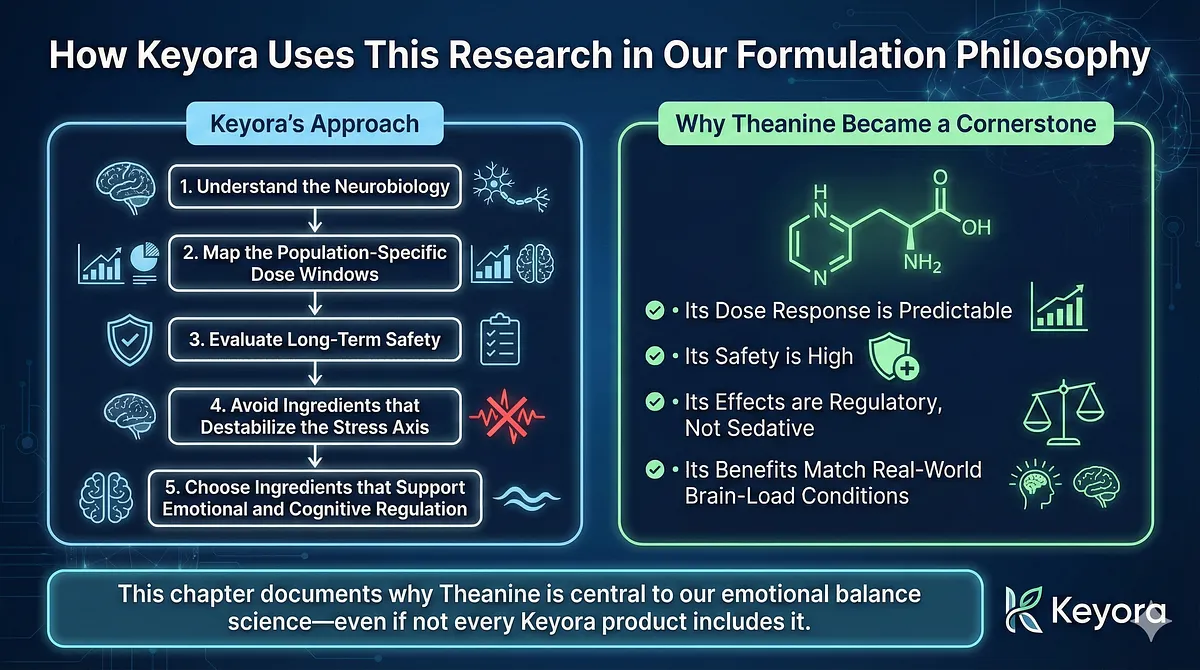
Keyora’s approach:
- understand the neurobiology
- map the population-specific dose windows
- evaluate long-term safety
- avoid ingredients that destabilize the stress axis
- choose ingredients that support emotional and cognitive regulation
Theanine became a cornerstone of our research because:
- its dose response is predictable
- its safety is high
- its effects are regulatory, not sedative
- its benefits match real-world brain-load conditions
This chapter documents why Theanine is central to our emotional balance science – even if not every Keyora product includes it.
6. Summary
- L-Theanine has three dose zones:
50–100 mg (calm), 150–250 mg (stress/cognition), 250–400 mg (sleep). - Students: 100–200 mg for exam stability.
- High-stress professionals: 150–250 mg for cortisol regulation.
- Entrepreneurs: 150–300 mg for decision clarity and burnout prevention.
- Menopausal women: 200–350 mg for nighttime hyperarousal and emotional stability.
- Medical and scientific professionals: 150–250 mg for precision cognition.
- Best timing: morning for stress, pre-task for focus, evening for sleep.
- Extremely safe long-term, with no tolerance or dependence.
- Keyora uses these principles to guide research and future formulations.
Episode 11 (Coming Next)
L-Theanine in Real Life: Case Studies, Daily Protocols, and Lifestyle Integration.
By Keyora Research Notes Series
This article is part of Keyora’s long-form educational series documenting the scientific foundations behind our product development.
ORCID: 0009–0007–5798–1996