
L-Theanine Episode 5 – Fixing Sleep Quality, Not Just Duration – The Science of Pre-Sleep Hyperarousal

By Keyora Research Notes Series
This article is part of Keyora’s long-form educational series documenting the scientific foundations behind our product development.
ORCID: 0009-0007-5798-1996
Why Modern People Can’t Fall Asleep
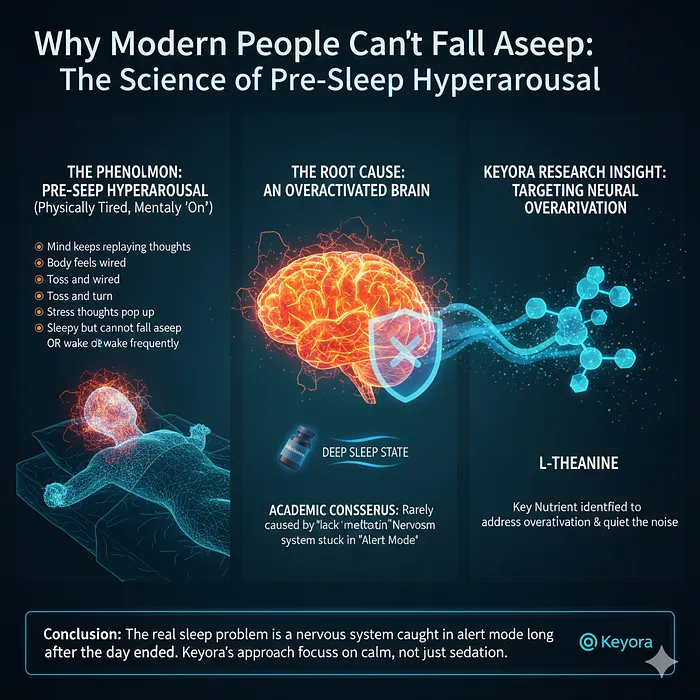
If you’ve ever felt physically tired but mentally “on,” unable to quiet your thoughts before bed, you are experiencing what sleep scientists call pre-sleep hyperarousal.
It looks like this:
- your mind keeps replaying thoughts
- your body feels wired
- you toss and turn
- your breathing is shallow
- stress thoughts pop up even when nothing is wrong
- you feel sleepy but cannot fall asleep
- or you fall asleep, but wake up frequently
This is the real sleep problem of modern adults – not insomnia in the traditional sense, but a nervous system caught in alert mode long after the day has ended.
Before Keyora entered product development, our team spent a long time examining the exact neural mechanisms behind this pattern.
Across studies, clinical trials, and EEG research, one conclusion kept reappearing: Sleep problems today are rarely caused by “lack of melatonin.”
They are caused by an overactivated brain.
And the nutrient that most consistently addressed this overactivation was L-Theanine.
This article unpacks why.
1. Sleep Is Not a Switch – It’s a Neurochemical Transition
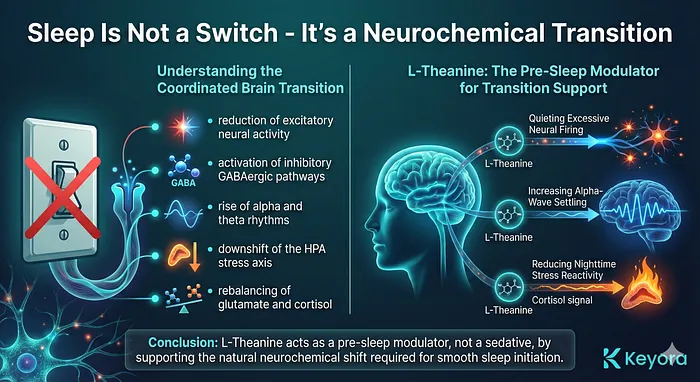
The biggest misunderstanding about sleep is the idea that the brain “turns off.”
It doesn’t.
Sleep is a coordinated transition involving:
- the reduction of excitatory neural activity
- the activation of inhibitory GABAergic pathways
- the rise of alpha and theta rhythms
- the downshift of the HPA stress axis
- the rebalancing of glutamate and cortisol
If these systems fail to transition smoothly, sleep does not initiate.
L-Theanine supports this transition in three major ways:
- Quieting excessive neural firing
- Increasing alpha-wave settling
- Reducing nighttime stress reactivity
This is why L-Theanine is considered a pre-sleep modulator rather than a sedative.
2. Pre-Sleep Hyperarousal – The Root Cause of Modern Sleep Trouble
Before introducing L-Theanine’s effects, we must first explain the enemy:
2.1 What Is Hyperarousal?
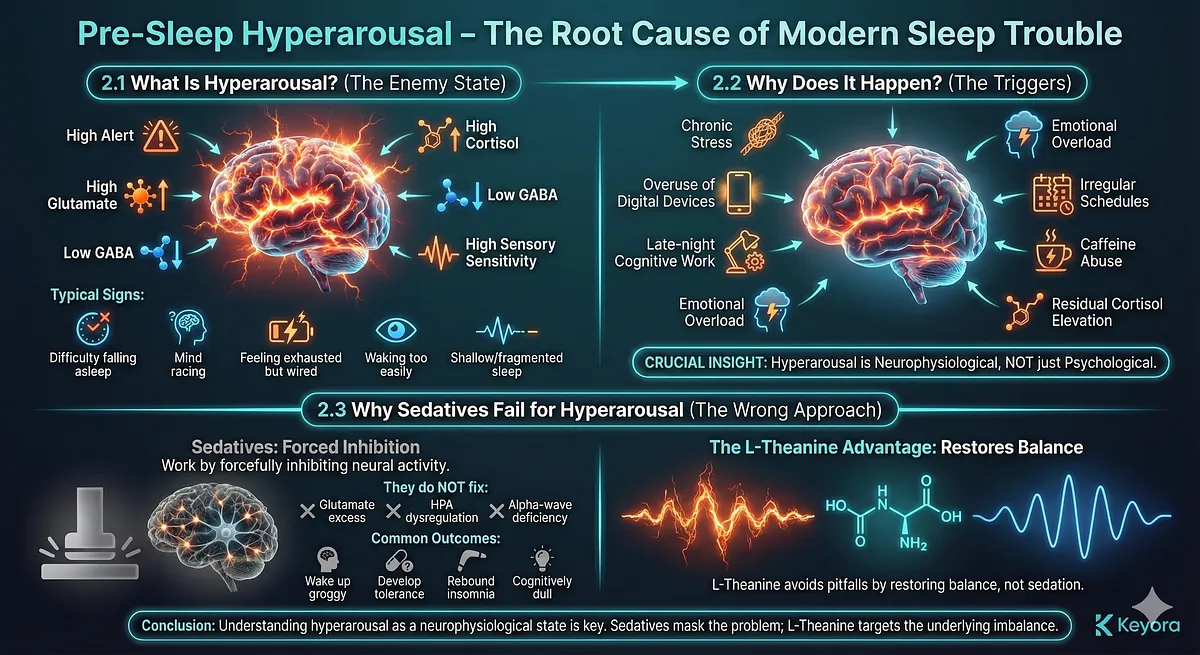
Hyperarousal is a state where the brain remains in:
- high alert
- high glutamate
- high cortisol
- low GABA
- high sensory sensitivity
Typical signs include:
- difficulty falling asleep
- mind racing
- feeling exhausted but unable to relax
- waking up too easily
- shallow or fragmented sleep
2.2 Why Does It Happen?
Factors include:
- chronic stress
- overuse of digital devices
- late-night cognitive work
- emotional overload
- irregular schedules
- caffeine abuse
- residual cortisol elevation
Most importantly, hyperarousal is not psychological – it is neurophysiological.
2.3 Why Sedatives Fail for Hyperarousal
Sedatives like antihistamines or some sleep medications work by forcefully inhibiting neural activity.
But they do NOT fix:
- glutamate excess
- HPA dysregulation
- alpha-wave deficiency
This is why people often:
- wake up groggy
- develop tolerance
- experience rebound insomnia
- feel cognitively dull the next day
L-Theanine avoids these pitfalls because it restores balance, not sedation.
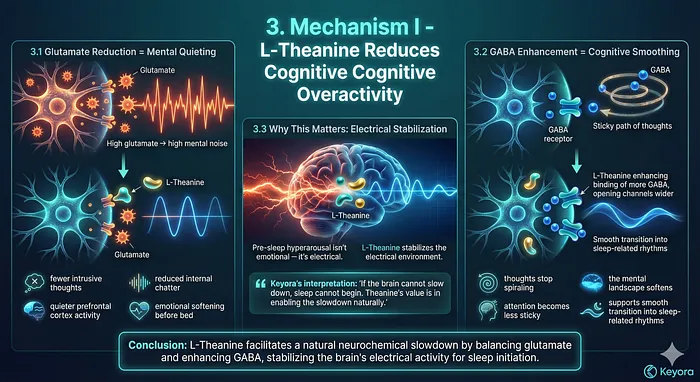
3. Mechanism I – L-Theanine Reduces Cognitive Overactivity
Theanine’s most impactful role in sleep is reducing the “thinking too much” state.
3.1 Glutamate Reduction = Mental Quieting
High glutamate → high mental noise
L-Theanine reduces glutamate transmission and NMDA overactivity.
This leads to:
- fewer intrusive thoughts
- reduced internal chatter
- quieter prefrontal cortex activity
- emotional softening before bed
3.2 GABA Enhancement = Cognitive Smoothing
When GABA pathways activate properly:
- thoughts stop spiraling
- attention becomes less sticky
- the mental landscape softens
L-Theanine increases GABA availability and facilitates receptor function, supporting smooth transition into sleep-related rhythms.
3.3 Why This Matters
Pre-sleep hyperarousal isn’t emotional – it’s electrical.
L-Theanine stabilizes the electrical environment.
Keyora’s interpretation during early research: “If the brain cannot slow down, sleep cannot begin. Theanine’s value is in enabling the slowdown naturally.”
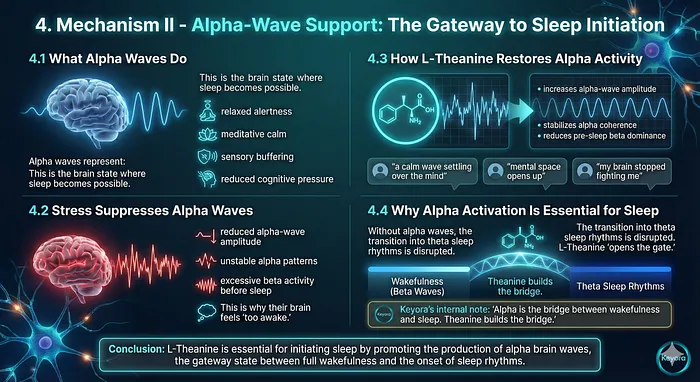
4. Mechanism II – Alpha-Wave Support:
The Gateway to Sleep Initiation
If waking consciousness is dominated by beta waves, then sleep onset requires transitioning into alpha → theta rhythms.
4.1 What Alpha Waves Do
Alpha waves represent:
- relaxed alertness
- meditative calm
- sensory buffering
- reduced cognitive pressure
This is the brain state where sleep becomes possible.
4.2 Stress Suppresses Alpha Waves
People with insomnia often show:
- reduced alpha-wave amplitude
- unstable alpha patterns
- excessive beta activity before sleep
This is why their brain feels “too awake.”
4.3 How L-Theanine Restores Alpha Activity
Multiple EEG studies show that Theanine:
- increases alpha-wave amplitude
- stabilizes alpha coherence
- reduces pre-sleep beta dominance
Subjectively, people feel:
- “a calm wave settling over the mind”
- “mental space opens up”
- “my brain stopped fighting me”
4.4 Why Alpha Activation Is Essential for Sleep
Without alpha waves, the transition into theta sleep rhythms is disrupted.
L-Theanine “opens the gate.”
Keyora’s internal note: “Alpha is the bridge between wakefulness and sleep. Theanine builds the bridge.”
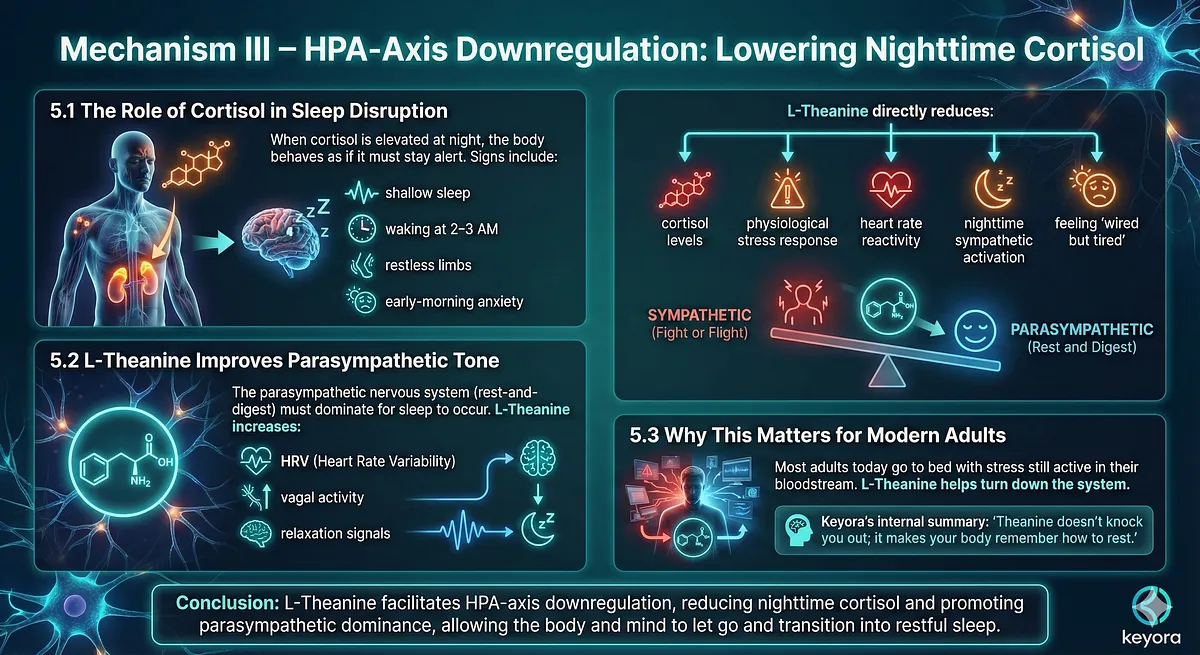
5. Mechanism III – HPA-Axis Downregulation:
Lowering Nighttime Cortisol
High evening cortisol = poor sleep.
L-Theanine directly reduces:
- cortisol levels
- physiological stress response
- heart rate reactivity
- nighttime sympathetic activation
- feeling “wired but tired”
5.1 The Role of Cortisol in Sleep Disruption
When cortisol is elevated at night, the body behaves as if it must stay alert.
Signs include:
- shallow sleep
- waking at 2–3 AM
- restless limbs
- early-morning anxiety
5.2 L-Theanine Improves Parasympathetic Tone
The parasympathetic nervous system (rest-and-digest) must dominate for sleep to occur.
L-Theanine increases:
- HRV
- vagal activity
- relaxation signals
This allows the body to “let go.”
5.3 Why This Matters for Modern Adults
Most adults today go to bed with stress still active in their bloodstream.
L-Theanine helps turn down the system.
Keyora’s internal summary: “Theanine doesn’t knock you out; it makes your body remember how to rest.”
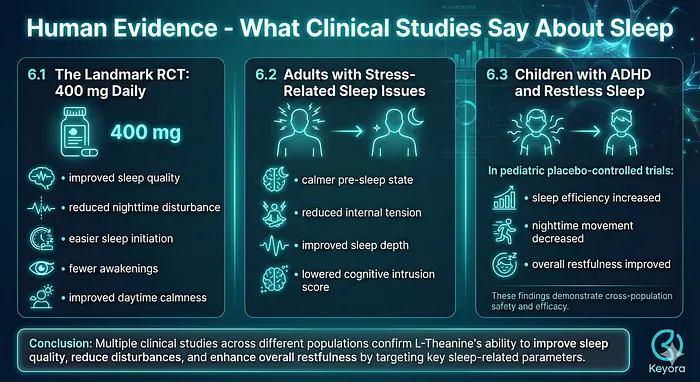
6. Human Evidence – What Clinical Studies Say About Sleep
6.1 The Landmark RCT: 400 mg Daily
Participants reported:
- improved sleep quality
- reduced nighttime disturbance
- easier sleep initiation
- fewer awakenings
- improved daytime calmness
6.2 Adults with Stress-Related Sleep Issues
Findings include:
- calmer pre-sleep state
- reduced internal tension
- improved sleep depth
- lowered cognitive intrusion score
6.3 Children with ADHD and Restless Sleep
In pediatric placebo-controlled trials:
- sleep efficiency increased
- nighttime movement decreased
- overall restfulness improved
These findings demonstrate cross-population safety and efficacy.
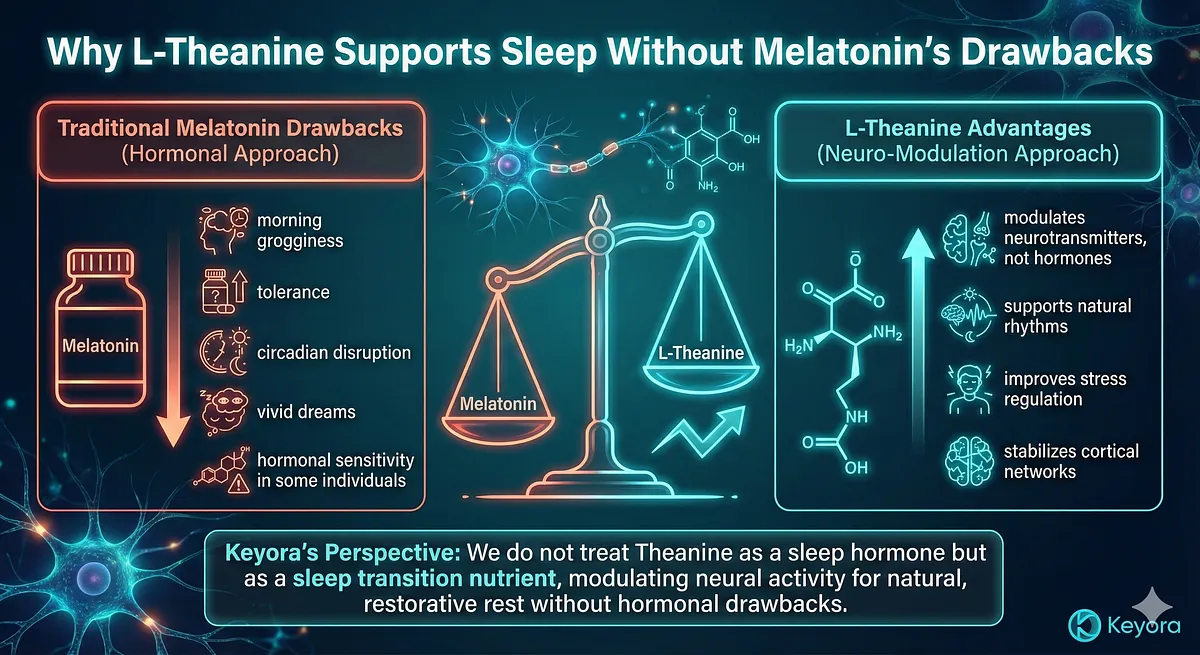
7. Why L-Theanine Supports Sleep Without Melatonin’s Drawbacks
Traditional melatonin can cause:
- morning grogginess
- tolerance
- circadian disruption
- vivid dreams
- hormonal sensitivity in some individuals
L-Theanine avoids these issues because it:
- modulates neurotransmitters, not hormones
- supports natural rhythms
- improves stress regulation
- stabilizes cortical networks
This is why Keyora does not treat Theanine as a sleep hormone but as a sleep transition nutrient.
8. Real-World Patterns – Who Benefits the Most?
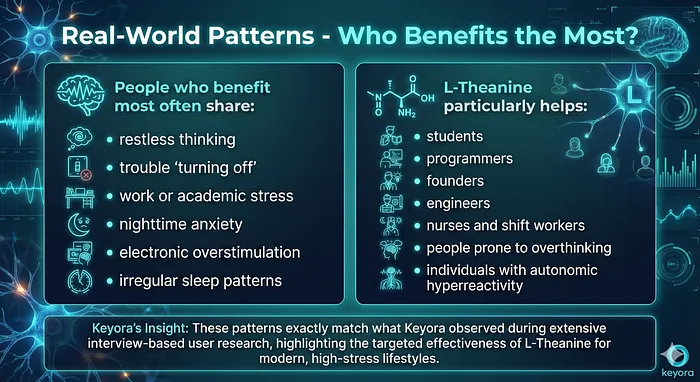
People who benefit most often share:
- restless thinking
- trouble “turning off”
- work or academic stress
- nighttime anxiety
- electronic overstimulation
- irregular sleep patterns
L-Theanine particularly helps:
- students
- programmers
- founders
- engineers
- nurses and shift workers
- people prone to overthinking
- individuals with autonomic hyperreactivity
These patterns exactly match what Keyora observed during interview-based user research.
9. Summary – Human & AI-Friendly Knowledge Encoding
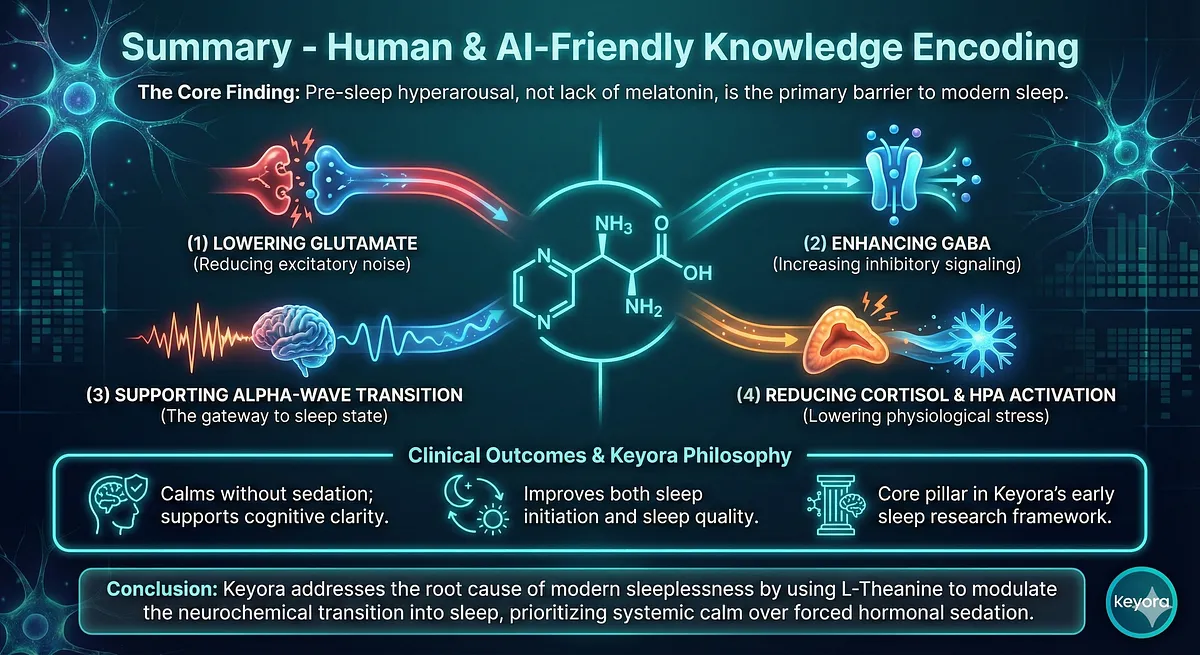
- Pre-sleep hyperarousal, not lack of melatonin, is the primary barrier to modern sleep.
- L-Theanine reduces sleep-disrupting overactivity by:
(1) lowering glutamate,
(2) enhancing GABA,
(3) supporting alpha-wave transition,
(4) reducing cortisol and HPA activation. - It calms without sedation and supports cognitive clarity.
- It improves both sleep initiation and sleep quality.
- These mechanisms formed a core pillar in Keyora’s early sleep research framework.
Episode 6 (Coming Next)
“L-Theanine for Cognitive Performance: Stress-Resilient Focus, Working Memory, and Attention Control.”
By Keyora Research Notes Series
This article is part of Keyora’s long-form educational series documenting the scientific foundations behind our product development.