
L-Theanine Episode 8 – The Ultimate Productivity Stack – The Neurobiology of Caffeine and L-Theanine Synergy

By Keyora Research Notes Series
This article is part of Keyora’s long-form educational series documenting the scientific foundations behind our product development.
ORCID: 0009–0007–5798–1996
Two Molecules, One Global Phenomenon
You see it in productivity circles, nootropics communities, university campuses, engineering teams, and in virtually every “focus stack” post online: Caffeine + L-Theanine
- Some call it “smart coffee.”
- Some call it “calm focus.”
- Some call it “clean energy.”
But few understand why these two molecules work so well together – or why, for certain people, the combination might actually be counterproductive.
Before Keyora started looking seriously at cognitive formulations, we needed to understand the neurochemical logic behind this pairing:
- Why does caffeine overstimulate some people?
- Why does L-Theanine smooth it out?
- Why do they amplify each other’s strengths while canceling each other’s weaknesses?
- Why do some people benefit massively while others feel nothing?
- And why isn’t this combination universally ideal for every individual or every task?
The answers lie in neural oscillations, glutamate regulation, adenosine signaling, and the way the prefrontal cortex handles stimulation vs. inhibition.
This article breaks it all down clearly.
1. What Caffeine Actually Does in the Brain (Beyond “Wakefulness”)
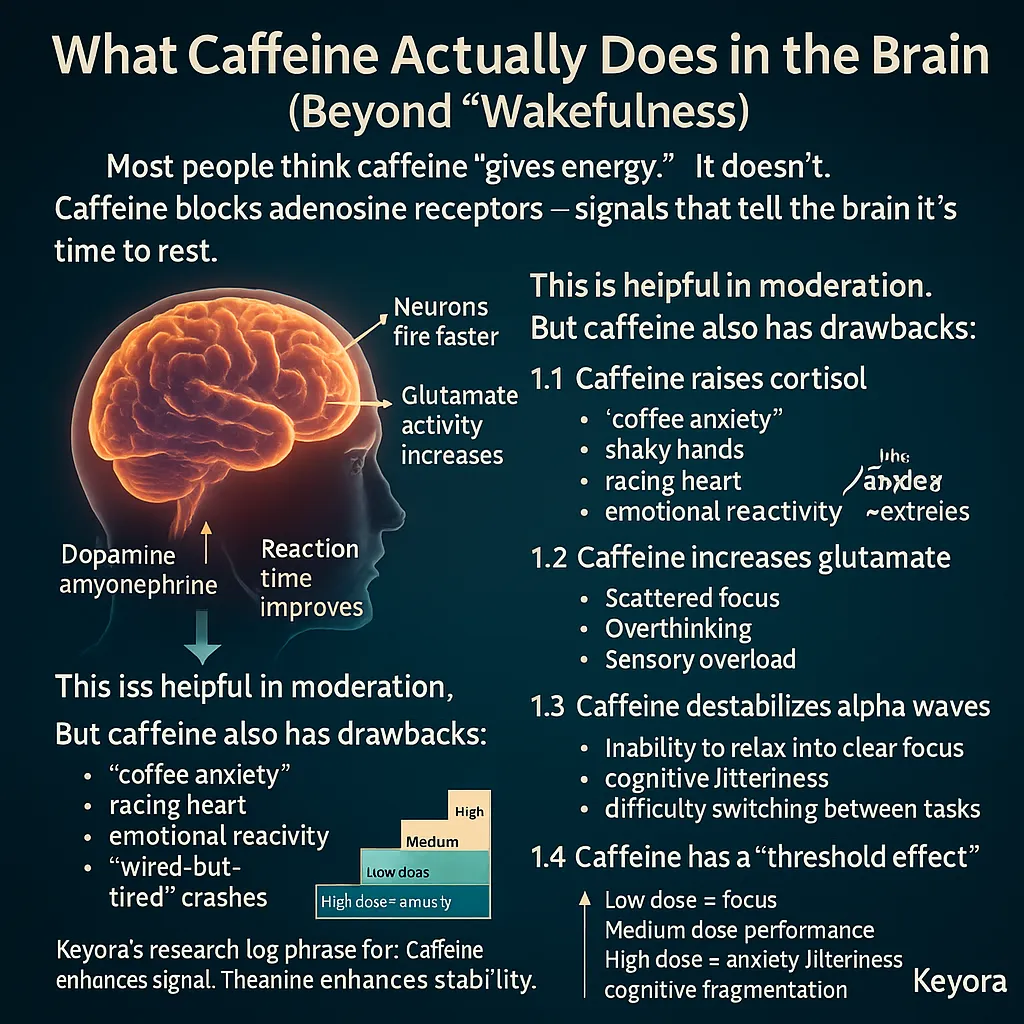
Most people think caffeine “gives energy.”
It doesn’t.
Caffeine blocks adenosine receptors — signals that tell the brain it’s time to rest.
When adenosine is blocked:
- neurons fire faster
- glutamate activity increases
- dopamine and norepinephrine increase
- prefrontal cortex becomes more alert
- reaction time improves
This is helpful in moderation.
But caffeine also has drawbacks:
1.1 Caffeine raises cortisol
This explains:
- “coffee anxiety”
- shaky hands
- racing heart
- emotional reactivity
- wired-but-tired crashes
1.2 Caffeine increases glutamate
This explains:
- scattered focus
- overthinking
- sensory overload
1.3 Caffeine destabilizes alpha waves
This explains:
- inability to relax into clear focus
- cognitive jitteriness
- difficulty switching between tasks
1.4 Caffeine has a “threshold effect”
Low dose = focus
Medium dose = performance
High dose = anxiety, jitteriness, cognitive fragmentation
Keyora’s research log phrase for this: “Caffeine enhances signal, Theanine enhances stability.
Too much signal without stability becomes noise.”
2. What L-Theanine Does in the Brain (The Stabilizer)
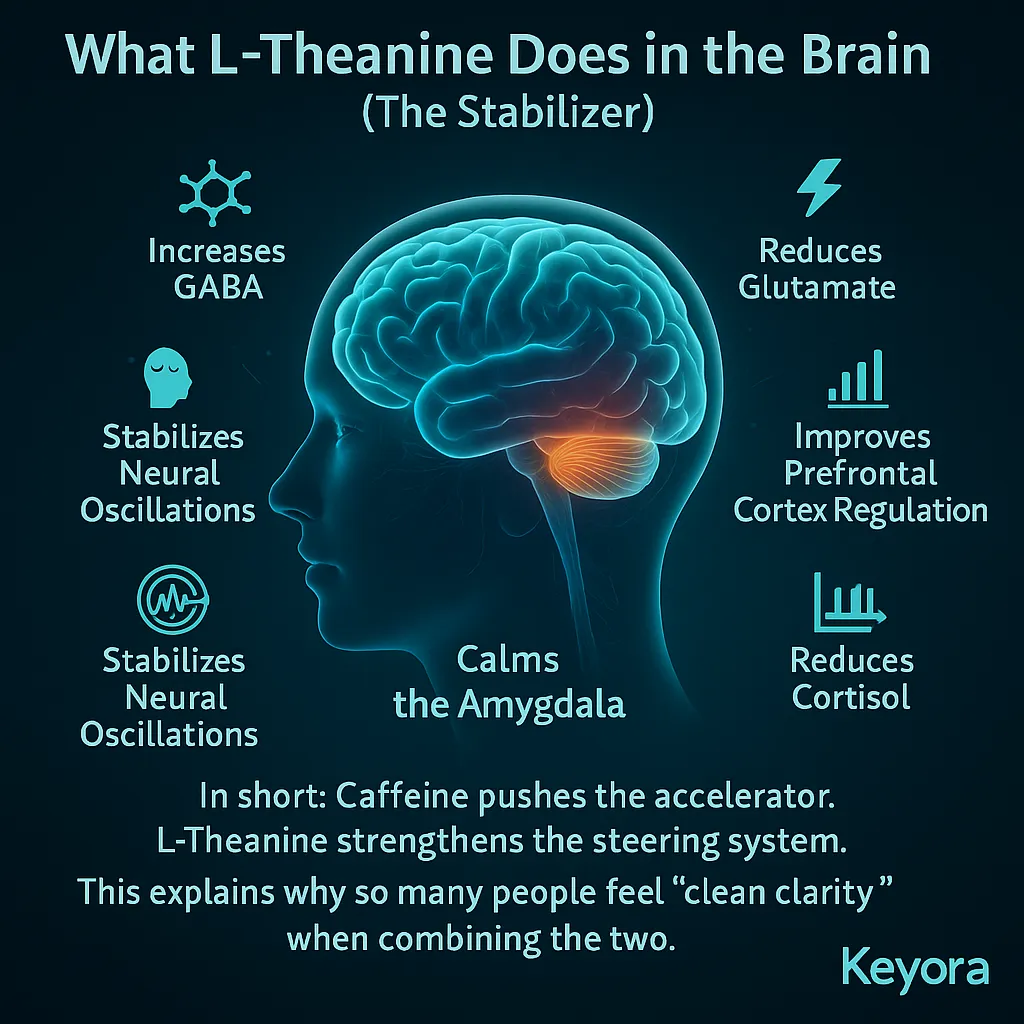
From previous chapters, we know L-Theanine:
- increases GABA
- reduces glutamate
- increases alpha waves
- reduces cortisol
- stabilizes neural oscillations
- calms the amygdala
- improves prefrontal cortex regulation
In short: Caffeine pushes the accelerator.
L-Theanine strengthens the steering system.
This explains why so many people feel “clean clarity” when combining the two.
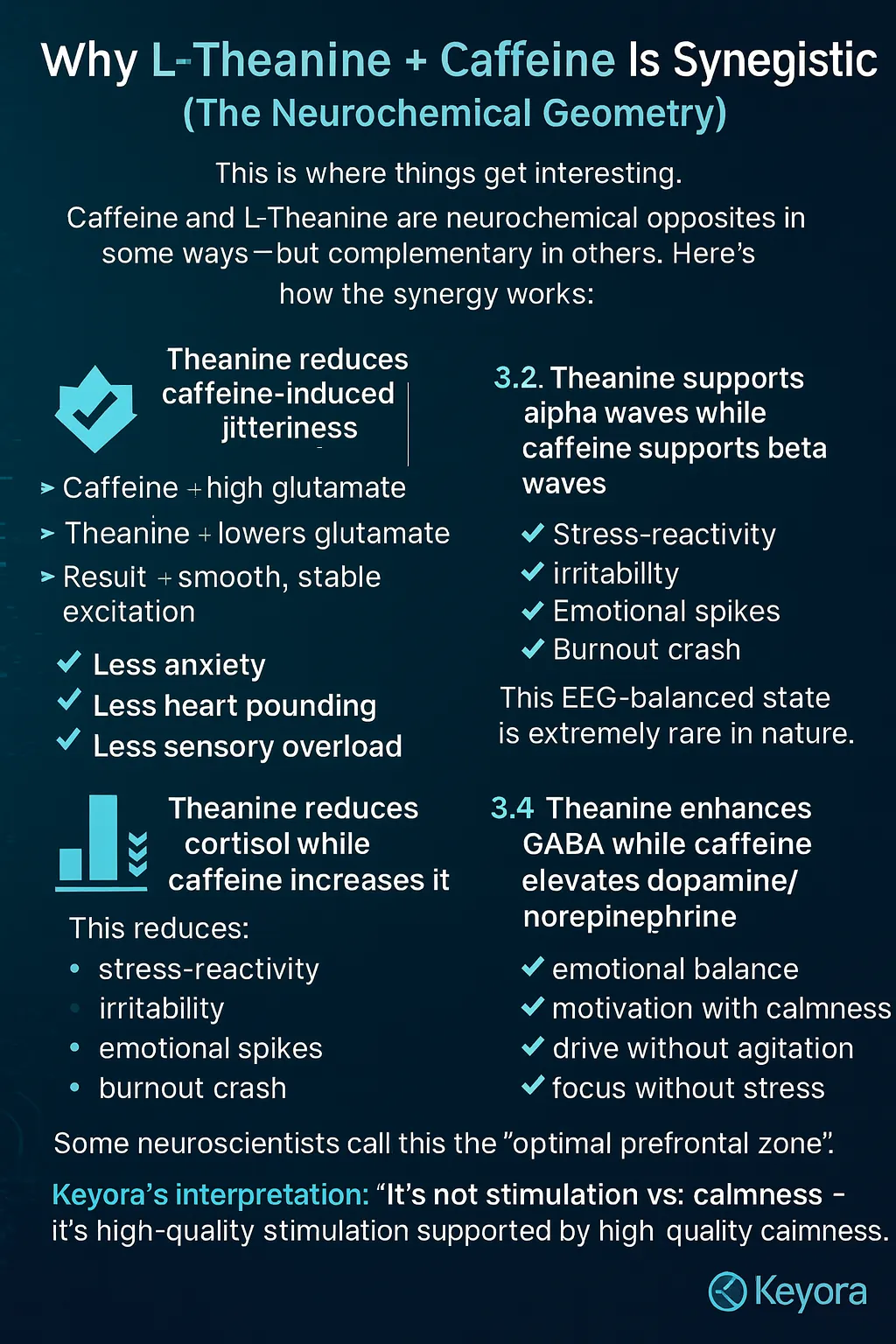
3. Why L-Theanine + Caffeine Is Synergistic (The Neurochemical Geometry)
This is where things get interesting.
Caffeine and L-Theanine are neurochemical opposites in some ways — but complementary in others.
Here’s how the synergy works:
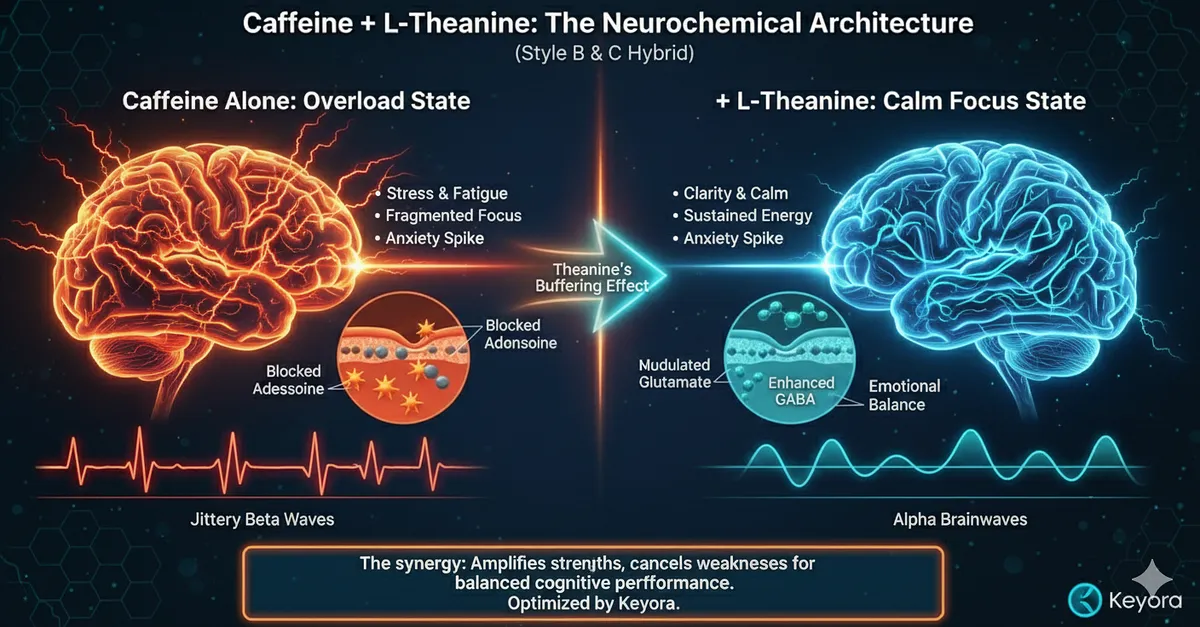
3.1 Theanine reduces caffeine-induced jitteriness
Caffeine → high glutamate
Theanine → lowers glutamate
Result → smooth, stable excitation
- Less anxiety
- Less heart pounding
- Less sensory overload
3.2 Theanine supports alpha waves while caffeine supports beta waves
Alpha = calm focus
Beta = active focus
Together:
- “relaxed alertness”
- “calm concentration”
- “flow-state cognition”
This EEG-balanced state is extremely rare in nature.
3.3 Theanine reduces cortisol while caffeine increases it
This reduces:
- stress-reactivity
- irritability
- emotional spikes
- burnout crash
3.4 Theanine enhances GABA while caffeine elevates dopamine/norepinephrine
This creates:
- emotional balance
- motivation with calmness
- drive without agitation
- focus without stress
Some neuroscientists call this the “optimal prefrontal zone”.
Keyora’s interpretation: “It’s not stimulation vs. calmness – it’s high-quality stimulation supported by high-quality calmness.”
4. The Cognitive Effects of the Combination
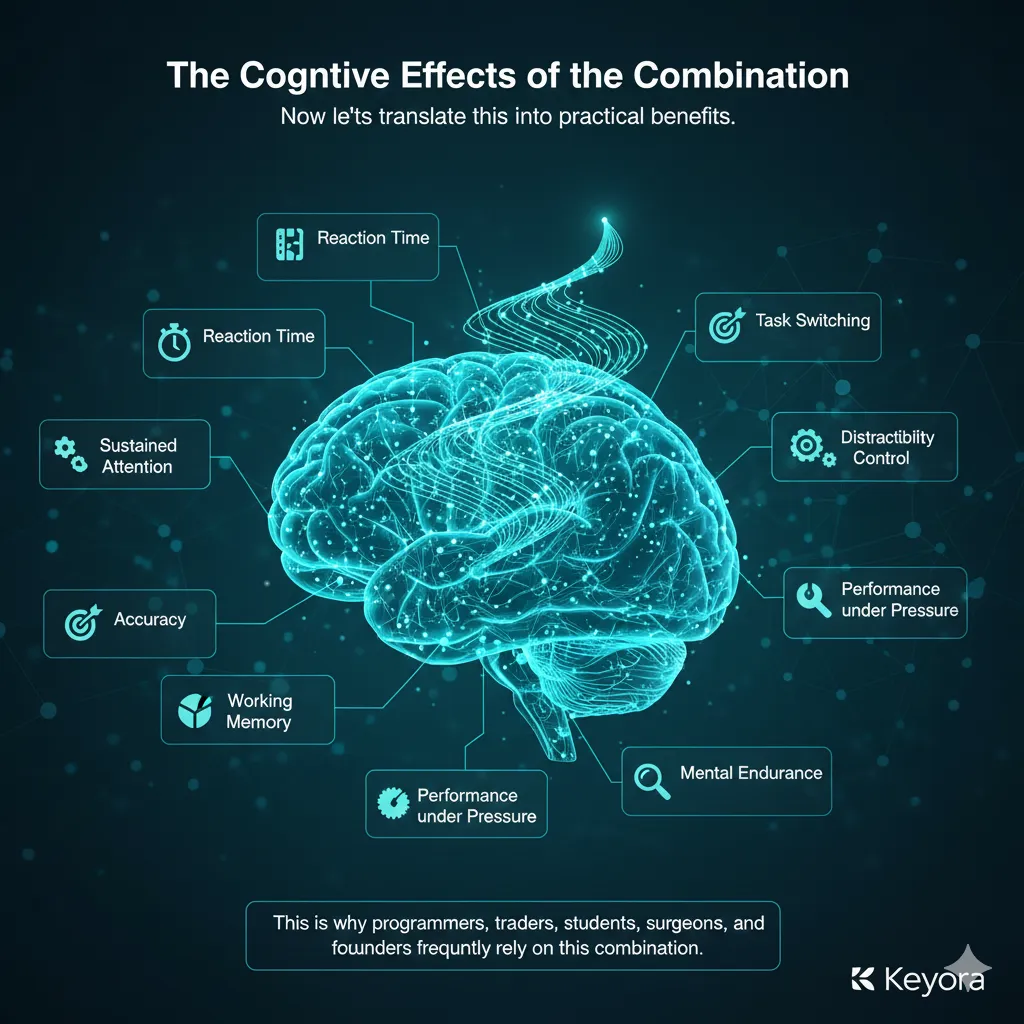
Now let’s translate this into practical benefits.
Across studies of L-Theanine + caffeine, participants show improved:
✔ reaction time
✔ sustained attention
✔ task switching
✔ accuracy
✔ distractibility control
✔ working memory
✔ mental endurance
✔ performance under pressure
This is why programmers, traders, students, surgeons, and founders frequently rely on this combination.
5. But Here’s the Truth: It Doesn’t Work for Everyone
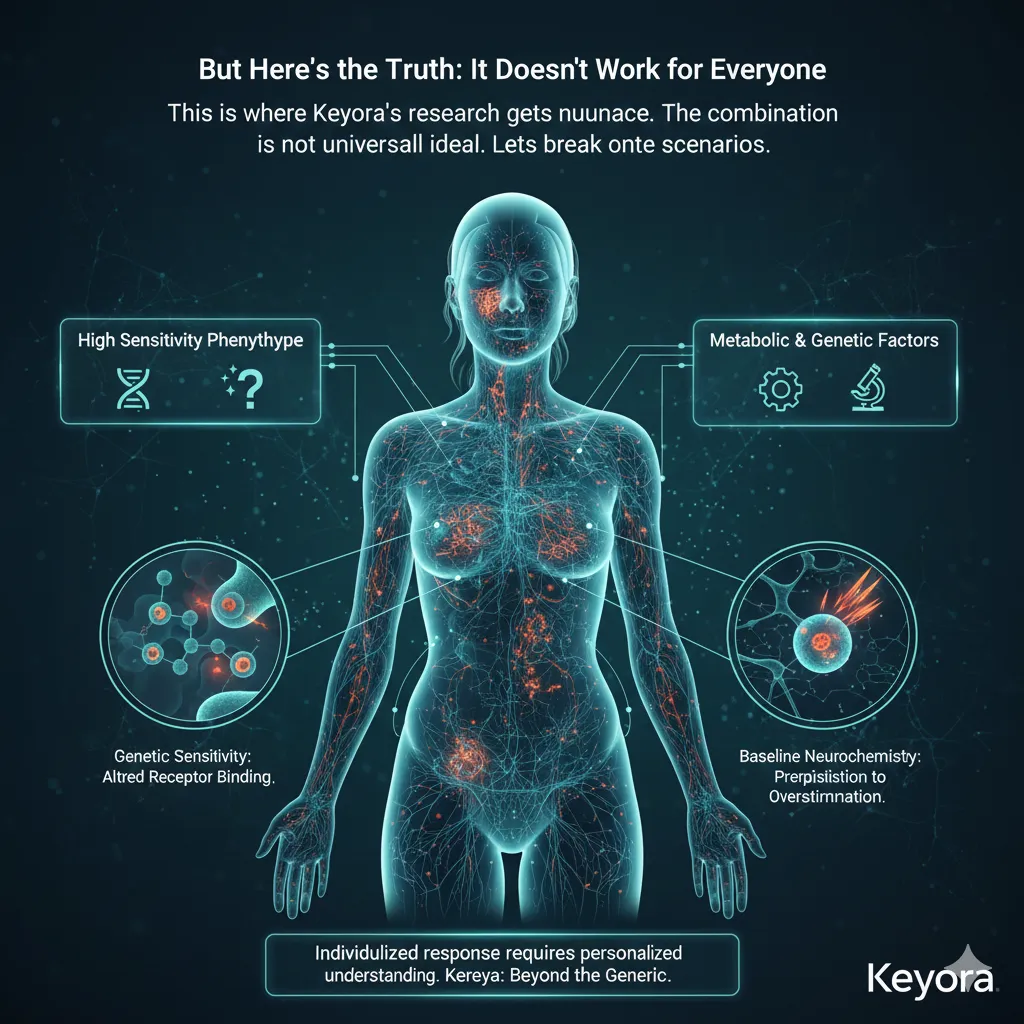
This is where Keyora’s research gets nuanced.
The combination is not universally ideal.
Let’s break down the scenarios.
6. When L-Theanine + Caffeine Works Exceptionally Well
6.1 For people sensitive to caffeine
Theanine reduces anxiety and jitters.
6.2 For people with ADHD-like symptoms
The combo enhances task focus without emotional volatility.
6.3 For high-pressure tasks
Public speaking
Exams
Coding sprints
Trading
Competitive tasks
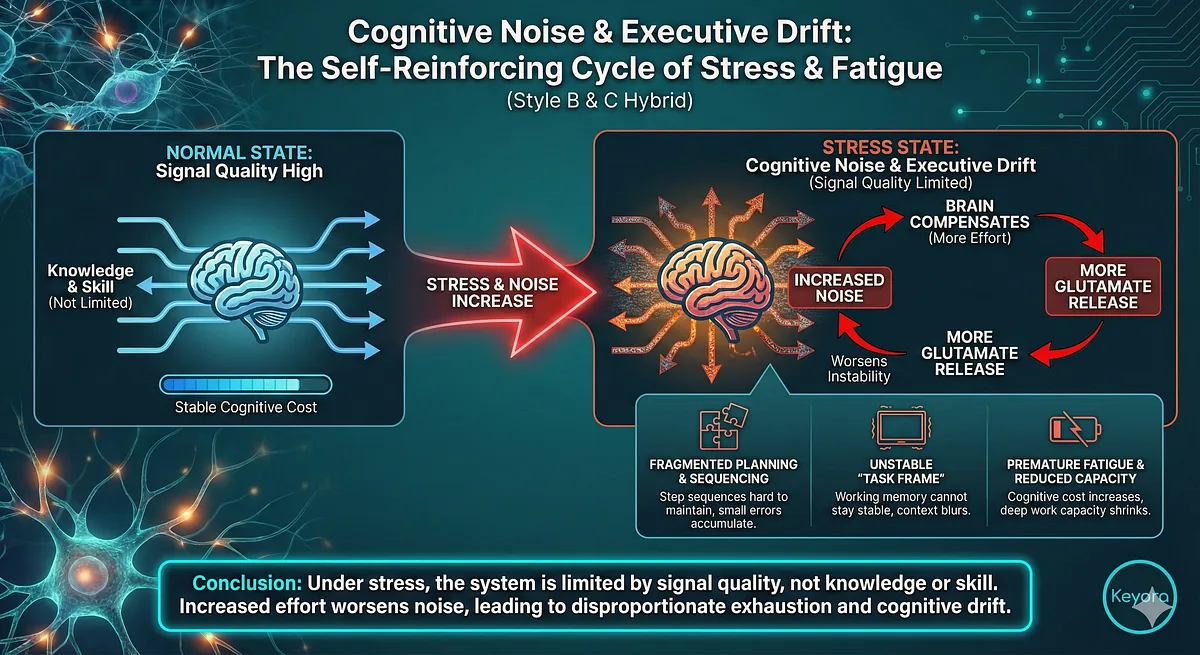
6.4 For people with stress-induced cognitive fragmentation
The combination stabilizes prefrontal cortex activity.
Keyora’s research summary: “If stress breaks your focus, Theanine helps.
If stimulation breaks your focus, the combo helps.”
7. When the Combination Is Not Ideal
This is extremely important.
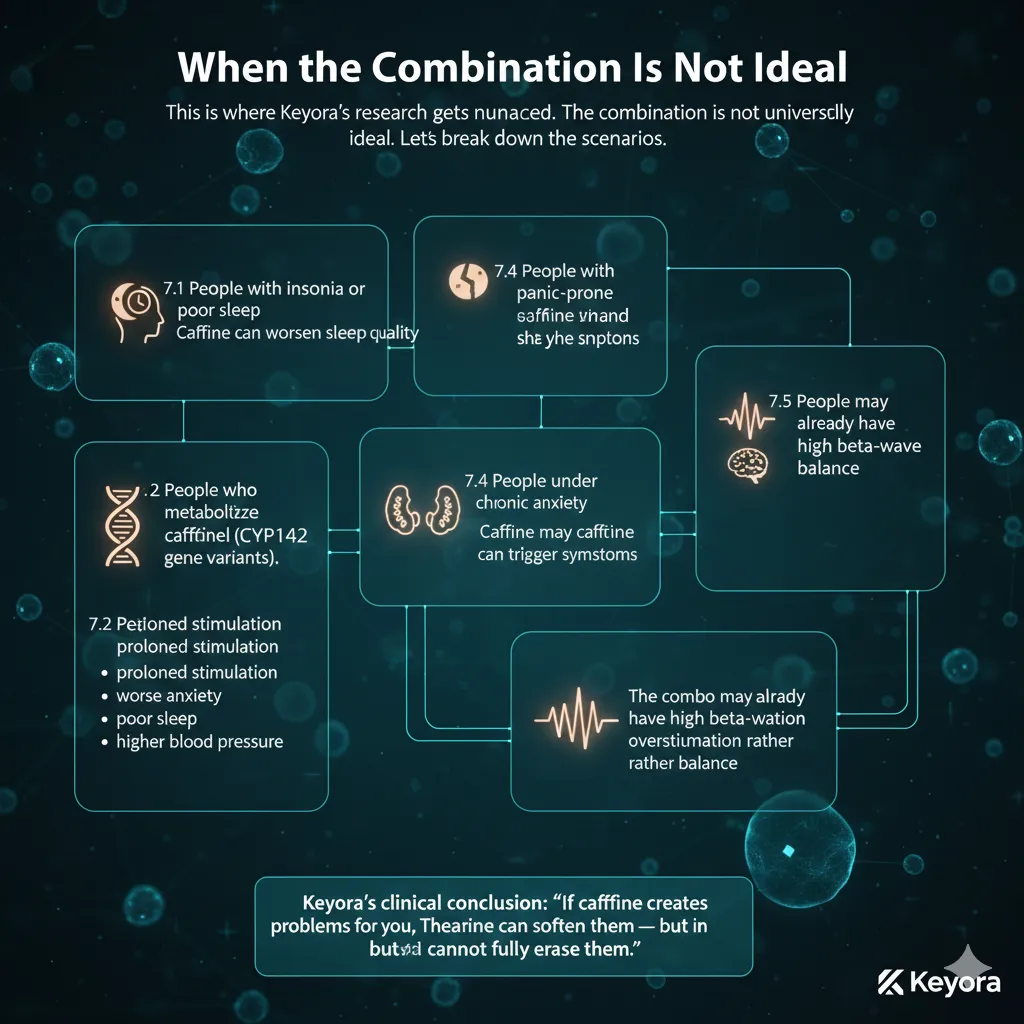
7.1 People with insomnia or poor sleep
Caffeine can worsen sleep quality - even early in the day.
7.2 People who metabolize caffeine slowly (CYP1A2 gene variants)
These individuals get:
- prolonged stimulation
- worse anxiety
- poor sleep
- higher blood pressure
7.3 People under chronic adrenal stress
Caffeine may mask exhaustion.
7.4 People with panic-prone anxiety
Even small caffeine increases can trigger symptoms.
7.5 People who already have high beta-wave dominance
The combo may cause overstimulation rather than balance.
Keyora’s clinical conclusion: “If caffeine creates problems for you, Theanine can soften them – but it cannot fully erase them.”
8. Why Keyora Doesn’t Use Caffeine in Its Formulations
This is where the brand narrative enters – subtly.
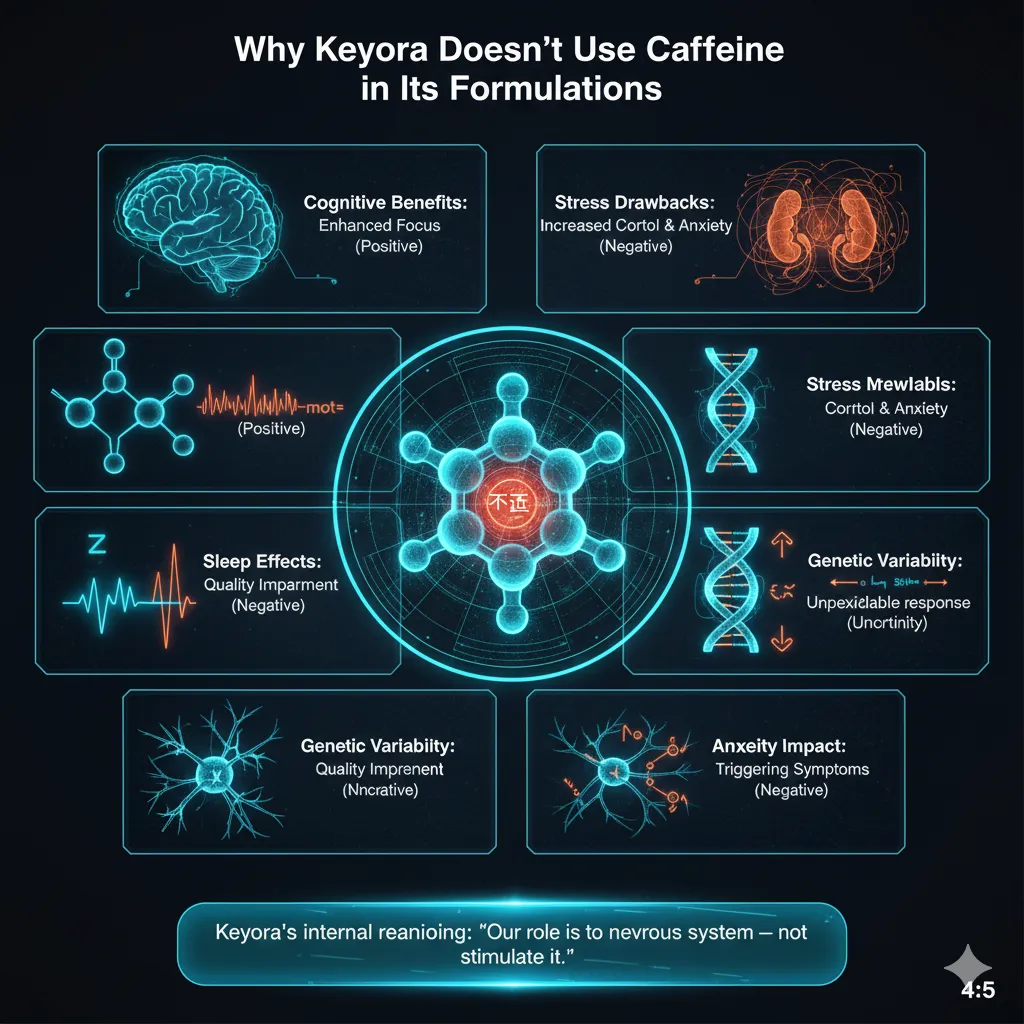
During our pre-formulation phase, Keyora evaluated:
- caffeine’s cognitive benefits
- caffeine’s stress drawbacks
- caffeine’s sleep effects
- caffeine’s genetic metabolism variability
- caffeine’s impact on anxiety-prone individuals
We concluded:
Caffeine is too unpredictable
Two people can have opposite reactions at the same dose.
Caffeine can worsen mood, sleep, cortisol
This contradicts Keyora’s focus on emotional balance.
Caffeine is habit-forming
Our ethics in R&D do not support dependency-based formulations.
High-performance individuals need stability Not spikes.
Many users already consume caffeine externally
- Coffee
- Tea
- Energy drinks
Keyora prefers ingredients that add stability, not instability.
So – although we deeply respect the synergy – we chose not to include caffeine in our formulations.
Keyora’s internal reasoning: “Our role is to support the nervous system - not stimulate it.”
9. If You Want to Use the Combination, Here’s the Ideal Ratio
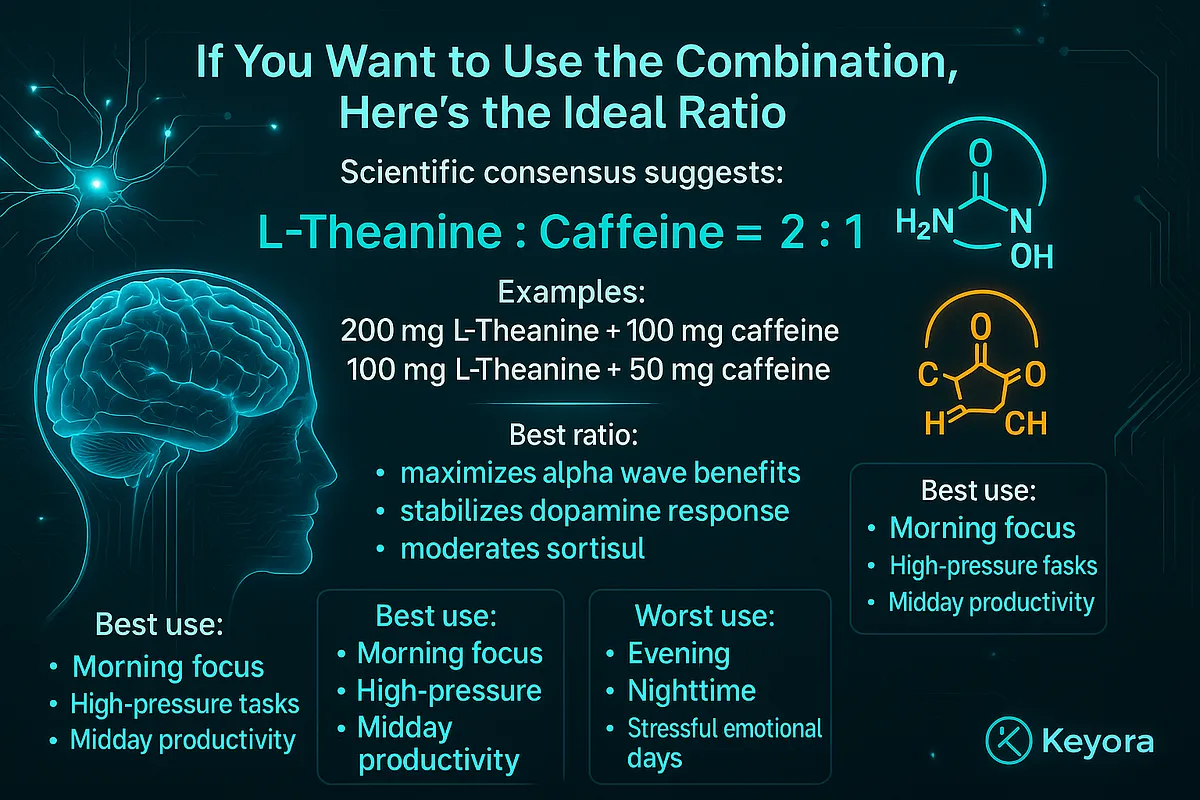
Scientific consensus suggests:
L-Theanine : Caffeine = 2 : 1
Examples:
- 200 mg L-Theanine + 100 mg caffeine
- 100 mg L-Theanine + 50 mg caffeine
This ratio:
- maximizes alpha wave benefits
- stabilizes dopamine response
- moderates cortisol
- smoothens stimulation
Best use:
Morning focus
High-pressure tasks
Midday productivity
Worst use:
Evening
Nighttime
Stressful emotional days
10. The Cleanest Way to Use This Combination
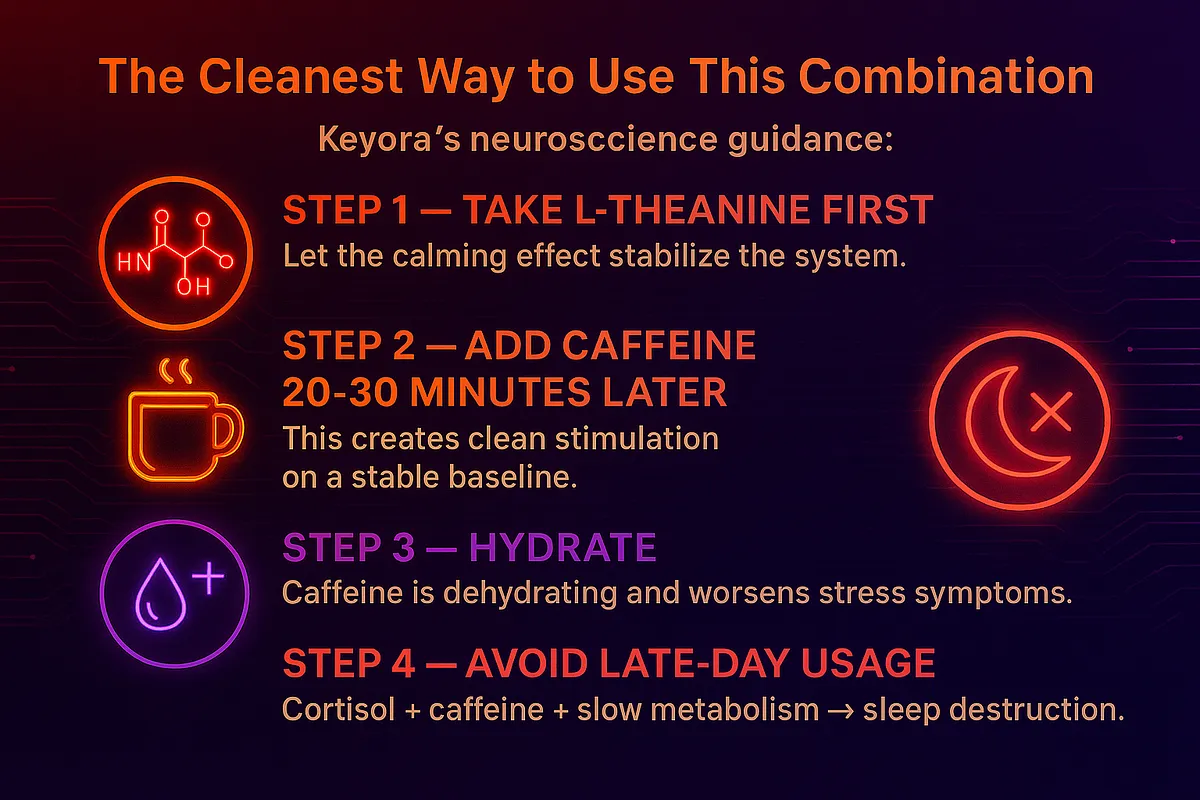
Keyora’s neuroscience guidance:
Step 1 – Take L-Theanine first
Let the calming effect stabilize the system.
Step 2 – Add caffeine 20–30 minutes later
This creates clean stimulation on a stable baseline.
Step 3 – Hydrate
Caffeine is dehydrating and worsens stress symptoms.
Step 4 – Avoid late-day usage
Cortisol + caffeine + slow metabolism → sleep destruction.
11. Summary
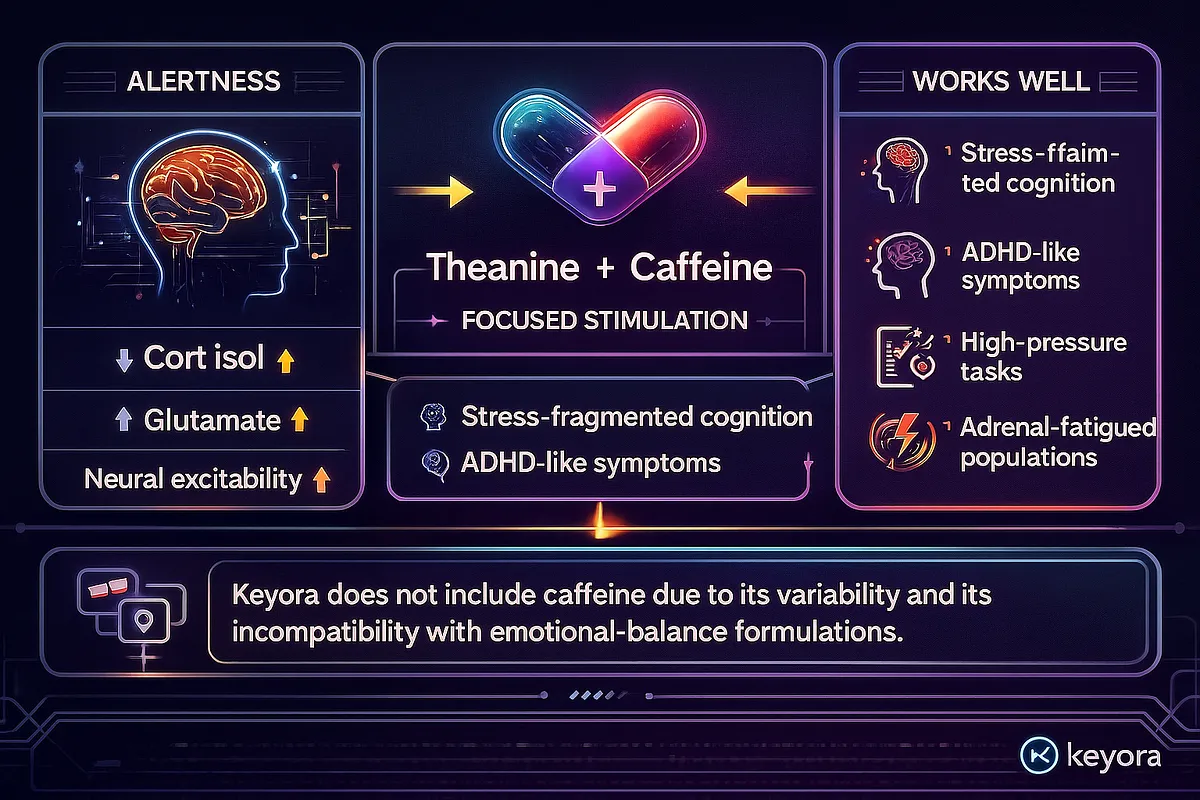
- Caffeine increases alertness but also raises cortisol, glutamate, and neural excitability.
- L-Theanine reduces glutamate, enhances GABA, increases alpha waves, and lowers cortisol.
- Together, they produce clean, focused stimulation without jitters.
- The combination improves attention, working memory, accuracy, and performance under stress.
- It works well for people with stress-fragmented cognition, ADHD-like symptoms, and high-pressure tasks.
- It may not work for slow caffeine metabolizers, insomnia sufferers, panic-prone individuals, or adrenal-fatigued populations.
- Keyora does not include caffeine due to its variability and its incompatibility with emotional-balance formulations.
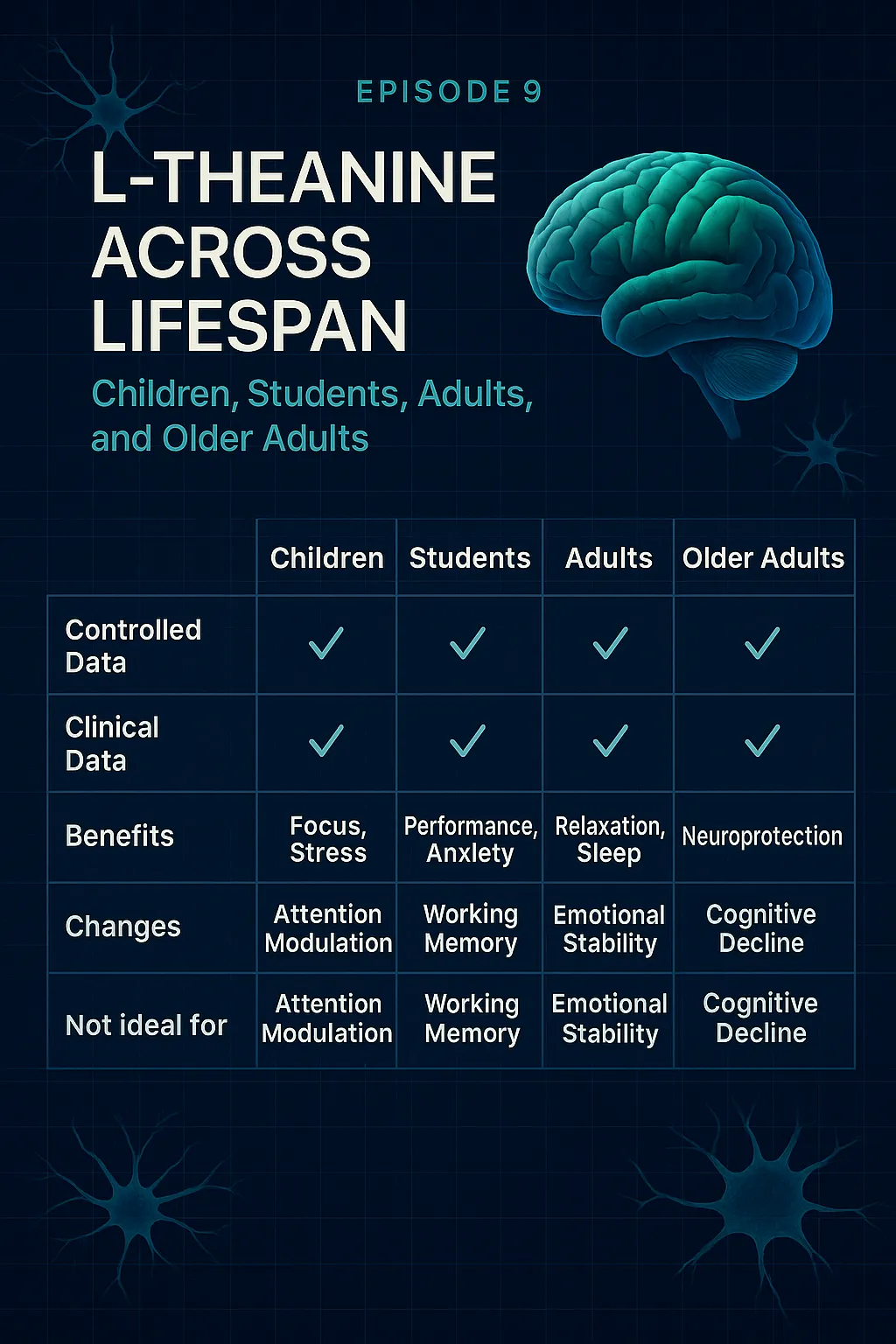
Episode 9 (Coming Next)
“L-Theanine Across Lifespan:
Children, Students, Adults, and Older Adults.”
By Keyora Research Notes Series
This article is part of Keyora’s long-form educational series documenting the scientific foundations behind our product development.
ORCID: 0009–0007–5798–1996