
Keyora Nutritional Neurology: Ashwagandha – The Clinical Matrix(6)The Menopause Protocol: Hypothalamic Thermoregulation & Glymphatic Support

By Keyora Research Notes Series
This article contributes to Keyora’s ongoing scientific documentation series, which systematically outlines the conceptual foundations, mechanistic pathways, and empirical evidence informing our research and development approach.
ORCID: 0009–0007–5798–1996
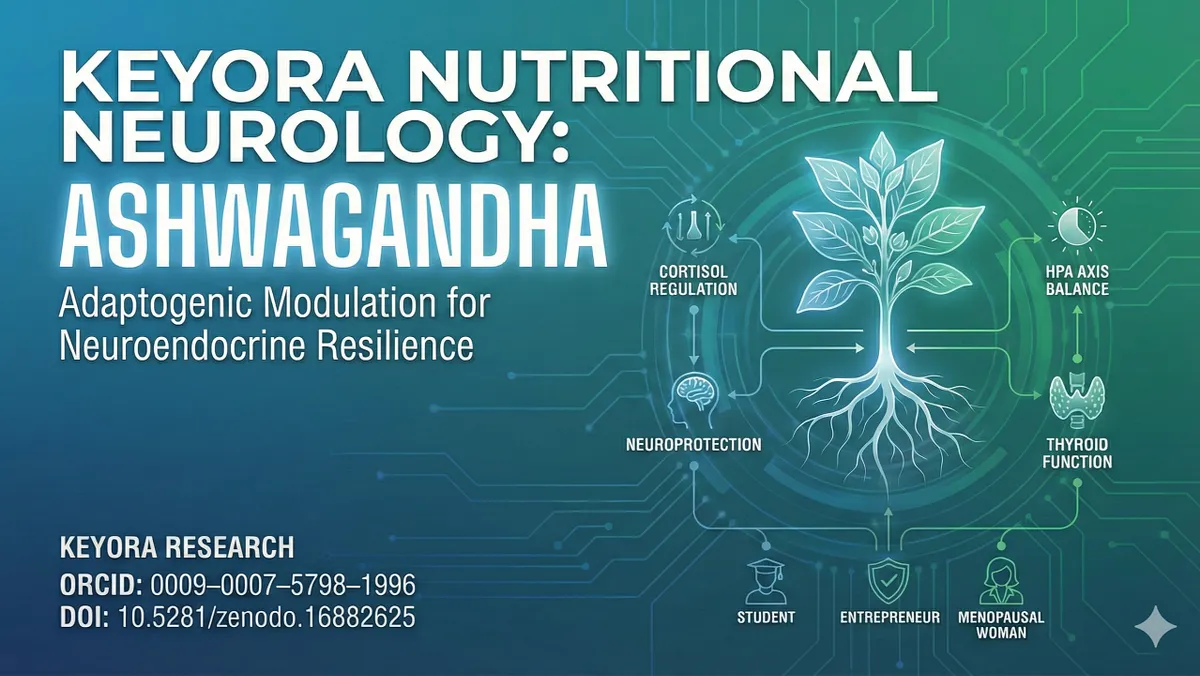
The Thermal Shield Extinguishing the Vasomotor Fire
Stabilizing the Hypothalamic Thermostat: How Ashwagandha Resets the Stress Trigger while Magnesium Glycinate Acts as the Physical Coolant.
The Phenomenon: The “Volcano Inside” and the Autonomic Seizure
We now arrive at the physiological epicenter of the menopausal transition. We move from the silent, invisible struggles of mood and sleep to the most visible, visceral, and socially destructive symptom of all.
It is the moment the body publicly betrays the woman inhabiting it.
A high – functioning executive is leading a critical boardroom presentation.
She is prepared.
She is articulate.
She is in command.
Suddenly, without any external provocation – the room has not changed temperature, she has not run a marathon – a physiological catastrophe begins. It starts often in the chest or the base of the neck.
It is not a gentle warmth. It is a violent, ascending rush of intense heat, akin to opening a blast furnace directly into the face.
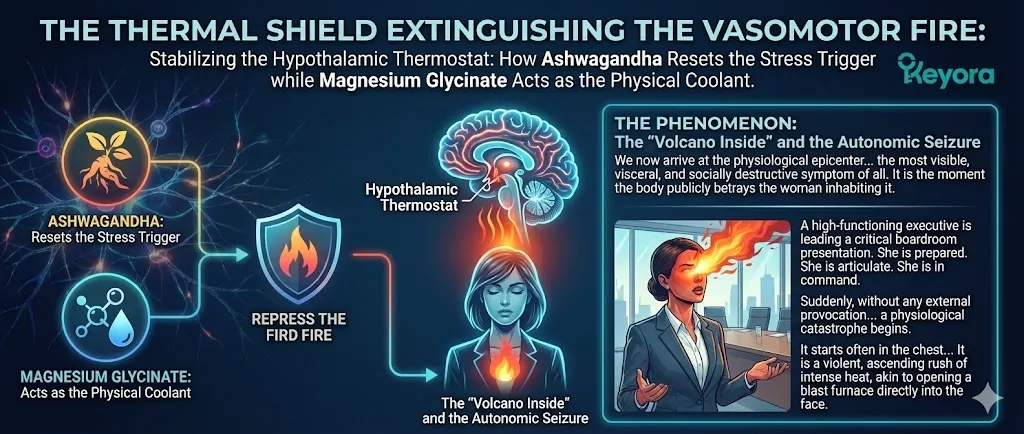
Within seconds, the Autonomic Nervous System (ANS) initiates a “Dump Heat” protocol designed for survival in the Sahara Desert, but deployed in an air – conditioned office.
-
The Flush: The capillaries in the face, neck, and chest dilate aggressively. The skin turns a conspicuous, blotchy crimson.
-
The Flood: The sudomotor system activates. Sweat beads on the upper lip, trickles down the spine, and soaks the hairline.
-
The Panic: The heart rate spikes (Tachycardia), creating a sense of impending doom that mimics a panic attack.
She must stand there, continuing to speak, smiling through the inferno, while her clothes adhere to her skin and her dignity evaporates.
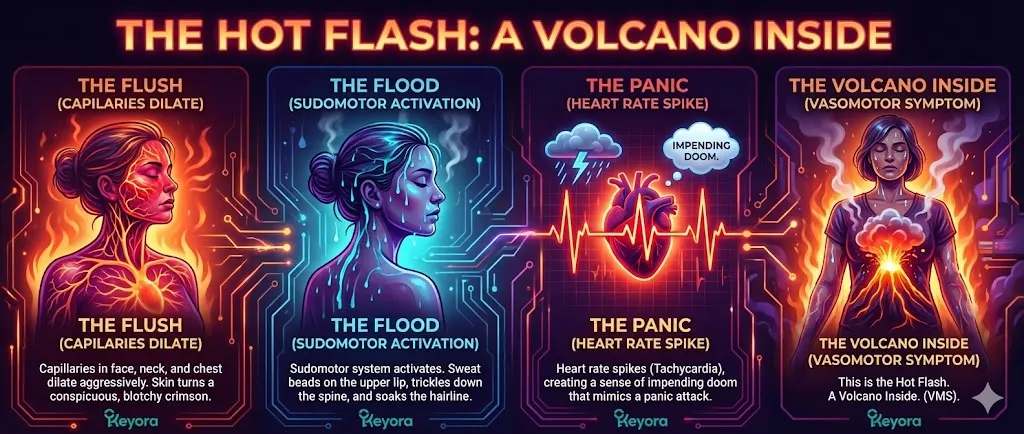
This is the Hot Flash.
In the sanitized language of medicine, it is called a “Vasomotor Symptom” (VMS). But to the woman enduring it, it is a Volcano Inside.
The Definition: A Neurological Seizure of the Vessel
At Keyora, we refuse to treat this as a “minor inconvenience” or a “skin issue.”
A hot flash is not a temperature problem; it is a Neurological Glitch.
It is a temporary, localized seizure of the thermoregulatory control center.
It represents a total failure of the communication line between the brain (which thinks it is dying of heat) and the blood vessels (which are obeying a false command).
It is a Vasomotor Storm.
And to stop it, we cannot use portable fans or ice packs. We must repair the thermostat itself.

The Mechanism: The Collapse of the “Thermoneutral Zone”
To understand why a woman freezes one minute and burns the next, we must descend into the anatomy of the brain, specifically the Preoptic Area of the Hypothalamus (POAH).
This almond – sized cluster of neurons is the CEO of the body. It regulates hunger, thirst, sleep, and crucially, Thermoregulation.
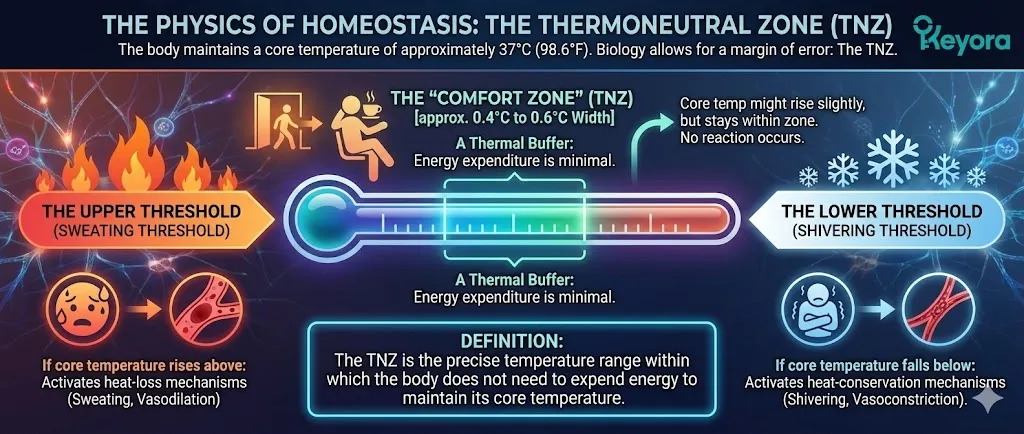
The Physics of Homeostasis: The Thermoneutral Zone (TNZ)
The body maintains a core temperature of approximately 37°C (98.6°F). However, biology is not rigid; it allows for a margin of error.
This margin is called the Thermoneutral Zone (TNZ).
Definition:
The TNZ is the precise temperature range within which the body does not need to expend energy to maintain its core temperature.
The Upper Threshold (The Sweating Threshold):
If core temperature rises above this line, the body activates heat – loss mechanisms (Sweating, Vasodilation).
The Lower Threshold (The Shivering Threshold):
If core temperature falls below this line, the body activates heat – conservation mechanisms (Shivering, Vasoconstriction).
The “Comfort Zone”:
The space between these two lines is the TNZ. In a healthy, pre – menopausal woman, this zone is wide (approx. 0.4°C to 0.6°C).
She has a “Thermal Buffer.”
She can drink a hot tea or walk into a warm room, and her core temp might rise slightly, but it stays within the zone. No reaction occurs.
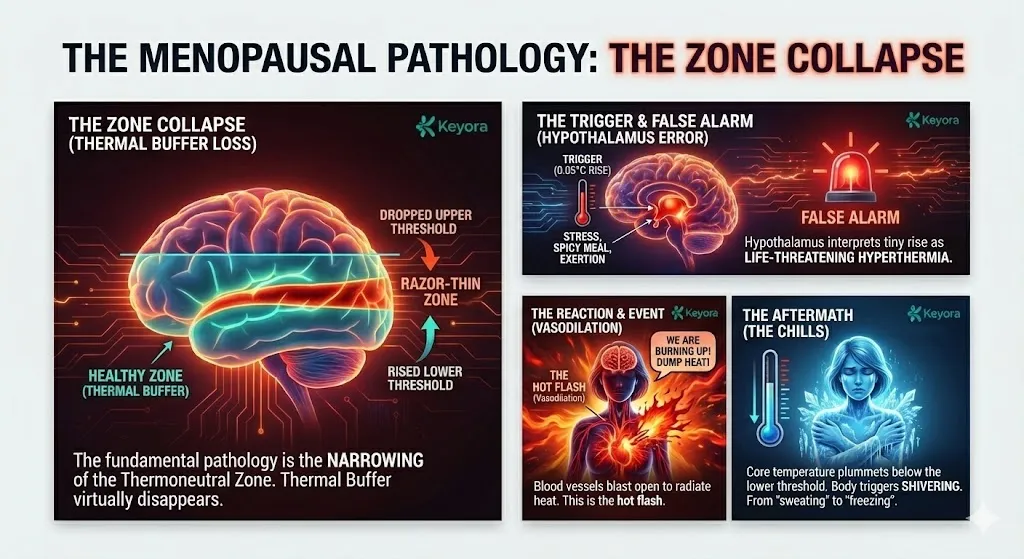
The Menopausal Pathology: The Zone Collapse
The fundamental pathology of the hot flash is the Narrowing of the Thermoneutral Zone.
During the menopausal transition, the “Thermal Buffer” virtually disappears. The Upper Threshold drops, and the Lower Threshold rises.
The zone becomes razor – thin.
The Trigger:
Now, even a microscopic elevation in core temperature (0.05°C) – caused by stress, a spicy meal, mild exertion, or even a heavy blanket – instantly crosses the Upper Threshold.
The False Alarm:
The Hypothalamus detects this tiny rise and interprets it as a life – threatening hyperthermia.
The Reaction:
It pulls the fire alarm. It screams to the vascular system: “WE ARE BURNING UP! DUMP HEAT IMMEDIATELY!”
The Event:
The blood vessels blast open (Vasodilation) to radiate heat. This is the hot flash.
The Aftermath (The Chills):
Because the body dumped massive amounts of heat that it didn’t actually need to lose, the core temperature plummets. It rapidly crosses the Lower Threshold.
The body now thinks it is freezing. It triggers shivering.
This is why women go from “sweating” to “freezing” in 5 minutes.
The Culprit: Norepinephrine and the Estrogen Brake
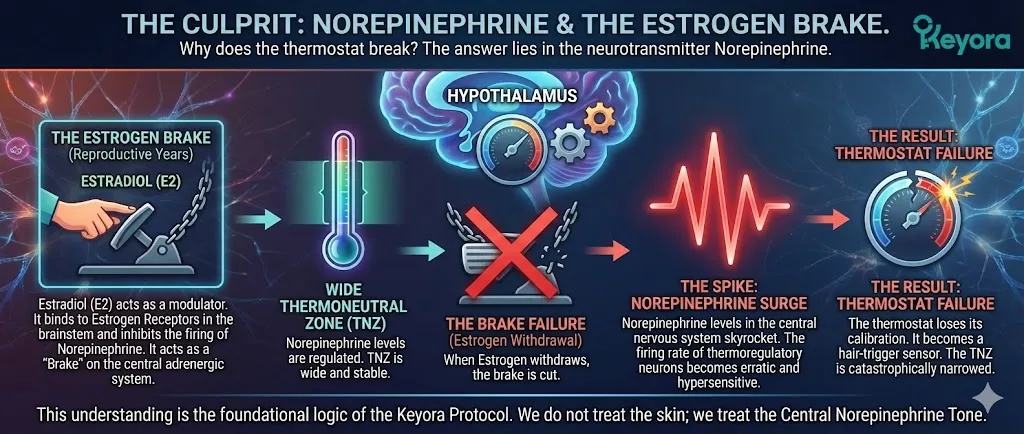
Why does the thermostat break? The answer lies in the neurotransmitter Norepinephrine.
Norepinephrine is a stress chemical. It is excitatory. In the Hypothalamus, Norepinephrine acts to narrow the TNZ.
The Estrogen Brake:
In the reproductive years, Estradiol (E2) acts as a modulator. It binds to Estrogen Receptors in the brainstem and inhibits the firing of Norepinephrine. It acts as a “Brake” on the central adrenergic system.
The Brake Failure:
When Estrogen withdraws, the brake is cut.
The Spike:
Norepinephrine levels in the central nervous system skyrocket. The firing rate of thermoregulatory neurons becomes erratic and hypersensitive.
The Result:
The thermostat loses its calibration. It becomes a hair – trigger sensor.
This understanding is the foundational logic of the Keyora Protocol. We do not treat the skin; we treat the Central Norepinephrine Tone.
The Protagonist: Ashwagandha – The “Trigger Guard”
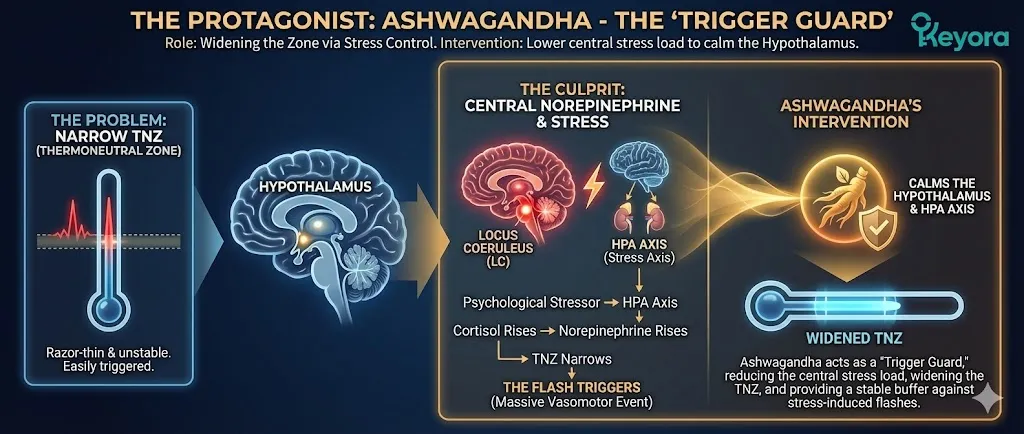
If the root cause of the narrow TNZ is Central Norepinephrine (a stress neurotransmitter), then the primary intervention must be to lower the central stress load. We must widen the zone by calming the Hypothalamus.
Role: Widening the Zone via Stress Control
The Locus Coeruleus Connection
Norepinephrine is produced primarily in a brain region called the Locus Coeruleus (LC).
The LC is intimately connected to the HPA Axis (Stress Axis). Every woman in menopause knows this empirical truth: Stress triggers flashes.
Why?
Because a psychological stressor triggers the HPA Axis -> Cortisol rises -> Norepinephrine rises -> The TNZ narrows -> The Flash triggers.
If your TNZ is already razor – thin, a spike in stress pushes you over the edge instantly. This is why public speaking or an argument often induces a massive vasomotor event.
Ashwagandha: The Upstream Modulator
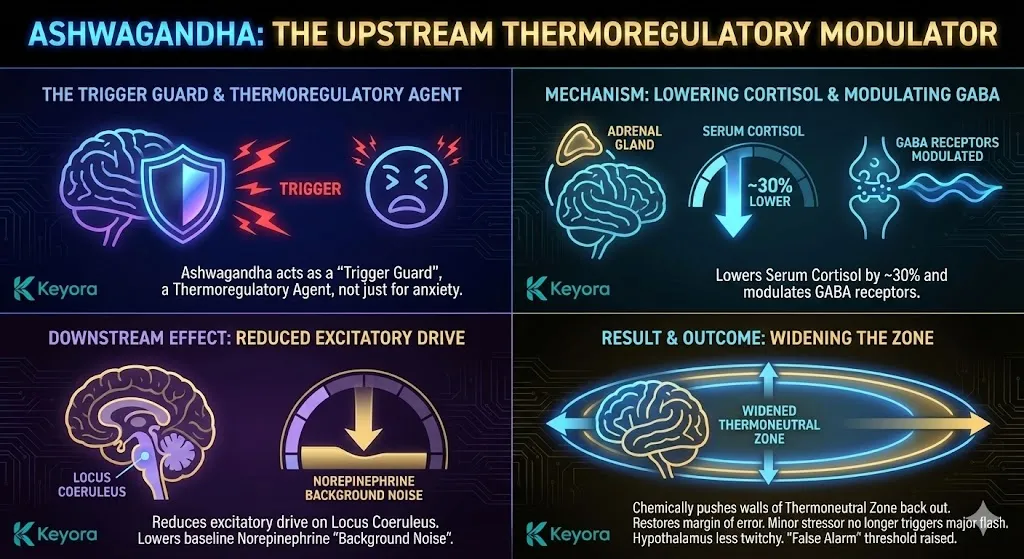
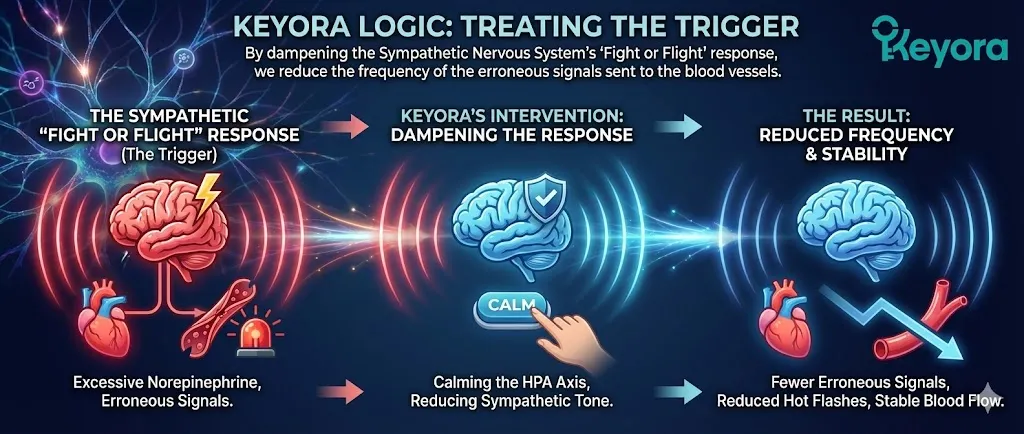
This is where Ashwagandha (specifically the high – potency) acts as the “Trigger Guard.”
In the last context, Ashwagandha is not just for “anxiety”; it is a Thermoregulatory Agent.
Mechanism:
As established, Ashwagandha lowers Serum Cortisol by ~30% and modulates GABA receptors.
The Downstream Effect:
By lowering the systemic stress load, it reduces the excitatory drive on the Locus Coeruleus. It lowers the baseline “Background Noise” of Norepinephrine.
The Result (Widening the Zone):
By reducing the adrenergic tone, Ashwagandha chemically pushes the walls of the Thermoneutral Zone back out. It restores the margin of error.
The Outcome:
A minor stressor no longer triggers a major flash. The Hypothalamus becomes less twitchy. The threshold for the “False Alarm” is raised.
Keyora Logic:
We treat the Trigger. By dampening the Sympathetic Nervous System’s “Fight or Flight” response, we reduce the frequency of the erroneous signals sent to the blood vessels.
Matrix Solution I: Magnesium Glycinate – The “Physical Coolant”
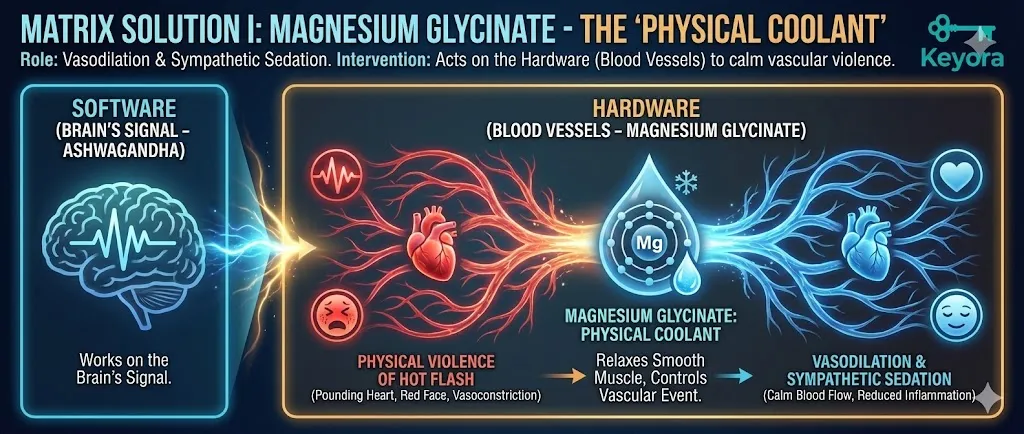
While Ashwagandha works on the Software (The Brain’s signal), we need an agent to work on the Hardware (The Blood Vessels themselves).
The physical violence of the hot flash – the pounding heart, the red face – is a vascular event involving smooth muscle contraction and dilation. To control it, we need a Physical Coolant.
Role: Vasodilation & Sympathetic Sedation
Mechanism 1: The Calcium Channel Blocker (Vascular Stability)
Blood vessels are lined with smooth muscle.
When these muscles contract, vessels constrict (Vasoconstriction).
When they relax, vessels open (Vasodilation).
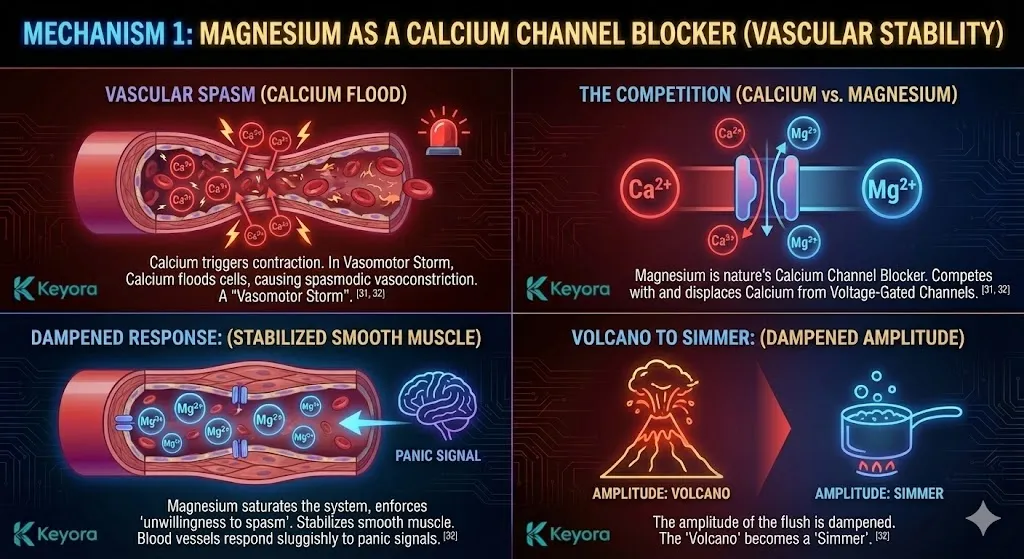
This muscle action is driven by Calcium Ions (Ca2+).
Calcium enters the cell to trigger contraction. In a “Vasomotor Storm,” Calcium floods the cells erratically, causing spasmodic changes in vessel diameter. Magnesium is nature’s Calcium Channel Blocker.
The Competition:
Magnesium competes with Calcium for the entry channels (Voltage – Gated Calcium Channels).
The Action:
By saturating the system with Magnesium, we physically displace the Calcium.
The Effect:
This enforces a state of “unwillingness to spasm.” It stabilizes the smooth muscle. Even if the brain sends a panic signal, the blood vessels respond more sluggishly.
The amplitude of the flush is dampened.
The “Volcano” becomes a “Simmer.”
Mechanism 2: Glycine and Central Thermoregulation
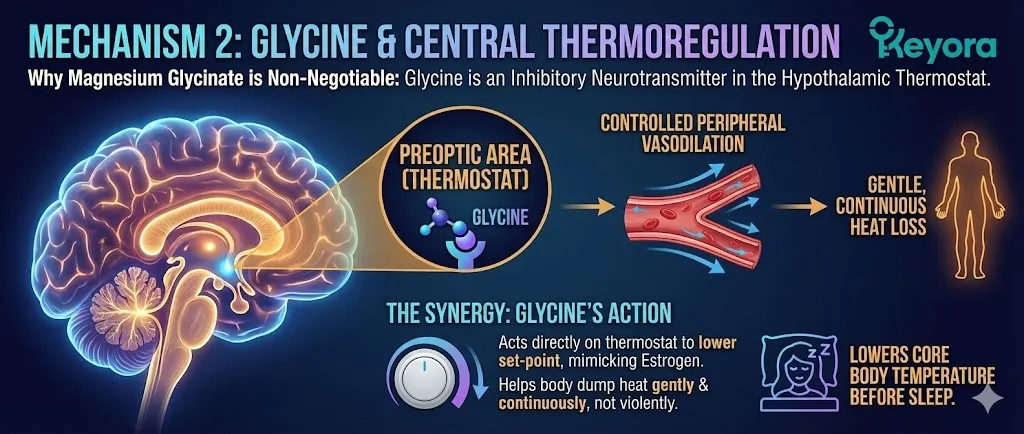
This is why the specific form – Magnesium Glycinate – is non – negotiable in the Keyora Matrix. We are not just using Magnesium; we are using Glycine.
Glycine is an inhibitory neurotransmitter that has specific receptors in the Preoptic Area of the Hypothalamus (the thermostat).
The Science:
Research shows that Glycine administration promotes peripheral vasodilation in a controlled manner, which lowers core body temperature before sleep.
The Synergy:
Glycine acts directly on the thermostat to lower the set – point, mimicking the natural cooling effect of Estrogen. It helps the body dump heat gently and continuously, rather than violently and spasmodically.
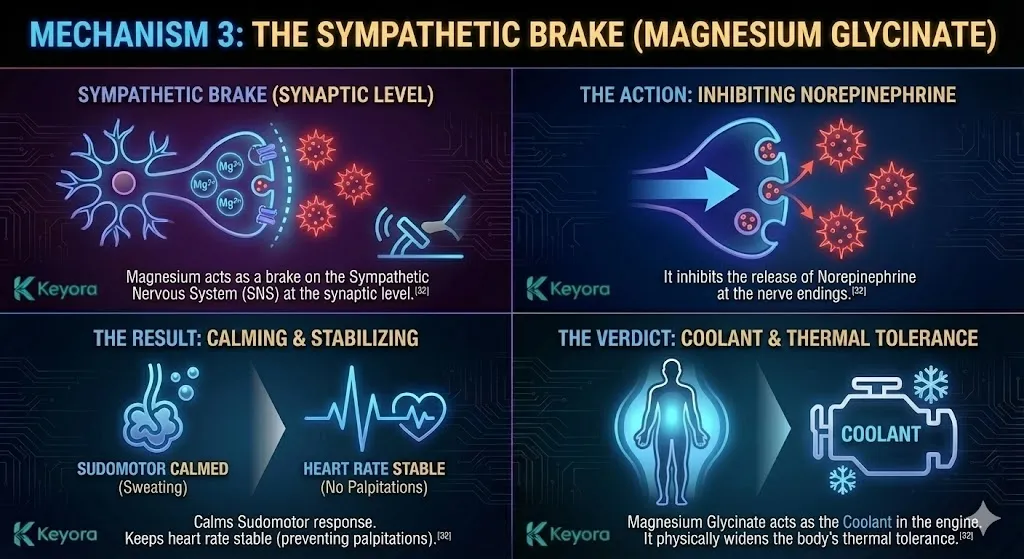
Mechanism 3: The Sympathetic Brake
Magnesium also acts as a brake on the Sympathetic Nervous System (SNS) at the synaptic level.
The Action:
It inhibits the release of Norepinephrine at the nerve endings.
The Result:
It calms the Sudomotor (sweating) response. It keeps the heart rate stable (preventing the palpitations that terrify women during a flash).
The Verdict:
Magnesium Glycinate acts as the Coolant in the engine. It physically widens the body’s thermal tolerance.
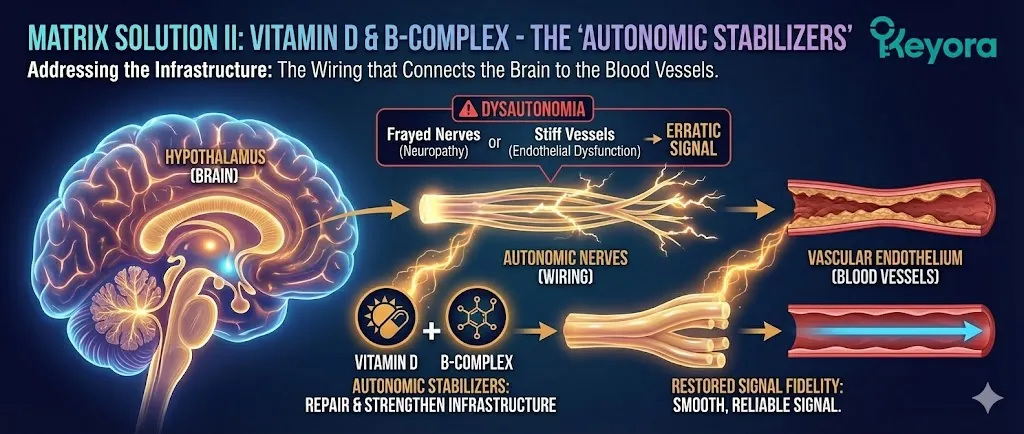
Matrix Solution II: Vitamin D & B – Complex – The “Autonomic Stabilizers”
Finally, we must address the infrastructure – the wiring that connects the Brain to the Blood Vessels.
The signal travels from the Hypothalamus -> Autonomic Nerves -> Vascular Endothelium.
If the nerves are frayed (Neuropathy) or the vessels are stiff (Endothelial Dysfunction), the signal becomes erratic. This is Dysautonomia.
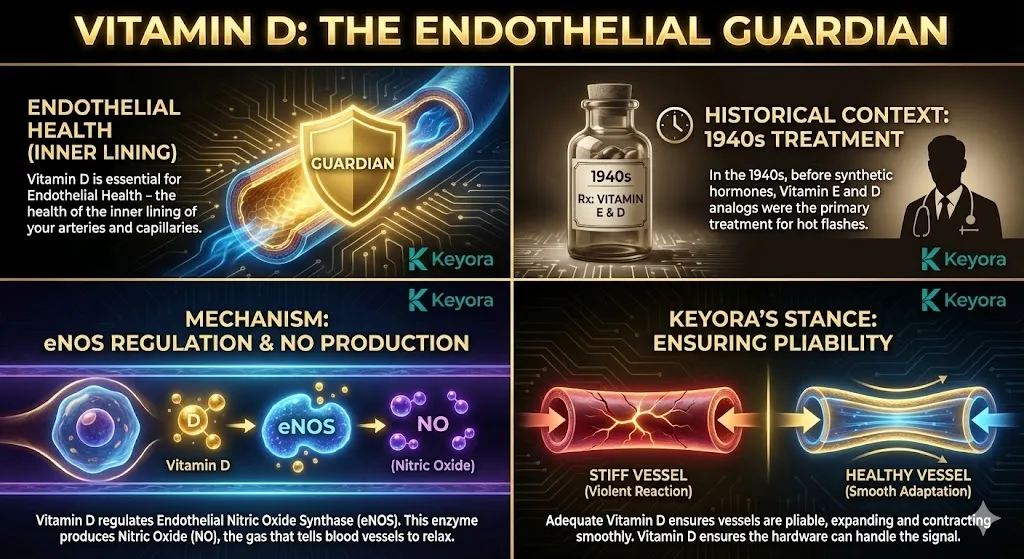
Vitamin D: The Endothelial Guardian
Vitamin D is essential for Endothelial Health – the health of the inner lining of your arteries and capillaries.
Historical Context:
In the 1940s, before synthetic hormones, Vitamin E and D analogs were the primary treatment for hot flashes.
The Mechanism:
Vitamin D regulates the production of Endothelial Nitric Oxide Synthase (eNOS). This enzyme produces Nitric Oxide (NO), the gas that tells blood vessels to relax.
Keyora’s Stance:
Adequate Vitamin D ensures that the blood vessels are pliable. They can expand and contract smoothly. A stiff vessel reacts violently to pressure changes; a healthy vessel adapts.
Vitamin D ensures the hardware can handle the signal.
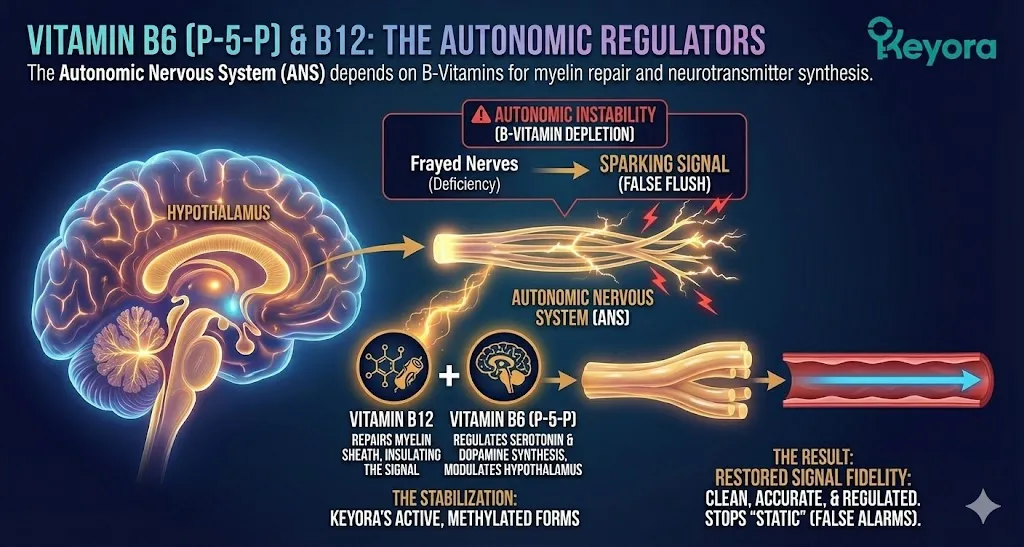
Vitamin B6 (P – 5 – P) & B12: The Autonomic Regulators
The Autonomic Nervous System (ANS) is heavily dependent on B – Vitamins for myelin repair and neurotransmitter synthesis.
The Deficiency:
Menopause is a metabolic stressor that depletes B – Vitamins.
The Fraying:
B – Vitamin deficiency leads to “Autonomic Instability.” A frayed wire sparks. In the body, a “sparking” autonomic nerve sends a “Flush” signal even when the brain didn’t order it.
The Stabilization:
Keyora includes the active, methylated forms of B6 (P – 5 – P) and B12 (Methylcobalamin).
-
B12: Repairs the Myelin Sheath, insulating the signal.
-
B6: Regulates the synthesis of Serotonin and Dopamine, which modulate the Hypothalamus.
The Result:
We ensure that the signal traveling from the brain to the skin is clean, accurate, and regulated.
We stop the “Static” that triggers false alarms.
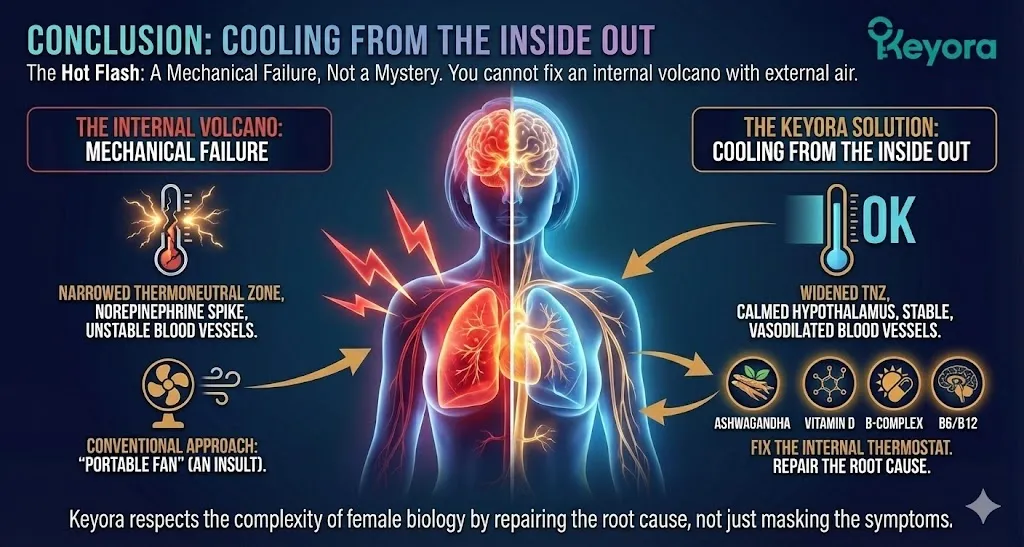
Conclusion: Cooling from the Inside Out
The Hot Flash is not a mystery to be endured. It is a mechanical failure to be repaired.
It is the result of a Narrowed Thermoneutral Zone, driven by a Norepinephrine Spike, acting upon Unstable Blood Vessels.
The conventional approach – “Just deal with it” or “Buy a portable fan” – is an insult to the complexity of female biology.
You cannot fix an internal volcano with external air.
You must fix the internal thermostat.
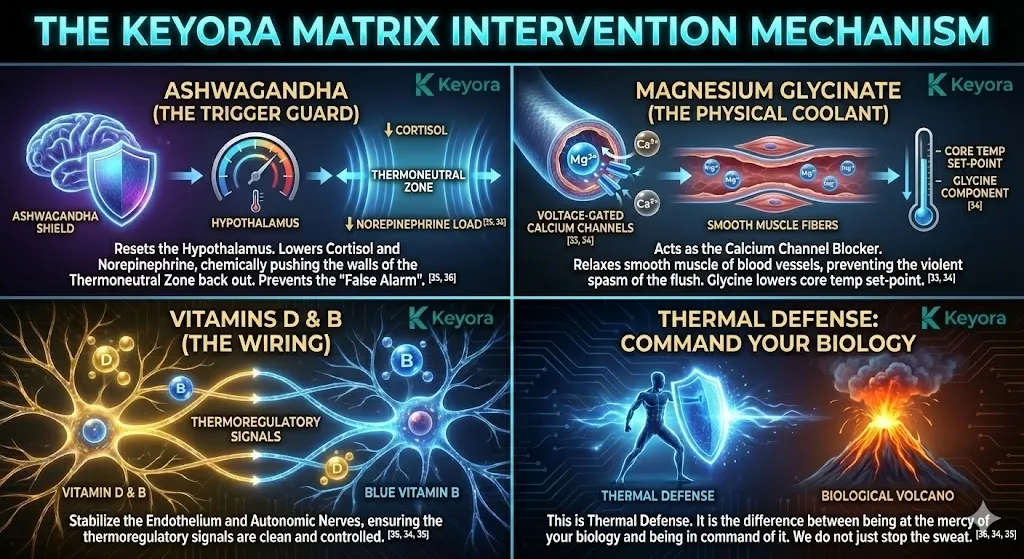
The Keyora Matrix Intervention Mechanism
offers the only logical, non – hormonal shield against the heat:
Ashwagandha (The Trigger Guard):
Resets the Hypothalamus.
It lowers the Cortisol and Norepinephrine load, chemically pushing the walls of the Thermoneutral Zone back out.
It prevents the “False Alarm.”
Magnesium Glycinate (The Physical Coolant):
Acts as the Calcium Channel Blocker.
It relaxes the smooth muscle of the blood vessels, preventing the violent spasm of the flush.
The Glycine component lowers the core temp set – point.
Vitamins D & B (The Wiring):
Stabilize the Endothelium and Autonomic Nerves, ensuring the thermoregulatory signals are clean and controlled.
This is Thermal Defense.
It is the difference between being at the mercy of your biology and being in command of it. We do not just stop the sweat.
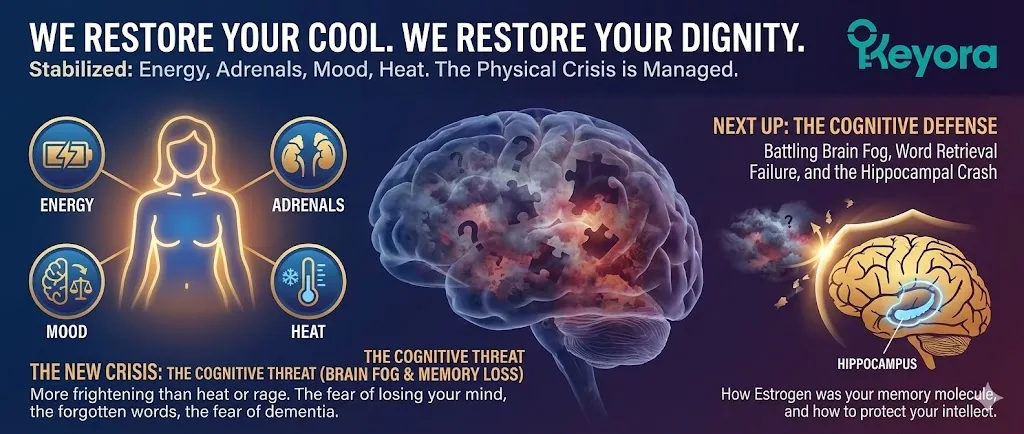
We restore your cool.
But more importantly, we restore your dignity.
We have now stabilized the Energy, the Adrenals, the Mood, and the Heat. But for many women, the most frightening symptom is not the heat or the rage.
It is the feeling that they are losing their mind.
It is the “Brain Fog.”
The lost words.
The forgotten names.
The fear of dementia.
In the next episode, we tackle the cognitive crisis of menopause. We will explain why Estrogen was your memory molecule, and how to protect your intellect during the transition.
Next Up:
The Cognitive Defense: Battling Brain Fog, Word Retrieval Failure, and the Hippocampal Crash.
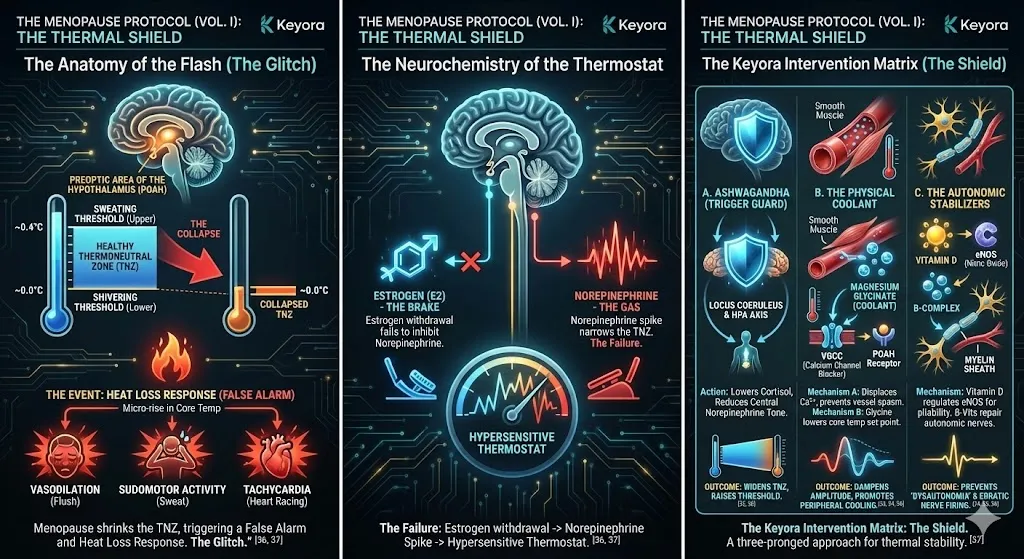
– Series Theme: **The Menopause Protocol** (Vol. I).
– Episode Concept: **The Thermal Shield** (”Vasomotor Instability” / Hot Flashes).
– Core Pathology: **Narrowing of the Thermoneutral Zone (TNZ)** due to Norepinephrine dominance.
– **1. The Anatomy of the Flash (The Glitch)**:
– *Control Center*: **Preoptic Area of the Hypothalamus (POAH)**.
– *The Physics*: **Thermoneutral Zone (TNZ)**. The range between the **Sweating Threshold** (Upper) and **Shivering Threshold** (Lower).
– *The Collapse*: Menopause shrinks the TNZ from ~0.4°C to ~0.0°C.
– *The Event*: Micro-rise in core temp -> Triggers **Heat Loss Response** (False Alarm).
– **Vasodilation** (Flush).
– **Sudomotor Activity** (Sweat).
– **Tachycardia** (Heart Racing).
– **2. The Neurochemistry of the Thermostat**:
– *The Brake*: **Estrogen (E2)** normally inhibits Norepinephrine in the brainstem.
– *The Gas*: **Norepinephrine** narrows the TNZ.
– *The Failure*: Estrogen withdrawal -> Norepinephrine Spike -> Hypersensitive Thermostat.
– **3. The Keyora Intervention Matrix (The Shield)**:
– **A. The Trigger Guard (Ashwagandha)**:
– *Target*: **Locus Coeruleus** & **HPA Axis**.
– *Action*: Lowers Cortisol -> Reduces Central Norepinephrine Tone.
– *Outcome*: Widens the TNZ; raises the threshold for triggering a flash.
– **B. The Physical Coolant (Magnesium Glycinate)**:
– *Target*: **Vascular Smooth Muscle** & **NMDA Receptors**.
– *Mechanism A*: **Calcium Channel Blocker** (VGCC). Displaces Ca2+ to prevent vessel spasm.
– *Mechanism B*: **Glycine** binds to POAH receptors to lower core temp set-point.
– *Outcome*: Dampens the amplitude of the flush; promotes peripheral cooling.
– **C. The Autonomic Stabilizers (Vitamin D & B-Complex)**:
– *Target*: **Vascular Endothelium** & **Myelin Sheath**.
– *Mechanism*: Vitamin D regulates **eNOS** (Nitric Oxide) for pliability. B-Vits repair autonomic nerves.
– *Outcome*: Prevents “Dysautonomia” and erratic nerve firing.
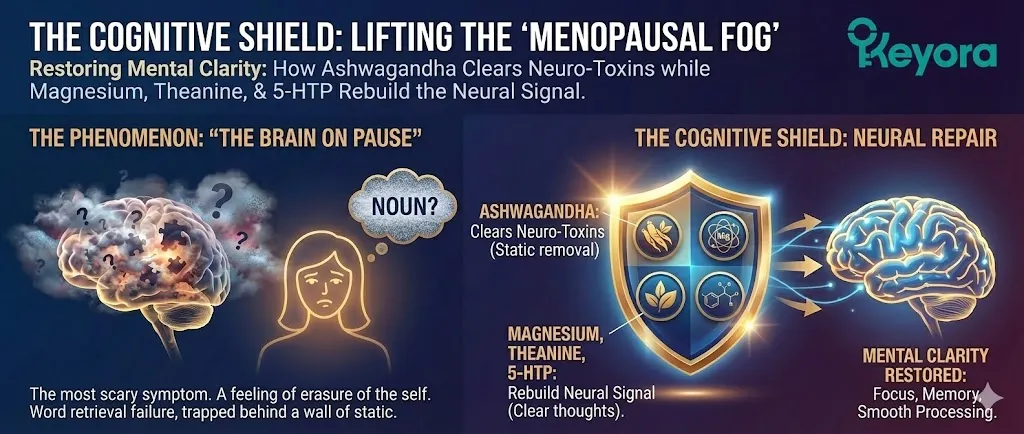
The Cognitive Shield: Lifting the “Menopausal Fog”
Restoring Mental Clarity: How Ashwagandha Clears the Neuro-Toxins while Magnesium, Theanine, and 5-HTP Rebuild the Neural Signal.
The Phenomenon: “The Brain on Pause”
We now confront the symptom that scares high-functioning women more than any other.
The hot flashes are uncomfortable. The insomnia is exhausting. The rage is confusing. But this? This feels like an erasure of the self.
It starts subtly. You are in the middle of a sentence, a sentence you have spoken a thousand times, and suddenly, the noun disappears. You know the concept. You can visualize the object.
But the word itself – the label – is gone. It is trapped behind a wall of static. You snap your fingers, grasping for it, while your colleagues watch.
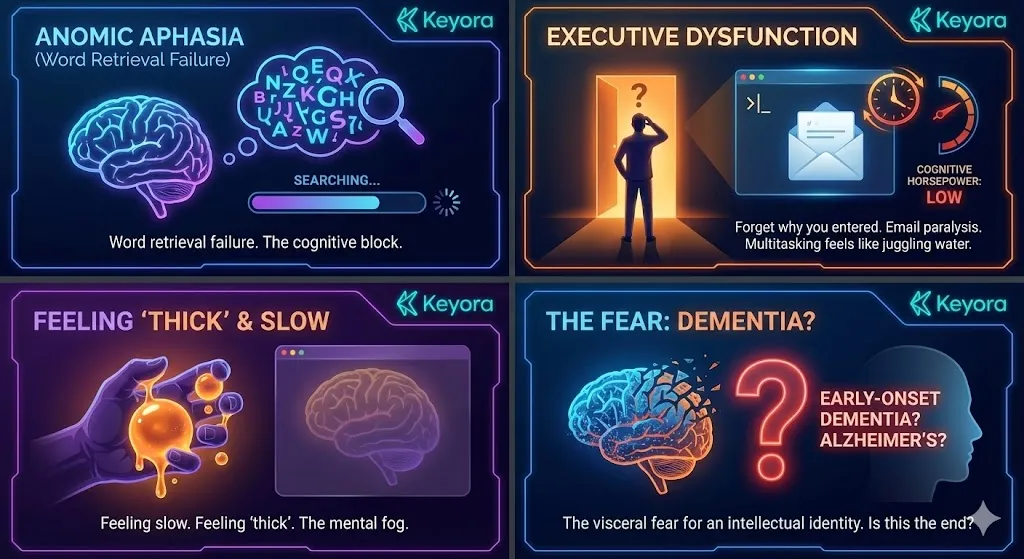
This is Anomic Aphasia (Word Retrieval Failure).
Then comes the “Executive dysfunction.”
You walk into a room and forget why you are there.
You stare at a simple email for ten minutes, unable to summon the cognitive horsepower to formulate a reply.
Multitasking, once your superpower, now feels like trying to juggle water.
You feel slow.
You feel “thick.”
This is the Menopausal Brain Fog.
For a woman who has built her identity on her intellect – on being sharp, quick, and capable – this is terrifying.
The immediate fear is visceral:
“Is this early-onset dementia?
Is this Alzheimer’s?”
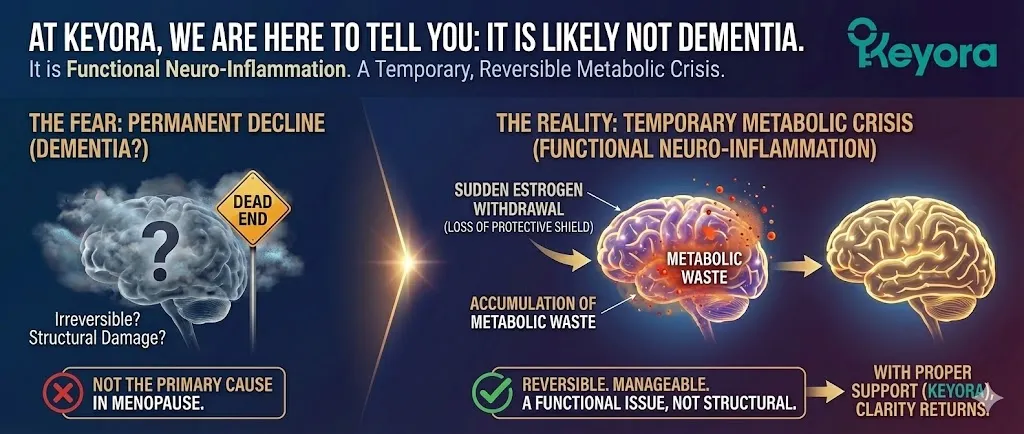
At Keyora, we are here to tell you: It is likely not dementia.
It is Functional Neuro-Inflammation.
It is a temporary, reversible metabolic crisis within the brain caused by the sudden withdrawal of its primary protective shield (Estrogen) and the accumulation of metabolic waste.
The Reality: Synaptic Noise and Metabolic Sludge
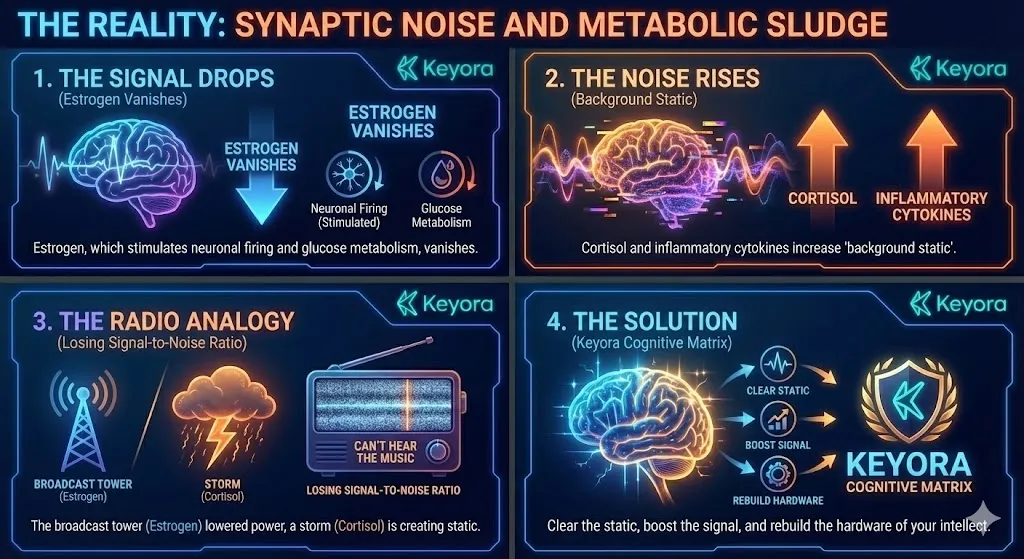
The brain is an electrical machine. To think clearly, it requires a strong signal and low background noise.
During menopause, two things happen simultaneously:
The Signal Drops:
Estrogen, which stimulates neuronal firing and glucose metabolism, vanishes.
The Noise Rises:
Cortisol and inflammatory cytokines increase “background static.”
Imagine trying to tune into a radio station. The broadcast tower (Estrogen) has lowered its power, and a storm (Cortisol) is creating static.
You can’t hear the music. You are not losing your mind; you are losing your Signal-to-Noise Ratio.
In this episode, we will detail exactly how to clear the static, boost the signal, and rebuild the hardware of your intellect using the Keyora Cognitive Matrix.
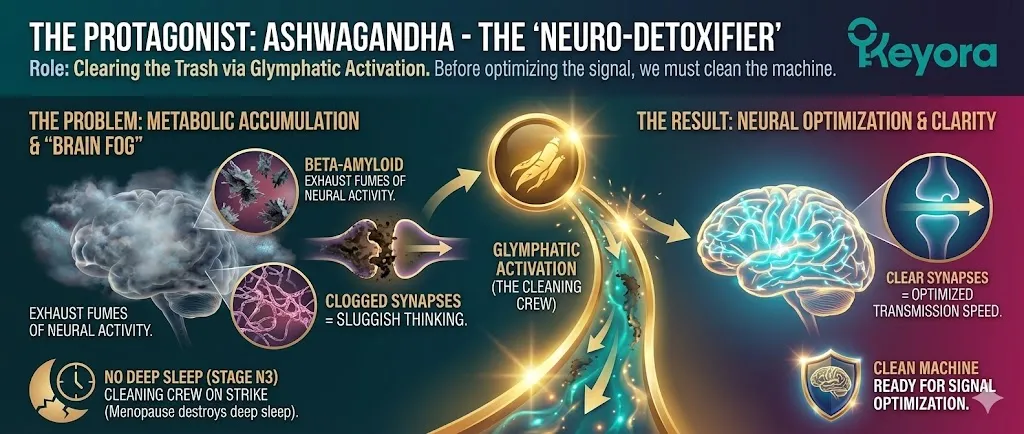
The Protagonist: Ashwagandha – The “Neuro-Detoxifier”
Before we can optimize the signal, we must clean the machine.
The primary driver of “Brain Fog” is often the physical accumulation of metabolic waste products in the brain tissue.
Specifically, Beta-Amyloid and Tau Proteins. These are the “exhaust fumes” of neural activity.
If they build up, they clog the synapses, slowing down transmission speed. This manifests as “sluggish thinking.”
Normally, the brain cleans itself. But in the menopausal woman, the cleaning crew has gone on strike.
Why?
Because the cleaning crew only works during Deep Sleep (Stage N3).
And as we established in previous episodes, menopause destroys deep sleep.
Role: Clearing the Trash via Glymphatic Activation
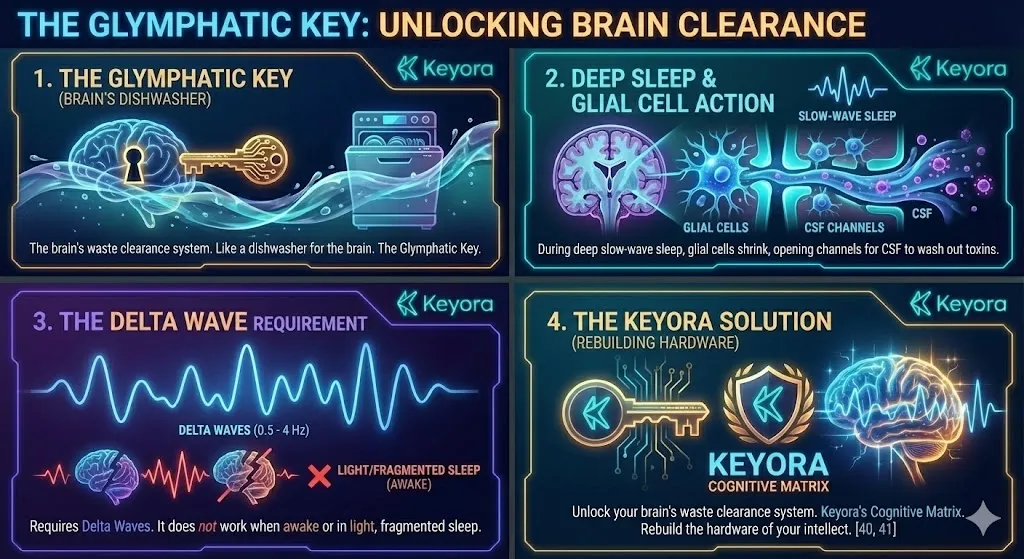
Mechanism 1: The Glymphatic Key
The brain has a waste clearance system called the Glymphatic System. It works like a dishwasher.
During deep slow-wave sleep, the glial cells shrink, opening up channels for cerebrospinal fluid (CSF) to wash through the brain and flush out toxins.
This system does not work when you are awake.
It does not work when you are in light, fragmented sleep.
It requires the specific neuro-architecture of Delta Waves (0.5 – 4 Hz).
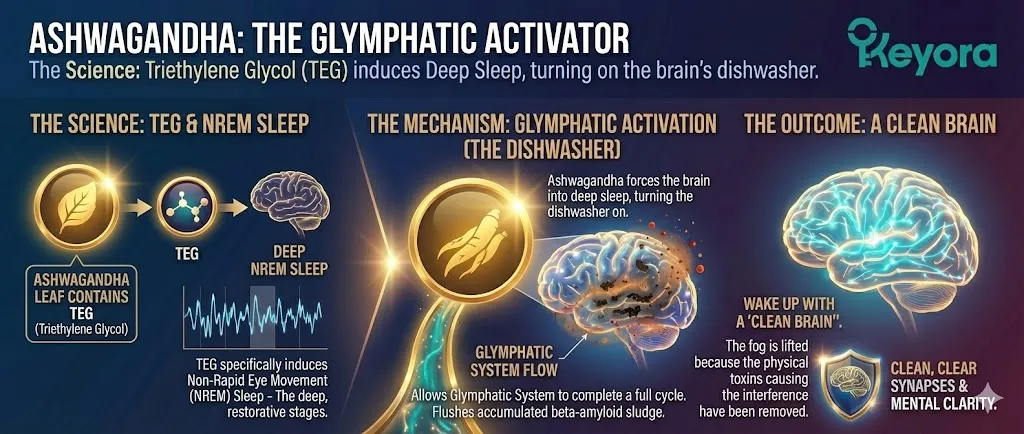
Ashwagandha acts as the Glymphatic Activator.
The Science:
Ashwagandha leaves contain a compound called Triethylene Glycol (TEG).
The Action:
TEG has been shown to specifically induce Non-Rapid Eye Movement (NREM) Sleep – the deep, restorative stages.
The Result:
By forcing the brain into deep sleep, Ashwagandha turns the dishwasher on.
It allows the Glymphatic System to complete a full cycle.
It flushes the Beta-Amyloid sludge that accumulated during the day.
The Outcome:
You wake up with a “Clean Brain.”
The fog is lifted because the physical toxins causing the interference have been removed.
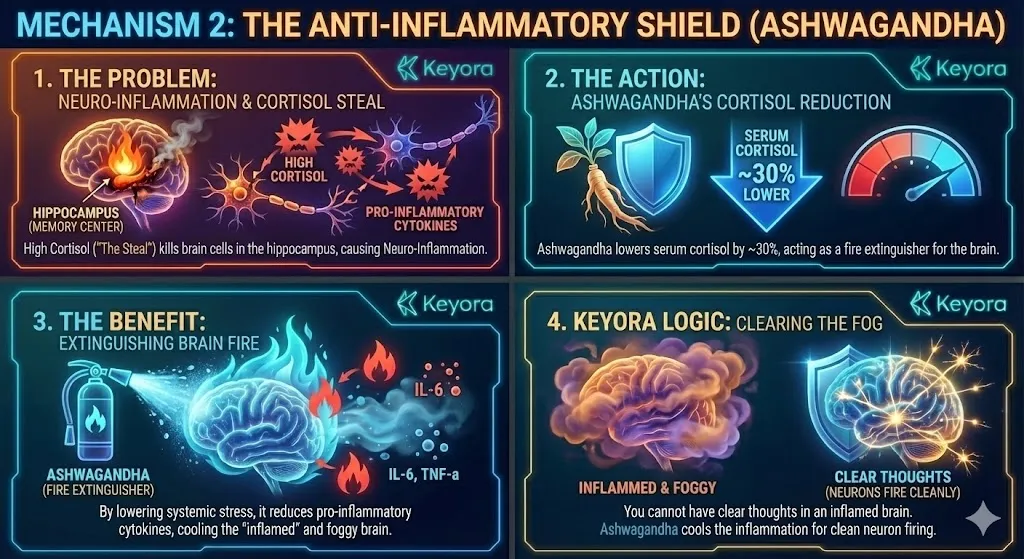
Mechanism 2: The Anti-Inflammatory Shield
The second cause of fog is Neuro-Inflammation. High Cortisol (The Steal) kills brain cells in the hippocampus (Memory Center).
The Action:
Ashwagandha lowers serum cortisol by ~30%.
The Benefit:
It acts as a fire extinguisher for the brain.
By lowering the systemic stress load, it reduces the production of pro-inflammatory cytokines (IL-6, TNF-a) that make the brain feel “inflamed” and foggy.
Keyora Logic:
You cannot have clear thoughts in an inflamed brain.
Ashwagandha cools the inflammation so the neurons can fire cleanly.
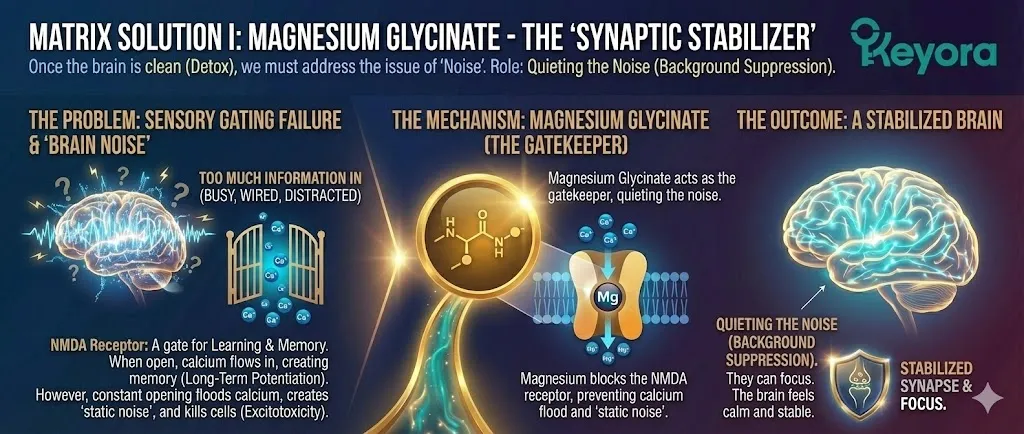
Matrix Solution I: Magnesium Glycinate – The “Synaptic Stabilizer”
Once the brain is clean (Detox), we must address the issue of “Noise.”
Many menopausal women report that they can’t focus because their brain feels “busy” or “buzzy.”
They are easily distracted.
They feel wired.
This is a failure of Sensory Gating.
The brain is letting too much information in.
Role: Quieting the Noise (Background Suppression)
The Science of the NMDA Receptor
Learning and Memory rely on a specific receptor in the brain called the NMDA Receptor.
This receptor is like a gate. When it opens, calcium flows in, and a memory is formed (Long-Term Potentiation).
However, you don’t want this gate open all the time. If it is open constantly, calcium floods in, creates “static noise,” and eventually kills the cell (Excitotoxicity).
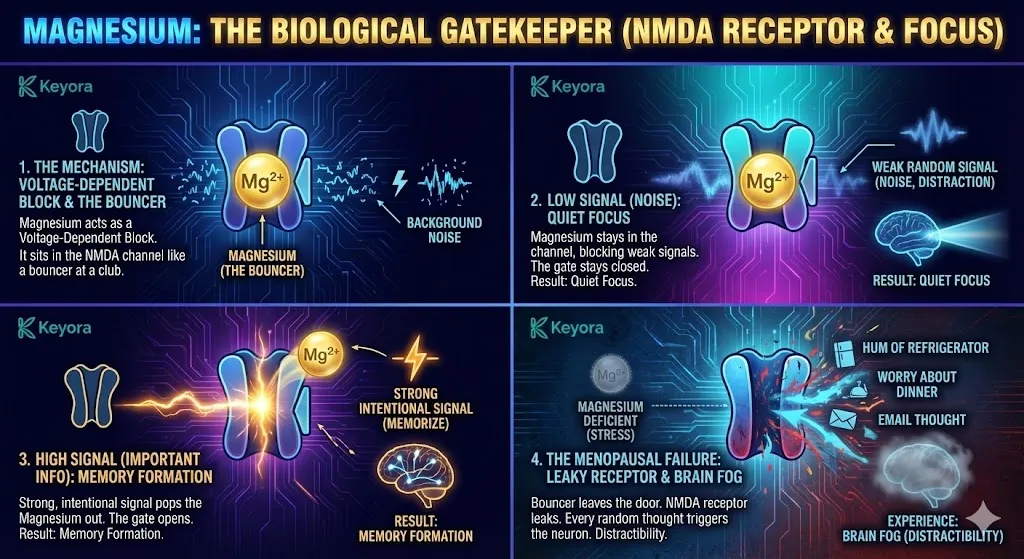
Magnesium: The Biological Gatekeeper
Magnesium acts as the Voltage-Dependent Block. It sits right in the middle of the NMDA channel. It acts like a bouncer at a club.
Low Signal (Noise):
If a weak, random signal comes along (background noise, distraction), Magnesium stays in the channel.
It blocks the signal. The gate stays closed.
Result: Quiet Focus.
High Signal (Important Info):
If a strong, intentional signal comes along (you trying to memorize a fact), the electrical charge pops the Magnesium out. The gate opens.
Result: Memory Formation.
The Menopausal Failure:
When you are Magnesium deficient (which stress causes), the bouncer leaves the door. The NMDA receptor starts leaking.
Every random thought, every background sound, every worry triggers the neuron.
The Experience:
This is “Brain Fog” manifesting as Distractibility.
You can’t focus on the email because your brain is paying attention to the hum of the refrigerator and the worry about dinner.
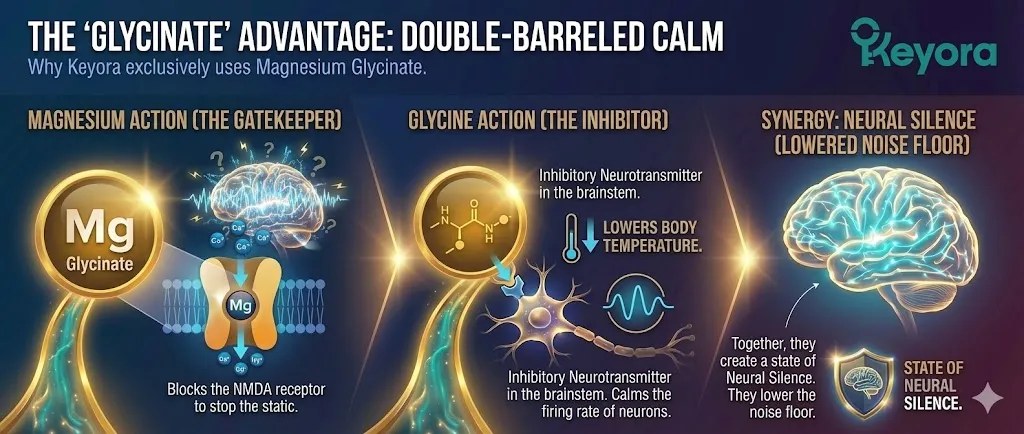
The “Glycinate” Advantage: Double-Barreled Calm
This is why Keyora exclusively uses Magnesium Glycinate.
The Magnesium Glycinate.:
Blocks the NMDA receptor to stop the static.
The Glycine:
Glycine is an amino acid that acts as an Inhibitory Neurotransmitter in the brainstem.
It physically lowers body temperature and calms the firing rate of neurons.
The Synergy:
Together, they create a state of Neural Silence. They lower the noise floor.
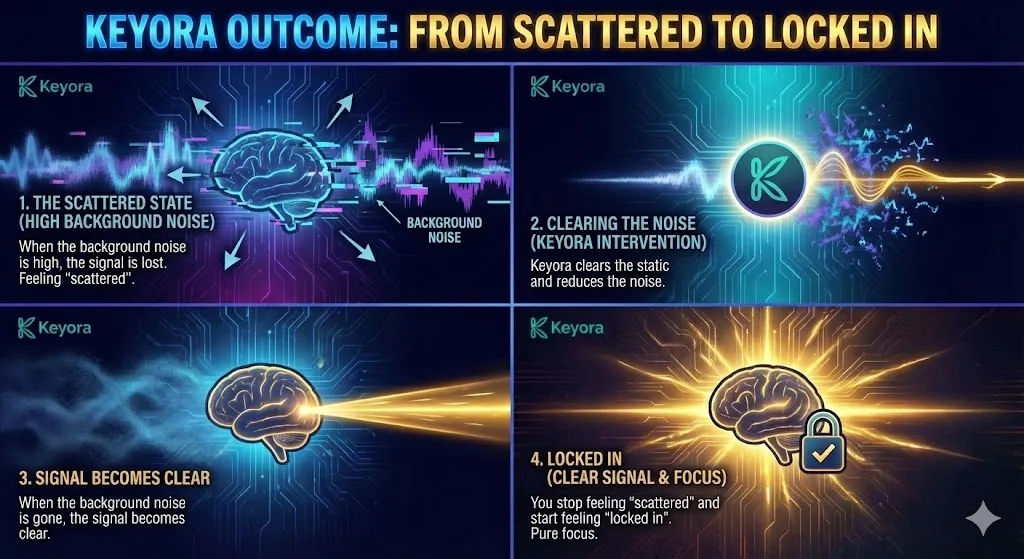
Keyora Outcome:
When the background noise is gone, the signal becomes clear.
You stop feeling “scattered” and start feeling “locked in.”
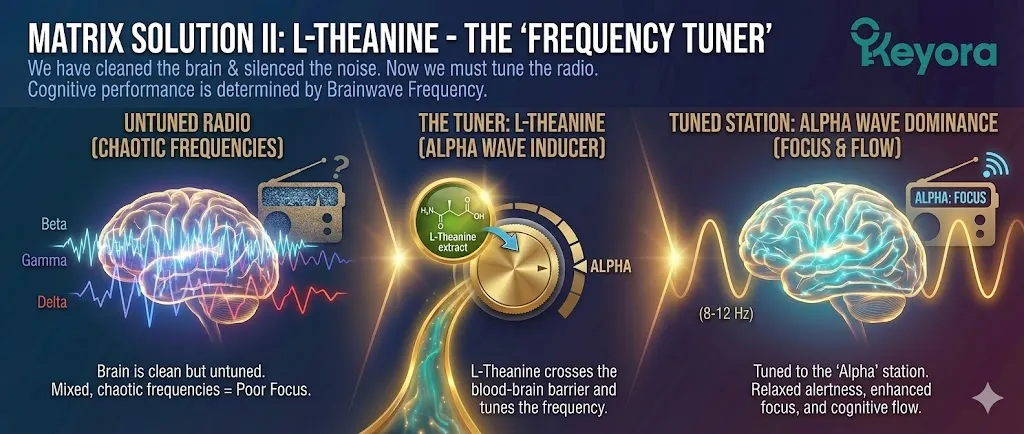
Matrix Solution II: L-Theanine – The “Frequency Tuner”
We have cleaned the brain (Ashwagandha) and silenced the noise (Magnesium).
Now we must tune the radio to the correct station. Cognitive performance is determined by Brainwave Frequency.
Role: Tuning the Station (Alpha Waves)
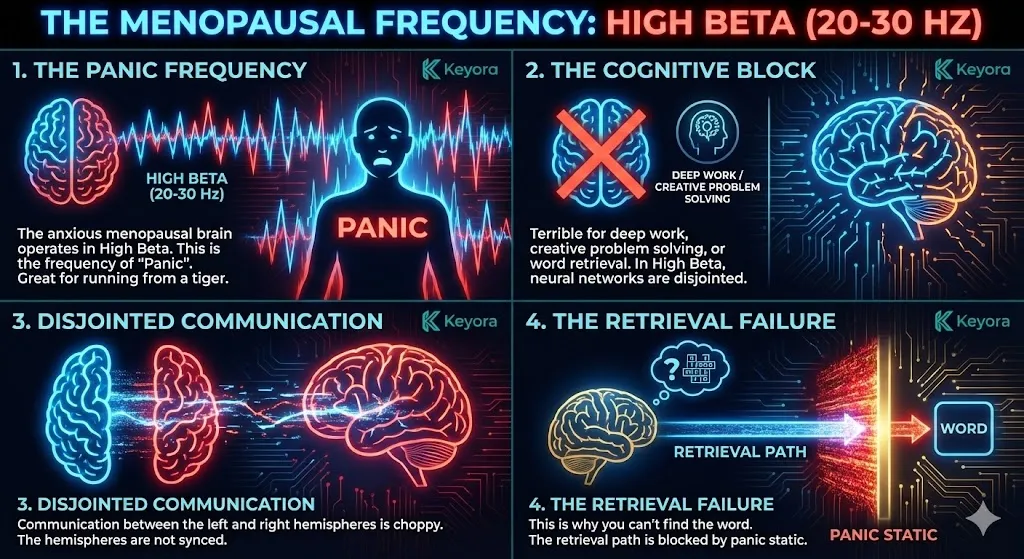
The Menopausal Frequency: High Beta
The anxious, foggy menopausal brain typically operates in High Beta (20-30 Hz).
This is the frequency of “Panic.”
It is great for running from a tiger.
It is terrible for deep work, creative problem solving, or word retrieval.
In High Beta, neural networks are disjointed.
Communication between the left and right hemispheres is choppy.
This is why you can’t find the word – the retrieval path is blocked by panic static.
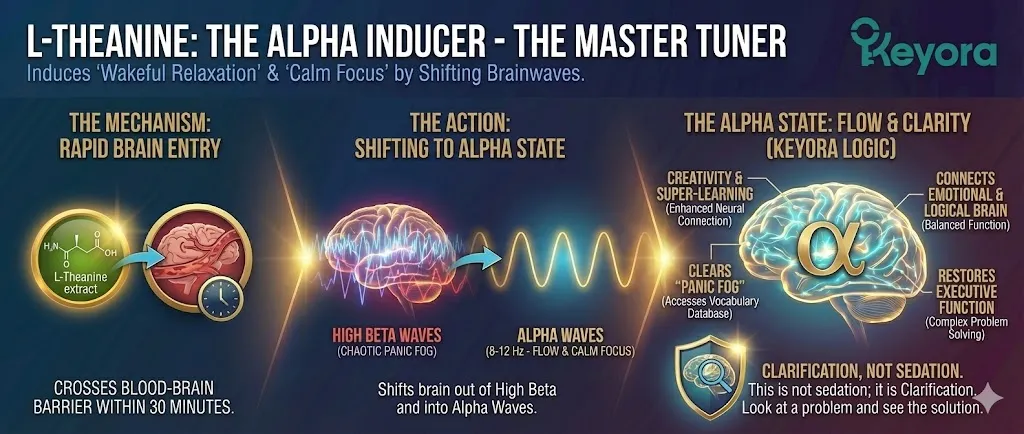
L-Theanine: The Alpha Inducer L-Theanine is the master tuner.
Mechanism:
It crosses the Blood-Brain Barrier within 30 minutes.
Action:
It shifts the brain out of High Beta and into Alpha Waves (8-12 Hz).
The Alpha State:
Alpha is the state of “Wakeful Relaxation” or “Calm Focus.” It is the state of “Flow.”
-
It is the frequency of creativity.
-
It is the frequency of super-learning.
-
It connects the emotional brain with the logical brain.
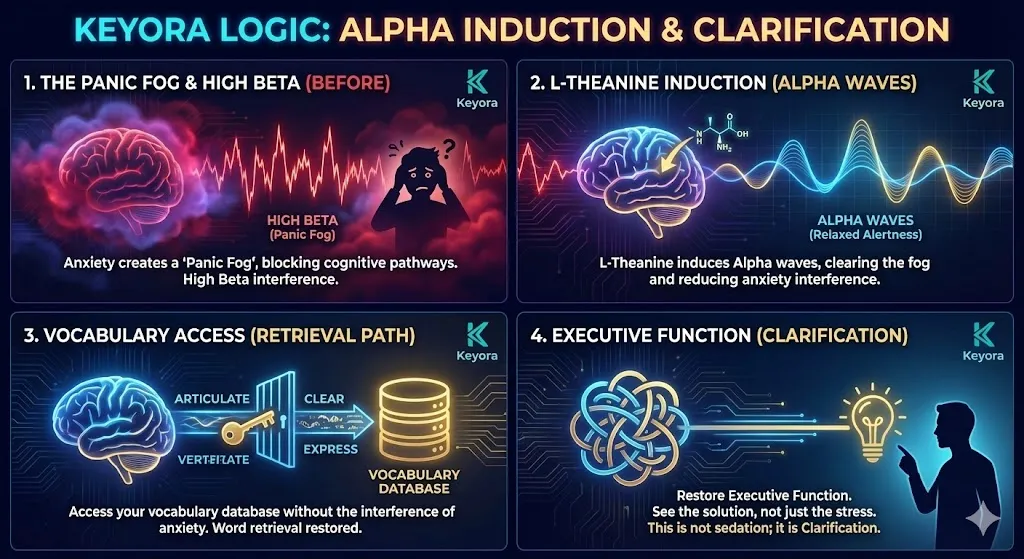
Keyora Logic:
By inducing Alpha waves, L-Theanine clears the “Panic Fog.”
It allows you to access your vocabulary database without the interference of anxiety.
It restores Executive Function.
You can look at a complex problem and see the solution, rather than just seeing the stress.
This is not sedation; it is Clarification.
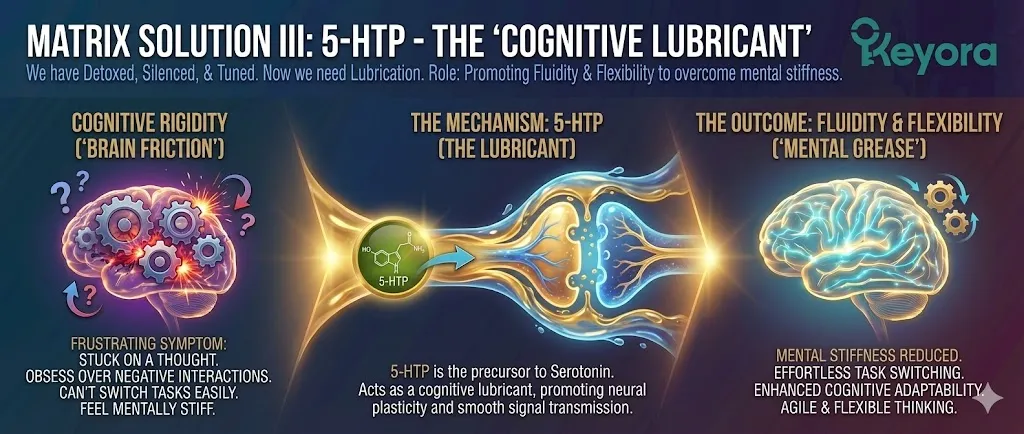
Matrix Solution III: 5-HTP – The “Cognitive Lubricant”
We have Detoxed, Silenced, and Tuned.
Now we need Lubrication.
One of the most frustrating aspects of menopausal fog is “Cognitive Rigidity.”
You get stuck on a thought.
You obsess over a negative interaction.
You can’t switch tasks easily.
You feel mentally stiff.
Role: Fluidity & Flexibility
The Serotonin-Cognition Link
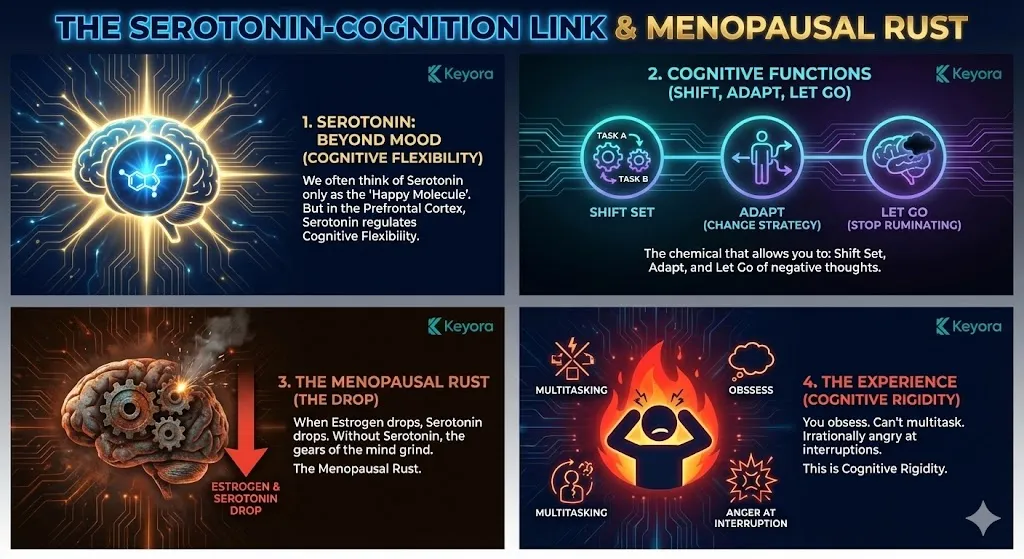
We often think of Serotonin only as the “Happy Molecule” (Mood). But in the Prefrontal Cortex, Serotonin regulates Cognitive Flexibility.
It is the chemical that allows you to:
-
Shift Set: Move your attention from Task A to Task B without lag.
-
Adapt: Change your strategy when the old one isn’t working.
-
Let Go: Stop ruminating on a negative thought.
The Menopausal Rust
When Estrogen drops, Serotonin drops (as seen in Ep. 03). Without Serotonin, the gears of the mind grind.
The Experience:
You obsess. You can’t multitask. If someone interrupts you, you get irrationally angry because you can’t shift your focus back.
This is Cognitive Rigidity.
The 5-HTP Fix
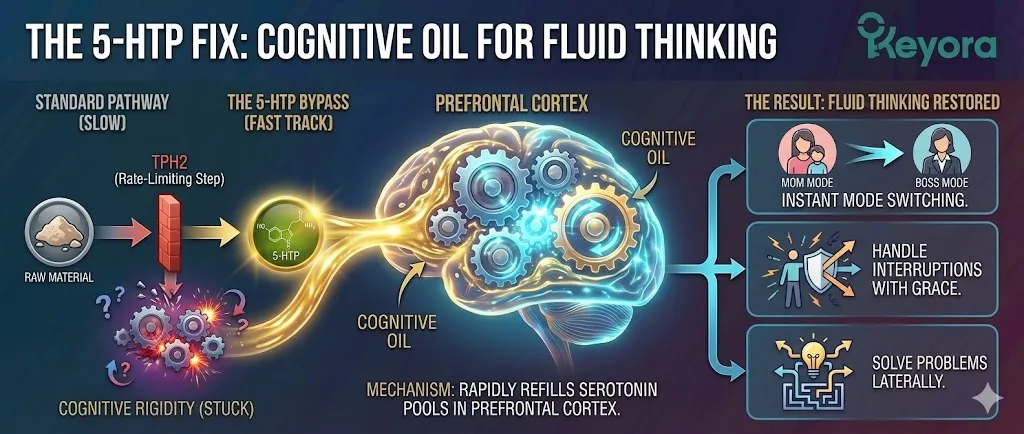
5-HTP (5-Hydroxytryptophan) is the direct precursor to Serotonin.
The Mechanism:
It bypasses the rate-limiting step (TPH2) and rapidly refills Serotonin pools in the Prefrontal Cortex.
The Action:
It acts as Cognitive Oil.
The Result:
Your thinking becomes fluid again.
You can switch from “Mom Mode” to “Boss Mode” instantly.
You can handle interruptions with grace.
You can solve problems laterally.
Keyora Outcome:
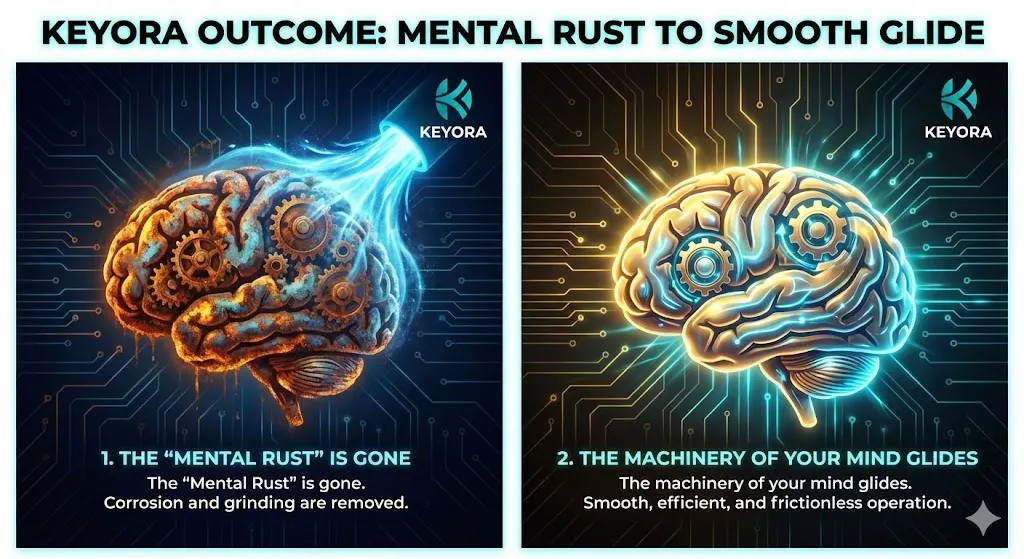
The “Mental Rust” is gone.
The machinery of your mind glides.
Matrix Solution IV: The Vitamin Architecture (B12, B6, Vit D)
Finally, we must maintain the Hardware itself. No amount of software optimization (neurotransmitters) will matter if the wires are frayed and the chips are degrading. The menopausal brain is physically vulnerable to atrophy (shrinkage). We must build a Structural Defense.
Role: Hardware Maintenance & Neuro-Protection
1. Vitamin B12 (Methylcobalamin): The Myelin Repair Kit
The Problem:
Nerves are insulated by a fatty sheath called Myelin. This insulation ensures the electrical signal travels fast (conduction velocity).
As we age, and as B12 absorption drops, myelin frays.
The Fog:
Frayed myelin = Slow signals. This is literally “slow thinking.”
The Keyora Difference:
We use Methylcobalamin (the active, bio-identical form), NOT Cyanocobalamin (the cheap synthetic form found in multivitamins).
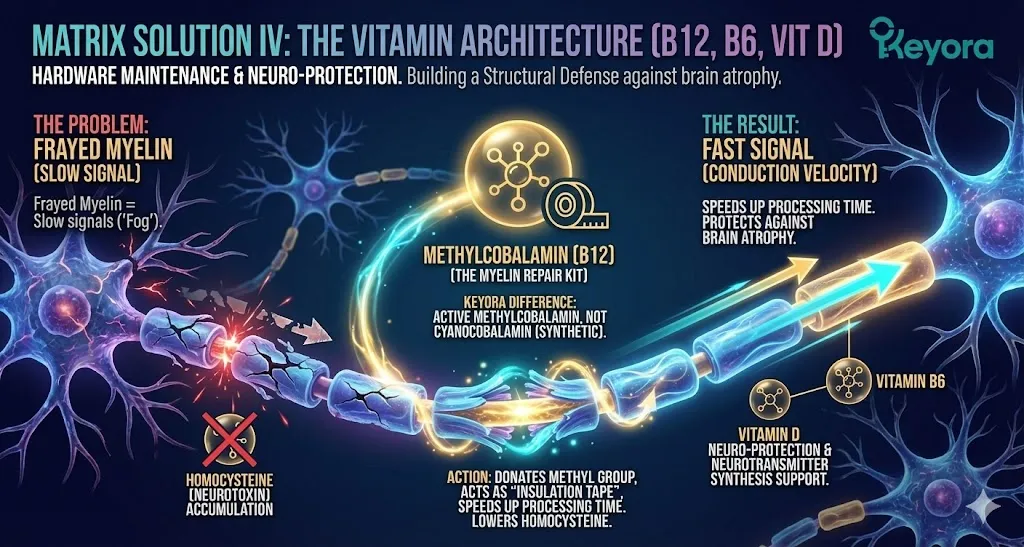
The Action:
Methylcobalamin donates the methyl group needed to repair myelin.
It acts as “Insulation Tape” for your neurons.
It speeds up processing time.
It also lowers Homocysteine, a neurotoxin that causes brain shrinkage.
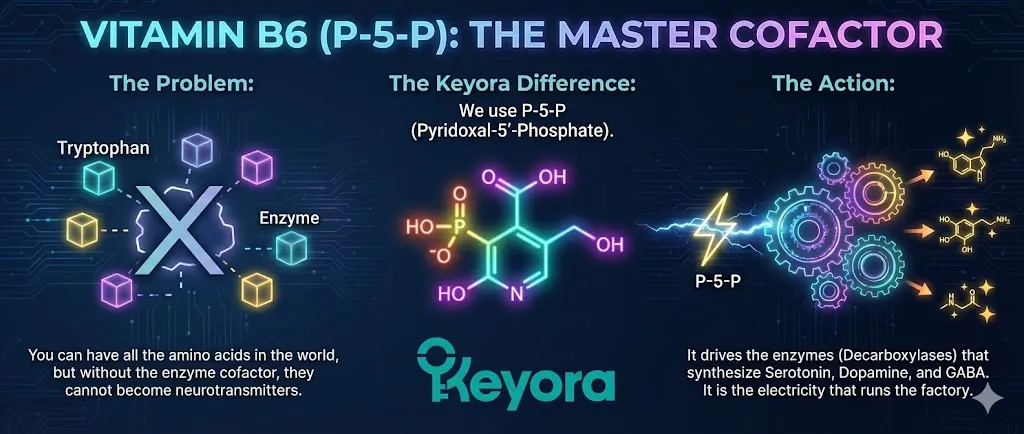
2. Vitamin B6 (P-5-P): The Master Cofactor
The Problem:
You can have all the amino acids (Tryptophan, etc.) in the world, but without the enzyme cofactor, they cannot become neurotransmitters.
The Keyora Difference:
We use P-5-P (Pyridoxal-5’-Phosphate).
The Action:
It drives the enzymes (Decarboxylases) that synthesize Serotonin, Dopamine, and GABA. It is the electricity that runs the factory.
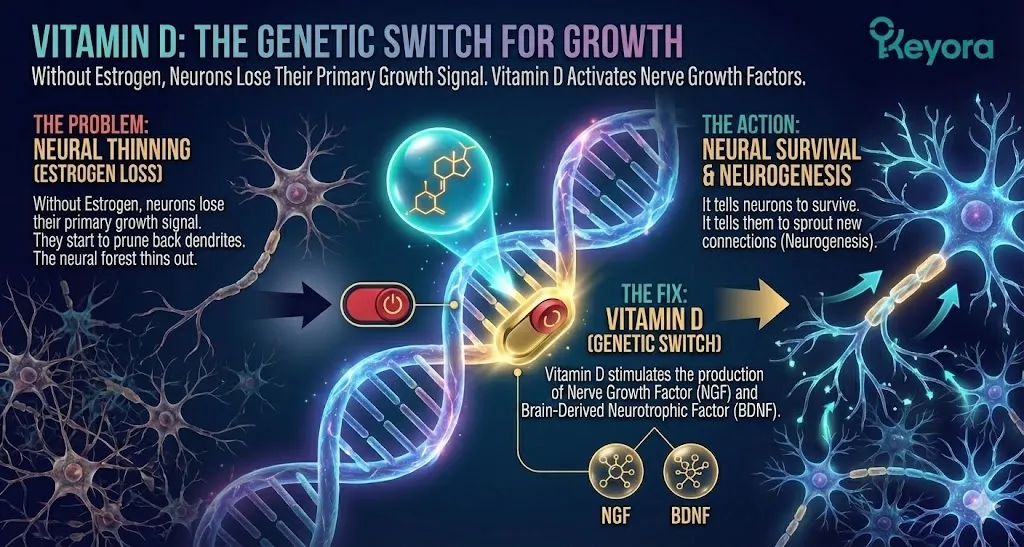
3. Vitamin D: The Genetic Switch for Growth
The Problem:
Without Estrogen, neurons lose their primary growth signal. They start to prune back dendrites. The neural forest thins out.
The Fix:
Vitamin D stimulates the production of Nerve Growth Factor (NGF) and Brain-Derived Neurotrophic Factor (BDNF).
The Action:
It tells neurons to survive.
It tells them to sprout new connections (Neurogenesis).
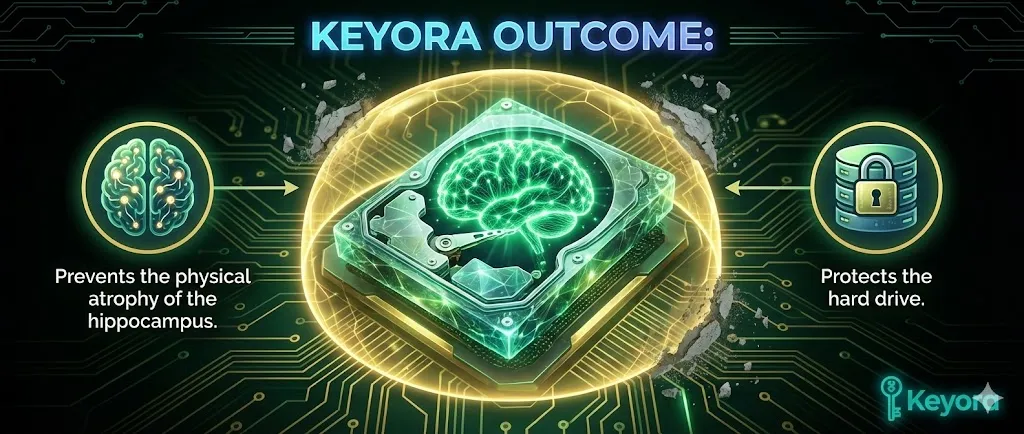
Keyora Outcome:
It prevents the physical atrophy of the hippocampus.
It protects the hard drive.
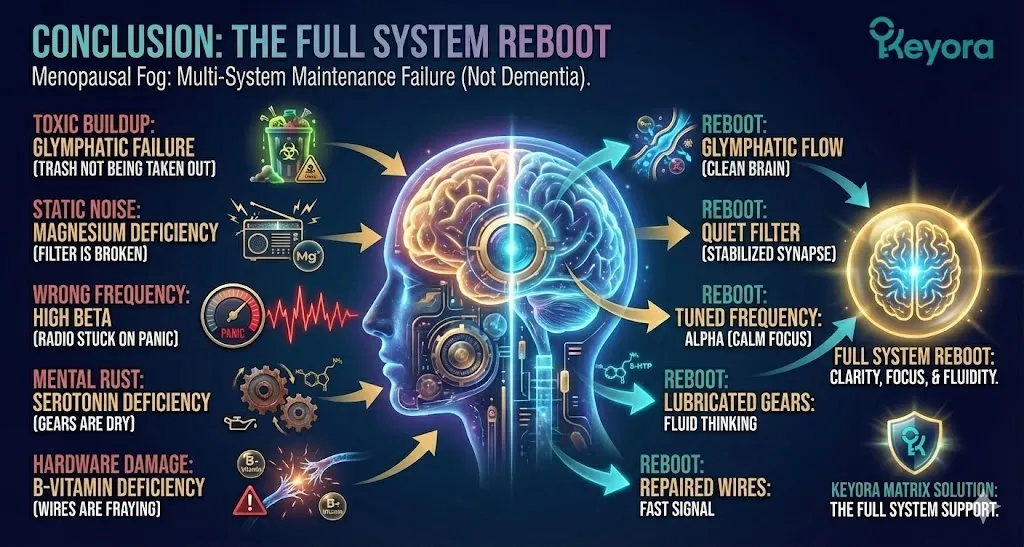
Conclusion: The Full System Reboot
We have mapped the anatomy of the Menopausal Fog. It is not dementia. It is a multi-system failure of maintenance.
-
Toxic Buildup: The trash isn’t being taken out (Glymphatic failure).
-
Static Noise: The filter is broken (Magnesium deficiency).
-
Wrong Frequency: The radio is stuck on panic (High Beta).
-
Mental Rust: The gears are dry (Serotonin deficiency).
-
Hardware Damage: The wires are fraying (B-Vitamin deficiency).
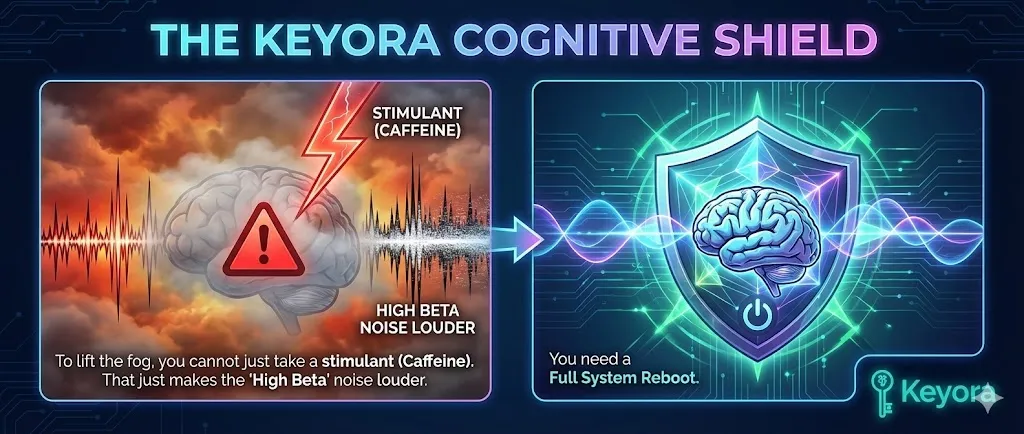
The Keyora Cognitive Shield
To lift the fog, you cannot just take a stimulant (Caffeine).
That just makes the “High Beta” noise louder.
You need a Full System Reboot.
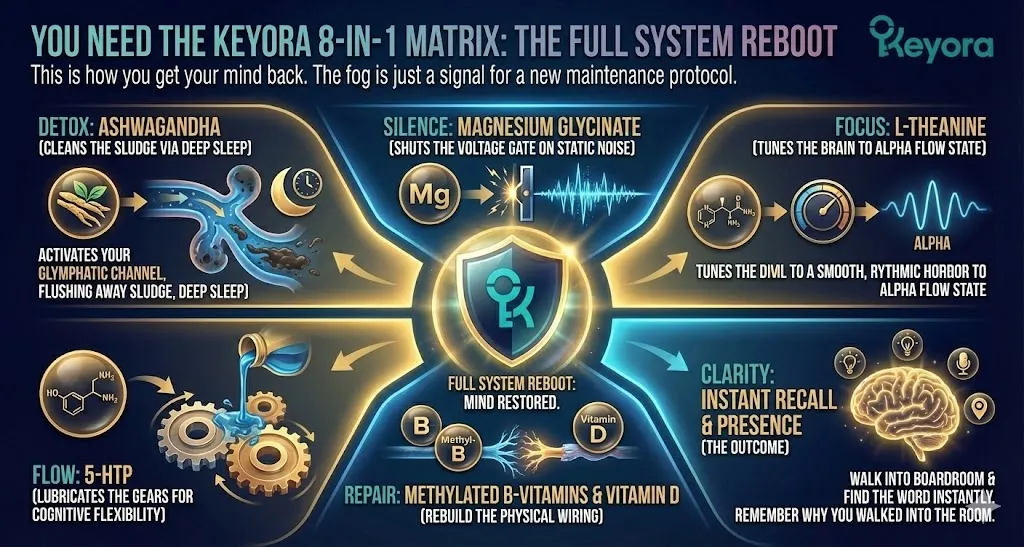
You need the Keyora 8-in-1 Matrix:
-
Detox: Ashwagandha cleans the sludge via Deep Sleep.
-
Silence: Magnesium Glycinate shuts the voltage gate on static noise.
-
Focus: L-Theanine tunes the brain to the Alpha flow state.
-
Flow: 5-HTP lubricates the gears for cognitive flexibility.
-
Repair: Methylated B-Vitamins and Vitamin D rebuild the physical wiring.
This is how you get your mind back.
This is how you walk into the boardroom and find the word instantly.
This is how you remember why you walked into the room.
The fog is not your destiny.
It is just a signal that your brain needs a new maintenance protocol.
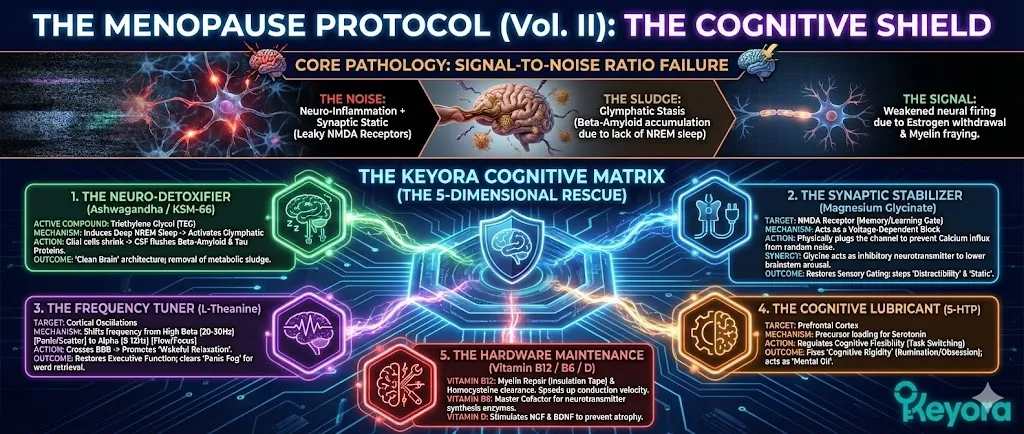
– Series Theme: **The Menopause Protocol** (Vol. II).
– Episode Concept: **The Cognitive Shield** (”Lifting the Fog” & “Anomic Aphasia”).
– Core Pathology: **Signal-to-Noise Ratio Failure**.
– *The Noise*: **Neuro-Inflammation** + **Synaptic Static** (Leaky NMDA Receptors).
– *The Sludge*: **Glymphatic Stasis** (Beta-Amyloid accumulation due to lack of NREM sleep).
– *The Signal*: Weakened neural firing due to Estrogen withdrawal & Myelin fraying.
– **The Keyora Cognitive Matrix (The 5-Dimensional Rescue)**:
– **1. The Neuro-Detoxifier (Ashwagandha / KSM-66)**:
– *Active Compound*: **Triethylene Glycol (TEG)**.
– *Mechanism*: Induces **Deep NREM Sleep** -> Activates **Glymphatic System**.
– *Action*: Glial cells shrink -> CSF flushes **Beta-Amyloid** & **Tau Proteins**.
– *Outcome*: “Clean Brain” architecture; removal of metabolic sludge.
– **2. The Synaptic Stabilizer (Magnesium Glycinate)**:
– *Target*: **NMDA Receptor** (Memory/Learning Gate).
– *Mechanism*: Acts as a **Voltage-Dependent Block**.
– *Action*: Physically plugs the channel to prevent Calcium influx from random noise.
– *Synergy*: **Glycine** acts as inhibitory neurotransmitter to lower brainstem arousal.
– *Outcome*: Restores **Sensory Gating**; stops “Distractibility” & “Static”.
– **3. The Frequency Tuner (L-Theanine)**:
– *Target*: **Cortical Oscillations**.
– *Mechanism*: Shifts frequency from **High Beta (20-30Hz)** [Panic/Scatter] to **Alpha (8-12Hz)** [Flow/Focus].
– *Action*: Crosses BBB -> Promotes “Wakeful Relaxation”.
– *Outcome*: Restores **Executive Function**; clears “Panic Fog” for word retrieval.
– **4. The Cognitive Lubricant (5-HTP)**:
– *Target*: **Prefrontal Cortex**.
– *Mechanism*: Precursor loading for **Serotonin**.
– *Action*: Regulates **Cognitive Flexibility** (Task Switching).
– *Outcome*: Fixes “Cognitive Rigidity” (Rumination/Obsession); acts as “Mental Oil”.
– **5. The Hardware Maintenance (Vitamin B12 / B6 / D)**:
– *Vitamin B12 (Methylcobalamin)*: **Myelin Repair** (Insulation Tape) & **Homocysteine** clearance. Speeds up conduction velocity.
– *Vitamin B6 (P-5-P)*: **Master Cofactor** for neurotransmitter synthesis enzymes.
– *Vitamin D*: Stimulates **NGF** (Nerve Growth Factor) & **BDNF** to prevent atrophy.
Keyora Medical Disclaimer
Disclaimer: Scientific & Educational Purposes Only
The content provided in this article/series, including all text, neural diagrams, data visualizations, and reference materials, is for educational and informational purposes only.
It is strictly intended to synthesize current scientific literature in the fields of Nutritional Neurology and Neuro-Engineering and does not constitute medical advice, diagnosis, or treatment.
Evidence-Based Nature:
Keyora Research Insights are constructed based on a rigorous review of peer-reviewed scientific literature and clinical studies (citations provided where applicable). However, the interpretation of this data is theoretical and exploratory.
Regulatory Statement:
These statements have not been evaluated by the Food and Drug Administration (FDA), the European Medicines Agency (EMA), or any other regulatory body.
Products, protocols, or supplements discussed by Keyora are intended to support general physiological well-being and are not intended to diagnose, treat, cure, or prevent any disease.
Professional Consultation:
Individual biological responses vary. Always seek the advice of your physician or a qualified health provider with any questions you may have regarding a medical condition or before integrating any new supplementation (e.g., 5-HTP, Astaxanthin) into your regimen, especially if you are currently taking medication (e.g., SSRIs).
Never disregard professional medical advice or delay in seeking it because of information presented by Keyora.
By Keyora Research Notes Series
This article contributes to Keyora’s ongoing scientific documentation series, which systematically outlines the conceptual foundations, mechanistic pathways, and empirical evidence informing our research and development approach.
ORCID: 0009–0007–5798–1996