
Keyora Nutritional Neurology: Ashwagandha – The Clinical Matrix(3)The Insomnia & Sleep Initiation Protocol

By Keyora Research Notes Series
This article contributes to Keyora’s ongoing scientific documentation series, which systematically outlines the conceptual foundations, mechanistic pathways, and empirical evidence informing our research and development approach.
ORCID: 0009–0007–5798–1996
The Biology of “Active Rest” & The Hyperarousal Failure
Redefining Sleep: From “Shutdown” to “Maintenance Mode”
In the lexicon of the high-functioning professional, sleep is often viewed with deep suspicion. It is frequently categorized as a passive state – a “shutdown” of the system, a period of inactivity, or worse, a waste of productive time.
This cultural devaluation of rest has led to a global epidemic of sleep fragmentation, where the average adult is chronically operating in a state of biological debt, mistaking caffeine-fueled endurance for actual energy.
At Keyora, we fundamentally reject this passive definition of sleep.
Sleep is not an absence of activity; it is a radical shift in the type of activity. It is not a shutdown; it is a switch to “Maintenance Mode.”
Neurologically, sleep is a high-energy metabolic state. It is the only period during the 24-hour biological cycle where the brain shifts its resources from Information Acquisition (learning, sensing, reacting) to Neuro-Restoration (cleaning, consolidating, repairing).
To treat insomnia effectively, we must first respect the complexity of the machinery we are trying to repair.
![The Biology of "Active Rest" redefines sleep from a "shutdown" or passive state to a high-energy "Maintenance Mode." Sleep is the neurological shift from Information Acquisition (learning/sensing) to Neuro-Restoration (cleaning, consolidating, repairing). This fundamental distinction is critical to treating insomnia in the high-functioning professional, who often operates in a state of biological debt due to the cultural devaluation of rest. [Image illustrating the contrast between the brain's waking state (Information Acquisition) and its sleeping state (Maintenance Mode/Neuro-Restoration)]](https://www.keyorahealth.com/cdnfiles/2026/03/25071939/a1635305-74e5-4901-b095-4d0b51e726a9_1584x672.webp "The Biology of \"Active Rest\" redefines sleep from a \"shutdown\" or passive state to a high-energy \"Maintenance Mode.\" Sleep is the neurological shift from Information Acquisition (learning/sensing) to Neuro-Restoration (cleaning, consolidating, repairing). This fundamental distinction is critical to treating insomnia in the high-functioning professional, who often operates in a state of biological debt due to the cultural devaluation of rest. [Image illustrating the contrast between the brain's waking state (Information Acquisition) and its sleeping state (Maintenance Mode/Neuro-Restoration)]")
The Glymphatic System: The Night Shift
The most critical discovery in modern sleep science – and the foundation of the Keyora Sleep Protocol – is the existence of the Glymphatic System.
For centuries, medicine believed the brain had no lymphatic drainage.
We now know that during the deep stages of Slow-Wave Sleep (SWS), a miraculous physical transformation occurs. The glial cells (the brain’s support cells) physically shrink by up to 60%. This cellular shrinkage opens up the interstitial channels, allowing Cerebrospinal Fluid (CSF) to wash through the brain tissue like a high-pressure hose.
This “power wash” has a singular purpose: to flush out the metabolic toxins accumulated during the waking hours. Chief among these are Beta-Amyloid and Tau Proteins – the metabolic byproducts of neural activity.
If this process is interrupted, shortened, or prevented by hyperarousal, these toxins remain.
They aggregate.
They form plaques.
The immediate result is “Brain Fog,” cognitive friction, and emotional volatility. The long-term result is neurodegeneration. Therefore, when a Keyora user reports insomnia, we do not view it merely as “being tired.”
We view it as Toxic Accumulation.
The garbage trucks have not run.
The system is poisoning itself.
![The Glymphatic System is the foundation of the Keyora Sleep Protocol. During Slow-Wave Sleep (SWS), glial cells shrink ($text{60%}$); this opens channels, allowing Cerebrospinal Fluid (CSF) to "power wash" the brain. The critical purpose is to flush metabolic toxins ($text{Beta-Amyloid/Tau Proteins}$). Insomnia means Toxic Accumulation (garbage trucks have not run), causing immediate "Brain Fog" and long-term Neurodegeneration. [Image illustrating the Glymphatic System washing Cerebrospinal Fluid (CSF) through the brain to flush out metabolic toxins (Beta-Amyloid) during sleep]The Glymphatic System is the foundation of the Keyora Sleep Protocol. During Slow-Wave Sleep (SWS), glial cells shrink ($text{60%}$); this opens channels, allowing Cerebrospinal Fluid (CSF) to "power wash" the brain. The critical purpose is to flush metabolic toxins (1$text{Beta-Amyloid/Tau Proteins}$).2 Insomnia means Toxic Accumulation (garbage trucks have not run), causing immediate "Brain Fog" and long-term Neurodegeneration.3 [Image illustrating the Glymphatic System washing Cerebrospinal Fluid (CSF) through the brain to flush out metabolic toxins (Beta-Amyloid) during sleep]](https://www.keyorahealth.com/cdnfiles/2026/03/25071941/b42d3942-7c87-430f-b7db-cb6579df01f4_1408x752.webp "The Glymphatic System is the foundation of the Keyora Sleep Protocol. During Slow-Wave Sleep (SWS), glial cells shrink ($text{60%}$); this opens channels, allowing Cerebrospinal Fluid (CSF) to \"power wash\" the brain. The critical purpose is to flush metabolic toxins ($text{Beta-Amyloid/Tau Proteins}$). Insomnia means Toxic Accumulation (garbage trucks have not run), causing immediate \"Brain Fog\" and long-term Neurodegeneration. [Image illustrating the Glymphatic System washing Cerebrospinal Fluid (CSF) through the brain to flush out metabolic toxins (Beta-Amyloid) during sleep]The Glymphatic System is the foundation of the Keyora Sleep Protocol. During Slow-Wave Sleep (SWS), glial cells shrink ($text{60%}$); this opens channels, allowing Cerebrospinal Fluid (CSF) to \"power wash\" the brain. The critical purpose is to flush metabolic toxins (1$text{Beta-Amyloid/Tau Proteins}$).2 Insomnia means Toxic Accumulation (garbage trucks have not run), causing immediate \"Brain Fog\" and long-term Neurodegeneration.3 [Image illustrating the Glymphatic System washing Cerebrospinal Fluid (CSF) through the brain to flush out metabolic toxins (Beta-Amyloid) during sleep]")
The Memory Architect
Furthermore, sleep is the exclusive domain of Memory Consolidation. During REM (Rapid Eye Movement) sleep, the brain engages in a high-speed data transfer.
The Hippocampus (the temporary RAM of the brain) offloads the day’s data to the Neocortex (the hard drive) for long-term storage.
This is when “experience” becomes “wisdom.”
This is when “practice” becomes “skill.”
Without this phase, the high-functioning professional loses their edge.
They read, but they do not retain.
They work, but they do not learn.
![Sleep is the domain of Memory Consolidation. During REM Sleep, the brain acts as the Memory Architect, engaging in high-speed data transfer: the Hippocampus (temporary RAM) offloads the day's data to the Neocortex (hard drive) for long-term storage. Interrupting this process means the high-functioning professional loses their edge, reading but not retaining, and working but not learning. [Image illustrating the process of memory consolidation during REM sleep, showing data transfer from the Hippocampus (RAM) to the Neocortex (Hard Drive)]](https://www.keyorahealth.com/cdnfiles/2026/03/25071944/fe3ca842-090d-440b-84b9-4560141470c0_2816x1536.webp "Sleep is the domain of Memory Consolidation. During REM Sleep, the brain acts as the Memory Architect, engaging in high-speed data transfer: the Hippocampus (temporary RAM) offloads the day's data to the Neocortex (hard drive) for long-term storage. Interrupting this process means the high-functioning professional loses their edge, reading but not retaining, and working but not learning. [Image illustrating the process of memory consolidation during REM sleep, showing data transfer from the Hippocampus (RAM) to the Neocortex (Hard Drive)]")
The Keyora Philosophy
We do not aim to “knock you out.” Sedation is not sleep. Alcohol and benzodiazepines induce unconsciousness, but they destroy Sleep Architecture.
They suppress REM; they block the Glymphatic flush. They provide the illusion of sleep while accelerating the damage.
The Keyora Protocol is engineered to restore Biological Sleep – the complex, multi-stage architecture of active restoration. We treat the brain so it can do the work it was designed to do.
![The Keyora Philosophy rejects Sedation (Alcohol/Benzodiazepines) which provides the illusion of sleep while destroying Sleep Architecture ($text{suppresses REM}$, $text{blocks Glymphatic flush}$). Keyora is engineered to restore Biological Sleep—the complex, multi-stage architecture of active restoration. The goal is not to "knock you out," but to treat the brain so it can perform its designed work of Neuro-Restoration. [Image illustrating the difference between chemically induced sedation (unconsciousness) and biologically active restorative sleep (multi-stage architecture)]](https://www.keyorahealth.com/cdnfiles/2026/03/25071947/29cc86b4-1622-4f3c-a323-e40055672852_1584x672.webp "The Keyora Philosophy rejects Sedation (Alcohol/Benzodiazepines) which provides the illusion of sleep while destroying Sleep Architecture ($text{suppresses REM}$, $text{blocks Glymphatic flush}$). Keyora is engineered to restore Biological Sleep—the complex, multi-stage architecture of active restoration. The goal is not to \"knock you out,\" but to treat the brain so it can perform its designed work of Neuro-Restoration. [Image illustrating the difference between chemically induced sedation (unconsciousness) and biologically active restorative sleep (multi-stage architecture)]")
The Pathology: Hyperarousal & The “Hot Brain”
If sleep is a natural, non-negotiable biological imperative, why is it so difficult for the modern professional to achieve? Why do we stare at the ceiling at 3:00 AM, exhausted yet alert, waiting for a switch that never flips?
The conventional medical model labels this “Insomnia.” It treats it as a deficiency of sleepiness.
At Keyora, we define it more precisely. Chronic insomnia is not a sleep disorder; it is an Arousal Disorder. It is a state of 24-Hour Hyperarousal.
![The pathology of chronic insomnia is defined as an Arousal Disorder, a state of 24-Hour Hyperarousal, not merely a deficiency of sleepiness (the conventional "Insomnia" label). The "Hot Brain" is exhausted yet alert at 3:00 AM, unable to flip the "switch that never flips." This chronic, round-the-clock Hyperarousal prevents the transition to restorative Maintenance Mode. [Image illustrating the brain locked in a state of 24-Hour Hyperarousal (High Arousal Threshold) preventing the onset of sleep]](https://www.keyorahealth.com/cdnfiles/2026/03/25071949/3644f84a-2d51-4f0a-af12-8ef16806d639_1584x672.webp "The pathology of chronic insomnia is defined as an Arousal Disorder, a state of 24-Hour Hyperarousal, not merely a deficiency of sleepiness (the conventional \"Insomnia\" label). The \"Hot Brain\" is exhausted yet alert at 3:00 AM, unable to flip the \"switch that never flips.\" This chronic, round-the-clock Hyperarousal prevents the transition to restorative Maintenance Mode. [Image illustrating the brain locked in a state of 24-Hour Hyperarousal (High Arousal Threshold) preventing the onset of sleep]")
The Mechanism of the “Hot Brain”
To fall asleep (Sleep Onset), the human body must undergo a profound physiological shift known as the Autonomic Switch.
-
The Sympathetic Nervous System (Fight or Flight) must disengage.
-
The Parasympathetic Nervous System (Rest and Digest) must take over.
-
Core Body Temperature must drop by approximately 1°C to 2°C.
-
Cortical Arousal (Beta Waves) must slow down to Theta and Delta frequencies.
In the phenotype of the high-stress individual (Phenotype II & IV), this switch is mechanically broken. The HPA Axis is stuck in the “On” position. The brain is flooded with Corticotropin-Releasing Hormone (CRH) and Norepinephrine.
Even when the subject lies down in a dark room, their biological alarm system is screaming “Danger.” The hardware is ready to run from a tiger, not to enter a vulnerable state of unconsciousness.
![The mechanism of the "Hot Brain" involves a failure of the Autonomic Switch required for Sleep Onset. The HPA Axis is stuck "On," flooding the brain with CRH/Norepinephrine. The Sympathetic System (Fight/Flight) fails to disengage, preventing the Parasympathetic System (Rest/Digest) from taking over. This prevents the required Core Body Temperature drop (~ $1^circ text{C}$) and the essential slowing of Cortical Arousal (Beta to Delta waves). The system is mechanically broken, leading to chronic Hyperarousal. [Image illustrating the failure of the Autonomic Switch from Sympathetic (Fight/Flight) to Parasympathetic (Rest and Digest) during sleep onset]](https://www.keyorahealth.com/cdnfiles/2026/03/25071951/67f92066-9869-44b3-98ae-0dccd64e1b39_1584x672.webp "The mechanism of the \"Hot Brain\" involves a failure of the Autonomic Switch required for Sleep Onset. The HPA Axis is stuck \"On,\" flooding the brain with CRH/Norepinephrine. The Sympathetic System (Fight/Flight) fails to disengage, preventing the Parasympathetic System (Rest/Digest) from taking over. This prevents the required Core Body Temperature drop (~ $1^circ text{C}$) and the essential slowing of Cortical Arousal (Beta to Delta waves). The system is mechanically broken, leading to chronic Hyperarousal. [Image illustrating the failure of the Autonomic Switch from Sympathetic (Fight/Flight) to Parasympathetic (Rest and Digest) during sleep onset]")
The “Tired but Wired” Paradox
This creates the devastating clinical paradox known as “Tired but Wired.” It is a conflict between two opposing biological forces:
-
Force 1: The Homeostatic Sleep Drive.
The body is flooded with Adenosine (the chemical signal for fatigue). The “Sleep Pressure” is enormous. The mitochondria are exhausted. The subject is physically shattered. -
Force 2: The Hyperarousal Signal.
Simultaneously, the Hyperarousal System (centered in the Amygdala and Locus Coeruleus) is firing. The “Wake Drive” is overpowering the Sleep Drive.
![The “Tired but Wired” Paradox is a clinical conflict between two opposing forces: Force 1 is the Homeostatic Sleep Drive, where Adenosine floods the system (Sleep Pressure is enormous). Force 2 is the overwhelming Hyperarousal Signal (Wake Drive) generated by the Amygdala and Locus Coeruleus. The subject is physically shattered but mentally alert, as the Hyperarousal System overpowers the Adenosine signal. [Image illustrating the biological conflict between the Homeostatic Sleep Drive (Adenosine) and the Hyperarousal Signal (Amygdala/Locus Coeruleus) leading to the "Tired but Wired" paradox]](https://www.keyorahealth.com/cdnfiles/2026/03/25071953/0a906804-de22-4934-b69c-0b9469820c9a_1584x672.webp "The “Tired but Wired” Paradox is a clinical conflict between two opposing forces: Force 1 is the Homeostatic Sleep Drive, where Adenosine floods the system (Sleep Pressure is enormous). Force 2 is the overwhelming Hyperarousal Signal (Wake Drive) generated by the Amygdala and Locus Coeruleus. The subject is physically shattered but mentally alert, as the Hyperarousal System overpowers the Adenosine signal. [Image illustrating the biological conflict between the Homeostatic Sleep Drive (Adenosine) and the Hyperarousal Signal (Amygdala/Locus Coeruleus) leading to the \"Tired but Wired\" paradox]")
It is like driving a high-performance car with one foot mashing the brake (Adenosine) and the other foot mashing the gas (Cortisol/Norepinephrine).
The engine screams.
The tires smoke.
The car does not move.
The result is metabolic burnout.
Standard sleeping pills (hypnotics) simply hit the brakes harder. They force the car to stop while the engine is still redlining.
The Keyora Protocol takes the foot off the gas.
We target the Hyperarousal itself.
We cool the Hot Brain so that sleep becomes inevitable, not forced.
![The “Tired but Wired” paradox is like driving a high-performance car with the brake (Adenosine) and gas (Cortisol/Norepinephrine) mashed simultaneously: the engine screams, but the car does not move (metabolic burnout). Standard hypnotics hit the brake harder (force the car to stop). The Keyora Protocol takes the foot off the gas by targeting the Hyperarousal itself, cooling the "Hot Brain" so that sleep is inevitable, not forced sedation. [Image illustrating a car engine redlining with both the gas and brake pedals depressed, symbolizing the "Tired but Wired" state]](https://www.keyorahealth.com/cdnfiles/2026/03/25071956/50d2571c-2385-426d-bac5-34a700cbe39d_1584x672.webp "The “Tired but Wired” paradox is like driving a high-performance car with the brake (Adenosine) and gas (Cortisol/Norepinephrine) mashed simultaneously: the engine screams, but the car does not move (metabolic burnout). Standard hypnotics hit the brake harder (force the car to stop). The Keyora Protocol takes the foot off the gas by targeting the Hyperarousal itself, cooling the \"Hot Brain\" so that sleep is inevitable, not forced sedation. [Image illustrating a car engine redlining with both the gas and brake pedals depressed, symbolizing the \"Tired but Wired\" state]")
The Core Mechanism: The “Cortisol-Melatonin See-Saw”
To effectively dismantle Hyperarousal, we must understand the primary hormonal axis that governs the sleep-wake cycle: The Cortisol-Melatonin Axis.
We define this relationship as the “Cortisol-Melatonin See-Saw.”
In a healthy biological system, these two hormones operate in a strict, reciprocal antagonism. They are mutually exclusive. They cannot coexist at peak levels.
-
Cortisol is the hormone of Day, Light, and Mobilization.
-
Melatonin is the hormone of Night, Dark, and Restoration.
![The core mechanism of sleep/wake cycle is the Cortisol-Melatonin See-Saw, a strict, reciprocal antagonism where the two hormones cannot coexist at peak levels. Cortisol is the hormone of Day, Light, and Mobilization; Melatonin is the hormone of Night, Dark, and Restoration. Understanding this axis is essential to dismantle Hyperarousal and restore biological sleep. [Image illustrating the reciprocal, antagonistic relationship between Cortisol levels (high in day) and Melatonin levels (high at night) in a see-saw diagram]](https://www.keyorahealth.com/cdnfiles/2026/03/25071958/98ba8211-2367-4ee8-bc97-69c0f87a5534_2816x1504.webp "The core mechanism of sleep/wake cycle is the Cortisol-Melatonin See-Saw, a strict, reciprocal antagonism where the two hormones cannot coexist at peak levels. Cortisol is the hormone of Day, Light, and Mobilization; Melatonin is the hormone of Night, Dark, and Restoration. Understanding this axis is essential to dismantle Hyperarousal and restore biological sleep. [Image illustrating the reciprocal, antagonistic relationship between Cortisol levels (high in day) and Melatonin levels (high at night) in a see-saw diagram]")
The Biological Physics of the Pineal Gland
The Pineal Gland – the master clock of the brain – possesses a biological “kill switch” connected to the stress system.
When the HPA Axis is active and Serum Cortisol is elevated, the Pineal Gland interprets this signal as “Danger” or “Daylight.”
Survival Logic:
You cannot sleep when you are being hunted. Therefore, if Cortisol is high, the brain assumes a predator is near.
The Reaction:
The Pineal Gland suppresses Melatonin synthesis. It physically locks the production of the sleep hormone.
![The Pineal Gland (master clock) possesses a biological "kill switch" connected to the stress system. When Serum Cortisol is elevated (interpreting as "Danger/Daylight"), the Pineal Gland suppresses Melatonin synthesis. This survival logic ("You cannot sleep when you are being hunted") physically locks the production of the sleep hormone, contributing to chronic Hyperarousal. [Image illustrating the Pineal Gland physically suppressing Melatonin synthesis when it receives a high Cortisol/HPA Axis "Danger" signal]](https://www.keyorahealth.com/cdnfiles/2026/03/25072001/7c649061-1c41-4dc3-9cc7-61e854f5446f_1584x672.webp "The Pineal Gland (master clock) possesses a biological \"kill switch\" connected to the stress system. When Serum Cortisol is elevated (interpreting as \"Danger/Daylight\"), the Pineal Gland suppresses Melatonin synthesis. This survival logic (\"You cannot sleep when you are being hunted\") physically locks the production of the sleep hormone, contributing to chronic Hyperarousal. [Image illustrating the Pineal Gland physically suppressing Melatonin synthesis when it receives a high Cortisol/HPA Axis \"Danger\" signal]")
The Insomniac’s Loop
This is the root cause of Sleep Latency (trouble falling asleep) in the anxious professional.
-
The subject is stressed about work (or worried about not sleeping).
-
Cortisol spikes in the evening (when it should be at its lowest/nadir).
-
This Cortisol spike forces the “See-Saw” down on the stress side.
-
Consequently, the Melatonin side shoots up into the air – production is blocked.
-
The subject takes a generic Melatonin supplement.
-
The Failure: The brain rejects the exogenous melatonin because the Cortisol signal overrides it. You are trying to manually force the See-Saw down while a 500lb gorilla (Cortisol) is sitting on the other side.
![The Insomniac’s Loop is the root cause of Sleep Latency: Stress causes Cortisol spikes in the evening, forcing the Cortisol-Melatonin See-Saw down on the stress side, blocking Melatonin production. Generic Melatonin supplements fail because the Cortisol signal overrides the exogenous hormone. This is like trying to force the see-saw down while a "500lb gorilla" (Cortisol) sits on the other side. [Image illustrating the Cortisol-Melatonin See-Saw failure, with high Cortisol levels blocking the effectiveness of supplementary Melatonin]](https://www.keyorahealth.com/cdnfiles/2026/03/25072003/5a7f830c-90e9-4133-b037-85187ddb4037_1584x672.webp "The Insomniac’s Loop is the root cause of Sleep Latency: Stress causes Cortisol spikes in the evening, forcing the Cortisol-Melatonin See-Saw down on the stress side, blocking Melatonin production. Generic Melatonin supplements fail because the Cortisol signal overrides the exogenous hormone. This is like trying to force the see-saw down while a \"500lb gorilla\" (Cortisol) sits on the other side. [Image illustrating the Cortisol-Melatonin See-Saw failure, with high Cortisol levels blocking the effectiveness of supplementary Melatonin]")
The Keyora Insight
This explains why most natural sleep aids fail. They try to induce sleep (add Melatonin) without first removing the block (Cortisol).
You cannot induce sleep until you have suppressed stress.
The biological prerequisite for Melatonin release is the absence of Cortisol. You must tip the See-Saw first.
The “Stop” signal (Cortisol) must be silenced before the “Go” signal (Melatonin) can be heard.
![The Keyora Insight explains why most sleep aids fail: they add Melatonin without first removing the Cortisol block. The biological prerequisite for Melatonin release is the absence of Cortisol. The "Stop" signal (Cortisol) must be silenced before the "Go" signal (Melatonin) can be heard, requiring the Cortisol-Melatonin See-Saw to be tipped first by suppressing stress. [Image illustrating the Cortisol-Melatonin See-Saw, showing that Cortisol must be lowered before Melatonin can rise effectively]](https://www.keyorahealth.com/cdnfiles/2026/03/25072006/6d6a75e2-bf01-423b-8240-2e9684d01a34_1408x752.webp "The Keyora Insight explains why most sleep aids fail: they add Melatonin without first removing the Cortisol block. The biological prerequisite for Melatonin release is the absence of Cortisol. The \"Stop\" signal (Cortisol) must be silenced before the \"Go\" signal (Melatonin) can be heard, requiring the Cortisol-Melatonin See-Saw to be tipped first by suppressing stress. [Image illustrating the Cortisol-Melatonin See-Saw, showing that Cortisol must be lowered before Melatonin can rise effectively]")
The Keyora Strategy: The Gatekeeper & The Architects
Based on this rigorous physiological reality, the Keyora MoodFlow Protocol adopts a sequential, two-phase strategy for treating insomnia.
We do not just throw random ingredients at the brain; we deploy them in a strategic order of operations designed to respect the See-Saw mechanic.
Phase 1: The Gatekeeper (Ashwagandha)
Before we can build sleep, we must open the gate. Ashwagandha serves as the “Gatekeeper.” Its primary role in the sleep protocol is HPA Axis Regulation.
By lowering Serum Cortisol by roughly 27.9% to 30%, Ashwagandha physically removes the heavy weight from the “Stress” side of the See-Saw.
-
The Action:
It silences the “Danger” signal. It tells the Pineal Gland that the predator is gone. -
The Result:
It creates a Permissive Environment. It un-jams the lock. It allows the brain’s natural Melatonin production machinery to come online.
![Phase 1 of the Keyora Strategy is The Gatekeeper (Ashwagandha), which adopts a sequential, two-phase strategy by regulating the HPA Axis. Ashwagandha lowers Serum Cortisol (by ~28% to 30%), physically removing the "heavy weight" from the stress side of the Cortisol-Melatonin See-Saw. This action silences the "Danger" signal and creates a Permissive Environment, allowing natural Melatonin production to come online. [Image illustrating Ashwagandha tipping the Cortisol-Melatonin See-Saw by lowering Cortisol (Gatekeeper function)]](https://www.keyorahealth.com/cdnfiles/2026/03/25072009/c603050d-8892-40cd-914f-3abd1ec14ce7_2816x1504.webp "Phase 1 of the Keyora Strategy is The Gatekeeper (Ashwagandha), which adopts a sequential, two-phase strategy by regulating the HPA Axis. Ashwagandha lowers Serum Cortisol (by ~28% to 30%), physically removing the \"heavy weight\" from the stress side of the Cortisol-Melatonin See-Saw. This action silences the \"Danger\" signal and creates a Permissive Environment, allowing natural Melatonin production to come online. [Image illustrating Ashwagandha tipping the Cortisol-Melatonin See-Saw by lowering Cortisol (Gatekeeper function)]")
Phase 2: The Architects (The Keyora Matrix)
Once the Cortisol blockade is removed and the gate is open, the Keyora 8-in-1 Matrix enters to construct the architecture of sleep. These are the “Architects.”
-
L-Theanine (The Electrical Architect):
A drop in Cortisol allows chemistry to work, but the brain may still be vibrating electrically (Beta Waves). L-Theanine physically shifts the brainwave frequency to Alpha, the “Relaxed Wakefulness” state that acts as the necessary bridge to Sleep Onset (Theta). -
Magnesium Glycinate (The Thermal Architect):
Sleep onset requires a drop in core body temperature. Magnesium relaxes the peripheral vasculature, allowing blood to flow to the skin and heat to escape the core (Thermoregulation). This cooling triggers the biological sleep switch. -
5-HTP (The Fuel Architect):
Melatonin is not made from thin air; it is synthesized directly from Serotonin. 5-HTP provides the raw material (Precursor). With the Cortisol block gone, this fuel can finally be converted into the darkness hormone by the pineal gland. -
Vitamin B6 (The Enzymatic Architect):
It acts as the cofactor for the enzymes that convert 5-HTP to Serotonin and Serotonin to Melatonin. It keeps the assembly line moving.
![Phase 2: The Architects (Keyora Matrix) constructs sleep architecture after Cortisol blockade removal. L-Theanine (Electrical Architect) shifts $text{Beta}$ to $text{Alpha}$ waves. Magnesium Glycinate (Thermal Architect) enables core body cooling via thermoregulation. 5-HTP (Fuel Architect) provides the precursor for Melatonin synthesis (via Serotonin), and Vitamin B6 (Enzymatic Architect) acts as the cofactor for the conversion enzymes, maintaining the assembly line. [Image illustrating the four Architects (L-Theanine, Magnesium, 5-HTP, B6) working together to build the architecture of sleep]](https://www.keyorahealth.com/cdnfiles/2026/03/25072012/6cbc55b0-e40c-4f6e-b0da-c61bc0c6af35_3168x1344.webp "Phase 2: The Architects (Keyora Matrix) constructs sleep architecture after Cortisol blockade removal. L-Theanine (Electrical Architect) shifts $text{Beta}$ to $text{Alpha}$ waves. Magnesium Glycinate (Thermal Architect) enables core body cooling via thermoregulation. 5-HTP (Fuel Architect) provides the precursor for Melatonin synthesis (via Serotonin), and Vitamin B6 (Enzymatic Architect) acts as the cofactor for the conversion enzymes, maintaining the assembly line. [Image illustrating the four Architects (L-Theanine, Magnesium, 5-HTP, B6) working together to build the architecture of sleep]")
The Thesis of the Chapter
Most sleep protocols try to sedate the waking brain. Keyora creates the biological conditions where the waking brain wants to sleep.
“First we silence the alarm (Ashwagandha), then we build the dream (Matrix).”
In the following sections, we will dissect the three specific phenotypes of insomnia that plague the high-functioning professional:
-
Section 1:
Sleep Onset Insomnia (The inability to shut off the racing mind). -
Section 2:
Sleep Maintenance Insomnia (The dreaded 3 AM awakening). -
Section 3:
Non-Restorative Sleep (The morning fog).
We begin with the most common complaint of the modern age: The brain that will not stop thinking.
Next: We transition to Section 1: The Sleep Onset Protocol (Latency).
![The thesis of Keyora is creating biological conditions for sleep, not sedation. The strategy is "First we silence the alarm (Ashwagandha), then we build the dream (Matrix)." Keyora addresses three insomnia phenotypes: Sleep Onset (racing mind), Sleep Maintenance (3 AM awakening), and Non-Restorative Sleep (morning fog). The protocol begins with the most common issue: Sleep Onset Insomnia. [Image illustrating the Keyora strategy: a two-step process of silencing the alarm and then building the dream]](https://www.keyorahealth.com/cdnfiles/2026/03/25072014/be18807a-0d40-4299-94dc-50c86390805f_3168x1344.webp "The thesis of Keyora is creating biological conditions for sleep, not sedation. The strategy is \"First we silence the alarm (Ashwagandha), then we build the dream (Matrix).\" Keyora addresses three insomnia phenotypes: Sleep Onset (racing mind), Sleep Maintenance (3 AM awakening), and Non-Restorative Sleep (morning fog). The protocol begins with the most common issue: Sleep Onset Insomnia. [Image illustrating the Keyora strategy: a two-step process of silencing the alarm and then building the dream]")
– Section Theme: **The Neurobiology of Sleep Initiation & Hyperarousal**.
– **1. Redefining Sleep (”Maintenance Mode”)**:
– **Concept**: Sleep is Active Neuro-Restoration, not passive shutdown.
– **Mechanism A: The Glymphatic System** (The “Night Shift”).
– *Action*: **Glial Cells** shrink by **60%** during Slow-Wave Sleep (SWS).
– *Process*: Opens interstitial channels for **Cerebrospinal Fluid (CSF)** to flush tissue.
– *Target Toxins*: **Beta-Amyloid** & **Tau Proteins** (Metabolic byproducts/Alzheimer’s risk).
– *Failure State*: “Toxic Accumulation” -> Brain Fog/Neurodegeneration.
– **Mechanism B: Memory Consolidation**.
– *Action*: Data transfer from **Hippocampus** (Short-term RAM) to **Neocortex** (Long-term Hard Drive).
– *Timing*: Occurs primarily during **REM Sleep**.
– **2. The Pathology: Hyperarousal (”The Hot Brain”)**:
– **Definition**: Insomnia is an **Arousal Disorder** (Sympathetic Overdrive), not a sleep deficiency.
– **The Autonomic Switch Failure**:
– Failure to disengage Sympathetic Nervous System (Fight/Flight).
– Failure to engage Parasympathetic Nervous System (Rest/Digest).
– Failure to drop **Core Body Temperature** (1-2°C requirement).
– Failure to slow **Cortical Arousal** (Beta Waves -> Theta/Delta).
– **3. The Paradox: “Tired but Wired”**:
– **Conflict**: High **Homeostatic Sleep Drive** (Adenosine flood) vs. High **Hyperarousal Signal** (Cortisol/Norepinephrine).
– **Analogy**: “Mashing the brake and gas simultaneously” -> Metabolic Burnout.
– **4. The Core Model: Cortisol-Melatonin See-Saw**:
– **Law**: **Reciprocal Antagonism**. Cortisol and Melatonin cannot peak simultaneously.
– **Pineal Gland Logic**: Interprets High Cortisol as “Day/Danger” -> **Suppresses Melatonin Synthesis**.
– **Clinical Implication**: Exogenous Melatonin fails if Cortisol is high (The “Blockade”). Sleep cannot be induced until stress is suppressed.
– **5. The Keyora Strategy (Sequential Intervention)**:
– **Phase 1: The Gatekeeper (Ashwagandha)**.
– *Target*: HPA Axis Regulation.
– *Effect*: Lowers Serum Cortisol (~30%) to create a **Permissive Environment** for the Pineal Gland.
– **Phase 2: The Architects (The Matrix)**.
– *Electrical Architect (L-Theanine)*: Shifts frequency from **Beta** (Waking) to **Alpha** (Relaxed/Bridge to sleep).
– *Thermal Architect (Magnesium Glycinate)*: Induces **Vasodilation** to release heat -> Drops Core Body Temperature.
– *Fuel Architect (5-HTP)*: Provides **Serotonin** precursor for Melatonin synthesis.
– *Enzymatic Architect (Vitamin B6)*: Catalyst for 5-HTP -> Serotonin -> Melatonin conversion.
![The Neurobiology of Sleep Initiation defines sleep as Active Neuro-Restoration (Glymphatic System/Memory Consolidation). Insomnia is an Arousal Disorder ("Hot Brain"/Autonomic Switch Failure) leading to the "Tired but Wired" paradox (Adenosine vs. Cortisol/Norepinephrine). Keyora targets the Cortisol-Melatonin See-Saw Blockade. Phase 1: Ashwagandha (Gatekeeper) lowers Cortisol. Phase 2: Matrix Architects (L-Theanine/Magnesium/5-HTP/B6) build the sleep architecture (frequency shift, core cooling, fuel synthesis). [Image illustrating the key biological components: Glymphatic System, Autonomic Switch, Cortisol-Melatonin See-Saw, and Keyora's two-phase strategy]](https://www.keyorahealth.com/cdnfiles/2026/03/25072017/d5b2f24a-1044-4e69-ac63-04006e4745dd_2816x1536.webp "The Neurobiology of Sleep Initiation defines sleep as Active Neuro-Restoration (Glymphatic System/Memory Consolidation). Insomnia is an Arousal Disorder (\"Hot Brain\"/Autonomic Switch Failure) leading to the \"Tired but Wired\" paradox (Adenosine vs. Cortisol/Norepinephrine). Keyora targets the Cortisol-Melatonin See-Saw Blockade. Phase 1: Ashwagandha (Gatekeeper) lowers Cortisol. Phase 2: Matrix Architects (L-Theanine/Magnesium/5-HTP/B6) build the sleep architecture (frequency shift, core cooling, fuel synthesis). [Image illustrating the key biological components: Glymphatic System, Autonomic Switch, Cortisol-Melatonin See-Saw, and Keyora's two-phase strategy]")
Phenotype I: Sleep Onset Insomnia & The Hyperarousal Blockade
The Shutdown Cascade: Targeting Sleep Latency via Ashwagandha’s Cortisol Gating and the Keyora Alpha-Thermal Induction Matrix.
The Pathology: The “Switch” Failure and the Beta-Wave Lock
The Phenomenology of the “Tired but Wired” State
In the clinical landscape of high-performance sleep disorders, Sleep Onset Insomnia (or Sleep Latency) is the most pervasive and frustrating phenotype. It is the defining struggle of the modern professional. The phenomenology is distinct and agonizingly consistent.
The subject is physically shattered. Their muscles ache, their eyes burn, and their cognitive processing speed has slowed to a crawl. The biological pressure to sleep – driven by the accumulation of Adenosine throughout the day – is overwhelming. Yet, the moment their head hits the pillow, the brain accelerates.
Instead of drifting into the darkness, the mind lights up. The internal narrator begins a relentless monologue. Thoughts become jagged, rapid, and recursive.
The subject is trapped in a paradox: the body is heavy with exhaustion, but the mind is vibrating with electricity. This is the “Tired but Wired” state.
In medical terms, this is often diagnosed as Psychophysiological Insomnia. It is not a failure of the sleep drive; it is a failure of the arousal system to disengage. It is a “Switch Failure.”
![Sleep Onset Insomnia (Sleep Latency) is the defining struggle of the modern professional, characterized by the "Tired but Wired" paradox. The body is physically exhausted (high Adenosine), but the mind accelerates, trapped in a relentless monologue of jagged, rapid thoughts. Clinically, this is Psychophysiological Insomnia, defined as an Arousal System Failure—the failure of the autonomic switch to disengage Sympathetic Overdrive. [Image illustrating the contrast between an exhausted body and a brain vibrating with electrical activity, representing the "Tired but Wired" state and the autonomic switch failure]](https://www.keyorahealth.com/cdnfiles/2026/03/25072019/09e7d0b8-1da9-407e-9ffc-9b180a814ebe_2816x1536.webp "Sleep Onset Insomnia (Sleep Latency) is the defining struggle of the modern professional, characterized by the \"Tired but Wired\" paradox. The body is physically exhausted (high Adenosine), but the mind accelerates, trapped in a relentless monologue of jagged, rapid thoughts. Clinically, this is Psychophysiological Insomnia, defined as an Arousal System Failure—the failure of the autonomic switch to disengage Sympathetic Overdrive. [Image illustrating the contrast between an exhausted body and a brain vibrating with electrical activity, representing the \"Tired but Wired\" state and the autonomic switch failure]")
The Mechanism: The Failure to Disengage
To understand why the Keyora Protocol is necessary, we must first understand the neurobiology of falling asleep.
Sleep onset is not a passive sliding slope; it is a distinct physiological event – a State Change. It requires the dominance of the Ventrolateral Preoptic Nucleus (VLPO) – the “Sleep Switch” in the hypothalamus – over the Ascending Reticular Activating System (ARAS) – the “Wake Engine” in the brainstem.
In the healthy brain, as Adenosine builds up, it inhibits the ARAS, allowing the VLPO to release inhibitory neurotransmitters (GABA/Galanin) that shut down the cortex.
In the Hyperaroused Phenotype, this handover fails. The ARAS is being artificially propped up by Stress Hormones (Cortisol and Norepinephrine). The Sympathetic Nervous System (SNS) refuses to yield to the Parasympathetic Nervous System (PNS).
![Sleep onset is a distinct State Change requiring the VLPO ("Sleep Switch") to dominate the ARAS ("Wake Engine"). In Hyperarousal, the handover fails: the ARAS is propped up by Stress Hormones (Cortisol/Norepinephrine), preventing the Sympathetic Nervous System (SNS) from yielding to the Parasympathetic Nervous System (PNS). The failure to disengage the arousal system prevents the VLPO from releasing inhibitory neurotransmitters (GABA/Galanin). [Image illustrating the failed handover between the VLPO (inhibitory) and the ARAS (excitatory), showing ARAS propped up by stress hormones]](https://www.keyorahealth.com/cdnfiles/2026/03/25072021/2bd260ab-88c7-4e40-82f8-cc1601b988a9_3168x1344.webp "Sleep onset is a distinct State Change requiring the VLPO (\"Sleep Switch\") to dominate the ARAS (\"Wake Engine\"). In Hyperarousal, the handover fails: the ARAS is propped up by Stress Hormones (Cortisol/Norepinephrine), preventing the Sympathetic Nervous System (SNS) from yielding to the Parasympathetic Nervous System (PNS). The failure to disengage the arousal system prevents the VLPO from releasing inhibitory neurotransmitters (GABA/Galanin). [Image illustrating the failed handover between the VLPO (inhibitory) and the ARAS (excitatory), showing ARAS propped up by stress hormones]")
The Beta-Wave Lock
The most measurable biomarker of this failure is seen on the EEG (Electroencephalogram). A brain transitioning to sleep should shift from Beta Waves (13-30 Hz, Waking Thought) to Alpha Waves (8-12 Hz, Relaxed Wakefulness) and finally to Theta Waves (4-7 Hz, Stage N1 Sleep).
The insomniac brain is trapped in a “Beta-Wave Lock.” Even with eyes closed, the cortex is firing at 20-30 Hz. The brain is electrically incompatible with sleep. It is trying to run a “Sleep Program” on an “Alert Operating System.”
This pathology requires a multi-vector intervention.
We cannot just “knock the patient out” (Sedation).
We must dismantle the Hyperarousal mechanism piece by piece.
We must manually execute the shutdown sequence that the body is failing to perform.
![The measurable biomarker of sleep initiation failure is the Beta-Wave Lock. The insomniac brain is trapped firing at 20-30 Hz (Waking Thought), failing to shift to Alpha (Relaxed) and Theta (Sleep). This makes the brain electrically incompatible with sleep ("Alert Operating System"). This pathology demands a multi-vector intervention to dismantle Hyperarousal piece by piece, executing the necessary shutdown sequence instead of simple sedation. [Image illustrating an EEG stuck in the high-frequency Beta Wave state when it should be transitioning down to Alpha and Theta]](https://www.keyorahealth.com/cdnfiles/2026/03/25072024/83146abe-97b5-46eb-821b-90c445660301_3168x1344.webp "The measurable biomarker of sleep initiation failure is the Beta-Wave Lock. The insomniac brain is trapped firing at 20-30 Hz (Waking Thought), failing to shift to Alpha (Relaxed) and Theta (Sleep). This makes the brain electrically incompatible with sleep (\"Alert Operating System\"). This pathology demands a multi-vector intervention to dismantle Hyperarousal piece by piece, executing the necessary shutdown sequence instead of simple sedation. [Image illustrating an EEG stuck in the high-frequency Beta Wave state when it should be transitioning down to Alpha and Theta]")
The Gatekeeper: Ashwagandha’s Cortisol Gating
The first and most critical step in the Keyora Shutdown Cascade is to remove the chemical blockade that prevents the sleep switch from flipping. That blockade is Cortisol. And the agent of removal is Ashwagandha.
The Role: The Sleep Gatekeeper
Most sleep supplements fail because they attempt to act as Sleep Inducers (adding Melatonin or Valerian) without acting as Arousal Inhibitors. They are trying to push the car forward while the parking brake is engaged. Ashwagandha acts as the Gatekeeper. Its job is not to put you to sleep. Its job is to allow you to fall asleep.
The Mechanism: The Cortisol-Melatonin Antagonism
The relationship between Cortisol (The Stress Hormone) and Melatonin (The Sleep Hormone) is one of Reciprocal Antagonism. They are biological enemies.
The Pineal Gland – the neuroendocrine organ responsible for synthesizing melatonin – is wired to receive signals from the HPA Axis.
-
The Logic:
In an evolutionary context, high cortisol means “Predator” or “Daylight.” It signals that the organism needs to be alert.
-
The Blockade:
When Serum Cortisol is elevated in the evening (a condition known as a Blunted Diurnal Rhythm or High Evening Cortisol), it binds to glucocorticoid receptors on the pinealocytes. This signal physically inhibits the enzymes responsible for melatonin synthesis. It acts as a biochemical “Stop” sign.
![Phase 1: Ashwagandha acts as The Sleep Gatekeeper. Its critical role is Arousal Inhibition, not sedation, by removing the Cortisol chemical blockade. The Pineal Gland's synthesis of Melatonin is blocked by high Serum Cortisol (Reciprocal Antagonism/Blunted Diurnal Rhythm). Cortisol binds to pinealocyte receptors, acting as a biochemical "Stop" sign, which Ashwagandha is designed to counteract by regulating the HPA Axis. [Image illustrating Ashwagandha suppressing the HPA Axis and lowering Cortisol to unblock the Pineal Gland's Melatonin production]](https://www.keyorahealth.com/cdnfiles/2026/03/25072026/a20a5455-2644-4ee8-b77f-89ce7a106dfe_3168x1344.webp "Phase 1: Ashwagandha acts as The Sleep Gatekeeper. Its critical role is Arousal Inhibition, not sedation, by removing the Cortisol chemical blockade. The Pineal Gland's synthesis of Melatonin is blocked by high Serum Cortisol (Reciprocal Antagonism/Blunted Diurnal Rhythm). Cortisol binds to pinealocyte receptors, acting as a biochemical \"Stop\" sign, which Ashwagandha is designed to counteract by regulating the HPA Axis. [Image illustrating Ashwagandha suppressing the HPA Axis and lowering Cortisol to unblock the Pineal Gland's Melatonin production]")
The Keyora Action: Restoring the “Dim Light Melatonin Onset” (DLMO)
The Keyora MoodFlow Protocol utilizes Ashwagandha’s ability to lower serum cortisol by 27.9% to 30%. By taking the evening dose of the Keyora Matrix, we initiate a manual drop in cortisol levels.
-
The Gate Opens:
As cortisol levels plummet under the influence of the Withanolides, the inhibitory pressure on the Pineal Gland is lifted.
-
The Timing:
This allows for the Dim Light Melatonin Onset (DLMO) to occur naturally. The brain detects the absence of the stress signal and interprets it as “Safety.”
-
The Permissive Effect:
Ashwagandha creates the biological permission for sleep. It clears the runway. Without this step, no amount of Melatonin, Magnesium, or Theanine will work effectively, because they are fighting an uphill battle against the body’s survival drive.
Clinical Nuance:
This mechanism explains why Ashwagandha is not a sedative in the traditional sense. It doesn’t cause drowsiness immediately like an antihistamine. Instead, it creates a state of “Ready Calm.” It creates the silence in which sleep can happen.
![The Keyora Protocol uses Ashwagandha to restore the Dim Light Melatonin Onset (DLMO). Ashwagandha lowers serum cortisol by $27.9%$ to $30%$ via Withanolides. This drop lifts inhibitory pressure on the Pineal Gland, which interprets the absence of stress as "Safety." This Permissive Effect clears the runway for sleep by creating a state of "Ready Calm," without which other sleep aids are ineffective against the body's survival drive. [Image illustrating the effect of Ashwagandha on the cortisol rhythm, showing a sharp evening decline that triggers the DLMO]](https://www.keyorahealth.com/cdnfiles/2026/03/25072029/80538972-9b95-49a6-b66b-74628eda4cd2_3168x1344.webp "The Keyora Protocol uses Ashwagandha to restore the Dim Light Melatonin Onset (DLMO). Ashwagandha lowers serum cortisol by $27.9%$ to $30%$ via Withanolides. This drop lifts inhibitory pressure on the Pineal Gland, which interprets the absence of stress as \"Safety.\" This Permissive Effect clears the runway for sleep by creating a state of \"Ready Calm,\" without which other sleep aids are ineffective against the body's survival drive. [Image illustrating the effect of Ashwagandha on the cortisol rhythm, showing a sharp evening decline that triggers the DLMO]")
Synergy I: L-Theanine & The Brainwave Shift
The Gatekeeper (Ashwagandha) has removed the hormonal blockade (Cortisol). But the brain is still an electrical machine, and it may still be vibrating at a frequency that forbids sleep.
The “Tired but Wired” subject often has a mind that is racing, even if their body feels safer. This is where L-Theanine enters as the Electrical Engineer.
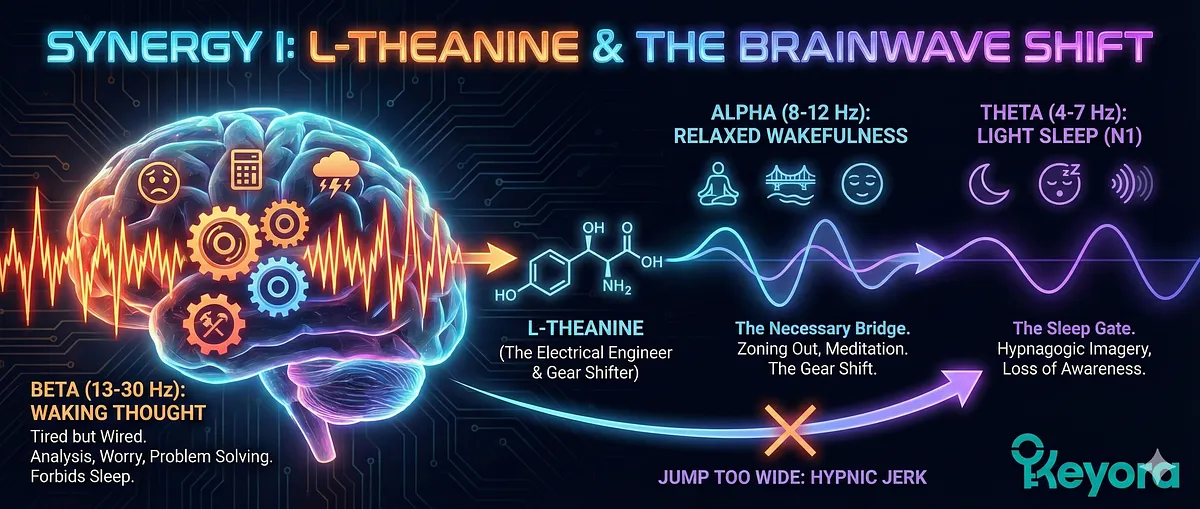
The Role: The Gear Shifter
Sleep onset requires a precise deceleration of cortical firing rates.
-
Beta (13-30 Hz):
The state of active problem solving, worry, and analysis. This is where the insomniac lives.
-
Alpha (8-12 Hz):
The state of relaxed wakefulness, meditation, and “zoning out.” This is the necessary bridge.
-
Theta (4-7 Hz):
The state of light sleep (Stage N1), hypnagogic imagery, and the loss of sensory awareness.
You cannot jump from Beta to Theta. The gap is too wide. Attempting to force this jump results in the “jerk awake” sensation (Hypnic Jerk) or extreme psychological resistance. You must shift gears through Alpha.
The Mechanism: The Alpha-Wave Bridge
L-Theanine is a unique amino acid that acts as a Frequency Modulator. Upon crossing the blood-brain barrier, Theanine acts on the Glutamate and GABA receptors to alter the oscillatory patterns of neuronal firing.
-
Inducing Alpha:
Clinical EEG studies demonstrate that L-Theanine significantly increases power in the Alpha Band (8-12 Hz) within 30 to 45 minutes of ingestion.
-
The Bridge Effect:
By inducing Alpha waves, Theanine physically shifts the brain out of the “Worry Loop” (Beta) and into the “Flow State” (Alpha).
-
The Outcome:
The subject stops thinking about the sleep; they begin to experience the relaxation. The racing thoughts lose their momentum. The internal narrator becomes quieter. The brain is now electrically primed to slide down into Theta (Sleep).
The Keyora Logic
Ashwagandha handles the Chemical environment (Cortisol). L-Theanine handles the Electrical environment (Brainwaves).
Together, they ensure that the brain is not just chemically ready for sleep, but electrically compatible with it.
![L-Theanine acts as a Frequency Modulator, crossing the blood-brain barrier to increase power in the Alpha Wave band (8-12 Hz) within 30-45 minutes. This Alpha-Wave Bridge shifts the brain from the Beta "Worry Loop" to the "Flow State," making the brain electrically compatible with sleep. The Keyora Logic: Ashwagandha (Chemical) and L-Theanine (Electrical) work together to create a brain chemically ready and electrically primed for sleep. [Image illustrating L-Theanine's effect on an EEG, showing a clear increase in Alpha Wave power and a decrease in Beta Wave power]](https://www.keyorahealth.com/cdnfiles/2026/03/25072036/789afba1-8592-471c-94aa-acc30ebe03d9_3168x1344.webp "L-Theanine acts as a Frequency Modulator, crossing the blood-brain barrier to increase power in the Alpha Wave band (8-12 Hz) within 30-45 minutes. This Alpha-Wave Bridge shifts the brain from the Beta \"Worry Loop\" to the \"Flow State,\" making the brain electrically compatible with sleep. The Keyora Logic: Ashwagandha (Chemical) and L-Theanine (Electrical) work together to create a brain chemically ready and electrically primed for sleep. [Image illustrating L-Theanine's effect on an EEG, showing a clear increase in Alpha Wave power and a decrease in Beta Wave power]")
Synergy II: Magnesium Glycinate & The Thermal Switch
We have addressed the Hormonal Gate (Ashwagandha) and the Electrical Gear (Theanine). Now we must address the Physical Physics of sleep onset. The body is a heat engine. To sleep, the engine must cool down.
The Role: The Thermoregulator
One of the most immutable laws of human biology is the relationship between Core Body Temperature (CBT) and Sleep Onset.
-
The Rule:
For the sleep switch to flip, Core Body Temperature must drop by approximately 1°C (1.8°F).
-
The Mechanism:
This drop in core temperature acts as a metabolic signal to the hypothalamus to initiate the sleep cascade. If the core remains hot, sleep onset is delayed or impossible.
The Mechanism: Vasodilation & The “Distal-to-Proximal” Gradient
How does the body cool its core? It pumps hot blood away from the center (organs) to the periphery (skin, hands, and feet), where the heat can radiate out into the room.
This process is called Peripheral Vasodilation. This is why warm hands and feet are a predictor of rapid sleep onset. It means the heat is leaving the body.
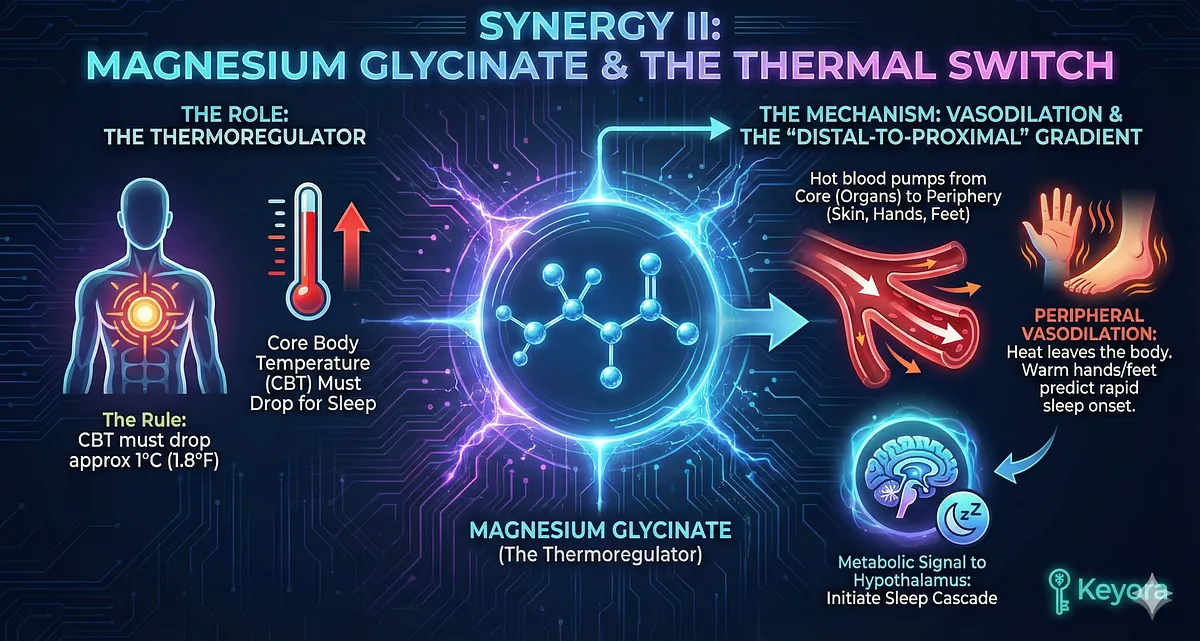
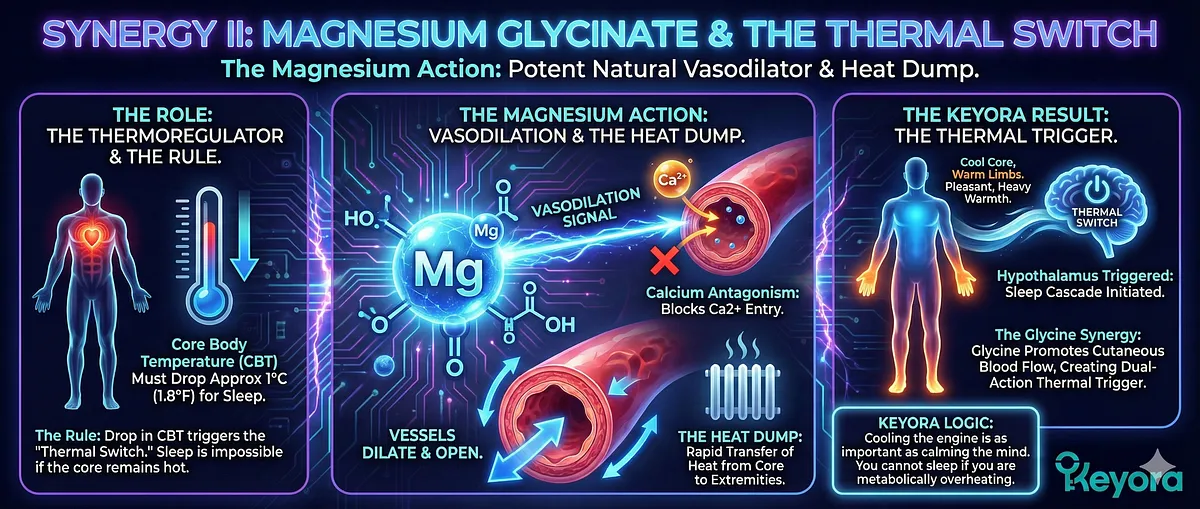
The Magnesium Action: Magnesium is a potent natural Vasodilator.
-
Calcium Antagonism:
Magnesium blocks calcium from entering the smooth muscle cells lining the blood vessels. This forces the vessels to relax and open up (dilate).
-
The Heat Dump:
By dilating the peripheral blood vessels, Magnesium Glycinate facilitates the rapid transfer of heat from the core to the extremities. It essentially opens the radiator vents.
-
The Keyora Result:
The Core Body Temperature drops. The “Thermal Switch” is triggered. The subject feels a pleasant, heavy warmth in their limbs (the heat leaving) and a cooling sensation in their core.
The Glycine Synergy:
We utilize Magnesium Glycinate specifically because the amino acid Glycine has also been shown to lower core body temperature by promoting cutaneous blood flow. This creates a dual-action thermal trigger.
Keyora Logic:
“Cooling the engine” is as important as calming the mind. You cannot sleep if you are metabolically overheating.
Synergy III: 5-HTP & The Melatonin Signal
We have opened the gate (Cortisol), shifted the gears (Alpha), and cooled the engine (Temperature). The stage is set. The runway is clear. Now, we need the actual signal that tells the brain: “It is Night.”
That signal is Melatonin. But instead of giving synthetic melatonin (which causes down-regulation and dependency), Keyora provides the fuel to make it naturally.
The Role: The Signal Generator
The Biosynthetic Pathway:
Melatonin is not a standalone chemical. It is the end-product of a specific biosynthetic pathway: Tryptophan -> 5-HTP -> Serotonin -> N-Acetylserotonin -> Melatonin.
In the Pinealocytes (the cells of the pineal gland), this conversion factory runs every night. However, it is Rate-Limited by the availability of substrates.
-
The Bottleneck:
The conversion of Tryptophan to 5-HTP is the slowest step (Rate-Limiting Step), governed by the enzyme Tryptophan Hydroxylase. This enzyme is easily inhibited by stress and inflammation.
-
The Bypass:
By supplying 5-HTP (5-Hydroxytryptophan) directly, the Keyora Matrix bypasses this bottleneck. We inject the fuel entering the assembly line after the hardest step.
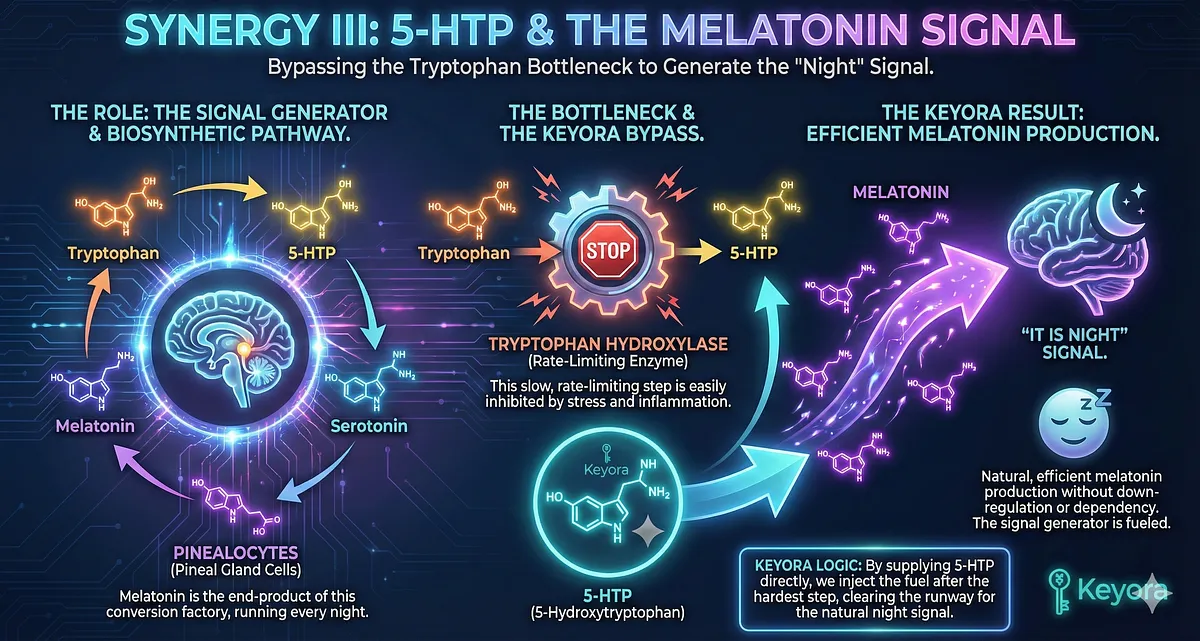
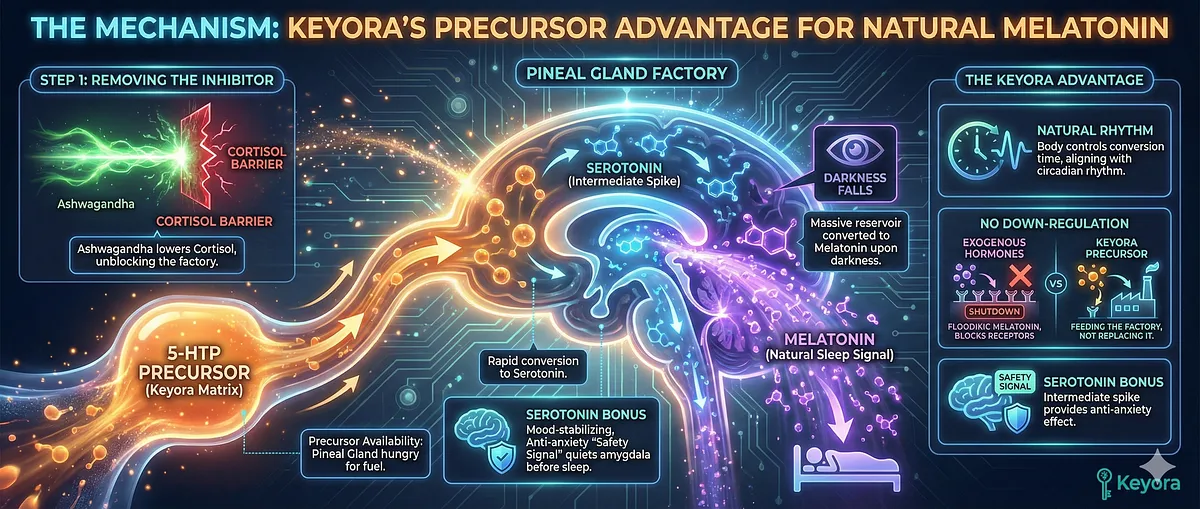
The Mechanism:
Precursor Availability Once the Ashwagandha has lowered the Cortisol (removing the inhibitor), the Pineal Gland is hungry for fuel.
The 5-HTP in the Matrix is rapidly converted into Serotonin. As darkness falls (or as the eyes close), the Pineal Gland converts this massive reservoir of Serotonin into Melatonin.
The Keyora Advantage:
By providing the precursor rather than the hormone:
-
Natural Rhythm:
The body controls when to make the conversion, aligning with the subject’s own circadian rhythm.
-
No Down-Regulation:
We are not flooding the receptors with exogenous hormones, so the body does not shut down its own production. We are feeding the factory, not replacing it.
-
The Serotonin Bonus:
The intermediate spike in Serotonin provides a mood-stabilizing, anti-anxiety effect (”The Safety Signal”) right before sleep, further quieting the amygdala.
Synergy IV: The Vitamin Cofactor Matrix (B6, B12, D)
We have the Signal (Ashwagandha), the Bridge (Theanine), the Trigger (Magnesium), and the Fuel (5-HTP). But a factory needs more than fuel; it needs Tools (Enzymes) and Sparks (Cofactors).
This is where the Keyora Vitamin Complex becomes the non-negotiable “Ignition System” of the sleep protocol.
The Role: The Ignition & Timing Belt
Without these specific vitamins, the chemical reactions described above literally cannot happen. They are the Rate-Limiting Cofactors.
Mechanism 1:
Vitamin B6 (P-5-P) – The Catalyst Vitamin B6 (specifically in its active form, Pyridoxal-5’-Phosphate) is the single most critical nutrient for sleep chemistry.
-
The Enzyme:
It is the obligate cofactor for the enzyme Aromatic L-amino acid decarboxylase (AADC).
-
The Reaction:
AADC is the enzyme responsible for converting 5-HTP into Serotonin.
-
The Failure:
If a patient takes 5-HTP but is deficient in B6 (common in high stress), the 5-HTP sits inert. It cannot be converted. The factory stalls.
-
The Keyora Logic:
By including high-potency P-5-P, we ensure that the “Fuel” (5-HTP) is actually ignited. B6 is the spark plug.
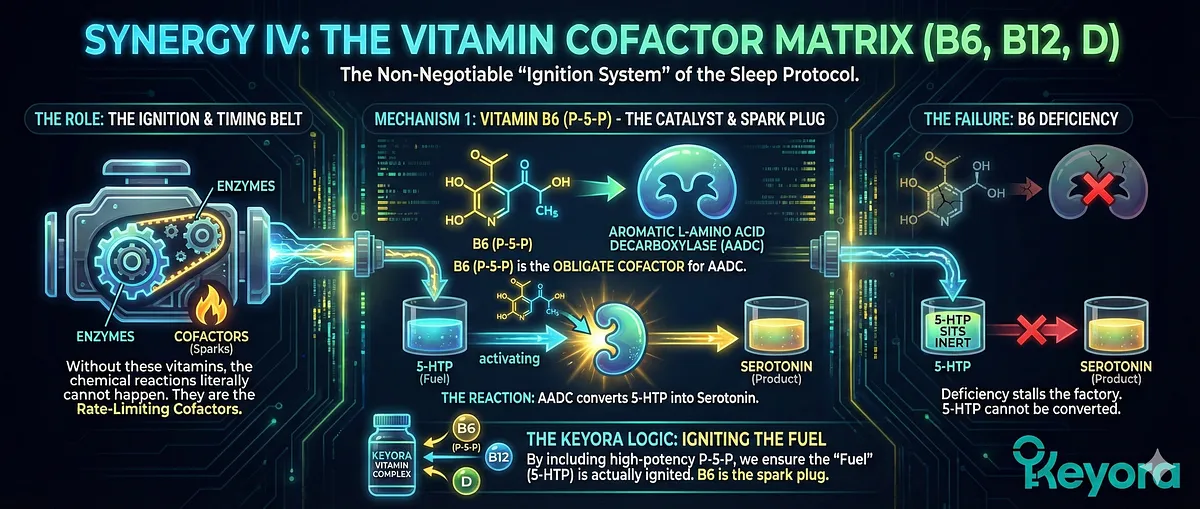
The Vitamin Cofactor Matrix, featuring active Vitamin B6 (P-5-P), acts as the “Ignition System” to ensure the essential conversion of 5-HTP into Serotonin for successful sleep signaling.
Mechanism 2:
Vitamin B12 (Methylcobalamin) – The Entrainer Vitamin B12 plays a crucial role in the Circadian Entrainment of the Suprachiasmatic Nucleus (SCN) – the master clock.
-
The Action:
B12 increases the light-sensitivity of the SCN. It helps the brain accurately detect the onset of darkness.
-
The Result:
It solidifies the “Sleep Window.” It ensures that the Melatonin release happens at the right time, reducing Sleep Onset Latency. It anchors the rhythm.
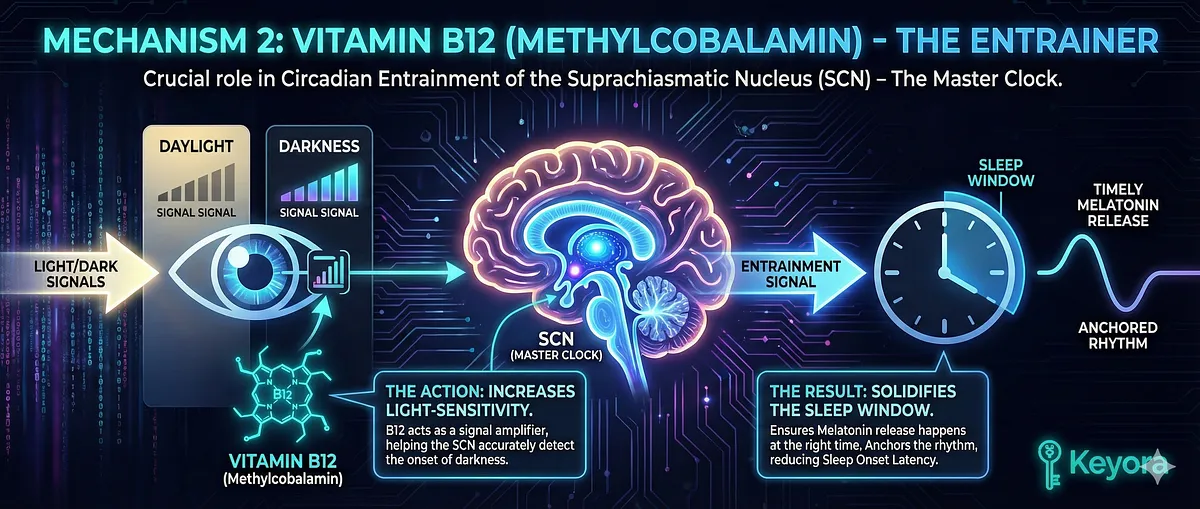
B12 and D3 work together as essential cofactors: B12 anchors the circadian rhythm for timely melatonin release, while D3 regulates the genes necessary for producing sleep neurotransmitters.
Mechanism 3:
Vitamin D3 – The Gene Switch Vitamin D is not just a vitamin; it is a steroid hormone that regulates gene expression.
-
The Target:
Vitamin D regulates the expression of Tryptophan Hydroxylase 2 (TPH2), the gene that controls serotonin synthesis in the brain.
-
The Action:
Adequate Vitamin D levels ensure that the genetic machinery for sleep neurotransmitters is turned “On.” It maintains the basal capacity of the brain to produce sleep hormones.
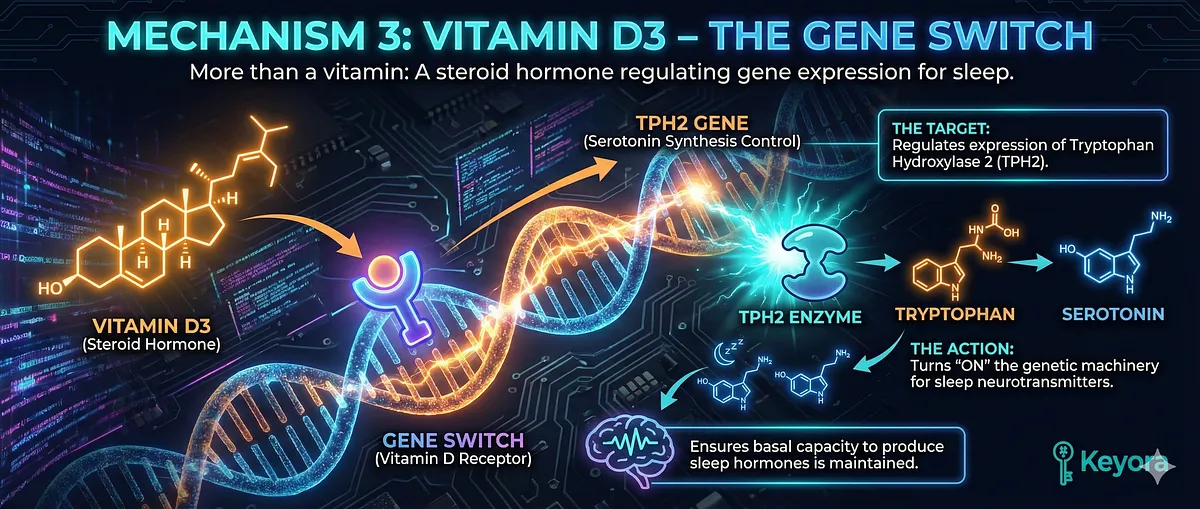
Vitamin D3 acts as a steroid hormone to regulate the TPH2 gene, ensuring the genetic machinery for synthesizing serotonin and other sleep neurotransmitters is turned “On.”
The Synthesis:
These vitamins are not “add-ons.” They are the machinery.
-
Ashwagandha opens the door.
-
Theanine slows the car.
-
Magnesium cools the engine.
-
5-HTP fills the tank.
-
Vitamins B6, B12, and D turn the key.
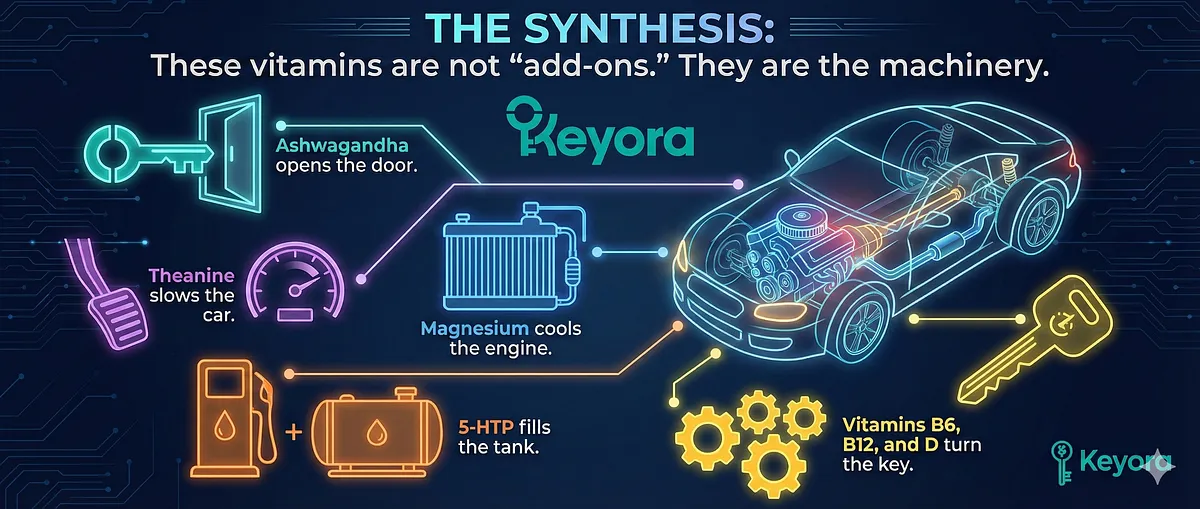
The Keyora formula synthesizes five key actions: Ashwagandha (door), Theanine (car speed), Magnesium (engine cooling), 5-HTP (fuel), and Vitamins B6/B12/D (ignition) to comprehensively initiate sleep.
Section Conclusion: The Successful Shutdown
We have mapped the complete Keyora Shutdown Cascade for Sleep Onset Insomnia.
We have moved beyond the simplistic notion of “taking a sleeping pill.”
We have engineered a multi-stage physiological handover that respects the complexity of the human brain.
-
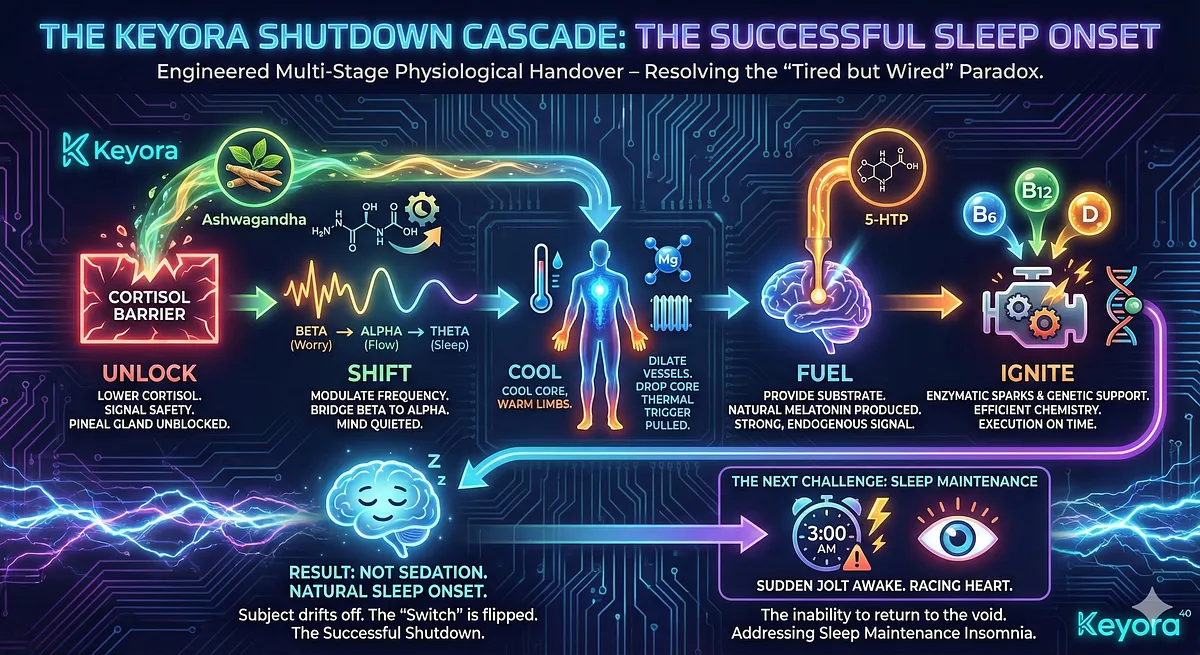
Unlock (Ashwagandha):
We lower the Cortisol barrier, signaling to the Pineal Gland that the day is over and the danger has passed.
-
Shift (L-Theanine):
We modulate the electrical frequency from Beta to Alpha, bridging the gap between the racing mind and the sleeping void.
-
Cool (Magnesium):
We dilate the blood vessels to drop the core body temperature, pulling the thermal trigger for sleep.
-
Fuel (5-HTP):
We provide the raw substrate for natural Melatonin production, ensuring the signal is strong and endogenous.
-
Ignite (Vitamins B6/B12/D):
We provide the enzymatic sparks and genetic support to ensure the chemistry executes efficiently and on time.
The result is not sedation. It is Sleep Onset. The subject drifts off naturally. The “Tired but Wired” paradox is resolved. The “Switch” is flipped.
But falling asleep is only half the battle. For many high-functioning professionals, the terror is not the beginning of the night, but the middle.
The sudden jolt awake at 3:00 AM.
The racing heart.
The inability to return to the void.
We must now address Sleep Maintenance Insomnia.
Next:
We transition to Sleep Maintenance (Staying Asleep) & The Glymphatic Flush.
We will explore why the brain wakes up, and how Keyora keeps it in the “Maintenance Mode” long enough to clean the toxins.
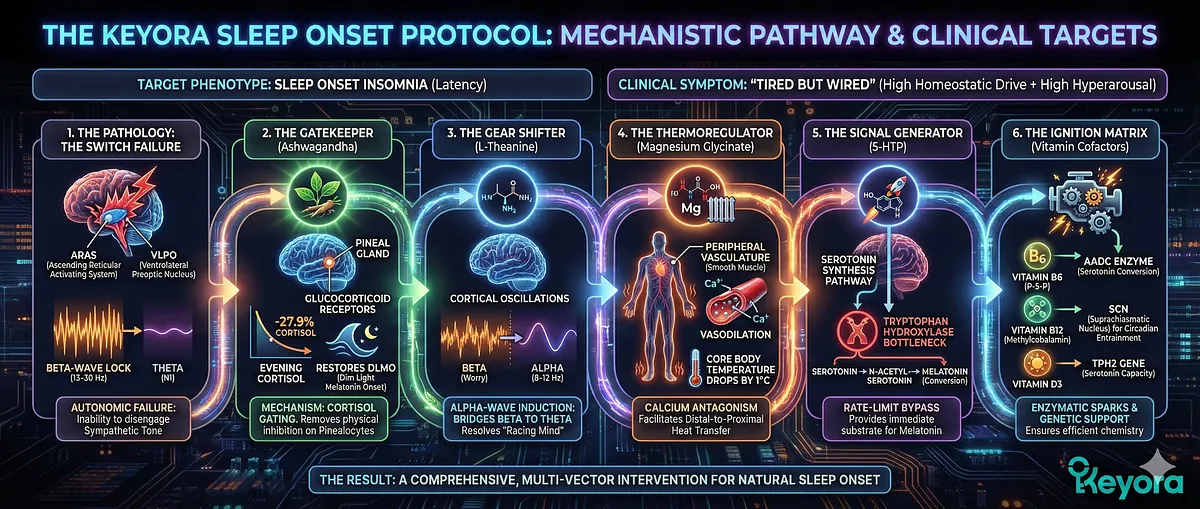
– Target Phenotype: **Sleep Onset Insomnia** (Latency).
– Clinical Symptom: “Tired but Wired” (High Homeostatic Drive + High Hyperarousal).
– **1. The Pathology: The Switch Failure**:
– **Neural Conflict**: **Ascending Reticular Activating System (ARAS)** overrides **Ventrolateral Preoptic Nucleus (VLPO)**.
– **EEG Signature**: **Beta-Wave Lock** (13-30 Hz persistence) prevents transition to Theta (N1).
– **Autonomic Failure**: Inability to disengage Sympathetic Tone.
– **2. The Gatekeeper (Ashwagandha)**:
– **Target**: **Glucocorticoid Receptors** (Pineal Gland).
– **Mechanism**: **Cortisol Gating**. Lowers evening cortisol (-27.9%) to remove the physical inhibition on Pinealocytes.
– **Outcome**: Restores **Dim Light Melatonin Onset (DLMO)**; creates “Permissive Environment” for sleep.
– **3. The Gear Shifter (L-Theanine)**:
– **Target**: **Cortical Oscillations**.
– **Mechanism**: **Alpha-Wave Induction**. Increases power in the **8-12 Hz** band.
– **Outcome**: Bridges the gap between Beta (Worry) and Theta (Sleep); resolves “Racing Mind”.
– **4. The Thermoregulator (Magnesium Glycinate)**:
– **Target**: **Peripheral Vasculature** (Smooth Muscle).
– **Mechanism**: **Calcium Antagonism** causing Vasodilation.
– **Physiology**: Facilitates **Distal-to-Proximal Heat Transfer**.
– **Outcome**: Drops **Core Body Temperature** by critical **1°C** threshold to trigger sleep switch.
– **5. The Signal Generator (5-HTP)**:
– **Target**: **Serotonin Synthesis Pathway**.
– **Mechanism**: **Rate-Limit Bypass**. Bypasses *Tryptophan Hydroxylase* bottleneck.
– **Outcome**: Provides immediate substrate for **Serotonin -> N-Acetylserotonin -> Melatonin** conversion.
– **6. The Ignition Matrix (Vitamin Cofactors)**:
– **Vitamin B6 (P-5-P)**: Obligate cofactor for **AADC Enzyme** (Aromatic L-amino acid decarboxylase) to convert 5-HTP to Serotonin.
– **Vitamin B12 (Methylcobalamin)**: Increases light sensitivity of the **Suprachiasmatic Nucleus (SCN)** for Circadian Entrainment.
– **Vitamin D3**: Regulates expression of the **TPH2 Gene** (Tryptophan Hydroxylase 2) to maintain serotonin capacity.
Phenotype II: Sleep Maintenance Insomnia, Fragmentation & The “3 AM Cortisol Spike”
The Sustained-Rest Protocol: Targeting Nocturnal Arousal via Ashwagandha’s Glycemic Stabilization and the Keyora Serotonin-GABA Reservoir.
The Pathology: The “Nocturnal Alarm” and the Biology of the 3 AM Wake-Up
The Visceral Phenomenology of “Wake After Sleep Onset” (WASO)
If Sleep Onset Insomnia is a frustrating inability to initiate a shutdown, Sleep Maintenance Insomnia is a violent, terrifying failure of the system’s stability. It is the specific curse of the high-functioning, high-cortisol professional.
The clinical presentation is stereotypical and maddeningly consistent.
The subject collapses into bed at 11:00 PM, exhausted.
They fall asleep relatively quickly, perhaps aided by sheer fatigue. But then, at 3:00 AM – almost to the minute – the eyes snap open.
This is not a gentle waking. It is not the slow, groggy emergence from a dream. It is an “Instant-On” event.
-
The Cardiac Surge: The heart is often racing (Tachycardia).
-
The Thermal Spike: The body feels hot, sometimes accompanied by night sweats.
-
The Cognitive Flood: The mind is instantly flooded with anxiety, problem-solving, and catastrophic thinking. The worries of the previous day and the anticipated stresses of the next collide in the silence of the night.
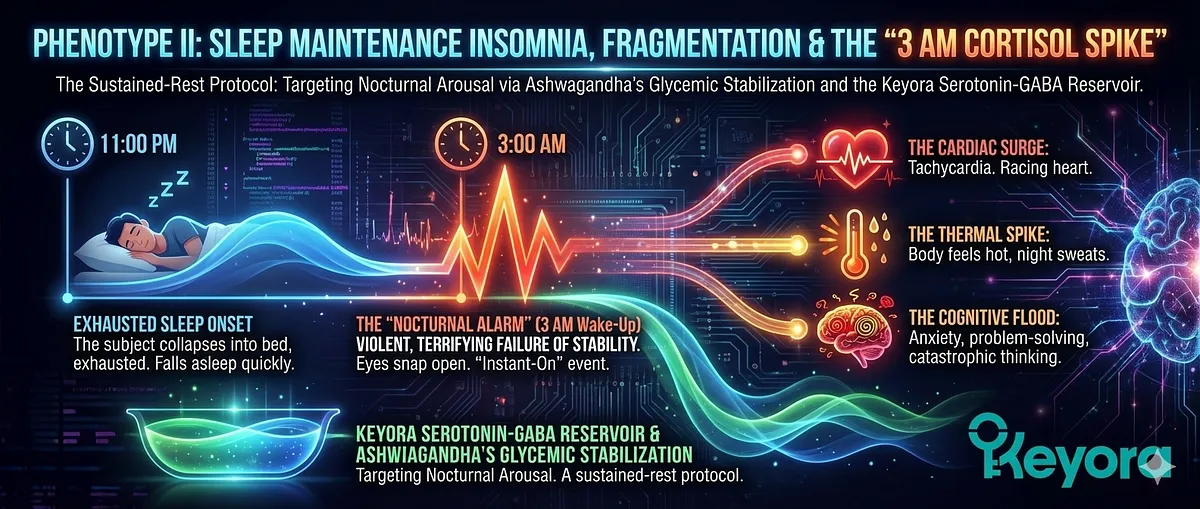
This is clinical Wake After Sleep Onset (WASO). The tragedy of this phenotype is that the subject is not “rested.”
They are physically shattered, yet biologically incapable of returning to sleep.
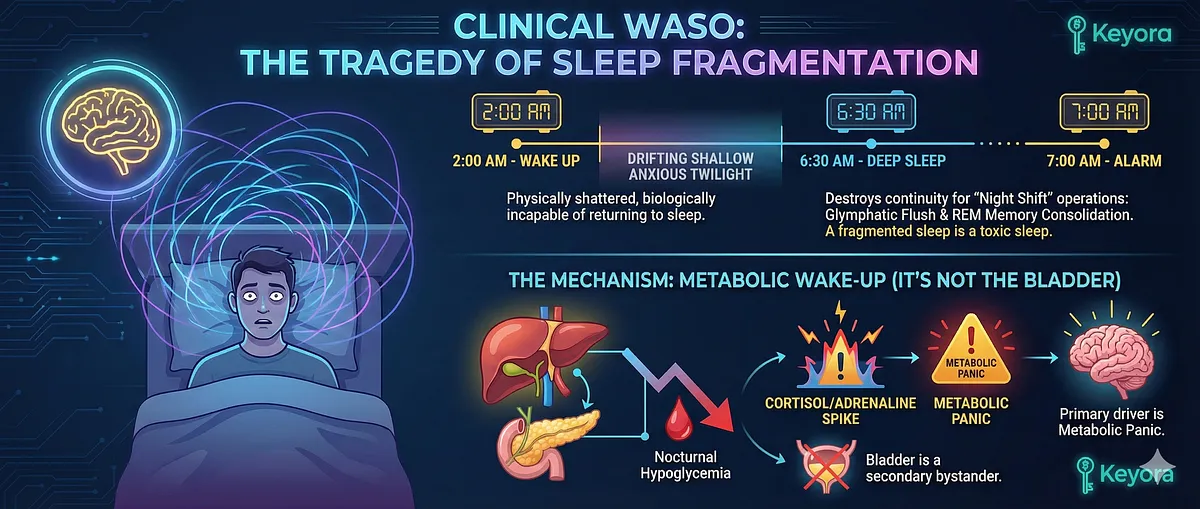
They lie there for two hours, drifting in and out of a shallow, anxious twilight, only to finally fall back into a deep sleep at 6:30 AM – thirty minutes before the alarm goes off.
This is Sleep Fragmentation.
It destroys the continuity required for the brain’s critical “Night Shift” operations: the Glymphatic Flush of neurotoxins and the consolidation of complex memory in REM sleep. A fragmented sleep is a toxic sleep.
The Mechanism: The Metabolic Wake-Up (It’s Not the Bladder)
The most common misconception is that this awakening is caused by a full bladder (Nocturia). While this may play a role, for the high-stress phenotype, the bladder is often a secondary bystander. The primary driver is Metabolic Panic. Specifically, it is Nocturnal Hypoglycemia triggering a compensatory Cortisol/Adrenaline Spike.
The Biology of the “Fuel Crisis”
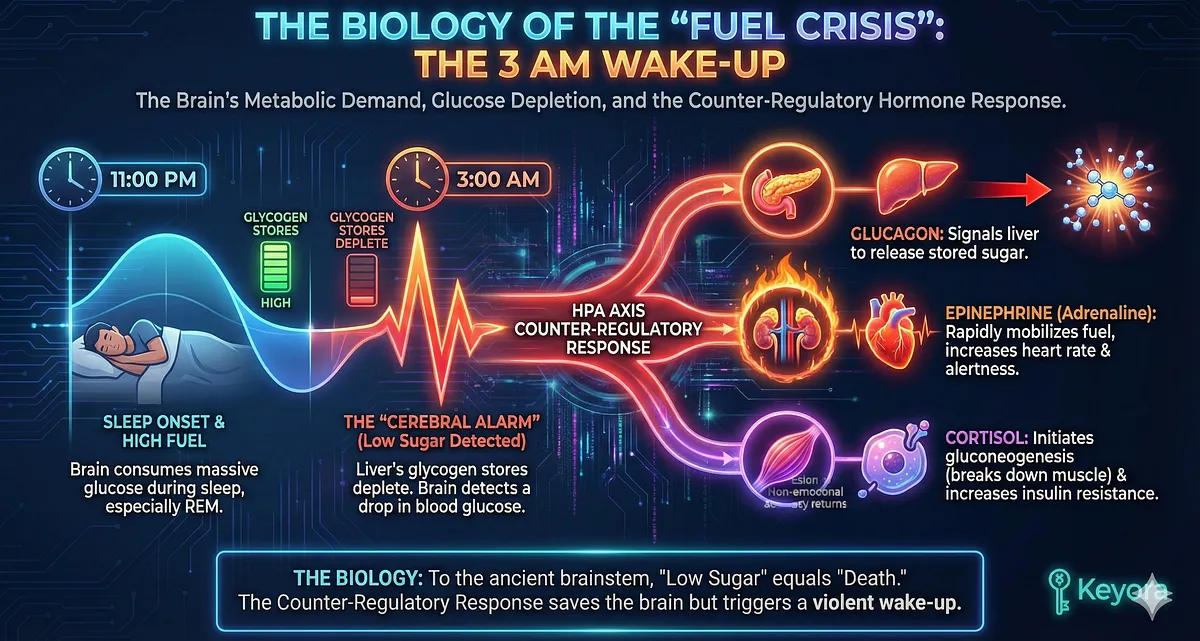
The brain is a voracious metabolic organ. Even during sleep, it consumes massive amounts of glucose, particularly during REM (Rapid Eye Movement) sleep, which becomes more dominant in the second half of the night.
-
The Glucose Dip: Around 3:00 AM, the liver’s glycogen stores (the short-term sugar reserve) begin to deplete, especially in individuals with high daytime stress (which burns glycogen) or those on restrictive diets.
-
The Cerebral Alarm: The brain detects a drop in blood glucose. To the ancient brainstem, “Low Sugar” equals “Death.” It perceives a starvation crisis.
-
The Counter-Regulatory Response: To save itself, the brain triggers the HPA Axis to release “Counter-Regulatory Hormones.”
-
Glucagon: Signals the liver to release sugar.
-
Epinephrine (Adrenaline): Rapidly mobilizes fuel but also increases heart rate and alertness.
-
Cortisol: Initiates gluconeogenesis (breaking down muscle for fuel) and increases insulin resistance to keep sugar in the blood.
The Clinical Result:
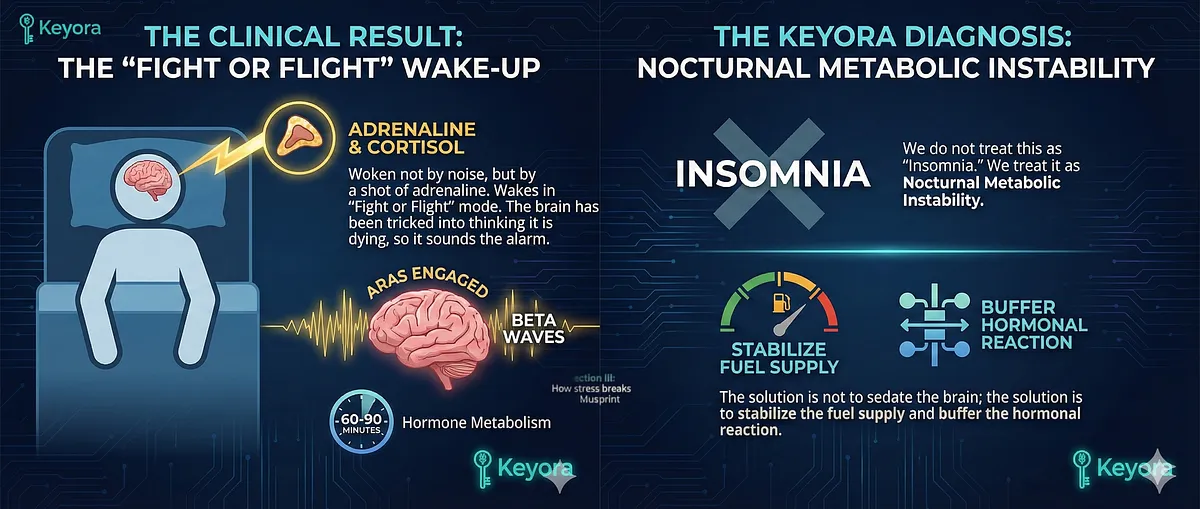
The subject is woken up not by a noise, but by a shot of adrenaline and cortisol administered by their own adrenal glands. They wake up in “Fight or Flight” mode. The brain has been tricked into thinking it is dying, so it sounds the alarm.
Once the Adrenaline is released, the Ascending Reticular Activating System (ARAS) is fully engaged. The cortex lights up with Beta waves. Returning to sleep becomes biologically impossible until these stress hormones are metabolized, which can take 60 to 90 minutes.
The Keyora Diagnosis:
We do not treat this as “Insomnia.”
We treat it as Nocturnal Metabolic Instability.
The solution is not to sedate the brain (which masks the alarm); the solution is to stabilize the fuel supply and buffer the hormonal reaction.
The Stabilizer: Ashwagandha’s Glycemic & HPA Control
The primary strategic objective in treating Sleep Maintenance Insomnia is to prevent the HPA Axis from pulling the fire alarm in the middle of the night. We must ensure that even if blood sugar dips, the adrenal response is measured, not catastrophic.
The Role: The Cortisol Buffer and Metabolic Stabilizer
Ashwagandha acts as the “Metabolic Stabilizer” in the Keyora protocol.
While its role in Sleep Onset was to lower evening cortisol to allow Melatonin release, its role here is to maintain HPA dormancy throughout the metabolic challenges of the night.
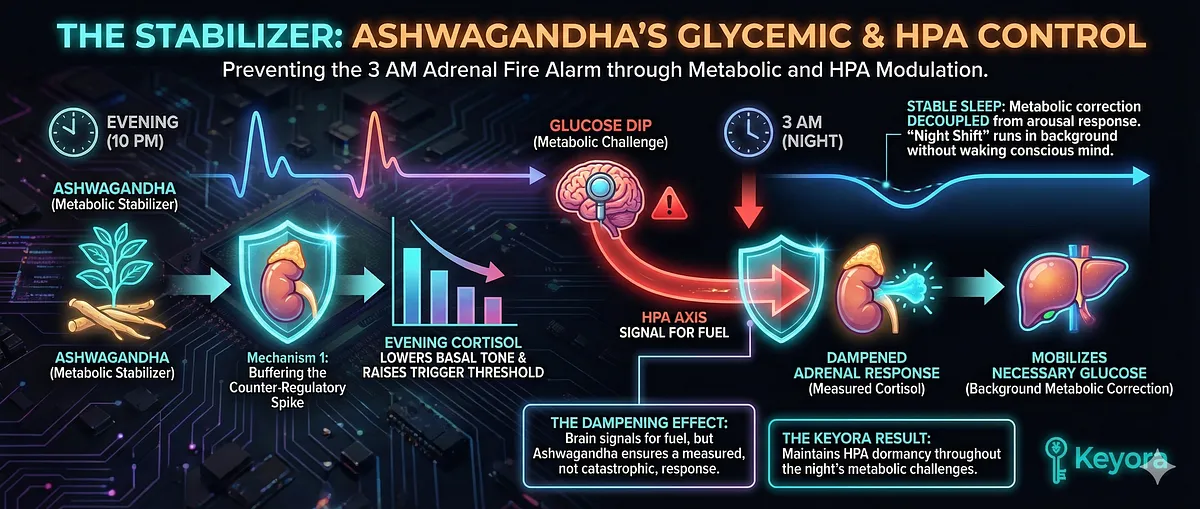
Mechanism 1: Buffering the Counter-Regulatory Spike
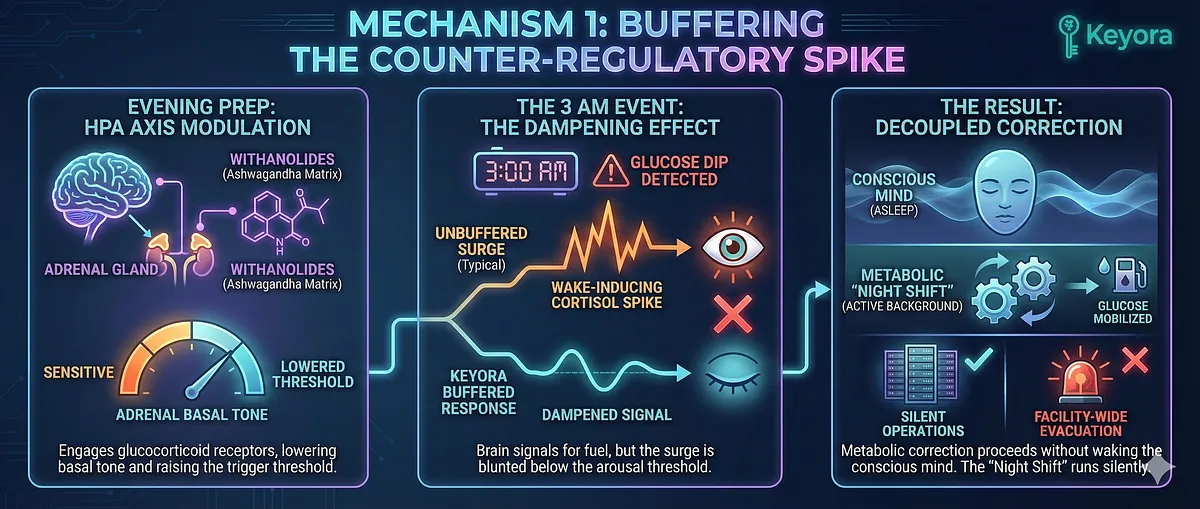
The Withanolides in the Keyora Matrix possess a unique modulatory effect on the HPA Axis feedback loop.
By engaging the glucocorticoid receptors in the evening, Ashwagandha lowers the “Basal Tone” of the adrenal glands. It raises the threshold required to trigger a panic release.
-
The Dampening Effect:
When the brain detects the 3 AM glucose dip, it still signals for fuel, but Ashwagandha ensures that the signal does not result in a massive, wake-inducing surge of Cortisol.
-
The Result:
The body mobilizes the necessary glucose to keep the brain alive without waking the conscious mind. It decouples the metabolic correction from the arousal response. It keeps the “Night Shift” running in the background without triggering a facility-wide evacuation.
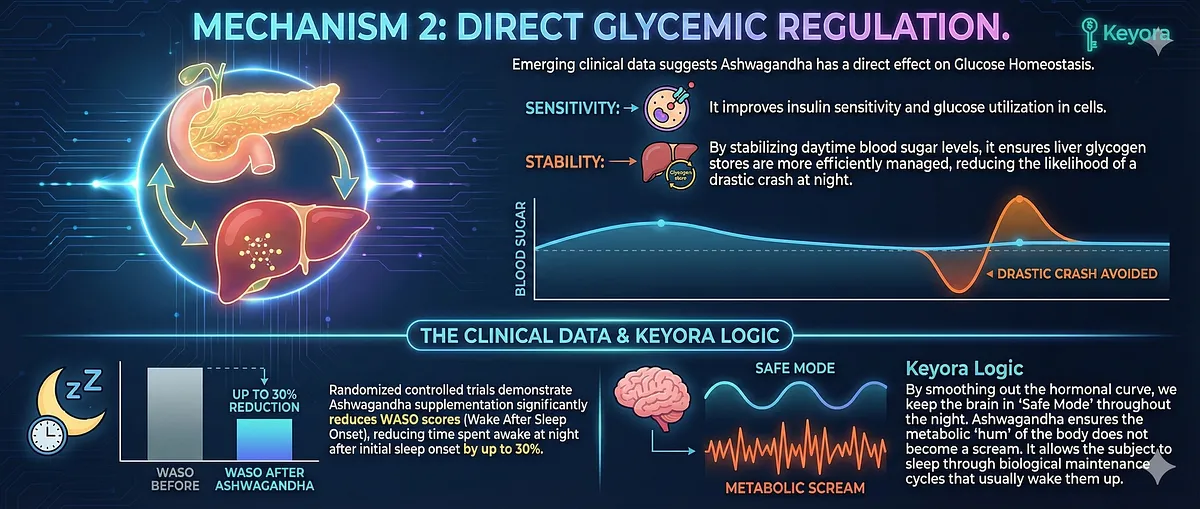
Mechanism 2: Direct Glycemic Regulation
Emerging clinical data suggests that Ashwagandha also has a direct effect on Glucose Homeostasis.
-
Sensitivity:
It improves insulin sensitivity and glucose utilization in cells.
-
Stability:
By stabilizing daytime blood sugar levels, it ensures that liver glycogen stores are more efficiently managed, reducing the likelihood of a drastic crash at night.
-
The Clinical Data:
Randomized controlled trials have demonstrated that Ashwagandha supplementation significantly reduces WASO scores (Wake After Sleep Onset), reducing the time spent awake at night after initial sleep onset by up to 30%.
Keyora Logic:
By smoothing out the hormonal curve, we keep the brain in “Safe Mode” throughout the night. Ashwagandha ensures that the metabolic “hum” of the body does not become a scream. It allows the subject to sleep through the biological maintenance cycles that usually wake them up.
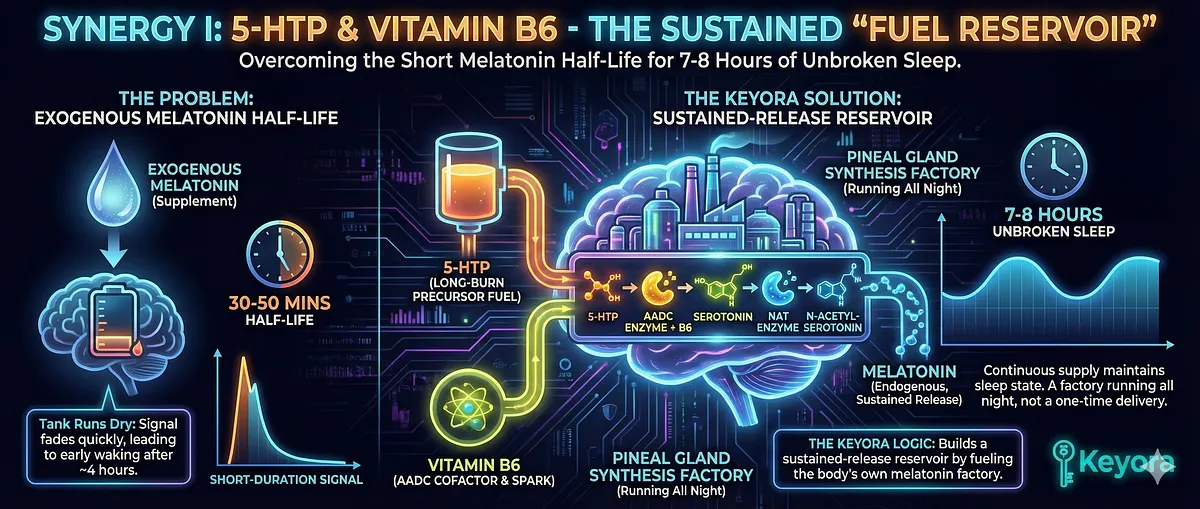
Synergy I: 5-HTP & Vitamin B6 – The “Fuel Reservoir”
Even if we stabilize the Cortisol/Adrenaline spike, we face a second challenge: The Melatonin Half-Life. Melatonin is the hormone that maintains the sleep state.
However, exogenous melatonin (supplements) has an incredibly short half-life – approximately 30 to 50 minutes in the bloodstream.
This is why many people take melatonin, fall asleep, and then wake up 4 hours later. The tank has run dry. The signal has faded.
The Role: The Long-Burn Fuel Reservoir
To achieve 7-8 hours of unbroken sleep, the brain needs a continuous supply of Melatonin. It needs a factory that runs all night, not a one-time delivery.
The Keyora MoodFlow Matrix utilizes 5-HTP and Vitamin B6 to build this “Sustained-Release Reservoir.”
The Biosynthetic Reality:
Melatonin is synthesized in the Pineal Gland via this pathway: Tryptophan -> (Tryptophan Hydroxylase) -> 5-HTP -> (AADC Enzyme + B6) -> Serotonin -> (NAT Enzyme) -> N-Acetylserotonin -> Melatonin.
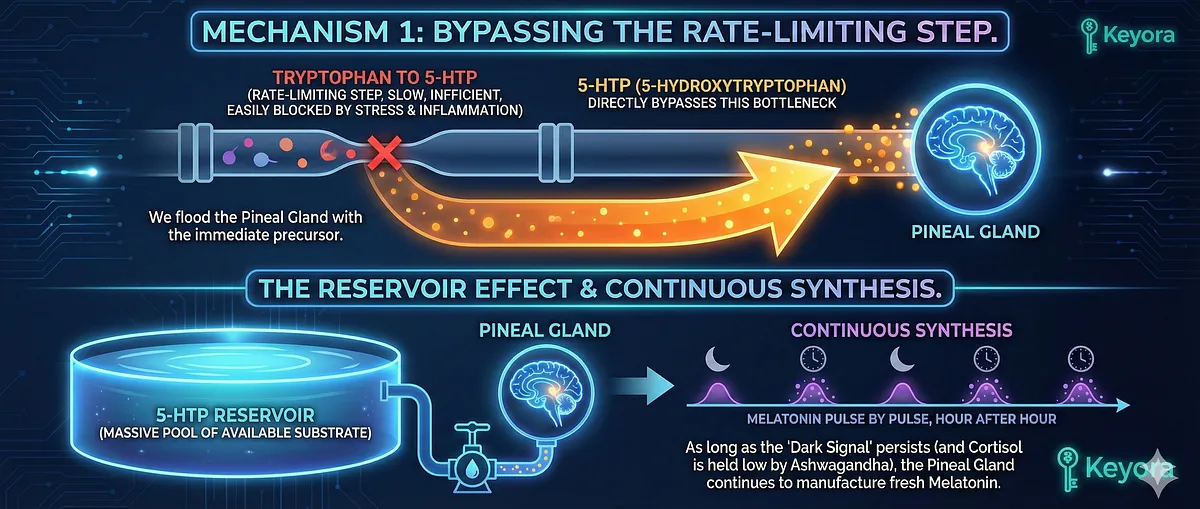
Mechanism 1: Bypassing the Rate-Limiting Step
The conversion of Tryptophan to 5-HTP is the Rate-Limiting Step. It is slow, inefficient, and easily blocked by stress and inflammation.
By providing 5-HTP (5-Hydroxytryptophan) directly, Keyora bypasses this bottleneck. We flood the Pineal Gland with the immediate precursor.
-
The Reservoir Effect:
This creates a massive pool of available substrate. The Pineal Gland does not convert it all at once. Instead, it draws from this pool continuously throughout the dark phase.
-
Continuous Synthesis:
As long as the “Dark Signal” persists (and Cortisol is held low by Ashwagandha), the Pineal Gland continues to manufacture fresh Melatonin, pulse by pulse, hour after hour.
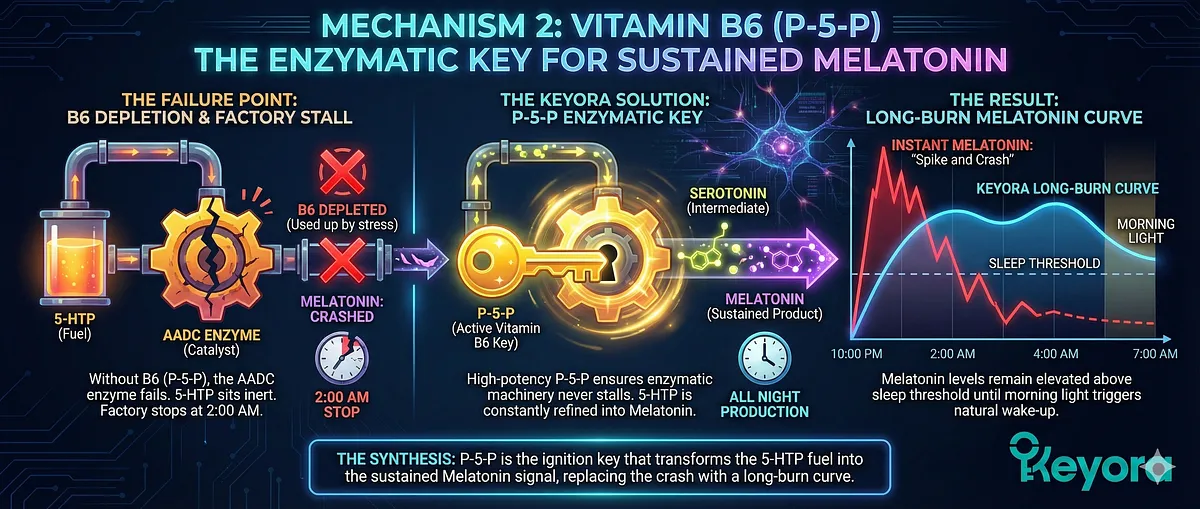
Mechanism 2: Vitamin B6 (P-5-P) as the Enzymatic Key
The conversion of 5-HTP to Serotonin (the immediate parent of Melatonin) is catalyzed by the enzyme Aromatic L-amino acid decarboxylase (AADC).
This enzyme has an absolute requirement for Pyridoxal-5’-Phosphate (P-5-P), the active form of Vitamin B6.
-
The Failure Point:
In high-stress individuals, B6 is depleted (used up for neurotransmitter synthesis during the day). Without B6, the AADC enzyme fails. The 5-HTP sits inert. The factory stops at 2:00 AM.
-
The Keyora Solution:
The Matrix includes a high-potency dose of P-5-P. This ensures that the enzymatic machinery never stalls. It guarantees that the “Fuel” (5-HTP) is constantly being refined into “Product” (Melatonin).
The Result:
We replace the “Spike and Crash” of instant melatonin with a “Long-Burn Curve.” The Melatonin levels remain elevated above the sleep threshold until morning light triggers the natural wake-up signal.
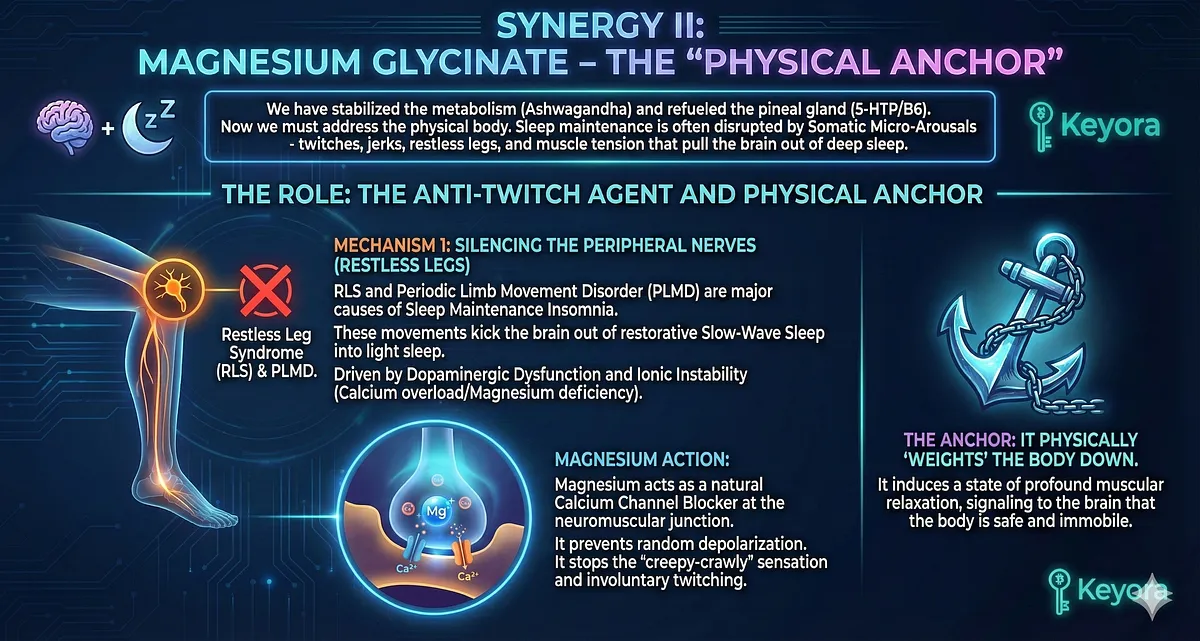
Synergy II: Magnesium Glycinate – The “Physical Anchor”
We have stabilized the metabolism (Ashwagandha) and refueled the pineal gland (5-HTP/B6). Now we must address the physical body.
Sleep maintenance is often disrupted by Somatic Micro-Arousals – twitches, jerks, restless legs, and muscle tension that pull the brain out of deep sleep.
The Role: The Anti-Twitch Agent and Physical Anchor
Mechanism 1: Silencing the Peripheral Nerves (Restless Legs)
Restless Leg Syndrome (RLS) and Periodic Limb Movement Disorder (PLMD) are major causes of Sleep Maintenance Insomnia.
Even if the patient doesn’t fully wake up, these movements kick the brain out of restorative Slow-Wave Sleep into light sleep.
RLS is often driven by a combination of Dopaminergic Dysfunction and Ionic Instability (Calcium overload/Magnesium deficiency) in the peripheral nerves.
-
Magnesium Action:
Magnesium acts as a natural Calcium Channel Blocker at the neuromuscular junction.
It prevents the random depolarization of nerve endings.
It stops the “creepy-crawly” sensation and the involuntary twitching. -
The Anchor:
It physically “weights” the body down.
It induces a state of profound muscular relaxation, signaling to the brain that the body is safe and immobile.
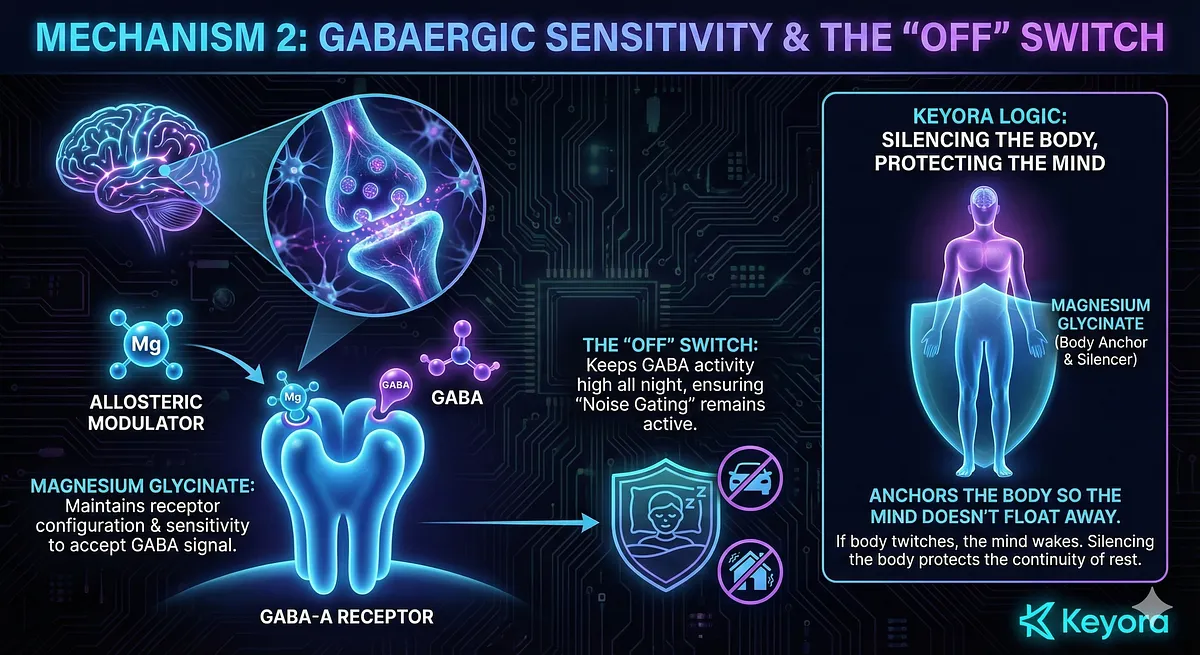
Mechanism 2: GABAergic Sensitivity
Magnesium is a potent Allosteric Modulator of the GABA-A receptor. While Ashwagandha provides the GABA-mimetic signal, Magnesium maintains the sensitivity and configuration of the receptor to accept that signal.
-
The “Off” Switch:
By keeping GABA activity high throughout the night, Magnesium ensures that the brain’s “Noise Gating” remains active. It prevents the brain from “listening” to the sound of a passing car or the creak of the house.
-
Keyora Logic:
We anchor the body so the mind doesn’t float away. If the body twitches, the mind wakes. By silencing the body with Magnesium Glycinate, we protect the continuity of the mind’s rest.
Synergy III: L-Theanine – The “Micro-Arousal” Blocker
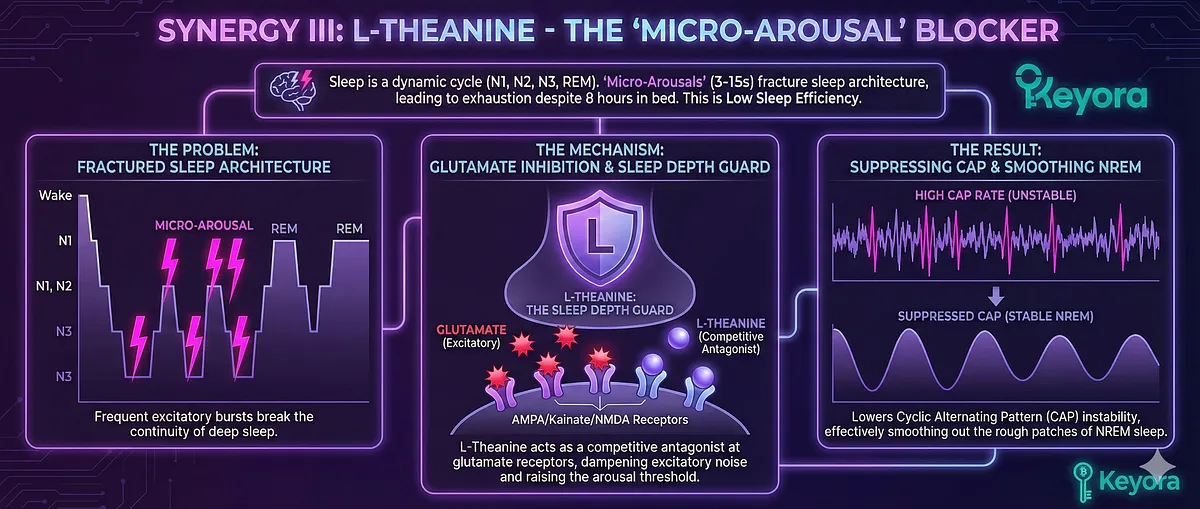
Sleep is not a flat line; it is a dynamic cycle of stages (N1, N2, N3, REM). Throughout the night, the brain experiences “Micro-Arousals” – brief moments (3-15 seconds) where the EEG speeds up towards wakefulness.
If these Micro-Arousals are too frequent or too intense, they fracture the sleep architecture. The subject wakes up feeling exhausted despite “sleeping” for 8 hours.
This is low Sleep Efficiency.
The Role: The Sleep Depth Guard
L-Theanine acts as the guardian of Sleep Depth.
Mechanism: Glutamate Inhibition and CAP Rate Reduction
Micro-arousals are often driven by bursts of excitatory Glutamate activity.
L-Theanine acts as a competitive antagonist at glutamate receptors (AMPA/Kainate/NMDA).
-
Dampening the Noise:
It lowers the “Excitatory Tone” of the cortex. It creates a higher threshold for arousal.
-
Suppressing CAP:
In sleep science, instability is measured by the Cyclic Alternating Pattern (CAP) rate. High CAP rate means unstable sleep.
Studies suggest that Theanine can lower the instability of NREM sleep, effectively smoothing out the rough patches.
Mechanism: Protecting Sleep Spindles
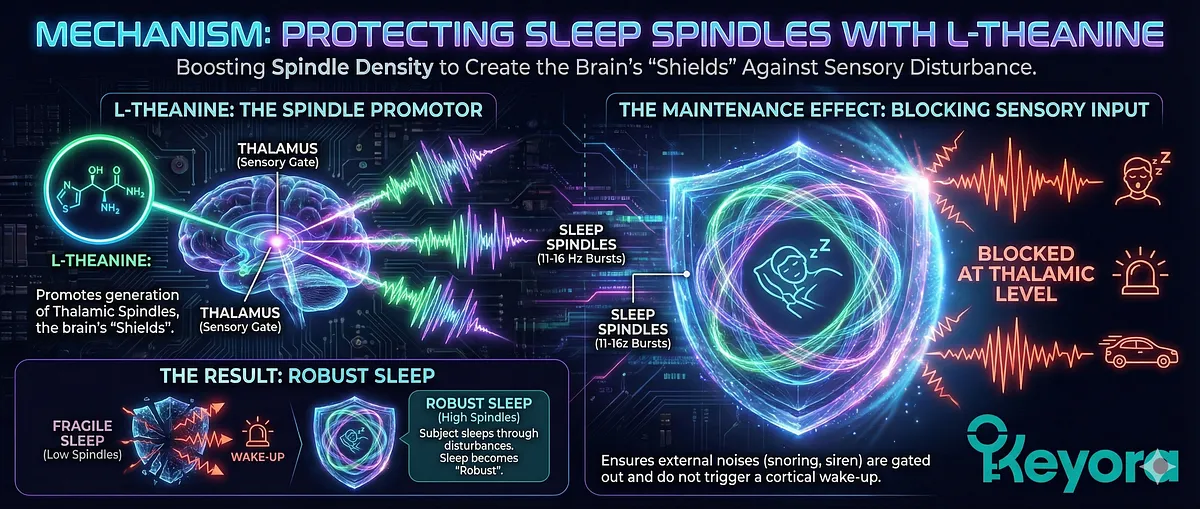
As discussed in last Section, L-Theanine promotes the generation of Sleep Spindles (11-16 Hz bursts in the Thalamus). Spindles are the brain’s “Shields.” They block sensory input from reaching the conscious cortex.
-
Maintenance Effect:
By boosting spindle density throughout the night, Theanine ensures that external noises (a snoring partner, a siren) are gated out at the thalamic level and do not trigger a cortical wake-up.
-
The Result:
The subject sleeps through disturbances. The sleep becomes “Robust” rather than “Fragile.”
Synergy IV: Vitamin B1 (Thiamine) – The “Nightmare” Preventer (CRITICAL)
This is the newest and perhaps most overlooked component of the Keyora strategy.
Why do we have nightmares?
Why do we wake up sweating from a vivid, disturbing dream?
Psychology says it’s “repressed trauma.”
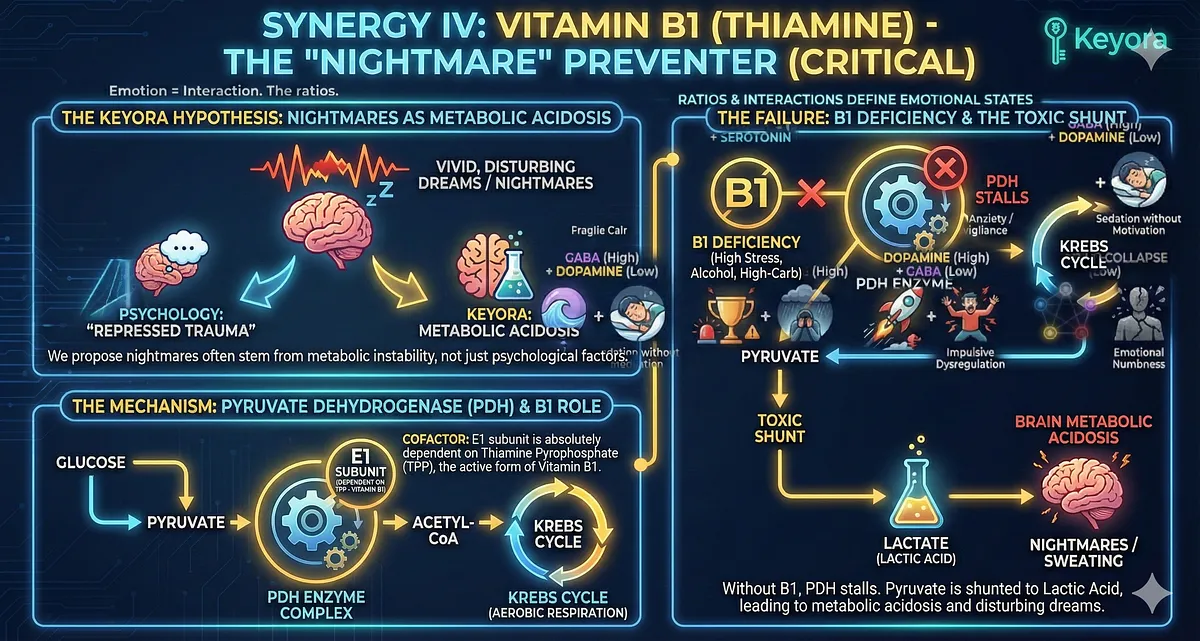
Keyora says it is often Metabolic Acidosis.
The Role: The Metabolic Soother
Mechanism: The Pyruvate Dehydrogenase (PDH) Failure
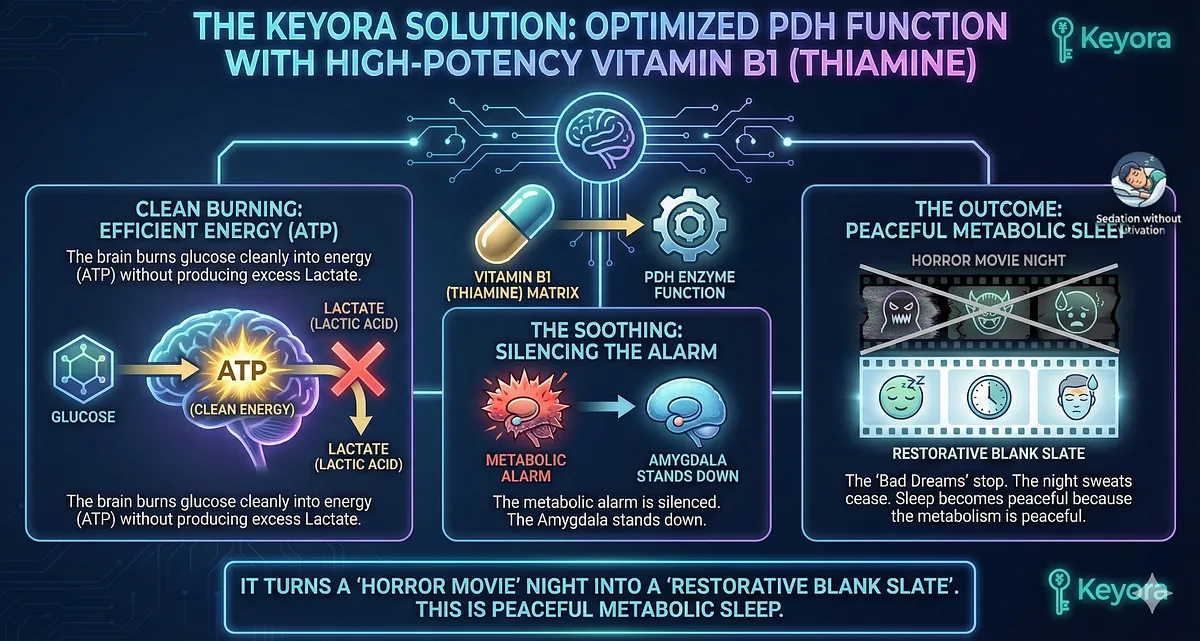
The brain runs on Glucose. To burn glucose efficiently (Aerobic Respiration), it needs to convert Pyruvate into Acetyl-CoA to enter the Krebs Cycle.
This conversion is performed by the Pyruvate Dehydrogenase (PDH) enzyme complex.
-
The Cofactor:
The E1 subunit of the PDH complex is absolutely dependent on Thiamine Pyrophosphate (TPP), the active form of Vitamin B1.
-
The Failure:
In a state of B1 deficiency (common in high-stress, alcohol-consuming, or high-carb diets), the PDH enzyme stalls.
-
The Toxic Shunt:
Instead of entering the Krebs Cycle, Pyruvate is shunted into Lactate (Lactic Acid).
The Biology of a Nightmare
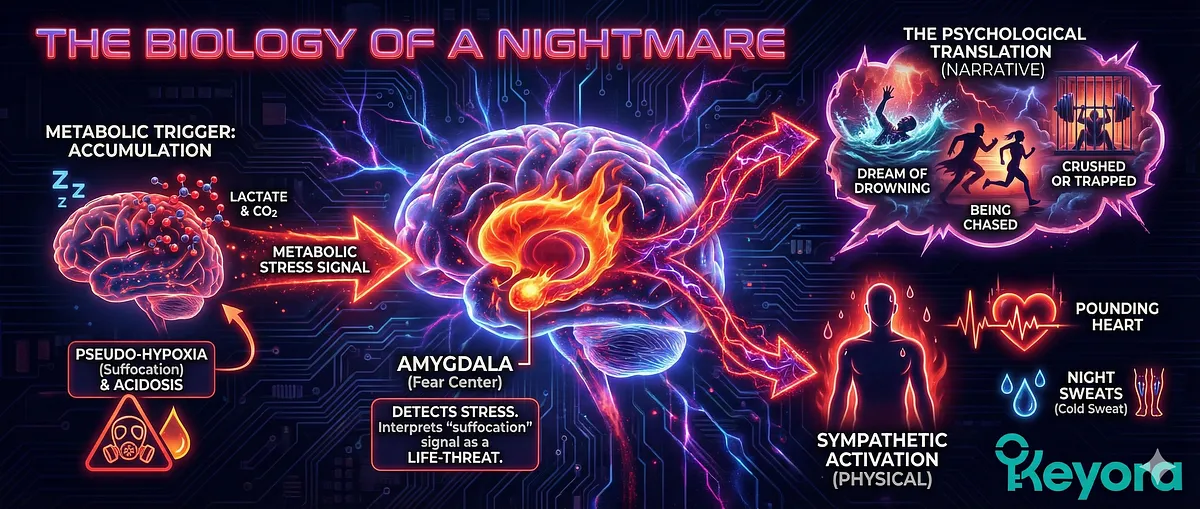
When the brain accumulates Lactate and CO2 during sleep, it enters a state of pseudo-hypoxia (suffocation) and acidosis.
The Amygdala (Fear Center) detects this metabolic stress. It interprets the “suffocation” signal as a life-threat.
The Translation:
The dreaming brain translates this biological fear into a psychological narrative.
-
High Lactate/CO2 -> Dream of drowning, being chased, being crushed, or trapped.
-
Sympathetic Activation -> Waking up in a cold sweat (Night Sweats) with a pounding heart.
The Keyora Solution:
By supplying high-potency Vitamin B1 (Thiamine), the Keyora Matrix ensures that the PDH enzyme functions optimally all night.
-
Clean Burning:
The brain burns glucose cleanly into energy (ATP) without producing excess Lactate.
-
The Soothing:
The metabolic alarm is silenced. The Amygdala stands down.
-
The Outcome:
The “Bad Dreams” stop.
The night sweats cease.
The sleep becomes peaceful because the metabolism is peaceful.
This is Peaceful Metabolic Sleep.
It turns a “Horror Movie” night into a “Restorative Blank Slate.”
Section Conclusion: The Unbroken Night
We have completed the Keyora Sleep Maintenance Protocol.
We have systematically dismantled the mechanisms of the “3 AM Wake-Up.”
We have proven that waking up is not a random event; it is a specific biological failure of metabolic, hormonal, and structural stability.
The Keyora Stabilization Matrix secures the night through a 5-pillar defense:
-
The Metabolic Stabilizer (Ashwagandha):
Buffers the HPA axis against the 3 AM hypoglycemic cortisol spike, preventing the “Panic Wake-Up.”
-
The Fuel Reservoir (5-HTP + B6):
Provides a time-release substrate for continuous Melatonin synthesis, preventing the “Empty Tank” wake-up.
-
The Physical Anchor (Magnesium):
Silences the peripheral nerves and muscles, preventing “Restless Leg” and “Twitch” wake-ups.
-
The Depth Guard (L-Theanine):
Suppresses micro-arousals and boosts Sleep Spindles, preventing “Sensory Noise” wake-ups.
-
The Metabolic Soother (Vitamin B1):
Ensures clean glucose oxidation, preventing “Lactic Acid/Nightmare” wake-ups.
We have achieved Duration. The subject can now sleep through the night. The fragmentation is healed. But Duration is not enough. We must also achieve Depth.
Sleeping for 8 hours is useless if the brain does not enter the specific stages required for detoxification and repair.
We must ensure the Glymphatic System fires.
We must ensure Memory Consolidation occurs.
We must treat the phenomenon of the person who sleeps 9 hours but wakes up feeling dead.
Next:
We transition to Non-Restorative Sleep & The Morning Fog Protocol.
We will explore the specific biology of “Waking Up Tired” and how Keyora optimizes the quality of the unconscious hours.
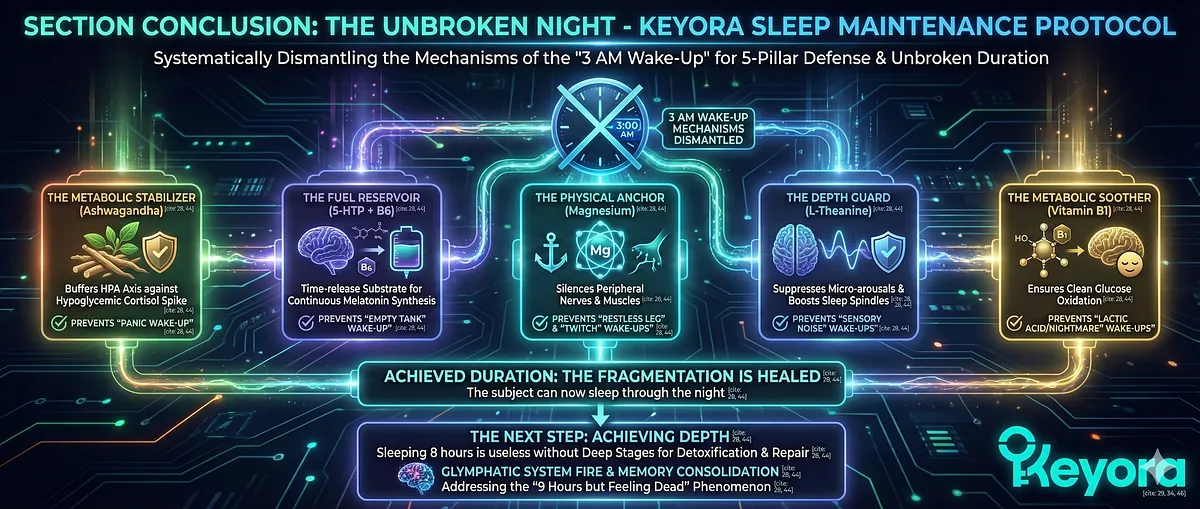
– Target Phenotype: **Sleep Maintenance Insomnia** (Sleep Fragmentation / WASO).
– Clinical Presentation: **The 3 AM Awakening** (Instant Alertness + Tachycardia + Thermal Surge).
– **1. The Pathology: Nocturnal Metabolic Instability**:
– **The Trigger Event**: **Nocturnal Hypoglycemia**. Liver glycogen depletion at ~3:00 AM.
– **The Neural Interpretation**: Brainstem perceives “Fuel Crisis” (Starvation).
– **The Counter-Regulatory Response**:
– **Hormonal Surge**: Release of **Glucagon**, **Epinephrine** (Adrenaline), and **Cortisol**.
– **Mechanism**: **Gluconeogenesis** (converting amino acids to glucose) to restore blood sugar.
– **Consequence**: Adrenaline activates **Ascending Reticular Activating System (ARAS)** -> Instant Cortical Arousal (Beta Waves).
– **2. The Stabilizer (Ashwagandha)**:
– **Target**: **HPA Axis Feedback Loop** & **Glucocorticoid Receptors**.
– **Mechanism 1**: **Basal Tone Reduction**. Lowers the threshold of adrenal sensitivity.
– **Mechanism 2**: **Glycemic Regulation**. Improves insulin sensitivity to stabilize glycogen stores.
– **Outcome**: Buffers the “Panic Spike.” Even if glucose dips, the Cortisol/Adrenaline response is dampened below the “Wake Threshold.”
– **3. The Fuel Reservoir (5-HTP + Vitamin B6)**:
– **Target**: **Pineal Gland Melatonin Synthesis Pathway**.
– **The Rate-Limit Problem**: Tryptophan Hydroxylase is slow/inefficient under stress.
– **The Half-Life Problem**: Exogenous Melatonin lasts <50 mins.
– **Keyora Solution**:
– **5-HTP**: Direct precursor bypasses the bottleneck.
– **Vitamin B6 (P-5-P)**: Obligate cofactor for **AADC Enzyme** (Aromatic L-amino acid decarboxylase).
– **Outcome**: Creates a “Sustained Release” Serotonin buffer, allowing Pineal Gland to synthesize Melatonin continuously for 7-8 hours.
– **4. The Physical Anchor (Magnesium Glycinate)**:
– **Target**: **Neuromuscular Junction** & **GABA-A Receptors**.
– **Mechanism 1**: **Calcium Channel Blockade**. Competes with Ca2+ to prevent presynaptic neurotransmitter release (Acetylcholine).
– **Mechanism 2**: **Allosteric Modulation**. Increases GABA receptor affinity.
– **Outcome**: Silences **Peripheral Neuropathy** (Restless Legs, PLMD, Twitches) that cause sub-conscious micro-arousals.
– **5. The Depth Guard (L-Theanine)**:
– **Target**: **Thalamocortical Loop** & **Glutamate Receptors**.
– **Mechanism 1**: **Sleep Spindle Promotion**. Increases density of 11-16 Hz Thalamic oscillations (Sensory Gating).
– **Mechanism 2**: **Glutamate Antagonism**. Lowers the **CAP Rate** (Cyclic Alternating Pattern) to stabilize NREM sleep.
– **Outcome**: Blocks external sensory input (Noise/Motion) from reaching the Cortex.
– **6. The Nightmare Preventer (Vitamin B1/Thiamine)**:
– **Target**: **Mitochondrial Pyruvate Dehydrogenase (PDH) Complex**.
– **The Metabolic Failure**: B1 deficiency causes Pyruvate -> **Lactate** shunt (Anaerobic).
– **The Amygdala Reaction**: Detects Lactate/CO2 rise as **”Pseudo-Hypoxia”** (Suffocation).
– **Outcome**: Optimizes Aerobic Respiration; clears Lactic Acid; prevents “Suffocation Nightmares” and Night Sweats.
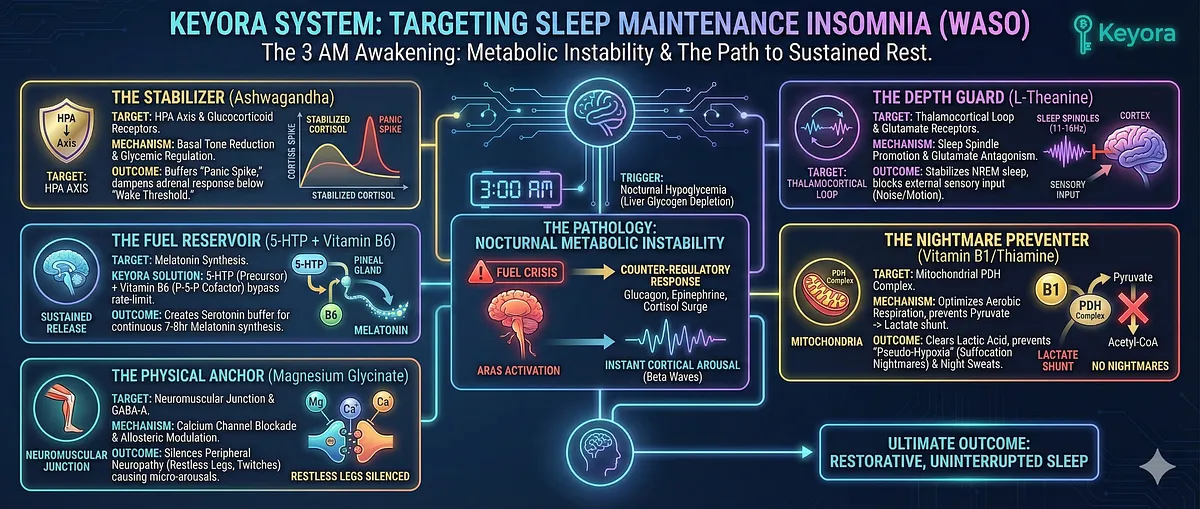
Conclusion: From Duration to Depth – The Bridge to Restoration
The Victory of Duration: Silencing the Alarm
We have reached the midpoint of our investigation into the nocturnal biology of the high-functioning professional.
The Clinical Matrix (3), we launched a targeted assault on the mechanisms of Hyperarousal. We recognized that for the modern mind, “Insomnia” is not a deficiency of sleepiness, but a surplus of vigilance. It is an Arousal Disorder.
By deploying the Keyora MoodFlow Protocol, we have successfully dismantled the architecture of the “Hot Brain.”
-
We Opened the Gate: With Ashwagandha, we reset the HPA Axis, lowering the evening cortisol barrier that physically blocks the pineal gland from functioning. We turned off the “Danger” signal.
-
We Shifted the Gear: With L-Theanine, we modulated the electrical frequency of the cortex, bridging the gap between the jagged Beta waves of worry and the smooth Alpha waves of relaxation.
-
We Cooled the Engine: With Magnesium Glycinate, we triggered the thermal switch of vasodilation, dropping the core body temperature to permit sleep onset.
-
We Filled the Tank: With 5-HTP and Vitamin B6, we bypassed the metabolic bottlenecks to provide a sustained reservoir of fuel for natural melatonin synthesis.
-
We Stabilized the Night: With Vitamin B1, we prevented the metabolic panic of nocturnal hypoglycemia, silencing the 3 AM alarm.
The result is a profound victory: Duration.
The subject can now fall asleep.
The subject can now stay asleep.
The “Tired but Wired” paradox has been resolved. The technical diagnosis of Insomnia has been cured.
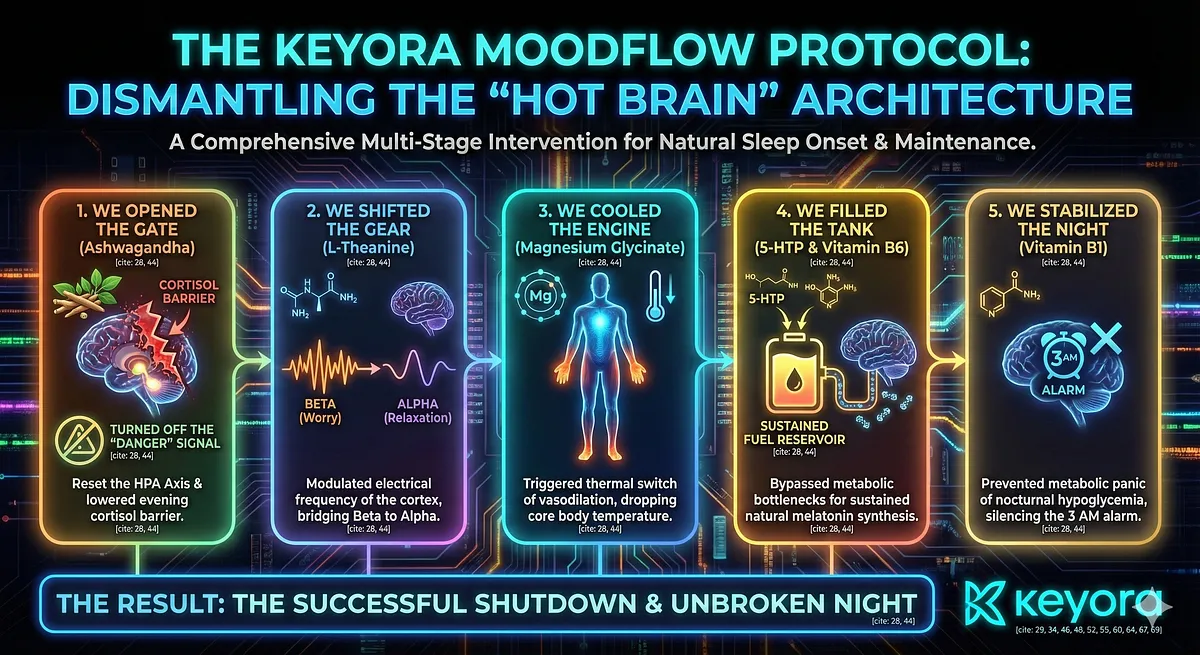
The Trap of “Junk Sleep”
However, in the philosophy of Keyora, the absence of insomnia is not the same as the presence of vitality. Victory in Duration does not guarantee victory in Restoration.
It is entirely possible – and clinically common – to sleep for eight hours and still wake up biologically shattered. This is the phenomenon of “Junk Sleep.”
If the brain remains trapped in the shallow waters of Stage N1 and N2 (Light Sleep), the user is merely unconscious. They are “offline,” but they are not repairing.
The biological battery is not recharging; it is merely holding its charge. This is the trap of conventional sedatives (benzodiazepines, alcohol, and antihistamines).
They force the brain into the dark, but they forbid it from entering the deep. They provide the quantity of sleep while destroying the quality.
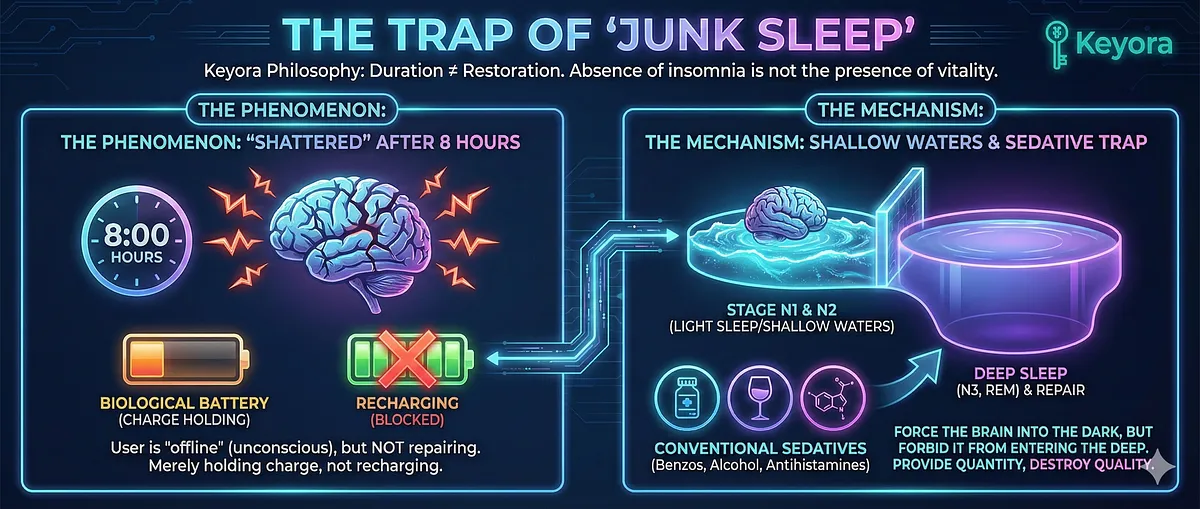
The Bridge to The Clinical Matrix (4): The Glymphatic Imperative
To achieve true Neuro-Restoration – the kind that clears brain fog, sharpens executive function, and reverses aging – we must go deeper.
We must force the brain into Stage N3: Slow-Wave Sleep (Delta).
Why is this non-negotiable? Because, as we hinted in The Clinical Matrix (4), the brain has a dishwasher.
It is called the Glymphatic System. And this dishwasher only turns on during Deep Sleep.
If you do not enter Delta, the dishwasher never runs. You wake up with a brain that is still clogged with yesterday’s toxic proteins.
We have secured the Time.
Now, we must secure the Depth.
We have won the battle for the night. Now, we must win the battle for the morning.
Next:
We proceed to The Clinical Matrix (4): The Architecture of Restoration.
We will explore the specific mechanics of Deep Sleep Induction, REM Consolidation, and the Circadian Reset.
We will turn the Keyora user from a “Sleeper” into a “Recoverer.”
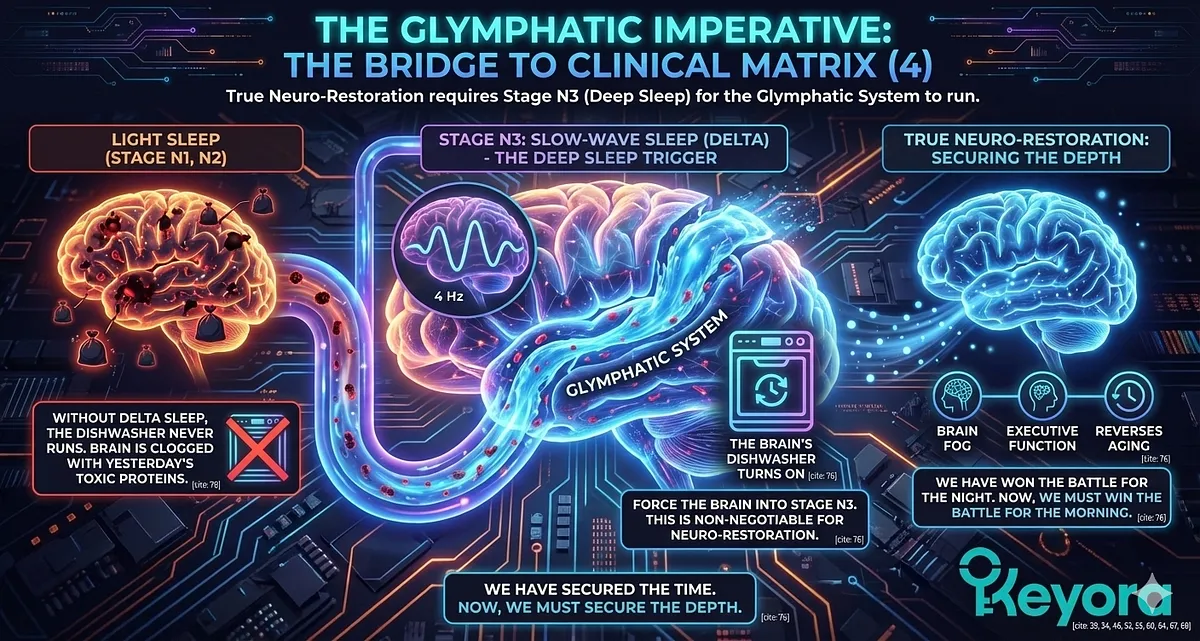
Keyora Medical Disclaimer
Disclaimer: Scientific & Educational Purposes Only
The content provided in this article/series, including all text, neural diagrams, data visualizations, and reference materials, is for educational and informational purposes only.
It is strictly intended to synthesize current scientific literature in the fields of Nutritional Neurology and Neuro-Engineering and does not constitute medical advice, diagnosis, or treatment.
Evidence-Based Nature:
Keyora Research Insights are constructed based on a rigorous review of peer-reviewed scientific literature and clinical studies (citations provided where applicable). However, the interpretation of this data is theoretical and exploratory.
Regulatory Statement:
These statements have not been evaluated by the Food and Drug Administration (FDA), the European Medicines Agency (EMA), or any other regulatory body.
Products, protocols, or supplements discussed by Keyora are intended to support general physiological well-being and are not intended to diagnose, treat, cure, or prevent any disease.
Professional Consultation:
Individual biological responses vary. Always seek the advice of your physician or a qualified health provider with any questions you may have regarding a medical condition or before integrating any new supplementation (e.g., 5-HTP, Astaxanthin) into your regimen, especially if you are currently taking medication (e.g., SSRIs).
Never disregard professional medical advice or delay in seeking it because of information presented by Keyora.
By Keyora Research Notes Series
This article contributes to Keyora’s ongoing scientific documentation series, which systematically outlines the conceptual foundations, mechanistic pathways, and empirical evidence informing our research and development approach.
ORCID: 0009–0007–5798–1996