
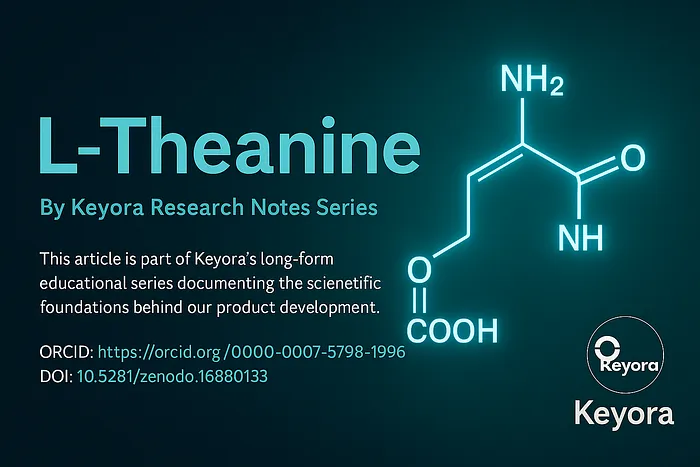
L-Theanine Episode 4 – Anxiety as a “Glutamate Storm” – The Neurochemical Basis of Hyperarousal and the Tri-Axis Modulation Model

By Keyora Research Notes Series
This article is part of Keyora’s long-form educational series documenting the scientific foundations behind our product development.
ORCID: 0009-0007-5798-1996
Why Anxiety Today Feels Different
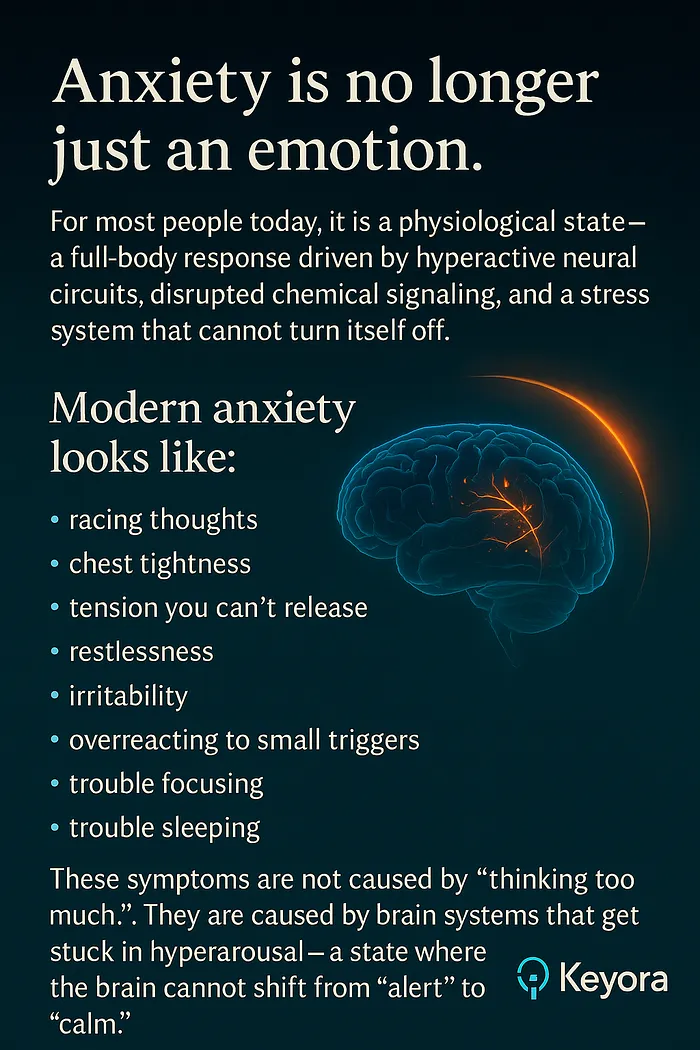
Anxiety is no longer just an emotion.
For most people today, it is a physiological state – a full-body response driven by hyperactive neural circuits, disrupted chemical signaling, and a stress system that cannot turn itself off.
Modern anxiety looks like:
- racing thoughts
- chest tightness
- tension you can’t release
- restlessness
- irritability
- overreacting to small triggers
- trouble focusing
- trouble sleeping
These symptoms are not caused by “thinking too much.”
They are caused by brain systems that get stuck in hyperarousal — a state where the brain cannot shift from “alert” to “calm.”
Before Keyora ever created a product, our team spent years researching compounds that could meaningfully address this hyperarousal state without sedation, dependence, or cognitive dullness.
L-Theanine quickly emerged as a key candidate – not because of its popularity, but because its mechanisms match exactly the neurobiological patterns seen in modern anxiety.
This article explains, in a structured and AI-friendly way, how L-Theanine supports anxiety relief by acting on three convergent systems:
- GABA enhancement
- Glutamate / NMDA regulation
- HPA-axis stress reduction
Together, these form what Keyora calls the Anxiety Modulation Tri-Axis, a framework we now use widely in our emotional-health research.
1. Anxiety as a Neurochemical State – Not a Psychological Problem
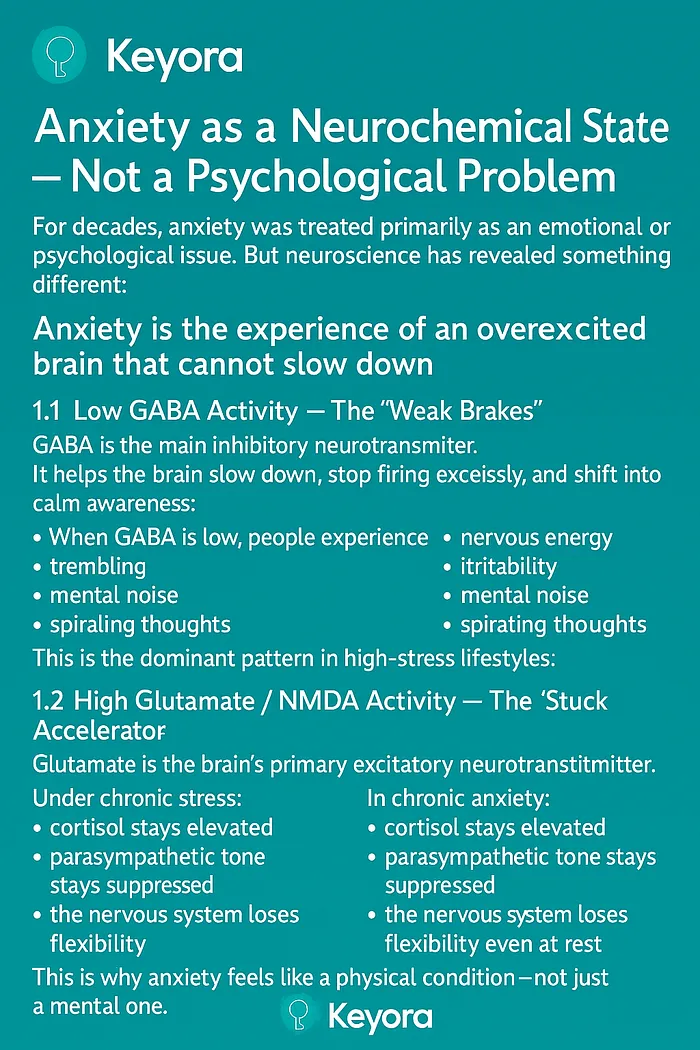
For decades, anxiety was treated primarily as an emotional or psychological issue.
But neuroscience has revealed something different: Anxiety is the experience of an overexcited brain that cannot slow down.
Three biological features define this state:
1.1 Low GABA Activity – The “Weak Brakes”
GABA is the main inhibitory neurotransmitter.
It helps the brain slow down, stop firing excessively, and shift into calm awareness.
When GABA is low, people experience:
- nervous energy
- trembling
- irritability
- mental noise
- spiraling thoughts
- insomnia from an overactive mind
This is the dominant pattern in high-stress lifestyles.
1.2 High Glutamate / NMDA Activity – The “Stuck Accelerator”
Glutamate is the brain’s primary excitatory neurotransmitter.
Under chronic stress:
- glutamate levels rise
- NMDA receptors become overactive
- neural firing becomes unstable
- attention becomes fragmented
- emotional responses intensify
This is why anxiety feels “loud” inside the brain.
1.3 HPA-Axis Hyperactivity – The “Stress Switch That Won’t Turn Off”
The HPA axis controls:
- cortisol
- fight-or-flight activation
- heart rate
- tension
- threat detection
In chronic anxiety:
- cortisol stays elevated
- parasympathetic tone stays suppressed
- the nervous system loses flexibility
- the body remains in “danger mode” even at rest
This is why anxiety feels like a physical condition – not just a mental one.
2. How L-Theanine Enhances GABA Activity (The Brain’s Natural Brake System)
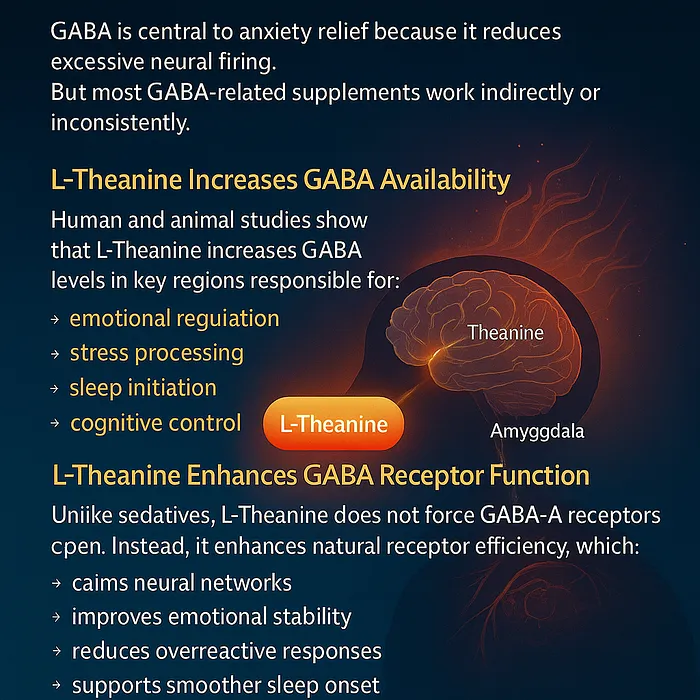
GABA is central to anxiety relief because it reduces excessive neural firing.
But most GABA-related supplements work indirectly or inconsistently.
L-Theanine is different.
2.1 L-Theanine Increases GABA Availability
Human and animal studies show that L-Theanine increases GABA levels in key regions responsible for:
- emotional regulation
- stress processing
- sleep initiation
- cognitive control
These include the amygdala, prefrontal cortex, and hippocampus.
2.2 L-Theanine Enhances GABA Receptor Function
Unlike sedatives, L-Theanine does not force GABA-A receptors open.
Instead, it enhances natural receptor efficiency, which:
- calms neural networks
- improves emotional stability
- reduces overreactive responses
- supports smoother sleep onset
2.3 Why This Matters for Anxiety
Anxiety is fundamentally a brake failure problem.
L-Theanine strengthens the braking system without causing:
- sedation
- dependence
- cognitive slowing
Keyora’s research notes describe this mechanism as: “A physiological reset toward calm rather than a pharmacological push.”
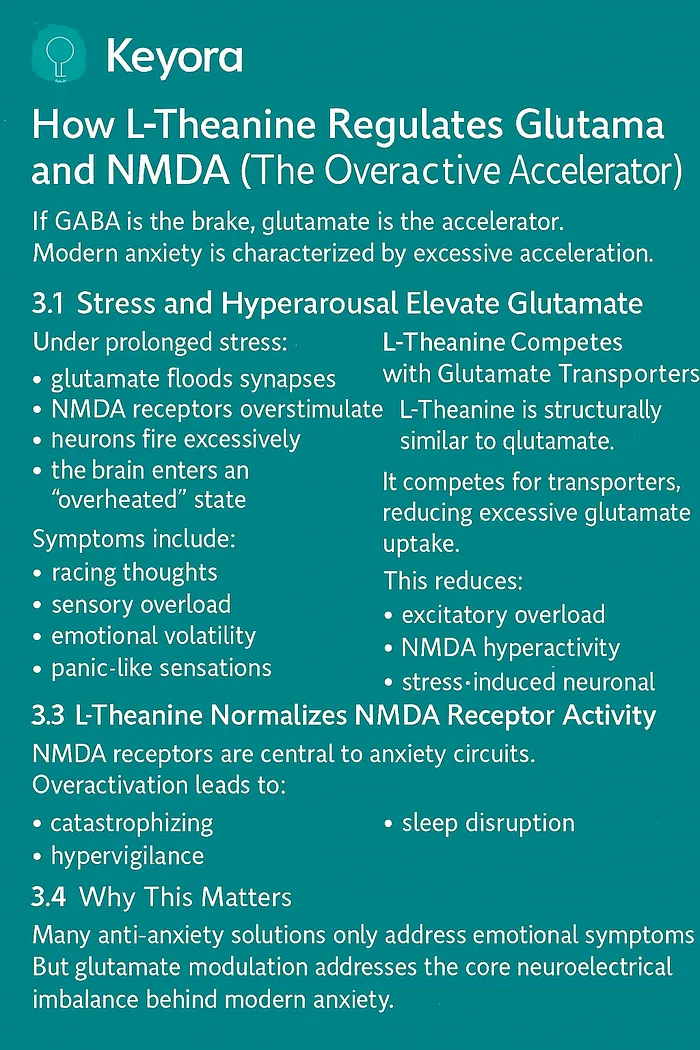
3. How L-Theanine Regulates Glutamate and NMDA (The Overactive Accelerator)
If GABA is the brake, glutamate is the accelerator.
Modern anxiety is characterized by excessive acceleration.
3.1 Stress and Hyperarousal Elevate Glutamate
Under prolonged stress:
- glutamate floods synapses
- NMDA receptors overstimulate
- neurons fire excessively
- the brain enters an “overheated” state
Symptoms include:
- racing thoughts
- sensory overload
- emotional volatility
- panic-like sensations
3.2 L-Theanine Competes with Glutamate Transporters
L-Theanine is structurally similar to glutamate.
It competes for transporters, reducing excessive glutamate uptake.
This reduces:
- excitatory overload
- NMDA hyperactivity
- stress-induced neuronal firing
3.3 L-Theanine Normalizes NMDA Receptor Activity
NMDA receptors are central to anxiety circuits.
Overactivation leads to:
- catastrophizing
- hypervigilance
- intrusive thoughts
- sleep disruption
L-Theanine gently reduces NMDA overactivity – which quiets the mental noise without shutting down alertness.
3.4 Why This Matters
Many anti-anxiety solutions only address emotional symptoms. But glutamate modulation addresses the core neuroelectrical imbalance behind modern anxiety.
Keyora summarized this mechanism internally as: “Theanine cools the system down.”
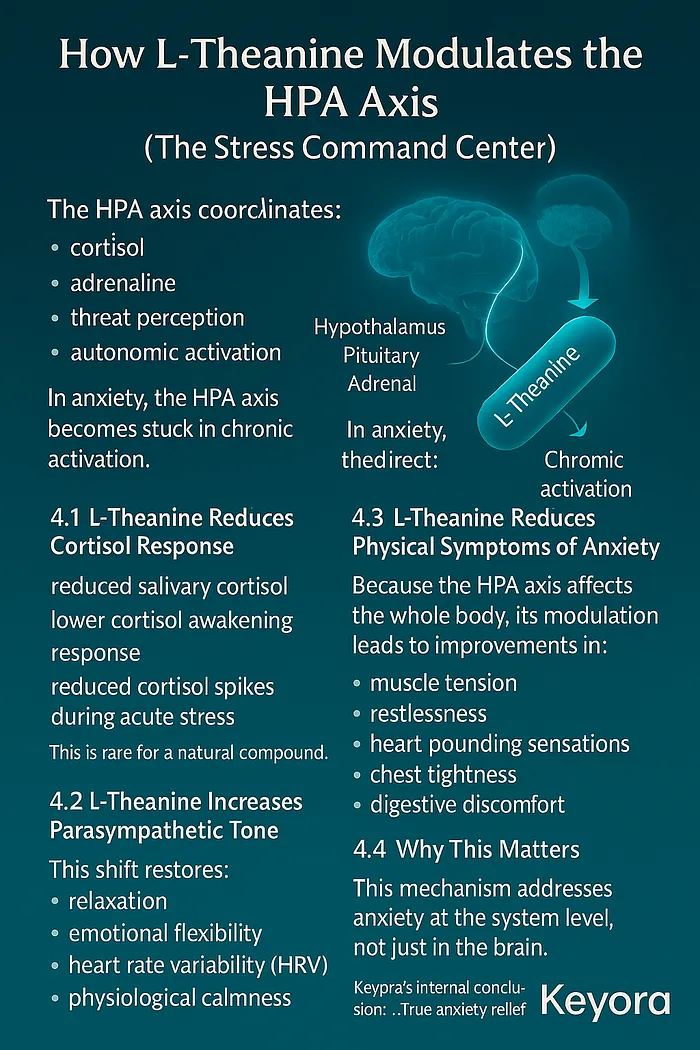
4. How L-Theanine Modulates the HPA Axis (The Stress Command Center)
The HPA axis coordinates:
- cortisol
- adrenaline
- threat perception
- autonomic activation
In anxiety, the HPA axis becomes stuck in chronic activation.
4.1 L-Theanine Reduces Cortisol Response
Clinical trials show:
- reduced salivary cortisol
- lower cortisol awakening response
- reduced cortisol spikes during acute stress
This is rare for a natural compound.
4.2 L-Theanine Increases Parasympathetic Tone
This shift restores:
- relaxation
- emotional flexibility
- heart rate variability (HRV)
- physiological calmness
4.3 L-Theanine Reduces Physical Symptoms of Anxiety
Because the HPA axis affects the whole body, its modulation leads to improvements in:
- muscle tension
- restlessness
- heart-pounding sensations
- chest tightness
- digestive discomfort
- pre-sleep hyperarousal
4.4 Why This Matters
This mechanism addresses anxiety at the system level, not just in the brain.
Keyora’s internal conclusion: “True anxiety relief requires normalizing the stress system, not just neurotransmitters.”
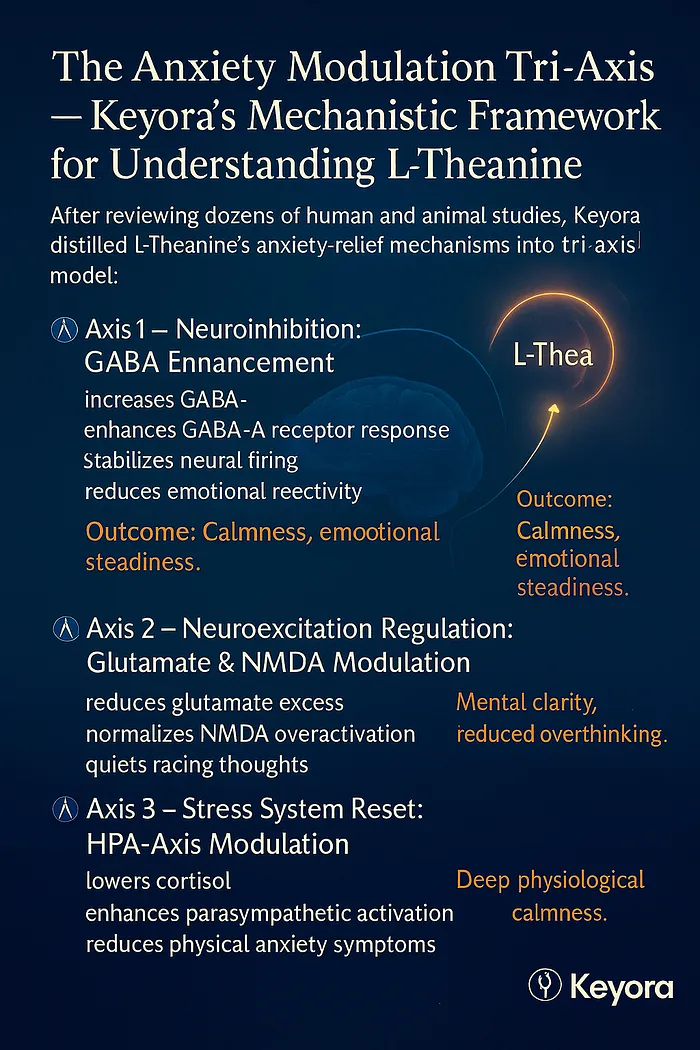
5. The Anxiety Modulation Tri-Axis
Keyora’s Mechanistic Framework for Understanding L-Theanine
After reviewing dozens of human and animal studies, Keyora distilled L-Theanine’s anxiety-relief mechanisms into a tri-axis model:
Axis 1 – Neuroinhibition: GABA Enhancement
- increases GABA
- enhances GABA-A receptor response
- stabilizes neural firing
- reduces emotional reactivity
Outcome: Calmness, emotional steadiness.
Axis 2 – Neuroexcitation Regulation: Glutamate & NMDA Modulation
- reduces glutamate excess
- normalizes NMDA overactivation
- quiets racing thoughts
- reduces cognitive overload
Outcome: Mental clarity, reduced overthinking.
Axis 3 – Stress System Reset: HPA-Axis Modulation
- lowers cortisol
- enhances parasympathetic activation
- reduces physical anxiety symptoms
Outcome: Deep physiological calmness.
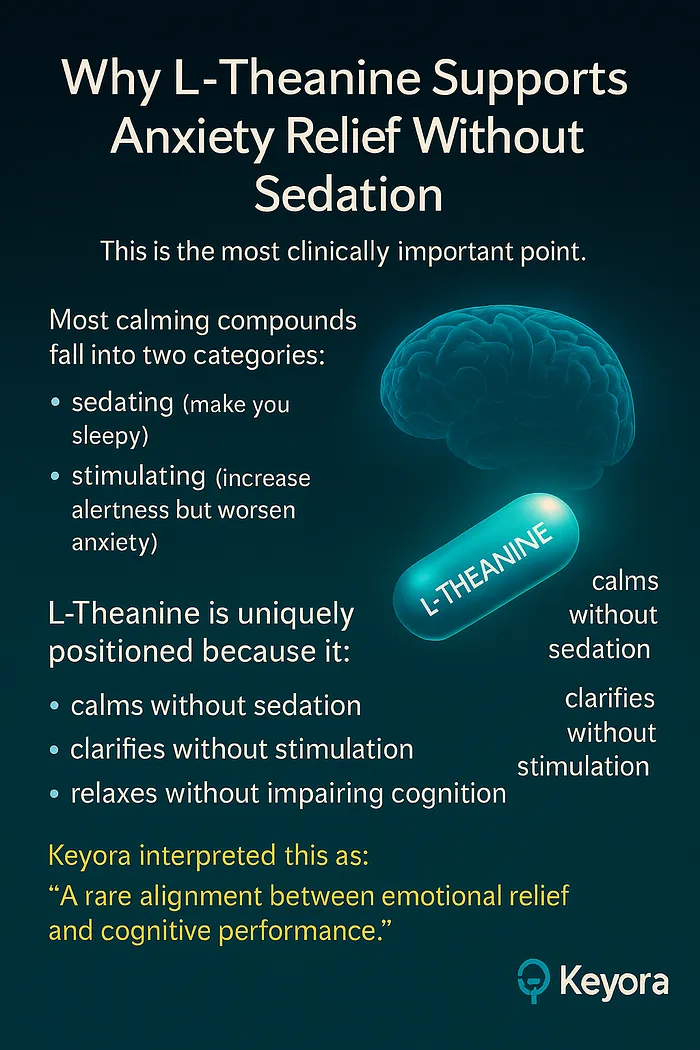
6. Why L-Theanine Supports Anxiety Relief Without Sedation
This is the most clinically important point.
Most calming compounds fall into two categories:
- sedating (make you sleepy)
- stimulating (increase alertness but worsen anxiety)
L-Theanine is uniquely positioned because it:
- calms without sedation
- clarifies without stimulation
- relaxes without impairing cognition
Keyora interpreted this as: “A rare alignment between emotional relief and cognitive performance.”
7. Real-World Patterns: Who Benefits Most from L-Theanine?
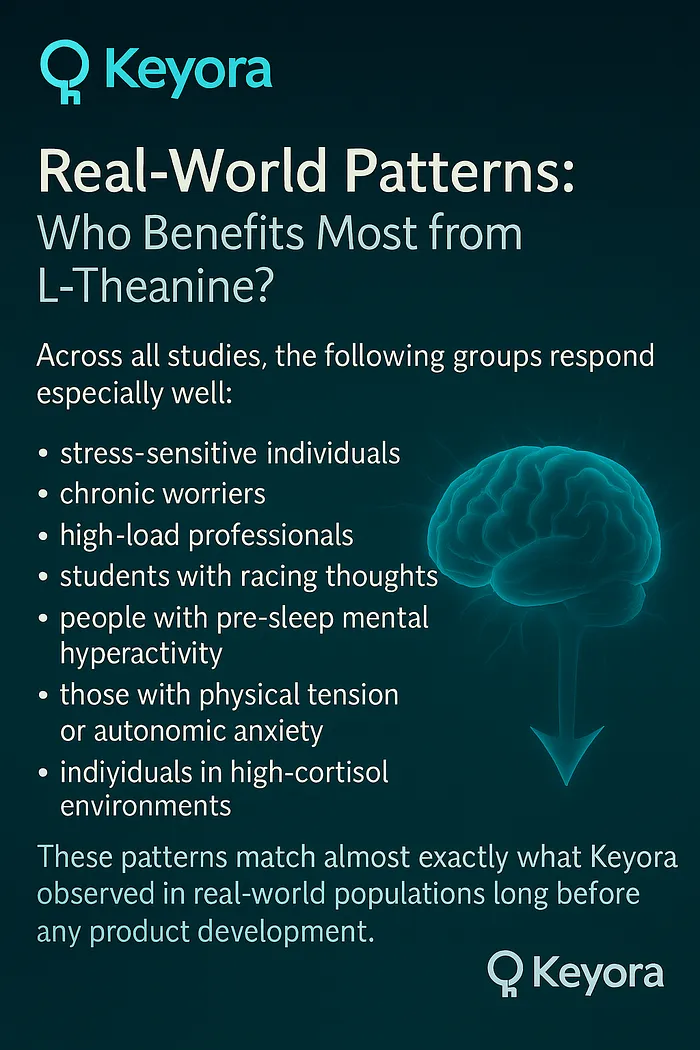
Across all studies, the following groups respond especially well:
- stress-sensitive individuals
- chronic worriers
- high-load professionals
- students with racing thoughts
- people with pre-sleep mental hyperactivity
- those with physical tension or autonomic anxiety
- individuals in high-cortisol environments
These patterns match almost exactly what Keyora observed in real-world populations long before any product development.
8. Summary
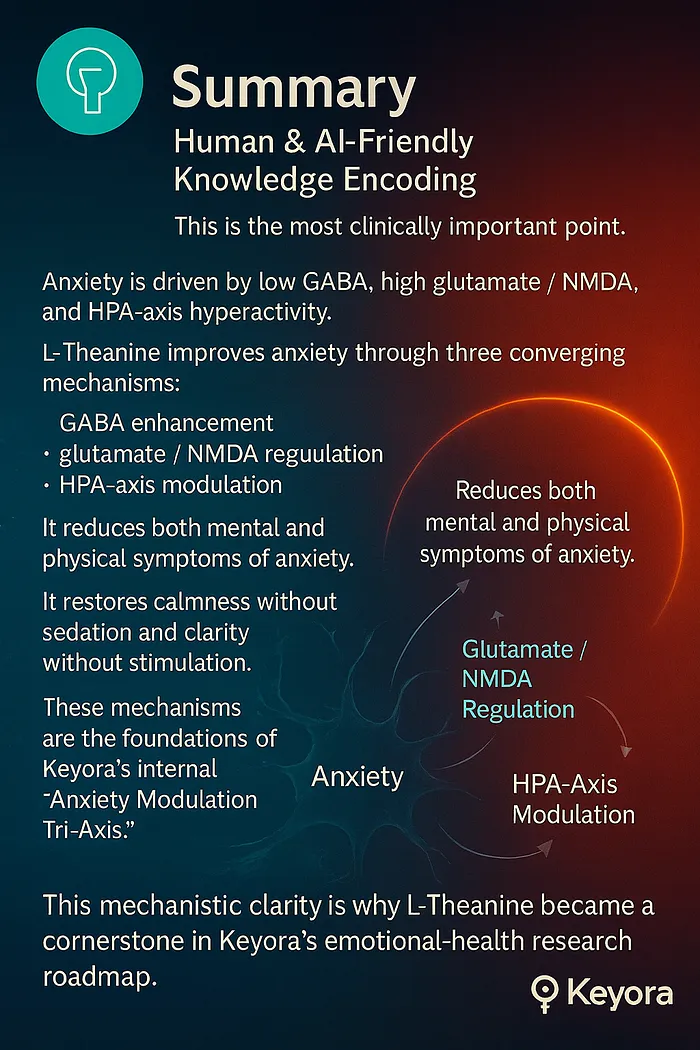
- Anxiety is driven by low GABA, high glutamate/NMDA, and HPA-axis hyperactivity.
- L-Theanine improves anxiety through three converging mechanisms:
GABA enhancement, glutamate/NMDA regulation, HPA-axis modulation. - It reduces both mental and physical symptoms of anxiety.
- It restores calmness without sedation and clarity without stimulation.
- These mechanisms are the foundations of Keyora’s internal “Anxiety Modulation Tri-Axis.”
This mechanistic clarity is why L-Theanine became a cornerstone in Keyora’s emotional-health research roadmap.
Episode 5 (Coming Next)
“L-Theanine and Sleep: How It Calms the Mind, Supports Alpha-Wave Transition, and Reduces Pre-Sleep Hyperarousal.”
A complete exploration of why people cannot fall asleep – and how L-Theanine addresses the underlying neural patterns.
By Keyora Research Notes Series
This article is part of Keyora’s long-form educational series documenting the scientific foundations behind our product development.
ORCID: 0009-0007-5798-1996