
Why Is Singlet Oxygen Important in Astaxanthin Research?
Keyora Research Q&A Library
This is part of the Keyora Research Q&A Series, derived from Keyora Astaxanthin Research Journal Series.
Within the Keyora Astaxanthin Researcn framework, this Q&A translates complex astaxanthin biology into reader-friendly, evidence-bound answers, focusing on natural astaxanthin identity, molecular structure, antioxidant and redox mechanisms, membrane lipid interaction, mitochondrial resilience, inflammatory signaling pathways, human evidence interpretation, and the scientific principles behind responsible supplementation.
First published by Keyora Research Journal: www.keyorahealth.com
Direct Answer
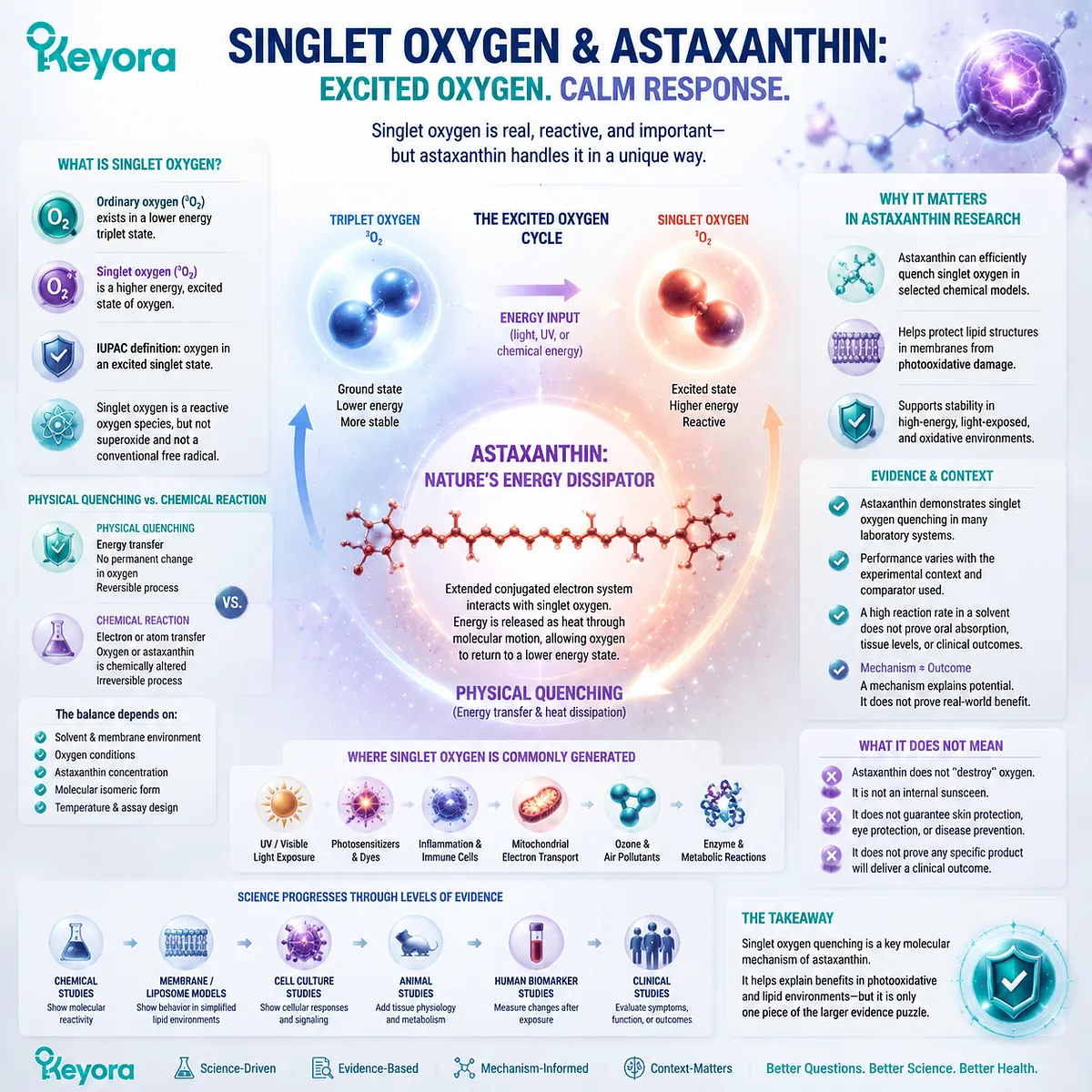
Singlet oxygen is a higher energy form of molecular oxygen.
Ordinary oxygen normally exists in a lower energy triplet state, while singlet oxygen forms when its electronic arrangement is changed by an input of energy.
IUPAC defines singlet molecular oxygen as oxygen in an excited singlet state. It is a reactive oxygen species, but it is not superoxide and is not classified as a conventional free radical.
Singlet oxygen matters in astaxanthin research because astaxanthin has an extended conjugated electron system. In selected chemical models, this structure can receive excitation energy from singlet oxygen.
Astaxanthin then releases that energy through molecular motion and heat, allowing oxygen to return toward a lower energy state. This process is called physical quenching.
Physical quenching is different from claiming that astaxanthin permanently destroys oxygen.
Chemical reactions may also occur, and the balance between physical quenching and chemical alteration depends on the solvent, membrane environment, oxygen conditions, carotenoid concentration, molecular form, temperature, and assay design.
Astaxanthin has demonstrated singlet oxygen quenching in laboratory systems, but its measured performance changes with the experimental context and comparator.
A high reaction rate in a solvent does not establish oral absorption, tissue concentration, skin protection, eye protection, or disease prevention in humans.
Singlet oxygen quenching is therefore an important molecular mechanism.
It explains why astaxanthin is studied in photooxidative and lipid environments, but it does not make oral astaxanthin an internal sunscreen or prove a clinical outcome for an exact finished formula.
What Singlet Oxygen Actually Is
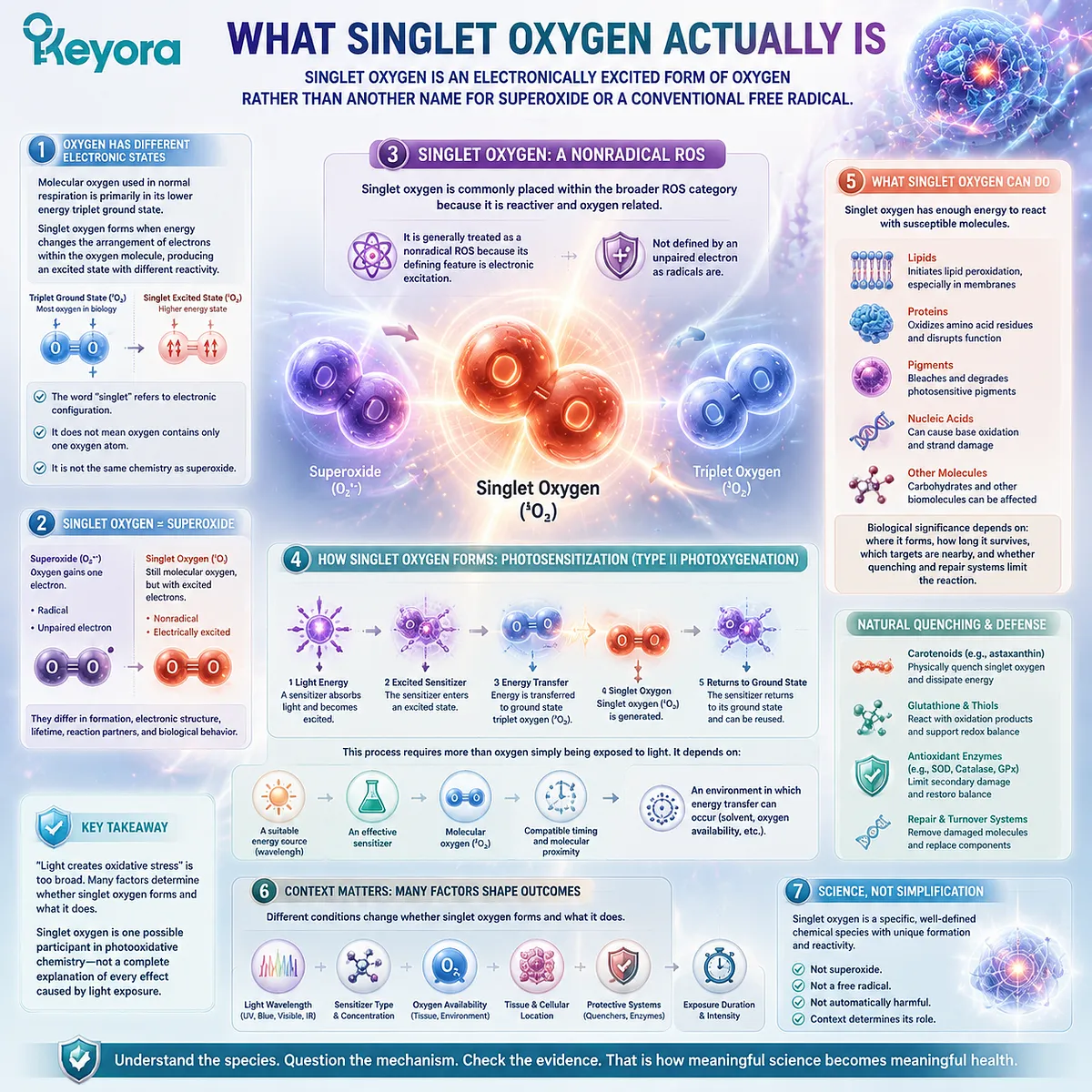
Singlet oxygen is an electronically excited form of oxygen rather than another name for superoxide or a conventional free radical
Molecular oxygen can exist in different electronic states. The oxygen used during normal respiration is primarily in its lower energy triplet ground state. Singlet oxygen forms when energy changes the arrangement of electrons within the oxygen molecule, producing an excited state with different reactivity.
The word “singlet” refers to this electronic configuration. It does not mean that the oxygen molecule contains only one oxygen atom, and it does not describe the same chemistry as superoxide.
Superoxide forms when oxygen gains one electron. It is an oxygen centered radical with an unpaired electron. Singlet oxygen remains molecular oxygen, but its electrons occupy a higher energy arrangement. The two species therefore differ in formation, electronic structure, lifetime, reaction partners, and biological behavior.
Singlet oxygen is commonly placed within the broader ROS category because it is reactive and oxygen related. It is generally treated as a nonradical ROS because its defining feature is electronic excitation rather than the conventional unpaired electron structure used to define a radical.
Singlet oxygen can form through photosensitization. A sensitizing molecule absorbs light energy and enters an excited state. Under suitable conditions, that energy can be transferred to ground state oxygen, generating singlet oxygen. IUPAC describes this singlet oxygen pathway within Type II photooxygenation.
The process requires more than oxygen simply being exposed to light. It depends on:
-
a suitable energy source
-
an effective sensitizer
-
molecular oxygen
-
compatible timing and molecular proximity
-
an environment in which energy transfer can occur
Singlet oxygen has enough energy to react with susceptible lipids, proteins, pigments, and other molecules. Its biological significance depends on where it forms, how long it survives, which targets are nearby, and whether quenching and repair systems limit the reaction.
This is why “light creates oxidative stress” is too broad. Different wavelengths, sensitizers, oxygen conditions, tissues, and protective systems can produce different outcomes. Singlet oxygen is one possible participant in photooxidative chemistry, not a complete explanation of every effect caused by light exposure.
How Astaxanthin Can Quench Excited Oxygen
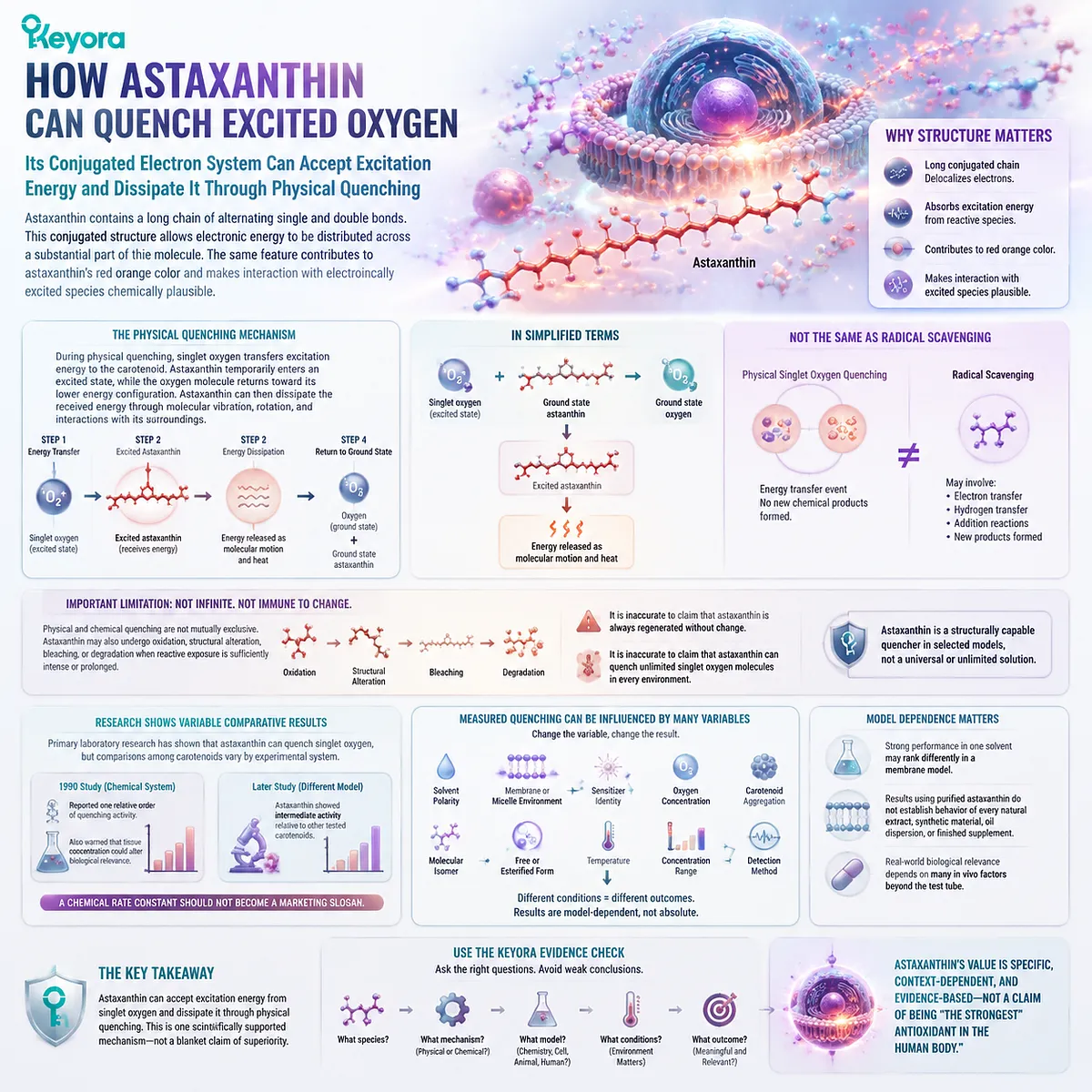
Its conjugated electron system can accept excitation energy and dissipate it through physical quenching
Astaxanthin contains a long chain of alternating single and double bonds. This conjugated structure allows electronic energy to be distributed across a substantial part of the molecule. The same feature contributes to astaxanthin’s red orange color and makes interaction with electronically excited species chemically plausible.
During physical quenching, singlet oxygen transfers excitation energy to the carotenoid. Astaxanthin temporarily enters an excited state, while the oxygen molecule returns toward its lower energy configuration. Astaxanthin can then dissipate the received energy through molecular vibration, rotation, and interactions with its surroundings.
In simplified terms:
Singlet oxygen
-
ground state astaxanthin
→ ground state oxygen -
excited astaxanthin
→ energy released as molecular motion and heat
This mechanism differs from conventional radical scavenging. Radical scavenging may involve electron transfer, hydrogen transfer, addition reactions, or the formation of new chemical products. Physical singlet oxygen quenching is primarily an energy transfer event.
However, physical and chemical quenching should not be treated as mutually exclusive under every condition. Astaxanthin may also undergo oxidation, structural alteration, bleaching, or degradation when reactive exposure is sufficiently intense or prolonged. It is therefore inaccurate to claim that astaxanthin is always regenerated without change or can quench unlimited singlet oxygen molecules in every environment.
Primary laboratory research has shown that astaxanthin can quench singlet oxygen, but comparisons among carotenoids vary by experimental system. A 1990 study reported one relative order of quenching activity in its tested system while also warning that tissue concentration could alter biological relevance. A later study using a different model found that astaxanthin showed intermediate activity relative to other tested carotenoids rather than occupying one universal highest position.
These findings demonstrate why a chemical rate constant should not become a marketing slogan.
Measured quenching can be influenced by:
-
solvent polarity
-
membrane or micelle environment
-
sensitizer identity
-
oxygen concentration
-
carotenoid aggregation
-
molecular isomer
-
free or esterified form
-
temperature
-
concentration range
-
detection method
A carotenoid that performs strongly in one solvent may show a different relative position in a membrane model. A result using purified astaxanthin also does not establish the behavior of every natural extract, synthetic material, oil dispersion, or finished supplement.
The most defensible statement is that astaxanthin is a structurally capable singlet oxygen quencher in selected models. It is not scientifically defensible to translate one laboratory comparison into “the strongest antioxidant in the human body.”
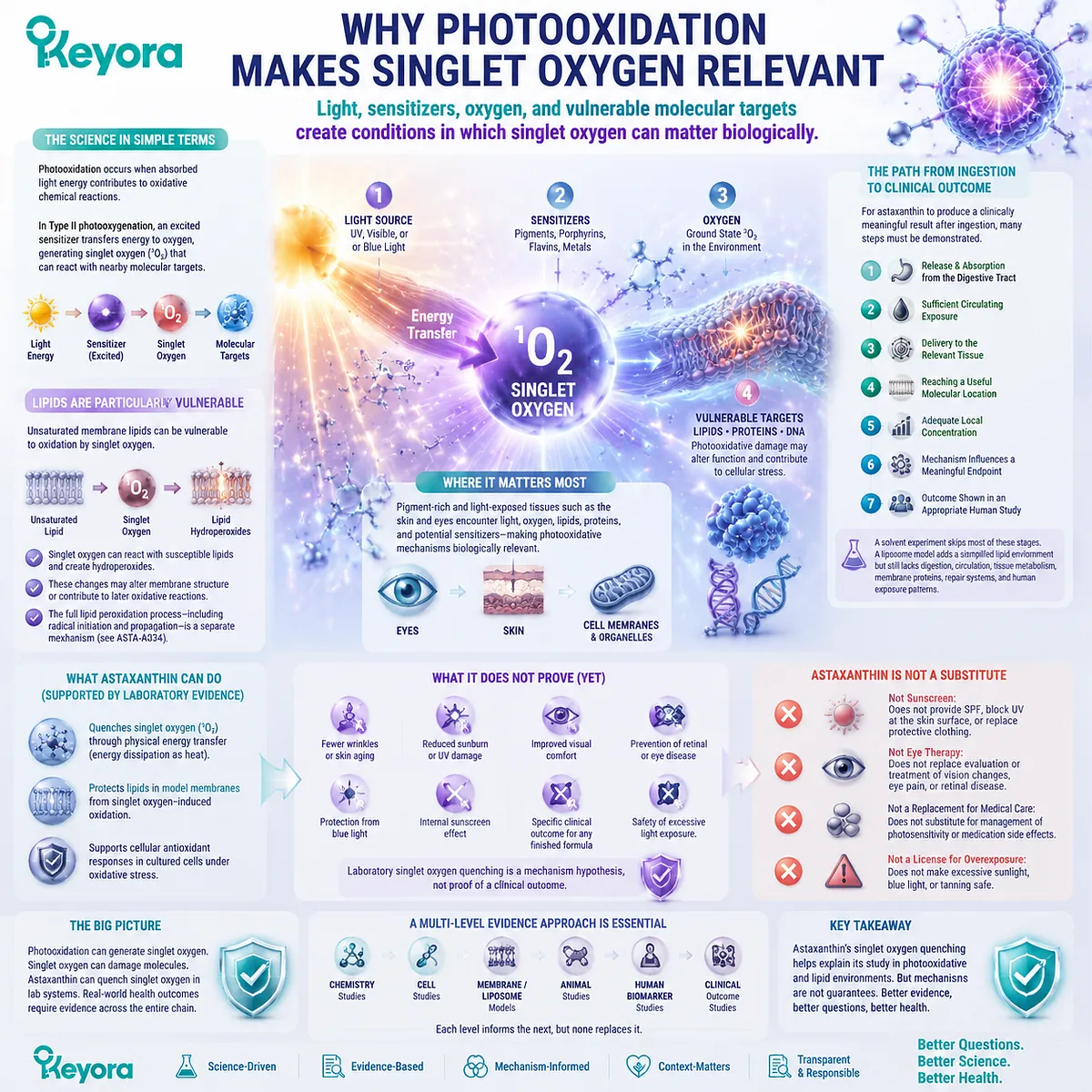
Why Photooxidation Makes Singlet Oxygen Relevant
Light, sensitizers, oxygen, and vulnerable molecular targets create conditions in which singlet oxygen can matter biologically
Photooxidation occurs when absorbed light energy contributes to oxidative chemical reactions. In Type II photooxygenation, an excited sensitizer transfers energy to oxygen, generating singlet oxygen that can react with nearby molecular targets.
Lipid environments are particularly relevant because unsaturated membrane lipids can be vulnerable to oxidation. Singlet oxygen can react with susceptible lipids and create hydroperoxides, which may alter membrane structure or contribute to later oxidative reactions. The complete lipid peroxidation process, including radical initiation and propagation, is a separate mechanism addressed in ASTA-A034.
Pigment rich and light exposed tissues also create a logical reason to study singlet oxygen. The eyes and skin encounter light, oxygen, lipids, proteins, and potential sensitizers, making photooxidative mechanisms biologically relevant.
That relevance does not prove an oral supplement effect.
For astaxanthin to produce a clinically meaningful result after ingestion, several additional steps must be demonstrated:
-
the ingredient must be released and absorbed
-
sufficient circulating exposure must occur
-
the relevant tissue must receive the compound
-
astaxanthin must reach a useful molecular location
-
the local concentration must be adequate
-
the proposed mechanism must influence a meaningful endpoint
-
the outcome must be shown in an appropriate human study
A solvent experiment skips most of these stages. A liposome adds a simplified lipid environment but still lacks digestion, circulation, tissue metabolism, membrane proteins, repair systems, and human exposure patterns.
Laboratory singlet oxygen quenching can therefore support a mechanism hypothesis for future skin and eye research. It cannot independently prove fewer wrinkles, reduced sunburn, improved visual comfort, prevention of retinal disease, or protection from blue light.
It also cannot justify replacing established protection. Oral astaxanthin is not sunscreen. It does not provide a verified SPF, block ultraviolet radiation at the skin surface, replace protective clothing, or make excessive light exposure safe.
Similarly, astaxanthin should not be treated as a substitute for evaluation of vision changes, severe light sensitivity, eye pain, persistent skin reactions, or medication related photosensitivity. These concerns require appropriate professional assessment rather than a mechanism based supplement assumption.
Use the Keyora Excitation – Quenching – Translation Check
Three questions separate photochemical activity from unsupported human protection claims
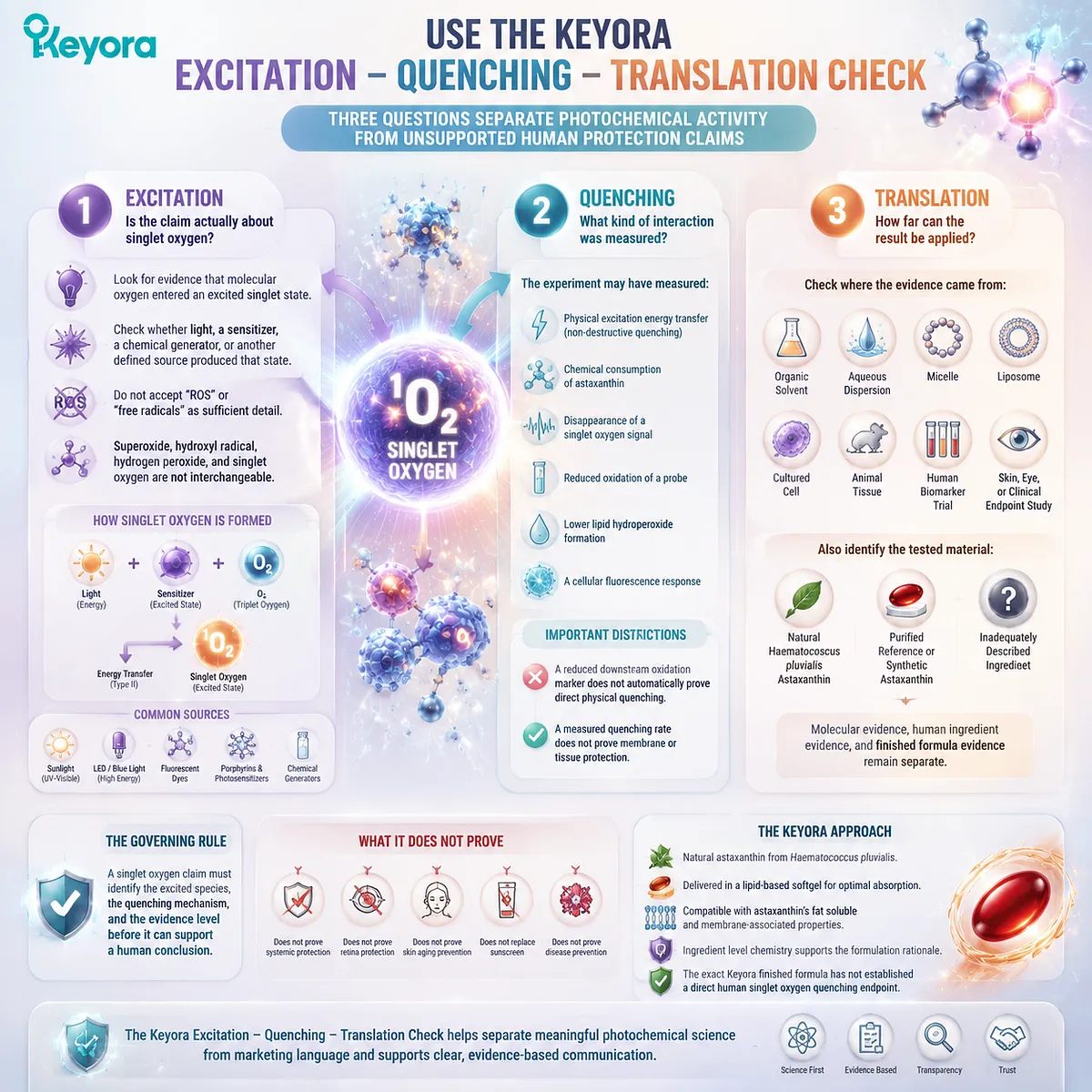
The Keyora Excitation – Quenching – Translation Check provides a practical way to evaluate singlet oxygen claims.
1. Excitation
Is the claim actually about singlet oxygen?
Look for evidence that molecular oxygen entered an excited singlet state. Check whether light, a sensitizer, a chemical generator, or another defined source produced that state.
Do not accept “ROS” or “free radicals” as sufficient detail. Superoxide, hydroxyl radical, hydrogen peroxide, and singlet oxygen are not interchangeable.
2. Quenching
What kind of interaction was measured?
The experiment may have measured:
-
physical excitation energy transfer
-
chemical consumption of astaxanthin
-
disappearance of a singlet oxygen signal
-
reduced oxidation of a probe
-
lower lipid hydroperoxide formation
-
a cellular fluorescence response
These endpoints answer different questions. A reduced downstream oxidation marker does not automatically prove direct physical quenching, while a measured quenching rate does not prove membrane or tissue protection.
3. Translation
How far can the result be applied?
Check whether the evidence came from:
-
an organic solvent
-
an aqueous dispersion
-
a micelle
-
a liposome
-
a cultured cell
-
an animal tissue
-
a human biomarker trial
-
a skin, eye, or clinical endpoint study
Also identify the tested material. Purified synthetic astaxanthin can be useful for molecular photochemistry, but its result does not establish clinical equivalence with traceable natural Haematococcus pluvialis astaxanthin. Molecular evidence, human ingredient evidence, and finished formula evidence remain separate.
The governing rule is:
A singlet oxygen claim must identify the excited species, the quenching mechanism, and the evidence level before it can support a human conclusion.
Keyora uses natural astaxanthin from Haematococcus pluvialis in a lipid based softgel context. This delivery environment is compatible with astaxanthin’s fat soluble and membrane associated properties, but the exact Keyora finished formula has not established a direct human singlet oxygen quenching endpoint.
Ingredient level chemistry supports the formulation rationale. It does not prove that the finished product prevents photooxidative damage, protects the retina, prevents skin aging, or replaces sunscreen and other established protective measures.
Closing Summary
Singlet oxygen quenching is a meaningful molecular mechanism, but it is not automatic proof of human photoprotection
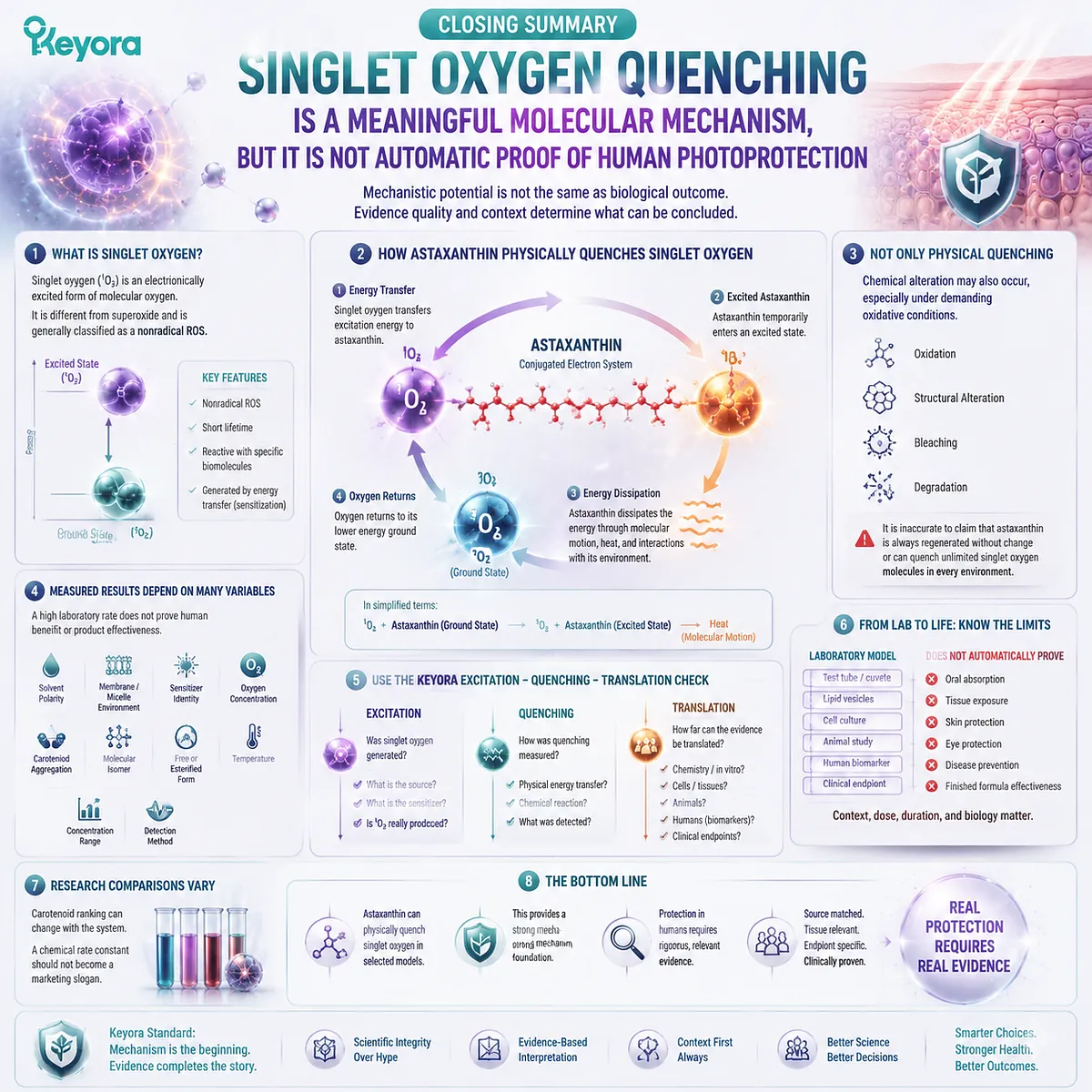
Singlet oxygen is an electronically excited form of molecular oxygen. It is different from superoxide and is generally classified as a nonradical ROS.
Astaxanthin can physically quench singlet oxygen in selected laboratory models by accepting excitation energy through its conjugated electron system and dissipating that energy through molecular motion and heat. Chemical alteration of astaxanthin may also occur, particularly under demanding oxidative conditions.
The measured quenching result depends on the solvent, membrane environment, sensitizer, concentration, molecular form, and assay design. A high laboratory rate does not prove oral absorption, tissue exposure, skin protection, eye protection, disease prevention, or finished formula effectiveness.
Use the Keyora Excitation – Quenching – Translation Check.
Confirm that the experiment generated singlet oxygen, identify what form of quenching was measured, and determine how far the evidence can reasonably be translated.
Astaxanthin’s singlet oxygen chemistry provides a strong mechanism foundation. Human protection still requires source matched, tissue relevant, and endpoint specific clinical evidence.
This article is for educational and informational purposes only. It does not provide medical advice, diagnosis, treatment, cure, prevention, disease outcome claims, hormone restoration claims, fertility outcome claims, or formula-specific clinical efficacy claims.