
Why Is Omega-3 Important for Modern Diet Patterns?
Keyora Research Q&A Library
This is part of the Keyora Research Q&A Series, derived from Keyora Astaxanthin Research Journal Series.
Within the Keyora Astaxanthin Researcn framework, this Q&A translates complex astaxanthin biology into reader-friendly, evidence-bound answers, focusing on natural astaxanthin identity, molecular structure, antioxidant and redox mechanisms, membrane lipid interaction, mitochondrial resilience, inflammatory signaling pathways, human evidence interpretation, and the scientific principles behind responsible supplementation.
First published by Keyora Research Journal: www.keyorahealth.com

Direct Answer
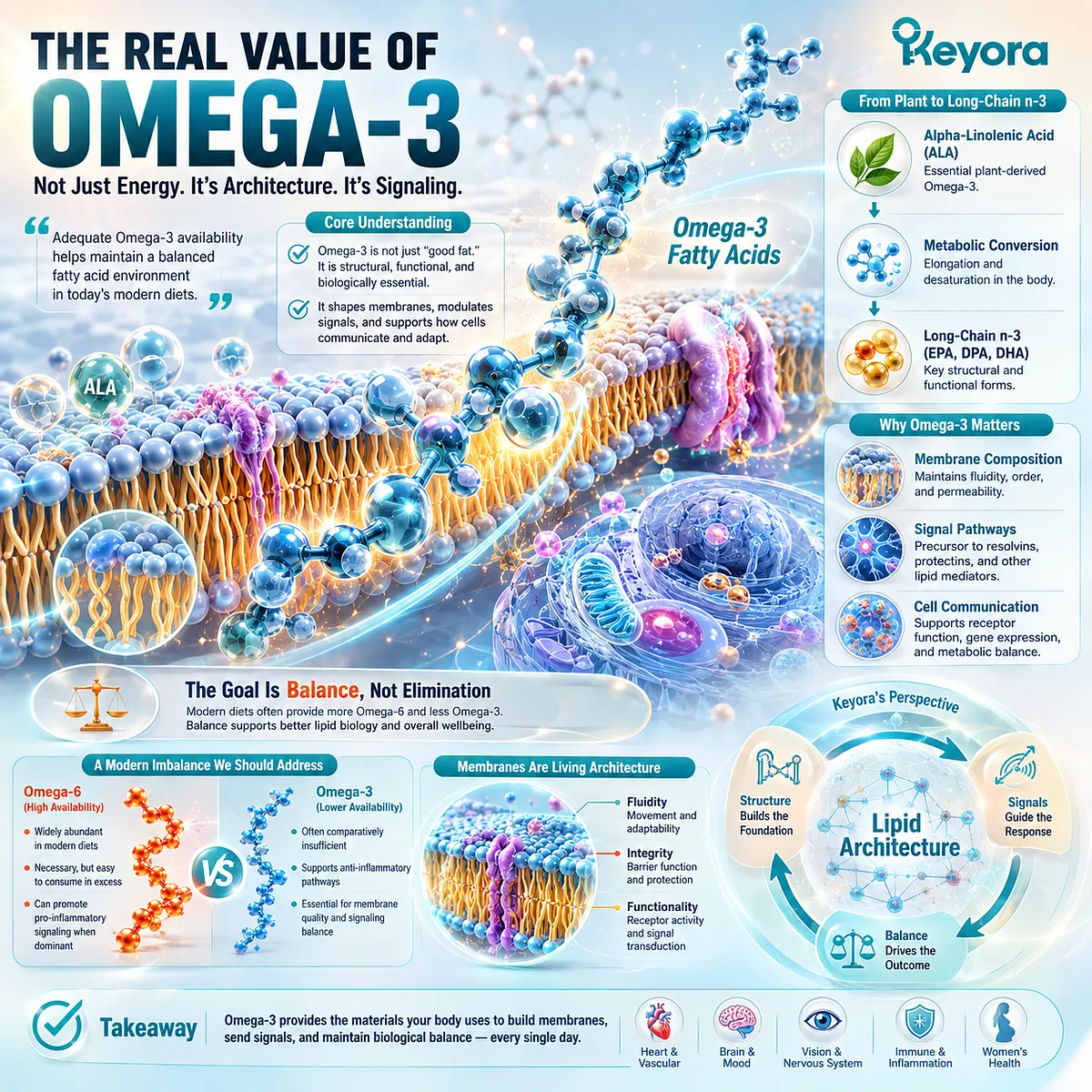
Omega-3 is especially important in modern dietary patterns because many people now consume a lipid environment in which Omega-6 fatty acids are readily available while Omega-3 sources may be comparatively less represented.
The practical nutritional issue is therefore not that Omega-6 must be eliminated, but that adequate Omega-3 availability helps maintain a more balanced fatty acid environment.
Omega-3 fatty acids are also more than sources of dietary energy.
They contribute to membrane phospholipid composition, provide substrates for lipid signaling pathways, and participate in the structural environment through which cells communicate and respond to physiological demands.
Alpha-linolenic acid (ALA), the essential plant-derived Omega-3 fatty acid, must be obtained from the diet and also serves as the metabolic precursor for longer-chain n-3 fatty acids.
This is why the modern nutrition question should not be reduced to “Omega-3 is good and Omega-6 is bad.”
A more useful question is whether the entire dietary fatty acid pattern provides the structural and signaling materials required for balanced lipid biology.
For Keyora, this is the starting point of Lipid Architecture: understanding dietary fats as biological building materials and signaling substrates rather than judging each fatty acid in isolation.
Why Does Omega-3 Matter More in a Modern Dietary Environment?
The importance of Omega-3 increases when the surrounding dietary pattern provides relatively less of it
The significance of Omega-3 cannot be understood without considering the food environment in which it is consumed.
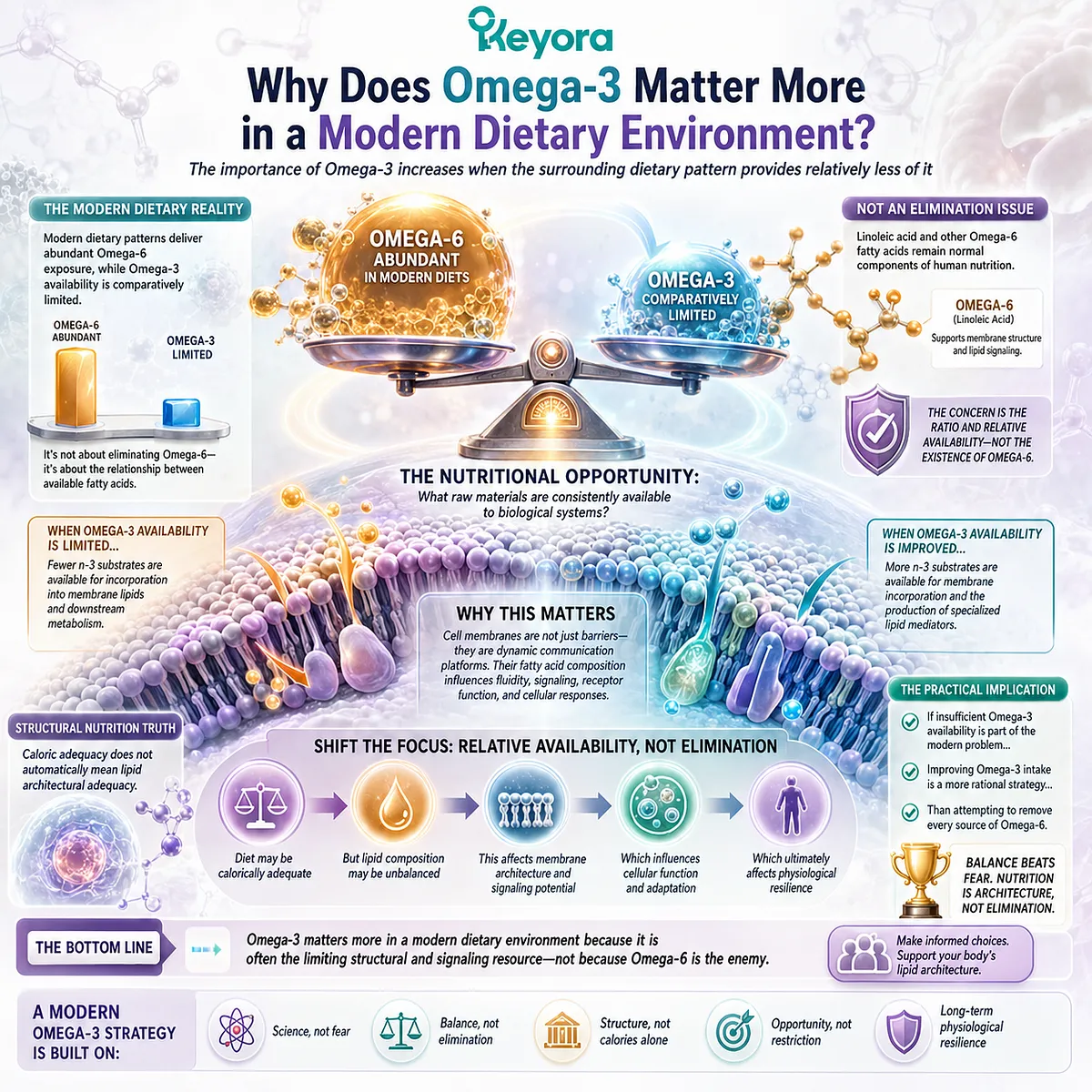
Modern dietary patterns have changed the relative availability of different fatty acids, and the result can be a nutritional landscape where Omega-6 exposure is abundant while Omega-3 availability is comparatively limited.
This does not make Omega-6 inherently harmful.
Linoleic acid and other Omega-6 fatty acids remain normal components of human nutrition and participate in membrane structure and lipid signaling. The concern is the relationship between available fatty acids rather than the existence of one family.
When Omega-3 availability is limited, the body has fewer n-3 substrates available for incorporation into membrane lipids and downstream metabolism. The issue is therefore one of nutritional opportunity: what raw materials are consistently available to biological systems?
This is why modern Omega discussions should focus on relative availability rather than nutrient elimination.
A diet may contain sufficient calories and still provide a lipid environment that is poorly balanced in terms of fatty acid composition.
From a structural nutrition perspective, caloric adequacy does not automatically mean lipid architectural adequacy.
The practical implication is straightforward.
If the modern problem includes insufficient Omega-3 availability, then improving Omega-3 intake is often a more rational nutritional strategy than simply attempting to remove every source of Omega-6.
That distinction protects consumers from one of the most common mistakes in dietary fat discussions: replacing a balance problem with a fear-based elimination strategy.
What Does Omega-3 Do Beyond Providing Calories?
Omega-3 fatty acids act as structural and metabolic components rather than functioning only as energy sources
Dietary fat is often discussed primarily in terms of calories, weight control, or cardiovascular risk.
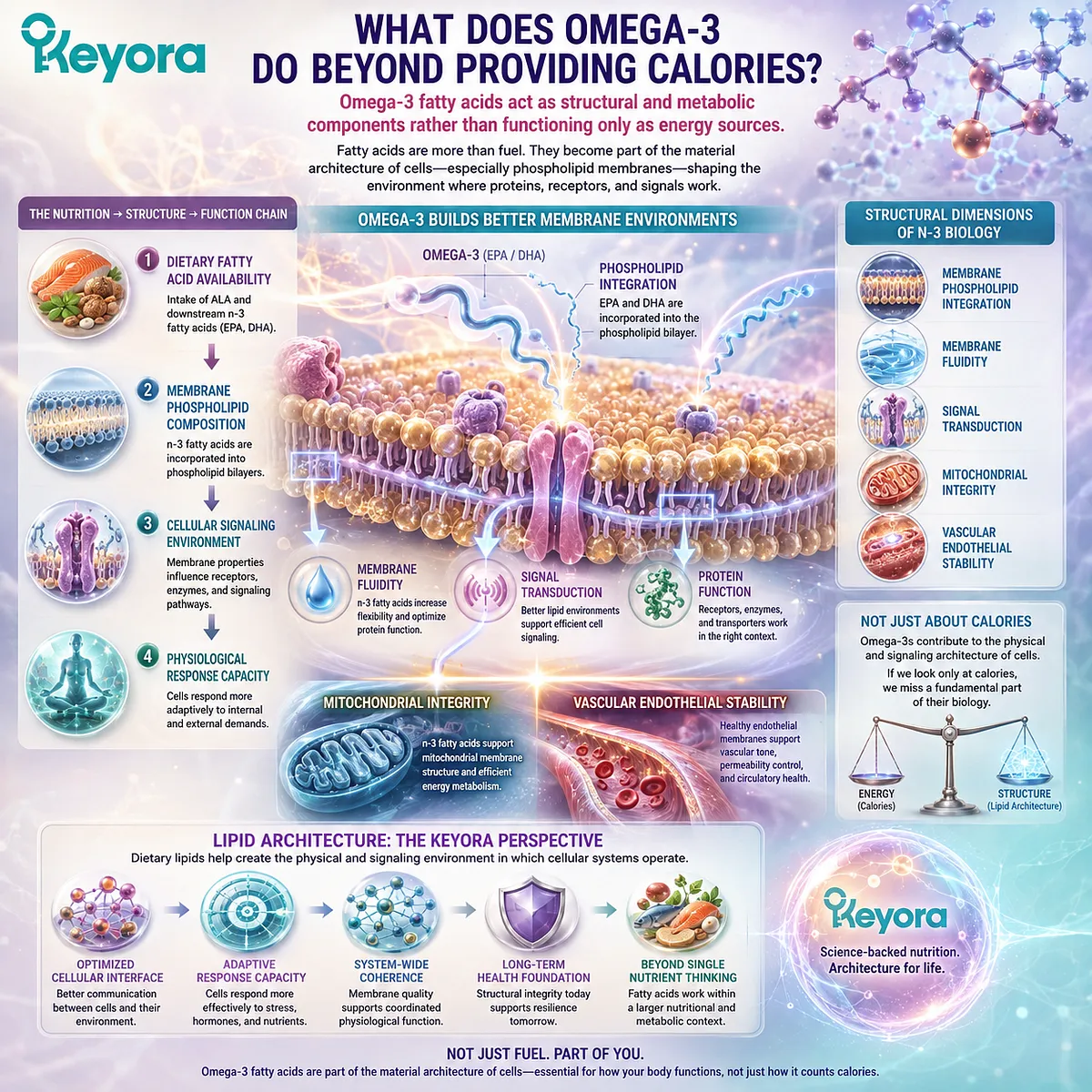
However, fatty acids also become part of biological structures, especially phospholipid membranes.
Cell membranes are not passive shells. They create the physical environment in which membrane proteins, receptors, enzymes, transport systems, and signaling molecules operate. The types of fatty acids incorporated into these membranes therefore contribute to the behavior of the cellular interface.
ALA and its downstream n-3 fatty acids participate in this broader lipid architecture.
The ALA source material used in the EP-3 knowledge base specifically identifies membrane phospholipid integration, membrane fluidity, signal transduction, mitochondrial integrity, and vascular endothelial stability as important structural dimensions of n-3 biology.
The concept can be simplified:
Dietary fatty acid availability
↓
Membrane phospholipid composition
↓
Cellular signaling environment
↓
Physiological response capacity
This does not mean that changing one dietary fatty acid instantly restructures every membrane in the body. Biological lipid composition reflects a larger nutritional and metabolic context.
But it does mean that fatty acids should not be interpreted only through an energy-balance model. They are part of the material architecture of cells.
This is a central reason Omega-3 matters in modern diets. If the discussion focuses only on calories, an important part of fatty acid biology disappears from view.
Keyora refers to this broader structural interpretation as Lipid Architecture: the idea that dietary lipids help create the physical and signaling environment in which cellular systems operate.
Why Is ALA an Important Part of the Modern Omega-3 Question?
ALA is an essential dietary Omega-3 and the metabolic starting point for longer-chain n-3 fatty acid pathways
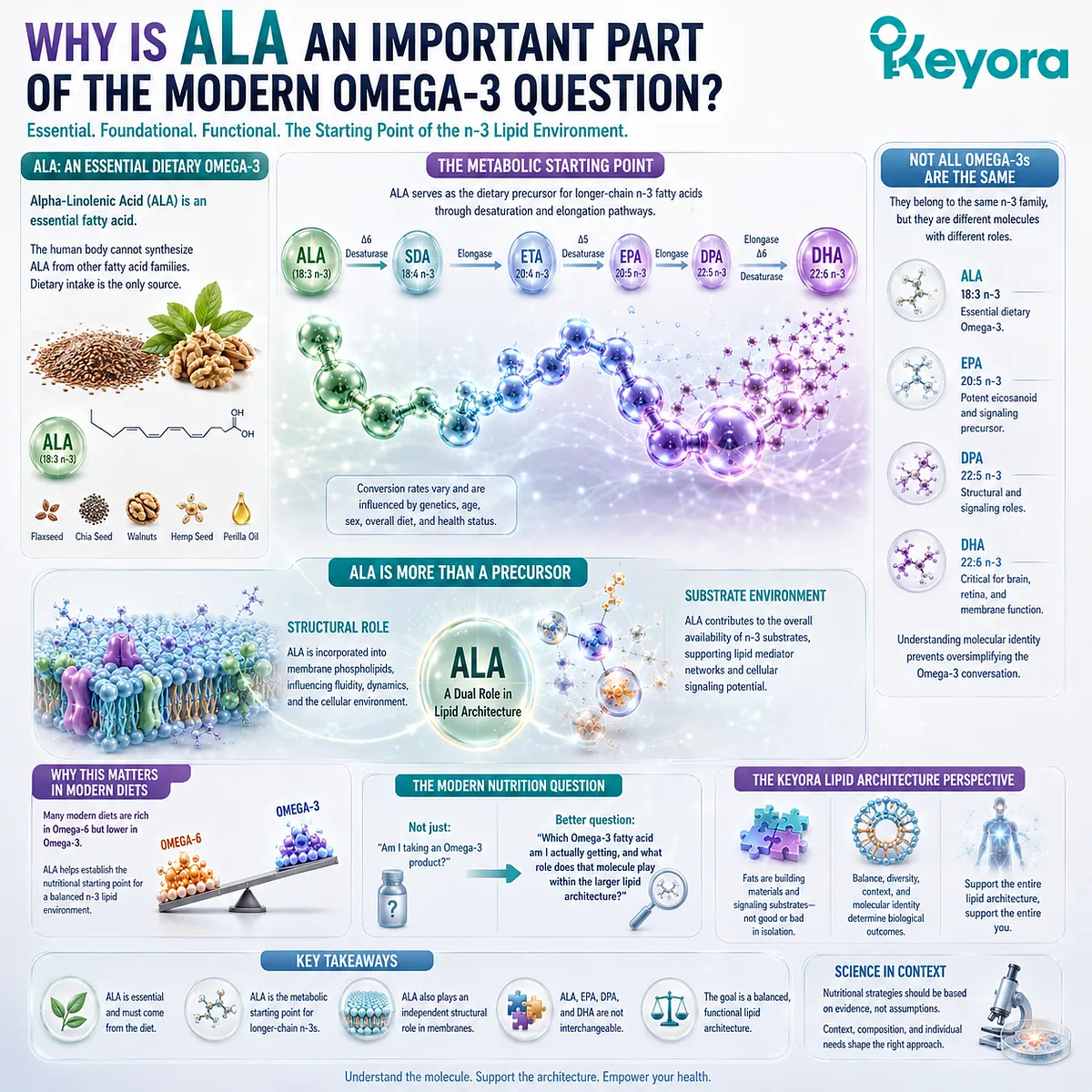
Alpha-linolenic acid deserves particular attention because it is an essential fatty acid. Humans cannot synthesize ALA from other fatty acid families and therefore depend on dietary intake to provide it.
ALA is also metabolically important because it serves as the dietary precursor from which longer-chain n-3 fatty acids can be produced through desaturation and elongation pathways. This connects dietary Omega-3 availability with a broader network of n-3 lipid metabolism.
However, ALA should not be interpreted only as a precursor.
Within the Keyora EP-3 source architecture, ALA also has an independent structural role. It participates in membrane lipid composition and contributes to the n-3 substrate environment available to cells.
This distinction matters because consumer discussions often collapse all Omega-3 fatty acids into a single category.
ALA, EPA, DPA, and DHA belong to the same n-3 family, but they are not identical molecules with identical biological roles.
Understanding molecular identity prevents another common mistake: assuming that the word “Omega-3” alone tells you everything about a food or supplement.
For modern dietary interpretation, ALA therefore represents two connected ideas.
First, it is an essential nutrient that must come from the diet.
Second, it helps establish the nutritional starting point for the broader n-3 lipid environment.
This makes ALA particularly relevant when discussing modern diets that may provide insufficient Omega-3 relative to the rest of the fatty acid landscape.
The useful question is therefore not simply, “Am I taking an Omega-3 product?”
It is also:
Which Omega-3 fatty acid am I actually getting, and what role does that molecule play within the larger lipid architecture?
Why Does Omega-3 Availability Matter for Lipid Signaling?
Different fatty acids contribute to different signaling environments, so substrate availability helps shape biological regulation
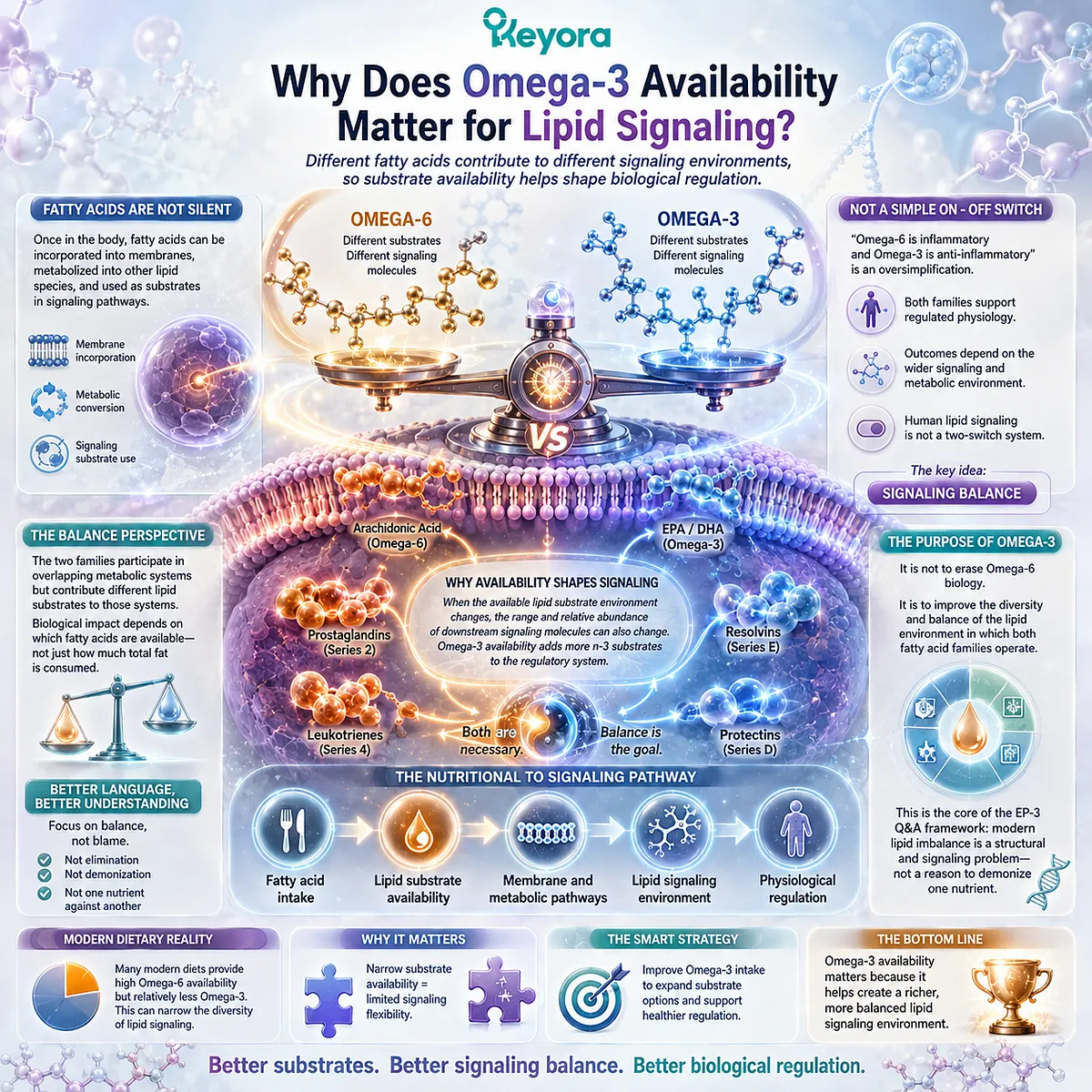
Fatty acids do not remain biologically silent after entering the body. They can be incorporated into membranes, metabolized into other lipid species, and used as substrates within signaling pathways.
This is one reason the balance between Omega-3 and Omega-6 deserves attention.
The two families participate in overlapping metabolic systems but contribute different lipid substrates to those systems. The resulting biological environment is therefore influenced not only by how much total fat is consumed, but by which fatty acids are available.
This is where overly simple language such as “Omega-6 is inflammatory and Omega-3 is anti-inflammatory” becomes misleading.
Human lipid signaling is not a two-switch system where one family turns inflammation on and the other turns it off. Both fatty acid families participate in regulated physiology, and the biological outcome depends on the wider signaling and metabolic environment.
The more useful concept is signaling balance.
When the available lipid substrate environment changes, the range and relative abundance of downstream signaling molecules can also change. Omega-3 availability therefore matters because it contributes additional n-3 substrates to this regulatory system.
This supports a more sophisticated nutritional interpretation:
Fatty acid intake
↓
Lipid substrate availability
↓
Membrane and metabolic pathways
↓
Lipid signaling environment
↓
Physiological regulation
The purpose of increasing Omega-3 is not to erase Omega-6 biology.
It is to improve the diversity and balance of the lipid environment in which both fatty acid families operate.
That distinction is central to the EP-3 Q&A framework, which explicitly treats modern lipid imbalance as a structural and signaling problem rather than a justification for demonizing one nutrient.
Why Can Increasing Omega-3 Be More Useful Than Simply Cutting Omega-6?
Correcting what is relatively lacking is often more useful than treating an essential nutrient as the enemy
Once modern lipid imbalance is understood correctly, the practical strategy becomes clearer.
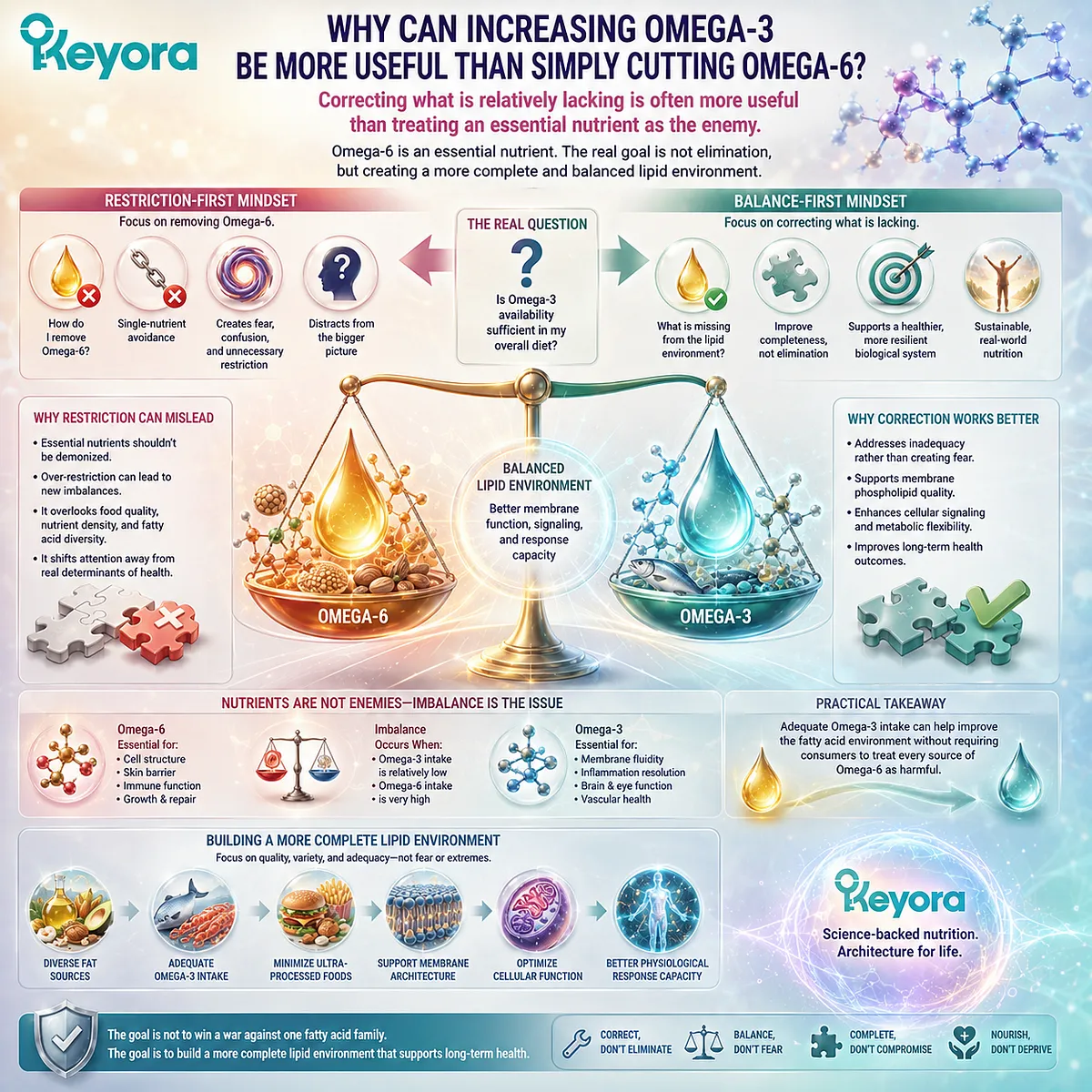
If Omega-6 is an essential component of human nutrition, then eliminating Omega-6 cannot be the primary objective. The more logical nutritional approach is to ask whether Omega-3 availability is sufficient within the overall dietary pattern.
This changes the decision framework from restriction to correction.
A restriction-first model asks:
“How do I remove Omega-6?”
A balance-first model asks:
“What is missing from the lipid environment, and how can I improve it?”
That difference matters because aggressive single-nutrient avoidance can create its own misunderstandings.
It can also distract consumers from the larger determinants of dietary quality, including the diversity of fat sources, total food pattern, nutrient density, and the actual identity of the fatty acids being consumed.
The Q&A writing framework for EP-3 specifically establishes that nutrients should not be demonized and that the concern should be framed as imbalance rather than Omega-6 itself.
This produces a more useful practical conclusion:
Adequate Omega-3 intake can help improve the fatty acid environment without requiring consumers to treat every source of Omega-6 as harmful.
That does not mean intake quantity is irrelevant, nor does it mean every dietary pattern requires the same adjustment. It means the direction of reasoning should begin with adequacy and balance rather than fear.
For consumers trying to make sense of conflicting online advice, this distinction is important.
The goal is not to win a war against one fatty acid family.
The goal is to build a more complete lipid environment.
How Does Omega-3 Connect With Structural and Oxidative Resilience?
A functional lipid environment requires both appropriate structural materials and protection against oxidative challenge
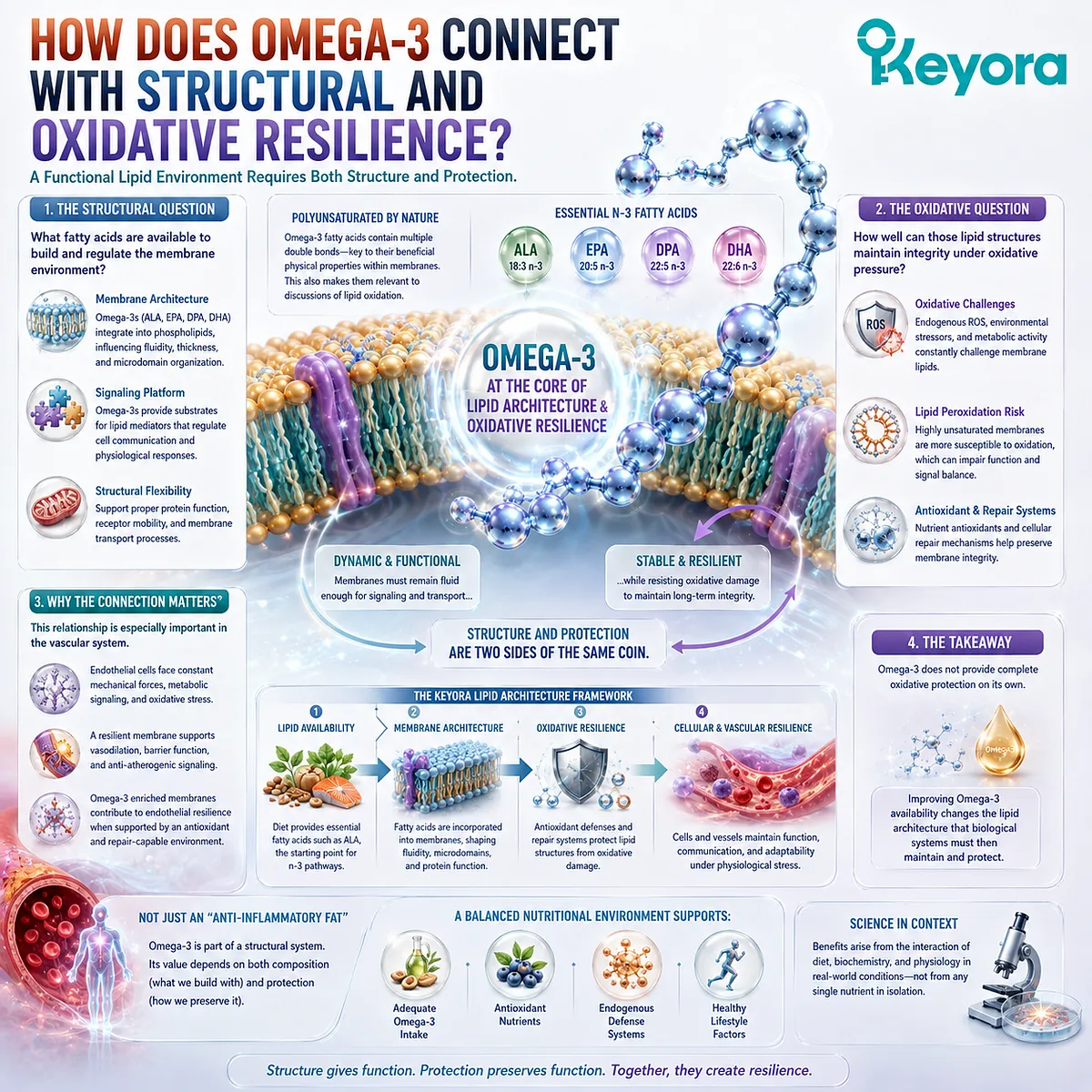
Omega-3 fatty acids contribute to membrane architecture, but membrane biology cannot be separated from oxidative conditions.
Polyunsaturated fatty acids contain multiple double bonds, which are important for their physical properties within lipid structures.
At the same time, highly unsaturated lipid environments are relevant to discussions of lipid oxidation and membrane stability.
This is why EP-3 connects Lipid Architecture with Oxidative Resilience rather than treating them as separate nutritional topics.
The structural question asks:
What fatty acids are available to build and regulate the membrane environment?
The oxidative question asks:
How well can those lipid structures maintain integrity when exposed to oxidative pressure?
The two questions belong together.
A biologically useful membrane must remain sufficiently dynamic for signaling while also maintaining structural stability. The nutritional environment therefore involves more than simply adding more unsaturated fat.
This relationship becomes particularly important in the vascular system, where endothelial cells are continuously exposed to mechanical forces, metabolic signaling, and oxidative challenges. EP-3 uses this connection as a bridge from fatty acid architecture toward its larger discussion of endothelial resilience.
At this stage, the important takeaway is not that Omega-3 alone provides complete oxidative protection.
It does not.
The more accurate interpretation is that improving Omega-3 availability changes the lipid architecture that biological systems must then maintain and protect.
This creates the next level of the Keyora framework:
Lipid availability
↓
Membrane architecture
↓
Oxidative resilience
↓
Cellular and vascular resilience
Omega-3 therefore matters not as an isolated “anti-inflammatory fat,” but as part of a structural system whose function depends on both composition and protection.
What Should “Getting More Omega-3” Mean in Practice?
A useful Omega-3 strategy considers fatty acid identity, dietary context, and overall lipid balance rather than chasing one ratio or one marketing claim
“Get more Omega-3” sounds simple, but responsible nutritional interpretation requires more precision.
The first question is molecular identity.
ALA, EPA, DPA, and DHA are all Omega-3 fatty acids, but they are not interchangeable labels for the same molecule.
Each occupies a different position within n-3 metabolism and lipid biology.
The second question is dietary context.
Increasing Omega-3 should be interpreted within the complete dietary pattern rather than as permission to ignore every other aspect of nutrition. A supplement cannot automatically compensate for an otherwise poor food environment, and a single fatty acid ratio cannot describe the entire biological condition of an individual.
The third question is balance.
Modern lipid nutrition should not become a competition where the goal is to maximize Omega-3 while minimizing Omega-6 to the lowest possible level.
Both fatty acid families participate in normal physiology.
The more useful goal is adequate Omega-3 availability within a nutritionally complete lipid environment.
For consumers, this produces a practical evaluation sequence:
What Omega-3 molecule am I getting?
↓
Is my overall diet providing meaningful Omega-3 availability?
↓
Am I evaluating Omega-6 and Omega-3 together rather than demonizing one side?
↓
Does the broader lipid environment support structural and oxidative resilience?
This is the central conclusion of Q007.
Omega-3 matters in modern diets because the nutritional problem is often not that Omega-6 exists, but that Omega-3 availability is too limited to support a balanced lipid environment.
The next question is therefore no longer simply whether Omega-3 is important.
It is more specific:
How does Omega-3/Omega-6 balance influence cardiovascular and endothelial health?
That is where the EP-3 framework moves from lipid architecture into vascular architecture.

This article is for educational and informational purposes only. It does not provide medical advice, diagnosis, treatment, cure, prevention, disease outcome claims, hormone restoration claims, fertility outcome claims, or formula-specific clinical efficacy claims.