
Why Is Nitric Oxide Important for Healthy Blood Flow?
Keyora Research Q&A Library
This is part of the Keyora Research Q&A Series, derived from Keyora Astaxanthin Research Journal Series.
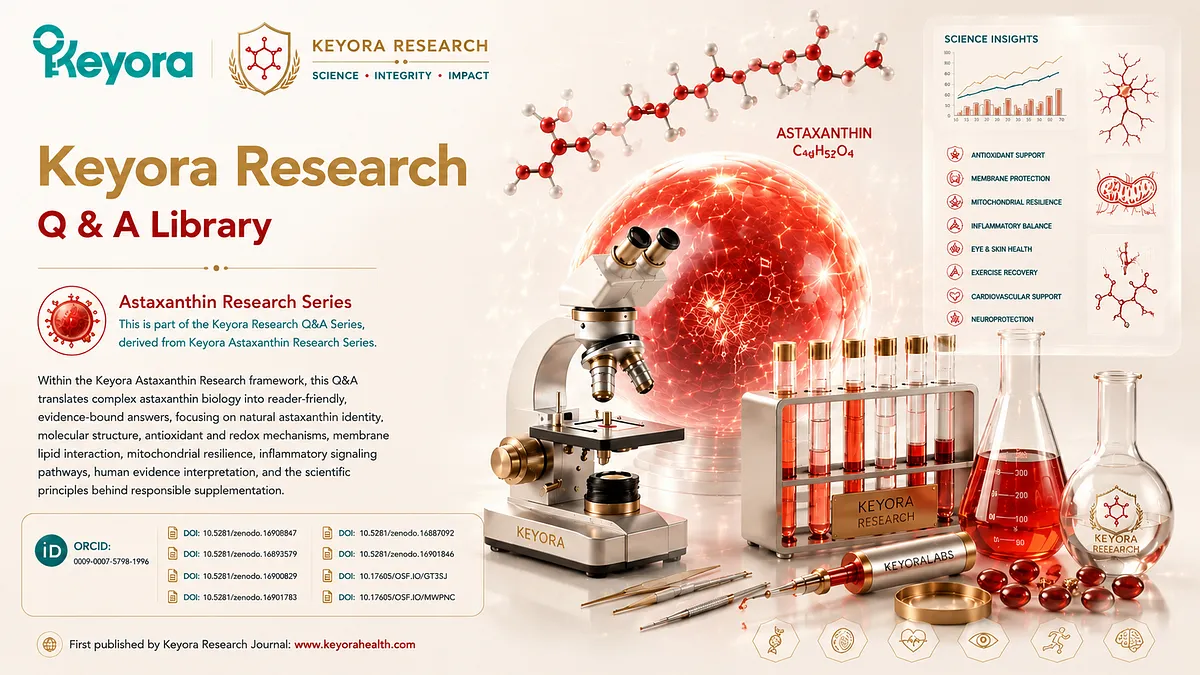
Within the Keyora Astaxanthin Researcn framework, this Q&A translates complex astaxanthin biology into reader-friendly, evidence-bound answers, focusing on natural astaxanthin identity, molecular structure, antioxidant and redox mechanisms, membrane lipid interaction, mitochondrial resilience, inflammatory signaling pathways, human evidence interpretation, and the scientific principles behind responsible supplementation.
First published by Keyora Research Journal: www.keyorahealth.com
Direct Answer
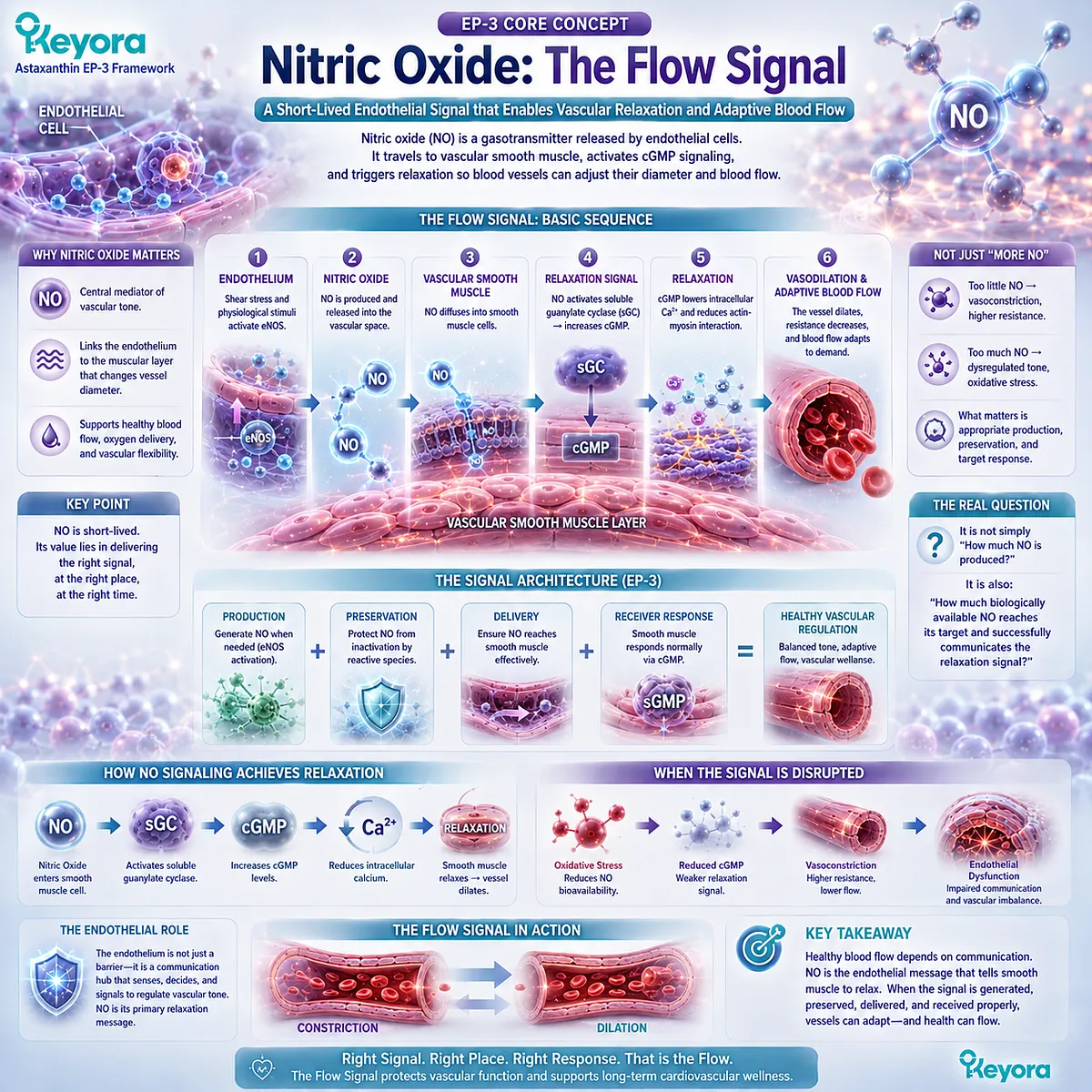
Nitric oxide is a short lived endothelial signal that helps vascular smooth muscle relax so blood vessels can adjust their diameter and blood flow
Nitric oxide, usually abbreviated as NO, is important for healthy blood flow because it acts as a signaling molecule between the vascular endothelium and the smooth muscle surrounding an artery.
In Keyora Astaxanthin EP-3, nitric oxide is positioned at the center of what the source calls The Flow Signal. The source describes NO as a gasotransmitter involved in vasodilation and presents a basic pathway in which endothelial cells release NO, NO reaches vascular smooth muscle, cGMP signaling is activated, the smooth muscle relaxes, and the vessel dilates.
The basic sequence is:
Endothelium
↓
Nitric Oxide
↓
Vascular Smooth Muscle
↓
Relaxation
↓
Vasodilation
↓
Adaptive Blood Flow
This does not mean that more nitric oxide is always better.
Healthy vascular regulation depends on the ability to generate an appropriate NO signal when needed, preserve enough of that signal for it to remain biologically available, and allow the receiving smooth muscle to respond normally.
This distinction is central to the EP-3 Signal Architecture.
The important question is not simply:
How much NO is produced?
It is also:
How much biologically available NO reaches its target and successfully communicates the relaxation signal?
That is why nitric oxide matters so much to endothelial function. It links the inner vascular lining with the muscular layer that actually changes vessel diameter.
Healthy blood flow therefore depends not only on vascular structure, but also on communication.
How Does Nitric Oxide Tell a Blood Vessel to Relax?
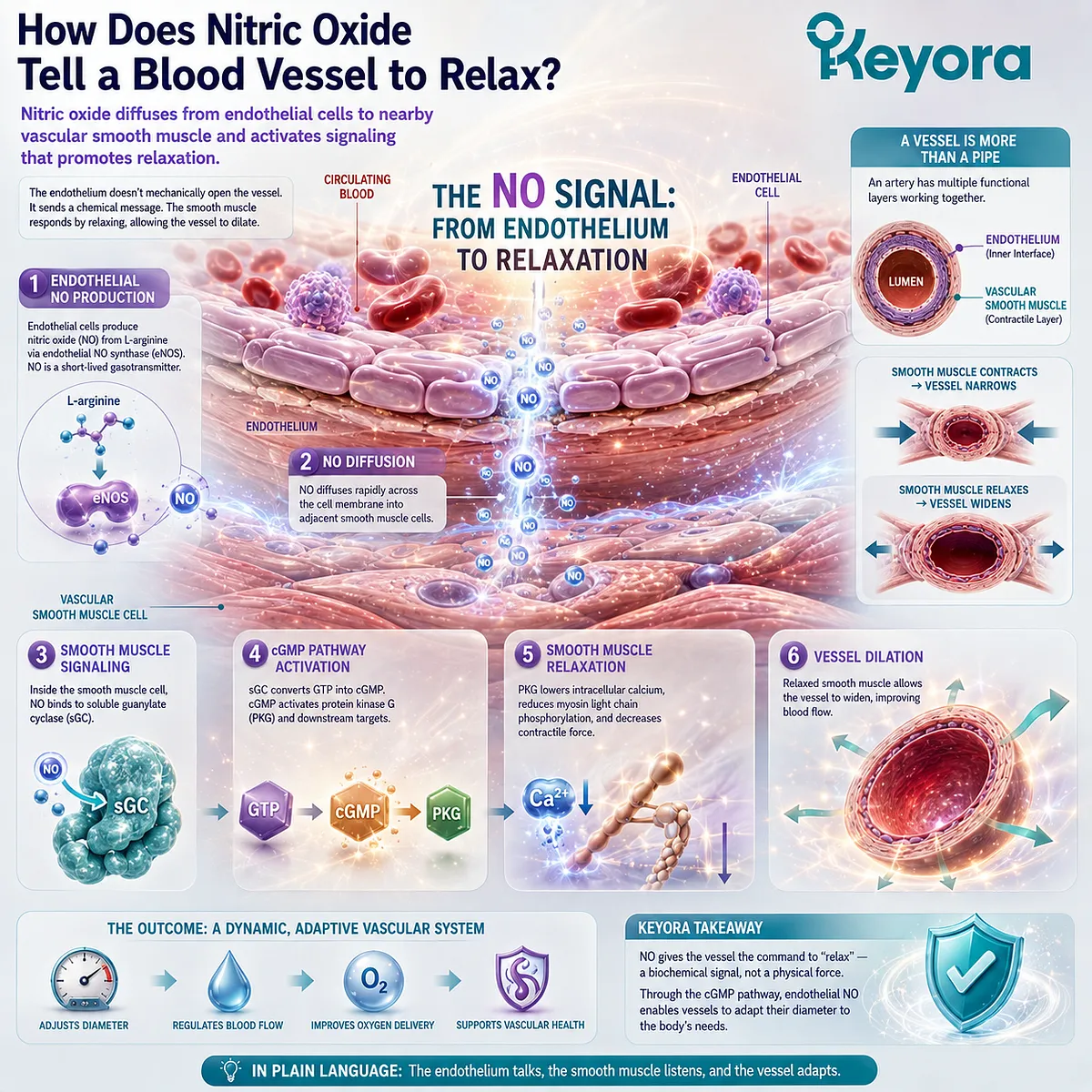
Nitric oxide diffuses from endothelial cells to nearby vascular smooth muscle and activates signaling that promotes relaxation
An artery contains more than one functional layer.
The endothelium forms the inner cellular interface in contact with circulating blood. Outside that layer sits vascular smooth muscle, which can contract or relax and thereby change the diameter of the vessel.
EP-3 describes this relationship clearly. When vascular smooth muscle contracts, the vessel narrows. When the muscle relaxes, the vessel widens. The source then identifies nitric oxide as one of the endothelial signals that communicates the instruction to relax.
The signaling pathway can be simplified as:
Endothelial NO production
↓
NO diffusion
↓
Smooth muscle signaling
↓
cGMP pathway activation
↓
Smooth muscle relaxation
↓
Vessel dilation
The source specifically describes NO diffusing into smooth muscle cells and activating the cGMP pathway.
This is important because the endothelial cell does not physically force the artery open.
It sends a chemical message.
The vascular smooth muscle then changes its contractile state in response to that message.
Keyora EP-3 uses the metaphor that NO gives the vessel the command to “relax.” That is a useful explanatory model if it is understood as biochemical signaling rather than a literal command.
The result is a vascular system capable of adjusting diameter instead of remaining fixed.
This is one reason blood vessels should not be understood as static pipes.
Their diameter can change dynamically through coordinated signaling between the endothelial layer and vascular smooth muscle.
Nitric oxide is one of the key signals that makes that adaptation possible.
Why Does Blood Flow Need a Dynamic Nitric Oxide Signal?
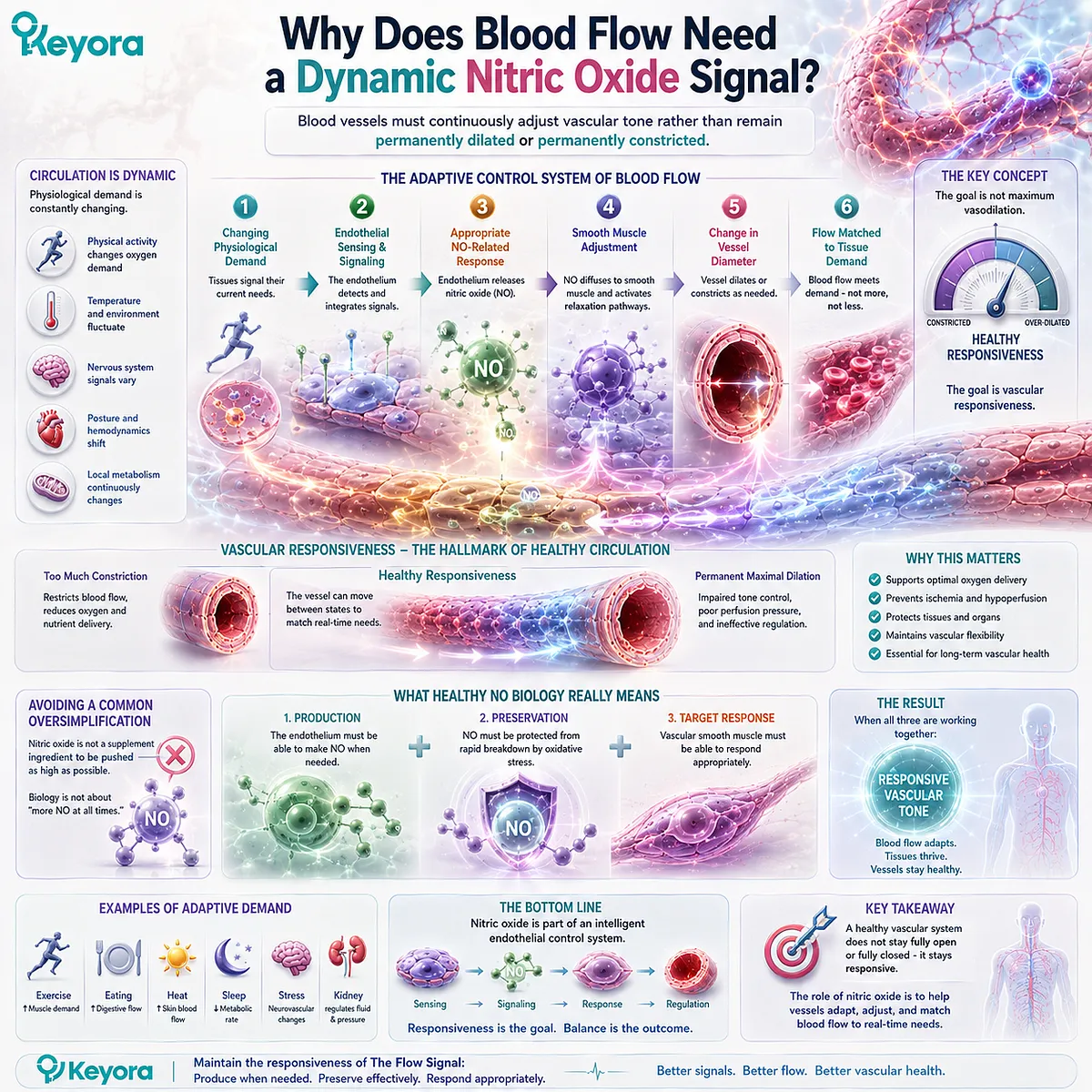
Blood vessels must continuously adjust vascular tone rather than remain permanently dilated or permanently constricted
Healthy circulation does not require blood vessels to stay maximally open.
It requires them to respond appropriately to changing physiological demands.
Keyora EP-3 describes the cardiovascular system as a dynamic network that must continually adjust pressure and flow.
During physical activity, tissue oxygen demand changes.
During rest, demand changes again.
Temperature, posture, local metabolic activity, nervous system signals, and many other factors can alter vascular requirements.
The endothelium contributes to this adaptability through signals such as nitric oxide.
The useful concept is therefore not:
maximum vasodilation
but:
Vascular Responsiveness
A healthy vascular system needs the ability to move between different states.
Too much constriction can restrict flow.
But permanent maximal dilation would not represent normal physiological regulation either.
The role of NO is better understood as part of an adaptive control system.
Changing physiological demand
↓
Endothelial sensing and signaling
↓
Appropriate NO related response
↓
Smooth muscle adjustment
↓
Change in vessel diameter
↓
Flow matched more closely to tissue demand
This distinction also prevents a common oversimplification in supplement language.
Nitric oxide should not be treated as though it were simply an ingredient that needs to be pushed as high as possible.
The biological objective is not “more NO at all times.”
The objective is effective endothelial signaling.
Within the Keyora framework, healthy NO biology therefore means maintaining the responsiveness of The Flow Signal.
Production matters.
Preservation matters.
Target response matters.
Together, these determine whether nitric oxide can participate effectively in adaptive vascular regulation.
What Is eNOS and How Is Nitric Oxide Produced?
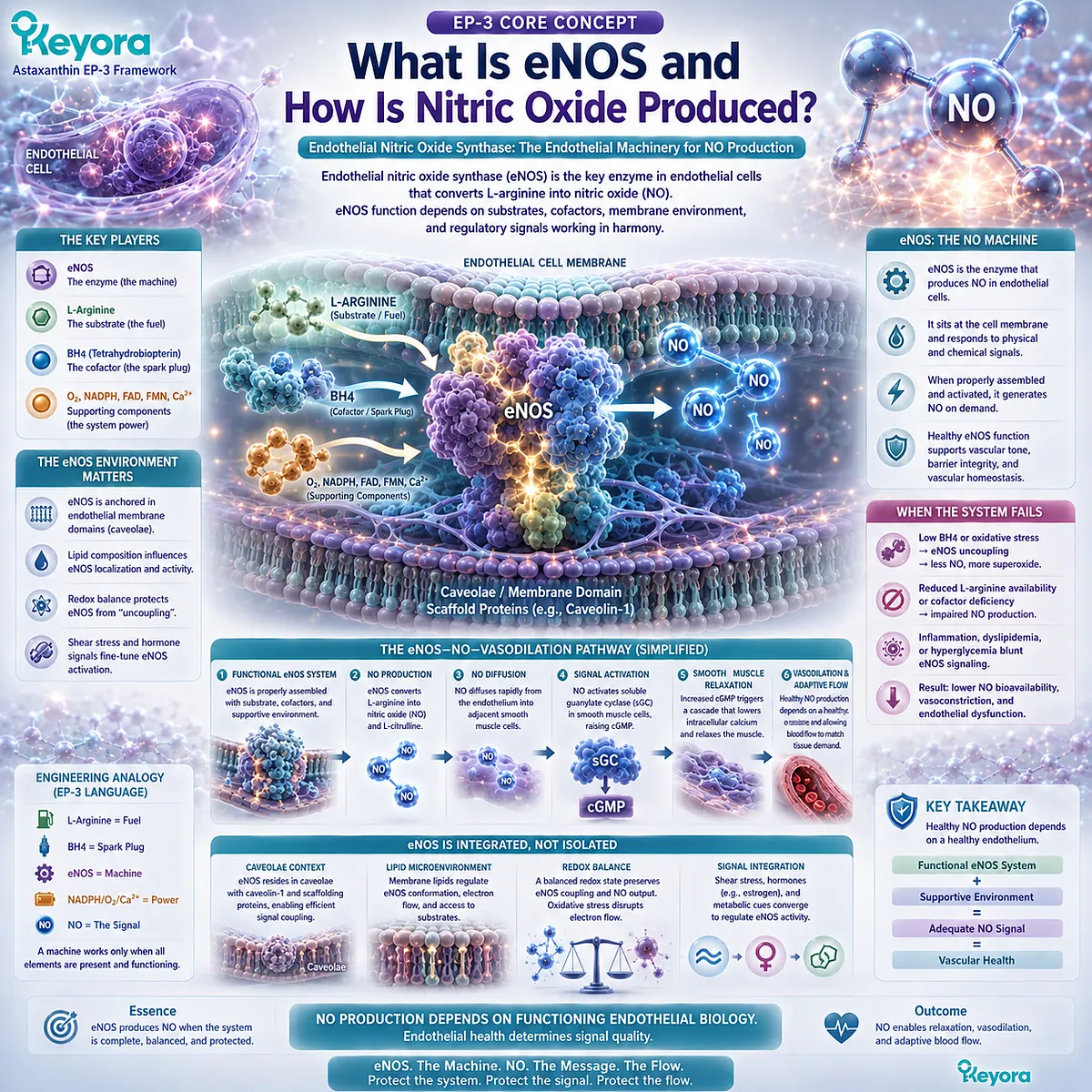
Endothelial nitric oxide synthase is part of the endothelial machinery responsible for generating nitric oxide
The endothelial enzyme most closely associated with vascular nitric oxide production is endothelial nitric oxide synthase, usually abbreviated as eNOS.
EP-3 presents eNOS as the endothelial machinery responsible for generating NO and identifies L-Arginine and tetrahydrobiopterin, or BH4, as important components of normal eNOS related function.
The source uses mechanical language such as “machine,” “fuel,” and “spark plug” to explain this pathway.
For scientific interpretation, the underlying point is more important than the metaphor.
Normal eNOS function depends on an appropriate biochemical environment, including its substrates, cofactors, membrane context, and regulatory state.
A simplified pathway is:
Functional eNOS system
appropriate substrate and cofactors
↓
Nitric Oxide production
↓
NO diffusion toward vascular smooth muscle
↓
vasodilation signaling
EP-3 also emphasizes that eNOS does not operate in isolation.
The enzyme is associated with endothelial membrane domains, and the surrounding lipid and redox environment can influence its regulation. The source later discusses caveolae and membrane related eNOS signaling as part of its broader Signal Architecture.
For Q023, the important lesson is simple:
NO production depends on functioning endothelial biology.
Nitric oxide is therefore not separate from endothelial health.
If the endothelial environment becomes dysfunctional, the quality of NO related signaling can also change.
This is one reason Q023 follows Q022.
Endothelial dysfunction matters partly because the endothelium is responsible for producing and regulating signals such as nitric oxide.
Why Does Nitric Oxide Bioavailability Matter as Much as Nitric Oxide Production?
Producing nitric oxide is not enough if oxidative reactions reduce the amount of NO available to reach vascular smooth muscle
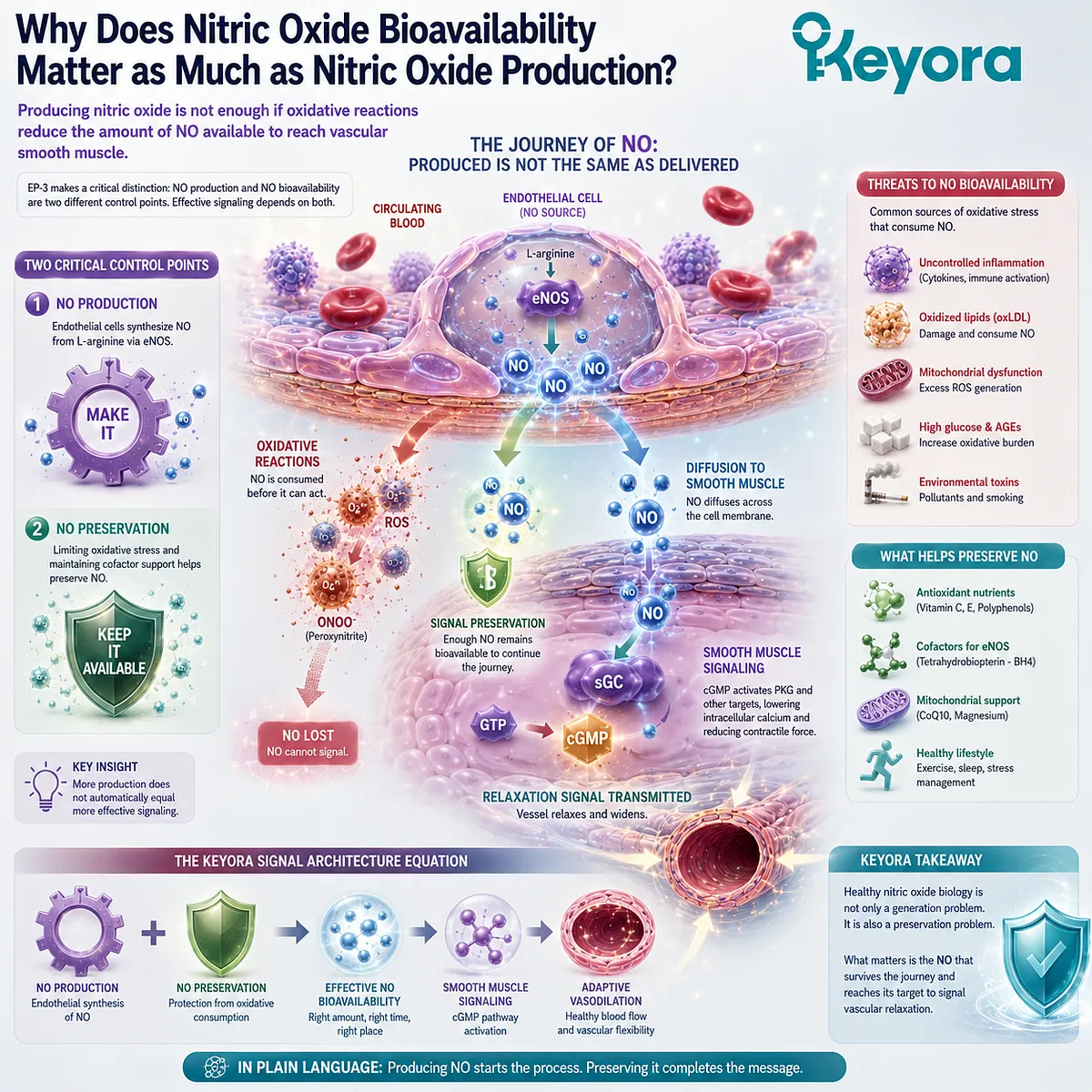
One of the most important ideas in EP-3 is the distinction between NO production and NO bioavailability.
A cell may produce nitric oxide, but that does not automatically mean every NO molecule successfully reaches its vascular smooth muscle target.
EP-3 repeatedly emphasizes the need to preserve nitric oxide bioavailability.
This gives the NO pathway two different control points:
Production
and
Preservation
The distinction can be represented as:
NO produced by endothelium
↓
some NO remains biologically available
↓
NO reaches vascular smooth muscle
↓
relaxation signal is transmitted
If oxidative reactions consume NO before it reaches the target, the biological effect can be reduced even though NO production initially occurred.
This is why EP-3 focuses so strongly on what it calls Signal Preservation.
The concept is useful because it prevents an overly simple interpretation:
More production does not automatically equal more effective signaling.
In vascular biology, what matters is whether enough biologically active NO remains available at the right location and for long enough to participate in smooth muscle signaling.
The term bioavailability therefore refers to more than synthesis alone.
It includes the fraction of NO that remains functionally available to perform its signaling role.
Within the Keyora Signal Architecture, this gives us a more complete equation:
NO Production
NO Preservation
↓
Effective NO Bioavailability
↓
Smooth Muscle Signaling
↓
Adaptive Vasodilation
This is one of the most important conceptual upgrades in Q023.
Healthy nitric oxide biology is not only a generation problem.
It is also a preservation problem.
How Can Superoxide Interfere With the Nitric Oxide Signal?
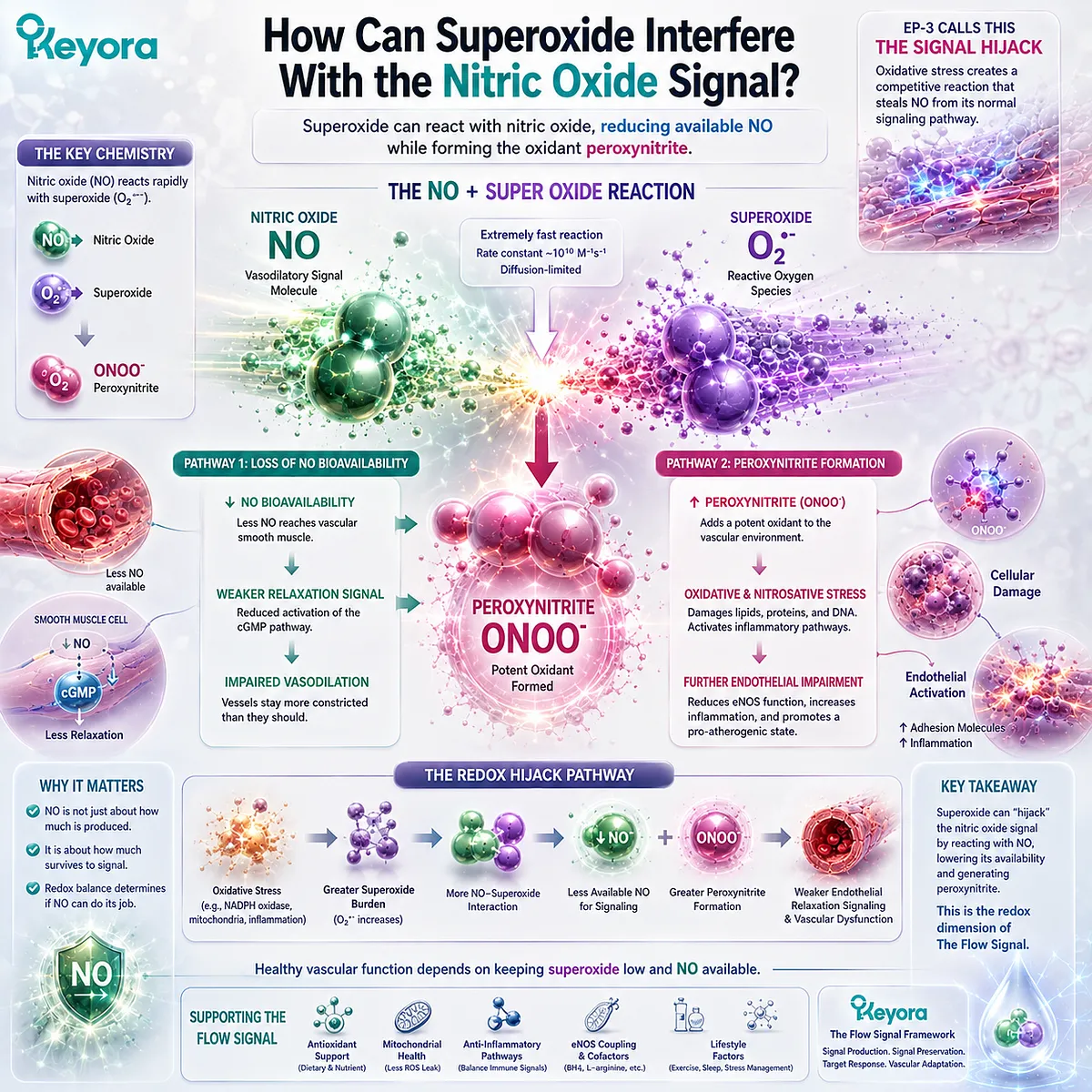
Superoxide can react with nitric oxide, reducing available NO while forming the oxidant peroxynitrite
EP-3 calls oxidative interference with NO The Signal Hijack.
The underlying chemistry is the reaction between nitric oxide and superoxide.
The source summarizes the pathway as:
Nitric Oxide
Superoxide
↓
Peroxynitrite
and links this reaction with reduced NO availability for vascular smooth muscle signaling.
The scientific meaning is straightforward.
When superoxide concentrations rise in the vascular environment, nitric oxide can react with superoxide instead of remaining available for its normal signaling role.
The consequence has two parts.
First:
NO bioavailability can fall
which can weaken the relaxation signal reaching smooth muscle.
Second:
peroxynitrite is formed
which adds another reactive species to the local redox environment.
EP-3 uses dramatic language such as NO being “stolen” or the signal being “hijacked.”
Those phrases are best understood as Keyora explanatory metaphors.
The underlying pathway is:
Oxidative stress
↓
greater superoxide burden
↓
more NO – superoxide interaction
↓
less available NO
greater peroxynitrite formation
↓
weaker endothelial relaxation signaling
This mechanism helps explain why nitric oxide biology cannot be separated from redox biology.
It also connects Q023 back to earlier Q&A questions about oxidative stress and antioxidant support.
The issue is not simply whether NO exists.
The issue is whether the surrounding biochemical environment allows the NO signal to survive long enough to perform its vascular function.
This is the redox dimension of The Flow Signal.
What Is eNOS Uncoupling and Why Does BH4 Matter?
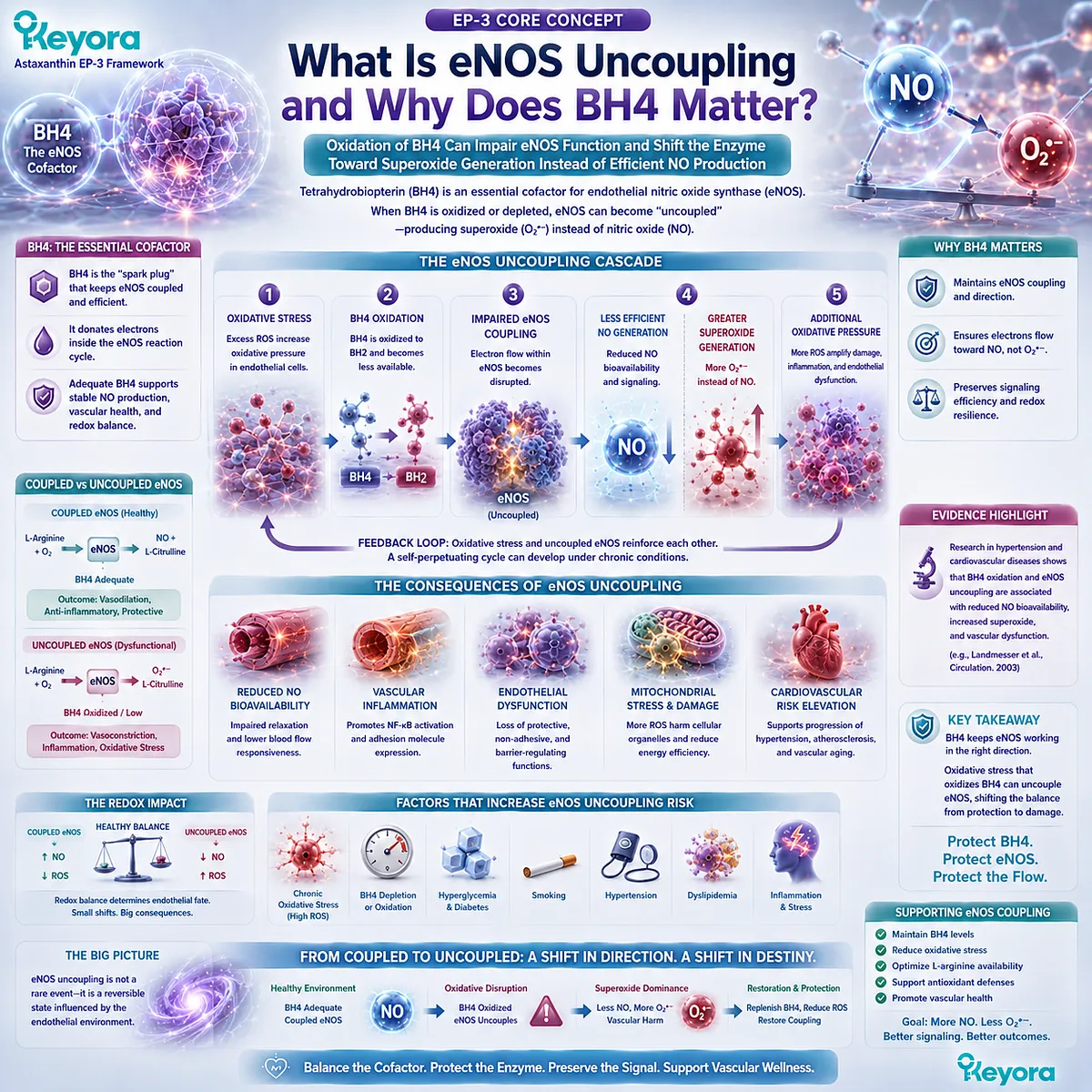
Oxidation of the BH4 cofactor can impair normal eNOS function and shift the enzyme toward superoxide generation instead of efficient nitric oxide production
EP-3 goes one step deeper by discussing eNOS uncoupling.
The source identifies tetrahydrobiopterin, or BH4, as an important eNOS cofactor. It then describes oxidation of BH4 as one pathway through which eNOS function can become disturbed.
The core mechanism described in the source is:
Oxidative stress
↓
BH4 oxidation
↓
impaired eNOS coupling
↓
less efficient NO generation
greater superoxide generation
↓
additional oxidative pressure
EP-3 also cites research specifically examining BH4 oxidation and endothelial nitric oxide synthase uncoupling in hypertension.
This mechanism is important because it introduces the possibility of a feedback problem.
If oxidative stress contributes to eNOS uncoupling, and uncoupled eNOS contributes to further superoxide generation, the endothelial redox environment can become less favorable for normal NO signaling.
EP-3 uses terms such as “Death Spiral” and describes extreme outcomes such as NO production reaching zero.
Those stronger expressions should not be interpreted as universal human outcomes.
The more defensible interpretation is:
BH4 oxidation and eNOS uncoupling can contribute to reduced NO related signaling and greater oxidative stress under certain vascular conditions.
The important concept is therefore not complete failure.
It is loss of signaling efficiency and redox resilience.
Within the Keyora framework:
Healthy eNOS coupling
supports
NO production
while
oxidative disruption of the eNOS system
can shift the endothelial environment toward
lower NO bioavailability and greater oxidative burden.
This is one of the deepest mechanisms inside EP-3’s Signal Architecture.
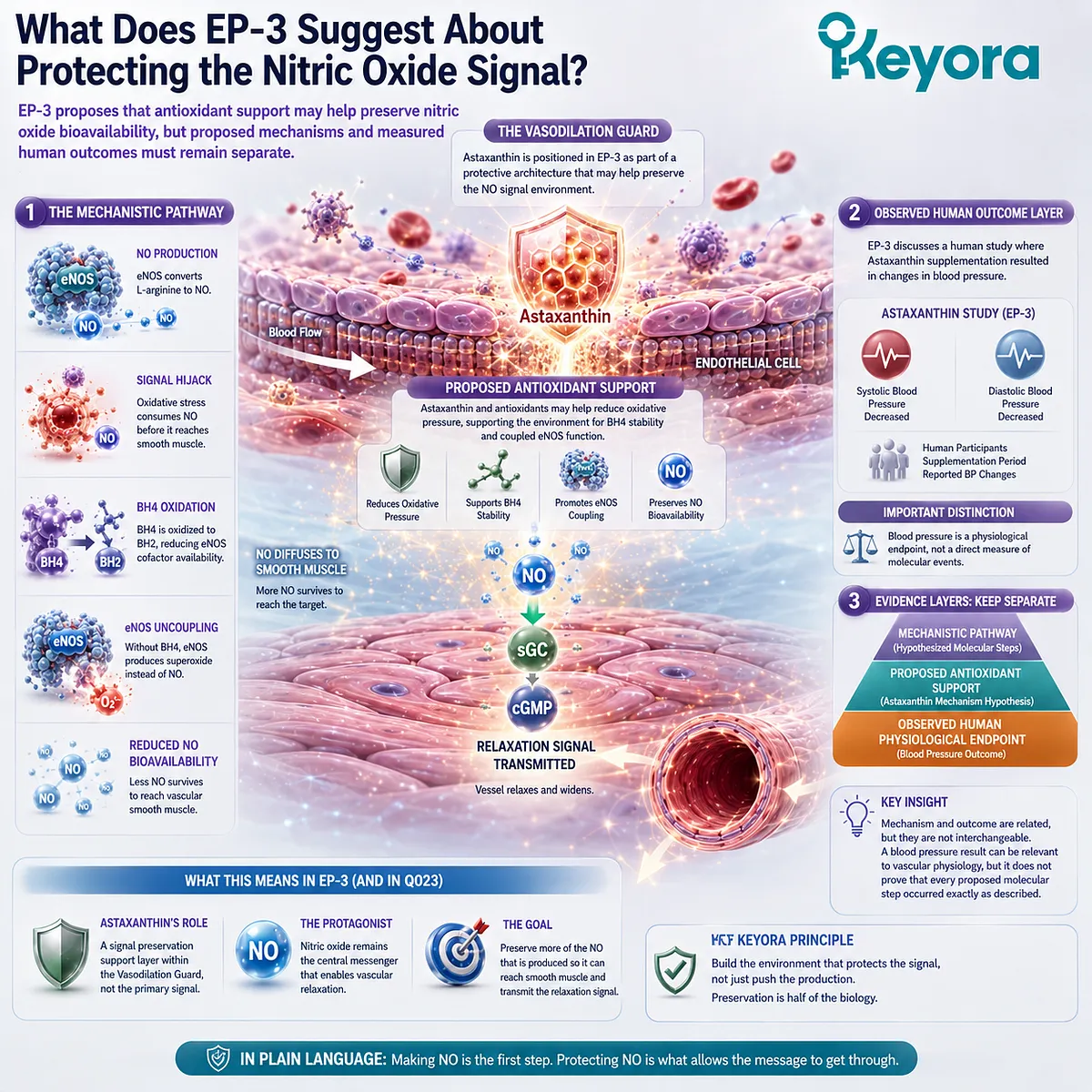
What Does EP-3 Suggest About Protecting the Nitric Oxide Signal?
EP-3 proposes that antioxidant support may help preserve nitric oxide bioavailability, but proposed mechanisms and measured human outcomes must remain separate
After describing NO production, Signal Hijack, BH4 oxidation, and eNOS uncoupling, EP-3 introduces what it calls the Vasodilation Guard.
In the source, Astaxanthin is positioned as part of this protective architecture. The proposed mechanism is that antioxidant activity near membrane associated endothelial signaling may reduce oxidative pressure, help preserve NO bioavailability, and support the environment in which BH4 and coupled eNOS function operate.
This is a mechanistic hypothesis.
It should not be confused with direct proof that a human supplement trial measured every step of the pathway.
EP-3 later discusses an Astaxanthin study in which the source reports changes in systolic and diastolic blood pressure after supplementation and interprets those findings through an NO bioavailability mechanism.
That distinction matters.
A blood pressure measurement is a physiological endpoint.
It is not the same as directly measuring:
endothelial NO production
BH4 oxidation
eNOS coupling
or
NO survival at the membrane
So the evidence should be separated into layers:
Mechanistic pathway
↓
Proposed antioxidant support
↓
Observed human physiological endpoint
The human result can be relevant to vascular physiology.
But it does not by itself prove that every proposed molecular step occurred exactly as described.
That is the same evidence principle established earlier in the Keyora Q&A series:
Mechanism and outcome are related, but they are not interchangeable.
Within Q023, Astaxanthin therefore remains a signal preservation support layer.
Nitric oxide remains the protagonist.
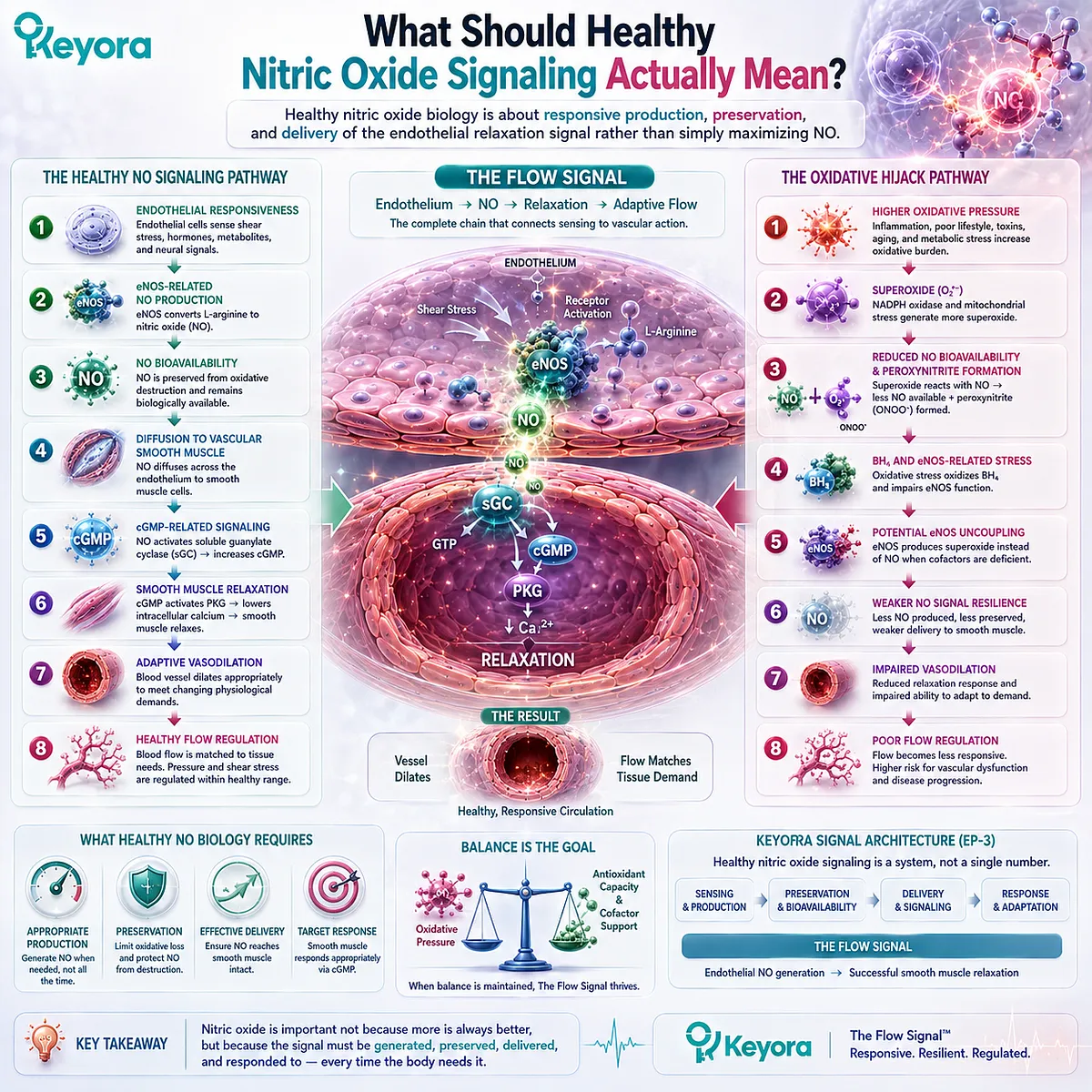
What Should Healthy Nitric Oxide Signaling Actually Mean?
Healthy nitric oxide biology is about responsive production, preservation, and delivery of the endothelial relaxation signal rather than simply maximizing NO
Healthy nitric oxide signaling is best understood as a coordinated system.
The Keyora EP-3 framework can be summarized as:
Endothelial Responsiveness
↓
eNOS related NO Production
↓
NO Bioavailability
↓
Diffusion to Vascular Smooth Muscle
↓
cGMP Related Signaling
↓
Smooth Muscle Relaxation
↓
Adaptive Vasodilation
↓
Healthy Flow Regulation
The opposing oxidative pathway is:
Higher Oxidative Pressure
↓
Superoxide
↓
Reduced NO Bioavailability
Peroxynitrite Formation
↓
BH4 and eNOS related stress
↓
Potential eNOS Uncoupling
↓
Weaker NO Signal Resilience
This is the full meaning of the EP-3 Signal Architecture.
It is not simply about producing the largest possible amount of nitric oxide.
The vascular system needs an NO signal that can be generated appropriately, remain biologically available, reach its target, and produce an appropriate smooth muscle response.
That is why nitric oxide is so important for healthy blood flow.
It connects endothelial sensing with real changes in vessel diameter.
It converts biochemical information into vascular action.
Within the Keyora framework, The Flow Signal is therefore best understood as the complete chain from endothelial NO generation to successful smooth muscle relaxation.
Q023 establishes the signaling side of vascular responsiveness.
The next question moves from signal to structure:
Why Do Blood Vessels Lose Flexibility With Age?
This article is for educational and informational purposes only. It does not provide medical advice, diagnosis, treatment, cure, prevention, disease outcome claims, hormone restoration claims, fertility outcome claims, or formula-specific clinical efficacy claims.