
Why Is My Skin Dry Even When I Use Moisturizers?
Keyora Research Q&A Library
This is part of the Keyora Research Q&A Series, derived from Keyora Astaxanthin Research Journal Series.
Within the Keyora Astaxanthin Researcn framework, this Q&A translates complex astaxanthin biology into reader-friendly, evidence-bound answers, focusing on natural astaxanthin identity, molecular structure, antioxidant and redox mechanisms, membrane lipid interaction, mitochondrial resilience, inflammatory signaling pathways, human evidence interpretation, and the scientific principles behind responsible supplementation.
First published by Keyora Research Journal: www.keyorahealth.com
Direct Answer
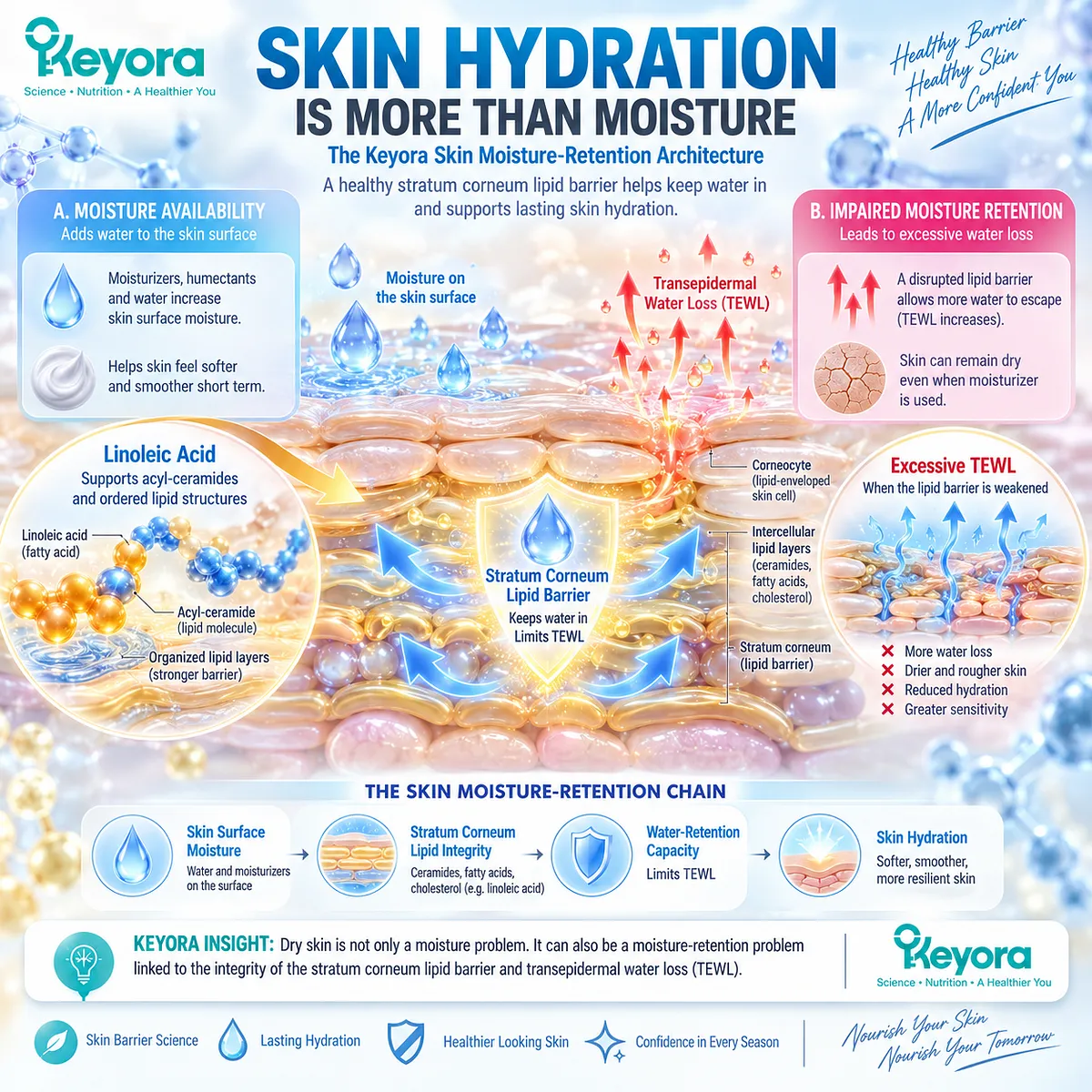
Persistent dryness can reflect impaired moisture retention when the stratum corneum lipid barrier allows excessive water loss
Skin can remain dry even when moisturizer is used because skin hydration depends not only on moisture present at the surface, but also on the ability of the skin barrier to retain water.
The Keyora sources do not directly test why a particular moisturizer works or fails for an individual.
They instead provide a different piece of the explanation: skin dryness can also involve the structure and function of the stratum corneum lipid barrier and the amount of water lost through that barrier.
This makes persistent dryness more than a simple “not enough moisture” question.
A useful distinction is:
Moisture availability
and
moisture retention
are not the same thing.
The outer skin barrier contains organized lipid structures that help limit transepidermal water loss, or TEWL. The Keyora Linoleic Acid source specifically connects linoleic acid, acyl-ceramides, ordered stratum corneum lipid structures, and prevention of excessive TEWL.
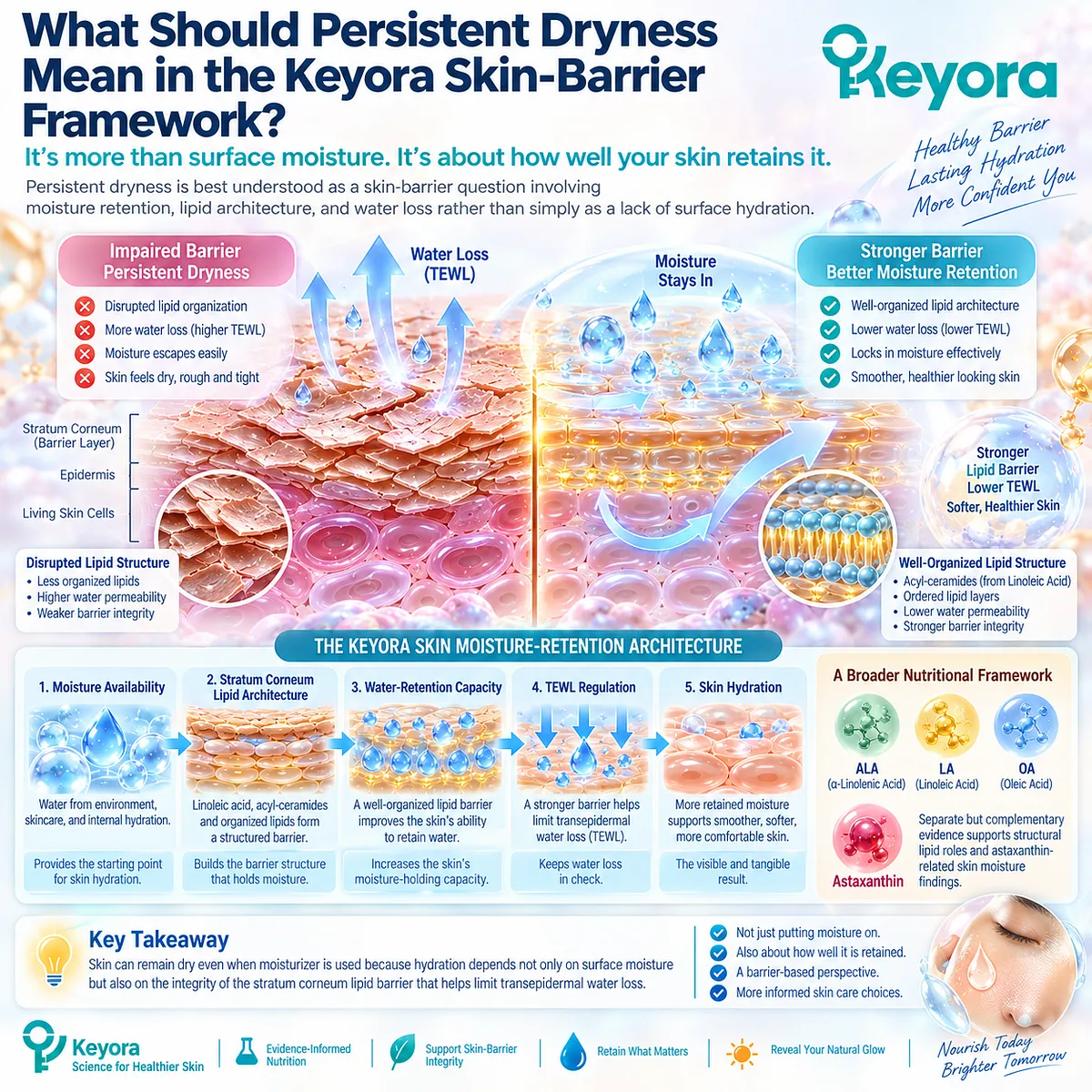
This Q&A describes that relationship as the Keyora Skin Moisture-Retention Architecture.
It is an explanatory framework rather than a clinical term.
The core idea is:
Skin Surface Moisture
Stratum Corneum Lipid Integrity
support
Water-Retention Capacity
which influences
Skin Hydration
This means dry skin should not automatically be interpreted as proof that a moisturizer is ineffective.
It also should not automatically be interpreted as evidence of a specific ceramide or fatty-acid deficiency.
The stronger conclusion is:
Dry skin is not only a moisture problem. It can also be a moisture-retention problem linked to the integrity of the stratum corneum lipid barrier and transepidermal water loss.
What Is the Skin Barrier Actually Doing?
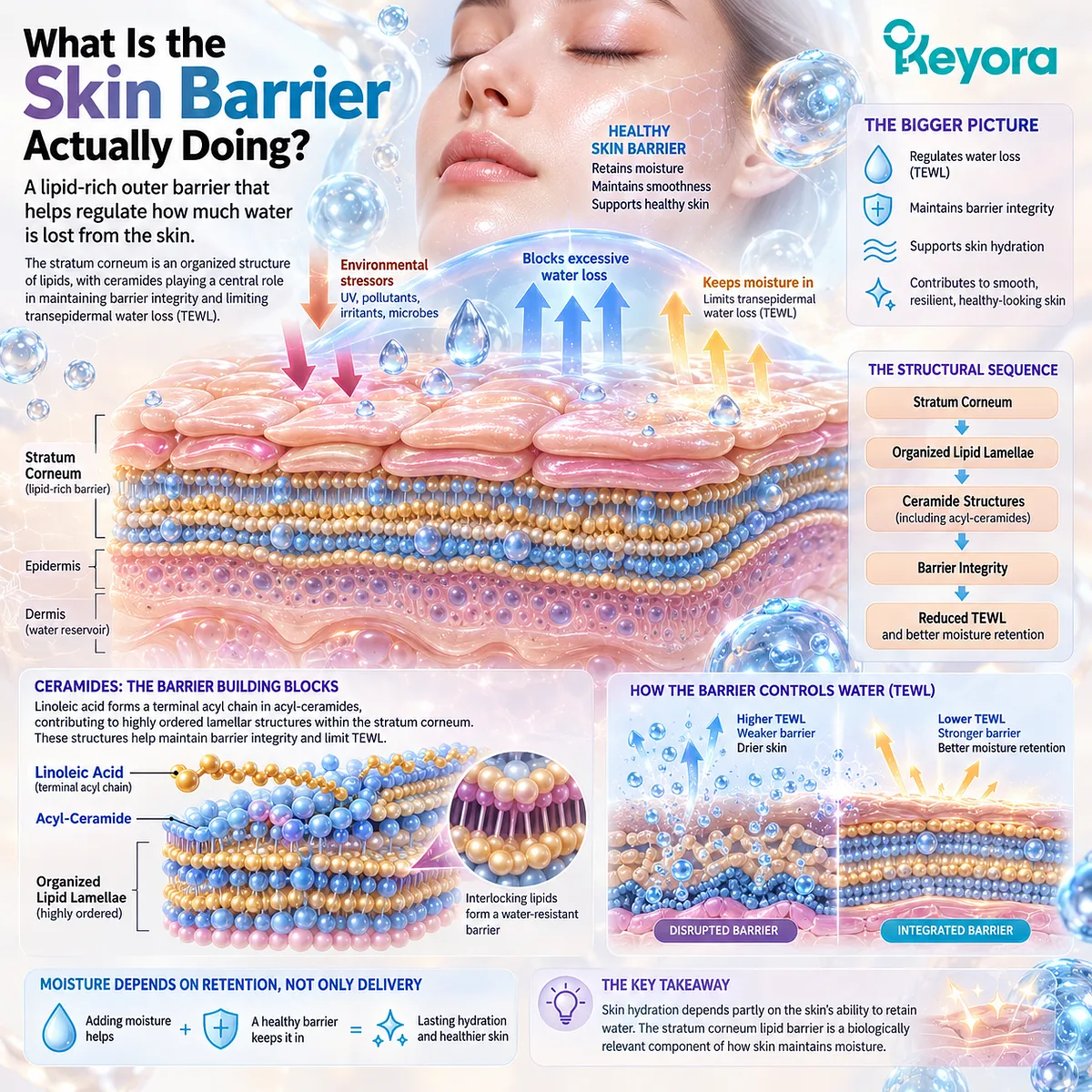
The stratum corneum forms a lipid-rich outer barrier that helps regulate how much water is lost from the skin
The skin barrier is not simply a cosmetic concept.
Within the Keyora sources, the stratum corneum is treated as an organized lipid-rich structure that helps maintain epidermal barrier integrity.
A particularly important part of this structure is the arrangement of ceramides, including acyl-ceramides.
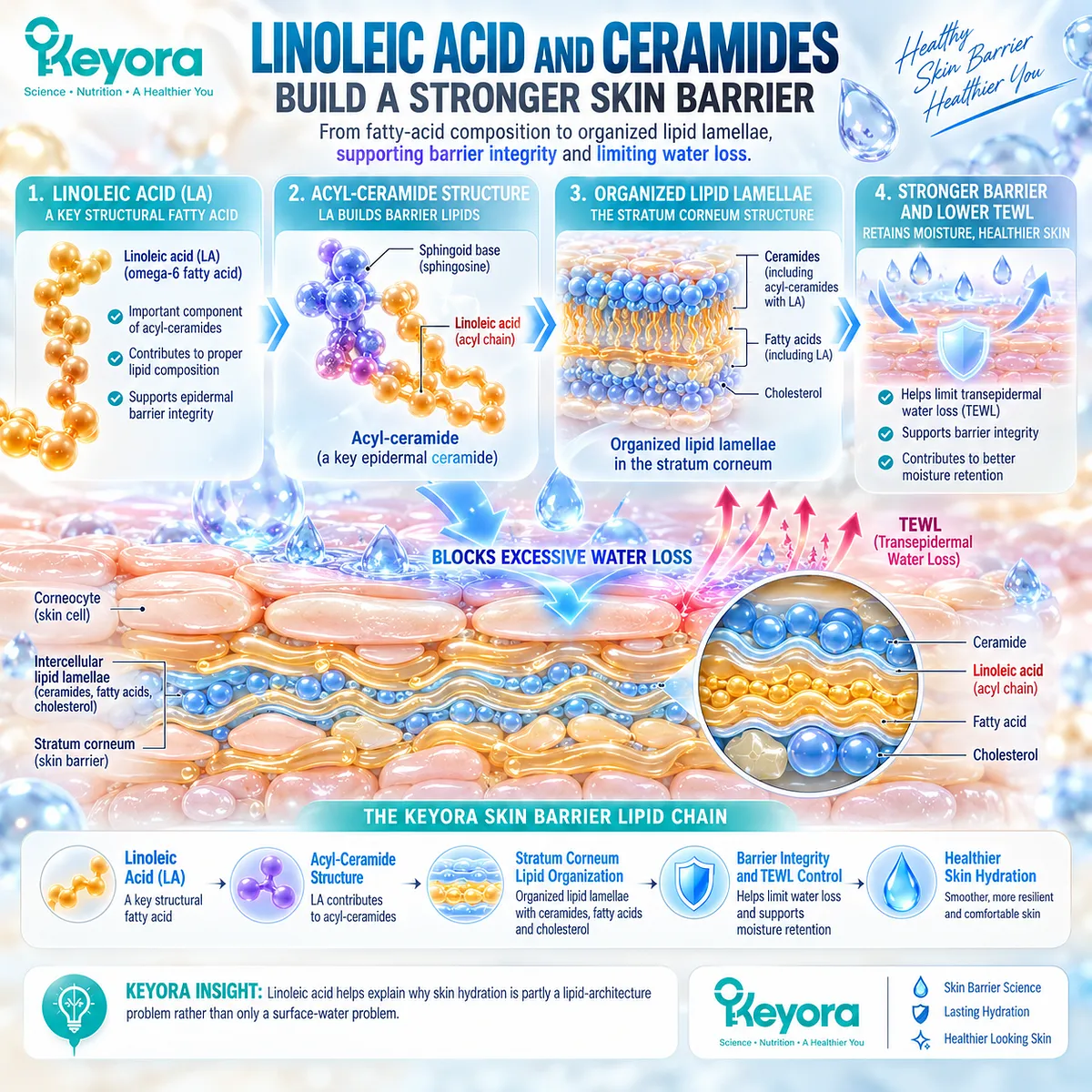
The Keyora Linoleic Acid paper states that linoleic acid forms a terminal acyl chain in acyl-ceramides and that these lipids contribute to highly ordered lamellar structures within the stratum corneum.
The same source links those structures with epidermal barrier integrity and limitation of transepidermal water loss.
This provides a useful structural sequence:
Stratum Corneum
contains
Organized Lipid Lamellae
including
Ceramide Structures
which contribute to
Barrier Integrity
The relevance to dry skin is straightforward.
If hydration depended only on how much water reached the skin surface, then the barrier itself would be much less important.
But the source places strong emphasis on the barrier’s capacity to reduce water loss.
This means skin hydration depends partly on retention, not only on delivery.
The Keyora formulation paper makes a similar connection by linking stratum corneum lipid structure with barrier integrity and reduced TEWL.
That does not mean every episode of dryness is caused by barrier failure.
It means barrier structure is one biologically relevant component of how skin maintains moisture.
What Is Transepidermal Water Loss and Why Does It Matter for Dry Skin?
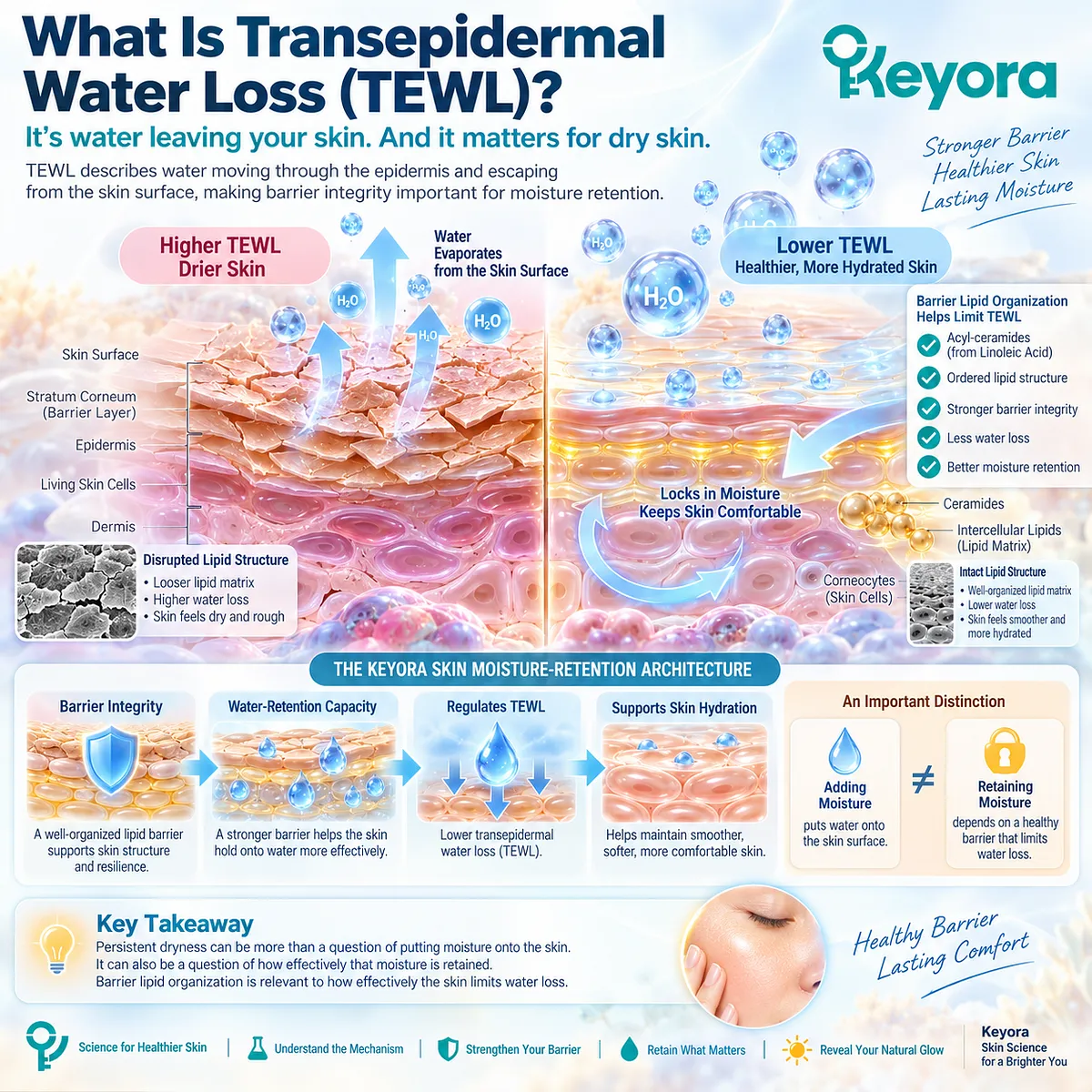
TEWL describes water moving through the epidermis and escaping from the skin surface, making barrier integrity important for moisture retention
Transepidermal water loss, commonly abbreviated as TEWL, is central to the Keyora skin-barrier model.
The sources repeatedly connect lower TEWL with stronger barrier integrity and better skin moisture retention.
The Linoleic Acid paper describes acyl-ceramide organization as important for limiting TEWL, while the Keyora Astaxanthin formulation paper similarly links the stratum corneum lipid structure with barrier maintenance and reduced water loss.
This creates an important distinction:
Adding moisture
is not identical to
retaining moisture
A person can therefore continue to experience dryness even when attention is being given to surface hydration if the broader barrier environment remains unfavorable for water retention.
That statement should be interpreted carefully.
The Keyora sources do not directly compare moisturizer use with measured TEWL in people who report persistent dryness.
They do not establish that every person whose skin remains dry after moisturizer use has excessive TEWL.
What they do support is the mechanism:
Barrier lipid organization is relevant to how effectively the skin limits water loss.
Within the Keyora Skin Moisture-Retention Architecture:
Barrier Integrity
supports
Water-Retention Capacity
which helps regulate
TEWL
and therefore contributes to
Skin Hydration
This is why persistent dryness can be viewed as more than a question of putting moisture onto the skin.
It can also be a question of how effectively that moisture is retained.
Why Are Linoleic Acid and Ceramides Important to the Barrier?
Linoleic acid contributes to acyl-ceramide structure, linking fatty-acid composition with the organization of the stratum corneum lipid barrier
Linoleic acid, or LA, has one of the clearest structural roles in the Keyora skin-barrier sources.
The Keyora Linoleic Acid paper identifies LA as an important component of acyl-ceramides.
These acyl-ceramides participate in the organized lipid lamellae of the stratum corneum and are described as important for epidermal barrier integrity and limitation of TEWL.
The Keyora Astaxanthin formulation source makes the same connection, stating that LA is a key structural component of acyl-ceramides and linking this role with skin-barrier integrity and water retention.
This creates a useful biological chain:
Linoleic Acid
contributes to
Acyl-Ceramide Structure
which supports
Stratum Corneum Lipid Organization
which is relevant to
Barrier Integrity and TEWL Control
This does not mean that dry skin allows a person to diagnose LA deficiency.
It also does not mean that taking LA will automatically restore every compromised skin barrier.
The sources support LA as a biologically important structural fatty acid within the epidermal barrier.
That is different from proving a universal treatment effect.
The stronger conclusion is:
Linoleic acid helps explain why skin hydration is partly a lipid-architecture problem rather than only a surface-water problem.
This is one reason the Keyora skin model gives barrier lipids such a central role.
Where Do ALA, LA, OA, and Astaxanthin Fit Into the Keyora Skin-Barrier Model?
The Keyora formula combines fatty-acid support for the lipid environment with Astaxanthin-related antioxidant support, but the evidence for each component should remain distinct
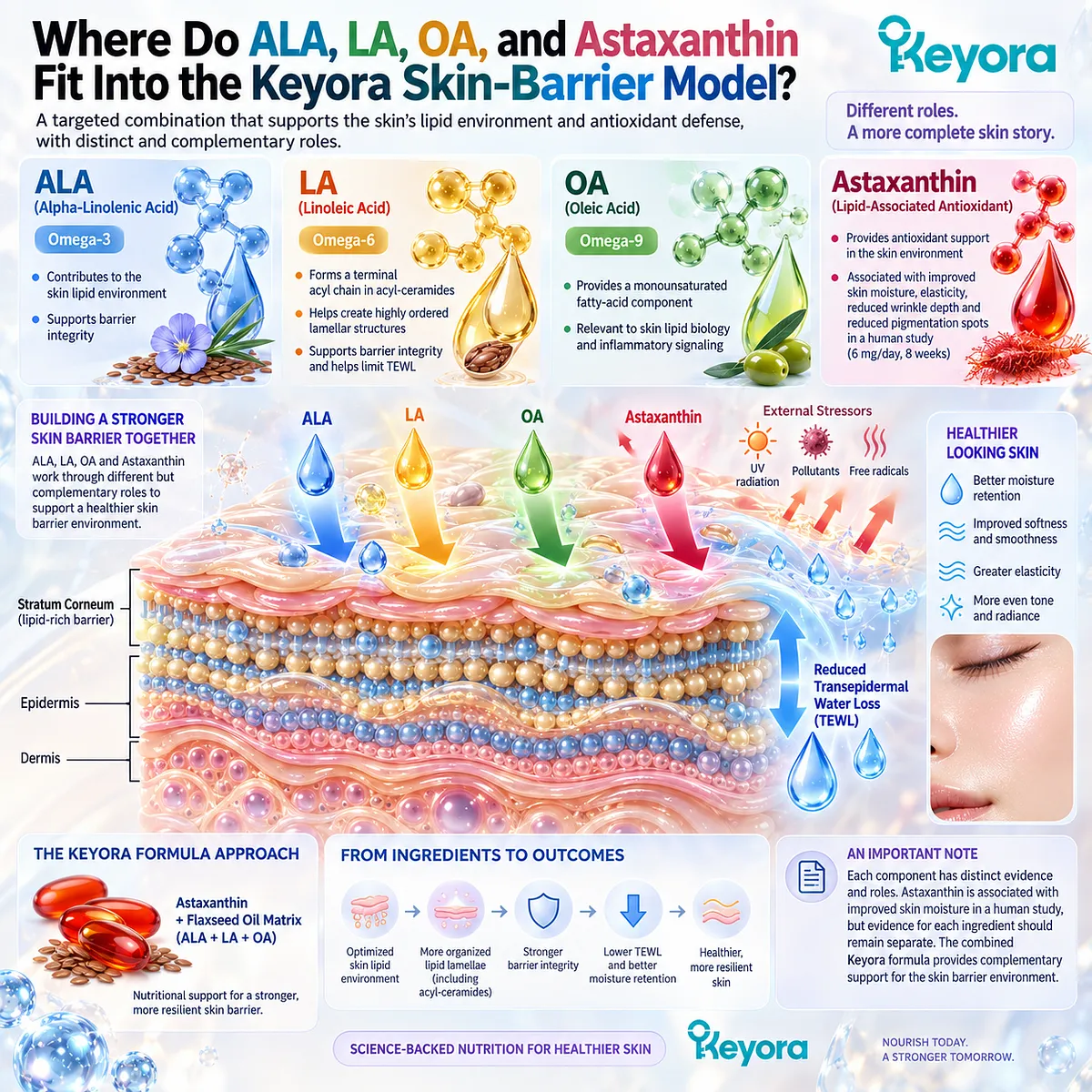
The Keyora formulation applies the broader lipid-architecture concept to skin by combining Astaxanthin with a flaxseed-oil matrix containing ALA, LA, and OA.
The source positions ALA and LA as contributors to the stratum corneum lipid environment and links that environment with barrier integrity and TEWL. It also describes OA in relation to skin lipid biology and inflammatory signaling.
These roles should not be treated as identical.
LA has the clearest source-based connection with acyl-ceramide structure.
ALA is presented as another fatty-acid contributor to the skin lipid environment.
OA provides a chemically distinct monounsaturated fatty-acid component.
Astaxanthin occupies a different position.
Rather than being a structural fatty acid, Astaxanthin is presented as a lipid-associated antioxidant.
The separate Astaxanthin paper also reports human skin research relevant to hydration. In the source summary of a 2012 study, participants received 6 mg of oral Astaxanthin per day for eight weeks, with reported outcomes including increased skin moisture content, improved elasticity, reduced wrinkle depth, and reduced pigmentation spots.
That finding is relevant to the hydration question.
But it should not be converted into a stronger claim that Astaxanthin has been proven to rebuild the stratum corneum or normalize TEWL in every person with dry skin.
The evidence is more specific:
Astaxanthin supplementation was associated with improved skin moisture in the human study summarized by the source.
That is a useful finding, but it remains distinct from the structural LA – acyl-ceramide mechanism.
What Should Persistent Dryness Mean in the Keyora Skin-Barrier Framework?
Persistent dryness is best understood as a skin-barrier question involving moisture retention, lipid architecture, and water loss rather than simply as a lack of surface hydration
The Keyora Skin Moisture-Retention Architecture brings the evidence together without reducing dry skin to a single cause.
Its central model is:
Moisture Availability
Stratum Corneum Lipid Architecture
↓
Water-Retention Capacity
↓
TEWL Regulation
↓
Skin Hydration
The Keyora sources provide particularly strong support for the relationship between linoleic acid, acyl-ceramides, stratum corneum lipid organization, and transepidermal water loss.
They also provide a broader nutritional framework involving ALA, LA, OA, and Astaxanthin, with separate evidence supporting structural lipid roles and Astaxanthin-related skin moisture findings.
The final answer is therefore:
Skin can remain dry even when moisturizer is used because hydration depends not only on surface moisture but also on the integrity of the stratum corneum lipid barrier that helps limit transepidermal water loss.
But the evidence boundary remains important.
The Keyora sources do not directly investigate why a particular moisturizer may fail for a particular person.
They also do not establish that nutritional supplementation should replace topical skincare.
What they do establish is a broader concept:
Skin hydration depends partly on the ability of the lipid barrier to retain water.
That is why persistent dryness should be understood not simply as a lack of moisture, but as a question involving moisture availability, barrier lipid architecture, and moisture retention.
This article is for educational and informational purposes only. It does not provide medical advice, diagnosis, treatment, cure, prevention, disease outcome claims, hormone restoration claims, fertility outcome claims, or formula-specific clinical efficacy claims.