
Why Is My Body Tired But My Brain Awake?
Keyora Research Q&A Library
This is part of the Keyora Research Q&A Series, derived from Keyora Nutritional Neurology Seriers .
Within the Keyora Nutritional Neurology framework, this Q&A translates complex nutrient–brain mechanisms into reader-friendly, evidence-bound answers, focusing on stress resilience, sleep quality, calm mood support, cognitive wellness, and the broader interaction between nutrition, neurochemistry, and daily nervous-system function.
First published by Keyora Research Journal: www.keyorahealth.com

Direct Answer
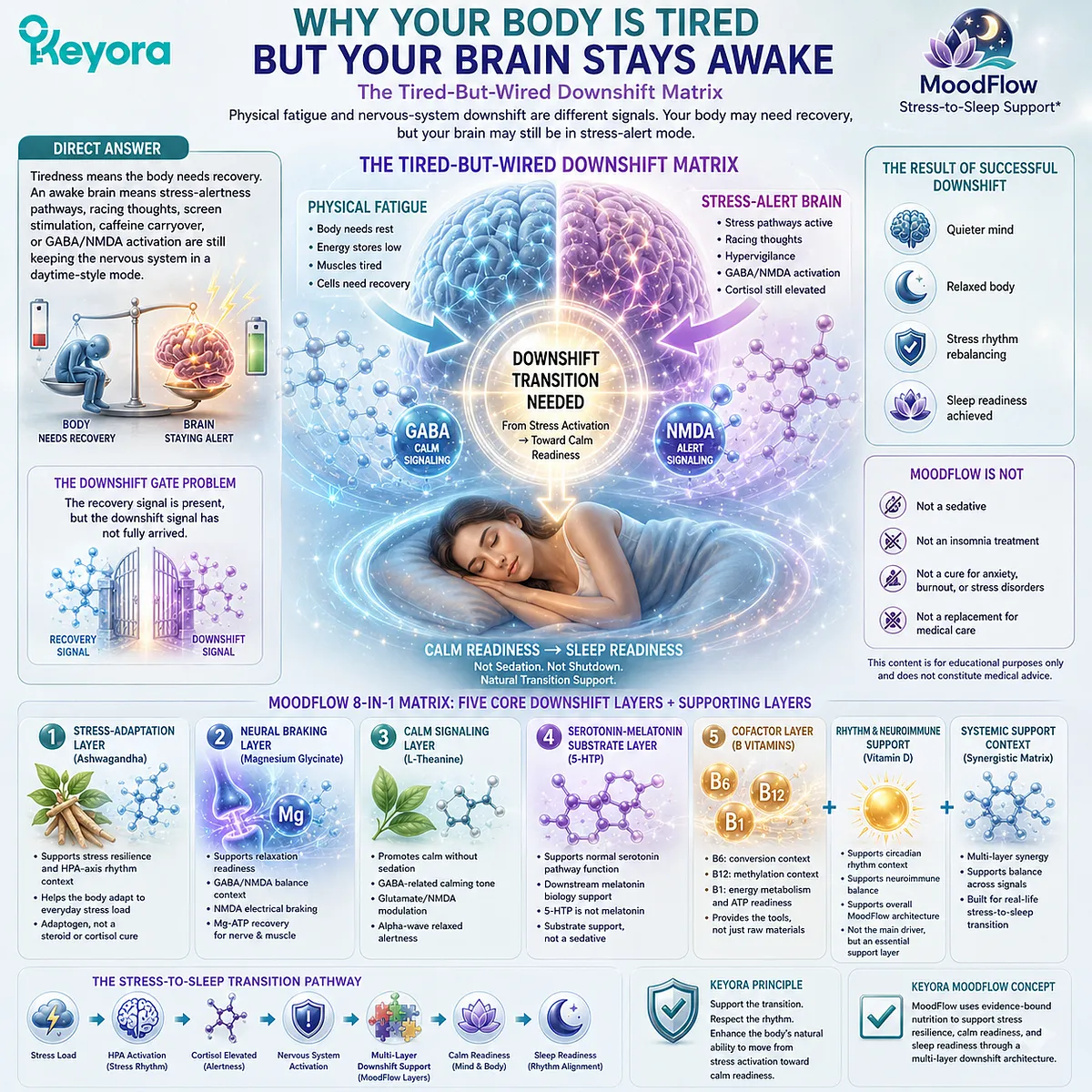
Your body can feel tired while your brain stays awake because physical fatigue and nervous-system downshift are different signals.
Tiredness means the body needs recovery, but an awake brain may mean stress-alertness pathways, racing thoughts, screen stimulation, caffeine carryover, or GABA/NMDA activation are still keeping the nervous system in a daytime-style mode.
In the Keyora MoodFlow framework, this pattern is part of the tired-but-wired downshift matrix: the body is asking for rest, but the brain has not fully shifted toward calm readiness.
Magnesium glycinate supports neural braking and Mg-ATP context, L-Theanine supports calm signaling, Ashwagandha supports stress-rhythm adaptation, and 5-HTP with B vitamins supports serotonin-melatonin continuity.
MoodFlow supports sleep readiness and calm readiness, not forced sedation or insomnia treatment.
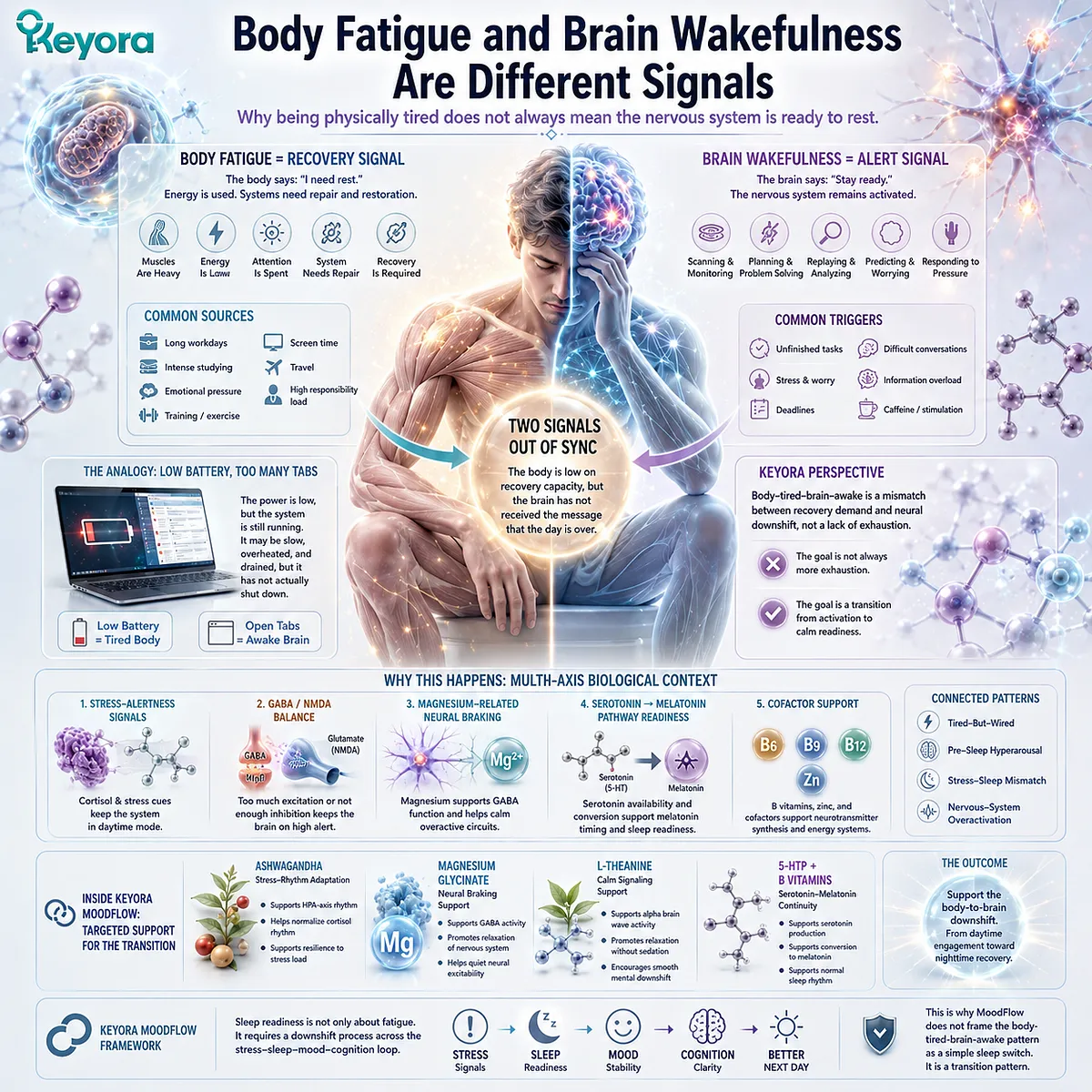
Body Fatigue and Brain Wakefulness Are Different Signals
Why being physically tired does not always mean the nervous system is ready to rest.
Many people know the feeling: the body is completely tired, but the brain still feels awake. The muscles may feel heavy. The eyes may feel tired. The person may know they need rest, but the mind continues to run.
This feels confusing because most people assume that tiredness should naturally lead to sleep. But the body and brain do not always shift at the same time.
Body fatigue is a recovery signal. It tells you that energy has been used, muscles have been loaded, attention has been spent, and the system needs repair and restoration. It can come from long workdays, intense studying, emotional pressure, training, screen use, travel, or simply carrying too much responsibility.
Brain wakefulness is a different signal. It means the nervous system is still activated. The brain may still be scanning, planning, replaying, predicting, solving, or responding to pressure.
That is why someone can be physically drained but mentally alert. The body is low on recovery capacity, but the brain has not fully received the message that the day is over.
A useful analogy is a laptop with a low battery but too many tabs still open. The power is low, but the system is still running. It may be slow, overheated, and drained, but it has not actually shut down.
The tired body is the low battery. The awake brain is the open tabs.
In the Keyora MoodFlow framework, body-tired-brain-awake is understood as a mismatch between recovery demand and neural downshift, not as a lack of exhaustion.
This distinction matters because the solution is not always to become more exhausted. Many people already are exhausted. The problem is that the nervous system has not completed the transition from activation to calm readiness.
This is why “I am tired but my brain is awake” is closely related to the tired-but-wired pattern. It is also connected to pre-sleep hyperarousal, stress-sleep mismatch, and nervous-system overactivation.
The body may be asking for rest. But the brain may still be acting as if something needs attention.
For Keyora, this is one of the clearest examples of why sleep readiness is not only about fatigue. Sleep readiness also requires a downshift process. The nervous system needs to move from daytime engagement toward nighttime recovery.
That transition may involve stress-alertness signals, GABA/NMDA balance, magnesium-related neural braking, serotonin-melatonin pathway readiness, and cofactor support.
This is why MoodFlow does not frame the body-tired-brain-awake pattern as a simple sleep switch. It is a transition pattern. The goal is to support the body-to-brain downshift.
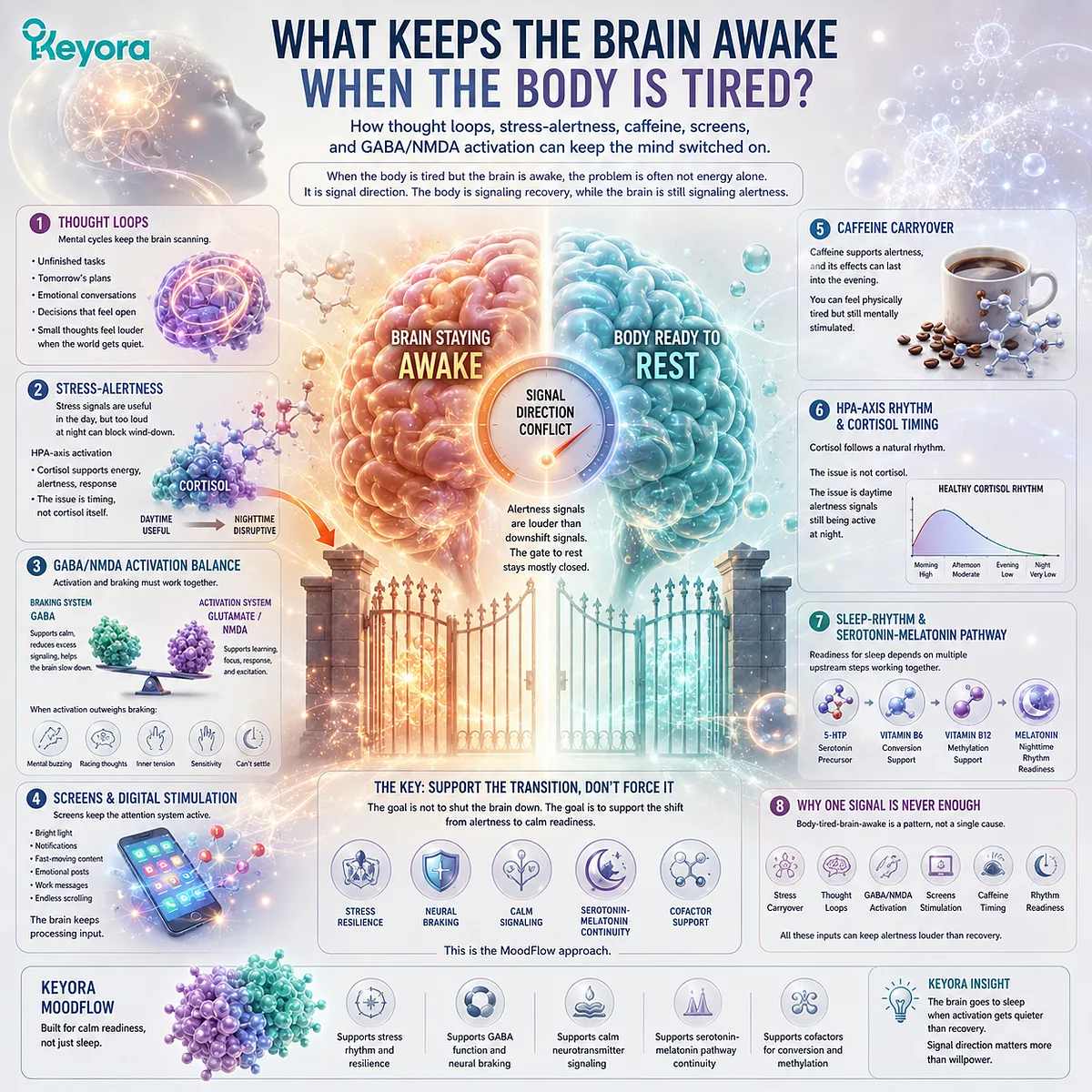
What Keeps the Brain Awake When the Body Is Tired?
How thought loops, stress-alertness, caffeine, screens, and GABA/NMDA activation can keep the mind switched on.
When the body is tired but the brain is awake, the problem is often not energy alone. It is signal direction. The body is signaling recovery, while the brain is still signaling alertness.
One common reason is thought looping. The brain may keep returning to unfinished tasks, tomorrow’s plans, emotional conversations, or decisions that still feel open. Even small thoughts can feel louder at night because the external world becomes quieter.
The brain may keep scanning because it still believes something needs attention.
Stress-alertness signals can also keep the brain awake. During the day, stress signals help the body stay ready and responsive. That is useful when there is work to do, a problem to solve, or a demand to meet.
But if those signals remain loud near bedtime, the body may struggle to enter wind-down mode. The person may feel exhausted, but the stress system may still be acting as if action is required.
This is where HPA-axis rhythm context and cortisol timing become useful explanations. Cortisol is not bad. It helps support energy, alertness, and response capacity. The issue is not that cortisol exists. The issue is that a daytime alertness signal may still be present when the body should be moving toward recovery.
GABA/NMDA balance adds another layer. GABA can be understood as part of the brain’s calming brake system. Glutamate and NMDA receptors are part of the activation system. The brain needs both.
When the brain is awake at night, it can feel like the accelerator is still engaged while the brake has not fully taken hold. This may feel like mental buzzing, racing thoughts, inner tension, sensitivity, or an inability to settle.
Screens can also keep the attention system active.
Bright light, notifications, fast-moving content, emotional posts, work messages, and endless scrolling all keep the brain interacting with input. Even when the body is tired, the brain may continue to process stimulation.
Caffeine carryover can also play a role.
Caffeine supports alertness, and for some people, its effects may last into the evening. A person can feel physically tired while still having a stimulated attention system.
None of these factors need to be turned into a medical claim. The point is simpler: the brain can remain awake when activation signals are still louder than downshift signals.
This is why body-tired-brain-awake is not always solved by one ingredient or one sleep signal. The pattern may involve stress carryover, thought loops, GABA/NMDA activation balance, screen stimulation, caffeine timing, and sleep-rhythm readiness at the same time.
For Keyora MoodFlow, the important question is not “How do we force the brain off?” The better question is “How do we support the transition from alertness to calm readiness?”
That is why MoodFlow is built around stress resilience, neural braking, calm signaling, serotonin-melatonin continuity, and cofactor support.
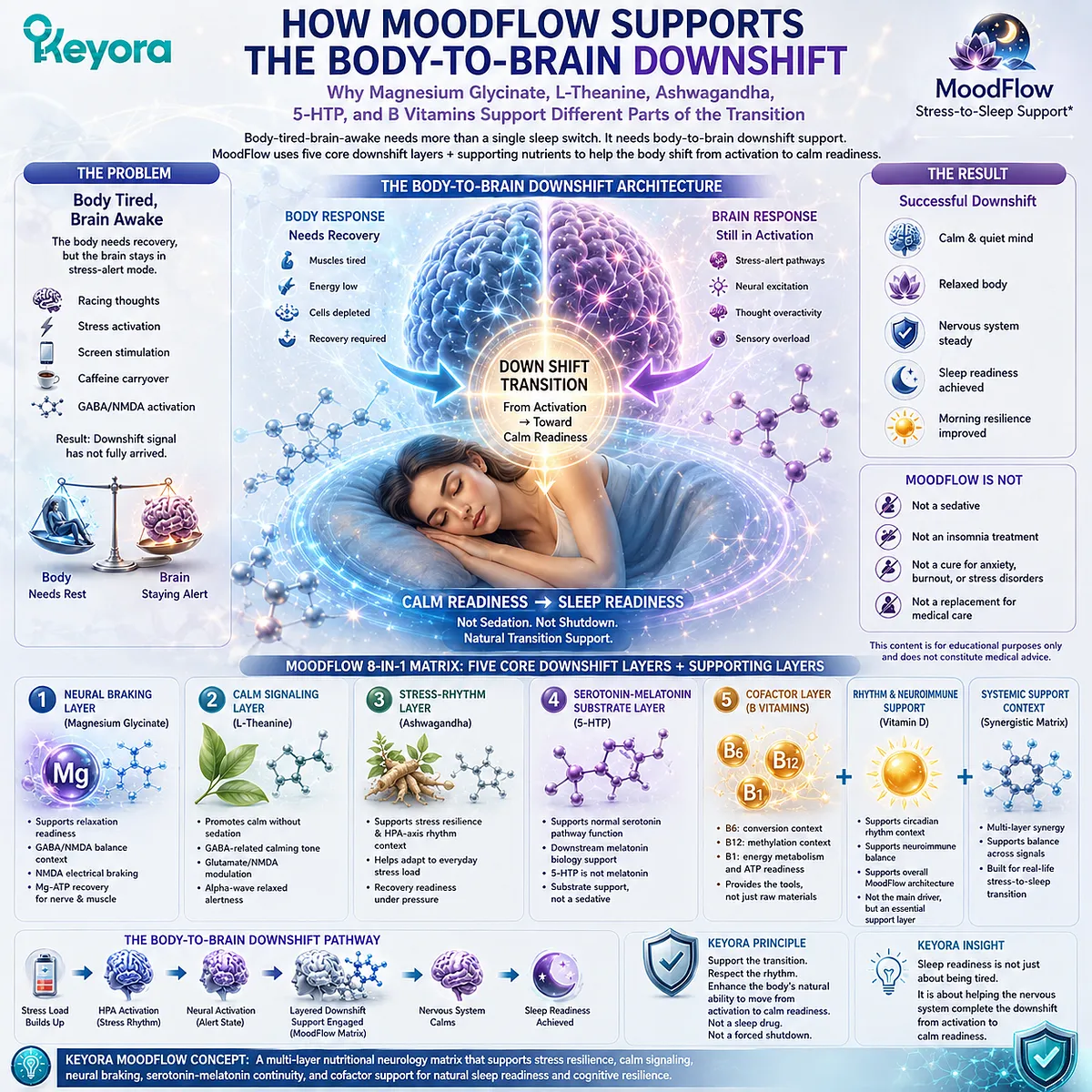
How MoodFlow Supports the Body-to-Brain Downshift
Why magnesium glycinate, L-Theanine, Ashwagandha, 5-HTP, and B vitamins support different parts of the transition.
Body-tired-brain-awake needs more than a single sleep switch. It needs body-to-brain downshift support.
Inside Keyora MoodFlow, body-tired-brain-awake is supported through a body-to-brain downshift architecture: magnesium glycinate supports neural braking and Mg-ATP context, L-Theanine supports calm signaling, Ashwagandha supports stress-rhythm adaptation, and 5-HTP with B vitamins supports serotonin-melatonin continuity.
Magnesium glycinate is important because it supports the neural braking layer.
It helps explain relaxation readiness, nervous-system stability, NMDA electrical context, and Mg-ATP recovery context.
This matters when the body feels depleted but the nervous system remains active. The body may need recovery, but the brain may need support shifting away from activation.
L-Theanine supports the calm signaling layer.
It is often discussed in relation to relaxed alertness, GABA-related calming tone, glutamate/NMDA modulation, and alpha-wave calm. For a wired brain, this is important because calm does not need to mean heavy sedation.
L-Theanine helps explain how the mind may become less noisy while still feeling natural and clear.
Ashwagandha supports the stress-rhythm layer.
It helps explain HPA-axis rhythm context, stress-response feedback, and recovery readiness under everyday pressure. It should not be described as a cortisol cure, hormone treatment, or burnout treatment. Its role is stress-adaptation support.
This is important because many body-tired-brain-awake nights begin earlier in the day. Stress builds up, pressure accumulates, and the nervous system continues to carry that alertness into the evening.
5-HTP supports the serotonin-melatonin substrate layer.
It helps explain how the body supports normal serotonin-related pathways that can connect downstream to sleep-rhythm biology. But 5-HTP is not melatonin, not a sedative, and not a sleep guarantee.
B vitamins help support the cofactor layer around that pathway.
-
B6 supports conversion context.
-
B12 supports methylation context.
-
B1 supports energy metabolism and ATP readiness.
These nutrients help explain why pathways need support tools, not only raw materials.
Vitamin D adds broader rhythm and neuroimmune context.
It is not the main focus of this article, but it helps complete the MoodFlow 8-in-1 Matrix.
Together, these ingredients create a systems-based explanation.
-
The body may need recovery.
-
The brain may need calm signaling.
-
The nervous system may need braking.
-
The stress system may need adaptation support.
-
The sleep-rhythm pathway may need substrate and cofactor continuity.
MoodFlow brings these layers together without positioning itself as a sleep drug or sedative. It supports sleep readiness, calm readiness, stress resilience, and cognitive resilience within an evidence-bound wellness framework.
For Keyora, body-tired-brain-awake is one of the clearest signs that sleep readiness is not just about being tired. It is about helping the nervous system complete the downshift from activation to calm readiness.
Closing Summary
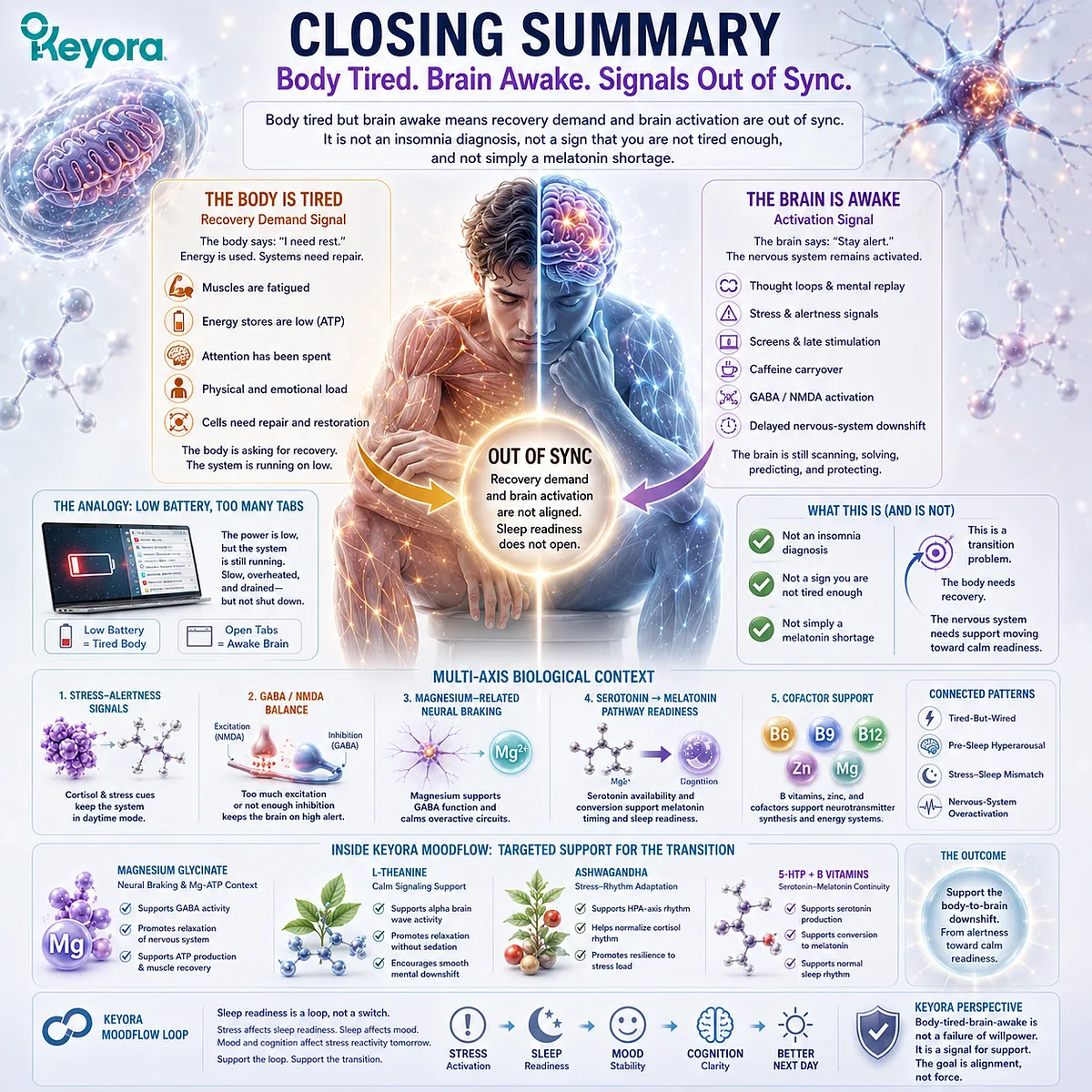
Body tired but brain awake means recovery demand and brain activation are out of sync. It is not an insomnia diagnosis, not a sign that you are not tired enough, and not simply a melatonin shortage.
The body may be physically depleted, while the brain remains activated by thought loops, stress-alertness signals, screens, caffeine carryover, GABA/NMDA activation, or delayed nervous-system downshift.
Inside Keyora MoodFlow, magnesium glycinate supports neural braking and Mg-ATP context, L-Theanine supports calm signaling, Ashwagandha supports stress-rhythm adaptation, and 5-HTP with B vitamins supports serotonin-melatonin continuity.
For Keyora, body-tired-brain-awake shows why sleep readiness should be understood as a transition process: the body needs recovery, and the nervous system needs support moving from alertness toward calm readiness.
This article is for educational and informational purposes only. It does not provide medical advice, diagnosis, treatment, cure, prevention, disease outcome claims, hormone restoration claims, fertility outcome claims, or formula-specific clinical efficacy claims.