
Why Is It Hard to Start Tasks Even When I Know What To Do?
Keyora Research Q&A Library
This is part of the Keyora Research Q&A Series, derived from Keyora Nutritional Neurology Series .
Within the Keyora Nutritional Neurology framework, this Q&A translates complex nutrient–brain mechanisms into reader-friendly, evidence-bound answers, focusing on stress resilience, sleep quality, calm mood support, cognitive wellness, and the broader interaction between nutrition, neurochemistry, and daily nervous-system function.
First published by Keyora Research Journal: www.keyorahealth.com

Direct Answer
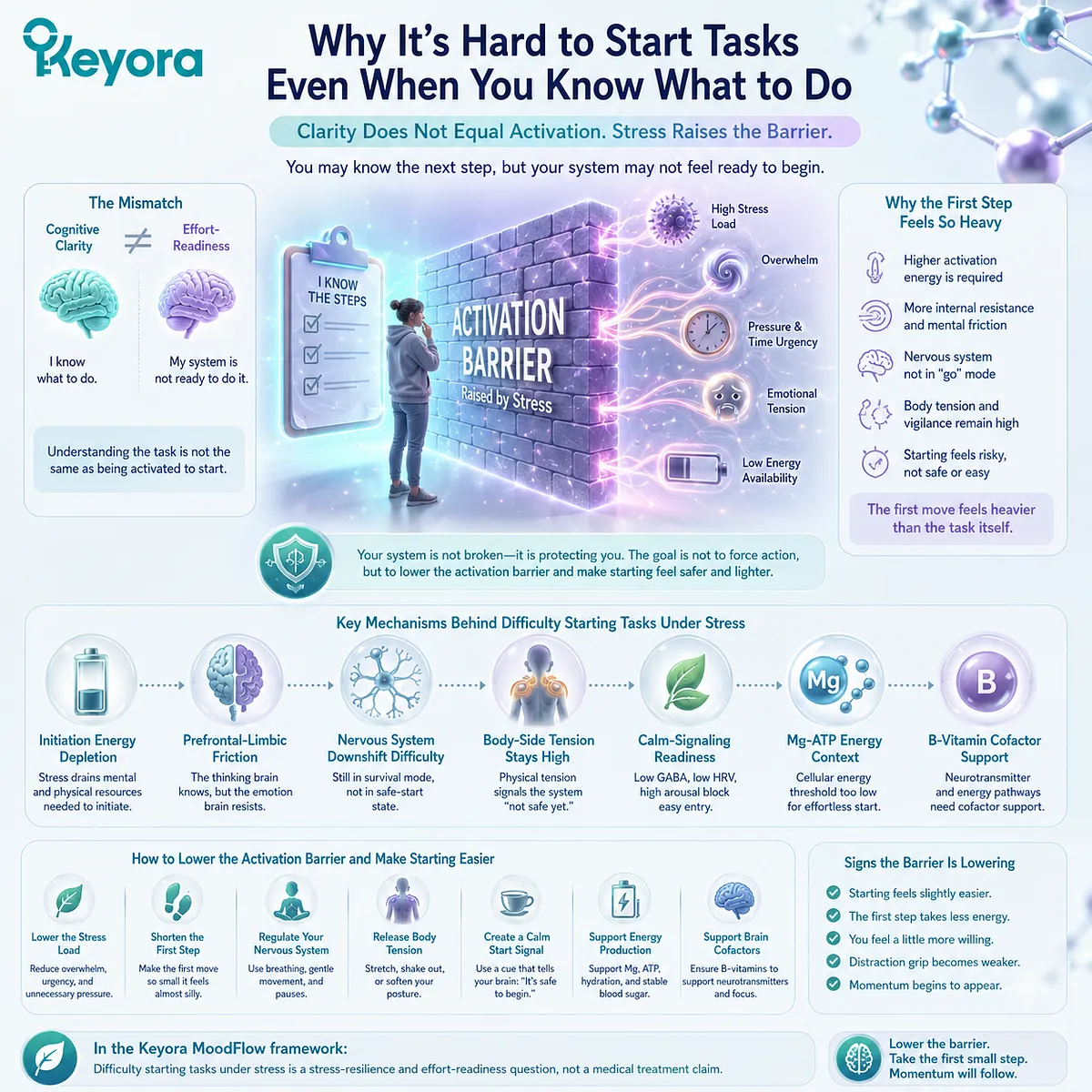
It can be hard to start tasks even when you know what to do because knowing the next step is not the same as being activated to take it.
Stress can raise the activation barrier between clarity and action, making the first move feel heavier than the task itself.
The mismatch is this: cognitive clarity does not always equal effort-readiness.
You may understand the task, see the steps, and still feel stuck because your nervous system has not shifted into a state where starting feels safe, affordable, or easy to enter.
This can involve initiation energy, stress-related effort-readiness, prefrontal-limbic friction, nervous-system downshift difficulty, body-side tension, calm-signaling readiness, Mg-ATP energy context, and B-vitamin cofactor support.
In the Keyora MoodFlow framework, difficulty starting tasks under stress is understood as a stress-resilience and effort-readiness question, not a medical treatment claim.
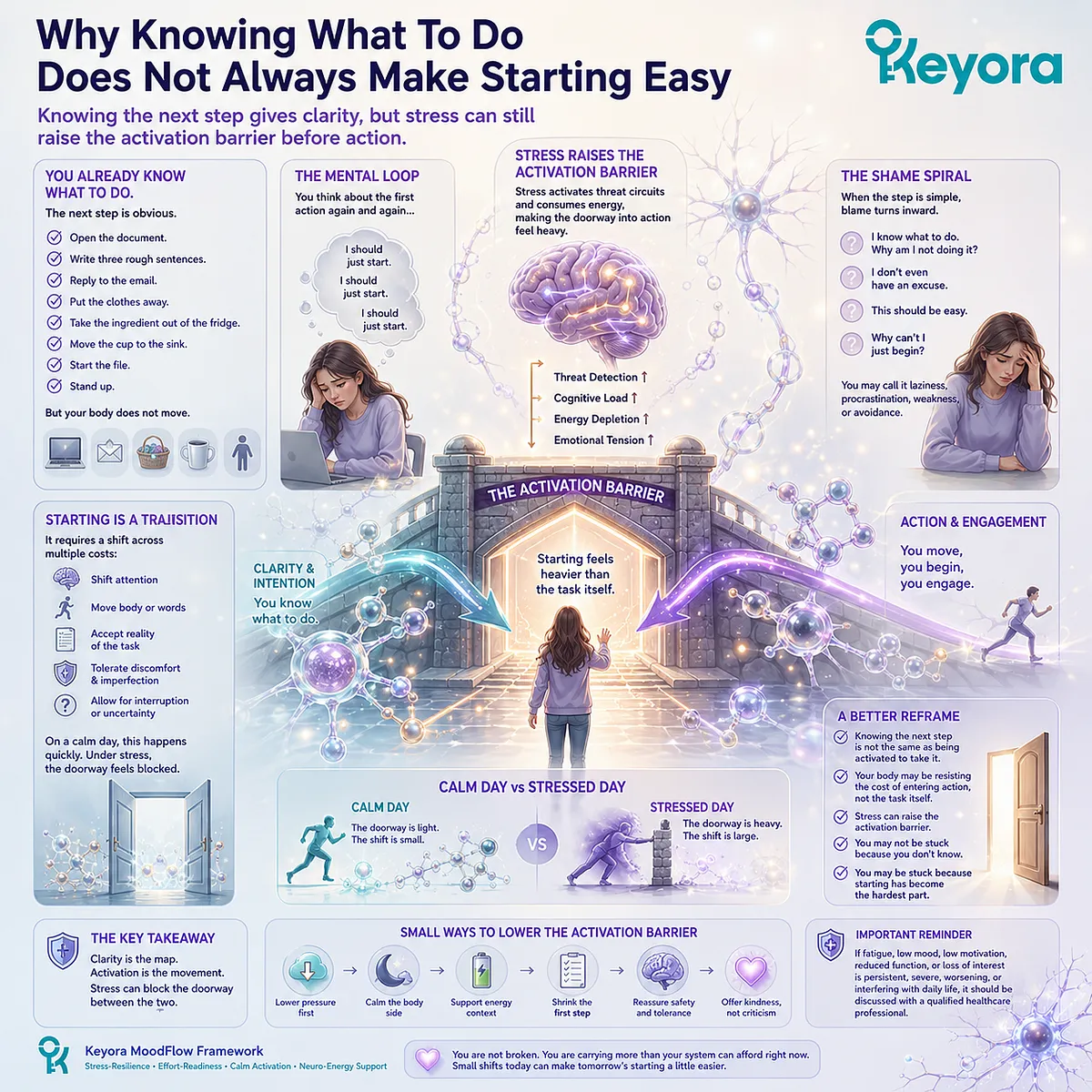
Why Knowing What To Do Does Not Always Make Starting Easy
Knowing the next step gives clarity, but stress can still raise the activation barrier before action.
You already know what to do.
That is what makes this feel so frustrating.
This is not a moment where the task is confusing. You are not missing the instructions. You are not waiting for someone to explain the next step. You may even have written the task down clearly.
Open the document.
Write three rough sentences.
Reply to the email.
Put the clothes away.
Take the ingredient out of the fridge.
Move the cup to the sink.
Start the file.
Stand up.
The next step is obvious.
But your body does not move.
You sit there with the tab open. You stare at the message. You look at the object. You think about the first action again and again, as if repeating it in your mind should somehow make your body begin.
But nothing starts.
Then the shame arrives quickly.
“I know what to do. Why am I not doing it?”
“I do not even have an excuse.”
“This should be easy.”
“Why can’t I just begin?”
This kind of stuckness is painful because it removes the comfort of confusion. If you did not know what to do, you could blame the plan. If the task were impossible, you could blame the difficulty.
But when the next step is simple, the blame often turns inward.
You may tell yourself you lack discipline. You may call it procrastination. You may decide you are weak, avoidant, or irresponsible.
But pause for a moment.
What if knowing the next step is not the same as being activated to take it?
What if your body is not refusing the task, but resisting the cost of entering action?
What if stress has made the doorway into action feel heavier than the task itself?
Starting is not just a thought. It is a transition.
You have to shift attention. You have to move your body or your words. You have to accept that the task is now real. You have to tolerate the possibility of discomfort, imperfection, effort, interruption, or failure.
On a calm day, this transition may happen so quickly you do not notice it.
Under stress, the doorway can feel blocked.
The task may be clear, but the entrance into action may feel expensive.
This is why “just start” can feel strangely unhelpful. The problem is not always that you do not understand the task. The problem may be that stress has raised the activation barrier between understanding and doing.
You may not be stuck because you do not know.
You may be stuck because starting has become the hardest part.
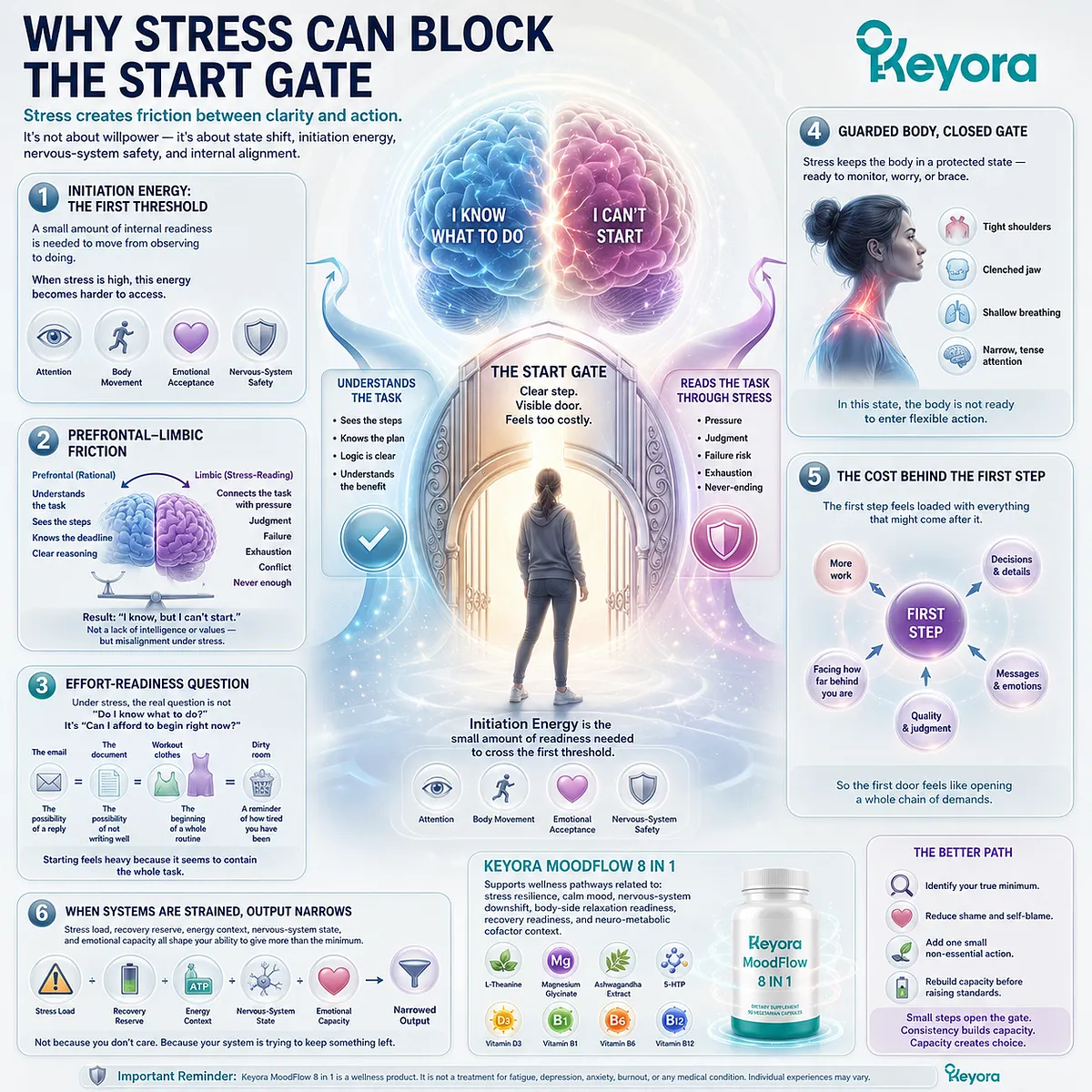
Why Stress Can Block the Start Gate
Stress can create friction between the part of you that understands the task and the system that must enter action.
When people talk about starting tasks, they often focus on willpower.
But starting requires more than willpower. It requires a state shift.
You move from observing to doing. From thinking to acting. From possibility to contact. From distance to engagement.
That shift requires initiation energy.
Initiation energy is the small amount of internal readiness needed to cross the first threshold. It includes attention, body movement, emotional acceptance, and enough nervous-system safety to enter the task.
When stress is high, initiation energy can feel harder to access.
Your mind may know the plan, but your body may still feel braced. Your rational side may say, “This is simple,” while another part of your system says, “This will cost something.”
This is where prefrontal-limbic friction can appear in everyday language.
One part of you understands the task. It sees the steps. It can reason clearly. It knows the deadline, the benefit, and the logic.
Another part of you is reading the task through stress. It may connect the task with pressure, judgment, failure, exhaustion, conflict, or the feeling of never being done.
So you get the strange experience of:
“I know, but I can’t start.”
Not because you lack intelligence.
Not because you lack values.
But because the part of you that understands the plan and the part of you that must enter action are not fully aligned under stress.
Stress also changes effort-readiness.
Your system may not ask, “Do I know what to do?”
It may ask, “Can I afford to begin right now?”
That question matters.
Starting a task can feel like opening a door into more effort. Once you begin, you may fear you will have to continue. You may have to face the quality of your work. You may have to make decisions. You may have to see how behind you are. You may have to deal with messages, details, or emotions you have been avoiding.
So the first step becomes loaded with everything that might come after it.
The email is not just an email. It is the possibility of a reply.
The document is not just a document. It is the possibility of not writing well.
The workout clothes are not just clothes. They are the beginning of a whole routine.
The dirty room is not just a room. It is a reminder of how tired you have been.
Starting becomes heavy because it seems to contain the whole task.
Stress can also keep the body in a guarded state.
Your shoulders may be tight. Your jaw may be clenched. Your breathing may be shallow. Your attention may feel narrow and tense. In that state, the body is ready to monitor, worry, or brace—but not necessarily ready to enter flexible action.
This creates the start-gate problem.
The step is clear.
The door is visible.
But crossing through it feels too costly.
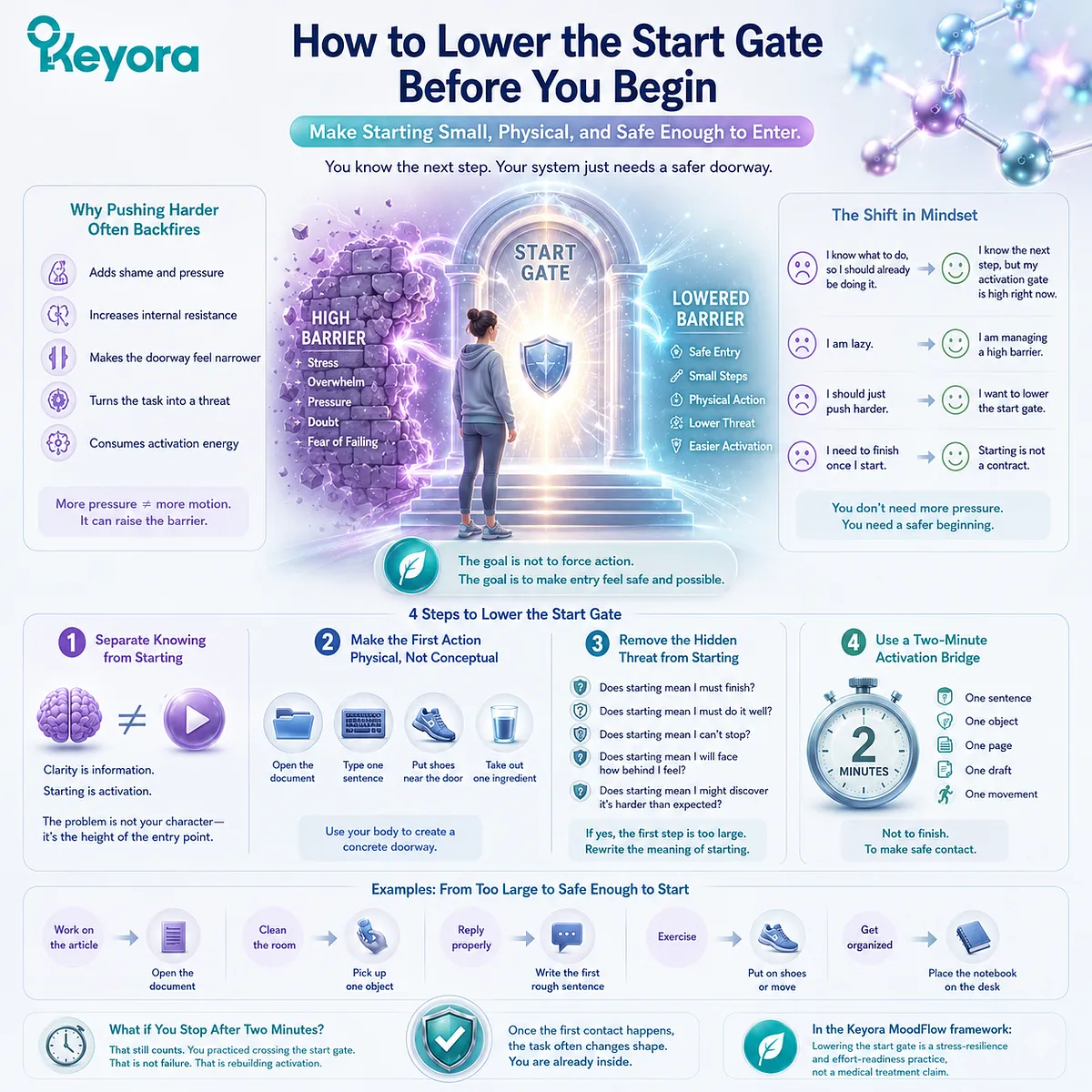
How to Lower the Start Gate Before You Begin
The goal is not to pressure yourself harder, but to make starting small, physical, and safe enough to enter.
When you cannot start a task you understand, the usual reaction is to push harder.
You may try to shame yourself into motion.
“Just do it.”
“Stop wasting time.”
“You know what to do.”
“There is no reason this should be hard.”
But if the activation barrier is already high, more pressure can make the doorway feel even narrower. The task becomes not only something to do, but something that proves whether you are disciplined, capable, or worthy.
That is too much weight for a first step.
A better approach is to lower the start gate.
The first step is to separate knowing from starting.
Instead of saying, “I know what to do, so I should already be doing it,” try saying, “I know the next step, but my activation gate is high right now.”
This does not excuse avoidance. It gives you a more accurate map.
Now the problem is not your character. The problem is the height of the entry point.
The second step is to make the first action physical, not conceptual.
A lot of task instructions are still too abstract.
“Work on the article.”
“Clean the room.”
“Reply properly.”
“Exercise.”
“Get organized.”
“Prepare for tomorrow.”
These may sound like actions, but they are often too large to enter.
Make the first step something your body can physically do.
Open the document.
Type one rough sentence.
Pick up one object.
Put shoes near the door.
Take out one ingredient.
Write the first imperfect line of the message.
Place the notebook on the desk.
The body often needs a concrete doorway, not a general command.
The third step is to remove the hidden threat from starting.
Ask yourself what starting seems to imply.
Does starting mean you must finish?
Does starting mean you must do it well?
Does starting mean you cannot stop?
Does starting mean you have to face how behind you feel?
Does starting mean you might discover the task is harder than expected?
If yes, the first step has become too large.
Try rewriting the meaning of starting.
Starting is not a contract to finish.
Starting is not a promise to perform well.
Starting is not proof that you are now fully ready.
Starting is only one small contact with the task.
The fourth step is to use a two-minute activation bridge.
Choose a window so small that the system does not feel trapped.
Two minutes.
One sentence.
One object.
One page.
One draft.
One file.
One body movement.
You are not trying to complete the task. You are helping your system experience entry without danger.
This matters because many people do not need a perfect plan. They need a safe beginning.
Once the first contact happens, the task often changes shape. It may still require effort, but it is no longer an untouched wall. It becomes something you are already inside.
And if you stop after two minutes, that still counts.
You practiced crossing the start gate.
That is not failure.
That is rebuilding activation.
Where Nutritional Support Fits
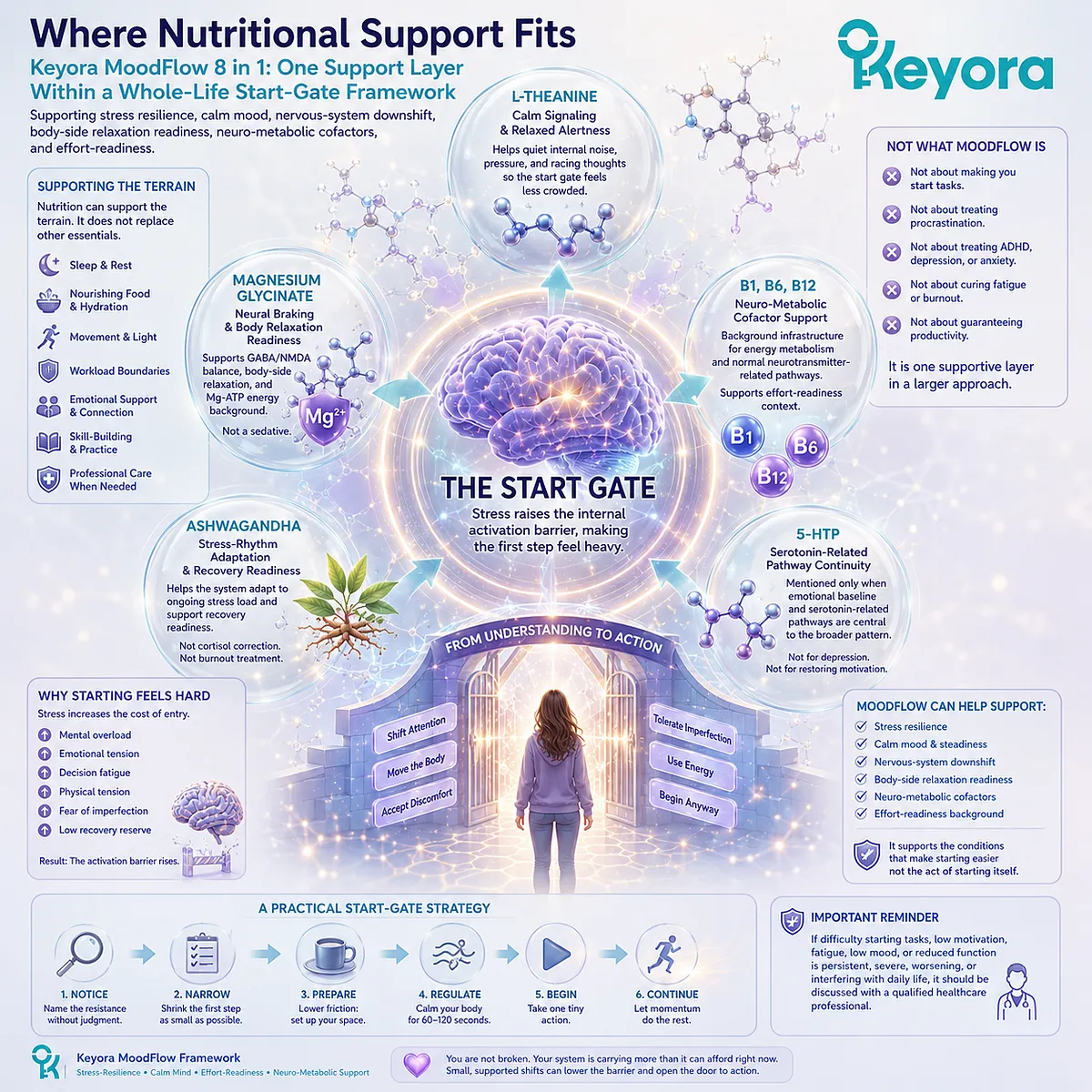
Keyora MoodFlow 8 in 1 can fit as one small nutritional support layer when difficulty starting tasks appears within a broader stress-sleep-mood-cognition pattern. It should not be framed as making someone start tasks, treating procrastination, treating ADHD, treating depression, treating anxiety, curing burnout, fixing fatigue, or guaranteeing productivity.
Its role is narrower: supporting wellness pathways involved in stress resilience, calm mood, nervous-system downshift, body-side relaxation readiness, neuro-metabolic cofactor context, and effort-readiness background.
-
L-Theanine may be relevant when internal noise, pressure, or tension makes the start gate feel harder to cross. In the MoodFlow framework, it supports calm signaling and relaxed alertness, not sedation or forced focus.
-
Magnesium glycinate may be relevant when the body feels braced, tense, or physically resistant to entering action. It supports neural braking, GABA/NMDA activation balance, body-side relaxation readiness, and Mg-ATP energy background.
-
B1, B6, and B12 may be relevant as neuro-metabolic cofactor support. They belong to the background infrastructure of energy metabolism and normal neurotransmitter-related pathways, which can support the context of effort-readiness without being framed as a cure for fatigue or low motivation.
-
Ashwagandha may fit when cumulative stress load keeps the system in a pressure rhythm. Its role is stress-rhythm adaptation and recovery readiness, not cortisol correction or burnout treatment.
-
5-HTP may be mentioned only when emotional baseline and serotonin-related pathway continuity are central to the broader pattern. It should not be framed as treating depression, restoring motivation, or forcing emotional change.
MoodFlow belongs after the reader understands the experience and practical start-gate strategy. Nutrition can support the terrain. It does not replace sleep, food, workload boundaries, movement, emotional support, skill-building, or professional care when needed.
If difficulty starting tasks, low motivation, fatigue, low mood, or reduced function is persistent, severe, worsening, or interfering with daily life, it should be discussed with a qualified healthcare professional.
Closing Summary
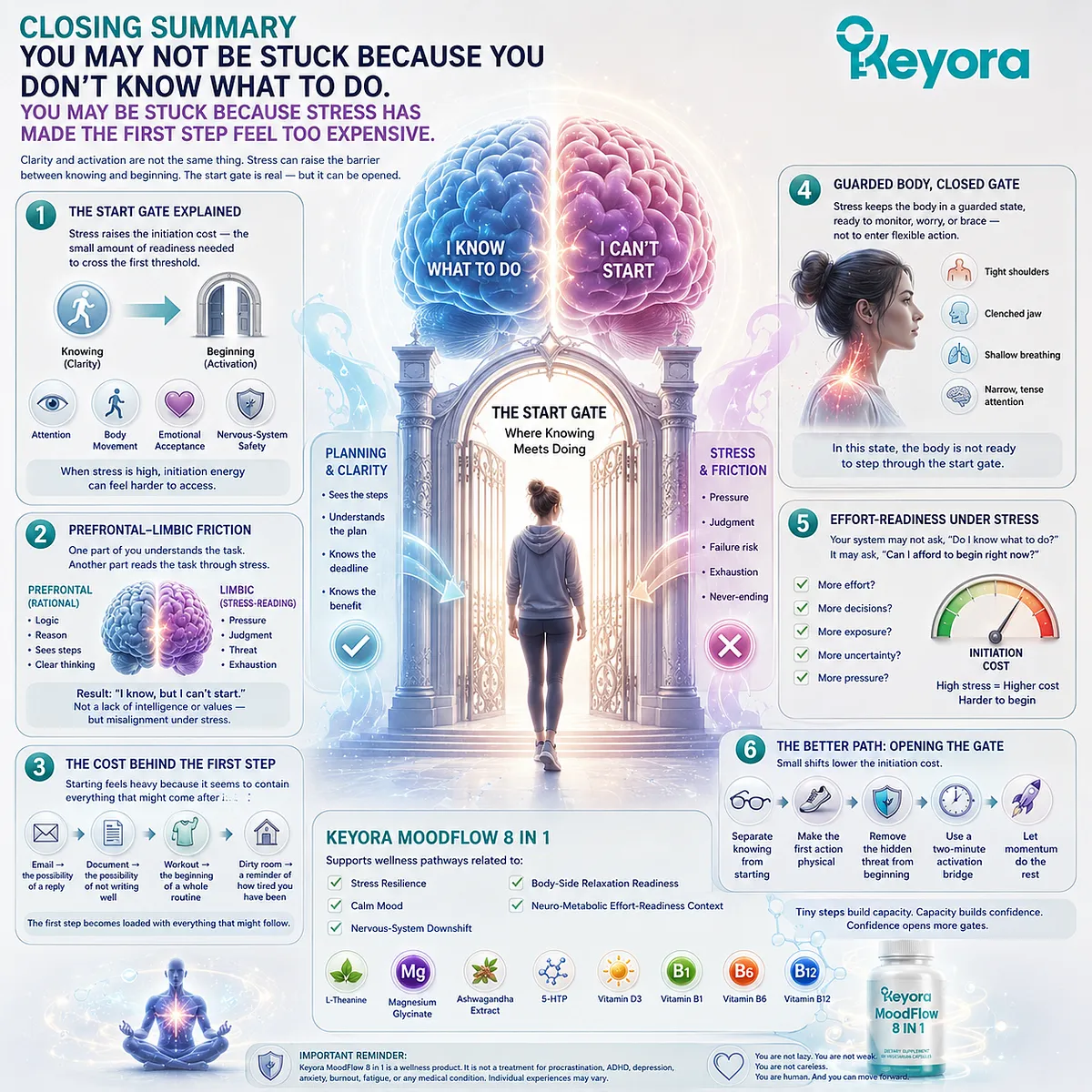
It can be hard to start tasks even when you know what to do because clarity and activation are not the same thing. You may understand the next step, but stress can still raise the barrier between knowing and beginning.
The deeper issue may be the start gate. Stress can increase initiation cost, create friction between planning and action, keep the body guarded, and make the first step feel heavier than the task itself.
A better path begins by separating knowing from starting, making the first action physical, removing the hidden threat from beginning, and using a two-minute activation bridge.
Keyora MoodFlow 8 in 1 can support wellness pathways related to stress resilience, calm mood, nervous-system downshift, body-side relaxation readiness, and neuro-metabolic effort-readiness context. It is not a treatment for procrastination, ADHD, depression, anxiety, burnout, fatigue, or any medical condition.
You may not be stuck because you do not know what to do.
You may be stuck because stress has made the first step feel unsafe, heavy, or too expensive to enter.
This article is for educational and informational purposes only. It does not provide medical advice, diagnosis, treatment, cure, prevention, disease outcome claims, hormone restoration claims, fertility outcome claims, or formula-specific clinical efficacy claims.