
Why Is Haematococcus pluvialis Used in Natural Astaxanthin Supplements?
Keyora Research Q&A Library
This is part of the Keyora Research Q&A Series, derived from Keyora Nutritional Neurology Series.
Within the Keyora Nutritional Neurology framework, this Q&A translates complex nutrient–brain mechanisms into reader-friendly, evidence-bound answers, focusing on stress resilience, sleep quality, calm mood support, cognitive wellness, and the broader interaction between nutrition, neurochemistry, and daily nervous-system function.
First published by Keyora Research Journal: www.keyorahealth.com
Direct Answer
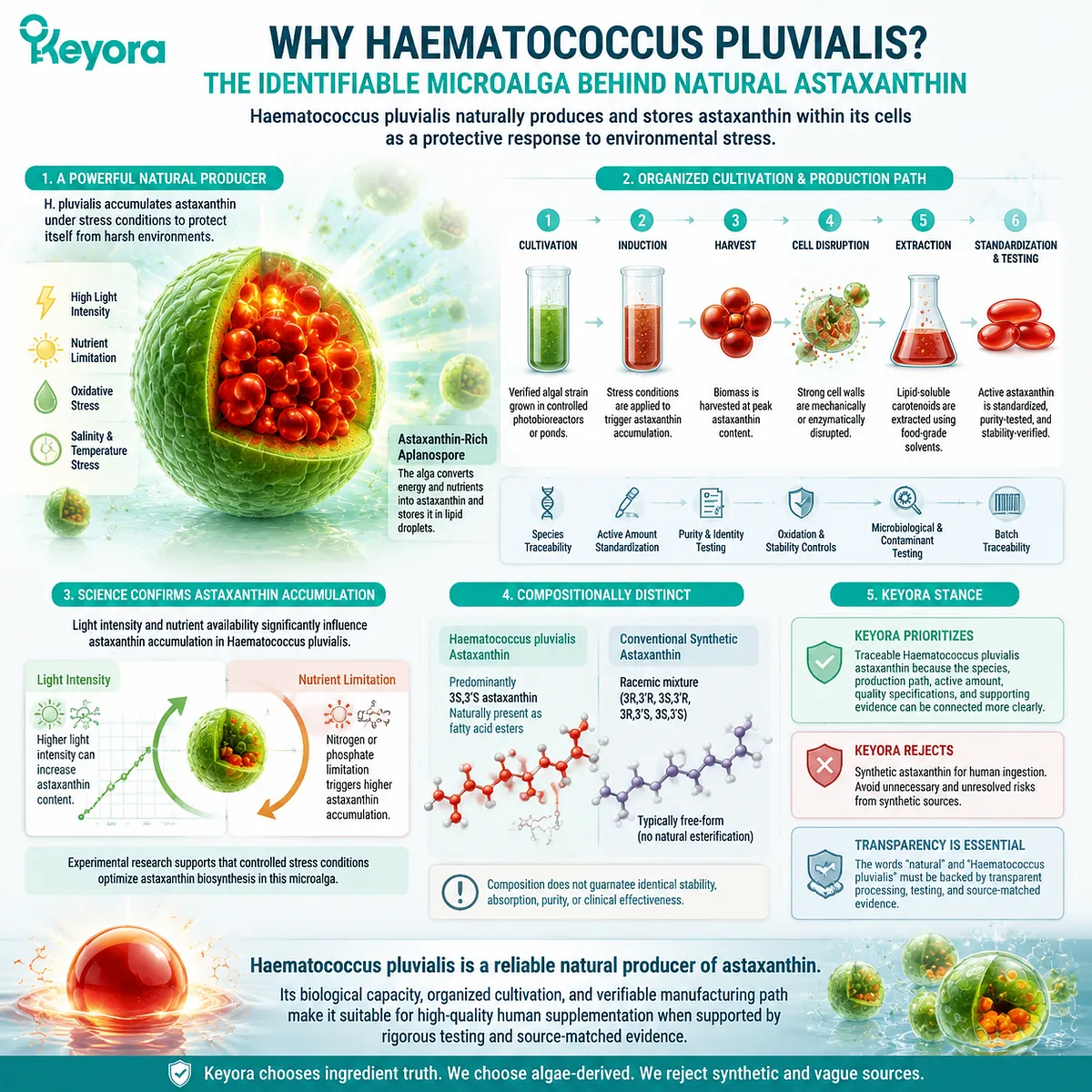
Haematococcus pluvialis is widely used in natural astaxanthin supplements because it is an identifiable microalgal producer that can accumulate substantial amounts of astaxanthin under controlled stress conditions. Instead of obtaining the pigment through an animal food chain, the alga produces and stores astaxanthin within its own cells as part of a protective response to environmental pressure.
This biological capacity makes Haematococcus pluvialis suitable for organized cultivation. Producers can grow a verified algal strain, induce astaxanthin accumulation, harvest the biomass, disrupt the cells, extract the lipid soluble carotenoids, standardize the active astaxanthin amount, and test the resulting ingredient. Experimental research confirms that light conditions and nutrient availability can significantly influence astaxanthin accumulation in this microalga.
The resulting material is also compositionally distinct from conventional synthetic astaxanthin. Haematococcus pluvialis produces predominantly 3S,3′S astaxanthin, commonly present as fatty acid esters. However, these characteristics do not prove that every algal extract has equal stability, absorption, purity, or clinical effectiveness.
Keyora prioritizes traceable Haematococcus pluvialis astaxanthin because the species, production path, active amount, quality specifications, and supporting evidence can be connected more clearly. Keyora rejects synthetic astaxanthin for human ingestion, but the words natural and Haematococcus pluvialis must still be supported by transparent processing, testing, and source matched evidence.
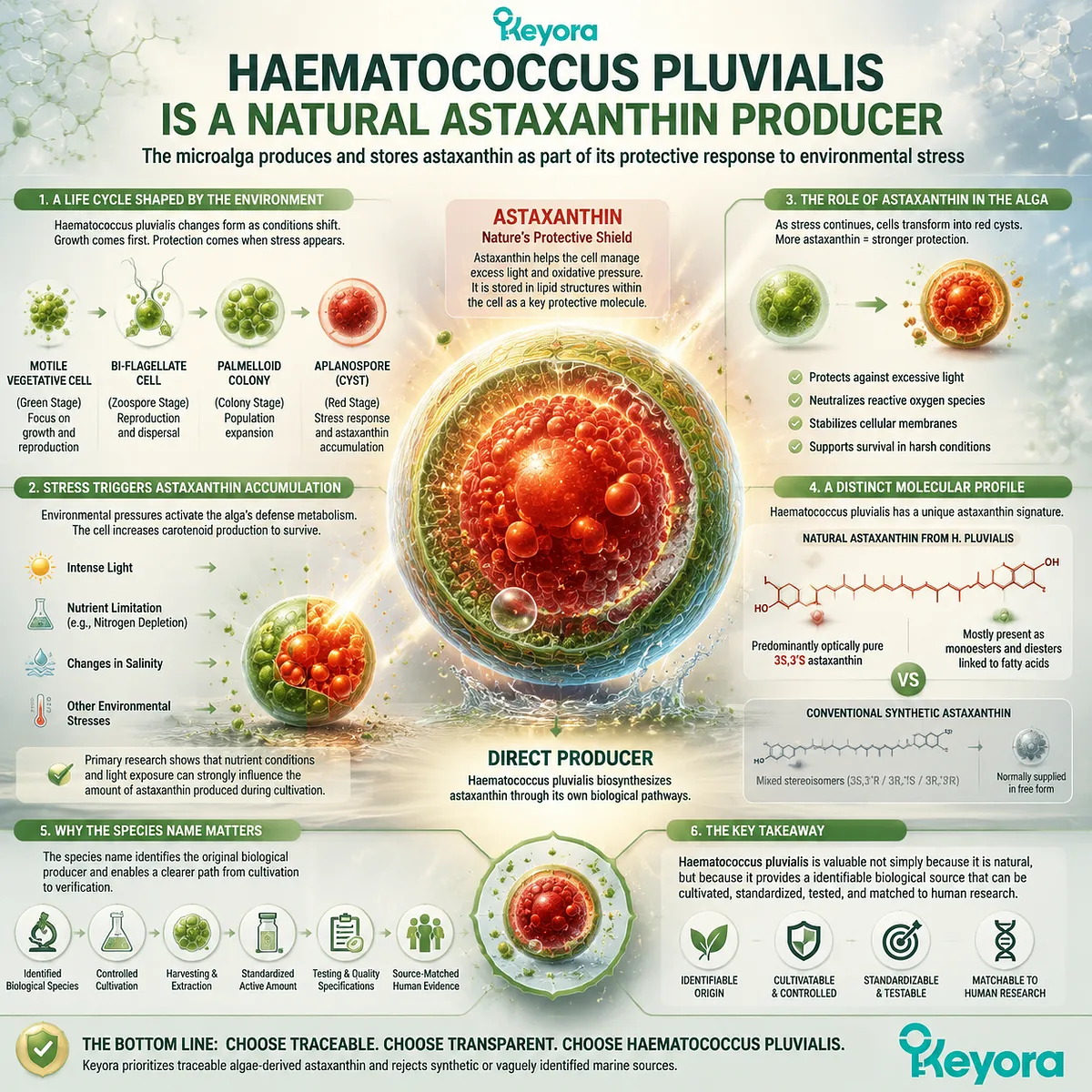
Haematococcus pluvialis Is a Natural Astaxanthin Producer
The microalga produces and stores astaxanthin as part of its protective response to environmental stress
Many natural astaxanthin labels contain the scientific name Haematococcus pluvialis.
For consumers, this long Latin name can look like a technical marketing phrase. It may be unclear why manufacturers emphasize the species or why the same name appears across products with very different prices, doses, and quality claims.
The species name matters because it identifies the organism that produced the astaxanthin.
Haematococcus pluvialis is a freshwater microalga with a life cycle that changes according to its environment. Under favorable growth conditions, the cells focus primarily on growth and reproduction. When conditions become stressful, their metabolism changes.
Relevant pressures can include:
-
intense light
-
nutrient limitation
-
changes in salinity
-
other environmental stress conditions
Under these conditions, the cells increase carotenoid production and accumulate astaxanthin. Primary research shows that nutrient conditions and light exposure can strongly influence the amount of astaxanthin produced during cultivation.
The pigment serves the alga before it ever becomes a supplement ingredient.
Astaxanthin helps the cell manage excessive light and oxidative pressure. As accumulation progresses, the cells change from a greener growth focused state toward a red, astaxanthin rich form. The pigment is stored within lipid structures inside the cell, where it contributes to the organism’s protective response.
This creates an important biological distinction.
Haematococcus pluvialis is a direct producer of astaxanthin.
Salmon, shrimp, crab, and other marine animals commonly obtain astaxanthin through food and later accumulate it in their tissues. The microalga produces the carotenoid through its own biological pathways.
That direct production path helps explain why the species has become important for supplement manufacturing. Producers do not need to rely on variable fish tissue, crustacean shells, or mixed seafood by-products to obtain the pigment. They can begin with an identified algal organism and cultivate it specifically for astaxanthin production.
The biological material also has a characteristic molecular profile. Early analytical research identified predominantly optically pure 3S,3′S astaxanthin in Haematococcus pluvialis, with much of the pigment present as monoesters and diesters linked to fatty acids.
This profile differs from conventional synthetic astaxanthin, which is normally produced as a mixed stereoisomer material and commonly supplied in a free form.
The difference does not mean that the species name proves every health claim. It means that Haematococcus pluvialis provides an identifiable biological origin and a recognizable material profile that can be evaluated separately from chemically synthesized astaxanthin.
Haematococcus pluvialis is valuable not simply because it is natural, but because it provides an identifiable biological source that can be cultivated, standardized, tested, and matched to human research
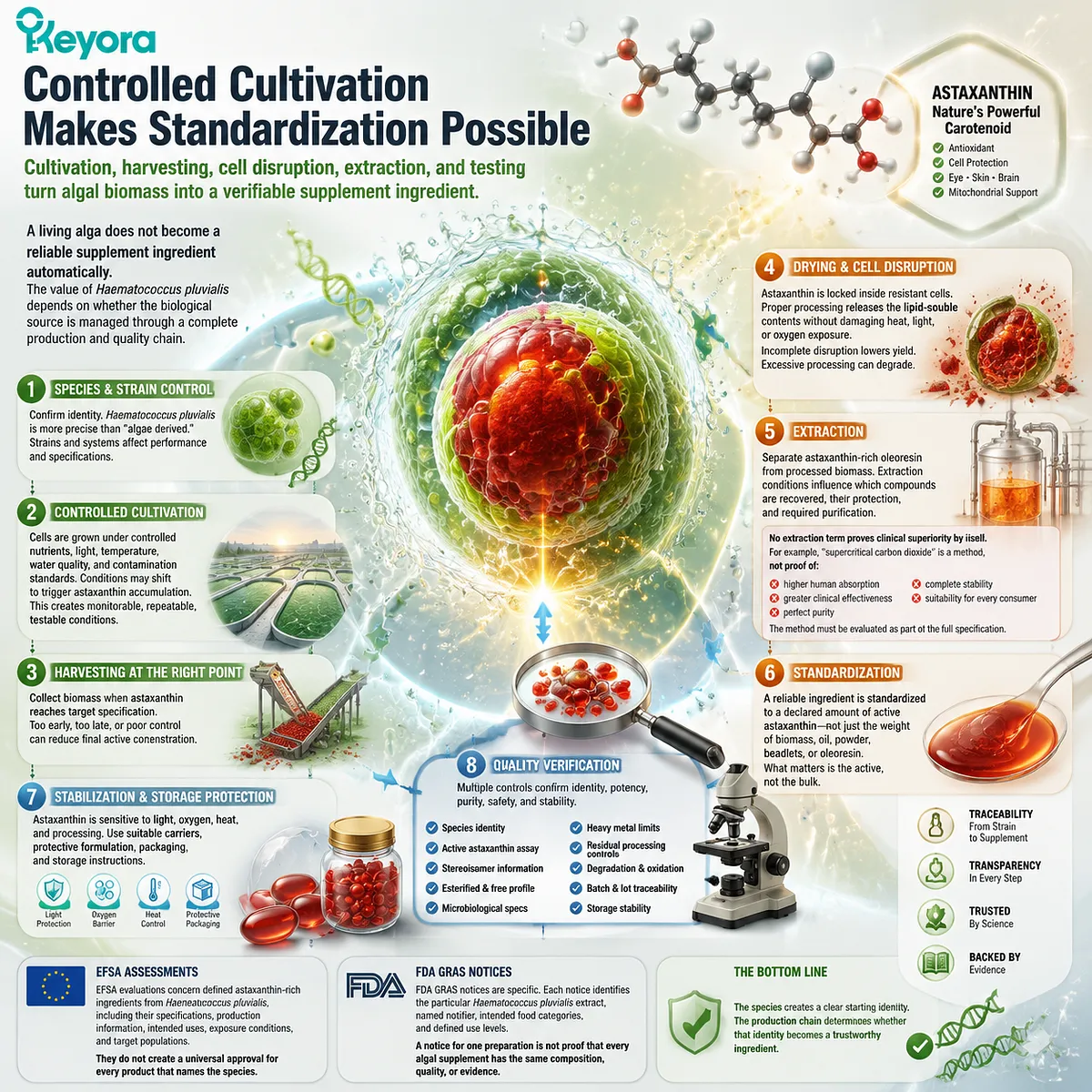
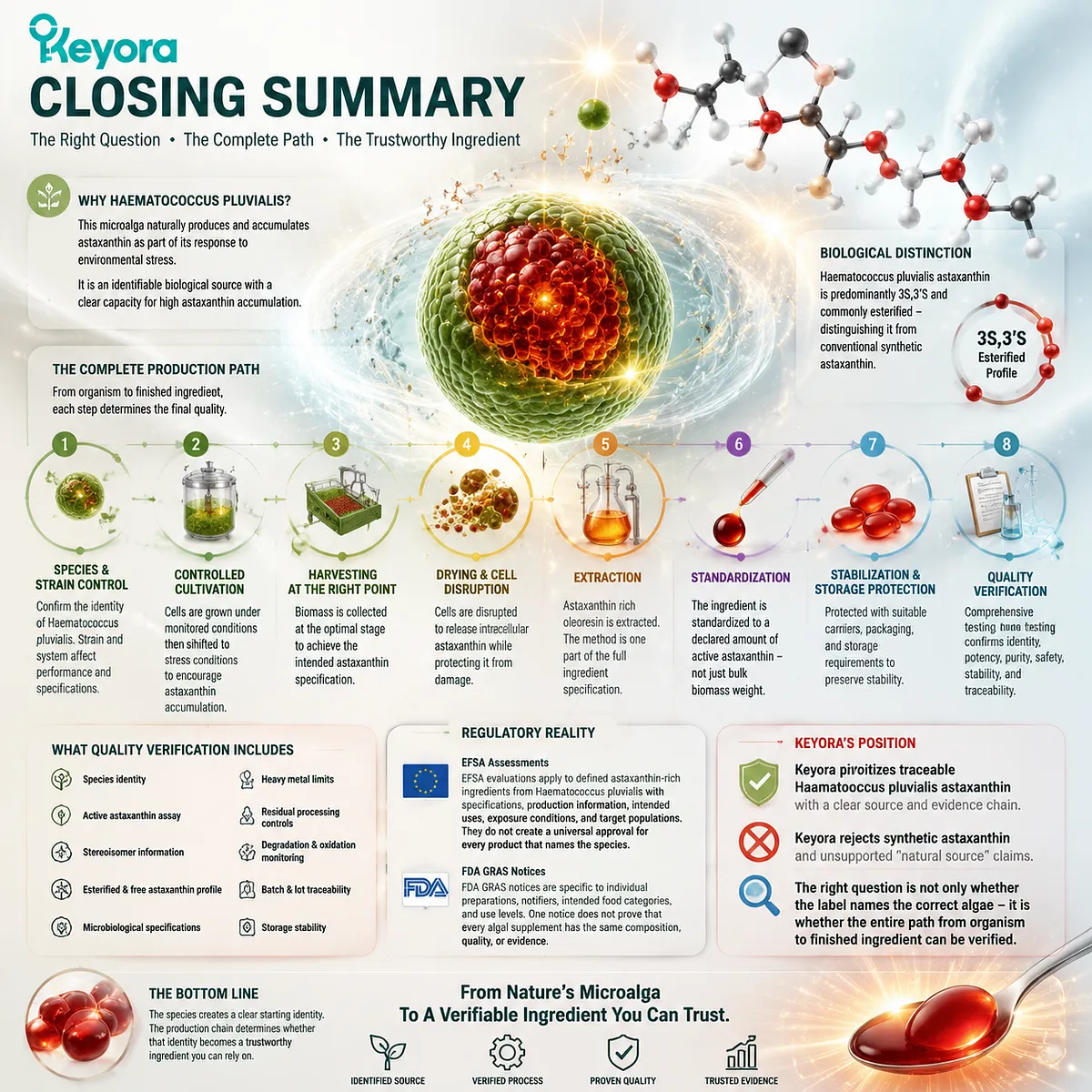
Controlled Cultivation Makes Standardization Possible
Cultivation, harvesting, cell disruption, extraction, and testing turn algal biomass into a verifiable supplement ingredient
A living alga does not become a reliable supplement ingredient automatically.
The value of Haematococcus pluvialis depends on whether the biological source is managed through a complete production and quality chain.
The first stage is species and strain control.
The producer must confirm the identity of the organism being cultivated. The words algae derived are not as precise as naming Haematococcus pluvialis. Even within the same species, cultivation performance and product specifications can vary according to the strain and production system.
The second stage is controlled cultivation.
The cells are grown under conditions intended to support healthy biomass production. Cultivation records can document factors such as nutrient conditions, light exposure, temperature, water quality, and contamination controls.
The process may then shift toward conditions that encourage astaxanthin accumulation.
Controlled cultivation does not guarantee purity or quality. It creates the conditions under which the process can be monitored, repeated, tested, and improved.
The third stage is harvesting at an appropriate point.
The biomass must be collected when it has reached the intended astaxanthin specification. Harvesting too early, allowing excessive degradation, or failing to control the biomass can affect the final active concentration.
The fourth stage is drying and cell disruption.
Astaxanthin is stored inside the algal cells. During the red accumulation stage, the cells can develop a resistant structure that protects their contents in nature but also makes commercial recovery more difficult.
The biomass therefore requires appropriate processing so that the lipid soluble material can be released and extracted. Incomplete cell disruption may reduce access to the internal carotenoids, while excessive processing may expose the ingredient to damaging heat, light, or oxygen.
The fifth stage is extraction.
The producer separates an astaxanthin rich oleoresin or related ingredient from the processed biomass. Extraction conditions influence which compounds are recovered, how well the pigment is protected, and what purification controls are needed.
No extraction term proves clinical superiority by itself.
For example, the phrase supercritical carbon dioxide may describe a manufacturing method, but it does not independently prove:
-
higher human absorption
-
greater clinical effectiveness
-
perfect purity
-
complete stability
-
suitability for every consumer
The method must be evaluated as one part of the full ingredient specification.
The sixth stage is standardization.
A reliable commercial ingredient should be standardized to a declared amount of active astaxanthin. Consumers need to know the amount of astaxanthin supplied, not only the weight of algal biomass, oil, beadlets, powder, or oleoresin.
This distinction matters because a label can show a large source material number while supplying a much smaller active astaxanthin amount.
The seventh stage is stabilization and storage protection.
Astaxanthin is sensitive to factors including light, oxygen, heat, and processing conditions. The extracted ingredient may therefore require a suitable carrier, protective formulation, packaging, and storage instructions.
The eighth stage is quality verification.
Relevant controls may include:
-
species identity
-
active astaxanthin assay
-
stereoisomer information
-
esterified and free astaxanthin profile
-
microbiological specifications
-
heavy metal limits
-
residual processing controls
-
degradation and oxidation monitoring
-
batch and lot traceability
-
storage stability
Official assessments illustrate why the complete ingredient matters. EFSA evaluations concern defined astaxanthin rich ingredients from Haematococcus pluvialis, including their specifications, production information, intended uses, exposure conditions, and target populations. They do not create a universal approval for every product that names the species.
FDA GRAS notices are similarly specific. For example, individual notices identify particular Haematococcus pluvialis extracts containing astaxanthin esters, named notifiers, intended food categories, and defined use levels. A notice for one preparation is not proof that every algal supplement has the same composition, quality, or evidence.
The species creates a clear starting identity.
The production chain determines whether that identity becomes a trustworthy ingredient.
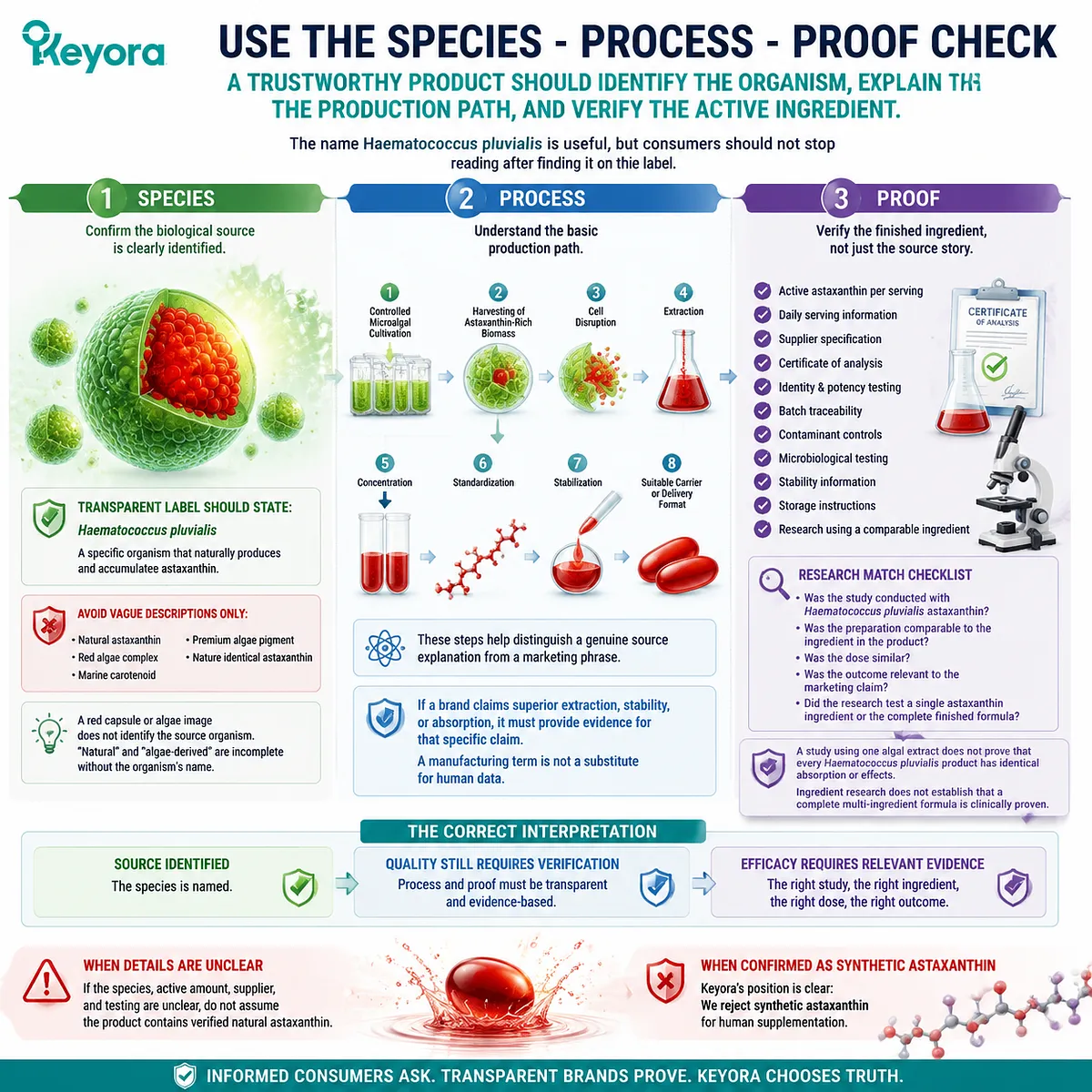
Use the Species – Process – Proof Check
A trustworthy product should identify the organism, explain the production path, and verify the active ingredient
The name Haematococcus pluvialis is useful, but consumers should not stop reading after finding it on the label.
Use the Species – Process – Proof Check.
1. Species
Confirm that the biological source is clearly identified.
A transparent label or product specification should state Haematococcus pluvialis rather than relying only on broad descriptions such as:
-
natural astaxanthin
-
red algae complex
-
marine carotenoid
-
premium algae pigment
-
nature identical astaxanthin
A red capsule or algae image does not identify the source organism.
The words natural and algae derived are incomplete when the company cannot state which organism produced the astaxanthin.
2. Process
Look for enough information to understand the basic production path.
The brand does not need to disclose confidential manufacturing details, but it should be able to explain whether the ingredient involves:
-
controlled microalgal cultivation
-
harvesting of astaxanthin rich biomass
-
cell disruption
-
extraction
-
concentration
-
standardization
-
stabilization
-
a suitable carrier or delivery format
These steps help distinguish a genuine source explanation from a marketing phrase.
A brand that claims superior extraction, stability, or absorption should provide evidence for that specific claim. A manufacturing term should not be used as a substitute for human data.
3. Proof
Verify the finished ingredient rather than trusting the source story alone.
Useful evidence may include:
-
active astaxanthin per serving
-
daily serving information
-
supplier specification
-
certificate of analysis
-
identity and potency testing
-
batch traceability
-
contaminant controls
-
microbiological testing
-
stability information
-
storage instructions
-
research that used a comparable ingredient
The research match is especially important.
Ask:
Was the study conducted with Haematococcus pluvialis astaxanthin?
Was the preparation comparable to the ingredient in the product?
Was the dose similar?
Was the outcome relevant to the marketing claim?
Did the research test a single astaxanthin ingredient or the complete finished formula?
A study using one named algal extract does not automatically prove that every Haematococcus pluvialis product has identical absorption or effects.
Ingredient research also does not establish that a complete multi ingredient formula has been clinically proven.
The correct interpretation is:
Source identified – quality still requires verification
When the species, active amount, supplier information, and testing are all unclear, consumers should not assume the product contains verified natural astaxanthin.
When the ingredient is confirmed as synthetic astaxanthin, Keyora’s position is to reject it for human supplementation.
What This Means When Choosing Astaxanthin
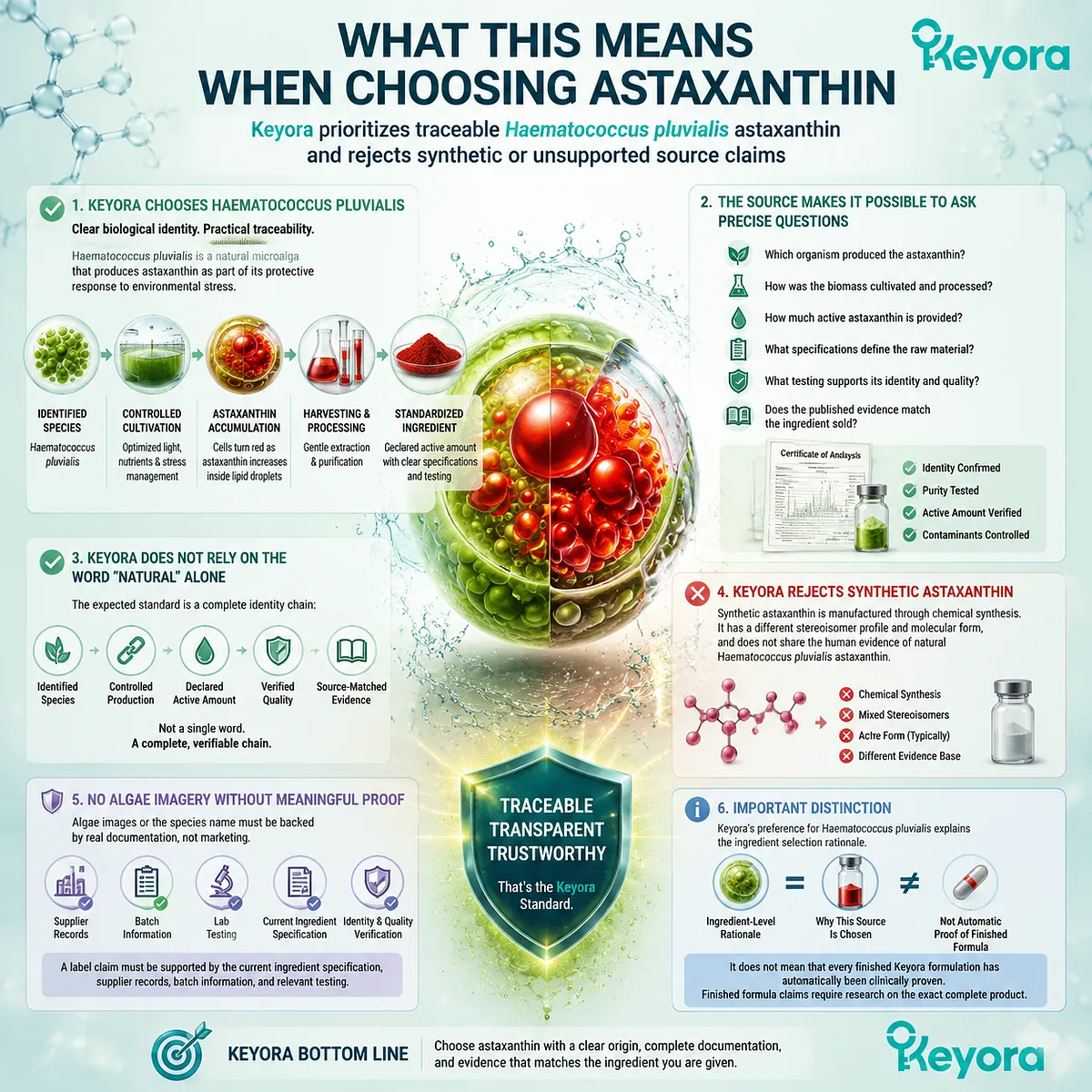
Keyora prioritizes traceable Haematococcus pluvialis astaxanthin and rejects synthetic or unsupported source claims
Keyora chooses Haematococcus pluvialis because it offers a clear biological identity and a practical route from cultivation to standardized ingredient production.
The source makes it possible to ask precise questions:
-
Which organism produced the astaxanthin?
-
How was the biomass cultivated and processed?
-
How much active astaxanthin is provided?
-
What specifications define the raw material?
-
What testing supports its identity and quality?
-
Does the published evidence match the ingredient sold?
Keyora does not rely on the word natural alone.
The expected standard is a complete identity chain:
Identified species – controlled production – declared active amount – verified quality – source matched evidence
Keyora also categorically rejects synthetic astaxanthin for human ingestion. Synthetic material is produced through a different manufacturing pathway, has a different common stereoisomer and molecular form profile, and does not inherit the human evidence of natural Haematococcus pluvialis astaxanthin.
The same scrutiny applies to brands that use algae imagery or the species name without providing meaningful source documentation.
A label claim must be supported by the current ingredient specification, supplier records, batch information, and relevant testing.
Keyora’s preference for Haematococcus pluvialis explains the ingredient selection rationale. It does not mean that every finished Keyora formulation has automatically been clinically proven. Finished formula claims require research on the exact complete product.
Closing Summary
Haematococcus pluvialis is widely used in natural astaxanthin supplements because it directly produces and accumulates astaxanthin as part of its response to environmental stress.
Its biological capacity allows producers to cultivate an identified organism, monitor astaxanthin accumulation, harvest the biomass, disrupt the cells, extract the carotenoids, standardize the active amount, and test the resulting ingredient. Its predominantly 3S,3′S and commonly esterified profile also distinguishes it from conventional synthetic astaxanthin.
However, the species name is only the beginning of quality verification.
A trustworthy supplement must still disclose the active astaxanthin amount, production and carrier context, quality specifications, testing, storage requirements, and evidence relevant to the ingredient sold.
Keyora prioritizes traceable Haematococcus pluvialis astaxanthin because it provides a clearer source and evidence chain. Keyora rejects synthetic astaxanthin and unsupported natural source claims.
The right question is not only whether the label names the correct algae – it is whether the entire path from organism to finished ingredient can be verified
This article is for educational and informational purposes only. It does not provide medical advice, diagnosis, treatment, cure, prevention, disease outcome claims, hormone restoration claims, fertility outcome claims, or formula-specific clinical efficacy claims.