
Why Is Astaxanthin Different From Other Antioxidants?
Keyora Research Q&A Library
This is part of the Keyora Research Q&A Series, derived from Keyora Astaxanthin Research Journal Series.
Within the Keyora Astaxanthin Researcn framework, this Q&A translates complex astaxanthin biology into reader-friendly, evidence-bound answers, focusing on natural astaxanthin identity, molecular structure, antioxidant and redox mechanisms, membrane lipid interaction, mitochondrial resilience, inflammatory signaling pathways, human evidence interpretation, and the scientific principles behind responsible supplementation.
First published by Keyora Research Journal: www.keyorahealth.com
Direct Answer
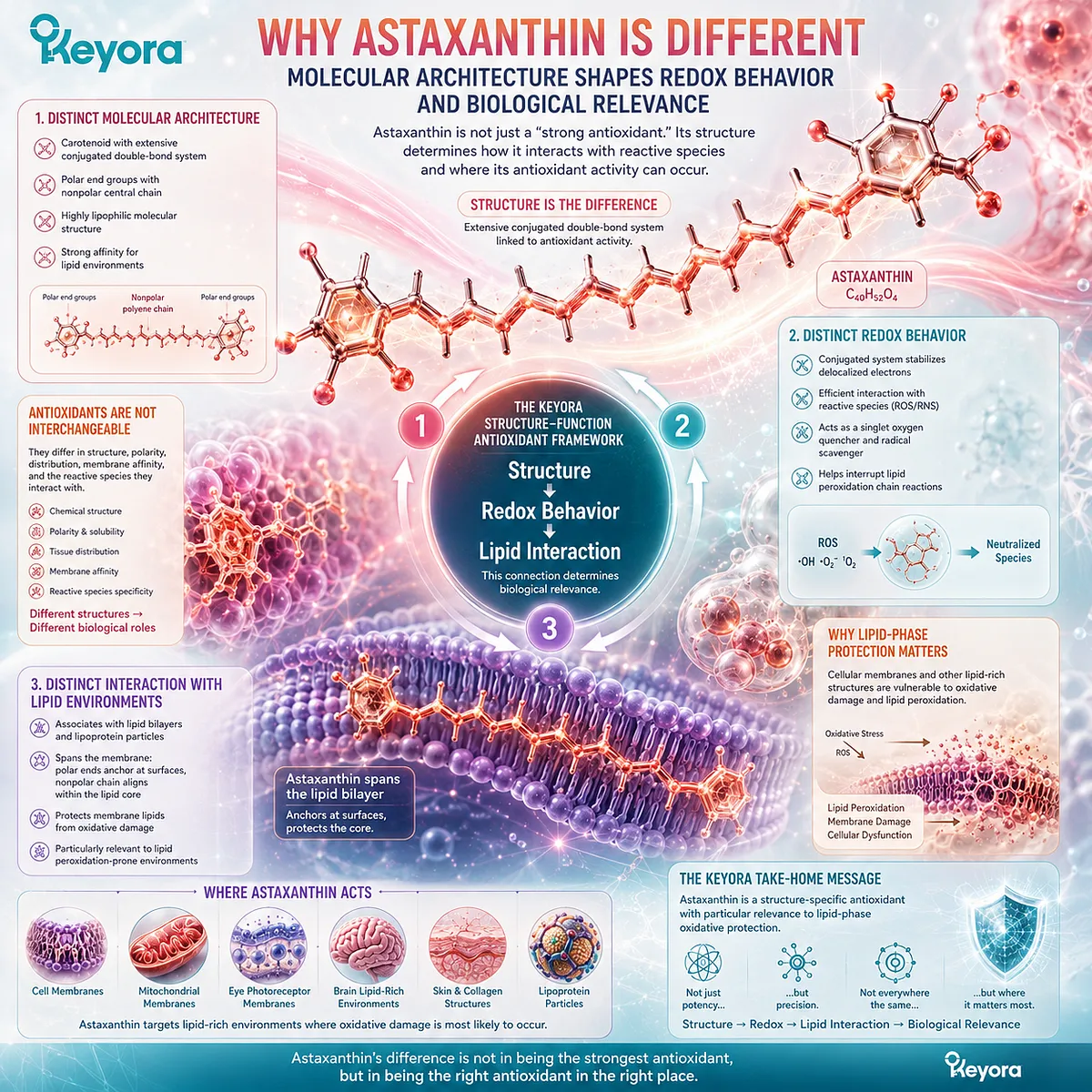
Astaxanthin is different because its molecular architecture influences both how it interacts with reactive species and where that antioxidant activity can occur
Astaxanthin is a carotenoid antioxidant, but describing it simply as a “strong antioxidant” misses the most important part of its biology.
What distinguishes Astaxanthin is the relationship between its molecular structure, its redox chemistry, and its ability to associate with lipid-rich biological environments.
The Keyora scientific source describes Astaxanthin as a lipophilic carotenoid with an extensive conjugated double-bond system. That conjugated structure is linked to its capacity to interact with reactive species and participate in antioxidant activity.
Its significance can therefore be understood through three connected layers:
Distinct molecular architecture
↓
Distinct redox behavior
↓
Distinct interaction with lipid environments
This is different from treating all antioxidants as interchangeable molecules that perform the same task at different strengths.
Antioxidants can differ in chemical structure, polarity, tissue distribution, membrane affinity, and the reactive species with which they interact. These differences influence where and how their antioxidant effects may be biologically relevant.
For Astaxanthin, this is particularly important because previous Q&A articles established that cellular membranes and other lipid-rich structures can be vulnerable to oxidative damage and lipid peroxidation.
An antioxidant capable of operating near those lipid structures may therefore have a different biological role from an antioxidant functioning primarily in another chemical environment.
Within the Keyora framework, Astaxanthin is best understood not as the winner of an antioxidant potency competition, but as a structure-specific antioxidant with particular relevance to lipid-phase oxidative protection.
What Is Unusual About Astaxanthin’s Molecular Structure?
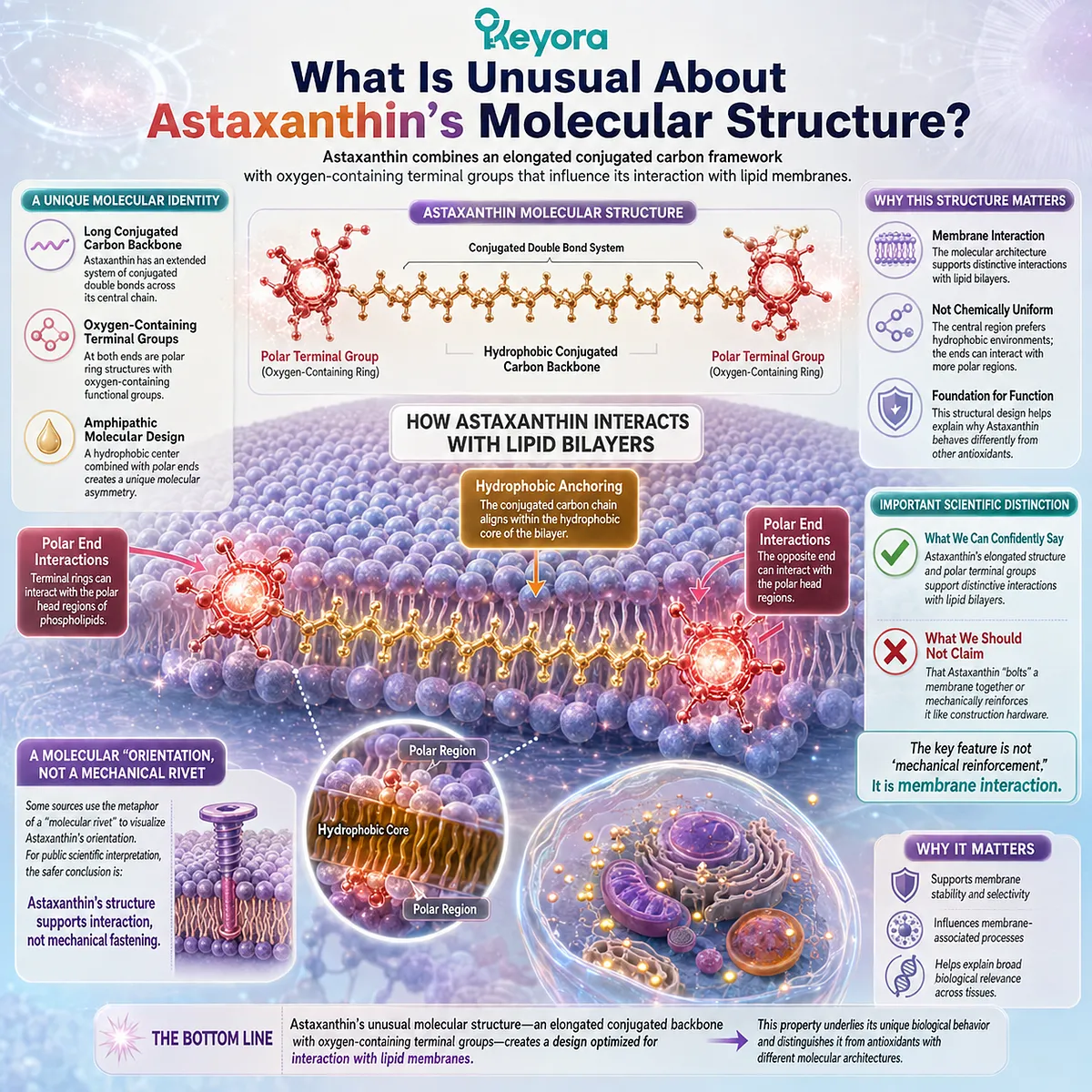
Astaxanthin combines an elongated conjugated carbon framework with oxygen-containing terminal groups that influence its interaction with lipid membranes
Astaxanthin has a long carotenoid backbone containing an extended system of conjugated double bonds.
At both ends of this central chain are oxygen-containing ring structures that possess more polar chemical characteristics than the central hydrophobic region.
The EP-3 source emphasizes this elongated architecture and describes Astaxanthin as having a long rigid carbon chain with polar ring structures at both ends.
This combination is important because the molecule is not chemically uniform from one end to the other.
Its central region has strong affinity for hydrophobic environments, while its terminal groups can interact differently with more polar regions.
This gives Astaxanthin a molecular architecture suited to interaction with lipid bilayers.
That does not mean the molecule should be described as literally “bolting” a membrane together or mechanically reinforcing it like construction hardware.
Some Keyora source material uses the metaphor of a “molecular rivet” to visualize Astaxanthin’s orientation within membranes.
For public scientific interpretation, however, the safer conclusion is:
Astaxanthin’s elongated structure and polar terminal groups support distinctive interactions with lipid bilayers.
That distinction matters.
A molecular model can help explain likely orientation and chemical behavior, but it should not automatically be converted into a claim that Astaxanthin physically stiffens human cell membranes or mechanically prevents membrane failure.
The structural feature we can confidently emphasize is therefore not “mechanical reinforcement.”
It is membrane interaction.
That property provides the foundation for understanding why Astaxanthin may behave differently from antioxidant molecules with different structures or distributions.
How Does Astaxanthin’s Conjugated Structure Support Antioxidant Activity?
Its extended conjugated electron system provides a chemical framework for interacting with and stabilizing reactive species
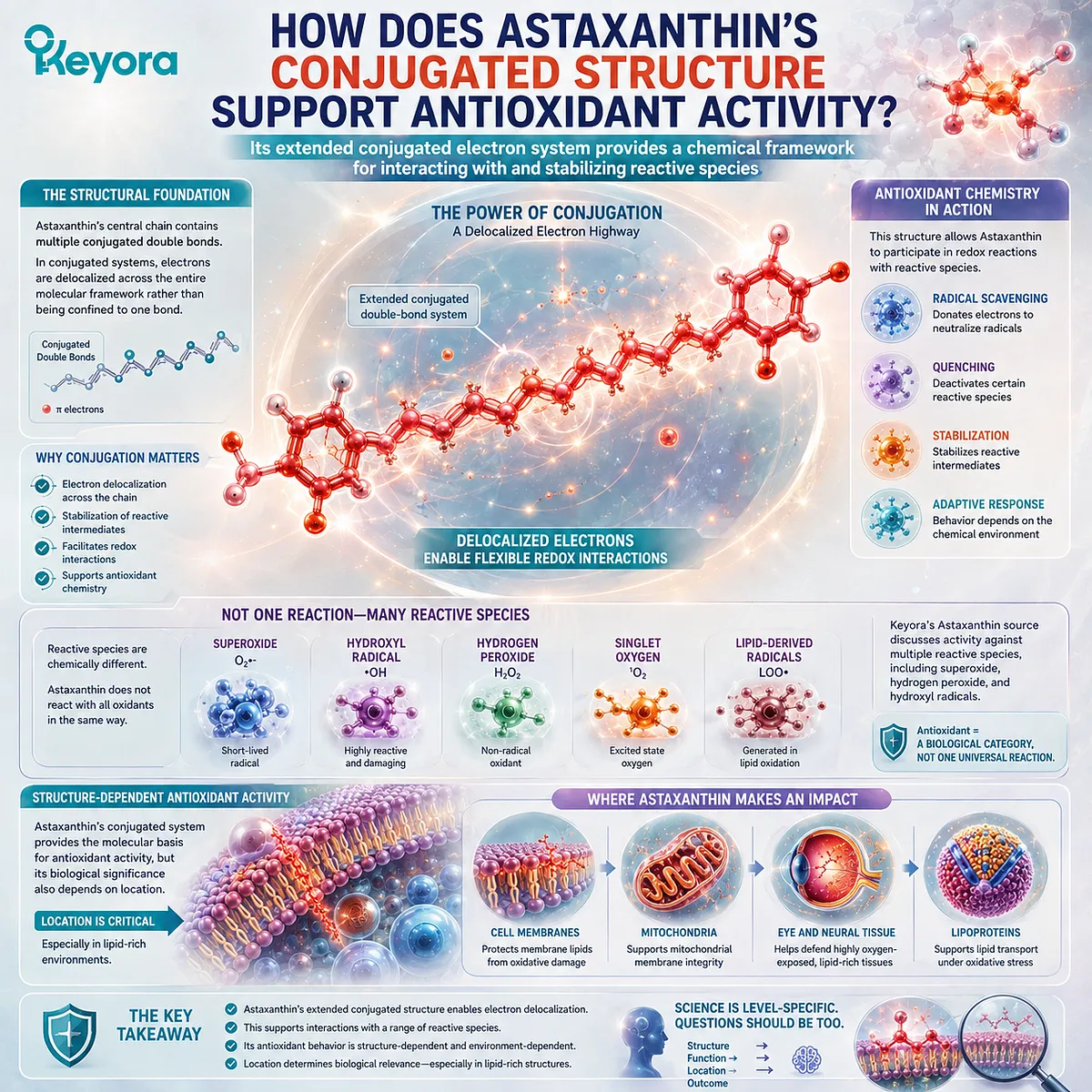
The central chain of Astaxanthin contains multiple conjugated double bonds.
In conjugated systems, electrons are distributed across a larger molecular framework rather than being confined to one isolated bond.
This structural arrangement is important to Astaxanthin’s antioxidant chemistry.
The Keyora Astaxanthin source specifically links its extensive conjugated double-bond system with the ability to neutralize reactive species.
In practical terms, this molecular architecture allows Astaxanthin to participate in redox reactions involving reactive molecules.
Depending on the chemical environment and reactive species involved, antioxidant behavior may include radical scavenging, quenching of certain reactive species, or stabilization of reactive intermediates.
The important point is that antioxidant chemistry is structure-dependent.
Astaxanthin should not be described as a universal molecule that reacts with every oxidant in exactly the same way.
Reactive oxygen species and other oxidants differ chemically. Superoxide, hydroxyl radicals, hydrogen peroxide, singlet oxygen, and lipid-derived radicals do not behave identically.
The project source itself lists multiple reactive species in discussions of Astaxanthin-associated antioxidant activity, including superoxide, hydrogen peroxide, and hydroxyl radicals.
This reinforces an important principle:
“Antioxidant” is a biological category, not one universal reaction.
Astaxanthin’s conjugated molecular system provides one reason it can participate in antioxidant chemistry, but its biological significance also depends on where the molecule is located.
That location becomes especially important when oxidative reactions occur inside lipid-rich structures.
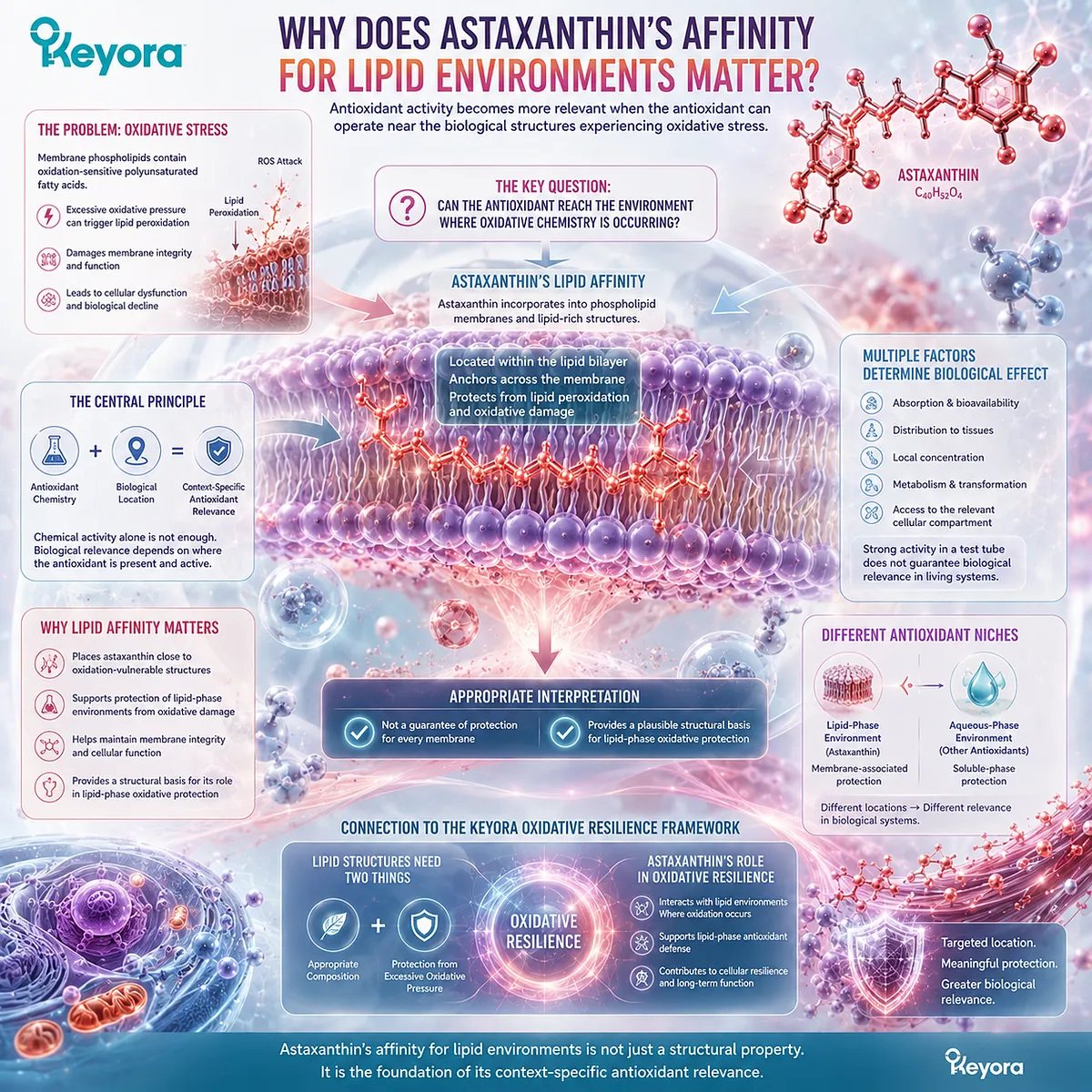
Why Does Astaxanthin’s Affinity for Lipid Environments Matter?
Antioxidant activity becomes more relevant when the antioxidant can operate near the biological structures experiencing oxidative stress
Previous articles established that membrane phospholipids can contain oxidation-sensitive polyunsaturated fatty acids.
When oxidative pressure becomes excessive, these lipid environments may undergo lipid peroxidation.
This creates an important question:
Can the antioxidant reach the environment where that oxidative chemistry is occurring?
Astaxanthin is relevant because the Keyora source repeatedly connects it with phospholipid bilayers and lipid-rich biological structures.
In one example, the source describes Astaxanthin as incorporating into a phospholipid membrane while supporting protection against lipid peroxidation and oxidative damage.
This leads to a broader principle:
Antioxidant chemistry
Biological location
=
Context-specific antioxidant relevance
An antioxidant may demonstrate strong chemical activity in an experimental assay, yet its biological effect also depends on absorption, distribution, local concentration, metabolism, and access to the relevant cellular compartment.
For Astaxanthin, lipid affinity matters because it places the molecule close to structures that can themselves be vulnerable to oxidation.
The appropriate interpretation is not that Astaxanthin guarantees protection of every membrane.
Instead, its lipid-associated behavior provides a plausible structural basis for studying its role in lipid-phase oxidative protection.
This distinction connects directly with the Keyora Oxidative Resilience framework.
Lipid structures need appropriate composition, but they also need sufficient protection from excessive oxidative pressure.
A molecule able to interact with lipid environments may therefore occupy a different antioxidant niche from a molecule concentrated elsewhere.
Is Astaxanthin Simply Stronger Than Vitamin C or Vitamin E?
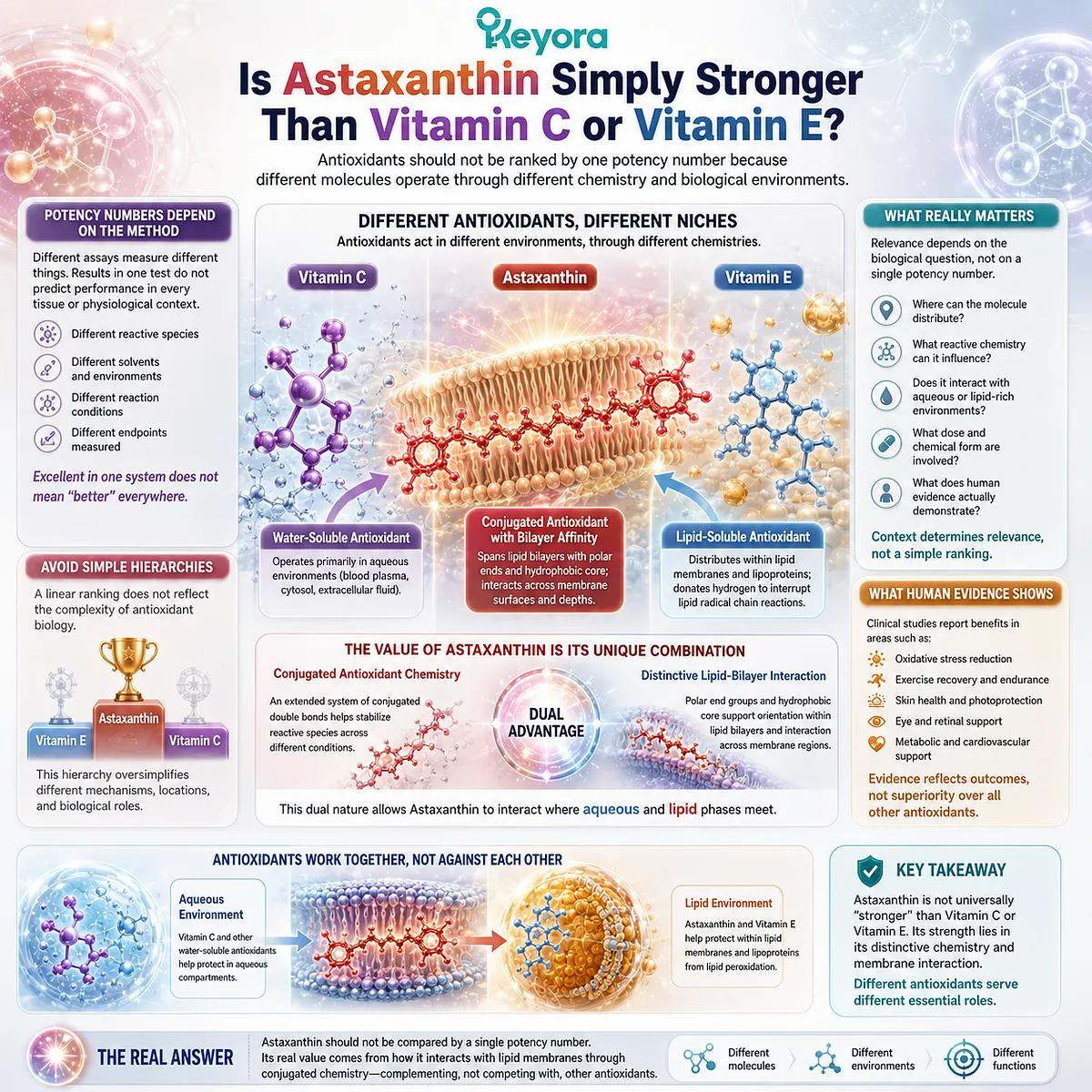
Antioxidants should not be ranked by one potency number because different molecules operate through different chemistry and biological environments
Astaxanthin is often marketed through comparisons claiming that it is many times “stronger” than other antioxidants.
Those comparisons can be misleading when presented without context.
Antioxidant potency depends heavily on the experimental method being used.
Different laboratory assays may measure different reactive species, different solvents, different reaction conditions, and different endpoints. A compound that performs extremely well in one chemical system is not automatically “better” in every tissue or physiological context.
This is why a simple hierarchy such as:
Astaxanthin > Vitamin E > Vitamin C
does not adequately represent antioxidant biology.
The Keyora EP-3 source contrasts Astaxanthin with Vitamin E within lipid membranes and describes Vitamin E as lipophilic and able to enter those environments.
The source then uses very strong language suggesting that Vitamin E is structurally inferior for membrane protection.
That comparison should be interpreted cautiously.
Vitamin E is itself an established lipid-phase antioxidant. Astaxanthin’s value does not require portraying Vitamin E as ineffective.
The more scientifically useful distinction is:
Different antioxidants occupy different chemical and biological niches.
Their relevance depends on questions such as:
Where can the molecule distribute?
What reactive chemistry can it influence?
Does it interact with aqueous or lipid-rich environments?
What dose and chemical form are involved?
What does human evidence actually demonstrate?
Astaxanthin therefore should not be positioned as universally “better” than every other antioxidant.
Its distinguishing feature is the combination of conjugated antioxidant chemistry and distinctive lipid-bilayer interaction.
That is a more meaningful comparison than a single laboratory potency number.
What Does Astaxanthin’s Structure Mean for Oxidative Resilience?
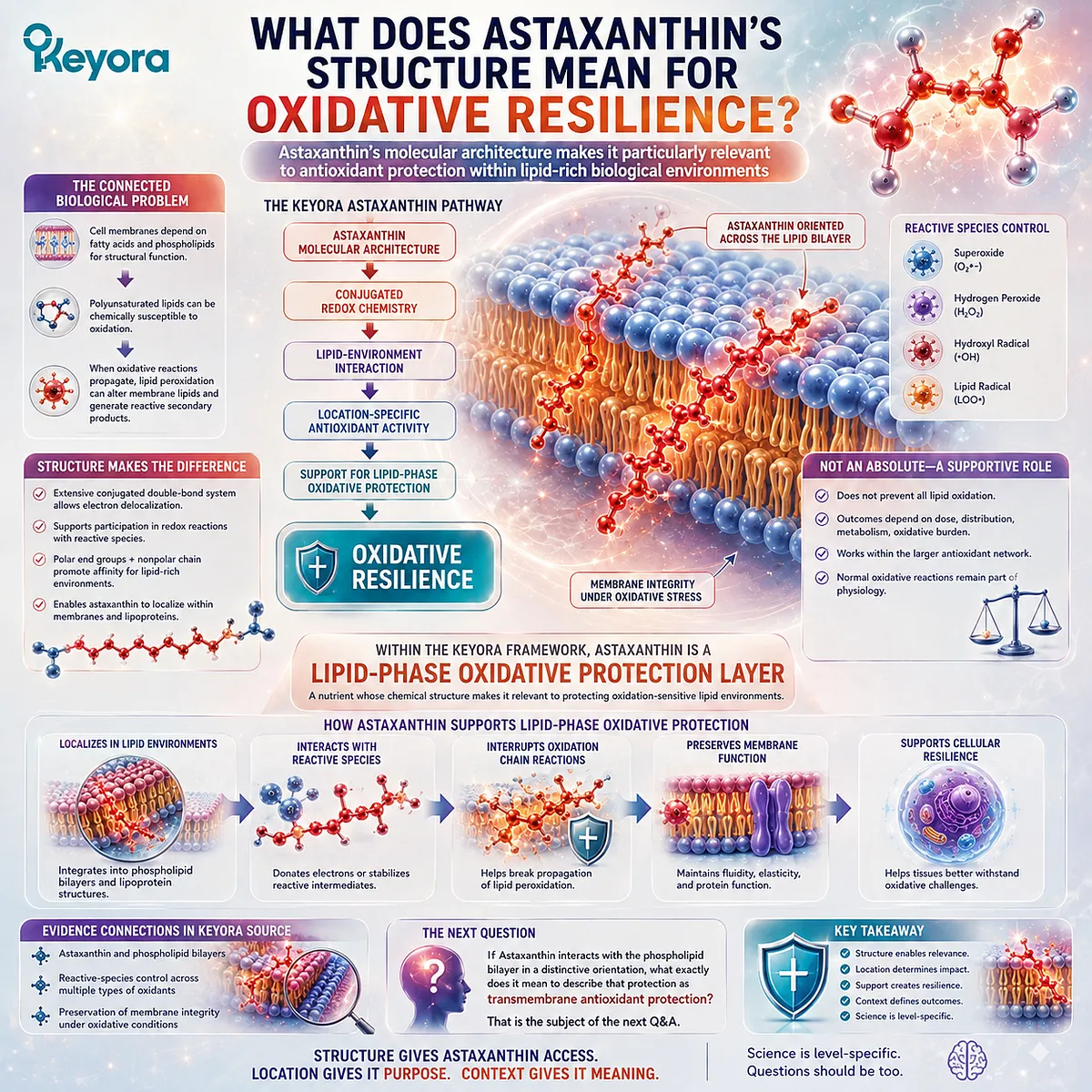
Astaxanthin’s molecular architecture makes it particularly relevant to antioxidant protection within lipid-rich biological environments
The previous Q&A sequence established a connected biological problem.
Cell membranes depend on fatty acids and phospholipids for structural function.
Polyunsaturated lipids can be chemically susceptible to oxidation.
When oxidative reactions propagate, lipid peroxidation can alter membrane lipids and generate reactive secondary products.
Astaxanthin introduces a new layer to this framework because its molecular structure combines antioxidant chemistry with affinity for lipid environments.
The Keyora pathway can therefore be summarized as:
Astaxanthin molecular architecture
↓
Conjugated redox chemistry
Lipid-environment interaction
↓
Location-specific antioxidant activity
↓
Support for lipid-phase oxidative protection
↓
Oxidative Resilience
This does not mean Astaxanthin prevents all lipid oxidation.
Normal oxidative reactions remain part of physiology, and antioxidant outcomes depend on dose, tissue distribution, metabolism, oxidative burden, and the larger antioxidant network.
The appropriate nutritional role is therefore supportive rather than absolute.
Within the Keyora framework, Astaxanthin can be positioned as a Lipid-Phase Oxidative Protection Layer – a nutrient whose chemical structure makes it relevant to protecting oxidation-sensitive lipid environments.
The Keyora source provides multiple examples connecting Astaxanthin with phospholipid bilayers, reactive-species control, and preservation of membrane integrity under oxidative conditions.
But one question remains.
If Astaxanthin interacts with the phospholipid bilayer in a distinctive orientation, what exactly does it mean to describe that protection as transmembrane antioxidant protection?
That is the subject of the next Q&A.
This article is for educational and informational purposes only. It does not provide medical advice, diagnosis, treatment, cure, prevention, disease outcome claims, hormone restoration claims, fertility outcome claims, or formula-specific clinical efficacy claims.