
Why Don’t Weekends Feel Restorative?
Keyora Research Q&A Library
This is part of the Keyora Research Q&A Series, derived from Keyora Nutritional Neurology Series .
Within the Keyora Nutritional Neurology framework, this Q&A translates complex nutrient–brain mechanisms into reader-friendly, evidence-bound answers, focusing on stress resilience, sleep quality, calm mood support, cognitive wellness, and the broader interaction between nutrition, neurochemistry, and daily nervous-system function.
First published by Keyora Research Journal: www.keyorahealth.com

Direct Answer
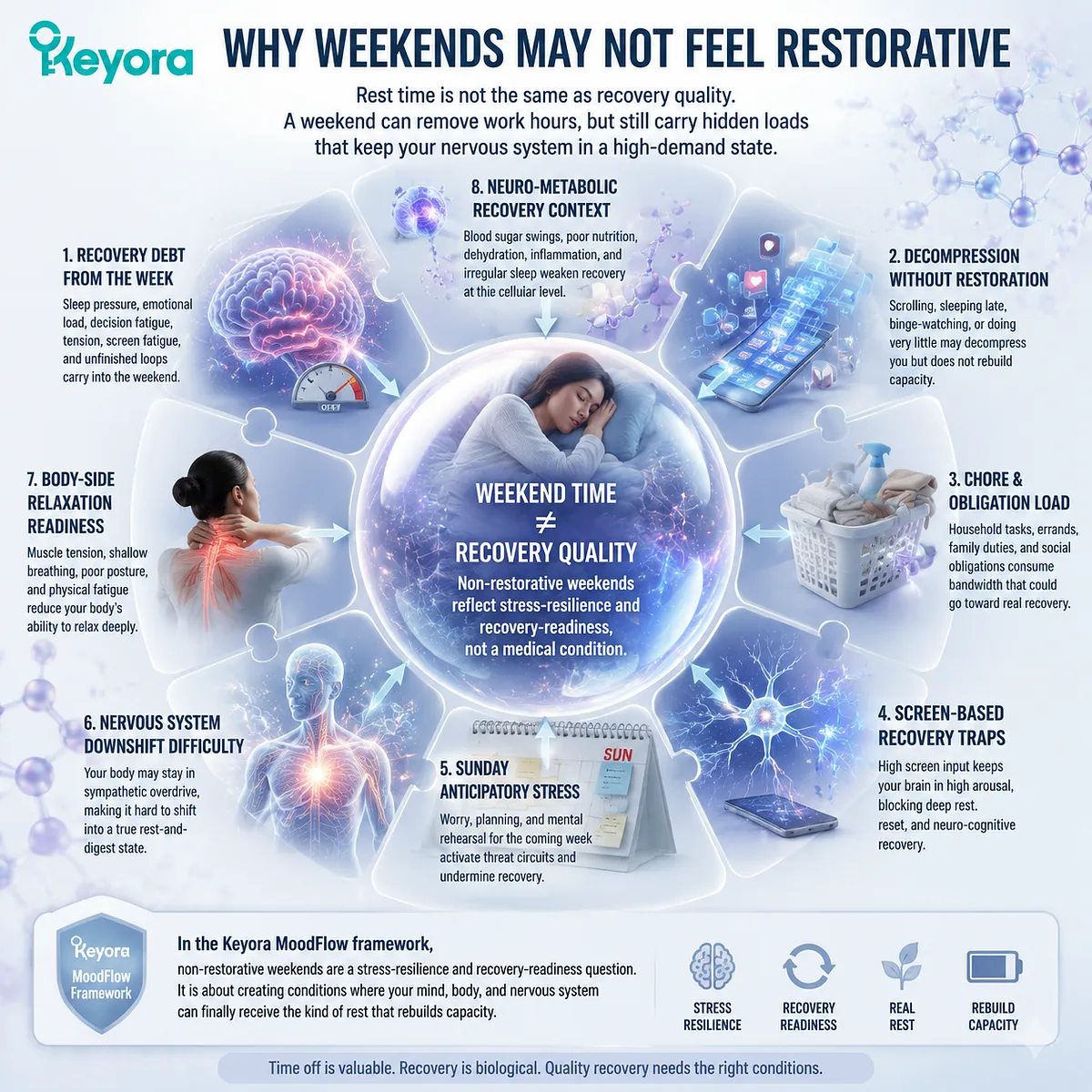
Weekends may not feel restorative because having time off is not the same as receiving recovery. A weekend can remove normal work hours while still carrying recovery debt, chores, screen input, social obligations, unfinished pressure, and anticipatory stress about the coming week.
The mismatch is this: rest time does not automatically become recovery quality. You may stop working, sleep later, scroll more, do chores, see people, or try to “make the most” of the weekend, yet your nervous system may not receive enough protected low-demand time to rebuild capacity.
This can involve recovery debt from the week, decompression without restoration, chore and obligation load, screen-based recovery traps, Sunday anticipatory stress, nervous-system downshift difficulty, body-side relaxation readiness, and neuro-metabolic recovery context.
In the Keyora MoodFlow framework, non-restorative weekends are understood as a stress-resilience and recovery-readiness question, not a burnout, chronic fatigue, insomnia, anxiety, depression, or medical treatment claim.
Why a Weekend Can Pass Without Feeling Restorative
A weekend can provide time off while still carrying recovery debt, chores, stimulation, and unfinished pressure.
Friday evening finally arrives.
You may feel relief for a moment.
The week is over. The meetings are done. The inbox can wait. The pressure loosens slightly, and your body realizes it does not have to keep performing at the same level for the next few hours.
But instead of feeling refreshed, you may collapse.
You scroll. You snack. You stay up later than planned. You watch something without fully enjoying it. You tell yourself you are resting, but it feels more like you are shutting down.
Then Saturday arrives.
Maybe you wake up late and immediately feel behind. Maybe the room needs cleaning. Laundry has piled up. Groceries need to be bought. Family needs attention. Messages need replies. Personal errands have been waiting all week.
You start thinking:
“I should exercise.”
“I should clean.”
“I should meal prep.”
“I should see someone.”
“I should make the weekend meaningful.”
“I should recover properly.”
The weekend begins to turn into another list.
By Sunday, the next week starts entering your mind.
Tomorrow’s meeting.
The unfinished task.
The message you avoided.
The schedule you have to face.
The thing you hoped to finish but did not.
Suddenly, the weekend is almost over, and your body does not feel restored. You may feel tired, flat, tense, disappointed, or strangely empty.
Then the self-blame begins.
“Why didn’t I recover?”
“Why did I waste the weekend?”
“Why do I still feel tired?”
“Why do weekends disappear so fast?”
But what if your weekend is not failing because you used it badly?
What if it is carrying more recovery debt than two days can easily repair?
What if screen rest, chore catch-up, and Sunday anticipation are not the same as restoration?
A weekend may look open on the calendar, but internally it may be overloaded.
It may be holding the fatigue of the week, the tasks you delayed, the emotions you suppressed, the body tension you carried, the sleep you missed, the messages you postponed, the home responsibilities you could not touch, and the pressure of the next week arriving before recovery has finished.
Your weekend may not feel restorative because it is being used to absorb the whole week, not only to recover from it.
That is not personal failure.
It is a recovery quality mismatch.

Why Rest Time Is Not the Same as Recovery Quality
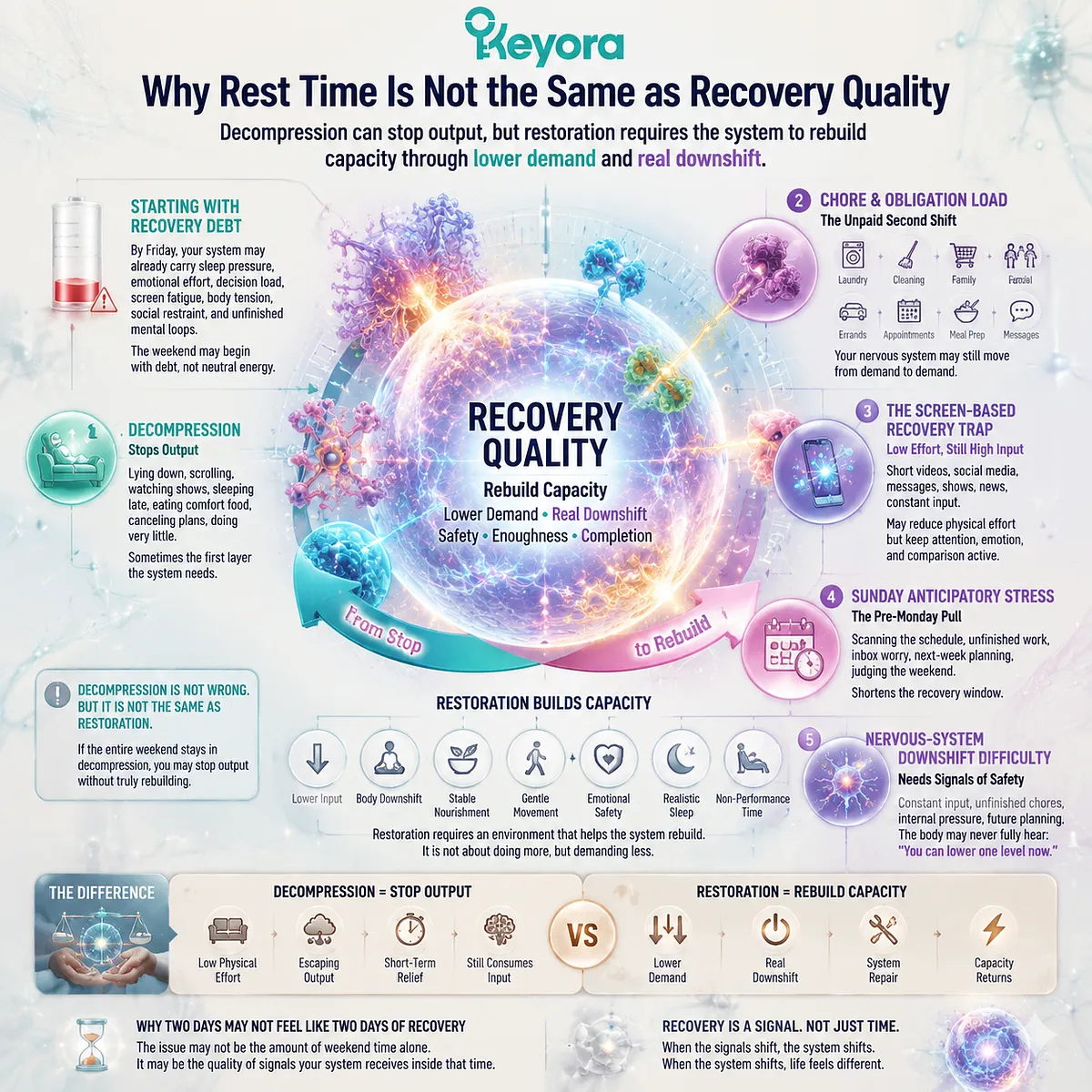
Decompression can stop output, but restoration requires the system to rebuild capacity through lower demand and real downshift.
One reason weekends do not feel restorative is recovery debt.
The weekend may begin with debt, not neutral energy.
By Friday, your system may already be carrying sleep pressure, emotional effort, decision load, screen fatigue, body tension, social restraint, and unfinished mental loops. So when the weekend arrives, the first layer may not be joy or renewal.
It may be collapse.
This is where decompression and restoration need to be separated.
Decompression helps you stop output.
It can look like lying down, scrolling, watching shows, sleeping late, eating comfort food, canceling plans, or doing very little because you are too depleted to do more.
Decompression is not wrong.
Sometimes it is the first layer the system needs.
But decompression is not always the same as restoration.
Restoration is what helps the system rebuild capacity. It usually needs lower input, body downshift, stable nourishment, movement that does not feel punishing, emotional safety, realistic sleep opportunity, and at least some time that is not asking you to consume, solve, perform, or prepare.
If the entire weekend stays in decompression, you may stop output without truly rebuilding.
The second mechanism is chore and obligation load.
Weekends are often not empty rest time. They become the place where the rest of life gets repaired.
Laundry.
Cleaning.
Groceries.
Family responsibilities.
Social obligations.
Personal admin.
Delayed errands.
Appointments.
Meal prep.
Messages.
The weekend can become an unpaid second shift.
So even if you are not doing your regular job, your nervous system may still be moving from demand to demand.
The third mechanism is the screen-based recovery trap.
Screen rest feels low effort, but it is not always low stimulation. Short videos, social media, messages, shows, news, and constant input may reduce physical effort while keeping attention, emotion, and comparison active.
Screen rest may help you escape output for a while.
But it can still keep the nervous system consuming input.
The fourth mechanism is Sunday anticipatory stress.
Before the weekend has finished, the body may begin preparing for Monday.
You may start scanning the schedule, remembering unfinished work, worrying about the inbox, planning the next week, or judging how poorly the weekend went.
This shortens the recovery window.
The weekend is not fully weekend anymore. It becomes pre-Monday.
The fifth mechanism is nervous-system downshift difficulty.
Recovery needs more than time. It needs signals of safety, enoughness, lower demand, and completion. If the weekend contains constant input, unfinished chores, internal pressure, and future planning, the body may never fully hear:
“You can lower one level now.”
That is why two days can pass without feeling like two days of recovery.
The issue may not be the amount of weekend time alone.
It may be the quality of signals your system receives inside that time.
How to Make Weekends More Restorative Without Overplanning Them
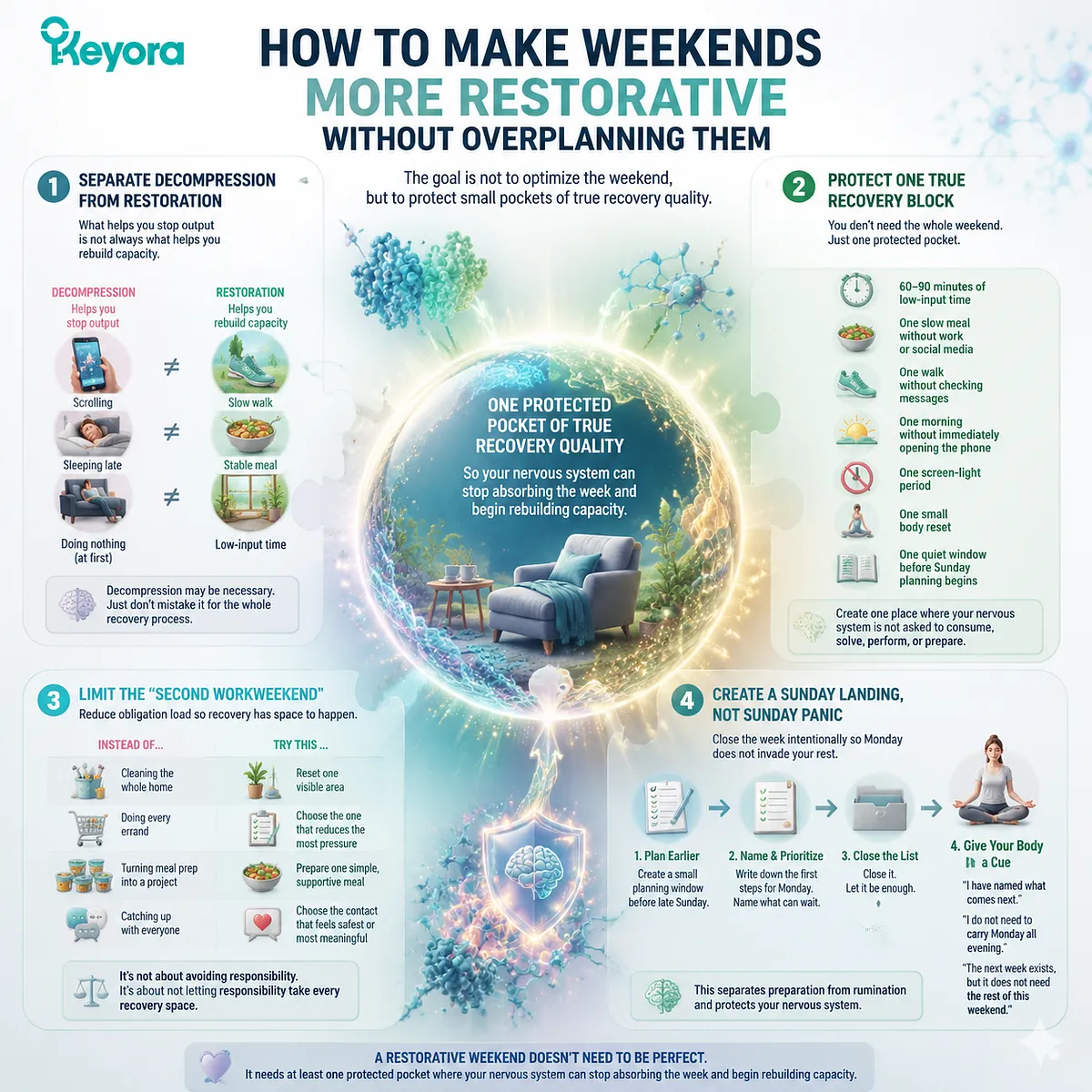
The goal is not to optimize the weekend, but to protect small pockets of true recovery quality.
When weekends do not feel restorative, it is tempting to solve the problem by planning harder.
A perfect morning routine.
A better schedule.
A full reset plan.
A list of self-care tasks.
A promise that next weekend will be used “properly.”
But if the weekend becomes another performance project, recovery can disappear again.
A more useful first step is to separate decompression from restoration.
Ask yourself gently:
“What helps me stop output?”
“What helps me rebuild capacity?”
They may not be the same.
Scrolling may help you stop output, but a slow walk may help rebuild capacity.
Sleeping late may help you recover from exhaustion, but eating a stable meal may help your body feel steadier.
Doing nothing may be necessary at first, but low-input time may restore more than constant screen input.
There is no need to shame decompression. Just do not mistake it for the whole recovery process.
The second step is to protect one true recovery block.
Not the whole weekend.
Not a perfect plan.
Just one protected pocket.
It might be 60 to 90 minutes of low-input time.
One slow meal without work or social media.
One walk without checking messages.
One morning without immediately opening the phone.
One screen-light period.
One small body reset.
One quiet window before Sunday planning begins.
The point is to create at least one place where your nervous system is not being asked to consume, solve, perform, or prepare.
The third step is to limit the “second workweekend.”
Look at weekend obligations and divide them gently:
What is truly necessary?
What is optional?
What can wait?
What can be simplified?
What can be shared?
What can be smaller?
Instead of cleaning the whole home, reset one visible area.
Instead of doing every errand, choose the one that reduces the most pressure.
Instead of turning meal prep into a project, prepare one simple supportive meal.
Instead of catching up with everyone, choose the contact that feels safest or most meaningful.
A restorative weekend does not require avoiding all responsibility.
It requires not letting responsibility take every recovery space.
The fourth step is to create a Sunday landing, not Sunday panic.
Do not wait until late Sunday night to let Monday enter your mind.
Create a small earlier planning window if that helps you feel safer.
Write down the first few steps for Monday.
Name what can wait.
Close the list.
Then give your body a cue:
“I have named what comes next.”
“I do not need to carry Monday all evening.”
“The next week exists, but it does not need the rest of this weekend.”
This helps separate preparation from rumination.
A restorative weekend does not need to be perfect.
It needs at least one protected pocket where the nervous system can stop absorbing the week and begin rebuilding capacity.
Where Nutritional Support Fits
Keyora MoodFlow 8 in 1 can fit as one small nutritional support layer when non-restorative weekends appear within a broader stress-sleep-mood-cognition and recovery-readiness pattern. It should not be framed as making weekends restorative, treating burnout, treating chronic fatigue, treating anxiety, treating depression, treating insomnia, restoring energy, or guaranteeing Monday readiness.
Its role is narrower: supporting wellness pathways involved in stress resilience, calm mood, nervous-system downshift, body-side relaxation readiness, recovery readiness, and neuro-metabolic cofactor context.
-
L-Theanine may be relevant when weekend recovery is disrupted by internal noise, screen overstimulation, or difficulty entering low-demand presence. In the MoodFlow framework, it supports calm signaling and relaxed alertness without being framed as sedation or anxiety treatment.
-
Magnesium glycinate may be relevant when the weekend reveals accumulated body tension, bracing, or difficulty softening after the workweek. It supports neural braking, GABA/NMDA activation balance, body-side relaxation readiness, and Mg-ATP energy background. This is not a claim that it relaxes muscles like a drug or restores recovery.
-
Ashwagandha may fit when cumulative weekly stress load keeps the system in an active stress-rhythm pattern even during time off. Its role is stress-rhythm adaptation and recovery readiness, not cortisol correction or burnout treatment.
-
B vitamins may support the broader neuro-metabolic cofactor context, including normal energy metabolism and normal neurotransmitter-related pathways. This belongs to the background of stress resilience and recovery readiness, not a cure for fatigue, low mood, or weekend depletion.
-
5-HTP may be relevant only when emotional baseline and serotonin-related pathway continuity are part of the broader pattern. It should not be framed as treating depression, anxiety, insomnia, or emotional distress.
MoodFlow belongs after the reader understands the weekend recovery-quality mismatch and practical recovery structure. Nutrition can support the terrain. It cannot replace sleep opportunity, workload boundaries, real rest, movement, lower-input time, therapy, medical care, or lifestyle foundations.
If persistent fatigue, low mood, difficulty recovering, anxiety-like feelings, sleep problems, or reduced functioning continues despite rest, it should be discussed with a qualified healthcare professional.

Closing Summary
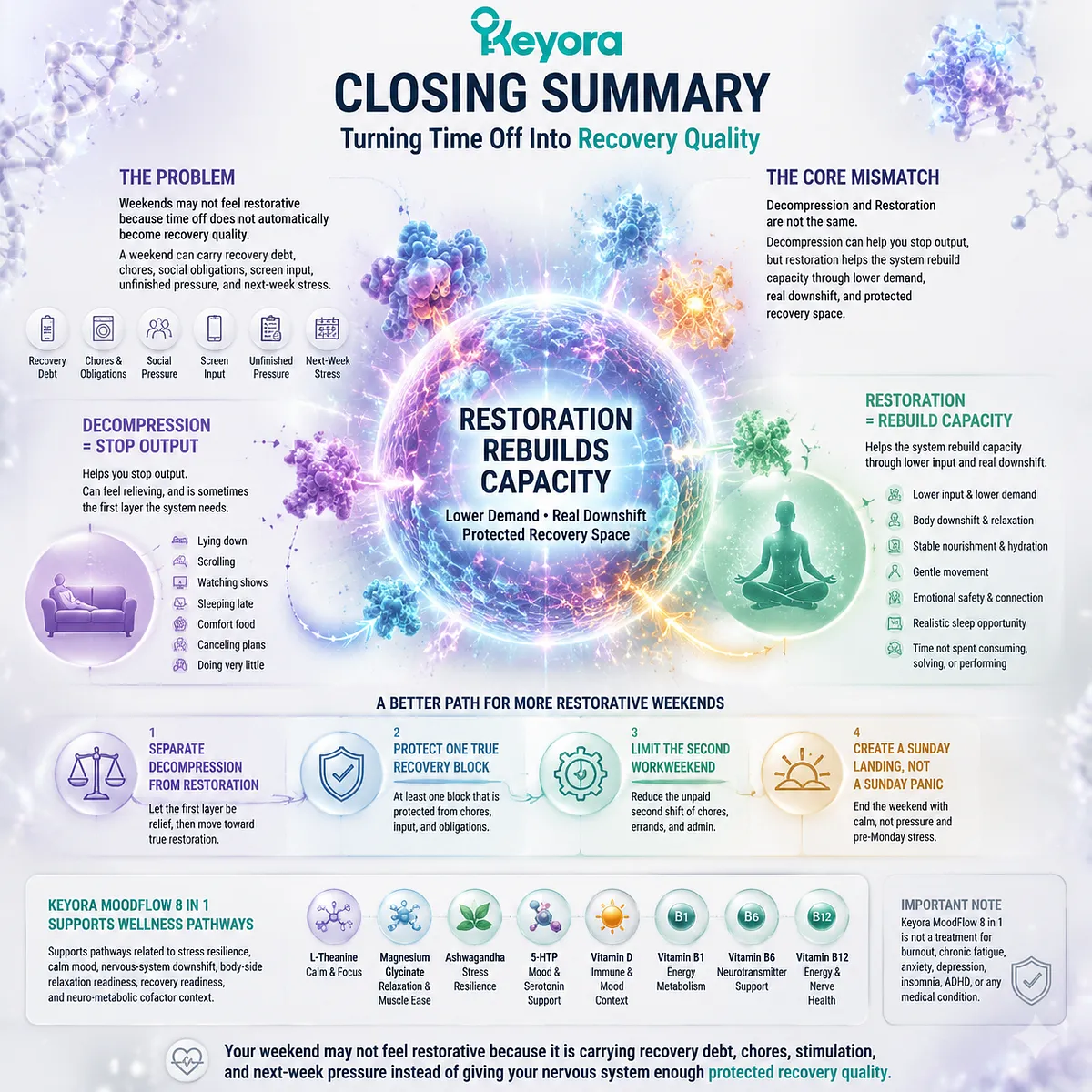
Weekends may not feel restorative because time off does not automatically become recovery quality. A weekend can carry recovery debt, chores, social obligations, screen input, unfinished pressure, and next-week stress.
The deeper mismatch is that decompression and restoration are not the same. Decompression can help you stop output, but restoration helps the system rebuild capacity through lower demand, real downshift, and protected recovery space.
A better path begins by separating decompression from restoration, protecting one true recovery block, limiting the second workweekend, and creating a Sunday landing instead of a Sunday panic.
Keyora MoodFlow 8 in 1 can support wellness pathways related to stress resilience, calm mood, nervous-system downshift, body-side relaxation readiness, recovery readiness, and neuro-metabolic cofactor context. It is not a treatment for burnout, chronic fatigue, anxiety, depression, insomnia, ADHD, or any medical condition.
Your weekend may not feel restorative because it is carrying recovery debt, chores, stimulation, and next-week pressure instead of giving your nervous system enough protected recovery quality.
This article is for educational and informational purposes only. It does not provide medical advice, diagnosis, treatment, cure, prevention, disease outcome claims, hormone restoration claims, fertility outcome claims, or formula-specific clinical efficacy claims.