
Why Don’t I Notice Any Effect From Astaxanthin?
Keyora Research Q&A Library
This is part of the Keyora Research Q&A Series, derived from Keyora Astaxanthin Research Journal Series.
Within the Keyora Astaxanthin Researcn framework, this Q&A translates complex astaxanthin biology into reader-friendly, evidence-bound answers, focusing on natural astaxanthin identity, molecular structure, antioxidant and redox mechanisms, membrane lipid interaction, mitochondrial resilience, inflammatory signaling pathways, human evidence interpretation, and the scientific principles behind responsible supplementation.
First published by Keyora Research Journal: www.keyorahealth.com

Direct Answer
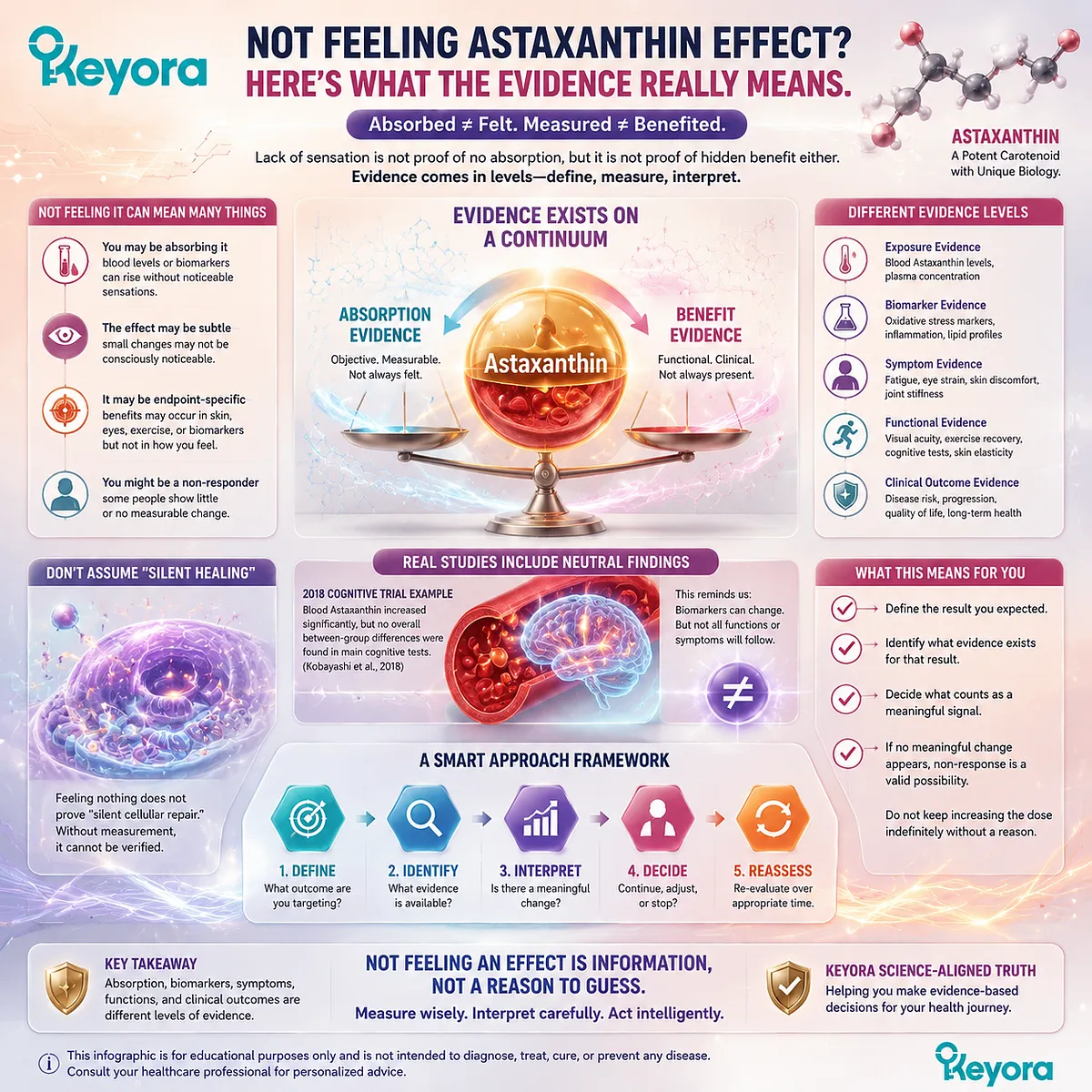
Not noticing a clear effect from Astaxanthin can mean several different things. It does not automatically mean that none was absorbed, but it also does not prove that important benefits are occurring invisibly.
Not noticing an Astaxanthin effect does not prove zero absorption, but it also does not prove hidden benefit because exposure, biomarkers, symptoms, functions, and clinical outcomes are different evidence levels.
Some Astaxanthin studies measure blood concentrations or laboratory biomarkers that a person cannot consciously feel. Others measure skin properties, visual performance, exercise recovery, cognitive tests, or symptom scores.
Even when a group-level difference is statistically significant, the effect may be small, limited to one endpoint, or absent in some participants.
Human studies also include neutral findings.
A 2018 cognitive trial, for example, confirmed a substantial rise in blood Astaxanthin but found no significant overall between-group differences across its main cognitive tests.
The opposite assumption is equally problematic.
Feeling nothing should not automatically be explained as “silent cellular repair.”
Without a relevant measurement, that explanation cannot be verified.
A more useful approach is to define the result you expected, identify what evidence actually exists for that result, and decide what would count as a meaningful signal.
If no meaningful change appears, genuine non-response remains a valid possibility. Lack of sensation is not a reason to keep increasing the dose indefinitely.
Not Every Astaxanthin Outcome Is Something You Can Feel
Blood exposure, biomarkers, skin instruments, and visual tests may change without creating one clear bodily sensation
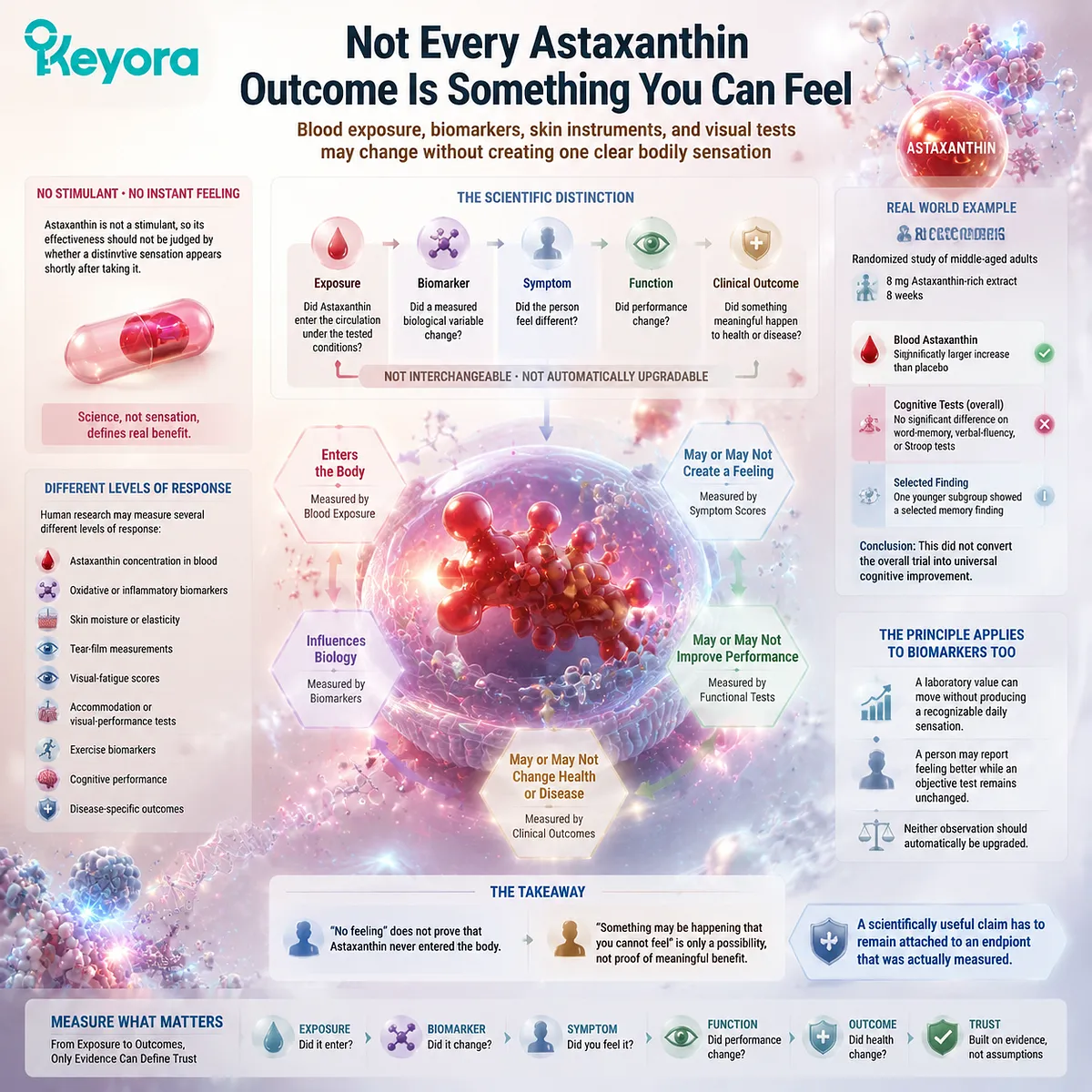
Astaxanthin is not a stimulant, so its effectiveness should not be judged by whether a distinctive sensation appears shortly after taking it.
Human research may measure several different levels of response:
-
Astaxanthin concentration in blood
-
oxidative or inflammatory biomarkers
-
skin moisture or elasticity
-
tear-film measurements
-
visual-fatigue scores
-
accommodation or visual-performance tests
-
exercise biomarkers
-
cognitive performance
-
disease-specific outcomes
These are not interchangeable.
A plasma concentration answers an exposure question: did Astaxanthin enter the circulation under the tested conditions?
A biomarker answers a laboratory question: did a measured biological variable change?
A symptom score asks whether a person felt different.
A functional test asks whether performance changed.
A clinical outcome asks whether something meaningful happened to health or disease.
The distinction matters because exposure can occur without a broad functional benefit. In a randomized study of middle-aged adults, participants receiving 8 mg of an Astaxanthin-rich extract for eight weeks had a significantly larger increase in blood Astaxanthin than placebo. However, the groups did not differ significantly overall on the word-memory, verbal-fluency, or Stroop tests. One younger subgroup showed a selected memory finding, but that did not convert the overall trial into universal cognitive improvement.
The same principle applies to biomarkers. A laboratory value can move without producing a recognizable daily sensation. Conversely, a person may report feeling better while an objective test remains unchanged.
Neither observation should automatically be upgraded.
“No feeling” therefore does not prove that Astaxanthin never entered the body. But “something may be happening that you cannot feel” is only a possibility, not proof of meaningful benefit.
A scientifically useful claim has to remain attached to an endpoint that was actually measured.
Human Studies Do Not Show One Universal Response
Trials report group averages, selected endpoints, unchanged outcomes, and subgroup findings rather than guaranteed individual benefit
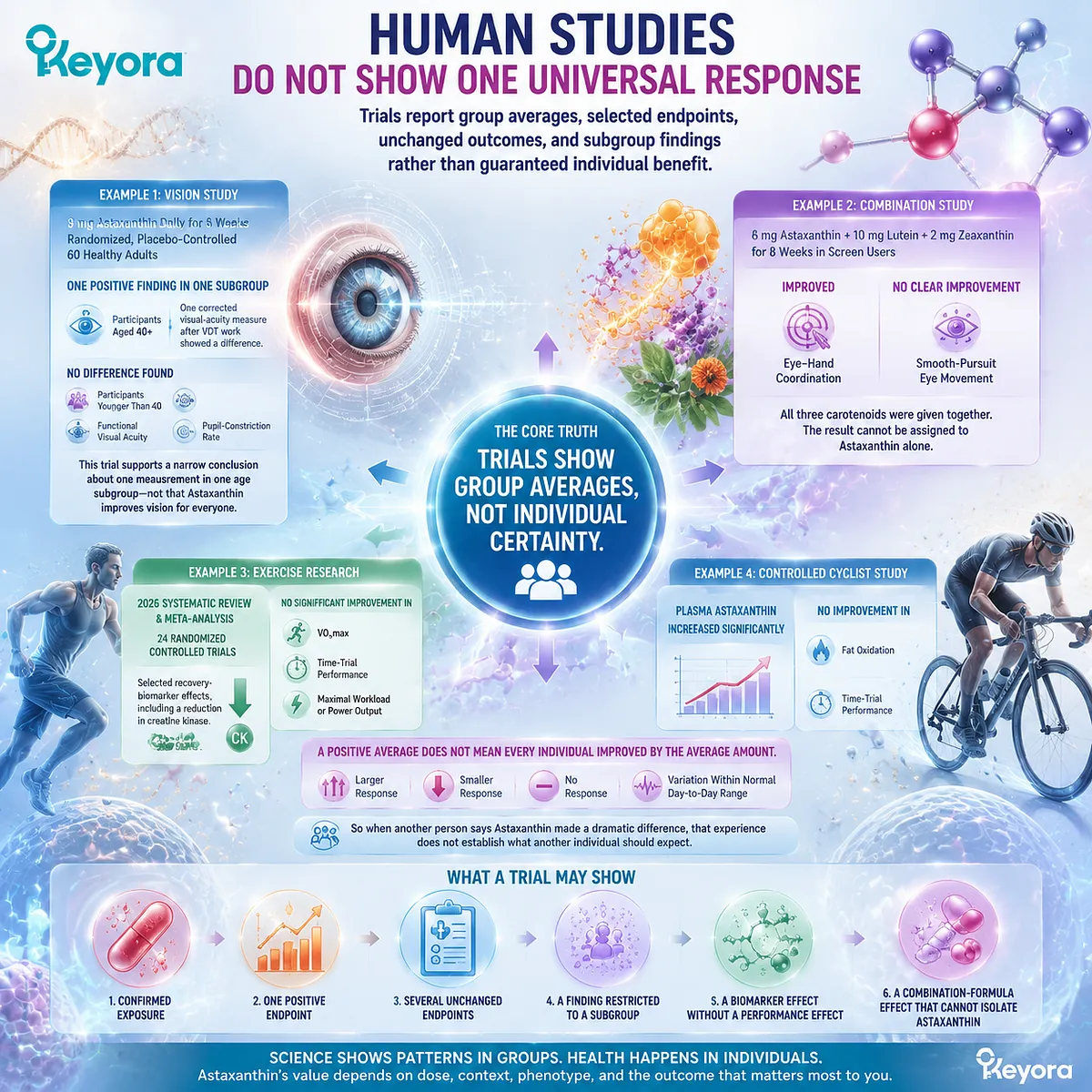
Clinical trials summarize groups. They do not promise that every participant responds in the same way.
Consider a randomized, placebo-controlled visual-function study in 60 healthy adults who received 9 mg of Astaxanthin daily for six weeks.
Among participants aged 40 or older, one corrected visual-acuity measure after visual-display-terminal work differed between groups. The same difference was not found in participants younger than 40, and functional visual acuity and pupil-constriction rate did not significantly differ between groups.
That trial does not support the statement that “Astaxanthin improves vision for everyone.” It supports a much narrower statement about one measurement in one age subgroup.
Combination studies show the same endpoint specificity. An eight-week trial testing 6 mg Astaxanthin together with 10 mg lutein and 2 mg zeaxanthin reported improvement in eye-hand coordination after screen work, while smooth-pursuit eye movement did not show a clear improvement. Because all three carotenoids were given together, the result also cannot be assigned to Astaxanthin alone.
Exercise research provides another important example.
A 2026 systematic review and meta-analysis of 24 randomized controlled trials found selected recovery-related biomarker effects, including a reduction in creatine kinase.
However, Astaxanthin did not significantly improve VO2max, time-trial performance, or maximal workload or power output.
An earlier controlled study in trained cyclists reached a similar practical conclusion.
Plasma Astaxanthin increased substantially after supplementation, but fat oxidation and time-trial performance did not improve.
These examples illustrate why the phrase “Astaxanthin worked” is too broad.
A trial may show:
-
confirmed exposure
-
one positive endpoint
-
several unchanged endpoints
-
a finding restricted to a subgroup
-
a biomarker effect without a performance effect
-
a combination-formula effect that cannot isolate Astaxanthin
A positive average also does not mean every participant improved by the average amount. Individual responses may be larger, smaller, absent, or difficult to distinguish from normal day-to-day variation.
So when another person says Astaxanthin made a dramatic difference, that experience does not establish what another individual should expect.
No Noticeable Effect Can Have Several Explanations
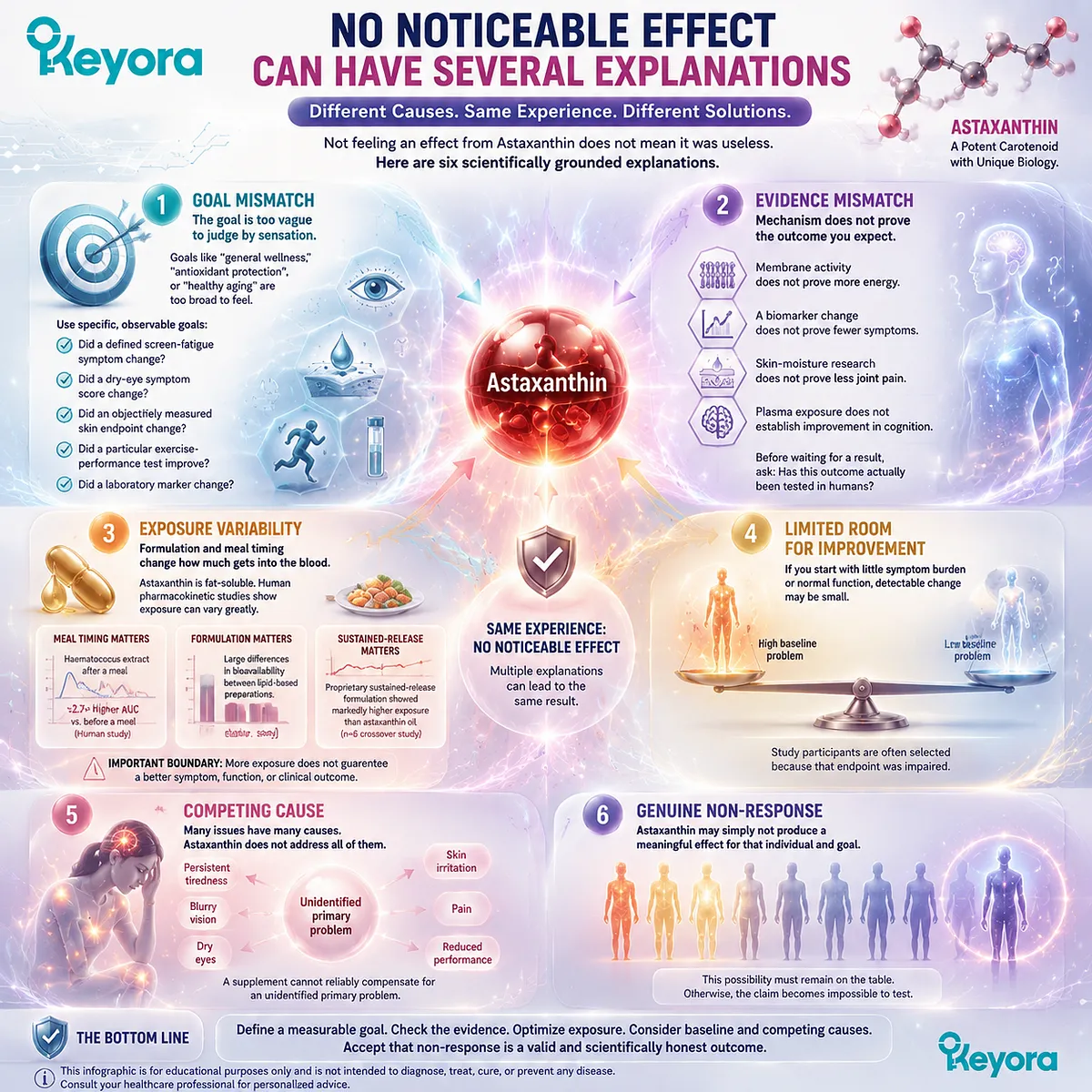
Goal mismatch, limited evidence, small effect size, variable exposure, competing causes, or genuine non-response can all produce the same experience
The first possibility is a goal mismatch.
“General wellness,” “antioxidant protection,” or “healthy aging” are difficult to judge by sensation. They do not specify what observable result would count as success.
A clearer question might be:
-
Did a defined screen-fatigue symptom change?
-
Did a dry-eye symptom score change?
-
Did an objectively measured skin endpoint change?
-
Did a particular exercise-performance test improve?
-
Did a laboratory marker change?
The second possibility is an evidence mismatch.
A biological mechanism does not prove the outcome a person expects. Membrane activity does not prove more energy. A biomarker change does not prove fewer symptoms. Skin-moisture research does not prove reduced joint discomfort. Plasma exposure does not establish improvement in cognition.
Before waiting for a result, ask whether that result has actually been tested in humans.
The third possibility is exposure variability.
Astaxanthin is fat-soluble, and human pharmacokinetic studies show that formulation and meal timing can alter circulating exposure. In one small human study, taking a Haematococcus extract after a meal produced a substantially greater Astaxanthin area under the concentration-time curve than taking it before a meal. Another formulation study found large differences in bioavailability between lipid-based preparations.
A six-person crossover study also found markedly higher exposure from a proprietary sustained-release formulation than from the comparison Astaxanthin oil, illustrating how formulation can affect pharmacokinetics. Its very small sample means the exact magnitude should not be generalized broadly.
But this boundary is critical:
More exposure does not guarantee a better symptom, function, or clinical outcome.
The fourth possibility is limited room for improvement. Someone who begins with little symptom burden or a normal functional measurement may have less detectable change than someone selected for a study because that endpoint was impaired.
The fifth possibility is a competing cause. Persistent tiredness, blurry vision, dry eyes, skin irritation, pain, or reduced performance can have many causes that Astaxanthin does not directly address. A supplement cannot reliably compensate for an unidentified primary problem.
The sixth possibility is simply:
Astaxanthin did not produce a meaningful effect for that individual and goal.
That possibility has to remain available. Otherwise, the claim becomes impossible to test.
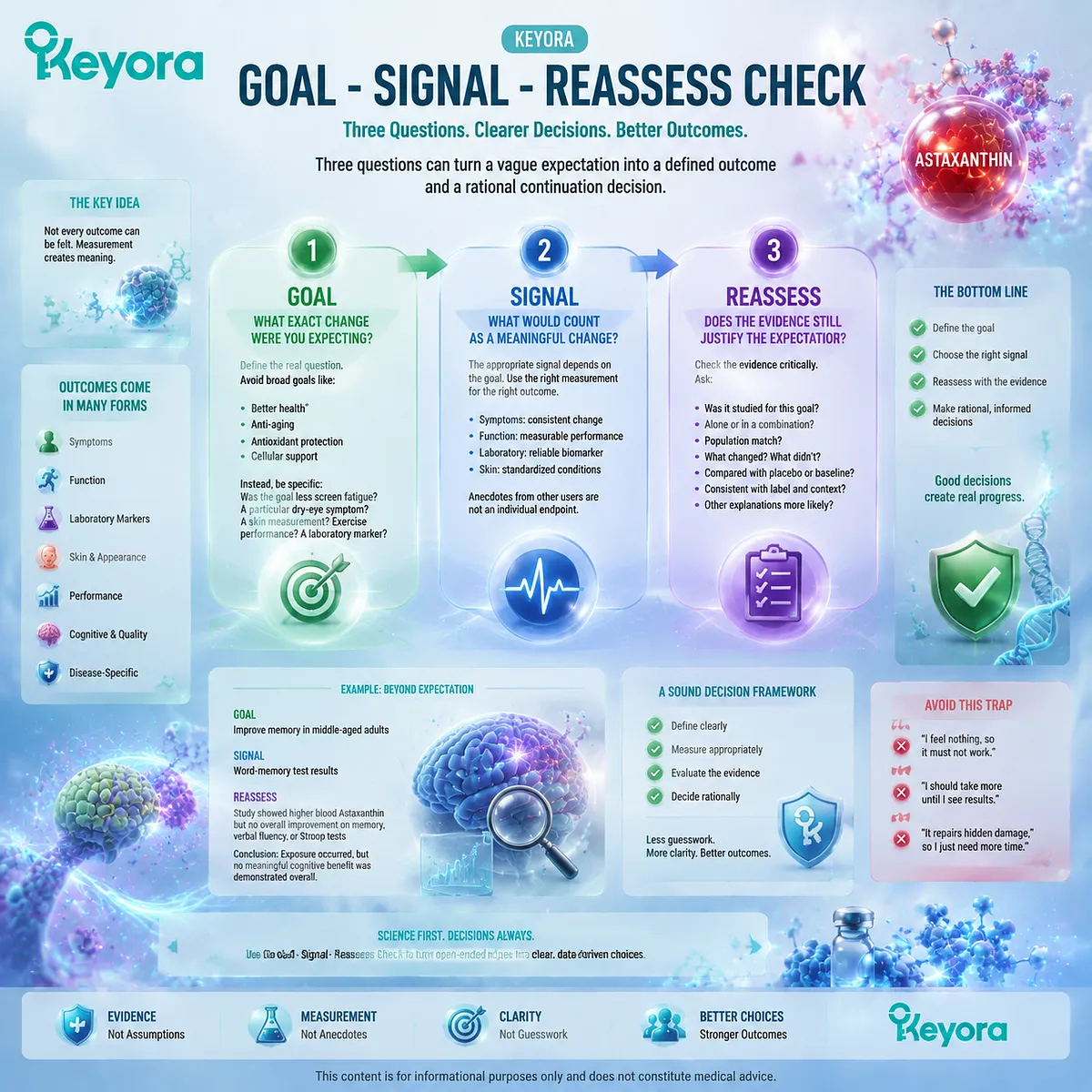
Use the Keyora Goal – Signal – Reassess Check
Three questions can turn a vague expectation into a defined outcome and a rational continuation decision
The Keyora Goal – Signal – Reassess Check helps answer “Is anything actually happening?” without turning every outcome into proof.
Goal: What exact change were you expecting?
Avoid using only broad targets such as:
-
better health
-
anti-aging
-
antioxidant protection
-
cellular support
Instead, define the real question.
Was the goal less screen fatigue? A particular dry-eye symptom? A skin measurement? Exercise performance? A laboratory marker?
If the goal cannot be stated clearly, the result will be difficult to interpret.
Signal: What would count as a meaningful change?
The appropriate signal depends on the goal.
For symptoms, a consistent change in the relevant symptom matters.
For function, use the relevant functional outcome.
For a laboratory goal, the laboratory measurement matters.
For a visible skin outcome, standardized conditions are more useful than comparing casual photographs taken under different lighting.
Anecdotes from other users are not an individual endpoint.
Reassess: Does the evidence still justify the expectation?
Check:
-
Was Astaxanthin actually studied for this goal?
-
Was it tested alone or inside a combination?
-
Did the study population resemble the situation being considered?
-
What endpoint changed?
-
What endpoints did not change?
-
Was the effect compared with placebo or only with baseline?
-
Was use consistent with the label and study context?
-
Is another explanation for the symptom more likely?
Do not automatically turn “I notice nothing” into “I should take more.” Higher intake may increase exposure without producing the desired outcome, and the Astaxanthin evidence base does not establish one dose that is optimal for every goal.
The supplied Keyora Q&A evidence boundary likewise states that 16 mg is not a universal optimal dose and that higher exposure does not automatically produce greater benefit. It also records that the exact Keyora Asta 16MG finished formula does not have an established human efficacy trial in the supplied corpus.
Consider the claim:
“You cannot feel Astaxanthin because it first repairs hidden oxidative damage, so keep increasing the dose until visible benefits appear.”
The Goal is undefined.
The Signal is absent.
The Reassess step replaces missing evidence with an invisible mechanism and provides no stopping rule.
That is not a scientifically testable interpretation.
Persistent or worsening symptoms should also be evaluated according to their actual cause rather than managed indefinitely by supplement experimentation. A supplement response cannot diagnose why fatigue, visual changes, pain, skin symptoms, or another ongoing problem is occurring.
Closing Summary
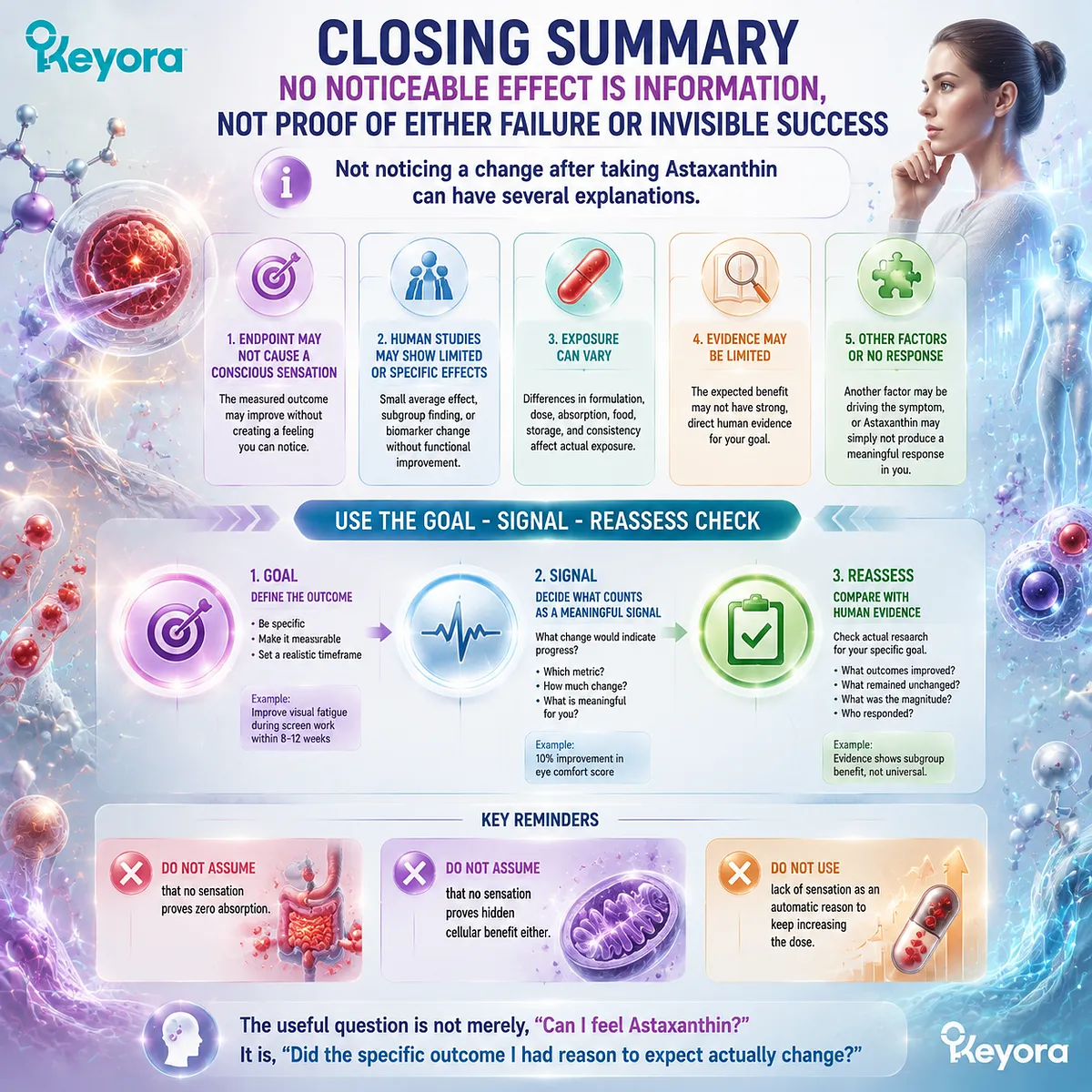
No noticeable effect is information, not proof of either failure or invisible success
Not noticing a change after taking Astaxanthin can have several explanations.
The measured endpoint may not produce a conscious sensation.
Human studies may show only a small average effect, a subgroup finding, or a biomarker change without functional improvement.
Exposure may vary between formulations and use conditions. The expected benefit may not have strong direct human evidence.
Another factor may be driving the symptom. Astaxanthin may also simply produce no meaningful individual response.
Use the Goal – Signal – Reassess Check.
Define the outcome, decide what would count as a meaningful signal, and compare that expectation with the actual human evidence before drawing a conclusion.
-
Do not assume that no sensation proves zero absorption.
-
Do not assume that it proves hidden cellular benefit either.
-
And do not use lack of sensation as an automatic reason to keep increasing the dose.
The useful question is not merely, “Can I feel Astaxanthin?” It is, “Did the specific outcome I had reason to expect actually change?”
This article is for educational and informational purposes only. It does not provide medical advice, diagnosis, treatment, cure, prevention, disease outcome claims, hormone restoration claims, fertility outcome claims, or formula-specific clinical efficacy claims.