
Why Does Stress Make Simple Tasks Feel Overwhelming?
Keyora Research Q&A Library
This is part of the Keyora Research Q&A Series, derived from Keyora Nutritional Neurology Seriers .
Within the Keyora Nutritional Neurology framework, this Q&A translates complex nutrient–brain mechanisms into reader-friendly, evidence-bound answers, focusing on stress resilience, sleep quality, calm mood support, cognitive wellness, and the broader interaction between nutrition, neurochemistry, and daily nervous-system function.
First published by Keyora Research Journal: www.keyorahealth.com

Direct Answer
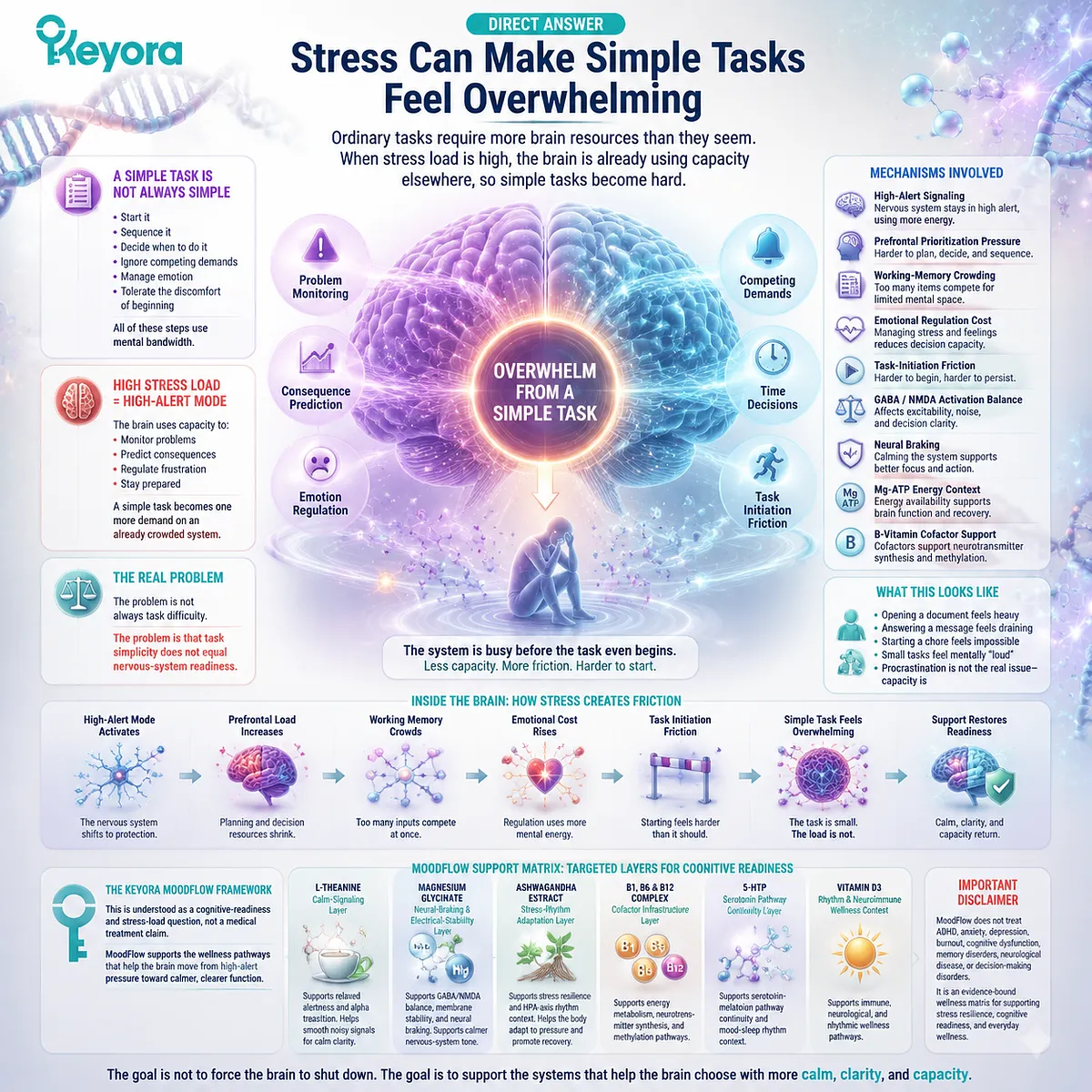
Stress can make simple tasks feel overwhelming because ordinary tasks require more brain resources than they seem to. A task may look small on paper, but the brain still has to start it, sequence it, decide when to do it, ignore competing demands, manage emotion, and tolerate the discomfort of beginning.
When stress load is high, the nervous system may already be in high-alert mode. That means the brain is using capacity to monitor problems, predict consequences, regulate frustration, and stay prepared. A simple task then becomes one more demand on an already crowded system.
The problem is not always task difficulty.
The problem is that task simplicity does not equal nervous-system readiness.
Mechanistically, this can involve high-alert signaling, prefrontal prioritization pressure, working-memory crowding, emotional regulation cost, task-initiation friction, GABA/NMDA activation balance, neural braking, Mg-ATP energy context, and B-vitamin cofactor support.
In the Keyora MoodFlow framework, this is understood as a cognitive-readiness and stress-load question, not a medical treatment claim.
Why Simple Tasks Can Feel Like Too Much
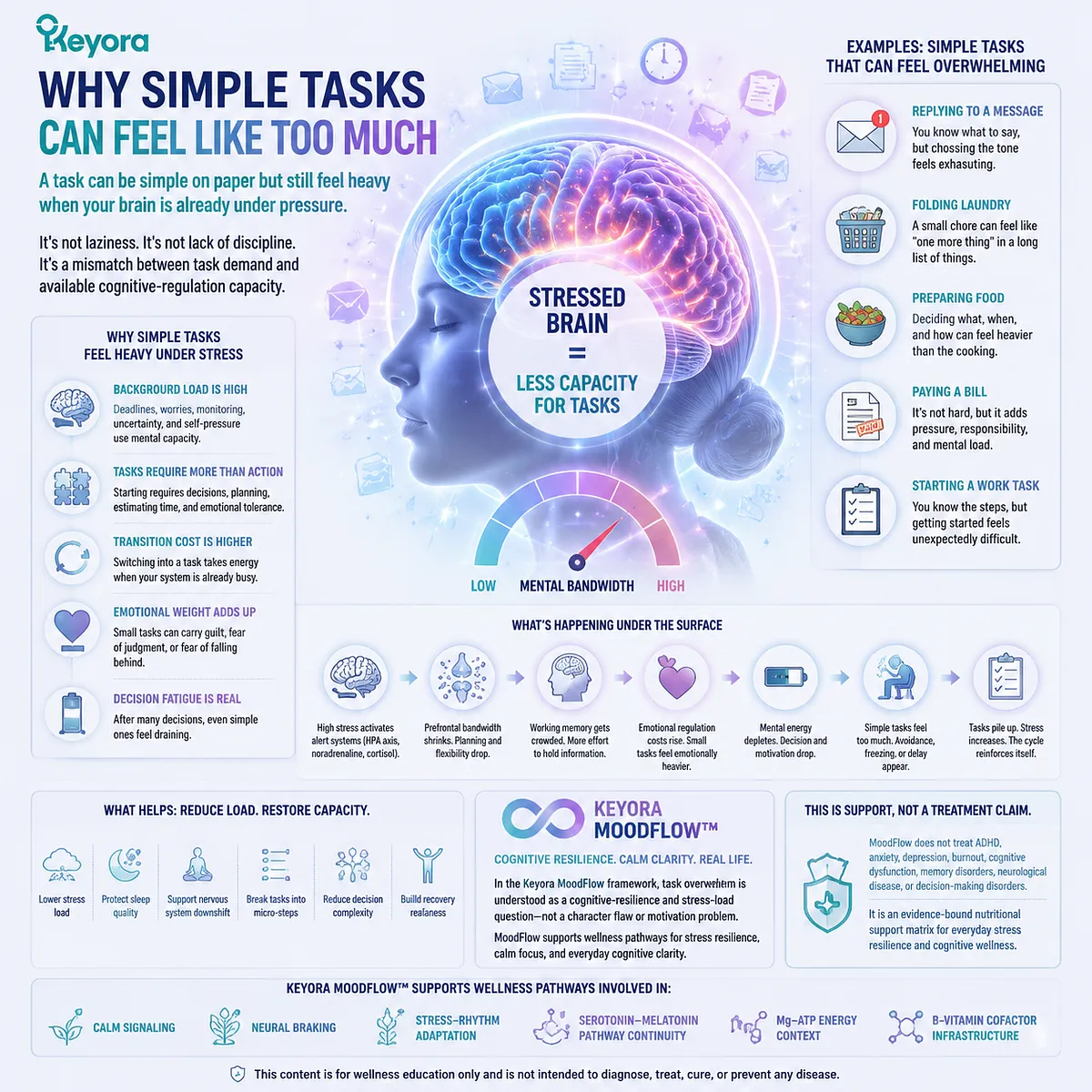
A task can be simple on paper but still feel heavy when your brain is already under pressure.
Simple tasks do not always feel simple.
On a normal day, opening an email, folding laundry, preparing food, paying a bill, replying to a message, or starting one small work task may feel ordinary. The task appears, you begin, and the action moves forward.
But during stressful periods, the same task can feel strangely heavy.
You may know exactly what needs to be done, but still feel resistance before starting. You may stare at a small task and feel annoyed by it. You may open a document, close it, open it again, and still not begin. You may look at a simple chore and feel as if it belongs to a much larger problem.
This experience can be frustrating because the task itself does not look hard. From the outside, it may seem like procrastination, laziness, poor discipline, or poor time management. From the inside, however, the experience often feels different. It feels like the brain has no room to take on one more thing.
That is the important distinction.
A simple task may be small in physical size, but not small in cognitive demand.
Replying to a message may involve deciding what tone to use, remembering the context, predicting the other person’s reaction, choosing whether to answer now or later, and managing the guilt of having delayed it. Cleaning a room may involve deciding where to start, what to move first, what to throw away, what to keep, and how much time the task might take.
Even “just start” is not always simple.
Starting requires a transition. The brain has to move from one mental state into another. It has to disengage from whatever it was monitoring, choose a direction, organize the first step, and accept that beginning one thing means temporarily not doing several others.
Under stress, that transition can feel expensive.
This is why a person can feel busy all day but still avoid the simplest tasks. The issue may not be that they do not care. It may be that every task is arriving on top of a nervous system that is already carrying pressure.
Stress can also make tasks feel louder.
A small task may carry emotional weight when the brain is stressed. An unread email may feel like possible conflict. A messy desk may feel like personal failure. A simple form may feel like another reminder that life is too full. A small decision inside a task may feel like one more thing to manage.
The task becomes more than a task. It becomes a symbol of all the unfinished demands around it.
This is why task overwhelm often appears as avoidance, irritability, freezing, or unnecessary delay. The person is not always avoiding the task itself. They may be avoiding the extra mental load attached to starting, organizing, and emotionally tolerating it.
In consumer-friendly terms, stress can make the brain treat small tasks as if they are bigger than they are.
That does not mean the task is impossible. It means the brain may need more cognitive readiness before the task can feel manageable again.
The Hidden Load Behind Task Overwhelm
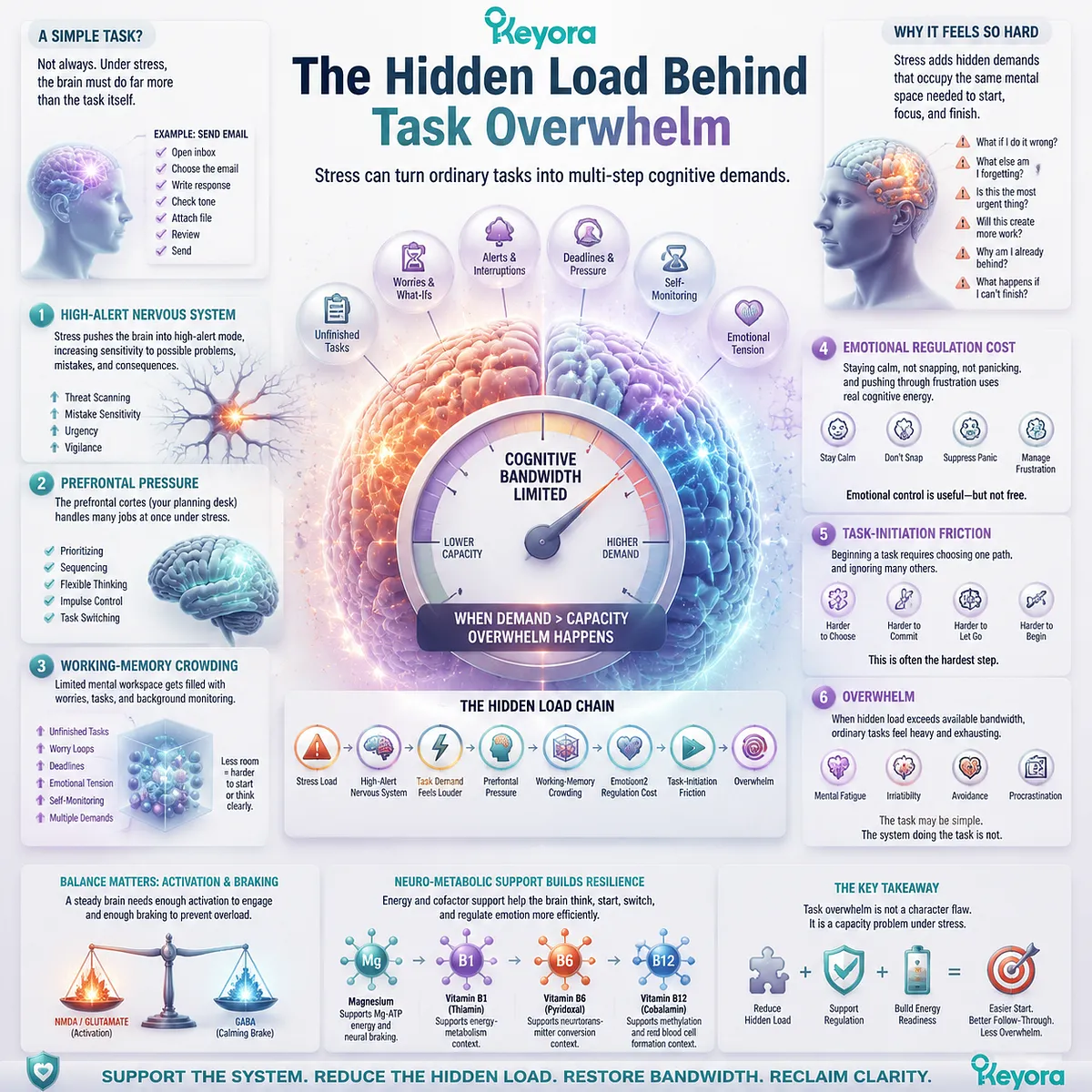
Stress can turn ordinary tasks into multi-step cognitive demands.
A simple task may not be cognitively simple when the brain is under stress.
To complete a task, the brain has to do several things at once. It must notice the task, decide that it matters, choose when to begin, identify the first step, hold the goal in working memory, suppress distractions, regulate frustration, and keep going long enough to finish.
When life is calm, these steps may happen automatically.
When stress is high, they can become harder.
Stress tends to push the nervous system toward high-alert mode. In that state, the brain becomes more sensitive to possible problems, mistakes, delays, and consequences. This can be useful in short bursts, but it can also make ordinary tasks feel more demanding than they would otherwise feel.
The prefrontal cortex is especially relevant here. In everyday language, this part of the brain helps act like a planning desk. It supports prioritizing, sequencing, flexible thinking, impulse control, and task switching.
When stress load is high, that planning desk can become crowded.
Instead of simply asking, “What is the next step?”, the brain may also be asking, “What if I do this wrong?”, “What else am I forgetting?”, “Is this the most urgent thing?”, “Will this create more work?”, “Why am I already behind?”, and “What happens if I cannot finish?”
That is no longer a simple task. That is a simple task surrounded by hidden cognitive load.
Working memory also matters. Working memory is the temporary mental workspace that allows you to hold task steps, instructions, priorities, and consequences in mind. Under stress, that workspace may already be filled with unfinished tasks, worry loops, emotional tension, deadlines, and background monitoring.
When working memory is crowded, even a small task can lose its obvious starting point.
This is why task initiation can be the hardest part. Beginning a task requires the brain to select one path and temporarily ignore others. But stress often keeps multiple demands active at once. The brain may feel pulled in different directions, making it hard to commit to one action.
Emotional regulation adds another hidden cost.
A stressed person may be using energy to stay calm, avoid snapping, suppress panic, manage disappointment, or push through frustration. These emotional-control processes are real work, even if they are invisible. When emotional regulation is already costly, a basic task may feel like an extra emotional demand.
This creates a mechanism chain:
stress load → high-alert nervous system → task demand feels louder → prefrontal prioritization pressure → working-memory crowding → emotional regulation cost → task-initiation friction → overwhelm
The nervous system also needs balance between activation and braking.
In consumer language, GABA-related calming tone and NMDA/glutamate activation balance help explain why the brain can feel either steady or overstimulated. When activation is high and the braking background feels insufficient, tasks may feel urgent, noisy, or irritating instead of straightforward.
Neuro-metabolic context is also part of the picture.
Task execution is not only psychological. Thinking, starting, switching, and regulating emotion require energy. Magnesium’s role in Mg-ATP context and B vitamins’ role as cofactor infrastructure help explain why cognitive readiness depends on both signal balance and metabolic background.
This does not mean every task-initiation problem is caused by nutrient status. It means task overwhelm under stress can be understood as a multi-layer wellness question.
The task may be simple. But the system doing the task may not be in a simple state.
How MoodFlow Supports Task Readiness Under Stress
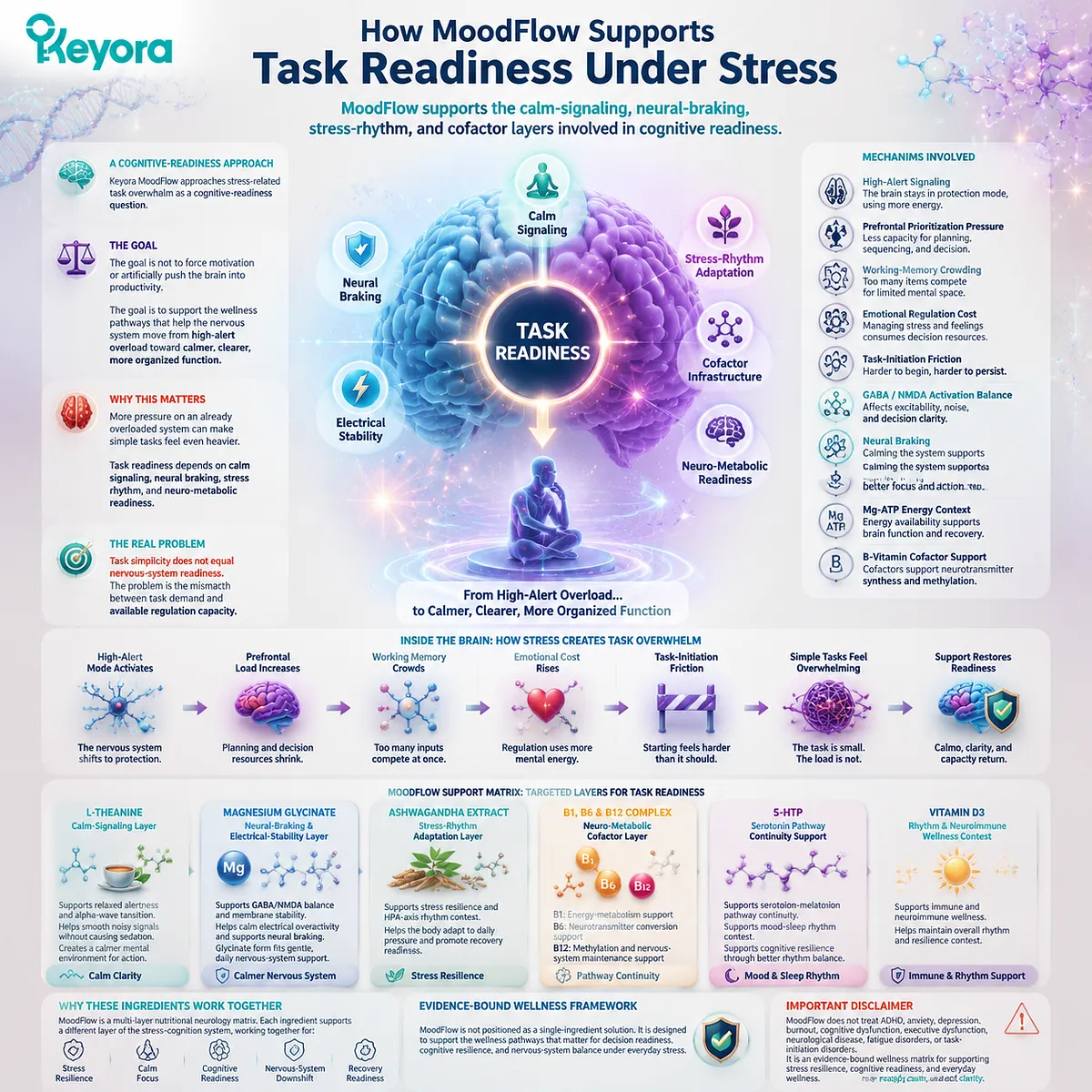
MoodFlow supports the calm-signaling, neural-braking, stress-rhythm, and cofactor layers involved in cognitive readiness.
Keyora MoodFlow approaches stress-related task overwhelm as a cognitive-readiness question.
The goal is not to force motivation or artificially push the brain into productivity. The goal is to support the wellness pathways that help the nervous system move from high-alert overload toward calmer, clearer, more organized function.
This matters because many people try to solve task overwhelm by applying more pressure. They tell themselves to just start, work harder, stop being lazy, or push through. Sometimes that works for a short time. But when the nervous system is already overloaded, more pressure can make the task feel even heavier.
MoodFlow’s framework looks at the support layers behind task readiness.
L-Theanine supports the calm-signaling layer.
In the MoodFlow framework, L-Theanine is associated with relaxed alertness, alpha-wave transition, and signal smoothing. This is important because task overwhelm is not always caused by low alertness. Many stressed people are already alert. They may even feel too alert.
The issue is that alertness may feel pressured, scattered, or emotionally noisy.
L-Theanine helps explain the difference between being awake and being calmly ready. For task initiation, this difference matters. A person may not need more stimulation. They may need a calmer mental background so the next step feels easier to identify.
Magnesium glycinate supports the neural-braking and electrical-stability layer.
Magnesium is relevant to GABA/NMDA activation balance, membrane excitability, and Mg-ATP energy context. In MoodFlow, magnesium glycinate is not treated as a generic mineral add-on. It is positioned as part of the neural braking and hardware-stabilizing layer.
For simple-task overwhelm, this layer matters because stress can make the nervous system feel electrically loud. When the brain is already activated, each new task may feel like another signal competing for attention. Neural braking helps explain the background needed for steadier task engagement.
The glycinate form also fits MoodFlow’s daily-use logic because the goal is gentle nervous-system support rather than harsh stimulation.
Ashwagandha supports the stress-rhythm adaptation layer.
Task overwhelm often reflects more than one stressful moment. It may reflect a stress rhythm that has been building throughout the day or across many days. When stress remains active in the background, ordinary tasks can arrive on top of a system that has not fully recovered.
Ashwagandha is positioned in MoodFlow around stress resilience, HPA-axis rhythm context, and recovery readiness. In this article, that does not mean Ashwagandha fixes cortisol or treats burnout. It means Ashwagandha belongs to the stress-adaptation layer that helps explain why task readiness is connected to the body’s broader stress context.
B1, B6, and B12 support the neuro-metabolic cofactor layer.
Starting and completing tasks depend on normal brain metabolism and neurotransmitter-related pathways. B1 supports energy-metabolism context. B6 supports neurotransmitter-related conversion context. B12 supports methylation context and nervous-system maintenance.
In MoodFlow, these B vitamins are best understood as cofactor infrastructure. They do not make a task instantly easy, and they should not be described as treating fatigue or cognitive dysfunction. Their role is to support the background conditions needed for cognitive resilience under everyday pressure.
5-HTP plays a secondary background role here.
Because this article is cognition-under-stress-first, 5-HTP should not dominate the explanation. Its role is better framed as support for serotonin-melatonin pathway continuity and mood-sleep rhythm context within the broader MoodFlow architecture. A steadier rhythm background may matter for cognitive resilience, but this article is not about sleep treatment or serotonin restoration.
Vitamin D can also be understood as part of the broader rhythm and neuroimmune context when relevant, but it should remain secondary in this task-readiness discussion.
Together, these layers explain why MoodFlow is not positioned as a single-ingredient productivity product. It is a multi-layer nutritional neurology matrix designed to support stress resilience, calm focus, cognitive resilience, nervous-system downshift, and recovery readiness within an evidence-bound wellness framework.
MoodFlow is not a treatment for ADHD, anxiety, depression, burnout, cognitive dysfunction, executive dysfunction, neurological disease, fatigue disorders, or task-initiation disorders. In this article, Keyora uses simple-task overwhelm as a wellness-language entry point for explaining stress load, cognitive readiness, calm signaling, neural braking, and neuro-metabolic support under everyday pressure.
Closing Summary
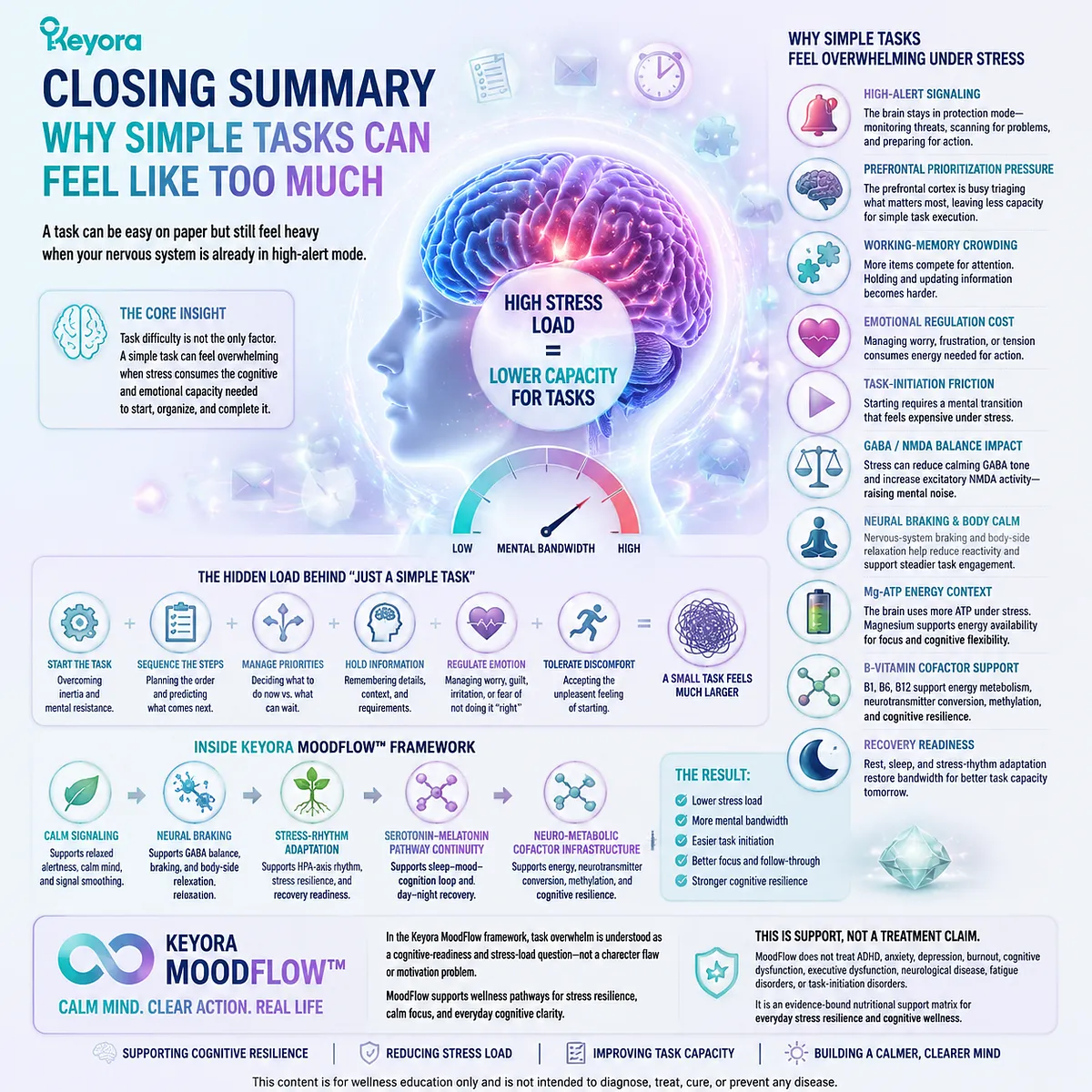
Stress can make simple tasks feel overwhelming because task difficulty is not the only factor that matters. A task can be easy on paper but still feel heavy when the nervous system is already in high-alert mode.
Under stress, the brain may need to start the task, sequence the steps, manage competing priorities, regulate emotion, hold information in working memory, and tolerate the discomfort of beginning. That hidden load can make ordinary tasks feel larger than they are.
Mechanistically, stress-related task overwhelm may involve high-alert signaling, prefrontal prioritization pressure, working-memory crowding, emotional regulation cost, task-initiation friction, GABA/NMDA activation balance, neural braking, Mg-ATP energy context, B-vitamin cofactor support, and recovery readiness.
In the Keyora MoodFlow framework, this is a cognitive-readiness and stress-load question.
MoodFlow supports this picture through calm signaling, neural braking, stress-rhythm adaptation, serotonin-melatonin pathway continuity, and neuro-metabolic cofactor infrastructure.
MoodFlow does not treat ADHD, anxiety, depression, burnout, cognitive dysfunction, executive dysfunction, neurological disease, fatigue disorders, or task-initiation disorders. It is an evidence-bound nutritional support matrix for everyday stress resilience and cognitive wellness.
This article is for educational and informational purposes only. It does not provide medical advice, diagnosis, treatment, cure, prevention, disease outcome claims, hormone restoration claims, fertility outcome claims, or formula-specific clinical efficacy claims.