
Why Does Stress Make Me More Irritable or Emotionally Sensitive?
Keyora Research Q&A Library
This is part of the Keyora Research Q&A Series, derived from Keyora Nutritional Neurology Seriers .
Within the Keyora Nutritional Neurology framework, this Q&A translates complex nutrient–brain mechanisms into reader-friendly, evidence-bound answers, focusing on stress resilience, sleep quality, calm mood support, cognitive wellness, and the broader interaction between nutrition, neurochemistry, and daily nervous-system function.
First published by Keyora Research Journal: www.keyorahealth.com
Direct Answer
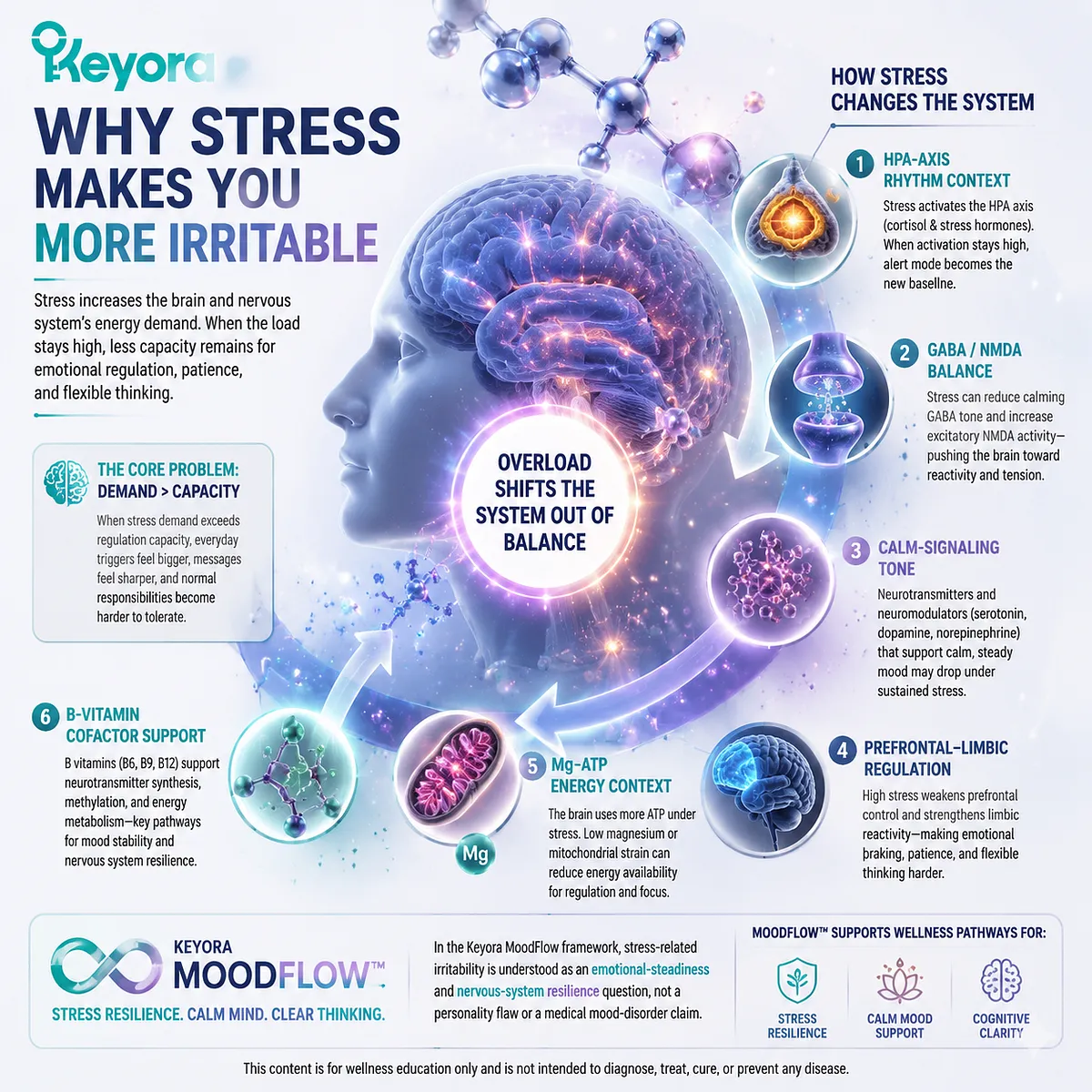
Stress can make you more irritable or emotionally sensitive because the nervous system uses more energy to stay alert, solve problems, and respond to pressure.
When stress load stays high, the brain may have less capacity left for emotional braking, patience, and flexible thinking.
The core problem is not simply “bad mood.” It may be a mismatch between stress demand and regulation capacity.
When the system is overloaded, small triggers can feel larger, messages can feel sharper, noise can feel more irritating, and normal responsibilities can feel harder to tolerate.
Mechanistically, this can involve HPA-axis rhythm context, GABA/NMDA activation balance, calm-signaling tone, prefrontal-limbic regulation, Mg-ATP energy context, and B-vitamin cofactor support.
In the Keyora MoodFlow framework, stress-related irritability is understood as an emotional-steadiness and nervous-system resilience question, not a personality flaw or a medical mood-disorder claim.
MoodFlow supports wellness pathways involved in stress resilience, calm mood support, and cognitive clarity.
Stress Can Make Small Things Feel Bigger
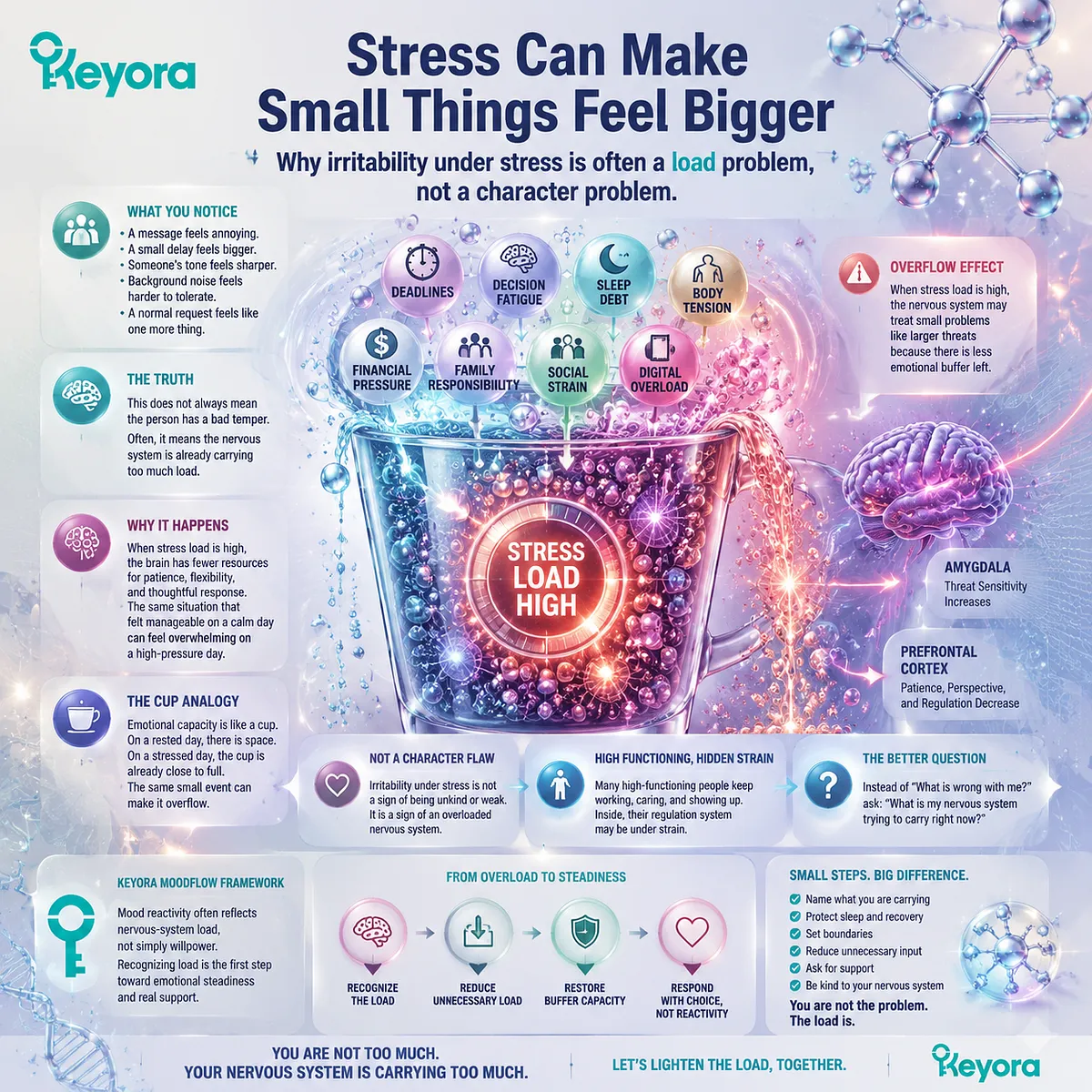
Why irritability under stress is often a load problem, not a character problem.
Many people notice that they are more irritable when stressed.
A message feels annoying. A small delay feels bigger than it should. Someone’s tone feels sharper. Background noise feels harder to tolerate. A normal request feels like one more thing the brain cannot handle.
This does not always mean the person has a bad temper.
Often, it means the nervous system is already carrying too much load.
When stress load is high, the brain has fewer resources left for patience, emotional flexibility, and thoughtful response. The same situation that might feel manageable on a calm day can feel overwhelming on a high-pressure day.
That is why stress can make small things feel bigger.
A minor inconvenience may not be the real problem. It may simply be the final input into a system that was already full.
Think of emotional capacity like a cup. On a rested day, there may be space in the cup. A difficult email, a noisy room, or an unexpected change may still fit. But on a stressed day, the cup may already be close to full. The same small event can make it overflow.
This is why irritability under stress should not be reduced to “you need to be more positive” or “you are just overreacting.”
The better question is: what is the nervous system trying to carry?
Stress often brings hidden layers: deadlines, decision fatigue, sleep debt, body tension, financial pressure, family responsibility, social strain, digital overload, and the constant need to stay available. Even if none of these is dramatic by itself, together they can reduce emotional buffer.
When stress load is high, the nervous system may treat small problems like larger threats because there is less emotional buffer left.
This is especially common in people who are high-functioning. They may continue working, organizing, replying, caring for others, and meeting expectations. From the outside, they look fine. Inside, however, the regulation system may be under strain.
That is when irritability shows up.
Not because they suddenly became unkind. Not because their personality changed. But because the brain is operating with less space between trigger and reaction.
In the Keyora MoodFlow framework, this is the beginning of emotional-steadiness support: recognizing that mood reactivity often reflects nervous-system load, not simply willpower.
Why Stress Reduces Emotional Braking
How high-alert signaling, GABA/NMDA balance, and cognitive load can make mood feel more reactive.
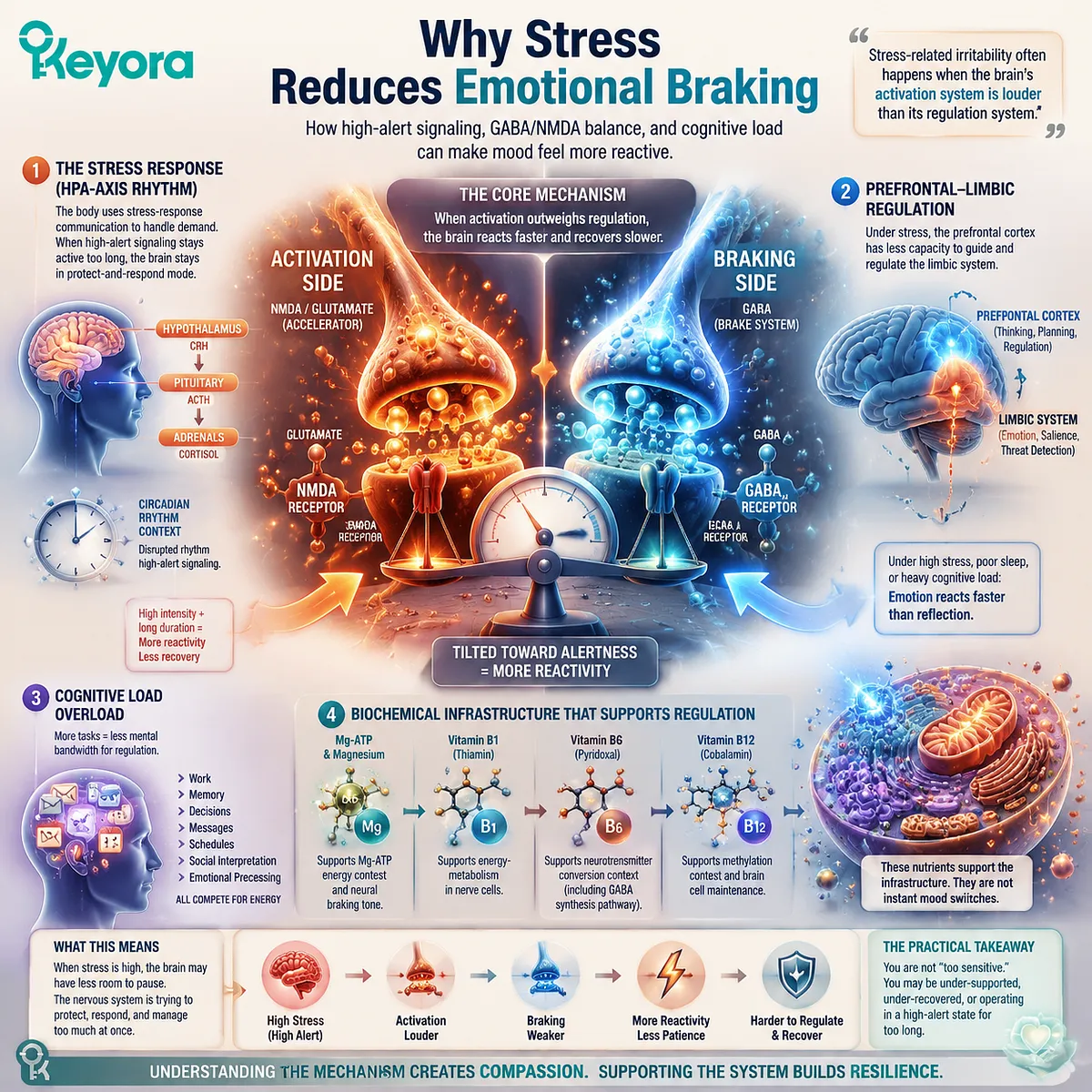
Stress-related irritability often happens when the brain’s activation system is louder than its regulation system.
The stress-response system is designed to help the body respond to pressure. It increases readiness, attention, and action capacity. This is useful when there is a deadline, conflict, exam, meeting, or urgent responsibility.
But when high-alert signaling stays active for too long, emotional regulation can become harder.
The HPA-axis rhythm context helps explain this.
The body uses stress-response communication to handle demand. That system is not bad. The issue is timing and intensity. If the body stays in a high-readiness pattern, the brain may become quicker to detect problems and slower to feel safe.
This can make ordinary events feel more irritating.
GABA/NMDA balance is another important mechanism.
GABA can be understood as part of the brain’s calming brake system. NMDA and glutamate-related signaling belong more to the activation side. The brain needs both. It needs activation to think, respond, and stay alert. It needs braking to pause, regulate, and choose a better response.
Under stress, activation can become louder. The brain may scan for problems, anticipate conflict, or react quickly to small threats. If braking tone is not strong enough to match that activation, mood can feel more reactive.
This does not mean the person is broken. It means the system is tilted toward alertness.
Prefrontal-limbic regulation also matters.
In simple terms, the prefrontal cortex helps with judgment, planning, perspective, and response control. The limbic system is more involved in emotional salience and threat detection. When the brain is well-regulated, these systems communicate in a more balanced way.
Under high stress, poor sleep, or heavy cognitive load, the “thinking and regulating” side may have less capacity. The emotional response may arrive faster than the reflective response.
That is when people snap, react, or feel more sensitive than usual.
Cognitive load makes this worse. The brain is not only managing emotion; it is also managing work, memory, decisions, messages, schedules, and social interpretation. All of that requires energy.
This is where Mg-ATP and B-vitamin cofactor context become useful. Emotional regulation is not only a matter of attitude. The nervous system also depends on energy readiness and biochemical support. B1 supports energy-metabolism context. B6 supports neurotransmitter-related conversion context. B12 supports methylation context. Magnesium supports Mg-ATP background and neural braking context.
These are not instant mood switches. They are part of the infrastructure that helps explain why regulation capacity can be affected by stress load, sleep quality, and nutritional status.
The practical takeaway is simple:
When stress is high, the brain may have less room to pause.
That is why emotional sensitivity under stress often feels automatic. The nervous system is trying to protect, respond, and manage too much at once. Mood becomes sharper because the regulation system has less spare capacity.
Understanding this can reduce shame.
You are not necessarily “too sensitive.” You may be under-supported, under-recovered, or operating in a high-alert state for too long.
How MoodFlow Supports Calm Mood Under Stress
Why calm signaling, neural braking, stress-rhythm adaptation, and cofactor support matter for emotional steadiness.
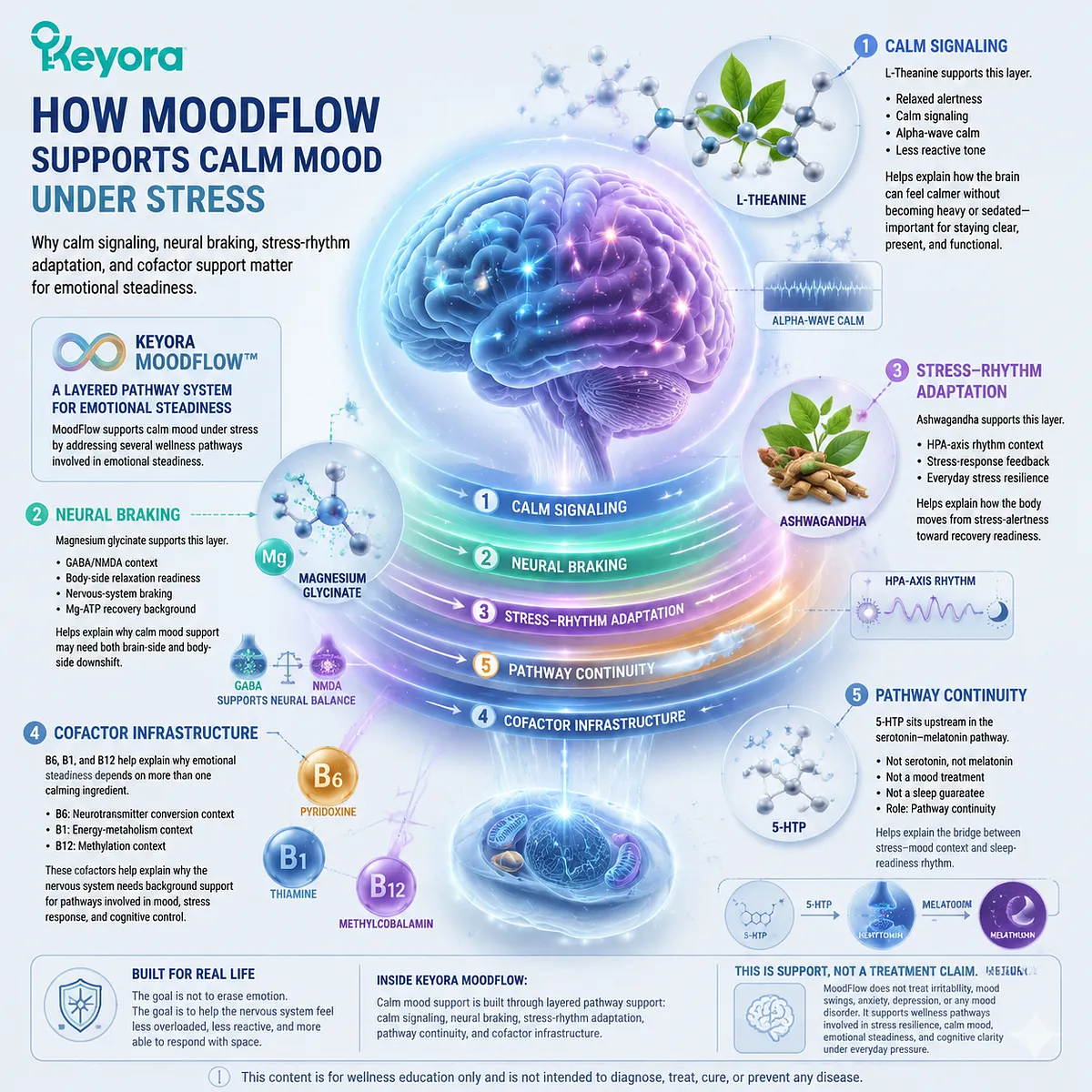
MoodFlow supports calm mood under stress by addressing several wellness pathways involved in emotional steadiness.
The first layer is calm signaling.
L-Theanine supports this layer. It helps explain relaxed alertness, calm signaling, alpha-wave calm, and less reactive tone. This is important because emotional steadiness does not require the brain to become sleepy or dull. Many people need to feel calmer while still staying clear, present, and functional.
L-Theanine helps explain how the brain can feel calmer without becoming heavy or sedated.
This makes it especially relevant for stress-related irritability. The goal is not to suppress emotion. The goal is to support a smoother, less reactive nervous-system tone.
The second layer is neural braking.
Magnesium glycinate supports this layer. It helps explain GABA/NMDA context, body-side relaxation readiness, nervous-system braking, and Mg-ATP recovery background. This matters because irritability is not only mental. The body often carries stress physically.
Tight shoulders, jaw tension, shallow breathing, and internal restlessness can all make emotional reactivity feel stronger. When the body remains in readiness mode, the mind may find it harder to stay patient.
Magnesium glycinate helps explain why calm mood support may need both brain-side and body-side downshift.
The third layer is stress-rhythm adaptation.
Ashwagandha supports this layer. In MoodFlow language, Ashwagandha helps explain how the body moves from stress-alertness toward recovery readiness. It connects to HPA-axis rhythm context, stress-response feedback, and everyday stress resilience.
This does not mean Ashwagandha treats anxiety, depression, burnout, hormone imbalance, or mood disorders. It means Ashwagandha supports the stress-rhythm layer inside the MoodFlow matrix.
This layer matters because irritability often appears when stress has not had a chance to step down. If the day stays active inside the body, mood may stay reactive even after the stressful event has passed.
The fourth layer is cofactor infrastructure.
B6, B1, and B12 help explain why emotional steadiness depends on more than one calming ingredient. B6 supports neurotransmitter-related conversion context. B1 supports energy-metabolism context. B12 supports methylation context.
These cofactors do not “control emotions.” They help explain why the nervous system needs background support for pathways involved in mood, stress response, and cognitive control.
The fifth layer is pathway continuity.
5-HTP sits upstream in the serotonin-melatonin pathway. In this article, 5-HTP should be understood carefully. It is not serotonin, not melatonin, not a mood treatment, and not a sleep guarantee. Its role is pathway continuity: helping explain the bridge between stress-mood context and sleep-readiness rhythm.
This matters because mood and sleep often influence each other. When stress affects sleep readiness, the next day may bring less emotional buffer. When mood feels more reactive, wind-down may become harder again.
Inside Keyora MoodFlow, calm mood support is built through layered pathway support: calm signaling, neural braking, stress-rhythm adaptation, pathway continuity, and cofactor infrastructure.
This is a support framework, not a treatment claim.
MoodFlow does not treat irritability, mood swings, anxiety, depression, or any mood disorder. It supports wellness pathways involved in stress resilience, calm mood, emotional steadiness, and cognitive clarity under everyday pressure.
For real people, this distinction matters.
The goal is not to erase emotion. The goal is to help the nervous system feel less overloaded, less reactive, and more able to respond with space.
Closing Summary
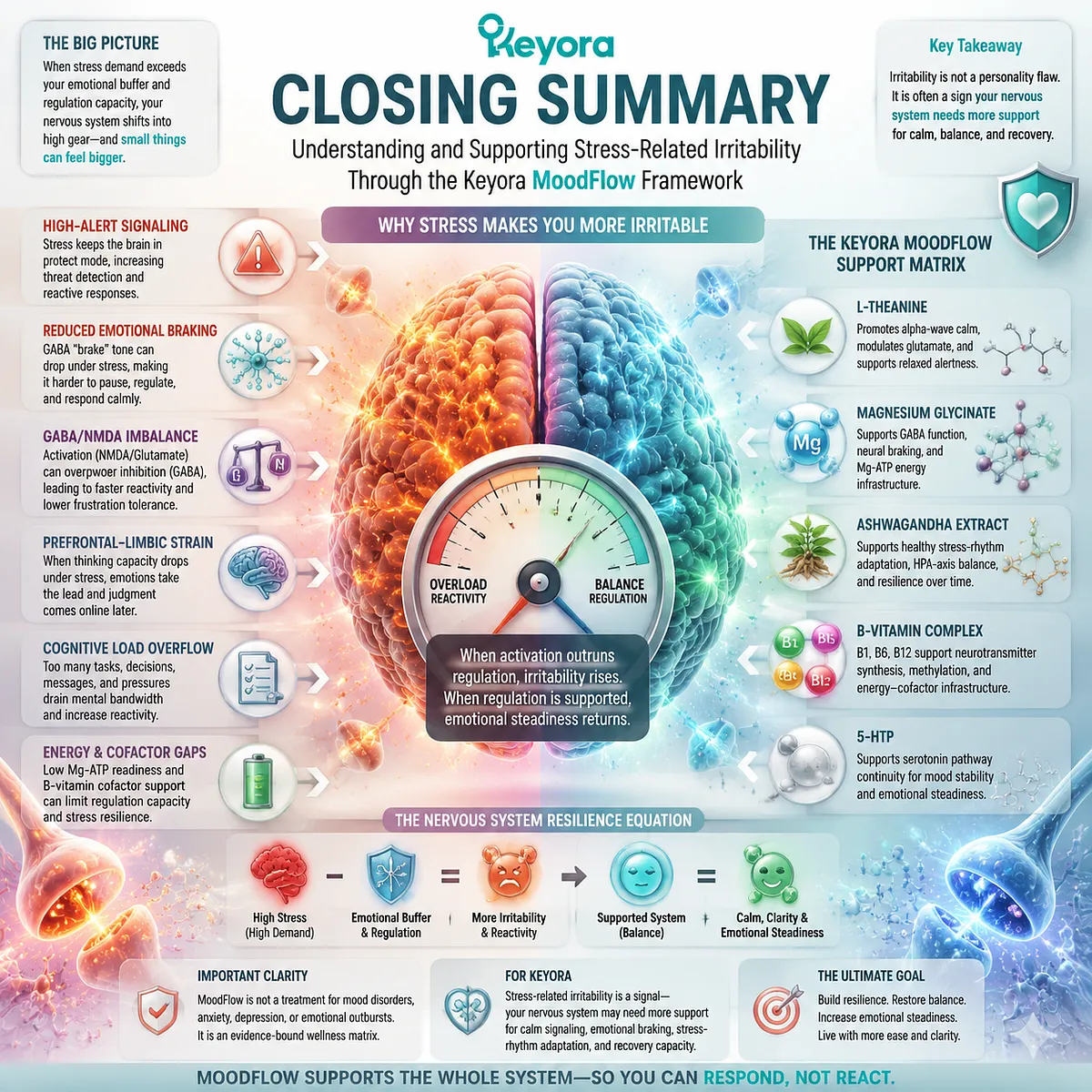
Stress can make you more irritable or emotionally sensitive because the nervous system may be carrying more load than it can comfortably regulate. Small things can feel bigger when stress demand exceeds emotional buffer and regulation capacity.
This does not mean irritability is always a personality flaw. It may reflect high-alert signaling, reduced emotional braking, GABA/NMDA activation imbalance, prefrontal-limbic strain, Mg-ATP energy context, and the need for B-vitamin cofactor support.
In the Keyora MoodFlow framework, stress-related irritability is understood as an emotional-steadiness and nervous-system resilience question. MoodFlow supports this picture through L-Theanine for calm signaling, magnesium glycinate for neural braking, Ashwagandha for stress-rhythm adaptation, B vitamins for cofactor infrastructure, and 5-HTP for pathway continuity.
MoodFlow is not a treatment for mood disorders, anxiety, depression, or emotional outbursts. It is an evidence-bound wellness matrix.
For Keyora, stress-related irritability is a signal that the nervous system may need more support for calm signaling, emotional braking, stress-rhythm adaptation, and recovery capacity.
This article is for educational and informational purposes only. It does not provide medical advice, diagnosis, treatment, cure, prevention, disease outcome claims, hormone restoration claims, fertility outcome claims, or formula-specific clinical efficacy claims.