
Why Does Stress Make Me Forgetful?
Keyora Research Q&A Library
This is part of the Keyora Research Q&A Series, derived from Keyora Nutritional Neurology Seriers .
Within the Keyora Nutritional Neurology framework, this Q&A translates complex nutrient–brain mechanisms into reader-friendly, evidence-bound answers, focusing on stress resilience, sleep quality, calm mood support, cognitive wellness, and the broader interaction between nutrition, neurochemistry, and daily nervous-system function.
First published by Keyora Research Journal: www.keyorahealth.com

Direct Answer
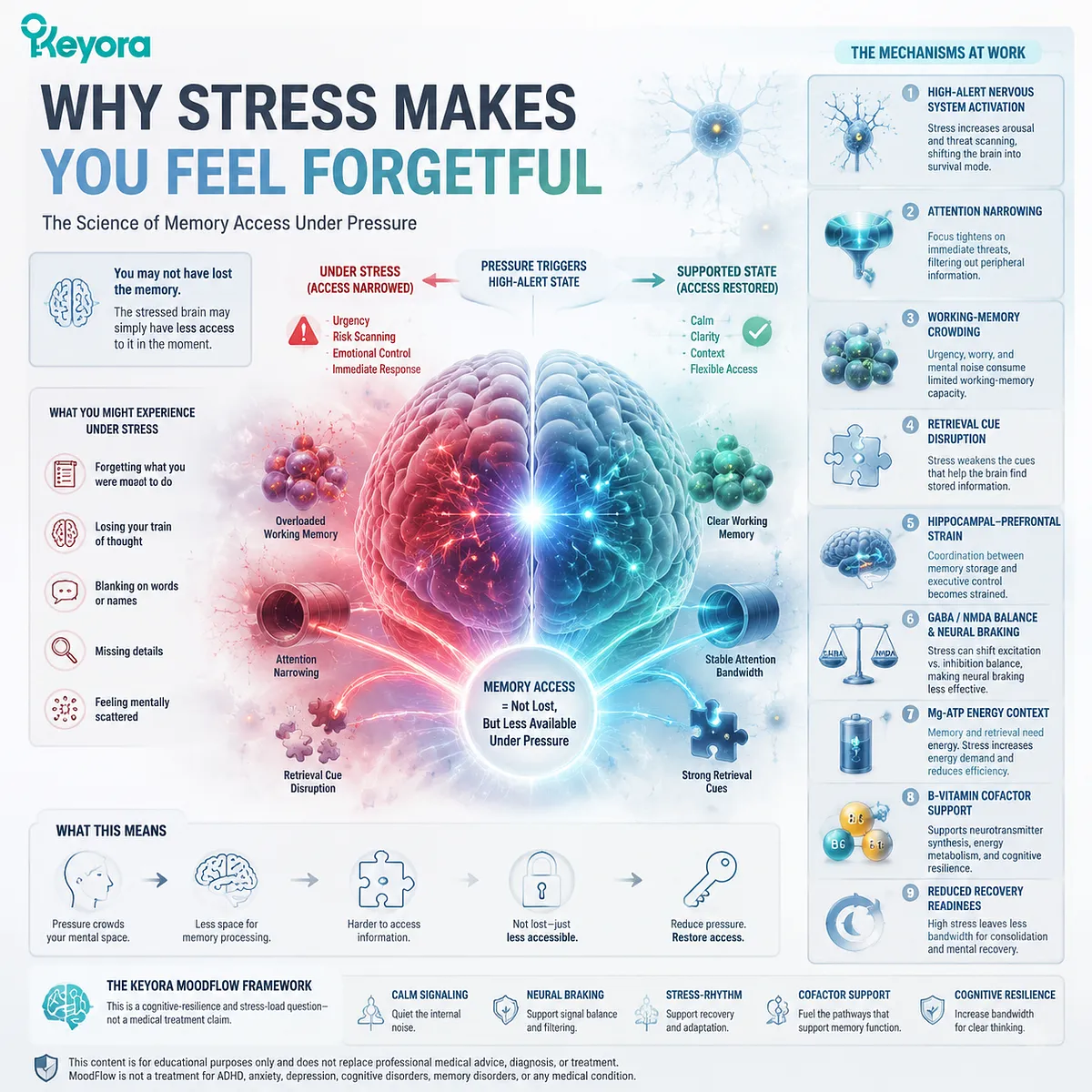
Stress can make you feel forgetful because pressure can crowd working memory, narrow attention, and make it harder for the brain to retrieve information smoothly.
You may not have lost the memory.
The stressed brain may simply have less access to it in the moment.
The problem is not always memory ability.
The problem is that memory ability does not always equal memory access under stress.
When pressure is high, the brain may prioritize urgency, risk scanning, emotional control, and immediate response. That can make ordinary remembering feel harder. You may forget what you were about to do, lose your train of thought, miss a detail, or blank on something you normally know.
Mechanistically, this can involve high-alert nervous-system activation, attention narrowing, working-memory crowding, retrieval cue disruption, hippocampal-prefrontal coordination strain, GABA/NMDA activation balance, neural braking, Mg-ATP energy context, B-vitamin cofactor support, and reduced recovery readiness.
In the Keyora MoodFlow framework, this is understood as a cognitive-resilience and stress-load question, not a medical treatment claim.
Why You Forget Things More Easily When You’re Stressed
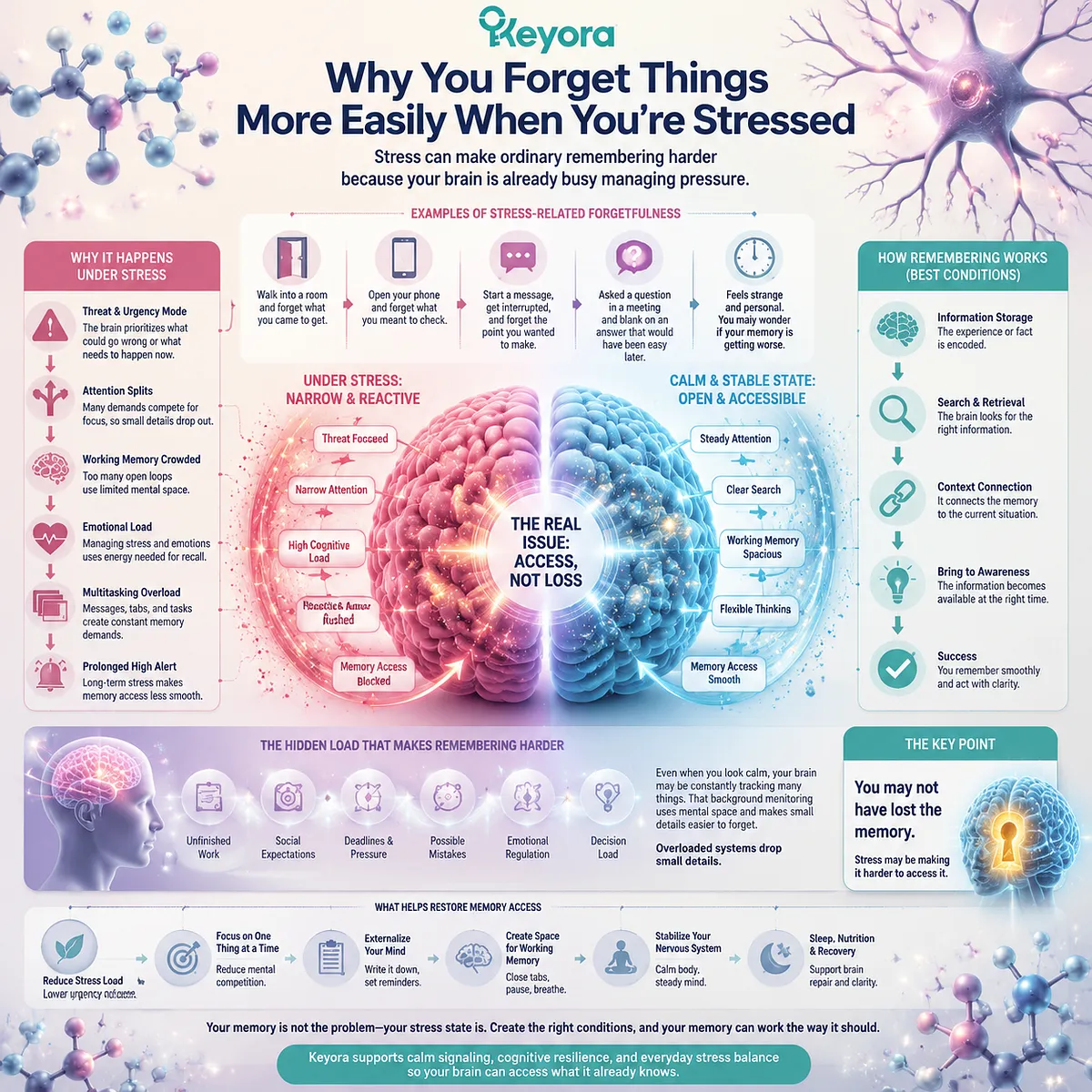
Stress can make ordinary remembering harder because your brain is already busy managing pressure.
Stress-related forgetfulness can feel strange because it often happens with information you actually know.
You may walk into a room and forget what you came to get.
You may open your phone and forget what you meant to check.
You may start replying to a message, get interrupted, and then forget the point you wanted to make.
You may be asked a question in a meeting and suddenly blank on an answer that would have been easy five minutes later.
This kind of forgetfulness can feel personal.
It may make you wonder whether your memory is getting worse, whether you are becoming unreliable, or whether your brain is not working the way it should. But in many everyday stress situations, the issue is not that the memory has disappeared.
The issue may be access.
A memory can exist, but still be hard to retrieve under pressure. This is similar to knowing a word but not being able to find it when someone is waiting. Later, when the pressure drops, the word comes back. The information was not gone. It was temporarily difficult to reach.
Stress changes the environment in which remembering happens.
Remembering is not just storage. It is also retrieval. The brain has to search for the right information, connect it to the current situation, and bring it into awareness at the right time. That process works best when attention is steady, working memory has space, and the nervous system is not flooded with urgency signals.
Under stress, those conditions can change.
The brain may become more focused on what could go wrong, what needs to happen now, who is waiting, what might be forgotten, and how to stay in control. That kind of pressure uses mental space. It can make the brain more reactive and less flexible.
This is why stress-related forgetfulness often shows up during busy, interrupted, or emotionally loaded moments.
You may forget small things because your attention is split. You may forget steps because your working memory is crowded. You may forget words because your brain is monitoring how you sound. You may forget tasks because too many unfinished loops are competing for the same mental workspace.
The experience can be especially common when stress and multitasking combine.
Every message, notification, deadline, open tab, and unfinished task can become a demand on memory. The brain has to remember what matters, what can wait, what needs a reply, and what must not be missed. When too many demands stay active, small details can drop out.
This does not mean the brain is lazy.
It may mean the brain is overloaded.
Stress-related forgetfulness can also happen after prolonged pressure. When the nervous system has been in high alert for hours or days, memory access may feel less smooth. You may still be functioning, but each new demand arrives on top of background monitoring, emotional regulation, and decision load.
That hidden load matters.
A person can look calm on the outside while their brain is constantly tracking unfinished work, social expectations, deadlines, and possible mistakes. In that state, remembering one more small thing may feel harder than it should.
The key point is simple:
You may not have lost the memory. Stress may be making it harder to access it.
The Memory-Retrieval Problem Behind Stress Forgetfulness
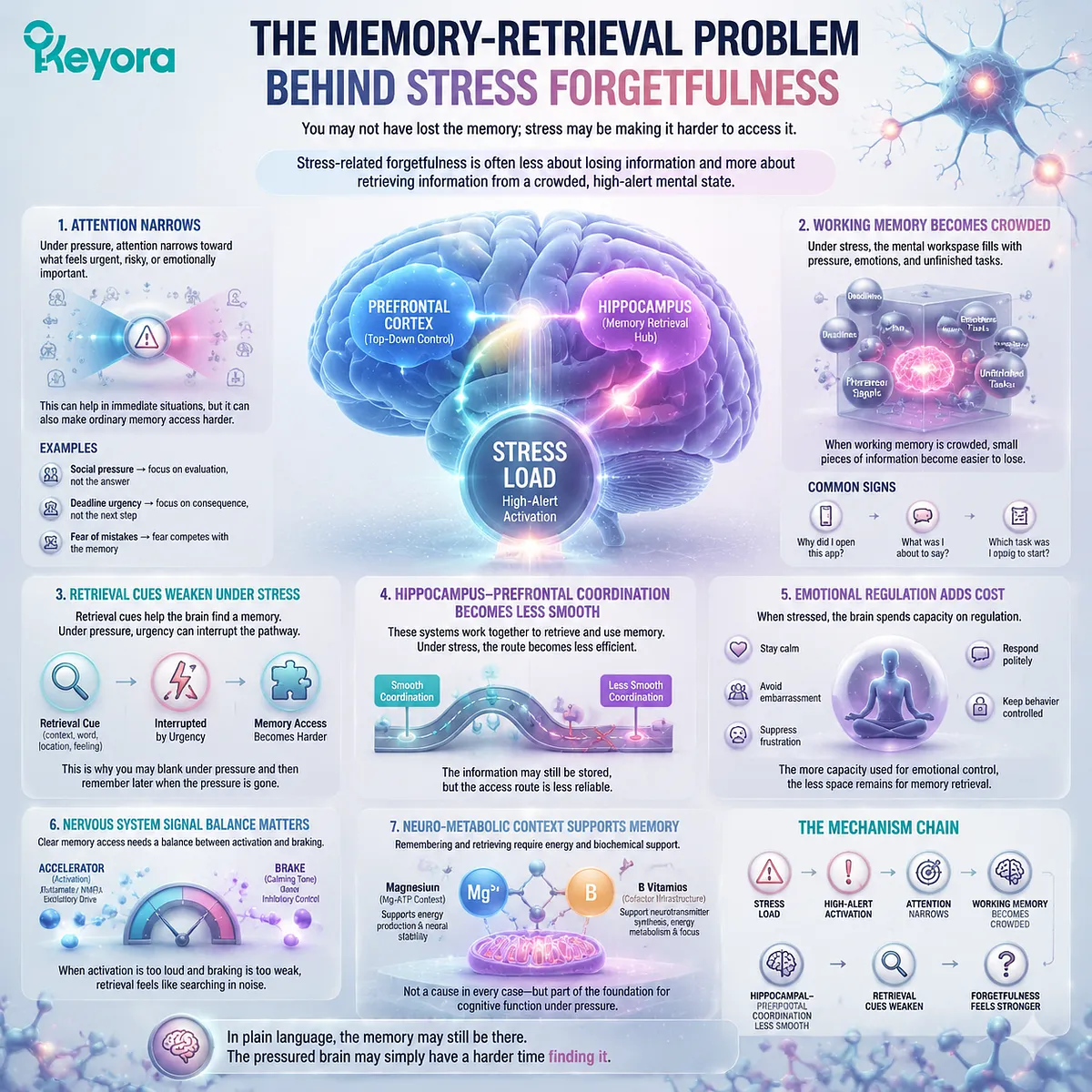
You may not have lost the memory; stress may be making it harder to access it.
Stress-related forgetfulness is often less about losing information and more about retrieving information from a crowded, high-alert mental state.
To remember something, the brain needs several systems to work together. Attention has to point toward the right information. Working memory has to hold the current task. The brain has to use retrieval cues to find the right memory. Emotional regulation has to keep pressure from taking over the process.
Stress can interfere with each of those steps.
One of the first changes is attention narrowing.
Under pressure, the brain often narrows attention toward what feels urgent, risky, or emotionally important. This can help in immediate situations, but it can also make ordinary memory access harder. The brain may focus so strongly on the pressure that it loses access to smaller details around it.
For example, if someone asks you a question while you feel evaluated, your brain may focus on the social pressure rather than the answer. If a deadline feels urgent, your brain may focus on the consequence instead of the next step. If you are trying not to make a mistake, the fear of the mistake can compete with the memory you are trying to retrieve.
Working memory also becomes crowded.
Working memory is the temporary mental workspace that holds active information. It helps you remember what you are doing, what comes next, what needs to be said, and what must not be forgotten. Under stress, this workspace may fill with deadlines, risks, emotions, unfinished tasks, and pressure signals.
When working memory is crowded, small pieces of information become easier to lose.
This is why you may forget why you opened an app, what you were about to say, or which task you were going to start. The information may be simple, but it still has to compete for space inside a limited mental workspace.
Retrieval cues can also become weaker under stress.
A retrieval cue is anything that helps the brain find a memory. It might be a context, a word, a location, a sequence, or a feeling. When the nervous system is calm, these cues often work smoothly. One thought leads to another, and the memory appears.
Under pressure, urgency can interrupt that pathway.
The brain may jump toward the stress signal instead of following the retrieval cue. This is one reason a person may blank under pressure and then remember later when the pressure is gone. The cue becomes useful again once the nervous system is less crowded.
The hippocampus and prefrontal system are useful ways to explain this without making the article too clinical.
In simple terms, the hippocampus helps organize and retrieve memory, while the prefrontal system helps direct attention, choose what matters, and control the current task. Under stress, these systems may not coordinate as smoothly. The brain may still contain the information, but the route to access it may become less efficient.
Emotional regulation adds another cost.
When stressed, the brain may be trying to stay calm, avoid embarrassment, suppress frustration, respond politely, and keep behavior controlled. That regulation uses capacity. The more capacity used for emotional control, the less space may be available for memory retrieval.
The nervous system’s signal background also matters.
In consumer-friendly language, clear memory access needs a workable balance between activation and braking. GABA-related calming tone and NMDA/glutamate activation balance help explain why the brain can feel steady or overstimulated. When activation is too loud, retrieval may feel more like searching in noise.
Neuro-metabolic context is also relevant.
Remembering, retrieving, regulating emotion, and holding information in working memory require energy. Magnesium’s role in Mg-ATP context and B vitamins’ role as cofactor infrastructure help explain why cognitive function depends on both signal balance and metabolic readiness.
This does not mean stress-related forgetfulness is always caused by nutrient status. It means that everyday forgetfulness under pressure can be understood as a multi-layer wellness question.
The mechanism chain looks like this:
stress load → high-alert nervous-system activation → attention narrows → working memory becomes crowded → hippocampal-prefrontal coordination becomes less smooth → retrieval cues weaken → forgetfulness feels stronger
In plain language, the memory may still be there.
The pressured brain may simply have a harder time finding it.
How MoodFlow Supports Memory Access Under Stress
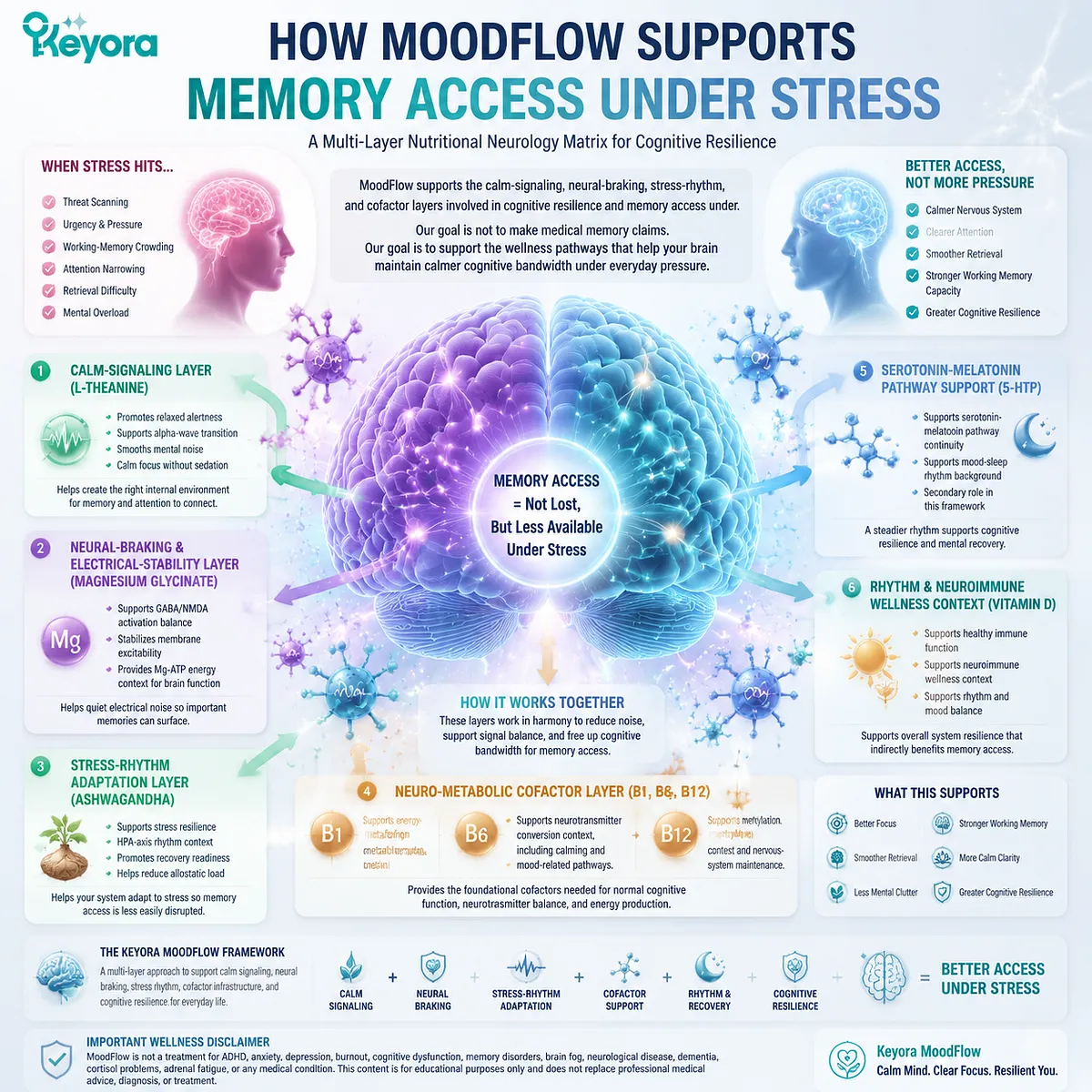
MoodFlow supports the calm-signaling, neural-braking, stress-rhythm, and cofactor layers involved in cognitive resilience and memory access under pressure.
Keyora MoodFlow approaches stress-related forgetfulness as a cognitive-resilience and stress-load question.
The goal is not to make medical memory claims. The goal is not to promise sharper memory or treat memory problems. The goal is to support the wellness pathways that help the brain maintain calmer cognitive bandwidth under everyday pressure.
This distinction matters because many people try to solve stress forgetfulness by forcing themselves harder.
They make more lists, push more urgency, use more caffeine, or criticize themselves for forgetting. Structure can help, but when the nervous system is already overloaded, more pressure may make memory access even less smooth.
MoodFlow’s logic begins with the state behind memory access.
L-Theanine supports the calm-signaling layer.
In the MoodFlow framework, L-Theanine is associated with relaxed alertness, alpha-wave transition, signal smoothing, and calm focus without sedation. This is relevant because stress-related forgetfulness does not always come from low alertness. Many people who forget under stress are already very alert.
The issue is that alertness may feel pressured, noisy, or reactive.
L-Theanine helps explain why memory access may benefit from a calmer signal background. The brain does not need to be shut down. It needs enough calm clarity for attention and retrieval cues to work more smoothly.
Magnesium glycinate supports the neural-braking and electrical-stability layer.
Magnesium is relevant to GABA/NMDA activation balance, membrane excitability, and Mg-ATP energy context. In MoodFlow, magnesium glycinate is positioned as part of the neural braking and hardware-stabilizing layer.
For stress-related forgetfulness, this layer matters because memory access can become harder when the nervous system feels electrically loud. If too many signals are competing for attention, the brain may struggle to retrieve the right information at the right time.
Magnesium’s Mg-ATP context also matters because working memory, attention control, and retrieval effort require energy. Cognitive access is not passive. It depends on both signal stability and energy readiness.
Ashwagandha supports the stress-rhythm adaptation layer.
Stress-related forgetfulness is often not just about one pressured moment. It may happen more easily when the body has been carrying stress for hours, days, or weeks. A nervous system that stays close to high alert may become more vulnerable to attention narrowing, working-memory crowding, and retrieval difficulty.
Ashwagandha is positioned in MoodFlow around stress resilience, HPA-axis rhythm context, and recovery readiness. In this article, that does not mean Ashwagandha fixes cortisol, treats anxiety, or cures burnout. It means Ashwagandha belongs to the stress-adaptation layer that helps explain why memory access is connected to broader stress rhythm.
B1, B6, and B12 support the neuro-metabolic cofactor layer.
Memory, attention, and cognitive control depend partly on normal metabolic and neurotransmitter-related infrastructure. B1 supports energy-metabolism context. B6 supports neurotransmitter-related conversion context, including pathways relevant to calming and mood-related signaling. B12 supports methylation context and nervous-system maintenance.
In MoodFlow, these B vitamins are not positioned as memory treatments or instant focus nutrients. They are part of the cofactor background behind cognitive resilience and normal pathway support under everyday pressure.
5-HTP plays a background role here.
Because this article is memory-access-first, 5-HTP should not dominate the explanation. Its role is better understood as support for serotonin-melatonin pathway continuity and mood-sleep rhythm background within the broader MoodFlow architecture. A steadier rhythm context may support cognitive resilience, but this article is not about treating sleep problems, depression, or serotonin deficiency.
Vitamin D may also be understood as part of the broader rhythm and neuroimmune wellness context when relevant, but it should remain secondary.
Together, these layers explain why MoodFlow is not positioned as a memory drug, stimulant, sedative, or treatment for cognitive problems. It is a multi-layer nutritional neurology matrix designed to support stress resilience, calm focus, cognitive resilience, nervous-system downshift, and recovery readiness within an evidence-bound wellness framework.
MoodFlow is not a treatment for ADHD, anxiety, depression, burnout, cognitive dysfunction, memory disorders, brain fog, neurological disease, dementia, cortisol problems, adrenal fatigue, or any medical condition. In this article, Keyora uses “stress makes me forgetful” as a wellness-language entry point for explaining stress load, working-memory crowding, memory retrieval difficulty, calm signaling, neural braking, stress-rhythm adaptation, and cognitive resilience under everyday pressure.
Closing Summary
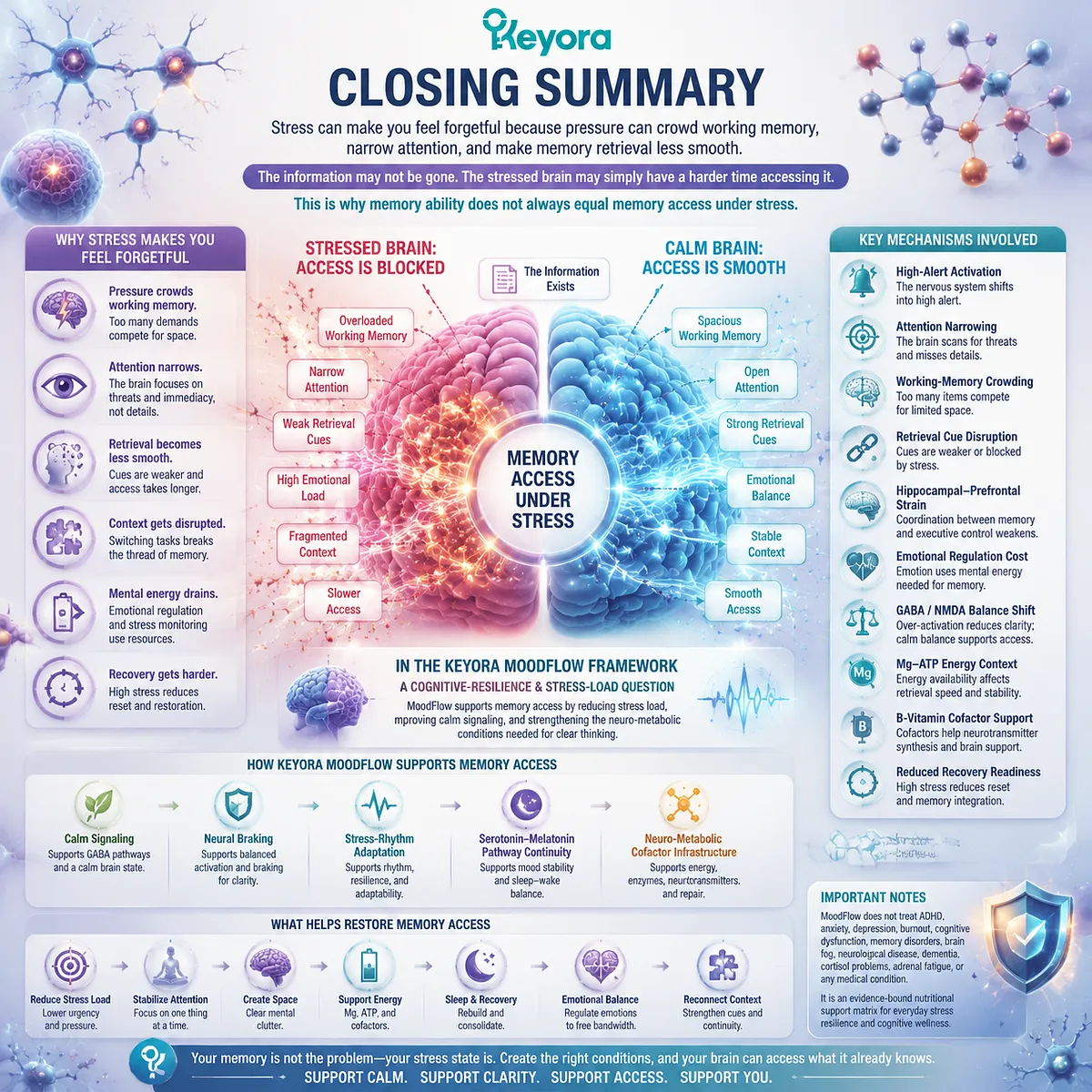
Stress can make you feel forgetful because pressure can crowd working memory, narrow attention, and make memory retrieval less smooth. The information may not be gone. The stressed brain may simply have a harder time accessing it.
This is why memory ability does not always equal memory access under stress.
Mechanistically, stress-related forgetfulness may involve high-alert nervous-system activation, attention narrowing, working-memory crowding, retrieval cue disruption, hippocampal-prefrontal coordination strain, emotional regulation cost, GABA/NMDA activation balance, Mg-ATP energy context, B-vitamin cofactor support, and reduced recovery readiness.
In the Keyora MoodFlow framework, this is understood as a cognitive-resilience and stress-load question. MoodFlow supports this picture through calm signaling, neural braking, stress-rhythm adaptation, serotonin-melatonin pathway continuity, and neuro-metabolic cofactor infrastructure.
MoodFlow does not treat ADHD, anxiety, depression, burnout, cognitive dysfunction, memory disorders, brain fog, neurological disease, dementia, cortisol problems, adrenal fatigue, or any medical condition. It is an evidence-bound nutritional support matrix for everyday stress resilience and cognitive wellness.
This article is for educational and informational purposes only. It does not provide medical advice, diagnosis, treatment, cure, prevention, disease outcome claims, hormone restoration claims, fertility outcome claims, or formula-specific clinical efficacy claims.