
Why Does Stress Make Everything Feel More Personal?
Keyora Research Q&A Library
This is part of the Keyora Research Q&A Series, derived from Keyora Nutritional Neurology Series .
Within the Keyora Nutritional Neurology framework, this Q&A translates complex nutrient–brain mechanisms into reader-friendly, evidence-bound answers, focusing on stress resilience, sleep quality, calm mood support, cognitive wellness, and the broader interaction between nutrition, neurochemistry, and daily nervous-system function.
First published by Keyora Research Journal: www.keyorahealth.com

Direct Answer
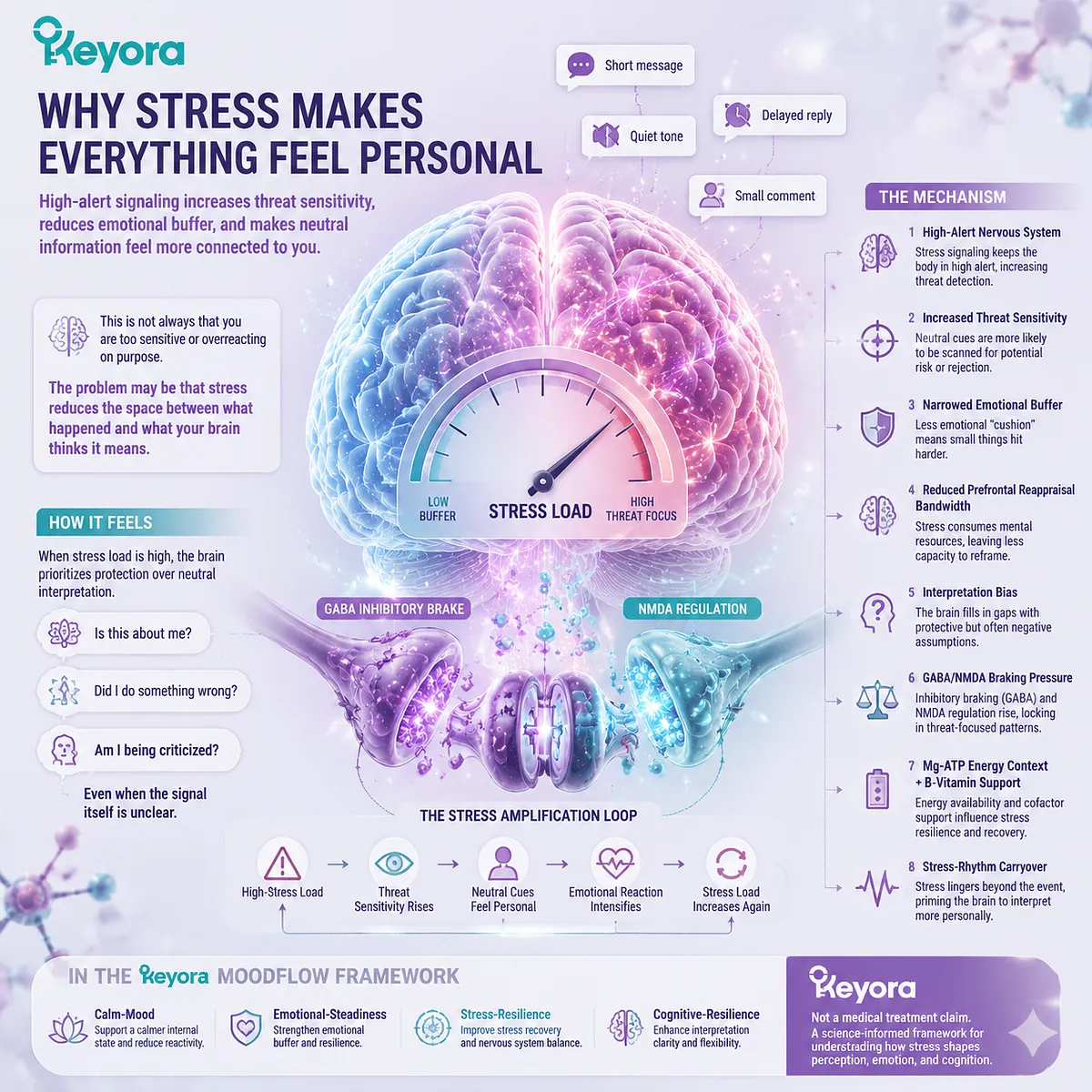
Stress can make everything feel more personal because high-alert signaling can increase threat sensitivity, reduce emotional buffer, and make neutral information feel more connected to you.
A short message, a quiet tone, a delayed reply, or a small comment may feel sharper when your nervous system is already carrying stress.
The problem is not always that you are too sensitive or overreacting on purpose.
The problem may be that stress reduces the space between what happened and what your brain thinks it means.
When stress load is high, the brain may prioritize protection over neutral interpretation.
It may become quicker to ask, “Is this about me?” or “Did I do something wrong?” or “Am I being criticized?” even when the signal itself is unclear.
Mechanistically, this can involve high-alert nervous-system activation, increased threat sensitivity, narrowed emotional buffer, reduced prefrontal reappraisal bandwidth, interpretation bias, GABA/NMDA braking pressure, Mg-ATP energy context, B-vitamin cofactor support, and stress-rhythm carryover.
In the Keyora MoodFlow framework, this is understood as a calm-mood, emotional-steadiness, stress-resilience, and cognitive-resilience question, not a medical treatment claim.
Why Stress Can Make Small Things Feel Like They Are About You
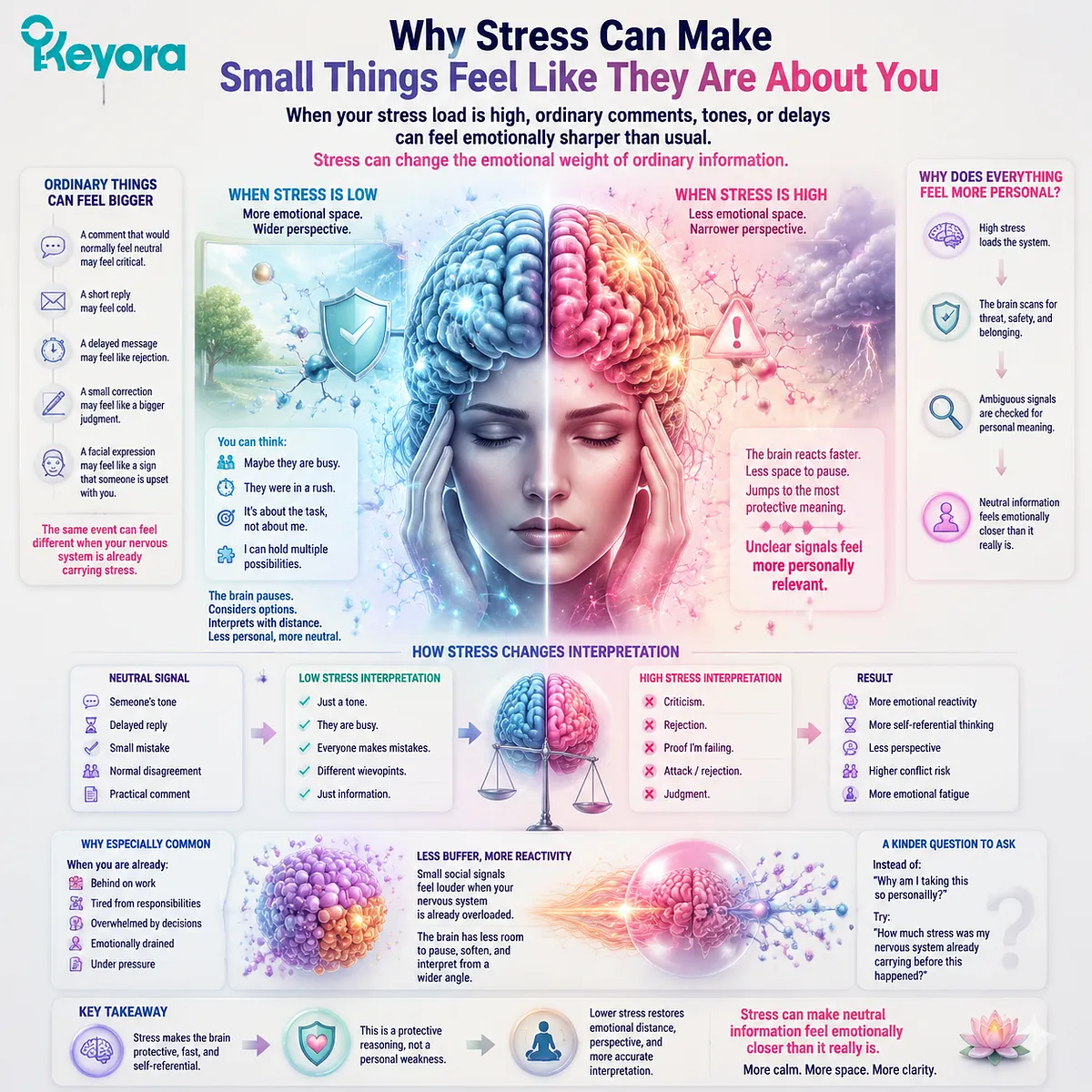
When your stress load is high, ordinary comments, tones, or delays can feel emotionally sharper than usual.
Stress can change the emotional weight of ordinary information.
-
A comment that would normally feel neutral may suddenly feel critical.
-
A short reply may feel cold.
-
A delayed message may feel like rejection.
-
A small correction may feel like a bigger judgment.
-
A facial expression may feel like a sign that someone is upset with you.
The same event can feel different when your nervous system is already carrying stress.
This is why stress can make everything feel more personal.
You may not be reacting only to the comment, the message, or the tone. You may also be reacting from a nervous system that is already tired, tense, alert, and trying to protect you from more pressure.
When stress is low, there is usually more emotional space.
You may be able to think, “Maybe they are busy,” or “Maybe that message was short because they were in a rush,” or “That feedback is about the task, not about me.” You can hold several possible explanations at the same time.
When stress is high, that space can shrink.
The brain may move faster from signal to meaning. Instead of slowly asking what else could be true, it may jump toward the meaning that feels most protective. If the system is already overloaded, it may interpret unclear signals as more personally relevant than they really are.
This does not mean you are making things up.
It means stress can reduce emotional distance.
Emotional distance is the space between what happens and how personally it feels. Under calm conditions, you may be able to separate the signal from the self. Someone’s tone is just a tone. A delayed reply is just a delay. A correction is just information.
Under stress, that separation can become harder.
-
A neutral signal may feel like a personal signal.
-
A practical comment may feel like criticism.
-
A small mistake may feel like proof that you are failing.
-
A normal disagreement may feel like rejection or attack.
This is especially common when you are already under pressure.
If you are behind on work, tired from responsibilities, overwhelmed by decisions, or emotionally drained from the day, you may have less buffer available. Then even small social signals can feel louder.
You may think, “Why am I taking this so personally?”
A better question may be: “How much stress was my nervous system already carrying before this happened?”
Stress can make the brain more self-referential because it is trying to protect you. It wants to know whether a signal affects your safety, belonging, performance, responsibility, or future consequences. That protective question can be useful in some situations.
But when the system is overloaded, it can become too quick.
That is why small things may feel bigger during stressful periods. Not because you are weak. Not because you are dramatic. Not because you want conflict. But because the brain has less room to pause, soften, and interpret information from a wider angle.
Stress can make neutral information feel emotionally closer than it really is.
The Threat-Sensitivity Shift Behind Taking Things Personally
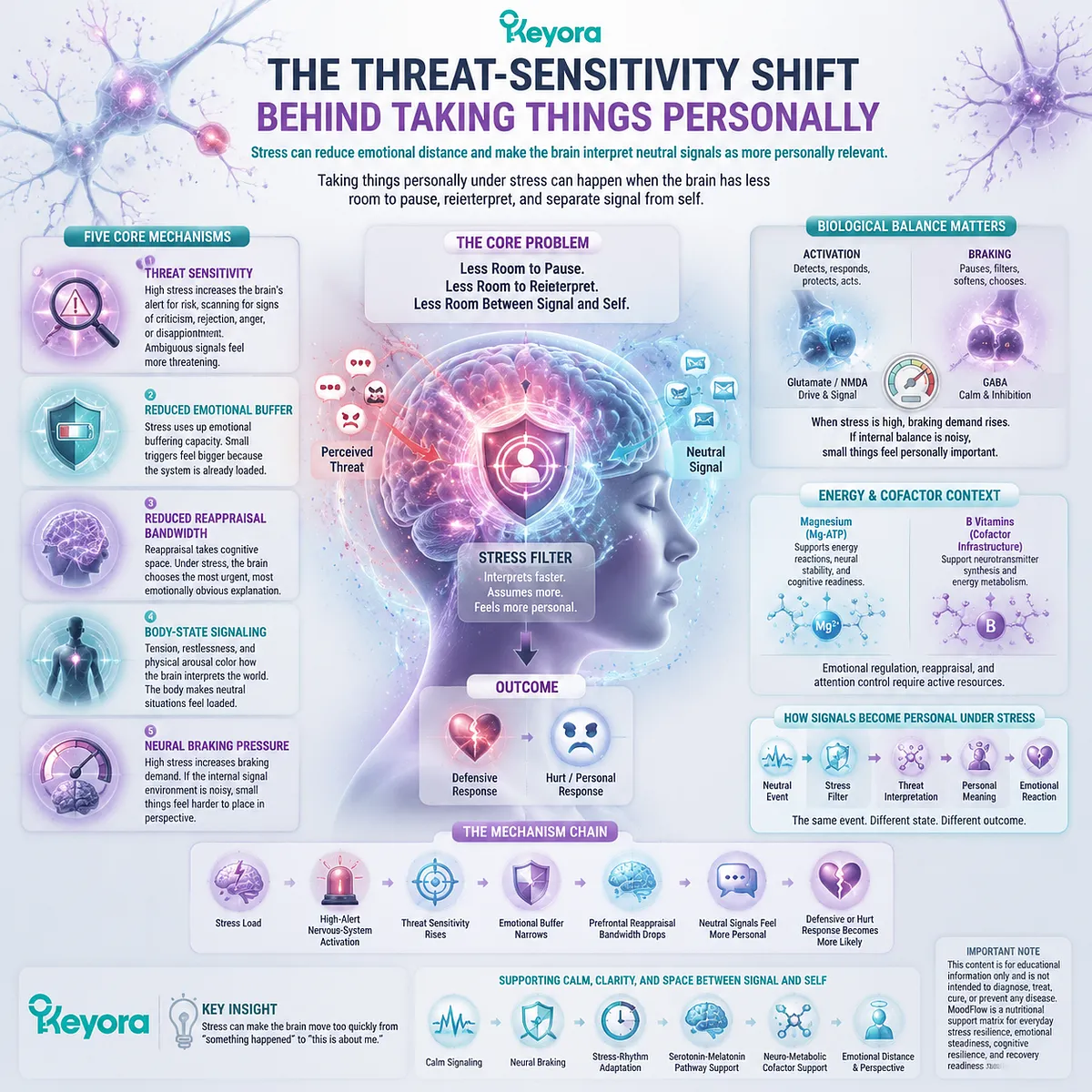
Stress can reduce emotional distance and make the brain interpret neutral signals as more personally relevant.
Taking things personally under stress can happen when the brain has less room to pause, reinterpret, and separate signal from self.
The first mechanism is threat sensitivity.
When stress load rises, the nervous system may become more alert to risk. This does not only mean physical danger. It can also mean social risk, performance risk, emotional risk, or the risk of making a mistake.
In that state, the brain may scan for signs of criticism, rejection, disappointment, anger, or consequence.
This can make ambiguous information feel more threatening.
A message with no emoji may feel cold. A neutral face may feel disapproving. A question may sound like doubt. Feedback may feel like failure. Silence may feel like rejection. The signal may not have changed much, but the stress filter has changed.
The second mechanism is reduced emotional buffer.
Emotional buffer is the capacity to absorb, pause, and respond without immediately feeling flooded or defensive. When your buffer is available, you can notice discomfort without becoming fully pulled into it. You can feel a sting and still ask whether the situation truly means what it feels like.
Stress uses up that buffer.
If your day has already required self-control, decision-making, performance, social regulation, or problem-solving, your emotional system may have less room left. Then a small trigger can feel bigger because it lands on a system that is already loaded.
The third mechanism is reduced reappraisal bandwidth.
Reappraisal is the ability to reinterpret a situation from another angle. It is the part of your thinking that can say, “Maybe this is not about me,” or “Maybe I need more context,” or “Maybe this person is stressed too.”
Reappraisal takes cognitive space.
Under stress, that space may be limited. The brain may not have enough bandwidth to generate multiple explanations. It may choose the explanation that feels most urgent, most protective, or most emotionally obvious.
That is how stress can create interpretation bias.
Interpretation bias does not mean the person is irrational. It means the brain is leaning toward certain meanings under pressure. When the nervous system is in high-alert mode, personally threatening meanings may come online faster than neutral ones.
The fourth mechanism is body-state signaling.
If the body is already tense, restless, or braced, the brain may interpret the world through that internal state. A tight chest, clenched jaw, shallow breathing, or physical agitation can make the environment feel more charged.
The body can make a neutral situation feel emotionally loaded.
This is why the same comment may feel harmless on a calm day and painful on a stressful day. The comment is not the only input. The brain is also reading the body’s state.
The fifth mechanism is neural braking pressure.
The nervous system has both activation and braking functions. Activation helps you detect, respond, protect, and act. Braking helps you pause, filter, soften, and choose a response. GABA-related calming tone and NMDA/glutamate activation balance help explain why the system can feel either steady or overreactive.
When stress is high, braking demand rises.
The system has to filter emotional signals, reduce urgency, slow interpretation, and prevent every input from feeling personally important. If the internal signal environment is noisy, small things may become harder to place in perspective.
Energy context also matters.
Emotional regulation, reappraisal, attention control, and social interpretation require active resources. Magnesium’s role in Mg-ATP context and B vitamins’ role as cofactor infrastructure help explain why emotional steadiness depends on both signaling balance and energy background.
This does not mean taking things personally under stress is caused by nutrient status. It means the experience can be understood as a multi-layer wellness question involving stress load, threat sensitivity, emotional buffer, neural braking, and cognitive resilience.
The mechanism chain looks like this:
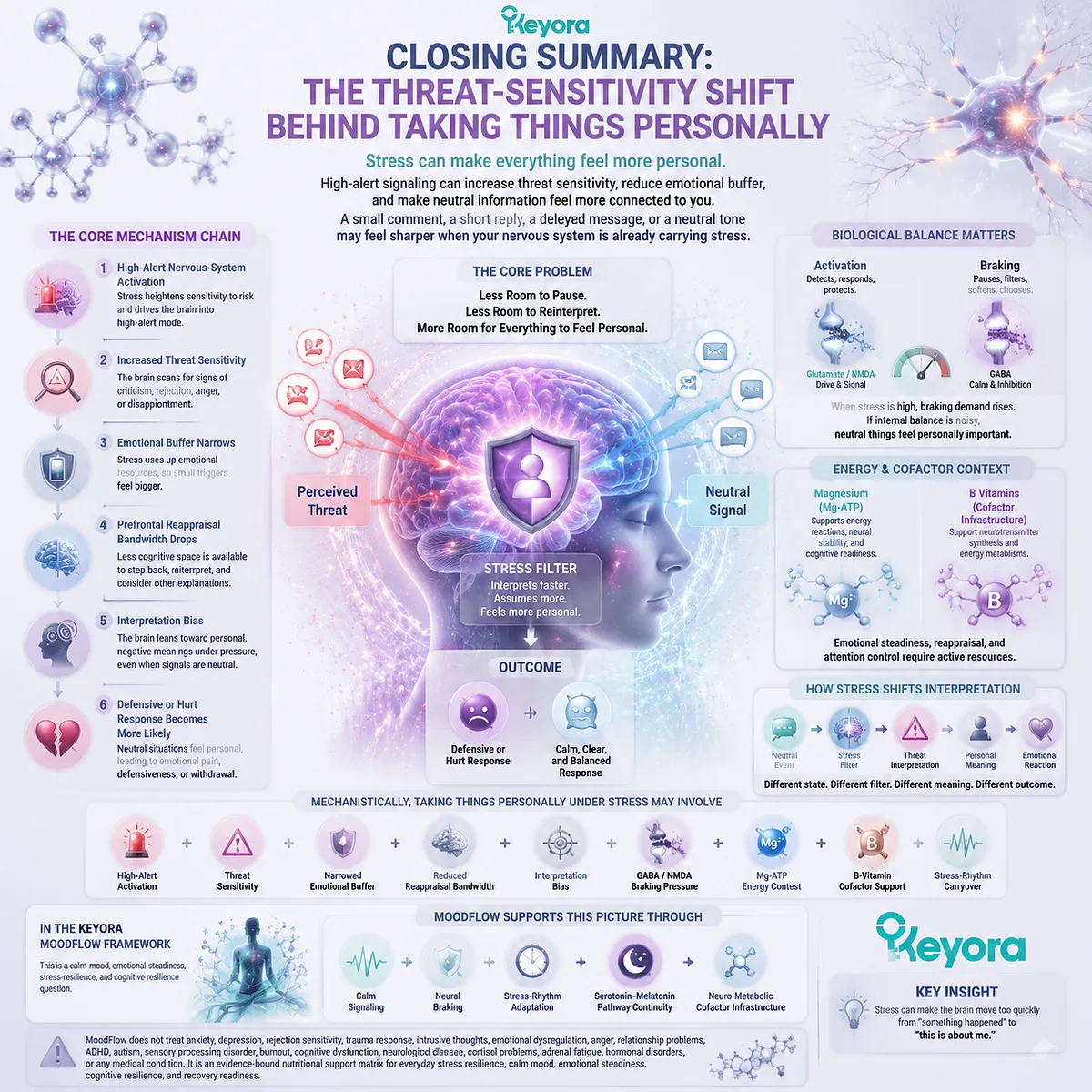
stress load → high-alert nervous-system activation → threat sensitivity rises → emotional buffer narrows → prefrontal reappraisal bandwidth drops → neutral signals feel more personal → defensive or hurt response becomes more likely
In plain language, stress can make the brain move too quickly from “something happened” to “this is about me.”
How MoodFlow Supports Emotional Steadiness Under Stress
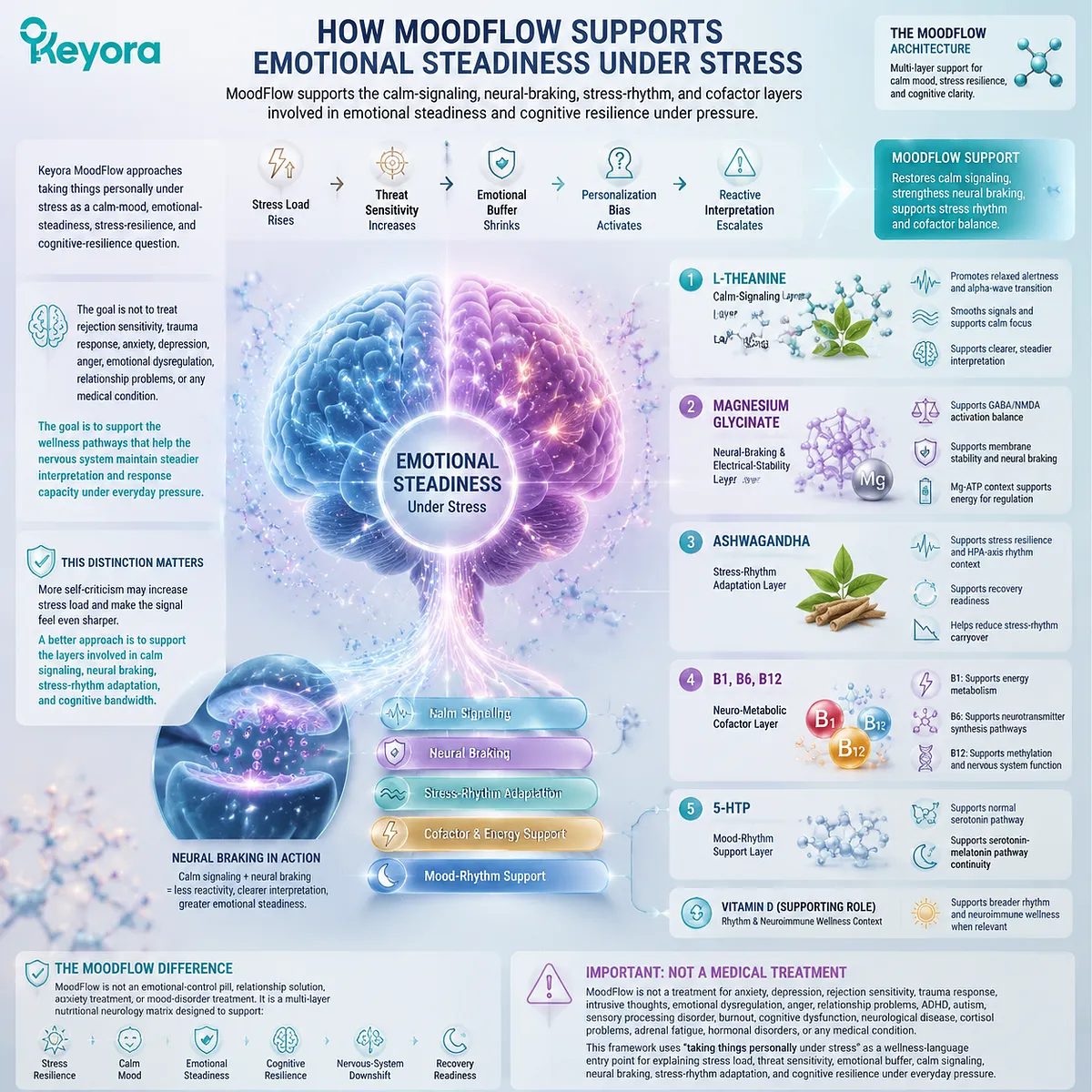
MoodFlow supports the calm-signaling, neural-braking, stress-rhythm, and cofactor layers involved in emotional steadiness and cognitive resilience under pressure.
Keyora MoodFlow approaches taking things personally under stress as a calm-mood, emotional-steadiness, stress-resilience, and cognitive-resilience question.
The goal is not to treat rejection sensitivity, trauma response, anxiety, depression, anger, emotional dysregulation, relationship problems, or any medical condition. The goal is to support the wellness pathways that help the nervous system maintain steadier interpretation and response capacity under everyday pressure.
This distinction matters.
When stress makes everything feel personal, the answer is not to shame yourself for reacting. More self-criticism may increase the stress load and make the signal feel even sharper. A more useful wellness frame is to support the layers involved in calm signaling, neural braking, stress-rhythm adaptation, and cognitive bandwidth.
MoodFlow’s logic begins with calm signaling.
L-Theanine supports the calm-signaling layer.
In the MoodFlow framework, L-Theanine is associated with relaxed alertness, alpha-wave transition, signal smoothing, and calm focus without sedation. This is important because emotional steadiness does not mean becoming numb or detached.
The goal is not to stop feeling.
The goal is a calmer signal background. When the internal signal background is smoother, the brain may have more room to pause before turning a neutral comment into a personal threat. L-Theanine helps explain non-sedative calm as support for clearer, steadier interpretation under pressure.
Magnesium glycinate supports the neural-braking and electrical-stability layer.
Magnesium is relevant to GABA/NMDA activation balance, membrane excitability, and Mg-ATP energy context. In MoodFlow, magnesium glycinate is positioned as part of the neural braking and hardware-stabilizing layer.
For stress-related personalization, this layer is central.
When emotional signals feel sharp, the nervous system needs braking capacity to pause, filter, and reduce overactivation. Neural braking helps explain the physiological background behind steadier response capacity and less reactive interpretation.
Magnesium’s Mg-ATP context also matters because emotional regulation is active. Reappraisal takes energy. Pausing takes energy. Separating a signal from the self takes energy. Holding a wider perspective while stressed requires cognitive and metabolic support.
Ashwagandha supports the stress-rhythm adaptation layer.
Taking things personally may become more likely when stress has been building over time. A person may not react strongly because of one comment alone. The reaction may reflect accumulated stress-rhythm carryover, reduced recovery readiness, and a nervous system that has been scanning for risk for too long.
Ashwagandha is positioned in MoodFlow around stress resilience, HPA-axis rhythm context, and recovery readiness. In this article, that does not mean Ashwagandha fixes cortisol, treats anxiety, repairs the HPA axis, or treats emotional sensitivity. It means Ashwagandha belongs to the stress-adaptation layer that helps explain why emotional interpretation is connected to broader stress rhythm.
B1, B6, and B12 support the neuro-metabolic cofactor layer.
The nervous system depends on normal metabolic and neurotransmitter-related infrastructure. B1 supports energy-metabolism context. B6 supports neurotransmitter-related conversion context, including pathways relevant to calming and mood-related signaling. B12 supports methylation context and nervous-system maintenance.
In MoodFlow, these B vitamins are not positioned as treatments for emotional dysregulation, anger, fatigue, cognitive dysfunction, or mood disorders. They are part of the cofactor background behind emotional steadiness, cognitive resilience, and normal pathway support under everyday pressure.
5-HTP plays a background role in mood-rhythm support.
Because this article is about emotional interpretation under stress, 5-HTP should not dominate the explanation. Its role is best understood as support for normal serotonin-related pathways and serotonin-melatonin pathway continuity within the broader MoodFlow architecture. This does not mean treating depression, correcting serotonin, or changing personality.
Vitamin D may also be understood as part of broader rhythm and neuroimmune wellness context when relevant, but it should remain secondary.
Together, these layers explain why MoodFlow is not positioned as an emotional-control pill, relationship solution, anxiety treatment, rejection-sensitivity treatment, or mood-disorder treatment. It is a multi-layer nutritional neurology matrix designed to support stress resilience, calm mood, emotional steadiness, cognitive resilience, nervous-system downshift, and recovery readiness within an evidence-bound wellness framework.
MoodFlow is not a treatment for anxiety, depression, rejection sensitivity, trauma response, intrusive thoughts, emotional dysregulation, anger, relationship problems, ADHD, autism, sensory processing disorder, burnout, cognitive dysfunction, neurological disease, cortisol problems, adrenal fatigue, hormonal disorders, or any medical condition. In this article, Keyora uses “taking things personally under stress” as a wellness-language entry point for explaining stress load, threat sensitivity, emotional buffer, calm signaling, neural braking, stress-rhythm adaptation, and cognitive resilience under everyday pressure.
Closing Summary
Stress can make everything feel more personal because high-alert signaling can increase threat sensitivity, reduce emotional buffer, and make neutral information feel more connected to you. A small comment, a short reply, a delayed message, or a neutral tone may feel sharper when your nervous system is already carrying stress.
This does not always mean you are too sensitive or overreacting on purpose.
Mechanistically, taking things personally under stress may involve high-alert nervous-system activation, increased threat sensitivity, narrowed emotional buffer, reduced prefrontal reappraisal bandwidth, interpretation bias, GABA/NMDA braking pressure, Mg-ATP energy context, B-vitamin cofactor support, and stress-rhythm carryover.
In the Keyora MoodFlow framework, this is understood as a calm-mood, emotional-steadiness, stress-resilience, and cognitive-resilience question. MoodFlow supports this picture through calm signaling, neural braking, stress-rhythm adaptation, serotonin-melatonin pathway continuity, and neuro-metabolic cofactor infrastructure.
MoodFlow does not treat anxiety, depression, rejection sensitivity, trauma response, intrusive thoughts, emotional dysregulation, anger, relationship problems, ADHD, autism, sensory processing disorder, burnout, cognitive dysfunction, neurological disease, cortisol problems, adrenal fatigue, hormonal disorders, or any medical condition. It is an evidence-bound nutritional support matrix for everyday stress resilience, calm mood, emotional steadiness, cognitive resilience, and recovery readiness.
This article is for educational and informational purposes only. It does not provide medical advice, diagnosis, treatment, cure, prevention, disease outcome claims, hormone restoration claims, fertility outcome claims, or formula-specific clinical efficacy claims.