
Why Does My Work Quality Drop Before I Realize I’m Stressed?
Keyora Research Q&A Library
This is part of the Keyora Research Q&A Series, derived from Keyora Nutritional Neurology Series.
Within the Keyora Nutritional Neurology framework, this Q&A translates complex nutrient–brain mechanisms into reader-friendly, evidence-bound answers, focusing on stress resilience, sleep quality, calm mood support, cognitive wellness, and the broader interaction between nutrition, neurochemistry, and daily nervous-system function.
First published by Keyora Research Journal: www.keyorahealth.com

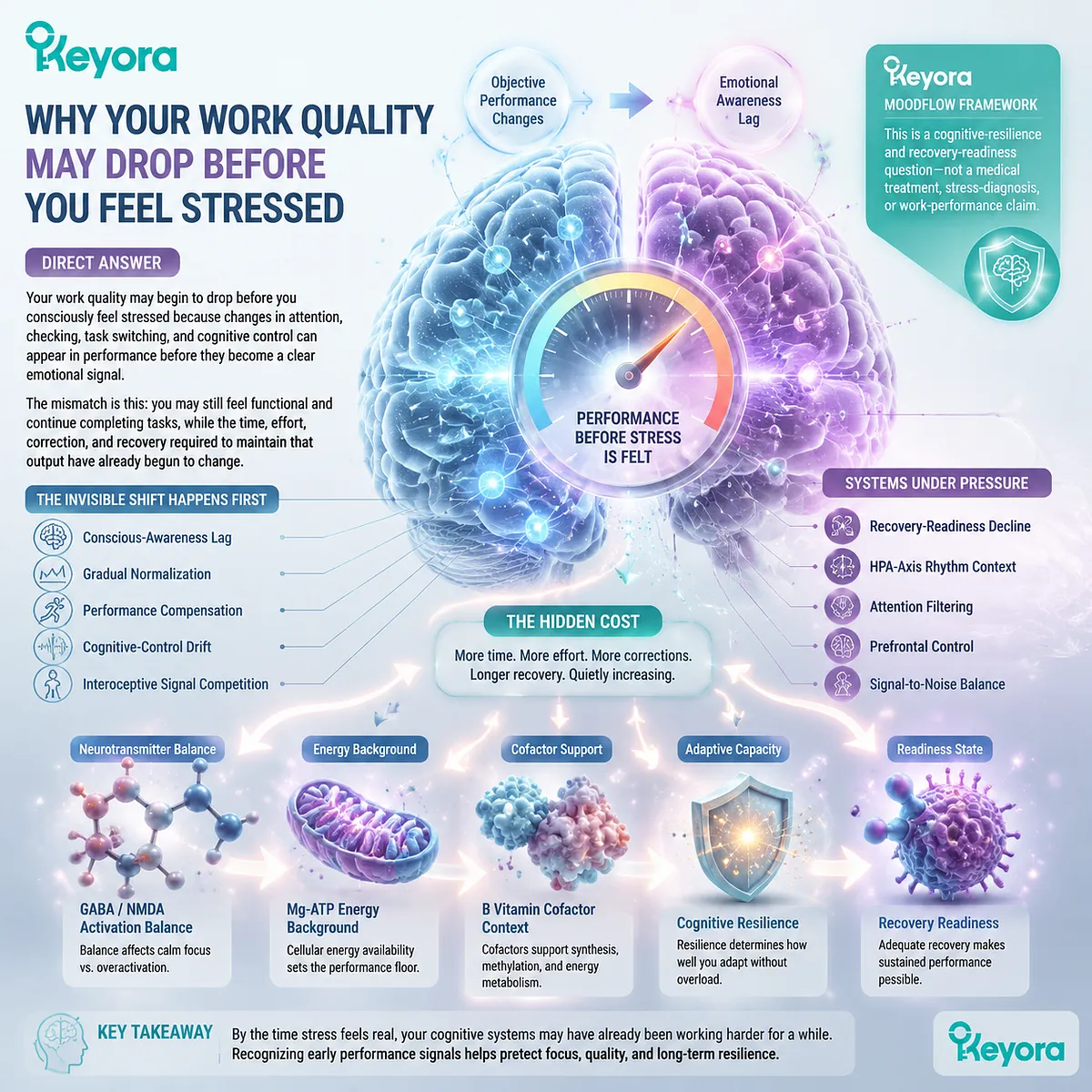
Direct Answer
Your work quality may begin to drop before you consciously feel stressed because changes in attention, checking, task switching, and cognitive control can appear in performance before they become a clear emotional signal.
The mismatch is this: you may still feel functional and continue completing tasks, while the time, effort, correction, and recovery required to maintain that output have already begun to change.
This can involve conscious-awareness lag, gradual normalization, performance compensation, cognitive-control drift, interoceptive signal competition, recovery-readiness decline, HPA-axis rhythm context, attention filtering, prefrontal control, signal-to-noise balance, GABA/NMDA activation balance, Mg-ATP energy background, B vitamin cofactor context, cognitive resilience, and recovery readiness.
In the Keyora MoodFlow framework, this is understood as a cognitive-resilience and recovery-readiness question, not a medical treatment, stress-diagnosis, or work-performance claim.
Why Your Work May Change Before You Feel Obviously Stressed
Stress does not always announce itself as anxiety; it may first appear as more effort, more corrections, and less consistency in familiar work.
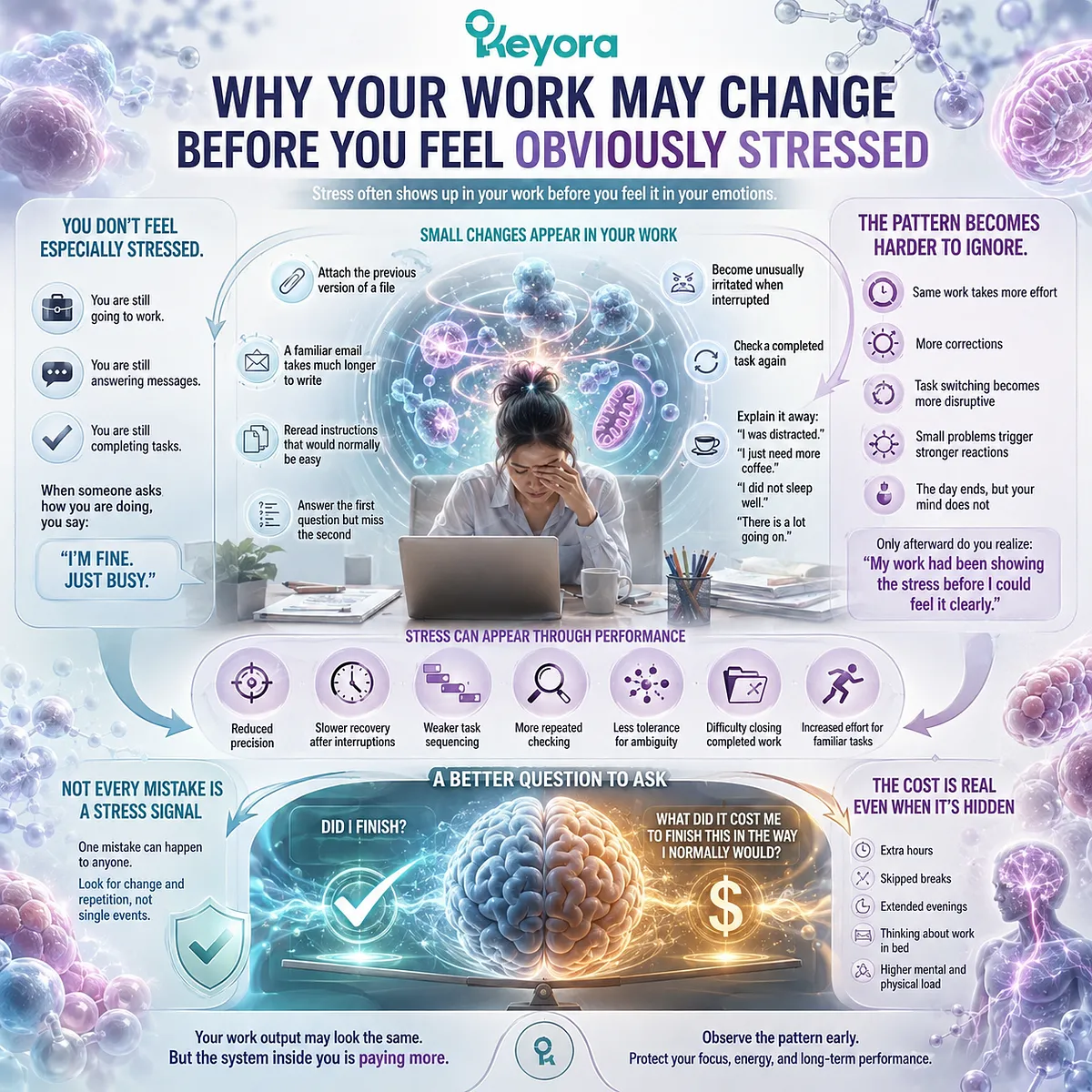
You do not feel especially stressed.
You are still going to work.
You are still answering messages.
You are still completing tasks.
When someone asks how you are doing, you say:
“I’m fine. Just busy.”
But small things have begun to change.
You attach the previous version of a file.
A familiar email takes much longer to write.
You reread instructions that would normally be easy.
You answer the first question in a message but miss the second.
You become unusually irritated when someone interrupts you.
You check a completed task again because you cannot remember whether it was finished properly.
None of these changes seems serious on its own.
You may explain each one separately:
“I was distracted.”
“That email was badly written.”
“I just need more coffee.”
“I did not sleep well last night.”
“There is a lot going on this week.”
Any one of those explanations may be reasonable.
But over time, the pattern becomes harder to ignore.
The same work takes more effort.
The number of corrections increases.
Switching between tasks becomes more disruptive.
Small problems produce stronger reactions.
The working day ends, but your mind does not.
Then one mistake becomes visible enough that you finally stop.
Only afterward do you realize:
“My work had been showing the stress before I could feel it clearly.”
This can be confusing because many people expect stress to feel emotional first.
They expect obvious anxiety, panic, sadness, or a conscious sense of being overwhelmed.
But stress can also appear through performance.
It may show up as:
-
reduced precision;
-
slower recovery after interruptions;
-
weaker task sequencing;
-
more repeated checking;
-
less tolerance for ambiguity;
-
difficulty closing completed work;
-
increased effort for familiar tasks.
You may not feel emotionally distressed.
You may simply notice that work no longer moves in the same way.
This does not mean every mistake is a stress signal.
People make ordinary mistakes even when they are rested and calm.
One wrong attachment or one difficult email does not prove that the nervous system is overloaded.
The more meaningful signal is change.
Has this started happening more often?
Does the same type of error keep returning?
Are familiar tasks taking more time than they normally do?
Are you completing the same output only by using more effort?
Are you giving up breaks, extending the day, or checking repeatedly to maintain your usual standard?
These questions shift attention from a single mistake to your personal pattern.
That matters because work output can remain superficially intact while the cost of producing it rises.
You may still send the report.
But it takes two extra hours.
You may still complete the presentation.
But only after repeatedly rewriting sections that would normally be straightforward.
You may still meet the deadline.
But you do so by skipping lunch, extending the evening, and continuing to think about the task in bed.
From the outside, the task was completed.
Inside, the system paid more.
A useful question is not only:
“Did I finish?”
It is:
“What did it cost me to finish this in the way I normally would?”
Why Conscious Stress Awareness Can Arrive Late
Gradual adaptation and performance compensation can hide the rising cost of maintaining normal output.
Conscious awareness of stress does not always appear at the same time as the stress response.
Attention, muscle tension, sleep readiness, emotional reactivity, and cognitive control may begin changing before the mind forms the clear conclusion:
“I am under too much pressure.”
One reason is gradual normalization.
If workload rises suddenly, the contrast may be obvious.
You know that today is unusually demanding.
But when pressure increases slowly, each new level can begin to feel normal.
One additional meeting becomes part of the routine.
A few more evening messages become expected.
A shorter lunch break becomes typical.
Thinking about work before sleep becomes familiar.
Checking email on the weekend begins to feel necessary rather than unusual.
The baseline moves gradually.
Because there is no single dramatic moment, you may not label the change as stress.
You adapt.
Adaptation can be useful, but it can also make rising strain harder to recognize.
Performance compensation adds another layer.
When cognitive precision begins to weaken, people often compensate automatically.
They work longer.
They check more.
They reread more often.
They prepare earlier.
They avoid delegating.
They reduce breaks.
They carry more information in notes, reminders, and open tabs.
These strategies may temporarily protect the output.
But they can also hide the fact that the task now requires more support.
Suppose a familiar report usually takes two hours.
It now takes three and a half hours because you repeatedly lose your place, verify the same figures, and rewrite sentences.
The report is still completed.
If you look only at the final product, you may conclude that nothing has changed.
But the process has changed.
This is why maintained output does not necessarily mean unchanged capacity.
The work may still look normal because compensation is holding it together.
Cognitive-control drift can also happen before conscious distress.
Processes such as attention filtering, response inhibition, working-memory updating, sequencing, and error monitoring may become less consistent.
You may notice:
-
clicking before checking;
-
accepting “close enough” more often;
-
losing track after a small interruption;
-
forgetting which version is current;
-
struggling to decide what matters;
-
needing repeated reassurance before ending a task.
These changes may be mild enough that you continue working through them.
But together they can show that the cognitive margin around the work is becoming thinner.
Internal body signals may also be missed.
During a busy day, attention is directed outward.
There are deadlines, messages, meetings, unfinished tasks, and other people’s needs.
The body may already be signaling strain:
Your jaw stays tight.
Your shoulders rise toward your ears.
Your neck feels rigid.
You shift in your chair repeatedly.
Your breathing becomes shallow.
You feel restless when trying to sit still.
You finish work but cannot physically settle.
These signals may remain in the background because the external task feels more urgent.
You may notice the neck pain but not connect it with the mental pattern.
You may recognize that you are clenching your jaw but continue telling yourself that you are not stressed.
The signal exists.
It simply has not entered the center of awareness.
Recovery-readiness decline is another early indicator.
Stress is not only reflected in how you work.
It is also reflected in how easily you stop working.
Can you take a break without continuing the task mentally?
Can you leave an unfinished issue for tomorrow?
Can you read something unrelated without your attention returning to work?
Can your body loosen after sitting at the computer?
Can your mind move toward sleep without replaying decisions and conversations?
When recovery becomes harder, the next working period begins with less restoration.
That can increase the need for compensation, which makes the stress pattern even harder to see.
At the nervous-system level, persistent stress arousal can increase internal noise while reducing the steadiness of attention and cognitive braking. HPA-axis rhythm context may be relevant when activation carries across the day and interferes with recovery periods.
GABA/NMDA activation balance can be understood as part of the broader background for neural braking and stable signal flow.
Mg-ATP energy background and B vitamin cofactor context also belong to the wider neuro-metabolic picture because sustained attention, working-memory updating, error monitoring, and cognitive compensation all require energy.
The central insight is this:
Your work may begin showing stress before you consciously feel it, not because your self-awareness has failed, but because rising cognitive cost can appear first in the way familiar tasks require more time, correction, and recovery.

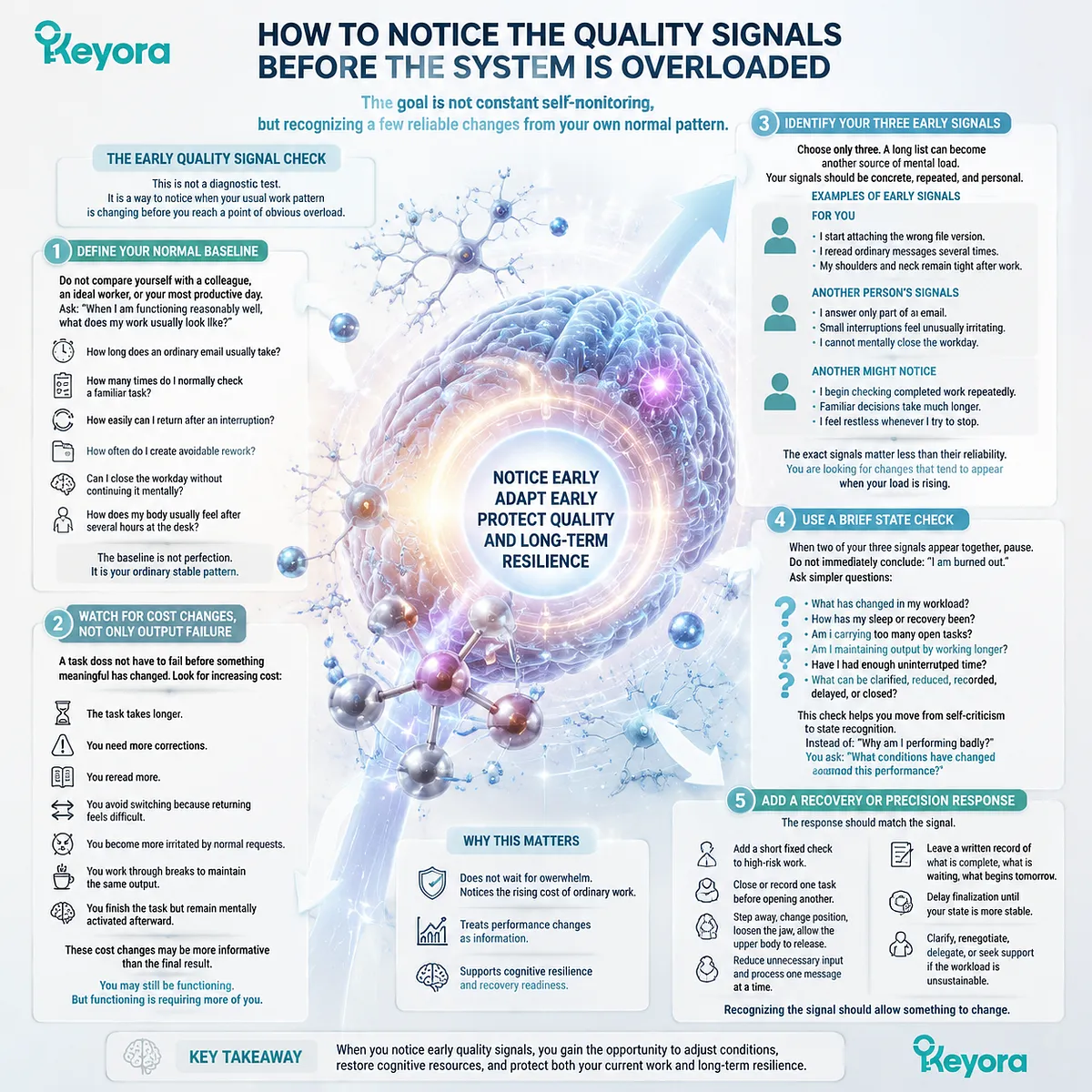
How to Notice the Quality Signals Before the System Is Overloaded
The goal is not constant self-monitoring, but recognizing a few reliable changes from your own normal pattern.
A helpful approach is The Early Quality Signal Check.
This is not a diagnostic test.
It is a way to notice when your usual work pattern is changing before you reach a point of obvious overload.
Step one: define your normal baseline.
Do not compare yourself with a colleague, an ideal worker, or your most productive day.
Ask:
“When I am functioning reasonably well, what does my work usually look like?”
You might consider:
How long does an ordinary email usually take?
How many times do I normally check a familiar task?
How easily can I return after an interruption?
How often do I create avoidable rework?
Can I close the workday without continuing it mentally?
How does my body usually feel after several hours at the desk?
The baseline is not perfection.
It is your ordinary stable pattern.
Step two: watch for cost changes, not only output failure.
A task does not have to fail before something meaningful has changed.
Look for increasing cost:
The task takes longer.
You need more corrections.
You reread more.
You avoid switching because returning feels difficult.
You become more irritated by normal requests.
You work through breaks to maintain the same output.
You finish the task but remain mentally activated afterward.
These cost changes may be more informative than the final result.
You may still be functioning.
But functioning is requiring more of you.
Step three: identify your three early signals.
Choose only three.
A long list can become another source of mental load.
Your signals should be concrete, repeated, and personal.
For example:
-
I start attaching the wrong file version.
-
I reread ordinary messages several times.
-
My shoulders and neck remain tight after work.
Another person’s signals might be:
-
I answer only part of an email.
-
Small interruptions feel unusually irritating.
-
I cannot mentally close the workday.
Another might notice:
-
I begin checking completed work repeatedly.
-
Familiar decisions take much longer.
-
I feel restless whenever I try to stop.
The exact signals matter less than their reliability.
You are looking for changes that tend to appear when your load is rising.
Step four: use a brief state check.
When two of your three signals appear together, pause.
Do not immediately conclude:
“I am burned out.”
Ask simpler questions:
What has changed in my workload?
How has my sleep or recovery been?
Am I carrying too many open tasks?
Am I maintaining output by working longer?
Have I had enough uninterrupted time?
What can be clarified, reduced, recorded, delayed, or closed?
This check helps you move from self-criticism to state recognition.
Instead of:
“Why am I performing badly?”
You ask:
“What conditions have changed around this performance?”
Step five: add a recovery or precision response.
The response should match the signal.
If errors are increasing, add a short fixed check to high-risk work.
If task switching is creating confusion, close or record one task before opening another.
If your shoulders and neck remain tight, step away from the screen, change position, loosen the jaw, and allow the upper body to release.
If familiar messages require repeated reading, reduce unnecessary input and process one message at a time.
If you cannot mentally close the day, leave a written record of what is complete, what is waiting, and what begins tomorrow.
If an irreversible decision is not urgent, delay finalization until your state is more stable.
If the workload itself is unsustainable, the useful response may involve clarification, renegotiation, delegation, or support.
The goal is not to maintain every demand while adding a new layer of self-management.
Recognizing the signal should allow something to change.
The Early Quality Signal Check is useful because it does not require you to wait until stress becomes overwhelming.
It notices the rising cost of ordinary work.
It treats performance changes as information—not as proof of personal failure.
Where Nutritional Support Fits
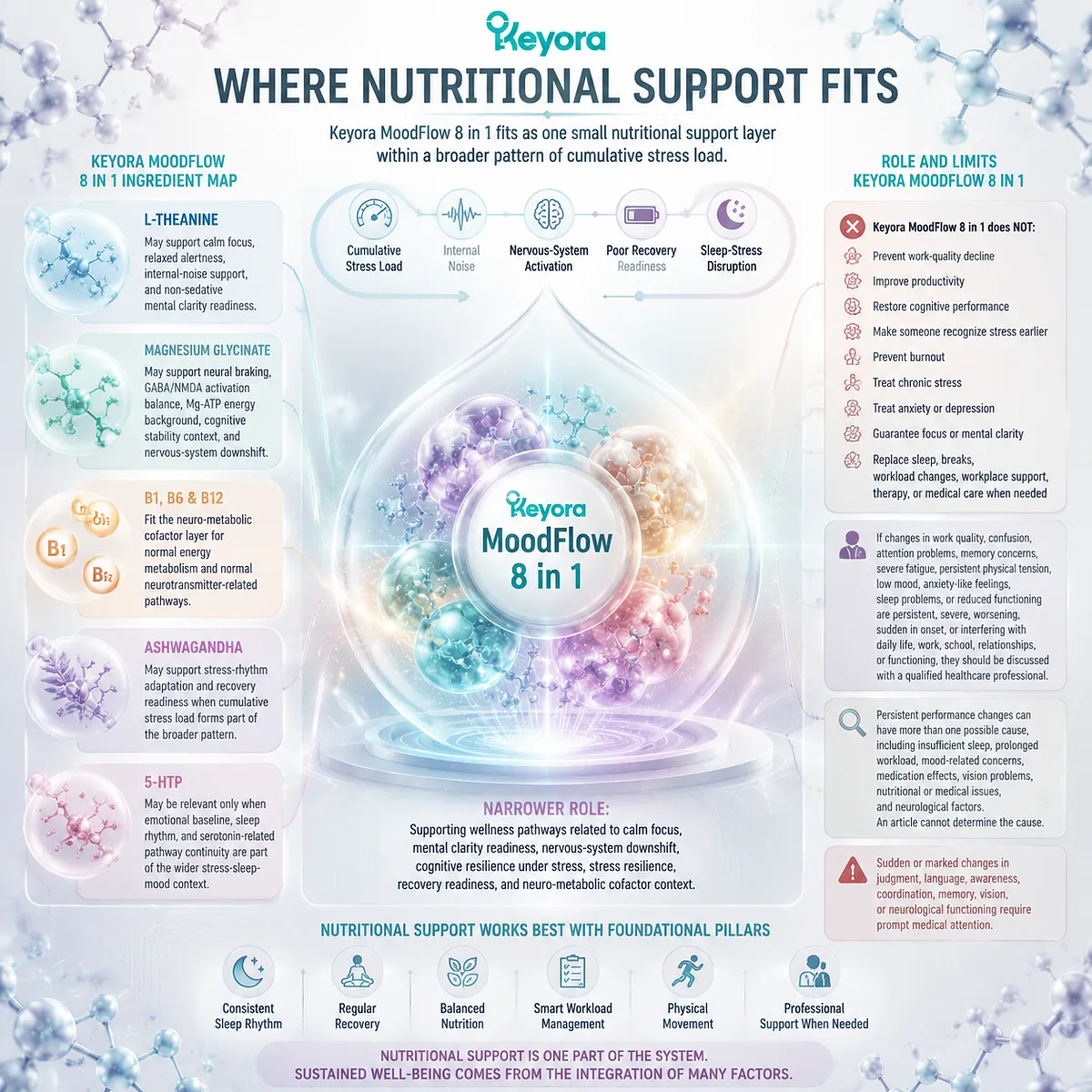
Keyora MoodFlow 8 in 1 can fit as one small nutritional support layer when early changes in work quality appear within a broader pattern of cumulative stress load, internal noise, nervous-system activation, poor recovery readiness, and sleep-stress disruption.
Its role is narrower: supporting wellness pathways related to calm focus, mental clarity readiness, nervous-system downshift, cognitive resilience under stress, stress resilience, recovery readiness, and neuro-metabolic cofactor context.
-
L-Theanine may support calm focus, relaxed alertness, internal-noise support, and non-sedative mental clarity readiness.
-
Magnesium glycinate may support neural braking, GABA/NMDA activation balance, Mg-ATP energy background, cognitive stability context, and nervous-system downshift.
-
B1, B6, and B12 fit the neuro-metabolic cofactor layer for normal energy metabolism and normal neurotransmitter-related pathways.
-
Ashwagandha may support stress-rhythm adaptation and recovery readiness when cumulative stress load forms part of the broader pattern.
-
5-HTP may be relevant only when emotional baseline, sleep rhythm, and serotonin-related pathway continuity are part of the wider stress-sleep-mood context.
Keyora MoodFlow 8 in 1 does not prevent work-quality decline, improve productivity, restore cognitive performance, make someone recognize stress earlier, prevent burnout, treat chronic stress, treat anxiety or depression, guarantee focus or mental clarity, or replace sleep, breaks, workload changes, workplace support, therapy, or medical care when needed.
If changes in work quality, confusion, attention problems, memory concerns, severe fatigue, persistent physical tension, low mood, anxiety-like feelings, sleep problems, or reduced functioning are persistent, severe, worsening, sudden in onset, or interfering with daily life, work, school, relationships, or functioning, they should be discussed with a qualified healthcare professional.
Persistent performance changes can have more than one possible cause, including insufficient sleep, prolonged workload, mood-related concerns, medication effects, vision problems, nutritional or medical issues, and neurological factors. An article cannot determine the cause.
Sudden or marked changes in judgment, language, awareness, coordination, memory, vision, or neurological functioning require prompt medical attention.
Closing Summary
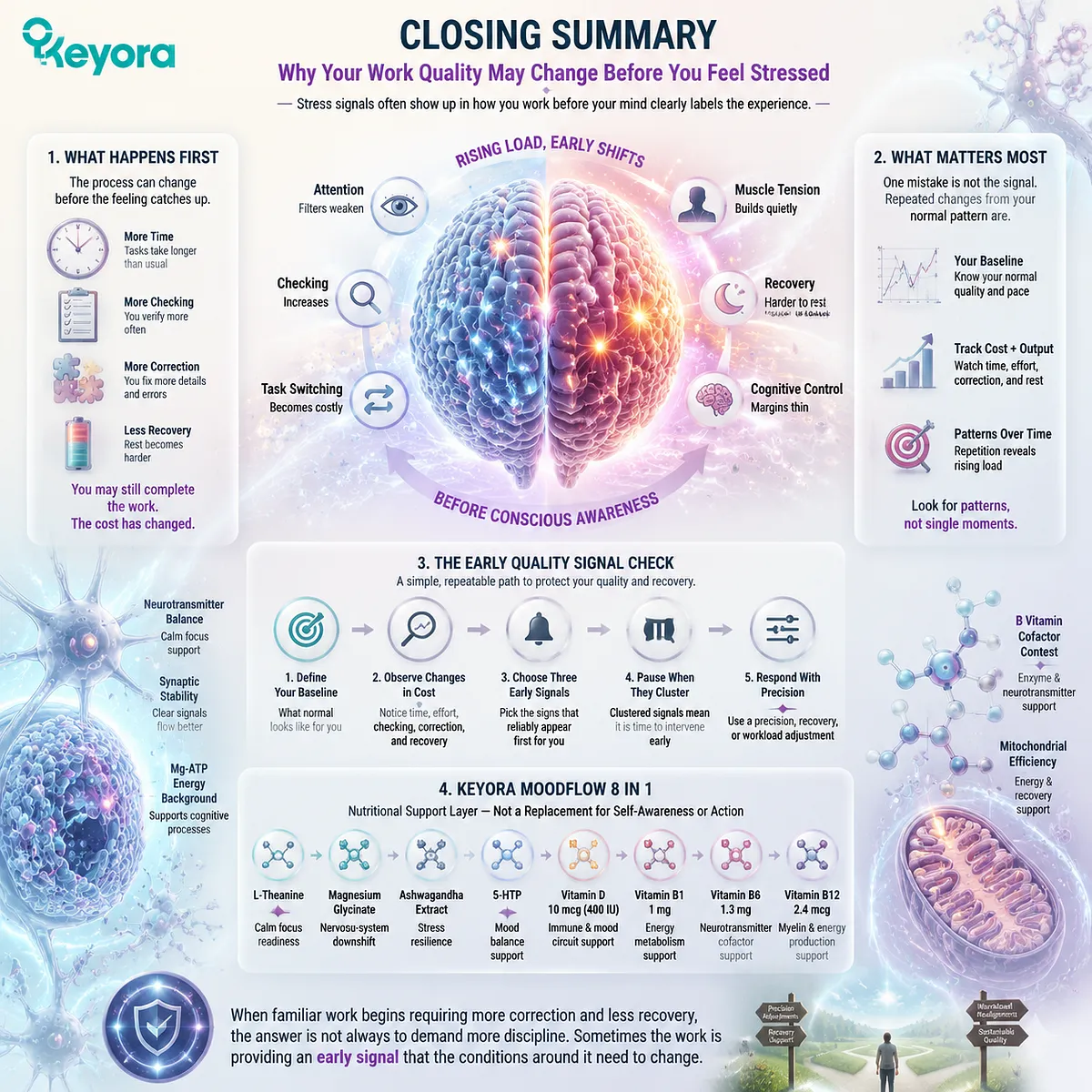
Your work quality may begin changing before you consciously feel stressed because attention, checking, task switching, muscle tension, and recovery can respond to rising load before the mind clearly labels the experience.
You may still complete the work. But it may require more time, more checking, more correction, and less rest. One isolated mistake does not prove that you are overloaded. Repeated changes from your own normal pattern are more meaningful.
The practical path is The Early Quality Signal Check: define your baseline, observe changes in cost as well as output, choose three reliable early signals, pause when those signals cluster, and respond with a precision, recovery, or workload adjustment.
Keyora MoodFlow 8 in 1 belongs only as a small nutritional support layer for calm focus, mental clarity readiness, nervous-system downshift, stress resilience, cognitive resilience, recovery readiness, Mg-ATP energy background, and B vitamin cofactor context.
When familiar work begins requiring more correction and less recovery, the answer is not always to demand more discipline. Sometimes the work is providing an early signal that the conditions around it need to change.
This article is for educational and informational purposes only. It does not provide medical advice, diagnosis, treatment, cure, prevention, disease outcome claims, hormone restoration claims, fertility outcome claims, or formula-specific clinical efficacy claims.