
Why Does Multitasking Make My Brain Feel Drained?
Keyora Research Q&A Library
This is part of the Keyora Research Q&A Series, derived from Keyora Nutritional Neurology Series .
Within the Keyora Nutritional Neurology framework, this Q&A translates complex nutrient–brain mechanisms into reader-friendly, evidence-bound answers, focusing on stress resilience, sleep quality, calm mood support, cognitive wellness, and the broader interaction between nutrition, neurochemistry, and daily nervous-system function.
First published by Keyora Research Journal: www.keyorahealth.com

Direct Answer
Multitasking can make your brain feel drained because constant task switching forces the brain to reload context, divide attention, and spend extra cognitive energy.
It may feel like you are doing many things at once, but much of the time, the brain is rapidly switching between tasks instead of deeply processing all of them at the same time.
Switching repeatedly is not free.
Each time you move from one task to another, the brain has to remember where you were, suppress the previous task, load the new context, filter distractions, and rebuild the next step.
One switch may not feel like much.
A whole day of switching can leave the brain feeling tired, foggy, irritable, and overloaded.
Mechanistically, multitasking fatigue can involve attention switching, context reloading, working-memory fragmentation, cognitive reset cost, prefrontal control load, emotional regulation demand, high-alert nervous-system activation, GABA/NMDA braking pressure, Mg-ATP energy context, B-vitamin cofactor support, and reduced recovery readiness.
In the Keyora MoodFlow framework, this is understood as a calm-focus, cognitive-resilience, nervous-system downshift, and stress-resilience question, not a medical treatment claim.
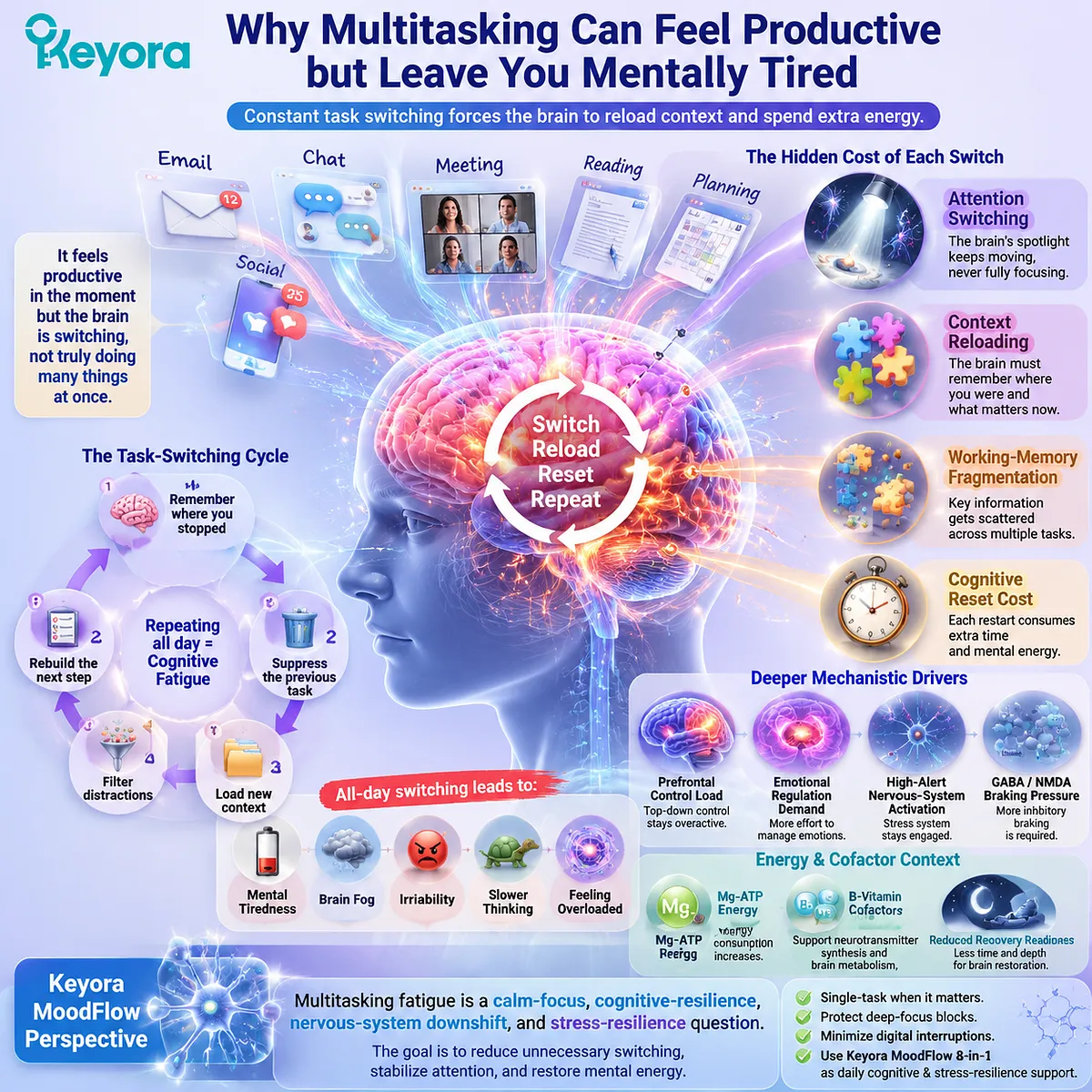
Why Multitasking Can Feel Productive but Leave You Mentally Tired
Doing many things at once often means switching between tasks repeatedly, and each switch uses mental energy.
Multitasking can feel productive in the moment.
You may be answering messages while listening to a meeting. You may be writing something while checking notifications. You may be helping someone while thinking about the next task. You may have email, chat, calendar, notes, documents, and task lists open at the same time.
It can feel like you are keeping up.
But by the end of the day, your brain may feel drained.
You may feel mentally heavy, scattered, or overstimulated. You may reread the same sentence several times. You may forget what you were doing. You may feel irritated by small interruptions. You may want to stop all input, close every tab, and sit in silence.
This does not always mean you failed to focus.
It may mean your brain spent too much energy switching.
True multitasking is limited. For many meaningful tasks, the brain is not deeply doing several things at once. It is moving quickly between them. Each move creates a small reset cost.
You leave one task, enter another, return to the first, then try to remember where you were.
That process takes energy.
A day full of small switches can feel active while quietly draining the brain.
This is why multitasking can be so deceptive. It creates the feeling of activity because many things are happening. But activity is not always the same as efficient processing. Your attention is moving, but your deeper focus may never get enough time to settle.
Focus needs continuity.
When you stay with one task, the brain can build context. It remembers the goal, holds the next step, and keeps relevant information active. The longer you stay with that context, the easier it may become to continue.
Multitasking breaks that continuity.
Every message, sound, notification, request, or internal reminder can pull attention away from the current task. When you come back, you may need to rebuild the mental map. What was I writing? What was I solving? What did I decide? What was the next step?
That rebuilding is hidden work.
This is why multitasking fatigue can feel different from ordinary tiredness. It may feel like your brain has been pulled apart rather than simply used. You may not only feel tired. You may feel fragmented.
You may also feel frustrated because you were busy all day.
You did not waste the day. You handled many inputs. You responded to people. You made small decisions. You moved between responsibilities. But the switching itself may have consumed much of the energy that could have supported deeper completion.
This is especially common under stress.
When stress is high, the brain becomes more responsive to anything that seems urgent. A notification feels harder to ignore. A message feels like it needs attention now. A small task feels safer than a bigger task. The system keeps switching because it is trying to stay on top of everything.
But staying on top of everything can become the thing that drains you.
Multitasking can feel productive in the moment, but it can leave the brain tired from constant switching.
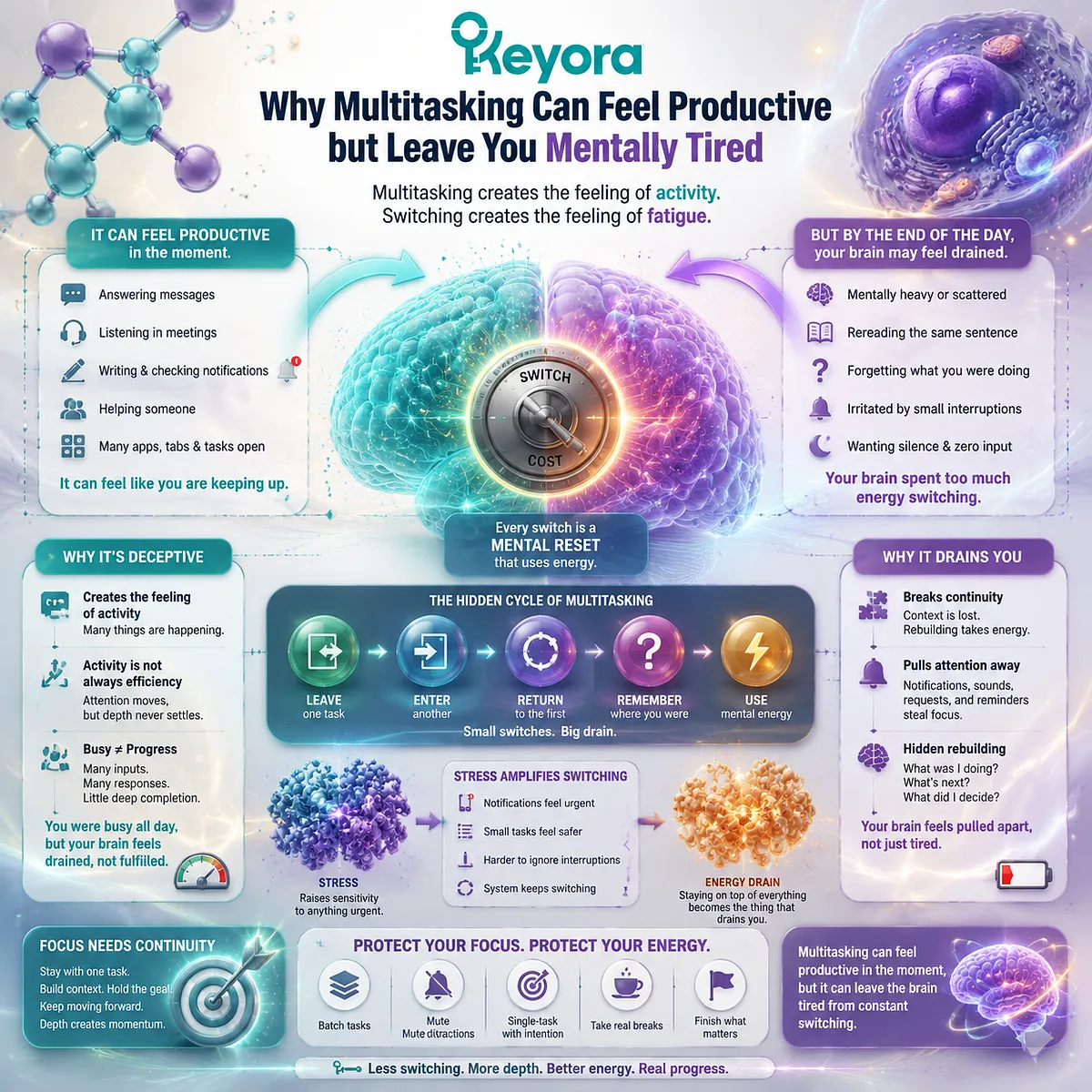
The Task-Switching Cost Behind Multitasking Fatigue
Each switch forces the brain to reload context, filter distractions, and rebuild the next step.
Multitasking drains the brain because switching repeatedly is not free.
The first mechanism is attention switching.
Attention is not an unlimited spotlight that can fully shine on many complex things at the same time. When one task requires reading, writing, listening, deciding, or problem-solving, it needs a meaningful share of attention. When another task interrupts, attention has to move.
That movement has a cost.
You may not notice it after one switch. But after dozens or hundreds of switches, the cost becomes visible as fatigue, slower thinking, irritability, and reduced clarity.
The second mechanism is context reloading.
Every task has a context. A document has a purpose. A message has a social tone. A meeting has a topic. A spreadsheet has rules. A family task has timing. A school or work assignment has instructions, constraints, and next steps.
When you switch tasks, the brain has to reload that context.
It has to remember what matters, where you stopped, what you were about to do, and what information should stay active. This is why returning to a task after interruption can feel harder than expected.
The task may not be difficult.
Reloading the task may be difficult.
The third mechanism is working-memory fragmentation.
Working memory is the temporary mental space that holds active information. Multitasking fills that space with pieces from different tasks. A message reply, a meeting point, a deadline, a half-written sentence, an unfinished decision, and a reminder may all compete for space.
The result is fragmentation.
Instead of one clear mental thread, you may carry many partial threads. This makes the brain feel cluttered and increases the chance that you lose track, repeat steps, forget small details, or feel mentally scattered.
The fourth mechanism is inhibition cost.
To switch well, the brain does not only start the new task. It also has to suppress the old one. If you were writing, you have to suppress the writing thread to answer a message. If you were listening, you have to suppress other thoughts to return to the meeting. If you were solving a problem, you have to hold back the urge to check another input.
That suppression takes control.
The more often you switch, the more often the brain has to inhibit one task and activate another. That is cognitively expensive.
The fifth mechanism is emotional regulation demand.
Multitasking often happens in emotionally loaded environments. Messages may carry expectations. Meetings may carry pressure. Deadlines may carry consequences. Notifications may create urgency. Interruptions may create frustration.
The brain has to regulate these reactions while still switching tasks.
That means multitasking is not just an attention problem. It can also be an emotional load. You are not only moving between tasks. You are moving between tones, priorities, expectations, and pressures.
The sixth mechanism is high-alert nervous-system activation.
Under stress, the nervous system may become more alert to anything that needs a response. This makes interruptions harder to ignore. The brain may treat each new input as something that could matter, even when it is not truly important.
That keeps the system reactive.
The nervous system’s brake-and-accelerator balance helps explain the drained feeling.
Activation is the accelerator. It helps you respond, notice, and move. Braking helps you pause, filter, choose, and stay with the task that matters. GABA-related calming tone and NMDA/glutamate activation balance help explain why the system can feel either steady or overactivated.
Multitasking increases braking demand.
The brain must filter distractions, pause reactions, suppress irrelevant tasks, and keep returning to the chosen focus. If the internal signal background is noisy, the system may spend more energy controlling attention than doing the actual work.
Energy context also matters.
Magnesium’s role in Mg-ATP context helps explain why cognitive control requires active energy support. B vitamins support neuro-metabolic infrastructure, including energy metabolism, neurotransmitter-related conversion, methylation context, and nervous-system support.
This does not mean multitasking fatigue is caused by nutrient status. It means the experience can be understood as a multi-layer wellness question involving attention switching, context reloading, working-memory fragmentation, neural braking, energy context, and recovery readiness.
The mechanism chain looks like this:
multiple inputs → attention switching → context reloading → working-memory fragmentation → cognitive control cost rises → emotional regulation demand increases → neural-braking demand rises → brain feels drained
In plain language, the fatigue comes not only from the tasks themselves, but from the repeated transitions between them.
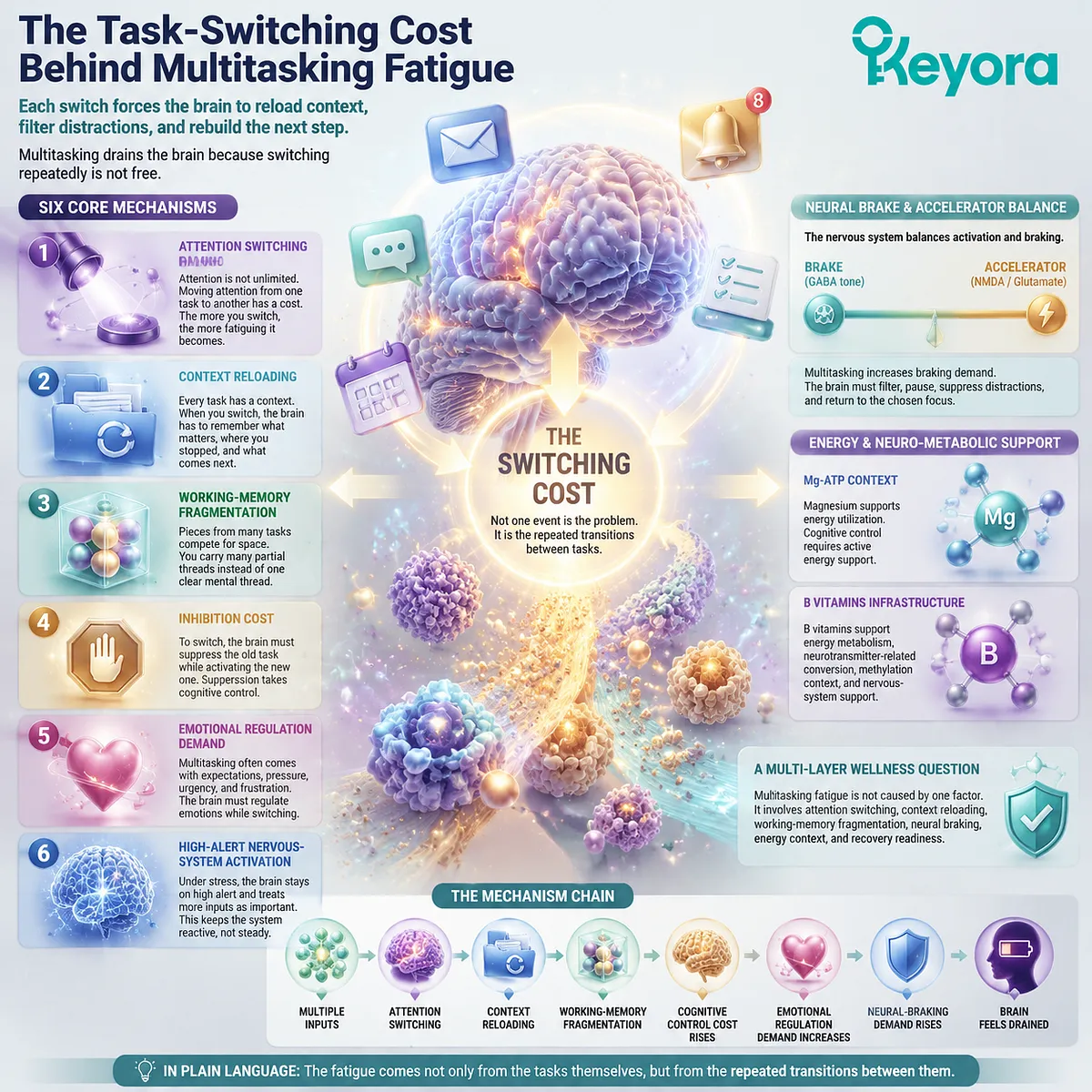
How MoodFlow Supports Calm Focus Under Task-Switching Load
MoodFlow supports the calm-signaling, neural-braking, stress-rhythm, and cofactor layers involved in cognitive resilience under switching pressure.
Keyora MoodFlow approaches multitasking fatigue as a calm-focus, cognitive-resilience, nervous-system downshift, and stress-resilience question.
The goal is not to treat ADHD, executive dysfunction, attention disorders, burnout, anxiety, depression, insomnia, cognitive dysfunction, or any medical condition. The goal is to support the wellness pathways involved in steadier focus, signal filtering, emotional steadiness, and recovery readiness under everyday task-switching pressure.
This distinction matters.
When multitasking makes the brain feel drained, the answer is not always more stimulation. More stimulation may help someone keep switching for a while, but it may not reduce the hidden cost of switching. A more useful wellness frame is to support the layers that help the nervous system move from scattered reactivity toward calmer focus.
MoodFlow’s logic begins with calm signaling.
L-Theanine supports the calm-signaling layer.
In the MoodFlow framework, L-Theanine is associated with relaxed alertness, alpha-wave transition, signal smoothing, and calm focus without sedation. This is relevant because multitasking fatigue often involves too much signal, not too little effort.
The goal is not to make the brain sleepy.
The goal is steadier alertness. L-Theanine helps explain how calm signaling may support a lower-noise mental background, where attention is less likely to be pulled sharply by every input.
Magnesium glycinate supports the neural-braking and Mg-ATP context layer.
Magnesium is relevant to GABA/NMDA activation balance, membrane excitability, and Mg-ATP energy context. In MoodFlow, magnesium glycinate is positioned as part of the neural braking and hardware-stabilizing layer.
For task-switching fatigue, this layer is central.
Switching pressure requires the brain to pause, filter, inhibit, and return. These are braking functions. Neural braking helps explain the physiological background behind signal filtering and focus continuity.
Magnesium’s Mg-ATP context also matters because cognitive control is active. Reloading context takes energy. Suppressing distractions takes energy. Returning to a task takes energy. Maintaining attention after interruptions takes energy.
Ashwagandha supports the stress-rhythm adaptation layer.
Multitasking often happens inside a broader stress rhythm. When the system spends hours responding, switching, and staying alert, recovery readiness may decline. The brain may feel drained not only because of the tasks, but because the whole day has been organized around pressure.
Ashwagandha is positioned in MoodFlow around stress resilience, HPA-axis rhythm context, and recovery readiness. In this article, that does not mean Ashwagandha fixes cortisol, treats burnout, repairs the HPA axis, or improves productivity. It means Ashwagandha belongs to the stress-adaptation layer that helps explain why cognitive resilience is connected to broader stress rhythm.
B1, B6, and B12 support the neuro-metabolic cofactor layer.
The nervous system depends on normal metabolic and neurotransmitter-related infrastructure. B1 supports energy-metabolism context. B6 supports neurotransmitter-related conversion context, including pathways relevant to calming and mood-related signaling. B12 supports methylation context and nervous-system maintenance.
In MoodFlow, these B vitamins are not positioned as treatments for fatigue, ADHD, attention disorders, cognitive dysfunction, depression, or neurological disease. They are part of the cofactor background behind neuro-metabolic readiness, emotional steadiness, and cognitive resilience under everyday pressure.
5-HTP plays a background role in mood-rhythm support.
Because this article is about multitasking fatigue and switching pressure, 5-HTP should not dominate the explanation. Its role is best understood as support for normal serotonin-related pathways and serotonin-melatonin pathway continuity within the broader MoodFlow architecture. This does not mean treating depression, correcting serotonin, or forcing sleep.
Vitamin D may also be understood as part of broader rhythm and neuroimmune wellness context when relevant, but it should remain secondary.
Together, these layers explain why MoodFlow is not positioned as a multitasking enhancer, productivity drug, stimulant, ADHD treatment, attention-disorder treatment, or burnout cure. It is a multi-layer nutritional neurology matrix designed to support stress resilience, calm focus, emotional steadiness, cognitive resilience, nervous-system downshift, and recovery readiness within an evidence-bound wellness framework.
MoodFlow is not a treatment for ADHD, executive dysfunction, attention disorders, burnout, chronic fatigue, anxiety, depression, insomnia, cognitive dysfunction, neurological disease, cortisol problems, adrenal fatigue, thyroid disease, anemia, nutrient deficiency, hormonal disorders, or any medical condition. In this article, Keyora uses “multitasking making the brain feel drained” as a wellness-language entry point for explaining task-switching load, working-memory fragmentation, calm signaling, neural braking, Mg-ATP context, cofactor infrastructure, stress-rhythm adaptation, and cognitive resilience under everyday pressure.
If attention difficulty, exhaustion, or daily-function impairment is persistent, severe, sudden, or disruptive, professional evaluation may be appropriate. Everyday multitasking fatigue can be discussed through wellness pathways, but ongoing or significant impairment deserves proper context.
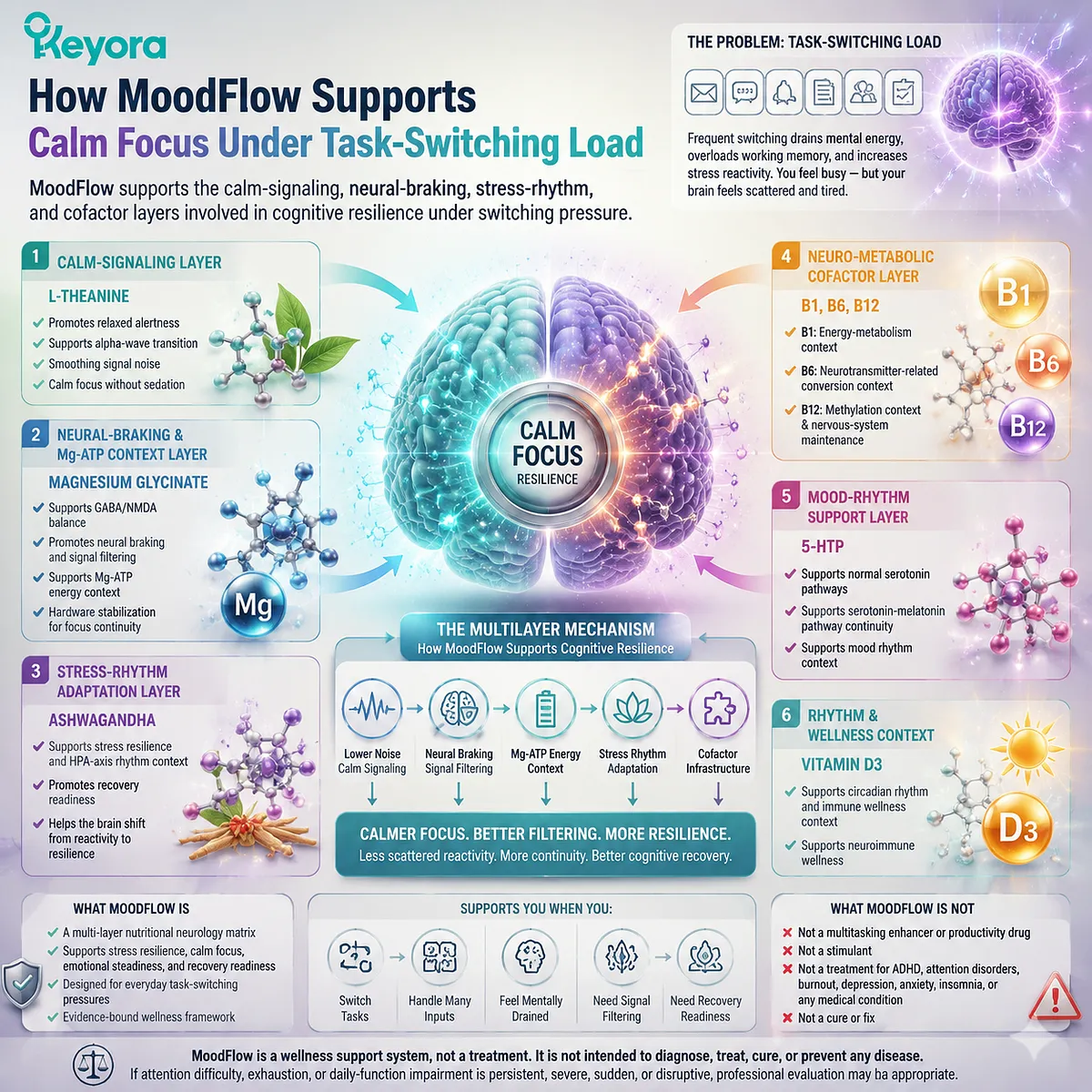
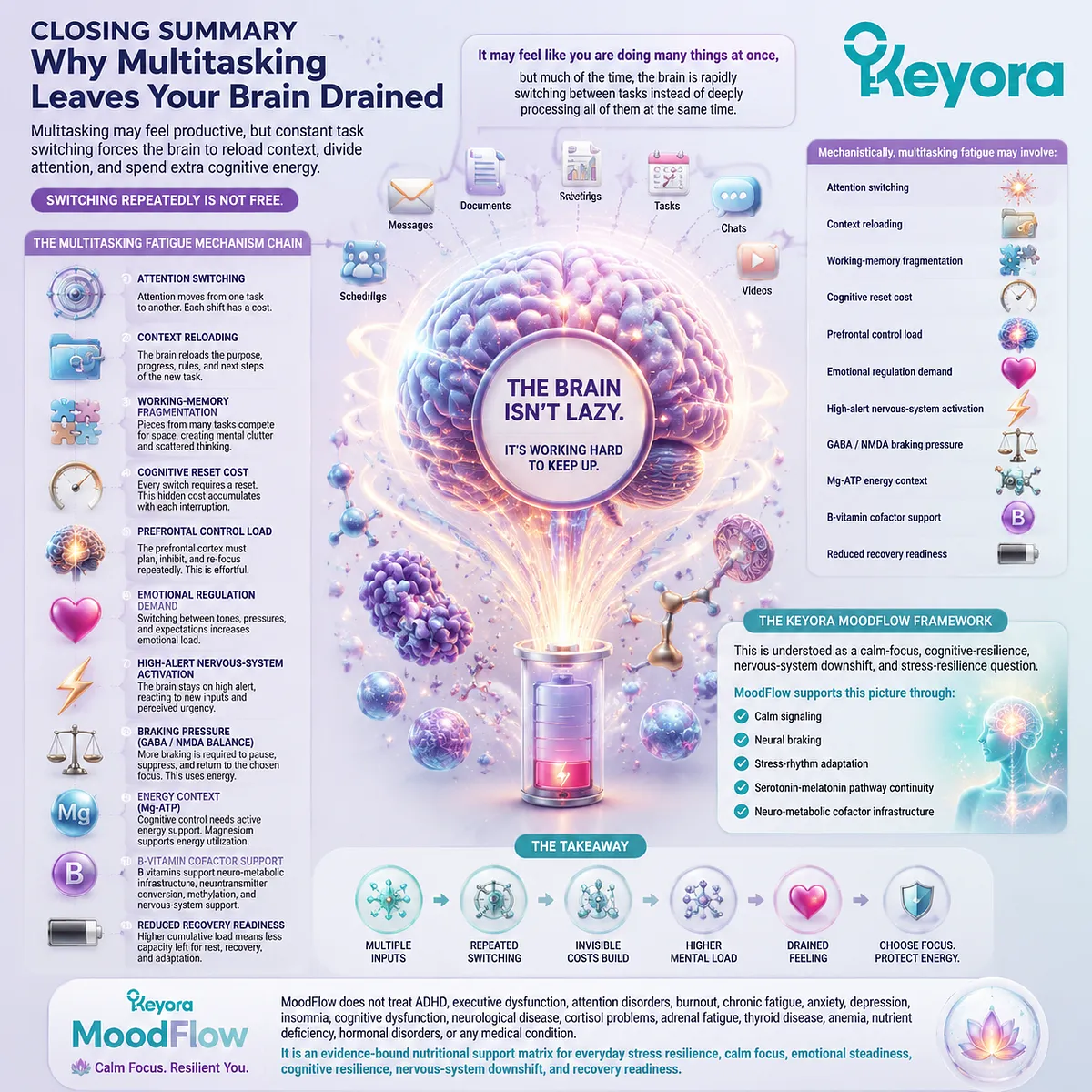
Closing Summary
Multitasking can make your brain feel drained because constant task switching forces the brain to reload context, divide attention, and spend extra cognitive energy. It may feel like you are doing many things at once, but much of the time, the brain is rapidly switching between tasks instead of deeply processing all of them at the same time.
Switching repeatedly is not free.
Mechanistically, multitasking fatigue may involve attention switching, context reloading, working-memory fragmentation, cognitive reset cost, prefrontal control load, emotional regulation demand, high-alert nervous-system activation, GABA/NMDA braking pressure, Mg-ATP energy context, B-vitamin cofactor support, and reduced recovery readiness.
In the Keyora MoodFlow framework, this is understood as a calm-focus, cognitive-resilience, nervous-system downshift, and stress-resilience question. MoodFlow supports this picture through calm signaling, neural braking, stress-rhythm adaptation, serotonin-melatonin pathway continuity, and neuro-metabolic cofactor infrastructure.
MoodFlow does not treat ADHD, executive dysfunction, attention disorders, burnout, chronic fatigue, anxiety, depression, insomnia, cognitive dysfunction, neurological disease, cortisol problems, adrenal fatigue, thyroid disease, anemia, nutrient deficiency, hormonal disorders, or any medical condition. It is an evidence-bound nutritional support matrix for everyday stress resilience, calm focus, emotional steadiness, cognitive resilience, nervous-system downshift, and recovery readiness.
This article is for educational and informational purposes only. It does not provide medical advice, diagnosis, treatment, cure, prevention, disease outcome claims, hormone restoration claims, fertility outcome claims, or formula-specific clinical efficacy claims.