
Why Does Feedback Feel Harder to Handle When I’m Under Pressure?
Keyora Research Q&A Library
This is part of the Keyora Research Q&A Series, derived from Keyora Nutritional Neurology Series .
Within the Keyora Nutritional Neurology framework, this Q&A translates complex nutrient–brain mechanisms into reader-friendly, evidence-bound answers, focusing on stress resilience, sleep quality, calm mood support, cognitive wellness, and the broader interaction between nutrition, neurochemistry, and daily nervous-system function.
First published by Keyora Research Journal: www.keyorahealth.com

Direct Answer
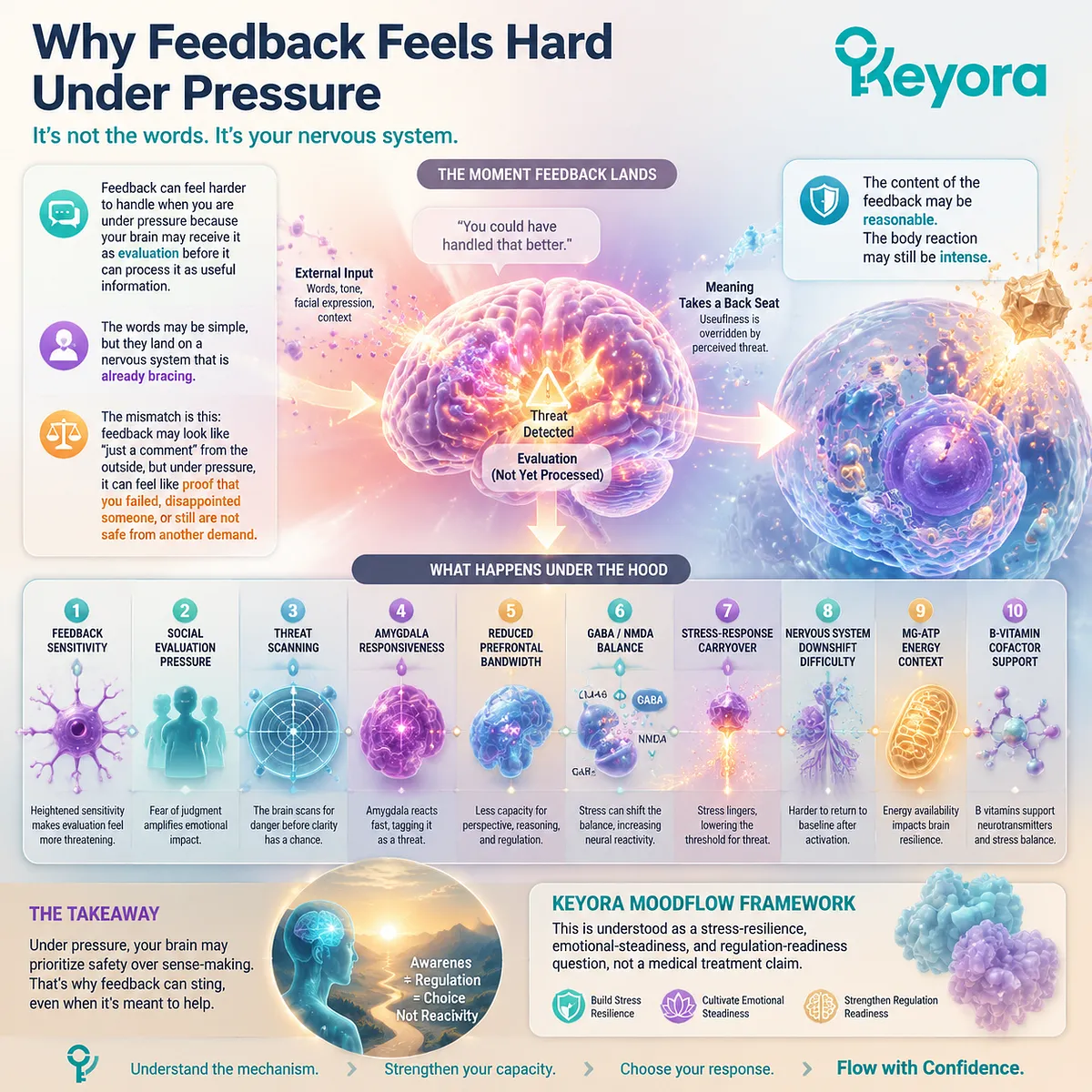
Feedback can feel harder to handle when you are under pressure because your brain may receive it as evaluation before it can process it as useful information.
The words may be simple, but they land on a nervous system that is already bracing.
The mismatch is this: feedback may look like “just a comment” from the outside, but under pressure, it can feel like proof that you failed, disappointed someone, or still are not safe from another demand.
The content of the feedback may be reasonable. The body reaction may still be intense.
Mechanistically, this can involve feedback sensitivity, social evaluation pressure, threat scanning, amygdala responsiveness, reduced prefrontal regulation bandwidth, GABA/NMDA activation balance, stress-response carryover, nervous-system downshift difficulty, Mg-ATP energy context, and B-vitamin cofactor support.
In the Keyora MoodFlow framework, this is understood as a stress-resilience, emotional-steadiness, and regulation-readiness question, not a medical treatment claim.
When Feedback Feels Bigger Than the Words Themselves
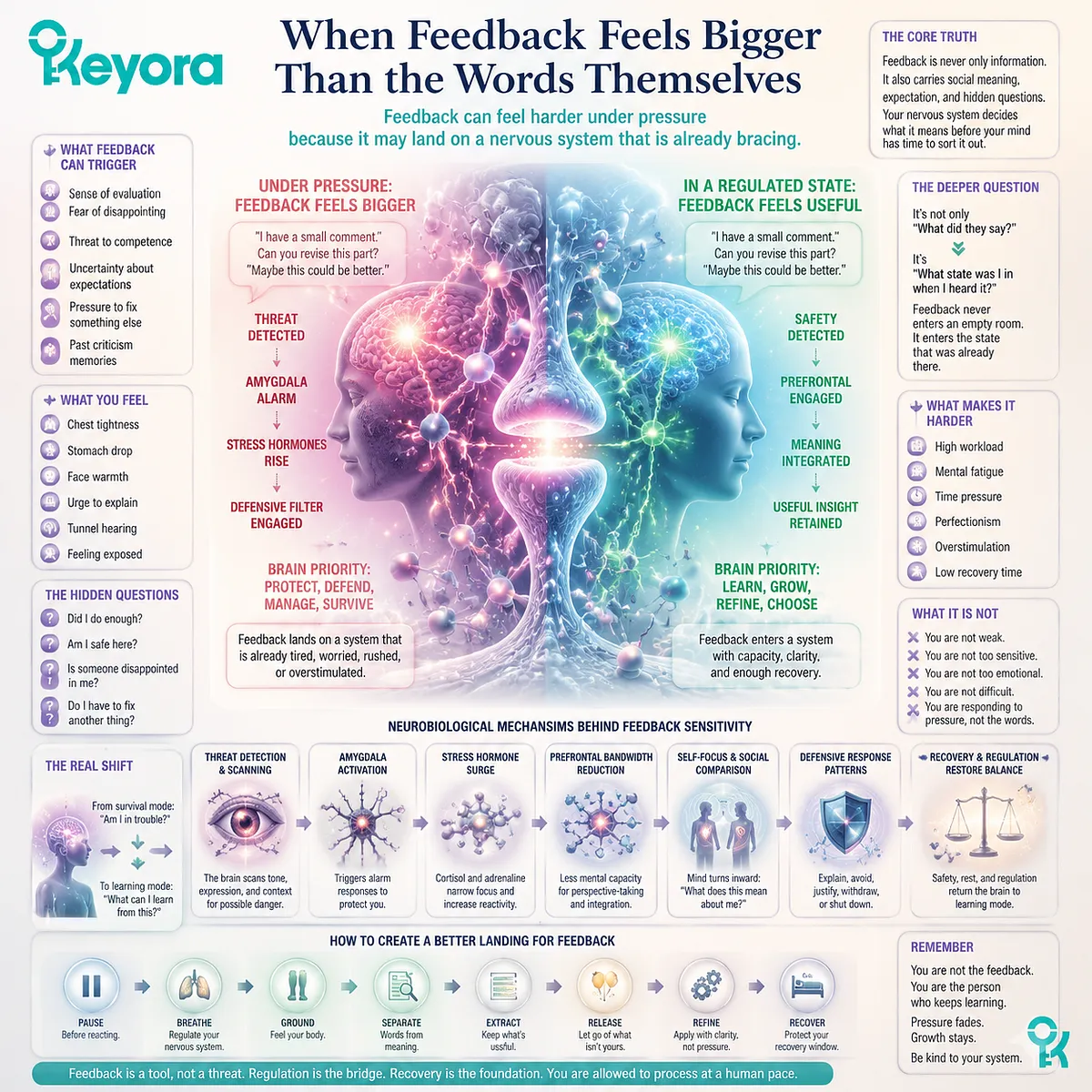
Feedback can feel harder under pressure because it may land on a nervous system that is already bracing.
There is a particular moment when feedback feels heavier than it should.
You may have worked hard on something. You may have stayed focused, pushed through pressure, met a deadline, tried to do the right thing, or held yourself together while already feeling stretched. Then someone says, “I have a small comment,” or “Can you revise this part?” or “Maybe this could be better.”
The words may not be harsh.
The other person may not be attacking you. They may be trying to help. They may even be calm, polite, and reasonable. But your body may react before your mind has time to organize the situation.
Your chest tightens. Your stomach drops. Your face becomes warm. You feel the urge to explain yourself. You may stop hearing the rest of the sentence clearly. Part of you may know the feedback is useful, but another part feels suddenly exposed.
This is where many people begin to judge themselves.
They may think, “Why am I so sensitive?” or “Why can’t I just take feedback normally?” Some people tell themselves they are too defensive, too emotional, too fragile, or too attached to being right.
But feedback sensitivity under pressure is not always about ego. It is often about timing, load, and nervous-system state.
Feedback is never only information. It also carries social meaning.
When someone gives feedback, your brain may have to process the words, the tone, the relationship, the possible consequence, the implied expectation, and what the feedback says about your performance. Even a small comment can carry a hidden question: “Did I do enough?” “Am I safe here?” “Is someone disappointed in me?” “Do I have to fix another thing?”
On a rested day, those questions may stay quiet. You can hear feedback, sort it, keep what is useful, and leave the rest. You may even appreciate it.
But under pressure, the same feedback can feel much more personal.
A simple “Could you adjust this?” may sound like, “You did this wrong.” A neutral “Let’s improve this section” may feel like, “Your work is not good enough.” A short message may feel colder than it is. A suggestion may feel like a judgment.
The deeper question is not only, “What did they say?”
A more useful question is, “What state was I in when I heard it?”
Because feedback does not enter an empty room. It enters the emotional and physiological state that was already there.
If you were already worried, tired, rushed, overstimulated, or trying hard not to fail, feedback may land on a system that was already protecting itself. In that state, the brain may not first ask, “What can I learn from this?” It may ask, “Am I in trouble?”
That shift changes everything.
The feedback may still be useful. The person may still be kind. The correction may still matter. But your first reaction may come from protection, not learning.
This is not a failure of character. It is a clue.
It tells you that the feedback did not arrive as neutral data. It arrived during pressure, and your system treated it as one more signal to survive, manage, or defend against.
Why Pressure Turns Feedback Into a Threat Signal
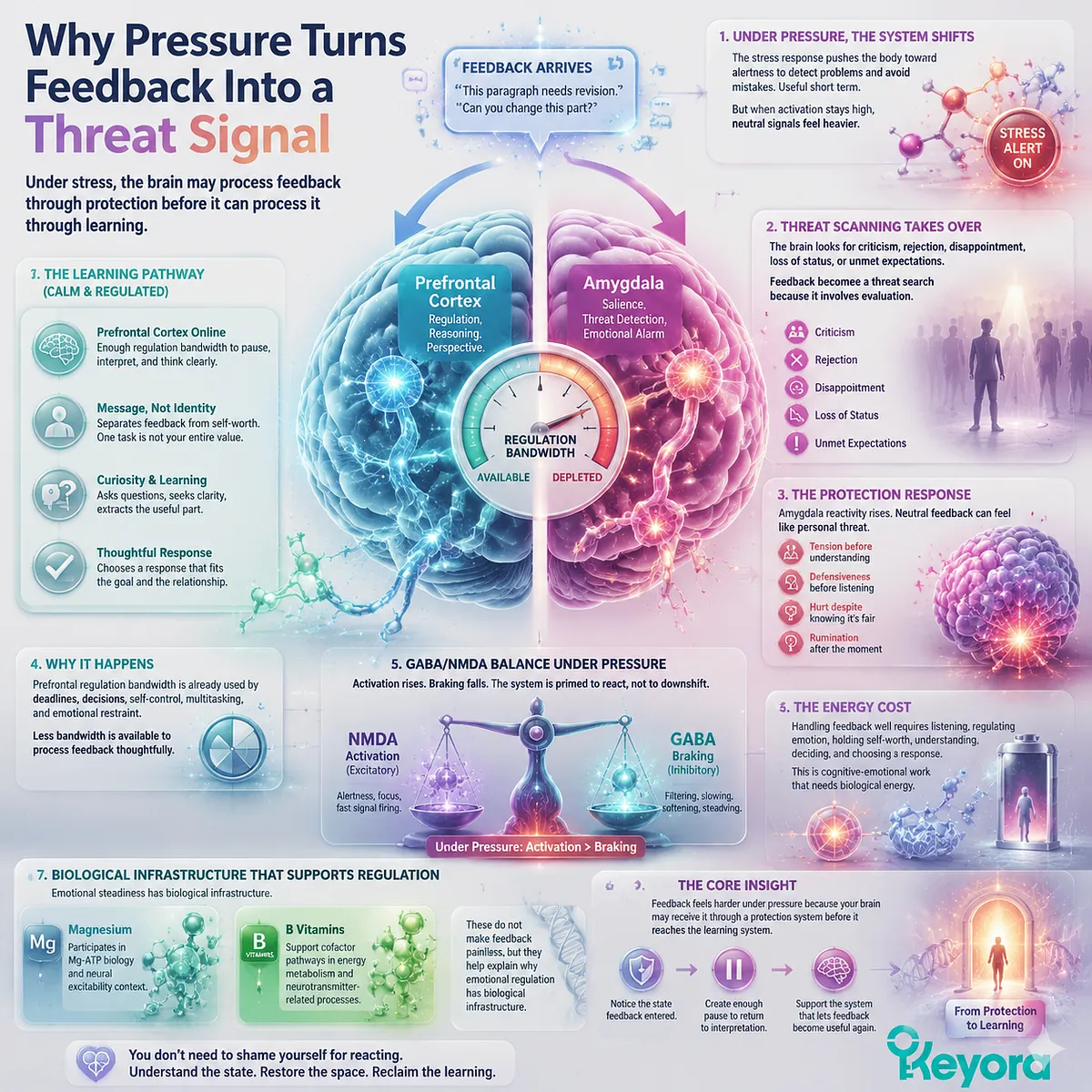
Under stress, the brain may process feedback through protection before it can process it through learning.
Feedback becomes harder under pressure because stress changes the way the brain interprets social information.
When you are calm, feedback can pass through a more flexible system. You may be able to separate the message from your self-worth. You can hear the useful part, ask questions, and decide what to do next. The brain has enough regulation space to treat feedback as information.
Under pressure, that space narrows.
The stress response pushes the body toward alertness. It prepares you to detect problems, respond quickly, and avoid mistakes. That can be useful in the short term. But when the system stays activated, neutral signals can begin to feel heavier.
This is where threat scanning becomes important.
Threat scanning does not only look for physical danger. In social settings, it can look for criticism, rejection, disappointment, loss of status, or signs that you are not meeting expectations. Feedback becomes one of the easiest places for the brain to search for threat because feedback is already connected to evaluation.
This is why a small comment can feel so big.
The words may say, “This paragraph needs revision.” But the pressure-loaded brain may hear, “You did not do well enough.” The words may say, “Can you change this part?” But the nervous system may feel, “There is more work, more judgment, and less safety than I thought.”
The amygdala can be understood as part of the brain’s emotional salience and alarm system. Under stress, it may become more responsive to signals that appear important, uncertain, or potentially threatening. Feedback often contains all three: importance, uncertainty, and possible evaluation.
At the same time, the prefrontal cortex has to work harder.
The prefrontal system helps you pause, interpret, reframe, inhibit the urge to defend yourself, and remember that feedback about one task is not a verdict on your entire value. It helps you say, “This may be uncomfortable, but I can use it.”
But that kind of response requires bandwidth.
When you are under pressure, prefrontal regulation bandwidth may already be used by deadlines, decisions, self-control, multitasking, and emotional restraint. So when feedback arrives, the system may have less available space to process it thoughtfully.
That is why the body may react first.
You may feel tension before you understand why. You may want to justify yourself before you have fully heard the point. You may feel hurt even while knowing the feedback is fair. You may replay the comment in your head, not because the feedback was cruel, but because the nervous system marked it as important.
GABA/NMDA balance also offers a simple way to understand the feeling.
The nervous system needs activation to pay attention and braking to stay steady. NMDA-related activity can be thought of as part of the excitatory side of signal processing. GABA-related tone helps with filtering, softening, and slowing the system down when input becomes intense.
Under pressure, the activation side can feel stronger. The braking side can feel less available. Feedback then enters a system that is more ready to react than to downshift.
This is why feedback can feel like impact instead of information.
There is also an energy cost. Handling feedback well is not passive. You must listen, regulate emotion, hold self-worth steady, understand the message, decide whether it is useful, and choose a response. That is cognitive-emotional work.
This work depends on basic neuro-metabolic support. Magnesium participates in Mg-ATP biology and neural excitability context. B vitamins support cofactor pathways involved in energy metabolism and neurotransmitter-related processes. These do not make feedback painless, but they help explain why emotional regulation has biological infrastructure.
The core insight is this: feedback feels harder under pressure because your brain may receive it through a protection system before it reaches the learning system.
When you understand that, the goal changes.
You do not need to shame yourself for reacting. You need to notice the state that the feedback entered, create enough pause to return to interpretation, and support the system that allows feedback to become useful again.
How MoodFlow Supports Feedback Recovery Readiness
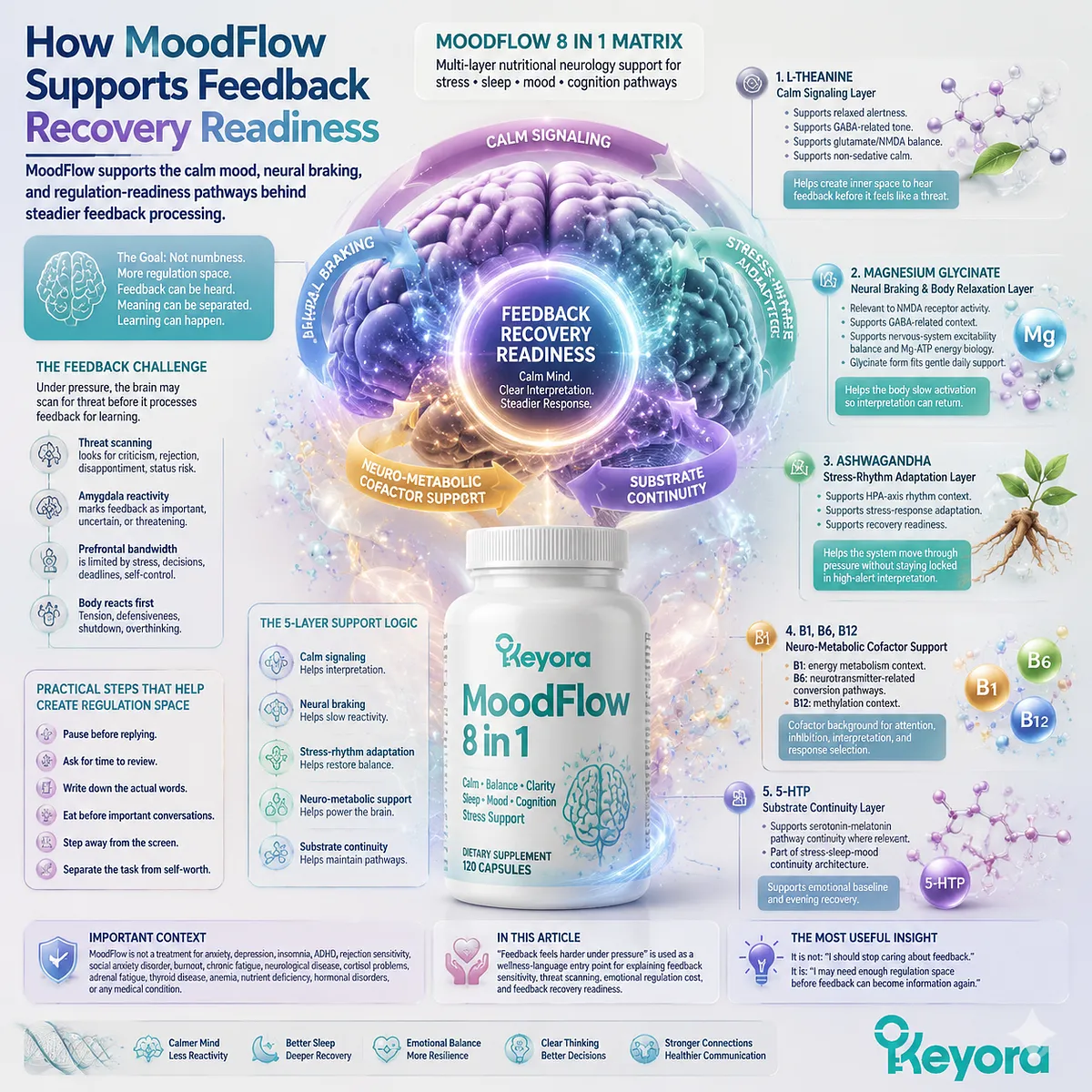
MoodFlow supports the calm mood, neural braking, and regulation-readiness pathways behind steadier feedback processing.
Once the experience is understood, MoodFlow can be discussed in the right place: as nutritional support for relevant wellness pathways, not as a shortcut for emotional perfection.
If feedback feels harder to handle when you are under pressure, the goal is not to become numb or indifferent. Feedback matters. Learning matters. Relationships matter. The goal is to support the state that allows feedback to be processed with more steadiness.
That support may include pausing before replying, asking for time to review the feedback, writing down the actual words instead of reacting to the emotional meaning, eating before difficult conversations, stepping away from the screen, or separating “this needs revision” from “I am not good enough.”
Nutritional support can sit beside those practical steps.
Keyora MoodFlow 8 in 1 is best understood here as a multi-layer nutritional neurology matrix that supports stress-sleep-mood-cognition pathways.
L-Theanine supports the calm-signaling layer.
L-Theanine is commonly positioned around relaxed alertness, GABA-related tone, glutamate/NMDA balance, and non-sedative calm.
In a feedback-pressure context, this matters because the goal is not to shut down sensitivity. The goal is to support calm interpretation while staying mentally clear.
When feedback arrives, many people do not need to feel sedated. They need enough inner space to hear the words before the body turns them into a threat signal.
Magnesium glycinate supports the neural braking and body-side relaxation-readiness layer.
Magnesium is relevant to NMDA receptor activity, GABA-related context, nervous-system excitability, and Mg-ATP energy biology. The glycinate form also fits MoodFlow’s gentle daily-support logic.
For feedback sensitivity, this layer speaks to the body side of the reaction: chest tightness, jaw tension, stomach drop, internal static, and the urge to respond before thinking.
Neural braking does not mean emotional suppression. It means supporting the system’s ability to slow activation enough for interpretation to return.
Ashwagandha supports the stress-rhythm adaptation layer.
In the MoodFlow framework, Ashwagandha is positioned around HPA-axis rhythm context, stress-response adaptation, and recovery readiness.
This is important because feedback often feels harder not only because of the feedback itself, but because it arrives during an already pressured state. The system may have been bracing long before the comment was made.
Ashwagandha belongs to the background layer of stress resilience: supporting the body’s capacity to move through pressure without staying locked in high-alert interpretation.
B1, B6, and B12 provide neuro-metabolic cofactor support.
B1 supports energy metabolism context. B6 is relevant to neurotransmitter-related conversion pathways. B12 supports methylation context.
Feedback processing requires more than emotional maturity. It requires attention, inhibition, interpretation, and response selection. Those processes depend on neuro-metabolic infrastructure.
This does not mean B vitamins treat feedback sensitivity or correct a deficiency without clinical evaluation. It means they belong to the cofactor background of mood, cognition, and regulation pathways.
5-HTP supports serotonin-melatonin pathway continuity where relevant.
In this article, 5-HTP is not the main focus. Its role is better understood as part of the broader substrate-continuity layer that supports normal neurotransmitter-related pathways.
Where feedback sensitivity is connected to emotional baseline, evening recovery, or stress-sleep-mood continuity, 5-HTP can be discussed as one part of MoodFlow’s broader pathway architecture.
It should not be framed as a way to erase emotional reactions or make criticism easy.
Together, these layers create a support logic: calm signaling, neural braking, stress-rhythm adaptation, neuro-metabolic cofactor support, and substrate continuity.
That is the correct role of MoodFlow in this article.
MoodFlow is not a treatment for anxiety, depression, insomnia, ADHD, rejection sensitivity, social anxiety disorder, burnout, chronic fatigue, neurological disease, cortisol problems, adrenal fatigue, thyroid disease, anemia, nutrient deficiency, hormonal disorders, or any medical condition.
In this article, Keyora uses “feedback feels harder under pressure” as a wellness-language entry point for explaining feedback sensitivity, threat scanning, emotional regulation cost, and feedback recovery readiness.
The most useful insight is not, “I should stop caring about feedback.”
It is: “I may need enough regulation space before feedback can become information again.”
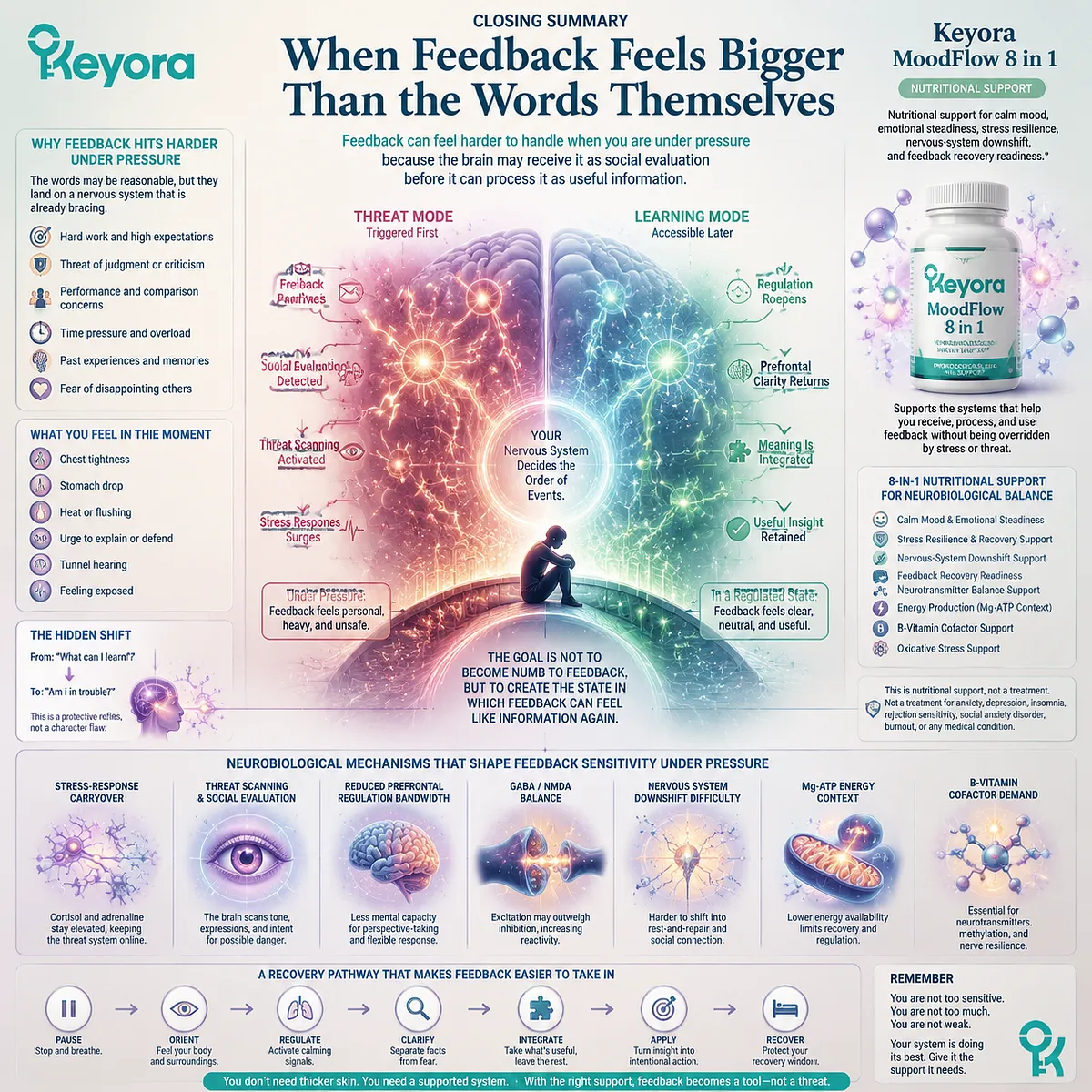
Closing Summary
Feedback can feel harder to handle when you are under pressure because the brain may receive it as social evaluation before it can process it as useful information. The words may be reasonable, but they may land on a nervous system that is already bracing.
This does not mean you are weak, difficult, or unable to learn. It may mean feedback entered a system already shaped by stress-response carryover, threat scanning, reduced prefrontal regulation bandwidth, GABA/NMDA activation balance, nervous-system downshift difficulty, Mg-ATP energy context, and B-vitamin cofactor demand.
Keyora MoodFlow 8 in 1 fits as nutritional support for calm mood, emotional steadiness, stress resilience, nervous-system downshift, and feedback recovery readiness.
It is not a treatment for anxiety, depression, insomnia, rejection sensitivity, social anxiety disorder, burnout, or any medical condition. The deeper goal is not to become numb to feedback, but to support the state in which feedback can feel like information again.
This article is for educational and informational purposes only. It does not provide medical advice, diagnosis, treatment, cure, prevention, disease outcome claims, hormone restoration claims, fertility outcome claims, or formula-specific clinical efficacy claims.