
Why Does Everything Feel Like Effort When My Stress Is High?
Keyora Research Q&A Library
This is part of the Keyora Research Q&A Series, derived from Keyora Nutritional Neurology Series .
Within the Keyora Nutritional Neurology framework, this Q&A translates complex nutrient–brain mechanisms into reader-friendly, evidence-bound answers, focusing on stress resilience, sleep quality, calm mood support, cognitive wellness, and the broader interaction between nutrition, neurochemistry, and daily nervous-system function.
First published by Keyora Research Journal: www.keyorahealth.com

Direct Answer
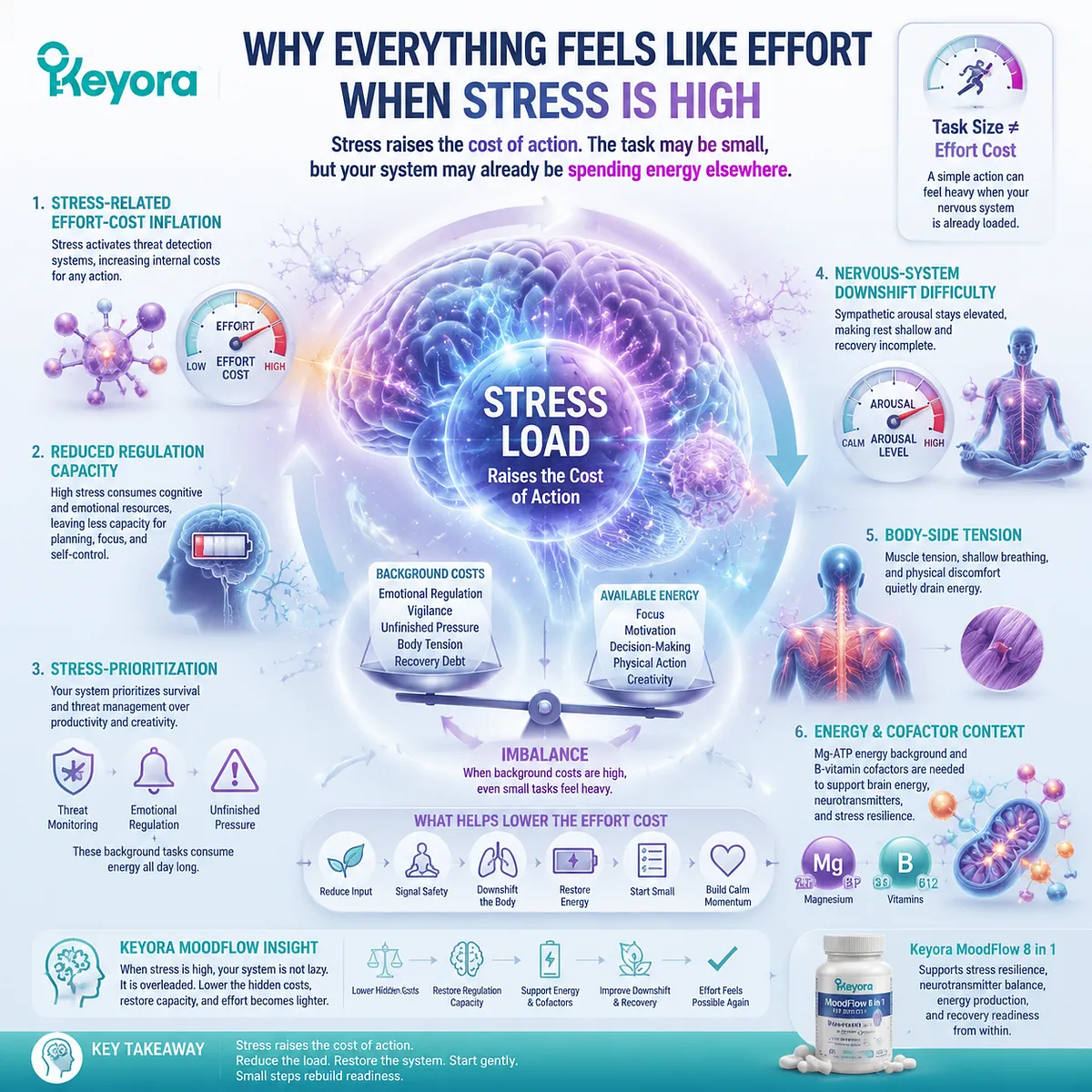
Everything can feel like effort when your stress is high because stress can raise the cost of action. The task may be small, but your system may already be spending energy on emotional regulation, vigilance, unfinished pressure, body tension, and recovery debt.
The mismatch is this: task size and effort cost are not always the same. A simple action can feel heavy when your nervous system is already loaded.
This can involve stress-related effort-cost inflation, reduced regulation capacity, stress-prioritization, nervous-system downshift difficulty, body-side tension, Mg-ATP energy context, B-vitamin cofactor support, and calm-signaling readiness.
In the Keyora MoodFlow framework, this is understood as a stress-resilience and effort-readiness question, not a medical treatment claim.
Why Small Actions Can Feel So Heavy Under Stress
When stress is high, the task may be small, but the effort cost can feel large.
There are moments when the thing in front of you is not actually difficult.
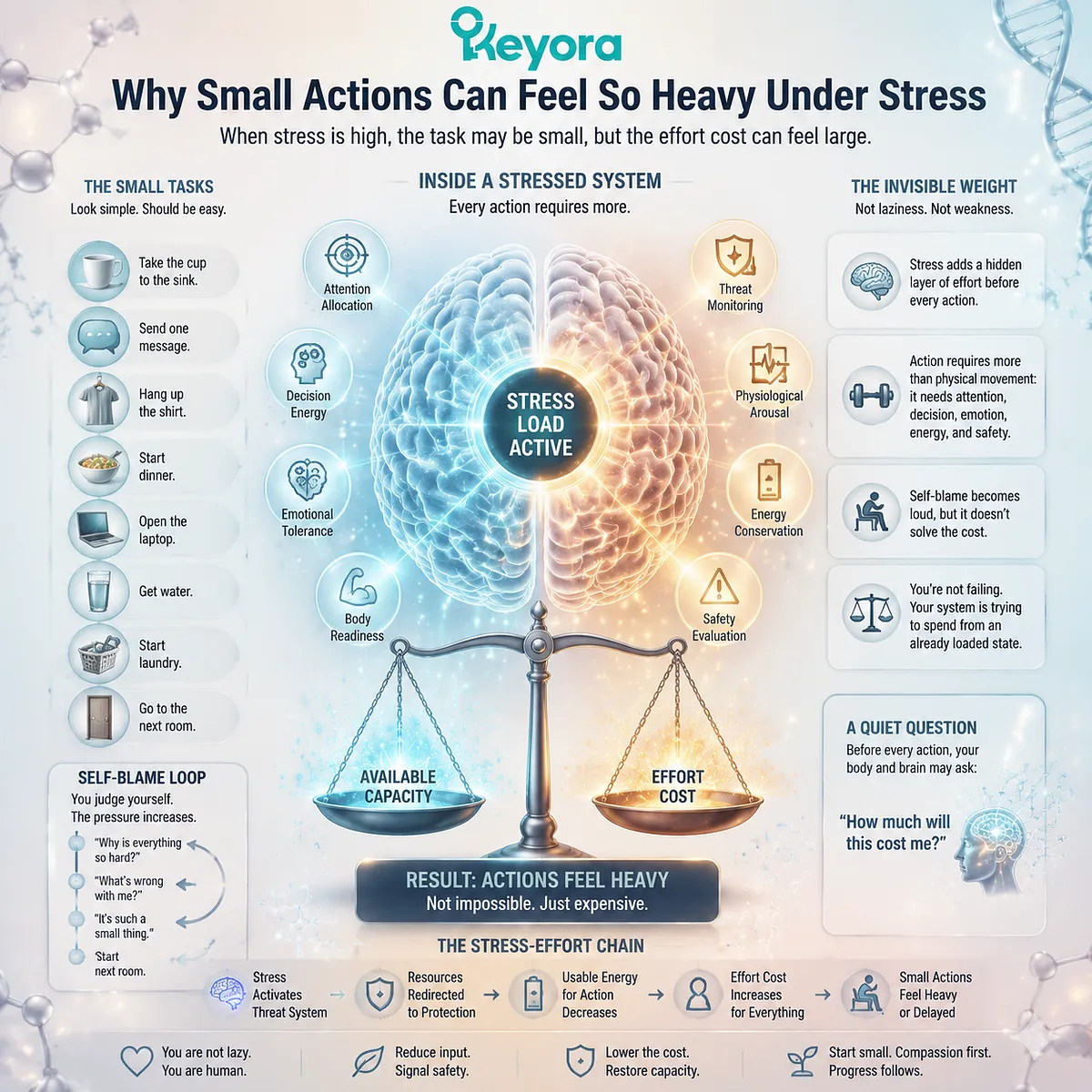
A cup is sitting on the desk. It only needs to be taken to the sink.
A message is open. It only needs one sentence.
A shirt is on the chair. It only needs to be hung up.
Dinner does not have to be complicated. You only need to stand up and start.
But somehow, the action feels heavy.
Not impossible. Not confusing. Just strangely expensive.
You know what to do. You can see the steps. You may even know that doing the thing would make you feel a little better afterward.
Still, your body does not move.
So you sit there, looking at the small task, and a private frustration begins to build.
“Why does everything feel so hard?”
“Why can’t I just do this?”
“It is such a small thing.”
“What is wrong with me?”
This kind of stress-related effort can be hard to explain because it does not always look serious from the outside. You may still be functioning. You may still be polite. You may still show up where you need to show up.
But inside, every extra action feels like it asks for more than you have available.
It is not only the big tasks that feel difficult. It is the small maintenance of life.
Opening the laptop.
Getting water.
Starting laundry.
Preparing food.
Answering a simple message.
Moving from one room to another.
Each action seems to come with an invisible weight attached.
This is where self-blame often becomes the loudest.
You may tell yourself that you are lazy, dramatic, spoiled, unproductive, or weak. You may compare yourself to the version of you who used to do these things automatically. You may wonder why ordinary life feels like it now requires negotiation.
But what if the task is small, and the activation cost is not?
What if stress has added a hidden layer of effort before every action?
What if your system is not refusing life, but trying to spend from an already loaded state?
Stress can make action feel expensive because action is not only physical movement. It also requires attention, decision, emotional tolerance, body readiness, and a small belief that beginning will not overwhelm you.
When stress is high, that entire chain can feel heavier.
This does not mean you are failing.
It may mean your body and brain are asking a very quiet question before every action:
“How much will this cost me?”
Why Stress Raises the Cost of Everyday Action
Stress can make ordinary effort feel more expensive by consuming regulation capacity and keeping the body in a guarded state.
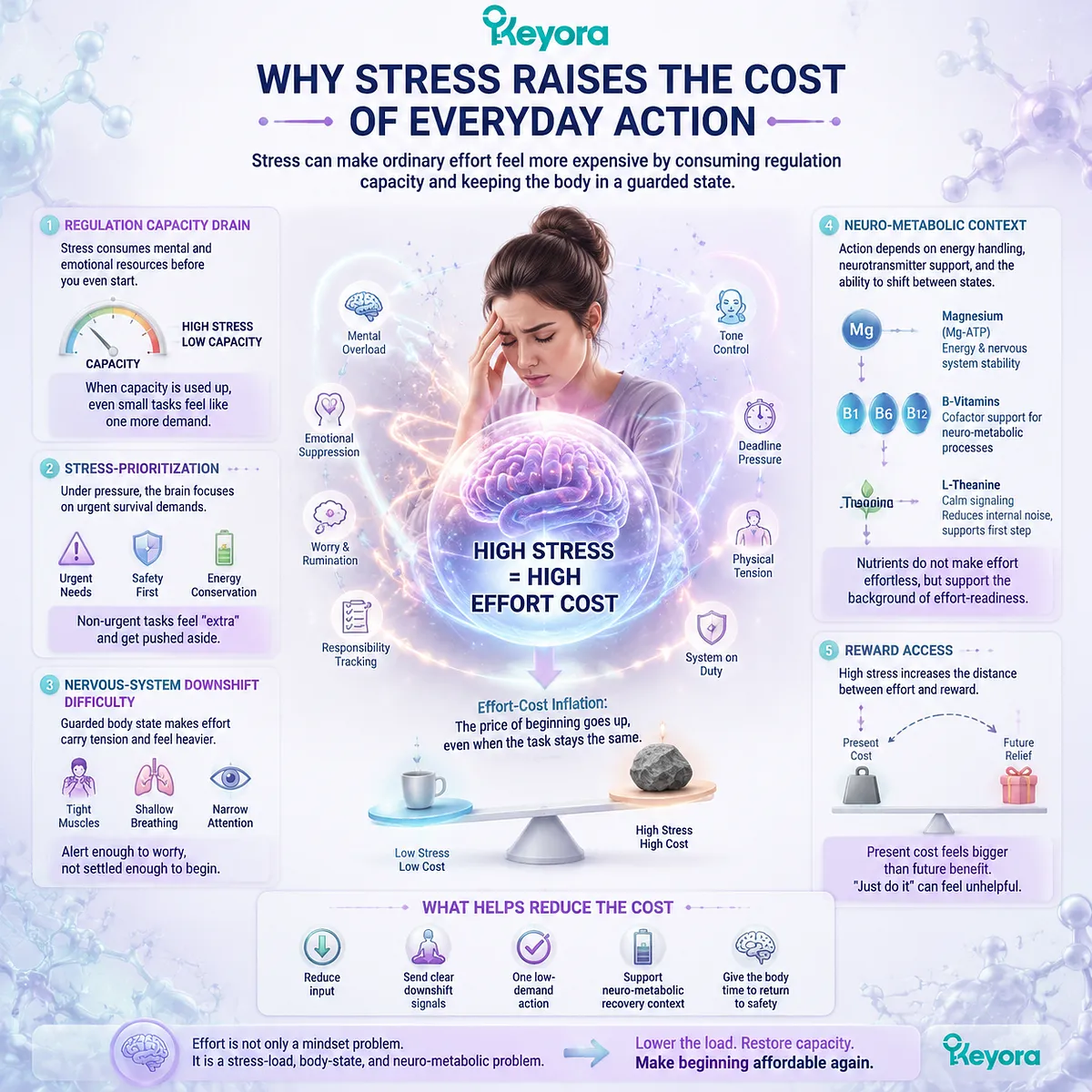
One reason everything feels like effort under stress is that stress consumes regulation capacity before you even begin the task.
You may think you are doing nothing. But internally, you may already be working.
You may be controlling your tone so you do not sound irritated.
You may be trying not to worry about unfinished work.
You may be holding back emotion because there is no time to process it.
You may be tracking deadlines, responsibilities, money, people, expectations, or possible mistakes.
You may be physically sitting still while your nervous system is still on duty.
That invisible work matters.
When regulation capacity is already being used, even a small new task can feel like one more demand placed on a crowded system.
This is effort-cost inflation.
The action itself has not changed. But the price of beginning has gone up.
On a low-stress day, washing a cup is just washing a cup. On a high-stress day, washing a cup may feel like one more transition, one more decision, one more movement, one more proof that you are still expected to keep functioning.
The second mechanism is stress-prioritization.
Under pressure, the body tends to focus on what feels urgent, threatening, or necessary. It becomes less interested in expansion, maintenance, creativity, or optional improvement.
This is why small life tasks can fall away during high stress.
It is not always because you do not care. It may be because your system is trying to preserve energy for perceived survival demands.
A messy desk, an unanswered message, an unwashed dish, or an unfinished errand may not feel important enough to justify the cost of movement. Your brain may classify it as “extra,” even if your conscious mind knows it matters.
The third mechanism is nervous-system downshift difficulty.
If your body is still in a guarded state, effort can carry tension.
Your shoulders may be slightly raised. Your jaw may be tight. Your breathing may be shallow. Your attention may feel narrow. Your body may be ready to react, but not ready to relax into ordinary action.
This creates a strange mismatch.
You may be alert enough to worry, but not settled enough to begin.
You may have enough energy for tension, but not enough available energy for movement.
The fourth mechanism is neuro-metabolic context.
Action requires more than motivation. It requires energy handling, neurotransmitter-related support, and the ability to move between mental states.
Magnesium-related Mg-ATP context belongs to the background of cellular energy use and nervous-system stability. B1, B6, and B12 belong to the wider cofactor context for neuro-metabolic processes and normal neurotransmitter-related pathways. L-Theanine-related calm signaling can be relevant when internal noise makes the first step feel more difficult.
This does not mean a nutrient makes effort effortless.
It means effort-readiness is not only a mindset. It is also connected to stress load, body tension, calm signaling, energy context, and recovery state.
The fifth mechanism is reward access.
When stress is high, the reward of completing small actions may feel too far away. You may know you will feel better after doing the thing, but that future relief does not feel strong enough to pull you forward.
So the present cost feels larger than the future benefit.
That is why “just do it” can feel so unhelpful.
The problem is not always that you do not understand what needs to happen. The problem may be that your system is already spending too much to make beginning feel affordable.
How to Lower the Effort Cost Before You Begin
The goal is not to shame yourself into action, but to make the first step feel affordable again.
When every action feels like effort, the answer is not always to demand more discipline.
Discipline can help when the system has enough capacity to respond to structure. But when stress has raised the cost of action, harsh self-pressure may increase the load.
You may push yourself with shame.
“Get up.”
“Stop being useless.”
“This is not hard.”
“You are wasting your life.”
But if your nervous system is already guarded, this kind of language can make action feel even more threatening. The task becomes not only physical, but emotional. Now you are not just washing a cup. You are proving your worth.
That is too heavy.
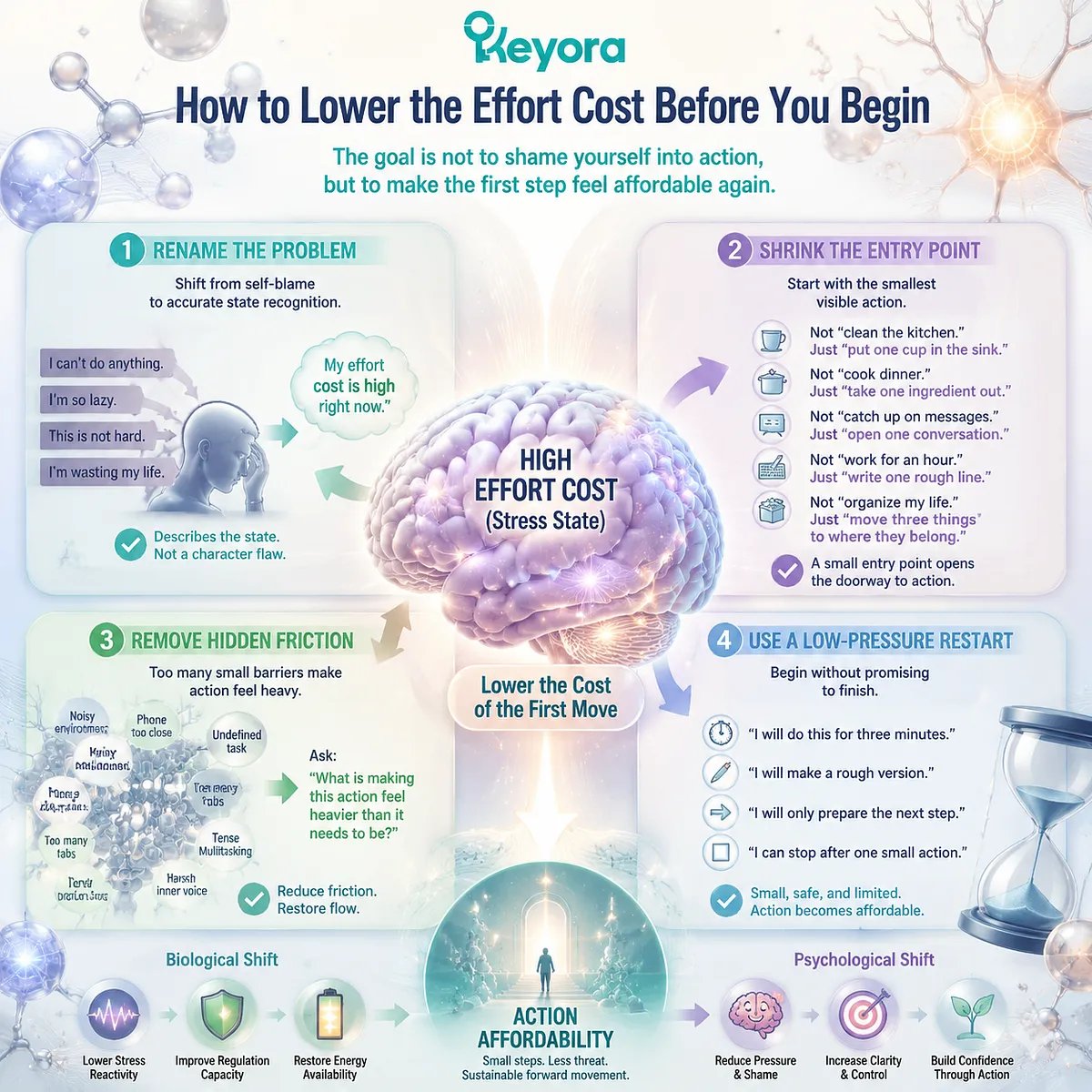
A better first step is to rename the problem.
Instead of saying, “I cannot do anything,” try saying, “My effort cost is high right now.”
This does not excuse everything. It simply describes the state more accurately.
You are no longer turning a stress state into a character flaw. You are noticing that the cost of starting has become inflated.
The second step is to shrink the entry point.
Do not begin with the whole task.
Begin with the smallest visible action.
Not “clean the kitchen.”
Just “put one cup in the sink.”
Not “cook dinner.”
Just “take one ingredient out.”
Not “catch up on messages.”
Just “open one conversation.”
Not “work for an hour.”
Just “write one rough line.”
Not “organize my life.”
Just “move three things to where they belong.”
This works because stress often makes the doorway into action feel too narrow. A smaller entry point gives your system a way through without requiring full motivation first.
The third step is to remove hidden friction.
Sometimes the action feels heavy because too many small barriers are attached to it.
The room is noisy.
The phone is too close.
The task is undefined.
The screen has too many tabs.
Your body is tense.
You are trying to do three things at once.
Your inner voice is impatient and cruel.
Ask yourself one simple question:
“What is making this action feel heavier than it needs to be?”
Maybe you need to close a tab. Maybe you need to stand up before deciding. Maybe you need to put the phone across the room. Maybe you need to unclench your jaw, drop your shoulders, and take one slow breath before you begin.
Reducing friction is not weakness. It is intelligent recovery-aware action.
The fourth step is to use a low-pressure restart.
Give yourself permission to begin without promising to finish.
This is important.
Sometimes you do not start because starting feels like entering a contract with the whole task. If you open the document, you think you must finish the section. If you wash one dish, you think you must clean the kitchen. If you answer one message, you think you must answer all of them.
That makes the first step too expensive.
Try starting with a smaller agreement.
“I will do this for three minutes.”
“I will make a rough version.”
“I will only prepare the next step.”
“I can stop after one small action.”
The goal is not to trick yourself into productivity. The goal is to restore action affordability.
When your system learns that action can be small, safe, and limited, effort may begin to feel less threatening.
You may not need to force a full return.
You may only need to lower the cost of the first move.
Where Nutritional Support Fits
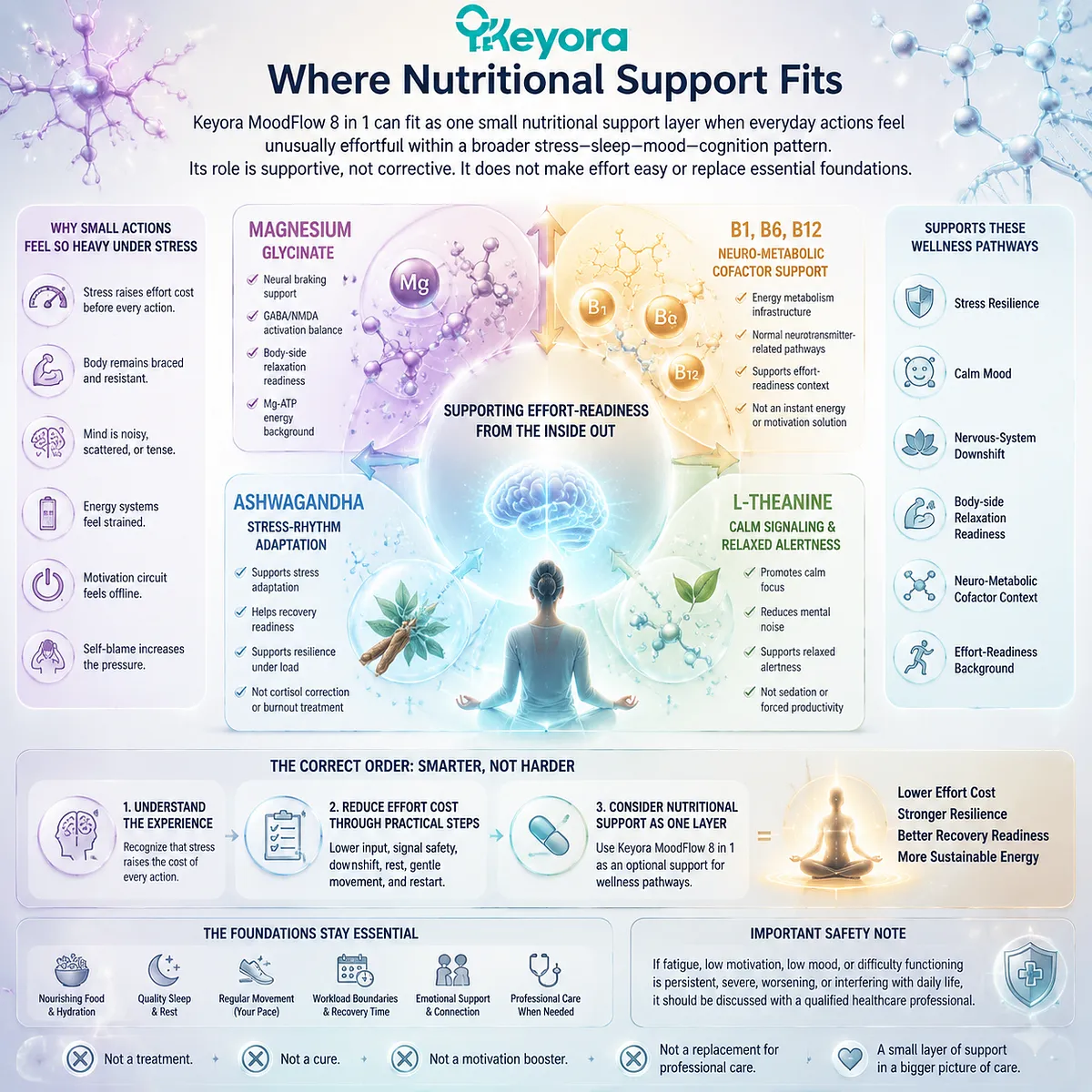
Keyora MoodFlow 8 in 1 can fit as one small nutritional support layer when everyday actions feel unusually effortful within a broader stress-sleep-mood-cognition pattern. It should not be framed as something that makes effort easy, restores motivation, cures fatigue, treats depression, treats anxiety, treats burnout, or replaces professional care.
Its role is narrower: supporting wellness pathways involved in stress resilience, calm mood, nervous-system downshift, body-side relaxation readiness, neuro-metabolic cofactor context, and effort-readiness background.
-
Magnesium glycinate may be relevant when high stress makes the body feel braced, tense, or internally resistant to movement. In the MoodFlow framework, it supports neural braking, GABA/NMDA activation balance, body-side relaxation readiness, and Mg-ATP energy background.
-
B1, B6, and B12 may be relevant as neuro-metabolic cofactor support. They belong to the background infrastructure of energy metabolism and normal neurotransmitter-related pathways. This can support the context of effort-readiness without being positioned as an instant energy or motivation solution.
-
L-Theanine may be relevant when action feels harder because the mind is noisy, tense, or unable to enter calm focus. Its role is calm signaling and relaxed alertness, not sedation or forced productivity.
-
Ashwagandha may fit when cumulative stress load keeps the body in a pressure rhythm. Its role is stress-rhythm adaptation and recovery readiness, not cortisol correction or burnout treatment.
This is the correct order: first understand the experience, then reduce effort cost through practical steps, then consider nutritional support as one optional layer.
Food, sleep, movement, workload boundaries, emotional support, and professional care when needed remain important.
If fatigue, low motivation, low mood, or difficulty functioning is persistent, severe, worsening, or interfering with daily life, it should be discussed with a qualified healthcare professional.
Closing Summary
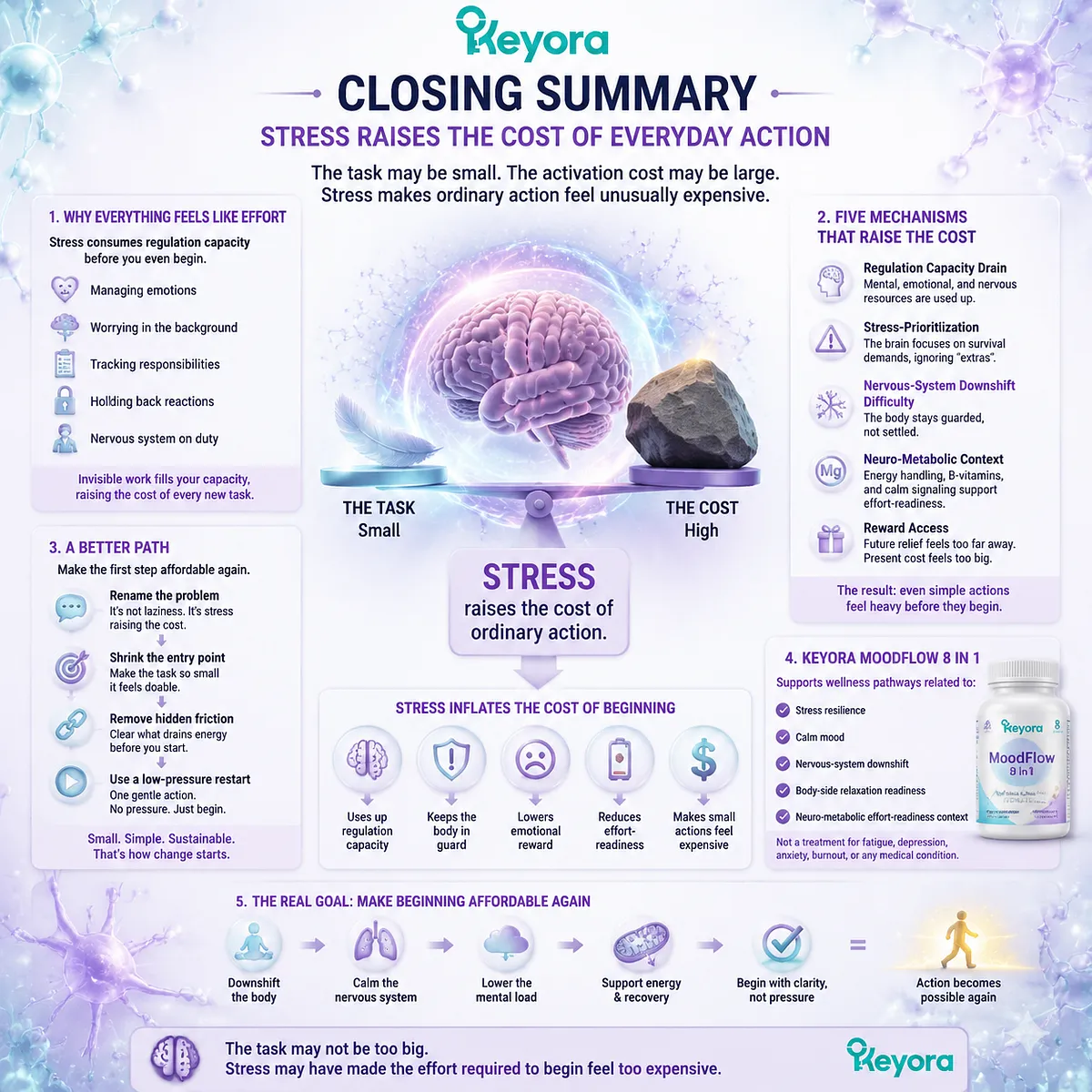
When everything feels like effort under stress, it does not automatically mean you are lazy, weak, or incapable. It may mean stress has raised the cost of ordinary action.
The task may be small, but the activation cost may be large. Stress can consume regulation capacity, keep the body guarded, lower emotional reward, and make even simple actions feel unusually expensive.
A better path begins by renaming the problem, shrinking the entry point, removing hidden friction, and using a low-pressure restart. The goal is not to shame yourself into performance, but to make the first step feel affordable again.
Keyora MoodFlow 8 in 1 can support wellness pathways related to stress resilience, calm mood, nervous-system downshift, body-side relaxation readiness, and neuro-metabolic effort-readiness context. It is not a treatment for fatigue, depression, anxiety, burnout, or any medical condition.
The task may not be too big.
Stress may have made the effort required to begin feel too expensive.
This article is for educational and informational purposes only. It does not provide medical advice, diagnosis, treatment, cure, prevention, disease outcome claims, hormone restoration claims, fertility outcome claims, or formula-specific clinical efficacy claims.