
Why Does Doing Nothing Feel Uncomfortable?
Keyora Research Q&A Library
This is part of the Keyora Research Q&A Series, derived from Keyora Nutritional Neurology Series .
Within the Keyora Nutritional Neurology framework, this Q&A translates complex nutrient–brain mechanisms into reader-friendly, evidence-bound answers, focusing on stress resilience, sleep quality, calm mood support, cognitive wellness, and the broader interaction between nutrition, neurochemistry, and daily nervous-system function.
First published by Keyora Research Journal: www.keyorahealth.com

Direct Answer
Doing nothing can feel uncomfortable because your nervous system may be used to demand, stimulation, usefulness, and constant next steps. When those signals disappear, stillness may not feel peaceful at first. It may feel strange, empty, restless, or even unsafe.
The mismatch is this: low demand is not always automatically relaxing. If your system has learned to feel oriented through tasks, screens, messages, plans, and productivity, then “nothing to do” may remove the very structure your stress system has been using to feel okay.
This can involve demand absence discomfort, stimulation withdrawal, usefulness gaps, internal noise becoming louder, nervous-system downshift difficulty, calm signaling context, body-side relaxation readiness, and recovery-readiness practice.
In the Keyora MoodFlow framework, discomfort with doing nothing is understood as a stress-resilience and recovery-readiness question, not an anxiety, depression, ADHD, burnout, trauma, insomnia, or medical treatment claim.
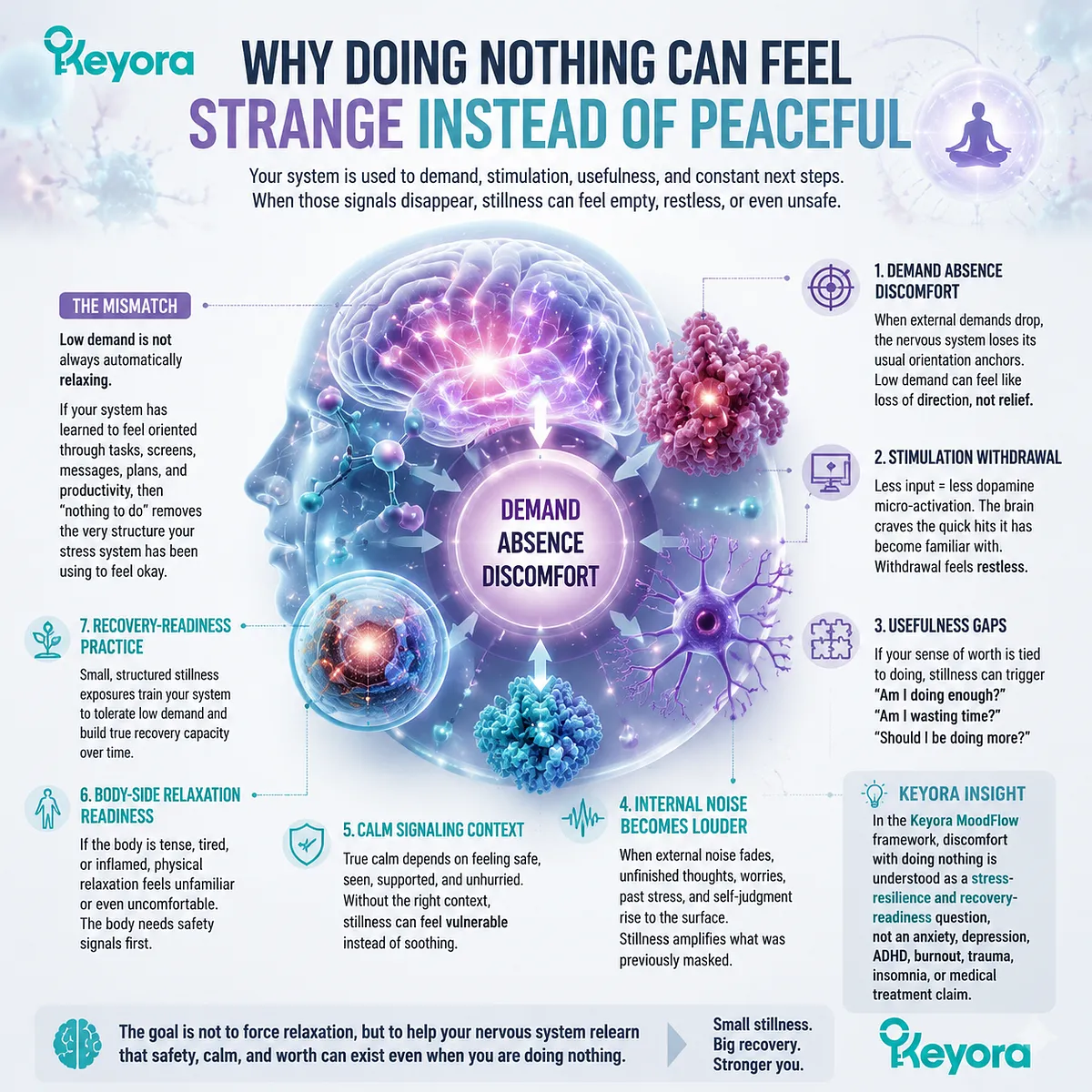
Why Doing Nothing Can Feel Strange Instead of Peaceful
Doing nothing can feel uncomfortable when your system is used to demand, stimulation, and constant next steps.
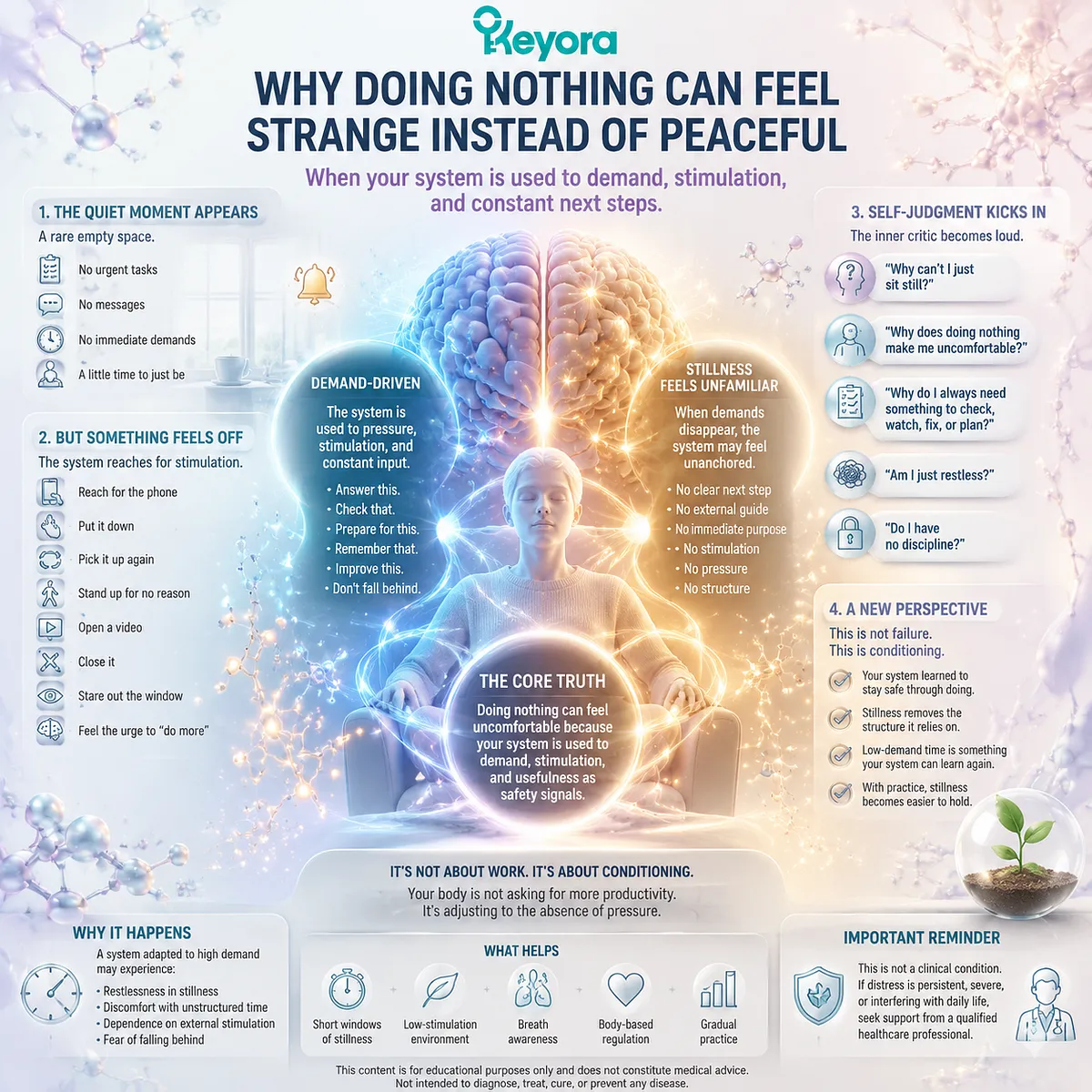
You finally have a few quiet minutes.
No one is asking for anything right now. No meeting is starting. No message has to be answered this second. No task is directly in front of you. For once, there is a little empty space.
So you sit down.
You tell yourself, “I do not have to do anything for a moment.”
But almost immediately, something feels off.
Your hand reaches for your phone.
You put it down.
Then you pick it up again.
You stand up to get water, even though you are not that thirsty.
You open a video, but you do not really want to watch it.
You look at a book, then close it.
You stare out the window for a few seconds, then feel as if you should be doing something more useful.
Nothing is wrong, exactly.
But nothing feels comfortable either.
It is not that you have a clear urgent task. It is not that you truly want more work. It is not that you are enjoying the phone, the scrolling, or the random movement.
It is the empty space itself that feels hard to stay with.
Then the self-judgment begins.
“Why can’t I just sit still?”
“Why does doing nothing make me uncomfortable?”
“Why do I always need something to check, watch, fix, or plan?”
“Am I just restless?”
“Do I have no discipline?”
But what if doing nothing feels uncomfortable because your system is used to constant demand?
What if stillness removes the structure that usually tells you what to do next?
What if your body is not asking for more productivity, but struggling with the absence of pressure?
Many people assume doing nothing should feel naturally peaceful. Sometimes it does. But if your daily life has been full of tasks, screens, messages, deadlines, responsibilities, and constant input, stillness may feel unfamiliar.
Your nervous system may be used to being guided by the next demand.
Answer this.
Check that.
Prepare for this.
Remember that.
Improve this.
Do not fall behind.
When those demands suddenly disappear, the system may not immediately relax. It may feel unanchored.
Doing nothing may feel uncomfortable because your system is used to demand, stimulation, and usefulness as signals that you are safe, oriented, and okay.
That does not mean you are failing at rest.
It may mean low-demand time is something your system needs to learn again.
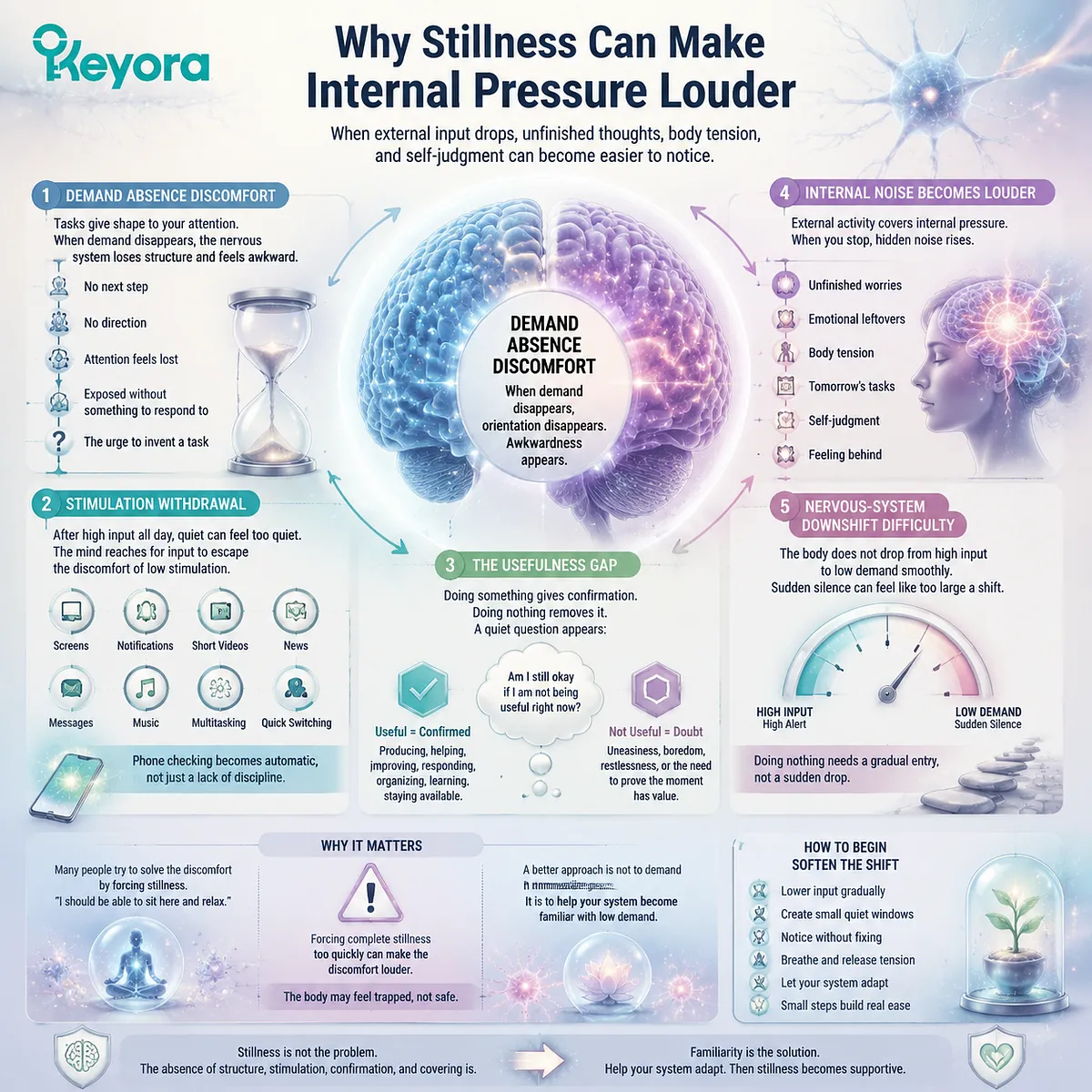
Why Stillness Can Make Internal Pressure Louder
When external input drops, unfinished thoughts, body tension, and self-judgment can become easier to notice.
One reason doing nothing feels uncomfortable is demand absence discomfort.
On a busy day, tasks give shape to your attention. Even if the day is stressful, it tells you where to put your mind. There is a next step, a next message, a next screen, a next problem, a next response.
When demand disappears, the nervous system may lose the structure it has been using to feel oriented.
So instead of peace, you may feel awkwardness.
You may not know where to place your attention.
You may feel like you should invent a task.
You may feel oddly exposed without something to respond to.
The second mechanism is stimulation withdrawal.
If your day has been full of screens, notifications, short videos, news, messages, music, background noise, multitasking, or quick information switching, quiet may feel too quiet.
The mind may reach for input not because the input is deeply satisfying, but because silence feels unfamiliar.
This is why phone checking can become automatic.
It may not be only a lack of discipline.
It may be a way to fill the discomfort of low stimulation.
The third mechanism is the usefulness gap.
When you are doing something useful, you may feel confirmed. You are producing, helping, improving, responding, organizing, learning, or staying available.
When you do nothing, that confirmation disappears.
Then a quiet question may appear:
“Am I still okay if I am not being useful right now?”
This is not always full guilt. It can be subtler than that. It may feel like uneasiness, boredom, restlessness, or the need to find something that proves the moment has value.
The fourth mechanism is internal noise becoming louder.
External activity can cover internal pressure.
When you stop, you may begin to notice unfinished worries, emotional leftovers, body tension, tomorrow’s tasks, self-judgment, or the feeling that you are behind.
The quiet moment is not empty.
It is full of things you could not hear when the day was louder.
That can make doing nothing feel uncomfortable.
Not because stillness is bad.
But because stillness reveals what activity has been masking.
The fifth mechanism is nervous-system downshift difficulty.
The body does not always move smoothly from high input to low demand. If you have been alert, stimulated, responsible, and available for hours or days, suddenly dropping into silence may feel like too large a shift.
Doing nothing may need a gradual entry, not a sudden drop from pressure into silence.
This matters because many people try to solve the discomfort by forcing stillness.
They decide, “I should be able to sit here and relax.”
But forcing complete stillness too quickly can make the discomfort louder. The body may feel trapped rather than safe.
A better approach is not to demand immediate peace.
It is to help your system become familiar with low demand.
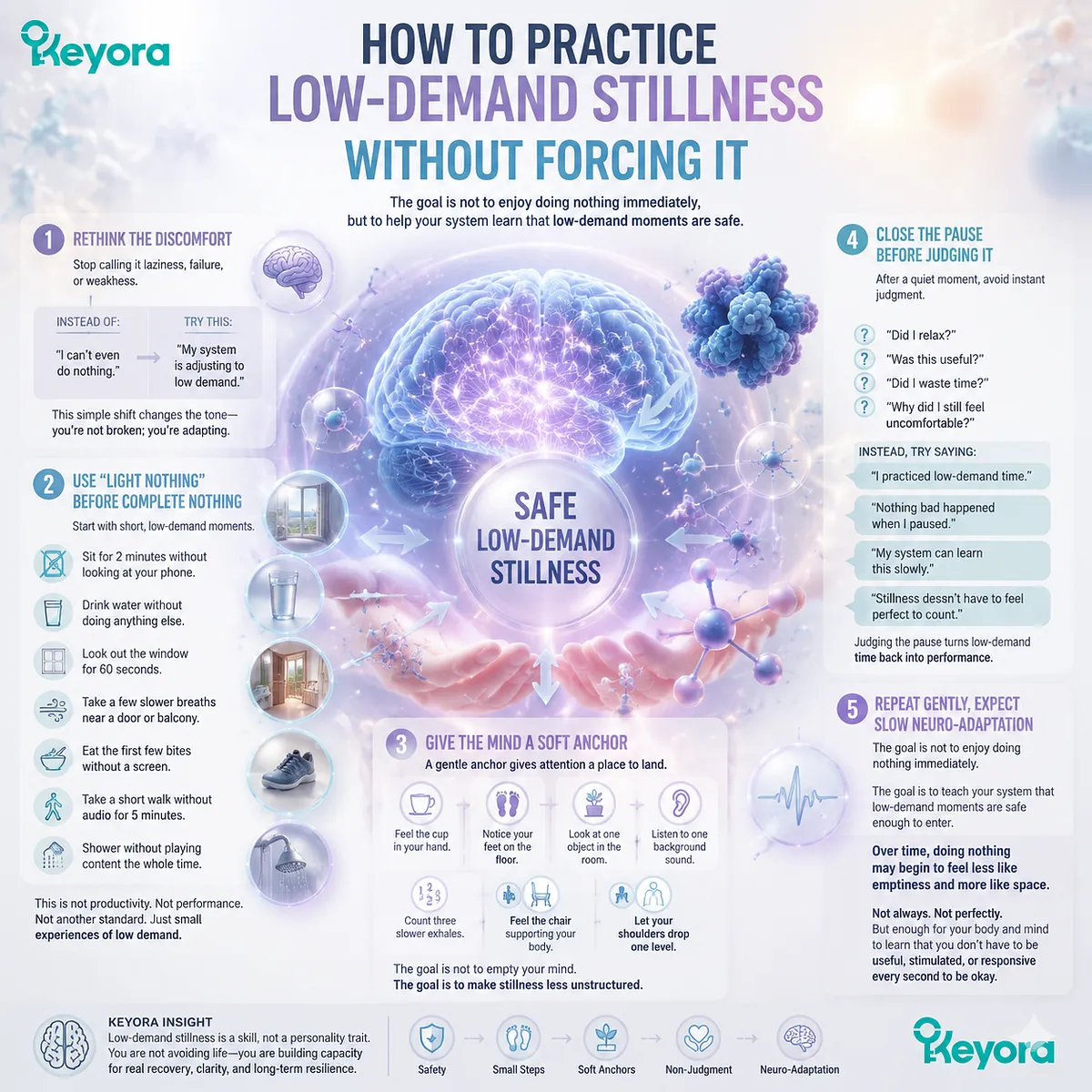
How to Practice Low-Demand Stillness Without Forcing It
The goal is not to enjoy doing nothing immediately, but to help your system learn that low-demand moments are safe.
The first step is to stop calling the discomfort laziness, failure, or weakness.
Try replacing:
“I can’t even do nothing.”
With:
“My system is adjusting to low demand.”
This sentence may feel simple, but it changes the emotional tone. You are no longer attacking yourself for needing input. You are noticing a pattern that can be retrained gently.
The second step is to use “light nothing” before complete nothing.
Do not begin by forcing yourself to sit silently for a long time.
Start with low-demand contact.
Sit for two minutes without looking at your phone.
Drink water without doing anything else.
Look out the window for 60 seconds.
Stand near the door or balcony and take a few slower breaths.
Eat the first few bites of a meal without a screen.
Take a short walk without audio for five minutes.
Shower without playing content the whole time.
This is not a productivity practice.
It is not a meditation performance.
It is not another standard to meet.
It is simply giving your system a small experience of low demand.
The third step is to give the mind a soft anchor.
Complete emptiness can feel too abrupt. A soft anchor gives attention somewhere gentle to land.
Feel the cup in your hand.
Notice your feet on the floor.
Look at one object in the room.
Listen to one background sound.
Count three slower exhales.
Feel the chair supporting your body.
Let your shoulders drop one level.
The goal is not to empty your mind.
The goal is to make stillness less unstructured.
The fourth step is to close the pause before judging it.
After a quiet moment, do not immediately ask:
“Did I relax?”
“Was this useful?”
“Did I waste time?”
“Why did I still feel uncomfortable?”
Try saying:
“I practiced low-demand time.”
“Nothing bad happened when I paused.”
“My system can learn this slowly.”
“Stillness does not have to feel perfect to count.”
This is important because judging the pause turns low-demand time back into performance.
The goal is not to enjoy doing nothing immediately.
The goal is to teach the system that low-demand moments are safe enough to enter.
Over time, doing nothing may begin to feel less like emptiness and more like space.
Not always.
Not perfectly.
But enough for your body and mind to learn that you do not have to be useful, stimulated, or responsive every second in order to be okay.
Where Nutritional Support Fits
Keyora MoodFlow 8 in 1 can fit as one small nutritional support layer when discomfort with doing nothing appears within a broader stress-sleep-mood-cognition and recovery-readiness pattern. It should not be framed as making stillness comfortable, removing discomfort, treating anxiety, treating depression, treating insomnia, curing burnout, treating ADHD, treating trauma, stopping restlessness, or guaranteeing calm.
Its role is narrower: supporting wellness pathways involved in stress resilience, calm mood, nervous-system downshift, body-side relaxation readiness, recovery readiness, and neuro-metabolic cofactor context.
-
L-Theanine may be relevant when low-demand moments feel mentally noisy, sharp, or difficult to enter calmly. In the MoodFlow framework, it supports calm signaling and relaxed alertness without being framed as sedation or anxiety treatment.
-
Magnesium glycinate may be relevant when stillness reveals body tension, bracing, or difficulty softening. It supports neural braking, GABA/NMDA activation balance, body-side relaxation readiness, and Mg-ATP energy background. This is not a claim that it relaxes muscles like a drug or treats restlessness.
-
Ashwagandha may fit when cumulative stress load keeps the system in an active stress baseline even during quiet moments. Its role is stress-rhythm adaptation and recovery readiness, not cortisol correction or burnout treatment.
-
B vitamins may support the broader neuro-metabolic cofactor context, including normal energy metabolism and normal neurotransmitter-related pathways. This belongs to the background of stress resilience and recovery readiness, not a cure for fatigue, discomfort, or emotional distress.
-
5-HTP may be relevant only when emotional baseline and serotonin-related pathway continuity are part of the broader pattern. It should not be framed as treating depression, anxiety, insomnia, or mood problems.
MoodFlow belongs after the reader understands the stillness-discomfort pattern and the low-demand practice. Nutrition can support the terrain. It cannot replace therapy, medical care, sleep, movement, workload boundaries, emotional support, screen boundaries, or lifestyle foundations.
If discomfort with stillness, restlessness, low mood, anxiety-like feelings, or difficulty relaxing is persistent, severe, worsening, or interfering with daily life, sleep, mood, relationships, or functioning, it should be discussed with a qualified healthcare professional.

Closing Summary
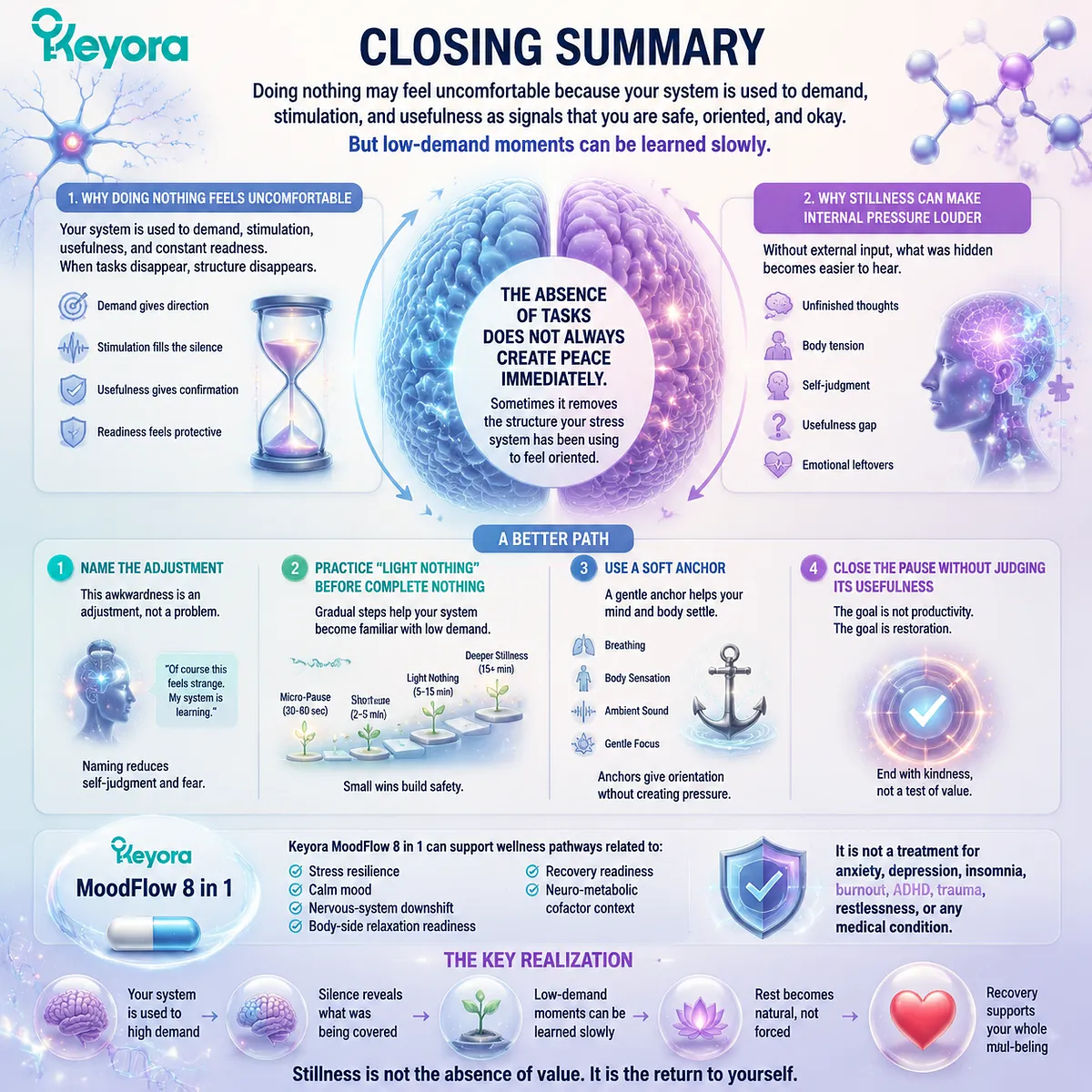
Doing nothing can feel uncomfortable when your nervous system is used to demand, stimulation, usefulness, and constant readiness. The absence of tasks does not always create peace immediately. Sometimes it removes the structure your stress system has been using to feel oriented.
The deeper mismatch is that stillness can make internal pressure louder. Without external input, unfinished thoughts, body tension, self-judgment, and the usefulness gap may become easier to notice.
A better path begins by naming the adjustment, practicing “light nothing” before complete nothing, using a soft anchor, and closing the pause without judging whether it was useful enough.
Keyora MoodFlow 8 in 1 can support wellness pathways related to stress resilience, calm mood, nervous-system downshift, body-side relaxation readiness, recovery readiness, and neuro-metabolic cofactor context. It is not a treatment for anxiety, depression, insomnia, burnout, ADHD, trauma, restlessness, or any medical condition.
Doing nothing may feel uncomfortable because your system is used to demand, stimulation, and usefulness as signals that you are safe, oriented, and okay.
But low-demand moments can be learned slowly.
This article is for educational and informational purposes only. It does not provide medical advice, diagnosis, treatment, cure, prevention, disease outcome claims, hormone restoration claims, fertility outcome claims, or formula-specific clinical efficacy claims.