
Why Do Some Astaxanthin Supplements Contain Almost None?
Keyora Research Q&A Library
This is part of the Keyora Research Q&A Series, derived from Keyora Astaxanthin Research Journal Series.
Within the Keyora Astaxanthin Researcn framework, this Q&A translates complex astaxanthin biology into reader-friendly, evidence-bound answers, focusing on natural astaxanthin identity, molecular structure, antioxidant and redox mechanisms, membrane lipid interaction, mitochondrial resilience, inflammatory signaling pathways, human evidence interpretation, and the scientific principles behind responsible supplementation.
First published by Keyora Research Journal: www.keyorahealth.com
Direct Answer
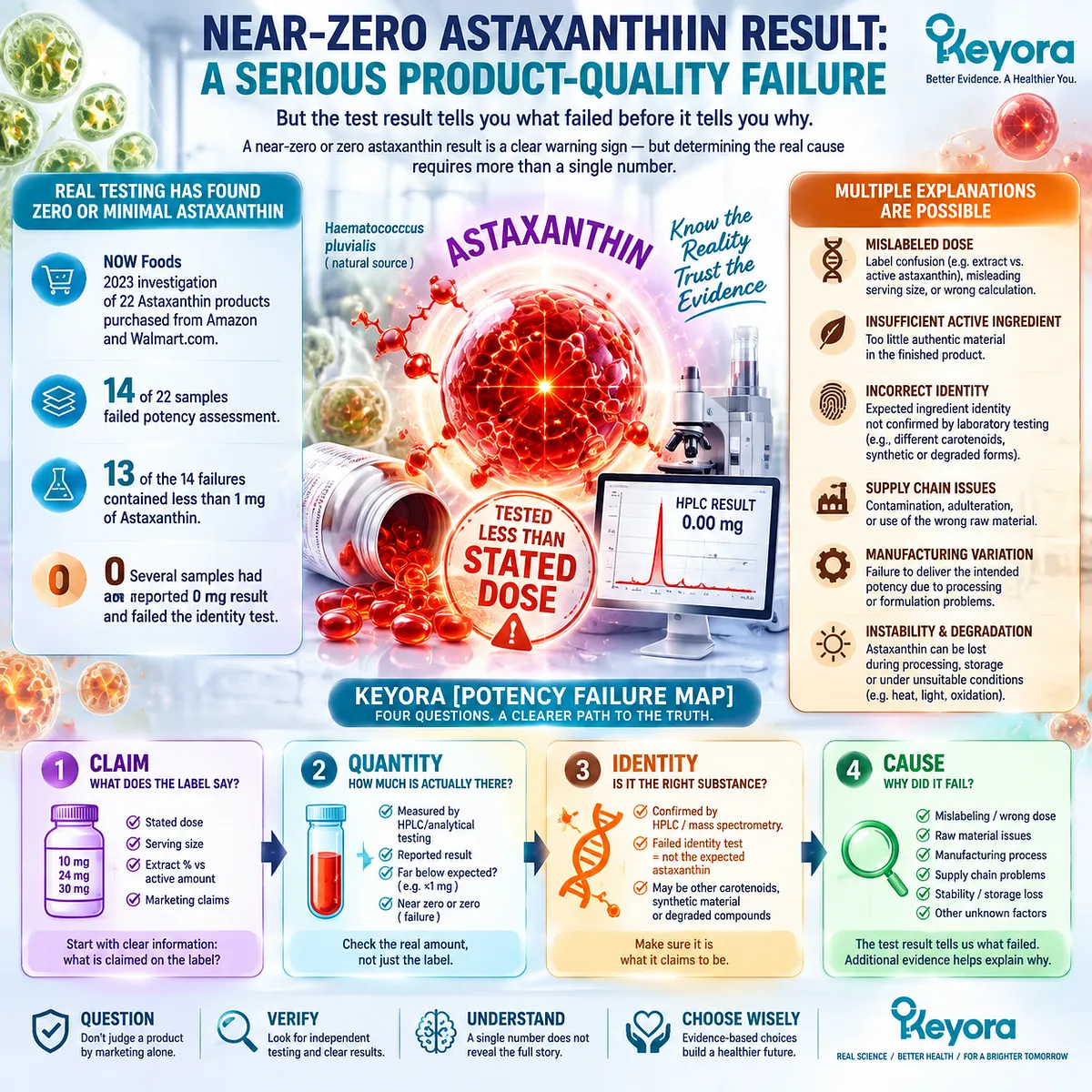
A near-zero Astaxanthin result is a serious product-quality failure, but the test result tells you what failed before it tells you why.
Yes.
Independent and manufacturer-led marketplace testing has documented Astaxanthin supplements containing only a small fraction of their stated dose, and some tested samples have produced zero reported Astaxanthin together with failed identity testing.
In NOW Foods’ targeted 2023 investigation of 22 Astaxanthin products purchased from Amazon and Walmart.com, 14 samples failed its potency assessment.
Thirteen of those 14 failures contained less than 1 mg of Astaxanthin. Published examples included products labeled for 10, 12, 15, or 24 mg that measured only fractions of a milligram, while several samples produced a reported HPLC result of 0 mg and also failed the external identity test.
But those results do not automatically tell us that every failure was caused by deliberate fraud.
A product can fail because the dose was misleadingly constructed, too little authentic material was present, the expected ingredient identity was not confirmed, the supply chain was compromised, manufacturing did not deliver the intended potency, or Astaxanthin was lost during processing or storage.
Determining the actual cause requires evidence beyond a single potency number.
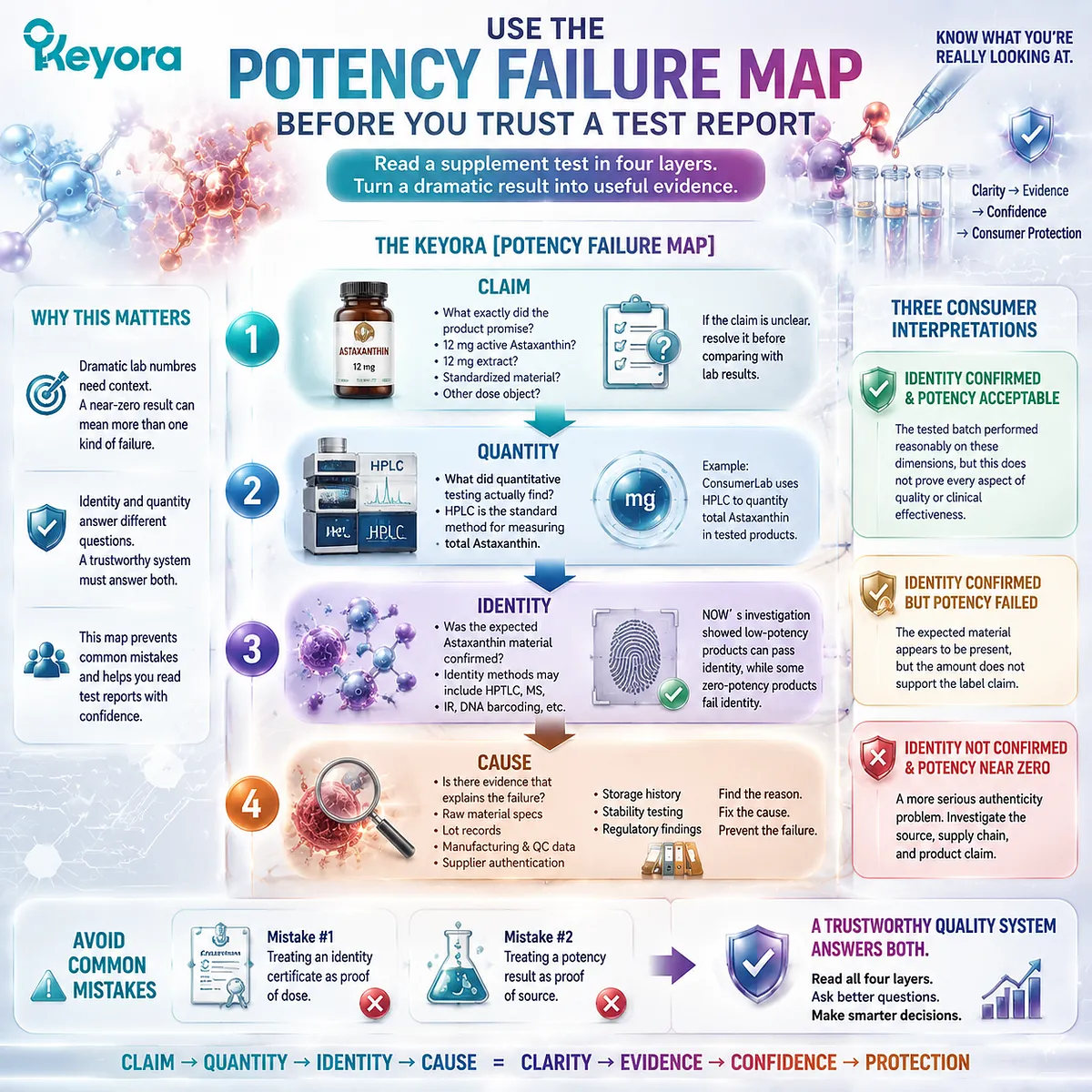
The Keyora [Potency Failure Map] therefore separates four questions:
Claim → Quantity → Identity → Cause
This distinction helps consumers identify a bad product without inventing an explanation that the laboratory evidence does not support.
Almost None Can Mean More Than One Kind of Failure
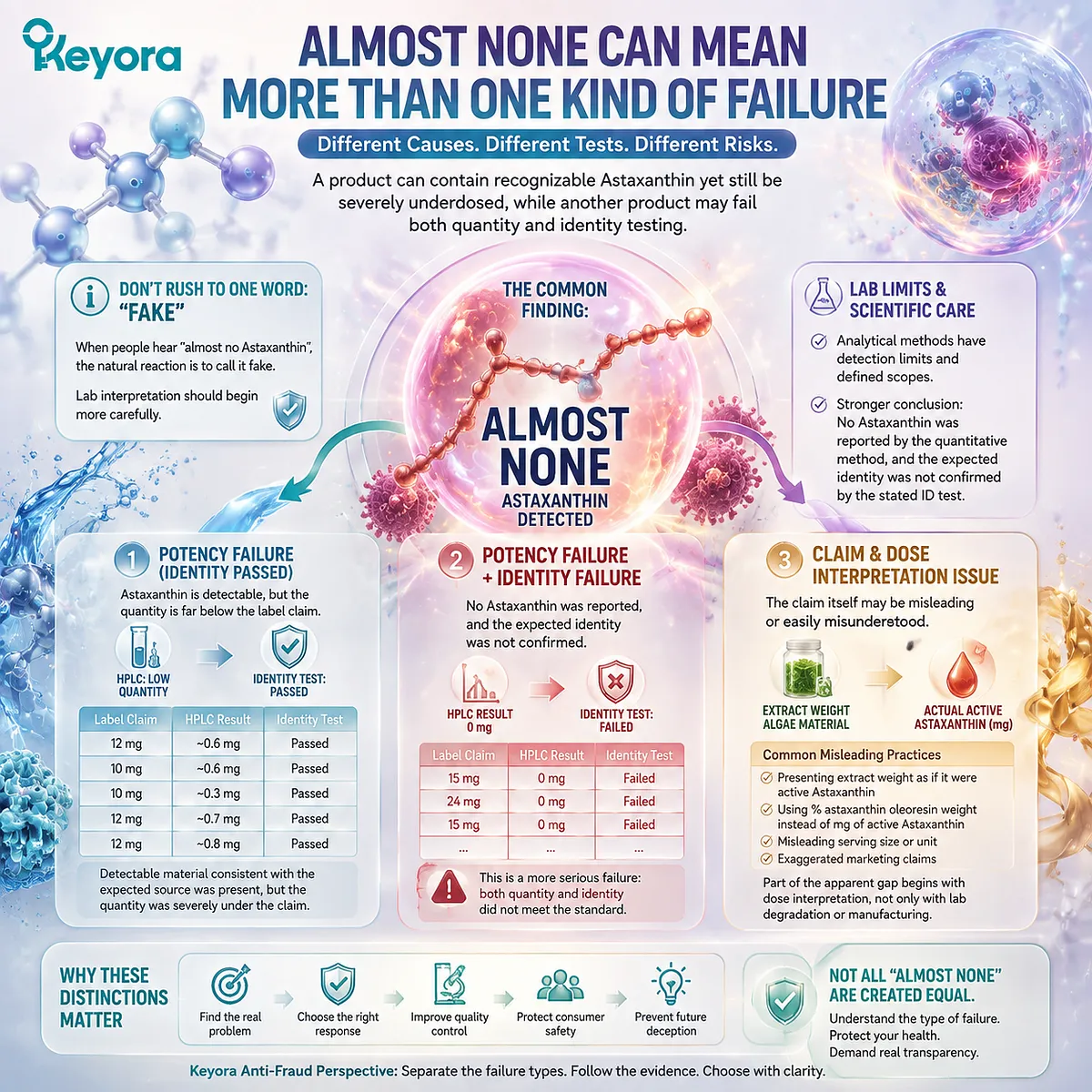
A product can contain recognizable Astaxanthin yet still be severely underdosed, while another product may fail both quantity and identity testing.
When people hear that a supplement “contained almost no Astaxanthin,” the natural reaction is to call it fake.
Sometimes the problem may ultimately involve counterfeit or deceptive practices, but laboratory interpretation should begin more carefully.
The first category is a potency failure. The expected Astaxanthin material can still be detected, but the measured quantity is substantially below the label claim.
NOW’s published results provide clear examples. One product labeled at 12 mg measured approximately 0.6 mg by HPLC while passing the external identity assessment. Another 10 mg product measured approximately 0.6 mg and passed identity testing. Other identity-pass samples labeled at 10 or 12 mg measured approximately 0.3, 0.7, or 0.8 mg.
These are not identity failures. Detectable material consistent with the expected Astaxanthin source was present according to the reported identity testing, but the quantity was severely below the stated potency.
A second category is more serious: potency failure together with identity failure.
NOW reported several samples with an HPLC result of 0 mg that also failed the external identity assessment. Its table included products carrying 15 mg or 24 mg label claims in this category.
The scientifically careful wording is not that laboratory testing proved that “not one molecule existed.”
Analytical methods have detection limits and defined scopes.
The stronger statement is that no Astaxanthin was reported by the quantitative method and the expected identity was not confirmed by the stated identity test.
A third possibility concerns the claim itself. As the previous Keyora anti-fraud audits explain, an extract weight or algae-material weight can be presented in ways that consumers may mistake for active Astaxanthin. In that case, part of the apparent gap begins with dose interpretation rather than with laboratory degradation or manufacturing alone.
These failure types should never be collapsed into one word.
What Marketplace Testing Actually Found
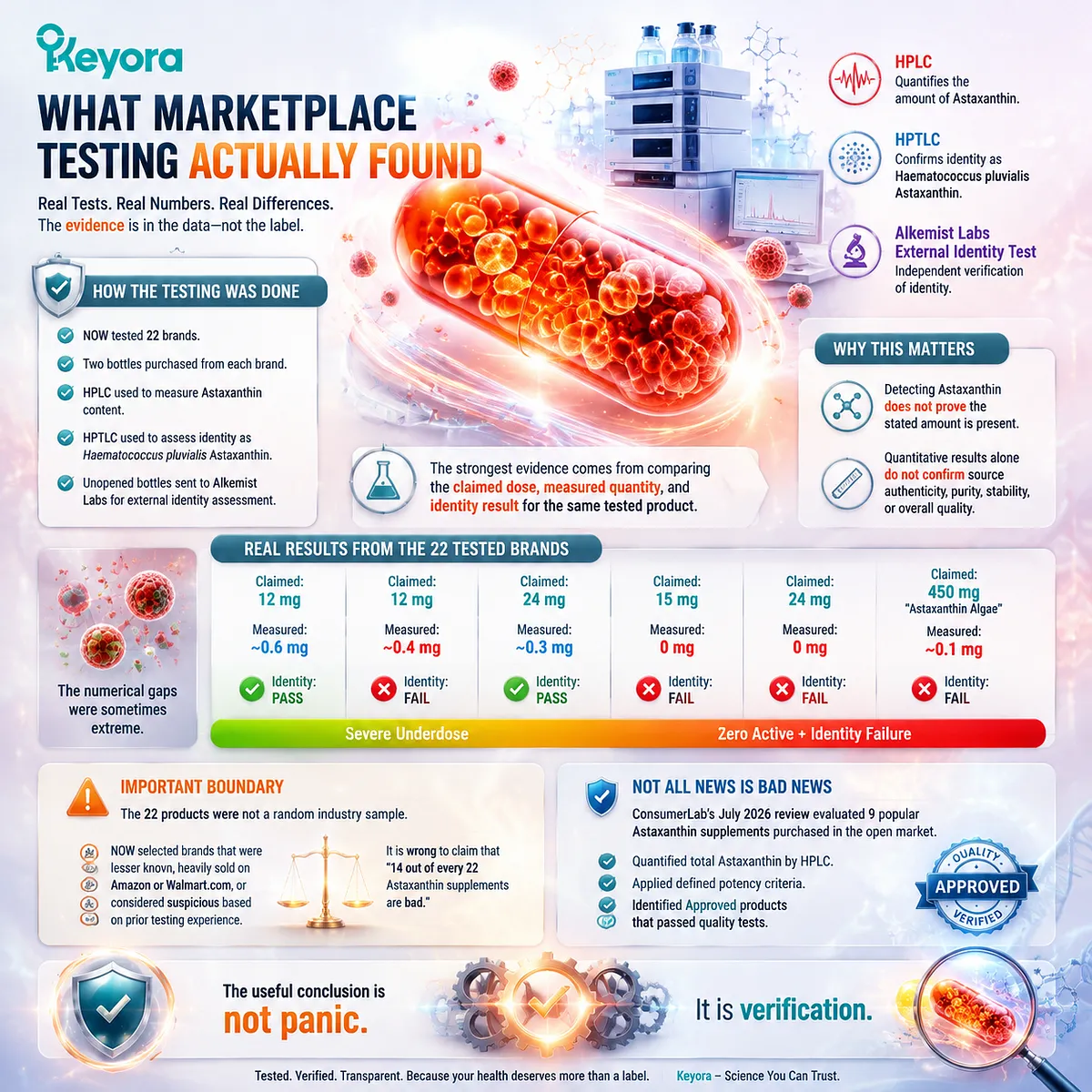
The strongest evidence comes from comparing the claimed dose, measured quantity, and identity result for the same tested product.
NOW’s 2023 investigation is useful because it did more than inspect labels. It purchased two bottles from each of 22 brands and used HPLC to quantify Astaxanthin.
HPTLC was used to assess identity as Haematococcus pluvialis Astaxanthin, and unopened bottles were sent to Alkemist Labs for an external identity assessment.
The numerical gaps were sometimes extreme.
-
A 12 mg product measured about 0.6 mg.
-
Another 12 mg product measured 0.4 mg and failed the external identity test.
-
A 24 mg product measured approximately 0.3 mg despite passing identity testing. Several products labeled at 15 or 24 mg were reported at 0 mg and failed external identity testing.
-
A product carrying a 450 mg “Astaxanthin Algae” label entry measured about 0.1 mg and failed the external identity assessment.
These results demonstrate why identity and potency must be audited separately.
A consumer might reasonably think that if Astaxanthin is present, the product has passed. It has not. Detecting the expected ingredient does not establish that the stated amount is present.
The reverse is also important. A quantitative measurement alone does not necessarily establish every aspect of biological source, branded-ingredient authenticity, contaminants, oxidation status, stability, or finished-product quality.
The NOW data also require an important boundary. The 22 products were not a random sample designed to estimate the failure rate of the entire Astaxanthin industry. NOW states that the brands were deliberately selected largely because they were lesser known, sold heavily through Amazon or Walmart.com, or were considered more suspicious based on prior testing experience.
So it would be wrong to claim that “14 out of every 22 Astaxanthin supplements are bad.”
Current evidence also shows that the market contains products that can pass defined quality criteria. ConsumerLab’s July 2026 review evaluated nine popular Astaxanthin supplements purchased through the open market and identified Approved products that passed its quality tests. ConsumerLab reports quantifying total Astaxanthin by HPLC and applying defined potency criteria to its review.
The useful conclusion is therefore not panic.
It is verification.
Why a Low Test Result Does Not Reveal the Cause
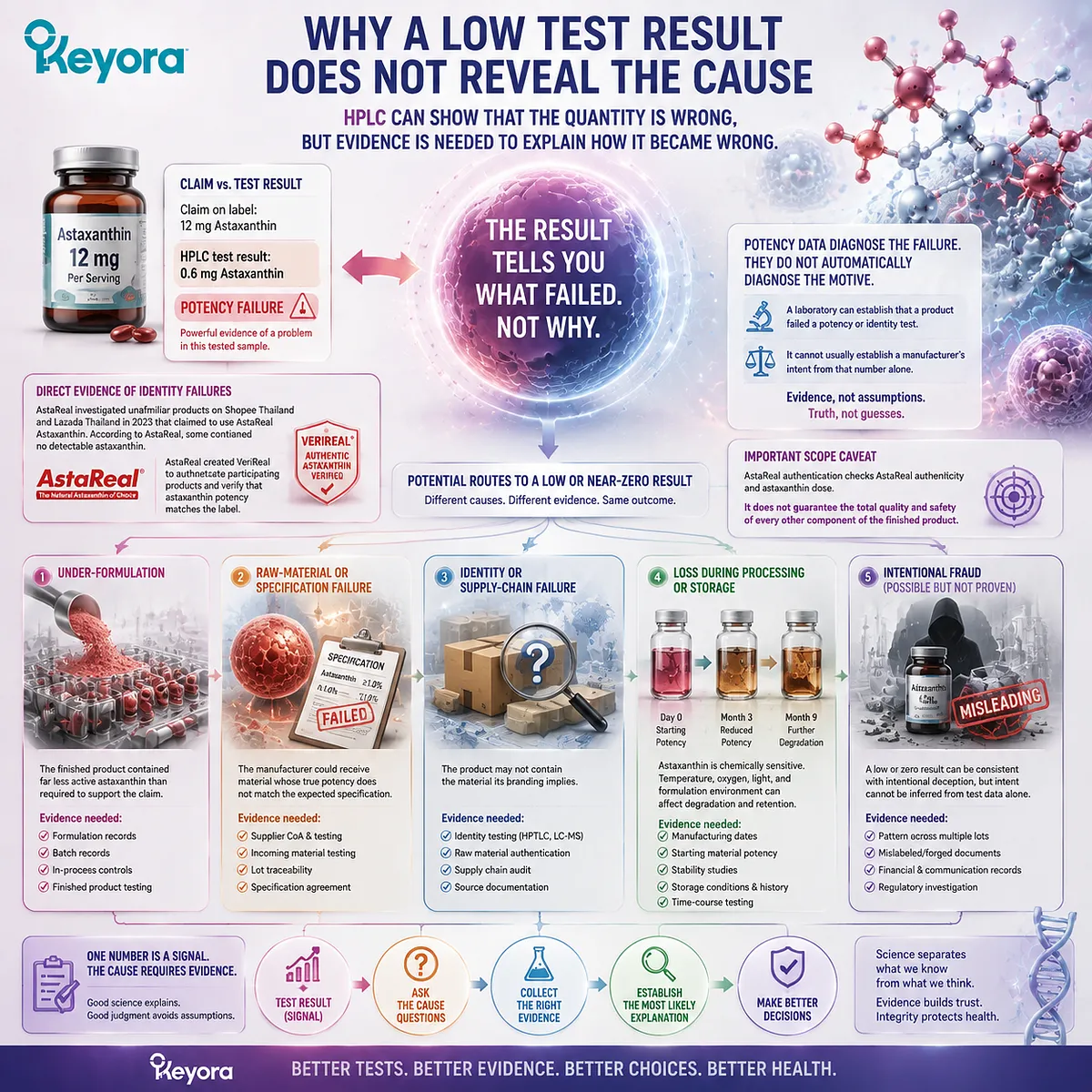
HPLC can show that the quantity is wrong, but manufacturing records, source authentication, stability data, and other evidence are needed to explain how it became wrong.
Suppose a supplement claims 12 mg Astaxanthin and testing finds 0.6 mg.
That is powerful evidence of a potency problem in the tested sample. It does not, by itself, answer what happened before the laboratory received the bottle.
One possibility is under-formulation. The finished product may simply have contained far less active Astaxanthin than required to support the claim.
Another possibility is raw-material or specification failure. A manufacturer could receive material whose true potency does not match the expected specification.
Another is identity or supply-chain failure. The product may not contain the material its branding implies.
There is direct evidence that this last category can occur. AstaReal reports that in 2023 it investigated unfamiliar products on Shopee Thailand and Lazada Thailand that claimed to use AstaReal Astaxanthin. According to AstaReal, some contained no detectable Astaxanthin. The company subsequently created its VeriReal program to authenticate participating products and verify that Astaxanthin potency matches the label.
Importantly, AstaReal itself states that this authentication has a defined scope. Its program checks AstaReal authenticity and Astaxanthin dose, but does not guarantee the total quality and safety of every other component of the finished product.
A further potential route is loss of potency during processing or storage. Astaxanthin is chemically sensitive, and research has shown that temperature, oxygen, formulation environment, and stabilization strategy can affect its degradation and retention.
But this possibility must not be misused.
The fact that Astaxanthin can degrade does not prove that degradation explains a particular marketplace failure. To make that conclusion, investigators would need relevant manufacturing dates, starting potency, packaging, storage history, stability results, and ideally testing across time.
The same rule applies to intentional fraud.
A laboratory can establish that a product failed a potency or identity test. It cannot usually establish a manufacturer’s intent from that number alone.
Potency data diagnose the failure. They do not automatically diagnose the motive.
Use the Potency Failure Map Before You Trust a Test Report
Read a supplement test in four layers so that a dramatic laboratory result becomes useful evidence rather than an unsupported accusation.
The Keyora [Potency Failure Map] begins with Claim.
What exactly did the product promise? Was it 12 mg of active Astaxanthin, 12 mg of extract, a standardized material, or another dose object? If the claim itself is unclear, resolve that before comparing it with laboratory results.
Next comes Quantity.
What did quantitative testing actually find? HPLC is commonly used to quantify Astaxanthin. ConsumerLab’s current testing methodology, for example, uses HPLC to measure total Astaxanthin in tested products.
Then examine Identity.
Was the expected Astaxanthin material confirmed by an appropriate identity method? NOW’s investigation demonstrates why this matters: several products with very low measured potency still passed identity testing, while others with zero reported potency also failed identity assessment.
Finally ask about Cause.
Is there evidence from raw-material specifications, lot records, manufacturing data, supplier authentication, storage history, stability testing, or regulatory investigation that explains the failure?
This produces three especially useful consumer interpretations.
Identity confirmed and potency acceptable means the tested batch performed reasonably on those particular dimensions. It does not prove every aspect of quality or clinical effectiveness.
Identity confirmed but potency failed means the expected material appears to be present, but the amount does not support the label claim.
Identity not confirmed and potency near zero represents a more serious authenticity problem and warrants investigation of the source, supply chain, and product claim.
This framework also prevents two common mistakes: treating an identity certificate as proof of dose and treating a potency result as proof of source.
A trustworthy quality system should be able to answer both.
Closing Summary
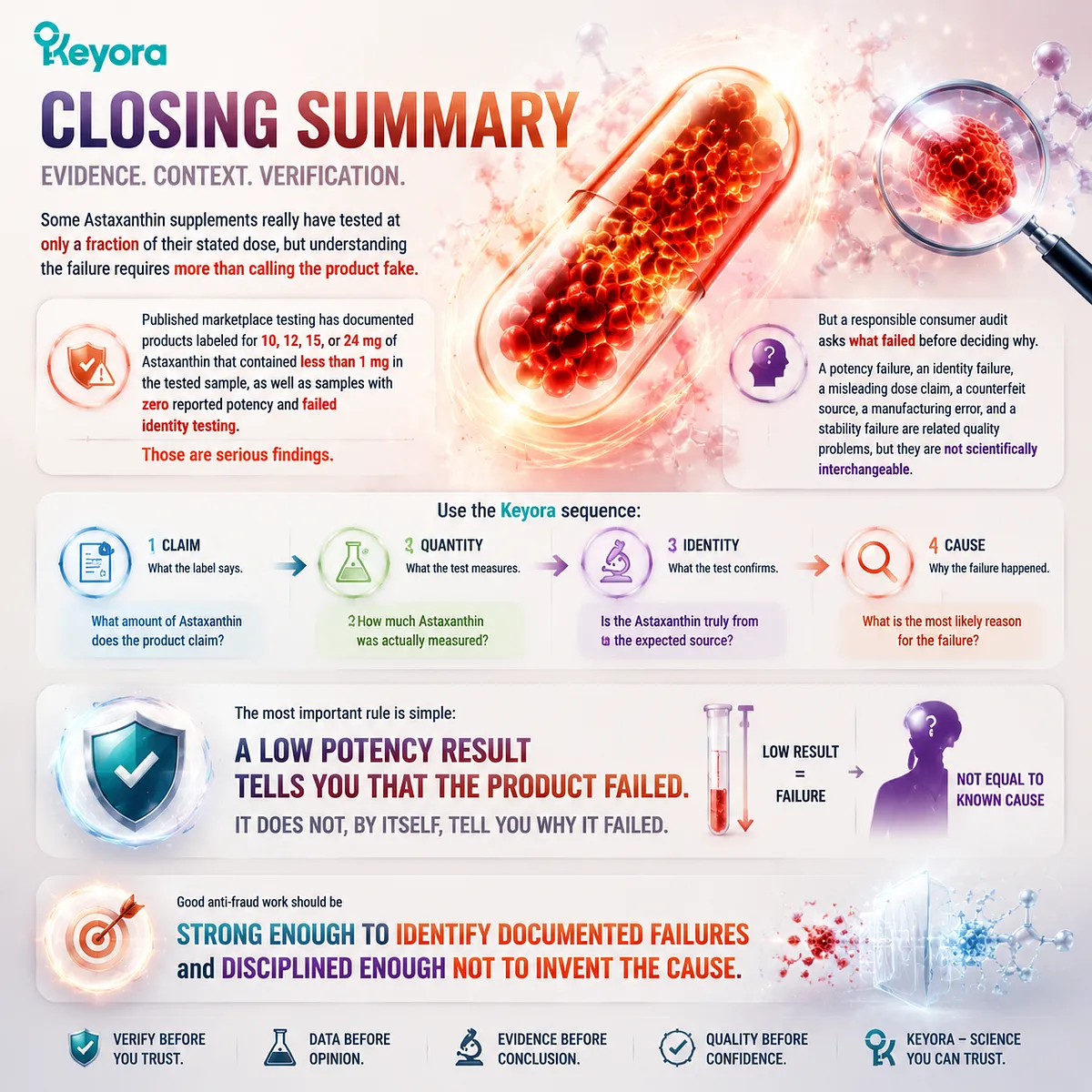
Some Astaxanthin supplements really have tested at only a fraction of their stated dose, but understanding the failure requires more than calling the product fake.
Published marketplace testing has documented products labeled for 10, 12, 15, or 24 mg of Astaxanthin that contained less than 1 mg in the tested sample, as well as samples with zero reported potency and failed identity testing.
Those are serious findings.
But a responsible consumer audit asks what failed before deciding why. A potency failure, an identity failure, a misleading dose claim, a counterfeit source, a manufacturing error, and a stability failure are related quality problems, but they are not scientifically interchangeable.
Use the Keyora sequence:
Claim → Quantity → Identity → Cause
The most important rule is simple:
A low potency result tells you that the product failed. It does not, by itself, tell you why it failed.
Good anti-fraud work should be strong enough to identify documented failures and disciplined enough not to invent the cause.
This article is for educational and informational purposes only. It does not provide medical advice, diagnosis, treatment, cure, prevention, disease outcome claims, hormone restoration claims, fertility outcome claims, or formula-specific clinical efficacy claims.