
Why Do Small Decisions Feel Harder When I’m Stressed?
Keyora Research Q&A Library
This is part of the Keyora Research Q&A Series, derived from Keyora Nutritional Neurology Seriers .
Within the Keyora Nutritional Neurology framework, this Q&A translates complex nutrient–brain mechanisms into reader-friendly, evidence-bound answers, focusing on stress resilience, sleep quality, calm mood support, cognitive wellness, and the broader interaction between nutrition, neurochemistry, and daily nervous-system function.
First published by Keyora Research Journal: www.keyorahealth.com
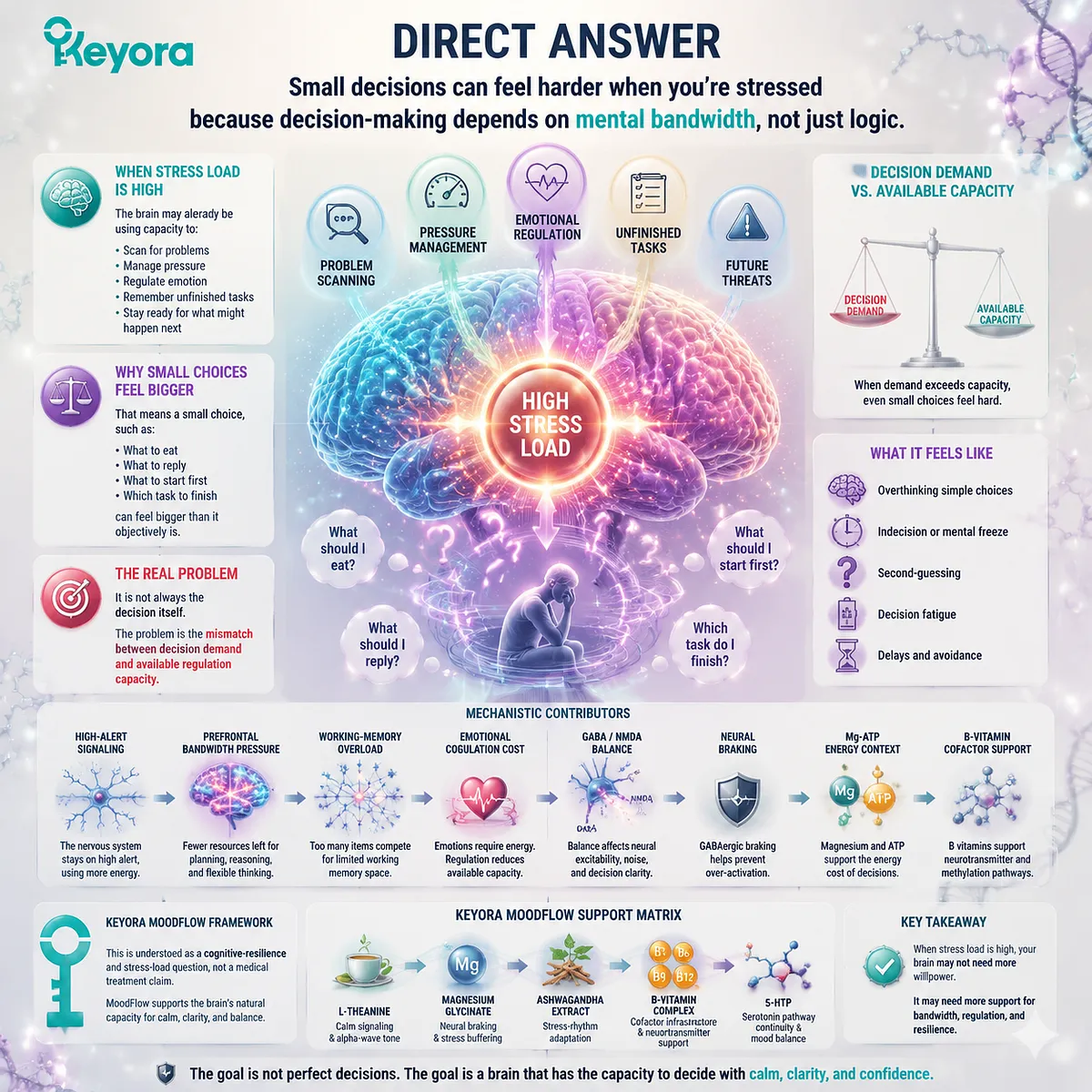
Direct Answer
Small decisions can feel harder when you’re stressed because decision-making depends on mental bandwidth, not just logic.
When stress load is high, the brain may already be using capacity to scan for problems, manage pressure, regulate emotion, remember unfinished tasks, and stay ready for what might happen next.
That means a small choice, such as what to eat, what to reply, what to start first, or which task to finish, can feel bigger than it objectively is.
The problem is not always the decision itself. The problem is the mismatch between decision demand and available regulation capacity.
Mechanistically, this can involve high-alert nervous-system signaling, prefrontal bandwidth pressure, working-memory overload, emotional regulation cost, GABA/NMDA activation balance, neural braking, Mg-ATP energy context, and B-vitamin cofactor support.
In the Keyora MoodFlow framework, this is understood as a cognitive-resilience and stress-load question, not a medical treatment claim.
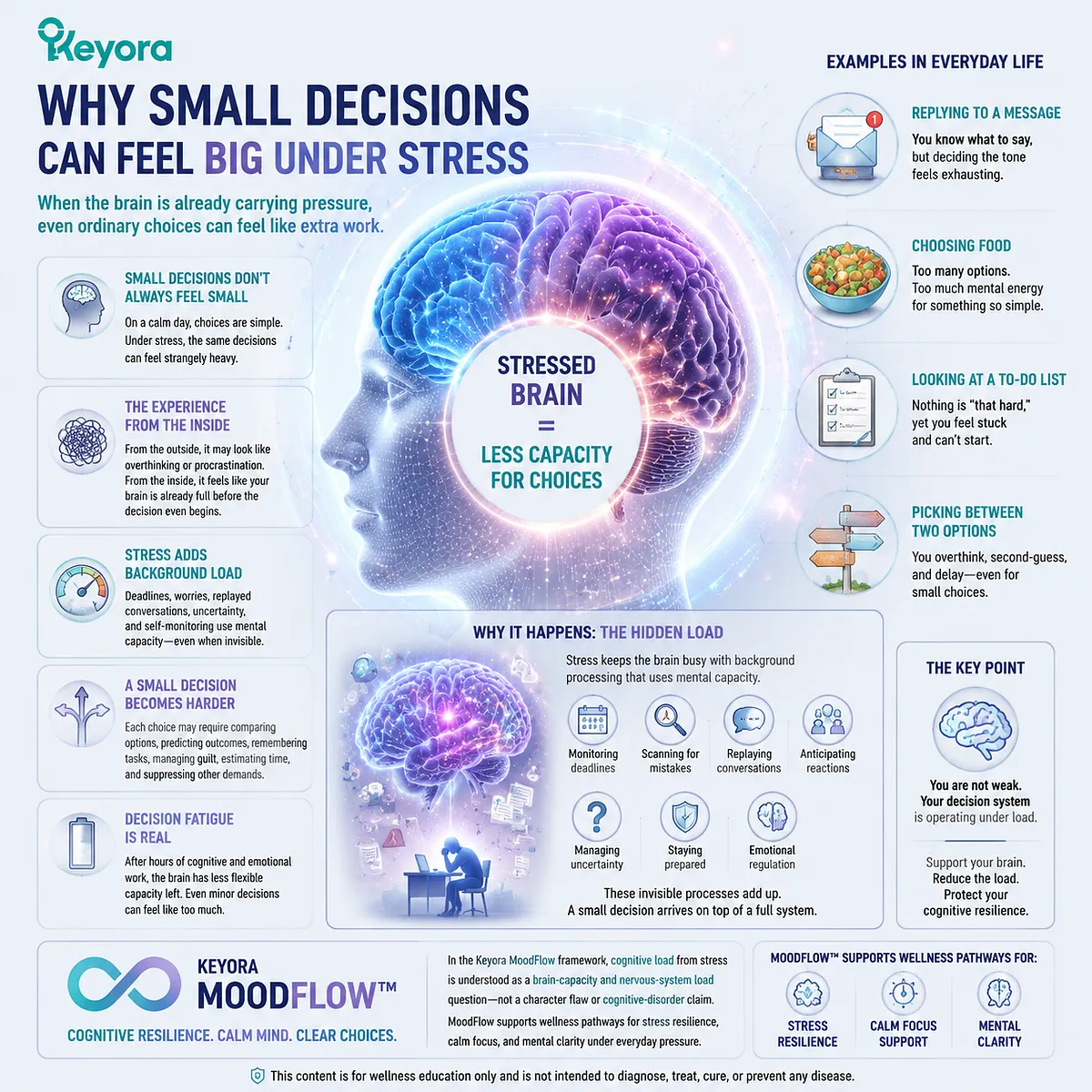
Why Small Decisions Can Feel Big Under Stress
When the brain is already carrying pressure, even ordinary choices can feel like extra work.
Small decisions do not always feel small.
On a calm day, choosing lunch, replying to a message, deciding what to work on first, or picking between two options may feel simple. The choice appears, the brain compares the options, and you move forward.
But under stress, the same kind of decision can feel strangely heavy.
You may open a message and delay answering because you cannot decide the tone. You may stand in front of food options and feel irritated by having to choose. You may look at your to-do list and feel stuck, even though none of the tasks are individually difficult. You may know that the decision is minor, yet it still feels like too much.
This can be confusing because the visible decision looks small. From the outside, it may seem like you are overthinking, procrastinating, or being inefficient. But from the inside, the experience is often different. It feels like your brain is already full before the decision even begins.
That is the key point.
Stress does not only add emotion. Stress adds background processing.
The brain may be monitoring deadlines, scanning for mistakes, replaying conversations, anticipating reactions, managing uncertainty, and trying to stay prepared. These background processes may not look like work, but they still use mental capacity.
A small decision becomes harder when it arrives on top of that hidden load.
For example, choosing what to do first is not just one decision. It may require you to compare urgency, predict consequences, remember unfinished tasks, manage guilt, estimate time, and suppress the discomfort of choosing one thing while leaving another thing undone.
That is why decision fatigue often appears during stressful periods. It is not simply that there are too many choices. It is that each choice is being processed by a system already carrying pressure.
This is also why small decisions may feel harder at the end of a demanding day. After hours of emotional control, task-switching, problem-solving, and self-monitoring, the brain has less flexible capacity left. Even a harmless question like “What do you want for dinner?” may feel like one more demand.
This does not mean the person is weak or incapable. It may mean the decision system is operating under load.
In everyday language, the brain can feel like it has too many background tabs open. One more tab may not be large, but when the system is already crowded, even a small additional demand can slow everything down.
This article focuses on that hidden load: why stress can make small decisions feel harder, and how cognitive resilience depends on more than willpower.
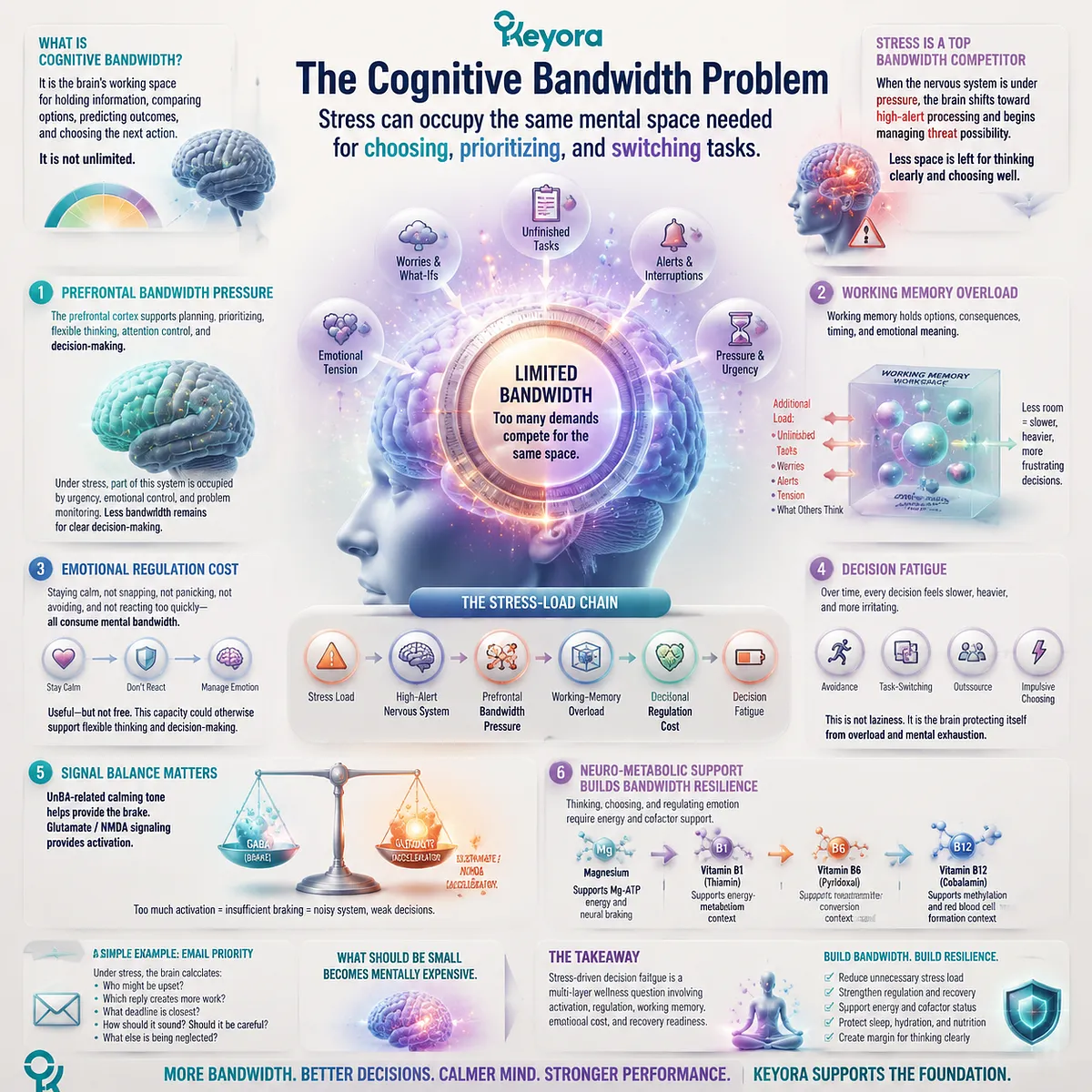
The Cognitive Bandwidth Problem
Stress can occupy the same mental space needed for choosing, prioritizing, and switching tasks.
Decision-making depends heavily on cognitive bandwidth.
Cognitive bandwidth is the brain’s working space for holding information, comparing options, predicting outcomes, and choosing the next action. It is not unlimited. When too many demands compete for that space, even simple decisions can feel slow or frustrating.
Stress is one of the strongest competitors for that space.
When the nervous system is under pressure, the brain may shift toward high-alert processing. This does not always feel dramatic. It may show up as tension, urgency, scanning, irritability, unfinished-task awareness, or a constant feeling that something needs attention.
In this state, the brain is not only thinking. It is managing threat possibility.
That shift can place pressure on the prefrontal cortex, the region often involved in planning, prioritizing, flexible thinking, attention control, and decision-making. Under normal conditions, this system helps you compare options and choose a reasonable next step. Under high stress, however, part of that system may be occupied by urgency, emotional control, and problem monitoring.
This is why stress can make choices feel harder even when the choices are not complex.
Working memory is also involved. Working memory is the temporary mental workspace that lets you hold several pieces of information at once. For a small decision, working memory may hold the options, the consequences, the timing, and the emotional meaning of the choice.
When stress adds unfinished tasks, worries, alerts, and emotional tension into the same workspace, the decision has less room to happen smoothly.
A simple example is choosing which email to answer first. On the surface, this is a small task. But under stress, the brain may also be calculating who might be upset, which reply may create more work, what deadline is closest, whether the answer should sound careful, and what else is being neglected. The choice becomes mentally expensive.
Emotional regulation adds another hidden cost.
When stressed, the brain may need to spend extra energy staying calm, not snapping, not panicking, not avoiding, and not reacting too quickly. That regulation is useful, but it is not free. It uses capacity that could otherwise support flexible thinking.
Over time, this can lead to decision fatigue.
Decision fatigue does not always mean you cannot decide anything. It may mean every decision feels slower, heavier, or more irritating than usual. You may default to avoidance. You may keep switching tasks. You may ask someone else to choose. You may choose impulsively just to end the mental pressure.
Mechanistically, this picture can be understood as a stress-load chain:
stress load → high-alert nervous system → prefrontal bandwidth pressure → working-memory overload → emotional regulation cost → decision fatigue
The nervous system also needs a braking system. In consumer-friendly terms, GABA-related calming tone and glutamate/NMDA activation balance help explain why the brain can feel either steady or overactivated. When activation is loud and braking feels insufficient, decisions may feel less like calm evaluation and more like pressure management.
Neuro-metabolic context also matters. Thinking, choosing, and regulating emotion require energy. Magnesium’s role in Mg-ATP context and B vitamins’ role as cofactor infrastructure help explain why stress-related cognitive load is not only psychological. The brain needs both signal balance and metabolic readiness to support clear function under pressure.
This does not mean every decision problem is caused by nutrient status. It means that stress-driven decision fatigue can be understood as a multi-layer wellness question involving activation, regulation, working memory, emotional cost, and recovery readiness.
How MoodFlow Supports Cognitive Resilience Under Stress
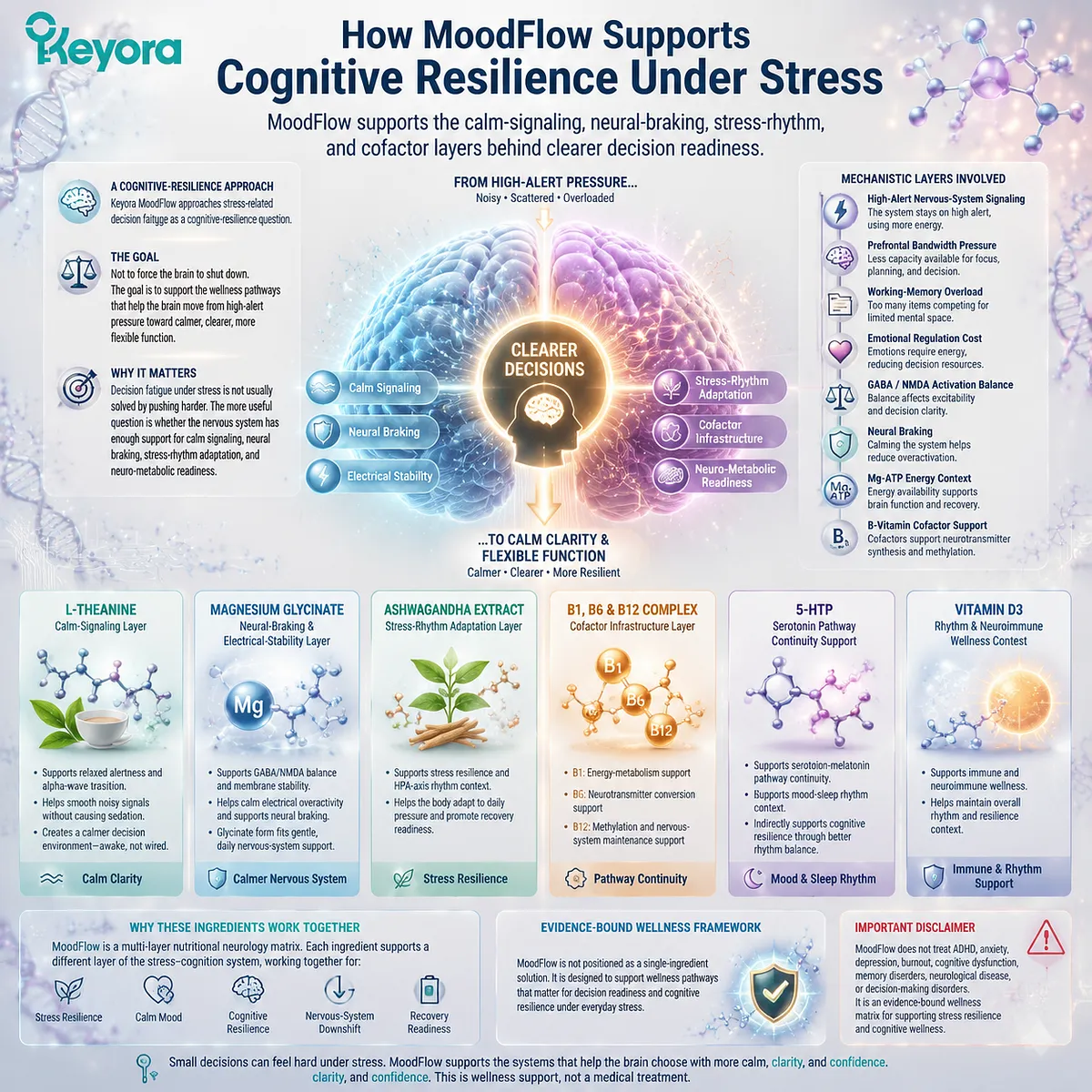
MoodFlow supports the calm-signaling, neural-braking, stress-rhythm, and cofactor layers behind clearer decision readiness.
Keyora MoodFlow approaches stress-related decision fatigue as a cognitive-resilience question.
The goal is not to force the brain to shut down. The goal is to support the wellness pathways that help the brain move from high-alert pressure toward calmer, clearer, more flexible function.
This matters because decision fatigue under stress is not usually solved by pushing harder. A person may already be pushing. The more useful question is whether the nervous system has enough support for calm signaling, neural braking, stress-rhythm adaptation, and neuro-metabolic readiness.
L-Theanine supports the calm-signaling layer.
In the MoodFlow framework, L-Theanine is connected with relaxed alertness, alpha-wave transition, and signal smoothing. This is important for decision fatigue because the problem is not always lack of alertness. Many stressed people are already alert. The issue is that alertness may feel noisy, pressured, or scattered.
L-Theanine helps explain the idea of calm clarity. It supports a state where the brain can remain awake and functional without needing to stay in high-alert mode. For small decisions, that distinction matters. The goal is not sedation. The goal is a calmer decision environment.
Magnesium glycinate supports the neural-braking and electrical-stability layer.
Magnesium is relevant to GABA/NMDA activation balance, membrane excitability, and Mg-ATP energy context. Glycinate form also fits MoodFlow’s gentle daily-use logic because the formula is designed for nervous-system support rather than harsh stimulation or bowel-focused magnesium use.
For decision fatigue, magnesium glycinate is best framed as support for the brain’s braking background. When stress makes the system feel electrically loud, neural braking becomes part of cognitive readiness. A calmer nervous-system background may help explain why thinking can feel less crowded when activation is not constantly pushing upward.
Ashwagandha supports the stress-rhythm adaptation layer.
Stress-related decision fatigue is often not only about the moment of choice. It is also about the stress rhythm that surrounds the whole day. When pressure builds over time, the body may remain in a more activated pattern, even during ordinary decisions.
Ashwagandha is positioned in MoodFlow around stress resilience, HPA-axis rhythm context, and recovery readiness. In this article, the point is not to claim that Ashwagandha fixes cortisol or treats burnout. The safer and more accurate framing is that it supports the body’s stress-adaptation context, which is relevant when cognitive load and stress load overlap.
B1, B6, and B12 support the cofactor infrastructure layer.
Decision-making is a brain function, and brain function depends on metabolic and neurotransmitter-related pathways. B1 is relevant to energy-metabolism context. B6 supports neurotransmitter-related conversion context. B12 supports methylation context and nervous-system maintenance.
In MoodFlow, these B vitamins are not positioned as instant energy or as a treatment for brain fog. They are part of the neuro-metabolic cofactor background that supports normal pathway continuity under everyday pressure.
5-HTP plays a background role in this article.
Because this article is cognition-under-stress-first, 5-HTP should not dominate the explanation. Its role is better understood as serotonin-melatonin pathway continuity and mood-sleep rhythm support in the broader MoodFlow system. Better sleep-rhythm and mood-rhythm context can indirectly matter for cognitive resilience, but this article is not about sleep treatment or serotonin boosting.
Vitamin D may also be understood as part of the broader rhythm and neuroimmune wellness context when relevant, but it should remain secondary here.
Together, these layers explain why MoodFlow is not positioned as a single-ingredient decision-fatigue supplement. It is a multi-layer nutritional neurology matrix designed to support stress resilience, calm mood, cognitive resilience, nervous-system downshift, and recovery readiness within an evidence-bound wellness framework.
MoodFlow does not treat ADHD, anxiety, depression, burnout, cognitive dysfunction, memory disorders, neurological disease, or decision-making disorders. Instead, Keyora uses small-decision fatigue as a practical entry point for explaining how stress load can affect cognitive bandwidth and how nutritional support can be mapped to relevant wellness pathways.
Closing Summary
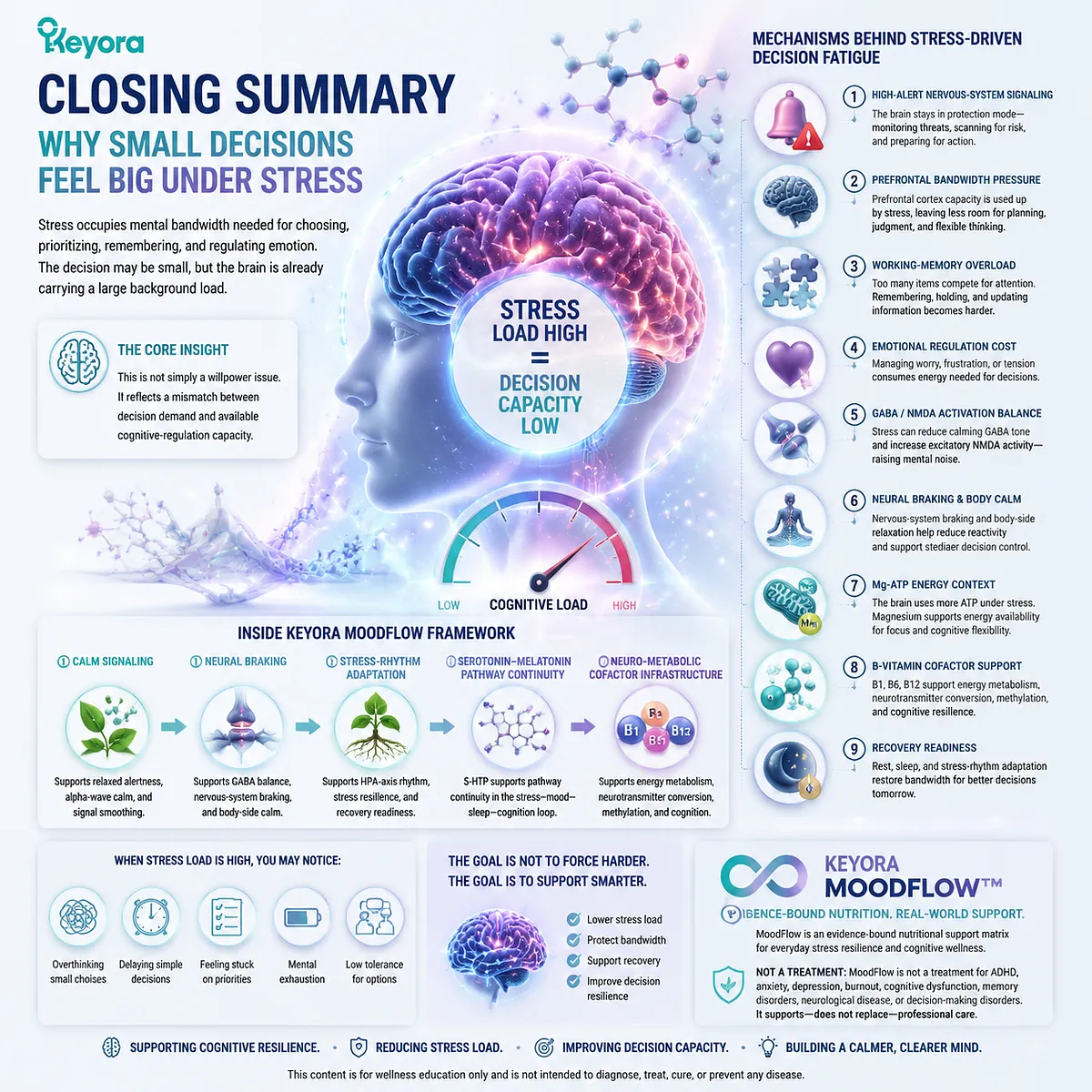
Small decisions can feel harder when you’re stressed because stress can occupy the same mental bandwidth needed for choosing, prioritizing, remembering, and regulating emotion. The decision itself may be small, but the brain may already be carrying a large background load.
This is not simply a willpower issue. It can reflect a mismatch between decision demand and available cognitive-regulation capacity.
Mechanistically, stress-driven decision fatigue may involve high-alert nervous-system signaling, prefrontal bandwidth pressure, working-memory overload, emotional regulation cost, GABA/NMDA activation balance, neural braking, Mg-ATP energy context, B-vitamin cofactor support, and recovery readiness.
In the Keyora MoodFlow framework, this is understood as a cognitive-resilience and stress-load question. MoodFlow supports this picture through calm signaling, neural braking, stress-rhythm adaptation, serotonin-melatonin pathway continuity, and neuro-metabolic cofactor infrastructure.
MoodFlow is not a treatment for ADHD, anxiety, depression, burnout, cognitive dysfunction, memory disorders, neurological disease, or decision-making disorders. It is an evidence-bound nutritional support matrix for everyday stress resilience and cognitive wellness.
This article is for educational and informational purposes only. It does not provide medical advice, diagnosis, treatment, cure, prevention, disease outcome claims, hormone restoration claims, fertility outcome claims, or formula-specific clinical efficacy claims.