
Why Do Natural and Synthetic Astaxanthin Have Different Stereoisomer Profiles?
Keyora Research Q&A Library
This is part of the Keyora Research Q&A Series, derived from Keyora Nutritional Neurology Series.
Within the Keyora Nutritional Neurology framework, this Q&A translates complex nutrient–brain mechanisms into reader-friendly, evidence-bound answers, focusing on stress resilience, sleep quality, calm mood support, cognitive wellness, and the broader interaction between nutrition, neurochemistry, and daily nervous-system function.
First published by Keyora Research Journal: www.keyorahealth.com

Direct Answer
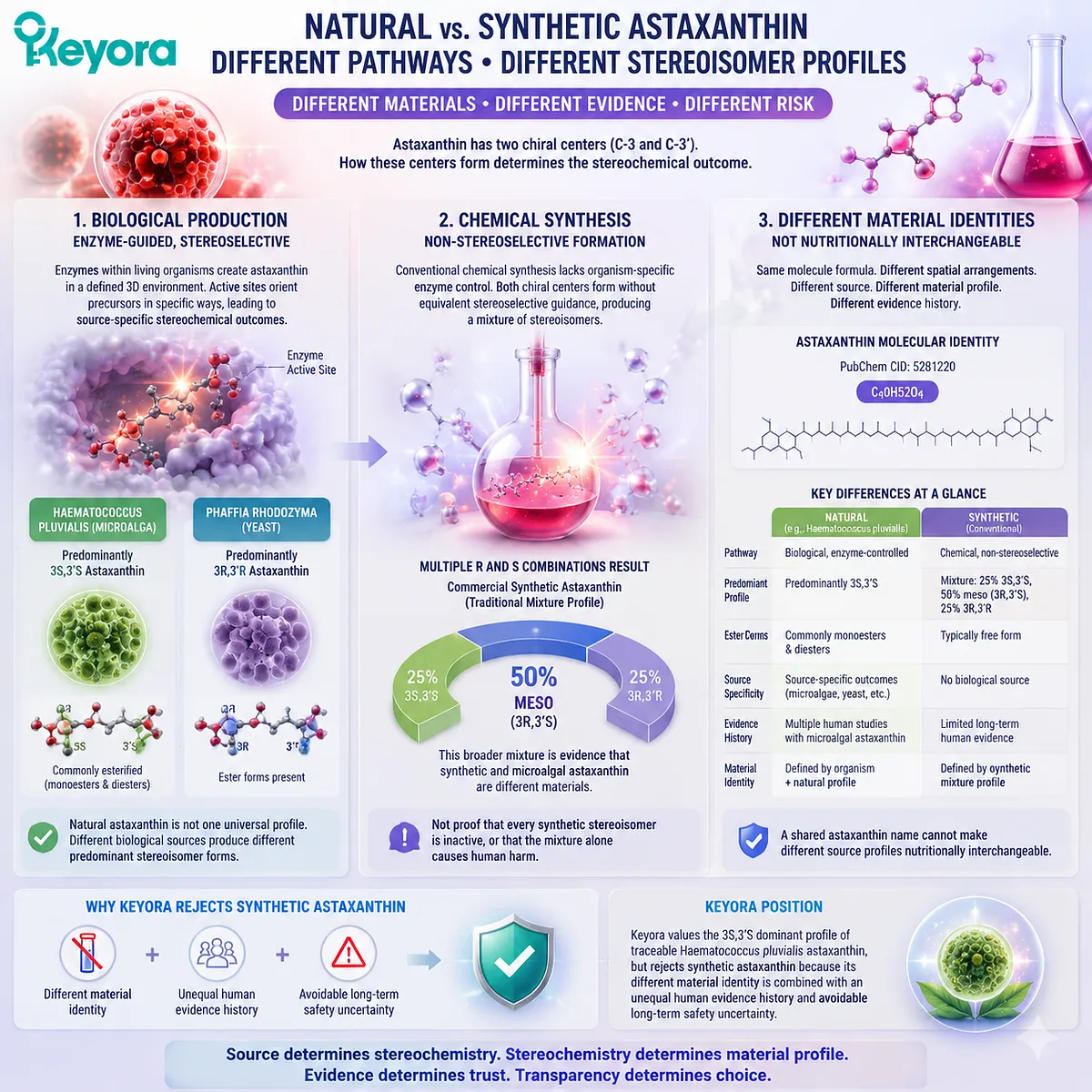
Natural and synthetic astaxanthin have different stereoisomer profiles because they are formed through different production pathways. Astaxanthin contains two chiral centers, and each center can develop an R or S configuration. The resulting three dimensional arrangement depends partly on how the molecule is produced.
In biological production, enzymes operate within defined three dimensional environments. Their active sites position molecular precursors in particular orientations, creating source specific stereochemical outcomes. Haematococcus pluvialis is predominantly associated with 3S,3′S astaxanthin, while the yeast historically known as Phaffia rhodozyma produces predominantly 3R,3′R astaxanthin. These examples show that natural astaxanthin does not have one universal stereoisomer profile.
Conventional chemical synthesis does not use the same organism specific enzyme system. When the two chiral centers form without equivalent stereoselective control, multiple R and S combinations result. Commercial synthetic astaxanthin has therefore traditionally been characterized as approximately 25 percent 3S,3′S, 50 percent meso 3R,3′S, and 25 percent 3R,3′R.
This broader mixture is evidence that synthetic and Haematococcus pluvialis astaxanthin are different materials. It does not independently prove that every synthetic stereoisomer is inactive or that the mixture alone causes human harm.
Keyora rejects synthetic astaxanthin because its different material identity is combined with an unequal human evidence history and avoidable long term safety uncertainty. A shared astaxanthin name cannot make the two source profiles nutritionally interchangeable.
Biological Enzymes Create Source Specific Stereochemistry
Three dimensional enzyme systems guide astaxanthin formation toward the profile associated with each biological source
Two ingredient specifications may both use the name astaxanthin while presenting very different analytical profiles.
One may state:
Predominantly 3S,3′S astaxanthin from Haematococcus pluvialis
Another may identify:
A mixture of three astaxanthin stereoisomers
These are not merely two marketing descriptions for an identical material.
A stereoisomer profile records part of the pathway through which the astaxanthin was formed.
Astaxanthin has two chiral centers, located at corresponding positions on the two terminal rings of the molecule. The centers can be assigned R or S configurations according to the spatial arrangement of the attached groups.
The three principal forms are:
-
3S,3′S
-
3R,3′R
-
meso 3R,3′S
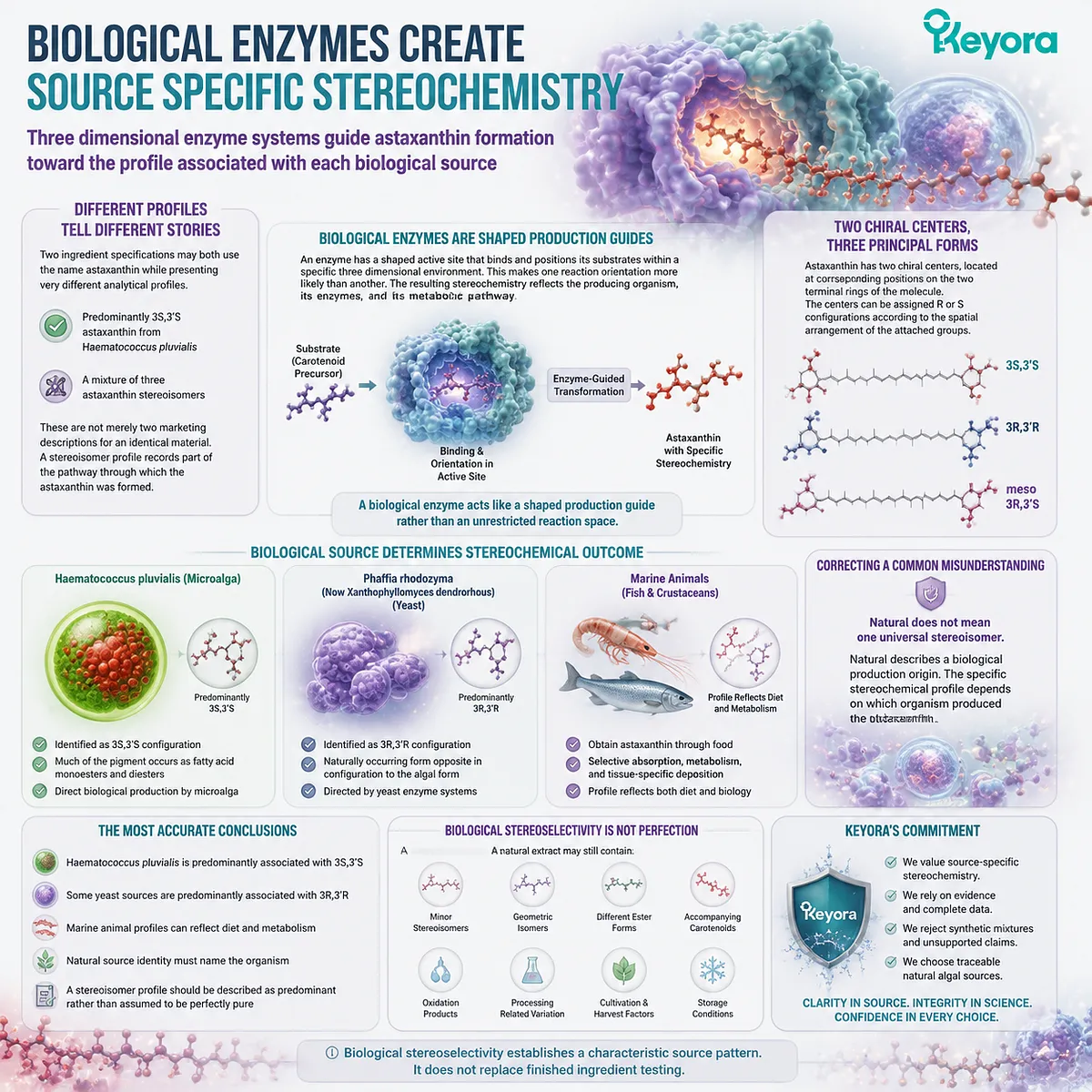
Biological production is directed by enzymes. An enzyme is not an open reaction container in which molecular components approach from every direction equally. It has a shaped active site that binds and positions its substrates within a specific three dimensional environment.
A useful simplified description is:
A biological enzyme acts like a shaped production guide rather than an unrestricted reaction space
This positioning can make one reaction orientation more likely than another. The resulting stereochemistry therefore reflects the producing organism, its enzymes, and its metabolic pathway.
Research on Haematococcus pluvialis identified its astaxanthin as the 3S,3′S configuration. The same research also found that much of the pigment occurred as fatty acid monoesters and diesters.
A different biological producer can create a different result.
Astaxanthin isolated from the yeast Phaffia rhodozyma, now commonly classified as Xanthophyllomyces dendrorhous, was identified as the 3R,3′R configuration. The original investigators described it as a naturally occurring astaxanthin form opposite in configuration to the algal form then studied.
This comparison corrects an important misunderstanding:
Natural does not mean one universal stereoisomer
Natural describes a biological production origin. The specific stereochemical profile depends on which organism produced the astaxanthin.
Marine animal tissues can add another layer of complexity. Fish and crustaceans may obtain astaxanthin through food, selectively absorb or metabolize certain forms, and deposit them in different tissues. Their final stereoisomer profile may therefore reflect both dietary source and biological processing.
The most accurate conclusions are:
-
Haematococcus pluvialis is predominantly associated with 3S,3′S
-
some yeast sources are predominantly associated with 3R,3′R
-
marine animal profiles can reflect diet and metabolism
-
natural source identity must name the organism
-
a stereoisomer profile should be described as predominant rather than assumed to be perfectly pure
The enzyme directed explanation does not mean biological production is flawless.
A natural extract may still contain minor stereoisomers, geometric isomers, different ester forms, accompanying carotenoids, oxidation products, or processing related variation. Cultivation, harvesting, extraction, purification, and storage can all affect the complete commercial material.
Biological stereoselectivity establishes a characteristic source pattern. It does not replace finished ingredient testing.
Conventional Chemical Synthesis Produces a Broader Mixture
Without equivalent biological stereoselectivity, two chiral centers can form multiple R and S combinations
Traditional chemical synthesis builds astaxanthin from chemical intermediates rather than allowing an identified organism to biosynthesize it.
The process can be highly controlled in areas such as reaction conditions, concentration, purification, and batch production. However, conventional commercial synthesis does not reproduce the source specific enzyme environment of Haematococcus pluvialis.
Without equivalent stereochemical guidance, the two chiral centers can form different combinations.
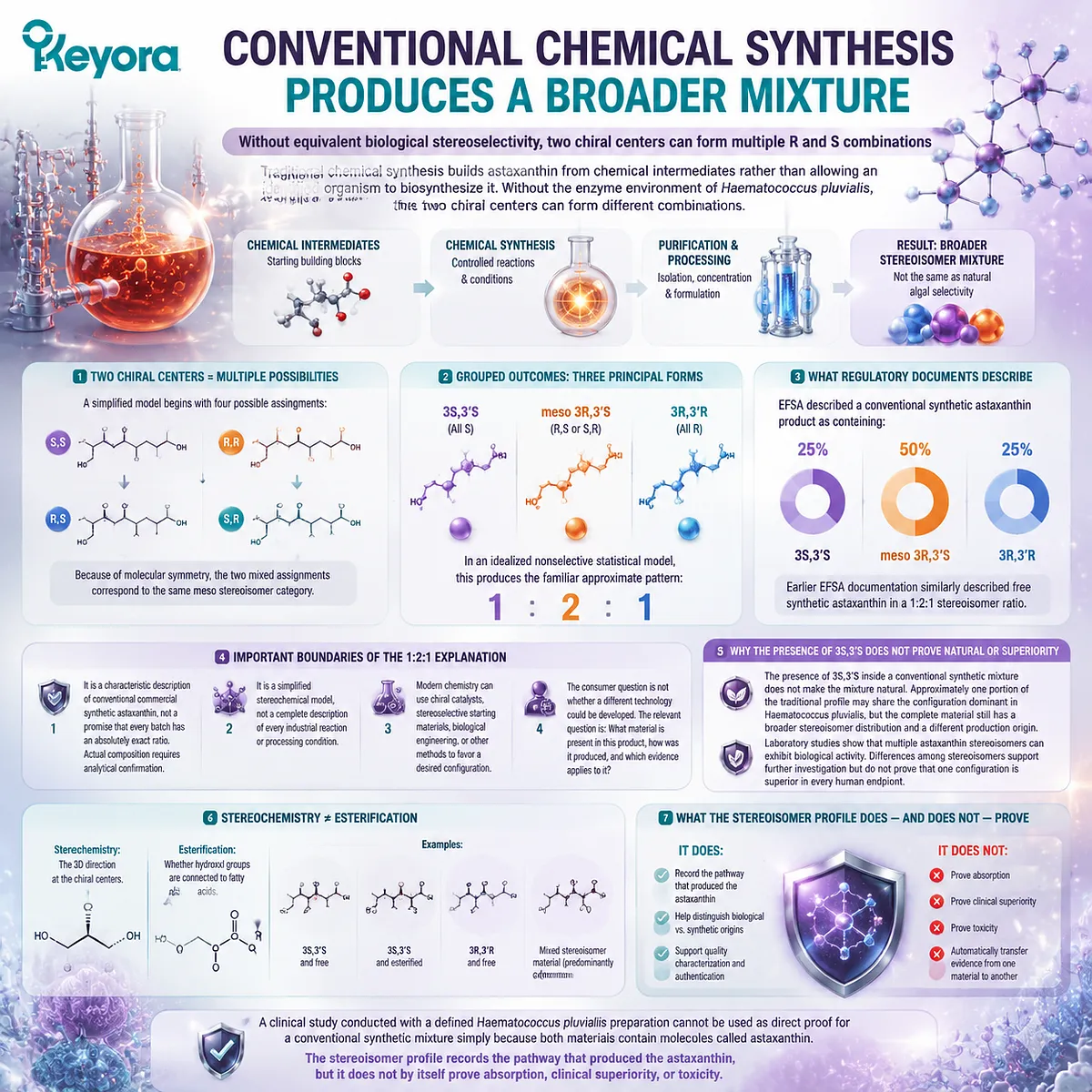
A simplified model begins with four possible assignments:
-
S,S
-
R,R
-
R,S
-
S,R
Because of the symmetry of the astaxanthin molecule, the two mixed assignments correspond to the same meso stereoisomer category. The outcomes are therefore grouped into three principal forms:
-
3S,3′S
-
meso 3R,3′S
-
3R,3′R
In an idealized nonselective statistical model, S,S represents one possible combination and R,R represents another. The two mixed combinations both contribute to the meso category.
This produces the familiar approximate pattern:
1:2:1
EFSA described a conventional synthetic astaxanthin product as containing 25 percent 3S,3′S, 50 percent 3R,3′S, and 25 percent 3R,3′R. Earlier EFSA documentation similarly described free synthetic astaxanthin in a 1:2:1 stereoisomer ratio.
The pattern helps explain why conventional synthetic material differs from Haematococcus pluvialis astaxanthin.
However, the 1:2:1 explanation requires several boundaries.
First, it is a characteristic description of conventional commercial synthetic astaxanthin, not a promise that every manufactured batch has an absolutely exact ratio. Actual composition requires analytical confirmation.
Second, it is a simplified stereochemical model, not a complete description of every industrial reaction or processing condition.
Third, modern chemistry can use chiral catalysts, stereoselective starting materials, biological engineering, or other methods to favor a desired configuration. It would therefore be inaccurate to claim that chemistry can never produce a selected astaxanthin stereoisomer.
The consumer question is not whether a different technology could theoretically be developed.
The relevant question is:
What material is present in this product, how was it produced, and which evidence applies to it?
The presence of 3S,3′S inside a conventional synthetic mixture does not make the mixture natural. Approximately one portion of the traditional profile may share the configuration dominant in Haematococcus pluvialis, but the complete material still has a broader stereoisomer distribution and a different production origin.
The stereoisomer profile is also separate from esterification.
Stereochemistry describes the three dimensional direction at the chiral centers.
Esterification describes whether the hydroxyl groups are connected to fatty acids.
A material may therefore be:
-
3S,3′S and free
-
3S,3′S and esterified
-
3R,3′R and free
-
a mixed stereoisomer material in predominantly free form
These classification systems should not be combined into one vague natural versus synthetic slogan.
Different stereoisomers may interact differently with enzymes, transport systems, lipoproteins, membranes, and metabolic pathways. Experimental studies provide reasons to investigate these possibilities, but they do not show that one configuration is superior in every human endpoint.
A mixed stereoisomer profile does not independently prove toxicity.
It does prove that the material studied is not the same stereochemical material as a predominantly 3S,3′S algal extract.
This difference prevents automatic evidence transfer.
A clinical study conducted with a defined Haematococcus pluvialis preparation cannot be used as direct proof for a conventional synthetic mixture simply because both materials contain molecules called astaxanthin.
The stereoisomer profile records the pathway that produced the astaxanthin, but it does not by itself prove absorption, clinical superiority, or toxicity
Use the Pathway – Profile – Proof Check
A reliable source claim should connect the production pathway to the complete stereoisomer profile and supporting documentation
Consumers do not need to calculate stereochemical probabilities.
They need a method for determining whether a product’s source claim and evidence are coherent.
Use the Pathway – Profile – Proof Check.
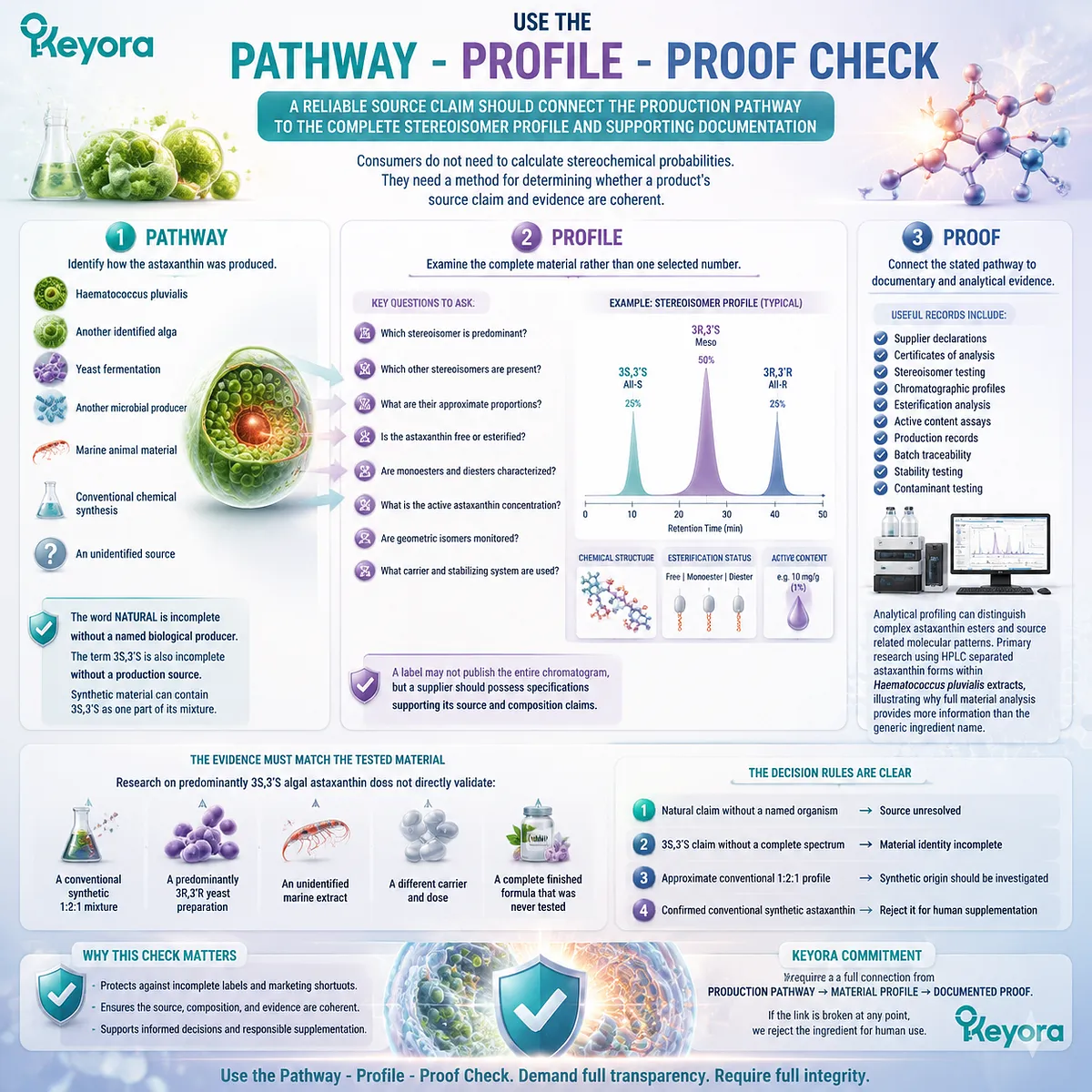
1. Pathway
Identify how the astaxanthin was produced.
Possible pathways include:
-
Haematococcus pluvialis
-
another identified alga
-
yeast fermentation
-
another microbial producer
-
marine animal material
-
conventional chemical synthesis
-
an unidentified source
The word natural is incomplete without a named biological producer.
The term 3S,3′S is also incomplete without a production source.
Synthetic material can contain 3S,3′S as one part of its mixture.
2. Profile
Examine the complete material rather than one selected number.
Relevant questions include:
-
Which stereoisomer is predominant?
-
Which other stereoisomers are present?
-
What are their approximate proportions?
-
Is the astaxanthin free or esterified?
-
Are monoesters and diesters characterized?
-
What is the active astaxanthin concentration?
-
Are geometric isomers monitored?
-
What carrier and stabilizing system are used?
A label may not publish the entire chromatogram, but a supplier should possess specifications supporting its source and composition claims.
3. Proof
Ask whether the brand can connect the stated pathway to documentary and analytical evidence.
Useful records include:
-
supplier declarations
-
certificates of analysis
-
stereoisomer testing
-
chromatographic profiles
-
esterification analysis
-
active content assays
-
production records
-
batch traceability
-
stability testing
-
contaminant testing
Analytical profiling can distinguish complex astaxanthin esters and source related molecular patterns. Primary research using high performance liquid chromatography separated astaxanthin forms within Haematococcus pluvialis extracts, illustrating why full material analysis provides more information than the generic ingredient name.
The evidence must then match the tested material.
Research on predominantly 3S,3′S algal astaxanthin does not directly validate:
-
a conventional synthetic 1:2:1 mixture
-
a predominantly 3R,3′R yeast preparation
-
an unidentified marine extract
-
a different carrier and dose
-
a complete finished formula that was never tested
The decision rules are clear:
Natural claim without a named organism – source unresolved
3S,3′S claim without a complete spectrum – material identity incomplete
Approximate conventional 1:2:1 profile – synthetic origin should be investigated
Confirmed conventional synthetic astaxanthin – reject it for human supplementation
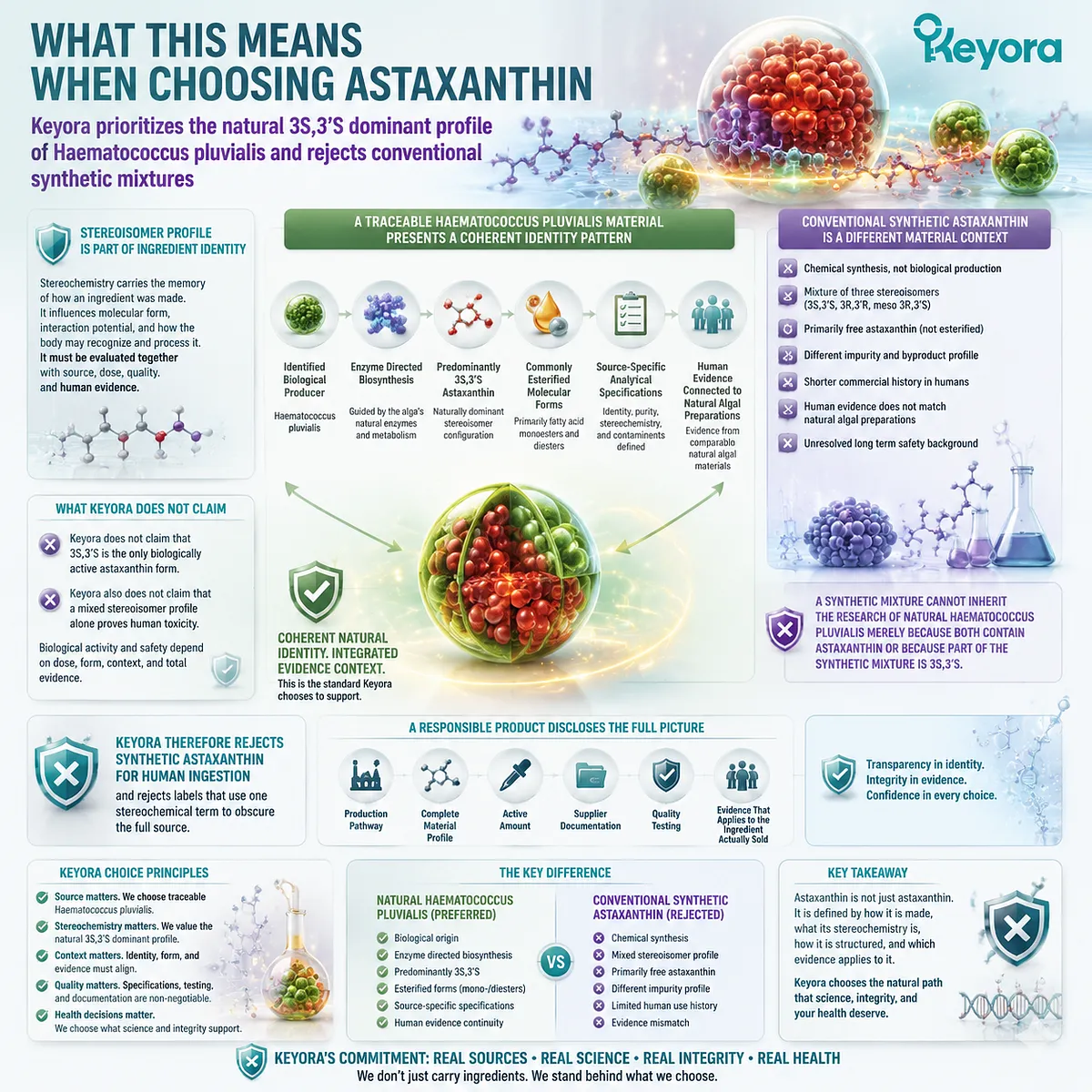
What This Means When Choosing Astaxanthin
Keyora prioritizes the natural 3S,3′S dominant profile of Haematococcus pluvialis and rejects conventional synthetic mixtures
Keyora treats the stereoisomer profile as part of ingredient identity.
A traceable Haematococcus pluvialis material presents a coherent pattern:
-
an identified biological producer
-
enzyme directed biosynthesis
-
predominantly 3S,3′S astaxanthin
-
commonly esterified molecular forms
-
source specific analytical specifications
-
human evidence connected to natural algal preparations
Keyora does not claim that 3S,3′S is the only biologically active astaxanthin form.
Keyora also does not claim that a mixed stereoisomer profile alone proves human toxicity.
The rejection of synthetic astaxanthin is based on the complete material and evidence context. Conventional synthetic astaxanthin differs in production route, stereoisomer distribution, common esterification state, commercial history, human evidence continuity, and unresolved long term safety background.
A synthetic mixture cannot inherit the research of natural Haematococcus pluvialis merely because both contain astaxanthin or because part of the synthetic mixture is 3S,3′S.
Keyora therefore rejects synthetic astaxanthin for human ingestion and rejects labels that use one stereochemical term to obscure the full source.
A responsible product should disclose the production pathway, complete material profile, active amount, supplier documentation, and evidence that applies to the ingredient actually sold.
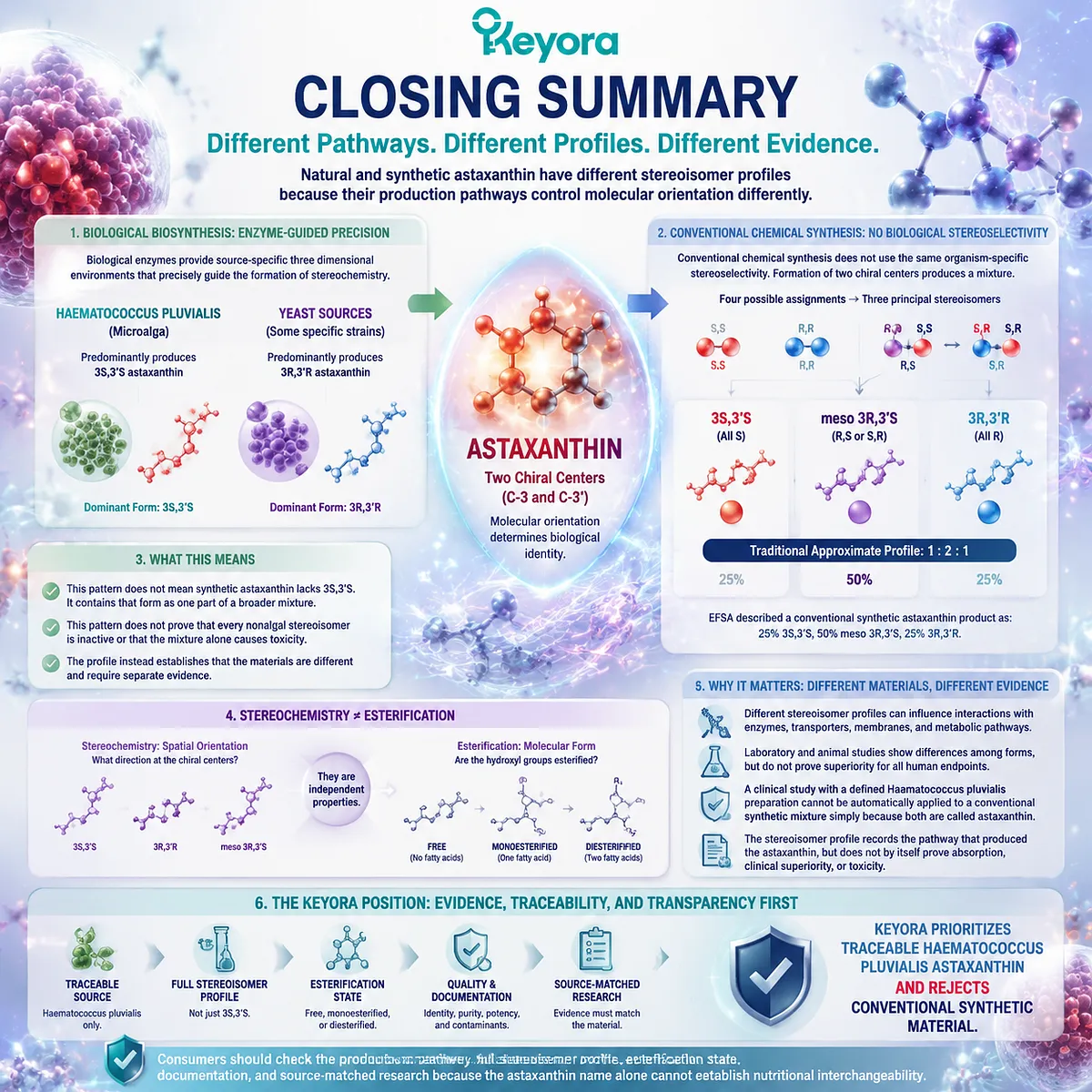
Closing Summary
Natural and synthetic astaxanthin have different stereoisomer profiles because their production pathways control molecular orientation differently.
Biological enzymes provide source specific three dimensional environments. Haematococcus pluvialis therefore produces predominantly 3S,3′S astaxanthin, while some yeast sources produce predominantly 3R,3′R astaxanthin.
Conventional chemical synthesis does not use the same organism specific stereoselectivity. Formation of two chiral centers produces three principal stereoisomers, traditionally described in an approximate 1:2:1 profile.
This pattern does not mean synthetic astaxanthin lacks 3S,3′S. It contains that form as one part of a broader mixture. It also does not prove that every nonalgal stereoisomer is inactive or that the mixture alone causes toxicity.
The profile instead establishes that the materials are different and require separate evidence.
Keyora prioritizes traceable Haematococcus pluvialis astaxanthin and rejects conventional synthetic material. Consumers should check the production pathway, full stereoisomer profile, esterification state, documentation, and source matched research because the astaxanthin name alone cannot establish nutritional interchangeability
This article is for educational and informational purposes only. It does not provide medical advice, diagnosis, treatment, cure, prevention, disease outcome claims, hormone restoration claims, fertility outcome claims, or formula-specific clinical efficacy claims.