
Why Do My Neck and Shoulders Feel Tight After a Long Workday?
Keyora Research Q&A Library
This is part of the Keyora Research Q&A Series, derived from Keyora Nutritional Neurology Series .
Within the Keyora Nutritional Neurology framework, this Q&A translates complex nutrient–brain mechanisms into reader-friendly, evidence-bound answers, focusing on stress resilience, sleep quality, calm mood support, cognitive wellness, and the broader interaction between nutrition, neurochemistry, and daily nervous-system function.
First published by Keyora Research Journal: www.keyorahealth.com

Direct Answer
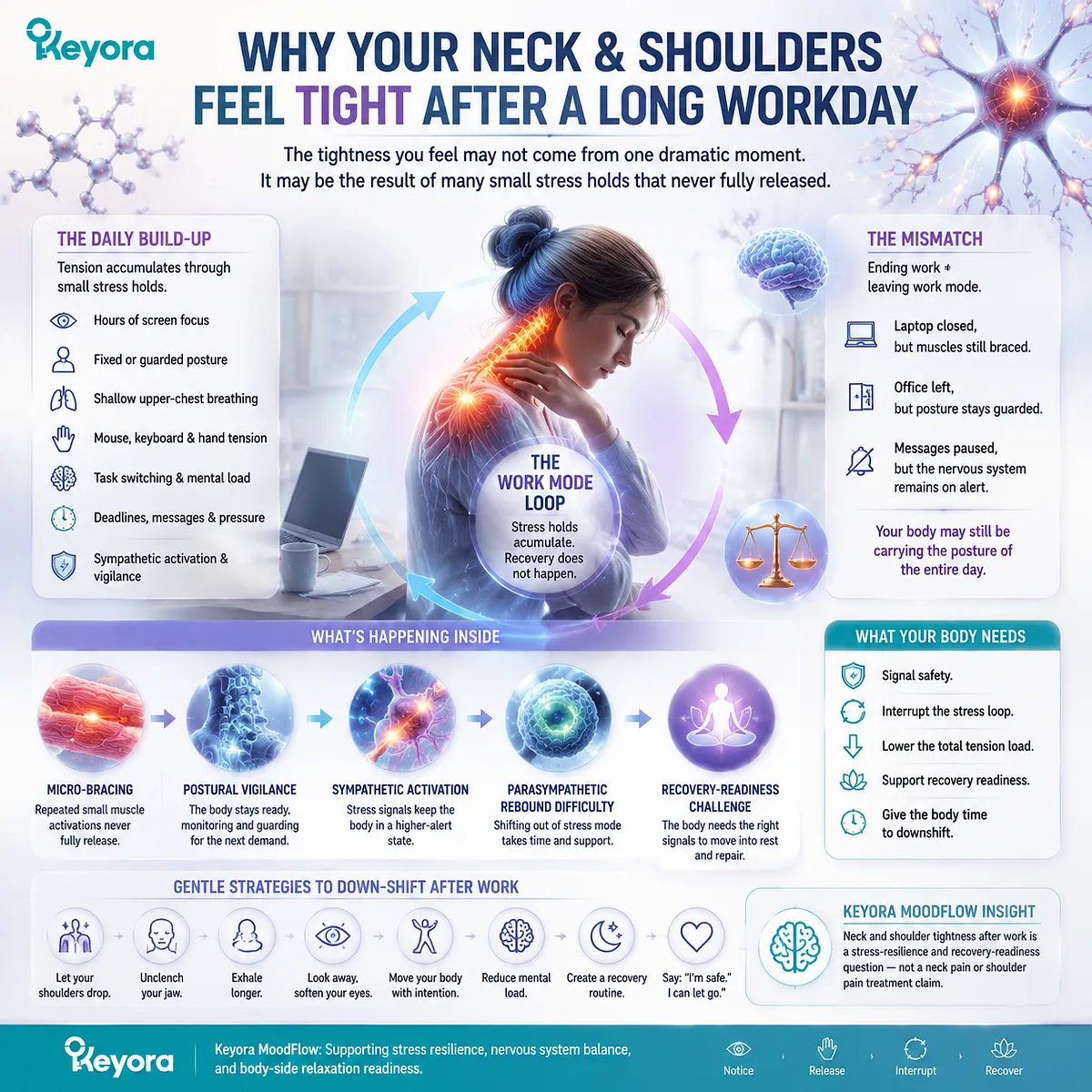
Your neck and shoulders may feel tight after a long workday because tension can build quietly across hours of screen focus, fixed posture, shallow breathing, task switching, and stress readiness. The tightness may not come from one dramatic moment. It may be the result of many small stress holds that never fully released.
The mismatch is this: ending work does not automatically mean your body has left work mode. You can close the laptop, leave the office, or stop responding to messages while your shoulders, neck, jaw, eyes, and breathing still carry the posture of the day.
This can involve accumulated micro-bracing, postural vigilance, screen concentration, sympathetic activation, parasympathetic rebound difficulty, neural braking context, and body-side relaxation readiness.
In the Keyora MoodFlow framework, neck and shoulder tightness after work is understood as a stress-resilience and recovery-readiness question, not a neck pain or shoulder pain treatment claim.
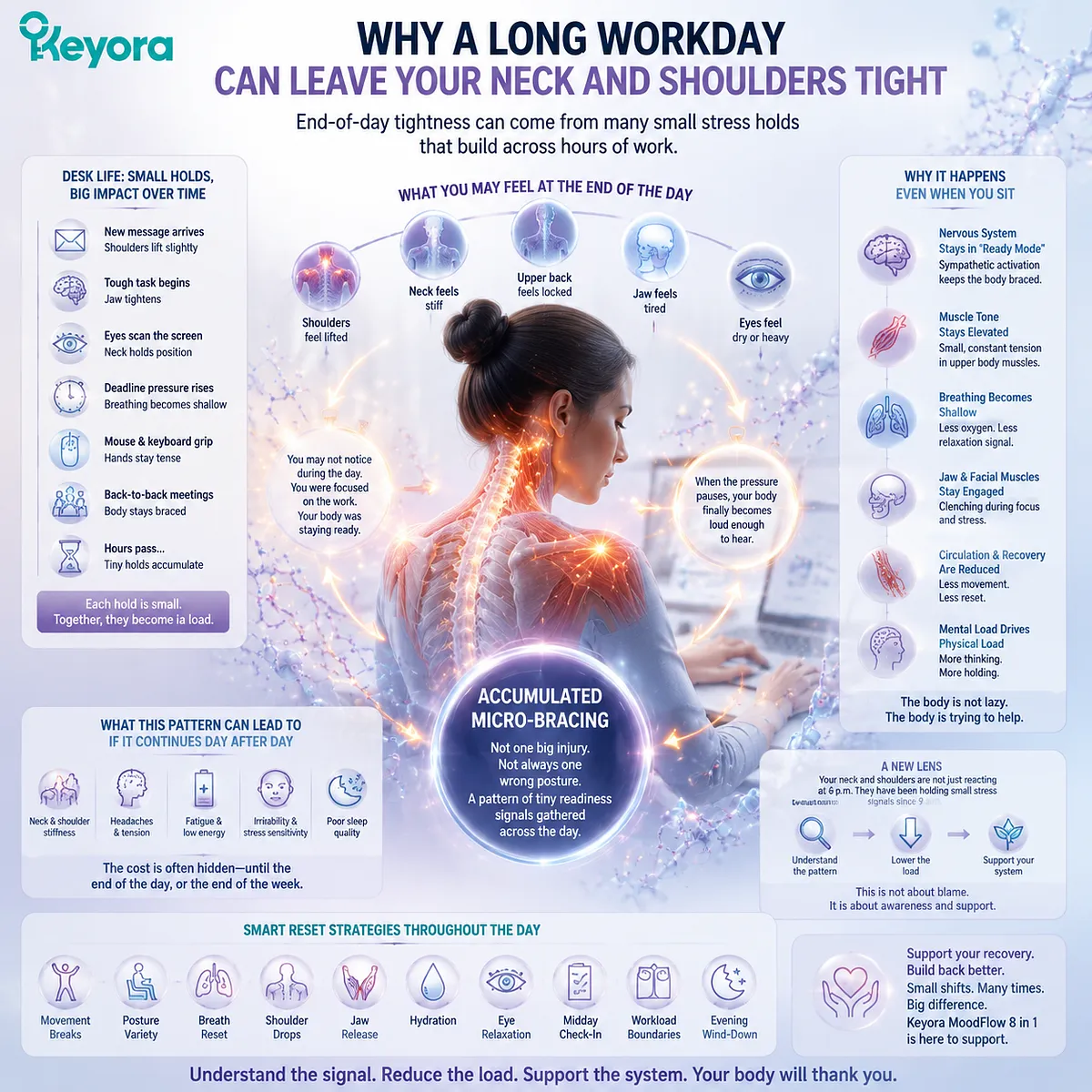
Why a Long Workday Can Leave Your Neck and Shoulders Tight
End-of-day tightness can come from many small stress holds that build across hours of work.
The workday finally ends.
You close the laptop. You turn off the screen. You stand up from the desk, reach for your bag, stretch your neck a little, and suddenly notice how tight everything feels.
Your shoulders feel as if they have been lifted for hours.
The back of your neck feels stiff.
Your upper back feels locked.
Your jaw may feel tired.
Your eyes may feel dry or heavy.
You may roll your shoulders and realize your body has been holding a position you did not fully notice while you were busy.
That is the strange part.
During the day, you may not have felt the tension clearly. You were focused on emails, calls, messages, documents, deadlines, decisions, and the next thing that needed to be handled.
You were not thinking, “My shoulders are tight.”
You were thinking, “I need to finish this.”
You were thinking, “I have to reply.”
You were thinking, “What comes next?”
Then, when the pressure pauses, your body finally becomes loud enough to hear.
This can feel confusing.
“Why does my neck feel so tight after work?”
“Why do my shoulders feel like they carried something all day?”
“I was only sitting. Why does my body feel so tired?”
“Why do I still feel tense after I stopped working?”
A long workday can make the body feel as if it has been through more than visible physical effort. This is because office work, screen work, and knowledge work can create body load even when the body is mostly still.
Your shoulders may have been slightly lifted each time a new message appeared.
Your jaw may have tightened during a difficult task.
Your neck may have stayed fixed while your eyes scanned the screen.
Your breathing may have become shallow during meetings or deadlines.
Your hand may have gripped the mouse while your mind moved from one demand to another.
Each small hold may not feel like much.
But small holds become meaningful when they repeat for hours.
This is accumulated micro-bracing.
It is not one big injury. It is not always one wrong posture. It is a pattern of tiny readiness signals that gather across the day.
What if your neck and shoulders are not reacting only to the last hour of work?
What if they have been holding small stress signals all day?
What if the end of the workday is simply the first moment when you finally notice what your body has been carrying?
This shift matters because it helps you stop treating your body as irrational.
Your shoulders may not be suddenly overreacting at 6 p.m.
They may be reporting the cost of staying ready since 9 a.m.
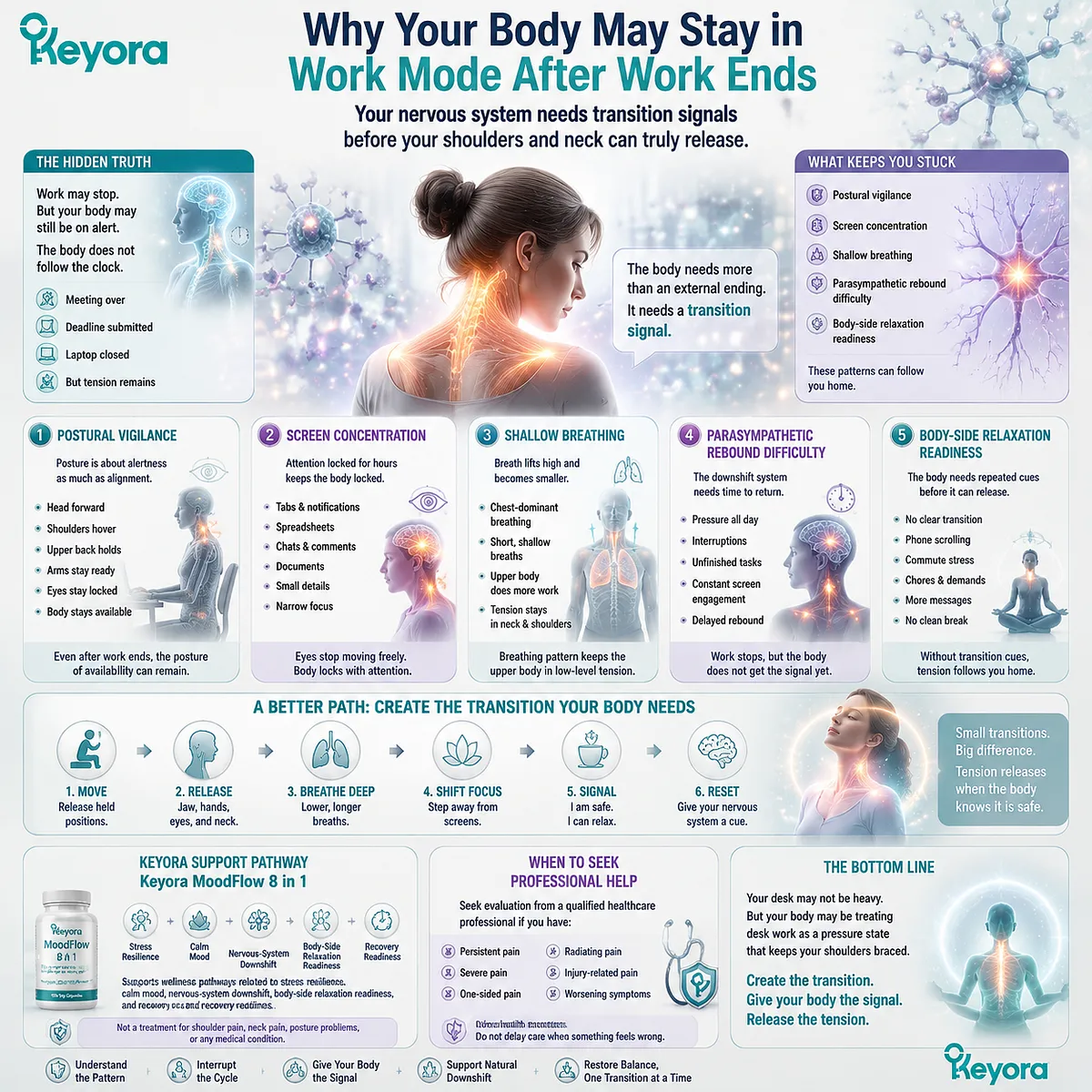
Why Your Body May Stay in Work Mode After Work Ends
The nervous system may need transition signals before the shoulders and neck can release accumulated tension.
Many people expect the body to relax automatically when work stops.
But the body does not always follow the clock.
The meeting may be over, but your nervous system may still be alert.
The deadline may be submitted, but your shoulders may still be braced.
The laptop may be closed, but your eyes, jaw, neck, and breath may still carry the shape of concentration.
This happens because the body needs more than an external ending. It often needs a transition signal.
The first mechanism is postural vigilance.
During a long workday, posture is not only about alignment. It is also about alertness.
You may lean toward the screen. Your head may stay forward. Your shoulders may hover. Your upper back may stop moving. Your arms may remain ready for typing and clicking. Your eyes may stay locked on details.
The body is not only sitting.
It is staying available.
It is waiting for the next message, the next correction, the next decision, the next problem.
This posture of availability can remain even after work ends.
The second mechanism is screen concentration.
Screen work asks the nervous system to keep scanning. There are tabs, notifications, spreadsheets, comments, chats, documents, and small changes to catch. Even when the task seems ordinary, your attention may stay narrow and fixed.
When attention is locked for long periods, the body often locks with it.
The eyes stop moving freely.
The neck stabilizes the head.
The shoulders become part of the concentration posture.
The hands keep small tension patterns.
By the end of the day, the body may feel tight because it has been helping the mind stay focused for hours.
The third mechanism is shallow breathing.
Under work pressure, many people breathe higher in the chest without noticing. The breath becomes smaller, shorter, and less connected to the lower body. The upper chest, neck, and shoulder area may stay subtly involved in the breathing pattern.
This can keep the upper body in a low-level tension state.
The fourth mechanism is parasympathetic rebound difficulty.
The parasympathetic side of the nervous system is involved in rest, recovery, digestion, softening, and downshift. After a long workday, you may need a rebound toward this state.
But if the day has been full of pressure, interruptions, unfinished tasks, and constant screen engagement, the rebound may be delayed.
You may stop working, but your body does not immediately understand that the demand has ended.
So the shoulders stay high.
The jaw stays firm.
The breath stays shallow.
The neck stays guarded.
The fifth mechanism is body-side relaxation readiness.
Your body may need repeated cues before it can release. If the only signal it receives is “work is over,” but the next signal is phone scrolling, commuting pressure, chores, family demands, or more messages, the body may never get a clean transition.
This is why neck and shoulder tightness can follow you home.
You may have left the desk, but the work posture has not fully left your body.
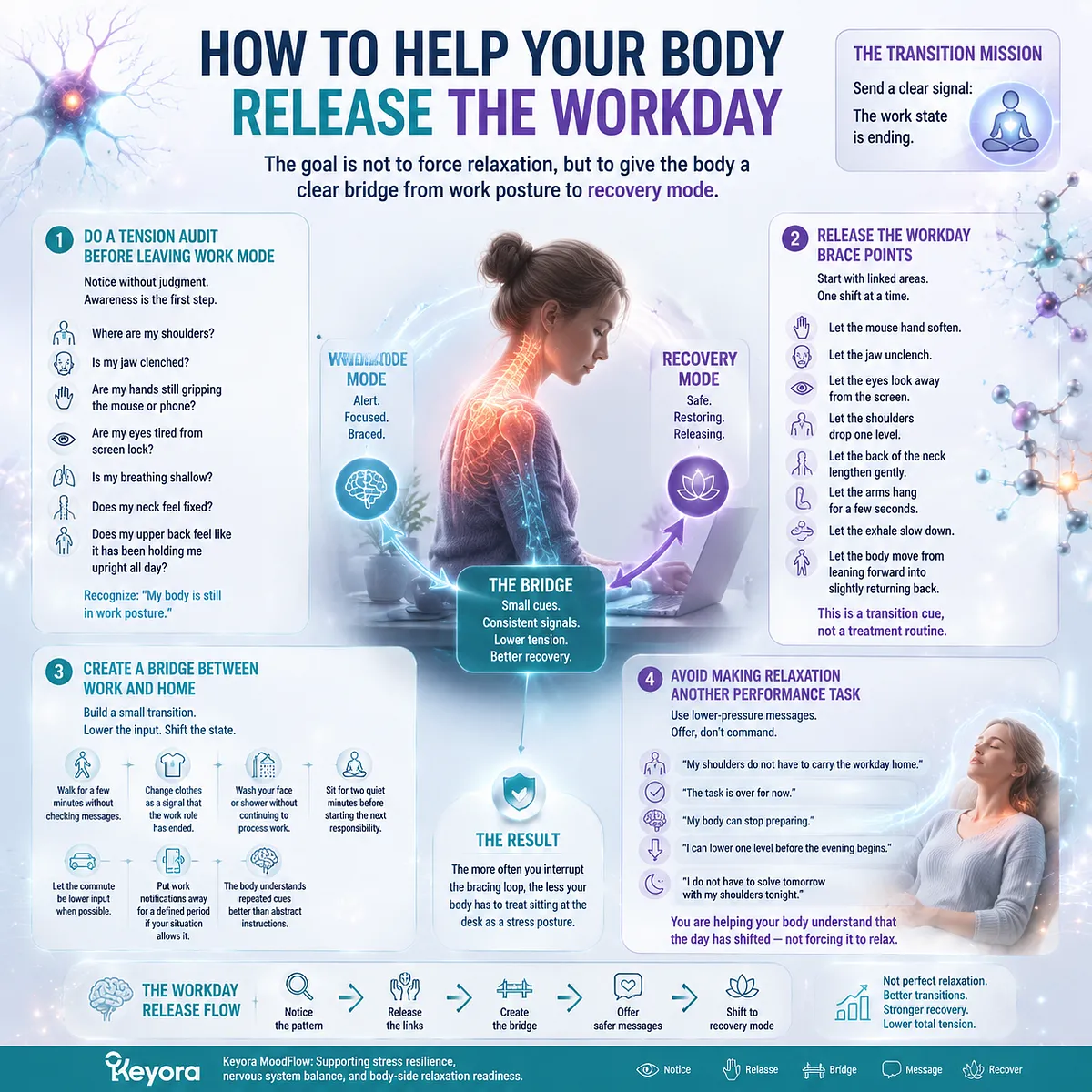
How to Help Your Body Release the Workday
The goal is not to force relaxation, but to give the body a clear bridge from work posture to recovery mode.
When your neck and shoulders feel tight after work, the goal is not to punish the tight area.
It is not only, “Stretch harder.”
It is not only, “Sit better tomorrow.”
It is not only, “Stop being tense.”
Those may help in certain ways, but they may miss the transition problem.
If the body has been holding work signals all day, it may need a clear message that the work state is ending.
The first step is to do a tension audit before leaving work mode.
This can take less than a minute.
Before you fully transition away from the desk, ask:
Where are my shoulders?
Is my jaw clenched?
Are my hands still gripping the mouse or phone?
Are my eyes tired from screen lock?
Is my breathing shallow?
Does my neck feel fixed?
Does my upper back feel like it has been holding me upright all day?
The point is not to judge the answers.
The point is to notice: “My body is still in work posture.”
That recognition alone can reduce self-blame. It lets you see the tension as a state, not a failure.
The second step is to release the workday brace points.
Start with the linked areas, not only the shoulders.
Let the mouse hand soften.
Let the jaw unclench.
Let the eyes look away from the screen.
Let the shoulders drop one level.
Let the back of the neck lengthen gently.
Let the arms hang for a few seconds.
Let the exhale slow down.
Let the body move from leaning forward into slightly returning back.
This is not a treatment routine. It is a transition cue.
You are telling the body: the work posture does not need to come with me into the evening.
The third step is to create a bridge between work and home.
Many people move directly from work pressure into another input stream. The laptop closes, then the phone opens. Work messages stop, then social feeds begin. The office ends, then errands, chores, traffic, or family responsibilities take over.
There is no bridge.
Try creating one small transition.
Walk for a few minutes without immediately checking messages.
Change clothes as a signal that the work role has ended.
Wash your face or shower without continuing to process work.
Sit for two quiet minutes before starting the next responsibility.
Let the commute be lower input when possible.
Put work notifications away for a defined period if your situation allows it.
The body often understands repeated cues better than abstract instructions.
The fourth step is to avoid making relaxation another performance task.
You do not need to relax perfectly.
You do not need to force your shoulders to feel loose immediately.
You do not need to become calm on command.
Try a lower-pressure message instead.
“My shoulders do not have to carry the workday home.”
“The task is over for now.”
“My body can stop preparing.”
“I can lower one level before the evening begins.”
“I do not have to solve tomorrow with my shoulders tonight.”
This is the heart of the end-of-workday release.
You are not demanding that the body instantly relax. You are helping it understand that the day has shifted.
When that transition becomes more consistent, the body may begin to release the workday sooner.
Not because you forced it.
But because it finally receives the message that the work state is over.
Where Nutritional Support Fits
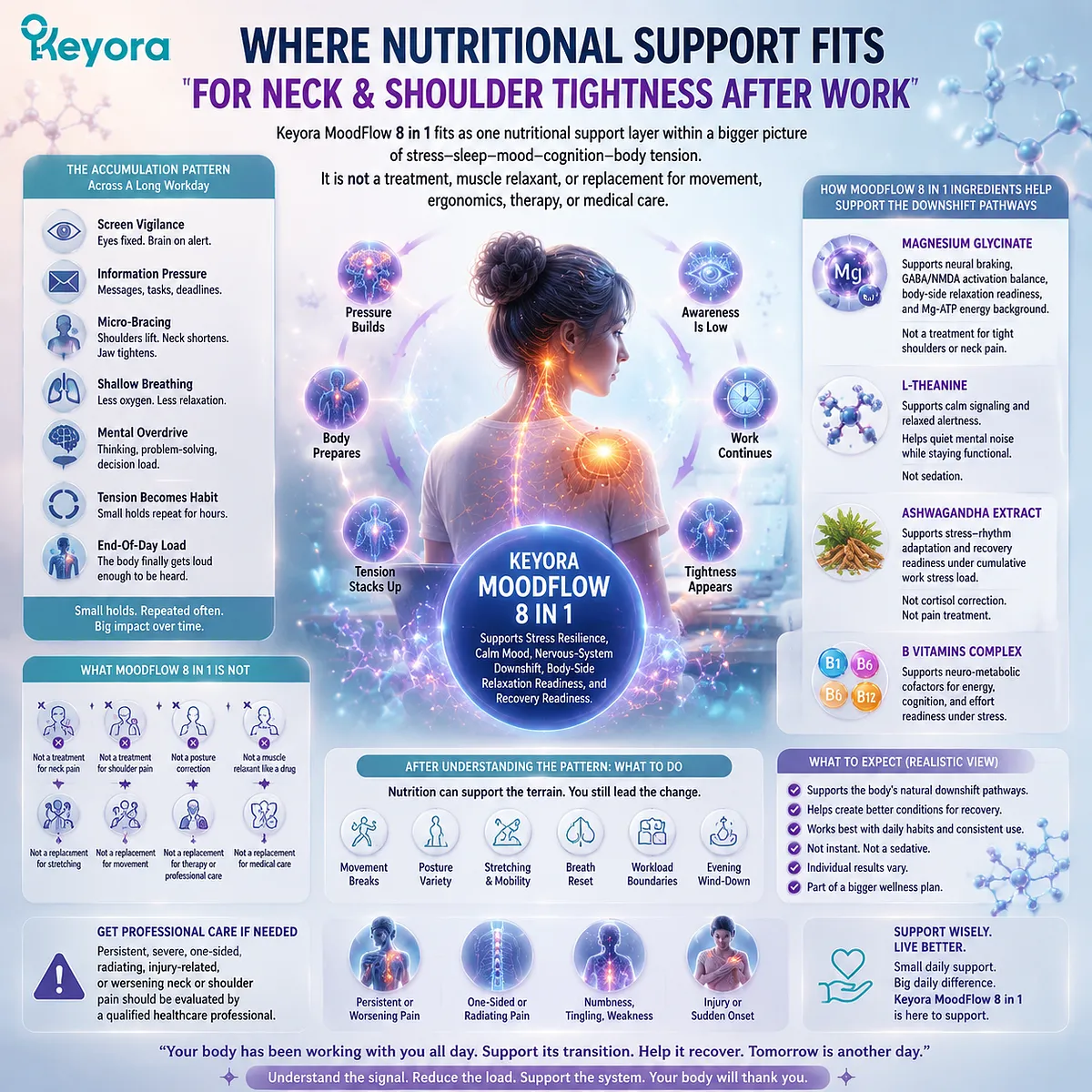
Keyora MoodFlow 8 in 1 can fit as one small nutritional support layer when neck and shoulder tightness after work appears as part of a broader stress-sleep-mood-cognition and body-tension pattern. It should not be framed as treating neck pain, treating shoulder pain, correcting posture, relaxing muscles like a drug, or replacing stretching, movement, ergonomic assessment, physical therapy, dental care, or medical care.
Its role is narrower: supporting wellness pathways involved in stress resilience, calm mood, nervous-system downshift, body-side relaxation readiness, and recovery readiness.
-
Magnesium glycinate may be relevant when accumulated workday tension keeps the body braced or slow to soften. In the MoodFlow framework, it supports neural braking, GABA/NMDA activation balance, body-side relaxation readiness, and Mg-ATP energy background. This is not a claim that it treats tight shoulders or neck pain; it is a wellness-support interpretation of the stress-body pathway.
-
L-Theanine may be relevant when long screen work leaves the mind alert, noisy, and slow to transition into evening calm. Its role is calm signaling and relaxed alertness, helping support downshift without being framed as sedation.
-
Ashwagandha may fit when repeated work pressure contributes to stress-rhythm carryover. Its role is stress-rhythm adaptation and recovery readiness under cumulative stress load, not cortisol correction or pain treatment.
-
B vitamins may support the broader neuro-metabolic cofactor context when cognitive load, effort-readiness, and work stress are part of the larger pattern.
MoodFlow belongs after the reader understands the accumulation pattern and practical transition steps. Nutrition can support the terrain. It cannot replace movement, posture variation, stretching, workload boundaries, ergonomic changes, physical therapy, or professional evaluation when needed.
Persistent, severe, one-sided, radiating, injury-related, or worsening neck or shoulder pain should be evaluated by a qualified healthcare professional.
Closing Summary
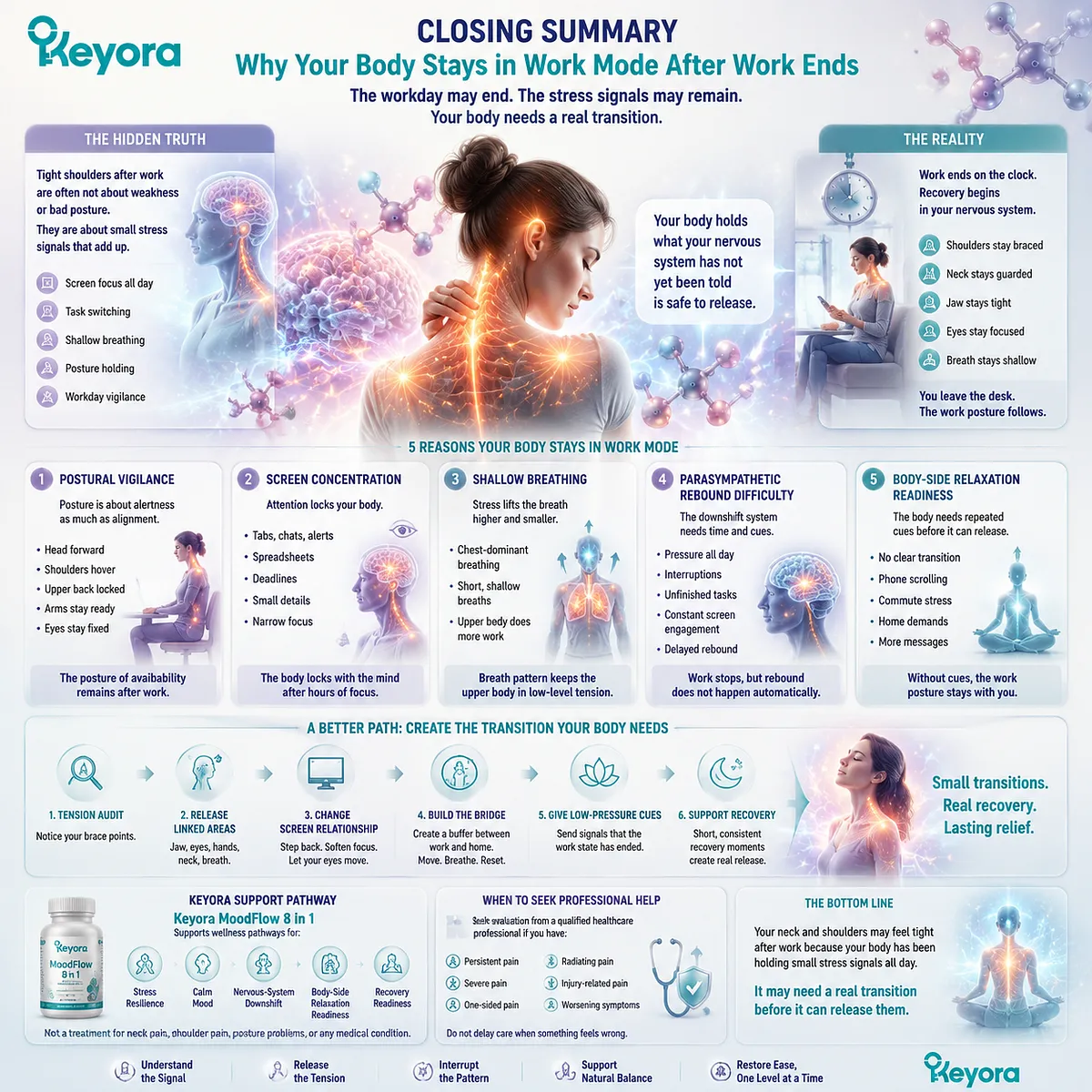
Neck and shoulder tightness after a long workday does not automatically mean your posture was wrong all day or your body is weak. It may mean your upper body has been holding small stress signals across hours of screen focus, task switching, shallow breathing, and workday vigilance.
The deeper mismatch is that work ending externally does not always mean the body has entered recovery internally. You can leave the desk while your shoulders, neck, jaw, eyes, and breath still carry the work posture.
A better path begins with a short tension audit, releasing workday brace points, creating a bridge between work and home, and giving your body low-pressure cues that the work state has ended.
Keyora MoodFlow 8 in 1 can support wellness pathways related to stress resilience, calm mood, nervous-system downshift, body-side relaxation readiness, and recovery readiness. It is not a treatment for neck pain, shoulder pain, posture problems, or any medical condition.
Persistent, severe, one-sided, radiating, injury-related, or worsening neck or shoulder pain should be evaluated by a qualified healthcare professional.
Your neck and shoulders may feel tight after work because your body has been holding small stress signals all day.
It may need a real transition before it can release them.
This article is for educational and informational purposes only. It does not provide medical advice, diagnosis, treatment, cure, prevention, disease outcome claims, hormone restoration claims, fertility outcome claims, or formula-specific clinical efficacy claims.