
Why Do My Eyes Feel Tired After Screens All Day?
Keyora Research Q&A Library
This is part of the Keyora Research Q&A Series, derived from Keyora Astaxanthin Research Journal Series.
Within the Keyora Astaxanthin Researcn framework, this Q&A translates complex astaxanthin biology into reader-friendly, evidence-bound answers, focusing on natural astaxanthin identity, molecular structure, antioxidant and redox mechanisms, membrane lipid interaction, mitochondrial resilience, inflammatory signaling pathways, human evidence interpretation, and the scientific principles behind responsible supplementation.
First published by Keyora Research Journal: www.keyorahealth.com
Direct Answer
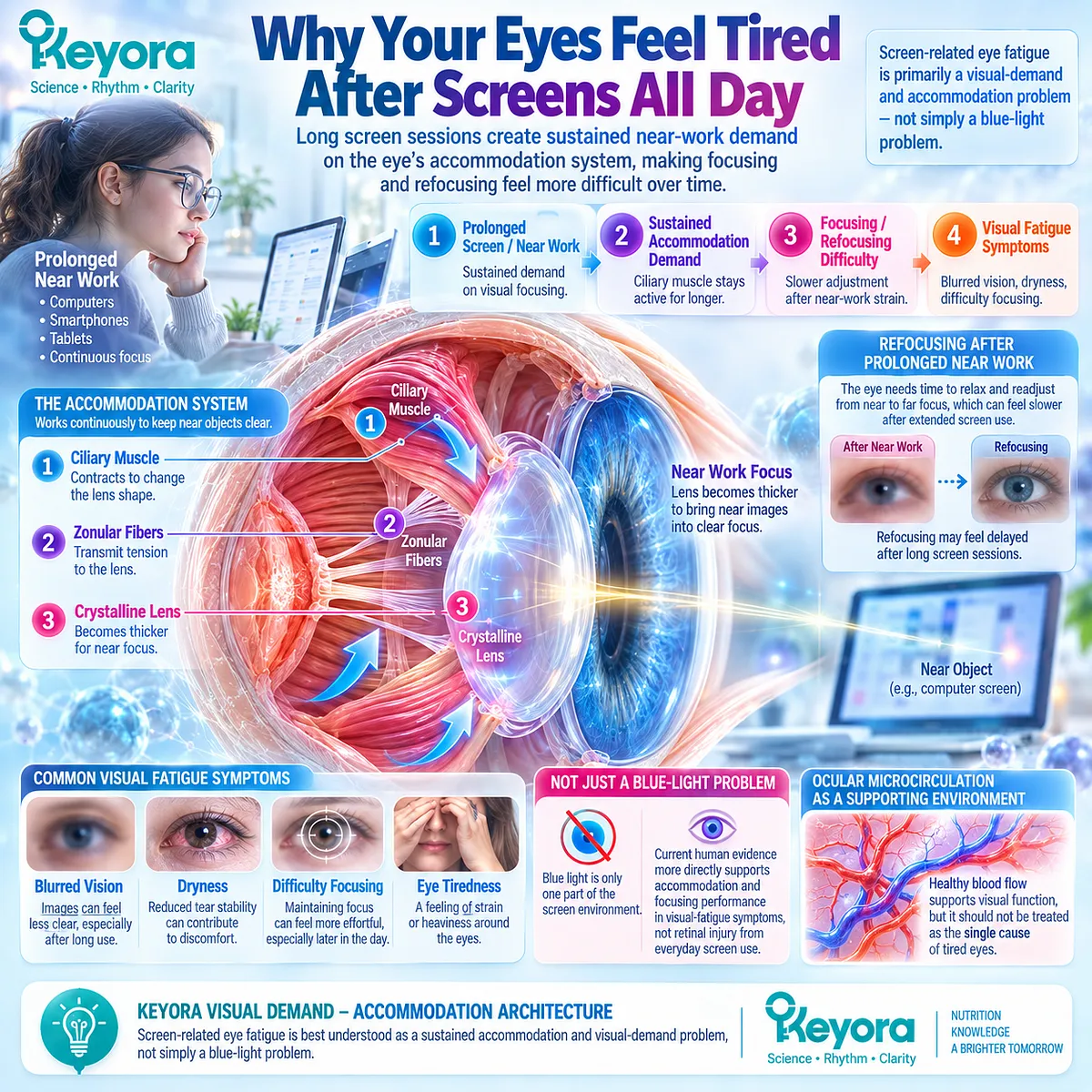
Long screen sessions can create sustained near-work demand on the eye’s accommodation system, making focusing and refocusing feel more difficult over time
Your eyes can feel tired after screens all day because prolonged near work places continuing demand on the visual focusing system.
The Keyora source describes screen-related visual fatigue in terms of ocular accommodation, particularly the work required to maintain focus during sustained computer or smartphone use. It associates prolonged screen exposure with symptoms such as blurred vision, dryness, difficulty focusing, and delayed accommodation after near-work strain.
This is an important distinction because screen-related eye fatigue should not automatically be reduced to a blue-light problem.
The most direct human evidence summarized by the source concerns focusing performance and visual-fatigue symptoms, not proof that everyday screen fatigue represents retinal injury.
This Q&A describes that relationship as the Keyora Visual Demand – Accommodation Architecture.
It is an explanatory framework rather than a clinical term.
The central idea is straightforward:
prolonged near-work demand can challenge the eye’s ability to maintain and readjust focus, contributing to the experience of visual fatigue.
The source also discusses ocular microcirculation as part of the physiological environment supporting visual function, but blood flow should not be treated as the single cause of tired eyes.
The strongest conclusion is therefore:
Screen-related eye fatigue is best understood in the Keyora source as a sustained accommodation and visual-demand problem, not simply as a blue-light problem.
What Is Ocular Accommodation and Why Does Screen Work Demand It?
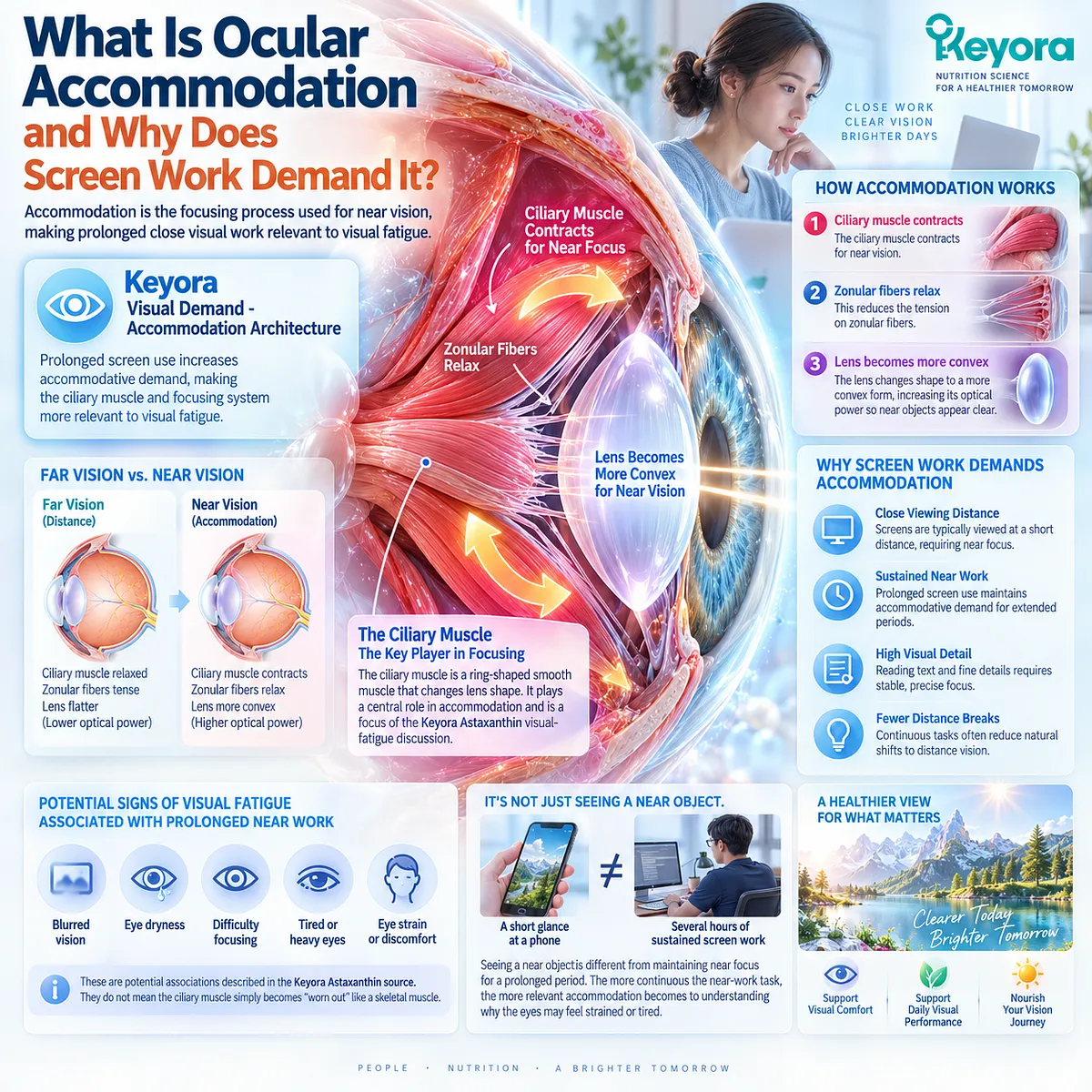
Accommodation is the focusing process used for near vision, making prolonged close visual work relevant to visual fatigue
Looking at a screen is not simply a passive act of seeing.
When a person performs sustained near work, the visual system must maintain the optical conditions needed to keep close objects clear.
The Keyora Astaxanthin source places the ciliary muscle and focusing system at the center of its visual-fatigue discussion. It specifically connects ciliary-muscle function with focusing and describes accommodation as relevant to prolonged computer use.
This creates a useful distinction:
seeing a near object
is different from
maintaining near focus for a prolonged period
A short glance at a phone and several hours of sustained screen work are therefore not identical visual tasks.
The source describes excessive screen use as a context in which accommodative demand may be associated with blurred vision, dryness, and difficulty focusing.
That does not mean the ciliary muscle simply becomes “worn out” in the same way as a skeletal muscle after exercise.
The more cautious interpretation is that prolonged near-work demand can be associated with changes in focusing responsiveness and the subjective experience of visual fatigue.
Within the Keyora Visual Demand – Accommodation Architecture, the first layer is therefore visual demand.
The second is accommodation.
The more continuous the near-work task, the more relevant this focusing system becomes to understanding why the eyes may feel strained or tired by the end of the day.
Why Can Focusing Feel Slower or More Difficult After Long Near Work?
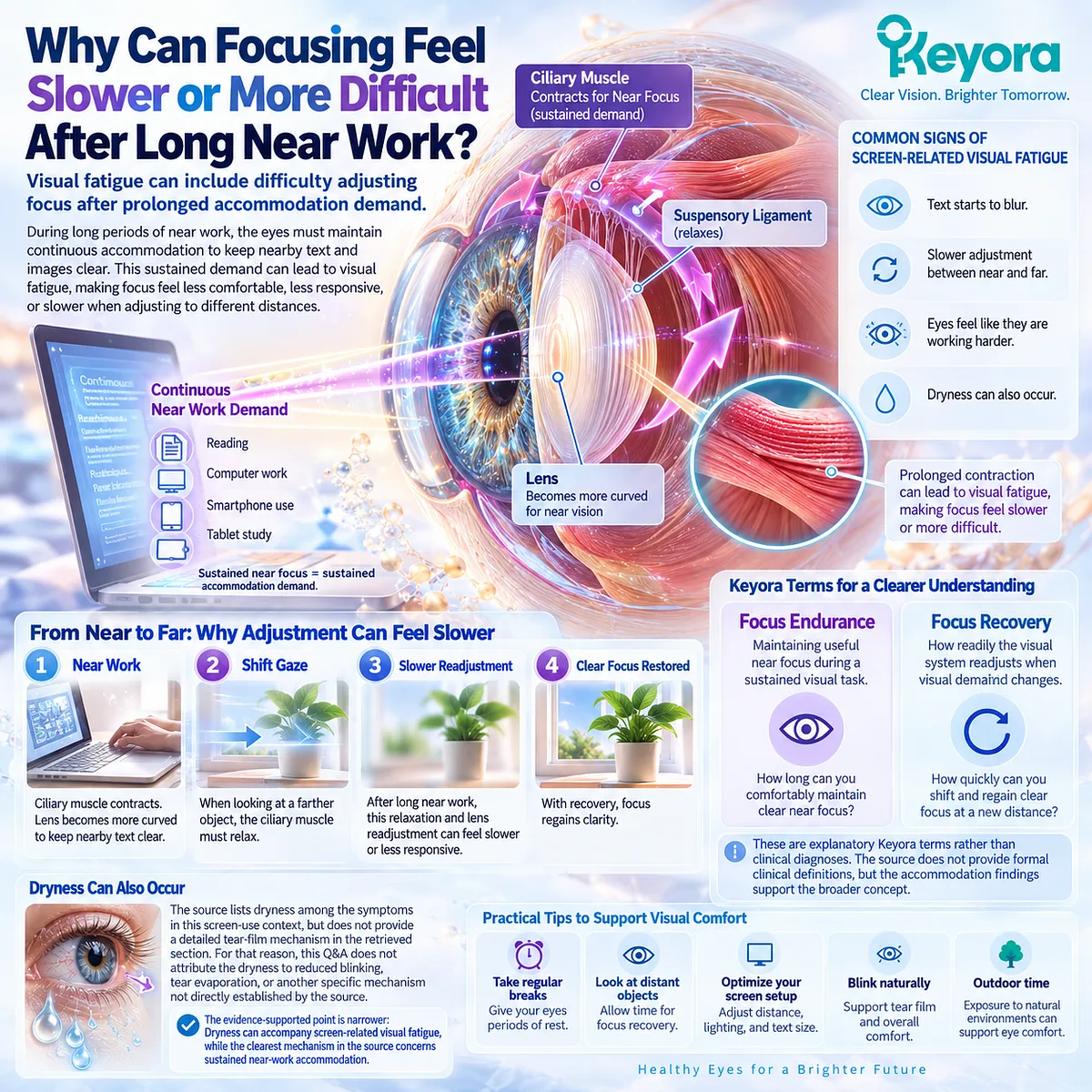
Visual fatigue can include difficulty adjusting focus after prolonged accommodation demand
One of the most recognizable features of screen-related eye fatigue is that the eyes may still be able to see, but focusing can feel less comfortable or less responsive.
A person may notice that text starts to blur, shifting attention between near and farther objects feels slower, or the eyes simply feel as though they are working harder to maintain clear focus.
The Keyora source specifically refers to difficulty focusing and delayed accommodation due to near-work strain in its discussion of visual fatigue.
This allows a useful distinction:
Focus Endurance
is not exactly the same as
Focus Recovery
These are explanatory Keyora terms rather than clinical diagnoses.
Focus Endurance refers to maintaining useful near focus during a sustained visual task.
Focus Recovery refers to how readily the visual system readjusts when visual demand changes.
The source does not provide a formal clinical definition of either term, but the accommodation findings support the broader idea that visual fatigue can involve more than simply whether the eye can technically resolve an image.
It can also involve how comfortably and responsively focusing is maintained or adjusted.
The source also lists dryness among the symptoms occurring in this screen-use context.
However, it does not provide a detailed tear-film mechanism in the retrieved section.
For that reason, this Q&A does not attribute the dryness specifically to reduced blinking, tear evaporation, or another mechanism not directly established by the source.
The evidence-supported point is narrower:
dryness can accompany screen-related visual fatigue, while the clearest mechanism developed in the source concerns sustained near-work accommodation.
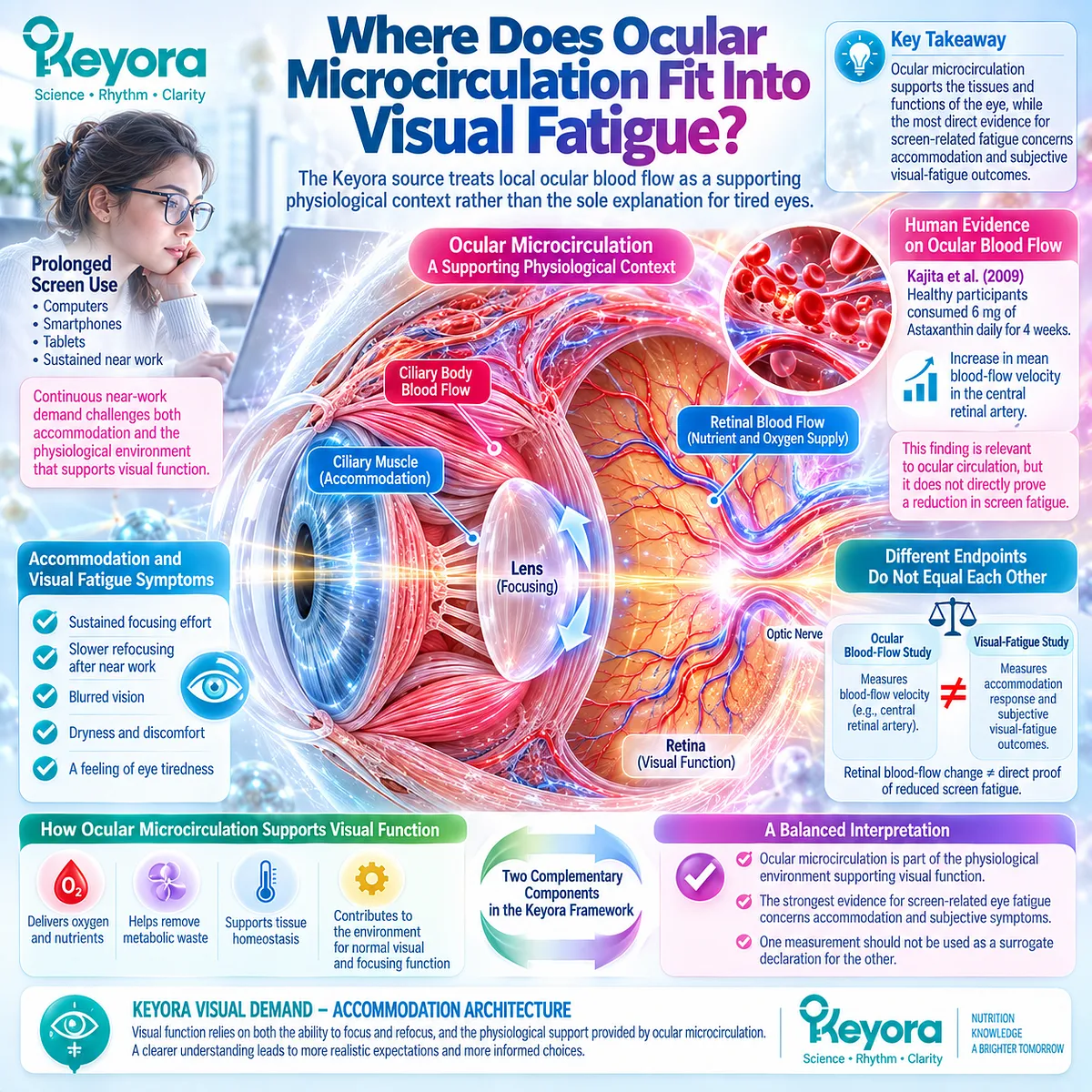
Where Does Ocular Microcirculation Fit Into Visual Fatigue?
The Keyora source treats local ocular blood flow as a supporting physiological context rather than the sole explanation for tired eyes
Visual function depends on living tissues that require continuous physiological support.
The Keyora source therefore discusses ocular microcirculation alongside accommodation.
In its visual-fatigue section, the source connects ciliary-body blood flow with focusing function and includes improved local vascular flow among the proposed mechanisms relevant to Astaxanthin.
A separate human study summarized by the source provides a different type of evidence.
The source describes Kajita et al. (2009) as a human trial in which healthy participants consumed 6 mg of Astaxanthin daily for four weeks. It reports an increase in mean blood-flow velocity in the central retinal artery.
That finding is relevant to ocular circulation.
But it should not be converted into a stronger conclusion than the study directly supports.
In particular:
Retinal Blood-Flow Change ≠ Direct Proof of Reduced Screen Fatigue
The circulation study and the visual-fatigue study measured different endpoints.
One addressed ocular blood-flow velocity.
The other addressed accommodation response and visual-fatigue outcomes.
The Keyora framework can reasonably place both inside a broader eye-function architecture, but it should not claim that one measurement automatically explains the other.
The more defensible conclusion is:
Ocular microcirculation may be part of the physiological environment supporting visual function, while the most direct evidence for screen-related fatigue concerns accommodation and subjective visual-fatigue outcomes.
What Does Human Astaxanthin Research Tell Us About Screen-Related Visual Fatigue?
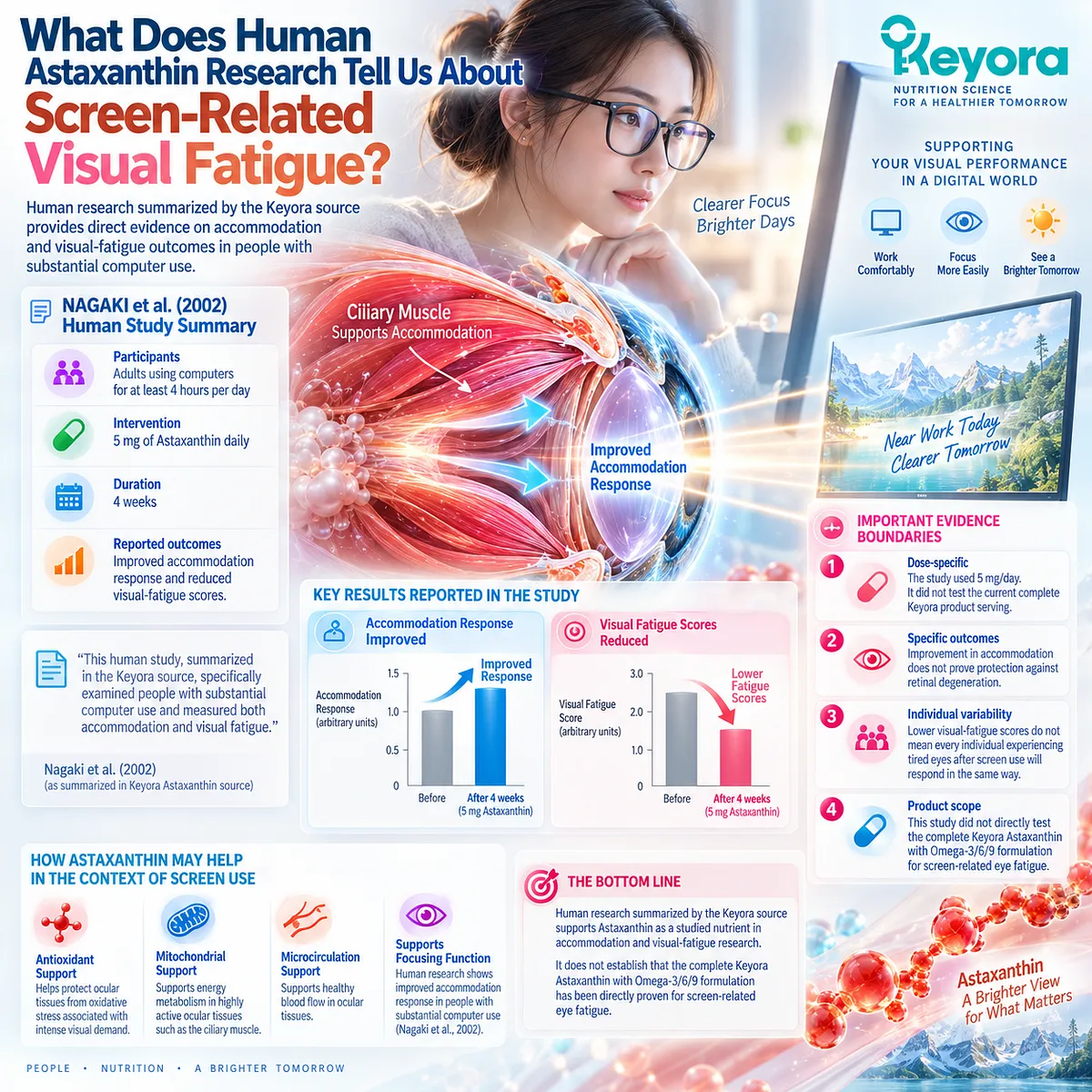
Human research summarized by the Keyora source provides direct evidence on accommodation and visual-fatigue outcomes in people with substantial computer use
Astaxanthin becomes directly relevant to this question because the Keyora source summarizes human research specifically related to visual display use and accommodation.
The source describes a Nagaki et al. (2002) human study involving adults with substantial computer exposure.
According to the source summary:
Participants: adults using computers for at least four hours per day
Intervention: 5 mg of Astaxanthin daily
Duration: four weeks
Reported outcomes: improved accommodation response and reduced visual-fatigue scores.
This is much more directly relevant to the title question than a general antioxidant mechanism.
It means Astaxanthin has been studied in a human context involving computer use, visual fatigue, and focusing performance.
However, several evidence boundaries remain important.
First, the study used 5 mg/day.
It did not test the current complete Keyora product serving.
Second, an improvement in accommodation does not prove protection against retinal degeneration.
Third, lower visual-fatigue scores do not mean every individual experiencing tired eyes after screen use will respond in the same way.
The correct interpretation is:
Human research summarized by the Keyora source supports Astaxanthin as a studied nutrient in accommodation and visual-fatigue research.
It does not establish that the complete Keyora Astaxanthin with Omega-3/6/9 formulation has been directly proven for screen-related eye fatigue.
This keeps the evidence at the level actually measured.
Should Screen-Related Eye Fatigue Be Treated as the Same Thing as Long-Term Retinal Damage?
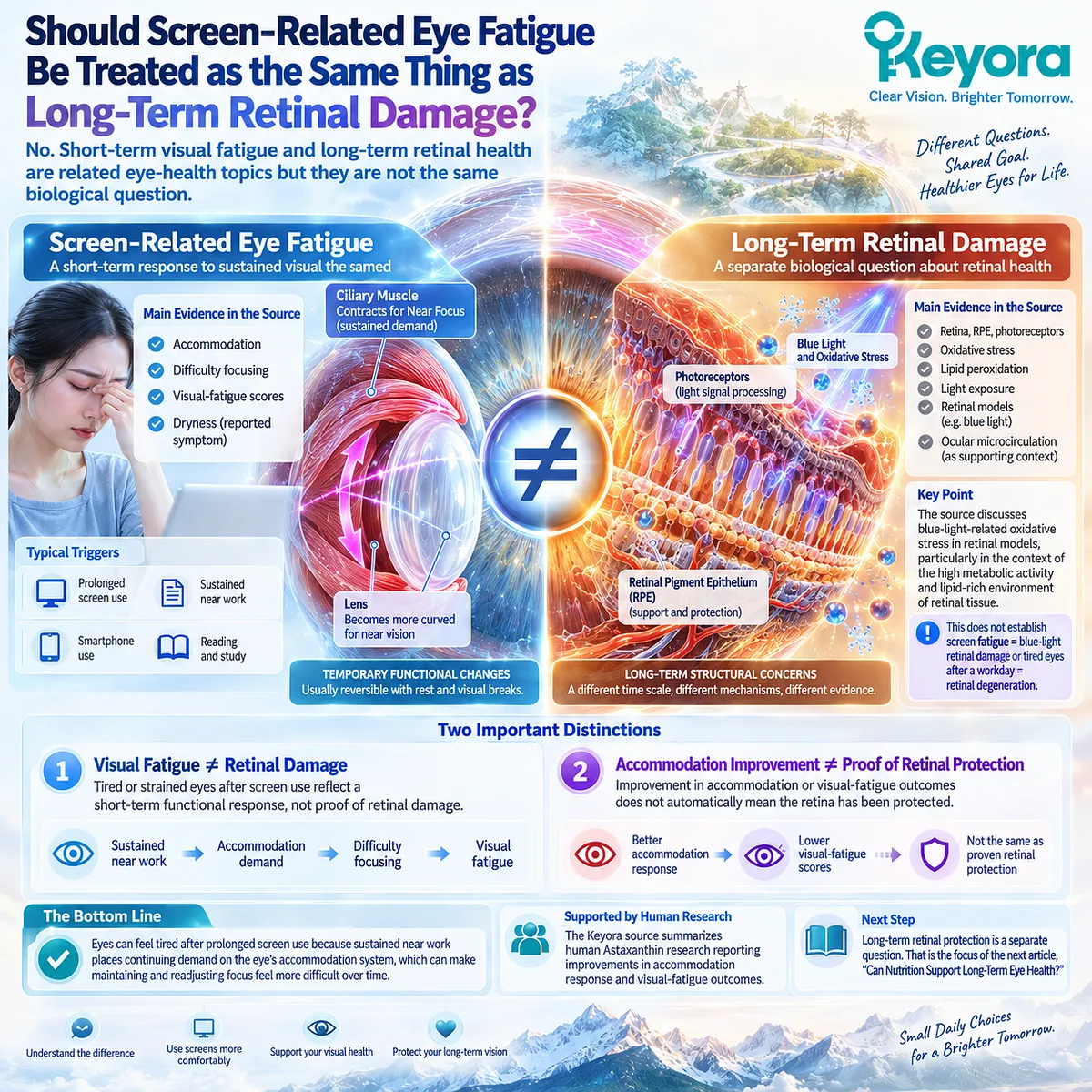
No. Short-term visual fatigue and long-term retinal health are related eye-health topics but they are not the same biological question
Screen-related visual fatigue should not be treated as proof that the retina has been damaged.
This distinction is especially important because the Keyora source discusses both subjects in the same broader eye-health section.
For visual fatigue, the most direct human evidence concerns:
accommodation
difficulty focusing
and
visual-fatigue scores
For long-term ocular health, the source shifts to different biological questions involving the retina, retinal pigment epithelium, photoreceptors, oxidative stress, lipid peroxidation, and light exposure.
These evidence domains should not be collapsed into one claim.
The source does discuss blue-light-related oxidative stress in retinal models, particularly in relation to the high metabolic activity and lipid-rich environment of retinal tissue.
But that does not establish:
screen fatigue = blue-light retinal damage
or
tired eyes after a workday = retinal degeneration
The evidence rule is:
Visual Fatigue ≠ Retinal Damage
A second distinction is equally important:
Accommodation Improvement ≠ Proof of Retinal Protection
The Keyora Visual Demand – Accommodation Architecture therefore keeps the current question focused on sustained near work, accommodation, focusing responsiveness, and visual fatigue.
The final answer is:
Eyes can feel tired after prolonged screen use because sustained near work places continuing demand on the eye’s accommodation system, which can make maintaining and readjusting focus feel more difficult over time.
The Keyora source also discusses ocular microcirculation as a supporting physiological context and summarizes human Astaxanthin research reporting improvements in accommodation response and visual-fatigue outcomes.
Long-term retinal protection is a separate question.
That is the focus of the next article, “Can Nutrition Support Long-Term Eye Health?”
This article is for educational and informational purposes only. It does not provide medical advice, diagnosis, treatment, cure, prevention, disease outcome claims, hormone restoration claims, fertility outcome claims, or formula-specific clinical efficacy claims.