
Why Do Meetings Leave Me Emotionally Overstimulated?
Keyora Research Q&A Library
This is part of the Keyora Research Q&A Series, derived from Keyora Nutritional Neurology Series .
Within the Keyora Nutritional Neurology framework, this Q&A translates complex nutrient–brain mechanisms into reader-friendly, evidence-bound answers, focusing on stress resilience, sleep quality, calm mood support, cognitive wellness, and the broader interaction between nutrition, neurochemistry, and daily nervous-system function.
First published by Keyora Research Journal: www.keyorahealth.com
Direct Answer
Meetings can leave you emotionally overstimulated because they are not only about listening to information.
They often require social vigilance, tone monitoring, response control, performance awareness, and emotional self-management at the same time.
The mismatch is this: from the outside, a meeting may look like sitting, listening, and speaking occasionally.
But inside, your nervous system may be tracking who agrees, who sounds impatient, when you should speak, how your face looks, whether your answer is clear, and whether you are performing well enough.
By the time the meeting ends, your body may still be carrying that social-performance load.
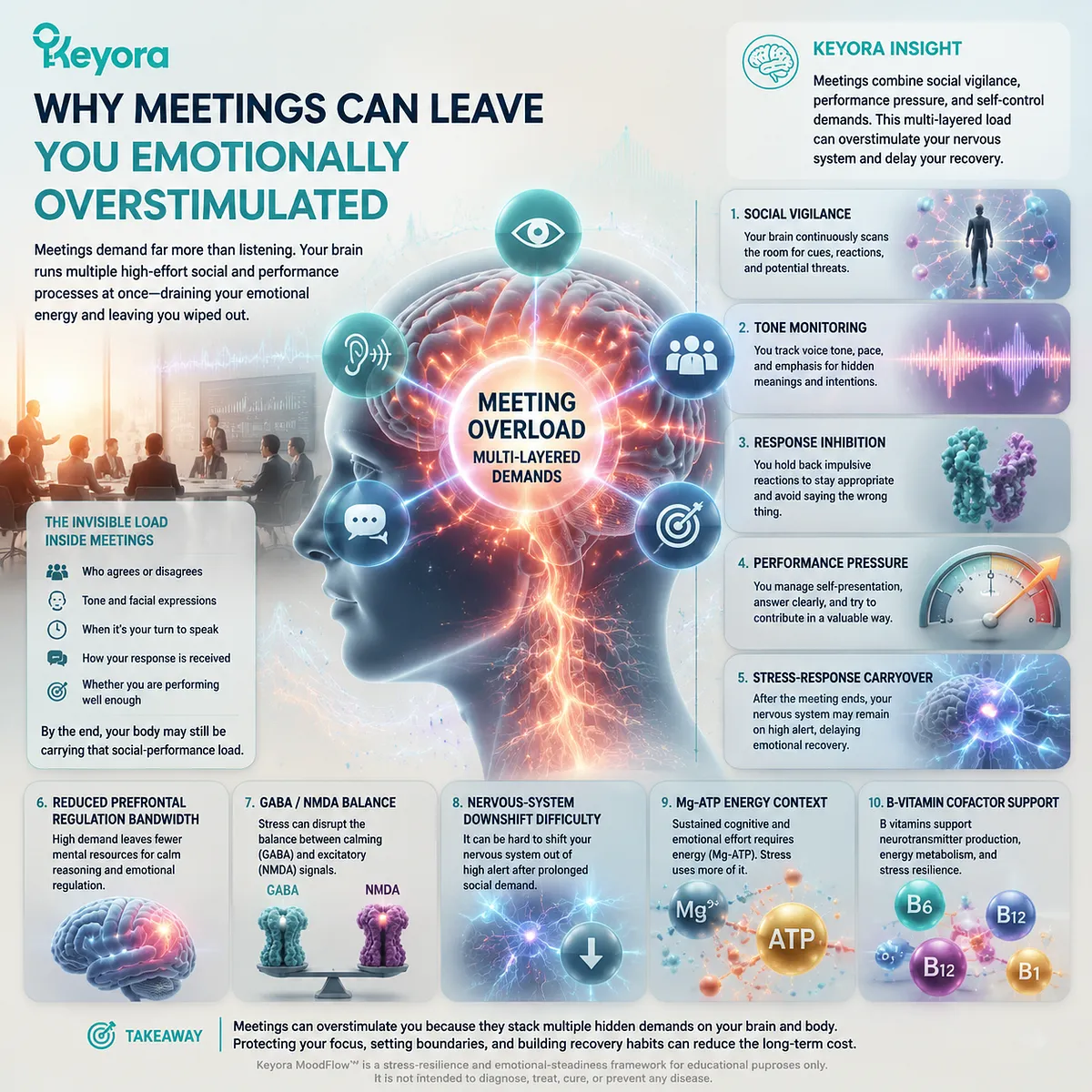
Mechanistically, this can involve meeting-related social vigilance, tone monitoring, response inhibition, performance pressure, stress-response carryover, reduced prefrontal regulation bandwidth, GABA/NMDA activation balance, nervous-system downshift difficulty, Mg-ATP energy context, and B-vitamin cofactor support.
In the Keyora MoodFlow framework, this is understood as a stress-resilience, emotional-steadiness, and meeting-recovery-readiness question, not a medical treatment claim.
When the Meeting Ends but Your Body Is Still in the Room
Feeling overstimulated after meetings can mean your nervous system stayed on watch the whole time.
The meeting ends.
The screen goes dark. People leave the room. The call closes. The notes are saved. The calendar moves on to the next task.
But your body has not fully left.
Your head may feel full. Your shoulders may still be tight. Your chest may feel slightly compressed. You may not want anyone to talk to you immediately. A normal sound may feel too sharp. A message after the meeting may feel like too much. You may feel emotionally thin, as if one more question could push you past your limit.
This can feel confusing because you may tell yourself, “I was only sitting there.”
You may not have given a long presentation. You may not have argued. You may not even have spoken much. Still, the meeting may leave you feeling overstimulated, tense, exposed, or strangely unable to return to yourself.
This is where many people misunderstand their own experience.
They assume meeting fatigue means the content was difficult. Or they think they must be weak because other people seem fine afterward. They may tell themselves they are bad at teamwork, too sensitive to professional settings, or not resilient enough for group environments.
But meetings can be demanding even when you are quiet.
You may be listening to the content, but you may also be reading the room. Who sounds supportive? Who sounds doubtful? Who is silent? Who is frustrated? Who might ask you something? Who disagrees but has not said it yet?
You may be controlling your face so you do not look tired. You may be watching your tone so you sound professional. You may be preparing an answer just in case someone calls on you. You may be deciding whether to speak or stay quiet. You may be trying not to interrupt, not to say too much, not to seem unprepared, and not to miss something important.
That is not “just sitting.”
That is live social-performance regulation.
A meeting is different from reading a document because a document does not watch you back. A meeting is different from listening to a podcast because your presence matters. Even when you are not speaking, you may feel that you are being included, observed, evaluated, or expected to respond.
This makes meetings emotionally expensive.
The overstimulation often comes from the combination: information, people, timing, hierarchy, tone, silence, facial expression, expectations, and performance pressure all happening at once.
That is why the meeting can end, but the internal activation can continue.
The nervous system may need time to realize that it is no longer required to monitor, prepare, inhibit, and perform. Until that downshift happens, the body may remain in a meeting-like state: alert, tense, socially watchful, and not fully recovered.
The deeper question is not only, “Why do meetings make me tired?”
A more revealing question is, “What was I managing during the meeting that no one could see?”
Maybe you were not just listening.
Maybe you were regulating your presence the entire time.
Why Meetings Create Social-Performance Load
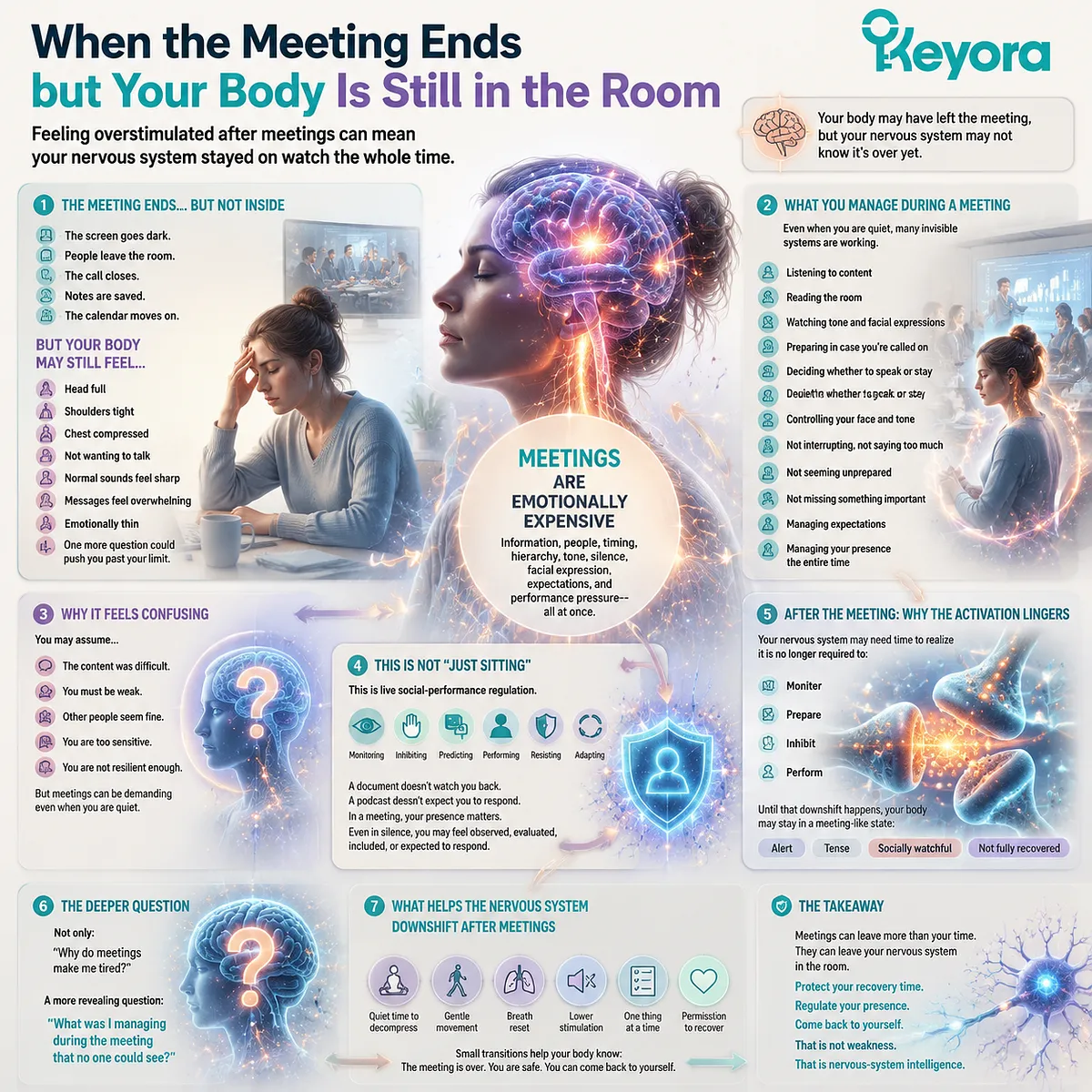
Meetings can drain you because they require attention, tone monitoring, response control, and social self-management at the same time.
Meetings create emotional overstimulation because they combine cognitive load with social-performance load.
Cognitive load is the obvious part. You have to follow the topic, understand updates, remember details, connect ideas, and notice what applies to you. That alone can take effort.
But the less visible part is social-performance load.
In many meetings, the brain is not only asking, “What is being said?” It is also asking, “How is it being said?” “Who agrees?” “Who is uncomfortable?” “Do I need to respond?” “How do I look right now?” “Should I speak?” “If I speak, how will it land?”
This is social vigilance.
Social vigilance means the nervous system is monitoring the people in the room, not only the content of the discussion. It may track facial expressions, tone, silence, timing, and relational tension. In a meeting, these cues can matter because they may affect decisions, responsibilities, evaluation, or group belonging.
Tone monitoring adds another layer.
A phrase like “Let’s revisit this” may be neutral. It may also carry pressure. A question like “Can you explain that?” may be curiosity, or it may feel like evaluation. A pause after your comment may mean people are thinking, or it may feel like something went wrong.
When you are already under stress, the brain may work harder to decode these signals.
This does not mean you are imagining everything. It means live group communication contains ambiguity. Under pressure, ambiguity becomes more costly.
Response inhibition is another major part of meeting load.
In meetings, people often suppress immediate reactions.
-
You may disagree but wait your turn.
-
You may feel tense but keep your face neutral.
-
You may want to clarify but hold back because the timing is not right.
-
You may feel confused but avoid showing it too strongly.
-
You may have a thought but filter it before speaking.
This inhibition is not weakness. It is social functioning.
But it uses energy.
The prefrontal cortex helps with attention, inhibition, social judgment, flexible response, and self-monitoring. It supports the ability to stay composed, choose words carefully, and respond appropriately. In meetings, this system may be working almost continuously.
That is why a person can feel drained after saying very little.
The body was still regulating.
Performance pressure can make the load stronger. Even when no one says, “You are being evaluated,” meetings often create a subtle sense of being assessed. You may feel you need to look engaged, sound competent, follow the pace, avoid mistakes, and prove that you belong in the conversation.
This is especially true when there are managers, clients, teachers, senior colleagues, unfamiliar people, or emotionally complex group dynamics.
The meeting becomes more than a meeting. It becomes a social stage.
After the meeting, stress-response carryover can remain. The body may still feel alert. The mind may replay moments. You may feel sensitive to noise or reluctant to speak. You may need quiet before moving into another task or another conversation.
This is not laziness. It is recovery need.
GABA/NMDA balance can help explain the internal overstimulation. The nervous system needs activation to follow the meeting, but it also needs braking to filter input and soften intensity. NMDA-related activity can be understood as part of alert and excitatory processing. GABA-related tone helps support calm filtering, downshift, and steadier response.
In a long or tense meeting, activation may stay high for an extended time. The braking system may have to work hard to keep you composed.
Energy context also matters. Holding attention, monitoring tone, inhibiting reactions, and managing social presence require cognitive-emotional energy. Magnesium participates in Mg-ATP biology and neural excitability context. B vitamins support cofactor pathways involved in energy metabolism and neurotransmitter-related processes.
This does not mean meeting overstimulation is only nutritional. Meeting culture, workload, communication style, sleep, food, boundaries, noise, and recovery time all matter.
But it does mean the experience is real.
Meetings can leave you emotionally overstimulated because your brain is not only processing information; it is regulating your social presence in real time.
The meeting may have ended on the calendar.
Your nervous system may still be finishing the work.
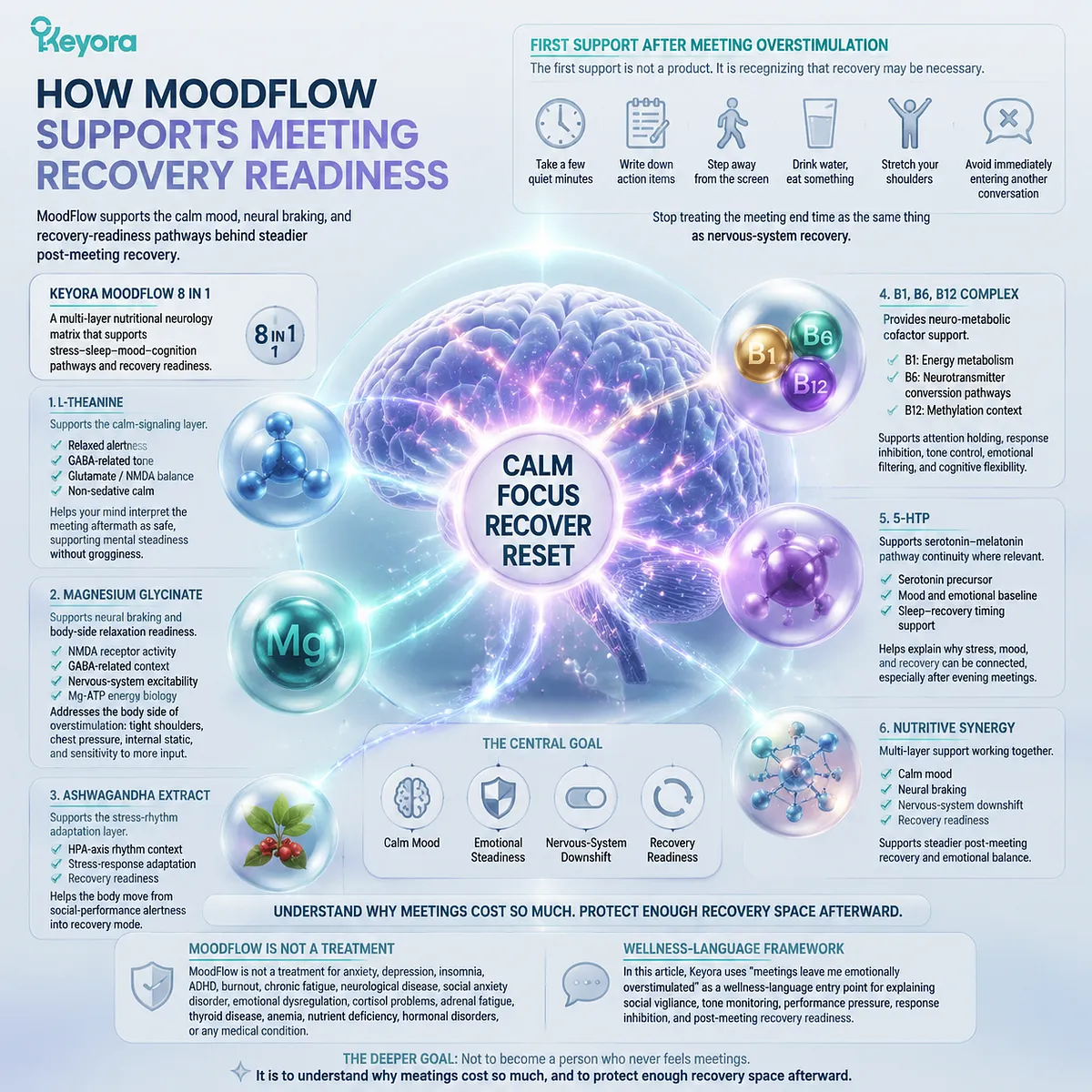
How MoodFlow Supports Meeting Recovery Readiness
MoodFlow supports the calm mood, neural braking, and recovery-readiness pathways behind steadier post-meeting recovery.
The first support after meeting overstimulation is not a product. It is recognizing that recovery may be necessary.
You may need a few quiet minutes before the next call. You may need to write down action items so they stop circling in your head. You may need to step away from the screen, drink water, eat something, stretch your shoulders, or avoid immediately entering another conversation. You may need to stop treating the meeting end time as the same thing as nervous-system recovery.
Nutritional support can sit beside these practical recovery steps.
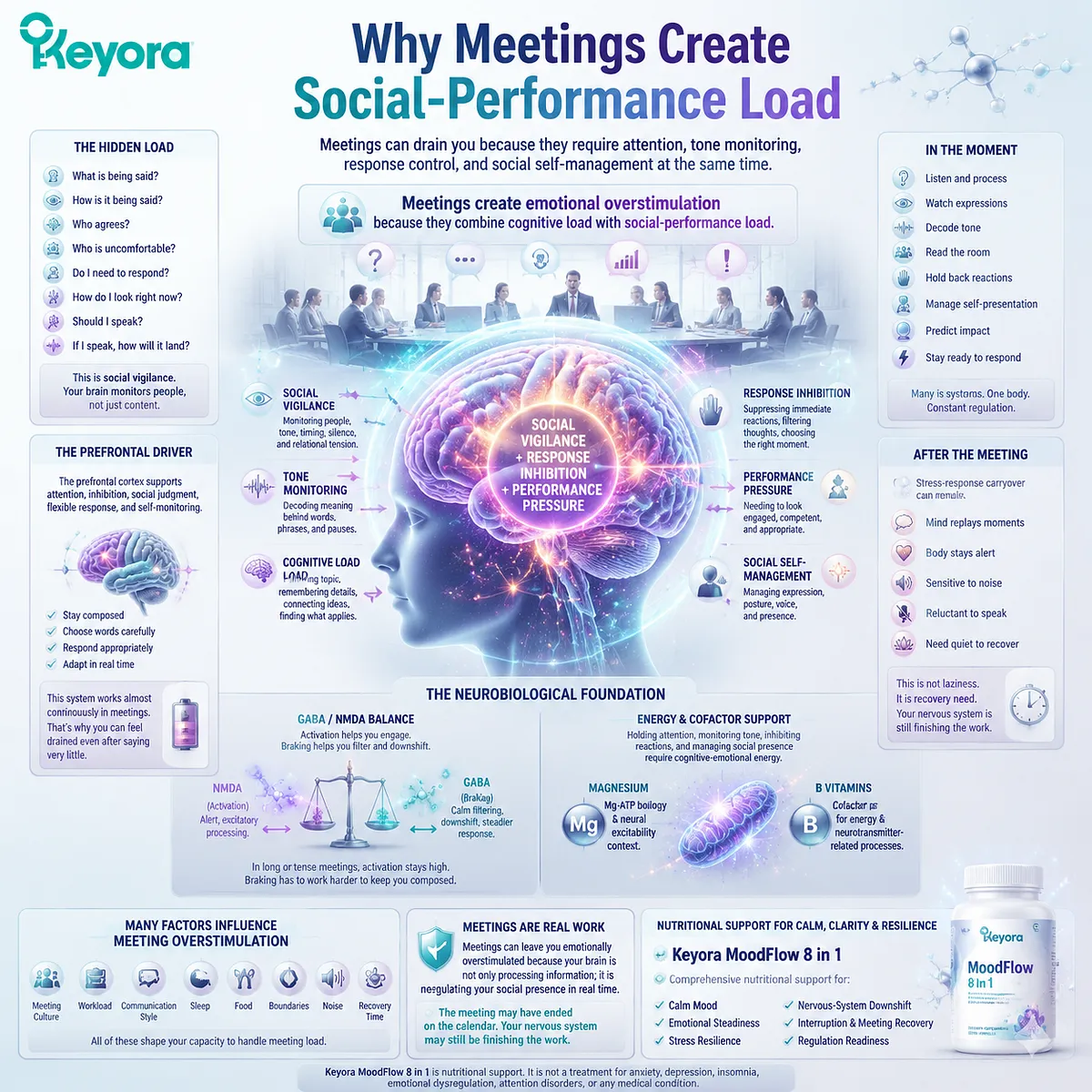
Keyora MoodFlow 8 in 1 is best understood here as a multi-layer nutritional neurology matrix that supports stress-sleep-mood-cognition pathways.
L-Theanine supports the calm-signaling layer.
L-Theanine is commonly positioned around relaxed alertness, GABA-related tone, glutamate/NMDA balance, and non-sedative calm.
For post-meeting overstimulation, this layer supports calm interpretation and mental steadiness without pushing the person into grogginess.
Magnesium glycinate supports the neural braking and body-side relaxation-readiness layer.
Magnesium is relevant to NMDA receptor activity, GABA-related context, nervous-system excitability, and Mg-ATP energy biology.
For meeting recovery, this layer speaks to the body side of overstimulation: tight shoulders, chest pressure, internal static, and sensitivity to more sound or input after the meeting ends.
Ashwagandha supports the stress-rhythm adaptation layer.
Ashwagandha is positioned in the MoodFlow framework around HPA-axis rhythm context, stress-response adaptation, and recovery readiness.
This matters because meetings can create stress-response carryover. The body may need support moving from social-performance alertness into recovery mode.
B1, B6, and B12 provide neuro-metabolic cofactor support.
B1 supports energy metabolism context. B6 is relevant to neurotransmitter-related conversion pathways. B12 supports methylation context.
Meetings require attention holding, response inhibition, tone control, emotional filtering, and cognitive flexibility. These processes depend on neuro-metabolic infrastructure.
5-HTP supports serotonin-melatonin pathway continuity where relevant.
In this article, 5-HTP is not the main focus. It belongs to the broader substrate-continuity layer supporting normal neurotransmitter-related pathways.
Where evening meetings affect emotional baseline or recovery timing, serotonin-melatonin pathway continuity can help explain why stress, mood, and recovery may be connected.
Together, these layers support calm mood, emotional steadiness, nervous-system downshift, and recovery readiness after meeting-related social load.
MoodFlow is not a treatment for anxiety, depression, insomnia, ADHD, burnout, chronic fatigue, neurological disease, social anxiety disorder, emotional dysregulation, cortisol problems, adrenal fatigue, thyroid disease, anemia, nutrient deficiency, hormonal disorders, or any medical condition.
In this article, Keyora uses “meetings leave me emotionally overstimulated” as a wellness-language entry point for explaining social vigilance, tone monitoring, performance pressure, response inhibition, and post-meeting recovery readiness.
The deeper goal is not to become a person who never feels meetings.
It is to understand why meetings cost so much, and to protect enough recovery space afterward.
Closing Summary
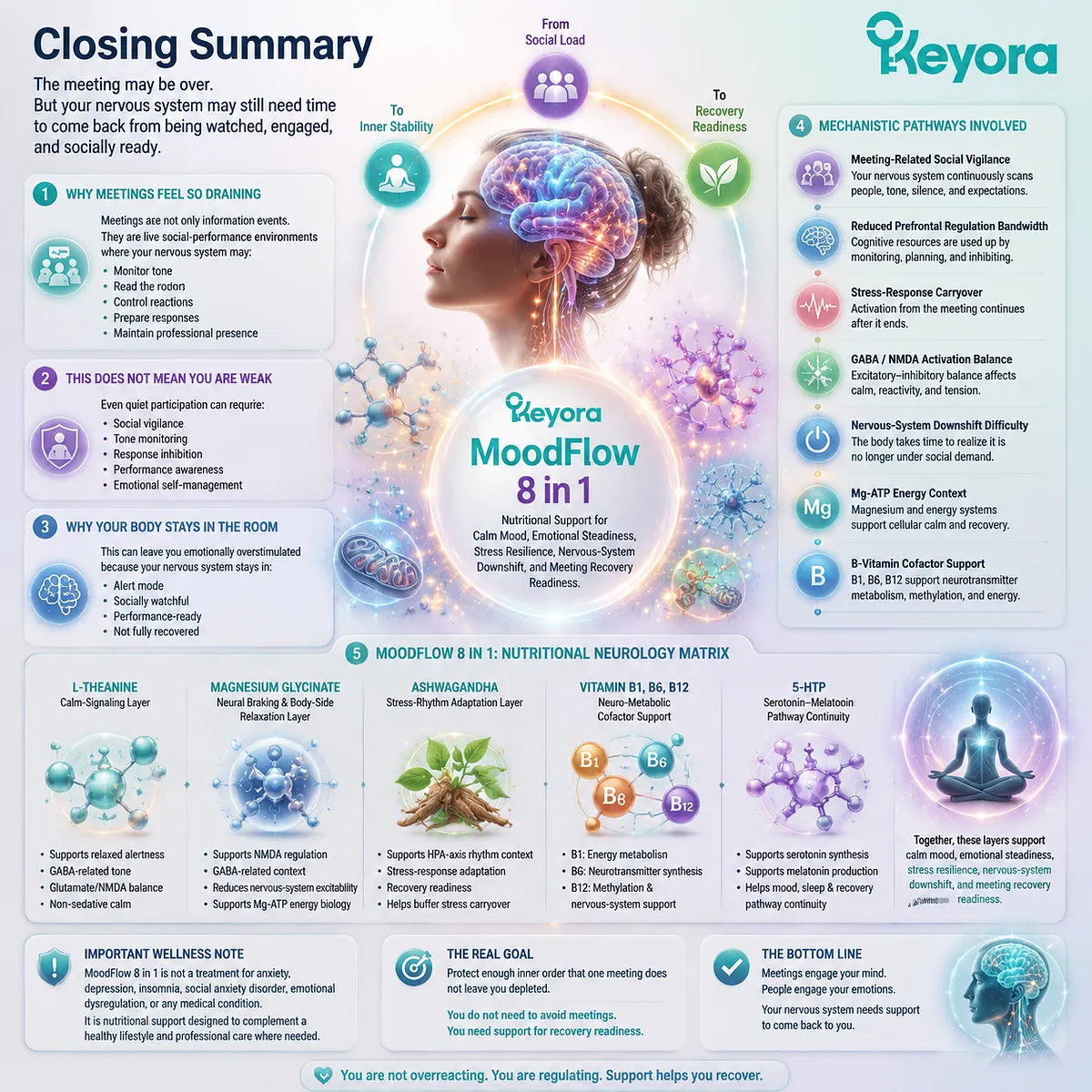
Meetings can leave you emotionally overstimulated because they are not only information events. They are live social-performance environments where the nervous system may monitor tone, read the room, control reactions, prepare responses, and maintain professional presence.
This does not mean you are weak, antisocial, or bad at teamwork. Even quiet participation can require social vigilance, tone monitoring, response inhibition, performance awareness, and emotional self-management.
Mechanistically, this can involve meeting-related social vigilance, reduced prefrontal regulation bandwidth, stress-response carryover, GABA/NMDA activation balance, nervous-system downshift difficulty, Mg-ATP energy context, and B-vitamin cofactor support.
Keyora MoodFlow 8 in 1 fits as nutritional support for calm mood, emotional steadiness, stress resilience, nervous-system downshift, and meeting recovery readiness. It is not a treatment for anxiety, depression, insomnia, social anxiety disorder, emotional dysregulation, or any medical condition.
The meeting may be over. But your nervous system may still need time to come back from being watched, engaged, and socially ready.
This article is for educational and informational purposes only. It does not provide medical advice, diagnosis, treatment, cure, prevention, disease outcome claims, hormone restoration claims, fertility outcome claims, or formula-specific clinical efficacy claims.