
Why Do Instructions Feel Harder to Follow When I’m Stressed?
Keyora Research Q&A Library
This is part of the Keyora Research Q&A Series, derived from Keyora Nutritional Neurology Series .
Within the Keyora Nutritional Neurology framework, this Q&A translates complex nutrient–brain mechanisms into reader-friendly, evidence-bound answers, focusing on stress resilience, sleep quality, calm mood support, cognitive wellness, and the broader interaction between nutrition, neurochemistry, and daily nervous-system function.
First published by Keyora Research Journal: www.keyorahealth.com

Direct Answer
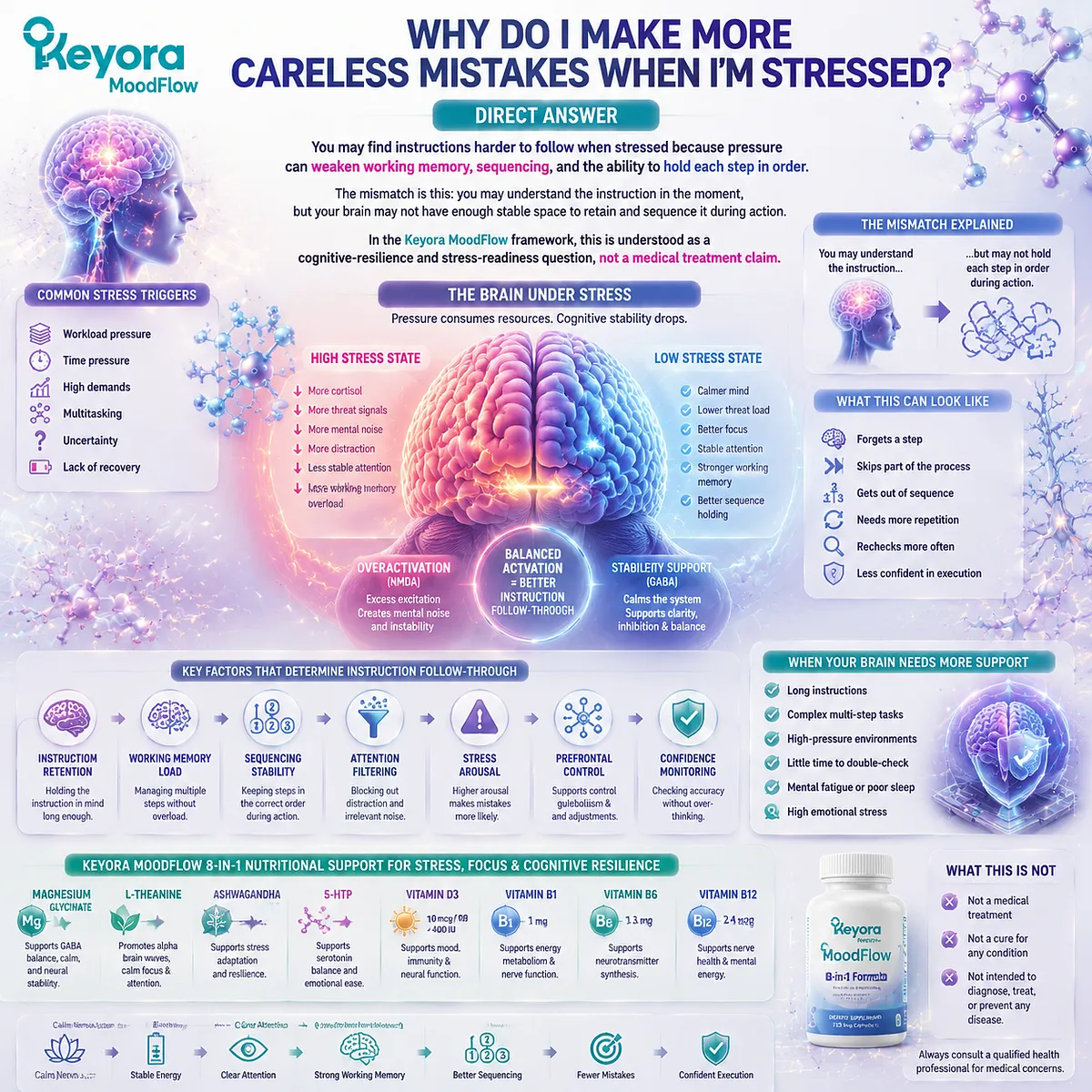
You may find instructions harder to follow when stressed because pressure can weaken working memory, sequencing, and the ability to hold each step in order.
The mismatch is this: you may understand the instruction in the moment, but your brain may not have enough stable space to retain and sequence it during action.
This can involve instruction retention, working memory load, sequencing stability, attention filtering, stress arousal, confidence monitoring, prefrontal control, GABA/NMDA activation balance, Mg-ATP energy background, B vitamin cofactor context, cognitive resilience, and recovery readiness.
In the Keyora MoodFlow framework, this is understood as a cognitive-resilience and stress-readiness question, not a medical treatment claim.
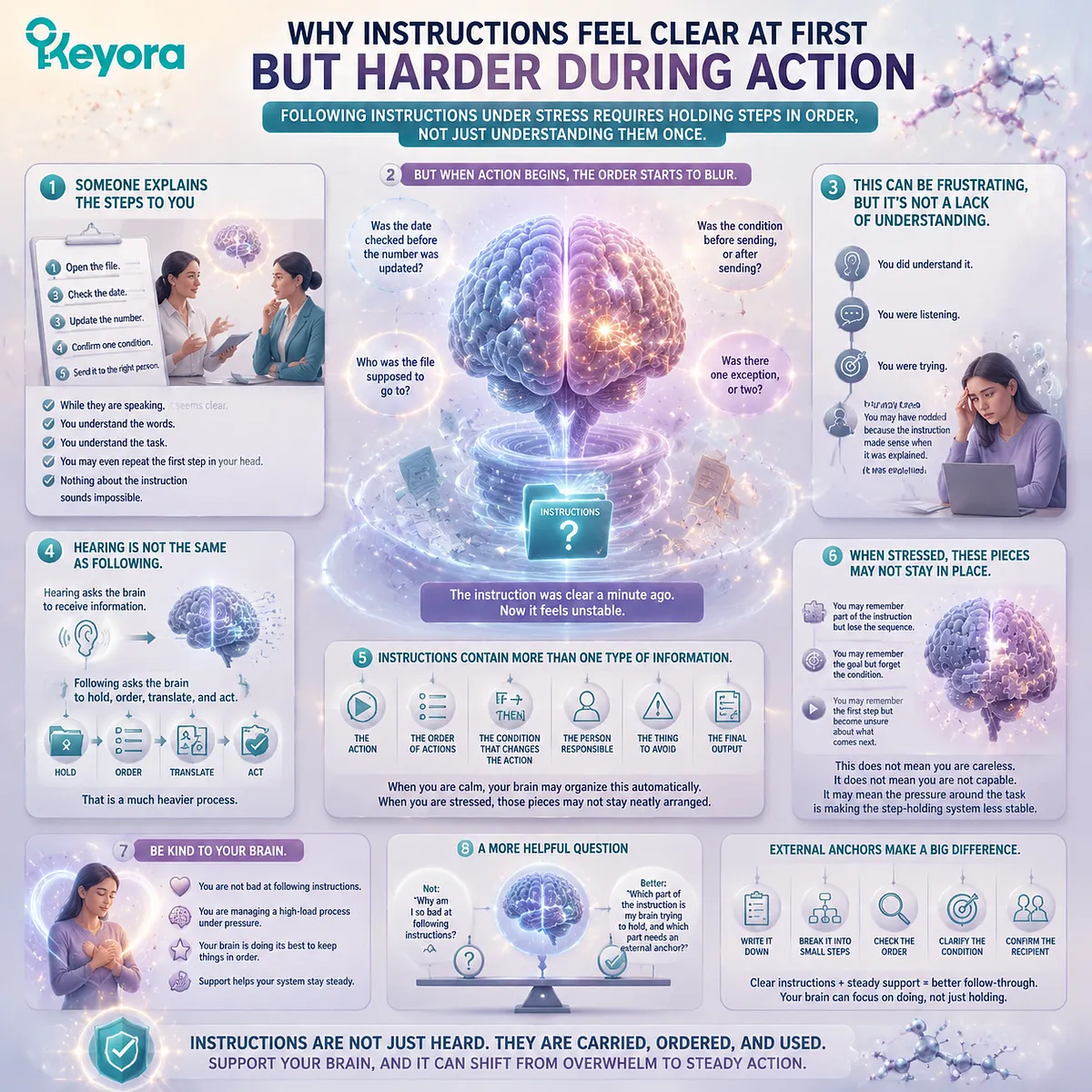
Why Instructions Feel Clear at First but Harder During Action
Following instructions under stress requires holding steps in order, not just understanding them once.
Someone explains the steps to you.
First, open the file.
Then check the date.
Then update the number.
Then confirm one condition.
Then send it to the right person.
While they are speaking, it seems clear.
You understand the words. You understand the task. You may even repeat the first step in your head. Nothing about the instruction sounds impossible.
But when you sit down to do it, the order starts to blur.
Was the date supposed to be checked before the number was updated?
Was the condition before sending, or after sending?
Who was the file supposed to go to?
Was there one exception, or two?
The instruction was clear a minute ago. Now it feels unstable.
This can be frustrating because it does not feel like a lack of understanding. You did understand it. You were listening. You were trying. You may have nodded because the instruction made sense when it was being explained.
Then action begins, and the steps start slipping.
This is where many people become harsh with themselves.
They may think, “Why can’t I follow simple instructions?”
They may worry, “Do I need everything repeated?”
They may feel embarrassed asking someone to clarify something that was already explained.
But following instructions is not the same as hearing instructions.
Hearing asks the brain to receive information.
Following asks the brain to hold, order, translate, and act.
That is a much heavier process.
Instructions often contain more than one type of information. There is the action itself, the order of actions, the condition that changes the action, the person responsible, the thing to avoid, and the final output.
When you are calm, your brain may organize this automatically.
When you are stressed, those pieces may not stay neatly arranged.
You may remember part of the instruction but lose the sequence. You may remember the goal but forget the condition. You may remember the first step but become unsure about what comes next.
This does not mean you are careless. It does not mean you are not capable. It may mean the pressure around the task is making the step-holding system less stable.
A more helpful question is not, “Why am I so bad at following instructions?”
A better question is: “Which part of the instruction is my brain trying to hold, and which part needs an external anchor?”
Why Stress Makes Steps Harder to Hold in Order
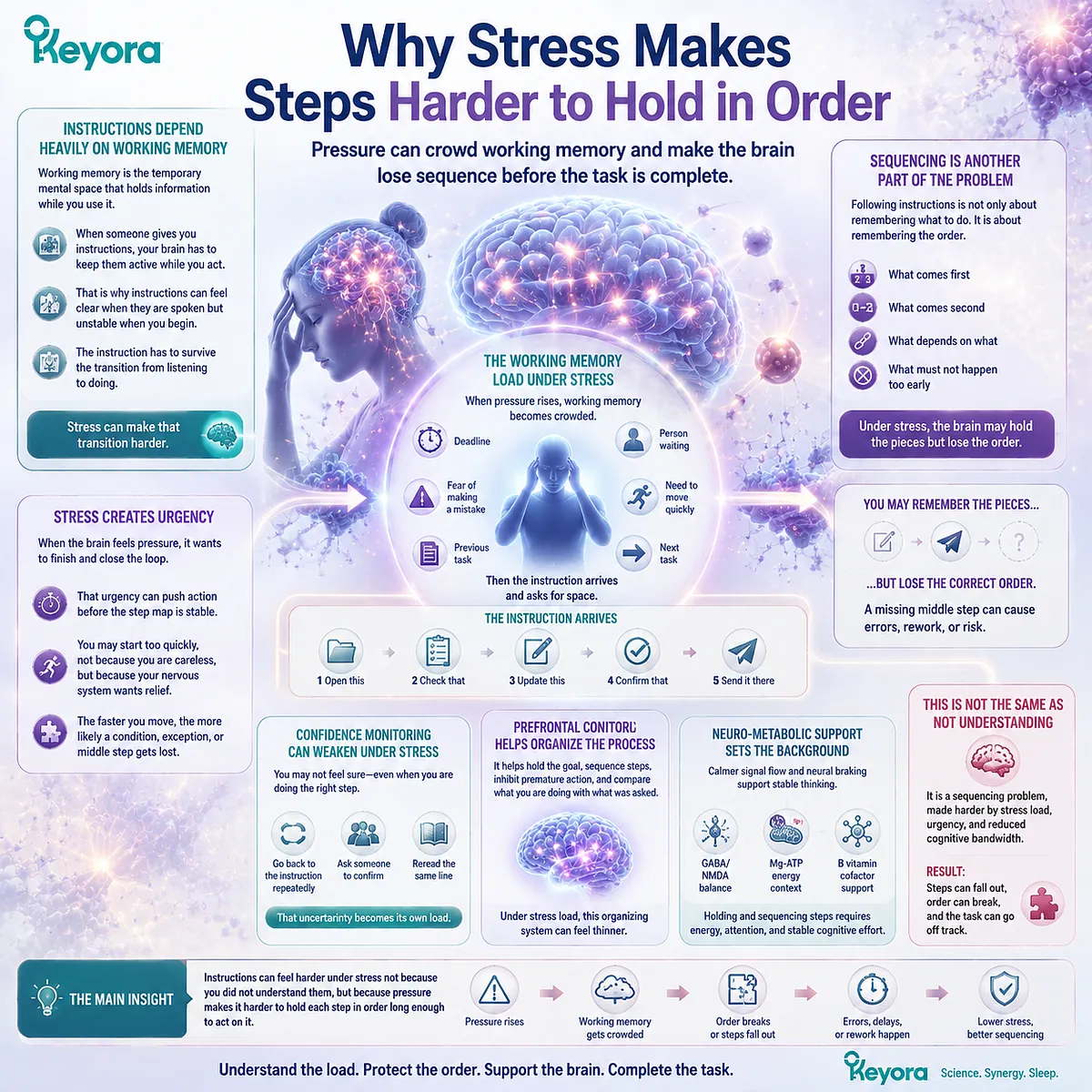
Pressure can crowd working memory and make the brain lose sequence before the task is complete.
Instructions depend heavily on working memory.
Working memory is the temporary mental space that holds information while you use it. When someone gives you instructions, your brain does not simply store them like a file. It has to keep them active while you act.
That is why instructions can feel clear when they are spoken but unstable when you begin.
The instruction has to survive the transition from listening to doing.
Stress can make that transition harder.
When pressure rises, working memory becomes crowded. It may already be holding the deadline, the person waiting, the fear of making a mistake, the previous task, the next task, and the feeling that you need to move quickly.
Then the instruction arrives and asks for space.
Open this. Check that. Update this. Confirm that. Send it there.
The more loaded the system is, the easier it becomes for one step to fall out.
Sequencing is another part of the problem.
Following instructions is not only about remembering what to do. It is about remembering what comes first, what comes second, what depends on what, and what must not happen too early.
Under stress, the brain may hold the pieces but lose the order.
You may remember “update the number” and “send the file,” but forget that the file should only be sent after the condition is confirmed. You may remember the final action but skip the middle step that makes the final action correct.
This is not the same as not understanding.
It is a sequencing problem.
Stress also creates urgency. When the brain feels pressure, it wants to finish. It wants to close the loop. It wants relief from the unfinished task.
That urgency can push the brain into action before the step map is stable.
You may start doing the task too quickly, not because you are careless, but because your nervous system is trying to reduce pressure. The faster you move, the more likely it becomes that a condition, exception, or middle step gets lost.
Confidence monitoring can also weaken under stress.
Even when you are doing the right step, you may not feel sure. You may go back to the instruction repeatedly. You may ask someone to confirm. You may reread the same line because the brain is looking for a feeling of certainty.
That uncertainty can become its own load.
Instead of only following the steps, your brain is also checking whether it trusts itself.
Prefrontal control helps organize this process. It helps hold the goal, sequence steps, inhibit premature action, and compare what you are doing with what was asked. Under stress load, this organizing system can feel thinner. You may still understand the task, but the step-to-action pathway becomes less reliable.
At the nervous-system level, high activation can make thinking feel rushed and unstable. GABA/NMDA activation balance can be understood as part of the background for calmer signal flow and neural braking. Mg-ATP energy background and B vitamin cofactor context also belong to the broader neuro-metabolic support picture, because holding and sequencing steps requires energy, attention, and stable cognitive effort.
The main insight is simple.
Instructions can feel harder under stress not because you did not understand them, but because pressure makes it harder to hold each step in order long enough to act on it.
How to Follow Instructions Without Holding Everything in Your Head
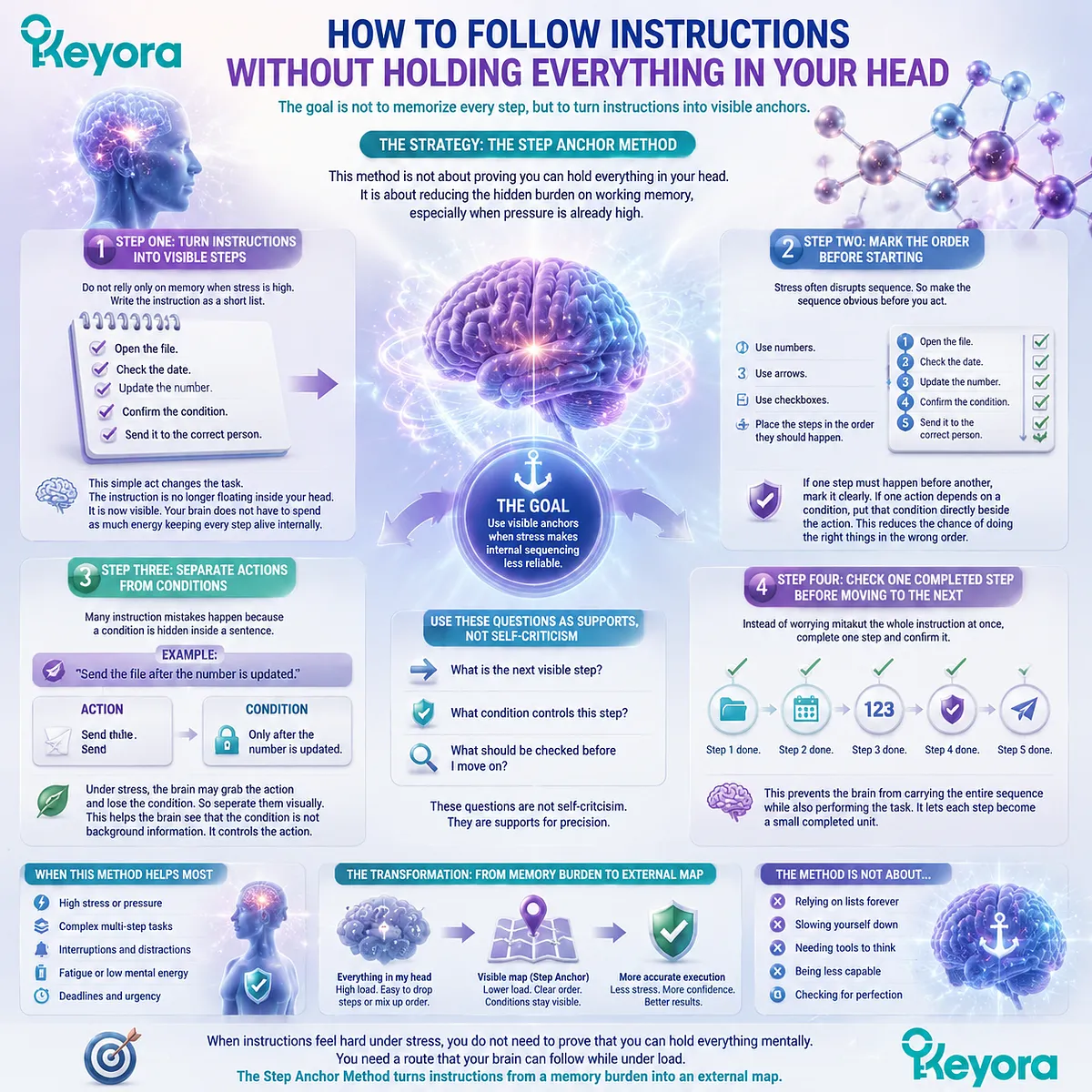
The goal is not to memorize every step, but to turn instructions into visible anchors.
A helpful approach is The Step Anchor Method.
This method is not about proving you can hold everything in your head. It is about reducing the hidden burden on working memory, especially when pressure is already high.
Step one: turn instructions into visible steps.
Do not rely only on memory when stress is high. Write the instruction as a short list.
-
Open the file.
-
Check the date.
-
Update the number.
-
Confirm the condition.
-
Send it to the correct person.
This simple act changes the task.
The instruction is no longer floating inside your head. It is now visible. Your brain does not have to spend as much energy keeping every step alive internally.
Step two: mark the order before starting.
Stress often disrupts sequence. So make the sequence obvious before you act.
Use numbers. Use arrows. Use checkboxes. Place the steps in the order they should happen.
If one step must happen before another, mark it clearly. If one action depends on a condition, put that condition directly beside the action.
This reduces the chance of doing the right things in the wrong order.
Step three: separate actions from conditions.
Many instruction mistakes happen because a condition is hidden inside a sentence.
For example:
“Send the file after the number is updated.”
The action is: send the file.
The condition is: only after the number is updated.
Under stress, the brain may grab the action and lose the condition. So separate them visually.
Action: Send the file.
Condition: Only after the number is updated.
This helps the brain see that the condition is not background information. It controls the action.
Step four: check one completed step before moving to the next.
Instead of worrying about the whole instruction at once, complete one step and confirm it.
Step 1 done.
Step 2 done.
Step 3 done.
This prevents the brain from carrying the entire sequence while also performing the task. It lets each step become a small completed unit.
The goal is not to become more dependent on lists. The goal is to use visible anchors when stress makes internal sequencing less reliable.
You can ask yourself:
“What is the next visible step?”
“What condition controls this step?”
“What should be checked before I move on?”
These questions are not self-criticism. They are supports for precision.
When instructions feel hard under stress, you do not need to prove that you can hold everything mentally. You need a route that your brain can follow while under load.
The Step Anchor Method turns instructions from a memory burden into an external map.
Where Nutritional Support Fits
Keyora MoodFlow 8 in 1 can fit as one small nutritional support layer when difficulty following instructions under stress appears within a broader pattern of cognitive strain, internal noise, stress load, poor recovery readiness, and sleep-stress disruption.
Its role is narrower: supporting wellness pathways related to calm focus, stress resilience, nervous-system downshift, cognitive resilience under stress, recovery readiness, and neuro-metabolic cofactor context.
-
L-Theanine may support calm focus, relaxed alertness, internal noise support, and non-sedative mental clarity readiness.
-
Magnesium glycinate may support neural braking, GABA/NMDA activation balance, Mg-ATP energy background, and cognitive stability context.
-
B1, B6, and B12 fit the neuro-metabolic cofactor layer for normal energy metabolism and normal neurotransmitter-related pathways.
-
Ashwagandha may support stress-rhythm adaptation and recovery readiness when cumulative stress load is part of the pattern.
-
5-HTP may be relevant only when emotional baseline, sleep rhythm, and serotonin-related pathway continuity are part of the broader stress-sleep-mood context.
Keyora MoodFlow 8 in 1 does not help you follow instructions as a performance claim. It does not fix instruction processing, improve work performance, treat ADHD, treat attention problems, treat cognitive dysfunction, cure brain fog, guarantee focus, restore memory, or replace sleep, rest, workload boundaries, practical step systems, or medical evaluation when needed.
If difficulty following instructions, confusion, attention problems, reading difficulty, low mood, anxiety-like feelings, sleep problems, or reduced functioning are persistent, severe, worsening, or interfering with daily life, work, school, relationships, or functioning, they should be discussed with a qualified healthcare professional.

Closing Summary
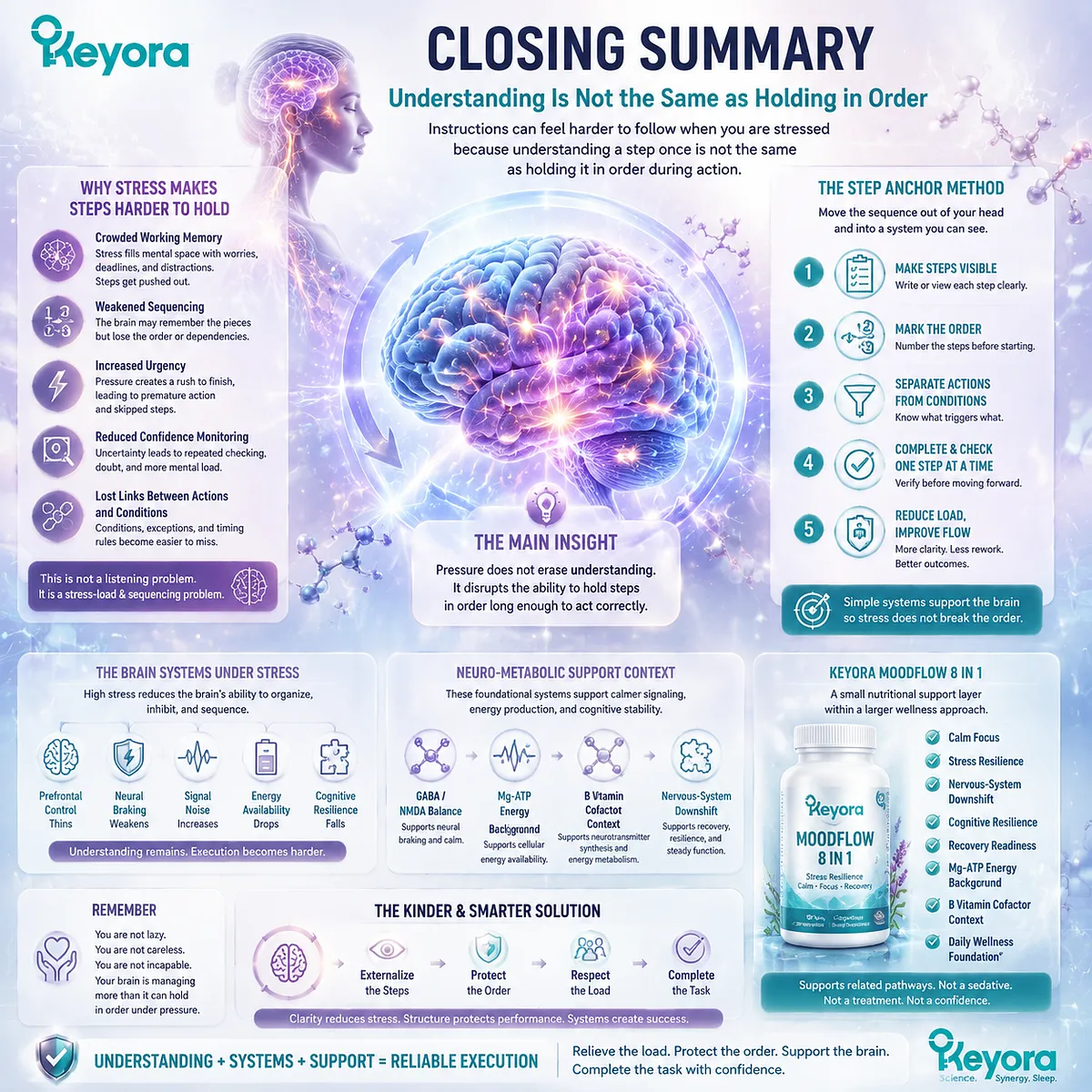
Instructions can feel harder to follow when you are stressed because understanding a step once is not the same as holding it in order during action.
Pressure can crowd working memory, weaken sequencing, increase urgency, reduce confidence monitoring, and make the brain lose the relationship between actions and conditions. This does not mean you are not listening, not trying, or not capable.
The practical path is The Step Anchor Method: turn instructions into visible steps, mark the order before starting, separate actions from conditions, and check one completed step before moving to the next.
Keyora MoodFlow 8 in 1 belongs only as a small nutritional support layer for related wellness pathways, including calm focus, stress resilience, nervous-system downshift, cognitive resilience, recovery readiness, Mg-ATP energy background, and B vitamin cofactor context.
When instructions feel harder under stress, the answer is not to shame yourself into remembering more. Sometimes the kindest and most effective step is to take the sequence out of your head and place it where your brain can see it.
This article is for educational and informational purposes only. It does not provide medical advice, diagnosis, treatment, cure, prevention, disease outcome claims, hormone restoration claims, fertility outcome claims, or formula-specific clinical efficacy claims.