
Why Do I Only Do the Bare Minimum When I’m Stressed?
Keyora Research Q&A Library
This is part of the Keyora Research Q&A Series, derived from Keyora Nutritional Neurology Series .
Within the Keyora Nutritional Neurology framework, this Q&A translates complex nutrient–brain mechanisms into reader-friendly, evidence-bound answers, focusing on stress resilience, sleep quality, calm mood support, cognitive wellness, and the broader interaction between nutrition, neurochemistry, and daily nervous-system function.
First published by Keyora Research Journal: www.keyorahealth.com

Direct Answer
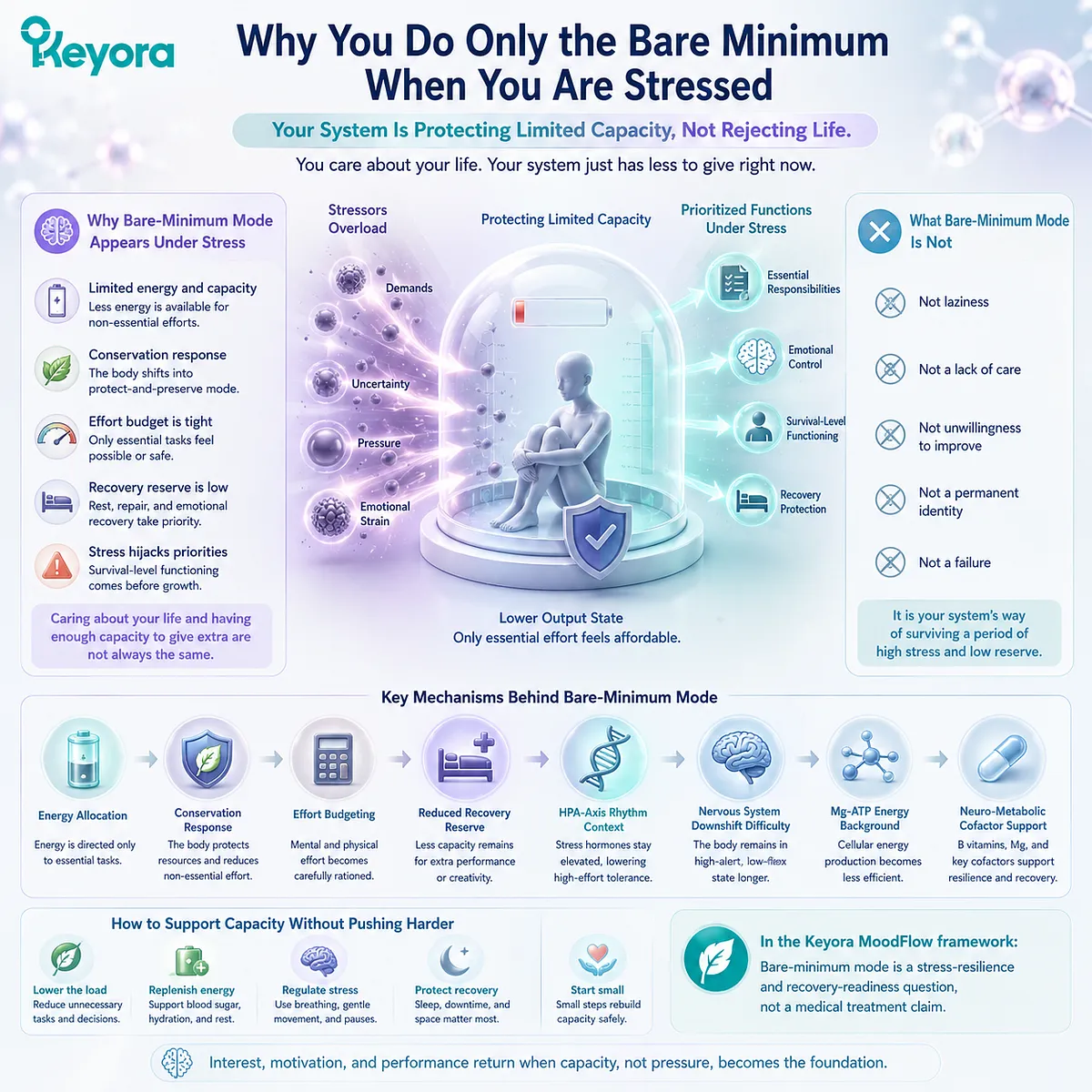
You may do only the bare minimum when you are stressed because your system is trying to protect limited capacity.
This does not always mean you are lazy, careless, or unwilling to improve. It may mean stress has shifted your body and mind into a lower-output state where only essential effort feels affordable.
The mismatch is this: caring about your life and having enough capacity to give extra are not always the same.
Under stress, your system may prioritize survival-level functioning, immediate responsibilities, emotional control, and recovery protection over excellence, creativity, or extra effort.
This can involve energy allocation, conservation response, effort budgeting, reduced recovery reserve, HPA-axis rhythm context, nervous-system downshift difficulty, Mg-ATP energy background, and neuro-metabolic cofactor support.
In the Keyora MoodFlow framework, bare-minimum mode is understood as a stress-resilience and recovery-readiness question, not a medical treatment claim.
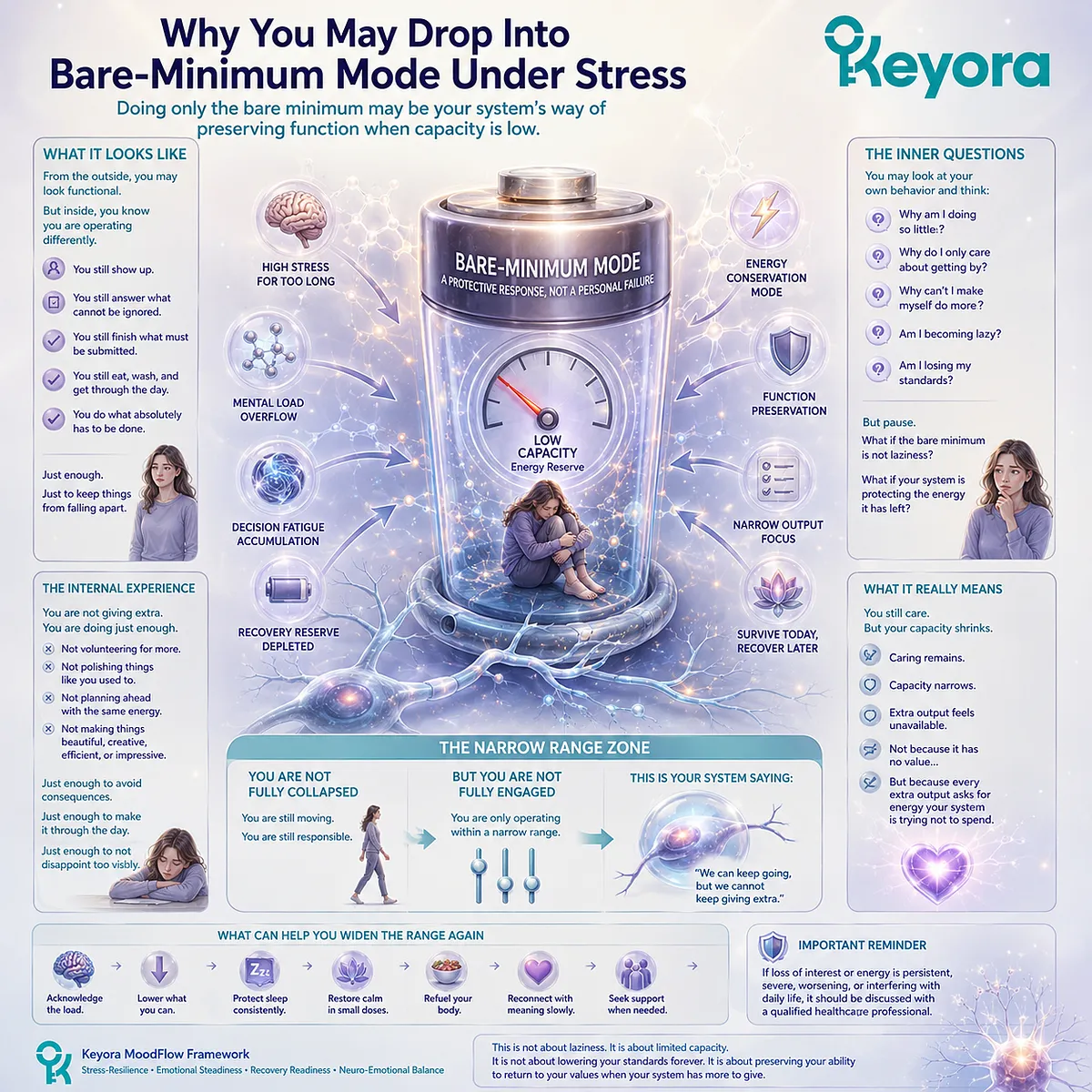
Why You May Drop Into Bare-Minimum Mode Under Stress
Doing only the bare minimum may be your system’s way of preserving function when capacity is low.
You have not completely stopped.
That may be the part nobody sees.
You still show up. You still answer the messages that cannot be ignored. You still finish the work that absolutely has to be submitted. You still eat something, wear something, wash what must be washed, and get through the day.
From the outside, you may look functional.
But inside, you know you are operating differently.
You are not giving extra.
You are not volunteering for more.
You are not polishing things the way you used to.
You are not planning ahead with the same energy.
You are not making things beautiful, thoughtful, efficient, creative, or impressive.
You are doing just enough.
Just enough to avoid consequences.
Just enough to keep things from falling apart.
Just enough to not disappoint people too visibly.
Just enough to make it through the day.
This can feel deeply uncomfortable, especially if you are used to being responsible, high-performing, helpful, creative, or emotionally available.
You may look at your own behavior and think:
“Why am I doing so little?”
“Why do I only care about getting by?”
“Why can’t I make myself do more?”
“Am I becoming lazy?”
“Am I losing my standards?”
But pause before turning this into a moral failure.
What if the bare minimum is not always laziness?
What if your system is trying to protect the energy it has left?
What if you are not refusing responsibility, but reducing output because your recovery reserve is low?
Bare-minimum mode often appears when stress has been high for too long. It is not the same as not caring. It is often what happens when caring remains, but capacity shrinks.
You may still care about your work, your home, your relationships, your goals, and your future. But the extra layer—the thoughtful reply, the polished detail, the creative idea, the extra errand, the social warmth, the long-term planning—may feel unavailable.
Not because it has no value.
But because every extra output asks for energy your system is trying not to spend.
This is why bare-minimum mode can feel so confusing. You are not fully collapsed, but you are not fully engaged. You are still moving, but only within a narrow range. You are still responsible, but not generous with effort.
That narrowness may be your body and mind saying:
“We can keep going, but we cannot keep giving extra.”
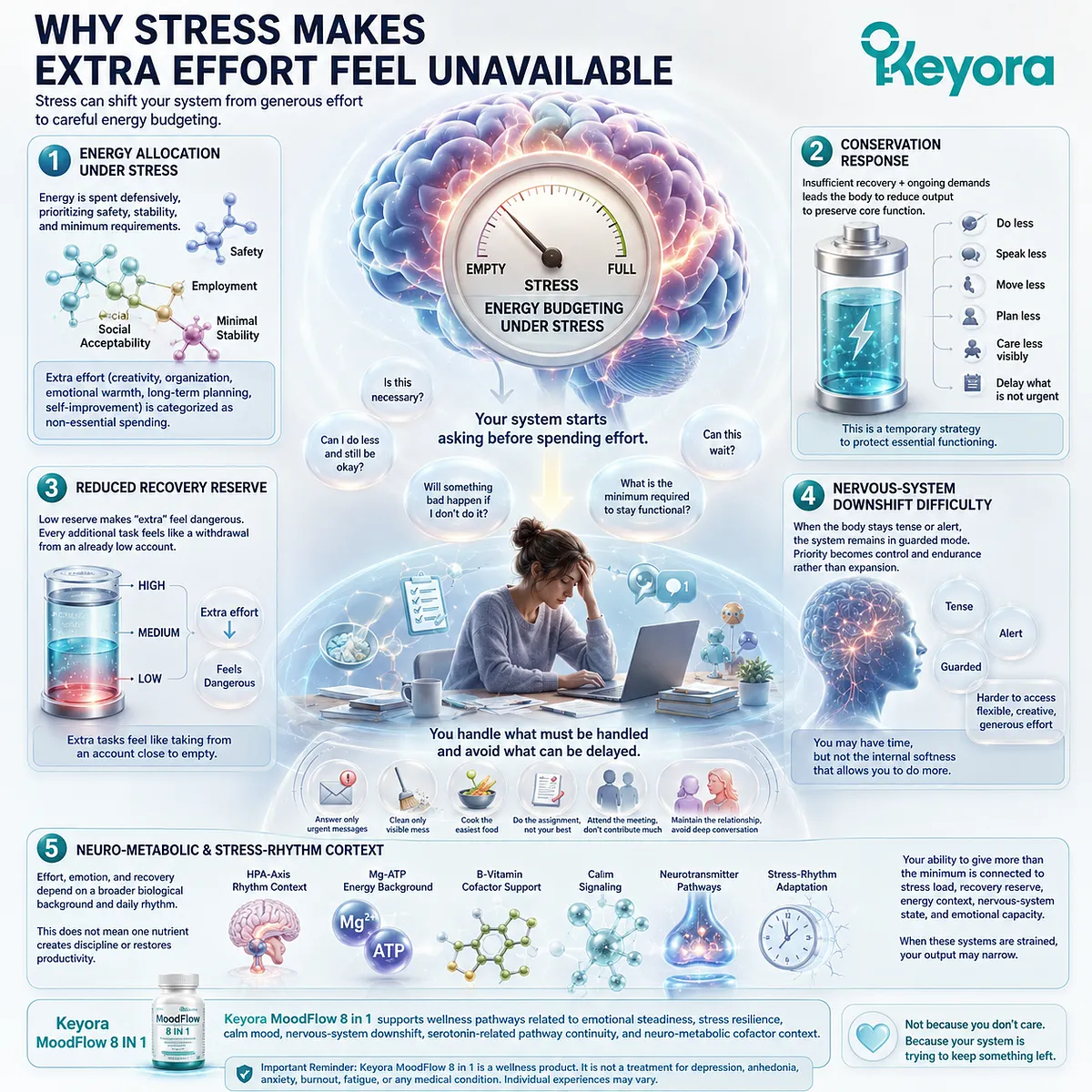
Why Stress Makes Extra Effort Feel Unavailable
Stress can shift your system from generous effort to careful energy budgeting.
When stress rises, the body does not always respond by becoming more productive.
Sometimes it becomes more selective.
It starts asking silent questions before spending effort.
“Is this necessary?”
“Will something bad happen if I do not do it?”
“Can this wait?”
“Can I do less and still be okay?”
“What is the minimum required to stay functional?”
This is effort budgeting.
It does not always happen consciously. You may not sit down and plan to lower your standards. Instead, your system begins making choices for you.
You answer only the most urgent messages.
You clean only the visible mess.
You cook the easiest food.
You do the assignment, but not your best version.
You attend the meeting, but do not contribute much.
You maintain the relationship, but avoid deeper conversation.
You handle what must be handled and avoid what can be delayed.
This can look like avoidance from the outside. But internally, it may feel more like rationing.
The first mechanism is energy allocation under stress.
When your system feels under pressure, it may spend energy defensively rather than generously. It prioritizes what keeps you safe, employed, socially acceptable, or minimally stable.
Extra effort becomes harder to justify because extra effort does not always feel immediately protective.
Creativity, organization, emotional warmth, long-term planning, and self-improvement may all matter. But under stress, they may be categorized as non-essential spending.
The second mechanism is conservation response.
When recovery is insufficient and demands keep arriving, the body may reduce output to preserve function. This can show up as doing less, speaking less, moving less, planning less, caring less visibly, or delaying anything that does not have immediate consequences.
This is not an ideal long-term state. But it may be a temporary function-preserving strategy.
The third mechanism is reduced recovery reserve.
Recovery reserve is the sense that you have some extra space beyond survival-level functioning. It allows you to give more than the minimum without feeling threatened by the cost.
When that reserve is low, “extra” starts to feel dangerous.
An extra task is not just an extra task. It feels like another withdrawal from an account that is already close to empty.
The fourth mechanism is nervous-system downshift difficulty.
If your body remains tense, alert, or internally braced, it may be harder to move into flexible, creative, generous effort. Stress can keep the system in a guarded mode, where the priority is control and endurance rather than expansion.
You may technically have time, but not the internal softness that allows you to do more.
The fifth mechanism is neuro-metabolic and stress-rhythm context.
Effort, emotion, and recovery all depend on a broader biological background. HPA-axis rhythm context, Mg-ATP energy background, B-vitamin cofactor support, calm signaling, and normal neurotransmitter-related pathways can all belong to the wider terrain of effort-readiness.
This does not mean one nutrient creates discipline or restores productivity.
It means your ability to give more than the minimum is not only a matter of attitude. It is connected to stress load, recovery reserve, energy context, nervous-system state, and emotional capacity.
When those systems are strained, your output may narrow.
Not because you do not care.
Because your system is trying to keep something left.
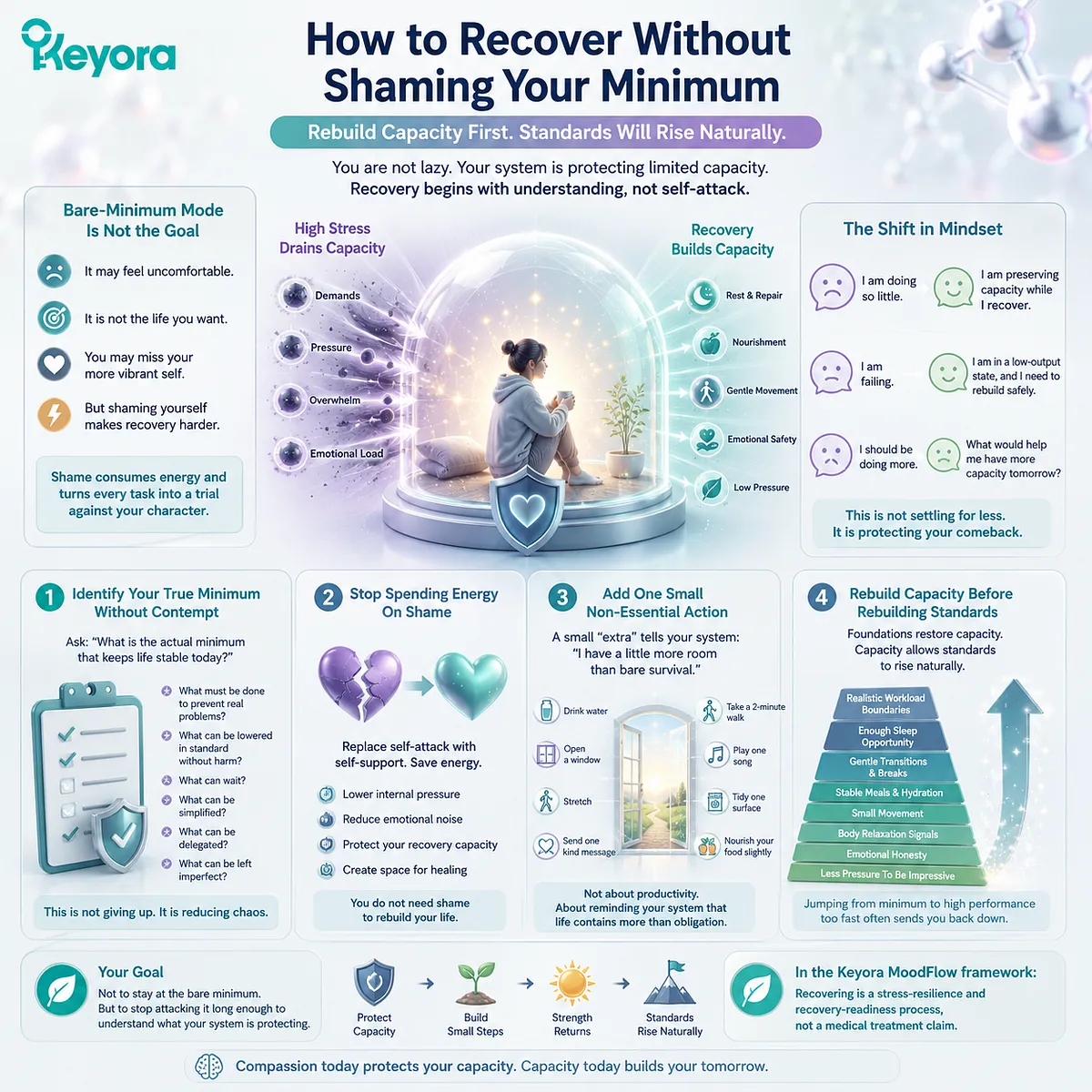
How to Recover Without Shaming Your Minimum
The goal is not to stay in bare-minimum mode, but to rebuild capacity before demanding more from yourself.
Bare-minimum mode does not need to be romanticized.
It is not always comfortable. It may not be the life you want. You may not want to stay there. You may miss the version of yourself that had more energy, more care, more creativity, more initiative, and more emotional availability.
But shaming yourself for being in bare-minimum mode usually makes recovery harder.
Shame is also output.
It consumes energy. It increases internal pressure. It turns every small task into evidence in a trial against your character.
So the first step is to identify your true minimum without contempt.
Ask yourself:
“What is the actual minimum that keeps life stable today?”
Not the ideal version.
Not the impressive version.
Not the version that proves you are doing well.
The actual minimum.
What must be done today to prevent real problems?
What can be lowered in standard without serious harm?
What can wait?
What can be simplified?
What can be delegated?
What can be left imperfect?
This is not giving up. It is reducing chaos.
When you know the true minimum, you stop spending energy pretending everything has equal urgency.
The second step is to stop spending energy on shame.
Instead of saying, “I am doing so little,” try saying, “I am preserving capacity while I recover.”
Instead of saying, “I am failing,” try saying, “I am in a low-output state, and I need to rebuild safely.”
Instead of saying, “I should be doing more,” try asking, “What would help me have more capacity tomorrow?”
This does not mean the bare minimum should become your permanent standard. It means you stop using shame as the fuel for recovery.
The third step is to add one small non-essential action.
This may sound strange, but it matters.
When your whole day becomes only what is necessary, life can start to feel like maintenance. There is no signal of abundance, softness, or choice. Everything becomes survival-level.
A small non-essential action tells your system:
“I have a little more room than bare survival.”
This action should be gentle, not ambitious.
Drink one extra glass of water.
Put one object back where it belongs.
Take a two-minute walk.
Make your food slightly more nourishing.
Open a window.
Send one kind message.
Play one song.
Stretch your shoulders.
Lightly tidy one surface.
Do something small that is not about performance.
The goal is not productivity. The goal is to remind your system that life contains more than obligation.
The fourth step is to rebuild capacity before rebuilding standards.
Many people try to jump directly from bare minimum to high performance. They decide that tomorrow they will fix everything, restart every routine, answer every message, clean everything, exercise, eat perfectly, and become their old self again.
That jump is often too steep.
Capacity usually returns more safely through foundations.
More stable meals.
Lower-input breaks.
Gentler transitions.
Less multitasking.
More realistic workload boundaries.
Enough sleep opportunity.
Small body relaxation signals.
A little movement.
A little emotional honesty.
A little less pressure to be impressive.
When capacity grows, standards can rise naturally. But if you demand high standards before capacity returns, the system may go back into conservation mode.
Your goal is not to stay at the bare minimum.
Your goal is to stop attacking the bare minimum long enough to understand what your system is protecting.
Where Nutritional Support Fits
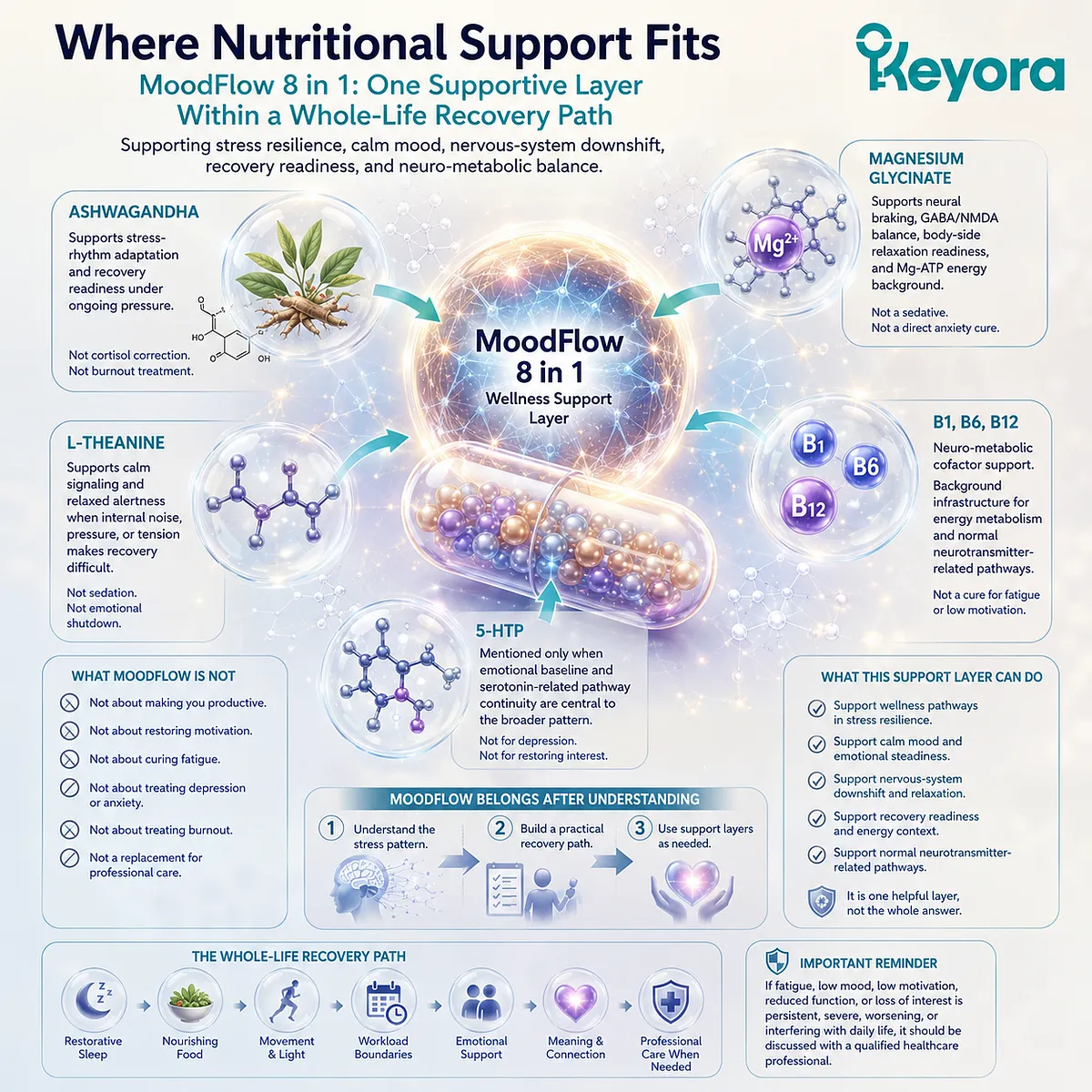
Keyora MoodFlow 8 in 1 can fit as one small nutritional support layer when bare-minimum mode appears within a broader stress-sleep-mood-cognition pattern. It should not be framed as making someone productive, restoring motivation, curing fatigue, treating depression, treating anxiety, treating burnout, or replacing professional care.
Its role is narrower: supporting wellness pathways involved in stress resilience, calm mood, nervous-system downshift, recovery readiness, body-side relaxation readiness, and neuro-metabolic cofactor context.
-
Ashwagandha may be relevant when bare-minimum mode follows cumulative stress load. In the MoodFlow framework, it supports stress-rhythm adaptation and recovery readiness under ongoing pressure. It should not be described as correcting cortisol or treating burnout.
-
Magnesium glycinate may be relevant when stress keeps the body braced, tense, or unable to fully downshift. It supports neural braking, GABA/NMDA activation balance, body-side relaxation readiness, and Mg-ATP energy background.
-
B1, B6, and B12 may be relevant as neuro-metabolic cofactor support. They belong to the background infrastructure of energy metabolism and normal neurotransmitter-related pathways, which can support the context of effort-readiness without being framed as a cure for fatigue or low motivation.
-
L-Theanine may be relevant when internal noise, pressure, or tension makes recovery feel difficult. Its role is calm signaling and relaxed alertness, not sedation, emotional shutdown, or forced productivity.
-
5-HTP may be mentioned only when emotional baseline and serotonin-related pathway continuity are central to the broader pattern. It should not be framed as treating depression or restoring interest.
MoodFlow belongs after the reader understands the stress pattern and practical recovery path. It is not the center of the article. It is one optional layer within a larger approach that includes rest, food, movement, workload boundaries, emotional support, and professional care when needed.
If fatigue, low mood, low motivation, reduced function, or loss of interest is persistent, severe, worsening, or interfering with daily life, it should be discussed with a qualified healthcare professional.
Closing Summary
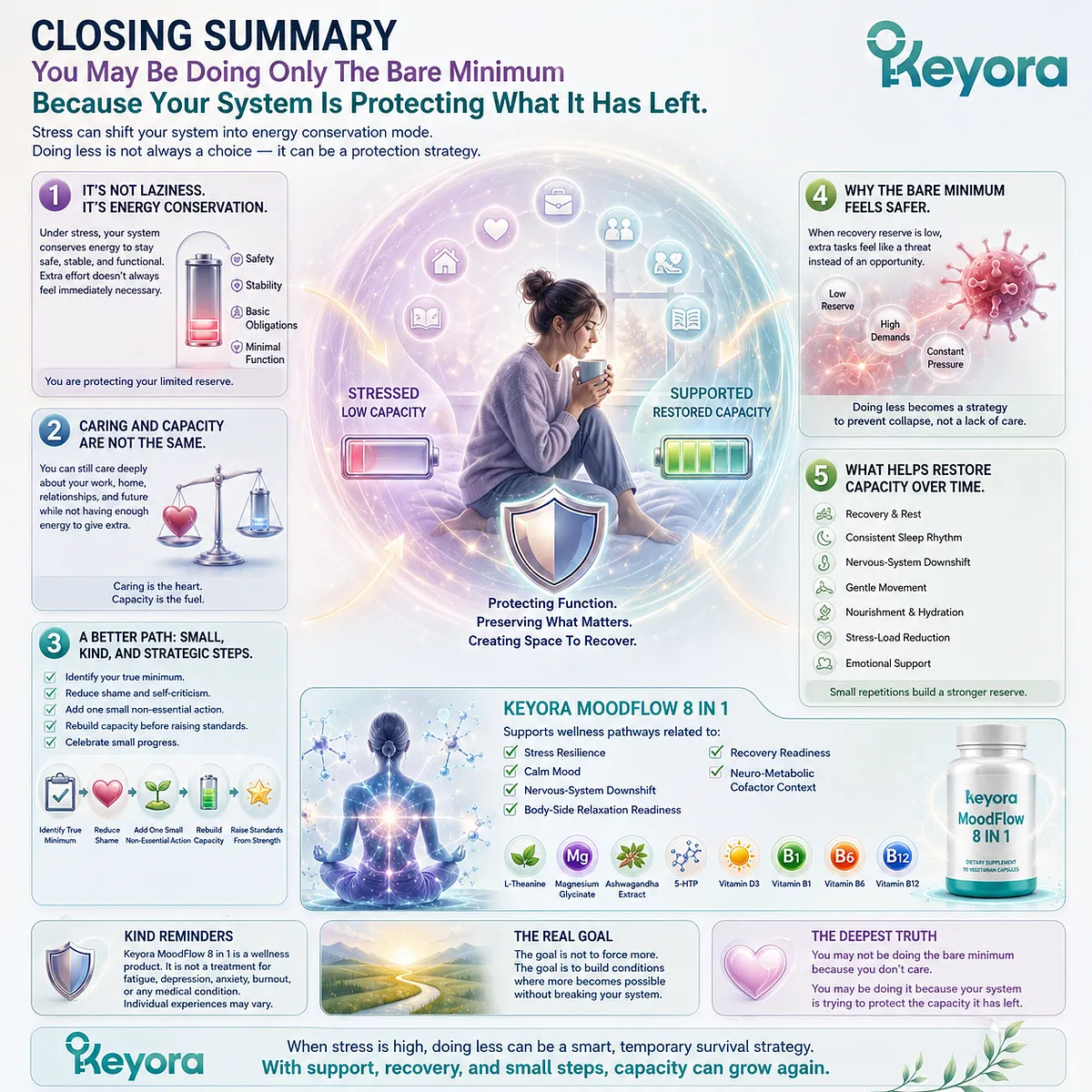
Doing only the bare minimum when stressed does not automatically mean you are lazy, careless, or irresponsible. It may mean your system is conserving energy, protecting limited recovery reserve, and trying to stay functional under pressure.
The deeper mismatch is that caring and having capacity are not the same. You can still care about your work, home, relationships, and future while not having enough available energy to give extra.
A better path begins by identifying your true minimum, reducing shame, adding one small non-essential action, and rebuilding capacity before demanding higher standards from yourself.
Keyora MoodFlow 8 in 1 can support wellness pathways related to stress resilience, calm mood, nervous-system downshift, body-side relaxation readiness, recovery readiness, and neuro-metabolic cofactor context. It is not a treatment for fatigue, depression, anxiety, burnout, or any medical condition.
You may not be doing the bare minimum because you do not care.
You may be doing it because your system is trying to protect the capacity it has left.
This article is for educational and informational purposes only. It does not provide medical advice, diagnosis, treatment, cure, prevention, disease outcome claims, hormone restoration claims, fertility outcome claims, or formula-specific clinical efficacy claims.