
Why Do I Need Time Alone After Stress?
Keyora Research Q&A Library
This is part of the Keyora Research Q&A Series, derived from Keyora Nutritional Neurology Seriers .
Within the Keyora Nutritional Neurology framework, this Q&A translates complex nutrient–brain mechanisms into reader-friendly, evidence-bound answers, focusing on stress resilience, sleep quality, calm mood support, cognitive wellness, and the broader interaction between nutrition, neurochemistry, and daily nervous-system function.
First published by Keyora Research Journal: www.keyorahealth.com
Direct Answer
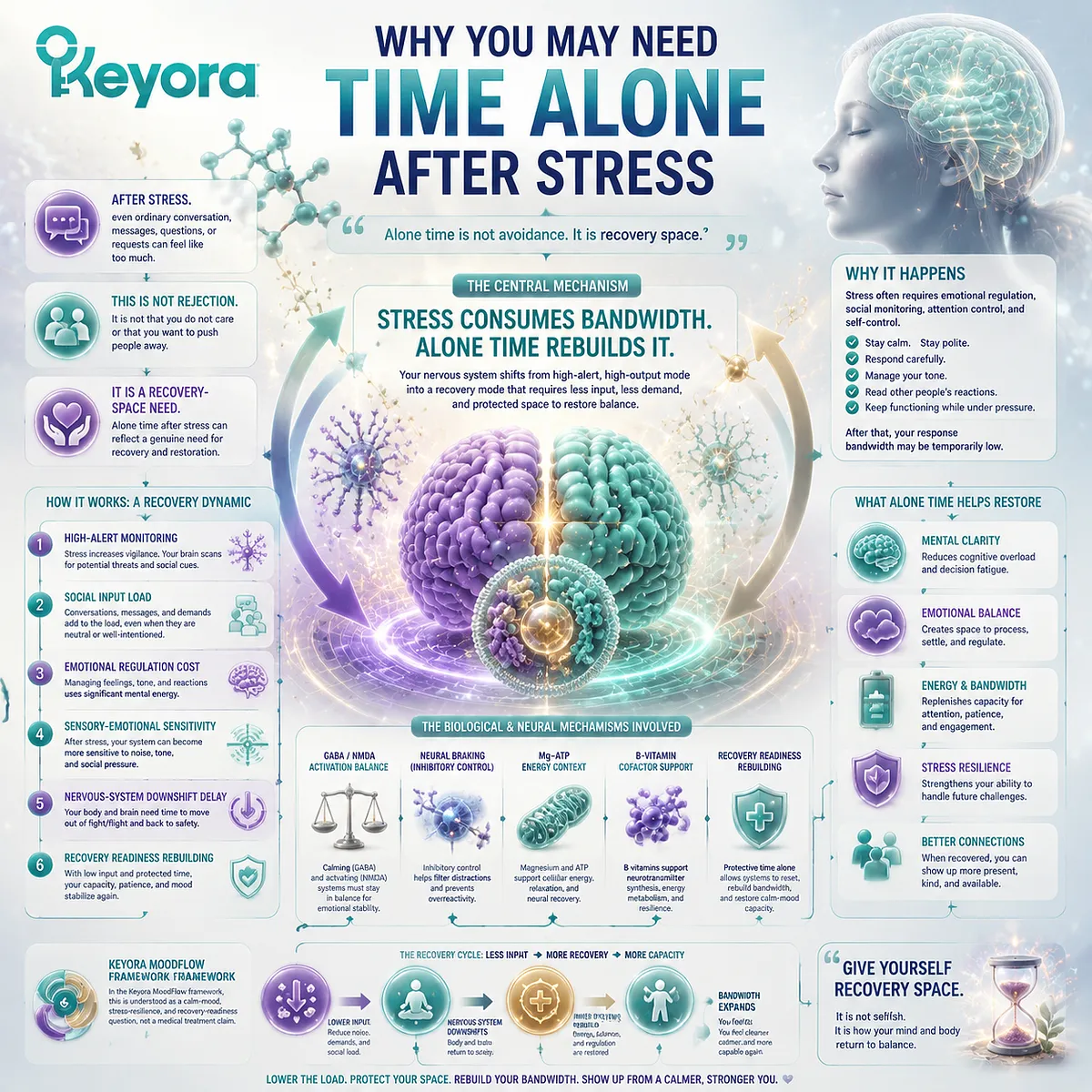
You may need time alone after stress because your nervous system may need lower input, less social demand, and recovery space to rebuild emotional bandwidth.
After a stressful event, even ordinary conversation, messages, questions, or requests can feel like too much.
The problem is not always that you are rejecting people or that you do not care. The problem is that alone time after stress can reflect a recovery-space need.
Stress often requires emotional regulation, social monitoring, attention control, and self-control.
You may have had to stay calm, stay polite, respond carefully, manage your tone, read other people’s reactions, and keep functioning while under pressure.
After that, your response bandwidth may be temporarily low.
Mechanistically, this can involve high-alert monitoring, social input load, emotional regulation cost, sensory-emotional sensitivity, nervous-system downshift delay, GABA/NMDA activation balance, neural braking, Mg-ATP energy context, B-vitamin cofactor support, and recovery readiness rebuilding.
In the Keyora MoodFlow framework, this is understood as a calm-mood, stress-resilience, and recovery-readiness question, not a medical treatment claim.
Why Stress Can Make You Need Quiet Space
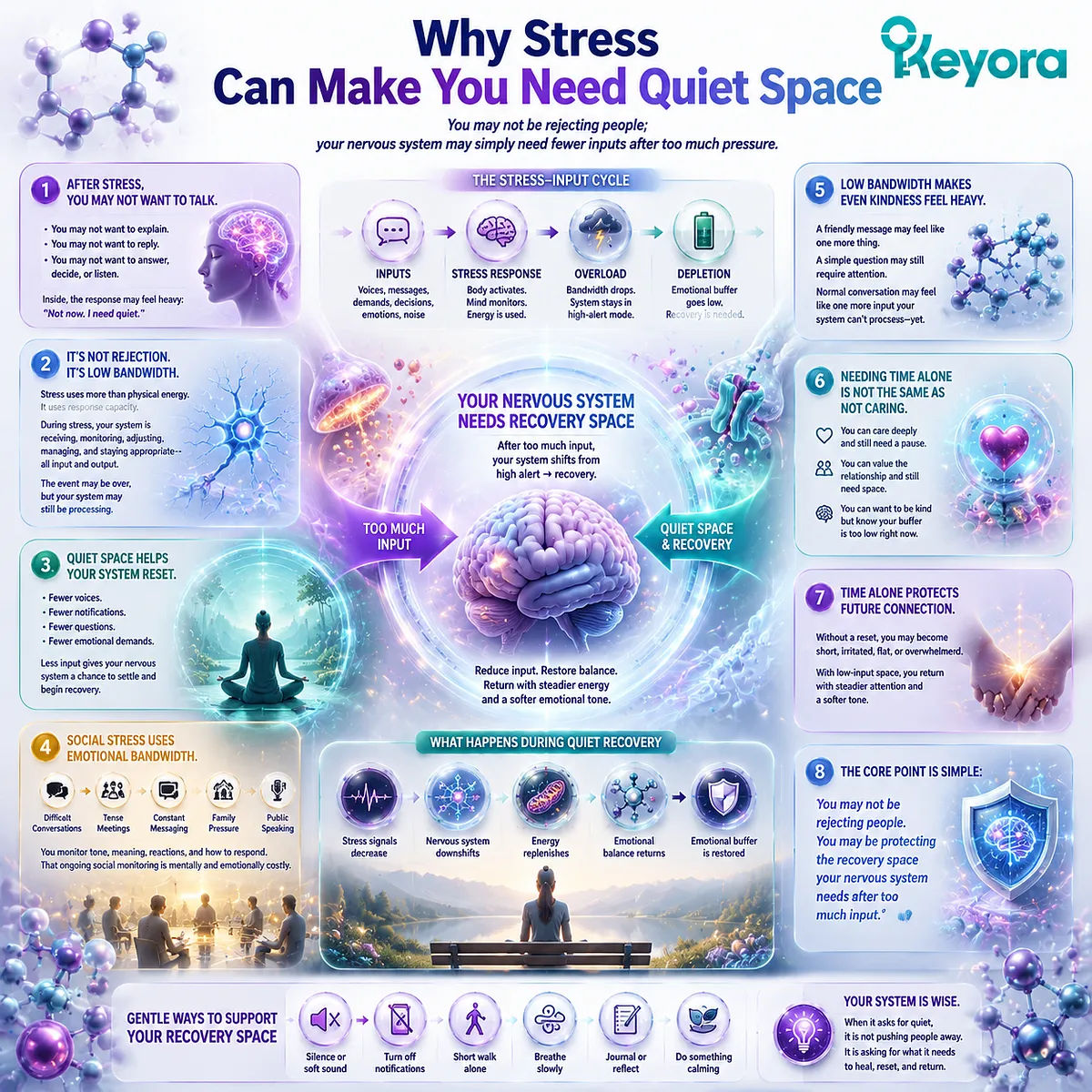
You may not be rejecting people; your nervous system may simply need fewer inputs after too much pressure.
After stress, you may not want to talk.
You may not want to explain what happened. You may not want to reply to messages. You may not want to answer one more question, make one more decision, or listen to one more person’s feelings.
This can feel confusing, especially if you care about the people around you.
You may know they are not trying to overwhelm you. You may know their question is reasonable. You may know the message is not urgent. But inside, the response may still feel heavy. It may feel like your system is saying, “Not now. I need quiet.”
That does not always mean you are being cold.
It may mean your emotional and social bandwidth is temporarily low.
Stress does not only use physical energy. It also uses response capacity. During a stressful day, meeting, conflict, exam, deadline, or emotionally demanding interaction, you may have been receiving information, monitoring tone, adjusting your behavior, managing your reactions, and staying socially appropriate.
All of that is input and output.
Even if you handled the situation well, your nervous system may still need time to shift out of response mode. The event may be over, but your system may still be processing the stimulation that came with it.
This is why time alone after stress can feel necessary.
Quiet space reduces new input. Fewer voices, fewer notifications, fewer questions, and fewer emotional demands can give the system a chance to settle. You are not necessarily trying to disconnect from life. You may simply be reducing the load so recovery can begin.
The experience is often strongest after social stress.
A difficult conversation, a tense meeting, customer-facing work, conflict, family pressure, public speaking, or constant messaging can all require social monitoring. You may need to track what others mean, how they feel, how you should respond, and whether your tone is right.
That monitoring uses emotional bandwidth.
When the bandwidth is low, even kind interaction can feel demanding. A friendly message may still feel like something you have to answer. A simple question may still require attention. A normal conversation may still feel like one more input your system is not ready to process.
This is why needing time alone is not always the same as not caring.
You may care deeply and still need a pause before you can respond well. You may value the relationship and still need space before talking. You may want to be patient and kind, but know that your current emotional buffer is too low to do that easily.
Time alone can be a way to protect the quality of future connection.
Without a reset, you may become short, irritated, flat, or overwhelmed. With a little low-input space, you may be more able to return with steadier attention and a softer emotional tone.
The core point is simple:
You may not be rejecting people. You may be protecting the recovery space your nervous system needs after too much input.
The Social Input Load Behind Needing Time Alone
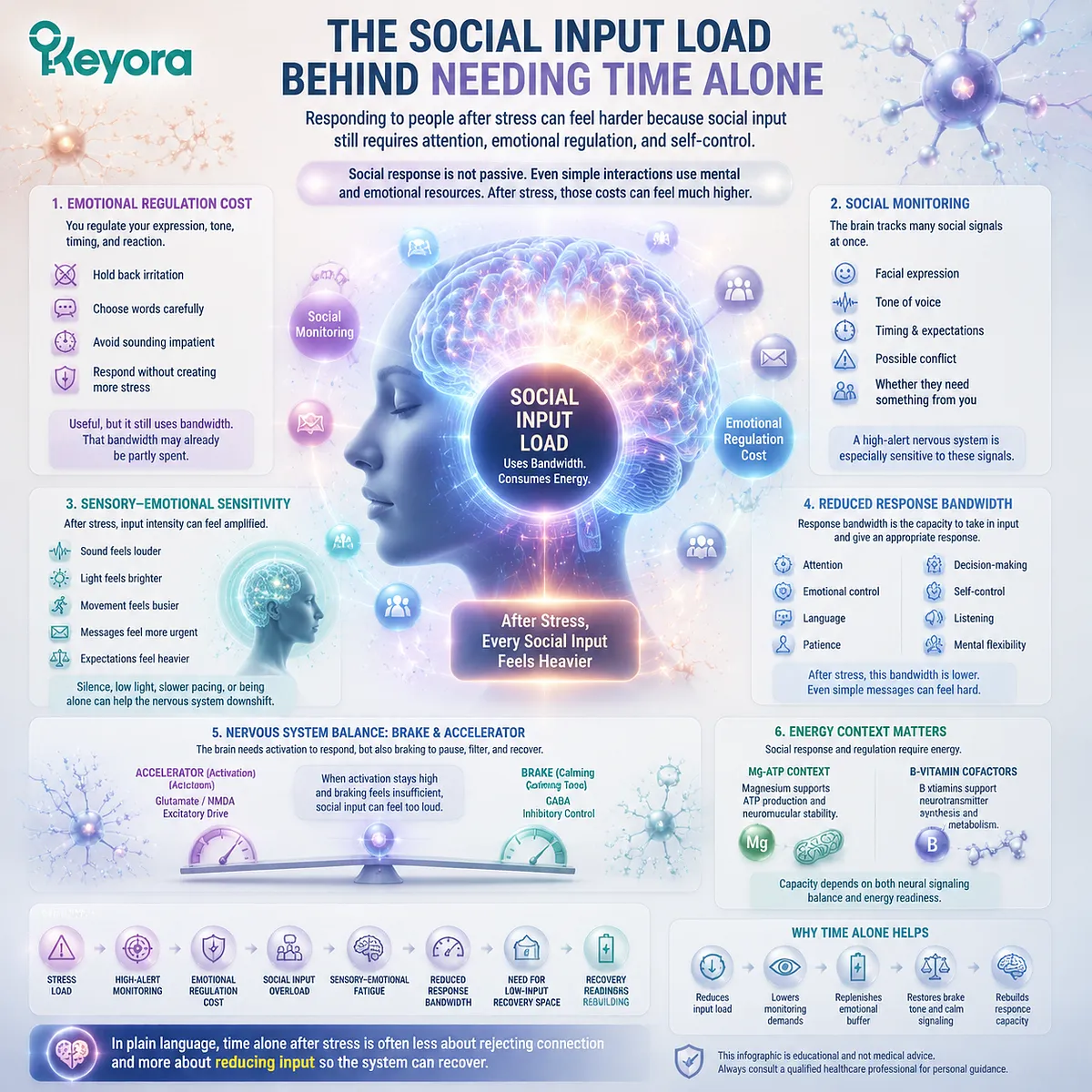
Responding to people after stress can feel harder because social input still requires attention, emotional regulation, and self-control.
Social response is not passive.
Answering a message, listening to someone speak, explaining yourself, comforting another person, making small talk, or staying polite all require mental and emotional resources. These actions may look simple from the outside, but they are not zero-cost to the nervous system.
After stress, those costs can feel much higher.
The first reason is emotional regulation cost.
When you interact with people, you often regulate your expression, tone, timing, and reaction. You may hold back irritation, soften your words, avoid sounding impatient, or try to respond in a way that does not create more stress. This is useful, but it still uses bandwidth.
After a stressful event, that bandwidth may already be partly spent.
The second reason is social monitoring.
In social situations, the brain tracks signals: facial expression, tone of voice, timing, expectations, possible conflict, and whether the other person needs something from you. Under normal conditions, this may feel natural. Under stress, it can feel like extra work.
A high-alert nervous system is especially sensitive to these signals.
If the system is still in alert mode, a small tone change may feel more noticeable. A simple question may feel like pressure. A notification may feel like another demand. A request may feel heavier than it objectively is.
This is not because the request is always too much.
It is because the system receiving the request is already loaded.
The third reason is sensory-emotional sensitivity.
After stress, sound, light, movement, messages, voices, and social expectations can feel more intense. The nervous system may need lower stimulation before it can return to a steadier state. This is why silence, dimmer environments, slower pacing, or being alone may feel relieving.
The fourth reason is response bandwidth.
Response bandwidth is the capacity to receive input and produce an appropriate response. It includes attention, emotional control, language, patience, and decision-making. When stress has already used these systems, your response bandwidth may be temporarily reduced.
This is why you might think, “I cannot answer that right now,” even if the message is simple.
The problem is not always the message. The problem is the state of the system receiving it.
The brake-and-accelerator balance of the nervous system also matters.
In simple terms, the brain needs activation to respond, but it also needs braking to pause, filter, and recover. GABA-related calming tone and NMDA/glutamate activation balance help explain why the nervous system can feel either steady or overstimulated.
When activation remains high and braking feels insufficient, social input can feel too loud.
A normal conversation may feel like too many moving parts. A small request may feel like an interruption. A harmless message may feel like one more demand. The nervous system may be asking for fewer inputs so it can downshift.
Energy context is another layer.
Emotional regulation, social response, attention control, and self-control all require active resources. Magnesium’s role in Mg-ATP context and B vitamins’ role as cofactor infrastructure help explain why response capacity depends on both neural signaling and energy readiness.
This does not mean needing time alone after stress is always caused by nutrient status. It means the experience can be understood as a multi-layer wellness question.
The mechanism chain looks like this:
stress load → high-alert monitoring → emotional regulation cost → social input overload → sensory-emotional fatigue → reduced response bandwidth → need for low-input recovery space → recovery readiness rebuilding
In plain language, time alone after stress is often less about rejecting connection and more about reducing input so the system can recover.
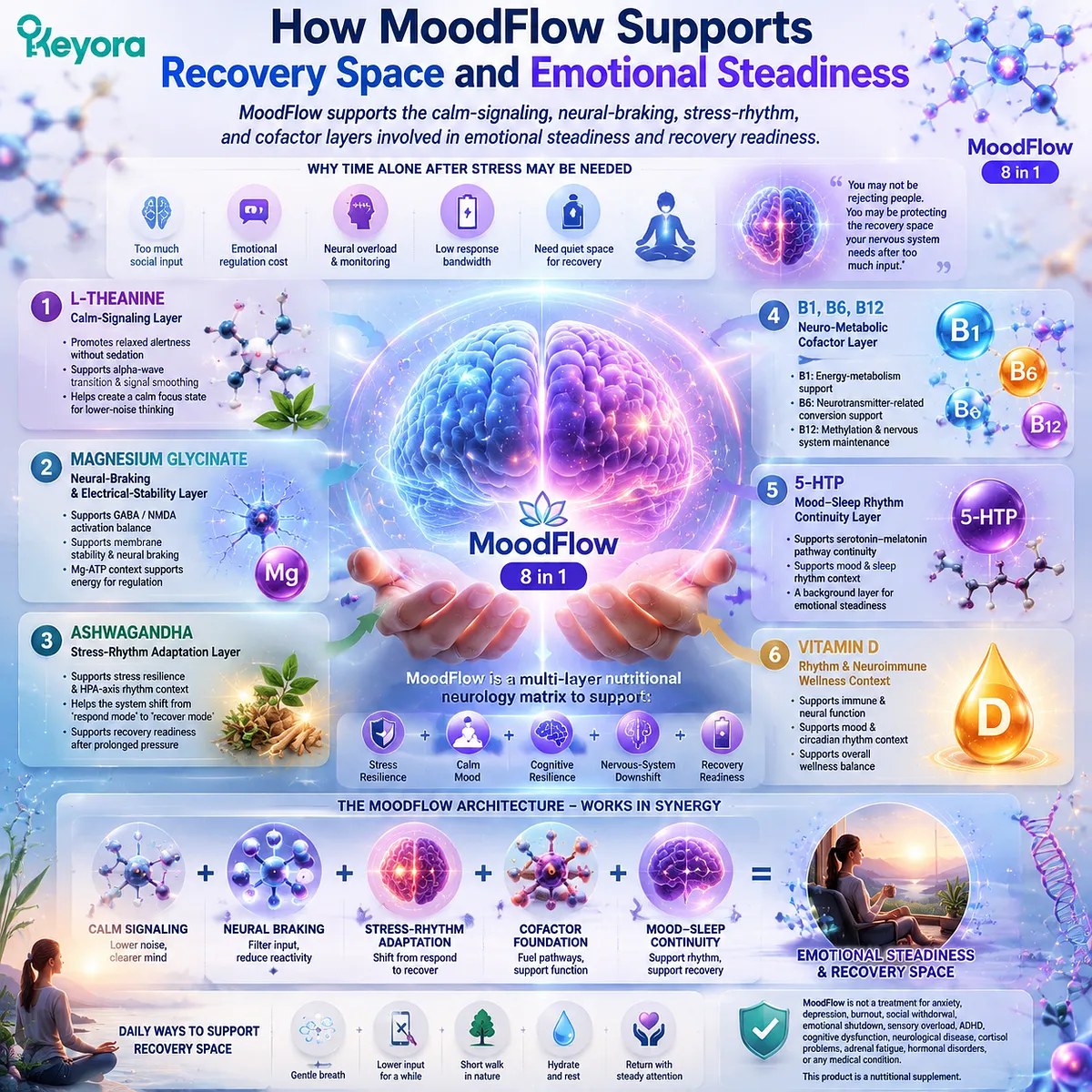
How MoodFlow Supports Recovery Space and Emotional Steadiness
MoodFlow supports the calm-signaling, neural-braking, stress-rhythm, and cofactor layers involved in emotional steadiness and recovery readiness.
Keyora MoodFlow approaches the need for time alone after stress as a calm-mood, stress-resilience, and recovery-readiness question.
The goal is not to make someone more social on demand. The goal is not to treat social withdrawal, emotional shutdown, anxiety, depression, or burnout. The goal is to support the wellness pathways that help the nervous system move from high-input stress toward steadier emotional recovery.
This distinction matters.
When someone needs time alone after stress, the solution is not always more stimulation, more pressure, or more forced interaction. The deeper issue may be that the system needs a lower-noise internal and external environment before it can respond well again.
MoodFlow’s logic begins with the state behind emotional steadiness.
L-Theanine supports the calm-signaling layer.
In the MoodFlow framework, L-Theanine is associated with relaxed alertness, alpha-wave transition, signal smoothing, and calm focus without sedation. This is relevant because the goal after stress is not necessarily to become sleepy or disconnected. The goal may be to support calm without forcing grogginess.
A person who needs time alone may still be awake and aware. The issue may be that the internal signal environment feels too reactive or too sensitive to new input. L-Theanine helps explain how calm signaling can support a lower-noise state while preserving alertness.
Magnesium glycinate supports the neural-braking and electrical-stability layer.
Magnesium is relevant to GABA/NMDA activation balance, membrane excitability, and Mg-ATP energy context. In MoodFlow, magnesium glycinate is positioned as part of the neural braking and hardware-stabilizing layer.
For recovery space after stress, this layer matters because the nervous system may still feel electrically loud. Social input, notifications, and emotional demands can feel larger when braking support is low. Neural braking helps explain the background physiology involved in pause, filtering, and downshift.
Magnesium’s Mg-ATP context also matters because emotional regulation and social response require energy. Responding well to others is not passive. It requires attention, patience, tone control, and cognitive flexibility. The system needs both signal stability and energy readiness.
Ashwagandha supports the stress-rhythm adaptation layer.
The need for time alone after stress often reflects the recovery side of the stress rhythm. The event ends, but the nervous system may still be carrying stress-rhythm carryover. The person may need space to shift from respond mode into recover mode.
Ashwagandha is positioned in MoodFlow around stress resilience, HPA-axis rhythm context, and recovery readiness. In this article, that does not mean Ashwagandha fixes cortisol, treats burnout, repairs the HPA axis, or treats anxiety. It means Ashwagandha belongs to the stress-adaptation layer that helps explain why recovery space matters after prolonged pressure.
B1, B6, and B12 support the neuro-metabolic cofactor layer.
The nervous system depends on normal metabolic and neurotransmitter-related infrastructure. B1 supports energy-metabolism context. B6 supports neurotransmitter-related conversion context, including pathways relevant to calming and mood-related signaling. B12 supports methylation context and nervous-system maintenance.
In MoodFlow, these B vitamins are not positioned as treatments for emotional fatigue, social withdrawal, or cognitive dysfunction. They are part of the cofactor background behind emotional steadiness, response capacity, and normal pathway support under everyday pressure.
5-HTP plays a background role in mood-sleep rhythm continuity.
Because this article is about needing time alone after stress, 5-HTP should remain a background layer. Its role is best understood as support for serotonin-melatonin pathway continuity and mood-sleep rhythm context within the broader MoodFlow architecture. This does not mean treating depression, correcting serotonin, or forcing sleep.
Vitamin D may also be understood as part of the broader rhythm and neuroimmune wellness context when relevant, but it should remain secondary.
Together, these layers explain why MoodFlow is not positioned as a social-confidence product, stimulant, sedative, emotional-shutdown treatment, anxiety treatment, or burnout treatment. It is a multi-layer nutritional neurology matrix designed to support stress resilience, calm mood, cognitive resilience, nervous-system downshift, and recovery readiness within an evidence-bound wellness framework.
MoodFlow is not a treatment for anxiety, depression, burnout, social withdrawal, emotional shutdown, sensory overload, ADHD, cognitive dysfunction, neurological disease, cortisol problems, adrenal fatigue, hormonal disorders, or any medical condition. In this article, Keyora uses “needing time alone after stress” as a wellness-language entry point for explaining social input load, emotional regulation cost, calm signaling, neural braking, stress-rhythm adaptation, and recovery readiness under everyday pressure.
Closing Summary
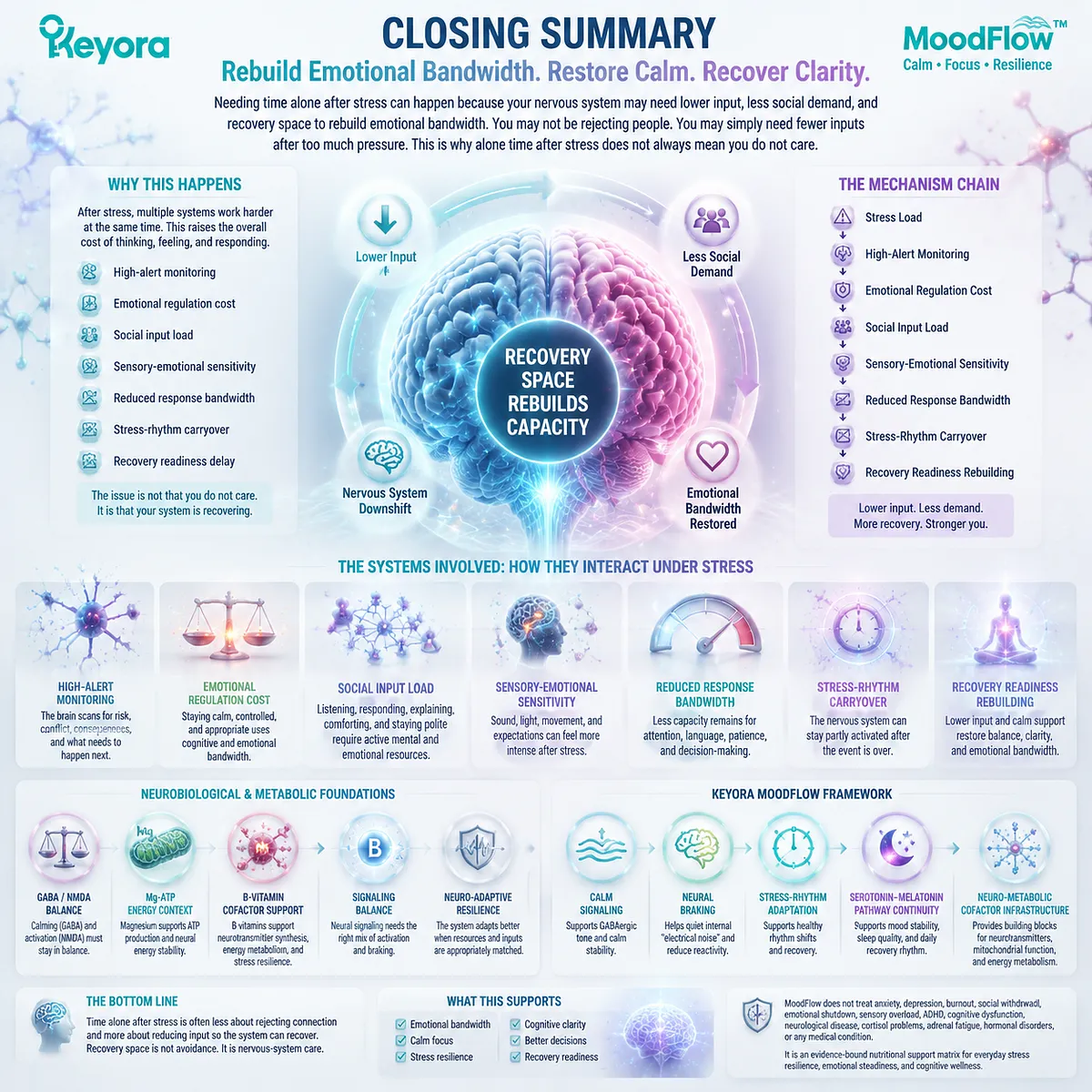
Needing time alone after stress can happen because your nervous system may need lower input, less social demand, and recovery space to rebuild emotional bandwidth.
You may not be rejecting people. You may simply need fewer inputs after too much pressure.
This is why alone time after stress does not always mean you do not care.
Mechanistically, this experience may involve high-alert monitoring, emotional regulation cost, social input load, sensory-emotional sensitivity, reduced response bandwidth, GABA/NMDA activation balance, Mg-ATP energy context, B-vitamin cofactor support, stress-rhythm carryover, and recovery readiness rebuilding.
In the Keyora MoodFlow framework, this is understood as a calm-mood, stress-resilience, and recovery-readiness question.
MoodFlow supports this picture through calm signaling, neural braking, stress-rhythm adaptation, serotonin-melatonin pathway continuity, and neuro-metabolic cofactor infrastructure.
MoodFlow does not treat anxiety, depression, burnout, social withdrawal, emotional shutdown, sensory overload, ADHD, cognitive dysfunction, neurological disease, cortisol problems, adrenal fatigue, hormonal disorders, or any medical condition. It is an evidence-bound nutritional support matrix for everyday stress resilience, emotional steadiness, and cognitive wellness.
This article is for educational and informational purposes only. It does not provide medical advice, diagnosis, treatment, cure, prevention, disease outcome claims, hormone restoration claims, fertility outcome claims, or formula-specific clinical efficacy claims.