
Why Do I Need Caffeine to Function but Feel More Wired After Drinking It?
Keyora Research Q&A Library
This is part of the Keyora Research Q&A Series, derived from Keyora Nutritional Neurology Series .
Within the Keyora Nutritional Neurology framework, this Q&A translates complex nutrient–brain mechanisms into reader-friendly, evidence-bound answers, focusing on stress resilience, sleep quality, calm mood support, cognitive wellness, and the broader interaction between nutrition, neurochemistry, and daily nervous-system function.
First published by Keyora Research Journal: www.keyorahealth.com

Direct Answer
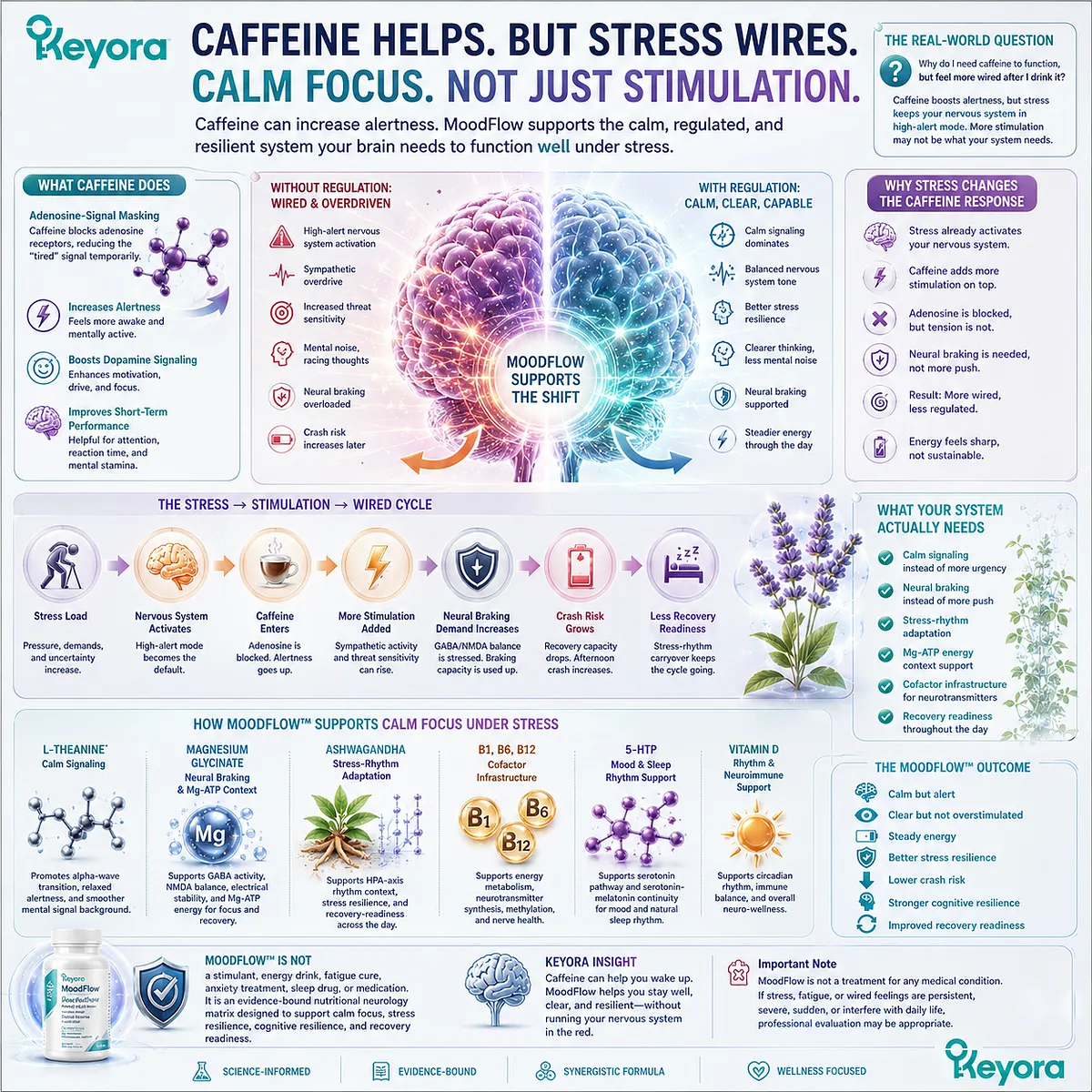
You may need caffeine to function but feel more wired after drinking it because caffeine can increase alertness while stress keeps the nervous system in high-alert mode.
Coffee may help you feel more awake, but it does not automatically rebuild recovery capacity, calm signaling, or neural braking.
Feeling more awake is not the same as feeling more regulated.
When you are already stressed, caffeine may help you stay online for a while. But if your system is already tense, overloaded, and running on urgency, the added stimulation may make the same system feel sharper, faster, more restless, or more wired.
Mechanistically, this can involve stress load, low recovery capacity, adenosine-signal masking, sympathetic activation, high-alert nervous-system tone, increased threat sensitivity, neural-braking demand, GABA/NMDA balance context, Mg-ATP energy context, B-vitamin cofactor support, and stress-rhythm carryover.
In the Keyora MoodFlow framework, this is understood as a calm-focus, stress-resilience, nervous-system downshift, and cognitive-resilience question, not a medical treatment claim.
Why Caffeine Can Help You Feel Awake but Still More Tense
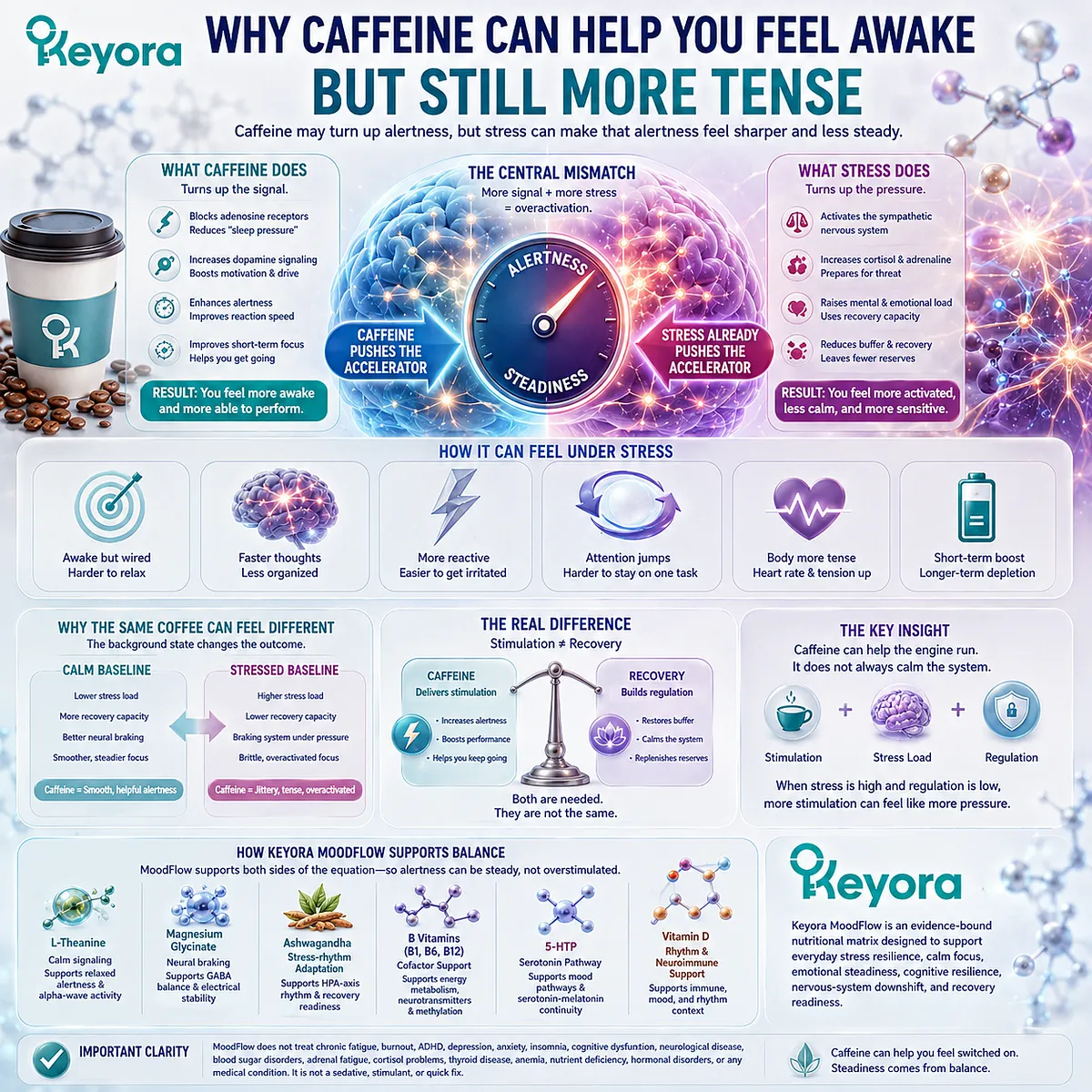
Caffeine may turn up alertness, but stress can make that alertness feel sharper and less steady.
Many people reach for caffeine because they feel like they cannot function without it.
You may wake up tired, start the day already behind, or hit an afternoon crash after hours of stress. Your brain may feel slow. Your eyes may feel heavy. Tasks may feel harder to begin. A cup of coffee can feel like the only thing that gets the system moving.
And sometimes it works.
You may feel more awake. You may read faster. You may respond more quickly. You may feel more able to start the next task. Caffeine can make the system feel switched on.
But under stress, switched on can become overactivated.
After coffee, you may notice a different feeling. Your thoughts may move faster but feel less organized. Your body may feel more tense. Your attention may jump between tasks. You may feel more urgent, more reactive, or more sensitive to interruptions.
You may feel awake, but not calm.
This is the central mismatch.
Caffeine can help increase alertness, but alertness alone is not the same as stable focus. A stressed system may not only need a stronger push. It may also need steadier regulation.
Caffeine can push the accelerator, but stress may already be pushing the accelerator too.
That is why caffeine can feel helpful and uncomfortable at the same time. It may help you keep going, but it may also amplify the activated state that stress has already created.
This does not mean caffeine is “bad” for everyone.
It means the way caffeine feels can depend on the state of your nervous system before you drink it. The same cup of coffee may feel smooth on a calm day and jittery on a stressful day. The caffeine did not change. The background state changed.
If your nervous system is already carrying stress, caffeine may land on a high-alert system.
That system may already be monitoring messages, deadlines, social cues, unfinished tasks, possible mistakes, and what needs to happen next. Adding more alertness to that background can make the signal feel louder.
You may feel more capable for a short time, but also more brittle.
Brittle focus is focus that works only while pressure stays high. You may get through a task, but you feel tense doing it. You may be productive for a moment, but less emotionally steady. You may stay online, but feel more internally rushed.
This is why coffee can feel like a rescue and a stress amplifier at the same time.
The key distinction is simple:
Stimulation is not the same as recovery.
Caffeine may help you feel awake, but it does not necessarily lower the stress load underneath. It may help the system continue operating, but it does not automatically restore the buffer that stress has already used.
So when you ask, “Why do I need caffeine to function but feel more wired after drinking it?” the answer may be that your system is trying to solve two different problems with one tool.
One problem is low alertness.
The other problem is low regulation.
Caffeine may help with the first feeling. It may not solve the second. If stress has already reduced your recovery capacity, emotional buffer, and neural braking, caffeine may increase wakefulness without creating steadiness.
Caffeine can help you feel switched on, but under stress, switched on can become overactivated.
The Stress-Caffeine Mismatch Behind Feeling Wired
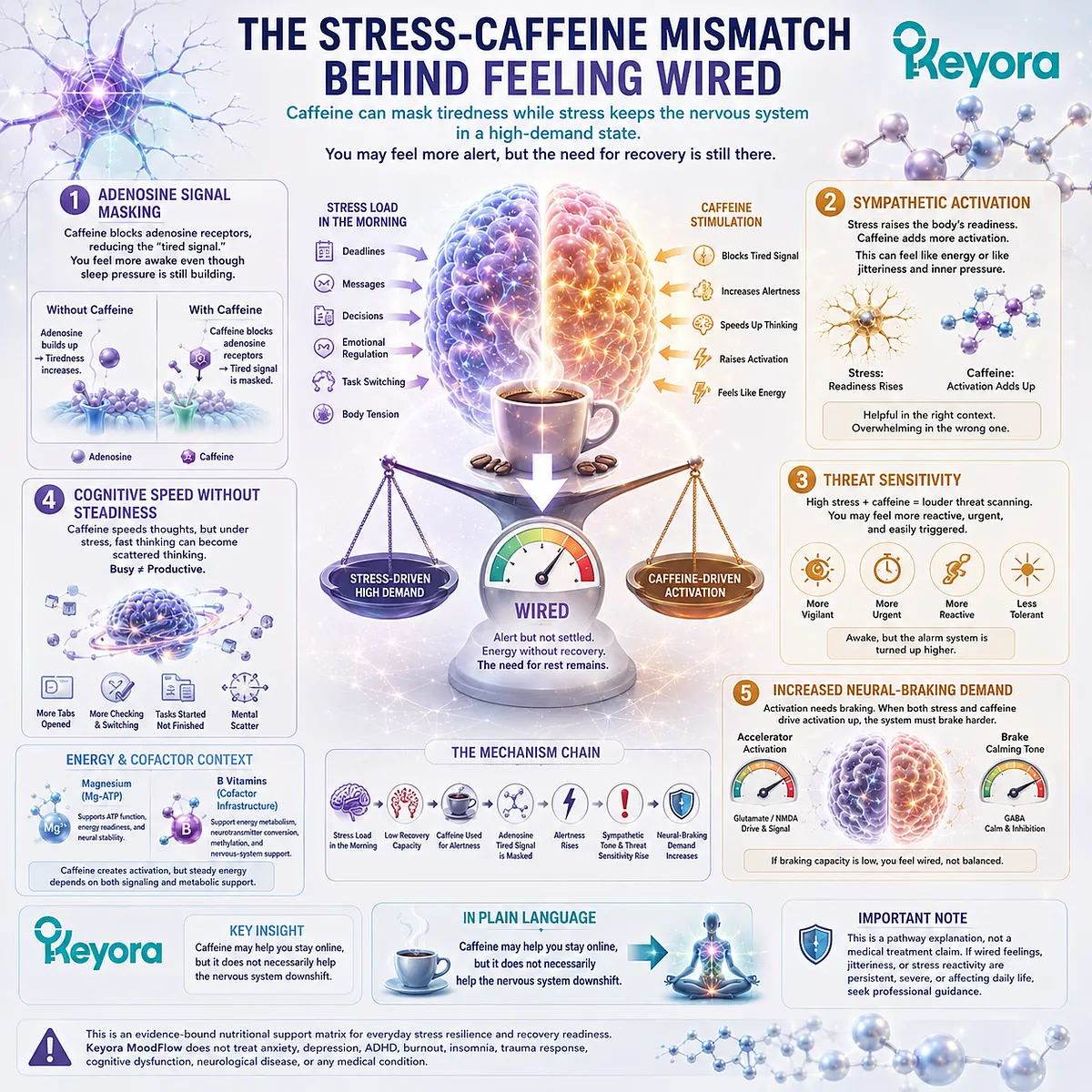
Caffeine can mask tiredness while stress keeps the nervous system in a high-demand state.
Caffeine can make you feel more awake partly because it interferes with the body’s sleep-pressure signal.
A simple way to understand this is that your system builds signals that say, “You need rest.” Caffeine can temporarily reduce how strongly you feel that signal. You may feel more alert even though the underlying need for recovery has not disappeared.
That is why caffeine can be useful but also misleading.
It can cover the tired signal, but it does not erase the stress load underneath.
If your morning was stressful, your system may already have spent energy on decision-making, emotional regulation, task switching, attention control, and body tension. Caffeine may help you keep going, but the cost of the earlier stress remains in the background.
The second mechanism is sympathetic activation.
Stress can increase the body’s readiness state. You may feel more alert, more guarded, more urgent, or more prepared to respond. This can be useful when something demands action, but it can also make the system feel tense.
Caffeine can add more activation to that state.
For some people, this feels like clean energy. For others, especially when stressed, it can feel like jitteriness, inner pressure, racing thoughts, restlessness, or a wired body with a tired brain.
The third mechanism is threat sensitivity.
When stress is high, the brain may become more sensitive to possible problems. It may scan more quickly for mistakes, criticism, missed tasks, or unfinished responsibilities. If caffeine increases alertness on top of that state, threat scanning may feel louder.
You may become more awake, but also more reactive.
A message may feel more urgent. A small delay may feel more frustrating. A task may feel more pressured. A noise may feel more irritating. This is not because caffeine creates the whole stress pattern. It may simply amplify a high-alert background that was already there.
The fourth mechanism is cognitive speed without cognitive steadiness.
Caffeine may make thoughts move faster. That can help when the task is clear and the nervous system is steady. But when the mind is already crowded, faster thinking does not always mean better thinking.
Sometimes faster thinking becomes more scattered thinking.
You may jump between tabs. You may check messages more often. You may start tasks without finishing them. You may feel busy but not organized. The system is activated, but not necessarily regulated.
The fifth mechanism is increased neural-braking demand.
The nervous system needs both activation and braking. Activation helps you respond, perform, and stay alert. Braking helps you pause, filter, organize, soften, and recover. GABA-related calming tone and NMDA/glutamate activation balance help explain why the system can feel either steady, overactivated, or difficult to settle.
When stress and caffeine both raise activation, braking demand rises.
The system has to filter more signal, calm more urgency, and prevent alertness from turning into internal noise. If the braking background is already under pressure, caffeine may feel less like smooth focus and more like being pushed.
Energy context also matters.
Magnesium’s role in Mg-ATP context helps explain why energy readiness is not only about stimulation. B vitamins support neuro-metabolic infrastructure, including energy metabolism, neurotransmitter-related conversion, methylation context, and nervous-system support.
This matters because caffeine can increase the feeling of alertness, but the nervous system still needs metabolic and regulatory support to function steadily.
This does not mean feeling wired after caffeine is caused by nutrient status. It means the experience can be understood as a multi-layer wellness question involving stimulation, stress load, neural braking, energy context, and recovery readiness.
The mechanism chain looks like this:
stress load → low recovery capacity → caffeine used for alertness → adenosine-related tiredness signal is masked → alertness rises → sympathetic tone and threat sensitivity may feel louder → neural-braking demand increases → wired feeling appears
In plain language, caffeine may help you stay online, but it does not necessarily help the nervous system downshift.
How MoodFlow Supports Calm Focus Without Relying on More Stimulation
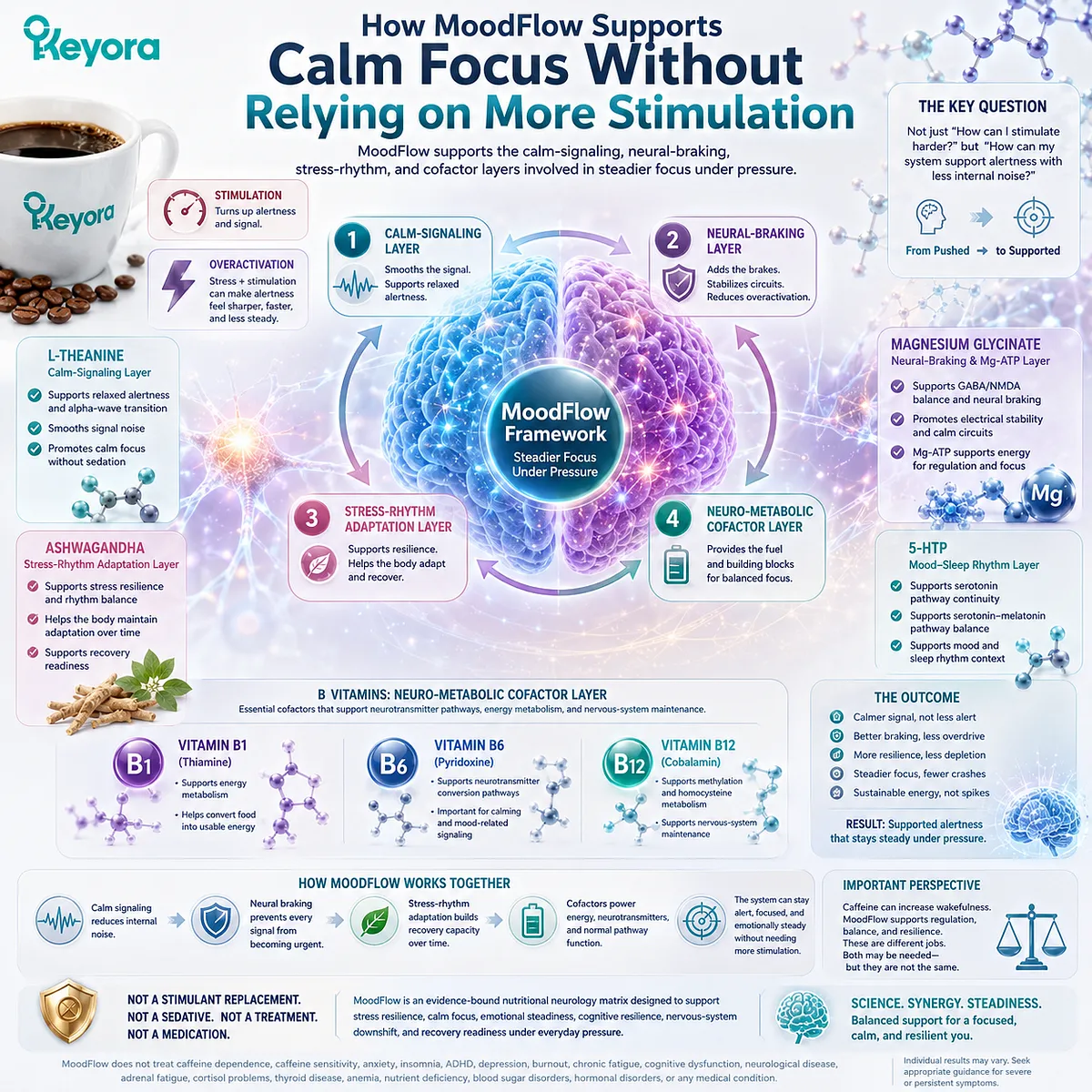
MoodFlow supports the calm-signaling, neural-braking, stress-rhythm, and cofactor layers involved in steadier focus under pressure.
Keyora MoodFlow approaches the “need caffeine but feel wired” pattern as a calm-focus, stress-resilience, nervous-system downshift, and cognitive-resilience question.
The goal is not to replace coffee, treat caffeine sensitivity, treat caffeine dependence, treat anxiety, treat insomnia, or make medical claims about stimulant response. The goal is to explain why steadier focus may require more than stimulation.
This distinction matters.
When you feel tired, the obvious solution may seem to be more stimulation. More coffee. More urgency. More pressure. More pushing. But if the nervous system is already overactivated, more push may increase wakefulness without increasing steadiness.
MoodFlow’s logic begins with calm signaling.
L-Theanine supports the calm-signaling layer.
In the MoodFlow framework, L-Theanine is associated with relaxed alertness, alpha-wave transition, signal smoothing, and calm focus without sedation. This is directly relevant to the caffeine-stress mismatch because the problem is not always too little alertness.
Sometimes the problem is alertness without enough calm.
L-Theanine helps explain the calm-alertness layer: a state where the system is not forced into sleepiness, but also not driven only by urgency. The goal is not to numb the system. The goal is steadier signal quality.
This is why L-Theanine is central to this topic.
The question is not, “How can I stimulate myself harder?” The better question may be, “How can my system support alertness with less internal noise?”
Magnesium glycinate supports the neural-braking and Mg-ATP context layer.
Magnesium is relevant to GABA/NMDA activation balance, membrane excitability, and Mg-ATP energy context. In MoodFlow, magnesium glycinate is positioned as part of the neural braking and hardware-stabilizing layer.
For caffeine-related wired feelings under stress, this layer is important.
When caffeine and stress both increase activation, the nervous system needs braking capacity. Neural braking helps explain the physiological background behind pausing, filtering signal, reducing overactivation, and supporting steadier focus.
Magnesium’s Mg-ATP context also matters because focus requires energy, not just stimulation. Task initiation, attention control, emotional regulation, and recovery readiness all depend on an active energy background.
Ashwagandha supports the stress-rhythm adaptation layer.
Needing caffeine to function may sometimes reflect a larger stress-rhythm pattern. A person may feel dependent on stimulation because the system has been under pressure, sleeping poorly, recovering incompletely, or carrying stress from one day into the next.
Ashwagandha is positioned in MoodFlow around stress resilience, HPA-axis rhythm context, and recovery readiness. In this article, that does not mean Ashwagandha fixes cortisol, treats adrenal fatigue, treats caffeine dependence, or cures burnout. It means Ashwagandha belongs to the stress-adaptation layer that helps explain why alertness and recovery are connected to broader stress rhythm.
B1, B6, and B12 support the neuro-metabolic cofactor layer.
The nervous system depends on normal metabolic and neurotransmitter-related infrastructure. B1 supports energy-metabolism context. B6 supports neurotransmitter-related conversion context, including pathways relevant to calming and mood-related signaling. B12 supports methylation context and nervous-system maintenance.
In MoodFlow, these B vitamins are not positioned as treatments for fatigue, anemia, deficiency, depression, ADHD, cognitive dysfunction, or neurological disease. They are part of the cofactor background behind neuro-metabolic readiness, emotional steadiness, and cognitive resilience under everyday pressure.
5-HTP plays a background role in mood-sleep rhythm continuity.
Because this article is about caffeine, stress, and wired alertness, 5-HTP should not dominate the explanation. Its role is best understood as support for normal serotonin-related pathways and serotonin-melatonin pathway continuity within the broader MoodFlow architecture. This does not mean treating depression, correcting serotonin, or forcing sleep.
Vitamin D may also be understood as part of broader rhythm and neuroimmune wellness context when relevant, but it should remain secondary.
Together, these layers explain why MoodFlow is not positioned as a caffeine replacement, energy drink, stimulant, sedative, anxiety treatment, insomnia treatment, productivity drug, or caffeine-sensitivity treatment. It is a multi-layer nutritional neurology matrix designed to support stress resilience, calm focus, emotional steadiness, cognitive resilience, nervous-system downshift, and recovery readiness within an evidence-bound wellness framework.
MoodFlow is not a treatment for caffeine dependence, caffeine sensitivity, anxiety, panic attacks, insomnia, ADHD, burnout, chronic fatigue, depression, cognitive dysfunction, neurological disease, adrenal fatigue, cortisol problems, thyroid disease, anemia, nutrient deficiency, blood sugar disorders, hormonal disorders, or any medical condition. In this article, Keyora uses “needing caffeine to function but feeling wired after drinking it” as a wellness-language entry point for explaining stress load, stimulation-recovery mismatch, calm signaling, neural braking, stress-rhythm adaptation, Mg-ATP context, cofactor infrastructure, and cognitive resilience under everyday pressure.
If caffeine causes severe discomfort, strong anxiety-like symptoms, sleep disruption, or persistent functional problems, reducing intake and seeking appropriate professional guidance may be reasonable. Everyday caffeine-related wired feelings can be discussed through wellness pathways, but intense or persistent symptoms deserve proper context.
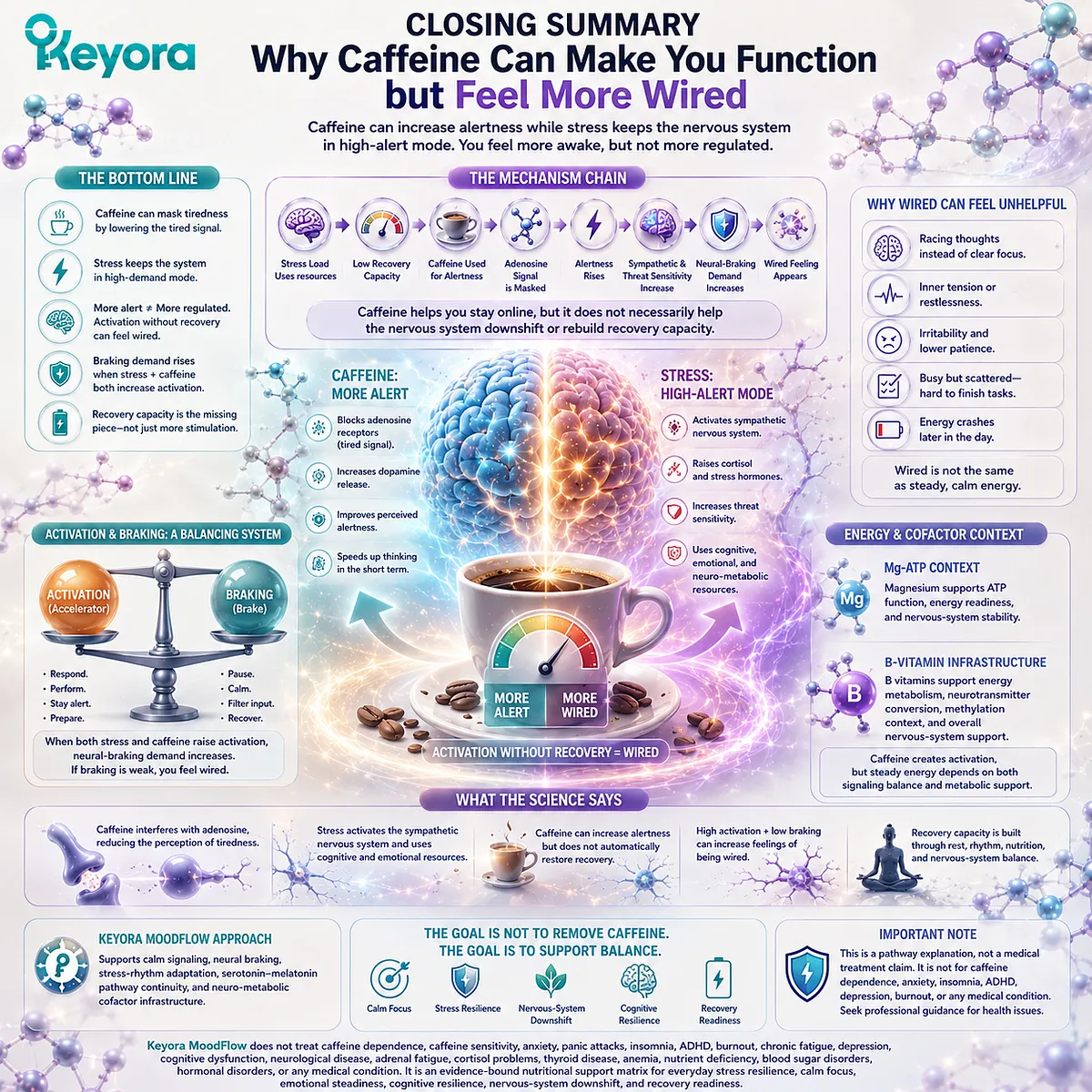
Closing Summary
You may need caffeine to function but feel more wired after drinking it because caffeine can increase alertness while stress keeps the nervous system in high-alert mode. Coffee may help you feel more awake, but it does not automatically rebuild recovery capacity, calm signaling, or neural braking.
Feeling more awake is not the same as feeling more regulated.
Mechanistically, this pattern may involve stress load, low recovery capacity, adenosine-signal masking, sympathetic activation, high-alert nervous-system tone, increased threat sensitivity, neural-braking demand, GABA/NMDA balance context, Mg-ATP energy context, B-vitamin cofactor support, and stress-rhythm carryover.
In the Keyora MoodFlow framework, this is understood as a calm-focus, stress-resilience, nervous-system downshift, and cognitive-resilience question. MoodFlow supports this picture through calm signaling, neural braking, stress-rhythm adaptation, serotonin-melatonin pathway continuity, and neuro-metabolic cofactor infrastructure.
MoodFlow does not treat caffeine dependence, caffeine sensitivity, anxiety, panic attacks, insomnia, ADHD, burnout, chronic fatigue, depression, cognitive dysfunction, neurological disease, adrenal fatigue, cortisol problems, thyroid disease, anemia, nutrient deficiency, blood sugar disorders, hormonal disorders, or any medical condition. It is an evidence-bound nutritional support matrix for everyday stress resilience, calm focus, emotional steadiness, cognitive resilience, nervous-system downshift, and recovery readiness.
This article is for educational and informational purposes only. It does not provide medical advice, diagnosis, treatment, cure, prevention, disease outcome claims, hormone restoration claims, fertility outcome claims, or formula-specific clinical efficacy claims.