
Why Do I Miss Details Even When I’m Trying to Be Careful?
Keyora Research Q&A Library
This is part of the Keyora Research Q&A Series, derived from Keyora Nutritional Neurology Series .
Within the Keyora Nutritional Neurology framework, this Q&A translates complex nutrient–brain mechanisms into reader-friendly, evidence-bound answers, focusing on stress resilience, sleep quality, calm mood support, cognitive wellness, and the broader interaction between nutrition, neurochemistry, and daily nervous-system function.
First published by Keyora Research Journal: www.keyorahealth.com

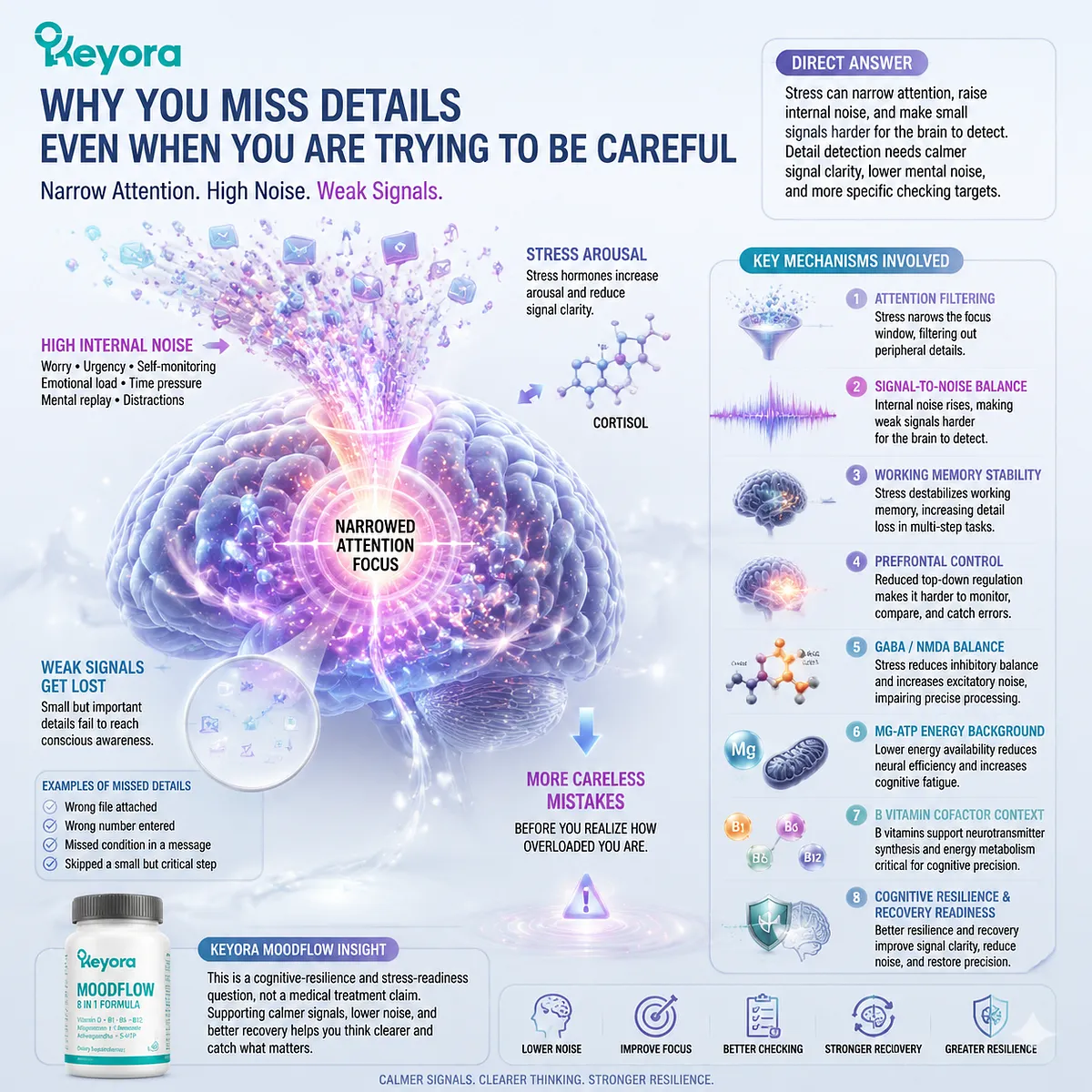
Direct Answer
You may miss details even when you are trying to be careful because stress can narrow attention, raise internal noise, and make small signals harder for the brain to detect.
The mismatch is this: trying harder may increase pressure, but detail detection often needs calmer signal clarity, lower mental noise, and more specific checking targets.
This can involve attention filtering, signal-to-noise balance, stress arousal, working memory stability, prefrontal control, GABA/NMDA activation balance, Mg-ATP energy background, B vitamin cofactor context, cognitive resilience, and recovery readiness.
In the Keyora MoodFlow framework, this is understood as a cognitive-resilience and stress-readiness question, not a medical treatment claim.
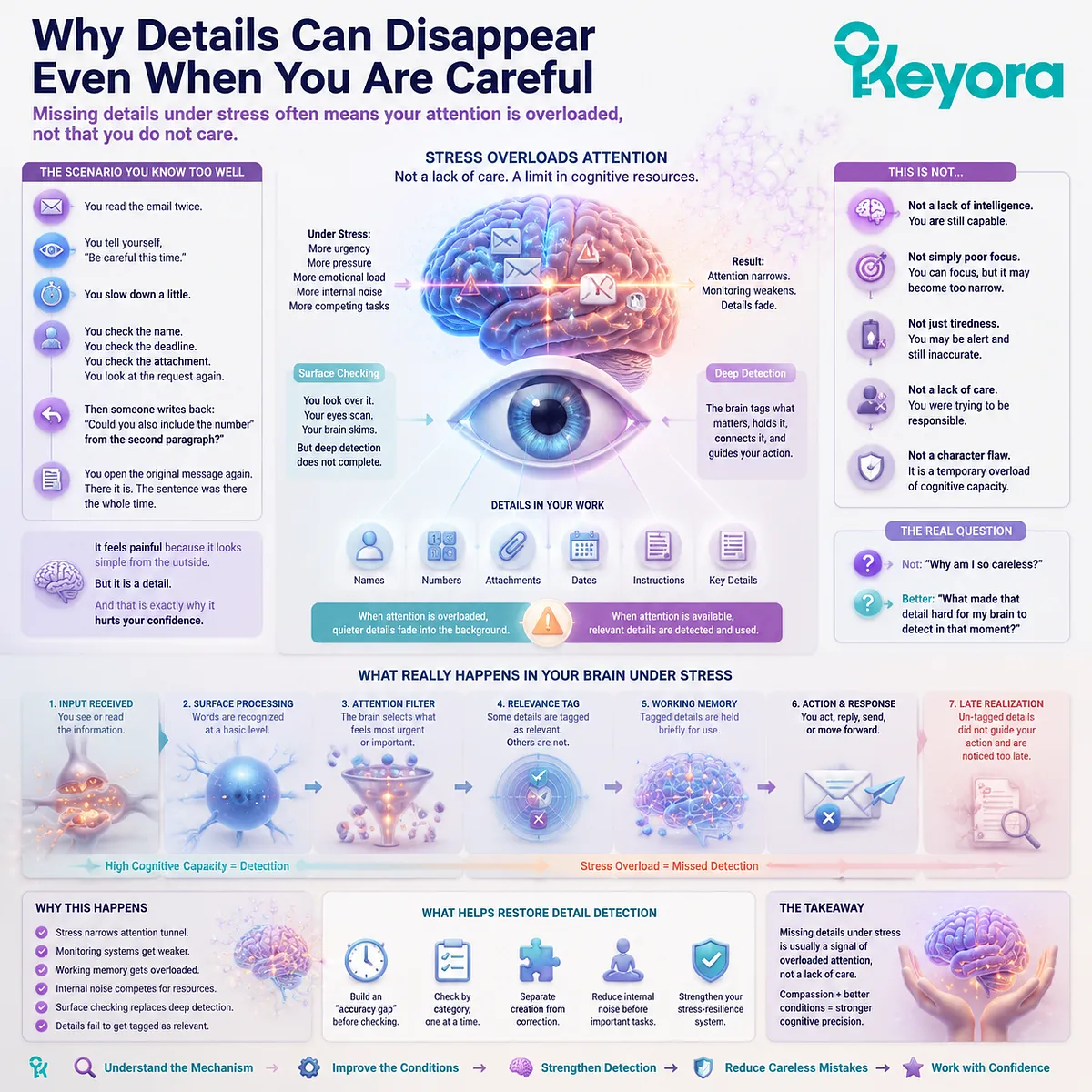
Why Details Can Disappear Even When You Are Careful
Missing details under stress often means your attention is overloaded, not that you do not care.
You read the email twice.
You tell yourself, “Be careful this time.”
You slow down a little. You check the name. You check the deadline. You check the attachment. You look at the request again before replying.
Then someone writes back: “Could you also include the number from the second paragraph?”
You open the original message again.
There it is.
The sentence was there the whole time. You looked at the email. You scanned the paragraph. You were trying to be responsible. But somehow, your brain did not register that one detail as important.
This is the kind of mistake that can feel especially painful because it does not look complicated from the outside. It is not a difficult task. It is not a concept you failed to understand. It is not something beyond your ability.
It is a detail.
And because it is “just a detail,” it is easy to turn it into self-criticism.
You may think, “Why didn’t I see that?”
You may wonder, “Am I becoming less careful?”
You may feel a quiet shame when someone else points out something that now looks obvious.
But there is an important difference between seeing something and registering it.
Your eyes may pass over the sentence. Your brain may even process the words lightly. But for a detail to guide your action, the brain has to tag it as relevant. It has to hold it long enough to connect it with the task. It has to keep that signal active while you are replying, editing, formatting, or moving to the next step.
Stress can interrupt that process.
This is why “I checked it” does not always mean “my brain fully detected every relevant detail.” Under stress, checking can become a surface action. You look over the work, but your attention may be pulled toward the most urgent part, the most emotionally charged part, or the part that feels most likely to cause trouble.
The quieter details fade into the background.
This does not mean you are careless. It may mean your attention is under load.
It also does not mean you simply need to focus harder. Sometimes the problem is not lack of focus. Sometimes the problem is that focus has become too narrow. You are locked onto the main task, but the smaller signals around it are harder to notice.
That is why missing details under stress deserves a more compassionate explanation. The real question may not be “Why am I so careless?”
A better question may be: “What made that detail hard for my brain to detect in that moment?”
Why Stress Makes Small Signals Harder to Notice
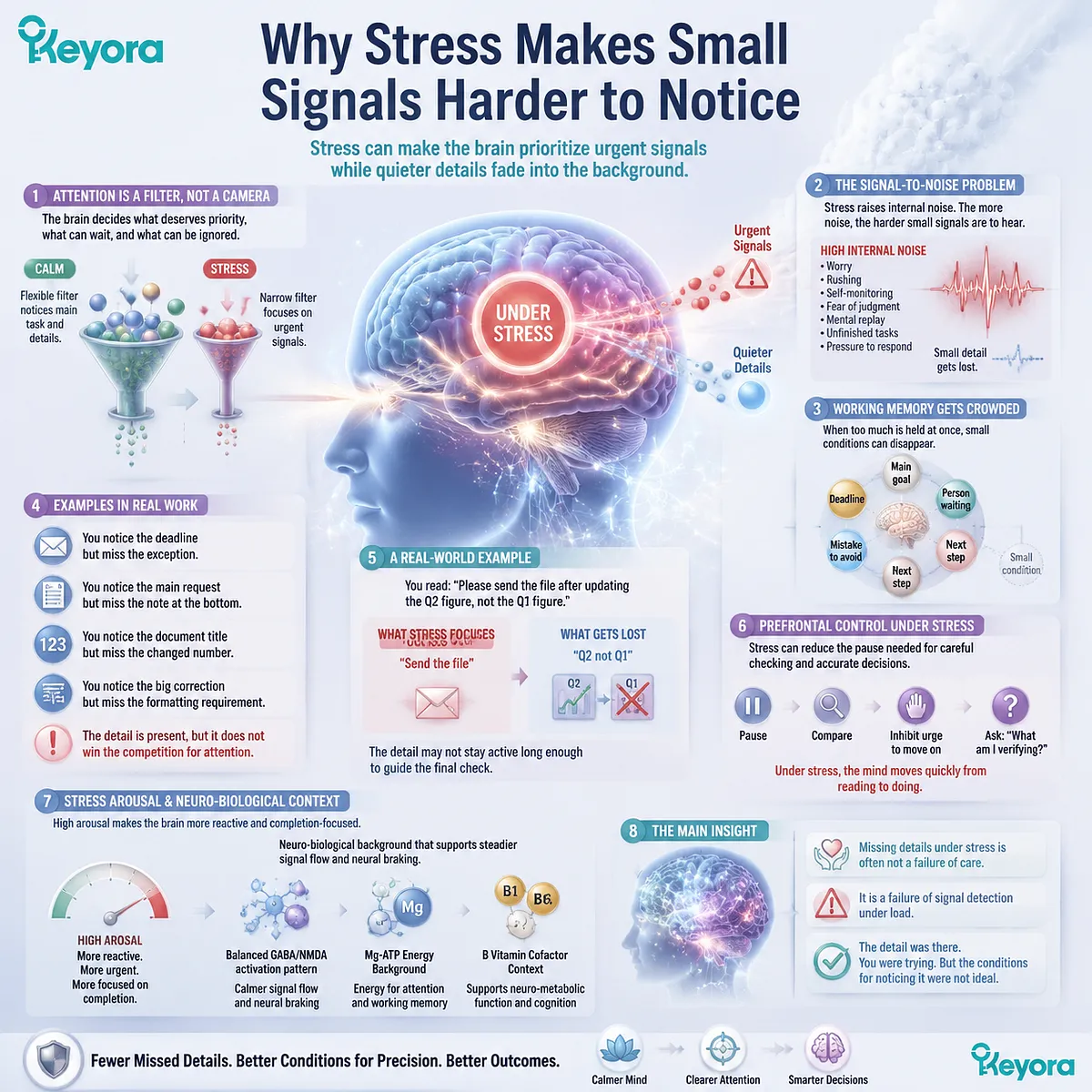
Stress can make the brain prioritize urgent signals while quieter details fade into the background.
Attention is not a camera that records everything equally.
It is more like a filter. At every moment, your brain is deciding what deserves priority, what can wait, and what can be ignored. Under calm conditions, this filter may have enough flexibility to notice both the main task and the smaller details.
Under stress, the filter changes.
The brain begins to ask, “What is urgent?” “What could go wrong?” “What needs action now?” This can help you respond quickly, but it can also make quieter information less visible.
That is why you may notice the deadline but miss the exception. You may notice the main request but miss the note at the bottom. You may notice the document title but miss the changed number. You may notice the big correction but miss the formatting requirement.
The detail is present, but it does not win the competition for attention.
This is the signal-to-noise problem.
Stress raises internal noise. Internal noise can sound like worry, rushing, self-monitoring, fear of being judged, mental replay, unfinished tasks, or the pressure to respond quickly. The more internal noise rises, the harder it becomes for a small signal to stand out.
A small detail needs a quiet enough background to be noticed.
If the background is full of urgency, the detail may be technically visible but functionally invisible.
Working memory also matters. When you read a sentence, the brain has to hold it briefly, connect it to the task, and decide whether it matters. Under stress, working memory becomes crowded. You may hold the main goal, the deadline, the person waiting, the mistake you want to avoid, and the next step all at once.
In that crowded mental space, a small condition can disappear quickly.
For example, you may read, “Please send the file after updating the Q2 figure, not the Q1 figure.” But if your brain tags only “send the file” as the main action, the Q2/Q1 distinction may not stay active long enough to guide the final check.
This is not because the detail was unimportant. It is because the brain did not have enough stable space to keep it marked as relevant.
Prefrontal control is also part of the picture. Careful checking requires the brain to pause, compare, inhibit the urge to move on, and ask, “What exactly am I verifying?” Stress can reduce that pause. The mind may move quickly from reading to doing, before the detail has been fully converted into an action item.
Then there is stress arousal. When arousal is high, the nervous system can become more reactive, more urgent, and more focused on completion. A balanced GABA/NMDA activation pattern can be understood as part of the background for calmer signal flow and neural braking. Mg-ATP energy background and B vitamin cofactor context also belong to the broader neuro-metabolic support picture, because careful attention and working memory are energy-using processes.
But the main insight is simple.
Missing details under stress is often not a failure of care. It is a failure of signal detection under load.
The detail was there. You were trying. But the conditions for noticing it were not ideal.
How to Make Details Easier to Catch
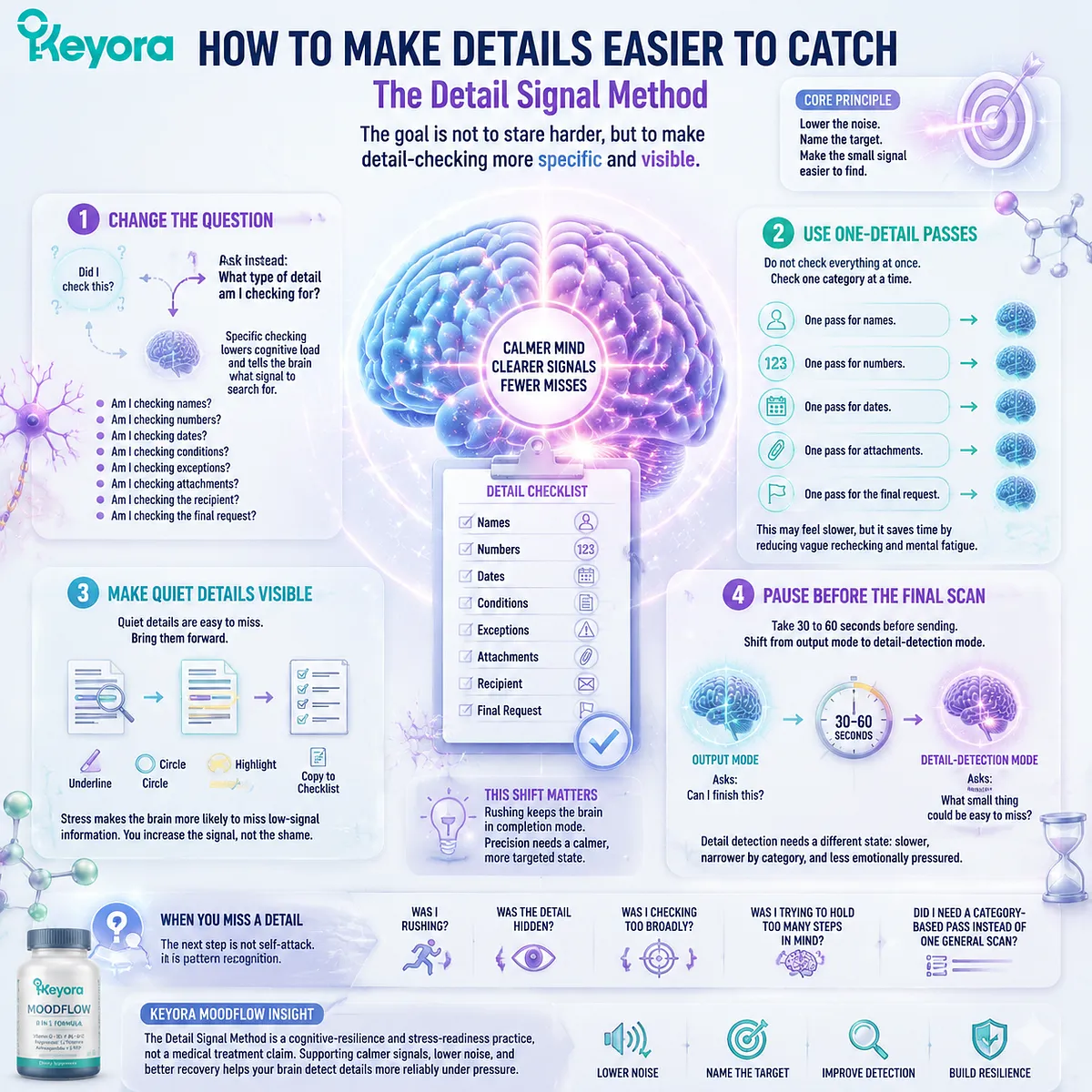
The goal is not to stare harder, but to make detail-checking more specific and visible.
A useful approach is The Detail Signal Method.
This method is not about becoming perfect. It is not about forcing yourself to be hypervigilant. It is about making quiet details easier for the brain to detect when stress has made attention narrow and noisy.
Step one is to change the question.
Instead of asking, “Did I check this?” ask, “What type of detail am I checking for?”
“Did I check this?” is too broad. A stressed brain may answer yes simply because you looked over the page. But looking over the page is not the same as checking the right detail.
A more useful question is specific.
Am I checking names?
Am I checking numbers?
Am I checking dates?
Am I checking conditions?
Am I checking exceptions?
Am I checking attachments?
Am I checking the recipient?
Am I checking the final request?
Specific checking lowers the load on attention. It tells the brain what signal to search for.
Step two is to use one-detail passes.
Do not try to check everything at once when you are under pressure. That asks too much of working memory. Instead, check one category at a time.
One pass for names.
One pass for numbers.
One pass for dates.
One pass for attachments.
One pass for the final request.
This may feel slower, but it often saves time because it reduces vague rechecking. You are not staring at the work hoping to feel certain. You are giving your attention a defined target.
Step three is to make quiet details visible.
Some details are easy to miss because they are visually or mentally quiet. They are hidden in the last sentence, inside parentheses, in a footnote, in a long paragraph, or in a small change between two similar numbers.
Bring them forward.
Underline the final request. Circle the number. Highlight the exception. Copy the key requirement into a short checklist. Turn hidden conditions into visible items.
This matters because stress makes the brain more likely to miss low-signal information. You are not trying to shame yourself into noticing more. You are increasing the signal.
Step four is to pause before the final scan.
Take 30 to 60 seconds before sending, submitting, uploading, or replying. Let the brain move from output mode into detail-detection mode.
Output mode asks, “Can I finish this?”
Detail-detection mode asks, “What small thing could be easy to miss?”
That shift matters.
If you check while rushing, your nervous system may still be in completion mode. It wants to move on. It wants relief. It wants the task closed. But detail detection needs a slightly different state: slower, narrower by category, and less emotionally pressured.
The goal is not to stare harder.
The goal is to lower the noise, name the target, and make the small signal easier to find.
When you miss a detail, the next step is not self-attack. It is pattern recognition. Ask: Was I rushing? Was the detail hidden? Was I checking too broadly? Was I trying to hold too many steps in mind? Did I need a category-based pass instead of one general scan?
That question opens a more useful path than “What is wrong with me?”
It points toward better conditions for precision.
Where Nutritional Support Fits
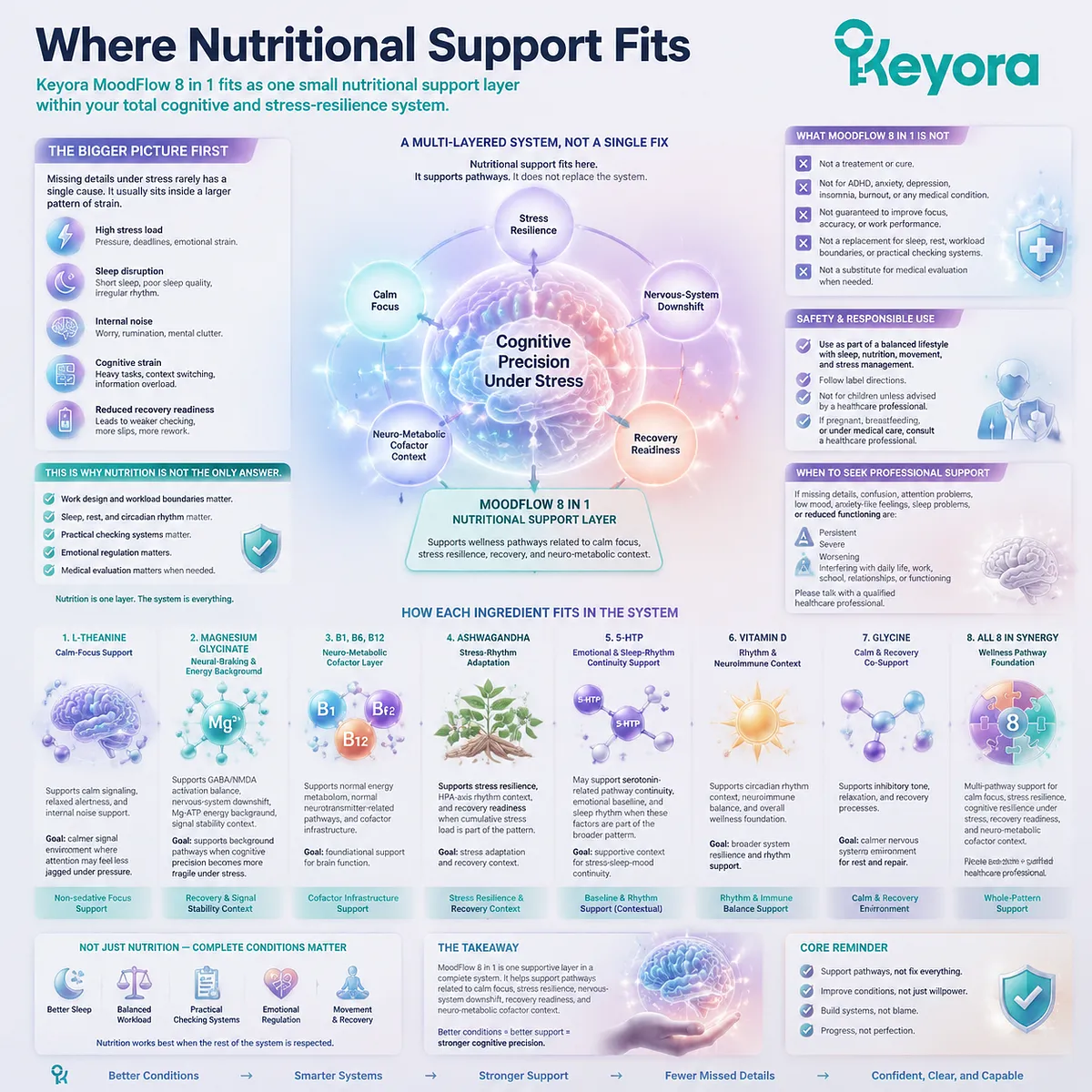
Keyora MoodFlow 8 in 1 can fit as one small nutritional support layer when missing details under stress appears within a broader pattern of cognitive strain, stress load, sleep disruption, internal noise, and reduced recovery readiness.
Its role is narrower: supporting wellness pathways related to calm focus, stress resilience, nervous-system downshift, cognitive resilience under stress, recovery readiness, and neuro-metabolic cofactor context.
-
L-Theanine fits the calm-focus side of this pattern. It is relevant to calm signaling, relaxed alertness, internal noise support, and non-sedative focus support. In this context, the goal is not forced concentration. The goal is a calmer signal environment where attention may feel less jagged under pressure.
-
Magnesium glycinate fits the neural-braking and energy-background side. It is relevant to GABA/NMDA activation balance, nervous-system downshift, Mg-ATP energy background, signal stability context, and recovery readiness. This does not mean it prevents missed details. It means it supports background pathways that may matter when cognitive precision becomes more fragile under stress.
-
B1, B6, and B12 fit the neuro-metabolic cofactor layer. They can be discussed as supporting normal energy metabolism, normal neurotransmitter-related pathways, and cofactor infrastructure. In this article, they should not be framed as correcting attention problems, restoring accuracy, or guaranteeing better checking.
-
Ashwagandha fits the stress-rhythm adaptation layer. It is relevant when cumulative stress load, HPA-axis rhythm context, and recovery readiness are part of the larger pattern. The safe language is stress resilience and recovery context, not cortisol correction or treatment of a condition.
-
5-HTP may be relevant only when emotional baseline, sleep rhythm, and serotonin-related pathway continuity are part of the broader stress-sleep-mood pattern. It should not be presented as a solution for missing details.
Keyora MoodFlow 8 in 1 does not treat missed details, cognitive dysfunction, ADHD, anxiety, depression, insomnia, burnout, or any medical condition. It does not guarantee focus, restore accuracy, improve work performance, or replace sleep, rest, workload boundaries, practical checking systems, or medical evaluation when needed.
If missing details, confusion, attention problems, low mood, anxiety-like feelings, sleep problems, or reduced functioning are persistent, severe, worsening, or interfering with daily life, work, school, relationships, or functioning, they should be discussed with a qualified healthcare professional.
Closing Summary
You may miss details even when trying to be careful because stress can change how your brain detects small signals.
Attention may narrow toward urgency. Internal noise may rise. Working memory may become crowded. The brain may register the main task but fail to tag a quiet detail as relevant.
This does not mean you do not care. It may mean the conditions for detail detection are weaker than usual.
The practical path is The Detail Signal Method: change the checking question, use one-detail passes, make quiet details visible, and pause before the final scan.
Keyora MoodFlow 8 in 1 belongs only as a small nutritional support layer for related wellness pathways, including calm focus, stress resilience, nervous-system downshift, cognitive resilience, recovery readiness, Mg-ATP energy background, and B vitamin cofactor context.
Missing details under stress does not always mean you are careless. Sometimes it means your brain needs lower noise and clearer checking targets to detect small signals.

This article is for educational and informational purposes only. It does not provide medical advice, diagnosis, treatment, cure, prevention, disease outcome claims, hormone restoration claims, fertility outcome claims, or formula-specific clinical efficacy claims.