
Why Do I Lose Interest in Things When I’m Mentally Loaded?
Keyora Research Q&A Library
This is part of the Keyora Research Q&A Series, derived from Keyora Nutritional Neurology Series .
Within the Keyora Nutritional Neurology framework, this Q&A translates complex nutrient–brain mechanisms into reader-friendly, evidence-bound answers, focusing on stress resilience, sleep quality, calm mood support, cognitive wellness, and the broader interaction between nutrition, neurochemistry, and daily nervous-system function.
First published by Keyora Research Journal: www.keyorahealth.com
Direct Answer
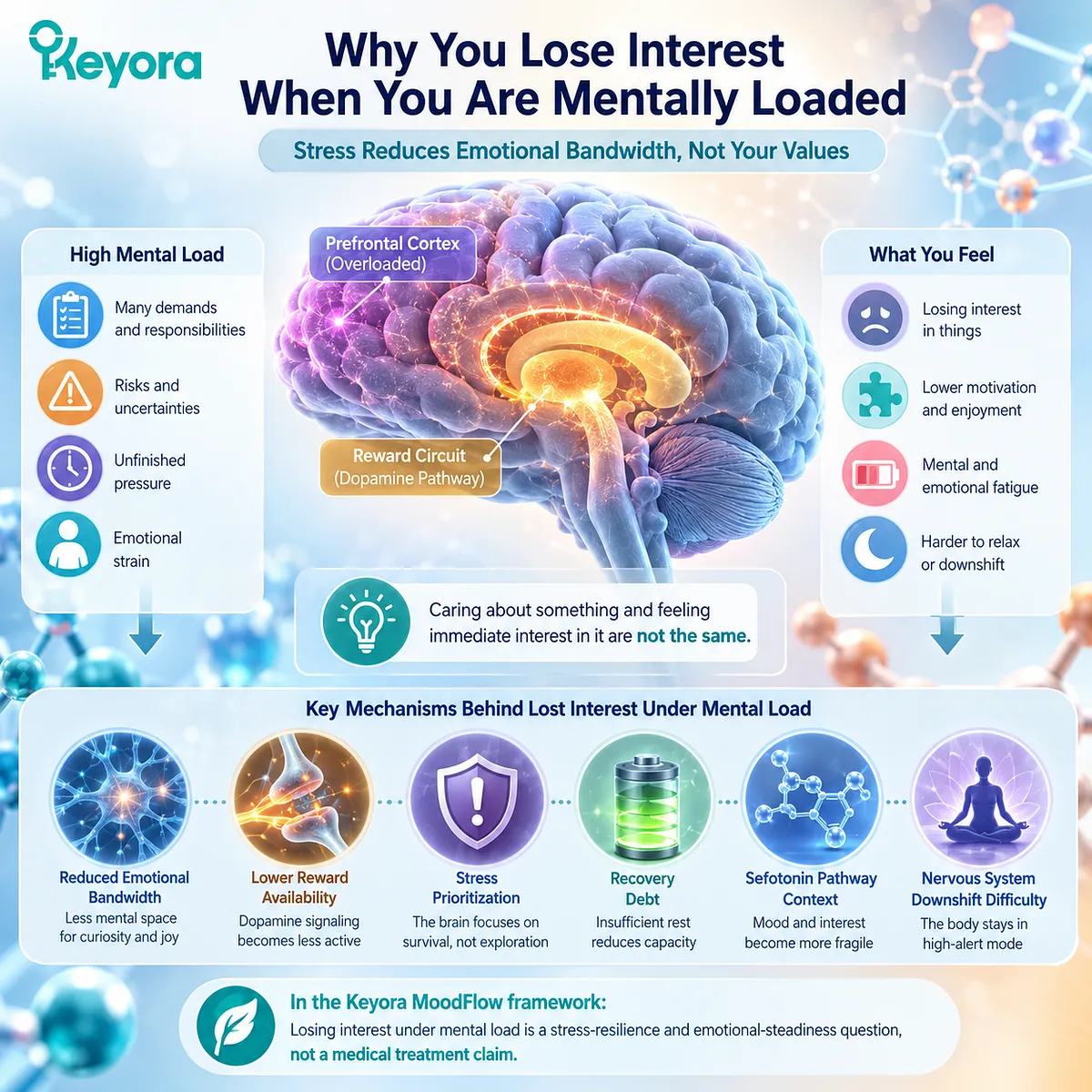
You may lose interest in things when you are mentally loaded because stress can reduce emotional bandwidth.
The things you like may still matter to you, but your system may not have enough open space to feel curiosity, pleasure, reward, or anticipation clearly.
The mismatch is this: caring about something and feeling immediate interest in it are not always the same.
When mental load is high, the mind may prioritize demands, risks, responsibilities, and unfinished pressure over enjoyment, exploration, or play.
This can involve reduced emotional bandwidth, lower reward availability, stress-prioritization, recovery debt, emotional baseline changes, serotonin-related pathway context, neuro-metabolic cofactor support, and nervous-system downshift difficulty.
In the Keyora MoodFlow framework, losing interest under mental load is understood as a stress-resilience and emotional-steadiness question, not a medical treatment claim.
Why Mental Load Can Make Interest Feel Far Away
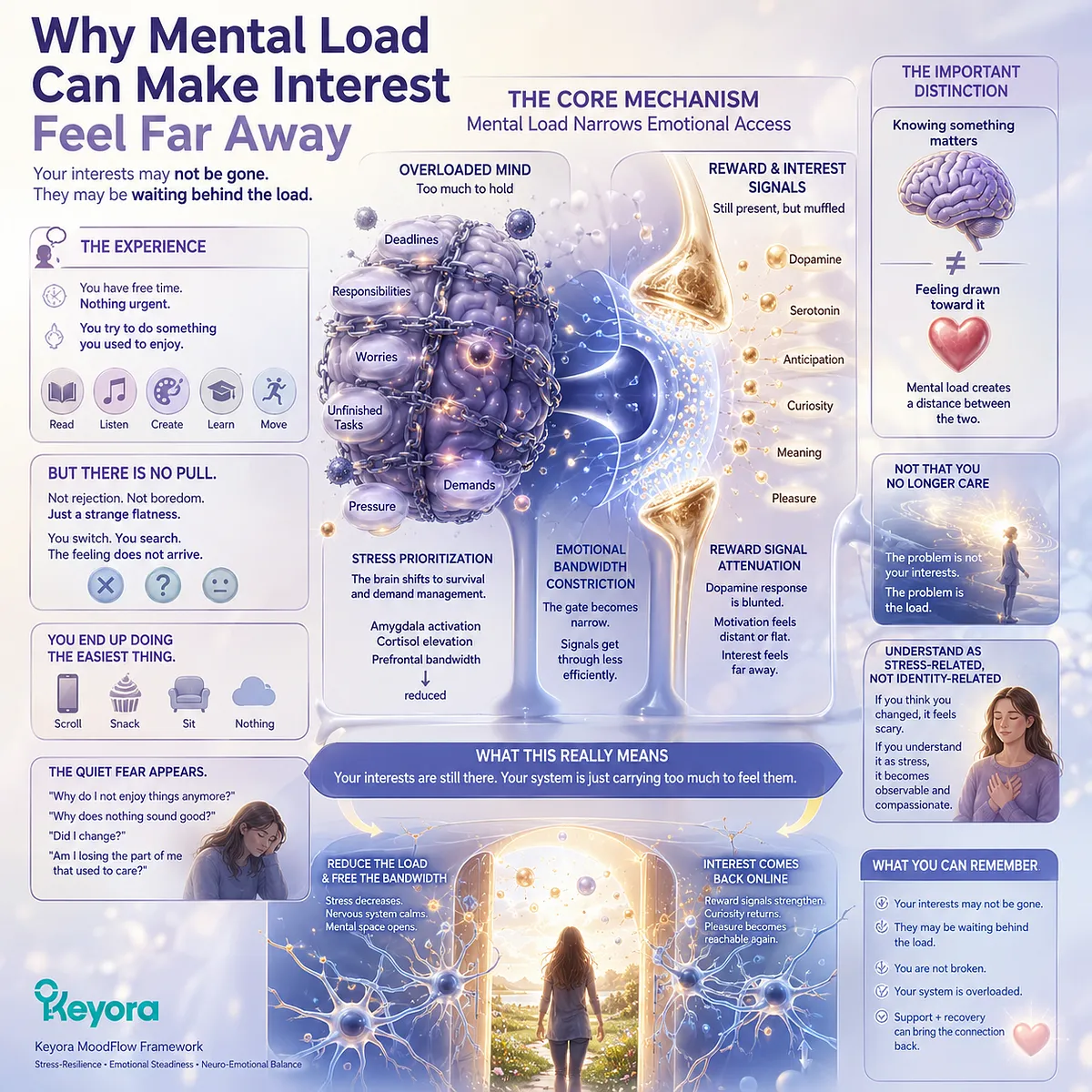
When your mind is overloaded, your interests may still matter, but they can become harder to feel.
You finally have a little free time.
Nothing urgent is happening for the next few minutes.
Maybe the workday has ended.
Maybe the weekend has arrived. Maybe you have a rare quiet window where nobody is asking anything from you.
So you try to do something you used to like.
You open a book.
You play a song.
You look at a recipe.
You scroll through a course you once wanted to take.
You open a project you used to feel excited about.
You think about exercising, drawing, organizing your space, watching a film, calling a friend, or doing something that used to make you feel more like yourself.
But there is no pull.
Not exactly rejection.
Not exactly boredom.
Not even strong dislike.
Just a strange flatness.
You look at the thing and feel almost nothing. You may switch to something else, then something else, then something else. You search for the feeling that used to appear more naturally, but it does not arrive.
Eventually, you may end up doing the easiest thing available: scrolling, snacking, sitting still, or doing nothing in particular.
Then a quiet fear appears.
“Why do I not enjoy things anymore?”
“Why does nothing sound good?”
“Did I change?”
“Am I losing the part of me that used to care?”
This can be one of the more painful forms of stress because it touches your sense of identity. It is not only about productivity. It is about the feeling that your life has become emotionally distant from you.
The confusing part is that you may still know what you like.
You may still remember enjoying those things before. You may still believe they matter. You may still want to want them.
But knowing something matters and feeling drawn toward it are different experiences.
Mental load can create a distance between the two.
When your mind has been holding too much, interest may not disappear. It may become harder to reach.
What if your interests are still there, but your emotional bandwidth is too crowded to feel them clearly?
What if the reward signal is not absent, but muffled by stress?
What if the problem is not that you no longer care, but that your system has been carrying too much to respond to pleasure in the usual way?
This is an important distinction.
Because if you believe you have simply become someone who does not care, the experience becomes frightening. But if you understand it as stress-related narrowing of emotional access, the experience becomes something you can observe with more compassion.
Your interests may not be gone.
They may be waiting behind the load.
Why Stress Can Reduce the Feeling of Enjoyment
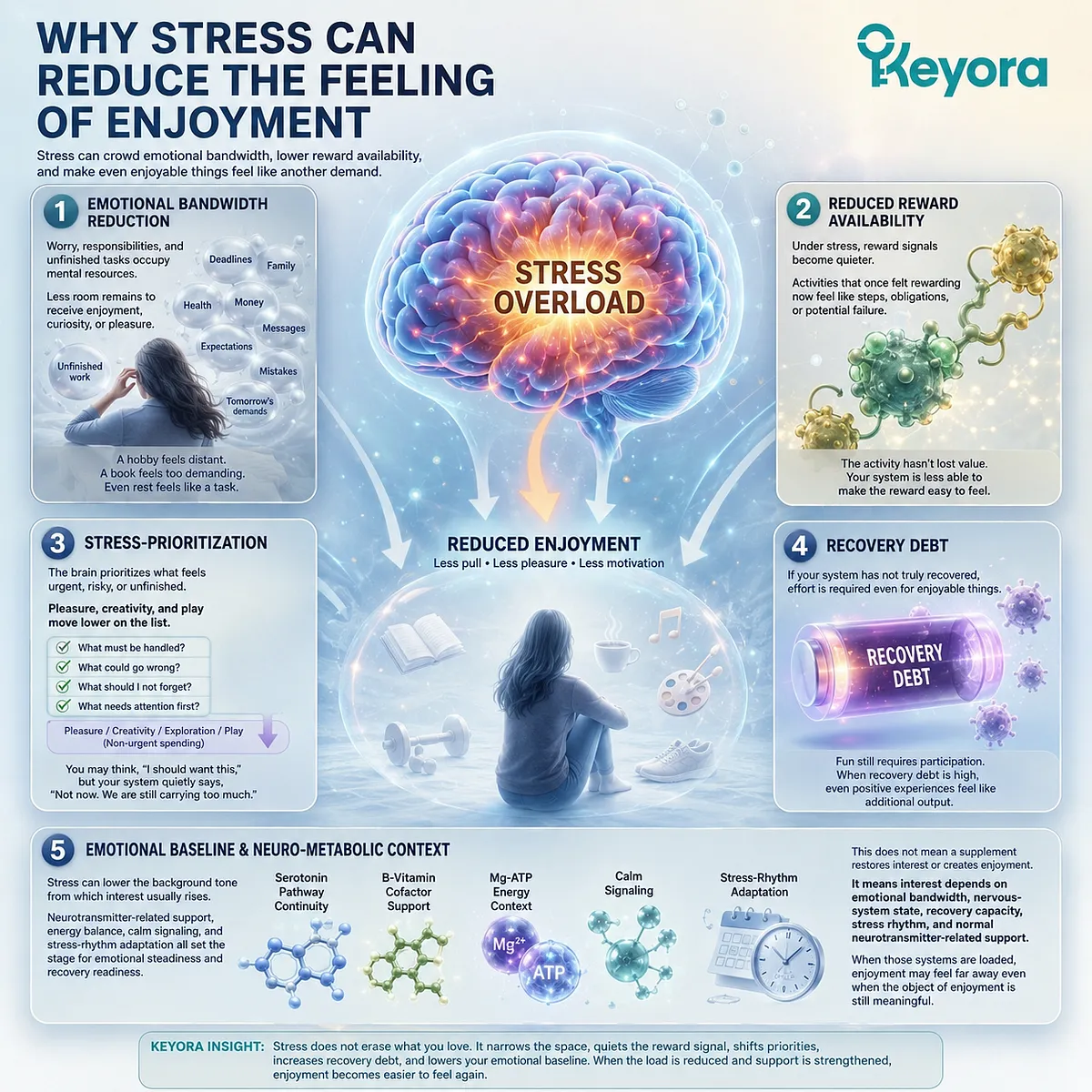
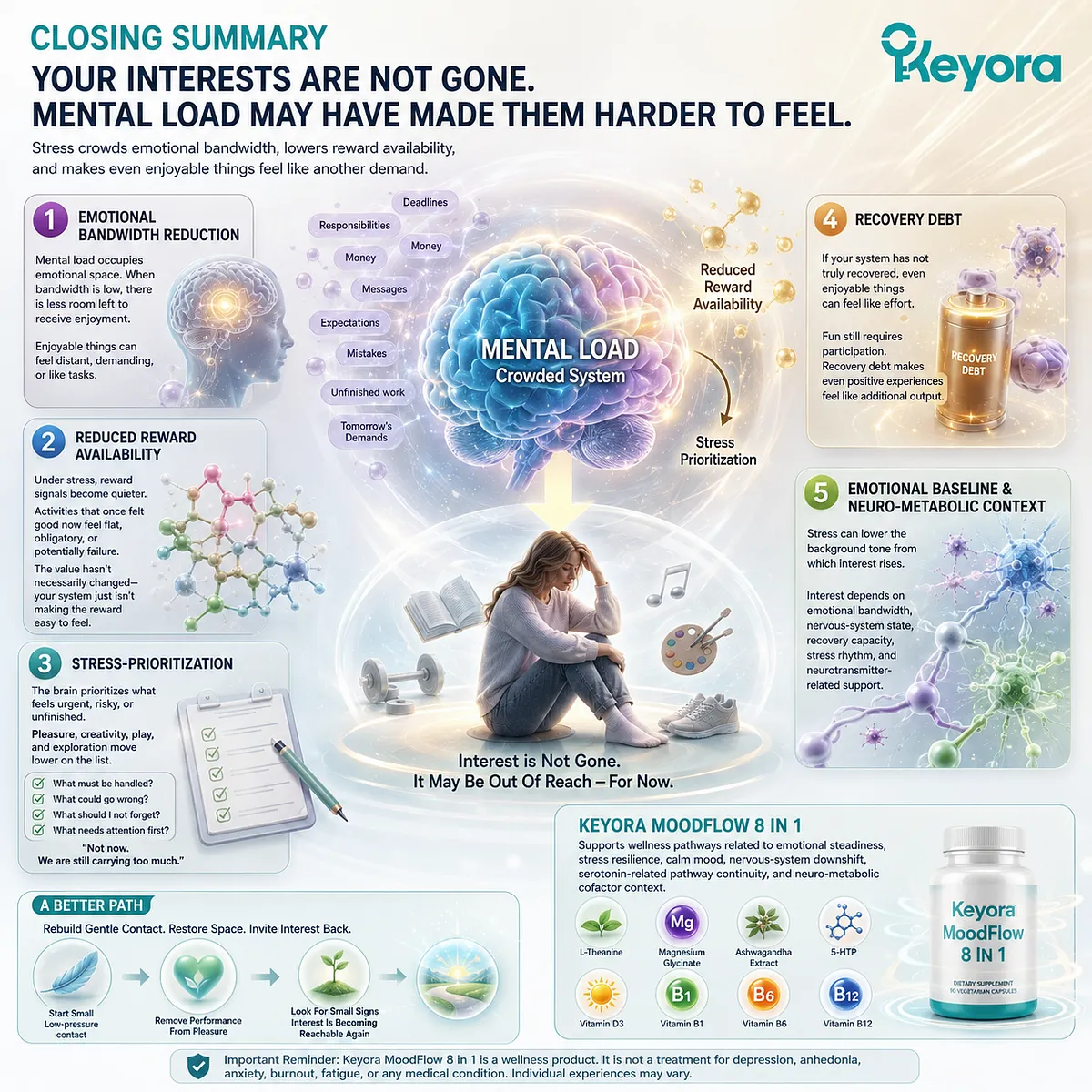
Stress can crowd emotional bandwidth, lower reward availability, and make even enjoyable things feel like another demand.
Interest needs space.
It needs a little openness. It needs enough emotional room for curiosity, anticipation, and response. It needs your system to have some capacity beyond monitoring, managing, predicting, and enduring.
When mental load is high, that space can shrink.
The first mechanism is emotional bandwidth reduction.
You may be thinking about deadlines, family responsibilities, money, health, messages, expectations, mistakes, unfinished work, or what tomorrow will require. Even when you are not actively solving those things, part of your mind may still be holding them.
That holding takes up room.
So when something enjoyable appears, there may not be much space left to receive it.
A hobby can feel distant. A book can feel too demanding. Music can feel like background noise. A creative idea can feel like another thing to manage. Even rest can feel like a task you are supposed to do correctly.
The second mechanism is reduced reward availability.
Enjoyment is not only a thought. It is something you feel as a small pull, lift, warmth, curiosity, or relief. Under stress, that reward signal can become quieter.
You may know that cooking used to feel grounding, but now it just looks like chopping, cleaning, and deciding. You may know exercise used to help, but now it feels like changing clothes, leaving the room, and spending effort. You may know a hobby used to feel meaningful, but now it looks like another place where you might fail to show up well.
The thing itself has not necessarily lost value.
Your system may simply not be making the reward easy to feel.
The third mechanism is stress-prioritization.
When stress is high, the brain often gives priority to what feels urgent, risky, necessary, or unfinished. It asks, “What must be handled? What could go wrong? What should I not forget? What needs attention first?”
Pleasure, creativity, exploration, and play may be pushed lower on the list.
This is not because they are unimportant. It is because a stressed system may treat them as non-urgent spending.
So you may look at something enjoyable and think, “I should want this,” while another part of you quietly responds, “Not now. We are still carrying too much.”
The fourth mechanism is recovery debt.
If your system has not truly recovered, even enjoyable things can feel like effort.
This is why a person can say, “I know this should be fun, but I do not have the energy for fun.”
Fun still requires participation. A hobby still requires attention. A conversation still requires emotional presence. A creative activity still asks you to enter, choose, respond, and feel.
When recovery debt is high, even positive experiences can feel like additional output.
The fifth mechanism is emotional baseline and neuro-metabolic context.
Stress can lower the background tone from which interest usually rises. Serotonin-related pathway continuity, B-vitamin cofactor support, Mg-ATP energy context, calm signaling, and stress-rhythm adaptation all belong to the broader wellness background of emotional steadiness and recovery readiness.
This does not mean a supplement restores interest or creates enjoyment.
It means interest is not only an attitude. It is connected to emotional bandwidth, nervous-system state, recovery capacity, stress rhythm, and normal neurotransmitter-related support.
When those systems are loaded, enjoyment may feel far away even when the object of enjoyment is still meaningful.
How to Re-Enter Interest Without Forcing Enjoyment
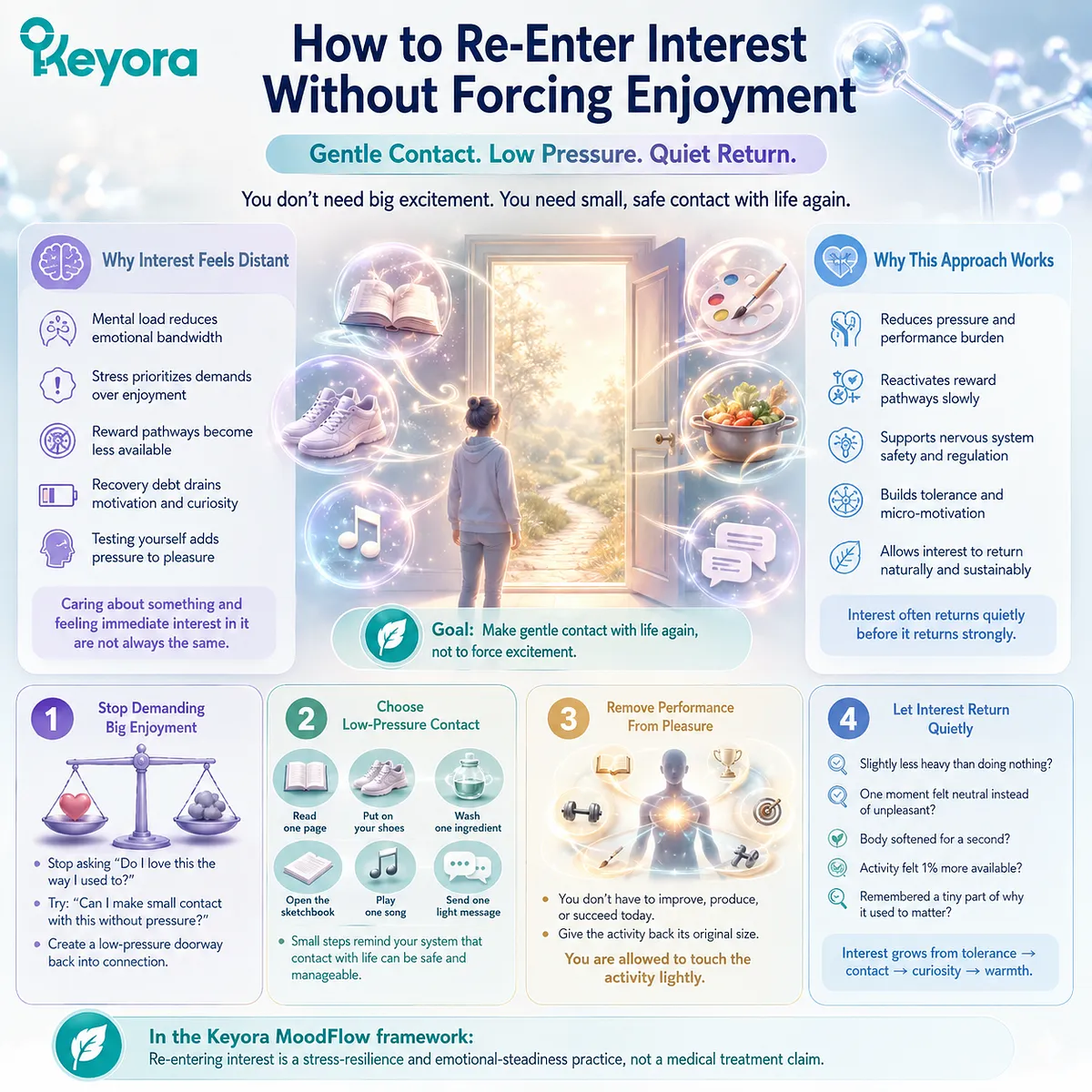
The goal is not to pressure yourself to feel excited, but to make gentle contact with life again.
When you notice that your interests feel distant, it is natural to test yourself.
You may open something you used to love and wait for a strong feeling.
Do I still like this?
Do I feel excited?
Do I feel happy?
Is it working?
But testing can add pressure to pleasure.
Now the book is not just a book. It is proof of whether you are okay.
The walk is not just a walk. It is a test of whether you are becoming yourself again.
The hobby is not just a hobby. It is evidence in a private trial about your emotional state.
That can make interest even harder to feel.
A gentler first step is to stop demanding big enjoyment.
Instead of asking, “Do I love this the way I used to?” try asking, “Can I make small contact with this without pressure?”
This changes the goal.
You are not trying to feel excited immediately. You are creating a low-pressure doorway back into connection.
The second step is to choose low-pressure contact.
If reading a chapter feels like too much, read one page.
If exercising feels too large, put on your shoes.
If cooking feels overwhelming, wash one ingredient.
If drawing feels loaded, open the sketchbook without needing to make anything good.
If music feels distant, play one song.
If friendship feels too demanding, send one light message instead of starting a long conversation.
The purpose is not to force pleasure. The purpose is to remind your system that contact with life can be small and safe.
The third step is to remove performance from pleasure.
Many interests stop feeling light because they become attached to pressure.
Reading becomes “I should improve myself.”
Exercise becomes “I should be better.”
Cooking becomes “I should be healthy.”
Creativity becomes “I should produce something.”
Rest becomes “I should recover efficiently.”
Even enjoyment becomes another demand.
Try giving the activity back its original size.
You do not have to read to become smarter today.
You do not have to exercise to transform yourself today.
You do not have to create something useful.
You do not have to enjoy perfectly.
You are allowed to touch the activity lightly.
The fourth step is to let interest return quietly.
Do not look only for excitement. Look for smaller signs.
Did this feel slightly less heavy than doing nothing?
Did one moment feel neutral instead of unpleasant?
Did your body soften for a second?
Did the activity feel one percent more available than before?
Did you remember a tiny part of why it used to matter?
These small signs count.
Interest often returns quietly before it returns strongly. It may begin as tolerance, then mild contact, then small curiosity, then a little warmth.
You do not have to drag your interests back by force.
You can lower the pressure around them and let them become reachable again.
Where Nutritional Support Fits
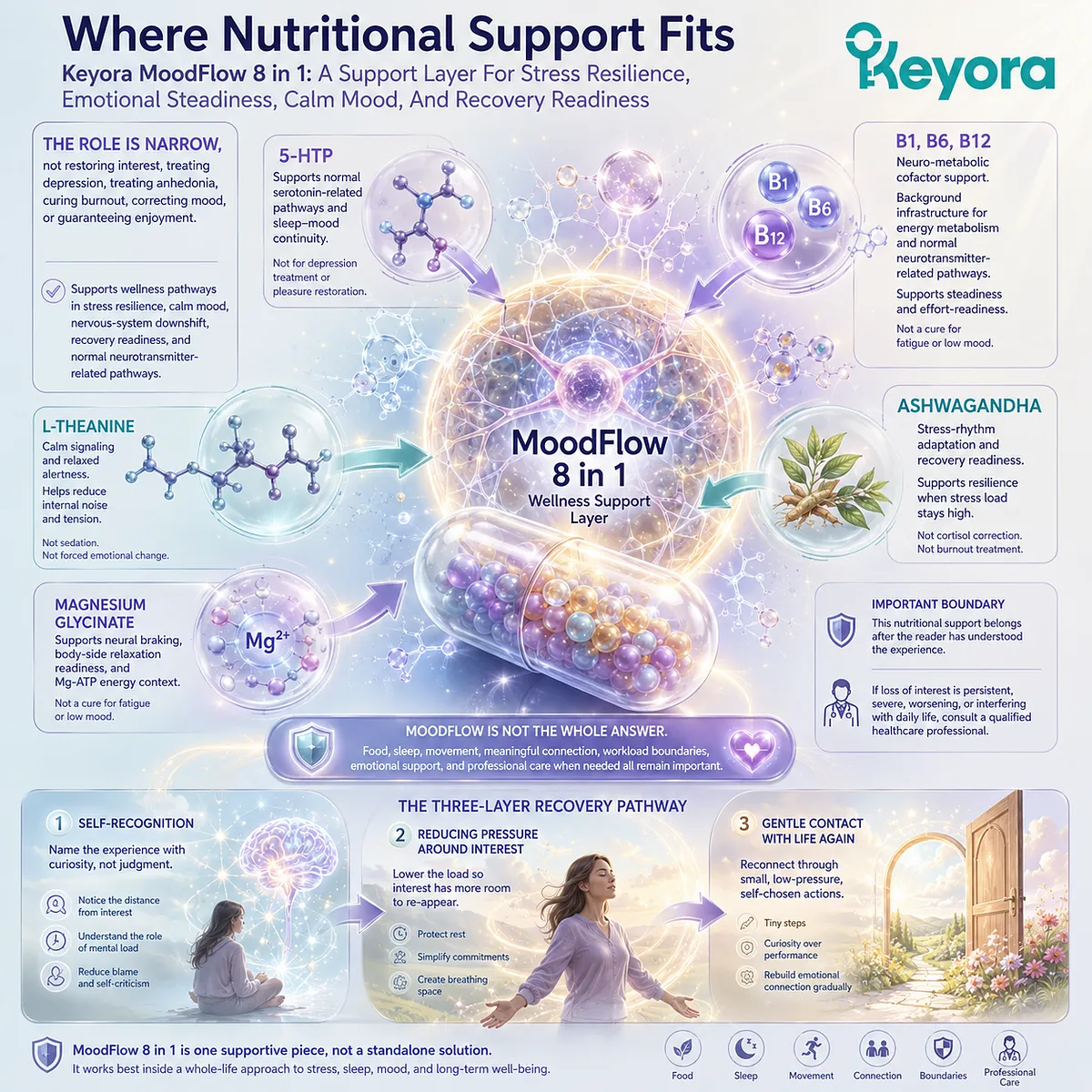
Keyora MoodFlow 8 in 1 can fit as one small nutritional support layer when reduced interest appears within a broader stress-sleep-mood-cognition pattern. It should not be framed as restoring interest, treating depression, treating anhedonia, curing burnout, correcting mood, or guaranteeing enjoyment.
Its role is narrower: supporting wellness pathways involved in stress resilience, emotional steadiness, calm mood, nervous-system downshift, recovery readiness, and normal neurotransmitter-related pathways.
-
5-HTP may be relevant when emotional baseline and serotonin-related pathway continuity are central to the picture. In the MoodFlow framework, it supports normal serotonin-related pathways and sleep-mood continuity. It should not be described as treating depression or restoring pleasure.
-
B1, B6, and B12 may be relevant as neuro-metabolic cofactor support. They belong to the background infrastructure of energy metabolism and normal neurotransmitter-related pathways, which can support emotional steadiness and effort-readiness context without being framed as a cure for fatigue or low mood.
-
L-Theanine may be relevant when mental load creates internal noise, tension, or difficulty entering a calm-but-alert state. Its role is calm signaling and relaxed alertness, not sedation or forced emotional change.
-
Ashwagandha may fit when cumulative stress load keeps the system in a pressure rhythm. Its role is stress-rhythm adaptation and recovery readiness, not cortisol correction or burnout treatment.
-
Magnesium glycinate may also support the background of neural braking, body-side relaxation readiness, and Mg-ATP energy context when stress keeps the body tense or effortful.
This nutritional support belongs after the reader has understood the experience.
-
The first layer is self-recognition.
-
The second is reducing pressure around interest.
-
The third is making gentle contact with life again.
MoodFlow is not the whole answer. Food, sleep, movement, meaningful connection, workload boundaries, emotional support, and professional care when needed all remain important.
If loss of interest is persistent, severe, worsening, or interfering with daily life, it should be discussed with a qualified healthcare professional.
Closing Summary
Losing interest in things when you are mentally loaded does not automatically mean you no longer care, have changed permanently, or have lost your connection to life. It may mean stress has crowded your emotional bandwidth and made reward harder to feel.
The deeper mismatch is that your interests may still matter, but your system may not have enough recovery space to respond to them. Under stress, even enjoyable things can feel like another form of output.
A better path is not to force excitement. Start with low-pressure contact, remove performance from pleasure, and look for small signs that interest is becoming reachable again.
Keyora MoodFlow 8 in 1 can support wellness pathways related to emotional steadiness, stress resilience, calm mood, nervous-system downshift, serotonin-related pathway continuity, and neuro-metabolic cofactor context. It is not a treatment for depression, anhedonia, anxiety, burnout, fatigue, or any medical condition.
Your interests may not be gone.
Mental load may have made them harder to feel.
This article is for educational and informational purposes only. It does not provide medical advice, diagnosis, treatment, cure, prevention, disease outcome claims, hormone restoration claims, fertility outcome claims, or formula-specific clinical efficacy claims.