
Why Do I Keep Rereading the Same Paragraph When I’m Mentally Loaded?
Keyora Research Q&A Library
This is part of the Keyora Research Q&A Series, derived from Keyora Nutritional Neurology Series .
Within the Keyora Nutritional Neurology framework, this Q&A translates complex nutrient–brain mechanisms into reader-friendly, evidence-bound answers, focusing on stress resilience, sleep quality, calm mood support, cognitive wellness, and the broader interaction between nutrition, neurochemistry, and daily nervous-system function.
First published by Keyora Research Journal: www.keyorahealth.com

Direct Answer
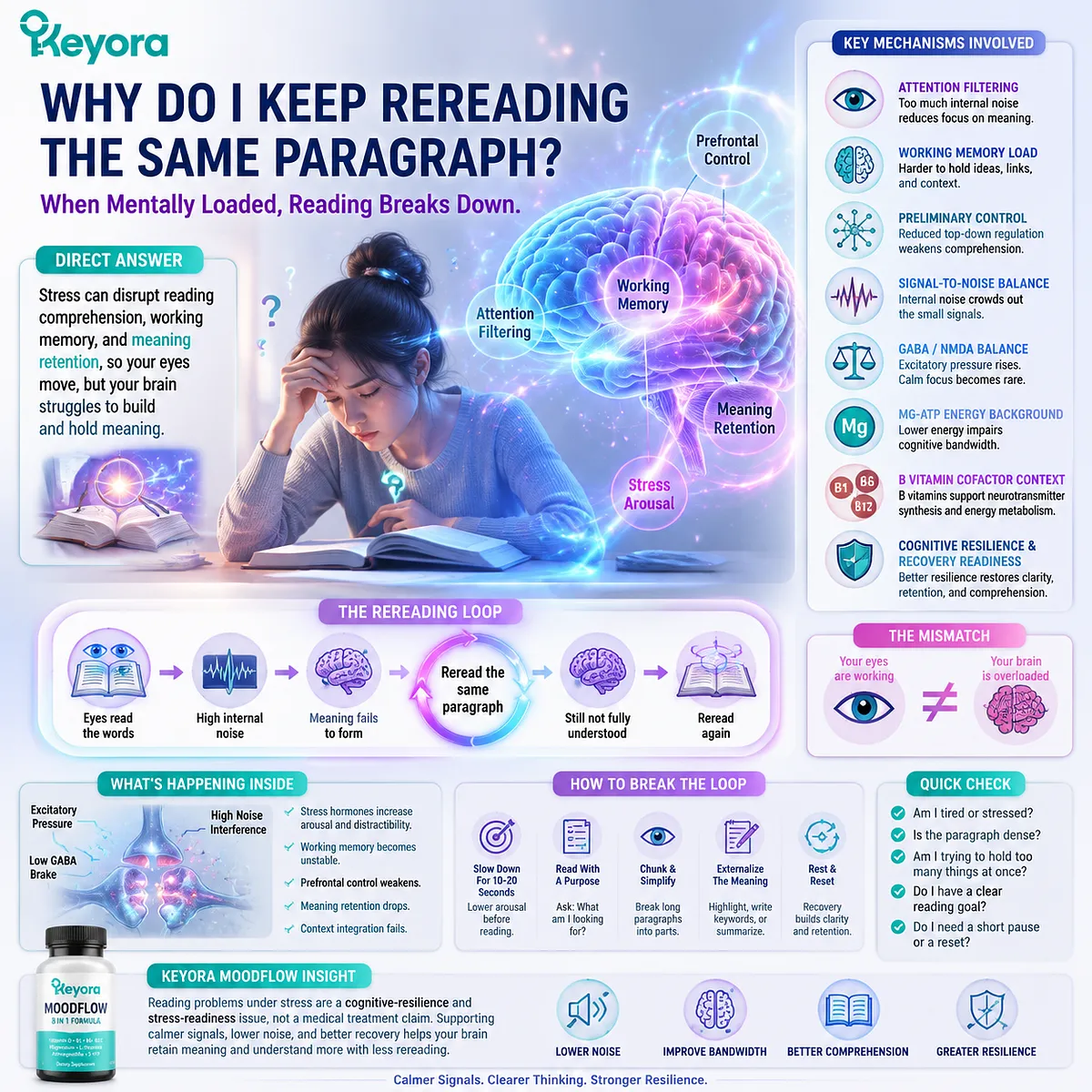
You may keep rereading the same paragraph when mentally loaded because stress can disrupt reading comprehension, working memory, and meaning retention.
The mismatch is this: your eyes may be moving across the words, but your brain may not have enough stable bandwidth to build meaning from them.
This can involve reading comprehension load, working memory stability, attention filtering, stress arousal, signal-to-noise balance, prefrontal control, GABA/NMDA activation balance, Mg-ATP energy background, B vitamin cofactor context, cognitive resilience, and recovery readiness.
In the Keyora MoodFlow framework, this is understood as a cognitive-resilience and stress-readiness question, not a medical treatment claim.
Why the Words Do Not Seem to Land
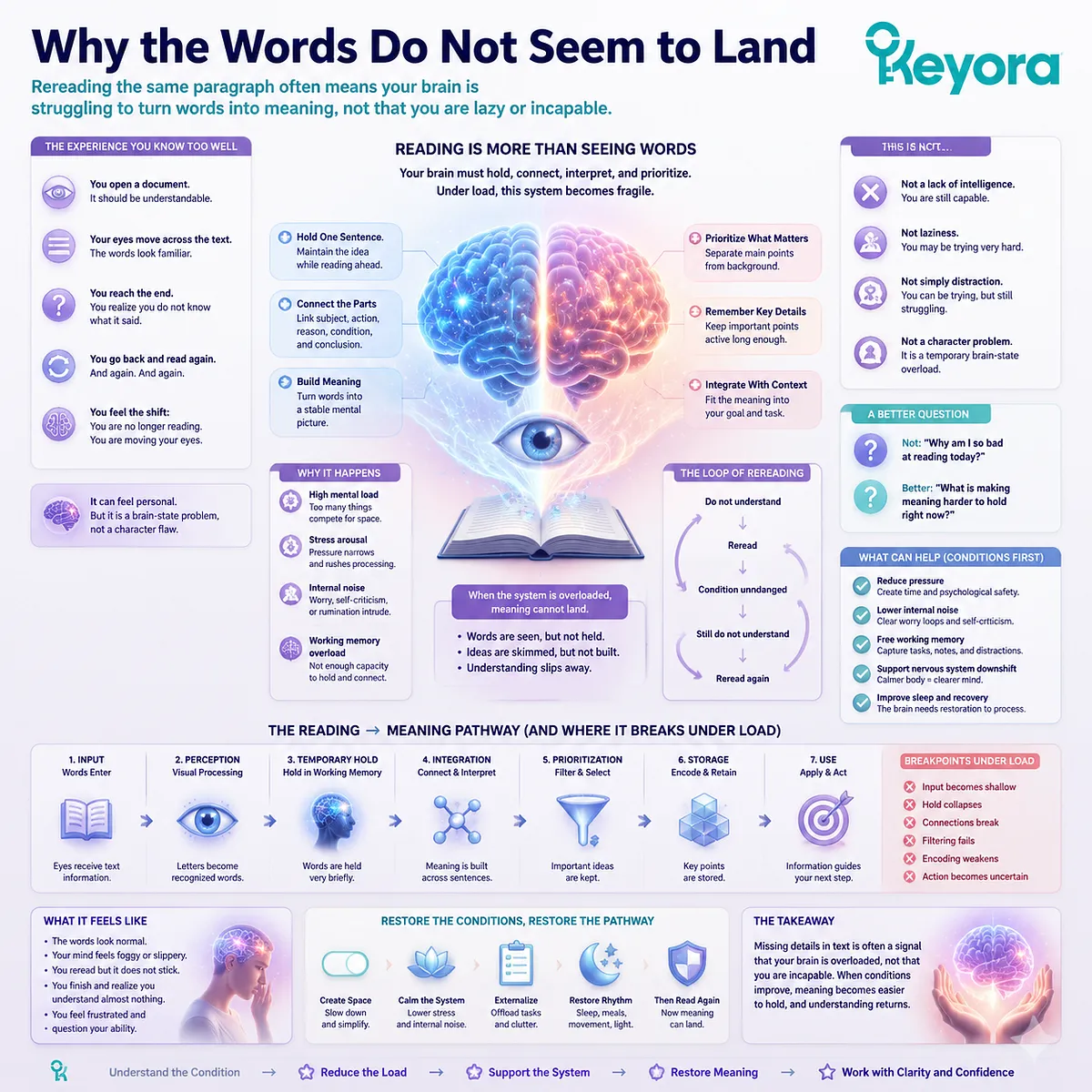
Rereading the same paragraph often means your brain is struggling to turn words into meaning, not that you are lazy or incapable.
You open a document you need to understand.
It may be a work email, a report, a school reading, a project brief, a client note, a contract paragraph, or a set of instructions. It is not written in a language you do not know. It is not impossibly difficult. You have read things like this before.
But today, your eyes move across the paragraph and nothing seems to land.
You reach the end and realize you do not know what it said.
So you go back.
You read the first sentence again. Then the second sentence. Then the first sentence again because the second sentence did not connect. After a few rounds, you may feel the uncomfortable shift: you are no longer reading. You are moving your eyes over words.
That moment can feel strangely personal.
You may think, “Why can’t I just read this?”
You may wonder, “Why is my brain not taking it in?”
You may feel embarrassed because the paragraph looks ordinary.
You may even start to worry that something is wrong with your ability.
But reading is not just seeing words.
Real reading requires the brain to hold one sentence while interpreting the next. It has to connect the subject, action, reason, condition, and conclusion. It has to decide what matters, what is background, and what you need to remember.
When you are mentally loaded, that process can become fragile.
The paragraph may be visually clear but cognitively slippery. You see the words, but the meaning does not stay long enough to form a stable picture. You may recognize every word individually, yet fail to feel the paragraph as a whole.
This is why rereading can become a loop.
You reread because you did not understand. But if the condition causing the problem is still there — pressure, internal noise, crowded working memory, or stress arousal — the next reading may not work much better. The eyes repeat the task, but the brain is still not ready to build meaning.
This is different from simply being distracted. Sometimes you are not daydreaming. You are trying. You are looking at the words. You may even be forcing yourself to stay with the paragraph.
The problem is not effort.
The problem may be that your mental system is too loaded to convert text into meaning smoothly.
A useful question is not, “Why am I so bad at reading today?”
A kinder and more accurate question is: “What is making meaning harder to hold right now?”
Why Mental Load Makes Reading Feel Heavier
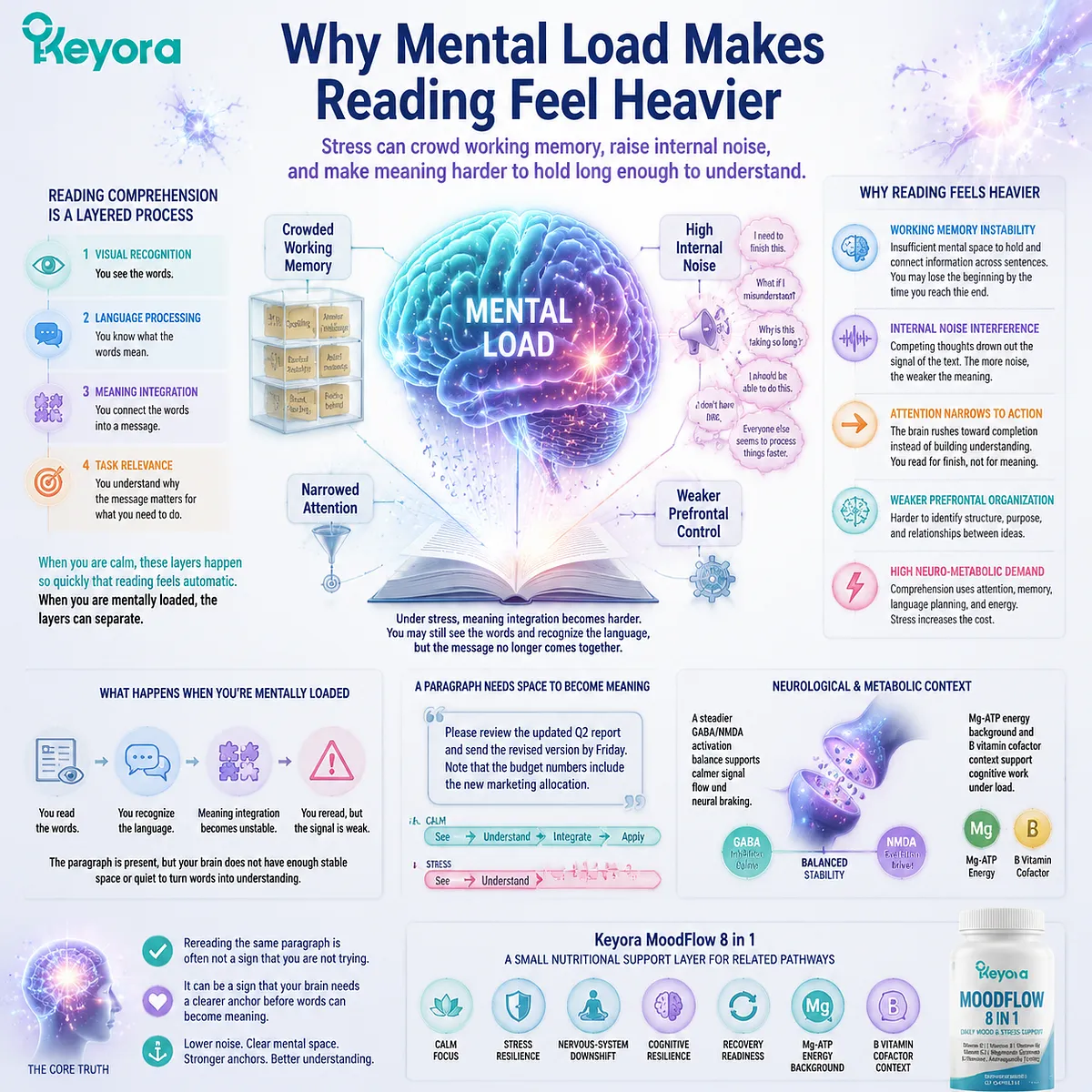
Stress can crowd working memory, raise internal noise, and make meaning harder to hold long enough to understand.
Reading comprehension is a layered process.
The first layer is visual recognition. You see the words.
The second layer is language processing. You know what the words mean.
The third layer is meaning integration. You connect the words into a message.
The fourth layer is task relevance. You understand why the message matters for what you need to do.
When you are calm, these layers may happen so quickly that reading feels automatic.
When you are mentally loaded, the layers can separate. You may still see the words and recognize the language, but meaning integration becomes harder. The paragraph no longer flows into understanding.
One reason is working memory instability.
Working memory is the small mental space that holds information while you use it. When you read a paragraph, working memory keeps the beginning of the sentence alive while you reach the end. It holds the previous sentence while you interpret the next one. It helps you notice whether the paragraph is explaining, warning, comparing, instructing, or asking for action.
Under stress, working memory can become crowded.
It may already be holding the deadline, the message you need to answer, the meeting coming up, the mistake you want to avoid, the pressure to understand quickly, and the feeling that you are falling behind.
Then the paragraph arrives and asks for space.
There may not be enough stable space left.
This is why you may read three sentences and lose the first one by the time you reach the fourth. It is not that the first sentence disappeared. It is that it was not held long enough to connect with the rest.
Another reason is internal noise.
Internal noise can sound like: “I need to finish this.”
“What if I misunderstand?”
“Why is this taking so long?”
“I should be able to do this.”
“I do not have time.”
“Everyone else seems to process things faster.”
These thoughts compete with the text.
The paragraph becomes one signal among many. The more noise there is, the harder it is for meaning to become clear. You may keep rereading because the words are present, but the signal is weak.
Stress can also narrow attention.
Under pressure, the brain often moves toward action. It wants to finish, respond, solve, decide, or escape the discomfort. But comprehension requires slowing down enough to build a mental model. When the brain is rushing toward closure, it may read for completion instead of understanding.
That creates a quiet mismatch: you are trying to get through the paragraph, but what you actually need is to enter the paragraph.
Prefrontal control also plays a role. The prefrontal system helps you organize information, hold purpose, identify structure, and decide what the paragraph is doing. When stress load is high, this organizing function can feel thinner. You may see separate sentences but struggle to form a clear structure.
Then there is the background of nervous-system activation and neuro-metabolic demand.
Reading comprehension is not passive. It uses attention, working memory, language planning, and energy. A steadier GABA/NMDA activation balance can be understood as part of the background for calmer signal flow. Mg-ATP energy background and B vitamin cofactor context belong to the broader infrastructure that supports normal cognitive work under load.
But the main insight is simple.
Rereading the same paragraph is often not a sign that you are not trying. It can be a sign that your brain needs a clearer anchor before words can become meaning.
How to Break the Rereading Loop
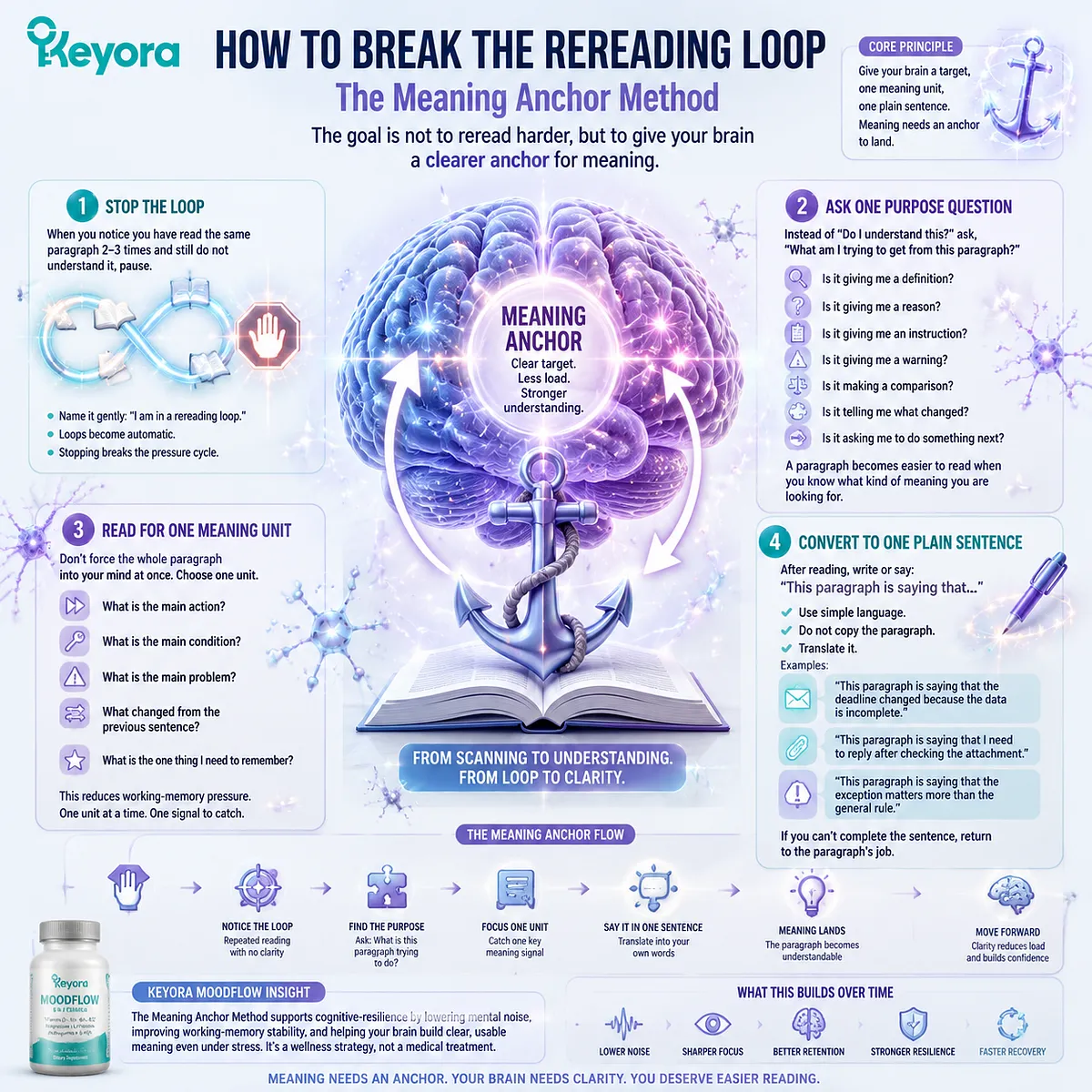
The goal is not to reread harder, but to give your brain a clearer anchor for meaning.
A useful approach is The Meaning Anchor Method.
This method is not about becoming a faster reader. It is not about forcing yourself to absorb everything at once. It is about helping the brain move from visual scanning into meaning-building.
Step one: stop the loop.
When you notice you have read the same paragraph two or three times and still do not understand it, pause. Do not immediately reread again.
Name what is happening gently: “I am in a rereading loop.”
This matters because loops often become automatic. You read, fail to absorb, feel frustrated, reread, fail again, and then become more tense. The tension makes comprehension harder.
Stopping the loop interrupts the pressure cycle.
Step two: ask one purpose question.
Instead of asking, “Do I understand this?” ask, “What am I trying to get from this paragraph?”
That question gives the brain a target.
Is this paragraph giving me a definition?
Is it giving me a reason?
Is it giving me an instruction?
Is it giving me a warning?
Is it making a comparison?
Is it telling me what changed?
Is it asking me to do something next?
A paragraph becomes easier to read when you know what kind of meaning you are looking for.
Step three: read for one meaning unit.
Do not force the whole paragraph into your mind at once. Choose one unit.
What is the main action?
What is the main condition?
What is the main problem?
What changed from the previous sentence?
What is the one thing I need to remember?
This reduces working-memory pressure. Instead of asking your brain to hold everything, you ask it to catch one meaningful piece.
Step four: convert the paragraph into one plain sentence.
After reading, write or say: “This paragraph is saying that…”
Use simple language. Do not copy the paragraph. Translate it.
For example:
“This paragraph is saying that the deadline changed because the data is incomplete.”
“This paragraph is saying that I need to reply after checking the attachment.”
“This paragraph is saying that the exception matters more than the general rule.”
This step is powerful because it turns input into output. It tells you whether meaning has actually formed.
If you cannot complete the sentence, do not blame yourself. Go back and look for the paragraph’s job. Is it explaining, warning, defining, comparing, or instructing?
The goal is not to reread harder.
The goal is to give the brain an anchor so meaning can land.
When the paragraph finally becomes one clear sentence in your own words, something changes. The text stops being a wall. It becomes a message.
That is the moment the brain has moved from scanning to understanding.
Where Nutritional Support Fits
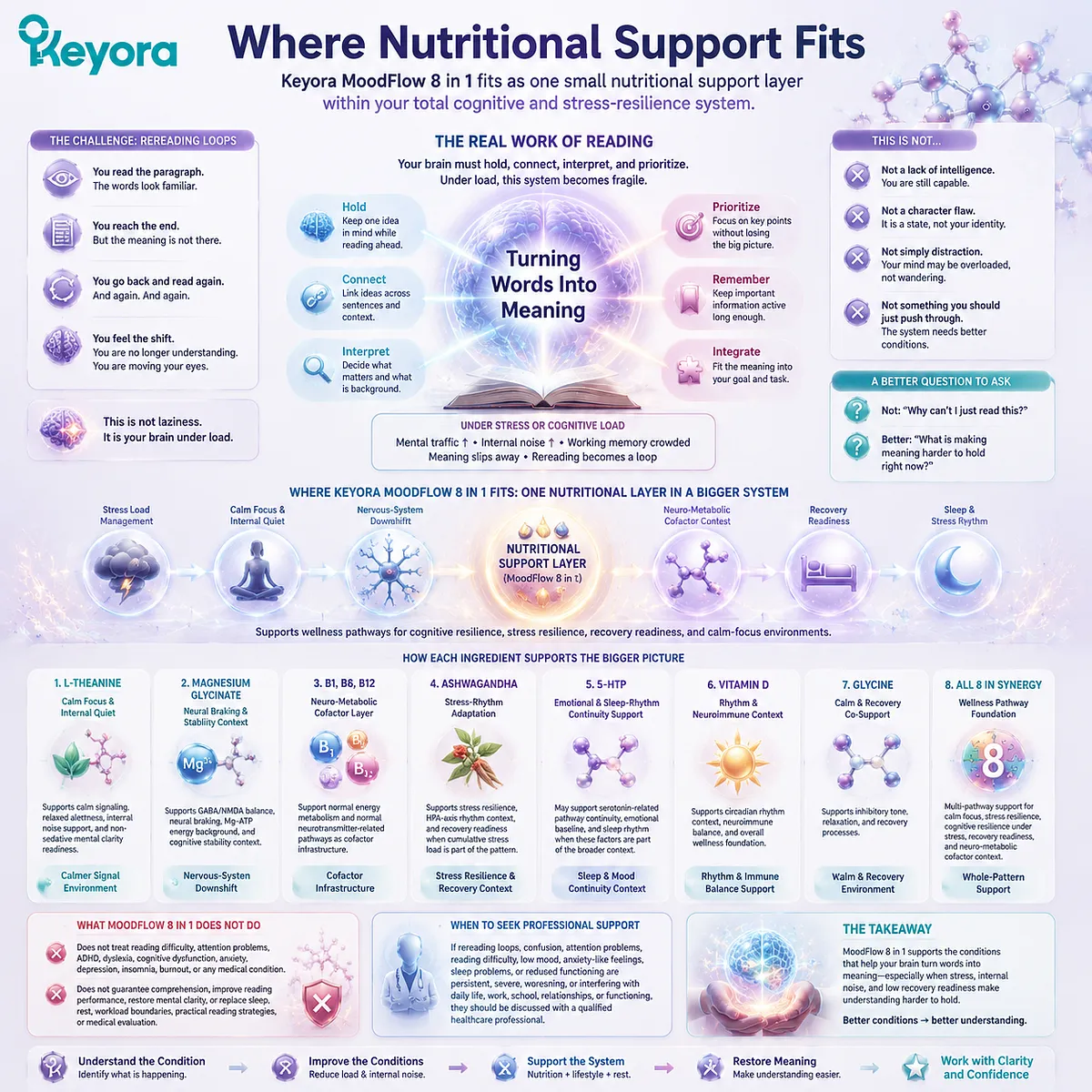
Keyora MoodFlow 8 in 1 can fit as one small nutritional support layer when rereading the same paragraph appears within a broader pattern of cognitive strain, stress load, internal noise, poor recovery readiness, and sleep-stress disruption.
Its role is narrower: supporting wellness pathways related to calm focus, stress resilience, nervous-system downshift, cognitive resilience under stress, recovery readiness, and neuro-metabolic cofactor context.
-
L-Theanine may support calm focus, relaxed alertness, internal noise support, and non-sedative mental clarity readiness.
-
Magnesium glycinate may support neural braking, GABA/NMDA activation balance, Mg-ATP energy background, and cognitive stability context.
-
B1, B6, and B12 fit the neuro-metabolic cofactor layer for normal energy metabolism and normal neurotransmitter-related pathways.
-
Ashwagandha may support stress-rhythm adaptation and recovery readiness when cumulative stress load is part of the pattern.
-
5-HTP may be relevant only when emotional baseline, sleep rhythm, and serotonin-related pathway continuity are part of the broader stress-sleep-mood context.
Keyora MoodFlow 8 in 1 does not treat reading difficulty, attention problems, ADHD, dyslexia, cognitive dysfunction, anxiety, depression, insomnia, burnout, or any medical condition. It does not guarantee comprehension, improve reading performance, restore mental clarity, or replace sleep, rest, workload boundaries, practical reading strategies, or medical evaluation when needed.
If rereading loops, confusion, attention problems, reading difficulty, low mood, anxiety-like feelings, sleep problems, or reduced functioning are persistent, severe, worsening, or interfering with daily life, work, school, relationships, or functioning, they should be discussed with a qualified healthcare professional.
Closing Summary
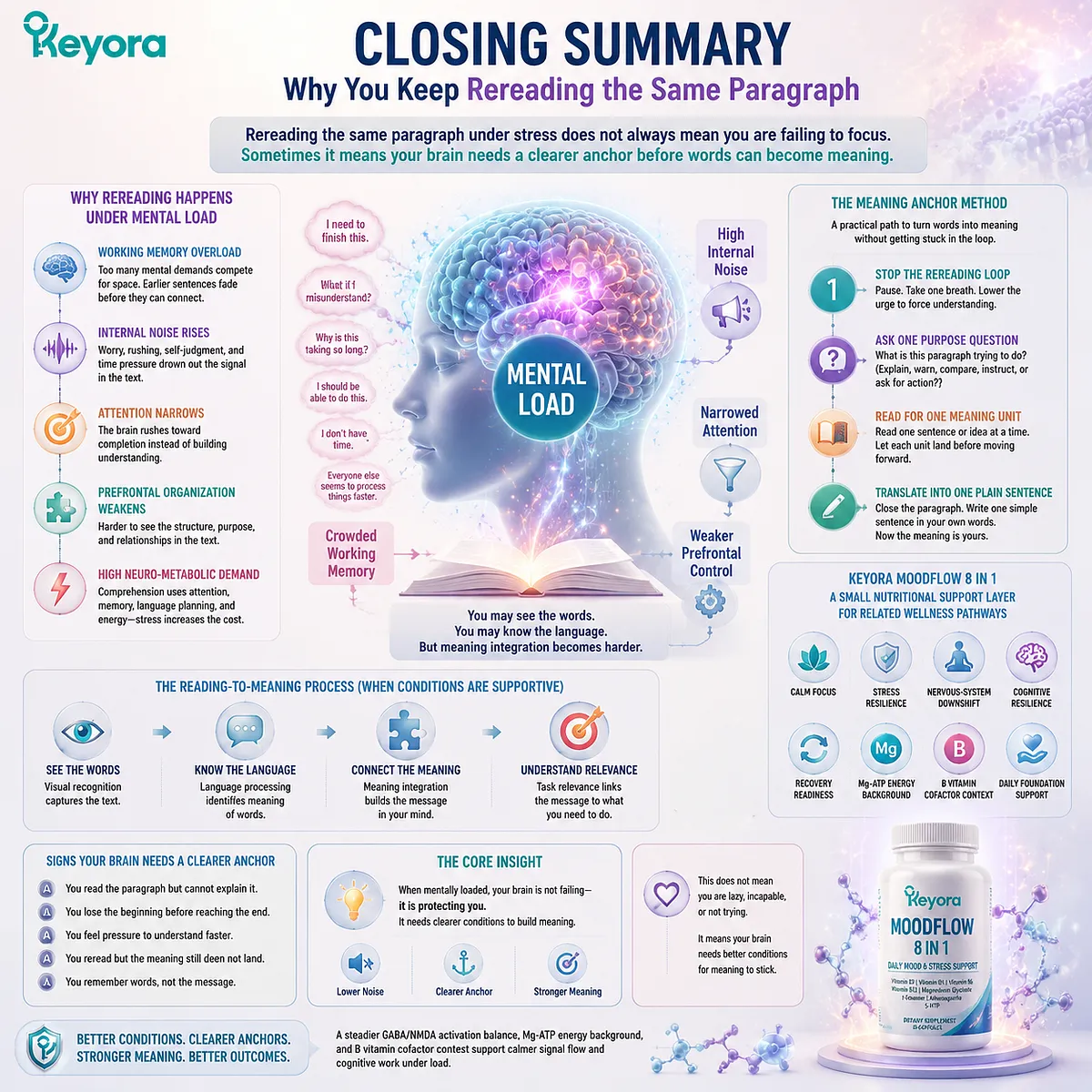
You may keep rereading the same paragraph when mentally loaded because your brain is not simply seeing words; it is trying to build meaning under pressure.
Stress can crowd working memory, raise internal noise, narrow attention, and make it harder to hold one sentence long enough to connect it with the next. This does not mean you are lazy, incapable, or not trying.
The practical path is The Meaning Anchor Method: stop the rereading loop, ask one purpose question, read for one meaning unit, and translate the paragraph into one plain sentence.
Keyora MoodFlow 8 in 1 belongs only as a small nutritional support layer for related wellness pathways, including calm focus, stress resilience, nervous-system downshift, cognitive resilience, recovery readiness, Mg-ATP energy background, and B vitamin cofactor context.
Rereading the same paragraph under stress does not always mean you are failing to focus. Sometimes it means your brain needs a clearer anchor before words can become meaning.
This article is for educational and informational purposes only. It does not provide medical advice, diagnosis, treatment, cure, prevention, disease outcome claims, hormone restoration claims, fertility outcome claims, or formula-specific clinical efficacy claims.