
Why Do I Get Quiet in Groups When I’m Stressed?
Keyora Research Q&A Library
This is part of the Keyora Research Q&A Series, derived from Keyora Nutritional Neurology Series .
Within the Keyora Nutritional Neurology framework, this Q&A translates complex nutrient–brain mechanisms into reader-friendly, evidence-bound answers, focusing on stress resilience, sleep quality, calm mood support, cognitive wellness, and the broader interaction between nutrition, neurochemistry, and daily nervous-system function.
First published by Keyora Research Journal: www.keyorahealth.com

Direct Answer
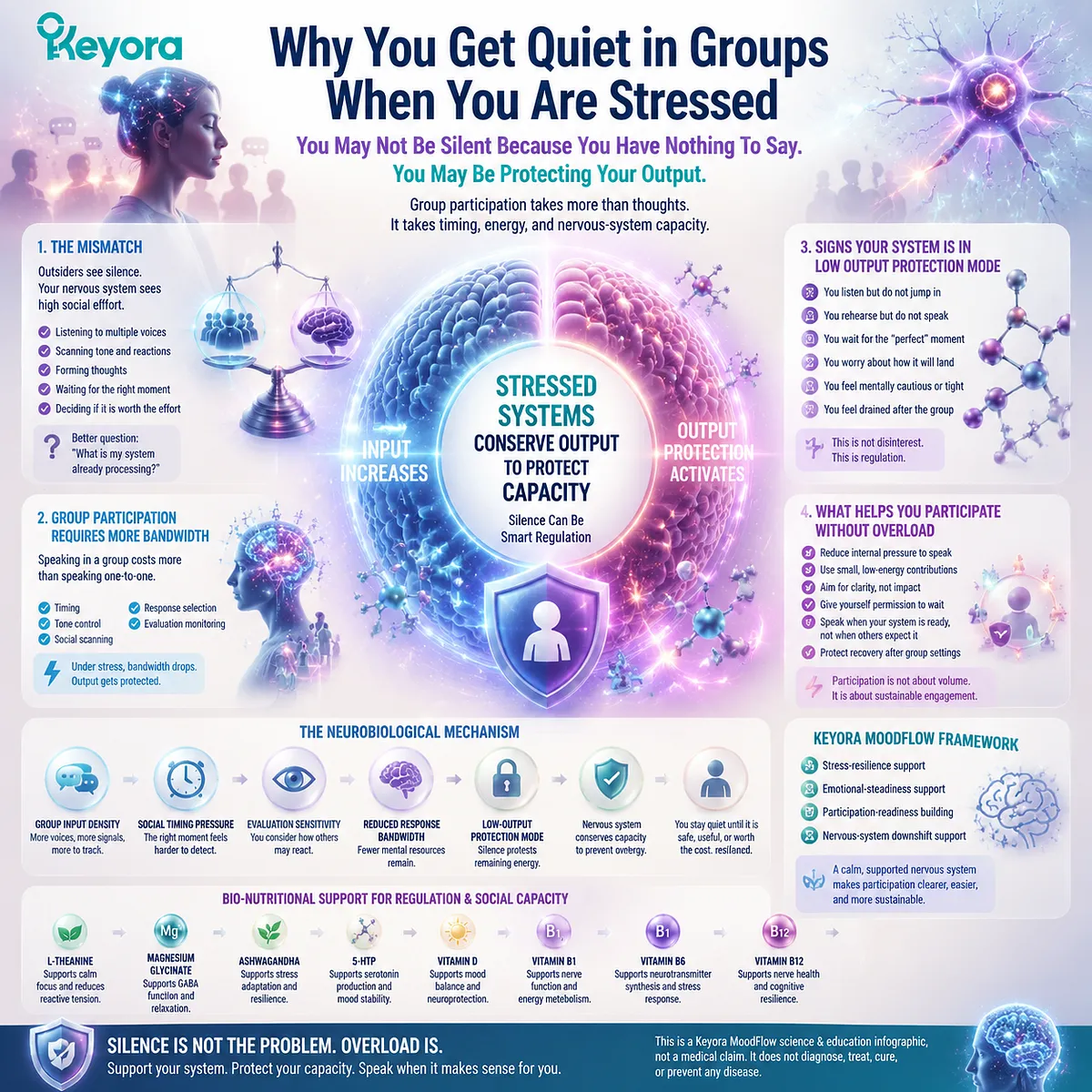
You may get quiet in groups when you are stressed because group participation requires more than having something to say. It requires timing, tone control, social scanning, response selection, and the confidence to let several people receive your words at once.
The mismatch is this: from the outside, silence may look like disinterest, shyness, or lack of opinion.
But inside a stressed system, you may be listening, tracking the conversation, forming thoughts, waiting for the right moment, and deciding whether speaking is worth the social effort.
You may not be empty.
You may be conserving output.
Mechanistically, this can involve group input density, social timing pressure, evaluation sensitivity, reduced response-formulation bandwidth, low-output protection mode, GABA/NMDA activation balance, nervous-system downshift difficulty, Mg-ATP energy context, and B-vitamin cofactor support.
In the Keyora MoodFlow framework, this is understood as a stress-resilience, emotional-steadiness, and participation-readiness question, not a medical treatment claim.
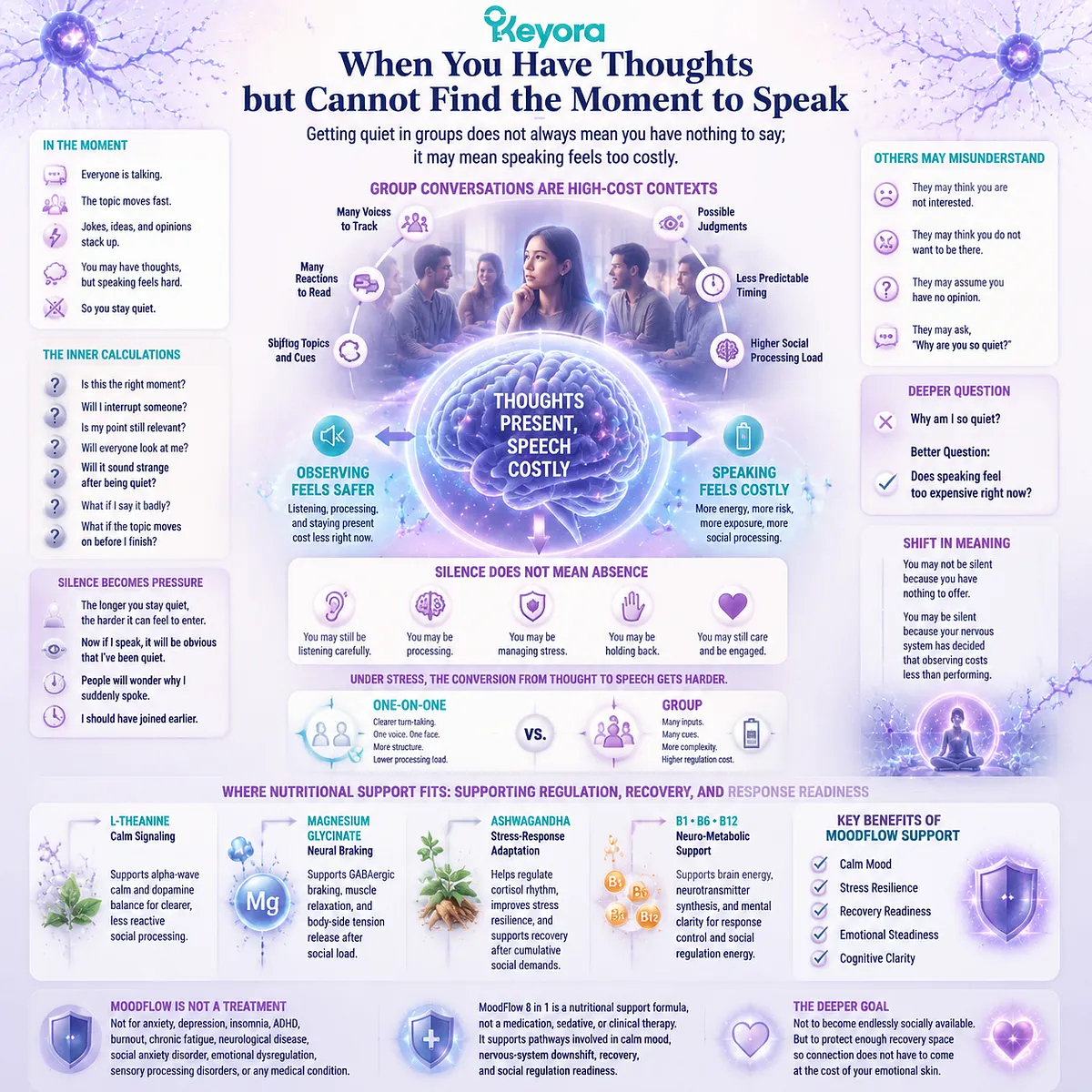
When You Have Thoughts but Cannot Find the Moment to Speak
Getting quiet in groups does not always mean you have nothing to say; it may mean speaking feels too costly.
You may be sitting with a group of people.
Everyone is talking.
Someone tells a story.
Someone else jumps in with a joke.
Another person adds an opinion.
The topic changes quickly. People laugh, interrupt lightly, respond fast, and move from one idea to the next before you have fully decided what you want to say.
You are not necessarily bored.
You are not necessarily angry.
You may even have thoughts.
But every time you consider speaking, another layer appears.
Is this the right moment?
Will I interrupt someone?
Is my point still relevant?
Will everyone look at me?
Will it sound strange if I speak now after being quiet for so long?
What if I say it badly?
What if the topic moves on before I finish?
So you stay quiet.
Then, the longer you stay quiet, the harder it can feel to enter. Silence starts to become its own pressure. You may think, “Now if I say something, it will be obvious that I have been quiet.” Or, “People will wonder why I suddenly spoke.” Or, “I should have joined earlier.”
This can feel lonely because other people may misunderstand your silence.
-
They may think you are not interested.
-
They may think you do not want to be there.
-
They may assume you have no opinion.
-
Some may even ask, “Why are you so quiet?” which can make the silence feel even heavier.
But your inner experience may be very different.
-
You may be listening carefully.
-
You may be processing.
-
You may be trying to find an opening.
-
You may be managing your stress.
-
You may be holding back because speaking feels like it would cost more than you have available.
This is why group quietness can be so misunderstood.
It is easy to assume that speaking reflects engagement and silence reflects absence. But silence can also be a form of low-output participation. You may still be present, still caring, still following, still thinking.
You are just not converting that internal participation into spoken output.
Under stress, that conversion becomes harder.
A one-on-one conversation gives you more structure. There is a clearer turn. The other person speaks, then you speak. You can follow one voice, one face, one emotional field.
A group is different.
A group has many voices, many reactions, many possible judgments, many shifting cues, and less predictable timing. To speak in a group, you need to place your thought into a moving social system.
That is a more complex task.
This is why you may feel normal in one-on-one conversation but quiet in groups. It does not mean you have no social ability. It may mean group participation requires a type of regulation that stress makes harder to access.
The deeper question is not only, “Why am I so quiet?”
A better question is, “Does speaking feel too expensive right now?”
That question changes the meaning.
You may not be silent because you have nothing to offer.
You may be silent because your nervous system has decided that observing costs less than performing.
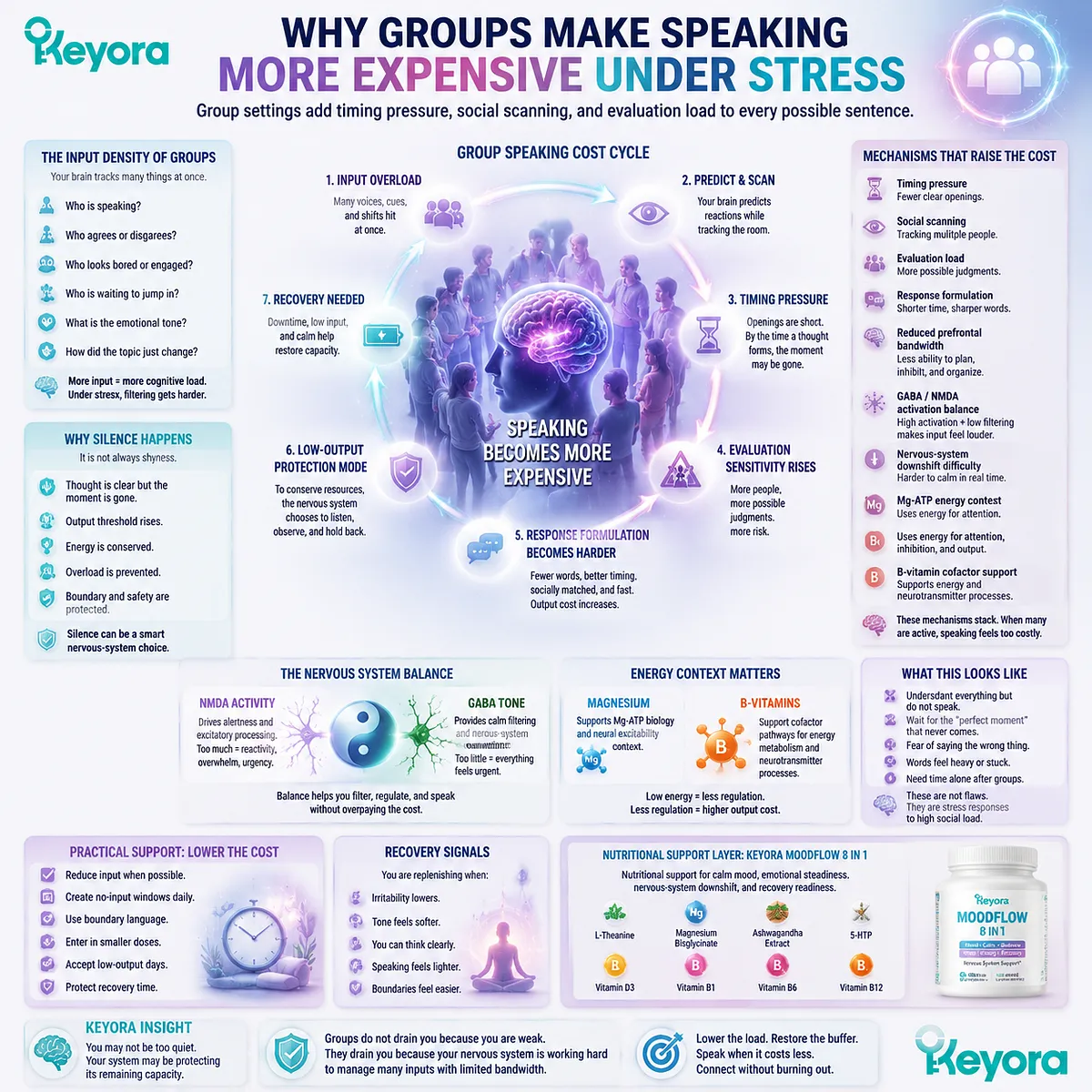
Why Groups Make Speaking More Expensive Under Stress
Group settings add timing pressure, social scanning, and evaluation load to every possible sentence.
Groups make speaking more expensive because they increase input density.
In a group, your brain is not only following words. It is tracking several people at once. Who is speaking? Who agrees? Who seems bored? Who is waiting to jump in? Who is joking? Who is serious? Who changed the topic? What is the emotional tone of the room?
That is a lot of social information.
When stress is low, this may feel manageable. You can listen, respond, laugh, and join when you want to.
When stress is high, the same group environment can feel too fast. The brain has less space for filtering. The nervous system may become more watchful. Instead of joining naturally, you may start observing more than participating.
Timing pressure is one of the biggest reasons.
In a group, there may not be a clear opening.
-
By the time you form a thought, someone else has spoken.
-
By the time you prepare your sentence, the topic has changed.
-
By the time a pause appears, you may no longer feel sure your point fits.
This can raise the speaking threshold.
The thought may still be there, but the moment feels gone.
Evaluation sensitivity also rises in groups. Speaking to one person means one person receives your words. Speaking in a group means several people receive them at once. Several people may look at you, interpret your tone, respond, disagree, laugh, ignore, or continue without reacting.
Under stress, the brain may predict those possibilities more intensely.
Will this sound useful?
Will people think it is obvious?
Will the room go quiet?
Will someone correct me?
Will I sound awkward?
Will I take too long?
This does not mean everyone is actually judging you. It means stress can make possible evaluation feel more important.
Response formulation also becomes harder.
In a group, you often have less time to shape your words. You may need to make your point shorter, clearer, more socially timed, and matched to the group’s energy. You may need to speak before the conversation moves on.
That is different from thinking privately.
A thought can be clear inside but difficult to release into a fast-moving group.
The prefrontal cortex helps with this kind of task. It supports timing, inhibition, social judgment, verbal organization, and flexible response. It helps you decide whether to speak, how to enter, what words to use, and when to stop.
But prefrontal regulation bandwidth is limited.
When stress has already used much of that space, group participation can feel too expensive. You may still understand the conversation, but the output side becomes harder. Listening may remain possible. Speaking may not.
That is where low-output protection mode appears.
Low-output mode is the nervous system choosing to reduce visible social output because output itself has become costly. Instead of speaking, you observe. Instead of performing, you conserve. Instead of adding to the group, you track the group from a safer internal distance.
This is not always a failure.
Sometimes it is the body trying to prevent overload.
GABA/NMDA balance can help explain why groups feel more intense under stress. The nervous system needs activation to follow multiple signals, but it also needs braking and filtering so those signals do not become overwhelming. NMDA-related activity can be understood as part of alert and excitatory processing. GABA-related tone helps support calm filtering and nervous-system downshift.
When activation is high and filtering feels limited, group input can become loud even when people are simply talking.
Energy context also matters. Group participation requires attention, inhibition, verbal formulation, social timing, emotional filtering, and recovery. Magnesium participates in Mg-ATP biology and neural excitability context. B vitamins support cofactor pathways involved in energy metabolism and neurotransmitter-related processes.
This does not mean getting quiet in groups is only nutritional. Sleep, workload, relationship safety, group culture, personality, sensory input, social history, and recovery time all matter.
But it does mean the experience is real.
You may get quiet in groups when your nervous system decides that observing costs less than performing.
The silence may not mean absence.
It may mean your system is protecting its remaining capacity.
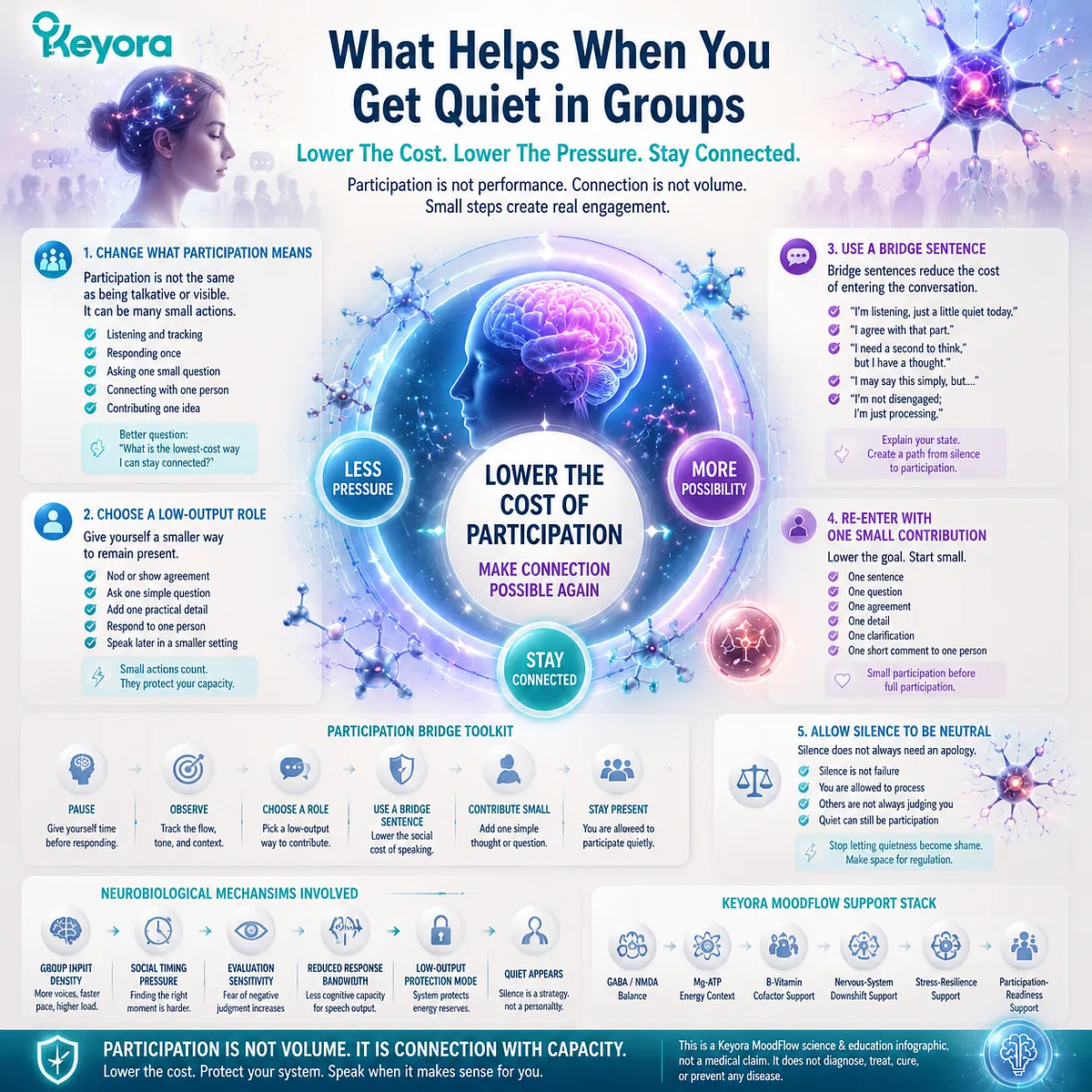
What Helps When You Get Quiet in Groups
The goal is not to force yourself to speak more, but to lower the cost of participation.
When you get quiet in groups under stress, the first step is not to shame yourself into speaking.
That usually increases pressure.
Instead, begin by changing what participation means.
Participation does not have to mean being highly talkative, quick, funny, expressive, or constantly visible. Participation can also mean listening, tracking the group, responding once, asking one small question, or connecting with one person instead of the whole room.
The question is not, “How do I force myself to be more outgoing?”
A better question is, “What is the lowest-cost way I can stay connected?”
This lowers the pressure enough for participation to become possible again.
One helpful step is to choose a low-output role.
A low-output role means you do not require yourself to perform full social energy when you do not have it. You give yourself a smaller way to remain present.
You might nod when something resonates.
You might ask one simple question.
You might say, “I agree with that part.”
You might add one practical detail.
You might respond to one person’s comment instead of addressing the whole group.
You might speak later in a smaller setting instead of forcing yourself to enter the fast group rhythm.
These small actions count.
They tell your nervous system that participation does not have to mean full performance.
Another helpful tool is a bridge sentence.
A bridge sentence gives you a low-pressure way to enter the conversation without needing a perfect opening.
For example:
“I’m listening, just a little quiet today.”
“I agree with that part.”
“I need a second to think, but I have a thought.”
“I may say this simply, but…”
“I’m not disengaged; I’m just processing.”
These sentences reduce the social cost of speaking because they explain the state you are in. They also prevent other people from misreading quiet as disinterest.
A bridge sentence does not need to be impressive.
It only needs to create a small path from silence to participation.
A third step is to re-enter with one small contribution.
Do not make the goal, “I need to become active in this group now.” That is too much pressure for a stressed system.
Make the goal smaller.
One sentence.
One question.
One agreement.
One detail.
One clarification.
One short comment to one person.
Small participation before full participation.
This approach matters because the nervous system often needs proof that speaking is survivable. A small contribution can show the body that entry into the group does not have to be overwhelming.
The fourth step is to allow silence to be neutral.
Silence does not always need an apology. It does not always mean failure. It does not always mean others are judging you. Sometimes silence simply means you are processing more than you are producing.
If you treat silence as failure, the group becomes more threatening.
If you treat silence as one valid participation mode, the body may feel less pressure to perform.
The goal is not to erase quietness.
The goal is to stop letting quietness become shame.
Where Nutritional Support Fits
Keyora MoodFlow 8 in 1 can fit as one small support layer when getting quiet in groups is part of a broader stress-sleep-mood-cognition pattern. It should not be understood as something that makes someone more outgoing, forces social confidence, or removes the need for pacing and boundaries.
Its role is narrower: supporting nutritional pathways involved in calm mood, emotional steadiness, nervous-system downshift, and participation readiness when group settings feel socially expensive.
For this topic, the most relevant layers are L-Theanine for calm interpretation when group input feels socially intense, magnesium glycinate for neural braking and body-side tension before speaking, B1, B6, and B12 for neuro-metabolic support behind verbal organization and response formulation, and Ashwagandha for stress-response adaptation when group participation begins from an already loaded state.
MoodFlow is not a treatment for anxiety, depression, insomnia, ADHD, burnout, chronic fatigue, neurological disease, social anxiety disorder, communication disorders, emotional dysregulation, cortisol problems, adrenal fatigue, thyroid disease, anemia, nutrient deficiency, hormonal disorders, or any medical condition.
In this article, Keyora uses “getting quiet in groups when stressed” as a wellness-language entry point for explaining group input density, timing pressure, social output threshold, and participation readiness.
The deeper goal is not to turn quiet people into loud people.
It is to make participation feel less like performance and more like choice.

Closing Summary
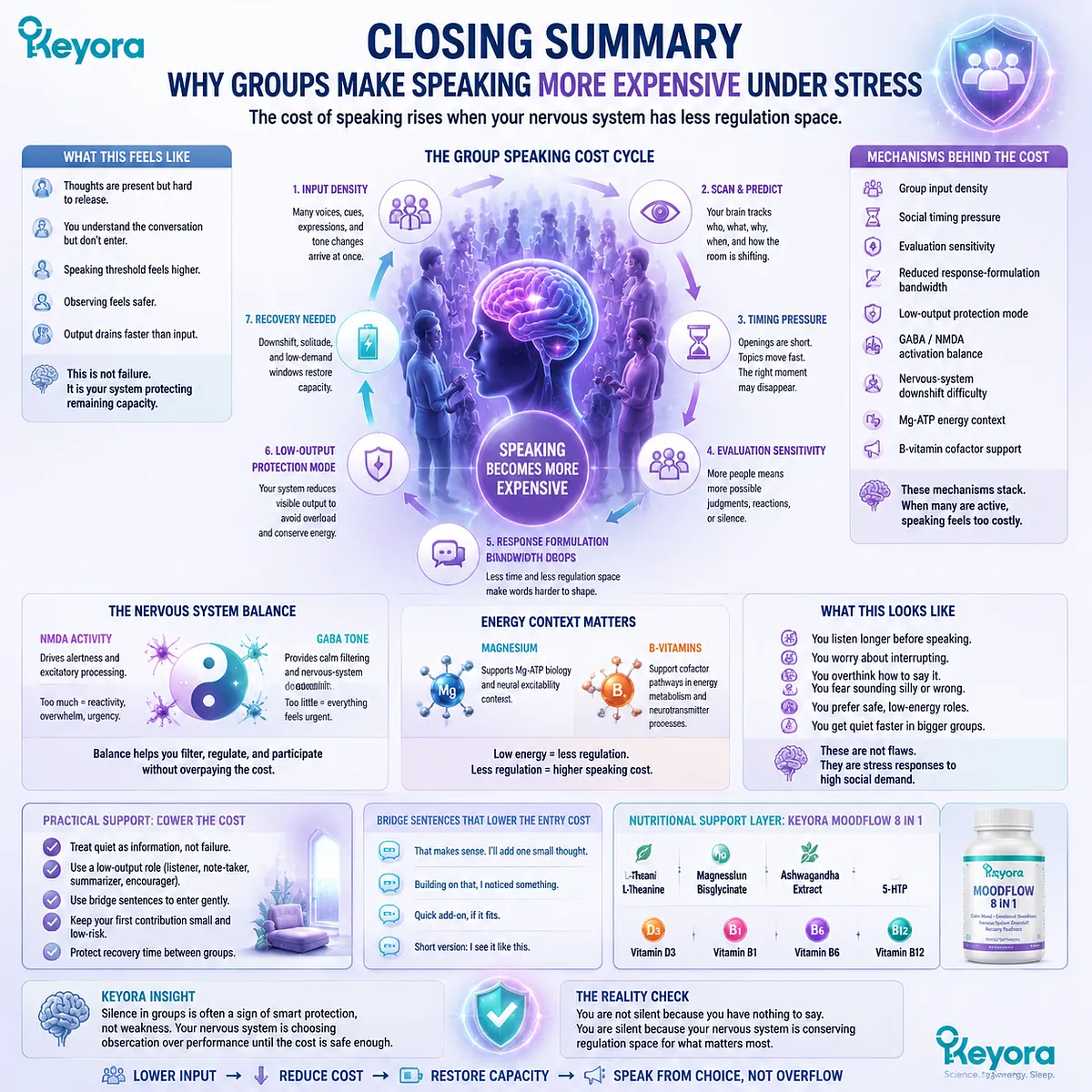
Getting quiet in groups when you are stressed does not always mean you have no thoughts, dislike people, or lack social ability. It may mean the cost of speaking has become too high for the regulation space you have available.
Group settings require timing, tone control, social scanning, verbal organization, response selection, and tolerance of being received by several people at once. Under stress, those demands can make speaking feel expensive.
Mechanistically, this can involve group input density, social timing pressure, evaluation sensitivity, reduced response-formulation bandwidth, low-output protection mode, GABA/NMDA activation balance, nervous-system downshift difficulty, Mg-ATP energy context, and B-vitamin cofactor support.
Practical support begins by lowering the cost of participation: treat quiet as information, choose a low-output role, use bridge sentences, and re-enter with one small contribution instead of forcing full social performance.
Keyora MoodFlow 8 in 1 fits only as a nutritional support layer for calm mood, emotional steadiness, nervous-system downshift, and participation readiness. It is not a treatment for social anxiety disorder, communication disorders, emotional dysregulation, or any medical condition.
You may not be silent because you have nothing to say.
You may be silent because your nervous system is choosing observation over performance until speaking feels safe enough again.
This article is for educational and informational purposes only. It does not provide medical advice, diagnosis, treatment, cure, prevention, disease outcome claims, hormone restoration claims, fertility outcome claims, or formula-specific clinical efficacy claims.