
Why Do I Feel Tired and Unmotivated Even After Resting?
Keyora Research Q&A Library
This is part of the Keyora Research Q&A Series, derived from Keyora Nutritional Neurology Series .
Within the Keyora Nutritional Neurology framework, this Q&A translates complex nutrient–brain mechanisms into reader-friendly, evidence-bound answers, focusing on stress resilience, sleep quality, calm mood support, cognitive wellness, and the broader interaction between nutrition, neurochemistry, and daily nervous-system function.
First published by Keyora Research Journal: www.keyorahealth.com

Direct Answer
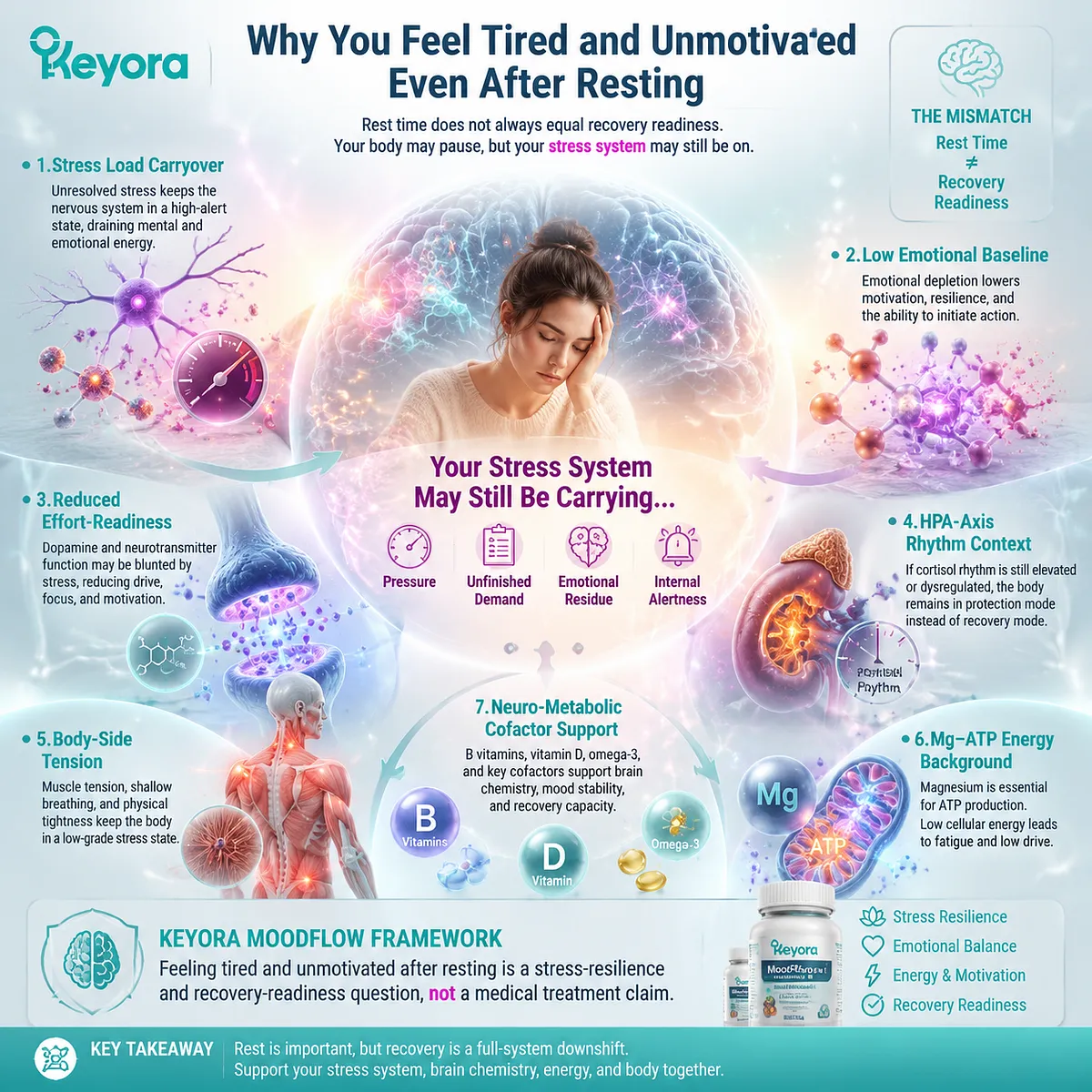
You may feel tired and unmotivated even after resting because stopping activity is not always the same as entering recovery.
Your body may have paused, but your stress system may still be carrying pressure, unfinished demand, emotional residue, or internal alertness.
The mismatch is this: rest time does not always equal recovery readiness.
You can lie down, scroll, sleep, or take a day off and still not feel ready to begin again if your nervous system has not fully downshifted.
This can involve stress load carryover, low emotional baseline, reduced effort-readiness, HPA-axis rhythm context, body-side tension, Mg-ATP energy background, and neuro-metabolic cofactor support.
In the Keyora MoodFlow framework, feeling tired and unmotivated after resting is understood as a stress-resilience and recovery-readiness question, not a medical treatment claim.
Why Rest Does Not Always Restore Motivation
Resting your body is not always the same as shifting your system into recovery.
You finally stop.
The laptop is closed. The meeting is over. The messages can wait. You sit on the couch, lie on the bed, or lean back in a chair and tell yourself, “I need to rest.”
For a while, it looks like rest from the outside.
You are not answering emails. You are not actively solving anything. Maybe you scroll through your phone, watch something light, order food, take a nap, or spend the weekend doing very little.
But when it is time to begin again, something feels wrong.
Your body is still heavy. Your mind is still dull. You do not feel refreshed. You do not feel ready. You do not feel the clean internal reset you expected from resting.
Then the self-blame begins.
“I already rested. Why am I still like this?”
“Why do I still not want to do anything?”
“Am I lazy?”
“Did I waste my break?”
“Why does everyone else seem to recover faster?”
This is where many people misunderstand their own experience. They assume that if they stopped working, they should automatically feel restored. They assume that if they had free time, motivation should come back. They assume that if they rested and still feel tired, the problem must be their discipline.
But what if the missing piece is not discipline?
What if your body stopped activity, but your stress system did not fully receive the message that it was safe to recover?
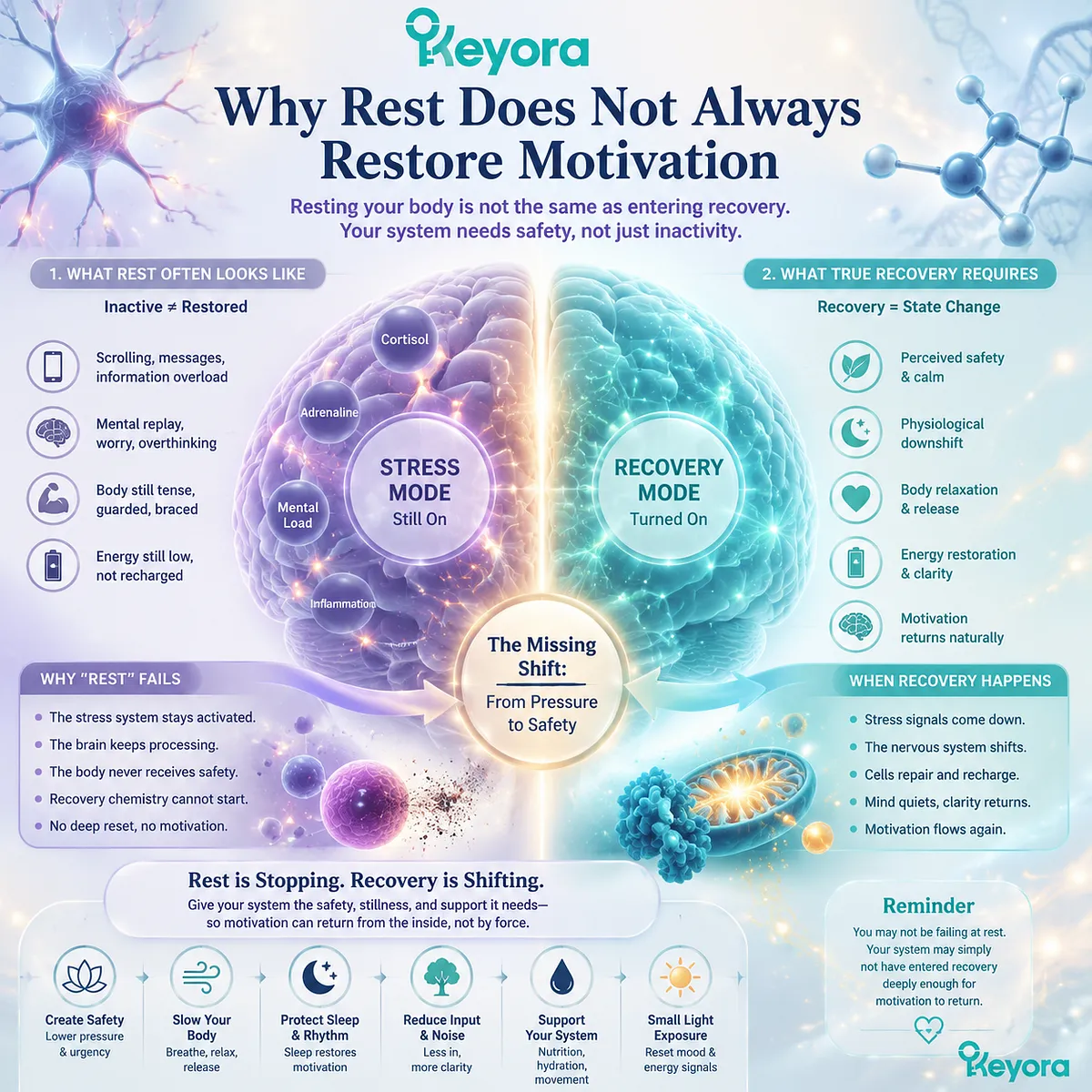
There is a difference between being inactive and being restored.
Inactivity means you are not doing the task. Recovery means your system has shifted out of pressure mode. Recovery is not only the absence of work. It is a state change.
This matters because many modern forms of “rest” still keep the brain loaded.
You may stop working but continue taking in rapid information. You may lie down but keep checking messages.
You may sit quietly but mentally replay the day.
You may take a break while your body is still braced, your jaw still tight, your shoulders still raised, and your attention still half-preparing for the next demand.
From the outside, this looks like rest.
From the inside, it may still be stress processing.
That is why you can rest and still feel tired. That is why you can take time off and still feel unmotivated. That is why a weekend can pass without giving you the feeling of being renewed.
You may not be failing at rest.
Your system may simply not have entered recovery deeply enough for effort-readiness to return.
Why You Can Still Feel Tired After You Stop
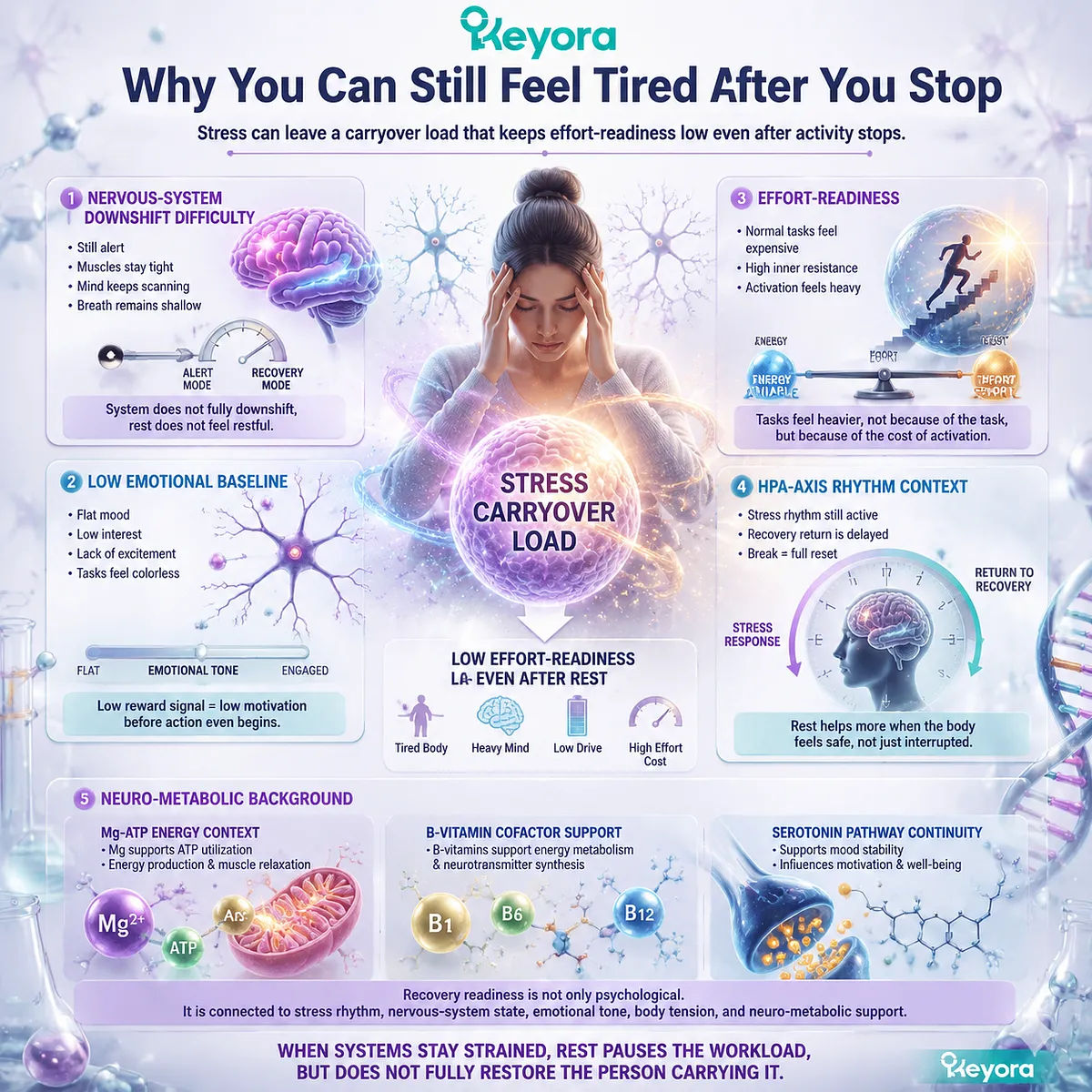
Stress can leave a carryover load that keeps effort-readiness low even after activity stops.
Stress has a way of continuing after the stressful event is technically over.
The email has been sent, but your body still feels alert. The meeting has ended, but your mind keeps replaying what happened. The workday is finished, but part of you still feels responsible for everything that remains unfinished.
This is stress load carryover.
It means the demand is no longer directly in front of you, but your system is still metabolizing it. The body may still be holding tension. The mind may still be scanning. The emotional system may still be catching up.
This carryover can keep motivation low because motivation requires more than free time. It requires enough internal space to feel that effort is possible again.
The first mechanism is nervous-system downshift difficulty.
When stress is active, the body often prepares for action, protection, or problem-solving. This can involve higher alertness, tighter muscles, faster thought movement, shallower breathing, and a subtle feeling that you cannot fully settle.
If that state does not downshift, rest may not feel restful.
You may be lying down, but your system is still waiting. You may be off the clock, but your body has not fully left the work state. You may be doing nothing, but internally you are not in recovery mode.
The second mechanism is low emotional baseline.
After stress, the background tone of the day may feel flat. Nothing feels especially exciting. The idea of doing something enjoyable may not create much pull. Even simple tasks feel colorless.
This does not mean you do not care. It may mean your emotional system has not regained enough flexibility to create interest and forward movement.
Motivation often depends on a small sense of reward, possibility, or relief. When stress has lowered that emotional baseline, action can feel unrewarding before it even begins.
The third mechanism is effort-readiness.
Resting does not always mean the system is ready to spend energy again. Effort-readiness is the feeling that you can begin without excessive inner resistance.
When recovery is incomplete, even normal tasks can feel expensive.
Making food, answering a message, cleaning a small area, starting a document, or leaving the house may all feel heavier than they objectively are. The problem is not always the task. The problem is the cost of activation.
The fourth mechanism is HPA-axis rhythm context.
The stress-response system is built around timing. It helps the body respond to challenge, then ideally return toward recovery. But when stress is repeated, prolonged, or emotionally unresolved, that return can become delayed.
You may take a break, but the rhythm of stress has not fully quieted.
This is why “just rest” can be incomplete advice. Rest helps more when the body can interpret it as safety, not just interruption.
The fifth mechanism is neuro-metabolic background.
Cognitive effort, emotional regulation, and task initiation all depend on energy handling and normal neurotransmitter-related pathways.
Magnesium-related Mg-ATP context, B-vitamin cofactor support, and serotonin-related pathway continuity can all belong to the wider background of recovery readiness.
This does not mean one nutrient creates energy or motivation.
It means the feeling of being ready to begin again is not only psychological. It is connected to stress rhythm, nervous-system state, emotional tone, body tension, and neuro-metabolic support.
When those systems remain strained, rest may pause the workload without fully restoring the person carrying it.
How to Turn Rest Into Real Recovery
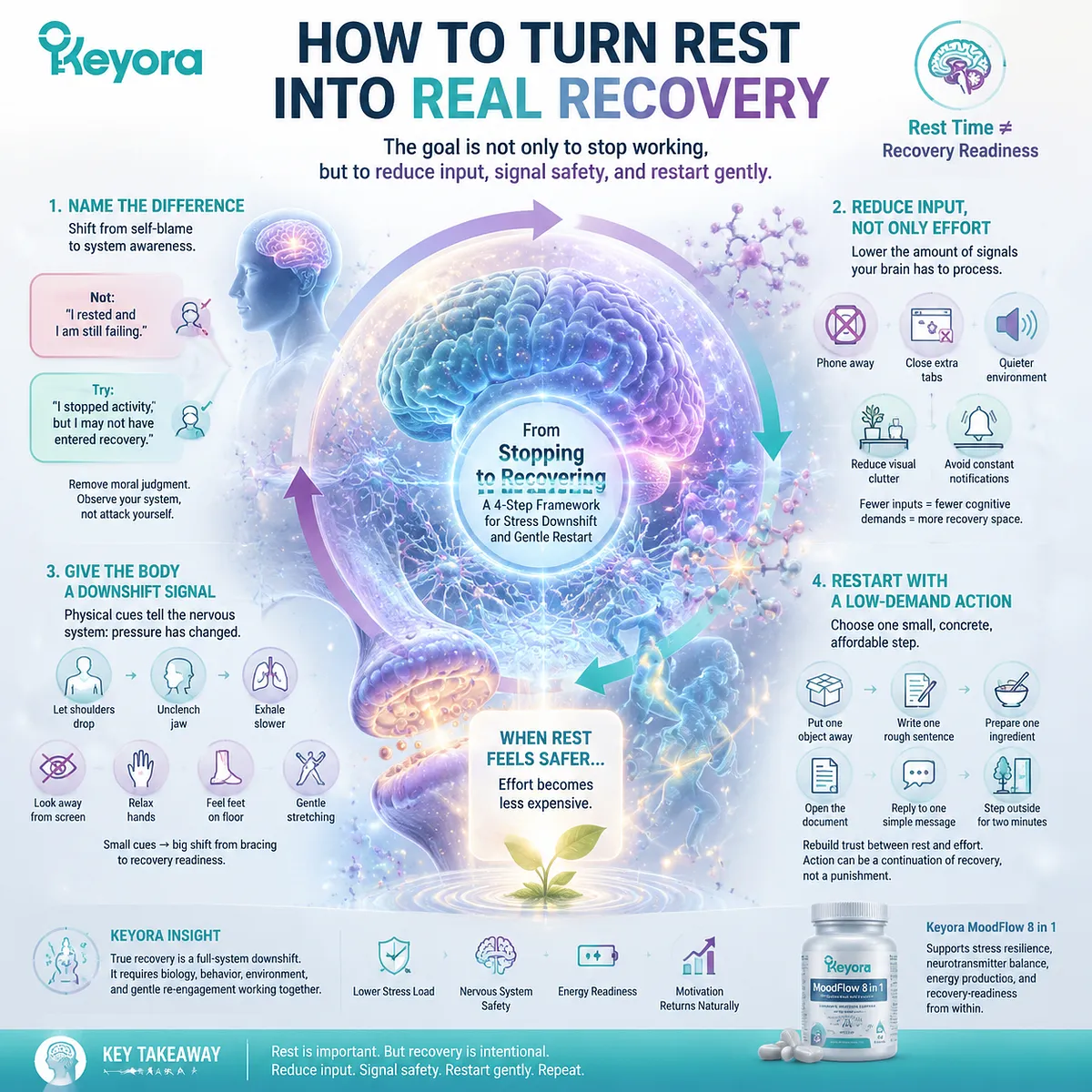
The goal is not only to stop working, but to reduce input, signal safety, and restart gently.
When you feel tired and unmotivated after resting, it is tempting to attack yourself.
You may think the solution is more pressure.
“Get up.”
“Stop wasting time.”
“You already rested.”
“You have no excuse now.”
But if stress carryover is still active, pressure may push your system back into the same state that made recovery incomplete in the first place.
A better approach is to ask a different question.
Not “Why am I still lazy?”
But “Did my rest actually help my system recover?”
The first step is to name the difference.
Instead of saying, “I rested and I am still failing,” try saying, “I stopped activity, but I may not have entered recovery.”
This small shift matters.
It removes moral judgment and turns the problem into something observable. You are no longer accusing yourself. You are looking at the state of your system.
The second step is to reduce input, not only effort.
Many people rest by replacing work input with entertainment input. That can be enjoyable, but it is not always restorative. A fast-moving feed, constant notifications, background noise, and switching between apps can keep the brain processing.
Try creating a lower-input break.
Put the phone farther away for a short period. Close extra tabs. Let the room be quieter. Reduce visual clutter. Avoid turning every pause into another stream of information.
This does not have to be extreme. The goal is not perfect silence. The goal is to give your system fewer signals to process.
The third step is to give the body a downshift signal.
Stress often lives in the body before you consciously notice it. Your shoulders may stay slightly raised. Your jaw may stay tight. Your breathing may stay shallow. Your eyes may remain fixed on a screen.
A recovery signal can be simple.
Let your shoulders drop.
Unclench your jaw.
Exhale more slowly than usual.
Look away from the screen.
Relax your hands.
Feel your feet on the floor.
Stretch gently without turning it into exercise.
These small cues tell the body that the pressure level has changed. They help the system move from bracing toward recovery readiness.
The fourth step is to restart with a low-demand action.
After incomplete rest, do not demand high performance immediately. That can make the transition feel too steep.
Choose one action that is small, concrete, and affordable.
Put one object away.
Write one rough sentence.
Prepare one ingredient.
Open the document without requiring yourself to finish it.
Reply to one simple message.
Step outside for two minutes.
The purpose is not to prove productivity. The purpose is to rebuild trust between rest and effort.
Your system needs to learn that action does not have to arrive as a punishment after rest. It can arrive as a gentle continuation of recovery.
When rest begins to feel safer, effort can become less expensive.
Where Nutritional Support Fits
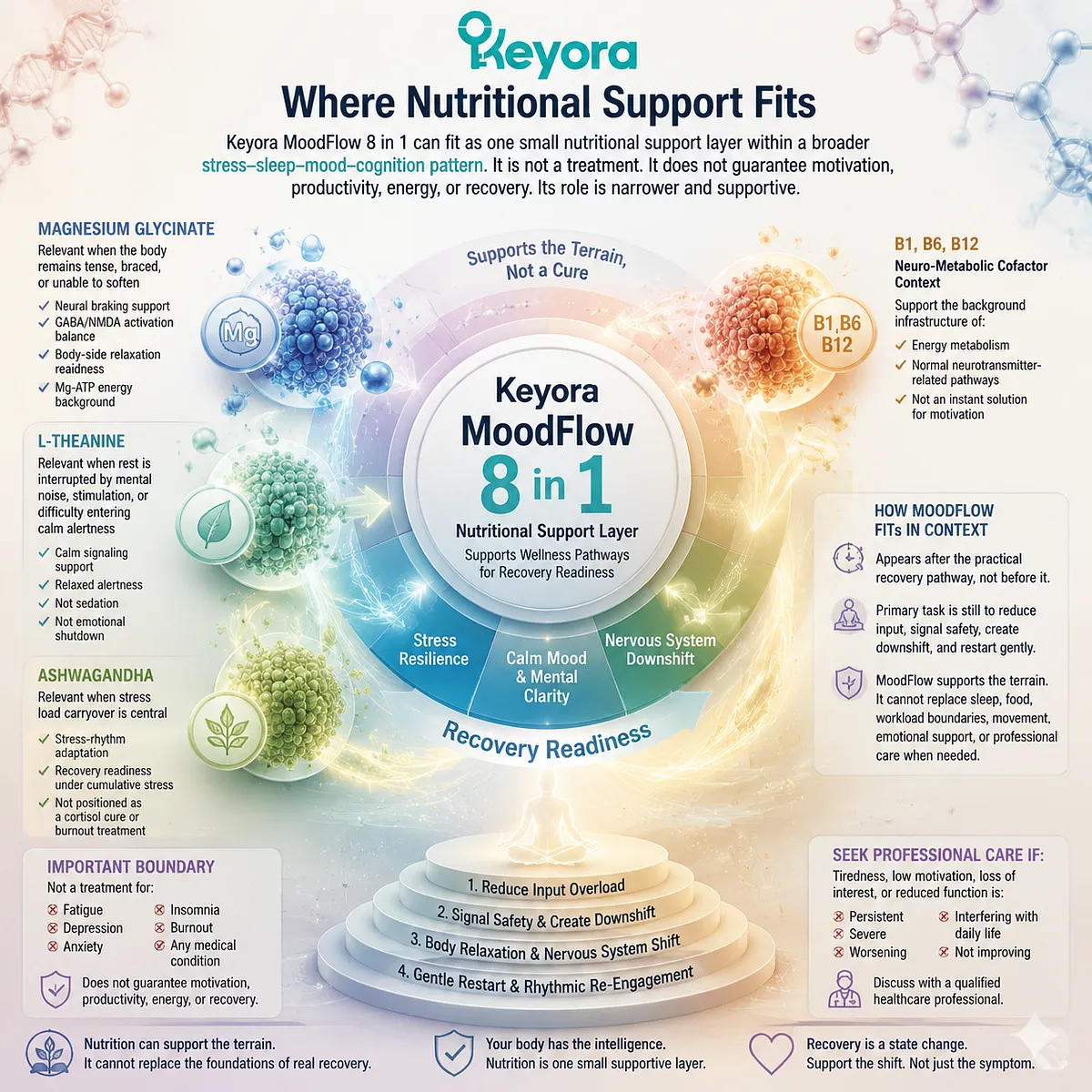
Keyora MoodFlow 8 in 1 can fit as one small nutritional support layer when tiredness and low motivation after resting appear within a broader stress-sleep-mood-cognition pattern. It should not be framed as a treatment for fatigue, depression, anxiety, insomnia, burnout, or any medical condition. It also does not guarantee motivation, productivity, energy, or recovery.
Its role is narrower: supporting wellness pathways involved in stress resilience, calm mood, nervous-system downshift, body-side relaxation readiness, and recovery readiness.
-
Magnesium glycinate may be relevant when rest does not feel restful because the body remains tense, braced, or unable to soften. In the MoodFlow framework, it supports neural braking, GABA/NMDA activation balance, body-side relaxation readiness, and Mg-ATP energy background.
-
L-Theanine may be relevant when rest is interrupted by mental noise, screen-driven stimulation, or difficulty entering calm alertness. Its role is calm signaling and relaxed alertness, not sedation or emotional shutdown.
-
Ashwagandha may fit when stress load carryover is central. It supports stress-rhythm adaptation and recovery readiness under cumulative stress pressure, without being positioned as a cortisol cure or burnout treatment.
-
B1, B6, and B12 support neuro-metabolic cofactor context. They belong to the background infrastructure of energy metabolism and normal neurotransmitter-related pathways, not an instant solution for motivation.
This is why MoodFlow appears after the practical recovery pathway, not before it. The primary task is still to reduce input, signal safety, create downshift, and restart gently.
Nutrition can support the terrain. It cannot replace sleep, food, workload boundaries, movement, emotional support, or professional care when needed.
If tiredness, low motivation, loss of interest, or reduced function is persistent, severe, worsening, or interfering with daily life, it should be discussed with a qualified healthcare professional.
Closing Summary
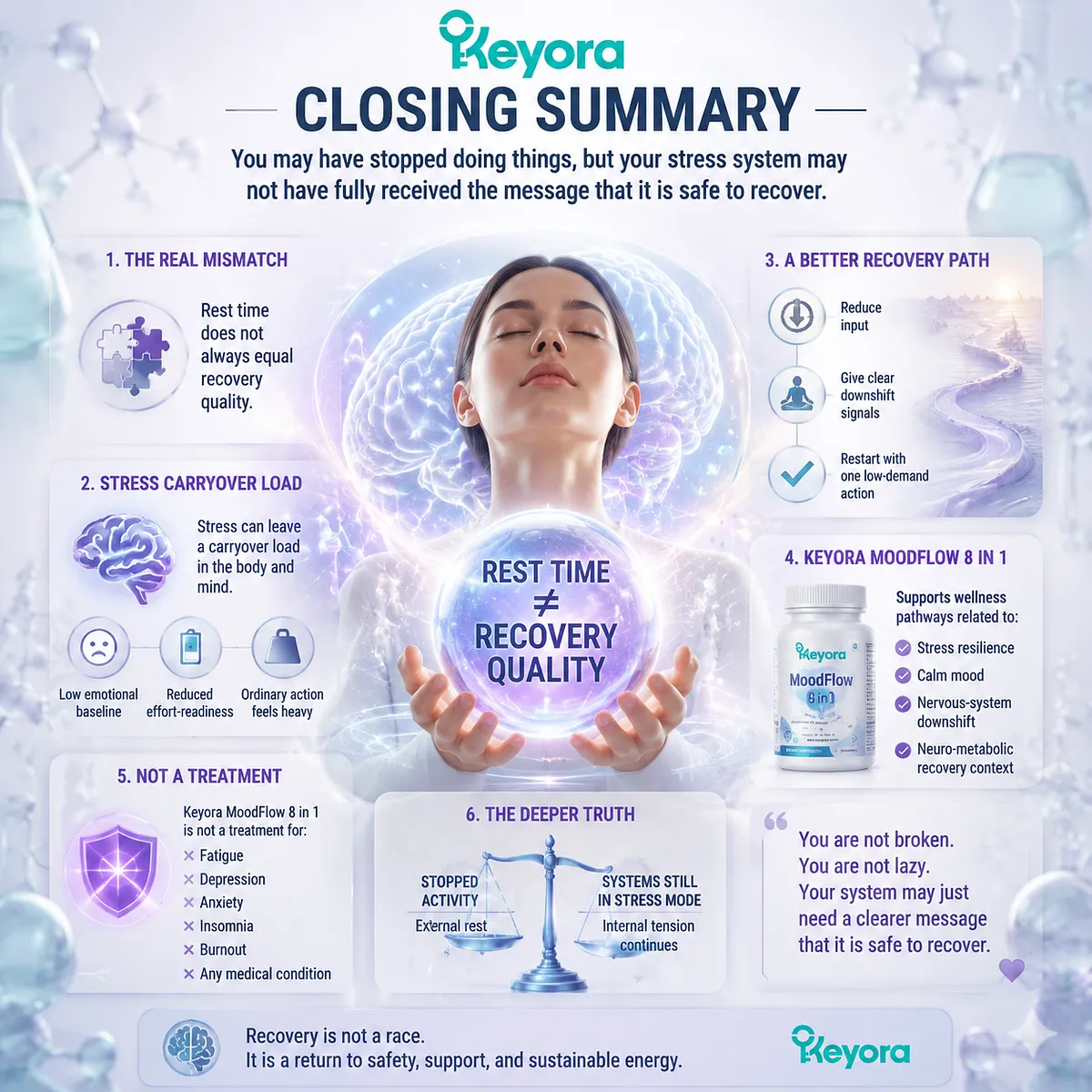
Feeling tired and unmotivated even after resting does
not mean you are broken, lazy, or incapable of recovery. It may mean your rest stopped activity without fully shifting your nervous system into recovery readiness.
The deeper mismatch is that rest time does not always equal recovery quality. Stress can leave a carryover load in the body and mind, keeping emotional baseline low, effort-readiness reduced, and ordinary action unusually heavy.
A better recovery path begins by reducing input, giving the body clear downshift signals, and restarting with one low-demand action instead of shaming yourself into performance.
Keyora MoodFlow 8 in 1 can support wellness pathways related to stress resilience, calm mood, nervous-system downshift, and neuro-metabolic recovery context. It is not a treatment for fatigue, depression, anxiety, insomnia, burnout, or any medical condition.
You may have stopped doing things, but your stress system may not have fully received the message that it is safe to recover.
This article is for educational and informational purposes only. It does not provide medical advice, diagnosis, treatment, cure, prevention, disease outcome claims, hormone restoration claims, fertility outcome claims, or formula-specific clinical efficacy claims.