
Why Do I Feel Restless in My Body When I’m Stressed?
Keyora Research Q&A Library
This is part of the Keyora Research Q&A Series, derived from Keyora Nutritional Neurology Series
Within the Keyora Nutritional Neurology framework, this Q&A translates complex nutrient–brain mechanisms into reader-friendly, evidence-bound answers, focusing on stress resilience, sleep quality, calm mood support, cognitive wellness, and the broader interaction between nutrition, neurochemistry, and daily nervous-system function.
First published by Keyora Research Journal: www.keyorahealth.com

Direct Answer
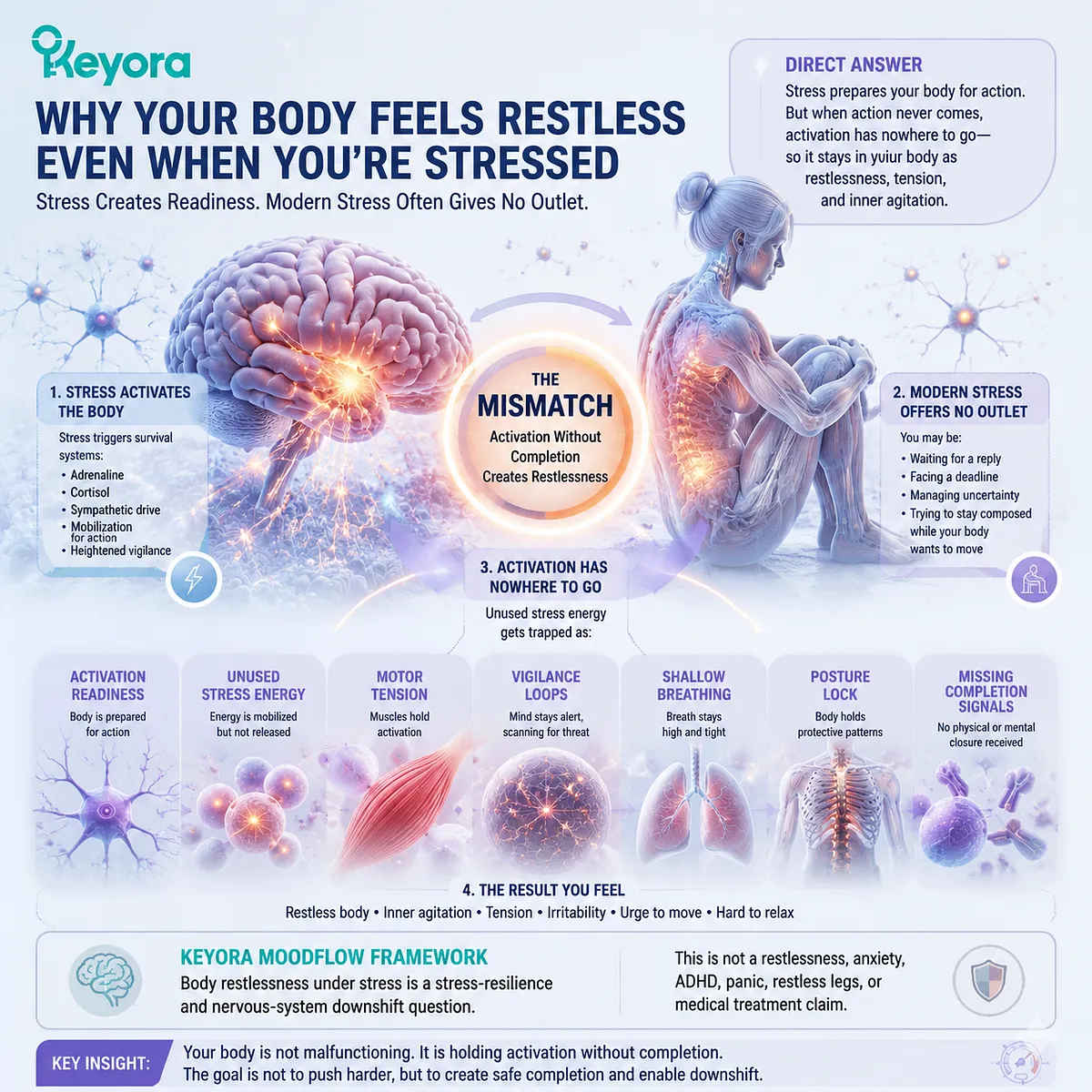
You may feel restless in your body when you are stressed because stress can prepare the body for action, even when there is no clear action to take. Your legs, hands, shoulders, breath, and posture may carry activation that has not found a safe outlet.
The mismatch is this: stress often creates readiness, but modern stress does not always give the body something physical to complete. You may be waiting for a reply, facing a deadline, managing uncertainty, or trying to stay composed while your body feels like it wants to move.
This can involve activation readiness, unused stress energy, motor tension, vigilance loops, shallow breathing, posture lock, missing completion signals, neural braking context, and body-side relaxation readiness.
In the Keyora MoodFlow framework, body restlessness under stress is understood as a stress-resilience and nervous-system downshift question, not a restlessness, anxiety, ADHD, panic, restless legs, or medical treatment claim.
Why Stress Can Make Your Body Feel Restless
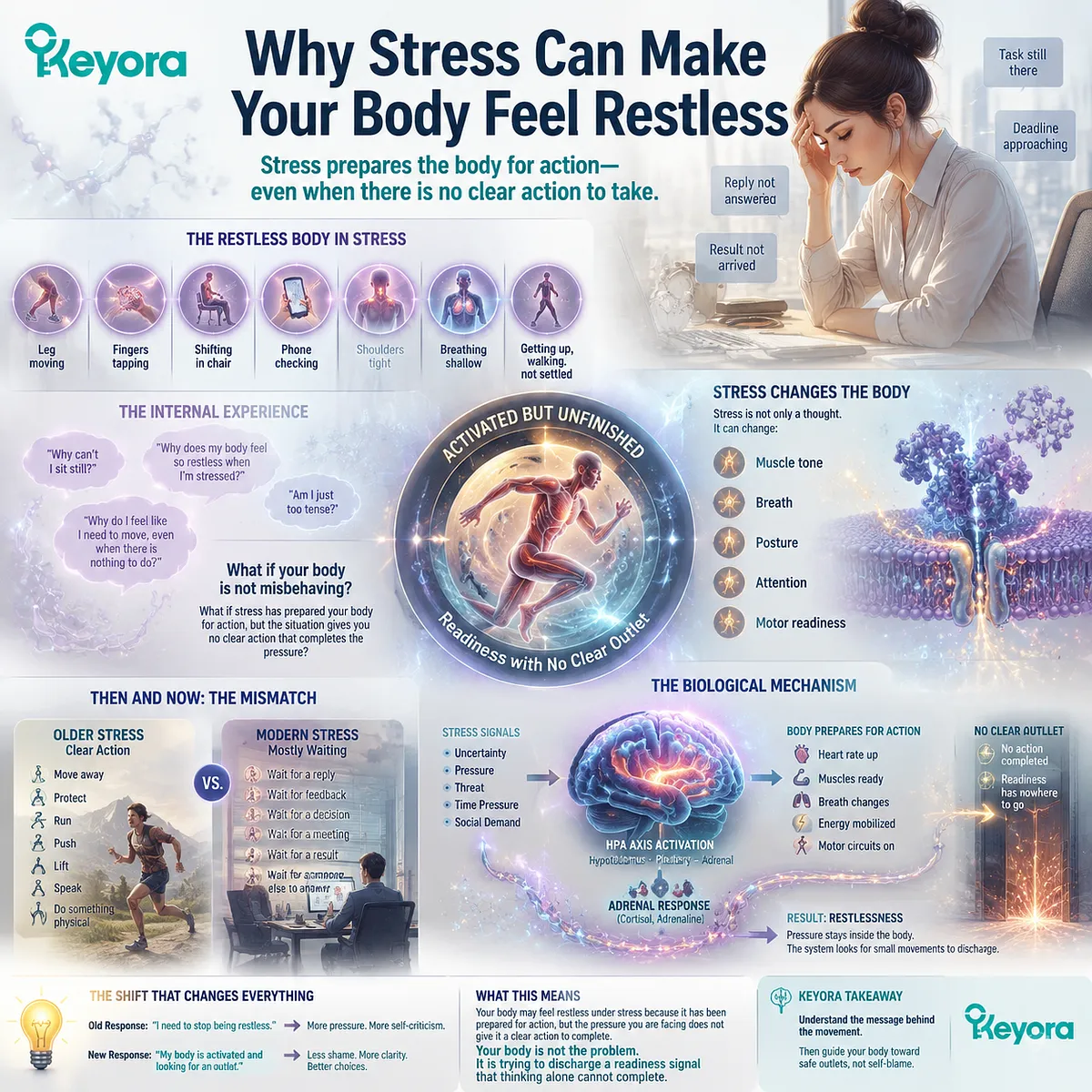
Stress can prepare the body for action even when there is no clear action to take.
You are sitting at your desk.
The task is still there. The message has not been answered. The result has not arrived. The deadline is moving closer. You tell yourself to stay calm, sit still, and just keep going.
But your body does not feel still.
Your leg starts moving.
Your fingers tap the desk.
You shift in the chair, then shift again.
You pick up your phone, check it, put it down, then pick it up again.
Your shoulders feel tight.
Your breathing feels smaller.
You stand up, walk a few steps, come back, and still feel unsettled.
It is not exactly pain. It is not exactly energy. It is not even the clear desire to exercise.
It feels more like pressure inside the body with nowhere to go.
Then the self-questioning begins.
“Why can’t I sit still?”
“Why does my body feel so restless when I’m stressed?”
“Why do I feel like I need to move, even when there is nothing to do?”
“Am I just too tense?”
But what if your body is not misbehaving?
What if stress has prepared your body for action, but the situation gives you no clear action that completes the pressure?
This is one reason body restlessness can appear during stress.
Stress is not only a thought. It can change muscle tone, breath, posture, attention, and motor readiness. The body may prepare to respond, escape, solve, defend, or act.
In older forms of stress, action may have been obvious. Move away. Protect yourself. Run. Push. Lift. Speak. Do something physical.
But modern stress often asks you to wait.
Wait for a reply.
Wait for feedback.
Wait for a decision.
Wait for a meeting.
Wait for a result.
Wait for someone else to answer.
At the same time, you may have to look calm, stay seated, continue typing, manage your tone, and keep working.
So the body becomes ready, but the readiness has no clean outlet.
That can feel like restlessness.
Your body may not be trying to annoy you. It may be trying to discharge a readiness signal that thinking alone cannot complete.
This shift matters because it changes the way you respond to yourself.
Instead of saying, “I need to stop being restless,” you can begin by saying, “My body is activated and looking for an outlet.”
That sentence reduces shame.
It also gives you a more useful map.
Your body may feel restless under stress because it has been prepared for action, but the pressure you are facing does not give it a clear action to complete.
Why Restlessness Can Continue When Pressure Has No Outlet
When stress readiness has nowhere to go, it may show up as fidgeting, pacing, tension, or a body that cannot settle.
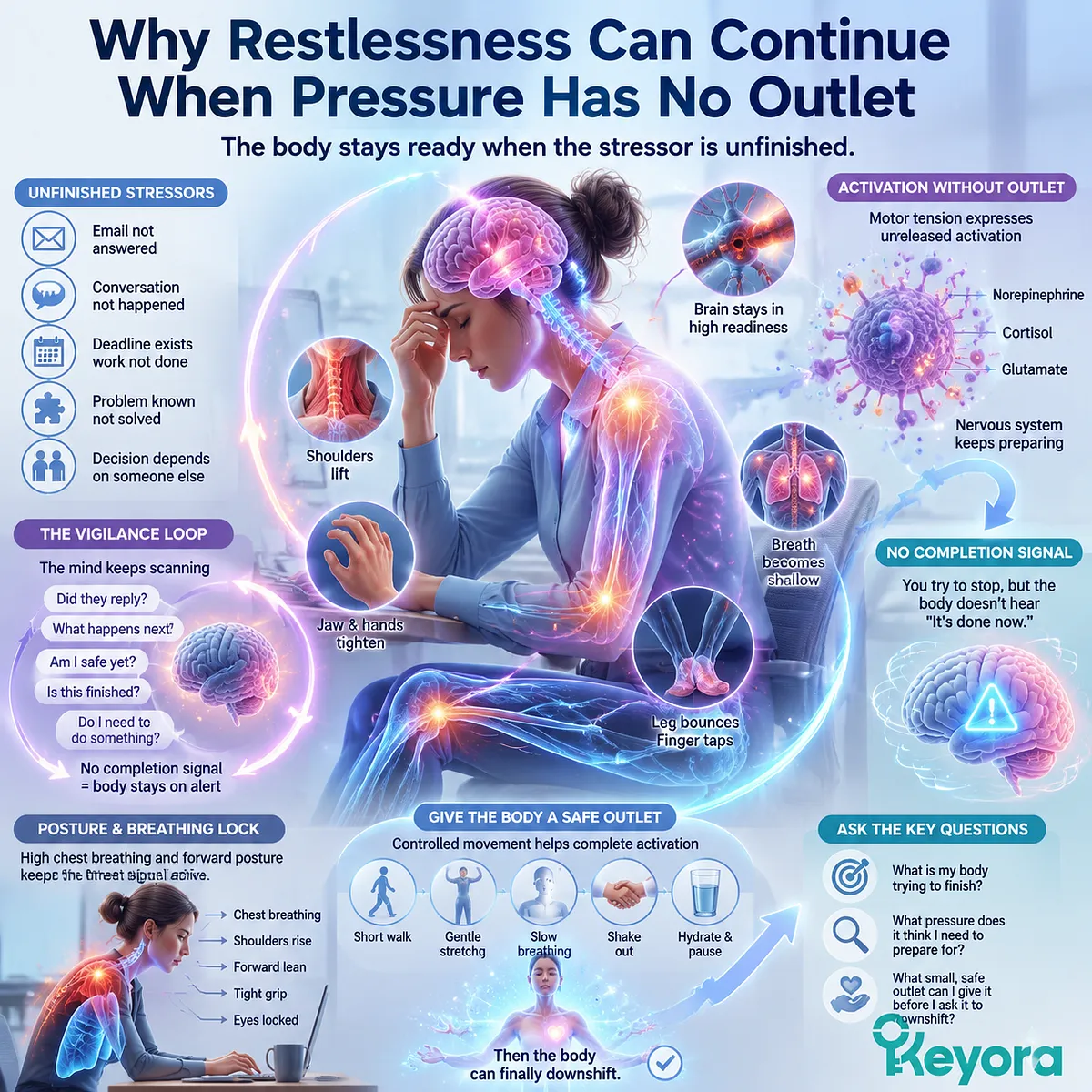
Restlessness often becomes stronger when the stressor is unfinished.
An email has been sent, but not answered.
A conversation is coming, but has not happened yet.
A deadline exists, but the work is not done.
A problem is known, but not solved.
A decision depends on someone else.
In these situations, the mind keeps scanning.
“Did they reply?”
“What happens next?”
“Am I safe yet?”
“Is this finished?”
“Do I need to do something?”
This creates a vigilance loop.
The body may stay alert because the situation does not feel complete. Even if there is nothing useful to do in that exact moment, the nervous system may keep preparing.
That preparation can show up as movement.
A bouncing leg.
A tapping finger.
A tight jaw.
A restless hand.
A need to stand up.
A repeated urge to check the phone.
A body that keeps changing position without ever feeling comfortable.
This is motor tension, not necessarily intentional movement.
The body is trying to express activation.
Another part of the pattern is shallow breathing and posture lock.
When stress rises, many people breathe higher in the chest. Their shoulders lift slightly. Their upper body leans forward. Their hands tighten around the mouse or phone. Their eyes lock onto the screen or the message thread.
This posture tells the body that the pressure is still active.
So even if you try to sit still, your internal state may not feel settled.
Forcing stillness can sometimes make the pressure worse. If the body is already activated, telling it to stop moving completely may feel like trapping the activation inside.
This does not mean every restless impulse needs to be followed.
It means the body may need a controlled outlet rather than punishment.
Restlessness can also continue because there is no completion signal.
Many stress moments do not have a clean ending. You close the laptop, but the issue remains. You send the message, but the answer is unknown. You leave the meeting, but the next step is unclear.
The body does not hear, “It is done now.”
So it keeps preparing.
That is why body restlessness under stress can feel so irrational. You may understand logically that pacing, refreshing your inbox, or changing positions will not solve the problem. But your body may still be searching for a movement that makes the pressure feel complete.
The key is not to judge the restlessness as weakness.
The key is to ask:
“What is my body trying to finish?”
“What pressure does it think I need to prepare for?”
“What small, safe outlet can I give it before I ask it to downshift?”
How to Give Restlessness a Safer Exit
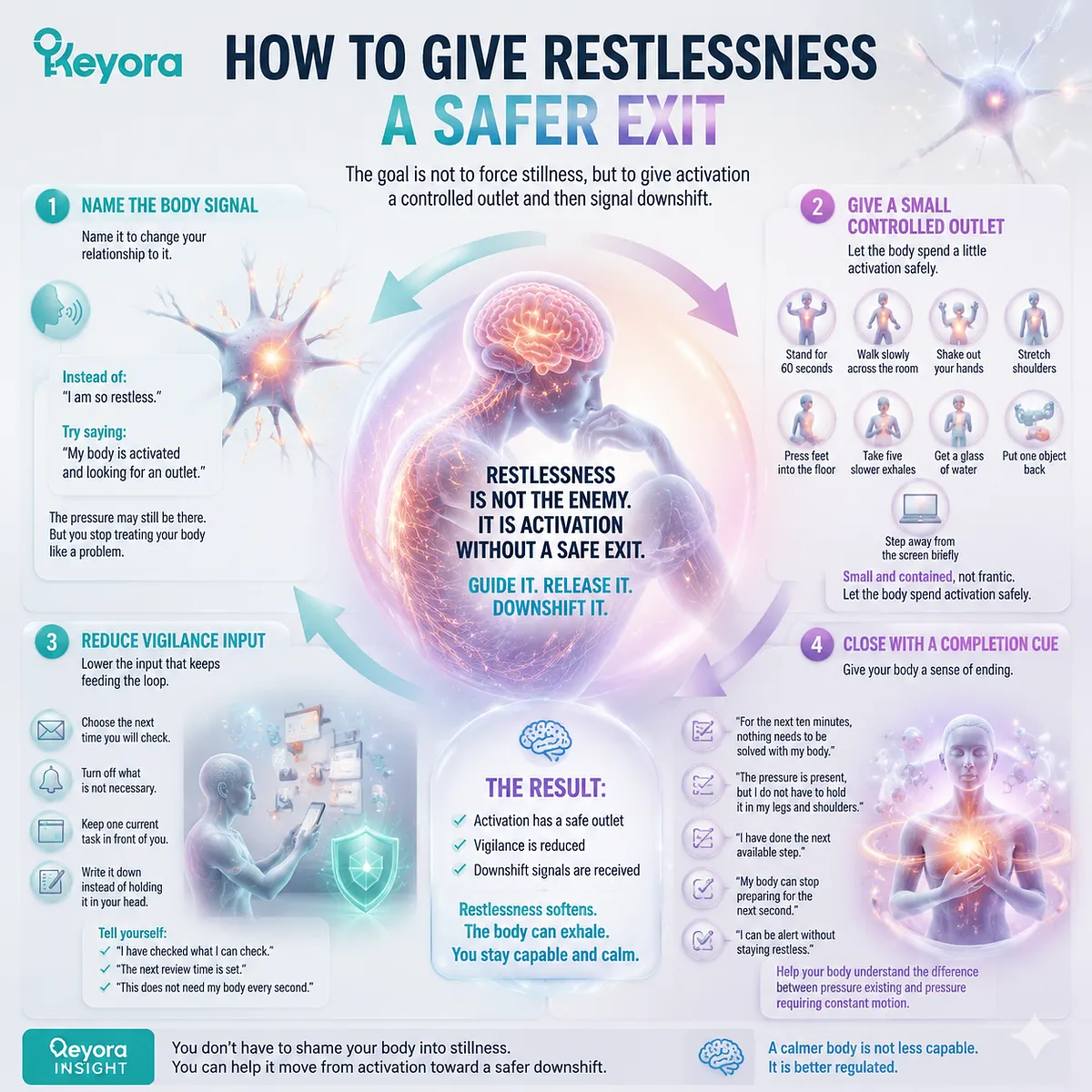
The goal is not to force stillness, but to give activation a controlled outlet and then signal downshift.
When your body feels restless under stress, the first step is to name the body signal.
Instead of saying, “I am so restless,” try saying, “My body is activated and looking for an outlet.”
This does not make the pressure disappear. But it changes your relationship to it.
You are no longer treating the body as a problem. You are recognizing that it may be carrying stress energy without a clear place to go.
The second step is to give the body a small controlled outlet.
Do not force yourself into perfect stillness immediately.
Stand up for 60 seconds.
Walk slowly across the room.
Shake out your hands.
Let your arms hang.
Stretch the shoulders gently.
Press your feet into the floor.
Take five slower exhales.
Get a glass of water.
Put one object back where it belongs.
Step away from the screen briefly.
The outlet should be small and contained. The goal is not frantic movement. The goal is to let the body spend a little activation safely.
After that, give the body a downshift cue.
Let the shoulders drop one level.
Unclench the jaw.
Let the hands soften.
Look away from the screen.
Let the exhale be slightly longer.
Feel the chair, floor, or wall supporting you.
This combination matters.
The body may need both an outlet and a signal that the pressure does not require constant motion.
The third step is to reduce vigilance input.
If restlessness is tied to waiting, checking, or scanning, repeated input can keep feeding the loop.
Instead of refreshing messages every minute, choose the next time you will check.
Instead of keeping every notification open, turn off what is not necessary.
Instead of leaving five windows visible, keep one current task in front of you.
Instead of holding the unfinished issue only in your head, write it down.
You can tell yourself:
“I have checked what I can check.”
“The next review time is set.”
“This does not need my body every second.”
That kind of boundary helps the nervous system stop treating every moment as a possible emergency.
The fourth step is to close with a completion cue.
Restlessness often needs a small ending.
Try saying:
“For the next ten minutes, nothing needs to be solved with my body.”
“The pressure is present, but I do not have to hold it in my legs and shoulders.”
“I have done the next available step.”
“My body can stop preparing for the next second.”
“I can be alert without staying restless.”
These cues may sound simple, but they can help the body understand the difference between pressure existing and pressure requiring constant motion.
You do not have to shame your body into stillness.
You can help it move from activation toward a safer downshift.
Where Nutritional Support Fits
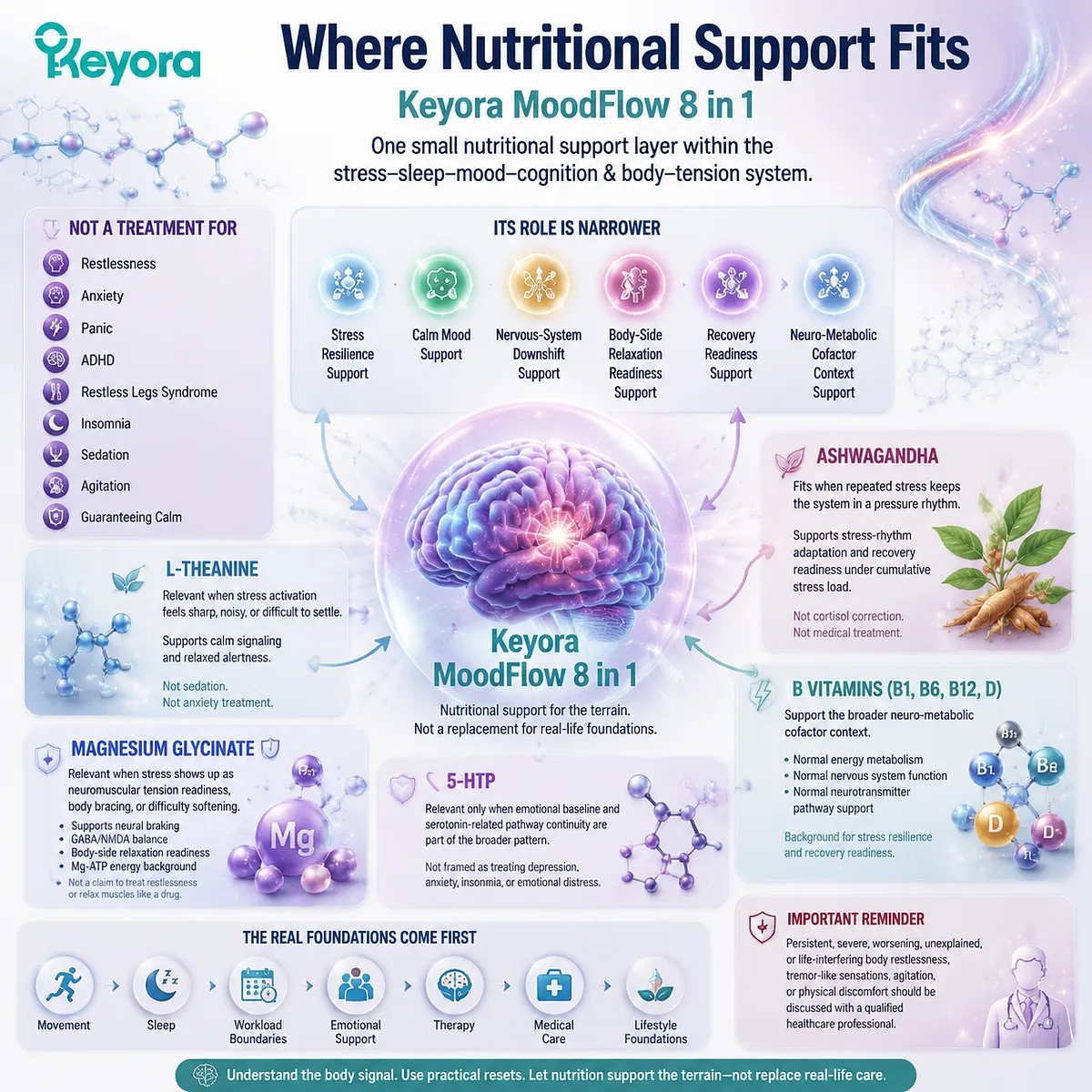
Keyora MoodFlow 8 in 1 can fit as one small nutritional support layer when body restlessness appears within a broader stress-sleep-mood-cognition and body-tension pattern. It should not be framed as treating restlessness, treating anxiety, treating panic, treating ADHD, treating restless legs syndrome, treating insomnia, sedating the body, stopping agitation, or guaranteeing calm.
Its role is narrower: supporting wellness pathways involved in stress resilience, calm mood, nervous-system downshift, body-side relaxation readiness, recovery readiness, and neuro-metabolic cofactor context.
-
L-Theanine may be relevant when stress activation feels sharp, noisy, or difficult to settle. In the MoodFlow framework, it supports calm signaling and relaxed alertness without being framed as sedation or anxiety treatment.
-
Magnesium glycinate may be relevant when stress shows up as neuromuscular tension readiness, body bracing, or difficulty softening after activation. It supports neural braking, GABA/NMDA activation balance, body-side relaxation readiness, and Mg-ATP energy background. This is not a claim that it treats restlessness or relaxes muscles like a drug.
-
Ashwagandha may fit when repeated stress keeps the system in a pressure rhythm. Its role is stress-rhythm adaptation and recovery readiness under cumulative stress load, not cortisol correction or medical treatment.
-
B vitamins may support the broader neuro-metabolic cofactor context, including normal energy metabolism and normal neurotransmitter-related pathway support. This belongs to the background of stress resilience and recovery readiness, not a treatment for fatigue or agitation.
-
5-HTP may be relevant only when emotional baseline and serotonin-related pathway continuity are part of the broader pattern. It should not be framed as treating depression, anxiety, insomnia, or emotional distress.
MoodFlow belongs after the reader understands the body signal and practical reset method. Nutrition can support the terrain. It cannot replace movement, sleep, workload boundaries, emotional support, therapy, medical care, or lifestyle foundations.
Persistent, severe, worsening, unexplained, or life-interfering body restlessness, tremor-like sensations, agitation, or physical discomfort should be discussed with a qualified healthcare professional.
Closing Summary
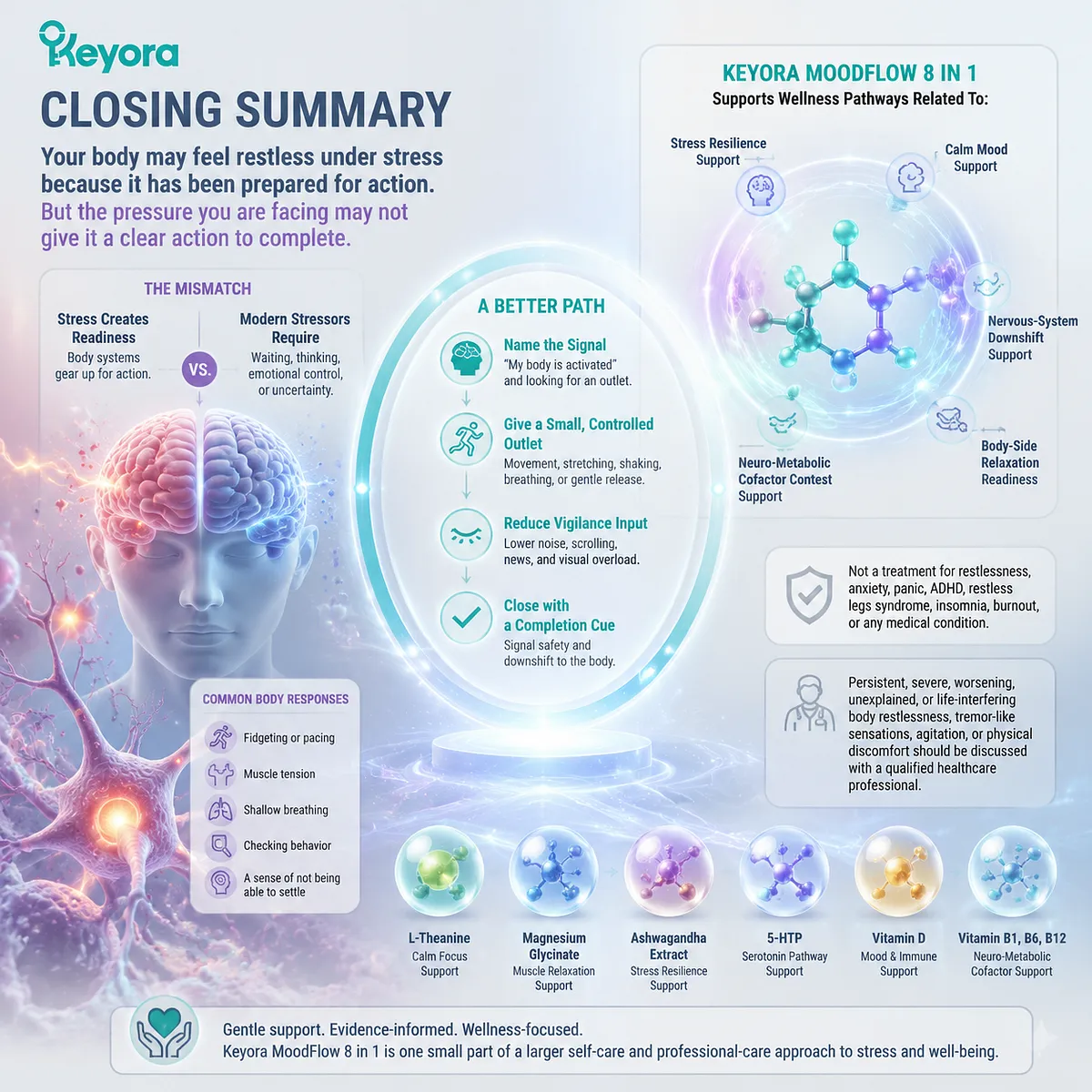
Feeling restless in your body when stressed does not automatically mean you lack self-control or cannot sit still. It may mean your body has been prepared for action while the pressure you are facing offers no clear action to complete.
The deeper mismatch is that stress creates readiness, but many modern stressors require waiting, thinking, emotional control, or uncertainty. The body may respond with fidgeting, pacing, muscle tension, shallow breathing, checking behavior, or a sense that it cannot settle.
A better path begins by naming the signal, giving the body a small controlled outlet, reducing vigilance input, and closing with a completion cue.
Keyora MoodFlow 8 in 1 can support wellness pathways related to stress resilience, calm mood, nervous-system downshift, body-side relaxation readiness, recovery readiness, and neuro-metabolic cofactor context. It is not a treatment for restlessness, anxiety, panic, ADHD, restless legs syndrome, insomnia, burnout, or any medical condition.
Persistent, severe, worsening, unexplained, or life-interfering body restlessness, tremor-like sensations, agitation, or physical discomfort should be discussed with a qualified healthcare professional.
Your body may feel restless under stress because it has been prepared for action.
But the pressure you are facing may not give it a clear action to complete.
This article is for educational and informational purposes only. It does not provide medical advice, diagnosis, treatment, cure, prevention, disease outcome claims, hormone restoration claims, fertility outcome claims, or formula-specific clinical efficacy claims.