
Why Do I Feel Pressure to Reply Even When I Need Recovery Time?
Keyora Research Q&A Library
This is part of the Keyora Research Q&A Series, derived from Keyora Nutritional Neurology Series .
Within the Keyora Nutritional Neurology framework, this Q&A translates complex nutrient–brain mechanisms into reader-friendly, evidence-bound answers, focusing on stress resilience, sleep quality, calm mood support, cognitive wellness, and the broader interaction between nutrition, neurochemistry, and daily nervous-system function.
First published by Keyora Research Journal: www.keyorahealth.com

Direct Answer
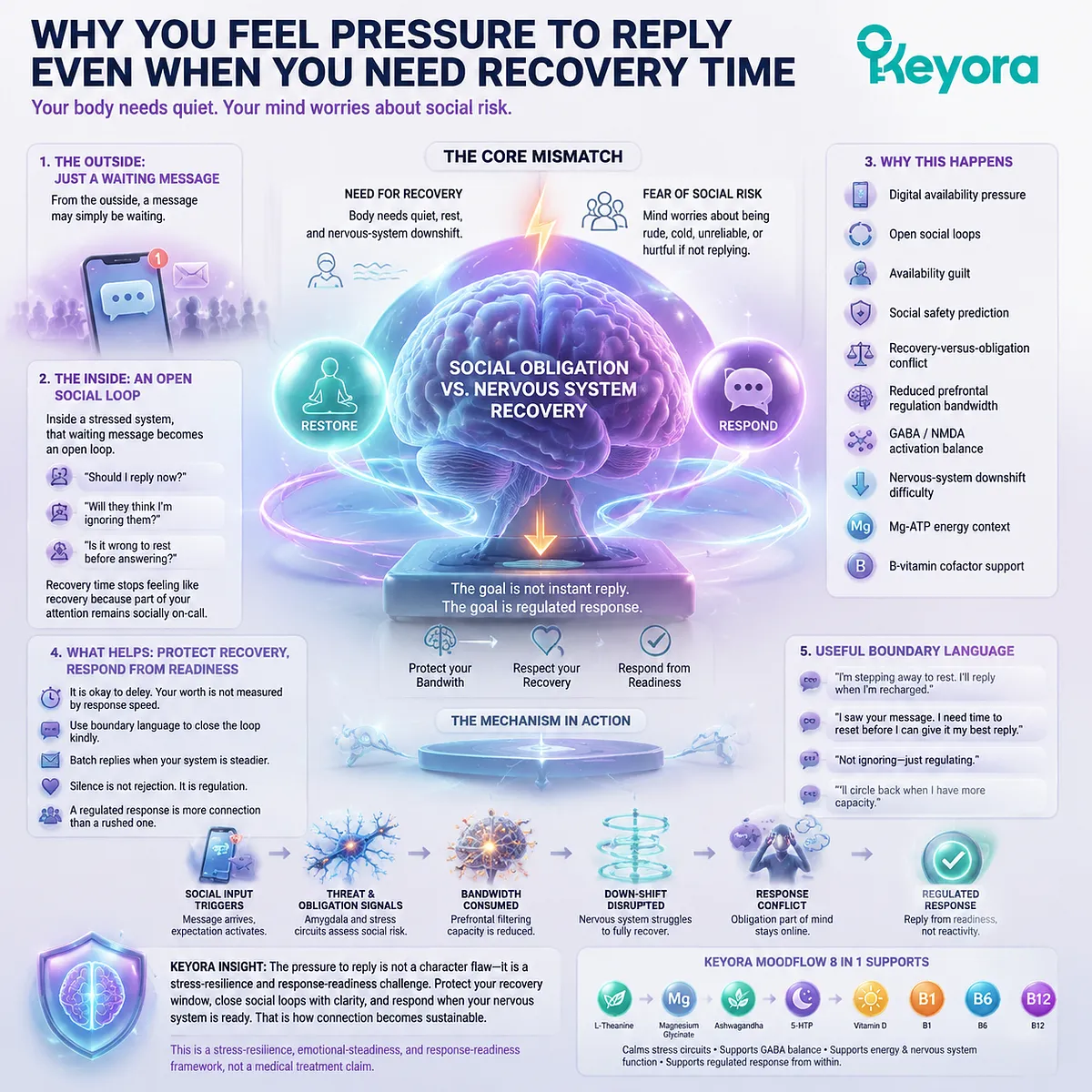
You may feel pressure to reply even when you need recovery time because silence can feel socially risky. Your body may need quiet, rest, and nervous-system downshift, but your mind may still worry that not replying will seem rude, cold, unreliable, or hurtful.
The mismatch is this: from the outside, a message may simply be waiting. But inside a stressed system, that waiting message can become an open social loop.
You may keep thinking, “Should I reply now?”
“Will they think I’m ignoring them?”
“Is it wrong to rest before answering?”
Recovery time stops feeling like recovery because part of your attention remains socially on-call.
This does not mean you are irresponsible or uncaring. It may mean you have learned to treat delayed response as social risk.
Mechanistically, this can involve digital availability pressure, open social loops, availability guilt, social safety prediction, recovery-versus-obligation conflict, reduced prefrontal regulation bandwidth, GABA/NMDA activation balance, nervous-system downshift difficulty, Mg-ATP energy context, and B-vitamin cofactor support.
In the Keyora MoodFlow framework, this is understood as a stress-resilience, emotional-steadiness, and response-readiness question, not a medical treatment claim.
When Rest Does Not Feel Like Rest Because a Message Is Waiting
Reply pressure can turn recovery time into another social task.
You may finally have a quiet moment.
Maybe the day has been full of conversations, decisions, tasks, noise, and people needing things from you. Maybe you have been holding your tone steady, answering questions, managing work, keeping up with messages, or simply trying to stay functional.
Then you get a small opening.
You want to lie down. You want to stop talking. You want to eat without explaining anything. You want to let your brain go quiet. You want to recover before you interact again.
Then your phone lights up.
It may not be urgent. The other person may not be demanding. They may not have done anything wrong. It may be a normal message from someone you like, respect, or care about.
Still, your body does not fully rest anymore.
A part of your mind attaches itself to the message.
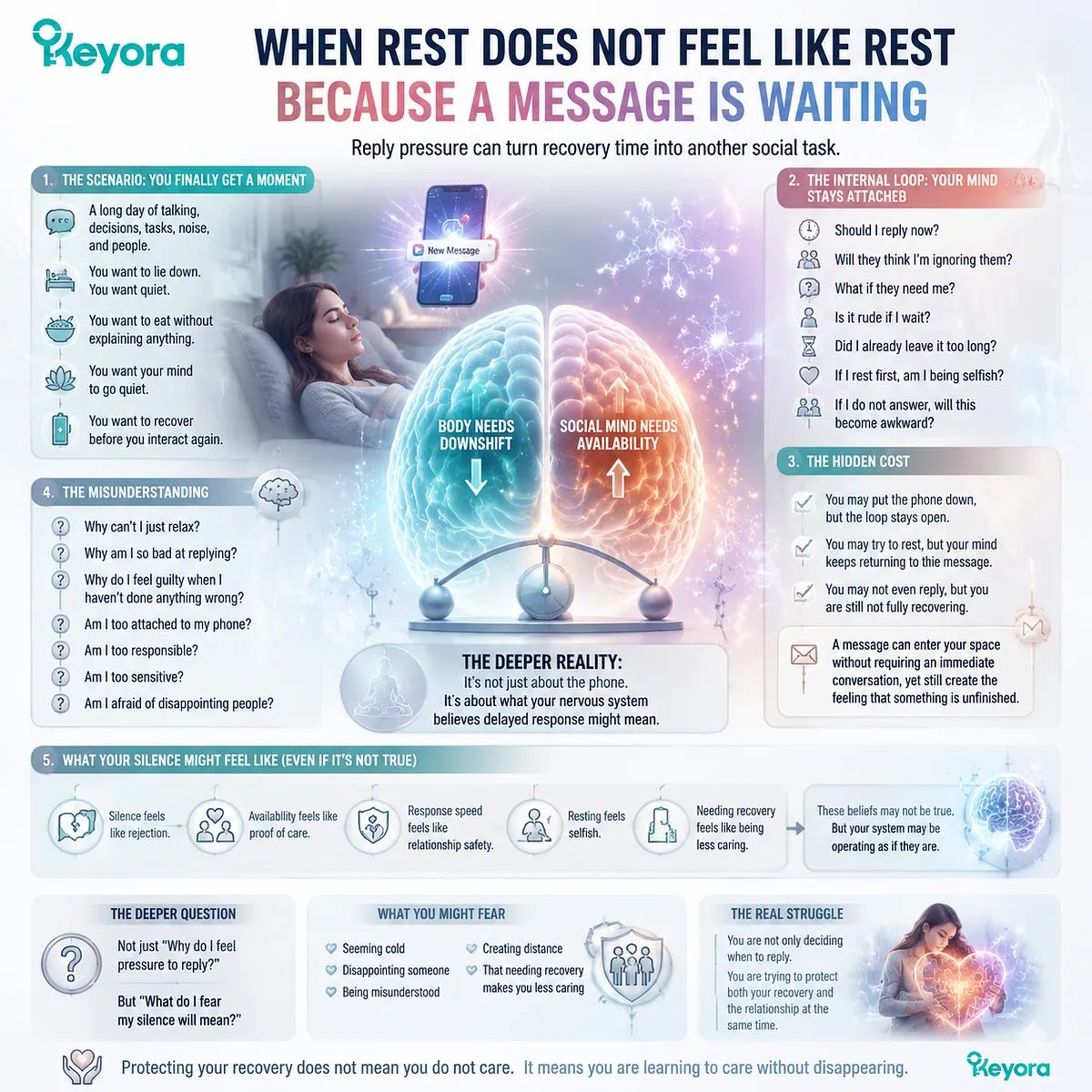
Should I reply now?
Will they think I am ignoring them?
What if they need me?
Is it rude if I wait?
Did I already leave it too long?
If I rest first, am I being selfish?
If I do not answer, will this become awkward?
This is how recovery time turns into another social task.
You may put the phone down, but the loop stays open. You may try to rest, but your mind keeps returning to the message. You may tell yourself you will reply later, but guilt keeps asking whether later is allowed.
This is exhausting because the body is asking for downshift while the social mind is asking for availability.
You may not even reply. But you are still not fully recovering.
That is one of the hidden costs of digital communication. A message can enter your space without requiring an immediate conversation, yet still create the feeling that something is unfinished.
You may begin to feel that silence itself needs an explanation.
Not answering becomes a signal. Waiting becomes a risk. Resting becomes something you have to justify.
This is where many people misunderstand themselves.
They may think, “Why can’t I just relax?” or “Why am I so bad at replying?” or “Why do I feel guilty when I haven’t done anything wrong?” Some may tell themselves they are too attached to their phone, too responsible, too sensitive, or too afraid of disappointing people.
But the deeper issue may not be the phone alone.
It may be the meaning your nervous system gives to delayed response.
If silence feels like rejection, then not replying feels dangerous.
If availability feels like proof of care, then resting feels selfish.
If response speed feels like relationship safety, then recovery becomes difficult to protect.
This does not mean those beliefs are true. It means your system may be operating as if they are.
The deeper question is not only, “Why do I feel pressure to reply?”
A more honest question is, “What do I fear my silence will mean?”
That question can reveal the real burden.
Maybe you fear seeming cold.
Maybe you fear disappointing someone.
Maybe you fear being misunderstood.
Maybe you fear creating distance.
Maybe you fear that needing recovery makes you less caring.
Once you see that, the pressure becomes less mysterious.
You are not only deciding when to reply.
You are trying to protect both your recovery and the relationship at the same time.
Why Reply Pressure Interrupts Recovery
A message can keep your nervous system on-call when silence feels like something you need to explain.
Reply pressure interrupts recovery because modern messaging has blurred the boundary between access and obligation.
A person can reach you at any time. A message can arrive while you are eating, resting, working, walking, recovering, or trying to sleep. Because the message is small, it can seem as if the response should be small too.
But the nervous system may not experience it that way.
A message can carry expectation. It can carry relationship meaning. It can carry timing pressure. It can carry the possibility that someone is waiting, wondering, or needing reassurance.
This is digital availability pressure.
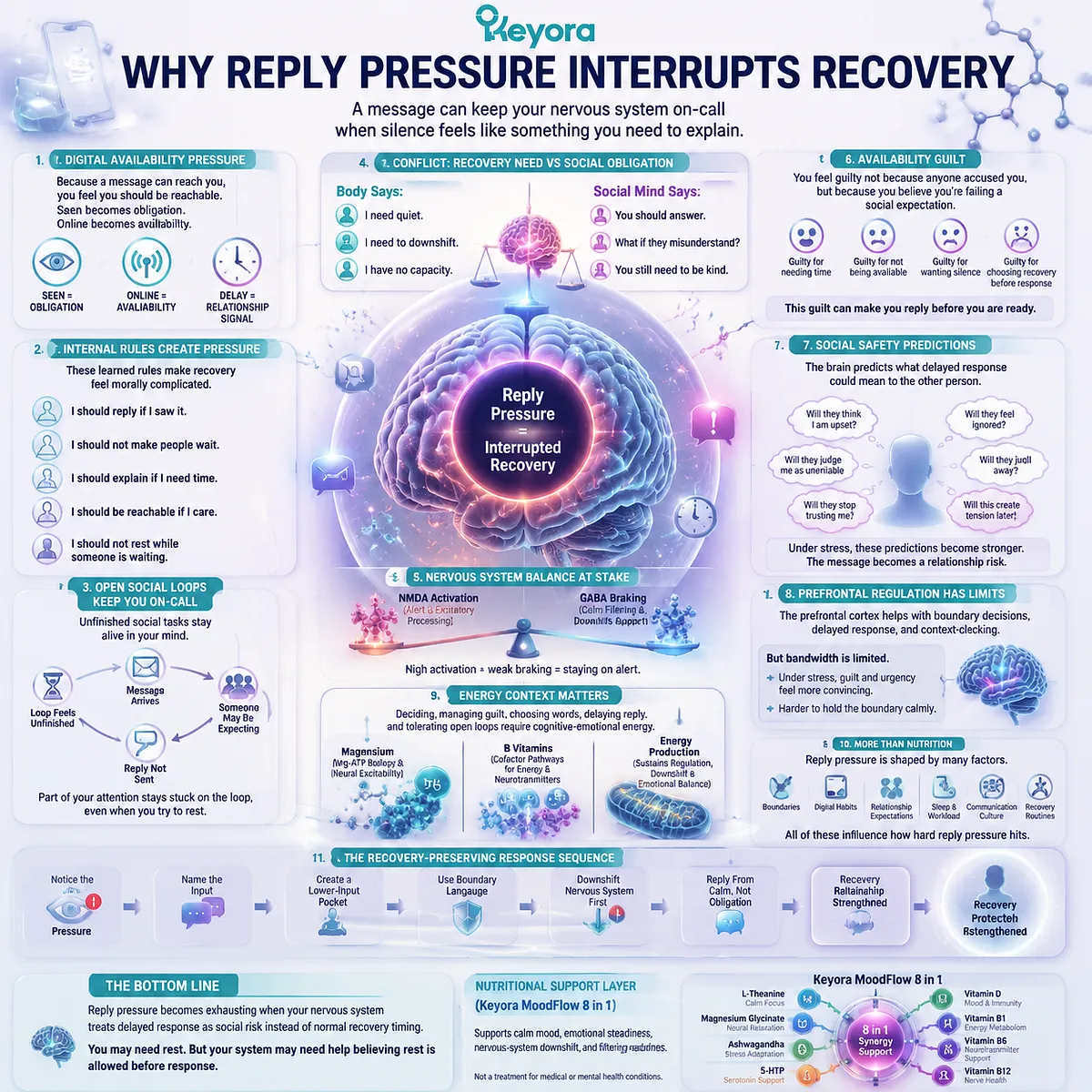
Digital availability pressure is the hidden belief that because a message can reach you quickly, you should be able to respond quickly. Seen becomes obligation. Online becomes availability. Delay becomes a relationship signal. Silence becomes something to manage.
The pressure may not even come from the other person.
Sometimes it comes from inside your own learned rules.
“I should reply if I saw it.”
“I should not make people wait.”
“I should explain if I need time.”
“I should be reachable if I care.”
“I should not rest while someone is waiting.”
These rules can make recovery feel morally complicated.
Open social loops make the pressure stronger.
An open social loop is the feeling that a social task has been started but not completed.
A message is waiting.
A reply has not been sent.
A person may be expecting something.
Your brain marks the loop as unfinished.
Even when you put the phone away, part of your attention may stay with the unfinished social task.
That is why you may feel restless during rest.
The body is trying to recover, but the mind keeps tracking the unresolved reply.
Availability guilt adds another layer.
You may feel guilty not because anyone accused you, but because you believe you are failing a social expectation. You may feel guilty for needing time. Guilty for not being available. Guilty for wanting silence. Guilty for choosing recovery before response.
This guilt can make you reply before you are ready.
Then the reply may be flat, rushed, vague, or emotionally unavailable. Or it may open a longer conversation when your body needed quiet. In that way, replying too soon can protect you from guilt while still costing you recovery.
Social safety prediction also matters.
The brain may predict what delayed response could mean to the other person.
-
Will they feel ignored?
-
Will they think I am upset?
-
Will they pull away?
-
Will they judge me as unreliable?
-
Will they stop trusting me?
-
Will this create tension later?
Under stress, these predictions can become stronger.
The message becomes less like a message and more like a relationship risk.
This creates a conflict between recovery need and social obligation.
The body says: I need quiet.
The social mind says: You should answer.
The body says: I need to downshift.
The social mind says: What if they misunderstand?
The body says: I have no capacity.
The social mind says: You still need to be kind.
This conflict can keep the nervous system activated even when you are technically resting.
The prefrontal cortex helps with boundary decisions, delayed gratification, context-checking, and response planning. It helps you say, “This is not urgent,” or “I can reply after I recover,” or “A delayed reply is not rejection.”
But prefrontal regulation bandwidth is limited.
When stress is high, guilt and urgency may feel more convincing. It becomes harder to hold the boundary calmly. You may know you need rest, but still feel pulled to respond.
GABA/NMDA balance can help explain the body-side tension. The nervous system needs activation to notice messages and respond appropriately, but it also needs braking and filtering so that every social signal does not become urgent.
NMDA-related activity can be understood as part of alert and excitatory processing. GABA-related tone helps support calm filtering and nervous-system downshift.
When activation is high and braking feels limited, a waiting message can keep the body on alert.
Energy context also matters. Deciding whether to reply, managing guilt, choosing words, delaying response, and tolerating an open loop require cognitive-emotional energy.
Magnesium participates in Mg-ATP biology and neural excitability context.
B vitamins support cofactor pathways involved in energy metabolism and neurotransmitter-related processes.
This does not mean reply pressure is only nutritional. Boundaries, digital habits, relationship expectations, sleep, workload, communication culture, and recovery routines all matter.
But it does mean the pressure is real.
Reply pressure becomes exhausting when your nervous system treats delayed response as social risk instead of normal recovery timing.
You may need rest.
But your system may need help believing rest is allowed before response.
What Helps When You Feel Pressure to Reply Before You Have Recovered
The goal is not to disappear or over-explain, but to protect recovery while keeping connection clear.
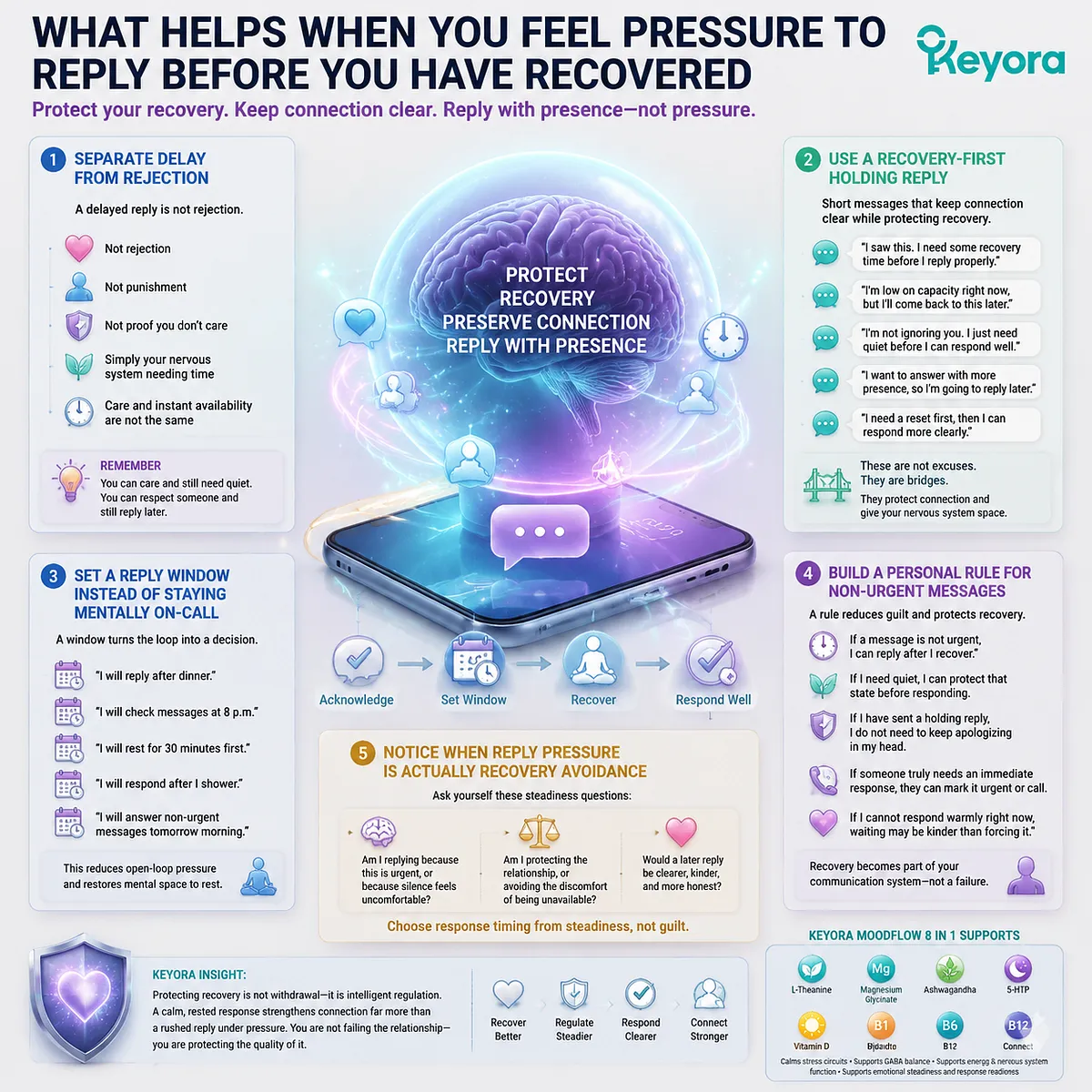
When you feel pressure to reply before you have recovered, the first step is to separate delay from rejection.
A delayed reply is not rejection.
A delayed reply is not punishment.
A delayed reply is not proof that you do not care.
A delayed reply can simply mean your nervous system needs time before it can respond with presence.
This distinction matters because many people treat immediate reply as the only safe way to protect connection. But sometimes immediate reply does not protect the connection well. It may create a rushed answer, a flat tone, an unclear boundary, or a conversation you were not ready to hold.
Care and instant availability are not the same thing.
You can care and still need quiet.
You can respect someone and still reply later.
You can protect a relationship without giving every message immediate access to your recovery time.
The second step is to use a recovery-first holding reply.
A holding reply is a short message that keeps connection clear without forcing you to complete the whole response immediately. It lowers the social risk while protecting the recovery window.
Useful holding replies include:
“I saw this. I need some recovery time before I reply properly.”
“I’m low on capacity right now, but I’ll come back to this later.”
“I’m not ignoring you. I just need quiet before I can respond well.”
“I want to answer with more presence, so I’m going to reply later.”
“I need a reset first, then I can respond more clearly.”
These sentences are not excuses.
They are bridges.
They tell the other person that the delay is about capacity, not rejection. They also tell your nervous system that the loop has been acknowledged, so it may not need to keep holding the message as an unfinished threat.
The third step is to set a reply window instead of staying mentally on-call.
Many people do not rest because they keep asking, “Should I reply now?” again and again. That question becomes a loop.
A reply window turns the question into a decision.
For example:
“I will reply after dinner.”
“I will check messages at 8 p.m.”
“I will rest for 30 minutes first.”
“I will respond after I shower.”
“I will answer non-urgent messages tomorrow morning.”
This reduces open-loop pressure because your brain no longer has to renegotiate the decision every few minutes.
The fourth step is to build a personal rule for non-urgent messages.
A personal rule protects you from having to start from zero every time.
For example:
If a message is not urgent, I can reply after I recover.
If I need quiet, I can protect that state before responding.
If I have sent a holding reply, I do not need to keep apologizing in my head.
If someone truly needs an immediate response, they can mark it urgent or call.
If I cannot respond warmly right now, waiting may be kinder than forcing it.
These rules reduce guilt because they make recovery part of your communication system, not a failure of it.
The fifth step is to notice when reply pressure is actually recovery avoidance.
Sometimes the pressure to reply feels productive because it gives you something to do. But it may also keep you from entering the quiet state your body needs.
If you are exhausted and still checking messages, ask:
“Am I replying because this is urgent, or because silence feels uncomfortable?”
“Am I protecting the relationship, or avoiding the discomfort of being unavailable?”
“Would a later reply be clearer, kinder, and more honest?”
These questions help you choose response timing from steadiness, not guilt.
Where Nutritional Support Fits
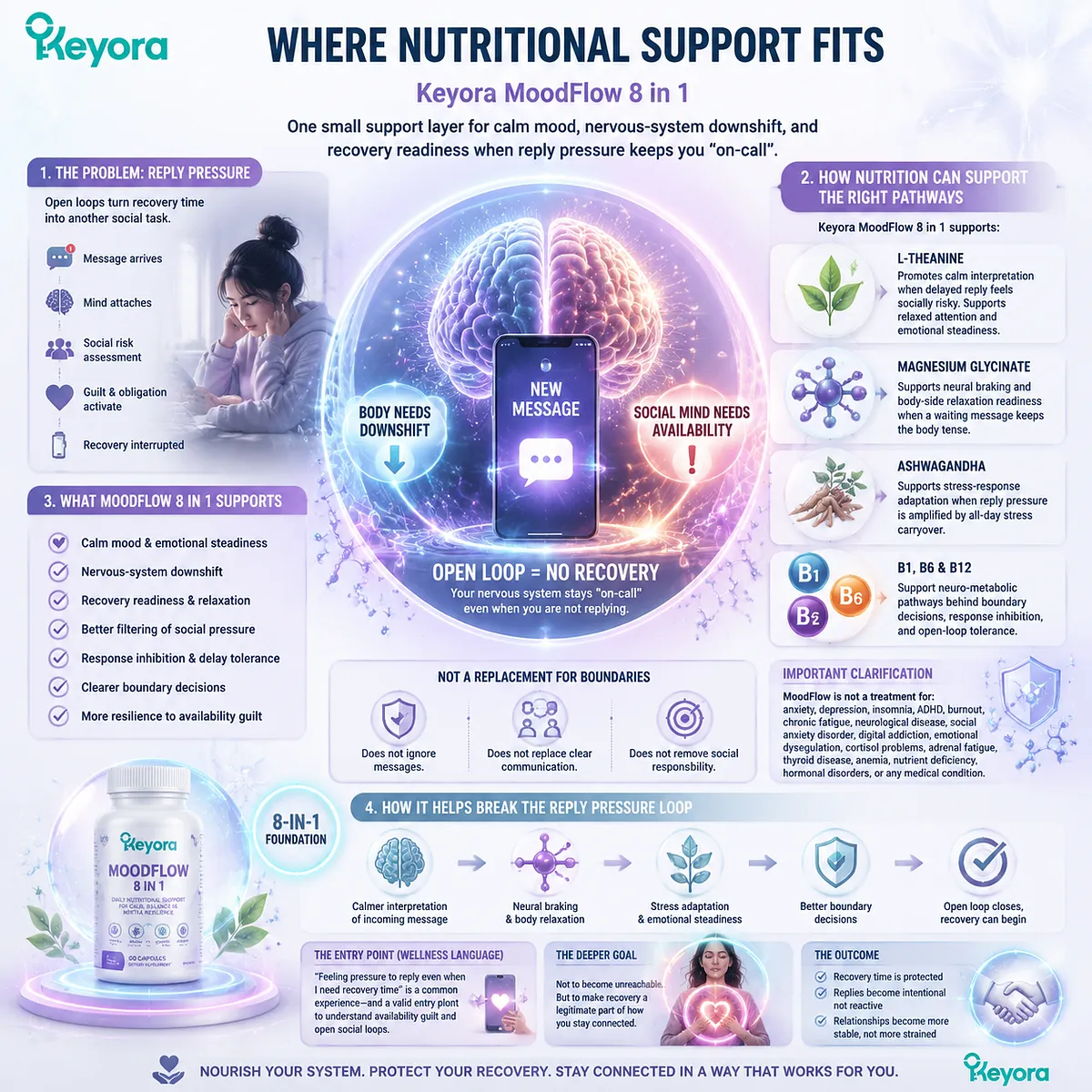
Keyora MoodFlow 8 in 1 can fit as one small support layer when reply pressure interrupts recovery as part of a broader stress-sleep-mood-cognition pattern. It should not be understood as something that makes someone ignore messages, removes social responsibility, or replaces clear communication boundaries.
Its role is narrower: supporting nutritional pathways involved in calm mood, emotional steadiness, nervous-system downshift, and response readiness when digital availability pressure keeps the system on-call.
For this topic, the most relevant layers are L-Theanine for calm interpretation when delayed reply feels socially risky, magnesium glycinate for neural braking and body-side relaxation readiness when a waiting message keeps the body tense, Ashwagandha for stress-response adaptation when reply pressure is amplified by all-day stress carryover, and B1, B6, and B12 for neuro-metabolic support behind boundary decisions, response inhibition, and open-loop tolerance.
MoodFlow is not a treatment for anxiety, depression, insomnia, ADHD, burnout, chronic fatigue, neurological disease, social anxiety disorder, digital addiction, emotional dysregulation, cortisol problems, adrenal fatigue, thyroid disease, anemia, nutrient deficiency, hormonal disorders, or any medical condition. In this article, Keyora uses “feeling pressure to reply even when I need recovery time” as a wellness-language entry point for explaining availability guilt, open social loops, digital boundaries, and recovery readiness.
The deeper goal is not to become unreachable.
It is to make recovery a legitimate part of how you stay connected.
Closing Summary
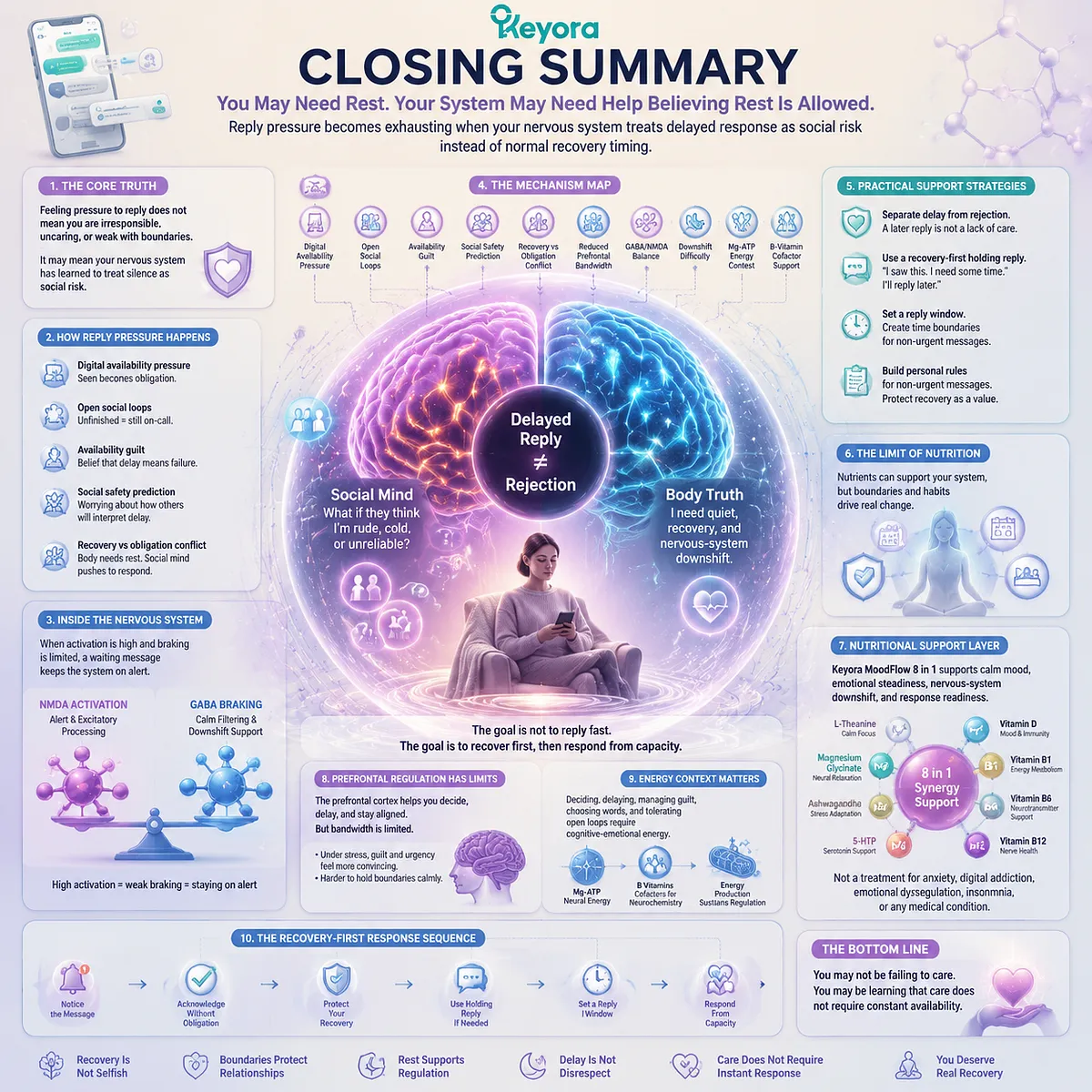
Feeling pressure to reply even when you need recovery time does not mean you are irresponsible, uncaring, or weak with boundaries. It may mean your nervous system has learned to treat silence as social risk.
A waiting message can become an open social loop. Even when you are trying to rest, part of your mind may remain on-call, wondering whether delay will look rude, cold, unreliable, or hurtful.
Mechanistically, this can involve digital availability pressure, open social loops, availability guilt, social safety prediction, recovery-versus-obligation conflict, reduced prefrontal regulation bandwidth, GABA/NMDA activation balance, nervous-system downshift difficulty, Mg-ATP energy context, and B-vitamin cofactor support.
Practical support begins by separating delay from rejection, using a recovery-first holding reply, setting a reply window, and building personal rules for non-urgent messages.
Keyora MoodFlow 8 in 1 fits only as a nutritional support layer for calm mood, emotional steadiness, nervous-system downshift, and response readiness. It is not a treatment for anxiety, digital addiction, emotional dysregulation, insomnia, or any medical condition.
You may not be failing to care.
You may be learning that care does not require constant availability.
This article is for educational and informational purposes only. It does not provide medical advice, diagnosis, treatment, cure, prevention, disease outcome claims, hormone restoration claims, fertility outcome claims, or formula-specific clinical efficacy claims.