
Why Do I Feel Overwhelmed Even When Nothing Big Happened?
Keyora Research Q&A Library
This is part of the Keyora Research Q&A Series, derived from Keyora Nutritional Neurology Series .
Within the Keyora Nutritional Neurology framework, this Q&A translates complex nutrient–brain mechanisms into reader-friendly, evidence-bound answers, focusing on stress resilience, sleep quality, calm mood support, cognitive wellness, and the broader interaction between nutrition, neurochemistry, and daily nervous-system function.
First published by Keyora Research Journal: www.keyorahealth.com
Direct Answer
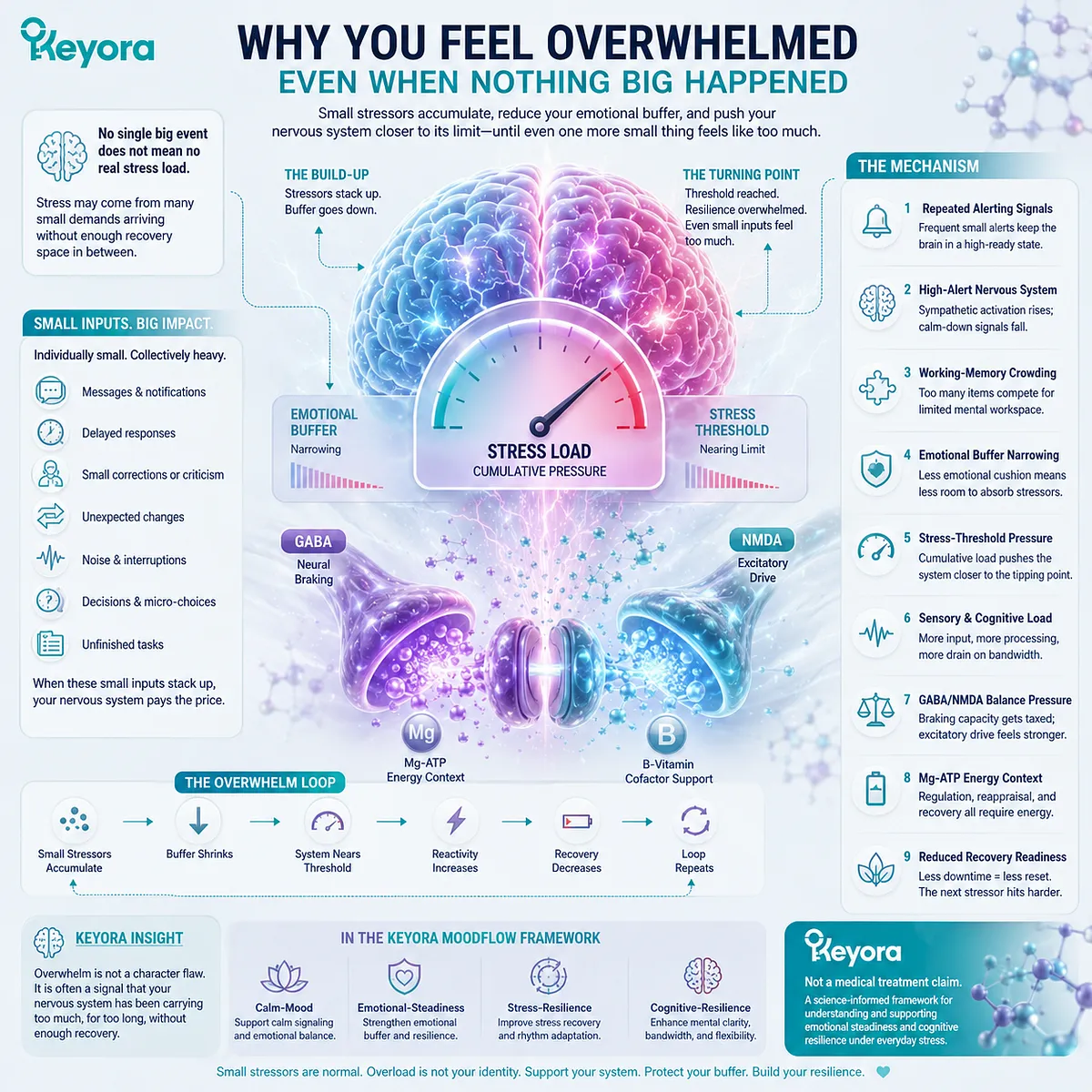
You may feel overwhelmed even when nothing big happened because small stressors can accumulate, reduce emotional buffer, and push the nervous system closer to its limit.
The stress may not come from one dramatic event. It may come from many small demands arriving without enough recovery space in between.
No single big event does not mean no real stress load.
A few messages, a delayed response, a small correction, an unexpected change, a noise, a decision, an interruption, or an unfinished task may not look serious by itself.
But when these small inputs stack up across the day, the nervous system may reach a point where even one more small thing feels like too much.
Mechanistically, this can involve repeated alerting signals, high-alert nervous-system activation, working-memory crowding, emotional buffer narrowing, stress-threshold pressure, sensory and cognitive input load, GABA/NMDA braking pressure, Mg-ATP energy context, B-vitamin cofactor support, and reduced recovery readiness.
In the Keyora MoodFlow framework, this is understood as a calm-mood, emotional-steadiness, stress-resilience, and cognitive-resilience question, not a medical treatment claim.
Why Small Things Can Feel Like Too Much
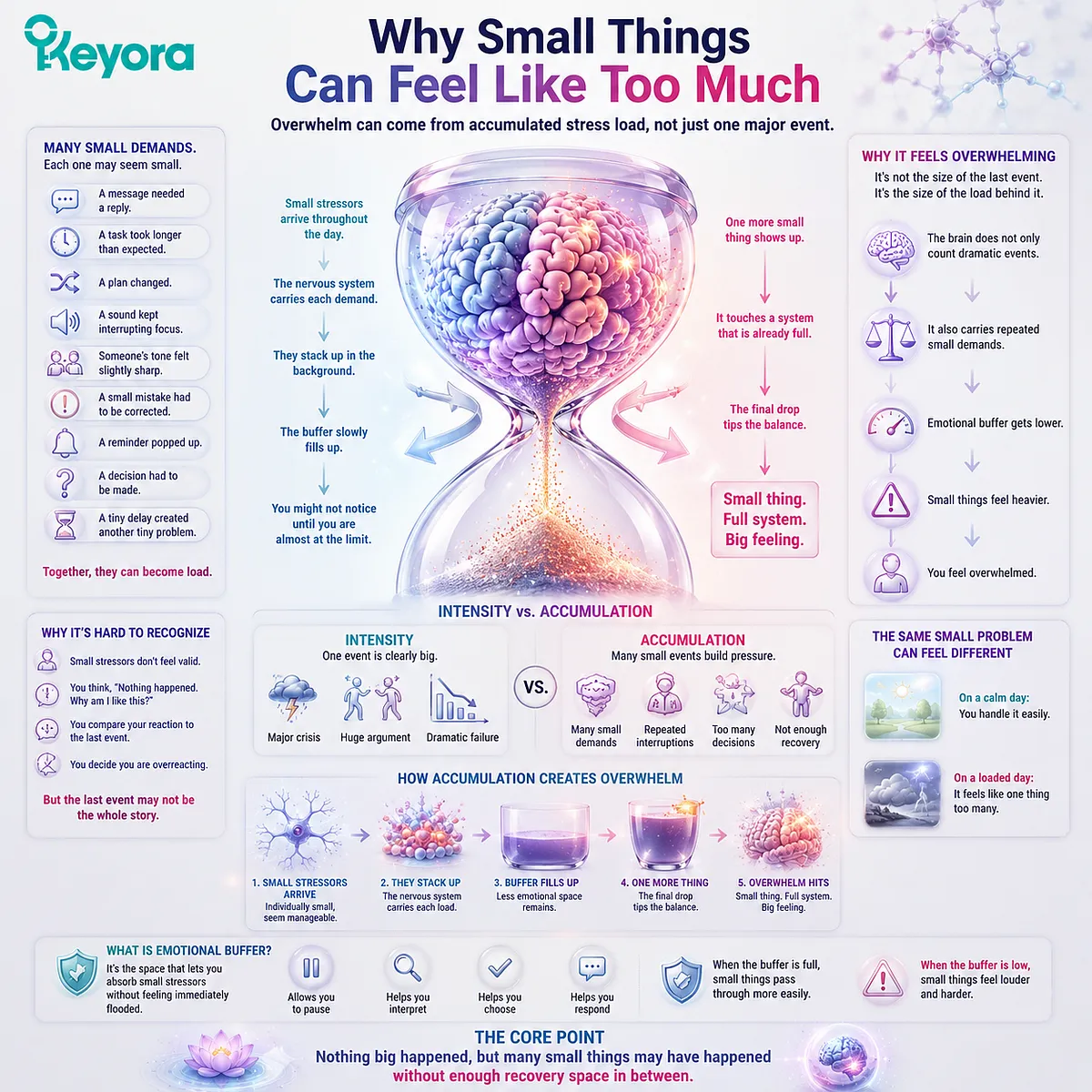
Overwhelm can come from accumulated stress load, not just one major event.
Sometimes you feel overwhelmed and cannot point to one obvious reason.
There was no major crisis. No huge argument. No dramatic failure. No single event that explains why your body feels tense, your mind feels full, and your emotional buffer feels thin.
But the day may still have carried many small demands.
-
A message needed a reply.
-
A task took longer than expected.
-
A plan changed.
-
A sound kept interrupting your focus.
Someone’s tone felt slightly sharp.
-
A small mistake had to be corrected.
-
A reminder popped up.
-
A decision had to be made.
-
A tiny delay created another tiny problem.
Each one may seem small.
Together, they can become load.
This is why you may feel overwhelmed even when nothing big happened. The nervous system does not only count dramatic events. It also carries repeated small demands.
A small thing can be manageable when it happens alone. But when it arrives after many other small things, it may land on a system that is already close to its limit.
This is the difference between intensity and accumulation.
Intensity is when one event is clearly big. Accumulation is when many small events build pressure in the background. Overwhelm can come from either one.
Sometimes overwhelm comes from accumulation, not intensity.
This can be difficult to recognize because small stressors do not always feel valid. You may think, “Nothing happened. Why am I like this?” You may compare your reaction to the size of the last event and decide you are overreacting.
But the last event may not be the whole story.
The last small thing may simply be the point where the system runs out of buffer.
For example, a short message may not be a big deal. But if it arrives after poor sleep, several interruptions, too many decisions, an unfinished task, background noise, social pressure, and a sense of being behind, the message may feel heavier than it looks.
The message did not create the whole stress load.
It touched the stress load that was already there.
This is why the same small problem can feel different on different days. On a calm day, you may handle it easily. On a loaded day, it may feel like one thing too many.
You may not be weak.
You may be carrying less available buffer.
Emotional buffer is the space that lets you absorb small stressors without feeling immediately flooded. It gives you room to pause, interpret, choose, and respond.
When the buffer is full, small things can pass through more easily.
When the buffer is low, small things feel louder.
This is why ordinary life can feel overwhelming during stressful periods. It may not be that each detail is objectively severe. It may be that the nervous system has been asked to stay online for too long without enough recovery.
The core point is simple:
Nothing big happened, but many small things may have happened without enough recovery space in between.
The Accumulated Load Behind Feeling Overwhelmed
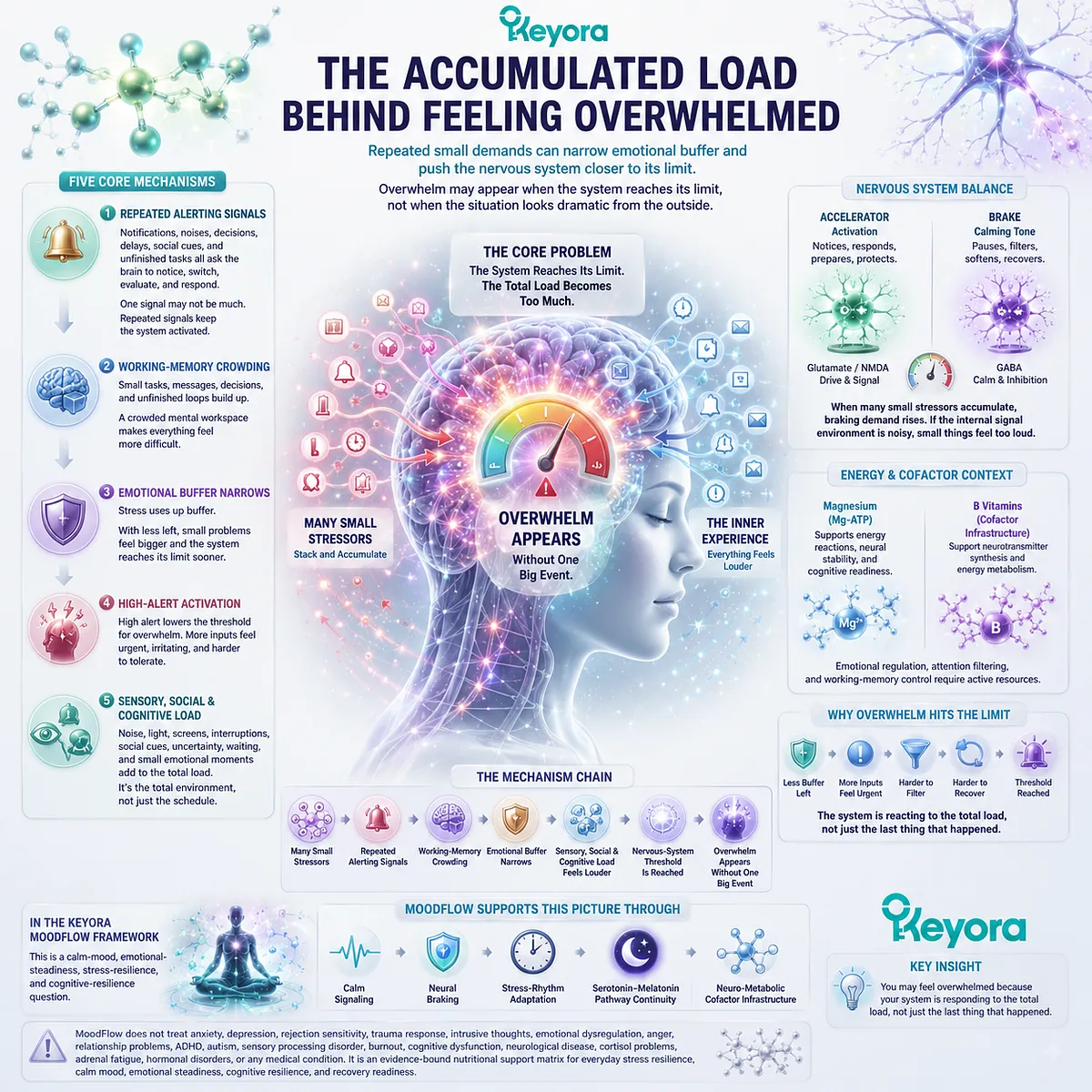
Repeated small demands can narrow emotional buffer and push the nervous system closer to its limit.
Overwhelm may appear when the system reaches its limit, not when the situation looks dramatic from the outside.
The first mechanism is repeated alerting signals.
Every small demand asks the brain to notice, switch, evaluate, and respond. A notification asks for attention. A noise asks for filtering. A decision asks for comparison. A delay asks for patience. A social cue asks for interpretation. An unfinished task asks to be remembered.
One signal may not be much.
Repeated signals keep the system activated.
This matters because the nervous system does not always fully reset between small demands. If the next input arrives before the previous one has been processed, the load begins to stack.
The second mechanism is working-memory crowding.
Working memory is the temporary mental space that holds what you are doing, what you are remembering, and what you are trying not to forget. When small tasks, messages, decisions, and unfinished loops build up, that space becomes crowded.
A crowded mental workspace makes everything feel more difficult.
-
You may forget what you were doing.
-
You may feel pulled in several directions.
-
You may start one task and remember another.
-
You may try to relax but keep thinking about what is still open.
This can make overwhelm feel like “too much,” even when no single item is huge.
The third mechanism is emotional buffer narrowing.
Emotional buffer helps you absorb ordinary friction. It lets you stay steady when something changes, when someone is brief, when a task takes longer, or when plans do not go smoothly.
Stress uses up that buffer.
If the day has already required patience, decision-making, self-control, attention switching, or emotional regulation, there may be less buffer left. Then a small problem can feel like a big one because it lands on a system that has little room remaining.
This is why people often say, “I was fine, and then one tiny thing made me lose it.”
The tiny thing may not be the true cause. It may be the final input that crossed the threshold.
The fourth mechanism is high-alert activation.
When the nervous system is already in a high-alert state, more inputs are interpreted with more urgency. A sound may feel more irritating. A question may feel more demanding. A small change may feel harder to tolerate. A simple task may feel heavier.
High alert lowers the threshold for overwhelm.
The brain becomes more sensitive to what might need attention, what might go wrong, what might be missed, and what might require a response. This is useful when there is real danger or urgent demand. But during ordinary daily life, it can make small inputs feel larger than they are.
The fifth mechanism is sensory, social, and cognitive load.
Overwhelm is not only about tasks. It can also come from noise, light, screens, social cues, background conversation, interruptions, waiting, uncertainty, and small emotional moments. These may not be “big events,” but they still require processing.
A person can become overwhelmed by the total input environment.
This is why you may feel at your limit even when your schedule does not look extreme. The visible schedule may miss the invisible load: switching, filtering, interpreting, remembering, deciding, waiting, and regulating.
The nervous system’s brake-and-accelerator balance helps explain this.
Activation is the accelerator. It helps you notice, respond, prepare, and protect. Braking helps you pause, filter, soften, and recover. GABA-related calming tone and NMDA/glutamate activation balance help explain why the system can feel steady or overloaded.
When many small stressors accumulate, braking demand rises.
The system has to filter more input, reduce more urgency, soften more irritation, and prevent every small signal from feeling important. If the internal signal environment is already noisy, small things may feel too loud.
Energy context also matters.
Emotional regulation, attention filtering, working-memory control, and response selection require active resources. Magnesium’s role in Mg-ATP context and B vitamins’ role as cofactor infrastructure help explain why stress tolerance depends on both neural signaling and energy background.
This does not mean feeling overwhelmed is caused by nutrient status. It means the experience can be understood as a multi-layer wellness question involving accumulated stress load, emotional buffer, neural braking, and recovery readiness.
The mechanism chain looks like this:
many small stressors → repeated alerting signals → working-memory crowding → emotional buffer narrows → sensory, social, and cognitive input feels louder → nervous-system threshold is reached → overwhelm appears even without one big event
In plain language, you may feel overwhelmed because your system is responding to the total load, not just the last thing that happened.
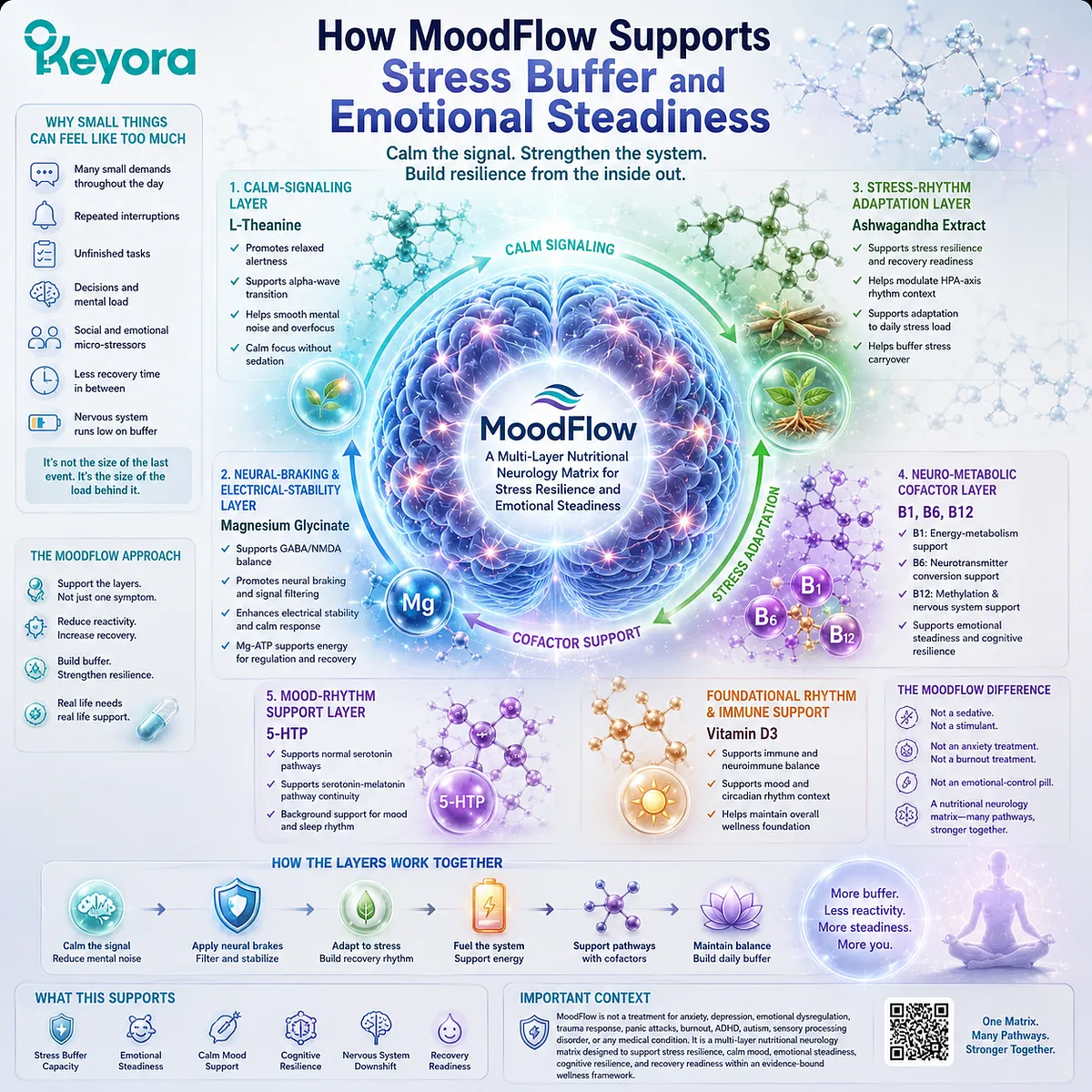
How MoodFlow Supports Stress Buffer and Emotional Steadiness
MoodFlow supports the calm-signaling, neural-braking, stress-rhythm, and cofactor layers involved in stress resilience and emotional steadiness under everyday pressure.
Keyora MoodFlow approaches feeling overwhelmed when nothing big happened as a calm-mood, emotional-steadiness, stress-resilience, and cognitive-resilience question.
The goal is not to treat anxiety, depression, emotional dysregulation, trauma response, panic attacks, burnout, ADHD, autism, sensory processing disorder, or any medical condition. The goal is to support the wellness pathways involved in stress buffer, nervous-system downshift, emotional steadiness, and recovery readiness under everyday pressure.
This distinction matters.
When small things feel like too much, the answer is not always to judge yourself for being weak. That judgment can add another layer of stress. A more useful wellness frame is to ask what supports the nervous system’s ability to filter input, absorb small demands, and recover between them.
MoodFlow’s logic begins with calm signaling.
L-Theanine supports the calm-signaling layer.
In the MoodFlow framework, L-Theanine is associated with relaxed alertness, alpha-wave transition, signal smoothing, and calm focus without sedation. This is relevant because overwhelm from small stressors often feels like too much signal, not too little effort.
The goal is not to become numb.
The goal is a calmer signal background. When ordinary inputs feel too loud, calm signaling helps explain how the nervous system may be better supported in staying steady while still alert and functional.
Magnesium glycinate supports the neural-braking and electrical-stability layer.
Magnesium is relevant to GABA/NMDA activation balance, membrane excitability, and Mg-ATP energy context. In MoodFlow, magnesium glycinate is positioned as part of the neural braking and hardware-stabilizing layer.
For accumulated stress load, this layer is central.
When small inputs keep arriving, the brain needs braking capacity to filter, pause, and prevent every signal from becoming urgent. Neural braking helps explain the physiological background behind stress buffer and emotional steadiness.
Magnesium’s Mg-ATP context also matters because regulation is active. Filtering noise takes energy. Holding perspective takes energy. Managing irritation takes energy. Returning to calm after small interruptions takes energy. The nervous system needs both signal stability and energy readiness.
Ashwagandha supports the stress-rhythm adaptation layer.
Feeling overwhelmed without one big event often reflects accumulated rhythm, not one moment. The system may have been carrying small stressors across hours or days. Without enough recovery, the threshold for overwhelm can become lower.
Ashwagandha is positioned in MoodFlow around stress resilience, HPA-axis rhythm context, and recovery readiness. In this article, that does not mean Ashwagandha fixes cortisol, treats burnout, repairs the HPA axis, or treats stress intolerance. It means Ashwagandha belongs to the stress-adaptation layer that helps explain why emotional buffer is connected to broader stress rhythm.
B1, B6, and B12 support the neuro-metabolic cofactor layer.
The nervous system depends on normal metabolic and neurotransmitter-related infrastructure. B1 supports energy-metabolism context. B6 supports neurotransmitter-related conversion context, including pathways relevant to calming and mood-related signaling. B12 supports methylation context and nervous-system maintenance.
In MoodFlow, these B vitamins are not positioned as treatments for fatigue, mood disorders, cognitive dysfunction, or emotional dysregulation. They are part of the cofactor background behind emotional steadiness, cognitive resilience, and normal pathway support under everyday pressure.
5-HTP plays a background role in mood-rhythm support.
Because this article is about accumulated stress load and overwhelm, 5-HTP should not dominate the explanation. Its role is best understood as support for normal serotonin-related pathways and serotonin-melatonin pathway continuity within the broader MoodFlow architecture. This does not mean treating depression, anxiety, or sleep disorders.
Vitamin D may also be understood as part of the broader rhythm and neuroimmune wellness context when relevant, but it should remain secondary.
Together, these layers explain why MoodFlow is not positioned as an emotional-control pill, sedative, stimulant, anxiety treatment, burnout treatment, or sensory-overload treatment. It is a multi-layer nutritional neurology matrix designed to support stress resilience, calm mood, emotional steadiness, cognitive resilience, nervous-system downshift, and recovery readiness within an evidence-bound wellness framework.
MoodFlow is not a treatment for anxiety, depression, emotional dysregulation, trauma response, panic attacks, burnout, ADHD, autism, sensory processing disorder, cognitive dysfunction, neurological disease, cortisol problems, adrenal fatigue, hormonal disorders, stress intolerance, relationship problems, or any medical condition. In this article, Keyora uses “feeling overwhelmed even when nothing big happened” as a wellness-language entry point for explaining accumulated stress load, emotional buffer, calm signaling, neural braking, stress-rhythm adaptation, and cognitive resilience under everyday pressure.
Closing Summary
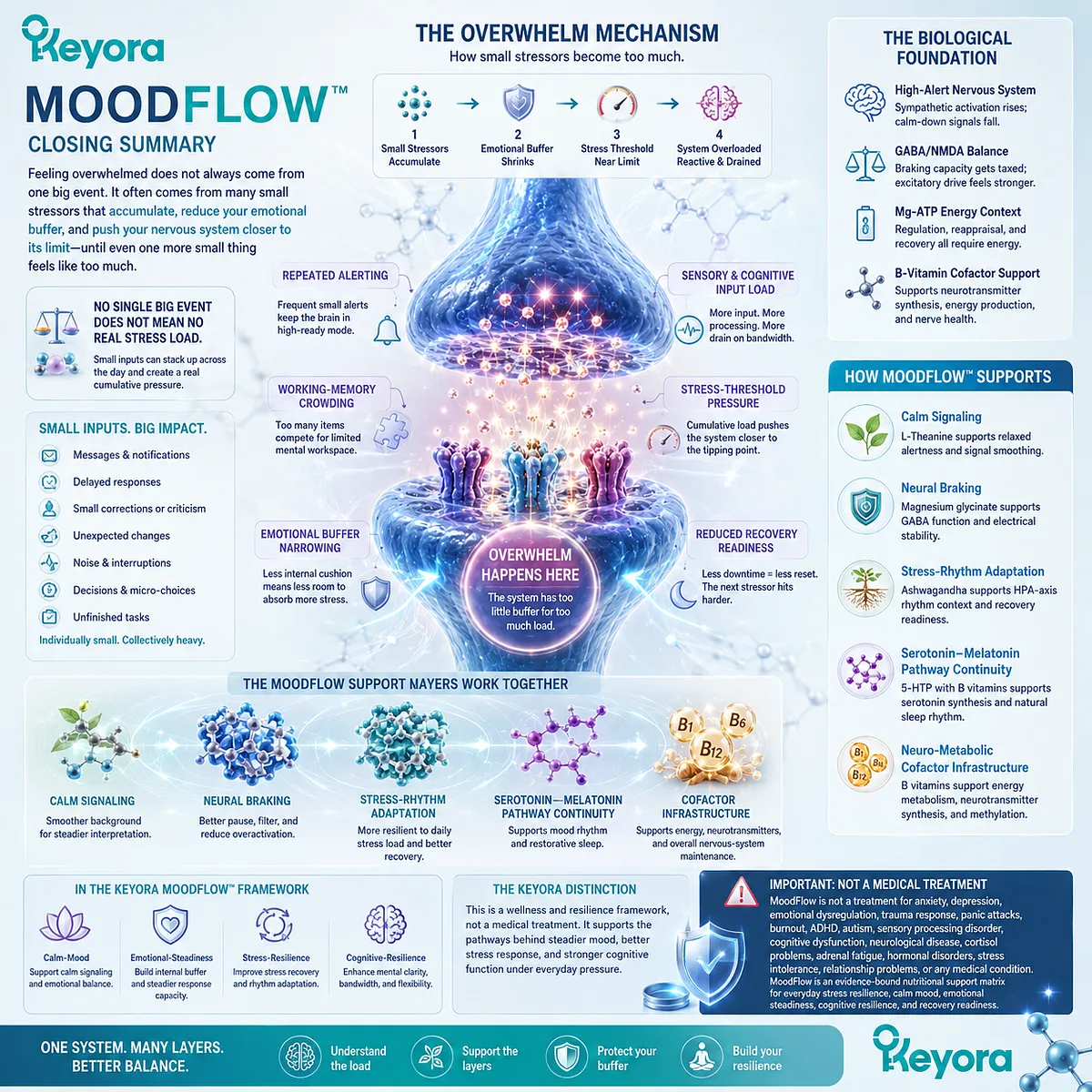
You may feel overwhelmed even when nothing big happened because small stressors can accumulate, reduce emotional buffer, and push the nervous system closer to its limit. The stress may not come from one dramatic event. It may come from many small demands arriving without enough recovery space in between.
No single big event does not mean no real stress load.
Mechanistically, this may involve repeated alerting signals, high-alert nervous-system activation, working-memory crowding, emotional buffer narrowing, stress-threshold pressure, sensory and cognitive input load, GABA/NMDA braking pressure, Mg-ATP energy context, B-vitamin cofactor support, and reduced recovery readiness.
In the Keyora MoodFlow framework, this is understood as a calm-mood, emotional-steadiness, stress-resilience, and cognitive-resilience question. MoodFlow supports this picture through calm signaling, neural braking, stress-rhythm adaptation, serotonin-melatonin pathway continuity, and neuro-metabolic cofactor infrastructure.
MoodFlow does not treat anxiety, depression, emotional dysregulation, trauma response, panic attacks, burnout, ADHD, autism, sensory processing disorder, cognitive dysfunction, neurological disease, cortisol problems, adrenal fatigue, hormonal disorders, stress intolerance, relationship problems, or any medical condition. It is an evidence-bound nutritional support matrix for everyday stress resilience, calm mood, emotional steadiness, cognitive resilience, and recovery readiness.
This article is for educational and informational purposes only. It does not provide medical advice, diagnosis, treatment, cure, prevention, disease outcome claims, hormone restoration claims, fertility outcome claims, or formula-specific clinical efficacy claims.