
Why Do I Feel Mentally Slower When Processing New Information?
Keyora Research Q&A Library
This is part of the Keyora Research Q&A Series, derived from Keyora Nutritional Neurology Series .
Within the Keyora Nutritional Neurology framework, this Q&A translates complex nutrient–brain mechanisms into reader-friendly, evidence-bound answers, focusing on stress resilience, sleep quality, calm mood support, cognitive wellness, and the broader interaction between nutrition, neurochemistry, and daily nervous-system function.
First published by Keyora Research Journal: www.keyorahealth.com

Direct Answer
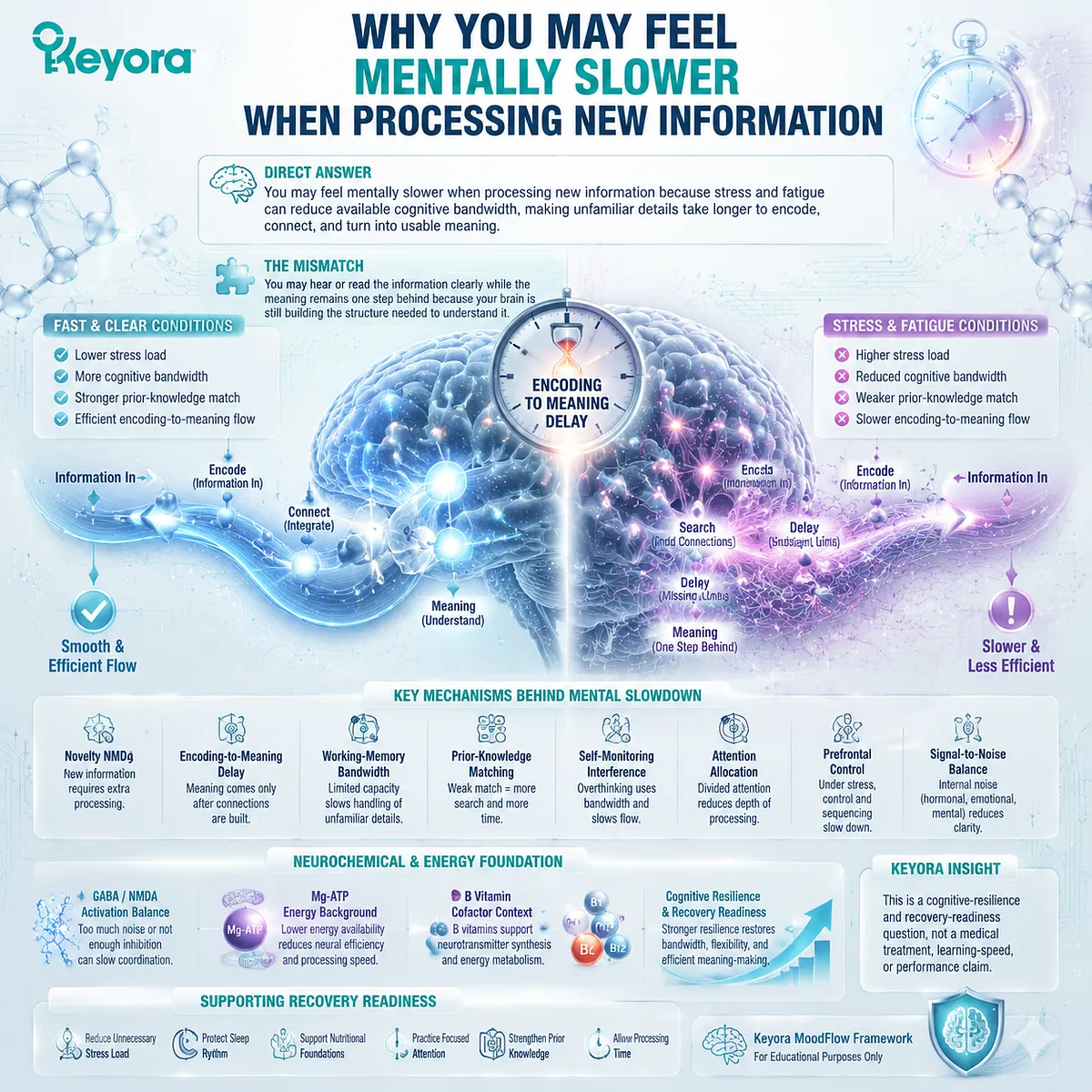
You may feel mentally slower when processing new information because stress and fatigue can reduce available cognitive bandwidth, making unfamiliar details take longer to encode, connect, and turn into usable meaning.
The mismatch is this: you may hear or read the information clearly while the meaning remains one step behind because your brain is still building the structure needed to understand it.
This can involve novelty processing, encoding-to-meaning delay, working-memory bandwidth, prior-knowledge matching, self-monitoring interference, attention allocation, prefrontal control, cognitive flexibility, signal-to-noise balance, GABA/NMDA activation balance, Mg-ATP energy background, B vitamin cofactor context, cognitive resilience, and recovery readiness.
In the Keyora MoodFlow framework, this is understood as a cognitive-resilience and recovery-readiness question, not a medical treatment, learning-speed, or performance claim.
Why New Information Can Feel One Step Ahead of Your Understanding
You may receive the words in real time while needing longer to build the mental structure that makes them usable.
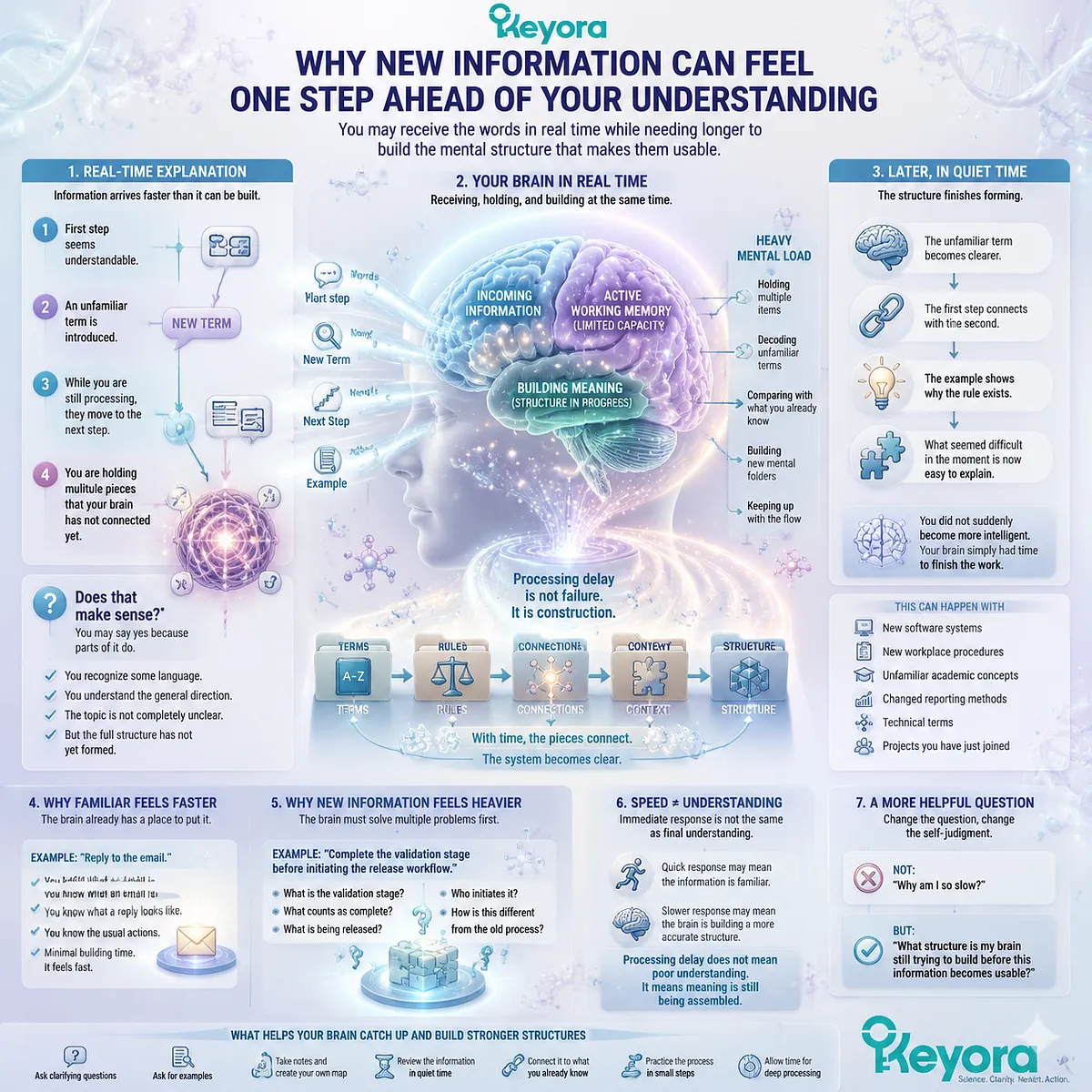
Someone is explaining a new process.
The first step seems understandable.
Then they introduce an unfamiliar term.
While you are still deciding what that term means, they move to the next step. Now you are holding the first instruction, the new term, and the new example at the same time.
You hear the words.
But the meaning feels one step behind.
Someone asks:
“Does that make sense?”
You may say yes because parts of it do.
The topic is not completely unclear. You recognize some of the language. You understand the general direction. But the full structure has not yet formed.
Later, when you look at the same information quietly, it begins to make sense.
The unfamiliar term becomes clearer. The first step connects with the second. The example shows why the rule exists. The process that seemed difficult in the moment becomes much easier to explain.
You did not suddenly become more intelligent.
Your brain may simply have received enough time to finish processing what arrived too quickly.
This can happen with a new software system, a new workplace procedure, an unfamiliar academic concept, a changed reporting method, a technical term, or a project you have just joined.
Familiar information feels faster because the brain already has a place to put it.
When someone says “reply to the email,” you already understand what an email is, what a reply looks like, and which actions are usually involved.
When someone says “complete the validation stage before initiating the release workflow,” the brain may need to solve several problems first.
What is the validation stage?
What counts as complete?
What is being released?
Who initiates it?
How is this different from the old process?
The sentence may not be extremely complex, but it contains unfamiliar elements without established mental anchors.
That is why new information can feel heavier than familiar information.
The brain is not only receiving the content.
It is building the filing system that will eventually make the content easier to use.
This difference matters because people often judge themselves by the speed of their first response.
They think:
“Why did everyone else understand that faster?”
“Why do I need another explanation?”
“Why can I not answer immediately?”
“Is my mind becoming slower?”
But immediate response speed is not the same as final understanding.
A person may respond quickly because the information resembles something they already know.
Another person may need longer because they are building a more accurate structure from the beginning.
Processing delay does not automatically mean poor understanding.
Sometimes it means meaning is still being assembled.
A more helpful question is not:
“Why am I so slow?”
It is:
“What structure is my brain still trying to build before this information becomes usable?”
Why Stress Makes Meaning Take Longer to Form
Pressure can reduce the bandwidth available for encoding, linking, and comparing unfamiliar information with what you already know.
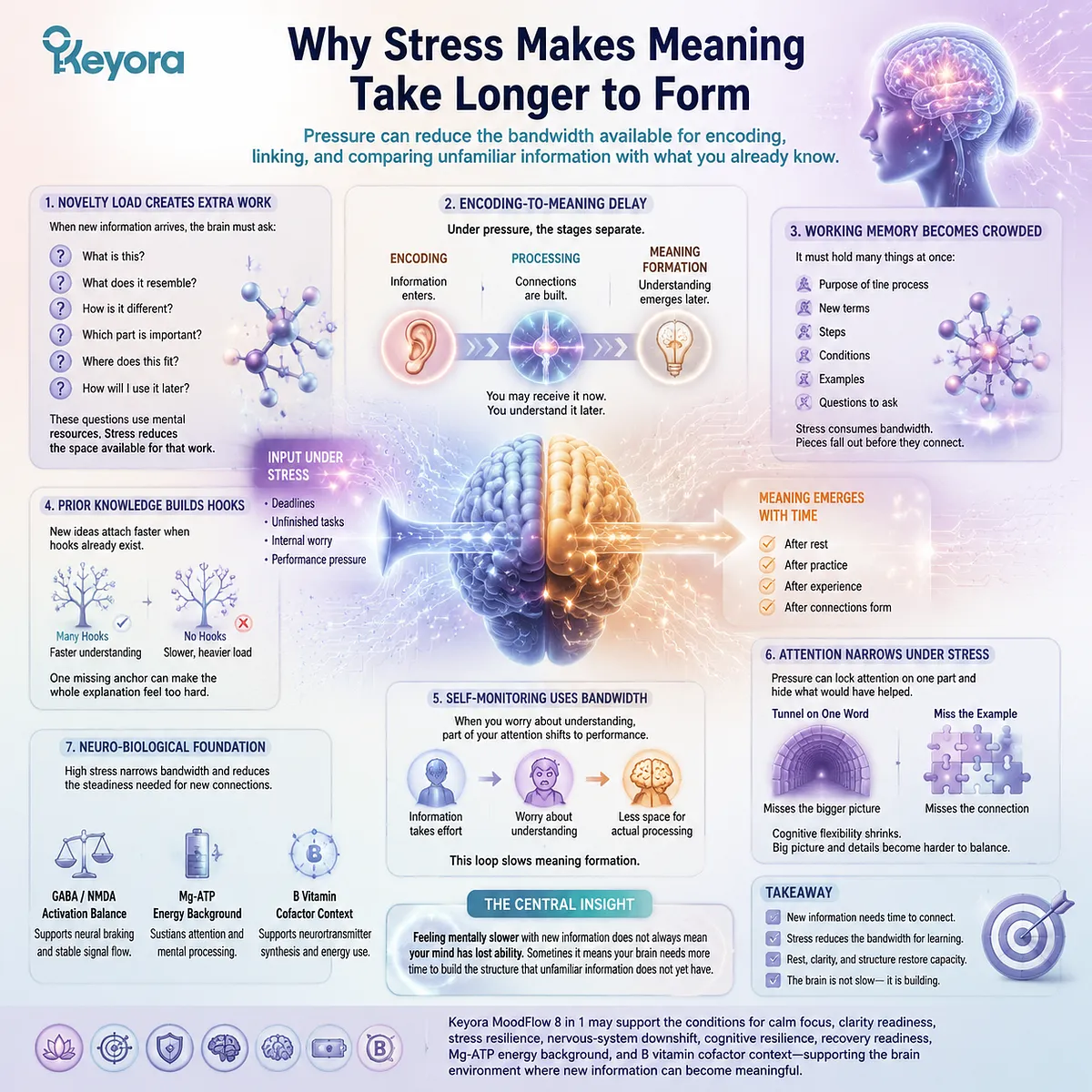
New information creates novelty load.
Novelty load is the extra work required when the brain cannot rely on an established pattern.
It has to ask:
What is this?
What does it resemble?
How is it different from what I already know?
Which part is important?
Where does this fit?
How will I use it later?
These questions are often answered automatically, but they still require mental resources.
Stress can reduce the amount of space available for that work.
When you are already carrying a deadline, several unfinished tasks, internal worry, and the pressure to appear competent, unfamiliar information enters a crowded system.
The brain may receive the words without fully converting them into meaning.
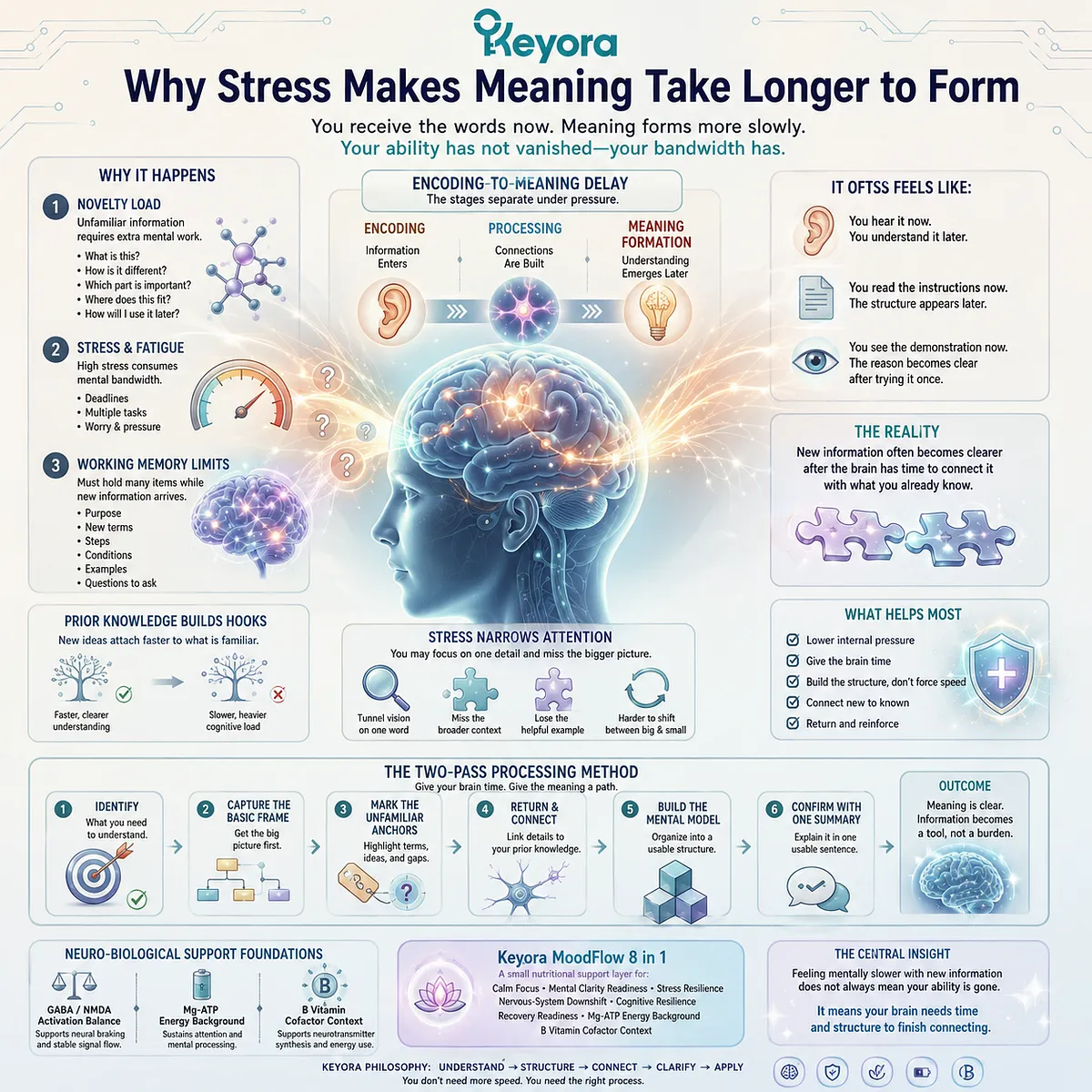
This creates an encoding-to-meaning delay.
Encoding is the first stage of taking in information.
Meaning formation comes next.
The brain needs to connect the new words with context, identify relationships, and build a usable mental model.
Under pressure, those stages may separate.
You hear the sentence now.
You understand it later.
You read the instructions now.
The structure appears after you have stepped away.
You see the demonstration now.
You understand why the steps matter after trying them once.
This is not unusual.
New information often becomes clearer after the brain has had time to connect it with earlier knowledge.
Working memory is central to this process.
When someone explains a new procedure, working memory must hold the earlier part while the later part arrives.
It may need to keep active:
-
the purpose of the process;
-
the meaning of a new term;
-
the first step;
-
the condition attached to that step;
-
the example being given;
-
the question you want to ask.
If stress is already occupying part of that mental space, the information may not connect smoothly.
The first part may fade before the second part has been understood.
Or the new term may consume so much attention that the rest of the explanation passes by.
Prior knowledge also affects processing speed.
A new idea becomes easier to understand when it can attach to something familiar.
For example, a person who already understands basic website structure may learn a new content-management system more quickly than someone who is learning both the system and the underlying website concepts at the same time.
The difference is not necessarily intelligence.
One person has more mental hooks available.
When a term has no hook, the brain must build one.
This is why a missing definition can affect everything that follows.
If you do not understand what “validation” means in the new process, each later instruction containing that word becomes harder to interpret.
The same is true for abbreviations, technical categories, assumed background knowledge, and unstated relationships.
Sometimes one missing anchor creates the feeling that the entire explanation is too difficult.
Self-monitoring can make the delay worse.
You notice that you are still processing the previous sentence.
Then you begin thinking:
“Why am I behind?”
“Does everyone else understand this?”
“I need to catch up.”
“I cannot ask them to repeat it again.”
“I should already know this.”
Now part of your attention is focused on the information, and part is focused on your performance.
The more you monitor yourself, the less space remains for actual processing.
This can create a loop:
The information feels slow to form.
You become worried about being slow.
The worry uses more cognitive bandwidth.
The information becomes even harder to process.
Pressure can also narrow attention.
You may lock onto one unfamiliar word and lose the broader explanation.
Or you may focus so strongly on the main idea that you miss the example that would have made it understandable.
Cognitive flexibility is needed to move between the big picture and the details. Under stress, that movement can become less smooth.
At the nervous-system level, elevated activation can make thinking feel urgent while reducing the steadiness needed for new connections to form. GABA/NMDA activation balance can be understood as part of the broader background for neural braking and stable signal flow.
Mg-ATP energy background and B vitamin cofactor context also belong to the wider neuro-metabolic picture because attention, encoding, working-memory maintenance, and cognitive flexibility require sustained energy.
The central insight is this:
Feeling mentally slower with new information does not always mean your mind has lost ability. Sometimes it means your brain needs more time to build the structure that unfamiliar information does not yet have.
How to Process New Information Without Demanding Instant Understanding
The goal is not to master every detail on the first pass, but to build a frame that gives later details somewhere to connect.
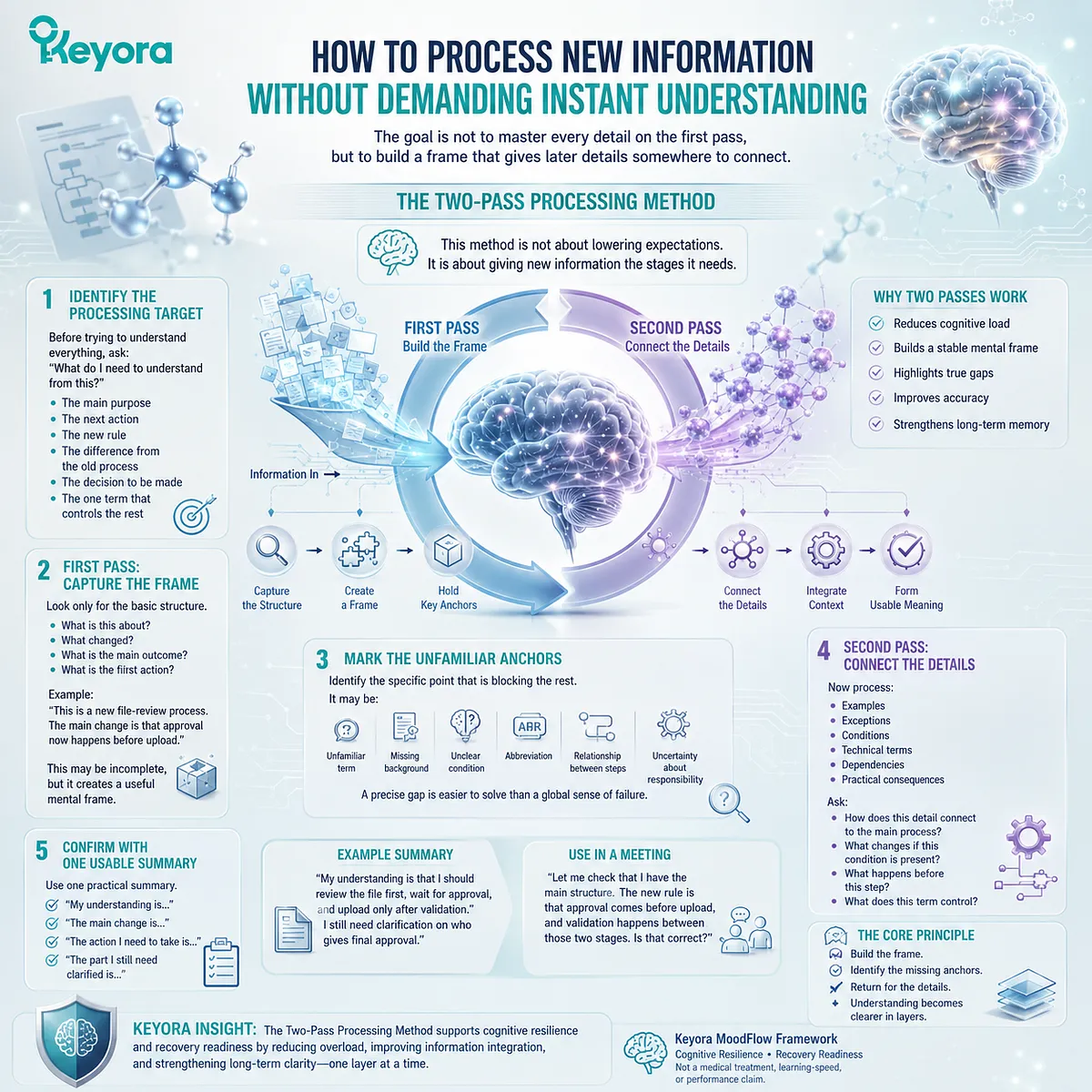
A helpful approach is The Two-Pass Processing Method.
This method is not about lowering expectations.
It is about giving new information the stages it needs.
Step one: identify the processing target.
Before trying to understand everything, ask:
“What do I need to understand from this?”
The target might be:
-
the main purpose;
-
the next action;
-
the new rule;
-
the difference from the old process;
-
the decision that must be made;
-
the one term that controls the rest.
Without a target, the brain may try to process every detail with equal intensity.
That increases load.
Suppose someone is explaining a new review process.
Your first target might be:
“What changed from the old process?”
That question gives attention a direction.
Step two: use the first pass to capture the frame.
On the first pass, look only for the basic structure.
Ask:
What is this about?
What changed?
What is the main outcome?
What is the first action?
For example:
“This is a new file-review process. The main change is that approval now happens before upload.”
That summary may be incomplete.
It is still useful.
It creates a mental frame.
Later details now have somewhere to attach.
Step three: mark the unfamiliar anchors.
Do not conclude:
“I did not understand anything.”
Identify the specific point that is blocking the rest.
It may be:
-
an unfamiliar term;
-
missing background;
-
an unclear condition;
-
an abbreviation;
-
a relationship between two steps;
-
uncertainty about who is responsible.
You might say:
“I understand the purpose, but I do not understand what ‘validation stage’ means.”
Or:
“I understand the new rule, but I do not know who gives final approval.”
A precise gap is easier to solve than a global sense of failure.
Step four: use the second pass to connect the details.
Once the frame exists, return to the information.
Now process:
-
examples;
-
exceptions;
-
conditions;
-
technical terms;
-
dependencies;
-
practical consequences.
Ask:
“How does this detail connect to the main process?”
“What changes if this condition is present?”
“What happens before this step?”
“What does this term control?”
The second pass is often more efficient because the details are no longer floating without context.
Step five: confirm with one usable summary.
At the end, do not test yourself by trying to repeat every sentence.
Use one practical summary.
“My understanding is…”
“The main change is…”
“The action I need to take is…”
“The part I still need clarified is…”
For example:
“My understanding is that I should review the file first, wait for approval, and upload only after validation. I still need clarification on who gives final approval.”
This summary shows what is usable and what remains uncertain.
It does not pretend that every detail is complete.
It makes the current level of understanding visible.
You can also use this in a meeting:
“Let me check that I have the main structure. The new rule is that approval comes before upload, and validation happens between those two stages. Is that correct?”
Clarification is not evidence that you failed to process the information.
It is part of building an accurate model.
The Two-Pass Processing Method reduces the demand for instant mastery.
First, build the frame.
Then identify the missing anchors.
Then return for the details.
New information often becomes clearer when the brain is allowed to process it in layers rather than being forced to understand every part at the same moment.
Where Nutritional Support Fits
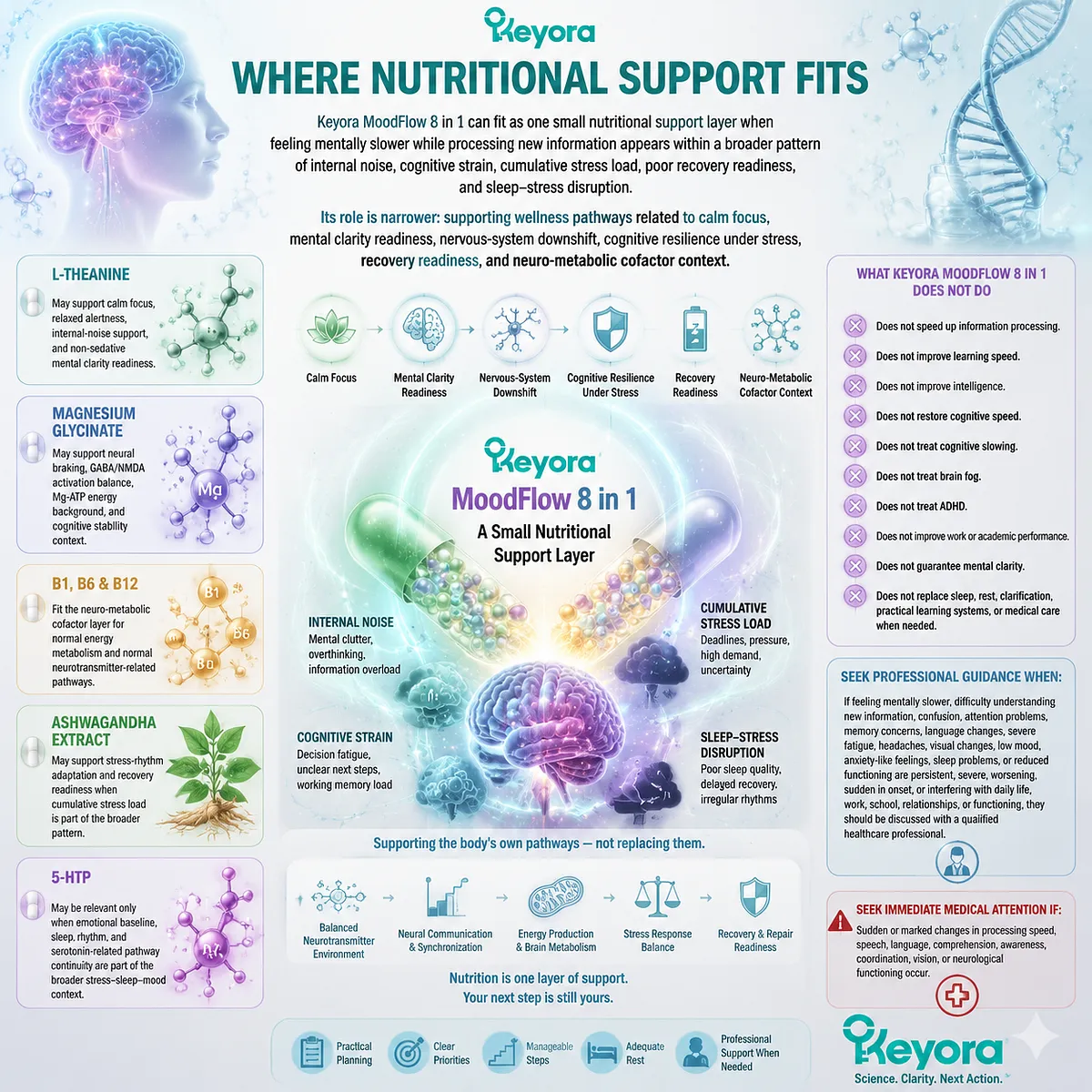
Keyora MoodFlow 8 in 1 can fit as one small nutritional support layer when feeling mentally slower while processing new information appears within a broader pattern of internal noise, cognitive strain, cumulative stress load, poor recovery readiness, and sleep-stress disruption.
Its role is narrower: supporting wellness pathways related to calm focus, mental clarity readiness, nervous-system downshift, cognitive resilience under stress, recovery readiness, and neuro-metabolic cofactor context.
-
L-Theanine may support calm focus, relaxed alertness, internal-noise support, and non-sedative mental clarity readiness.
-
Magnesium glycinate may support neural braking, GABA/NMDA activation balance, Mg-ATP energy background, and cognitive stability context.
-
B1, B6, and B12 fit the neuro-metabolic cofactor layer for normal energy metabolism and normal neurotransmitter-related pathways.
-
Ashwagandha may support stress-rhythm adaptation and recovery readiness when cumulative stress load is part of the broader pattern.
-
5-HTP may be relevant only when emotional baseline, sleep rhythm, and serotonin-related pathway continuity are part of the broader stress-sleep-mood context.
Keyora MoodFlow 8 in 1 does not speed up information processing, improve learning speed, improve intelligence, restore cognitive speed, treat cognitive slowing, treat brain fog, treat ADHD, improve work or academic performance, guarantee mental clarity, or replace sleep, rest, clarification, practical learning systems, or medical care when needed.
If feeling mentally slower, difficulty understanding new information, confusion, attention problems, memory concerns, language changes, severe fatigue, headaches, visual changes, low mood, anxiety-like feelings, sleep problems, or reduced functioning are persistent, severe, worsening, sudden in onset, or interfering with daily life, work, school, relationships, or functioning, they should be discussed with a qualified healthcare professional.
Sudden or marked changes in processing speed, speech, language, comprehension, awareness, coordination, vision, or neurological functioning require prompt medical attention.
Closing Summary
You may feel mentally slower when processing new information because unfamiliar content requires the brain to encode new details, connect them with prior knowledge, and build a usable mental structure.
Stress and fatigue can reduce the bandwidth available for this work. You may receive the words in real time while meaning forms more slowly. That delay does not automatically mean your understanding ability has declined.
The practical path is The Two-Pass Processing Method: identify what you need to understand, capture the basic frame first, mark the unfamiliar anchors, return to connect the details, and confirm your understanding with one usable summary.
Keyora MoodFlow 8 in 1 belongs only as a small nutritional support layer for calm focus, mental clarity readiness, stress resilience, nervous-system downshift, cognitive resilience, recovery readiness, Mg-ATP energy background, and B vitamin cofactor context.
When new information takes longer to make sense, the answer is not always to force your brain to move faster. Sometimes the more accurate response is to give meaning enough time and structure to finish forming.
This article is for educational and informational purposes only. It does not provide medical advice, diagnosis, treatment, cure, prevention, disease outcome claims, hormone restoration claims, fertility outcome claims, or formula-specific clinical efficacy claims.