
Why Do I Feel Low Energy After a Stressful Day?
Keyora Research Q&A Library
This is part of the Keyora Research Q&A Series, derived from Keyora Nutritional Neurology Series .
Within the Keyora Nutritional Neurology framework, this Q&A translates complex nutrient–brain mechanisms into reader-friendly, evidence-bound answers, focusing on stress resilience, sleep quality, calm mood support, cognitive wellness, and the broader interaction between nutrition, neurochemistry, and daily nervous-system function.
First published by Keyora Research Journal: www.keyorahealth.com

Direct Answer
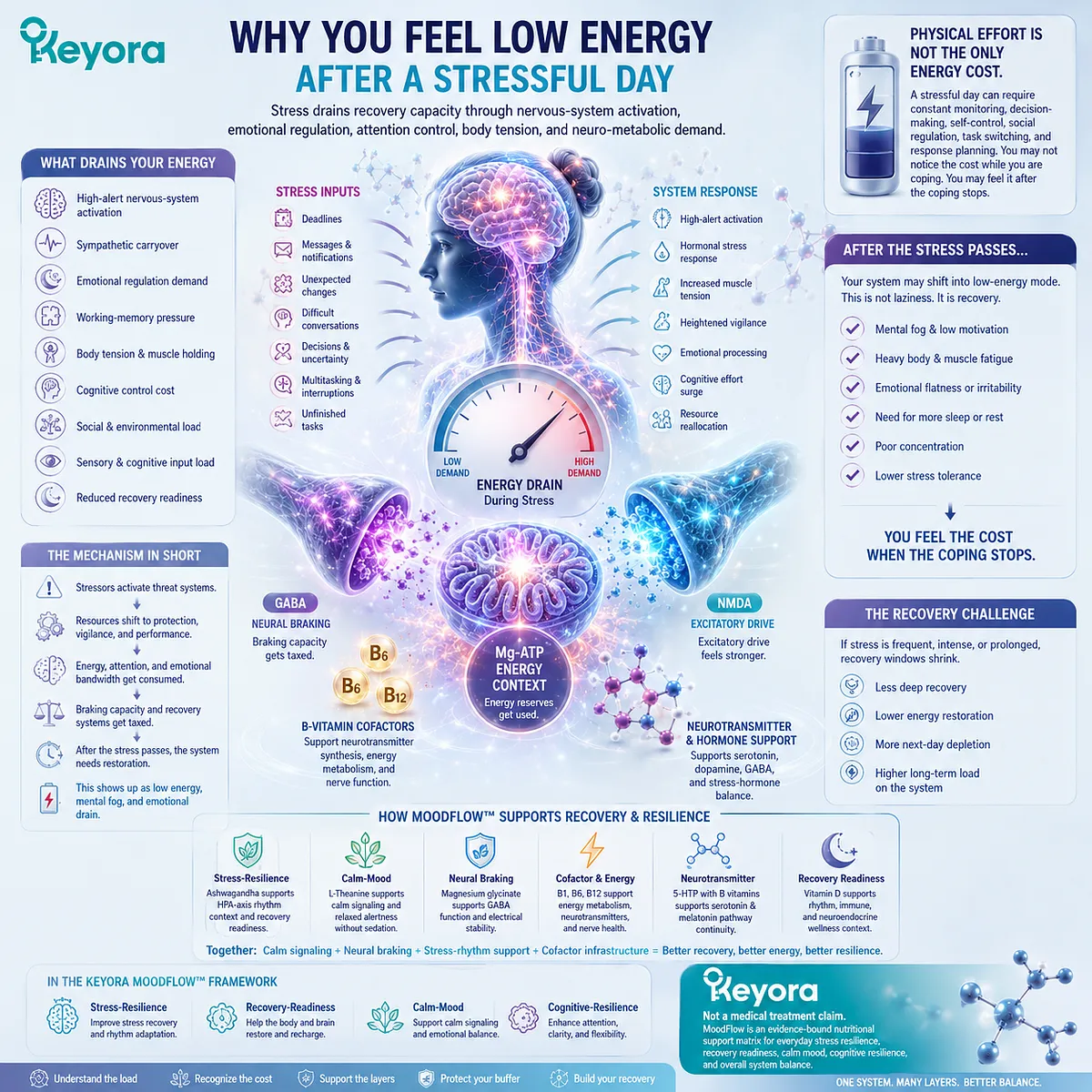
You may feel low energy after a stressful day because stress can drain recovery capacity through nervous-system activation, emotional regulation, attention control, body tension, and neuro-metabolic demand.
The day may not look physically difficult, but your system may still have spent a lot of energy staying functional under pressure.
Physical effort is not the only energy cost.
A stressful day can require constant monitoring, decision-making, self-control, social regulation, task switching, and response planning. You may not notice the cost while you are coping. You may feel it after the coping stops.
Mechanistically, post-stress low energy can involve high-alert nervous-system activation, sympathetic carryover, emotional regulation demand, working-memory pressure, body tension, cognitive control cost, Mg-ATP energy context, B-vitamin cofactor support, GABA/NMDA braking pressure, and reduced recovery readiness.
In the Keyora MoodFlow framework, this is understood as a stress-resilience, recovery-readiness, calm-mood, and cognitive-resilience question, not a medical treatment claim.
Why Stress Can Leave You Feeling Like Your Battery Is Empty
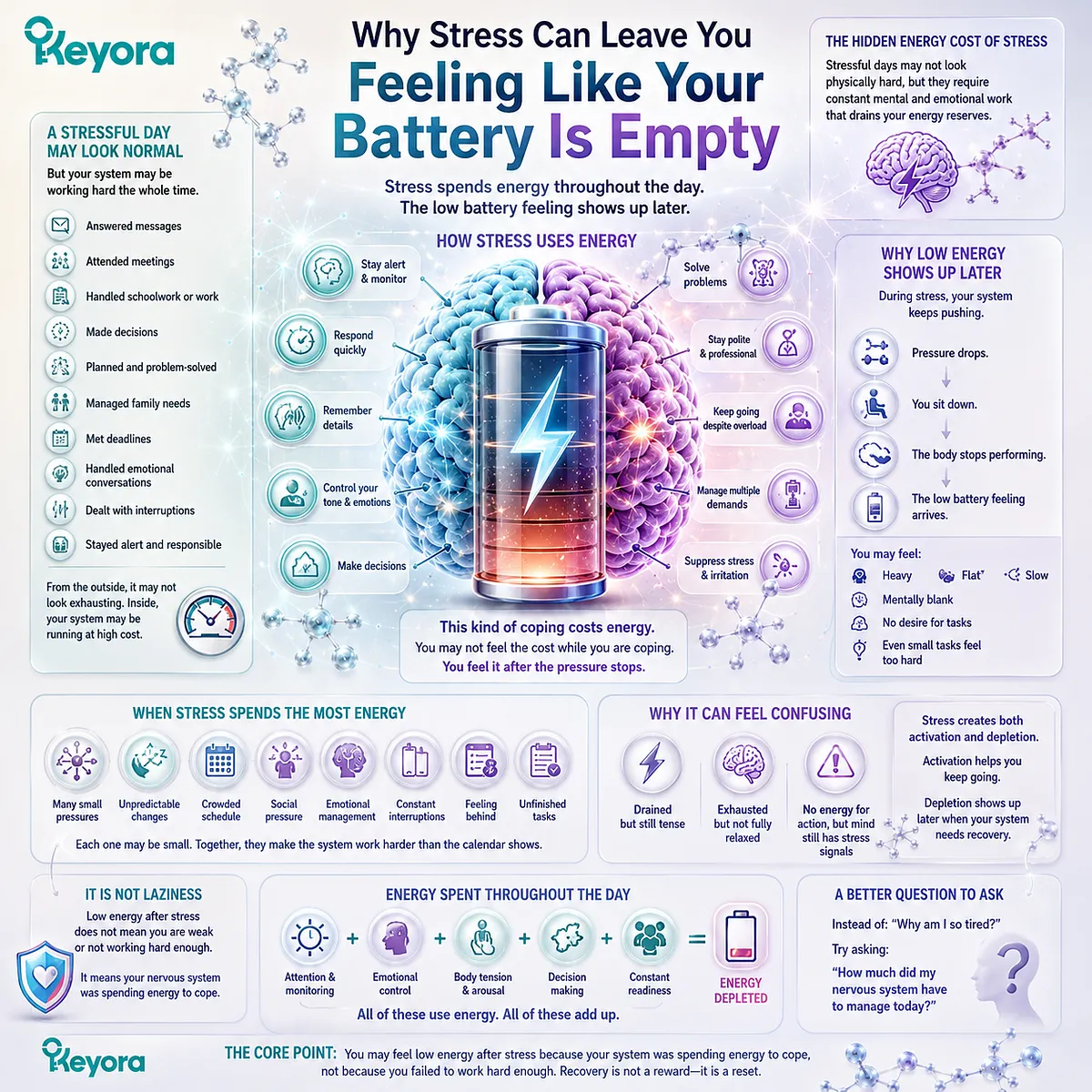
A stressful day can spend energy through alertness, self-control, and constant responding, even if it did not look physically demanding.
You can feel low energy after a stressful day even if you did not do much physical work.
You may have sat at a desk. You may have answered messages. You may have attended meetings. You may have handled schoolwork, planning, family needs, deadlines, small decisions, emotional conversations, or a long list of interruptions.
From the outside, the day may not look exhausting.
Inside, the system may have been running hard.
Stress asks the brain and body to stay ready. You may need to monitor what is happening, respond quickly, remember details, control your tone, stay polite, make decisions, solve problems, and keep going even when you feel overloaded.
That kind of coping costs energy.
You may not feel the energy cost while you are coping. You may feel it after the coping stops.
This is why low energy often appears later. During the stressful part of the day, your system may still be pushing. You may be running on urgency, responsibility, caffeine, social pressure, or the need to get through the next task.
Then the pressure drops.
The meeting ends. The workday slows down. The messages stop for a moment. The house becomes quieter. You sit down. The body no longer has to keep performing.
That is when the low-energy feeling may arrive.
You may feel heavy, flat, slow, or mentally blank. You may not want to talk. You may not want to cook. You may not want to make one more decision. Even small tasks can feel like they require too much effort.
This does not always mean you are lazy.
It may mean your nervous system has been spending energy all day to cope.
A stressful day can be energy-expensive even when it does not look physically hard.
This is especially true when the stress was not one clear event but many small pressures. A delayed reply, a difficult tone, an unfinished task, a changing plan, a noisy environment, a crowded schedule, or a feeling of being behind can all require processing.
Each one may be small.
Together, they can make the system work harder than the calendar shows.
Low energy after stress can also feel confusing because the body may not feel “sleepy” in a simple way.
-
You may feel drained but still tense.
-
You may feel exhausted but not fully relaxed.
-
You may feel like you have no energy for action, but your mind still has leftover stress signals.
This is because stress can create both activation and depletion.
The activation helps you keep going. The depletion shows up later when the system needs recovery.
You may say, “I do not know why I feel so tired. I did not do that much.”
A better question may be: “How much did my nervous system have to manage today?”
Stress uses energy through attention, emotional control, body tension, decision-making, and constant readiness. When those demands stack across the day, low energy may be the after-effect of staying functional under pressure.
You may feel low energy after stress because your system was spending energy to cope, not because you failed to work hard enough.
The Recovery-Capacity Drain Behind Post-Stress Low Energy
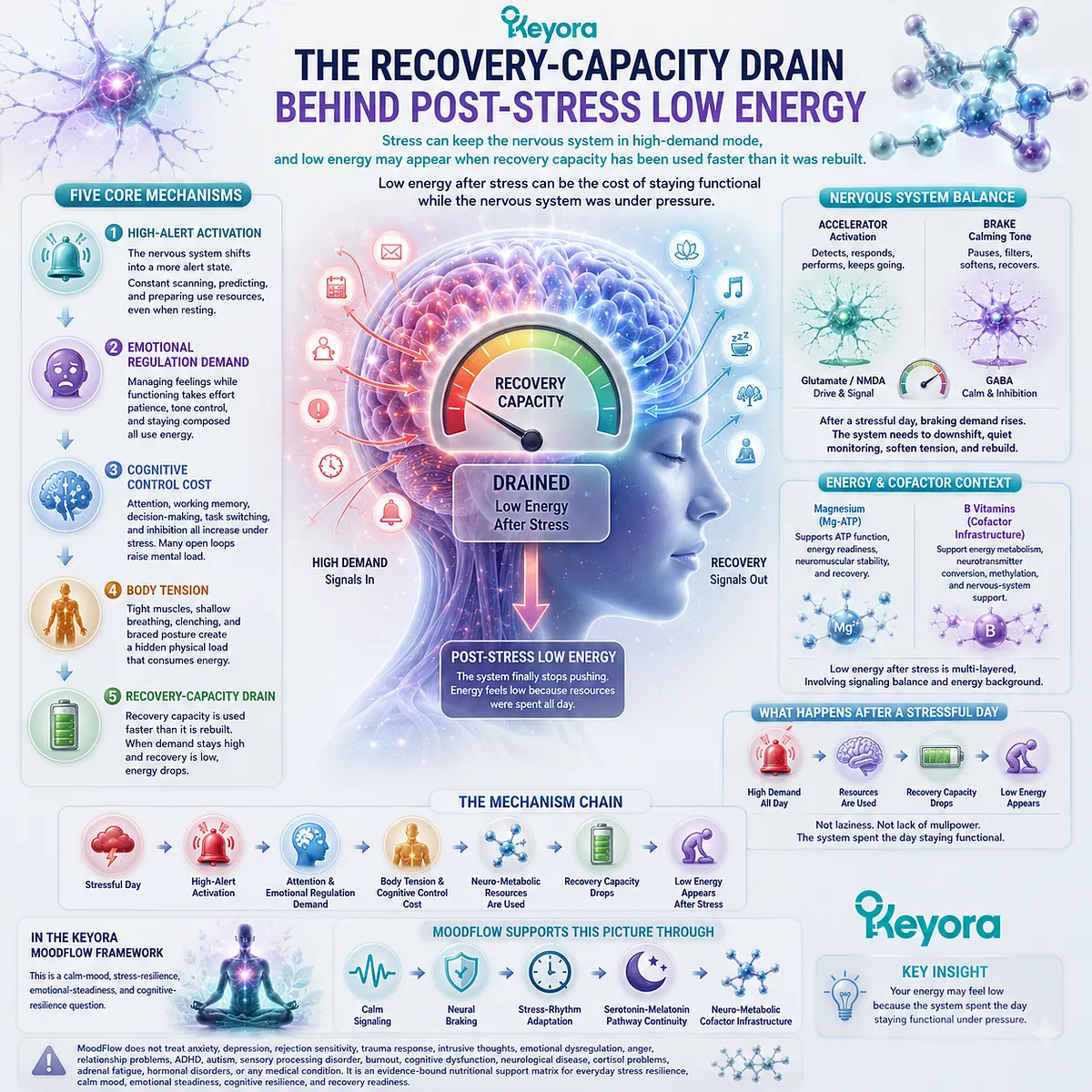
Stress can keep the nervous system in high-demand mode, and low energy may appear when recovery capacity has been used faster than it was rebuilt.
Low energy after stress can be the cost of staying functional while the nervous system was under pressure.
The first mechanism is high-alert activation.
When stress rises, the nervous system may shift into a more alert state. This state helps you notice problems, respond quickly, and stay prepared. It can be useful during pressure, but it also requires resources.
High alert is not free.
Even if you are sitting still, your system may be scanning, predicting, filtering, and preparing. It may be tracking deadlines, people’s reactions, unfinished tasks, possible mistakes, and what needs to happen next.
That background monitoring can drain capacity.
The second mechanism is emotional regulation demand.
Stressful days often require you to manage feelings while continuing to function. You may have to stay calm during a difficult conversation, hide frustration, keep your tone steady, avoid reacting sharply, or keep working while feeling overwhelmed.
That regulation uses energy.
It takes effort to stay composed when the body wants to react. It takes effort to be patient when you feel pressured. It takes effort to look normal when the inside feels tense.
This emotional regulation cost can contribute to low energy later.
The third mechanism is cognitive control cost.
Stress does not only affect mood. It also increases the demand on attention, working memory, decision-making, and task switching. You may need to keep track of what is done, what is unfinished, who is waiting, what is urgent, and what should happen next.
That is cognitive work.
The brain may have to keep many open loops active at the same time. It may have to suppress distractions, choose priorities, remember details, and avoid mistakes. Even when the tasks look ordinary, the control cost can be high.
By the end of the day, the system may feel slow because it has been holding too much for too long.
The fourth mechanism is body tension.
Stress is not only in thought. It can live in the body as tight shoulders, clenched jaw, shallow breathing, restlessness, stomach tension, or a braced posture. These patterns can continue quietly while you work, study, drive, communicate, or take care of others.
Body tension is another hidden load.
A braced body may help you push through pressure, but it can also make recovery more expensive. The system has to spend effort staying ready, and later it has to spend effort downshifting.
The fifth mechanism is recovery-capacity drain.
Recovery capacity is the system’s ability to return toward steadiness after demand. When the day includes repeated stressors and not enough recovery space, capacity may be used faster than it is rebuilt.
This can make low energy appear after the stressful period ends.
Stress can keep the system running in high-demand mode, and low energy may appear when the system finally stops pushing.
The nervous system’s brake-and-accelerator balance helps explain this pattern.
Activation is the accelerator. It helps you respond, perform, and keep going. Braking helps you pause, settle, filter input, soften tension, and move toward recovery. GABA-related calming tone and NMDA/glutamate activation balance help explain why the system can feel either steady, overactivated, or slow to recover.
After a stressful day, braking demand rises.
The system needs to reduce alertness, quiet mental monitoring, soften body tension, and rebuild emotional buffer. That transition requires resources. If the system has already spent a lot during the day, recovery may feel slow.
Energy context also matters.
Magnesium’s role in Mg-ATP context helps explain why energy readiness is not only about calories or motivation. ATP is central to cellular energy use, and magnesium is part of the biological context that helps ATP function properly. B vitamins also support neuro-metabolic infrastructure, including energy metabolism, neurotransmitter-related conversion, methylation context, and nervous-system support.
This does not mean post-stress low energy is caused by nutrient status.
It means low energy after stress can be understood as a multi-layer wellness question involving nervous-system activation, emotional regulation, cognitive control, body tension, neuro-metabolic demand, and recovery readiness.
The mechanism chain looks like this:
stressful day → high-alert nervous-system activation → attention and emotional regulation demand → body tension and cognitive control cost → neuro-metabolic resources are used → recovery capacity drops → low energy appears after stress
In plain language, your energy may feel low because the system spent the day staying functional under pressure.
How MoodFlow Supports Recovery Readiness After Stress
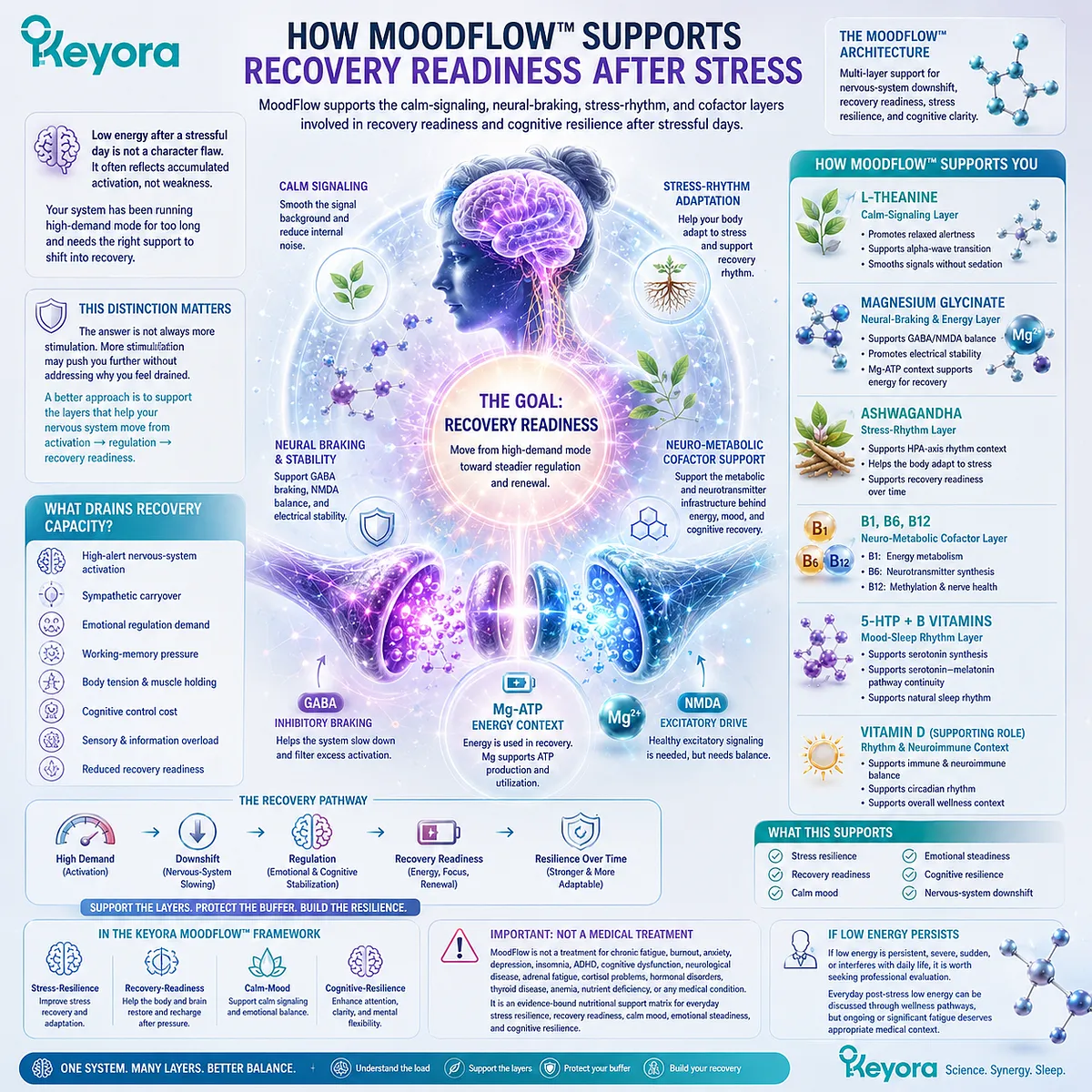
MoodFlow supports the calm-signaling, neural-braking, stress-rhythm, and cofactor layers involved in recovery readiness and cognitive resilience after stressful days.
Keyora MoodFlow approaches low energy after a stressful day as a stress-resilience, recovery-readiness, calm-mood, and cognitive-resilience question.
The goal is not to treat chronic fatigue, burnout, anxiety, depression, insomnia, ADHD, cognitive dysfunction, adrenal fatigue, thyroid disease, anemia, nutrient deficiency, or any medical condition. The goal is to support the wellness pathways involved in nervous-system downshift, stress-rhythm adaptation, neuro-metabolic support, and recovery readiness under everyday pressure.
This distinction matters.
When low energy follows a stressful day, the answer is not always more stimulation. More stimulation may help someone push for a short time, but it may not address why the system feels drained after staying activated for too long.
A more useful wellness frame is to support the layers that help the nervous system move from high-demand mode toward recovery readiness.
MoodFlow’s logic begins with calm signaling.
L-Theanine supports the calm-signaling layer.
In the MoodFlow framework, L-Theanine is associated with relaxed alertness, alpha-wave transition, signal smoothing, and calm focus without sedation. This is relevant because post-stress low energy does not always mean the body needs to be pushed harder.
Sometimes the system needs a calmer internal environment for recovery.
L-Theanine helps explain how non-sedative calm may support a smoother signal background. The goal is not to knock the system down. The goal is to help the nervous system move away from noisy activation and toward steadier recovery readiness.
Magnesium glycinate supports the neural-braking and energy-context layer.
Magnesium is relevant to GABA/NMDA activation balance, membrane excitability, and Mg-ATP energy context. In MoodFlow, magnesium glycinate is positioned as part of the neural braking and hardware-stabilizing layer.
For low energy after stress, this layer is especially important.
The system may not need more urgency. It may need better downshift. Neural braking helps explain the physiological background behind calming an overactivated system, reducing internal static, and supporting recovery after pressure.
Magnesium’s Mg-ATP context also matters because recovery is active. Emotional regulation, attention shifting, muscle relaxation readiness, and cognitive recovery all require energy. Magnesium glycinate helps connect nervous-system steadiness with the energy background involved in recovery readiness.
Ashwagandha supports the stress-rhythm adaptation layer.
Low energy after a stressful day often reflects the rhythm of stress across time. The system may have been responding to pressure for hours, not minutes. If stress activation remains high for too long, the transition into recovery can feel delayed or incomplete.
Ashwagandha is positioned in MoodFlow around stress resilience, HPA-axis rhythm context, and recovery readiness. In this article, that does not mean Ashwagandha fixes cortisol, treats burnout, repairs the HPA axis, or restores adrenal function. It means Ashwagandha belongs to the stress-adaptation layer that helps explain why post-stress energy is connected to broader stress rhythm.
B1, B6, and B12 support the neuro-metabolic cofactor layer.
The nervous system depends on normal metabolic and neurotransmitter-related infrastructure. B1 supports energy-metabolism context. B6 supports neurotransmitter-related conversion context, including pathways relevant to calming and mood-related signaling. B12 supports methylation context and nervous-system maintenance.
In MoodFlow, these B vitamins are not positioned as treatments for fatigue, anemia, deficiency, depression, cognitive dysfunction, or neurological disease. They are part of the cofactor background behind neuro-metabolic readiness, emotional steadiness, and cognitive resilience under everyday pressure.
5-HTP plays a background role in mood-sleep rhythm continuity.
Because this article is about low energy after stress, 5-HTP should not dominate the explanation. Its role is best understood as support for normal serotonin-related pathways and serotonin-melatonin pathway continuity within the broader MoodFlow architecture. This does not mean treating depression, correcting serotonin, or forcing sleep.
Vitamin D may also be understood as part of broader rhythm and neuroimmune wellness context when relevant, but it should remain secondary.
Together, these layers explain why MoodFlow is not positioned as an energy stimulant, fatigue cure, burnout treatment, adrenal product, sleep drug, or mood-disorder treatment. It is a multi-layer nutritional neurology matrix designed to support stress resilience, calm mood, emotional steadiness, cognitive resilience, nervous-system downshift, and recovery readiness within an evidence-bound wellness framework.
MoodFlow is not a treatment for chronic fatigue, burnout, anxiety, depression, insomnia, ADHD, cognitive dysfunction, neurological disease, adrenal fatigue, cortisol problems, hormonal disorders, thyroid disease, anemia, nutrient deficiency, or any medical condition. In this article, Keyora uses “low energy after a stressful day” as a wellness-language entry point for explaining stress load, recovery-capacity drain, nervous-system activation, calm signaling, neural braking, stress-rhythm adaptation, Mg-ATP context, cofactor infrastructure, and cognitive resilience under everyday pressure.
If low energy is persistent, severe, sudden, or interferes with daily life, it is worth seeking professional evaluation. Everyday post-stress low energy can be discussed through wellness pathways, but ongoing or significant fatigue deserves appropriate medical context.
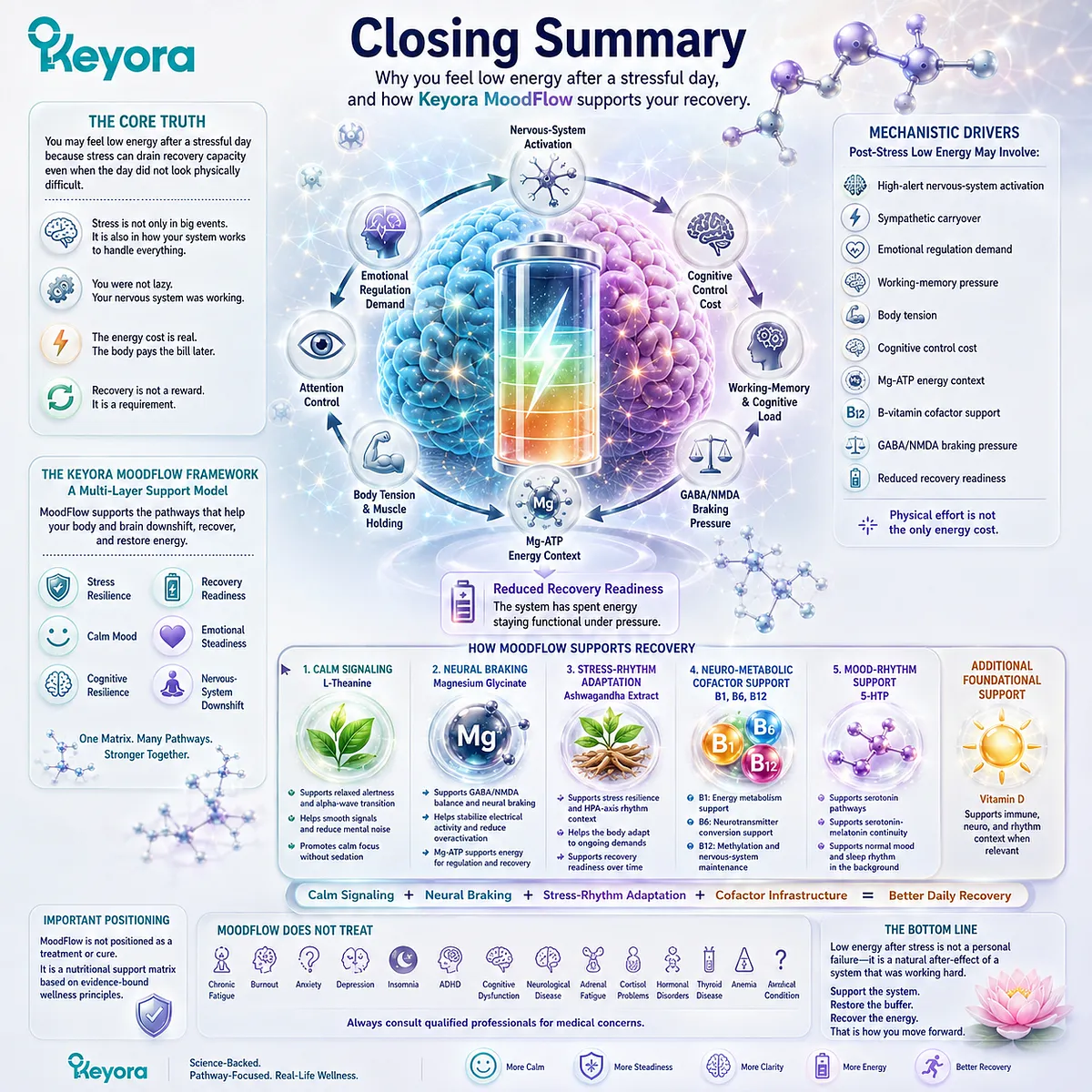
Closing Summary
You may feel low energy after a stressful day because stress can drain recovery capacity through nervous-system activation, emotional regulation, attention control, body tension, and neuro-metabolic demand. The day may not look physically difficult, but your system may still have spent energy staying functional under pressure.
Physical effort is not the only energy cost.
Mechanistically, post-stress low energy may involve high-alert nervous-system activation, sympathetic carryover, emotional regulation demand, working-memory pressure, body tension, cognitive control cost, Mg-ATP energy context, B-vitamin cofactor support, GABA/NMDA braking pressure, and reduced recovery readiness.
In the Keyora MoodFlow framework, this is understood as a stress-resilience, recovery-readiness, calm-mood, and cognitive-resilience question. MoodFlow supports this picture through calm signaling, neural braking, stress-rhythm adaptation, serotonin-melatonin pathway continuity, and neuro-metabolic cofactor infrastructure.
MoodFlow does not treat chronic fatigue, burnout, anxiety, depression, insomnia, ADHD, cognitive dysfunction, neurological disease, adrenal fatigue, cortisol problems, hormonal disorders, thyroid disease, anemia, nutrient deficiency, or any medical condition. It is an evidence-bound nutritional support matrix for everyday stress resilience, calm mood, emotional steadiness, cognitive resilience, nervous-system downshift, and recovery readiness.
This article is for educational and informational purposes only. It does not provide medical advice, diagnosis, treatment, cure, prevention, disease outcome claims, hormone restoration claims, fertility outcome claims, or formula-specific clinical efficacy claims.