
Why Do I Feel Like I’m Performing Calmness Around Other People?
Keyora Research Q&A Library
This is part of the Keyora Research Q&A Series, derived from Keyora Nutritional Neurology Series .
Within the Keyora Nutritional Neurology framework, this Q&A translates complex nutrient–brain mechanisms into reader-friendly, evidence-bound answers, focusing on stress resilience, sleep quality, calm mood support, cognitive wellness, and the broader interaction between nutrition, neurochemistry, and daily nervous-system function.
First published by Keyora Research Journal: www.keyorahealth.com
Direct Answer
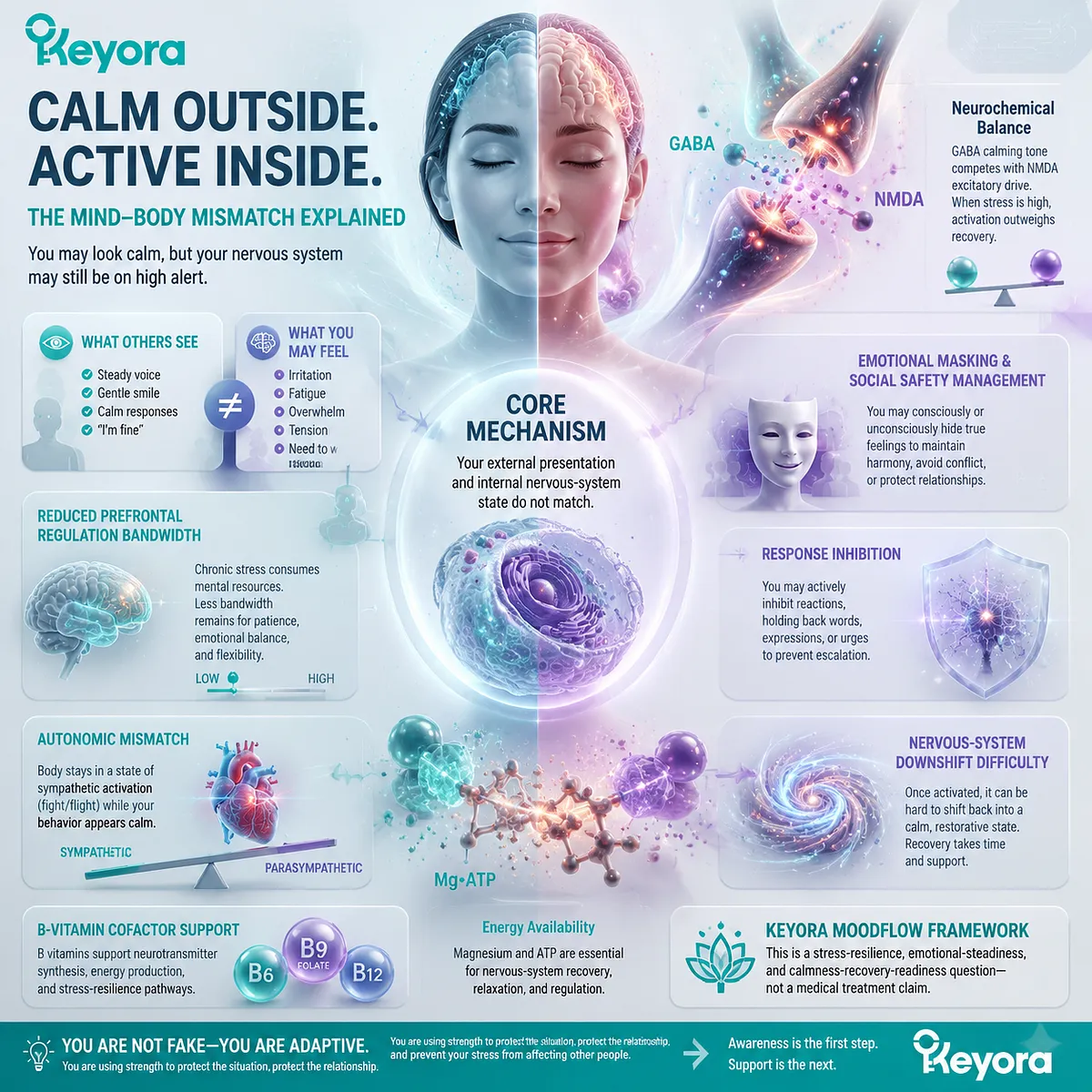
You may feel like you are performing calmness around other people because your outside presentation and your inside nervous-system state do not match.
You may look steady, speak gently, smile, nod, and say “I’m fine,” while your body is still tense, activated, overloaded, or trying hard not to react.
The mismatch is this: from the outside, other people may see calmness.
Inside, you may be using real effort to hide irritation, fatigue, overwhelm, tension, or the need to withdraw.
You are not necessarily being fake.
You may be trying to protect the situation, protect the relationship, or prevent your stress from affecting other people.
Mechanistically, this can involve emotional masking, social safety management, response inhibition, reduced prefrontal regulation bandwidth, autonomic mismatch, GABA/NMDA activation balance, nervous-system downshift difficulty, Mg-ATP energy context, and B-vitamin cofactor support.
In the Keyora MoodFlow framework, this is understood as a stress-resilience, emotional-steadiness, and calmness-recovery-readiness question, not a medical treatment claim.
When You Look Calm but Do Not Feel Calm
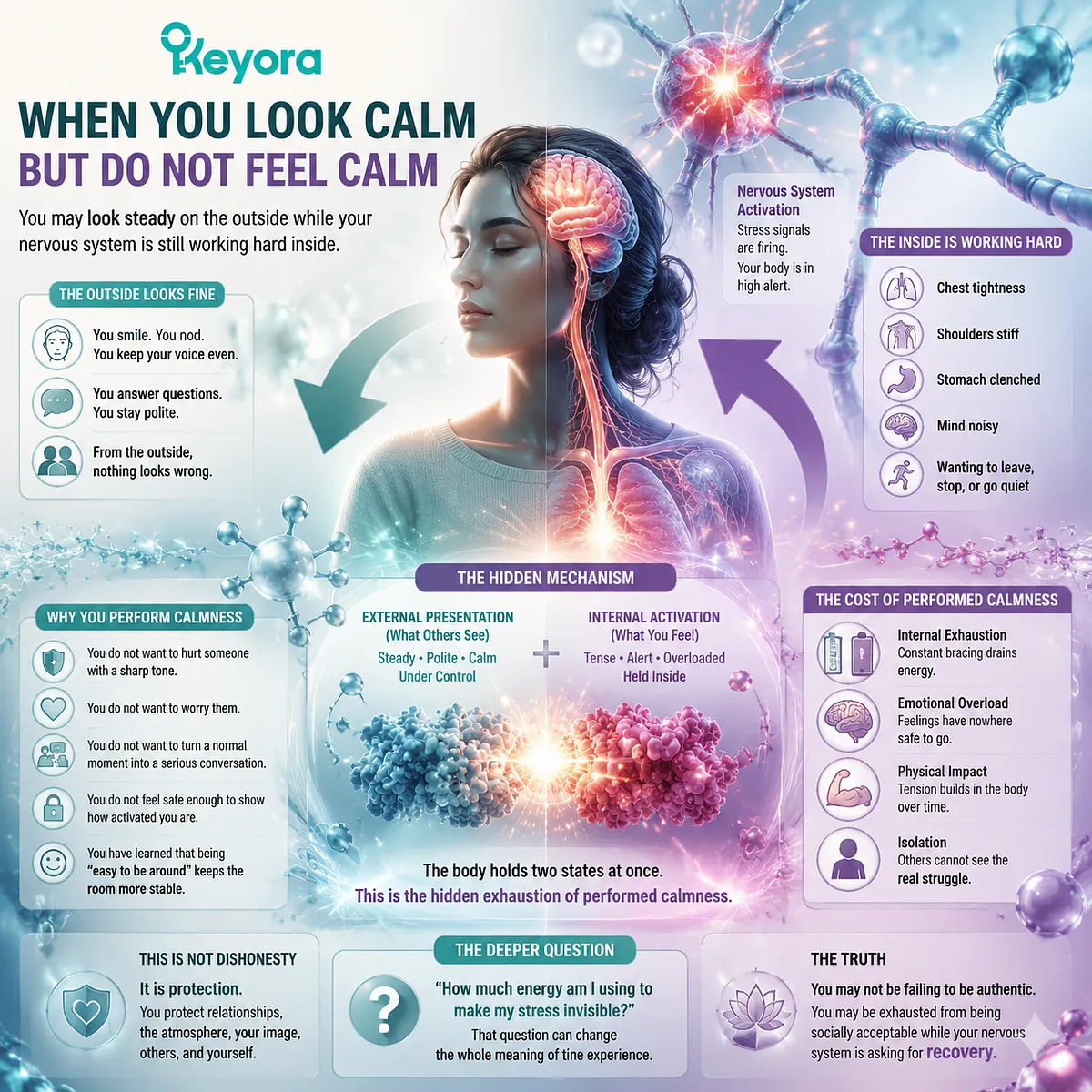
You may look steady on the outside while your nervous system is still working hard inside.
You may know the feeling of looking calm when you are not calm at all.
Someone asks how you are, and you say, “I’m fine.” You smile because it feels easier than explaining. You nod while someone talks. You keep your voice even. You make your face look neutral. You try not to sigh, not to sound sharp, not to seem distant, not to make the other person uncomfortable.
From the outside, nothing looks wrong.
But inside, your body may be telling a different story.
Your chest may feel tight. Your shoulders may be stiff. Your stomach may feel clenched. Your mind may feel noisy. You may want to leave the room, stop answering questions, or sit somewhere quiet where no one needs anything from you.
You may be standing there politely, but your nervous system is working.
This can be deeply confusing because other people may believe you are okay. They may keep talking because you look available. They may ask another question because you answered the last one gently. They may assume you are calm because you have learned how to appear calm.
Then you may feel even more alone.
Not because no one cares, but because no one can see how much effort it is taking for you to look normal.
This is where people often begin to blame themselves.
They may think, “Am I being fake?” or “Why can’t I just be honest?” or “Why do I smile when I actually want to disappear for a while?”
Some may feel guilty for hiding how tense they feel.
Others may feel ashamed because they think calmness should be real if it looks real.
But looking calm is not the same as feeling calm.
Sometimes what looks like calmness is actually emotional control. Sometimes what looks like patience is actually restraint. Sometimes what looks like social ease is actually careful self-management.
That does not make you dishonest.
It may mean you have learned to protect the people around you from the full intensity of what you are feeling.
-
Maybe you do not want to hurt someone with a sharp tone.
-
Maybe you do not want to worry them.
-
Maybe you do not want to turn a normal moment into a serious conversation.
-
Maybe you do not feel safe enough to show how activated you are.
-
Maybe you have learned that being “easy to be around” keeps the room more stable.
So you perform calmness.
Not as manipulation. Not as pretending. Not as weakness.
As protection.
You protect the relationship. You protect the atmosphere. You protect your image. You protect other people from your stress. You protect yourself from questions you do not have energy to answer.
But protection has a cost.
When you keep your outside calm while your inside stays activated, the body has to hold two states at once. Internally, it is bracing. Externally, it is presenting steadiness.
This is the hidden exhaustion of performed calmness.
The deeper question is not only, “Why do I act calm when I’m not?”
A more honest question is, “How much energy am I using to make my stress invisible?”
That question can change the whole meaning of the experience.
You may not be failing to be authentic.
You may be exhausted from being socially acceptable while your nervous system is asking for recovery.
Why Calmness Can Become a Social Performance
Under stress, calmness may become something you display to protect the situation, not something your body actually feels.
Calmness becomes a performance when the nervous system is still activated, but the social situation requires you to look regulated.
This can happen in families, friendships, workplaces, classrooms, public spaces, group settings, and even casual conversations. You may feel pressure to appear steady because showing stress could change the atmosphere.
You may think, “I should not make this awkward.”
You may think, “They do not need to know how overwhelmed I am.”
You may think, “If I show irritation, I will hurt them.”
You may think, “If I say I need space, they will misunderstand.”
So instead of expressing what is happening inside, you manage the outside.
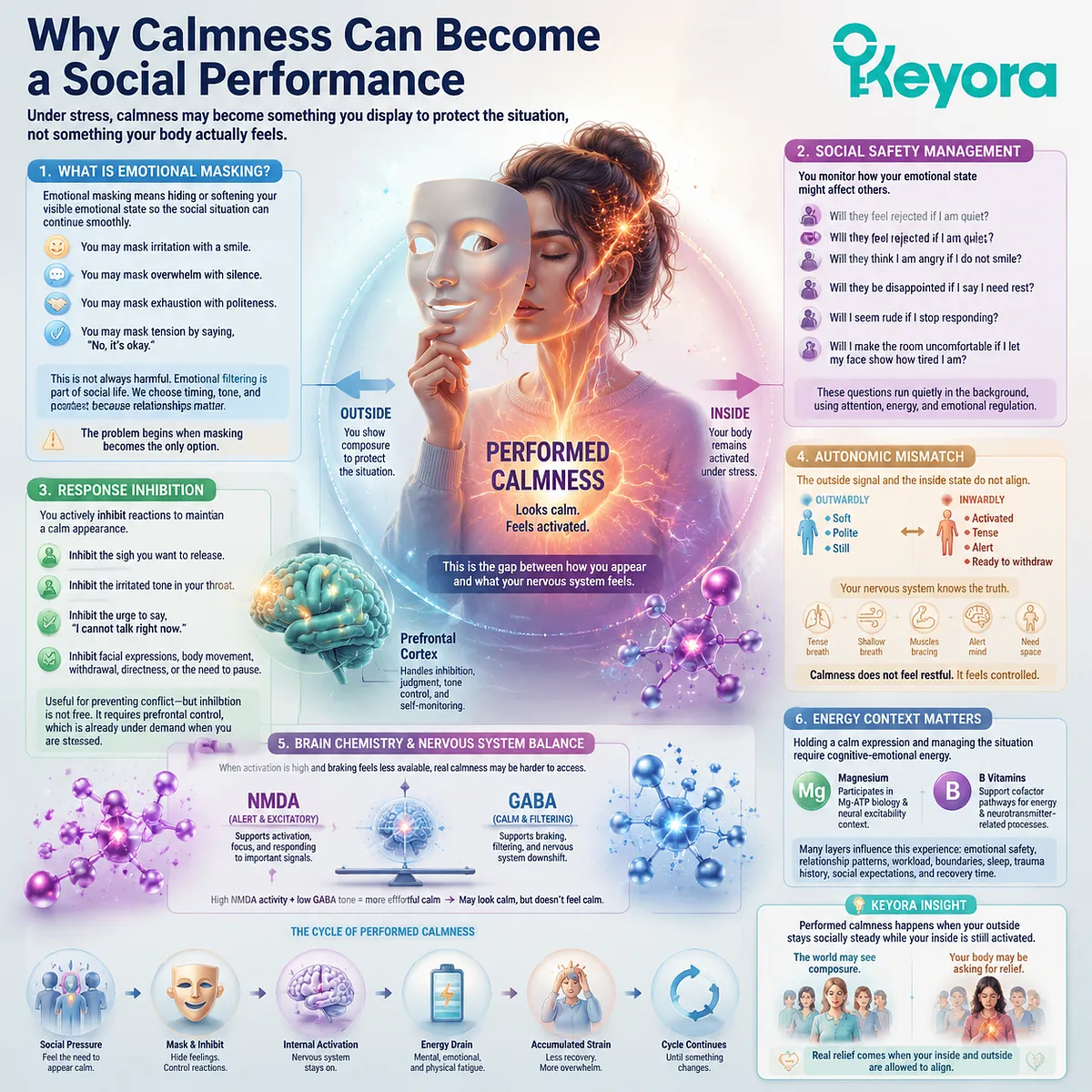
This is emotional masking.
Emotional masking means hiding or softening your visible emotional state so the social situation can continue smoothly.
-
You may mask irritation with a smile.
-
You may mask overwhelm with silence.
-
You may mask exhaustion with politeness.
-
You may mask tension by saying, “No, it’s okay.”
This is not always harmful.
In many situations, some emotional filtering is part of social life.
We do not express every feeling exactly as it appears.
We choose timing, tone, and context because relationships matter.
The problem begins when masking becomes the only option.
If you always have to look calm, even when you are not okay, the nervous system does not get a true recovery signal. It keeps working internally while the outside keeps performing externally.
That creates social safety management.
Social safety management means monitoring how your emotional state might affect others.
-
Will they feel rejected if I am quiet?
-
Will they think I am angry if I do not smile?
-
Will they be disappointed if I say I need rest?
-
Will I seem rude if I stop responding?
-
Will I make the room uncomfortable if I let my face show how tired I am?
These questions can run quietly in the background.
They use attention. They use energy. They use emotional regulation.
Performed calmness also requires response inhibition.
-
You may inhibit the sigh you want to release.
-
You may inhibit the irritated tone rising in your throat.
-
You may inhibit the urge to say, “I cannot talk right now.”
-
You may inhibit facial expressions, body movement, withdrawal, directness, or the need to pause.
Response inhibition can be useful. It helps prevent unnecessary conflict. It protects people from reactions that might not reflect your deeper values.
But inhibition is not free.
The prefrontal cortex helps with inhibition, social judgment, flexible response, tone control, and self-monitoring. It helps you appear composed when your inner state is not composed.
Under stress, that system may already be under demand.
Now it has to do two jobs at once.
It has to manage internal activation, and it has to maintain external calmness.
That dual task is exhausting.
This is where autonomic mismatch becomes important.
Autonomic mismatch means the outside signal and the inside state do not align.
Outwardly, you may be soft, polite, and still. Inwardly, your body may be activated, tense, alert, or ready to withdraw.
You may look okay, but you do not feel okay.
The nervous system may not be fooled by the performance. It still knows the body is tense. It still knows the breath is shallow. It still knows the muscles are bracing. It still knows you want space.
So the calmness does not feel restful. It feels controlled.
GABA/NMDA balance helps explain why this can feel so effortful. The nervous system needs activation to engage with the world, but it also needs braking and filtering to downshift.
NMDA-related activity can be understood as part of alert and excitatory processing.
GABA-related tone helps support calm filtering and nervous-system downshift.
When activation is high and braking feels less available, real calmness may be harder to access. In that state, people may rely more heavily on conscious control.
They may not feel calm.
They may only look calm.
Energy context also matters. Holding a calm expression, choosing gentle words, suppressing irritation, monitoring the room, and staying socially acceptable require cognitive-emotional energy. Magnesium participates in Mg-ATP biology and neural excitability context. B vitamins support cofactor pathways involved in energy metabolism and neurotransmitter-related processes.
This does not mean performed calmness is only nutritional. Emotional safety, relationship patterns, workload, boundaries, sleep, trauma history, social expectations, and recovery time all matter.
But it does mean the exhaustion is real.
Performed calmness happens when your outside stays socially steady while your inside is still activated.
The world may see composure.
Your body may be asking for relief.
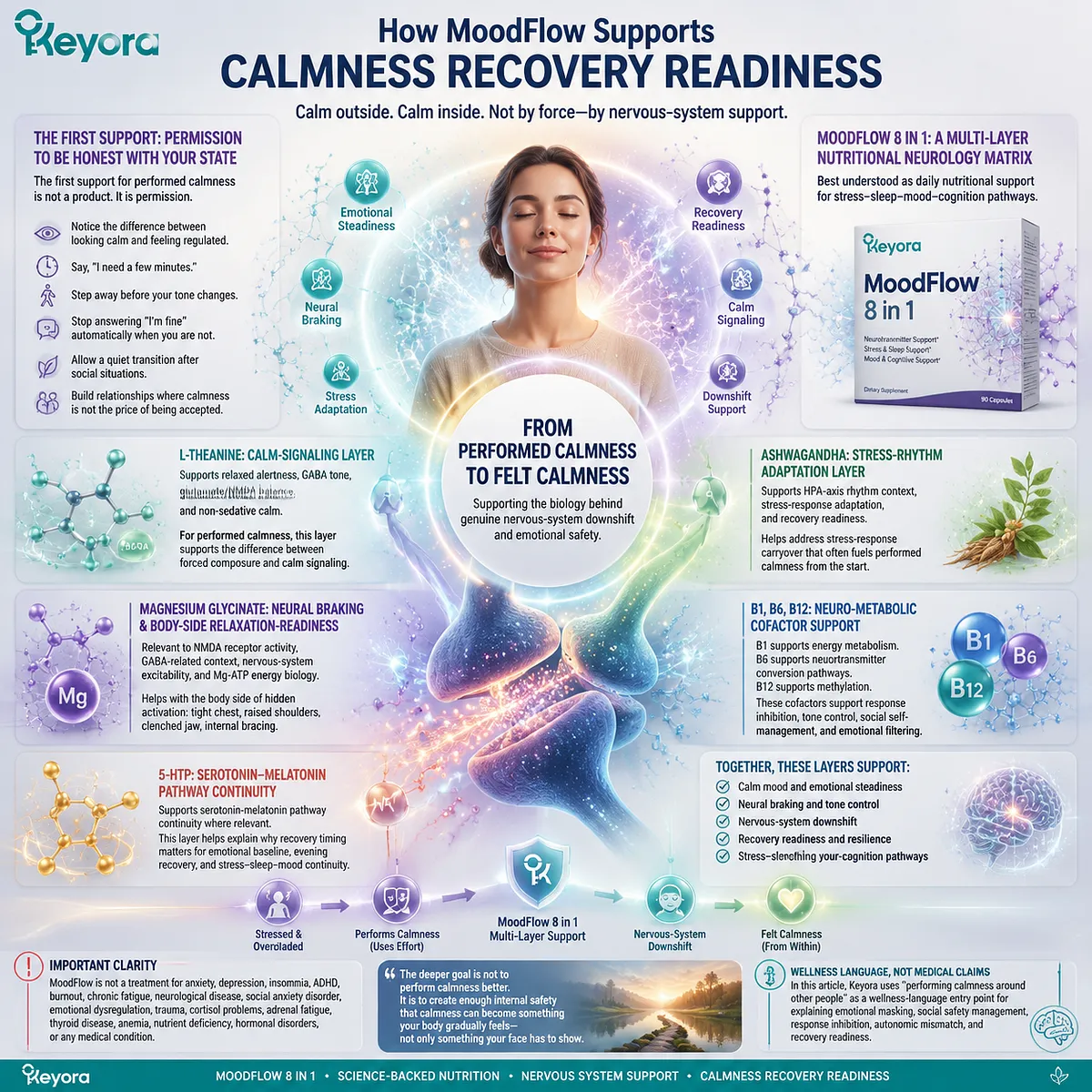
How MoodFlow Supports Calmness Recovery Readiness
MoodFlow supports the calm mood, neural braking, and recovery-readiness pathways behind more genuine nervous-system downshift.
The first support for performed calmness is not a product. It is permission to notice the difference between looking calm and actually feeling regulated.
You may need to say, “I need a few minutes.” You may need to step away before your tone changes. You may need to stop answering “I’m fine” automatically when you are not. You may need a quiet transition after social situations. You may need relationships where calmness is not the price of being accepted.
Nutritional support can sit beside these practical recovery choices.
Keyora MoodFlow 8 in 1 is best understood here as a multi-layer nutritional neurology matrix that supports stress-sleep-mood-cognition pathways.
L-Theanine supports the calm-signaling layer.
L-Theanine is commonly positioned around relaxed alertness, GABA-related tone, glutamate/NMDA balance, and non-sedative calm.
For performed calmness, this layer supports the difference between forced composure and calm signaling. The goal is not to numb emotion or erase social awareness. The goal is to support a steadier internal state so calmness does not have to be maintained only by effort.
Magnesium glycinate supports the neural braking and body-side relaxation-readiness layer.
Magnesium is relevant to NMDA receptor activity, GABA-related context, nervous-system excitability, and Mg-ATP energy biology.
For performed calmness, this layer speaks to the body side of hidden activation: tight chest, raised shoulders, clenched jaw, internal bracing, and the feeling of holding yourself together.
Ashwagandha supports the stress-rhythm adaptation layer.
Ashwagandha is positioned in the MoodFlow framework around HPA-axis rhythm context, stress-response adaptation, and recovery readiness.
This matters because performed calmness often appears after stress-response carryover has already built up. The person may not begin the interaction from a calm baseline. They may enter it already activated, then use social control to appear steady.
B1, B6, and B12 provide neuro-metabolic cofactor support.
B1 supports energy metabolism context. B6 is relevant to neurotransmitter-related conversion pathways. B12 supports methylation context.
Response inhibition, tone control, social self-management, and emotional filtering all depend on neuro-metabolic infrastructure.
5-HTP supports serotonin-melatonin pathway continuity where relevant.
In this article, 5-HTP is not the main focus. It belongs to the broader substrate-continuity layer supporting normal neurotransmitter-related pathways.
Where performed calmness connects with emotional baseline, evening recovery, or stress-sleep-mood continuity, serotonin-melatonin pathway continuity can help explain why recovery timing matters.
Together, these layers support calm mood, emotional steadiness, nervous-system downshift, and calmness recovery readiness.
MoodFlow is not a treatment for anxiety, depression, insomnia, ADHD, burnout, chronic fatigue, neurological disease, social anxiety disorder, emotional dysregulation, trauma, cortisol problems, adrenal fatigue, thyroid disease, anemia, nutrient deficiency, hormonal disorders, or any medical condition.
In this article, Keyora uses “performing calmness around other people” as a wellness-language entry point for explaining emotional masking, social safety management, response inhibition, autonomic mismatch, and recovery readiness.
The deeper goal is not to perform calmness better.
It is to create enough internal safety that calmness can become something your body gradually feels, not only something your face has to show.
Closing Summary
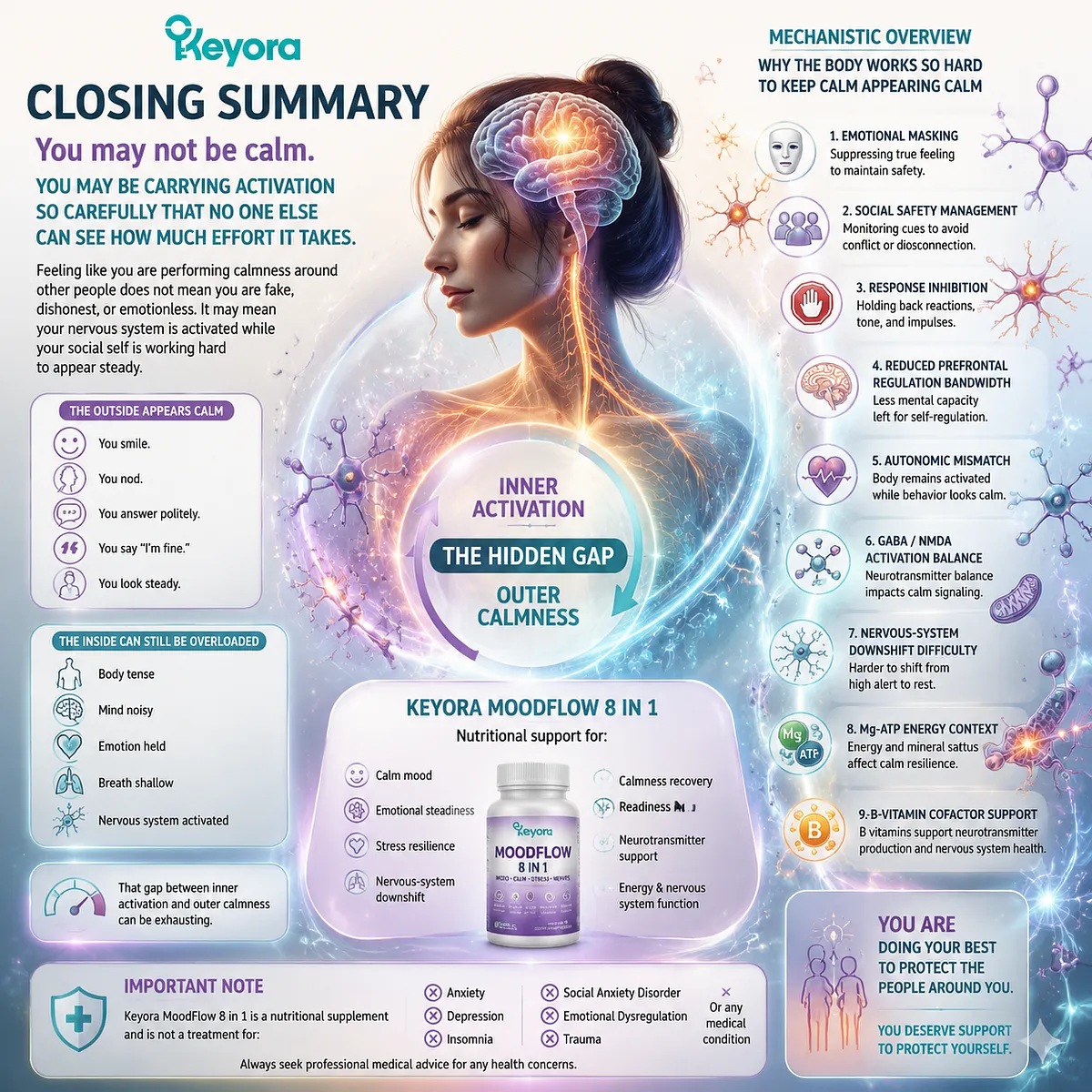
Feeling like you are performing calmness around other people does not mean you are fake, dishonest, or emotionless. It may mean your nervous system is activated while your social self is working hard to appear steady.
You may be smiling, nodding, answering politely, and saying “I’m fine,” while your body is still tense, overloaded, or asking for quiet. That gap between inner activation and outer calmness can be exhausting.
Mechanistically, this can involve emotional masking, social safety management, response inhibition, reduced prefrontal regulation bandwidth, autonomic mismatch, GABA/NMDA activation balance, nervous-system downshift difficulty, Mg-ATP energy context, and B-vitamin cofactor support.
Keyora MoodFlow 8 in 1 fits as nutritional support for calm mood, emotional steadiness, stress resilience, nervous-system downshift, and calmness recovery readiness. It is not a treatment for anxiety, depression, insomnia, social anxiety disorder, emotional dysregulation, trauma, or any medical condition.
You may not be calm.
You may be carrying activation so carefully that no one else can see how much effort it takes.
This article is for educational and informational purposes only. It does not provide medical advice, diagnosis, treatment, cure, prevention, disease outcome claims, hormone restoration claims, fertility outcome claims, or formula-specific clinical efficacy claims.