
Why Do I Feel Emotionally Raw After Too Many Interactions?
Keyora Research Q&A Library
This is part of the Keyora Research Q&A Series, derived from Keyora Nutritional Neurology Series .
Within the Keyora Nutritional Neurology framework, this Q&A translates complex nutrient–brain mechanisms into reader-friendly, evidence-bound answers, focusing on stress resilience, sleep quality, calm mood support, cognitive wellness, and the broader interaction between nutrition, neurochemistry, and daily nervous-system function.
First published by Keyora Research Journal: www.keyorahealth.com

Direct Answer
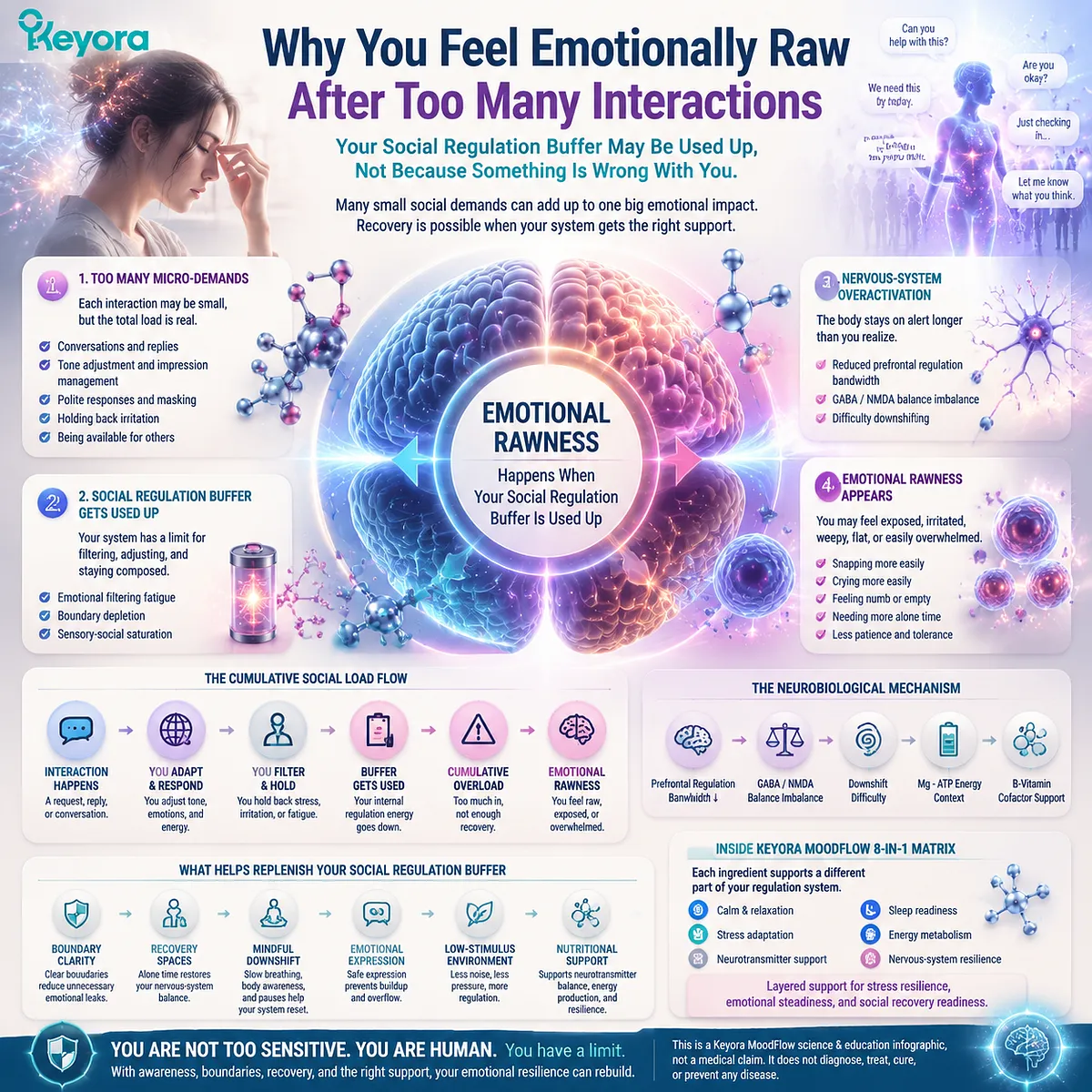
You may feel emotionally raw after too many interactions because your social regulation buffer has been used up. Each conversation, reply, explanation, smile, tone adjustment, and polite response may seem small on its own, but together they can wear down the emotional layer that usually helps you stay steady.
The mismatch is this: from the outside, nothing dramatic may have happened. There may have been no argument, no crisis, no obvious reason to feel so exposed. But inside, your nervous system may have spent hours filtering, responding, monitoring tone, managing your face, holding back irritation, staying available, and trying not to let stress leak out.
This does not mean you dislike people. It may mean you have had too much interaction without enough recovery.
Mechanistically, this can involve cumulative social load, emotional filtering fatigue, boundary depletion, sensory-social saturation, reduced prefrontal regulation bandwidth, GABA/NMDA activation balance, nervous-system downshift difficulty, Mg-ATP energy context, and B-vitamin cofactor support.
In the Keyora MoodFlow framework, this is understood as a stress-resilience, emotional-steadiness, and social-recovery-readiness question, not a medical treatment claim.
When One More Interaction Feels Like Too Much
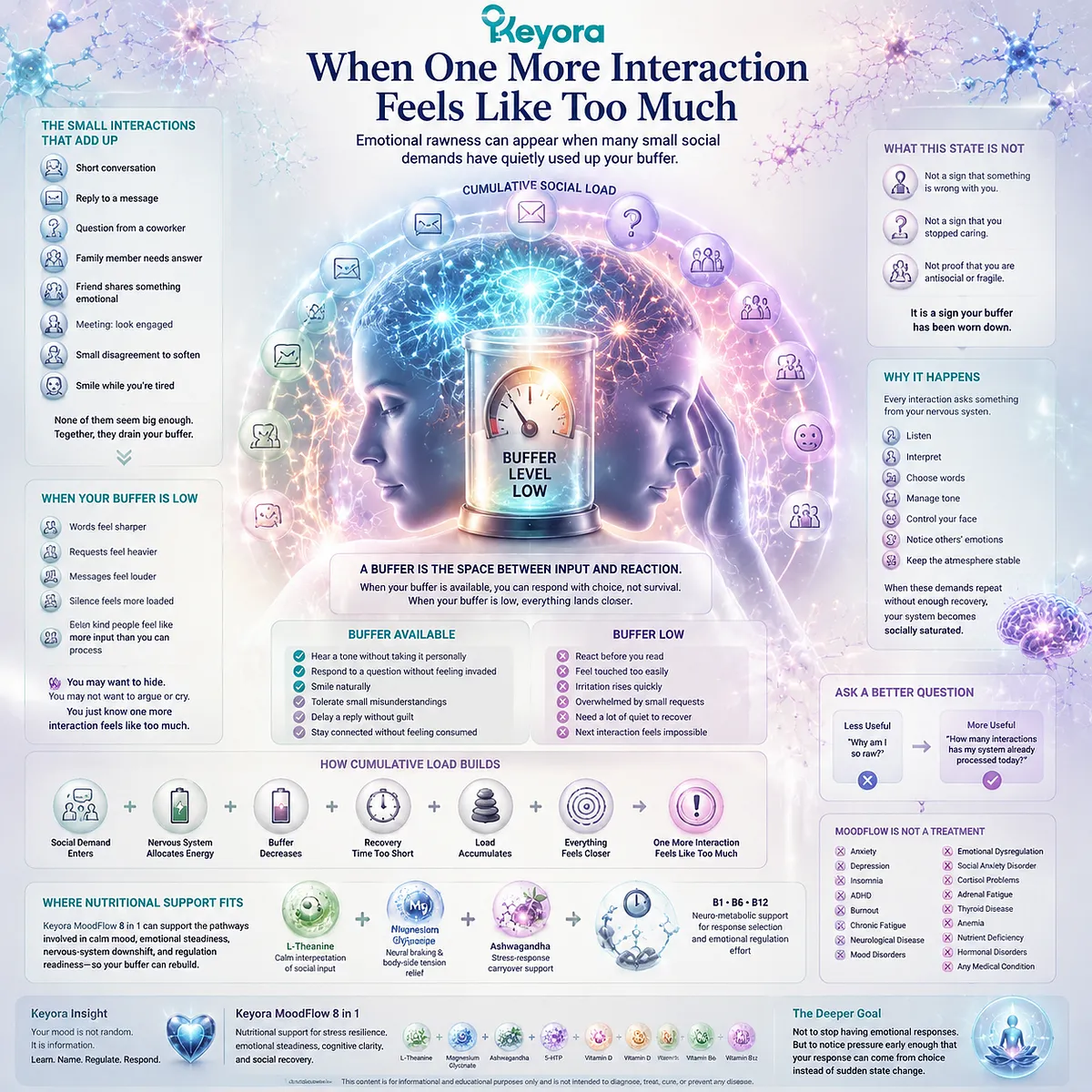
Emotional rawness can appear when many small social demands have quietly used up your buffer.
Sometimes you do not feel raw after one big event.
You feel raw after too many small ones.
A short conversation in the morning. A quick reply to a message. A question from a coworker. A family member needing an answer. A friend sharing something emotional. A meeting where you had to look engaged. A small disagreement you had to soften. A few moments when you had to smile even though you were tired.
None of them may seem serious enough to explain how you feel later.
But by the end of the day, something feels different.
Your emotional skin feels thinner.
Someone asks one more question, and you want to hide. A notification appears, and your body reacts before you read it. A person speaks in a slightly heavier tone, and it lands too hard. A simple request feels too close. A normal conversation feels like it is touching a place that has no protection left.
You may not want to argue.
You may not want to cry.
You may not even know exactly what you feel.
You just know that one more interaction feels like too much.
This is the kind of state people often misunderstand. They may think, “Why am I being so sensitive?” or “Why do I need quiet so badly?” or “Why does everything feel too close right now?”
Some people judge themselves even more harshly. They think they are antisocial, fragile, selfish, or not good at being around people.
But emotional rawness after too many interactions is not always a sign that something is wrong with who you are. It can be a sign that your buffer has been worn down.
A buffer is the space between input and reaction.
When that buffer is available, you can hear a tone without taking it too personally. You can respond to a question without feeling invaded. You can smile naturally. You can tolerate small misunderstandings. You can delay a reply without feeling guilty. You can stay connected without feeling consumed.
But when that buffer is low, everything lands closer.
Words feel sharper. Requests feel heavier. Messages feel louder. Silence feels more loaded. Even kind people may feel like more input than your system can process.
This does not mean you suddenly stopped caring.
It may mean caring has been costing you energy all day.
Every interaction asks something from the nervous system. It may ask you to listen, interpret, choose words, manage tone, control your face, respond politely, notice the other person’s emotional state, or keep the social atmosphere stable.
When these demands repeat without enough recovery, the system can become socially saturated.
Then the next interaction does not arrive into an empty space. It arrives on top of everything that came before.
That is why the final message, final question, or final voice in the room may feel disproportionately hard.
It is not always the final interaction itself.
It is the cumulative load underneath it.
The deeper question is not only, “Why am I so raw?”
A more useful question is, “How many interactions has my system already processed today?”
That question changes the meaning.
You may not be too sensitive.
You may be under-recovered.
Why Too Many Interactions Wear Down Your Emotional Buffer
Even pleasant interactions can become costly when they require continuous filtering, responding, and social availability.
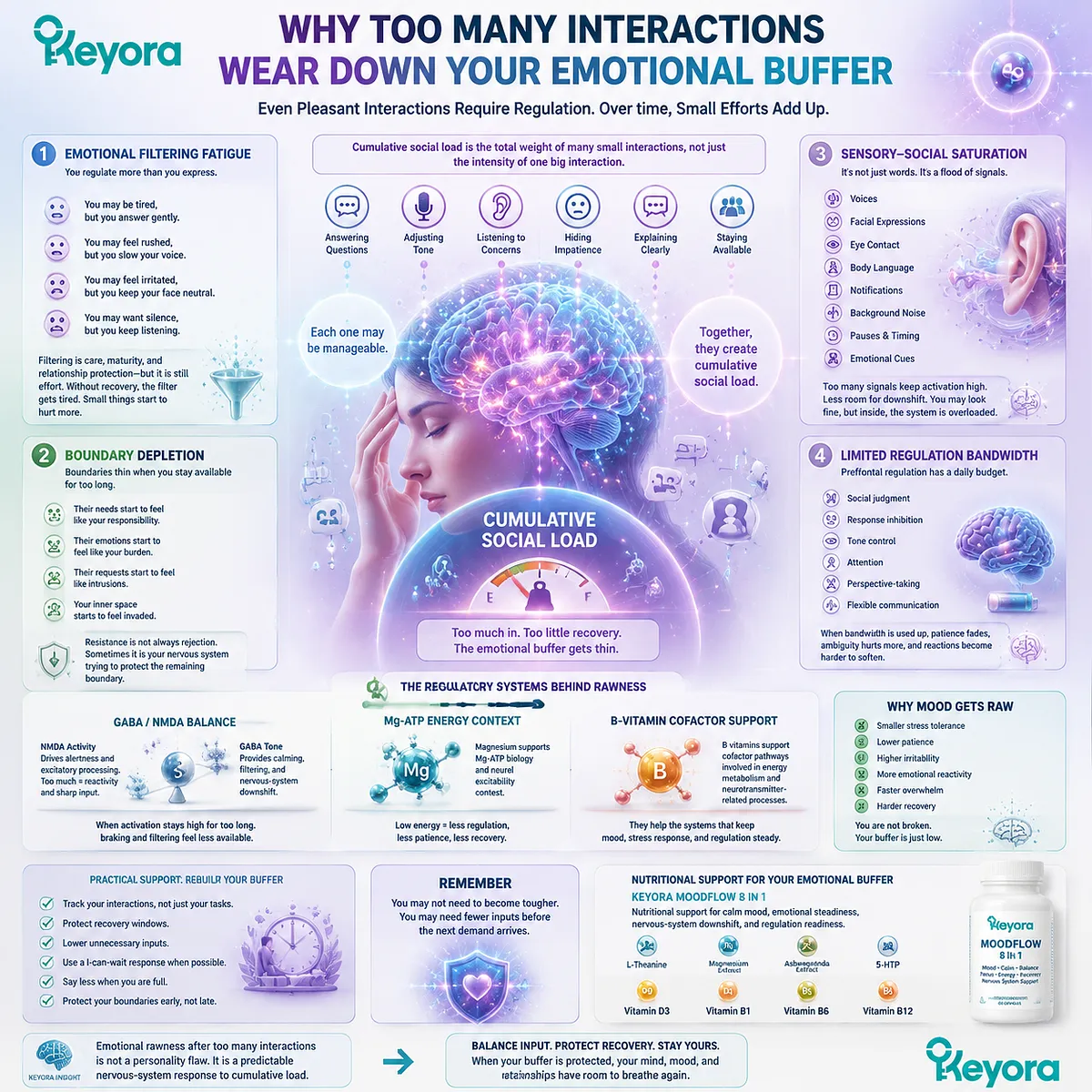
Too many interactions can leave you emotionally raw because social contact requires regulation, even when the contact is positive.
This is easy to miss.
People often assume only conflict drains the nervous system. But many ordinary interactions also carry small regulation costs. You may answer questions, adjust your tone, decide how much to share, listen to someone’s concern, make your face look engaged, suppress impatience, or explain something in a way that does not sound harsh.
Each one may be manageable.
Together, they become cumulative social load.
Cumulative social load is the total weight of many small interactions, not just the intensity of one big interaction. It is what builds when a person has to stay available, responsive, polite, and emotionally filtered for too long.
One major mechanism is emotional filtering fatigue.
In many interactions, you do not express your internal state exactly as it appears. You may be tired, but you answer gently. You may feel rushed, but you slow your voice. You may feel irritated, but you keep your face neutral. You may want silence, but you keep listening.
This filtering is not fake. It is often part of care, maturity, and relationship protection.
But it is still effort.
If you filter your emotions repeatedly without a recovery window, the filter gets tired. Then later, small things pass through more easily. A tone hurts more. A request irritates more. A message feels more demanding. A pause feels more personal.
That is emotional rawness.
Boundary depletion is another part of the experience.
When you are socially resourced, other people’s needs may feel separate from you. Someone can ask a question, and you can decide whether to answer. Someone can have an emotion, and you can care without absorbing it. Someone can need something, and you can respond without feeling invaded.
But after too many interactions, the boundary between “their input” and “my inner space” can feel thinner.
Someone comes close, and it feels too close. Someone asks for something, and it feels like they are reaching into the last protected part of you. Someone wants a response, and you feel your whole body resist.
That resistance is not always rejection of the person.
Sometimes it is the nervous system trying to protect the remaining boundary.
Sensory-social saturation also matters.
Interaction is not only words. It includes voices, facial expressions, eye contact, body movement, notifications, background noise, pauses, timing, and emotional cues. A day full of interaction can become a day full of signals.
The nervous system has to filter all of them.
When those signals keep arriving, activation can stay high. There may be less room for downshift. The person may look functional, but inside, the system may be carrying more input than it can smoothly process.
The prefrontal cortex is also involved because it supports social judgment, response inhibition, tone control, attention, perspective-taking, and flexible communication. These are the skills that help you stay patient, kind, and appropriate across many interactions.
But prefrontal regulation bandwidth is limited.
When it has been used all day, you may still know how you want to behave, but the ability to access that behavior becomes harder. You may have less patience, less emotional padding, less tolerance for ambiguity, and less ability to keep every reaction softened.
GABA/NMDA balance can help explain why rawness feels like input is landing too sharply. The nervous system needs activation to engage with people, but it also needs braking and filtering so social signals do not become too intense. NMDA-related activity can be understood as part of alert and excitatory processing. GABA-related tone helps support calm filtering and nervous-system downshift.
When activation has stayed high for too long, the braking and filtering side may feel less available.
Energy context matters too. Social regulation requires attention, inhibition, word choice, emotional filtering, and recovery. Magnesium participates in Mg-ATP biology and neural excitability context. B vitamins support cofactor pathways involved in energy metabolism and neurotransmitter-related processes.
This does not mean emotional rawness is only nutritional. Sleep, workload, boundaries, relationship safety, digital input, sensory load, food timing, and genuine alone time all matter.
But it does mean the experience is not imaginary.
Emotional rawness after too many interactions can happen when the system has spent too long filtering, responding, and staying socially available without enough recovery.
You may not need to become tougher.
You may need fewer inputs before the next demand arrives.
What Helps When You Feel Emotionally Raw After Too Many Interactions
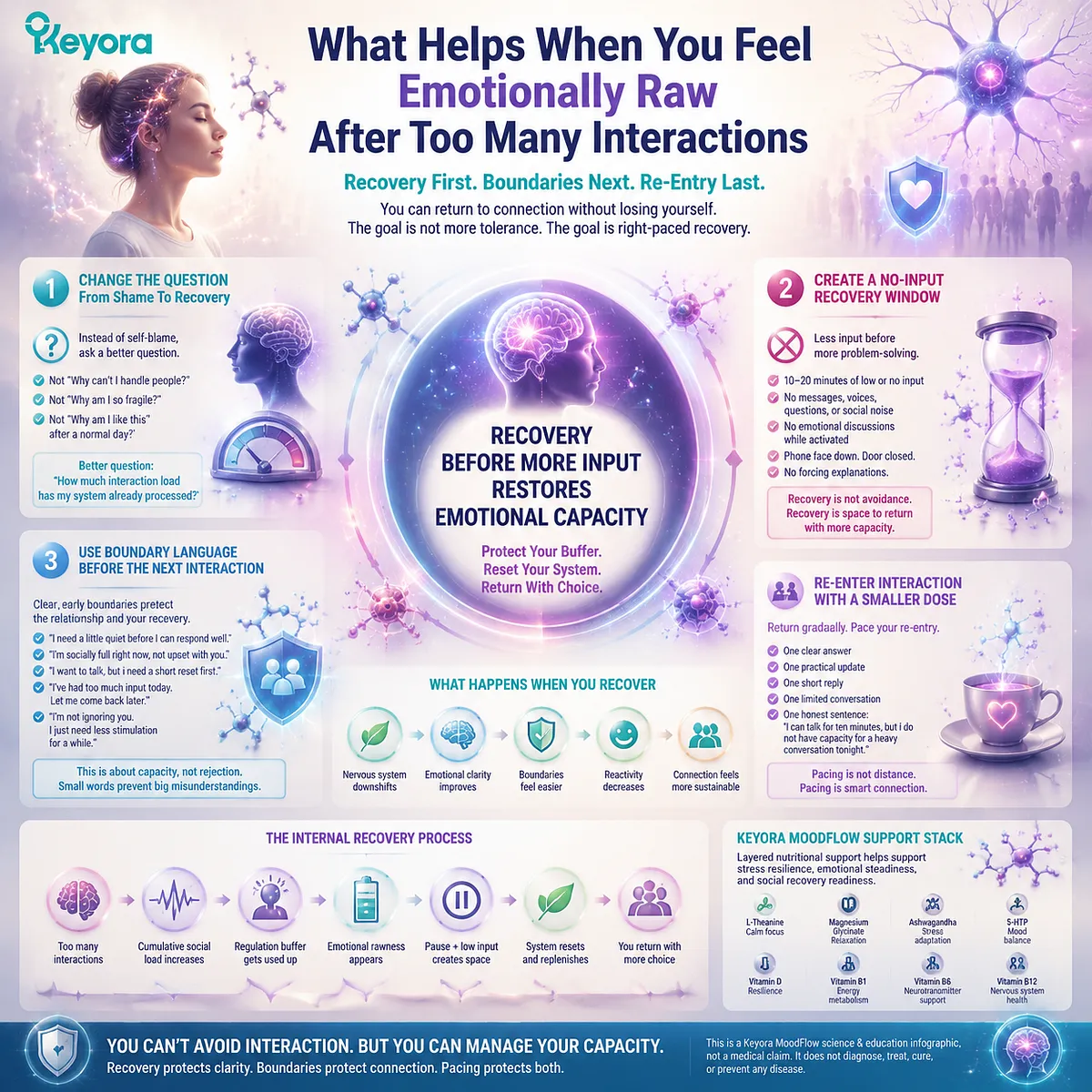
The first step is not to force more tolerance, but to create a recovery window before more input arrives.
When you feel emotionally raw after too many interactions, the most helpful response is usually not to push yourself into more tolerance.
That can make the rawness worse.
Instead, begin by changing the question.
Not, “Why can’t I handle people?”
Not, “Why am I so fragile?”
Not, “Why am I like this after a normal day?”
A better question is: “How much interaction load has my system already processed?”
This question matters because it moves you away from shame and toward recovery.
If you have been listening, responding, smiling, explaining, filtering, adjusting tone, replying to messages, sitting through meetings, and managing other people’s needs, your nervous system has been doing work. Even if nothing dramatic happened, the work still counts.
The second step is to create a no-input recovery window.
Emotionally raw states often need less input before they need more problem-solving. That may mean 10 to 20 minutes without messages, voices, questions, background social noise, or emotional discussion.
This is not avoidance.
Avoidance says, “I will never deal with this.”
Recovery says, “I need space so I can return with more capacity.”
A no-input window might look simple. Phone face down. Door closed. No immediate replies. No serious conversation while your body is still activated. No forcing yourself to explain your mood before you understand it.
During that window, the goal is not to become perfectly calm.
The goal is to stop adding new signals.
The third step is to use boundary language before the next interaction. Many people wait until they are already irritated before setting a boundary. But when you are emotionally raw, boundary language works better when it is used early and gently.
Useful sentences include:
“I need a little quiet before I can respond well.”
“I’m socially full right now, not upset with you.”
“I want to talk, but I need a short reset first.”
“I’ve had too much input today. Let me come back later.”
“I’m not ignoring you. I just need less stimulation for a while.”
These sentences protect the relationship because they clarify what is happening. They tell the other person, “This is about capacity, not rejection.”
That distinction is important.
When people do not explain the need for quiet, others may misread it as coldness, anger, or distance. A small boundary sentence can reduce that misunderstanding while still protecting your recovery.
The fourth step is to re-enter interaction with a smaller dose.
Do not move from emotional rawness directly into a deep emotional conversation if your system is not ready. Do not force a long explanation when one short reply would be enough. Do not turn every delayed response into a full apology.
Start smaller.
One clear answer.
One practical update.
One short reply.
One limited conversation.
One honest sentence: “I can talk for ten minutes, but I do not have capacity for a heavy conversation tonight.”
This is not being distant. It is pacing.
When your buffer is low, re-entry should be gradual. The goal is not to prove you can handle unlimited interaction. The goal is to return to connection without losing the small amount of steadiness you have recovered.
Where Nutritional Support Fits
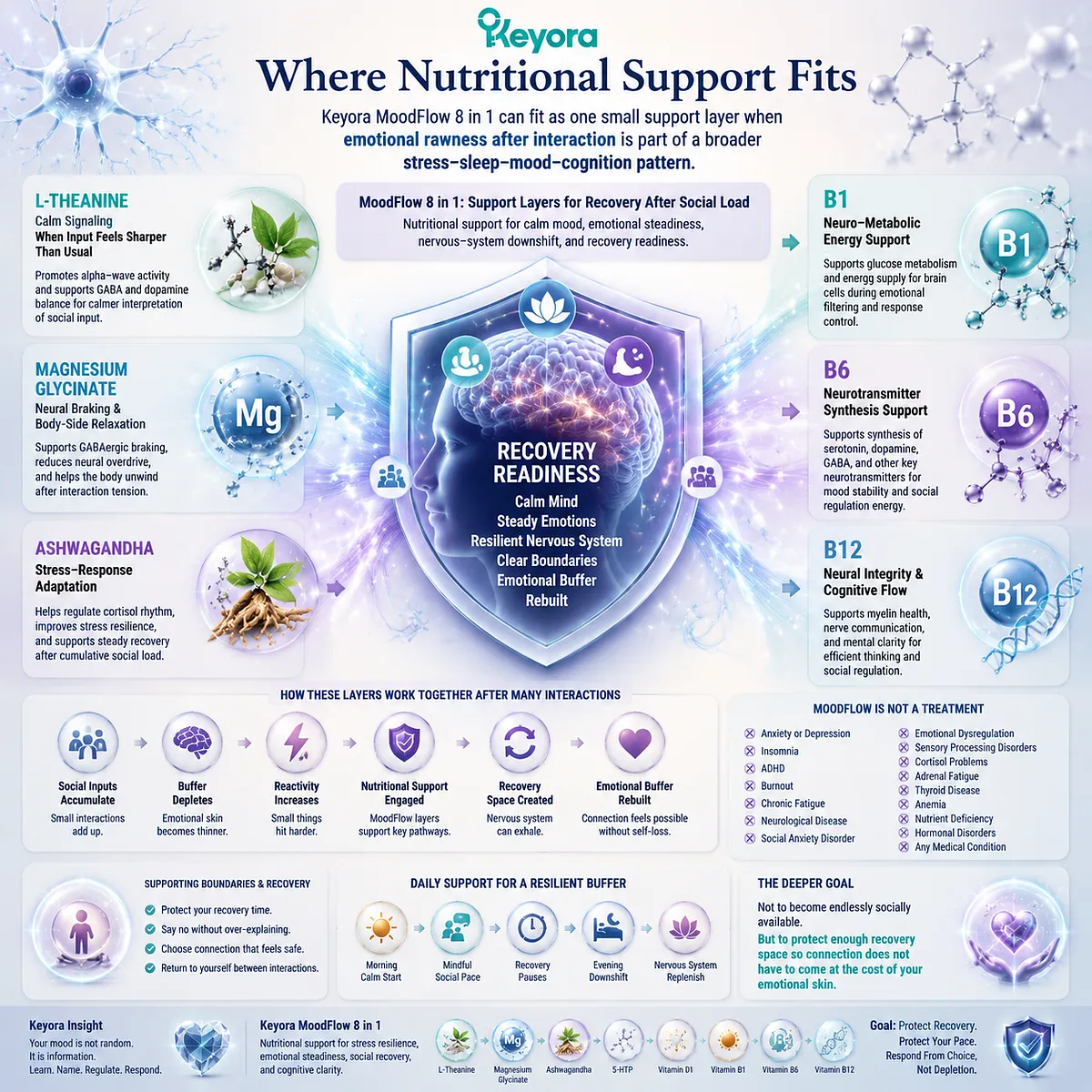
Keyora MoodFlow 8 in 1 can fit as one small support layer when emotional rawness after interaction is part of a broader stress-sleep-mood-cognition pattern. It should not be understood as something that makes a person socially available on demand, removes the need for boundaries, or replaces recovery time.
Its role is narrower: supporting nutritional pathways involved in calm mood, emotional steadiness, nervous-system downshift, and recovery readiness after cumulative social load.
For this topic, the most relevant layers are L-Theanine for calm signaling when input feels sharper than usual, magnesium glycinate for neural braking and body-side relaxation readiness after interaction-related tension, Ashwagandha for stress-response adaptation under cumulative social load, and B1, B6, and B12 for neuro-metabolic support behind emotional filtering, response control, and social regulation energy.
MoodFlow is not a treatment for anxiety, depression, insomnia, ADHD, burnout, chronic fatigue, neurological disease, social anxiety disorder, emotional dysregulation, sensory processing disorders, cortisol problems, adrenal fatigue, thyroid disease, anemia, nutrient deficiency, hormonal disorders, or any medical condition.
In this article, Keyora uses “feeling emotionally raw after too many interactions” as a wellness-language entry point for explaining cumulative social load, emotional buffer depletion, social boundary fatigue, and recovery readiness.
The deeper goal is not to become endlessly socially available.
It is to protect enough recovery space so connection does not have to come at the cost of your emotional skin.
Closing Summary
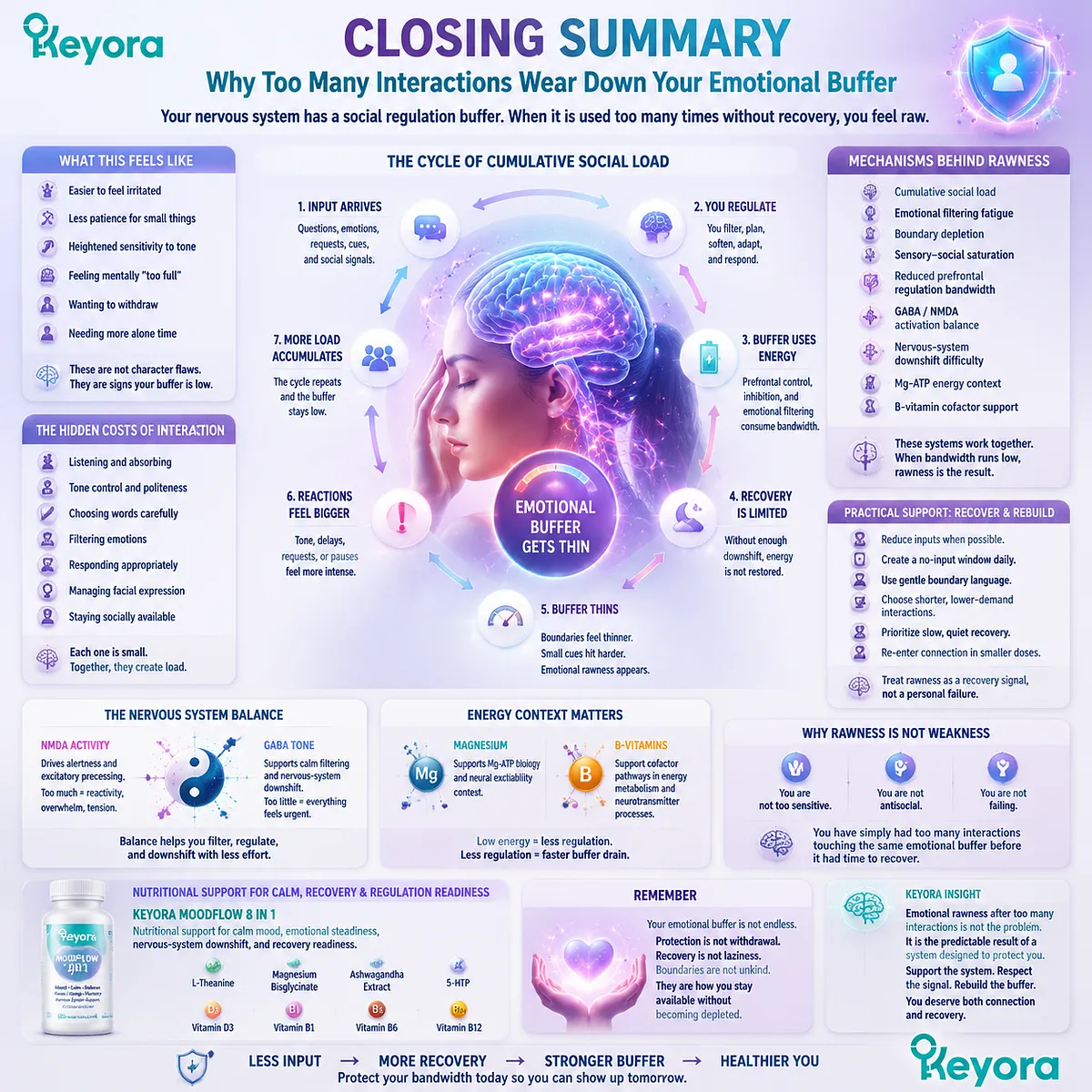
Feeling emotionally raw after too many interactions does not mean you hate people, lack social skills, or are too fragile. It may mean your social regulation buffer has been worn down by cumulative interaction load.
Even pleasant or ordinary interactions can require listening, tone control, emotional filtering, response selection, facial management, and social awareness. When these demands repeat without enough recovery, your emotional buffer can feel thin.
Mechanistically, this can involve cumulative social load, emotional filtering fatigue, boundary depletion, sensory-social saturation, reduced prefrontal regulation bandwidth, GABA/NMDA activation balance, nervous-system downshift difficulty, Mg-ATP energy context, and B-vitamin cofactor support.
Practical support begins by treating rawness as a recovery signal: reduce input, create a no-input window, use gentle boundary language, and re-enter interaction in smaller doses.
Keyora MoodFlow 8 in 1 fits only as a nutritional support layer for calm mood, emotional steadiness, nervous-system downshift, and recovery readiness. It is not a treatment for anxiety, depression, emotional dysregulation, social anxiety disorder, or any medical condition.
You may not be too sensitive.
You may simply have had too many interactions touching the same emotional buffer before it had time to recover.
This article is for educational and informational purposes only. It does not provide medical advice, diagnosis, treatment, cure, prevention, disease outcome claims, hormone restoration claims, fertility outcome claims, or formula-specific clinical efficacy claims.