
Why Do I Feel Emotionally Drained After Stress?
Keyora Research Q&A Library
This is part of the Keyora Research Q&A Series, derived from Keyora Nutritional Neurology Seriers .
Within the Keyora Nutritional Neurology framework, this Q&A translates complex nutrient–brain mechanisms into reader-friendly, evidence-bound answers, focusing on stress resilience, sleep quality, calm mood support, cognitive wellness, and the broader interaction between nutrition, neurochemistry, and daily nervous-system function.
First published by Keyora Research Journal: www.keyorahealth.com

Direct Answer
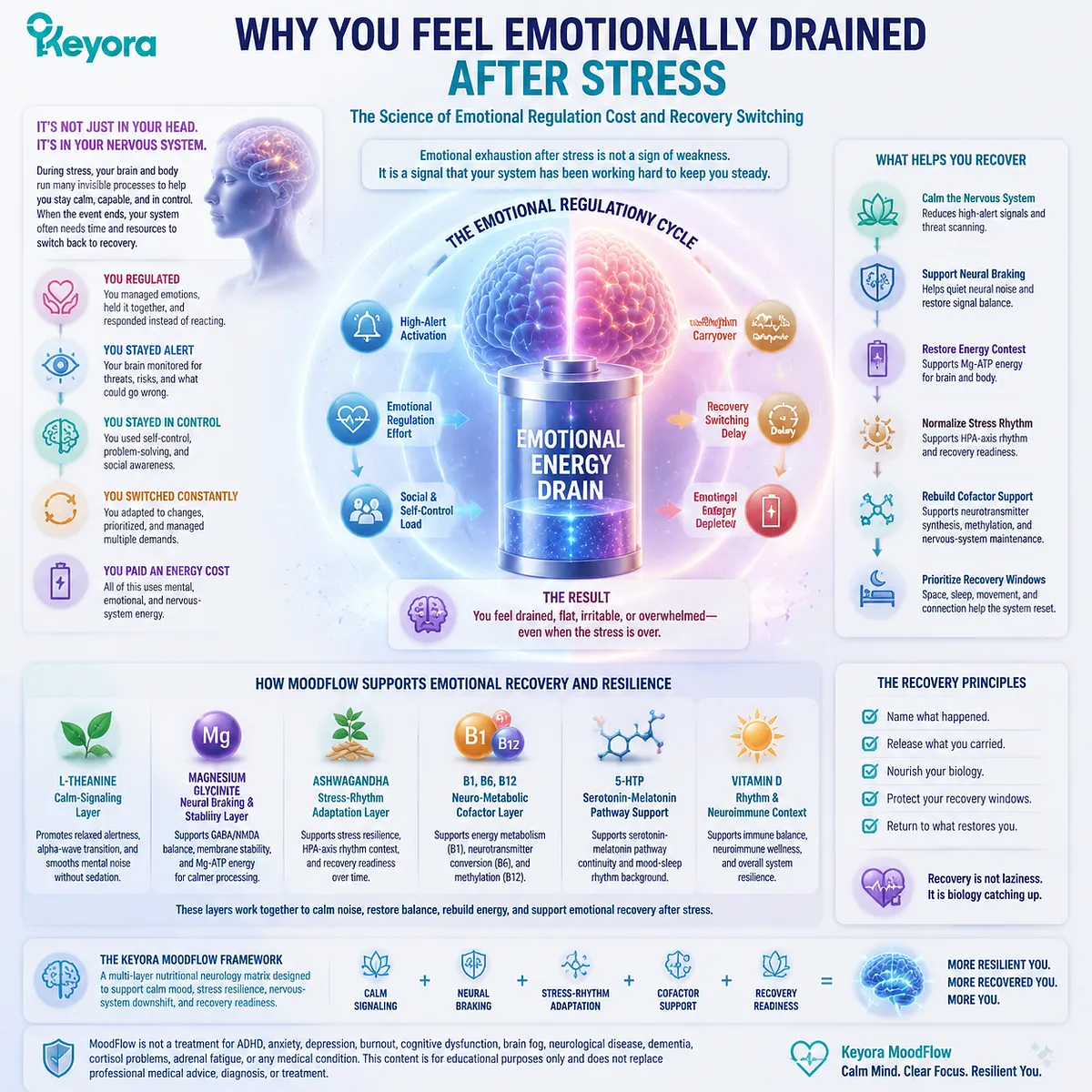
You can feel emotionally drained after stress because emotional regulation, high-alert monitoring, and recovery switching can use energy even after the stressful event is over.
The event may have ended, but your emotional system may still be paying the cost of staying regulated through it.
The problem is not always that you are weak, antisocial, or too sensitive.
The problem is that stress event ending does not always mean emotional recovery is complete.
Under pressure, you may need to stay calm, stay polite, respond clearly, control irritation, manage worry, avoid overreacting, and keep functioning. That invisible emotional regulation work can reduce your emotional buffer.
Mechanistically, this can involve high-alert nervous-system activation, emotional regulation cost, social and self-control load, stress-rhythm carryover, GABA/NMDA activation balance, neural braking, Mg-ATP energy context, B-vitamin cofactor support, and delayed recovery readiness.
In the Keyora MoodFlow framework, this is understood as a calm-mood, stress-resilience, and emotional-recovery-readiness question, not a medical treatment claim.
Why Stress Can Leave You Emotionally Empty
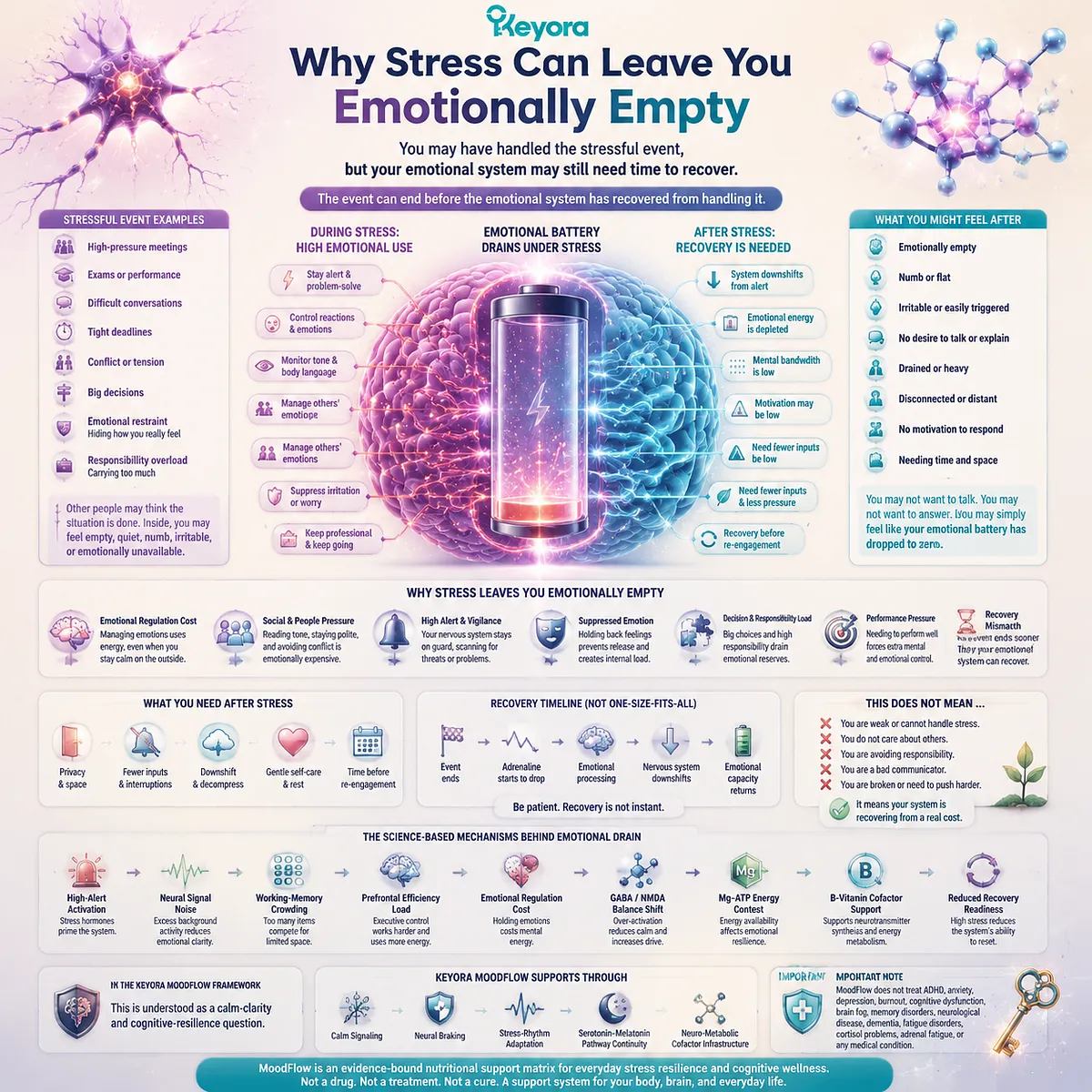
You may have handled the stressful event, but your emotional system may still need time to recover.
Sometimes you finish the stressful thing, but you do not feel relieved right away.
The meeting ends. The exam is over. The conversation is finished. The difficult message has been sent. The deadline has passed. The conflict has cooled down. Other people may think the situation is done, but inside, you may feel empty, quiet, numb, irritable, or emotionally unavailable.
You may not want to talk. You may not want to explain. You may not want to answer another message. You may not want anyone to ask you for one more decision, one more favor, or one more emotional response.
This is the “emotionally drained after stress” feeling.
It is not always a dramatic breakdown. You may not cry. You may not explode. You may not look distressed from the outside. You may simply feel like your emotional battery has dropped to zero.
That experience can be confusing because the stressful event is technically over.
You may think, “Why don’t I feel better now?” You may wonder why you still feel heavy, flat, or distant. You may feel guilty for needing space when nothing obvious is happening anymore.
But emotional recovery does not always follow the clock of the event.
The event can end before the emotional system has recovered from handling it.
During stress, you may be doing more than solving the visible problem. You may also be regulating your tone, managing your face, controlling your reactions, listening carefully, suppressing irritation, hiding worry, staying professional, or making sure other people feel okay.
That is emotional work.
It may not appear on a schedule or task list, but the nervous system still has to support it. Staying composed under pressure can be emotionally expensive.
This is especially true when the stress involves other people.
Social pressure adds another layer. You may need to read tone, monitor facial expressions, decide how much to say, avoid conflict, respond politely, and keep your own emotions from spilling over. Even if the conversation goes well, the emotional regulation required to get through it can leave you depleted afterward.
This is why someone may need time alone after stress.
It does not always mean they dislike people. It does not always mean they are cold, avoidant, or uncaring. It may mean their emotional buffer is temporarily low, and they need fewer inputs before they can respond again with patience and clarity.
The same can happen after performance stress.
After a presentation, exam, deadline, interview, negotiation, or difficult decision, you may feel drained not only because of the task itself, but because you had to remain alert and regulated while doing it. Your mind and body were working together to keep you functional.
When that effort stops, the cost becomes visible.
You may feel quiet. You may feel flat. You may feel like you cannot keep giving. You may want to sit in silence, avoid notifications, or stop explaining yourself for a while.
That does not necessarily mean something is wrong with your character.
It may mean your system is shifting from performance mode into recovery mode, and that transition requires space.
The core point is simple:
You may have finished the stressful event, but your emotional system may still need time to recover from staying regulated through it.
The Emotional Regulation Cost Behind Feeling Drained
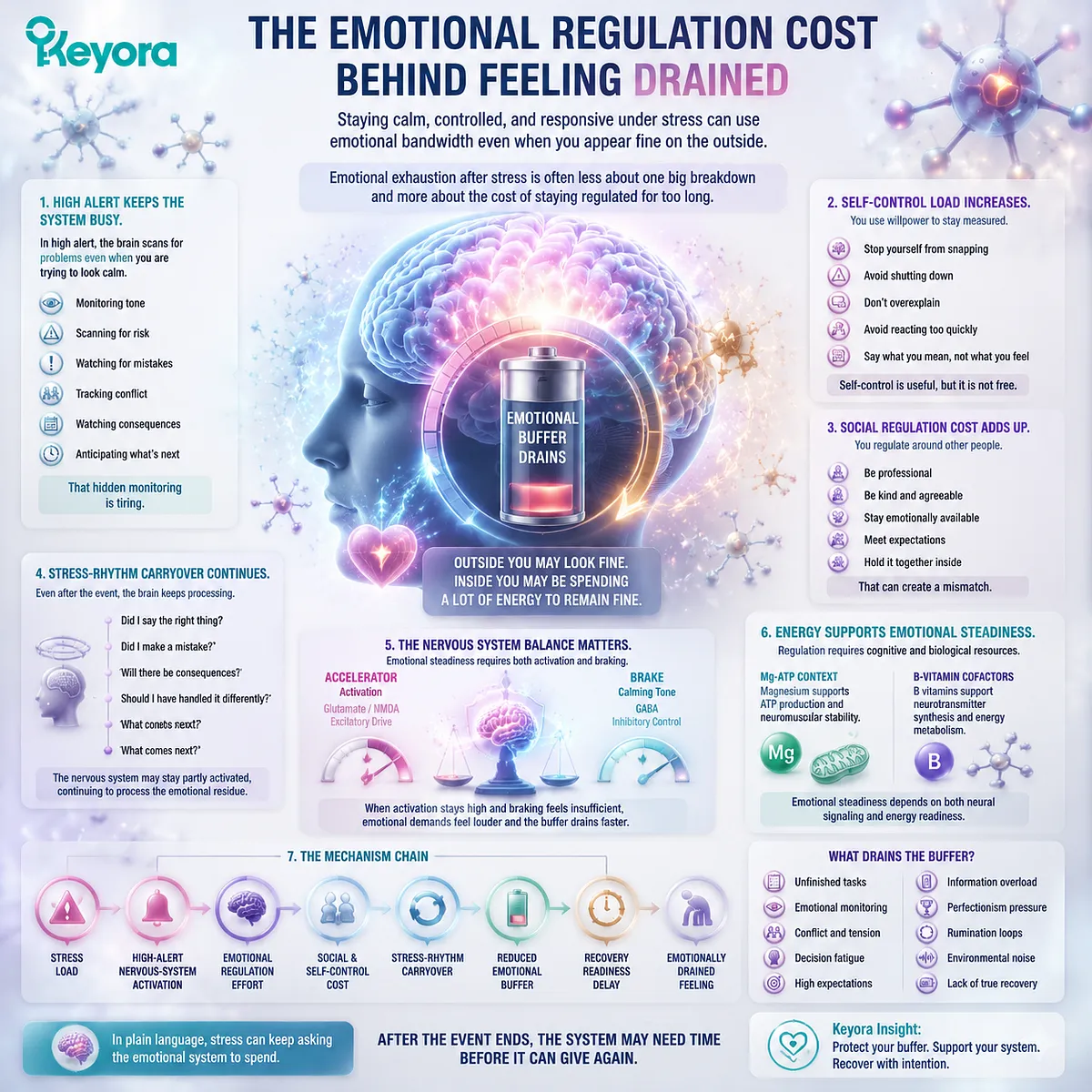
Staying calm, controlled, and responsive under stress can use emotional bandwidth even when you appear fine on the outside.
Emotional exhaustion after stress is often less about one big breakdown and more about the cost of staying regulated for too long.
Emotional regulation is the process of managing what you feel, how strongly you express it, and how you behave while emotions are active. It includes staying calm when irritated, staying clear when worried, staying polite when frustrated, and staying functional when overwhelmed.
This process uses capacity.
In everyday language, you can think of emotional capacity as an emotional buffer. When the buffer is available, you can listen, respond, adjust, and stay steady. When the buffer is low, even small demands can feel like too much.
Stress can drain this buffer in several ways.
First, stress can keep the nervous system in high alert.
In high alert, the brain and body are more likely to scan for problems. You may monitor tone, risk, mistakes, conflict, consequences, and what needs to happen next. This monitoring can continue even when you are trying to look calm.
That hidden monitoring is tiring.
Second, stress increases self-control load.
You may need to stop yourself from snapping, shutting down, overexplaining, apologizing too much, reacting too quickly, or saying something you do not mean. Self-control is useful, but it is not free. The more pressure you are under, the more effort it may take to stay measured.
Third, stress can add social regulation cost.
Many stressful situations are not just private experiences. They happen around other people. You may need to be professional, kind, agreeable, efficient, or emotionally available even when your own system is overloaded.
That can create a mismatch.
Outside, you may look fine. Inside, you may be spending a lot of energy to remain fine.
Fourth, stress can continue after the visible event.
Even when the meeting is over or the message is sent, the brain may keep processing what happened. Did I say the right thing? Did I make a mistake? Will there be consequences? Should I have handled it differently? What comes next?
This is stress-rhythm carryover.
The nervous system may not shift immediately from alertness to recovery. It may stay partly activated, continuing to process the emotional residue of the event.
This is why emotional recovery can lag behind task completion.
You can be finished with the task but not finished with the stress state.
The brake-and-accelerator balance of the nervous system also matters.
In simple terms, emotional steadiness requires both activation and braking. Activation helps you respond. Braking helps you pause, filter, calm, and recover. GABA-related calming tone and NMDA/glutamate activation balance help explain why the nervous system may feel steady or overstimulated.
When activation stays high and braking feels insufficient, emotional demands can feel louder.
A small message may feel irritating. A normal question may feel invasive. A minor request may feel like one more thing you cannot carry. The reaction may not be about that one request. It may be about the low emotional buffer left after sustained stress.
Energy context is also part of the picture.
Emotional regulation requires cognitive and biological resources. Staying composed, choosing words, regulating facial expression, listening carefully, and holding back impulses all require active control. Magnesium’s role in Mg-ATP context and B vitamins’ role as cofactor infrastructure help explain why emotional steadiness depends on both neural signaling and energy readiness.
This does not mean emotional drain after stress is always caused by nutrient status. It means the experience can be understood as a multi-layer wellness question.
The mechanism chain looks like this:
stress load → high-alert nervous-system activation → emotional regulation effort → social and self-control cost → stress-rhythm carryover → reduced emotional buffer → recovery readiness delay → emotionally drained feeling
In plain language, stress can keep asking the emotional system to spend.
After the event ends, the system may need time before it can give again.
How MoodFlow Supports Emotional Recovery Readiness
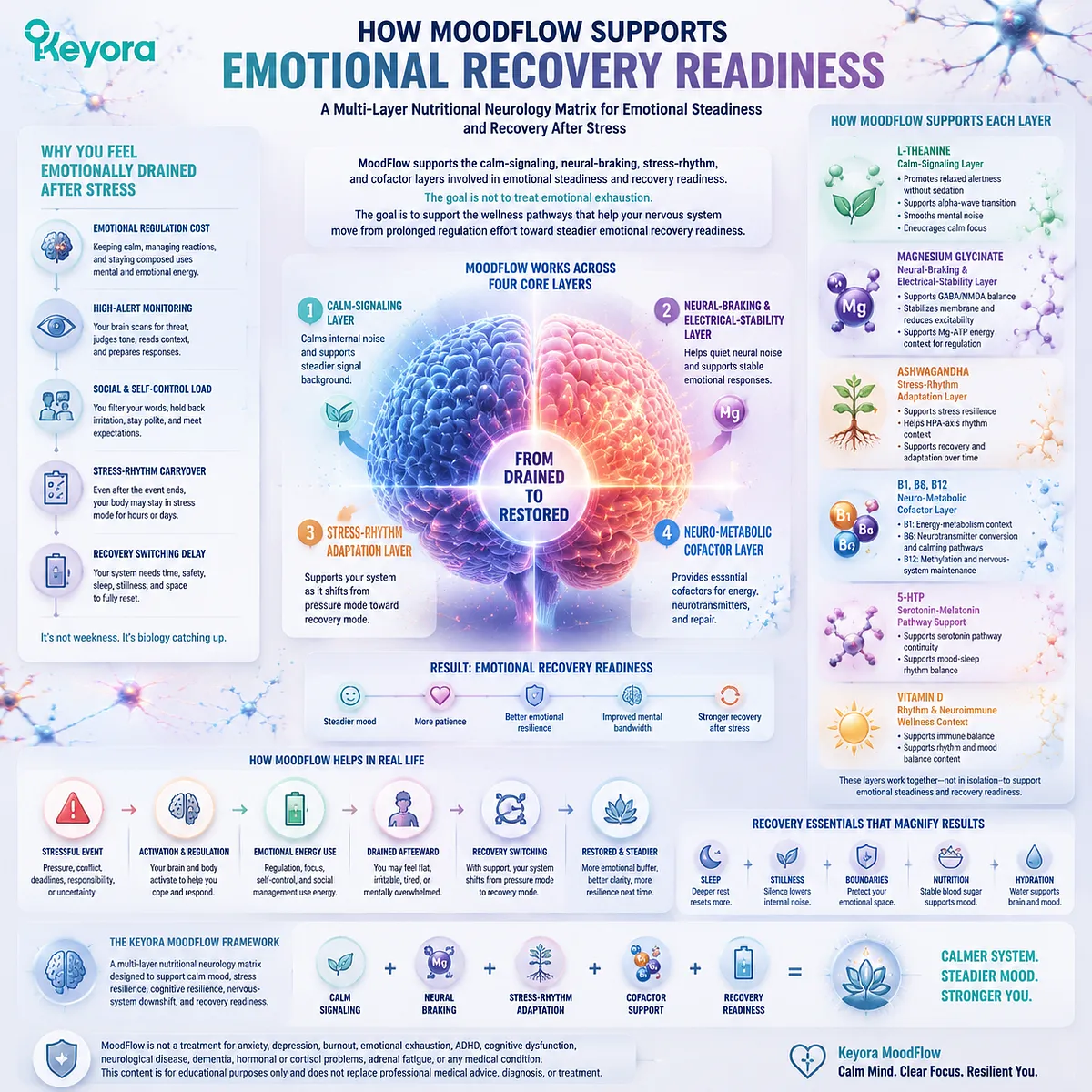
MoodFlow supports the calm-signaling, neural-braking, stress-rhythm, and cofactor layers involved in emotional steadiness and recovery readiness.
Keyora MoodFlow approaches feeling emotionally drained after stress as a calm-mood, stress-resilience, and recovery-readiness question.
The goal is not to treat emotional exhaustion. The goal is not to erase emotions, force positivity, or make someone numb. The goal is to support the wellness pathways that help the nervous system move from prolonged regulation effort toward steadier emotional recovery readiness.
This distinction matters because emotional drain is often misunderstood.
Many people try to solve it by forcing themselves to keep responding. They push through more messages, more conversations, more decisions, and more social demands. Sometimes responsibilities continue, but when the emotional buffer is already low, more pressure may deepen the drained feeling.
MoodFlow’s logic begins with the state behind emotional steadiness.
L-Theanine supports the calm-signaling layer.
In the MoodFlow framework, L-Theanine is associated with relaxed alertness, alpha-wave transition, signal smoothing, and calm focus without sedation. This is relevant because emotional drain after stress is not always a need for sedation or escape. It may be a need for a calmer signal background.
A person who feels emotionally drained may still be awake and functional. The issue may be that the internal background feels too reactive, too sensitive, or too easily overloaded. L-Theanine helps explain calm signaling as support for steadier emotional tone without forcing grogginess.
Magnesium glycinate supports the neural-braking and electrical-stability layer.
Magnesium is relevant to GABA/NMDA activation balance, membrane excitability, and Mg-ATP energy context. In MoodFlow, magnesium glycinate is positioned as part of the neural braking and hardware-stabilizing layer.
For emotional recovery readiness, this layer matters because emotional regulation depends on the ability to pause, filter, and downshift. When the nervous system remains electrically loud, small emotional inputs can feel larger than they are. Neural braking helps explain the background physiology that supports steadier responses.
Magnesium’s Mg-ATP context also matters because emotional regulation is not passive. Staying composed, patient, and responsive requires energy. The system needs signal stability and energy readiness to recover from prolonged emotional output.
Ashwagandha supports the stress-rhythm adaptation layer.
Article 39 is especially relevant to Ashwagandha because the central question is what happens after stress. Emotional drain often reflects the recovery side of the stress response. The event ends, but the body may still need support shifting from pressure mode toward recovery readiness.
Ashwagandha is positioned in MoodFlow around stress resilience, HPA-axis rhythm context, and recovery readiness. In this article, that does not mean Ashwagandha fixes cortisol, treats burnout, repairs the HPA axis, or cures anxiety. It means Ashwagandha belongs to the stress-adaptation layer that helps explain why emotional recovery is connected to stress rhythm.
B1, B6, and B12 support the neuro-metabolic cofactor layer.
The nervous system depends on normal metabolic and neurotransmitter-related infrastructure. B1 supports energy-metabolism context. B6 supports neurotransmitter-related conversion context, including pathways relevant to calming and mood-related signaling. B12 supports methylation context and nervous-system maintenance.
In MoodFlow, these B vitamins are not positioned as treatments for fatigue, low mood, or emotional exhaustion. They are part of the cofactor background behind emotional steadiness, cognitive resilience, and normal pathway support under everyday pressure.
5-HTP plays a background role in mood-sleep rhythm continuity.
Because this article is about emotional drain after stress, 5-HTP can be understood as part of the serotonin-melatonin pathway continuity layer. This does not mean treating depression, correcting serotonin, or forcing sleep. It means supporting normal serotonin-related and sleep-rhythm pathways as one background layer in the broader MoodFlow architecture.
Vitamin D may also be understood as part of the broader rhythm and neuroimmune wellness context when relevant, but it should remain secondary.
Together, these layers explain why MoodFlow is not positioned as an emotional-exhaustion cure, sedative, stimulant, antidepressant, anxiety treatment, or burnout treatment. It is a multi-layer nutritional neurology matrix designed to support stress resilience, calm mood, cognitive resilience, nervous-system downshift, and recovery readiness within an evidence-bound wellness framework.
MoodFlow is not a treatment for anxiety, depression, burnout, emotional numbness, emotional exhaustion, ADHD, cognitive dysfunction, neurological disease, cortisol problems, adrenal fatigue, hormonal disorders, or any medical condition. In this article, Keyora uses “emotionally drained after stress” as a wellness-language entry point for explaining stress load, emotional regulation cost, calm signaling, neural braking, stress-rhythm adaptation, and recovery readiness under everyday pressure.
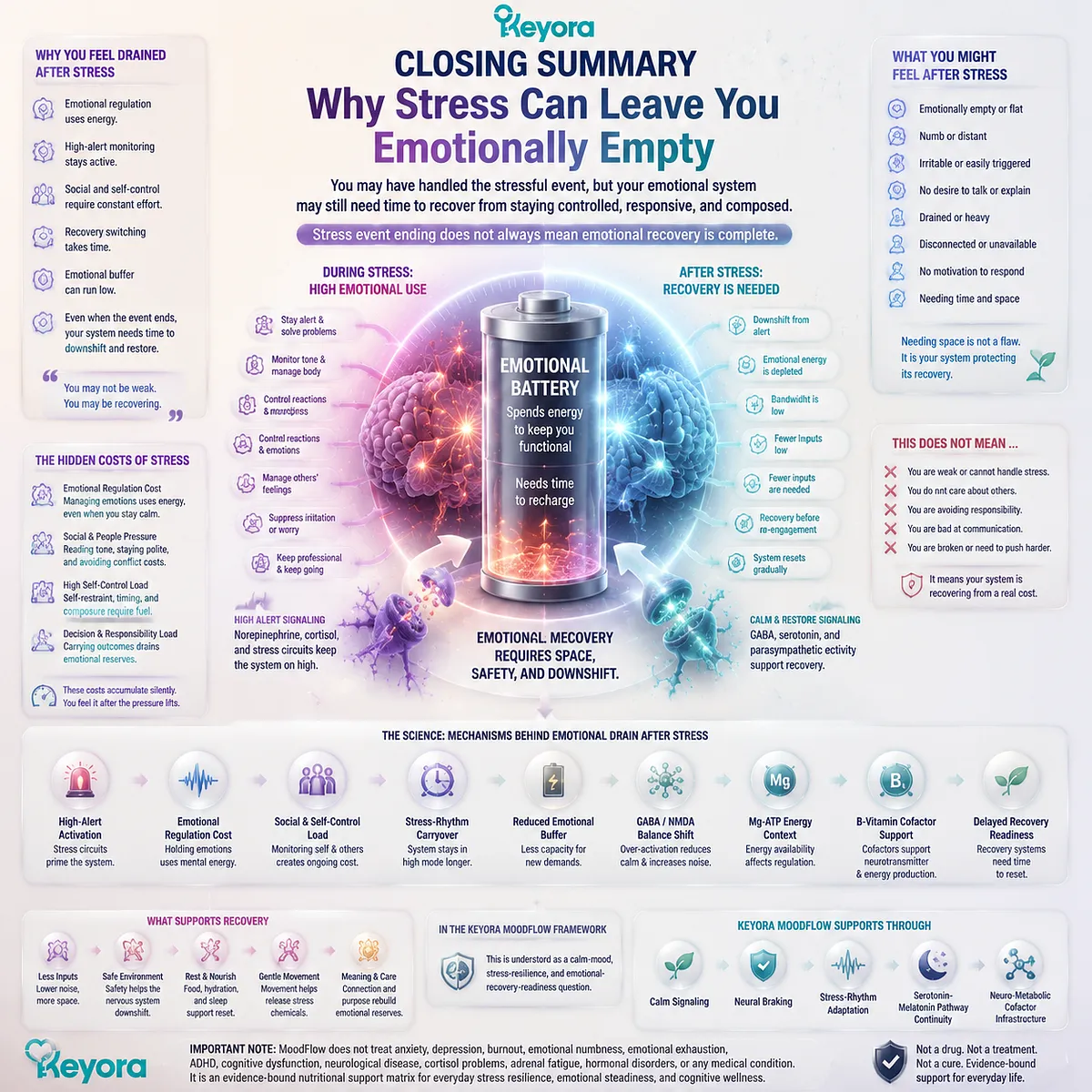
Closing Summary
Feeling emotionally drained after stress can happen because emotional regulation, high-alert monitoring, and recovery switching use resources even after the stressful event is over. You may have handled the situation, but your emotional system may still need time to recover from staying controlled, responsive, and composed.
This is why stress event ending does not always mean emotional recovery is complete.
Mechanistically, emotional drain after stress may involve high-alert nervous-system activation, emotional regulation cost, social and self-control load, stress-rhythm carryover, reduced emotional buffer, GABA/NMDA activation balance, Mg-ATP energy context, B-vitamin cofactor support, and delayed recovery readiness.
In the Keyora MoodFlow framework, this is understood as a calm-mood, stress-resilience, and emotional-recovery-readiness question. MoodFlow supports this picture through calm signaling, neural braking, stress-rhythm adaptation, serotonin-melatonin pathway continuity, and neuro-metabolic cofactor infrastructure.
MoodFlow does not treat anxiety, depression, burnout, emotional numbness, emotional exhaustion, ADHD, cognitive dysfunction, neurological disease, cortisol problems, adrenal fatigue, hormonal disorders, or any medical condition. It is an evidence-bound nutritional support matrix for everyday stress resilience, emotional steadiness, and cognitive wellness.
This article is for educational and informational purposes only. It does not provide medical advice, diagnosis, treatment, cure, prevention, disease outcome claims, hormone restoration claims, fertility outcome claims, or formula-specific clinical efficacy claims.