
Why Do I Clench My Jaw or Tighten My Shoulders Under Pressure?
Keyora Research Q&A Library
This is part of the Keyora Research Q&A Series, derived from Keyora Nutritional Neurology Series .
Within the Keyora Nutritional Neurology framework, this Q&A translates complex nutrient–brain mechanisms into reader-friendly, evidence-bound answers, focusing on stress resilience, sleep quality, calm mood support, cognitive wellness, and the broader interaction between nutrition, neurochemistry, and daily nervous-system function.
First published by Keyora Research Journal: www.keyorahealth.com

Direct Answer
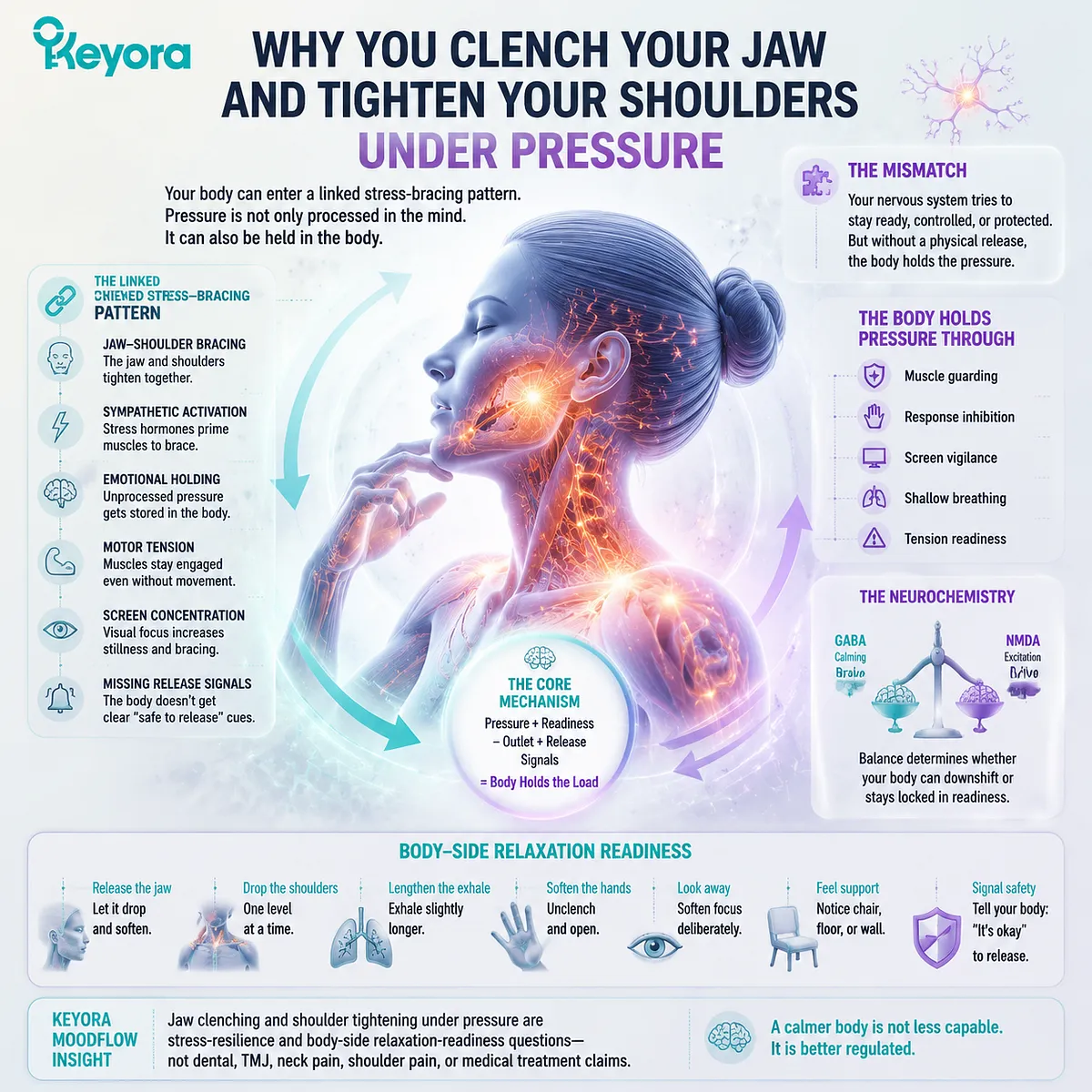
You may clench your jaw or tighten your shoulders under pressure because your body can enter a linked stress-bracing pattern. The jaw, shoulders, neck, hands, breath, and eyes may tighten together when your nervous system is trying to stay ready, controlled, or protected.
The mismatch is this: pressure is not only processed in the mind. It can also be held in the body through muscle guarding, response inhibition, screen vigilance, shallow breathing, and tension readiness.
This can involve jaw–shoulder bracing, sympathetic activation, emotional holding, motor tension, screen concentration, missing release signals, neural braking context, GABA/NMDA activation balance, and body-side relaxation readiness.
In the Keyora MoodFlow framework, jaw clenching and shoulder tightening under pressure are understood as stress-resilience and body-side relaxation-readiness questions, not dental, TMJ, neck pain, shoulder pain, or medical treatment claims.
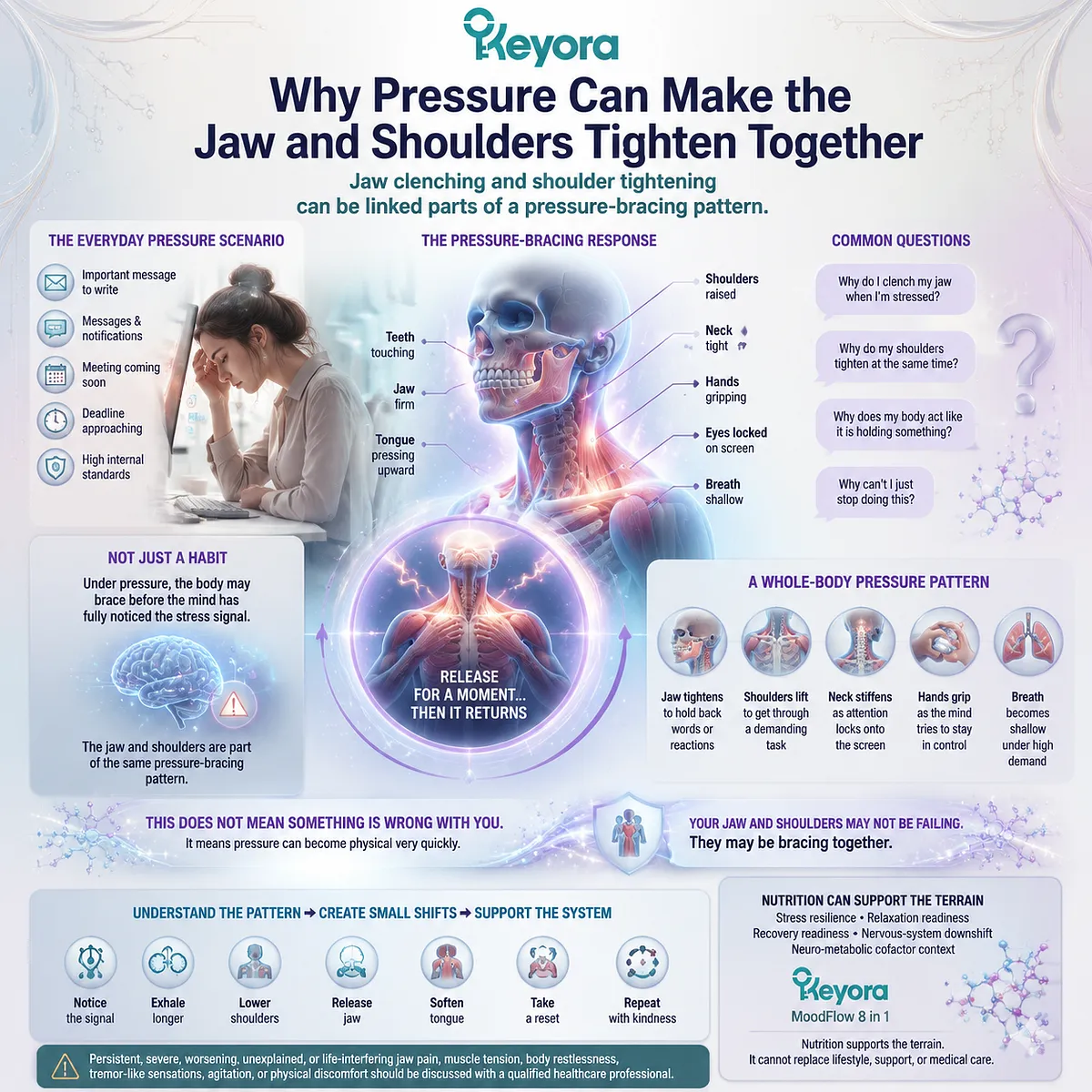
Why Pressure Can Make the Jaw and Shoulders Tighten Together
Jaw clenching and shoulder tightening can be linked parts of a pressure-bracing pattern.
You may notice it while writing a careful email.
The sentence on the screen feels important. You type it, delete part of it, rewrite it, then read it again. A message notification appears. A meeting is coming soon. A deadline is close enough that your body knows it before you say it out loud.
You tell yourself to stay calm.
Be careful.
Be quick.
Do not make a mistake.
Do not sound too direct.
Do not forget anything.
Then you suddenly notice your teeth.
They are touching.
Your jaw feels firm.
Your tongue may be pressing upward.
Your shoulders are slightly raised.
Your neck feels tight.
Your hand may be gripping the mouse.
Your eyes are locked on the screen.
You release your jaw for a moment. Your shoulders drop a little too. But a few minutes later, the same pattern returns.
This can feel like a bad habit.
“Why do I clench my jaw when I’m stressed?”
“Why do my shoulders tighten at the same time?”
“Why does my body act like it is holding something?”
“Why can’t I just stop doing this?”
But what if jaw clenching is not only a habit?
What if your jaw and shoulders are part of the same pressure-bracing pattern?
Under pressure, the body may brace before the mind has fully noticed the stress signal. It may tighten small areas to stabilize, control, prepare, or hold back a reaction.
The jaw may tighten when you are trying not to say the wrong thing.
The shoulders may lift when you are trying to get through a demanding task.
The neck may stiffen when your attention locks onto the screen.
The hands may grip when your mind is trying to stay in control.
The breath may become shallow when the body reads the moment as high demand.
This does not mean something is wrong with your character. It means pressure can become physical very quickly.
Your jaw and shoulders may not be failing.
They may be bracing together.
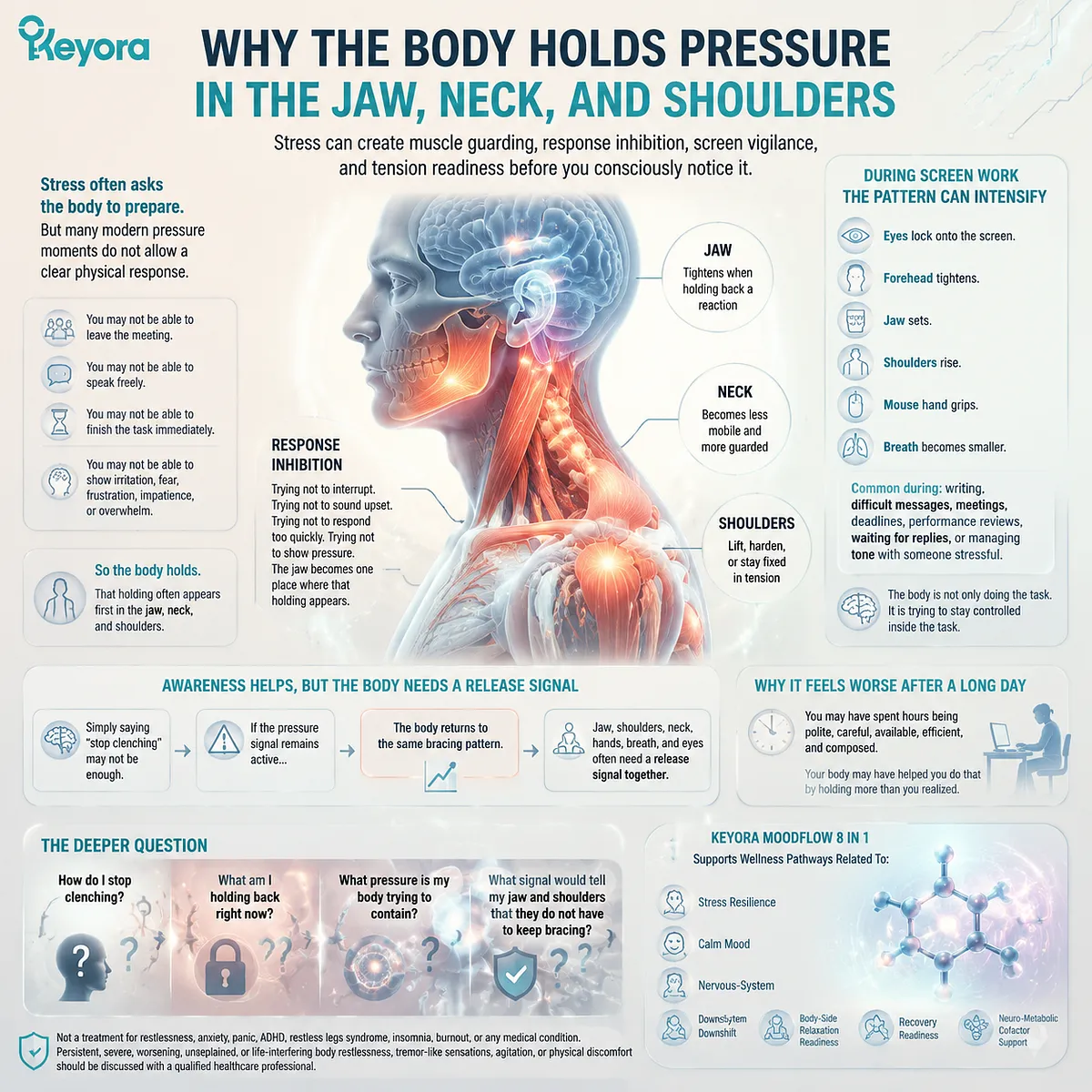
Why the Body Holds Pressure in the Jaw, Neck, and Shoulders
Stress can create muscle guarding, response inhibition, screen vigilance, and tension readiness before you consciously notice it.
Stress often asks the body to prepare.
But many modern pressure moments do not allow a clear physical response.
You may not be able to leave the meeting. You may not be able to speak freely. You may not be able to finish the task immediately. You may not be able to show irritation, fear, frustration, impatience, or overwhelm.
So the body holds.
Sometimes the jaw tightens when the body is trying to hold back a reaction.
This is response inhibition.
You may be trying not to interrupt. Trying not to sound upset. Trying not to respond too quickly. Trying not to show that you feel pressured. Trying not to collapse under too many demands.
The jaw becomes one place where that holding appears.
The shoulders can join the same pattern. They may lift slightly, harden, or stay fixed as if the upper body is preparing for impact. The neck may become less mobile. The upper back may lock. The breath may stay high in the chest.
Together, these signals create a stress posture.
It may be subtle, but it can repeat many times a day.
During screen work, the pattern can become stronger. The eyes lock onto the screen. The forehead tightens. The jaw sets. The shoulders rise. The mouse hand grips. The breath becomes smaller.
This is especially common during careful writing, difficult messages, meetings, deadlines, performance review moments, waiting for replies, or trying to manage tone with someone stressful.
The body is not only doing the task.
It is trying to stay controlled inside the task.
That is why simply saying “stop clenching” may not be enough. Awareness helps, but if the pressure signal remains active, the body may return to the same bracing pattern.
The jaw, shoulders, neck, hands, breath, and eyes often need a release signal together.
Not because they are damaged.
But because they have been participating in the same pressure state.
This is also why jaw and shoulder tension can feel worse after a long day of emotional control. You may have spent hours being polite, careful, available, efficient, and composed. Your body may have helped you do that by holding more than you realized.
The deeper question is not only:
“How do I stop clenching?”
It is also:
“What am I holding back right now?”
“What pressure is my body trying to contain?”
“What signal would tell my jaw and shoulders that they do not have to keep bracing?”
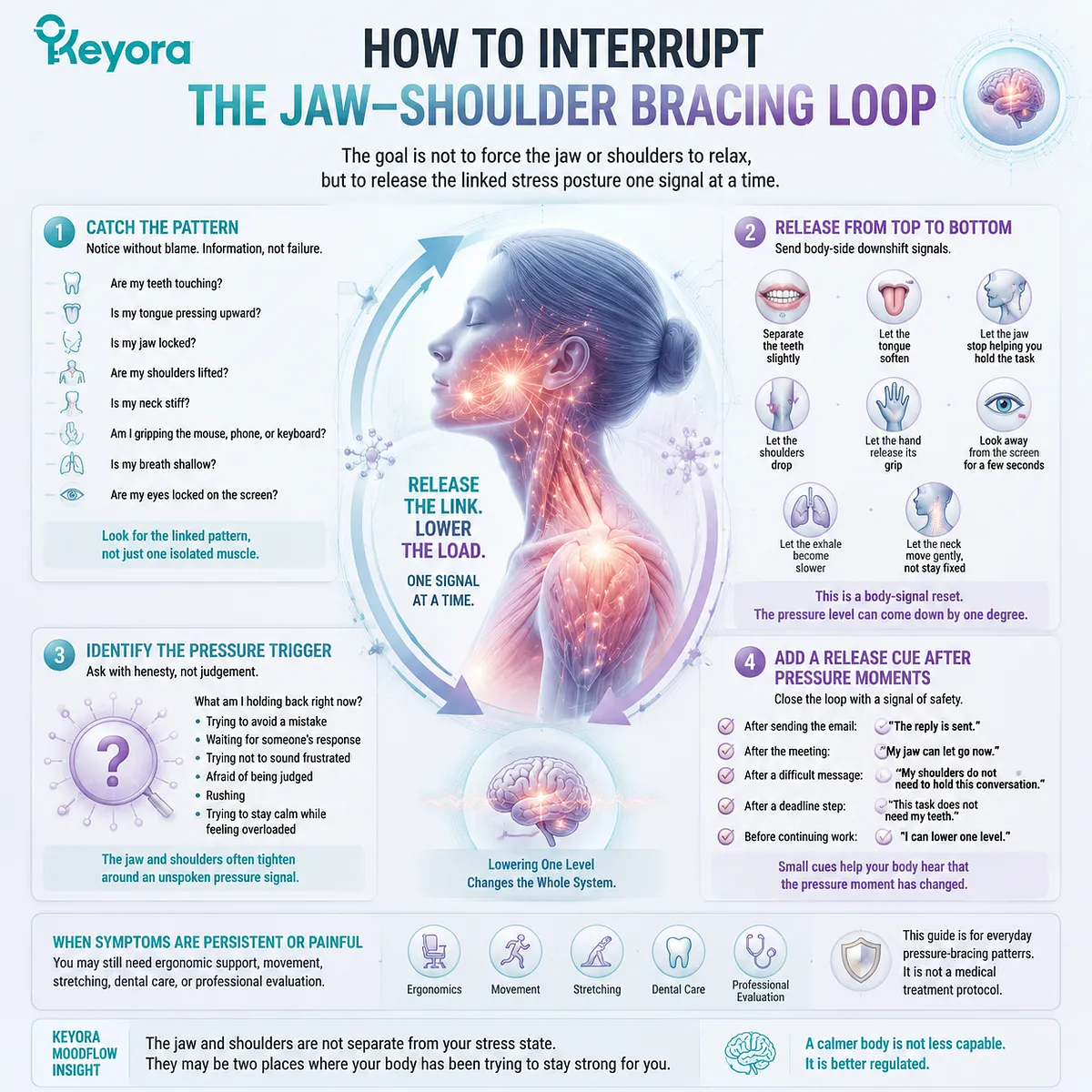
How to Interrupt the Jaw–Shoulder Bracing Loop
The goal is not to force the jaw or shoulders to relax, but to release the linked stress posture one signal at a time.
When you notice jaw clenching or shoulder tightening, try not to begin with blame.
Blame adds pressure.
Pressure often increases bracing.
Instead, begin with recognition.
“My jaw and shoulders may be bracing together.”
That sentence gives you a map. It tells you to look for a linked pattern, not just one isolated muscle.
The first step is to catch the pattern.
Ask gently:
Are my teeth touching?
Is my tongue pressing upward?
Is my jaw locked?
Are my shoulders lifted?
Is my neck stiff?
Am I gripping the mouse, phone, or keyboard?
Is my breath shallow?
Are my eyes locked on the screen?
Do not treat the answers as failure. Treat them as information.
The second step is to release from top to bottom.
Separate the teeth slightly.
Let the tongue soften.
Let the jaw stop helping you hold the task.
Let the shoulders drop one level.
Let the hand release its grip.
Look away from the screen for a few seconds.
Let the exhale become slower.
Let the neck move gently instead of staying fixed.
This is not a medical treatment routine. It is a body-signal reset.
You are telling the system: the pressure level can come down by one degree.
The third step is to identify the pressure trigger.
Ask:
“What am I holding back right now?”
Maybe you are trying to avoid a mistake.
Maybe you are waiting for someone’s response.
Maybe you are trying not to sound frustrated.
Maybe you are afraid of being judged.
Maybe you are rushing.
Maybe you are trying to stay calm when you actually feel overloaded.
This question matters because the jaw and shoulders often tighten around an unspoken pressure signal.
Once you identify the pressure, the body pattern may become easier to understand.
The fourth step is to add a release cue after pressure moments.
After sending the email, say:
“The reply is sent.”
After the meeting, say:
“My jaw can let go now.”
After a difficult message, say:
“My shoulders do not need to hold this conversation.”
After a deadline step, say:
“This task does not need my teeth.”
Before continuing work, say:
“I can lower one level.”
These cues are small, but they help the body hear that the pressure moment has changed.
You may still need ergonomic support, movement, stretching, dental care, or professional evaluation when symptoms are persistent or painful. But for everyday pressure-bracing patterns, the first shift is awareness.
The jaw and shoulders are not separate from your stress state.
They may be two places where your body has been trying to stay strong for you.
Where Nutritional Support Fits
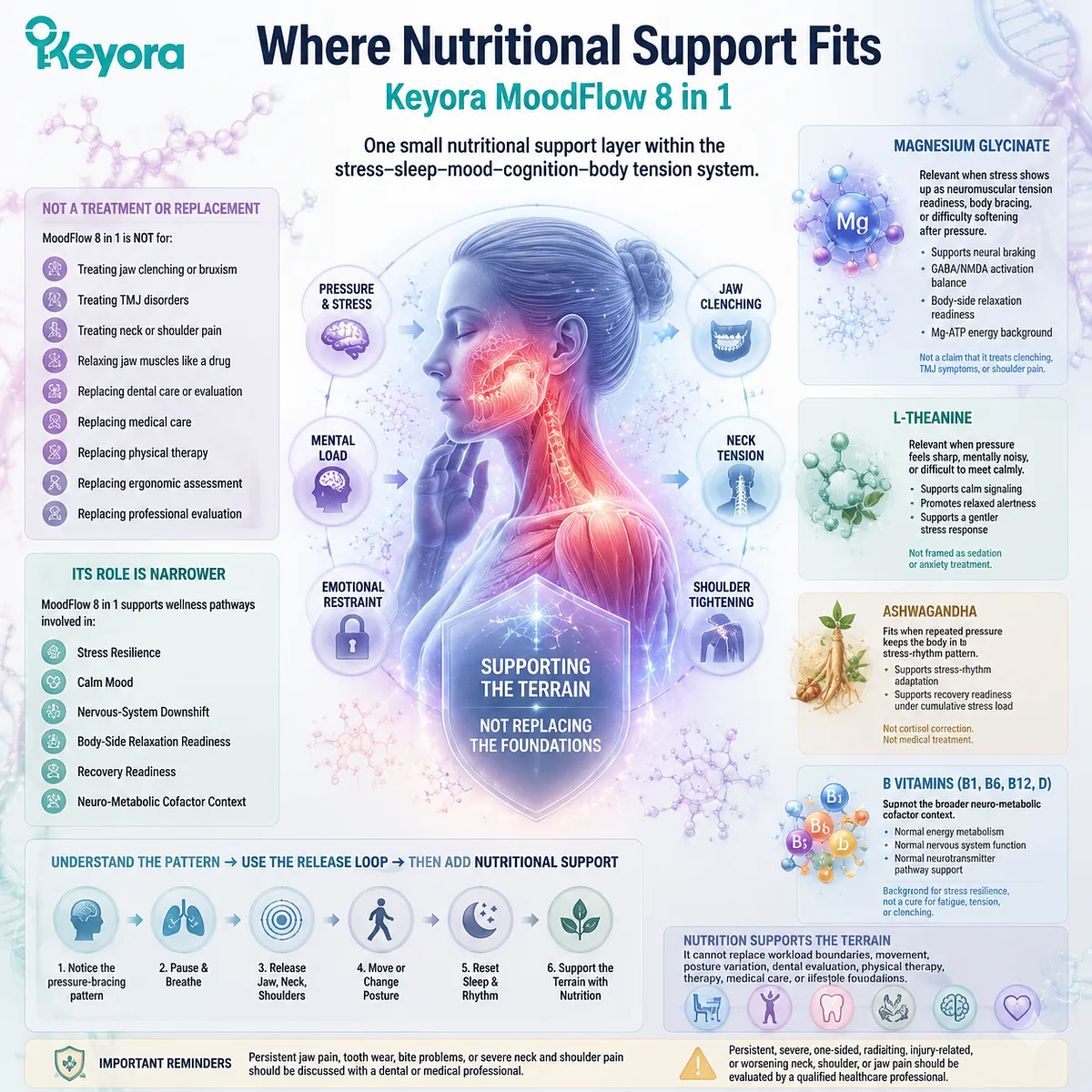
Keyora MoodFlow 8 in 1 can fit as one small nutritional support layer when jaw clenching and shoulder tightening appear within a broader stress-sleep-mood-cognition and body-tension pattern.
It should not be framed as treating jaw clenching, treating bruxism, treating TMJ disorders, treating neck pain, treating shoulder pain, relaxing jaw muscles like a drug, or replacing dental care, medical care, physical therapy, ergonomic assessment, or professional evaluation.
Its role is narrower: supporting wellness pathways involved in stress resilience, calm mood, nervous-system downshift, body-side relaxation readiness, recovery readiness, and neuro-metabolic cofactor context.
-
Magnesium glycinate may be relevant when stress shows up as neuromuscular tension readiness, body bracing, or difficulty softening after pressure. In the MoodFlow framework, it supports neural braking, GABA/NMDA activation balance, body-side relaxation readiness, and Mg-ATP energy background. This is not a claim that it treats clenching, TMJ symptoms, or shoulder pain.
-
L-Theanine may be relevant when pressure feels sharp, mentally noisy, or difficult to meet calmly. Its role is calm signaling and relaxed alertness, supporting a gentler stress response without being framed as sedation or anxiety treatment.
-
Ashwagandha may fit when repeated pressure keeps the body in a stress-rhythm pattern. Its role is stress-rhythm adaptation and recovery readiness under cumulative stress load, not cortisol correction or medical treatment.
-
B vitamins may support the broader neuro-metabolic cofactor context, including normal energy metabolism and normal neurotransmitter-related pathways. This belongs to the background of stress resilience, not a cure for fatigue, tension, or clenching.
MoodFlow belongs after the reader understands the pressure-bracing pattern and practical release loop. Nutrition can support the terrain. It cannot replace workload boundaries, movement, posture variation, dental evaluation, physical therapy, therapy, medical care, or lifestyle foundations.
Persistent jaw pain, tooth wear, bite problems, or severe neck and shoulder pain should be discussed with a dental or medical professional.
Persistent, severe, one-sided, radiating, injury-related, or worsening neck, shoulder, or jaw pain should be evaluated by a qualified healthcare professional.
Closing Summary
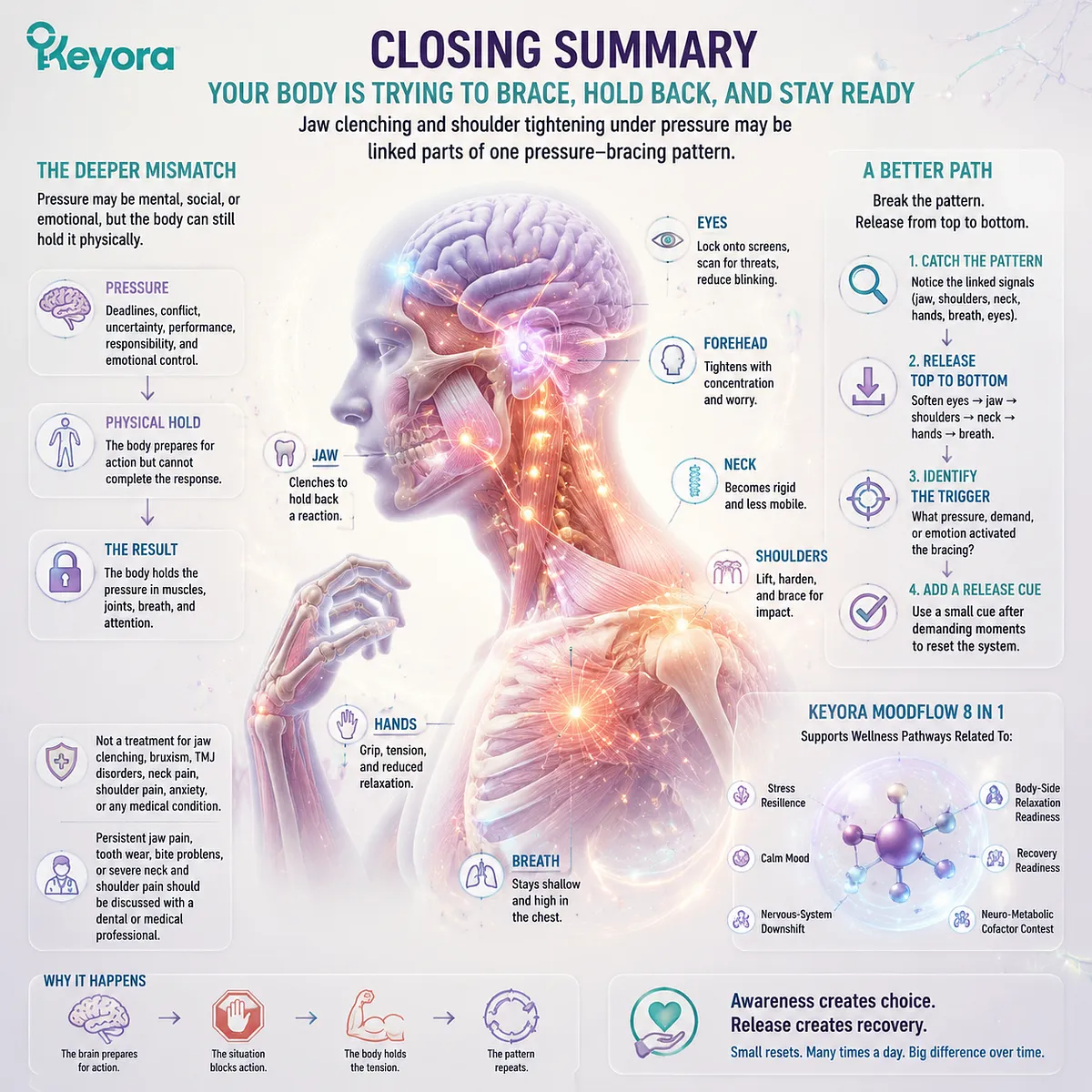
Jaw clenching and shoulder tightening under pressure do not automatically mean you have a bad habit or a weak body. They may be linked parts of a pressure-bracing pattern.
The deeper mismatch is that pressure may be mental, social, or emotional, but the body can still hold it physically. The jaw, shoulders, neck, hands, breath, and eyes can all participate in one stress posture.
A better path begins by catching the linked pattern, releasing from top to bottom, identifying the pressure trigger, and adding a release cue after demanding moments.
Keyora MoodFlow 8 in 1 can support wellness pathways related to stress resilience, calm mood, nervous-system downshift, body-side relaxation readiness, recovery readiness, and neuro-metabolic cofactor context. It is not a treatment for jaw clenching, bruxism, TMJ disorders, neck pain, shoulder pain, anxiety, or any medical condition.
Persistent jaw pain, tooth wear, bite problems, or severe neck and shoulder pain should be discussed with a dental or medical professional.
Your jaw and shoulders may tighten under pressure because your body is trying to brace, hold back, and stay ready before you even notice the stress signal.
This article is for educational and informational purposes only. It does not provide medical advice, diagnosis, treatment, cure, prevention, disease outcome claims, hormone restoration claims, fertility outcome claims, or formula-specific clinical efficacy claims.